Types of exercises Why exercising? Authorities in co-operation with contracting party shall establish: a minimum level of pre-positioned equipment for responding to pollution incidents; a programme of exercises for pollution incident
"Types of exercises Why exercising? Authorities in" is the property of its rightful owner. Permission is granted to
download and print the materials on this website for personal, non-commercial use only, and to display it
on your personal computer provided you do not modify the materials and that you retain all copyright
notices contained in the materials. By downloading content from our website, you accept the terms of this
agreement.
Presentation Transcript
01
Types of exercises<br>
02
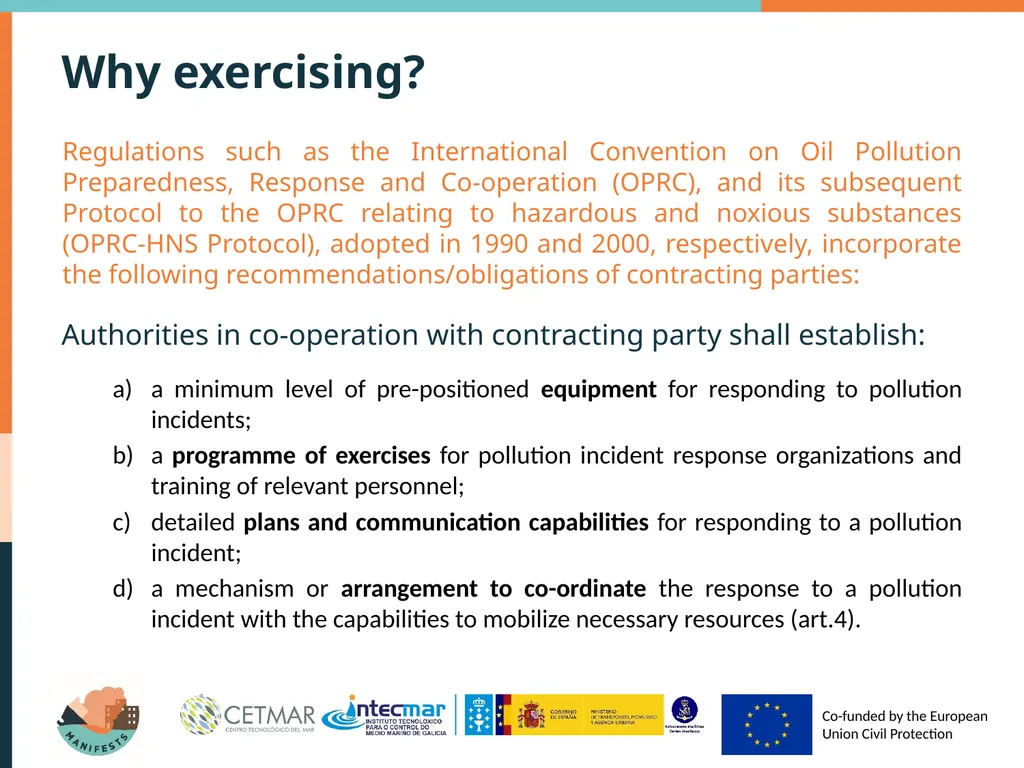
Why exercising? Authorities in co-operation with contracting party shall establish:
a minimum level of pre-positioned equipment for responding to pollution incidents;
a programme of exercises for pollution incident response organizations and training of relevant personnel;
detailed plans and communication capabilities for responding to a pollution incident;
a mechanism or arrangement to co-ordinate the response to a pollution incident with the capabilities to mobilize necessary resources (art.4). Regulations such as the International Convention on Oil Pollution Preparedness, Response and Co-operation (OPRC), and its subsequent Protocol to the OPRC relating to hazardous and noxious substances (OPRC-HNS Protocol), adopted in 1990 and 2000, respectively, incorporate the following recommendations/obligations of contracting parties:<br>
03
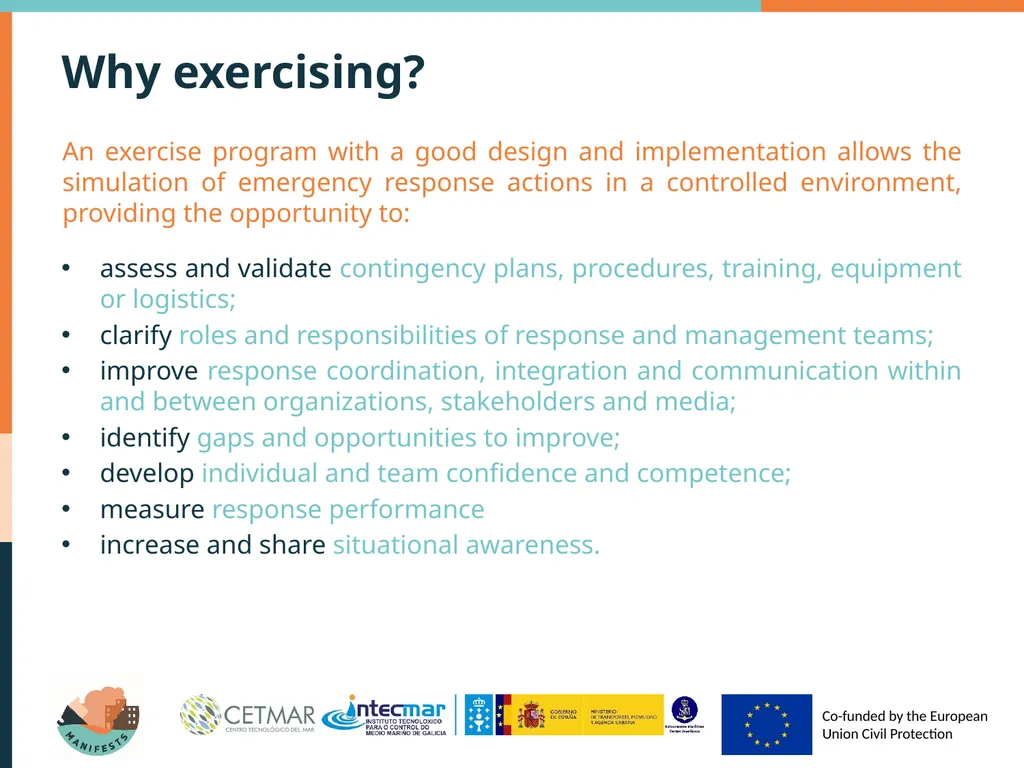
Why exercising? assess and validate contingency plans, procedures, training, equipment or logistics;
clarify roles and responsibilities of response and management teams;
improve response coordination, integration and communication within and between organizations, stakeholders and media;
identify gaps and opportunities to improve;
develop individual and team confidence and competence;
measure response performance
increase and share situational awareness. An exercise program with a good design and implementation allows the simulation of emergency response actions in a controlled environment, providing the opportunity to:<br>
04
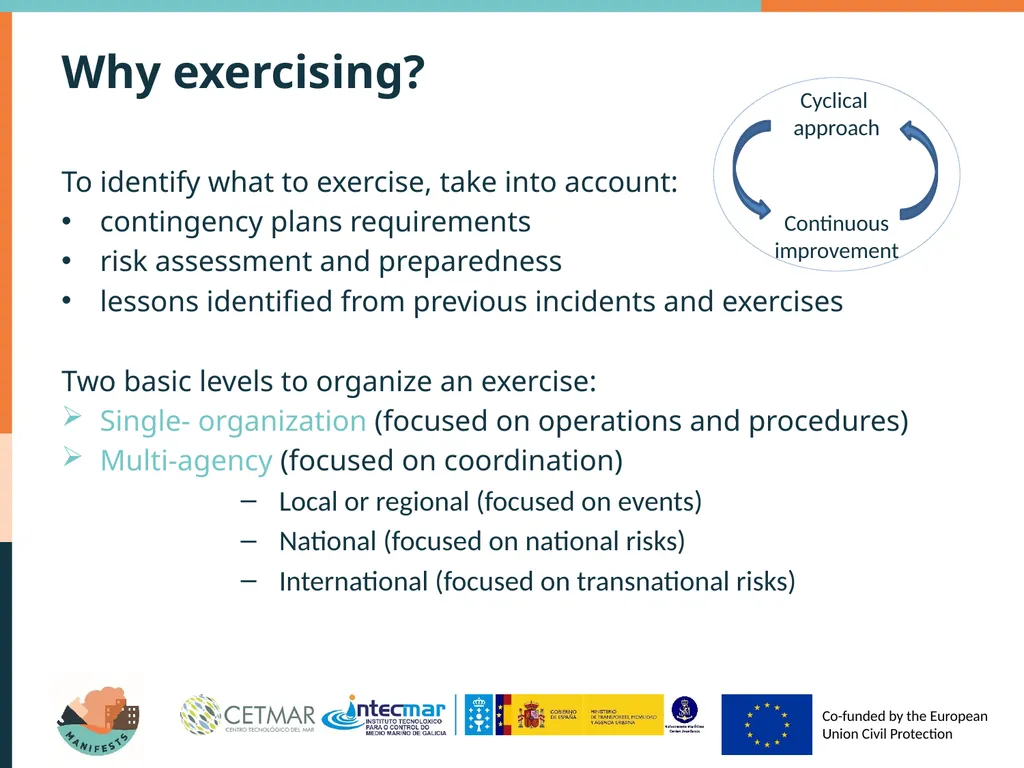
Why exercising? To identify what to exercise, take into account:
contingency plans requirements
risk assessment and preparedness
lessons identified from previous incidents and exercises
Two basic levels to organize an exercise:
Single- organization (focused on operations and procedures)
Multi-agency (focused on coordination)
Local or regional (focused on events)
National (focused on national risks)
International (focused on transnational risks)<br>
05
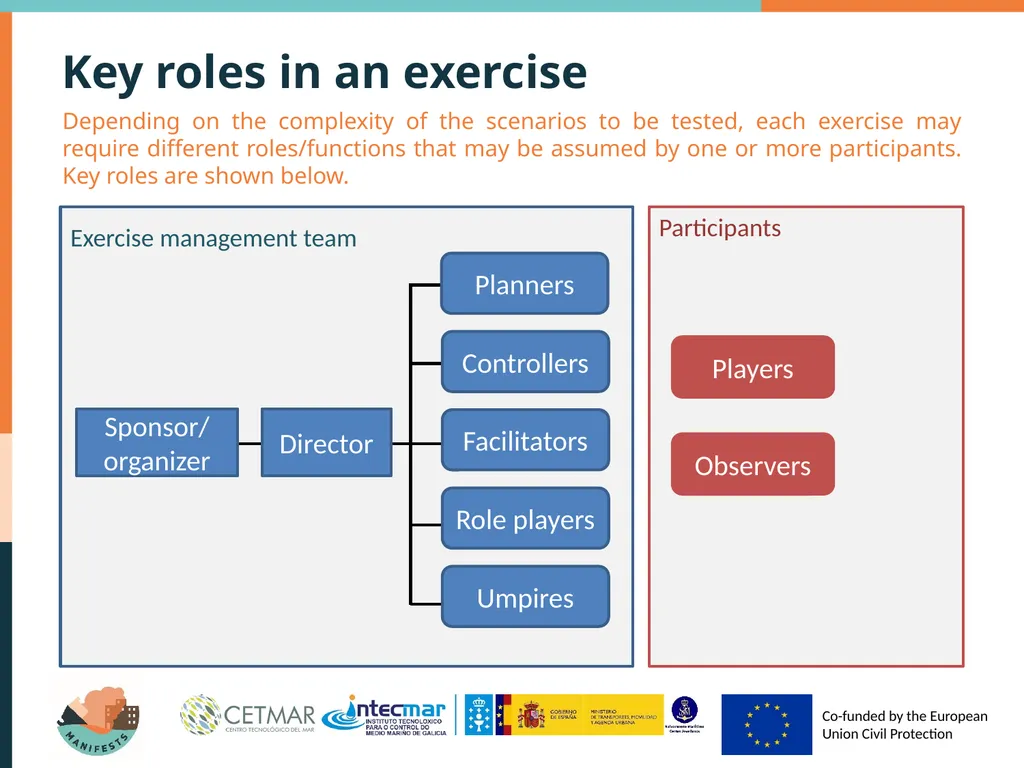
Key roles in an exercise Depending on the complexity of the scenarios to be tested, each exercise may require different roles/functions that may be assumed by one or more participants. Key roles are shown below. Exercise management team Participants Players Observers<br>
06
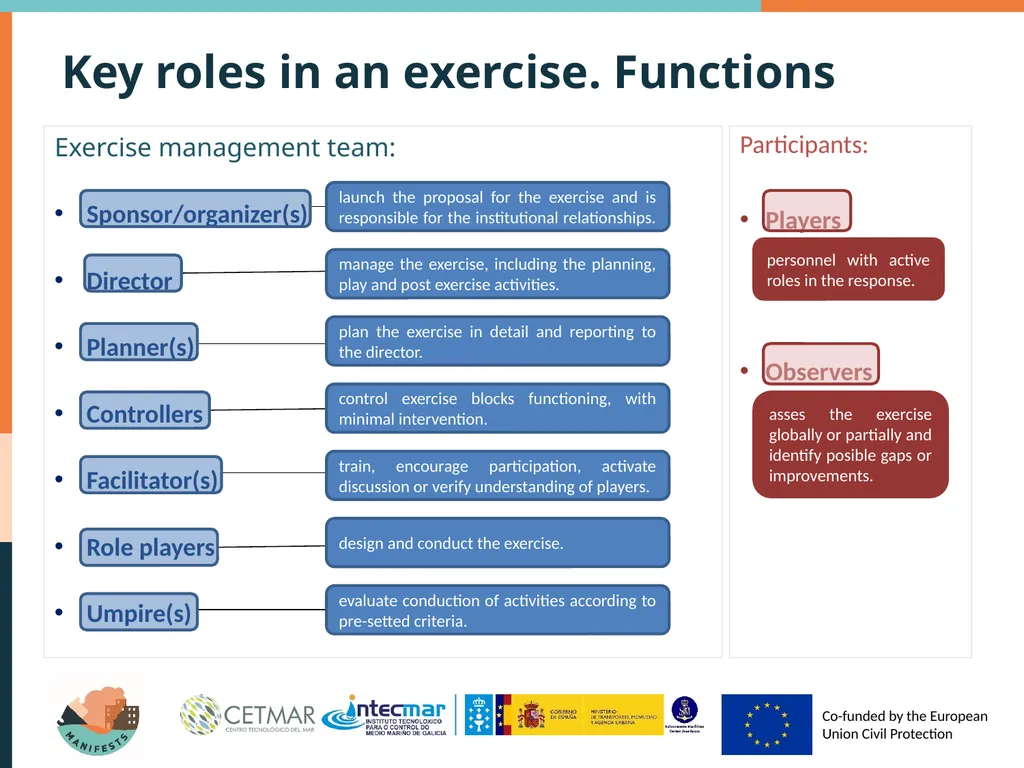
Key roles in an exercise. Functions<br>
07
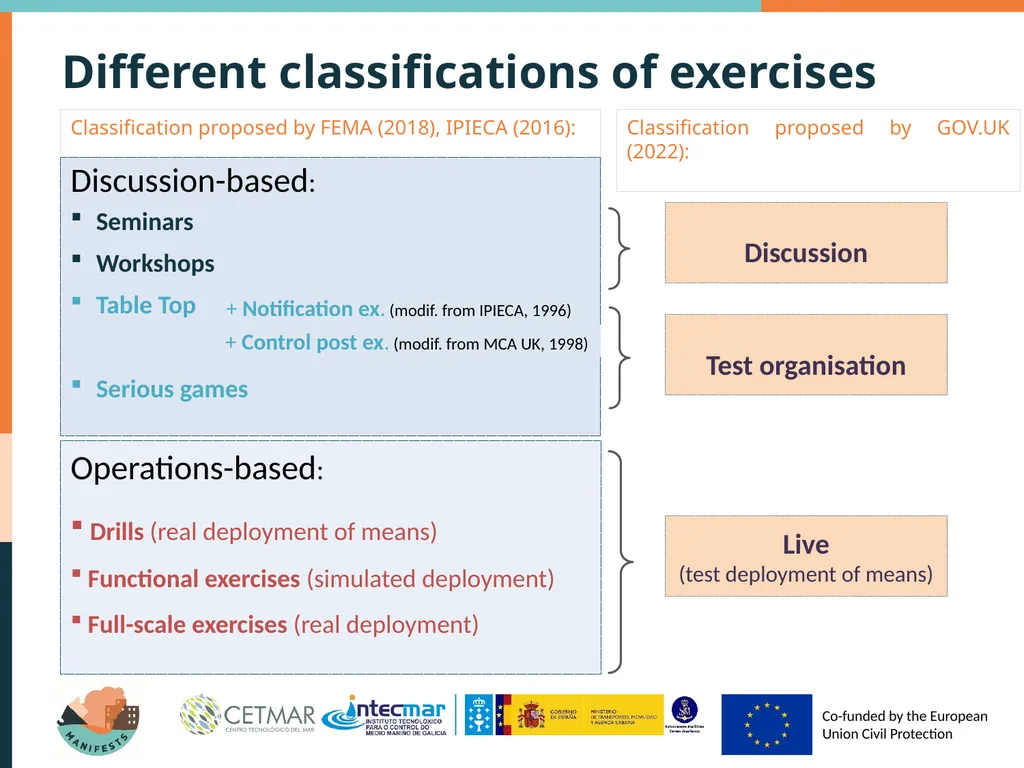
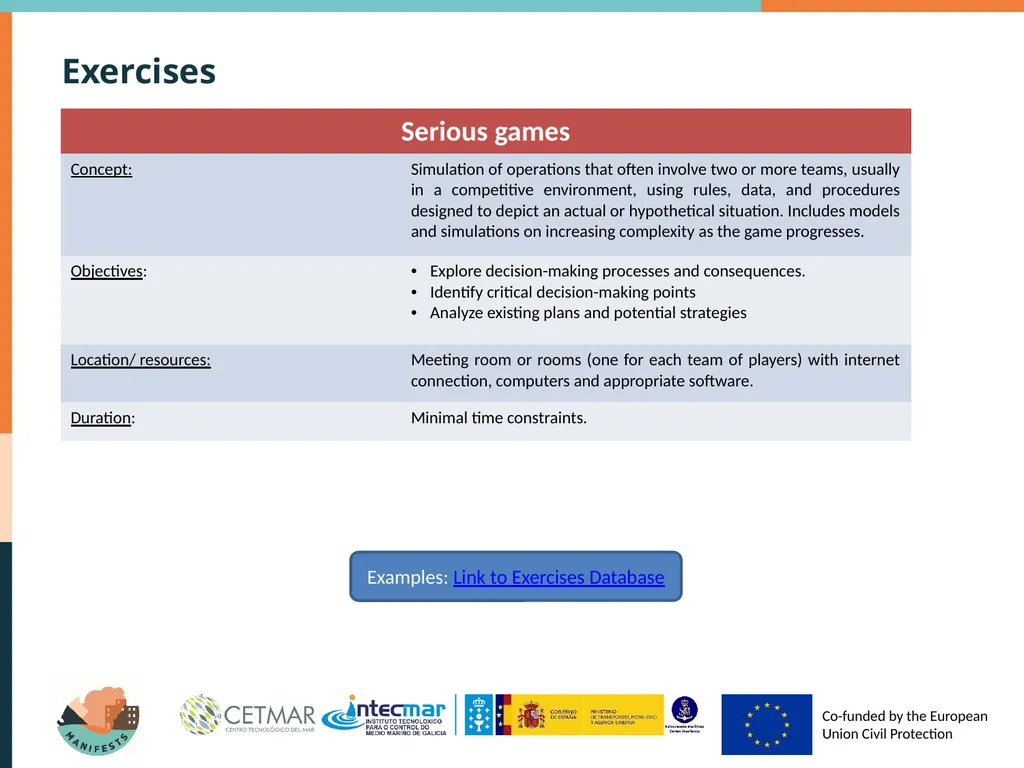
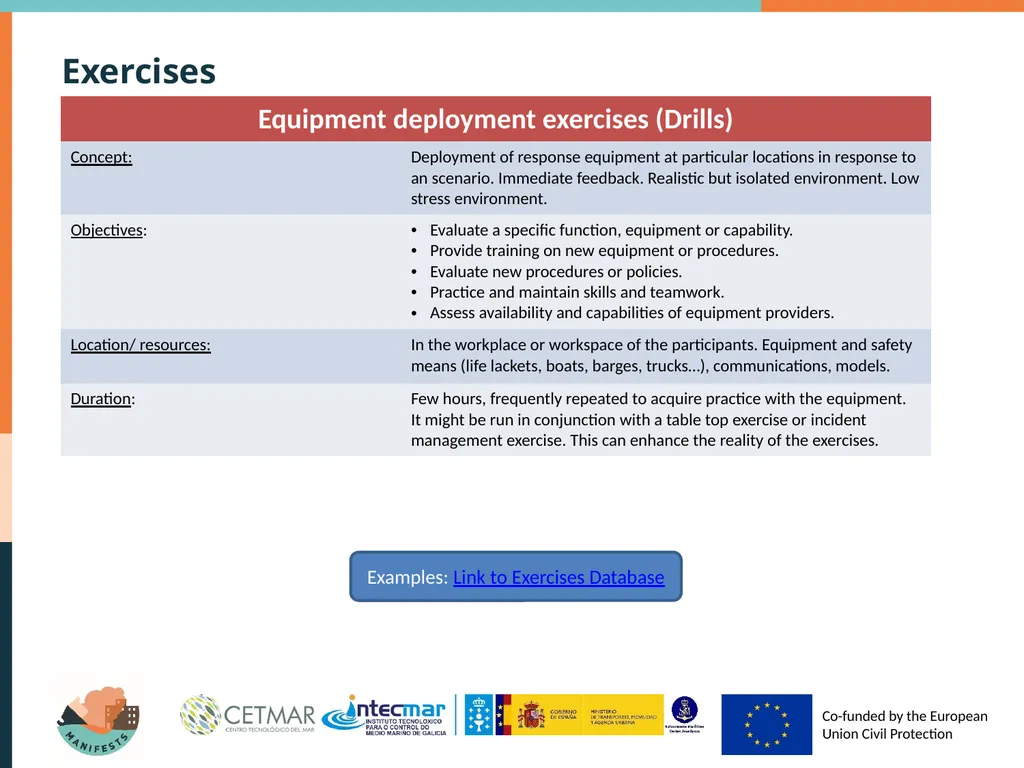
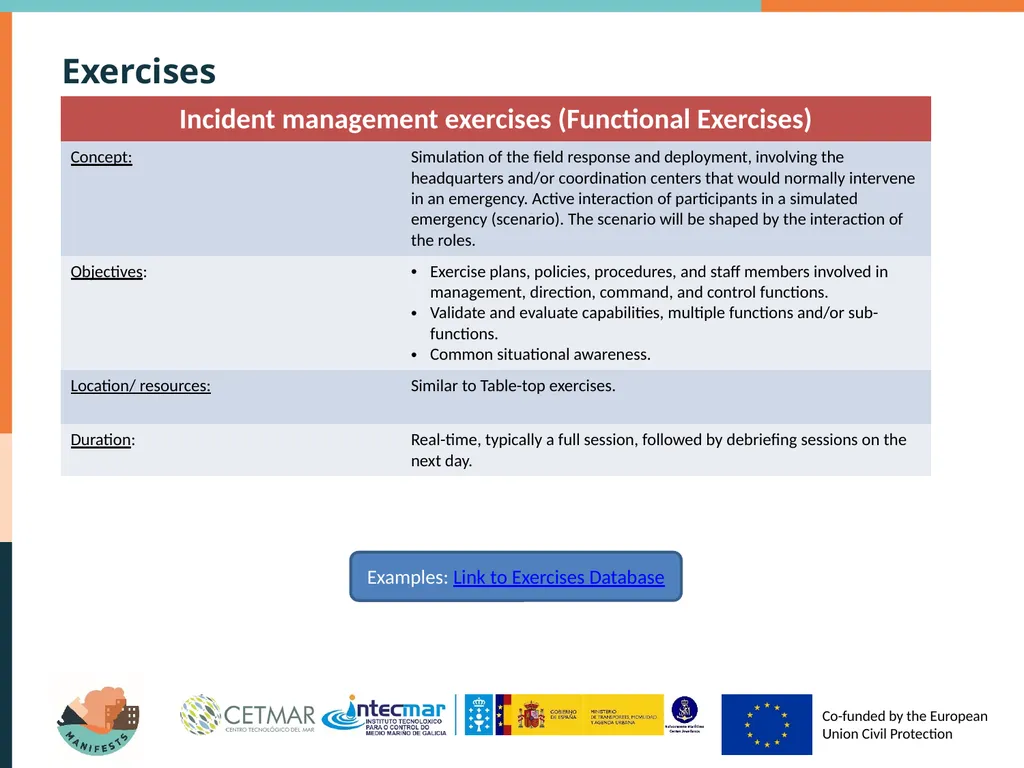
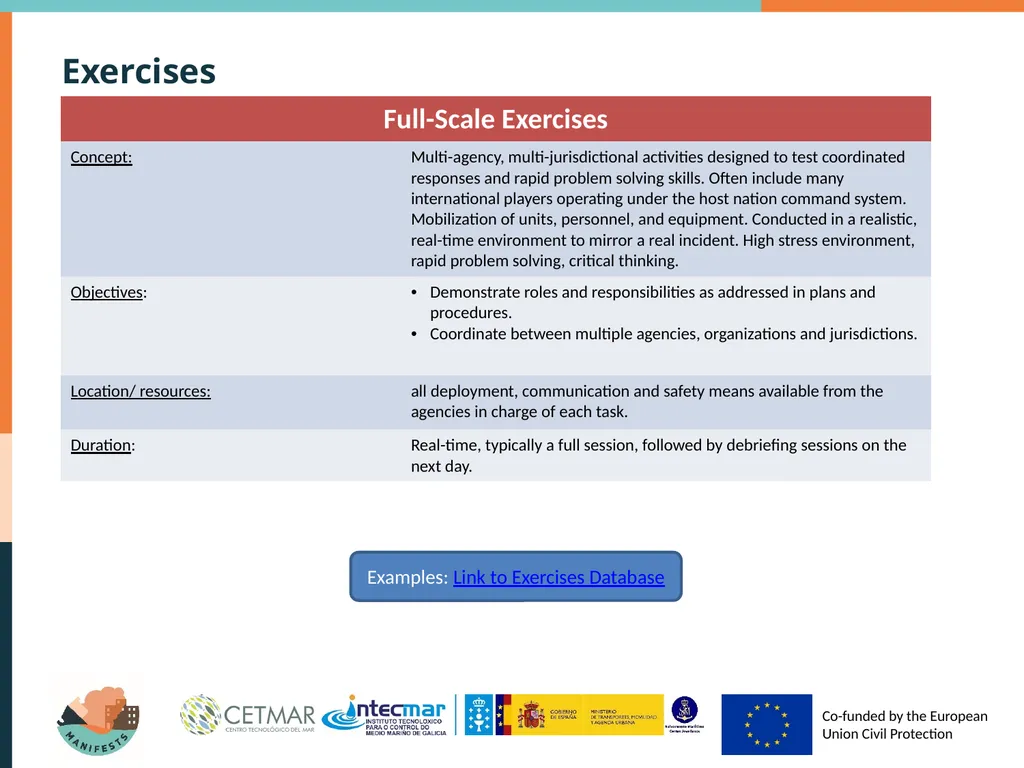
Different classifications of exercises Classification proposed by FEMA (2018), IPIECA (2016): Discussion Operations-based:
Drills (real deployment of means)
Functional exercises (simulated deployment)
Full-scale exercises (real deployment) Test organisation Live
(test deployment of means) Classification proposed by GOV.UK (2022):<br>
08
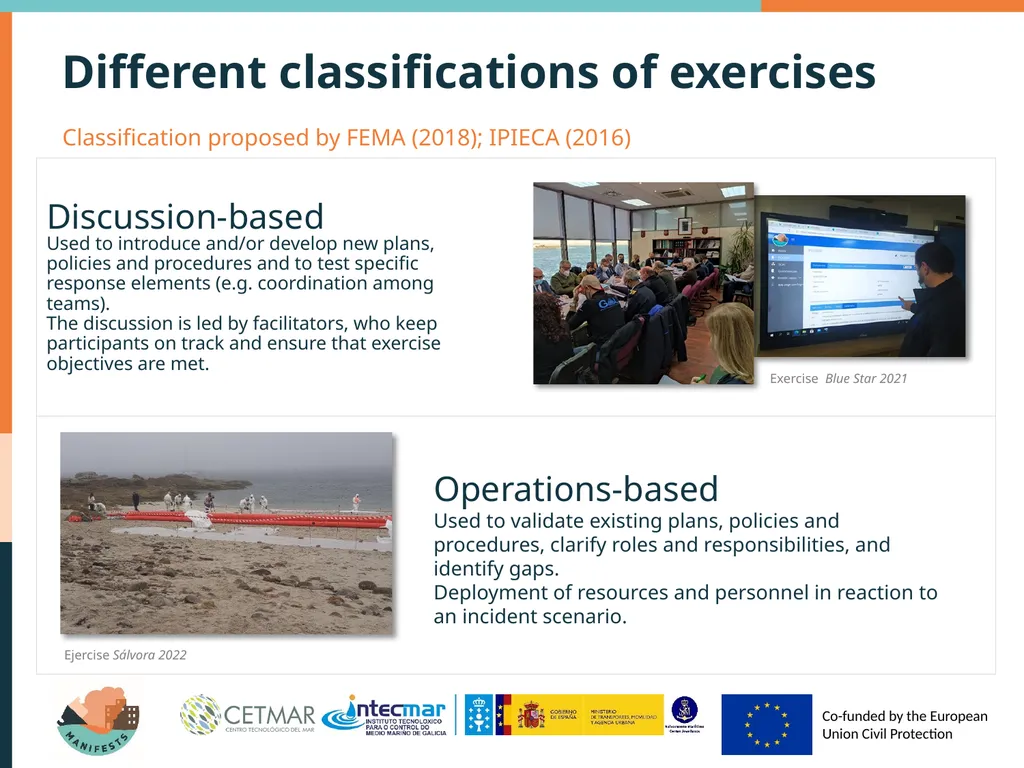
Classification proposed by FEMA (2018); IPIECA (2016) Operations-based Used to validate existing plans, policies and procedures, clarify roles and responsibilities, and identify gaps. Deployment of resources and personnel in reaction to an incident scenario. Discussion-based Used to introduce and/or develop new plans, policies and procedures and to test specific response elements (e.g. coordination among teams). The discussion is led by facilitators, who keep participants on track and ensure that exercise objectives are met. Different classifications of exercises<br>
09
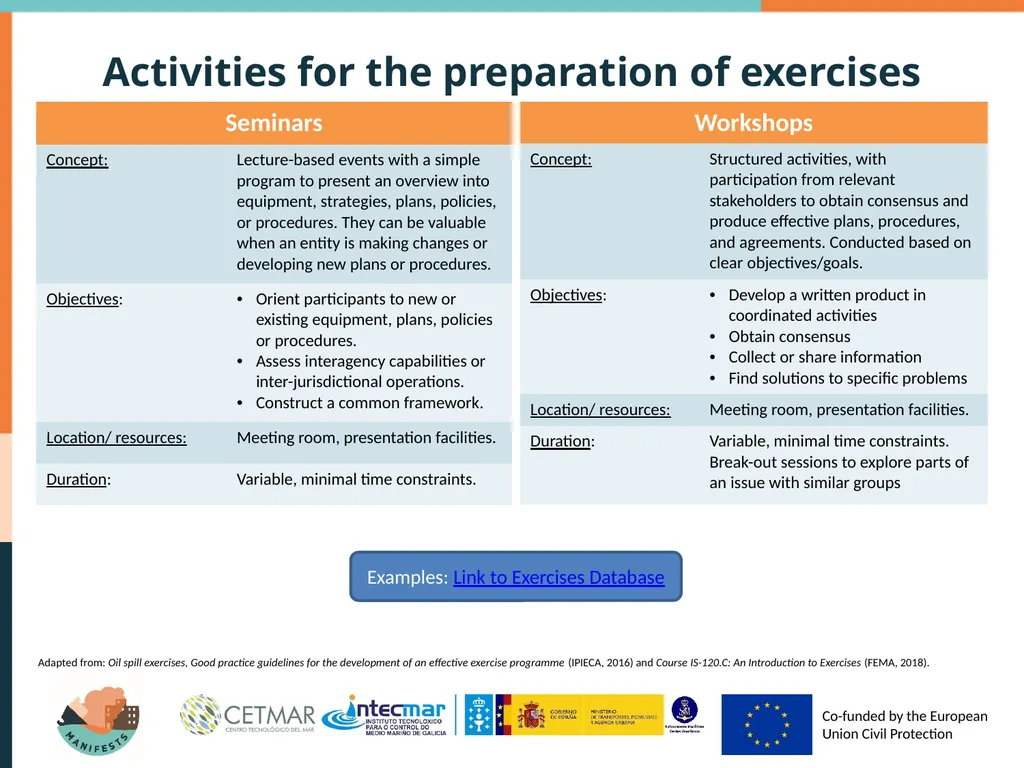
Activities for the preparation of exercises Adapted from: Oil spill exercises, Good practice guidelines for the development of an effective exercise programme (IPIECA, 2016) and Course IS-120.C: An Introduction to Exercises (FEMA, 2018). Examples: Link to Exercises Database<br>
10
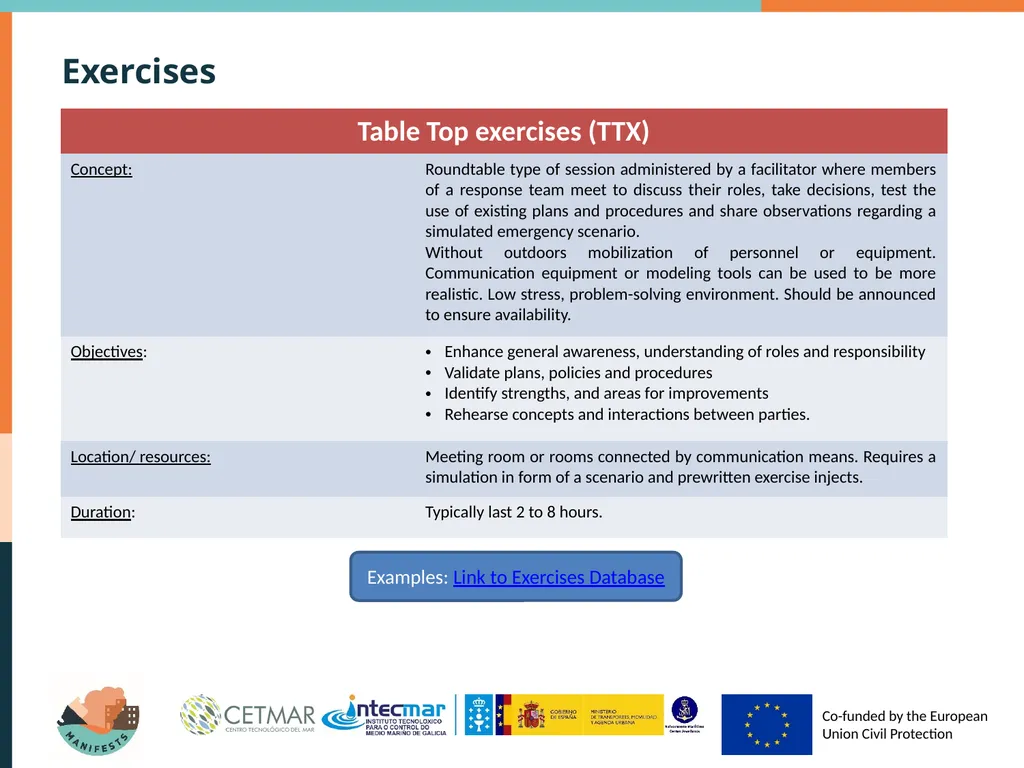
Exercises Examples: Link to Exercises Database<br>
11
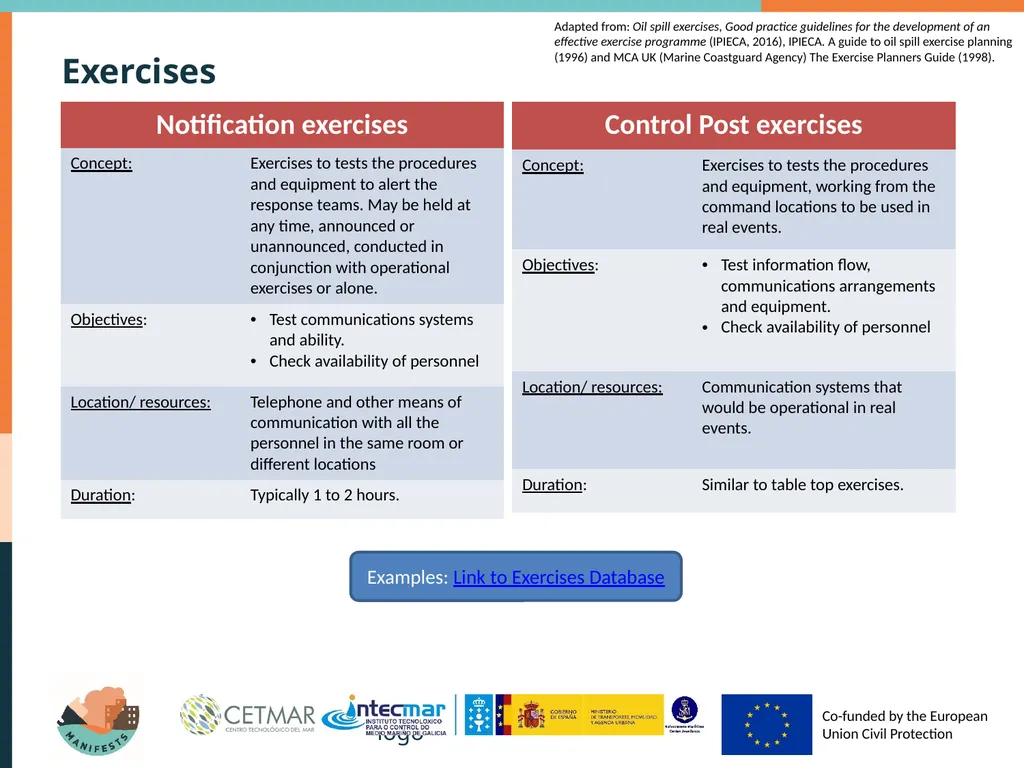
Exercises Partners’ logo Adapted from: Oil spill exercises, Good practice guidelines for the development of an effective exercise programme (IPIECA, 2016), IPIECA. A guide to oil spill exercise planning (1996) and MCA UK (Marine Coastguard Agency) The Exercise Planners Guide (1998). Examples: Link to Exercises Database<br>
12
Exercises Examples: Link to Exercises Database<br>
13
Exercises Examples: Link to Exercises Database<br>
14
Exercises Examples: Link to Exercises Database<br>
15
Exercises Examples: Link to Exercises Database<br>
16
References: Preparing Scotland (2022) Link
GOV.UK. Emergency planning and preparedness: exercises and training (2022) Link
DG ECHO. Technical Guide for UCPM Full-scale exercises (2021) Link
FEMA (Federal Emergency Management Agengy). Course IS-120.C: An Introduction to Exercises (2018) Link
IPIECA. Oil spill exercises, Good practice guidelines for the development of an effective exercise programme (2016) Link
Arcopol Plus. Activity 3, Task 3.1.3: Guides for training forecasting exercises (2014). Link
MCA UK (Marine Coastguard Agency) The Exercise Planners Guide (1998) Link
IPIECA. A guide to oil spill exercise planning (1996) Link Partners’ logo<br>