
TYPES OF RESEARCH Applied research Applied


Description: TYPES OF RESEARCH Applied research Applied research refers to scientific study and research that seeks to solve practical problems. Applied research is used to find solutions to everyday problems, cure illness, and develop innovative
Related Topics
Download Presentation
"TYPES OF RESEARCH Applied research Applied" is the property of its rightful owner. Permission is granted to download and print the materials on this website for personal, non-commercial use only, and to display it on your personal computer provided you do not modify the materials and that you retain all copyright notices contained in the materials. By downloading content from our website, you accept the terms of this agreement.
Presentation Transcript
slide1. TYPES OF RESEARCH<br>
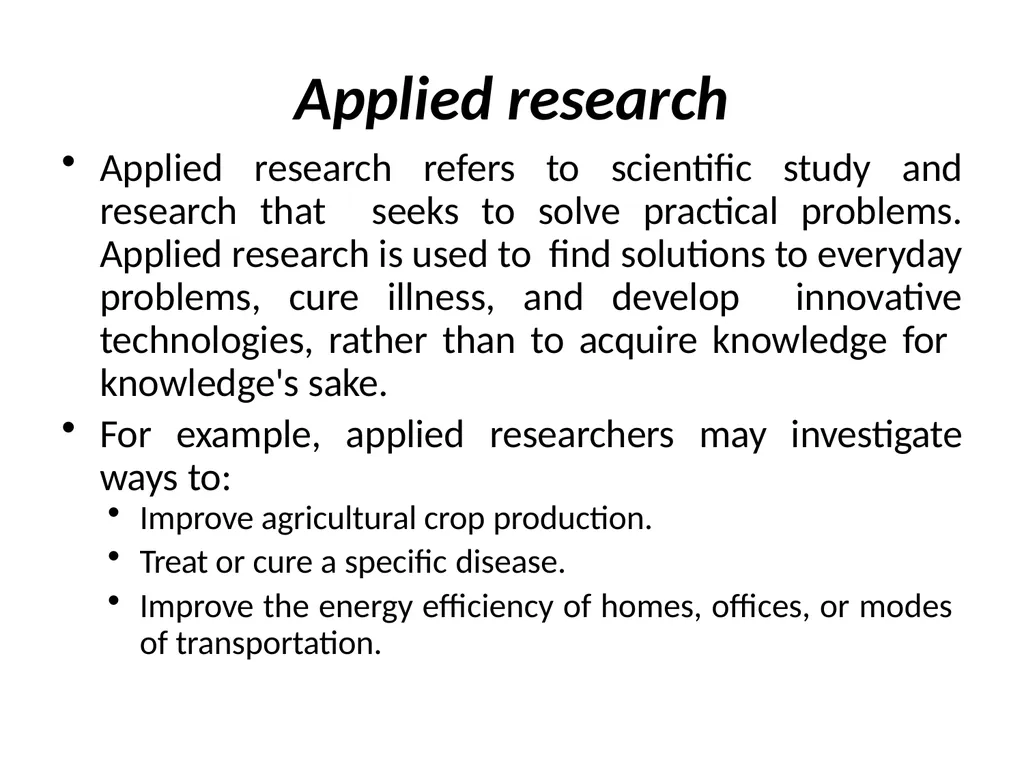
slide2. Applied research Applied research refers to scientific study and research that seeks to solve practical problems. Applied research is used to find solutions to everyday problems, cure illness, and develop innovative technologies, rather than to acquire knowledge for knowledge's sake.
For example, applied researchers may investigate ways to:
Improve agricultural crop production.
Treat or cure a specific disease.
Improve the energy efficiency of homes, offices, or modes of transportation.<br>
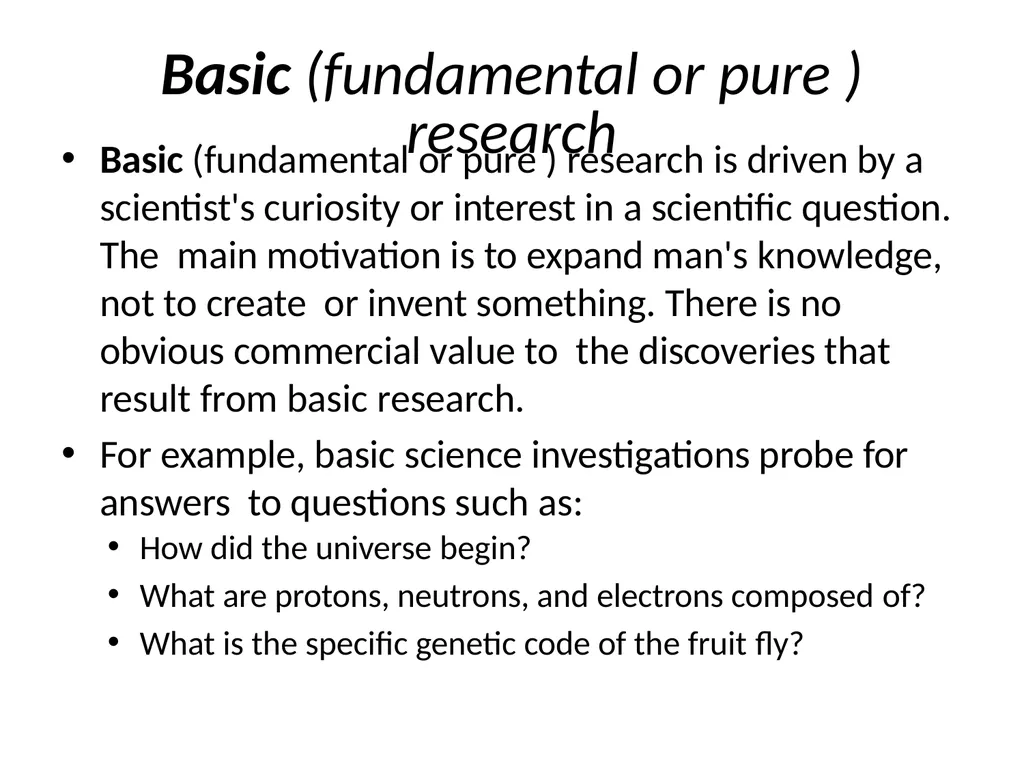
slide3. Basic (fundamental or pure ) research Basic (fundamental or pure ) research is driven by a scientist's curiosity or interest in a scientific question. The main motivation is to expand man's knowledge, not to create or invent something. There is no obvious commercial value to the discoveries that result from basic research.
For example, basic science investigations probe for answers to questions such as:
How did the universe begin?
What are protons, neutrons, and electrons composed of?
What is the specific genetic code of the fruit fly?<br>
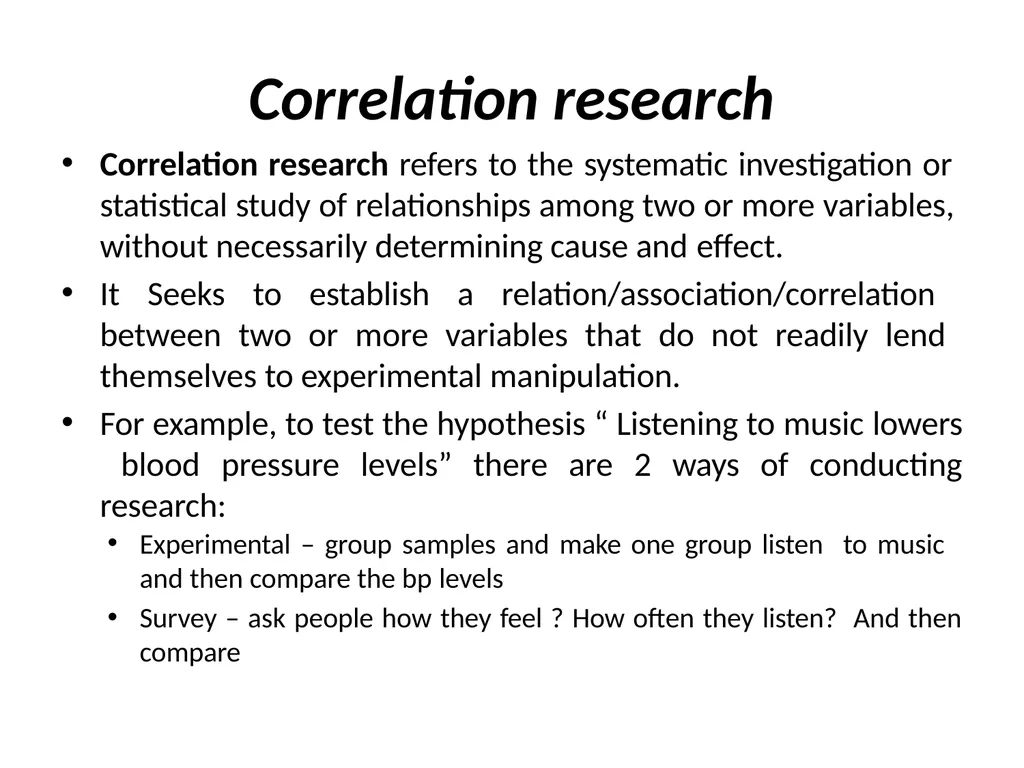
slide4. Correlation research Correlation research refers to the systematic investigation or statistical study of relationships among two or more variables, without necessarily determining cause and effect.
It Seeks to establish a relation/association/correlation between two or more variables that do not readily lend themselves to experimental manipulation.
For example, to test the hypothesis “ Listening to music lowers blood pressure levels” there are 2 ways of conducting research:
Experimental – group samples and make one group listen to music and then compare the bp levels
Survey – ask people how they feel ? How often they listen? And then compare<br>
slide5. Advantages: Can collect much information from many subjects at one time.
Can study a wide range of variables and their interrelations.
Study variables that are not easily produced in the laboratory.
Disadvantages:
Correlation does not indicate causation (cause and effect).
Problems with self-report method .<br>
slide6. Descriptive research It refers to research that provides an accurate portrayal of characteristics of a particular individual, situation, or group. Descriptive research, also known as statistical research.
These studies are a means of discovering new meaning, describing what exists, determining the frequency with which something occurs, and categorizing information.<br>
slide7. Descriptive research In short descriptive research deals with everything that can be counted and studied, which has an impact of the lives of the people.
For example,
finding the most frequent disease that affects the children of a town.
The reader of the research will know what to do to prevent that disease thus, more people will live a healthy life.<br>
slide8. Advantages: The people individual studied are unaware so they act naturally or as they usually do in everyday situation.
It is less expensive and time consuming than quantitative experiments.
Collects a large amount of notes for detailed studying.
Disadvantages:
Descriptive research requires more skills.
Does not identify cause behind a phenomenon.
Response rate is low in this research.
Results of this research can change over the period of time.<br>
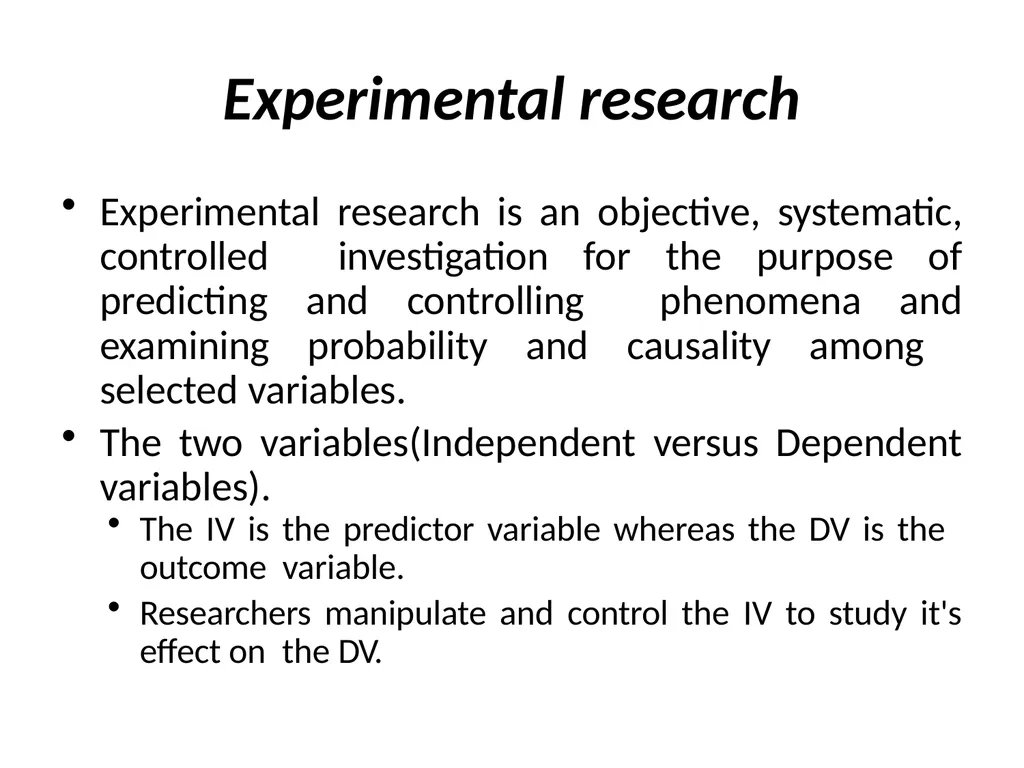
slide9. Experimental research Experimental research is an objective, systematic, controlled investigation for the purpose of predicting and controlling phenomena and examining probability and causality among selected variables.
The two variables(Independent versus Dependent variables).
The IV is the predictor variable whereas the DV is the outcome variable.
Researchers manipulate and control the IV to study it's effect on the DV.<br>
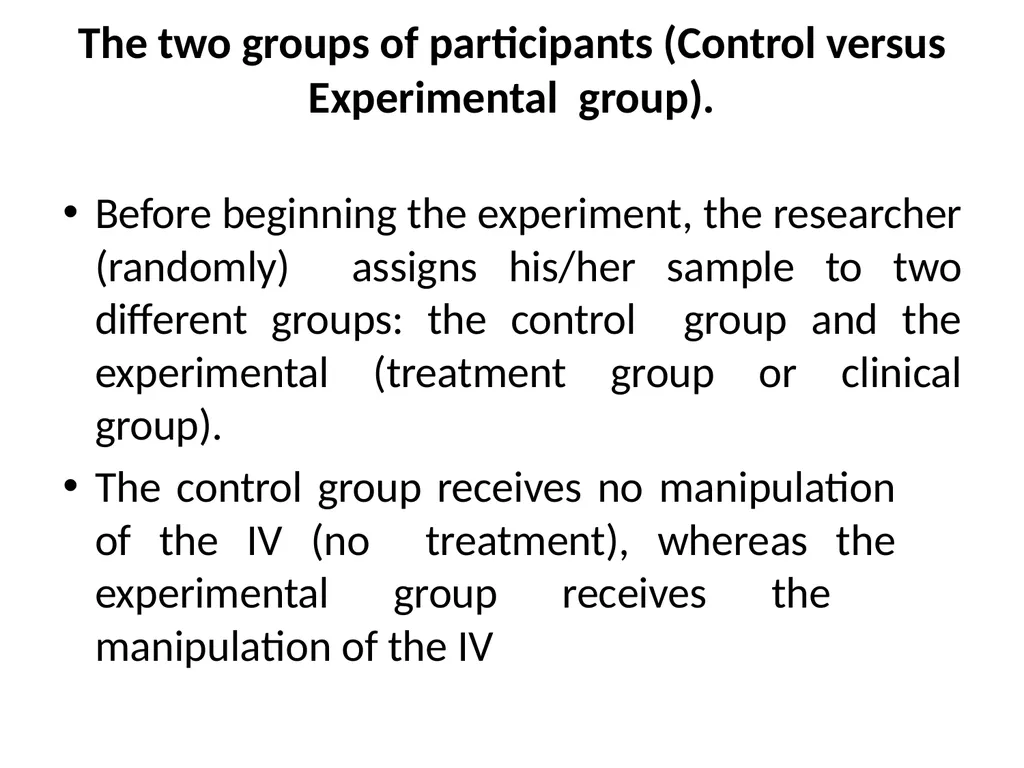
slide10. The two groups of participants (Control versus Experimental group). Before beginning the experiment, the researcher (randomly) assigns his/her sample to two different groups: the control group and the experimental (treatment group or clinical group).
The control group receives no manipulation of the IV (no treatment), whereas the experimental group receives the manipulation of the IV<br>
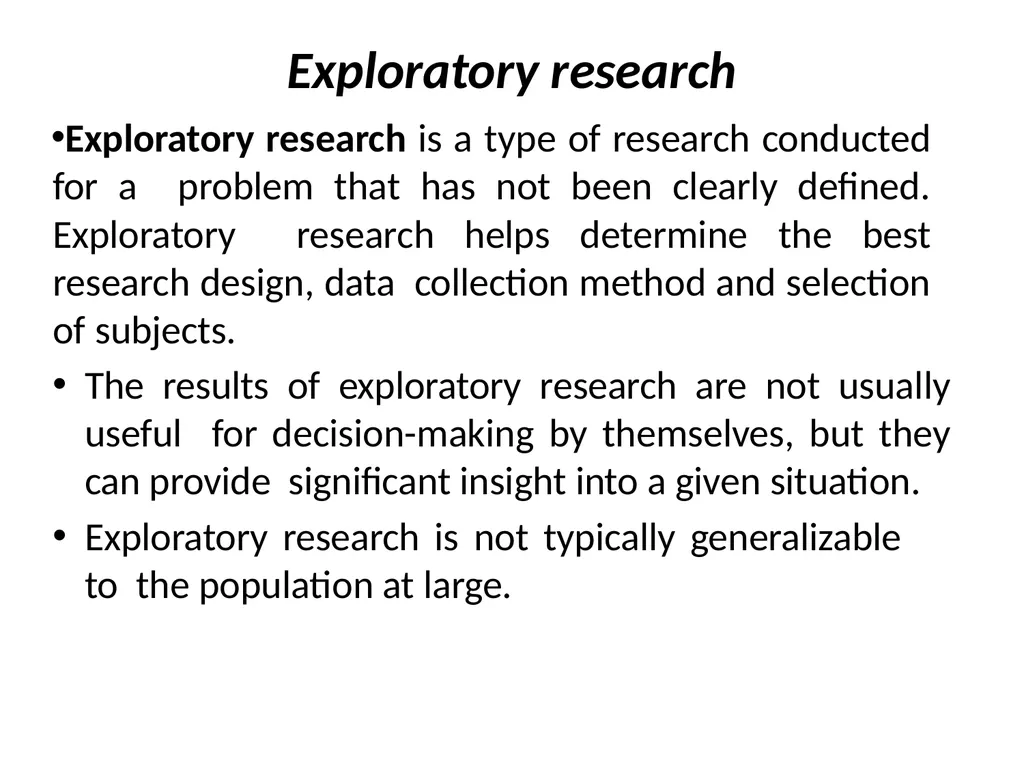
slide11. Exploratory research Exploratory research is a type of research conducted for a problem that has not been clearly defined. Exploratory research helps determine the best research design, data collection method and selection of subjects.
The results of exploratory research are not usually useful for decision-making by themselves, but they can provide significant insight into a given situation.
Exploratory research is not typically generalizable to the population at large.<br>
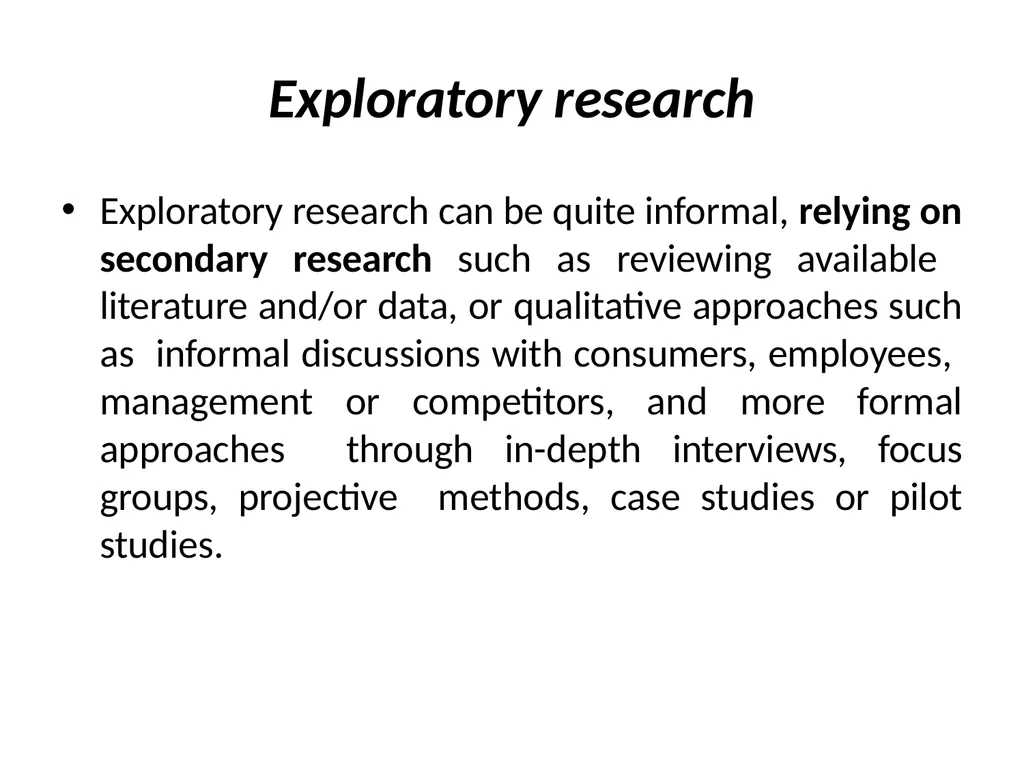
slide12. Exploratory research Exploratory research can be quite informal, relying on secondary research such as reviewing available literature and/or data, or qualitative approaches such as informal discussions with consumers, employees, management or competitors, and more formal approaches through in-depth interviews, focus groups, projective methods, case studies or pilot studies.<br>
slide13. Ex-post Facto Research It is systematic inquiry in which the researcher does not have direct control over independent variables because their manifestation have already been occurred and because they are such that can not be manipulated.<br>
slide14. Qualitative research Research dealing with phenomena that are difficult or impossible to quantify mathematically, such as beliefs, meanings, attributes, and symbols.
Qualitative researchers aim to gather an in-depth understanding of human behaviour and the reasons that govern such behaviour. The qualitative method investigates the why and how of decision making, not just what, where, when.<br>
slide15. Advantages It enables more complex aspects of a persons experience to be studied.
Fewer restriction or assumptions are placed on the data to be collected.
Not everything can be quantified, or quantified easily, Individuals can be studied in more depth.
Good for exploratory research and hypothesis generation.
The participants are able to provide data in their own words and in their own way.<br>
slide16. Ethnographic research Ethnographic research refer to the investigation of a culture through an in-depth study of the members of the culture; it involves the systematic collection, description, and analysis of data for development of theories of cultural behaviour.
It studies people, ethnic groups and other ethnic formations, their ethno genesis, composition, resettlement, social welfare characteristics, as well as their material and spiritual culture.
Data collection is often done through participant observation, interviews, questionnaires, etc.<br>
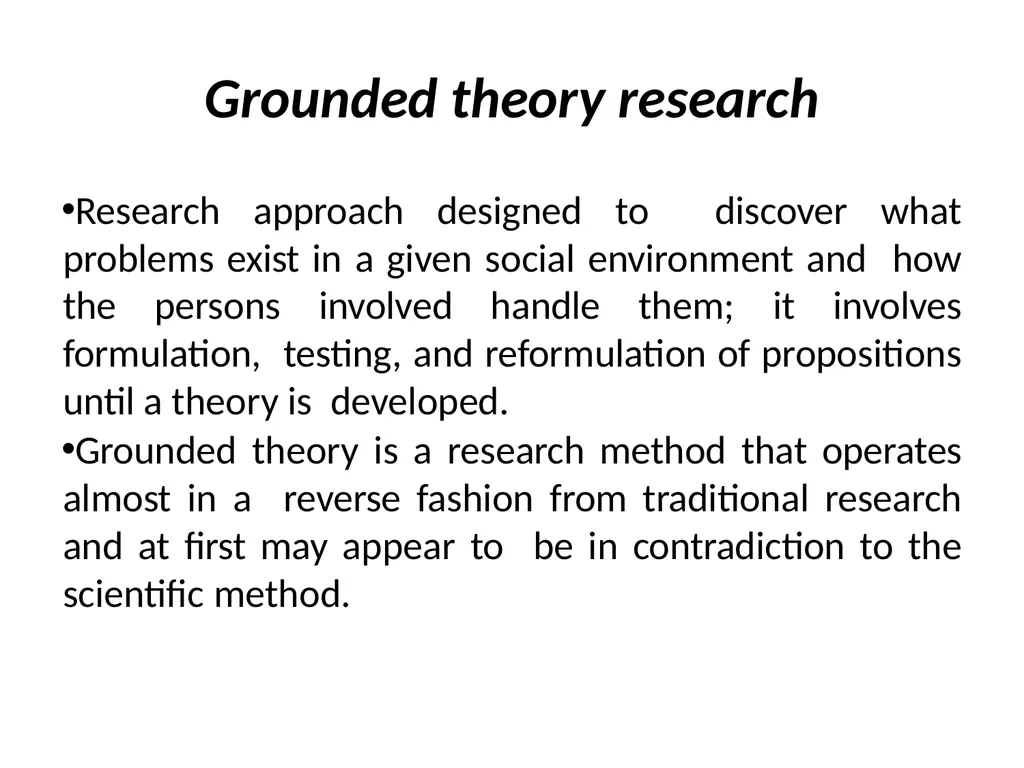
slide17. Grounded theory research Research approach designed to discover what problems exist in a given social environment and how the persons involved handle them; it involves formulation, testing, and reformulation of propositions until a theory is developed.
Grounded theory is a research method that operates almost in a reverse fashion from traditional research and at first may appear to be in contradiction to the scientific method.<br>
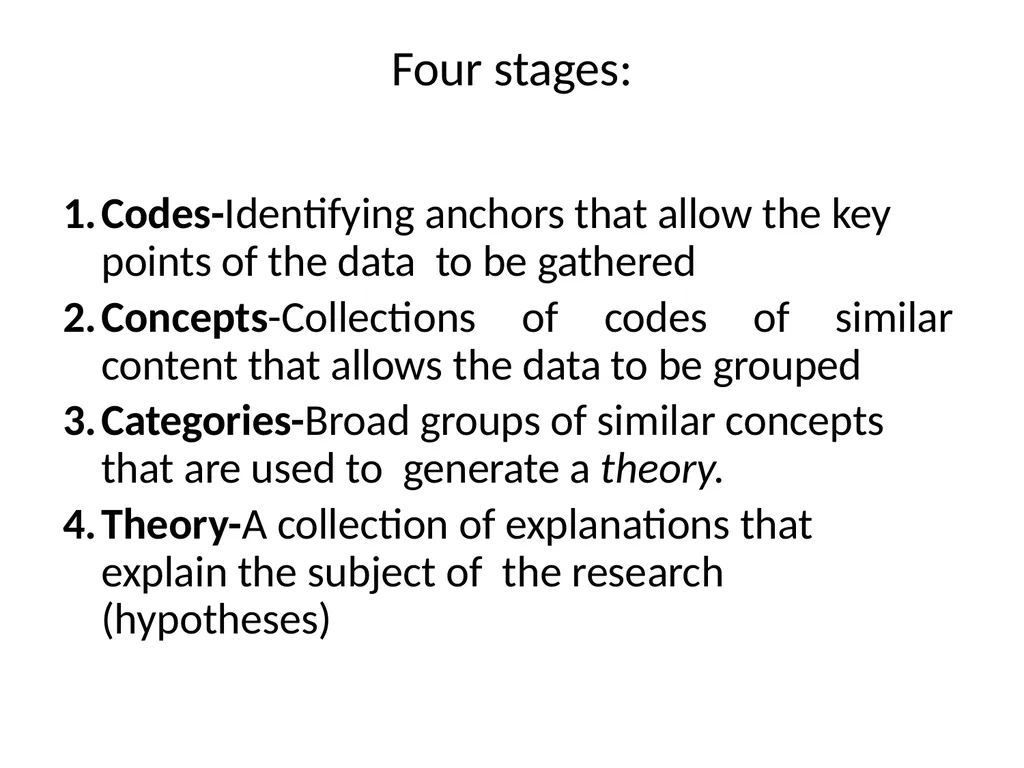
slide18. Four stages: Codes-Identifying anchors that allow the key points of the data to be gathered
Concepts-Collections of codes of similar content that allows the data to be grouped
Categories-Broad groups of similar concepts that are used to generate a theory.
Theory-A collection of explanations that explain the subject of the research (hypotheses)<br>
slide19. Four stages: Codes-Identifying anchors that allow the key points of the data to be gathered
Concepts-Collections of codes of similar content that allows the data to be grouped
Categories-Broad groups of similar concepts that are used to generate a theory
Theory-A collection of explanations that explain the subject of the research (hypotheses)<br>
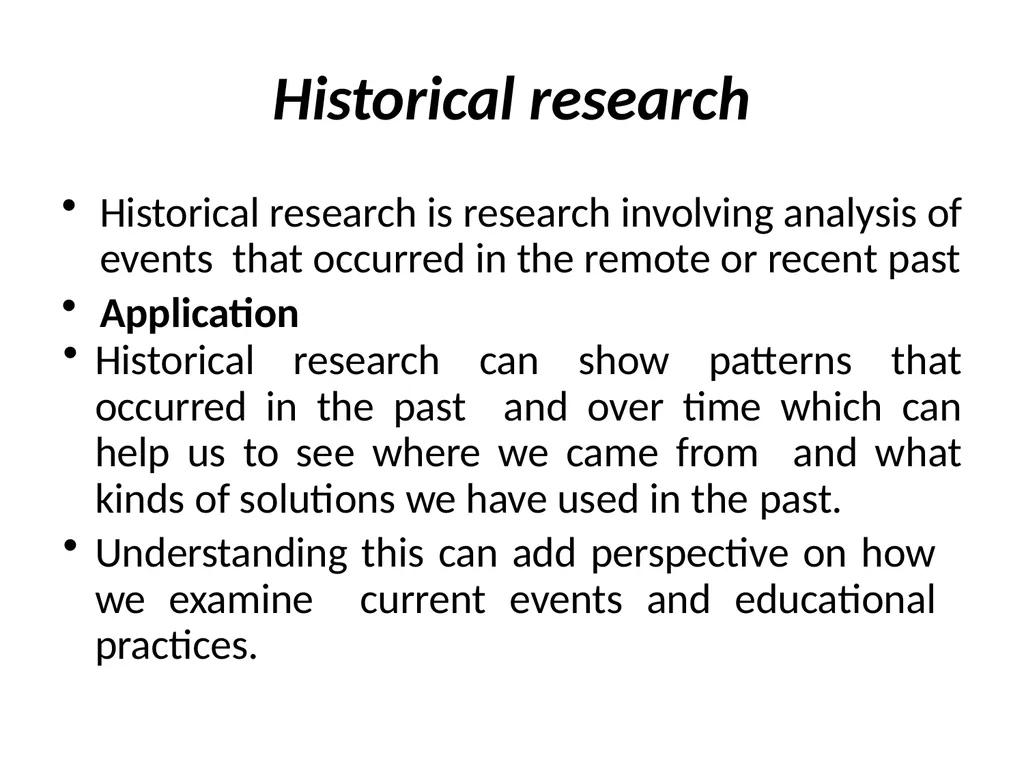
slide20. Historical research Historical research is research involving analysis of events that occurred in the remote or recent past
Application
Historical research can show patterns that occurred in the past and over time which can help us to see where we came from and what kinds of solutions we have used in the past.
Understanding this can add perspective on how we examine current events and educational practices.<br>
slide21. The steps involved in the conduct of historical research Here are the five steps:
Identification of the research topic and formulation of the research problem or question.
Data collection or literature review.
Evaluation of materials.
Data synthesis.
Report preparation or preparation of the narrative exposition.<br>
slide22. Phenomenological research Phenomenological research an inductive, descriptive research approach developed from phenomenological philosophy; its aim is to describe an experience as it is actually lived by the person.
As such they are powerful for understanding subjective experience, gaining insights into people’s motivations and actions, and cutting through the clutter of taken-for-granted assumptions and conventional wisdom.<br>
slide23. Advantages It enables more complex aspects of a persons experience to be studied.
Fewer restriction or assumptions are placed on the data to be collected.
Not everything can be quantified, or quantified easily, Individuals can be studied in more depth
Good for exploratory research and hypothesis generation.
The participants are able to provide data in their own words and in their own way<br>
slide24. Quantitative research It refers to the systematic empirical investigation of any phenomena via statistical, mathematical or computational techniques. The objective of quantitative research is to develop and employ mathematical models, theories and/or hypotheses pertaining to phenomena.
Quantitative research is generally made using scientific methods, which can include:
The generation of models, theories and hypotheses
The development of instruments and methods for measurement.
Experimental control and manipulation of variables.
Modeling and analysis of data.
Evaluation of results.<br>
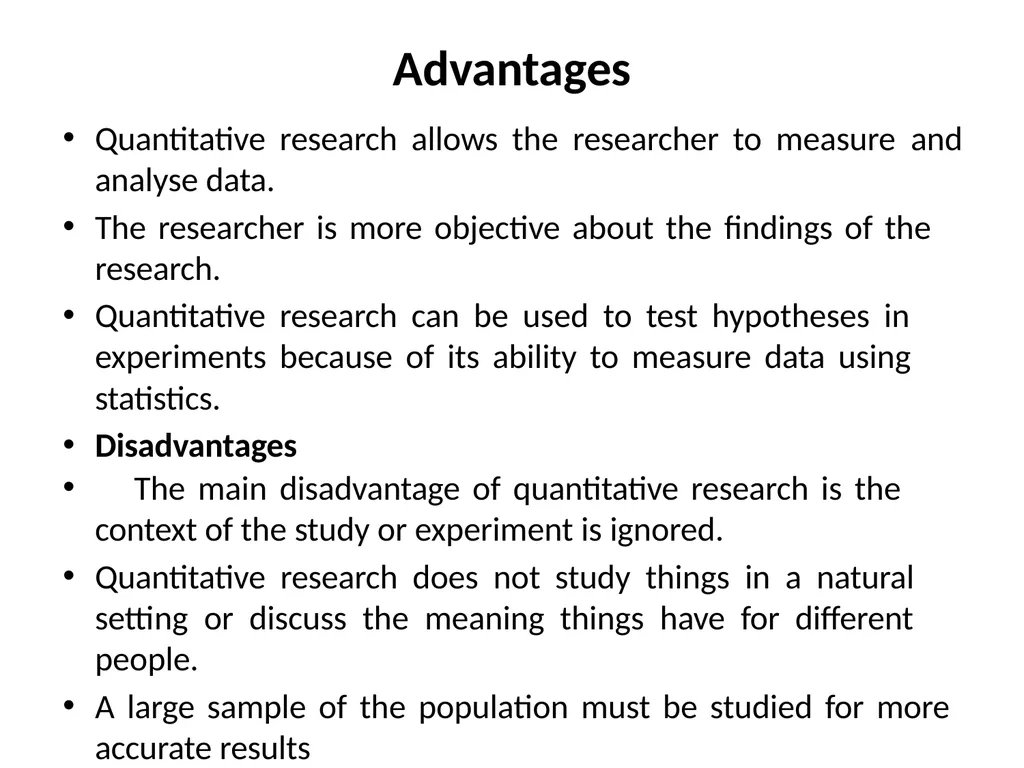
slide25. Advantages Quantitative research allows the researcher to measure and analyse data.
The researcher is more objective about the findings of the research.
Quantitative research can be used to test hypotheses in experiments because of its ability to measure data using statistics.
Disadvantages
The main disadvantage of quantitative research is the context of the study or experiment is ignored.
Quantitative research does not study things in a natural setting or discuss the meaning things have for different people.
A large sample of the population must be studied for more accurate results<br>
slide26. Thank you<br>
slide2. Applied research Applied research refers to scientific study and research that seeks to solve practical problems. Applied research is used to find solutions to everyday problems, cure illness, and develop innovative technologies, rather than to acquire knowledge for knowledge's sake.
For example, applied researchers may investigate ways to:
Improve agricultural crop production.
Treat or cure a specific disease.
Improve the energy efficiency of homes, offices, or modes of transportation.<br>
slide3. Basic (fundamental or pure ) research Basic (fundamental or pure ) research is driven by a scientist's curiosity or interest in a scientific question. The main motivation is to expand man's knowledge, not to create or invent something. There is no obvious commercial value to the discoveries that result from basic research.
For example, basic science investigations probe for answers to questions such as:
How did the universe begin?
What are protons, neutrons, and electrons composed of?
What is the specific genetic code of the fruit fly?<br>
slide4. Correlation research Correlation research refers to the systematic investigation or statistical study of relationships among two or more variables, without necessarily determining cause and effect.
It Seeks to establish a relation/association/correlation between two or more variables that do not readily lend themselves to experimental manipulation.
For example, to test the hypothesis “ Listening to music lowers blood pressure levels” there are 2 ways of conducting research:
Experimental – group samples and make one group listen to music and then compare the bp levels
Survey – ask people how they feel ? How often they listen? And then compare<br>
slide5. Advantages: Can collect much information from many subjects at one time.
Can study a wide range of variables and their interrelations.
Study variables that are not easily produced in the laboratory.
Disadvantages:
Correlation does not indicate causation (cause and effect).
Problems with self-report method .<br>
slide6. Descriptive research It refers to research that provides an accurate portrayal of characteristics of a particular individual, situation, or group. Descriptive research, also known as statistical research.
These studies are a means of discovering new meaning, describing what exists, determining the frequency with which something occurs, and categorizing information.<br>
slide7. Descriptive research In short descriptive research deals with everything that can be counted and studied, which has an impact of the lives of the people.
For example,
finding the most frequent disease that affects the children of a town.
The reader of the research will know what to do to prevent that disease thus, more people will live a healthy life.<br>
slide8. Advantages: The people individual studied are unaware so they act naturally or as they usually do in everyday situation.
It is less expensive and time consuming than quantitative experiments.
Collects a large amount of notes for detailed studying.
Disadvantages:
Descriptive research requires more skills.
Does not identify cause behind a phenomenon.
Response rate is low in this research.
Results of this research can change over the period of time.<br>
slide9. Experimental research Experimental research is an objective, systematic, controlled investigation for the purpose of predicting and controlling phenomena and examining probability and causality among selected variables.
The two variables(Independent versus Dependent variables).
The IV is the predictor variable whereas the DV is the outcome variable.
Researchers manipulate and control the IV to study it's effect on the DV.<br>
slide10. The two groups of participants (Control versus Experimental group). Before beginning the experiment, the researcher (randomly) assigns his/her sample to two different groups: the control group and the experimental (treatment group or clinical group).
The control group receives no manipulation of the IV (no treatment), whereas the experimental group receives the manipulation of the IV<br>
slide11. Exploratory research Exploratory research is a type of research conducted for a problem that has not been clearly defined. Exploratory research helps determine the best research design, data collection method and selection of subjects.
The results of exploratory research are not usually useful for decision-making by themselves, but they can provide significant insight into a given situation.
Exploratory research is not typically generalizable to the population at large.<br>
slide12. Exploratory research Exploratory research can be quite informal, relying on secondary research such as reviewing available literature and/or data, or qualitative approaches such as informal discussions with consumers, employees, management or competitors, and more formal approaches through in-depth interviews, focus groups, projective methods, case studies or pilot studies.<br>
slide13. Ex-post Facto Research It is systematic inquiry in which the researcher does not have direct control over independent variables because their manifestation have already been occurred and because they are such that can not be manipulated.<br>
slide14. Qualitative research Research dealing with phenomena that are difficult or impossible to quantify mathematically, such as beliefs, meanings, attributes, and symbols.
Qualitative researchers aim to gather an in-depth understanding of human behaviour and the reasons that govern such behaviour. The qualitative method investigates the why and how of decision making, not just what, where, when.<br>
slide15. Advantages It enables more complex aspects of a persons experience to be studied.
Fewer restriction or assumptions are placed on the data to be collected.
Not everything can be quantified, or quantified easily, Individuals can be studied in more depth.
Good for exploratory research and hypothesis generation.
The participants are able to provide data in their own words and in their own way.<br>
slide16. Ethnographic research Ethnographic research refer to the investigation of a culture through an in-depth study of the members of the culture; it involves the systematic collection, description, and analysis of data for development of theories of cultural behaviour.
It studies people, ethnic groups and other ethnic formations, their ethno genesis, composition, resettlement, social welfare characteristics, as well as their material and spiritual culture.
Data collection is often done through participant observation, interviews, questionnaires, etc.<br>
slide17. Grounded theory research Research approach designed to discover what problems exist in a given social environment and how the persons involved handle them; it involves formulation, testing, and reformulation of propositions until a theory is developed.
Grounded theory is a research method that operates almost in a reverse fashion from traditional research and at first may appear to be in contradiction to the scientific method.<br>
slide18. Four stages: Codes-Identifying anchors that allow the key points of the data to be gathered
Concepts-Collections of codes of similar content that allows the data to be grouped
Categories-Broad groups of similar concepts that are used to generate a theory.
Theory-A collection of explanations that explain the subject of the research (hypotheses)<br>
slide19. Four stages: Codes-Identifying anchors that allow the key points of the data to be gathered
Concepts-Collections of codes of similar content that allows the data to be grouped
Categories-Broad groups of similar concepts that are used to generate a theory
Theory-A collection of explanations that explain the subject of the research (hypotheses)<br>
slide20. Historical research Historical research is research involving analysis of events that occurred in the remote or recent past
Application
Historical research can show patterns that occurred in the past and over time which can help us to see where we came from and what kinds of solutions we have used in the past.
Understanding this can add perspective on how we examine current events and educational practices.<br>
slide21. The steps involved in the conduct of historical research Here are the five steps:
Identification of the research topic and formulation of the research problem or question.
Data collection or literature review.
Evaluation of materials.
Data synthesis.
Report preparation or preparation of the narrative exposition.<br>
slide22. Phenomenological research Phenomenological research an inductive, descriptive research approach developed from phenomenological philosophy; its aim is to describe an experience as it is actually lived by the person.
As such they are powerful for understanding subjective experience, gaining insights into people’s motivations and actions, and cutting through the clutter of taken-for-granted assumptions and conventional wisdom.<br>
slide23. Advantages It enables more complex aspects of a persons experience to be studied.
Fewer restriction or assumptions are placed on the data to be collected.
Not everything can be quantified, or quantified easily, Individuals can be studied in more depth
Good for exploratory research and hypothesis generation.
The participants are able to provide data in their own words and in their own way<br>
slide24. Quantitative research It refers to the systematic empirical investigation of any phenomena via statistical, mathematical or computational techniques. The objective of quantitative research is to develop and employ mathematical models, theories and/or hypotheses pertaining to phenomena.
Quantitative research is generally made using scientific methods, which can include:
The generation of models, theories and hypotheses
The development of instruments and methods for measurement.
Experimental control and manipulation of variables.
Modeling and analysis of data.
Evaluation of results.<br>
slide25. Advantages Quantitative research allows the researcher to measure and analyse data.
The researcher is more objective about the findings of the research.
Quantitative research can be used to test hypotheses in experiments because of its ability to measure data using statistics.
Disadvantages
The main disadvantage of quantitative research is the context of the study or experiment is ignored.
Quantitative research does not study things in a natural setting or discuss the meaning things have for different people.
A large sample of the population must be studied for more accurate results<br>
slide26. Thank you<br>