
Types of Variables Objective: Students should be
Description: Types of Variables Objective: Students should be able to identify the different types of variables, and know the characteristics of each type Types of Variables Categorical (data that are counted) Nominal Ordinal Quantitative or Numerical
Related Topics
Download Presentation
"Types of Variables Objective: Students should be" is the property of its rightful owner. Permission is granted to download and print the materials on this website for personal, non-commercial use only, and to display it on your personal computer provided you do not modify the materials and that you retain all copyright notices contained in the materials. By downloading content from our website, you accept the terms of this agreement.
Presentation Transcript
slide1. Types of Variables Objective:
Students should be able to identify the different types of variables, and know the characteristics of each type<br>
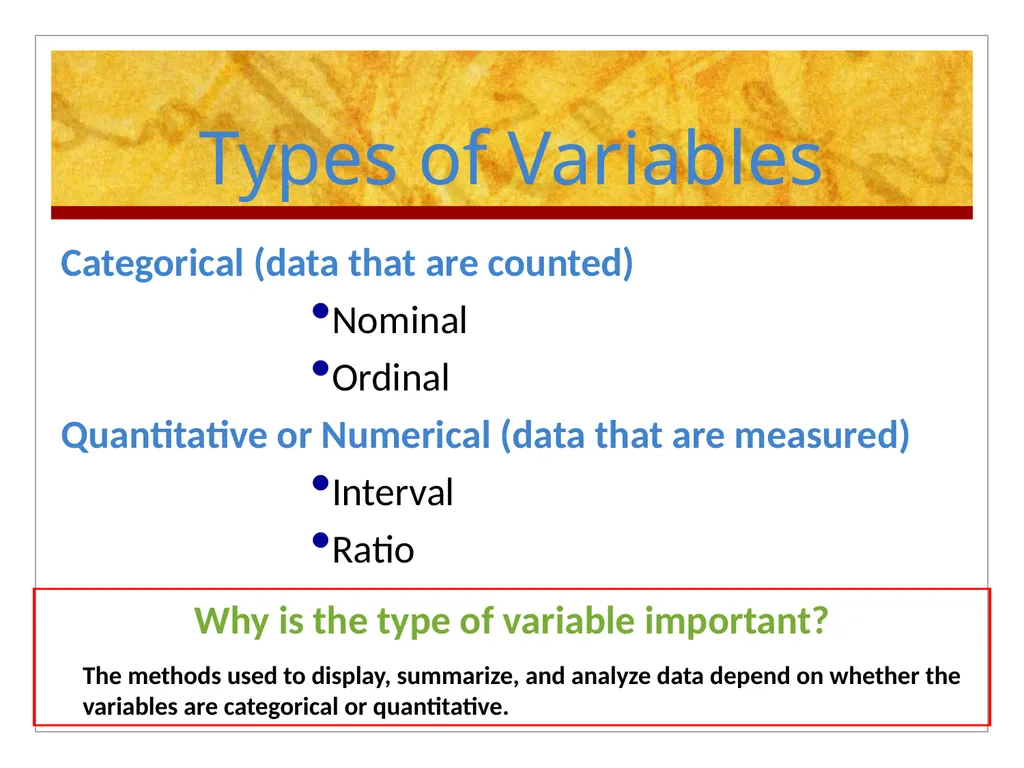
slide2. Types of Variables Categorical (data that are counted)
Nominal
Ordinal
Quantitative or Numerical (data that are measured)
Interval
Ratio Why is the type of variable important?
The methods used to display, summarize, and analyze data depend on whether the variables are categorical or quantitative.<br>
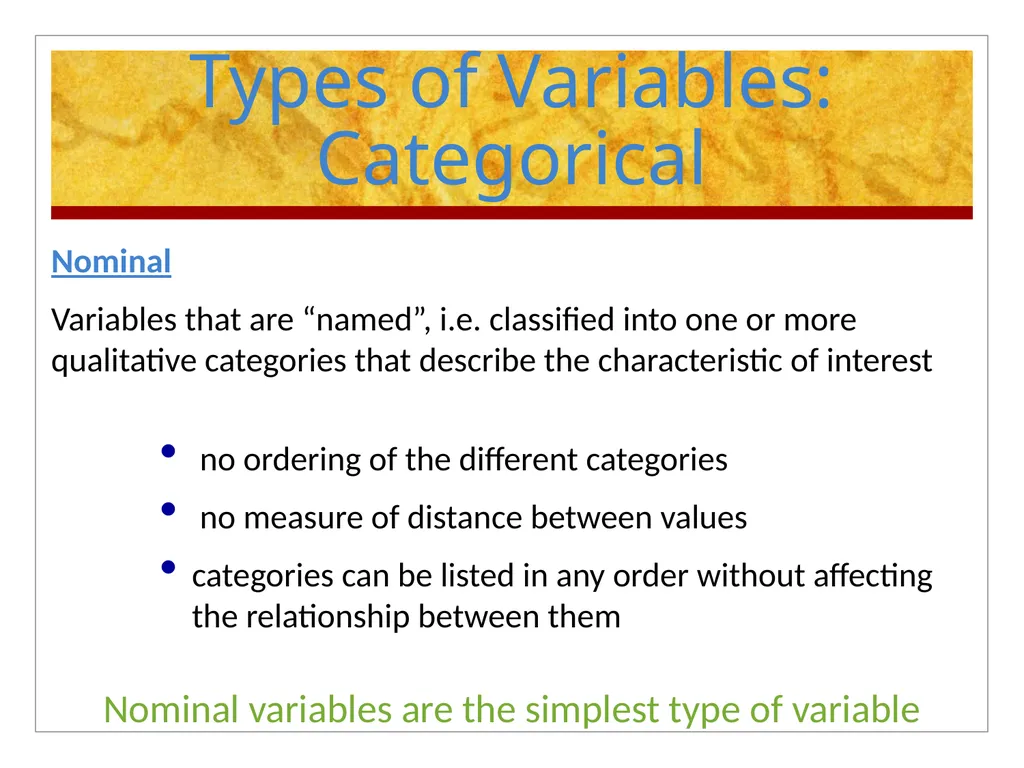
slide3. Types of Variables: Categorical Nominal
Variables that are “named”, i.e. classified into one or more qualitative categories that describe the characteristic of interest
no ordering of the different categories
no measure of distance between values
categories can be listed in any order without affecting the relationship between them Nominal variables are the simplest type of variable<br>
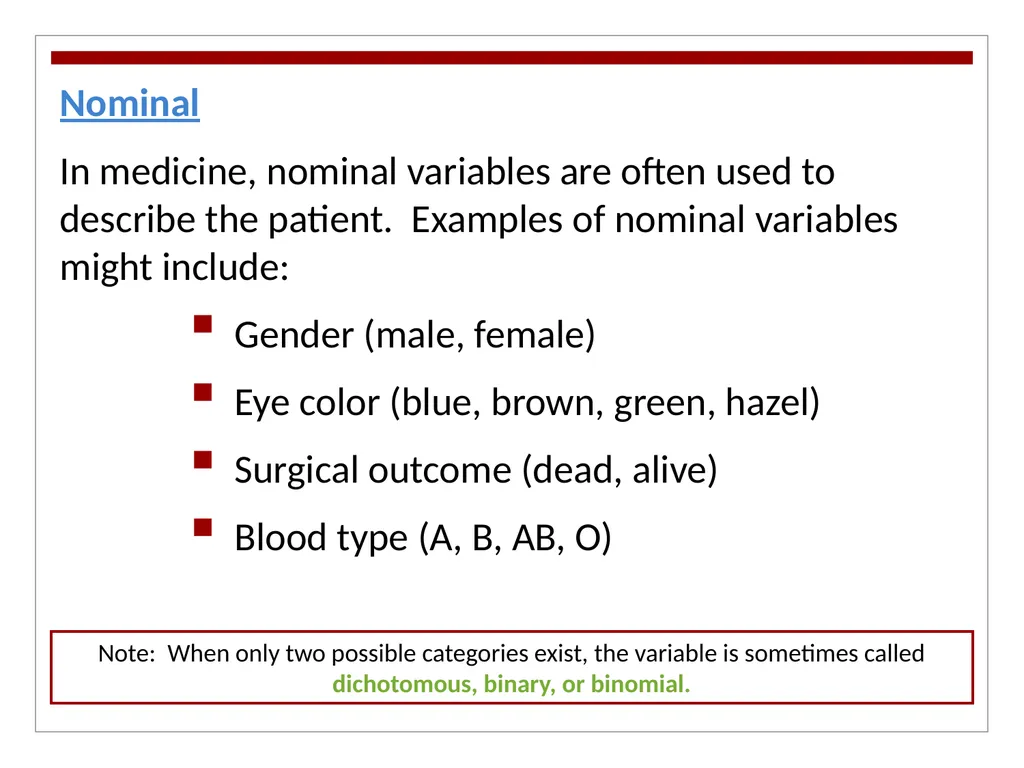
slide4. Nominal
In medicine, nominal variables are often used to describe the patient. Examples of nominal variables might include:
Gender (male, female)
Eye color (blue, brown, green, hazel)
Surgical outcome (dead, alive)
Blood type (A, B, AB, O) Note: When only two possible categories exist, the variable is sometimes called dichotomous, binary, or binomial.<br>
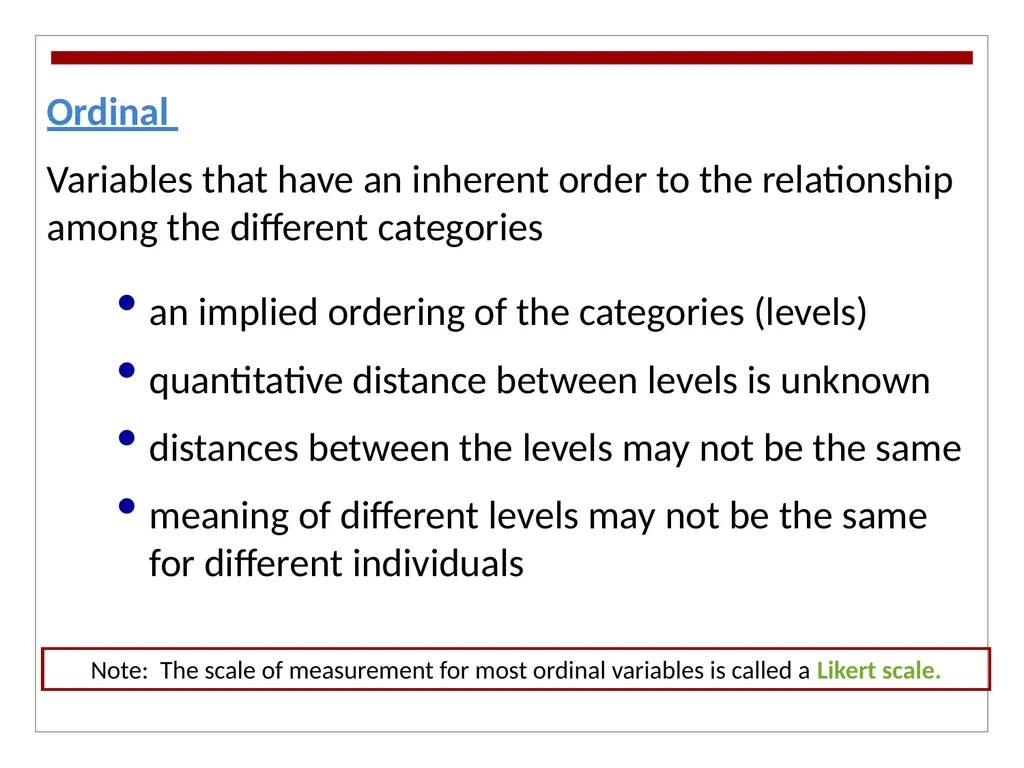
slide5. Ordinal
Variables that have an inherent order to the relationship
among the different categories
an implied ordering of the categories (levels)
quantitative distance between levels is unknown
distances between the levels may not be the same
meaning of different levels may not be the same for different individuals Note: The scale of measurement for most ordinal variables is called a Likert scale.<br>
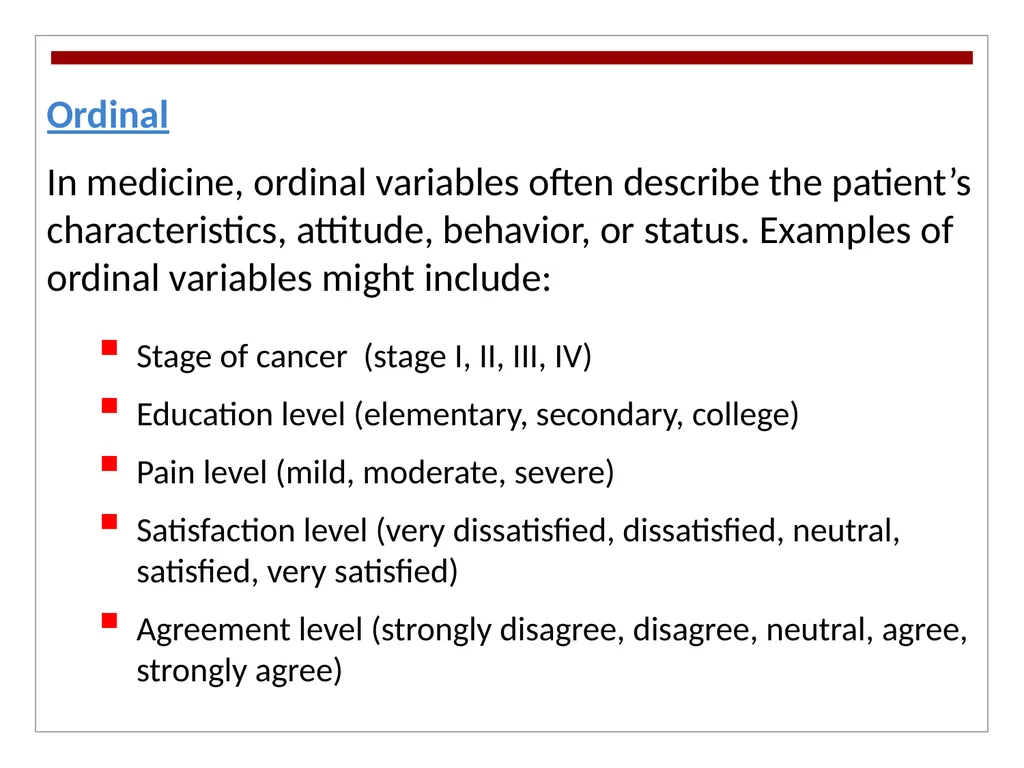
slide6. Ordinal
In medicine, ordinal variables often describe the patient’s characteristics, attitude, behavior, or status. Examples of ordinal variables might include:
Stage of cancer (stage I, II, III, IV)
Education level (elementary, secondary, college)
Pain level (mild, moderate, severe)
Satisfaction level (very dissatisfied, dissatisfied, neutral, satisfied, very satisfied)
Agreement level (strongly disagree, disagree, neutral, agree, strongly agree)<br>
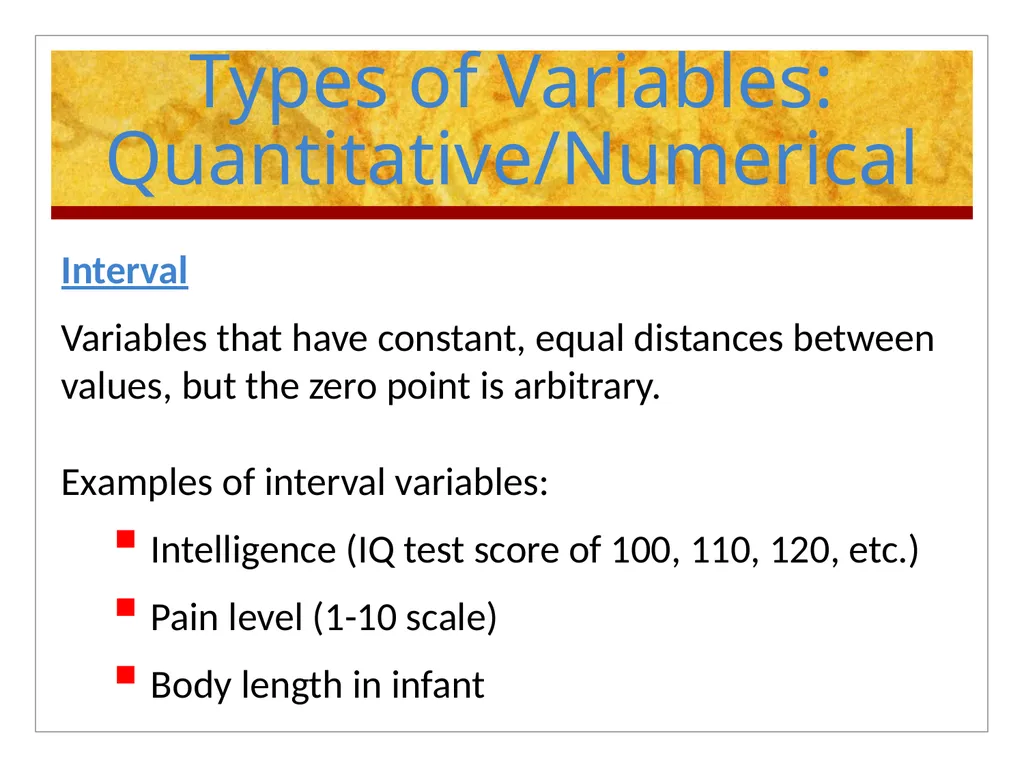
slide7. Types of Variables: Quantitative/Numerical Interval
Variables that have constant, equal distances between values, but the zero point is arbitrary.
Examples of interval variables:
Intelligence (IQ test score of 100, 110, 120, etc.)
Pain level (1-10 scale)
Body length in infant<br>
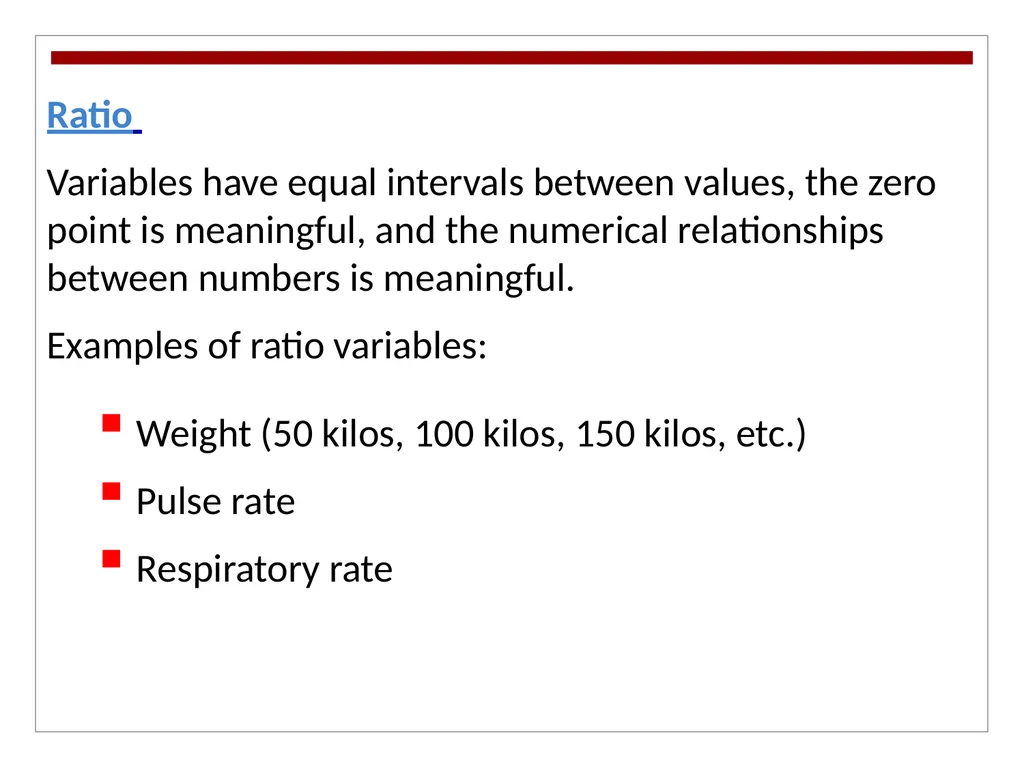
slide8. Ratio
Variables have equal intervals between values, the zero point is meaningful, and the numerical relationships between numbers is meaningful.
Examples of ratio variables:
Weight (50 kilos, 100 kilos, 150 kilos, etc.)
Pulse rate
Respiratory rate<br>
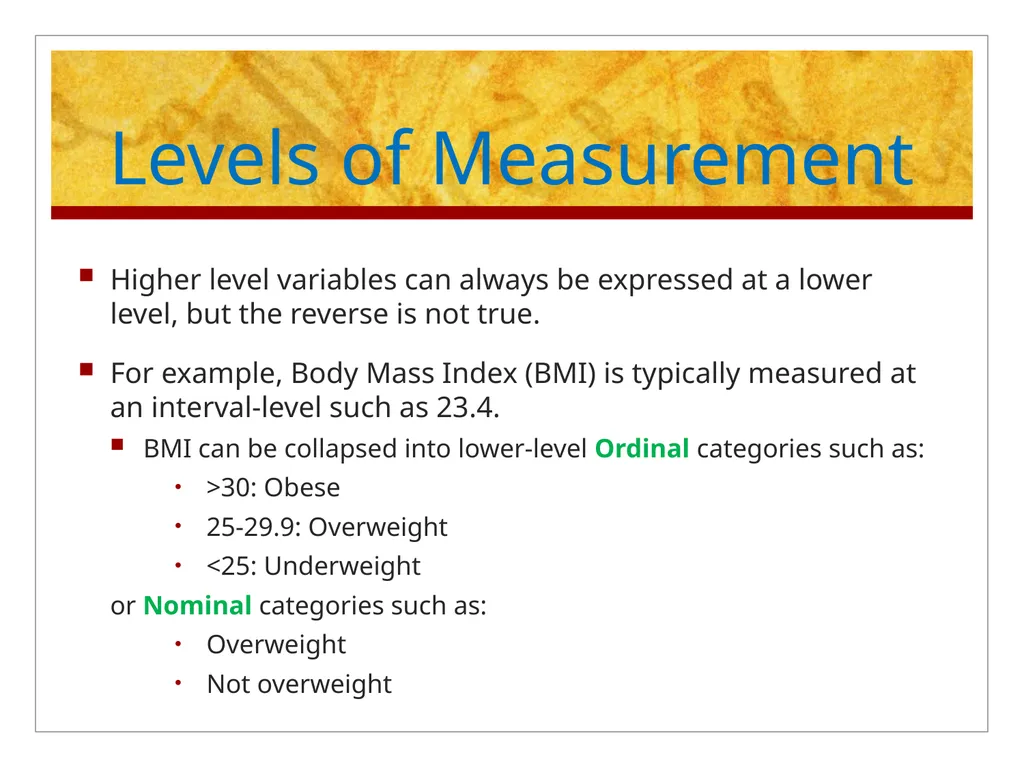
slide9. Levels of Measurement Higher level variables can always be expressed at a lower level, but the reverse is not true.
For example, Body Mass Index (BMI) is typically measured at an interval-level such as 23.4.
BMI can be collapsed into lower-level Ordinal categories such as:
>30: Obese
25-29.9: Overweight
<25: Underweight
or Nominal categories such as:
Overweight
Not overweight<br>
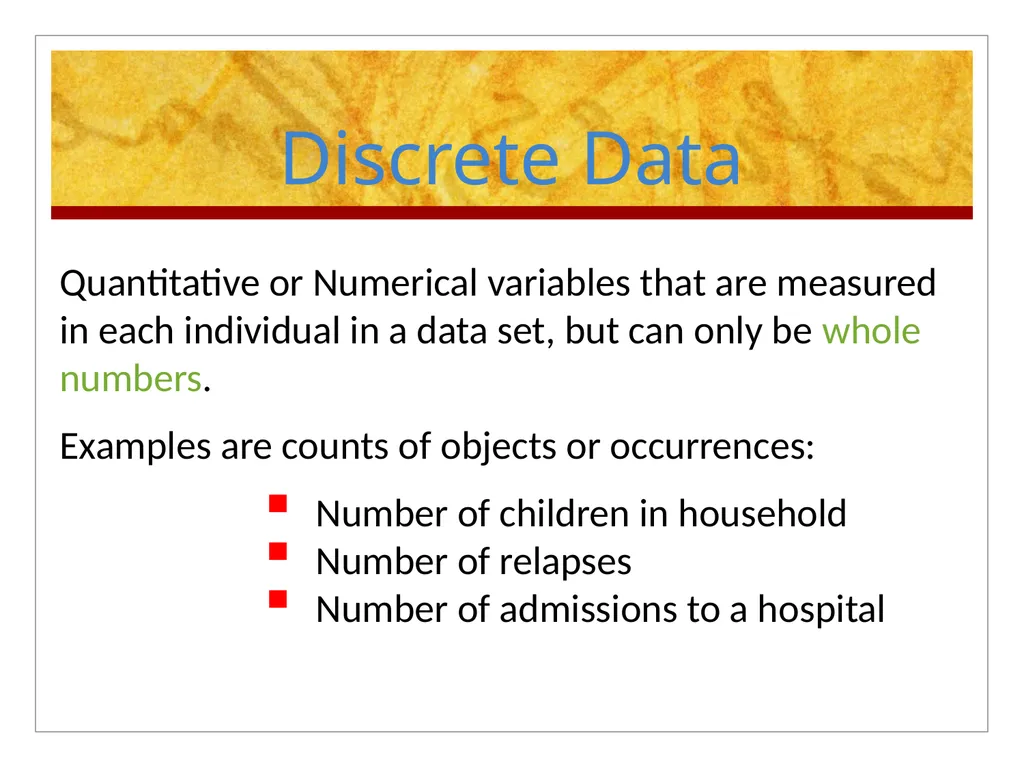
slide10. Discrete Data Quantitative or Numerical variables that are measured in each individual in a data set, but can only be whole numbers.
Examples are counts of objects or occurrences:
Number of children in household
Number of relapses
Number of admissions to a hospital<br>
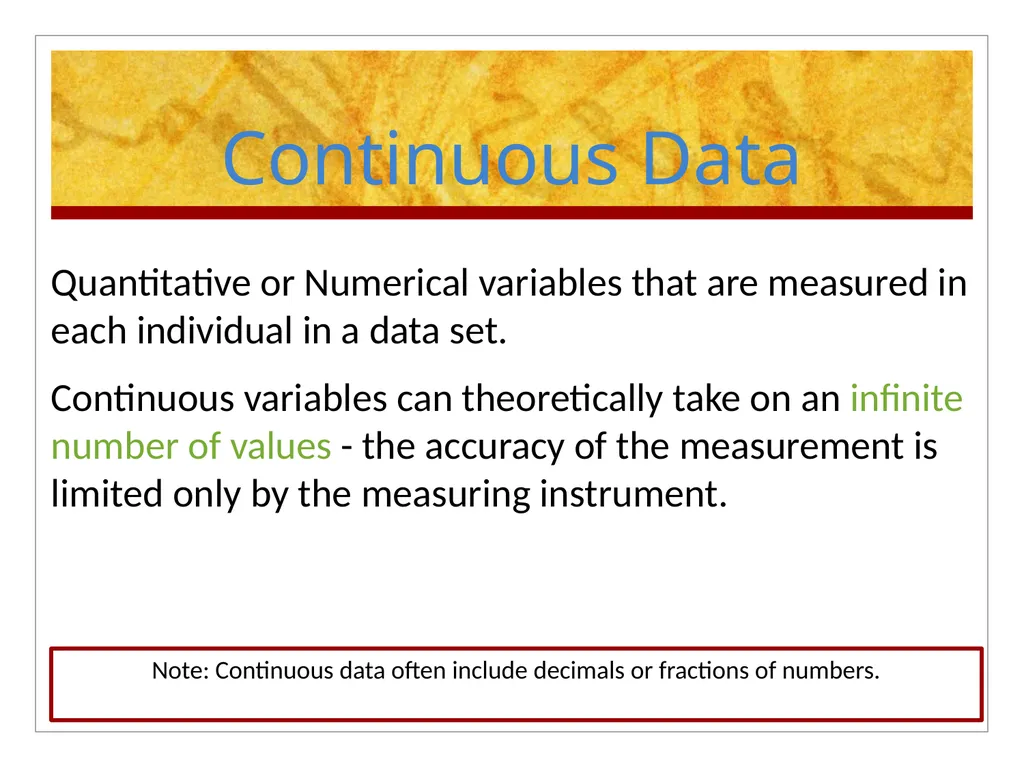
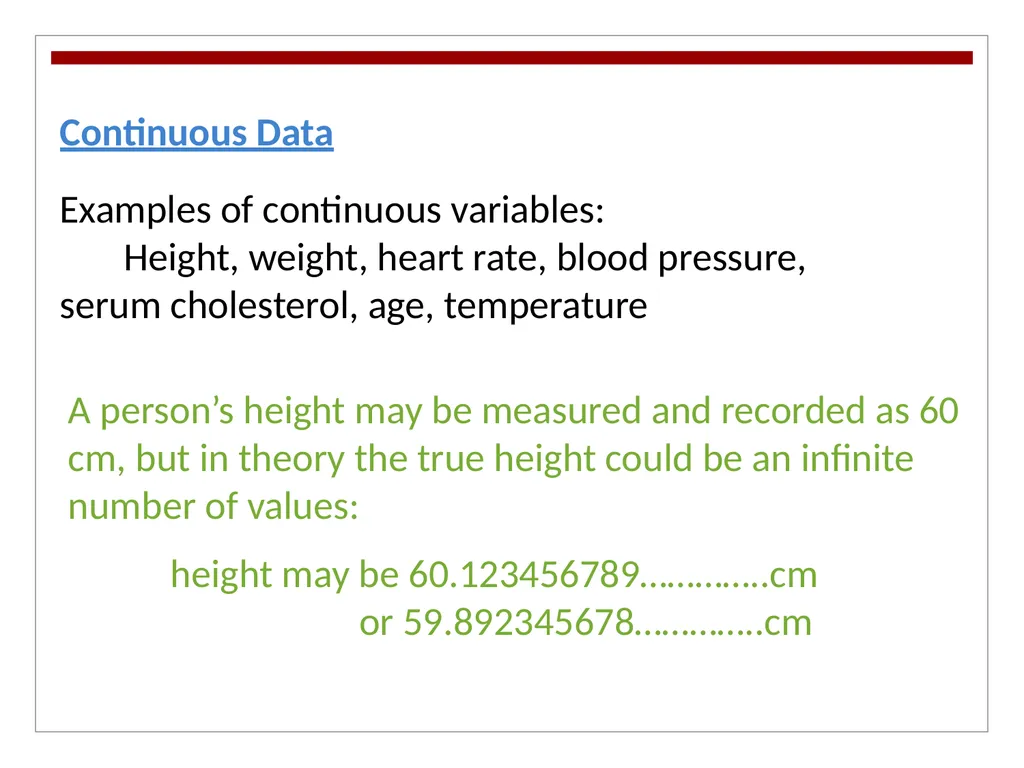
slide11. Continuous Data Quantitative or Numerical variables that are measured in each individual in a data set.
Continuous variables can theoretically take on an infinite number of values - the accuracy of the measurement is limited only by the measuring instrument. Note: Continuous data often include decimals or fractions of numbers.<br>
slide12. Continuous Data
Examples of continuous variables:
Height, weight, heart rate, blood pressure, serum cholesterol, age, temperature A person’s height may be measured and recorded as 60 cm, but in theory the true height could be an infinite number of values:
height may be 60.123456789…………..cm
or 59.892345678…………..cm<br>
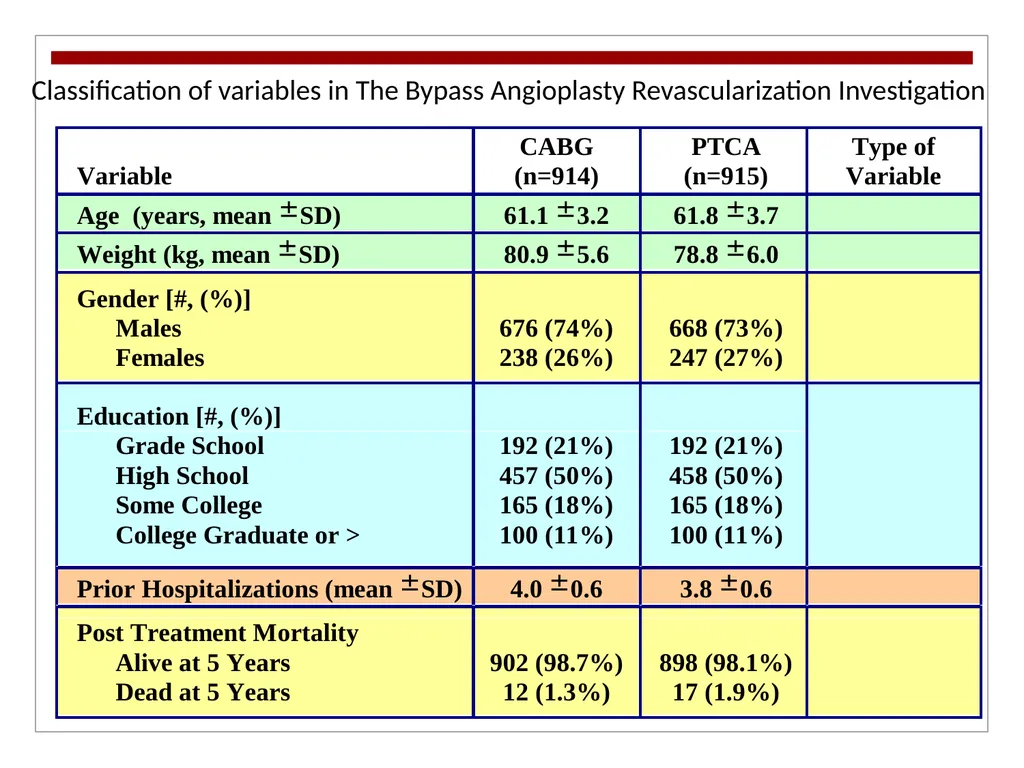
slide13. Classification of variables in The Bypass Angioplasty Revascularization Investigation<br>
Students should be able to identify the different types of variables, and know the characteristics of each type<br>
slide2. Types of Variables Categorical (data that are counted)
Nominal
Ordinal
Quantitative or Numerical (data that are measured)
Interval
Ratio Why is the type of variable important?
The methods used to display, summarize, and analyze data depend on whether the variables are categorical or quantitative.<br>
slide3. Types of Variables: Categorical Nominal
Variables that are “named”, i.e. classified into one or more qualitative categories that describe the characteristic of interest
no ordering of the different categories
no measure of distance between values
categories can be listed in any order without affecting the relationship between them Nominal variables are the simplest type of variable<br>
slide4. Nominal
In medicine, nominal variables are often used to describe the patient. Examples of nominal variables might include:
Gender (male, female)
Eye color (blue, brown, green, hazel)
Surgical outcome (dead, alive)
Blood type (A, B, AB, O) Note: When only two possible categories exist, the variable is sometimes called dichotomous, binary, or binomial.<br>
slide5. Ordinal
Variables that have an inherent order to the relationship
among the different categories
an implied ordering of the categories (levels)
quantitative distance between levels is unknown
distances between the levels may not be the same
meaning of different levels may not be the same for different individuals Note: The scale of measurement for most ordinal variables is called a Likert scale.<br>
slide6. Ordinal
In medicine, ordinal variables often describe the patient’s characteristics, attitude, behavior, or status. Examples of ordinal variables might include:
Stage of cancer (stage I, II, III, IV)
Education level (elementary, secondary, college)
Pain level (mild, moderate, severe)
Satisfaction level (very dissatisfied, dissatisfied, neutral, satisfied, very satisfied)
Agreement level (strongly disagree, disagree, neutral, agree, strongly agree)<br>
slide7. Types of Variables: Quantitative/Numerical Interval
Variables that have constant, equal distances between values, but the zero point is arbitrary.
Examples of interval variables:
Intelligence (IQ test score of 100, 110, 120, etc.)
Pain level (1-10 scale)
Body length in infant<br>
slide8. Ratio
Variables have equal intervals between values, the zero point is meaningful, and the numerical relationships between numbers is meaningful.
Examples of ratio variables:
Weight (50 kilos, 100 kilos, 150 kilos, etc.)
Pulse rate
Respiratory rate<br>
slide9. Levels of Measurement Higher level variables can always be expressed at a lower level, but the reverse is not true.
For example, Body Mass Index (BMI) is typically measured at an interval-level such as 23.4.
BMI can be collapsed into lower-level Ordinal categories such as:
>30: Obese
25-29.9: Overweight
<25: Underweight
or Nominal categories such as:
Overweight
Not overweight<br>
slide10. Discrete Data Quantitative or Numerical variables that are measured in each individual in a data set, but can only be whole numbers.
Examples are counts of objects or occurrences:
Number of children in household
Number of relapses
Number of admissions to a hospital<br>
slide11. Continuous Data Quantitative or Numerical variables that are measured in each individual in a data set.
Continuous variables can theoretically take on an infinite number of values - the accuracy of the measurement is limited only by the measuring instrument. Note: Continuous data often include decimals or fractions of numbers.<br>
slide12. Continuous Data
Examples of continuous variables:
Height, weight, heart rate, blood pressure, serum cholesterol, age, temperature A person’s height may be measured and recorded as 60 cm, but in theory the true height could be an infinite number of values:
height may be 60.123456789…………..cm
or 59.892345678…………..cm<br>
slide13. Classification of variables in The Bypass Angioplasty Revascularization Investigation<br>