
Typology in Sacred Scripture Rev 8/24/2024 1
EM
Published · 59 slides · 0 views

1 / 1






Description
Typology in Sacred Scripture Rev 8242024 1 Biblical Typology Course Outline Session 1 Introduction to Typology With Examples Session 2 Types and Prefiguring Genesis, Adam, Water, Baptism, Exodus More Session 3 Jewish Roots: Typology
Related Topics
Share
Embed code
Download this presentation From Below
"Typology in Sacred Scripture Rev 8/24/2024 1" is the property of its rightful owner. Permission is granted to download and print the materials on this website for personal, non-commercial use only, and to display it on your personal computer provided you do not modify the materials and that you retain all copyright notices contained in the materials. By downloading content from our website, you accept the terms of this agreement.
Presentation Transcript
01
Typology in Sacred Scripture Rev 8/24/2024 1<br>
02
Biblical Typology
Course Outline Session 1 Introduction to Typology With Examples Session 2 Types and Prefiguring – Genesis, Adam, Water, Baptism, Exodus & More Session 3 Jewish Roots: Typology of Moses, Isaac, Job, and in the Prophets Session 4 Typology of Mary, Joseph, Jesus, the Church 2<br>
03
Typology: a Reminder “We await a Savior, the Lord Jesus Christ, who will change our lowly body to be like his glorious body, by the power which enables him to subject all things to himself.”
- Philippians 3:20-21 3<br>
- Philippians 3:20-21 3<br>
04
Typology: a Reminder Typology of Old Testament history points to Christ and His Body, His Church, to you and me!
All that happened to God’s people was “as a figure [a type] of us…upon whom the end of the ages has come.” - 1 Corinthians 10:11
Old Testament typology points to Christ in His life, and by Him and through Him to the last times as He builds up His Mystical Body, and finally to the events of the Parousia (Second Coming). 4<br>
05
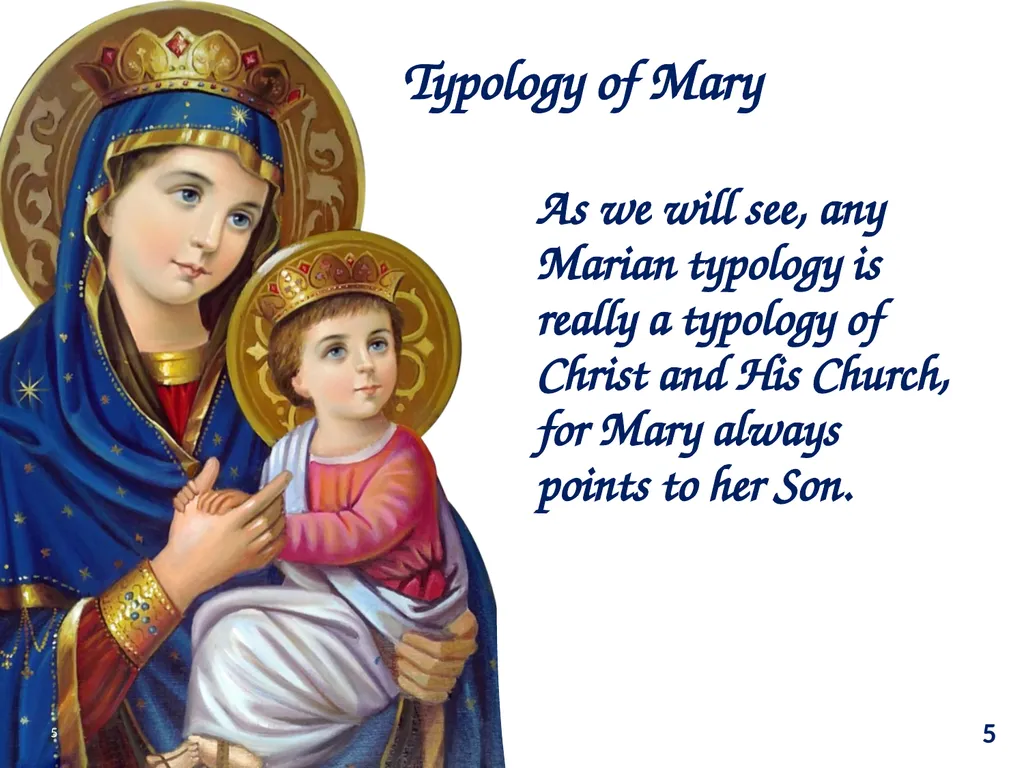
Typology of Mary 5 As we will see, any Marian typology is really a typology of Christ and His Church, for Mary always points to her Son. 5<br>
06
Typology of Mary New Testament writers allude to many Old Testament Marian types, as do extra-biblical types from other sources (Liturgy, Magisterium, Church Fathers, Theologians…).
Coverage will focus on the most logical New Testament source: the Gospel of Luke in which Mary has an early and prominent place. 6<br>
Coverage will focus on the most logical New Testament source: the Gospel of Luke in which Mary has an early and prominent place. 6<br>
07
Mary in God’s Plan “Hail, full of grace, the Lord is with you… He will be great, and will be called the Son of the Most High… and of his kingdom there will be no end.”
- Luke 1:28, 32-33 Mary saw what prophets and kings hoped to see: the King of whose “kingdom there shall be no end.” (Isaiah 9:7) 7<br>
- Luke 1:28, 32-33 Mary saw what prophets and kings hoped to see: the King of whose “kingdom there shall be no end.” (Isaiah 9:7) 7<br>
08
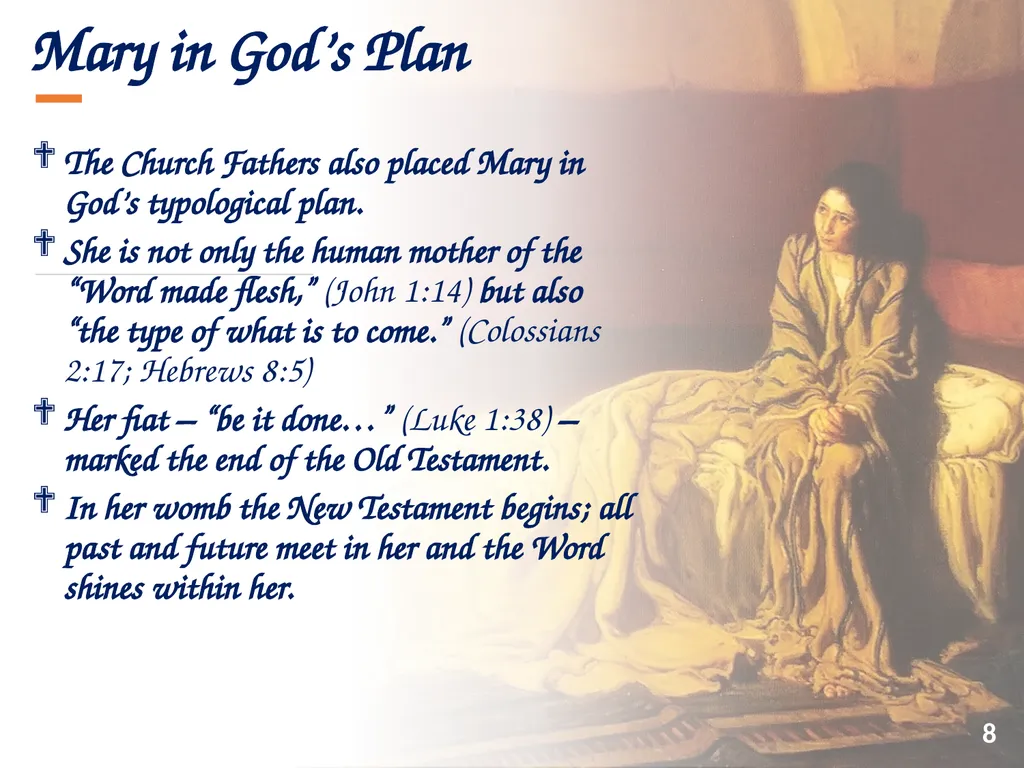
The Church Fathers also placed Mary in God’s typological plan.
She is not only the human mother of the “Word made flesh,” (John 1:14) but also “the type of what is to come.” (Colossians 2:17; Hebrews 8:5)
Her fiat – “be it done…” (Luke 1:38) – marked the end of the Old Testament.
In her womb the New Testament begins; all past and future meet in her and the Word shines within her. Mary in God’s Plan 8<br>
09
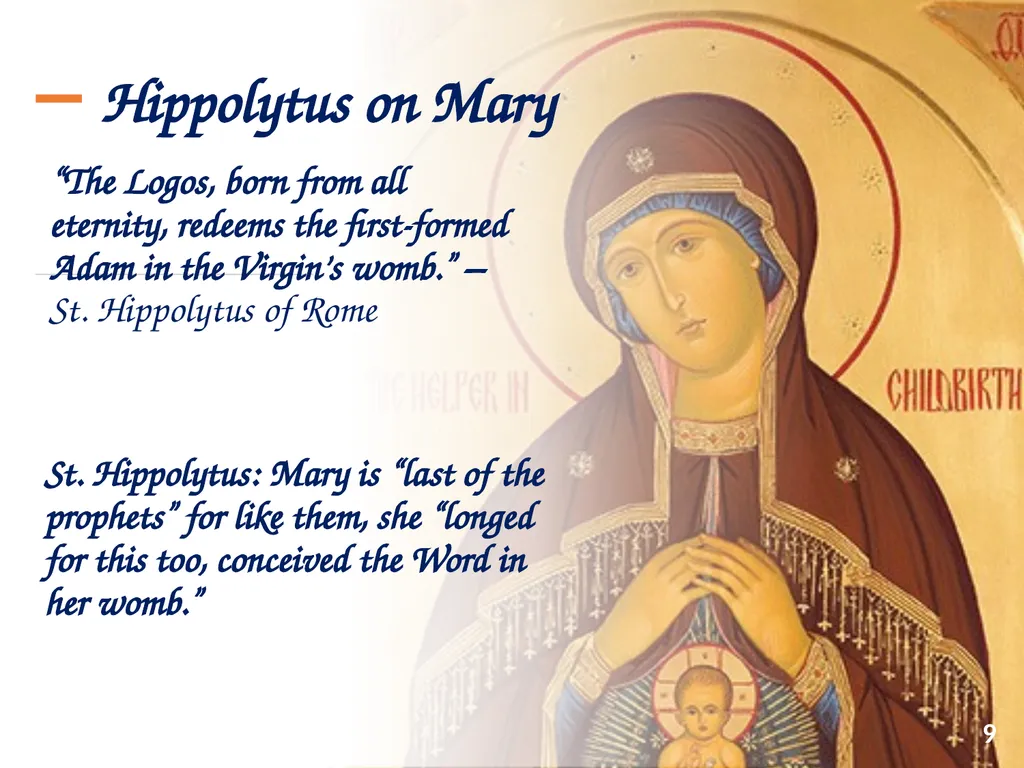
Hippolytus on Mary “The Logos, born from all eternity, redeems the first-formed Adam in the Virgin’s womb.” – St. Hippolytus of Rome St. Hippolytus: Mary is “last of the prophets” for like them, she “longed for this too, conceived the Word in her womb.” 9<br>
10
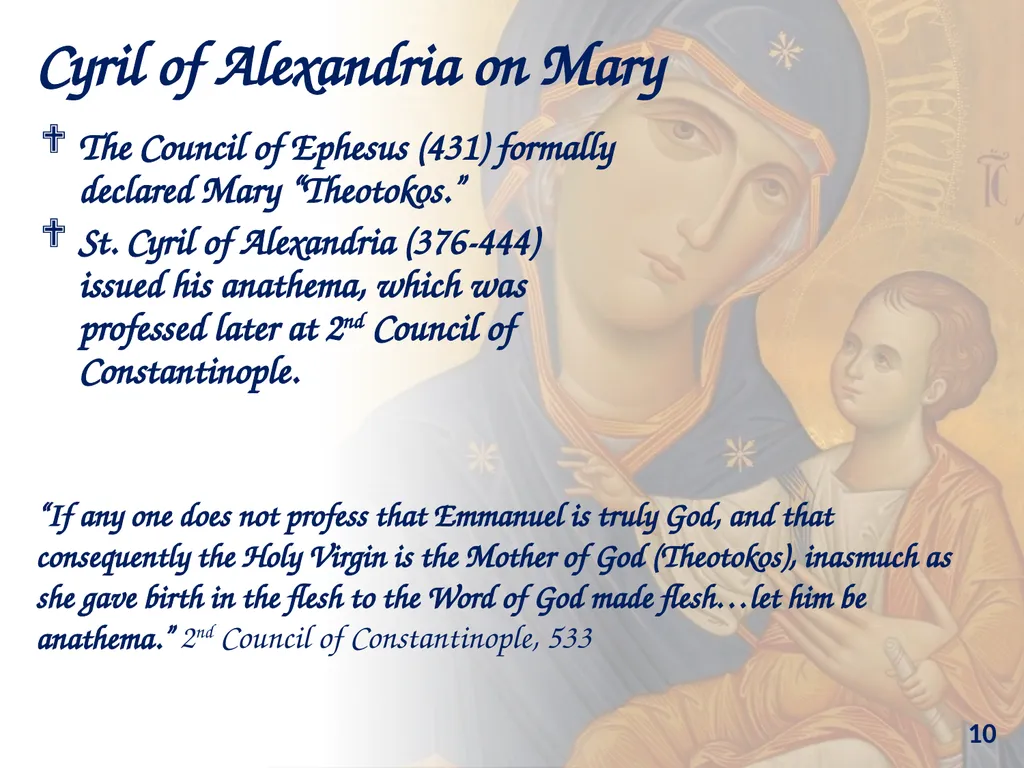
The Council of Ephesus (431) formally declared Mary “Theotokos.”
St. Cyril of Alexandria (376-444) issued his anathema, which was professed later at 2nd Council of Constantinople. Cyril of Alexandria on Mary “If any one does not profess that Emmanuel is truly God, and that consequently the Holy Virgin is the Mother of God (Theotokos), inasmuch as she gave birth in the flesh to the Word of God made flesh…let him be anathema.” 2nd Council of Constantinople, 533 10<br>
St. Cyril of Alexandria (376-444) issued his anathema, which was professed later at 2nd Council of Constantinople. Cyril of Alexandria on Mary “If any one does not profess that Emmanuel is truly God, and that consequently the Holy Virgin is the Mother of God (Theotokos), inasmuch as she gave birth in the flesh to the Word of God made flesh…let him be anathema.” 2nd Council of Constantinople, 533 10<br>
11
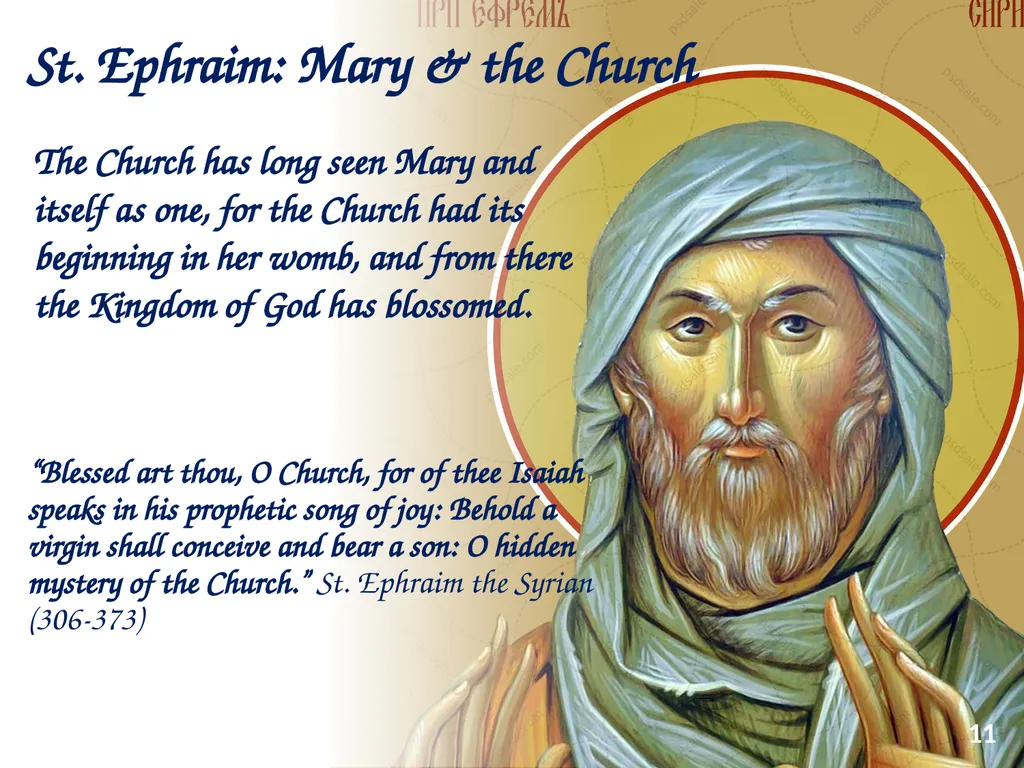
St. Ephraim: Mary & the Church “Blessed art thou, O Church, for of thee Isaiah speaks in his prophetic song of joy: Behold a virgin shall conceive and bear a son: O hidden mystery of the Church.” St. Ephraim the Syrian (306-373) The Church has long seen Mary and itself as one, for the Church had its beginning in her womb, and from there the Kingdom of God has blossomed. 11<br>
12
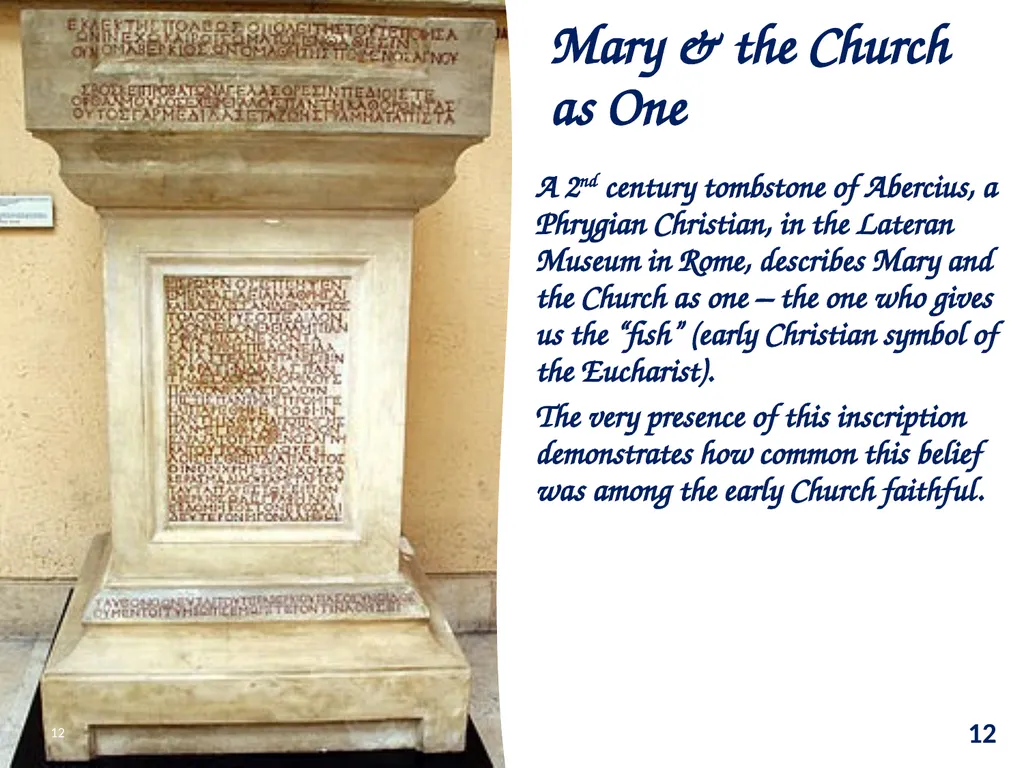
12 A 2nd century tombstone of Abercius, a Phrygian Christian, in the Lateran Museum in Rome, describes Mary and the Church as one – the one who gives us the “fish” (early Christian symbol of the Eucharist).
The very presence of this inscription demonstrates how common this belief was among the early Church faithful. Mary & the Church as One 12<br>
The very presence of this inscription demonstrates how common this belief was among the early Church faithful. Mary & the Church as One 12<br>
13
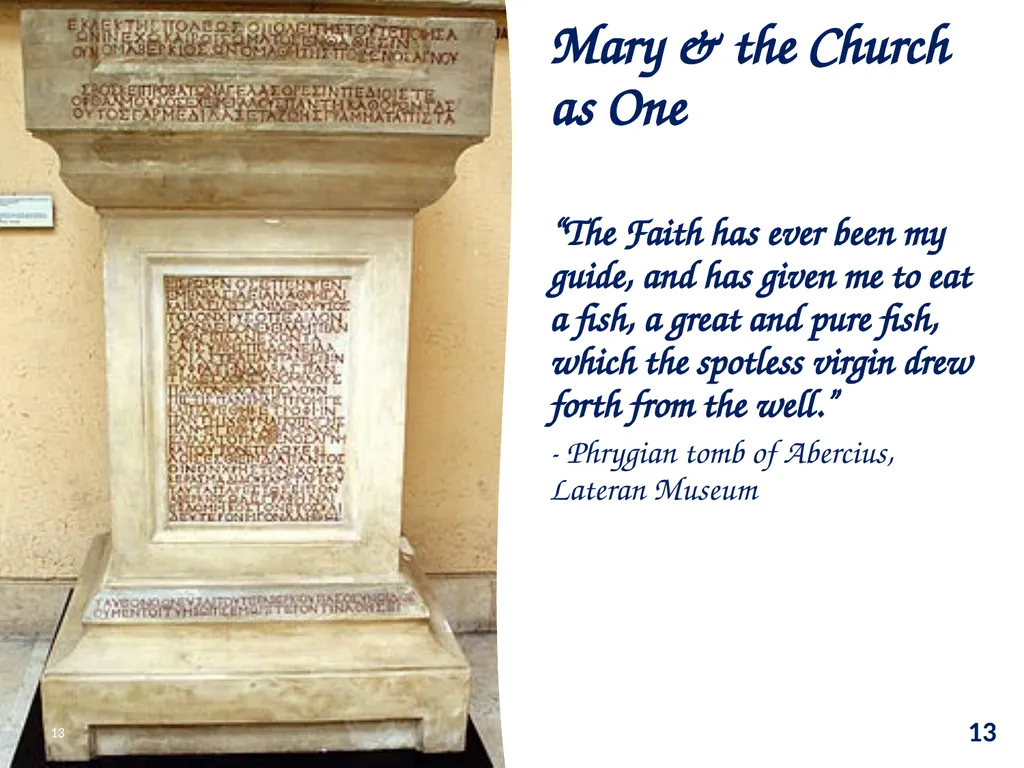
Mary & the Church as One 13 “The Faith has ever been my guide, and has given me to eat a fish, a great and pure fish, which the spotless virgin drew forth from the well.”
- Phrygian tomb of Abercius, Lateran Museum 13<br>
- Phrygian tomb of Abercius, Lateran Museum 13<br>
14
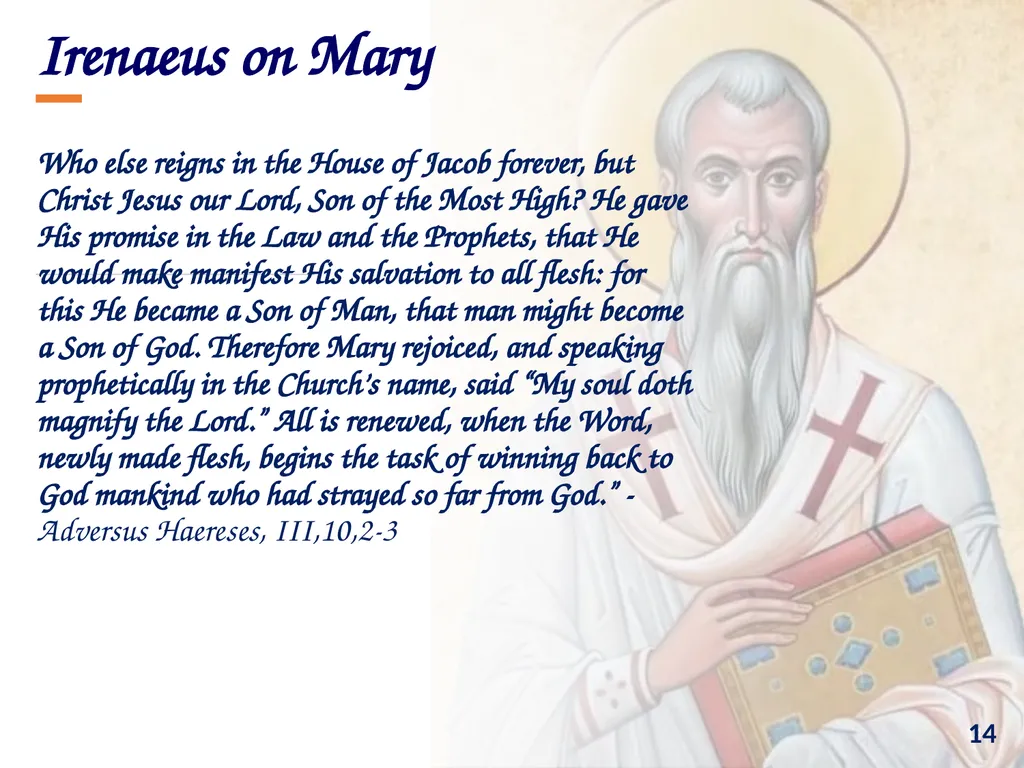
Irenaeus on Mary Who else reigns in the House of Jacob forever, but Christ Jesus our Lord, Son of the Most High? He gave His promise in the Law and the Prophets, that He would make manifest His salvation to all flesh: for this He became a Son of Man, that man might become a Son of God. Therefore Mary rejoiced, and speaking prophetically in the Church’s name, said “My soul doth magnify the Lord.” All is renewed, when the Word, newly made flesh, begins the task of winning back to God mankind who had strayed so far from God.” - Adversus Haereses, III,10,2-3 14 14<br>
15
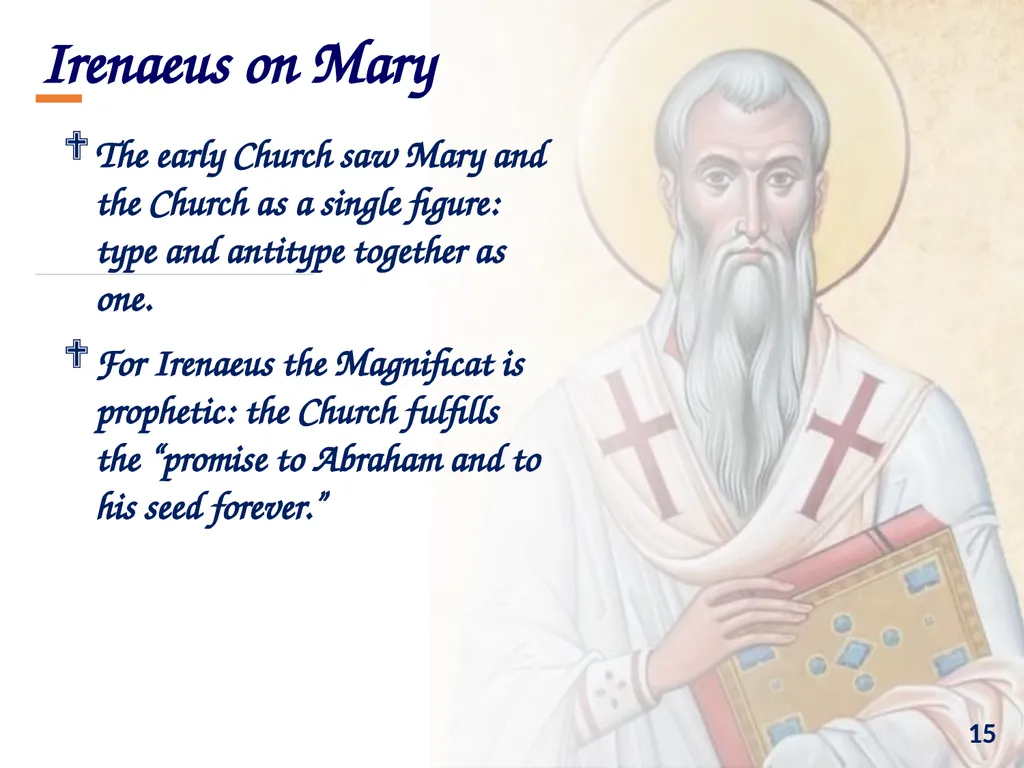
Irenaeus on Mary The early Church saw Mary and the Church as a single figure: type and antitype together as one.
For Irenaeus the Magnificat is prophetic: the Church fulfills the “promise to Abraham and to his seed forever.” 15<br>
For Irenaeus the Magnificat is prophetic: the Church fulfills the “promise to Abraham and to his seed forever.” 15<br>
16
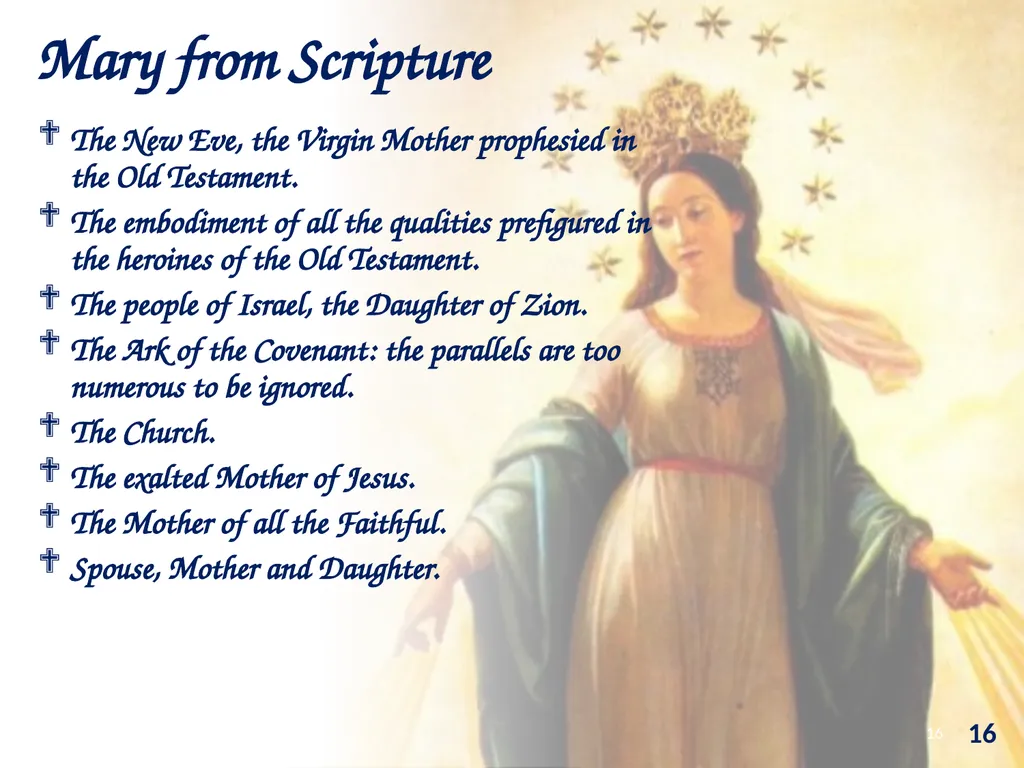
Mary from Scripture The New Eve, the Virgin Mother prophesied in the Old Testament.
The embodiment of all the qualities prefigured in the heroines of the Old Testament.
The people of Israel, the Daughter of Zion.
The Ark of the Covenant: the parallels are too numerous to be ignored.
The Church.
The exalted Mother of Jesus.
The Mother of all the Faithful.
Spouse, Mother and Daughter. 16 16<br>
17
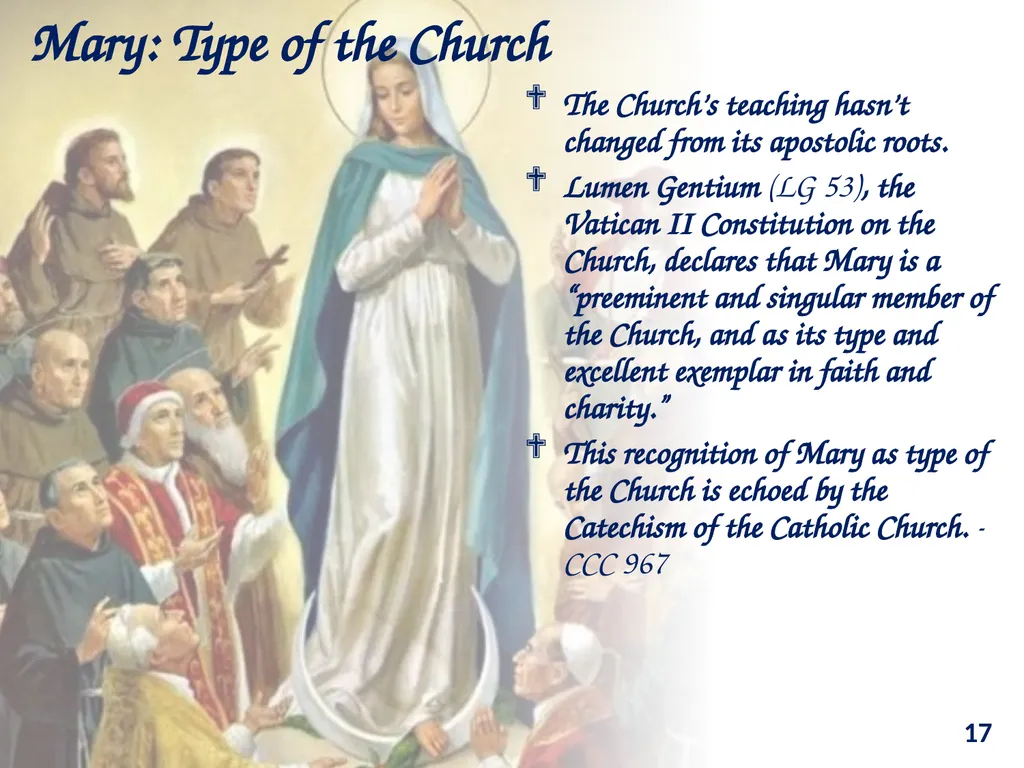
Mary: Type of the Church The Church’s teaching hasn’t changed from its apostolic roots.
Lumen Gentium (LG 53), the Vatican II Constitution on the Church, declares that Mary is a “preeminent and singular member of the Church, and as its type and excellent exemplar in faith and charity.”
This recognition of Mary as type of the Church is echoed by the Catechism of the Catholic Church. - CCC 967 17<br>
18
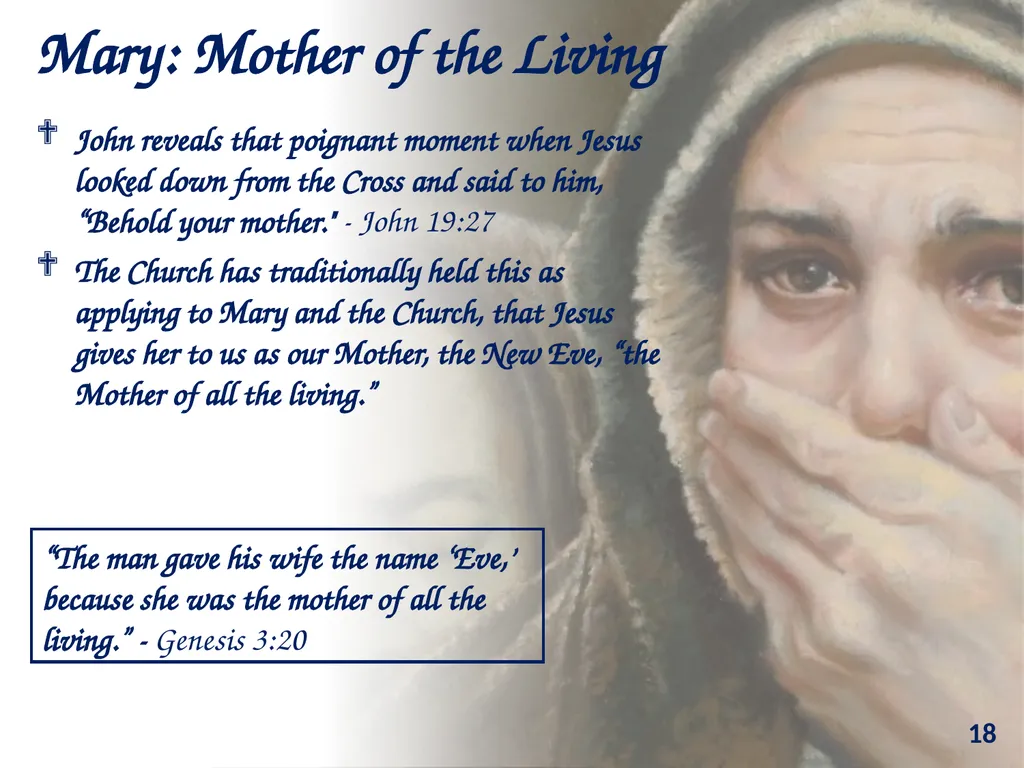
Mary: Mother of the Living John reveals that poignant moment when Jesus looked down from the Cross and said to him, “Behold your mother." - John 19:27
The Church has traditionally held this as applying to Mary and the Church, that Jesus gives her to us as our Mother, the New Eve, “the Mother of all the living.” “The man gave his wife the name ‘Eve,’ because she was the mother of all the living.” - Genesis 3:20 18<br>
The Church has traditionally held this as applying to Mary and the Church, that Jesus gives her to us as our Mother, the New Eve, “the Mother of all the living.” “The man gave his wife the name ‘Eve,’ because she was the mother of all the living.” - Genesis 3:20 18<br>
19
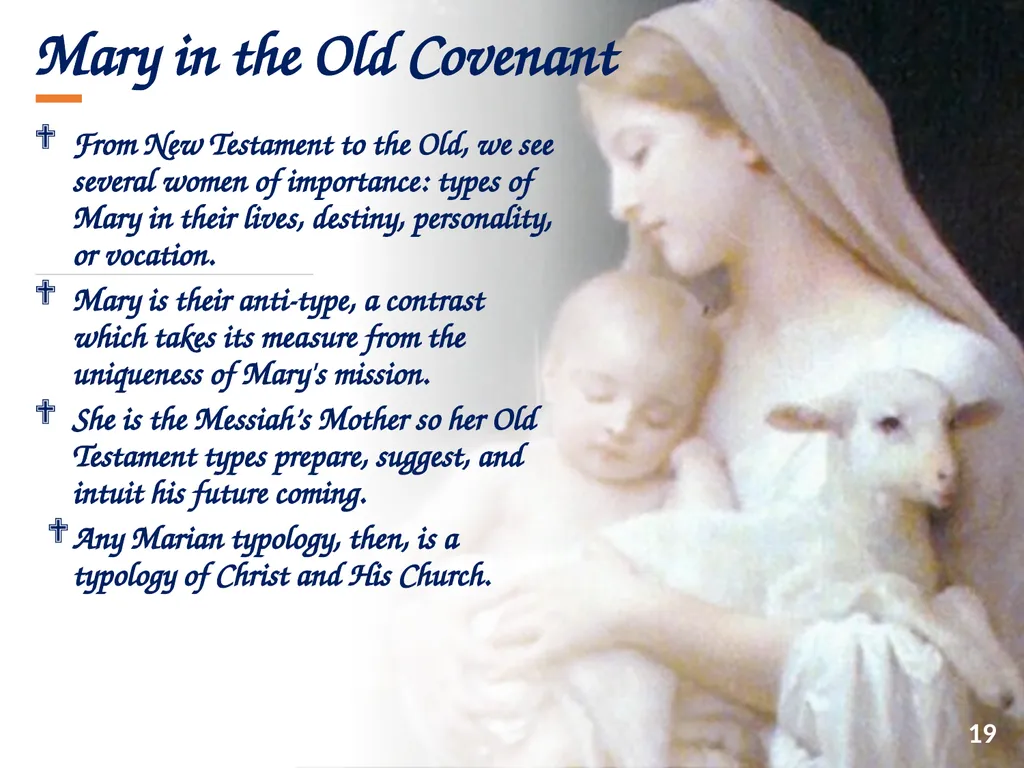
Mary in the Old Covenant From New Testament to the Old, we see several women of importance: types of Mary in their lives, destiny, personality, or vocation.
Mary is their anti-type, a contrast which takes its measure from the uniqueness of Mary's mission.
She is the Messiah’s Mother so her Old Testament types prepare, suggest, and intuit his future coming.
Any Marian typology, then, is a typology of Christ and His Church. 19<br>
Mary is their anti-type, a contrast which takes its measure from the uniqueness of Mary's mission.
She is the Messiah’s Mother so her Old Testament types prepare, suggest, and intuit his future coming.
Any Marian typology, then, is a typology of Christ and His Church. 19<br>
20
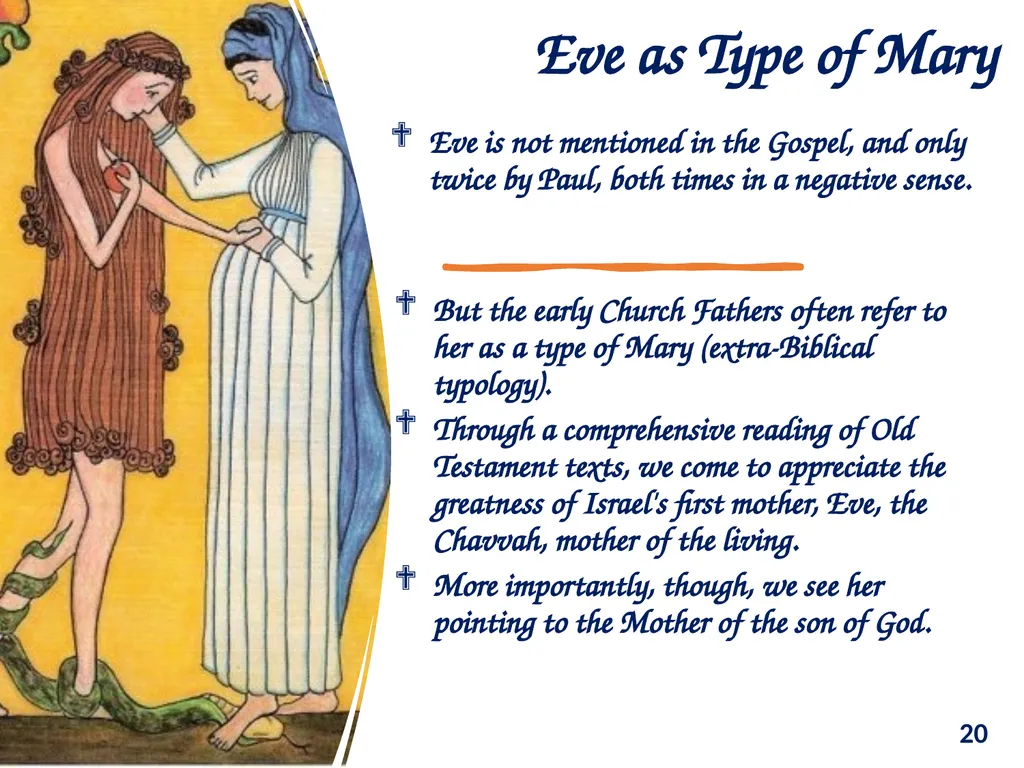
Eve as Type of Mary But the early Church Fathers often refer to her as a type of Mary (extra-Biblical typology).
Through a comprehensive reading of Old Testament texts, we come to appreciate the greatness of Israel's first mother, Eve, the Chavvah, mother of the living.
More importantly, though, we see her pointing to the Mother of the son of God. 20 Eve is not mentioned in the Gospel, and only twice by Paul, both times in a negative sense.<br>
21
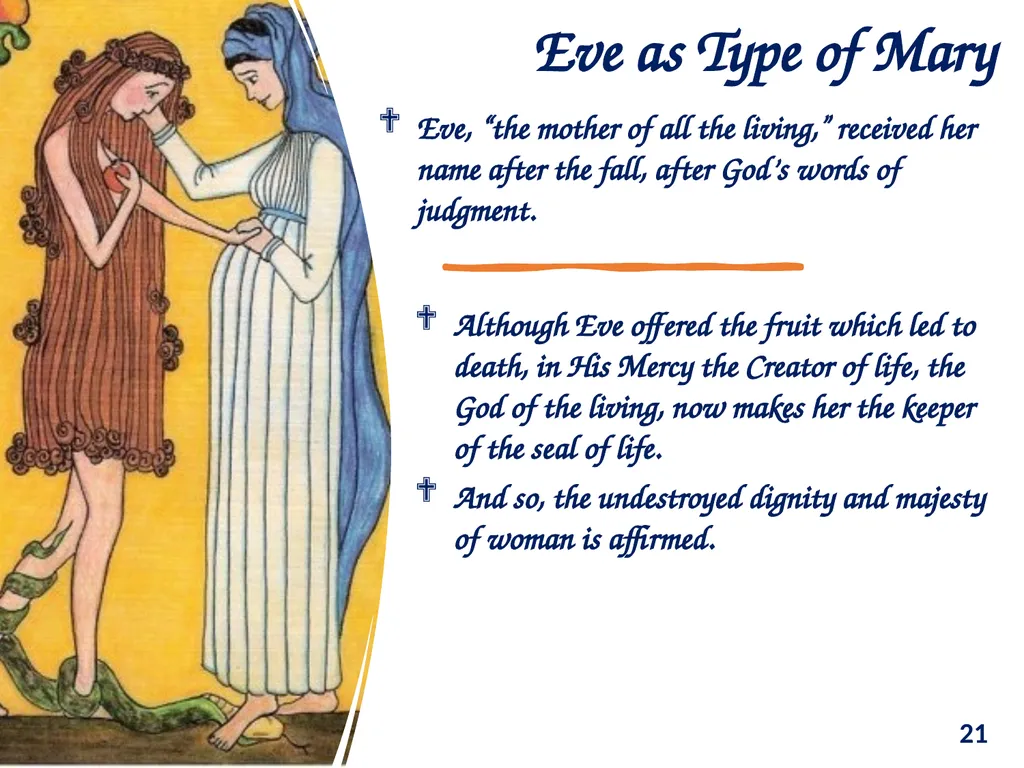
Eve as Type of Mary 21 Although Eve offered the fruit which led to death, in His Mercy the Creator of life, the God of the living, now makes her the keeper of the seal of life.
And so, the undestroyed dignity and majesty of woman is affirmed. Eve, “the mother of all the living,” received her name after the fall, after God’s words of judgment.<br>
And so, the undestroyed dignity and majesty of woman is affirmed. Eve, “the mother of all the living,” received her name after the fall, after God’s words of judgment.<br>
22
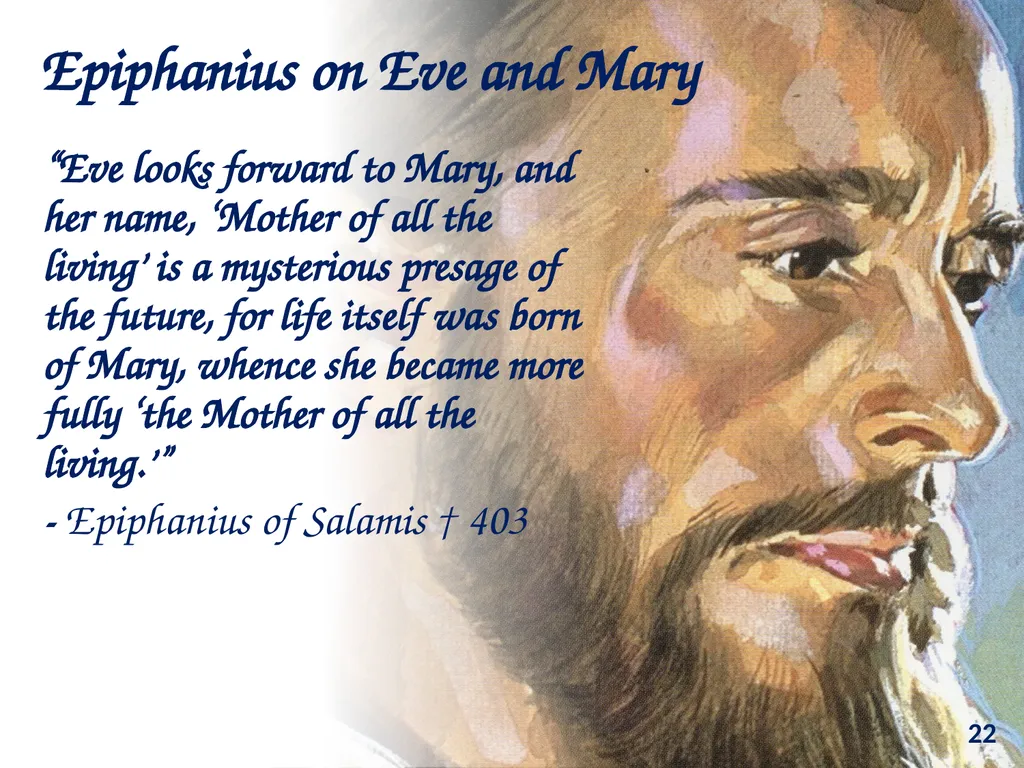
Epiphanius on Eve and Mary “Eve looks forward to Mary, and her name, ‘Mother of all the living’ is a mysterious presage of the future, for life itself was born of Mary, whence she became more fully ‘the Mother of all the living.’”
- Epiphanius of Salamis † 403 22<br>
- Epiphanius of Salamis † 403 22<br>
23
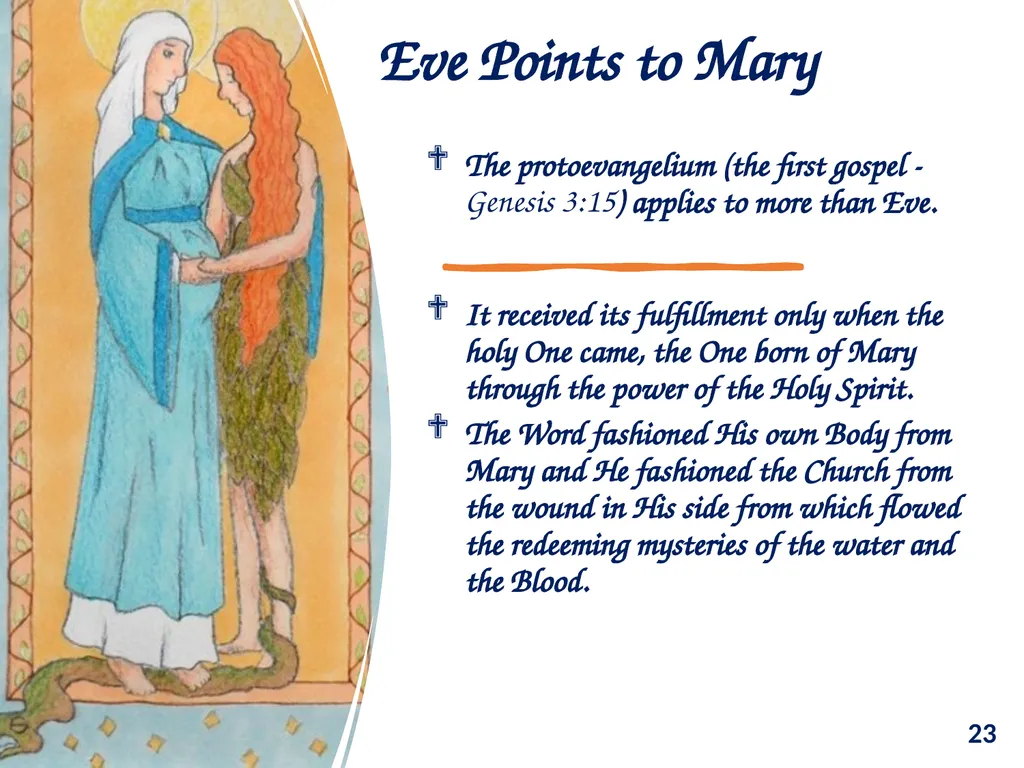
Eve Points to Mary It received its fulfillment only when the holy One came, the One born of Mary through the power of the Holy Spirit.
The Word fashioned His own Body from Mary and He fashioned the Church from the wound in His side from which flowed the redeeming mysteries of the water and the Blood. The protoevangelium (the first gospel - Genesis 3:15) applies to more than Eve. 23<br>
The Word fashioned His own Body from Mary and He fashioned the Church from the wound in His side from which flowed the redeeming mysteries of the water and the Blood. The protoevangelium (the first gospel - Genesis 3:15) applies to more than Eve. 23<br>
24
Mary in God’s Plan: Rejoice! The first word of Gabriel’s greeting – Χαῖρε – is better translated as “Rejoice!” or “Shout for Joy!” than simply as “Hail”
Rarely used in the Old Testament (only 4 times), but always an announcement of messianic joy
Mary’s reason for joy? “The Lord is with thee!” for she will be His Mother 24<br>
Rarely used in the Old Testament (only 4 times), but always an announcement of messianic joy
Mary’s reason for joy? “The Lord is with thee!” for she will be His Mother 24<br>
25
Mary in God’s Plan: Rejoice! “Hail (Rejoice), full of grace, the Lord is with you!
You shall call His name Jesus [Savior]
God will give Him the throne of His father David
Of His kingdom there will be no end
[He] will be called holy, the Son of God
(Lk 1:28,31,32,33,35) 25<br>
You shall call His name Jesus [Savior]
God will give Him the throne of His father David
Of His kingdom there will be no end
[He] will be called holy, the Son of God
(Lk 1:28,31,32,33,35) 25<br>
26
Zephaniah: Daughter Zion Shout for joy, daughter Zion! Sing joyfully, Israel! Be glad and exult with all your heart, daughter Jerusalem! The LORD has removed the judgment against you, he has turned away your enemies; the King of Israel, the Lord, is in your midst, you have no further misfortune to fear.
- Zephaniah 3:14-15 26<br>
- Zephaniah 3:14-15 26<br>
27
Zephaniah: Daughter Zion Zephaniah gives Daughter Zion a double promise and reason to rejoice:
God will come to save.
He will come to dwell in her.
Gabriel shows the fulfillment of these promises in Mary:
Jesus comes to save.
The Lord, the Son of God, is with her.
Daughter Zion, then, is seen as a type of Mary. 27<br>
God will come to save.
He will come to dwell in her.
Gabriel shows the fulfillment of these promises in Mary:
Jesus comes to save.
The Lord, the Son of God, is with her.
Daughter Zion, then, is seen as a type of Mary. 27<br>
28
The Bridal People of God The “Daughter Zion” prophecy, directed at Mary, is fulfilled by Gabriel’s words and Mary’s fiat – her acceptance of the Word.
She is now “Daughter Zion” in person; and is the bridal people of God, the Church.
The Church learns what it is meant to be by looking to Mary.
Why does the Church exist? To be the dwelling for God in the world – prefigured by the desert Sanctuary and Temple – yet God Incarnate dwelt first in Mary. 28<br>
29
The Bridal People of God Luke offers a subtle comparison between Mary and Abraham:
The promised son.
The climbing of the mount to witness the sacrifice.
Isaac’s rescue and the Resurrection.
Abraham as “Father of believers” and Mary as “Mother of believers.”
But Mary stands at the beginning of a new people 29<br>
The promised son.
The climbing of the mount to witness the sacrifice.
Isaac’s rescue and the Resurrection.
Abraham as “Father of believers” and Mary as “Mother of believers.”
But Mary stands at the beginning of a new people 29<br>
30
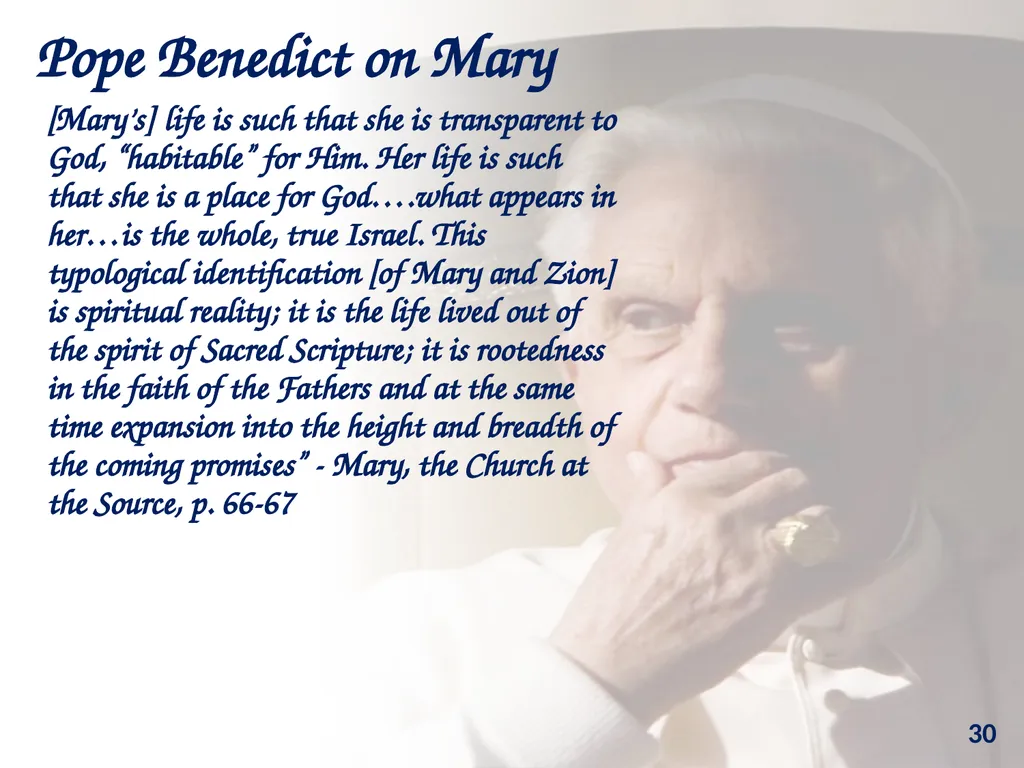
Pope Benedict on Mary [Mary’s] life is such that she is transparent to God, “habitable” for Him. Her life is such that she is a place for God….what appears in her…is the whole, true Israel. This typological identification [of Mary and Zion] is spiritual reality; it is the life lived out of the spirit of Sacred Scripture; it is rootedness in the faith of the Fathers and at the same time expansion into the height and breadth of the coming promises” - Mary, the Church at the Source, p. 66-67 30<br>
31
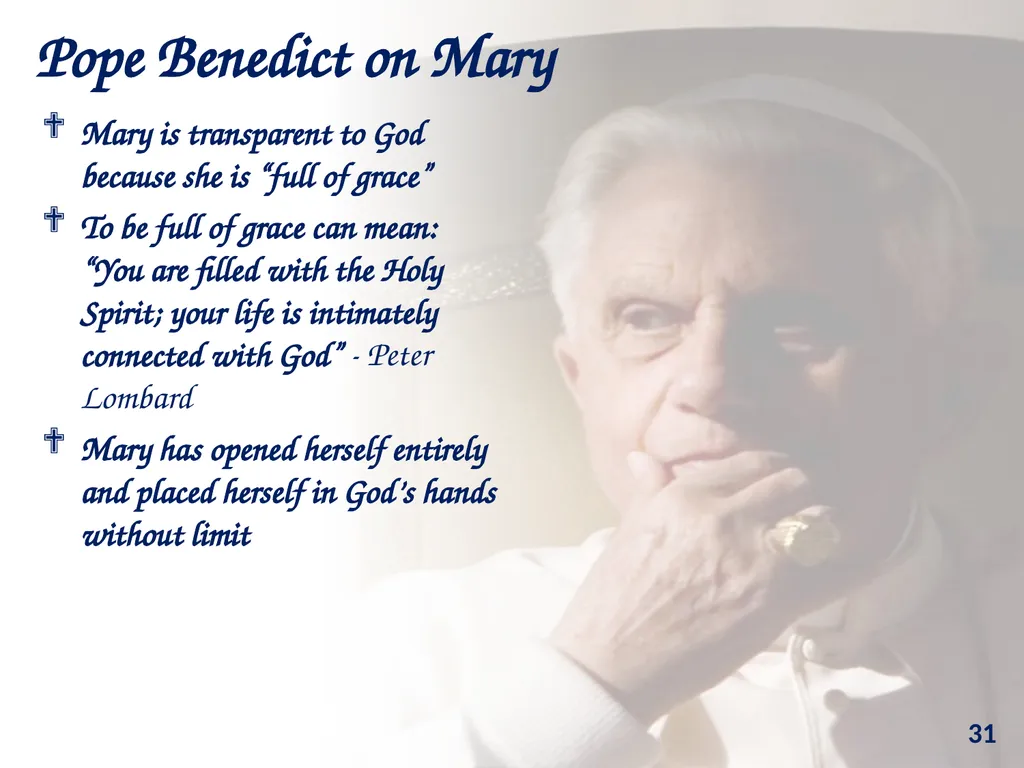
Pope Benedict on Mary Mary is transparent to God because she is “full of grace”
To be full of grace can mean: “You are filled with the Holy Spirit; your life is intimately connected with God” - Peter Lombard
Mary has opened herself entirely and placed herself in God’s hands without limit 31<br>
To be full of grace can mean: “You are filled with the Holy Spirit; your life is intimately connected with God” - Peter Lombard
Mary has opened herself entirely and placed herself in God’s hands without limit 31<br>
32
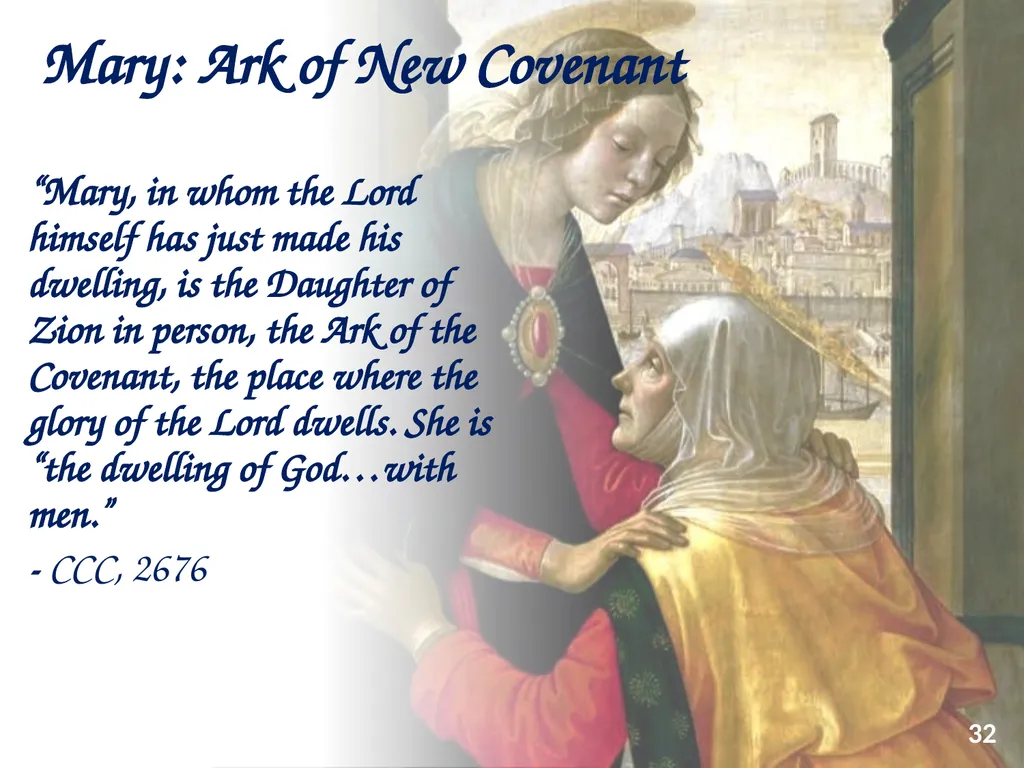
Mary: Ark of New Covenant “Mary, in whom the Lord himself has just made his dwelling, is the Daughter of Zion in person, the Ark of the Covenant, the place where the glory of the Lord dwells. She is “the dwelling of God…with men.”
- CCC, 2676 32<br>
- CCC, 2676 32<br>
33
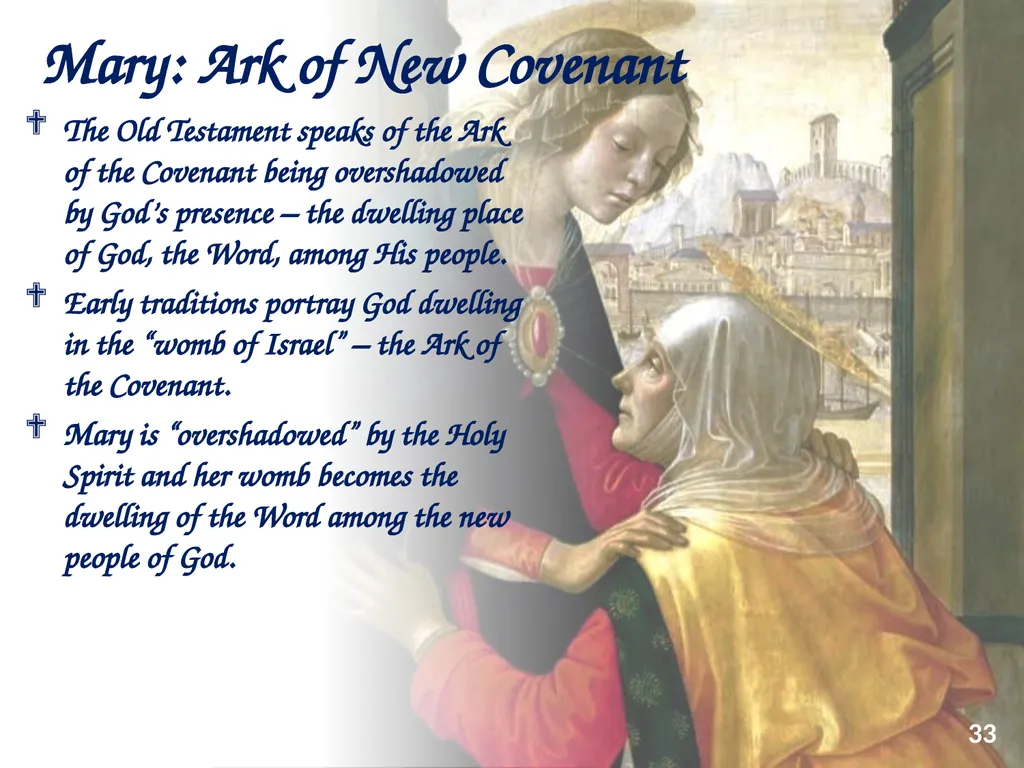
Mary: Ark of New Covenant The Old Testament speaks of the Ark of the Covenant being overshadowed by God’s presence – the dwelling place of God, the Word, among His people.
Early traditions portray God dwelling in the “womb of Israel” – the Ark of the Covenant.
Mary is “overshadowed” by the Holy Spirit and her womb becomes the dwelling of the Word among the new people of God. 33<br>
Early traditions portray God dwelling in the “womb of Israel” – the Ark of the Covenant.
Mary is “overshadowed” by the Holy Spirit and her womb becomes the dwelling of the Word among the new people of God. 33<br>
34
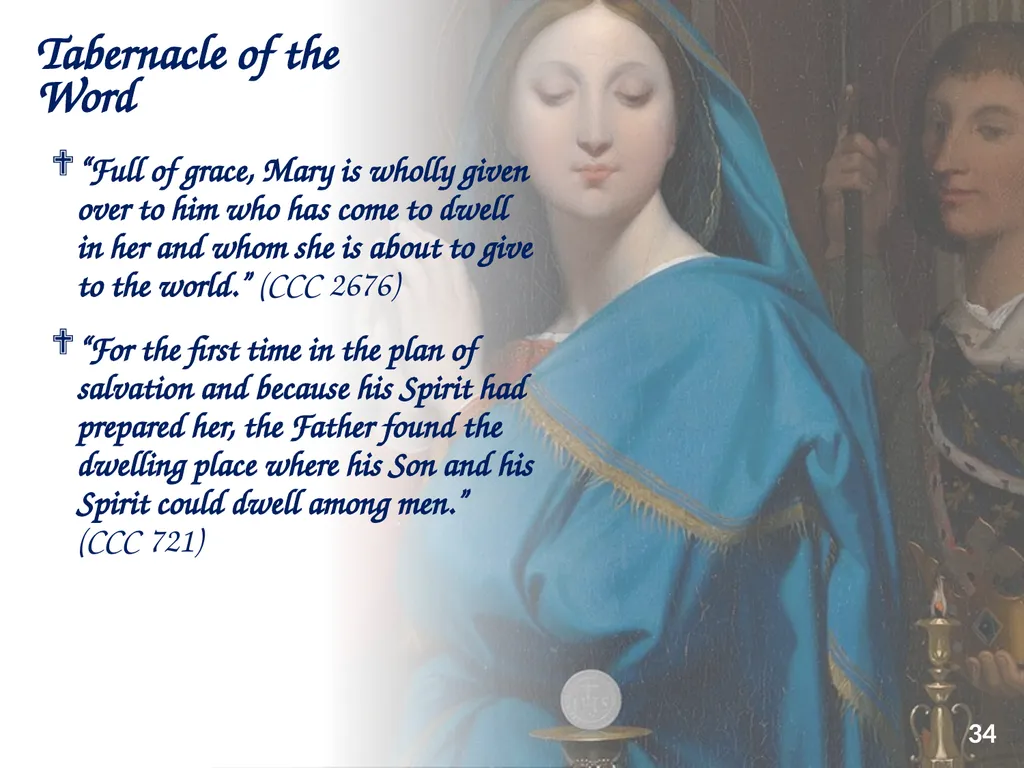
Tabernacle of the Word “Full of grace, Mary is wholly given over to him who has come to dwell in her and whom she is about to give to the world.” (CCC 2676)
“For the first time in the plan of salvation and because his Spirit had prepared her, the Father found the dwelling place where his Son and his Spirit could dwell among men.” (CCC 721) 34<br>
“For the first time in the plan of salvation and because his Spirit had prepared her, the Father found the dwelling place where his Son and his Spirit could dwell among men.” (CCC 721) 34<br>
35
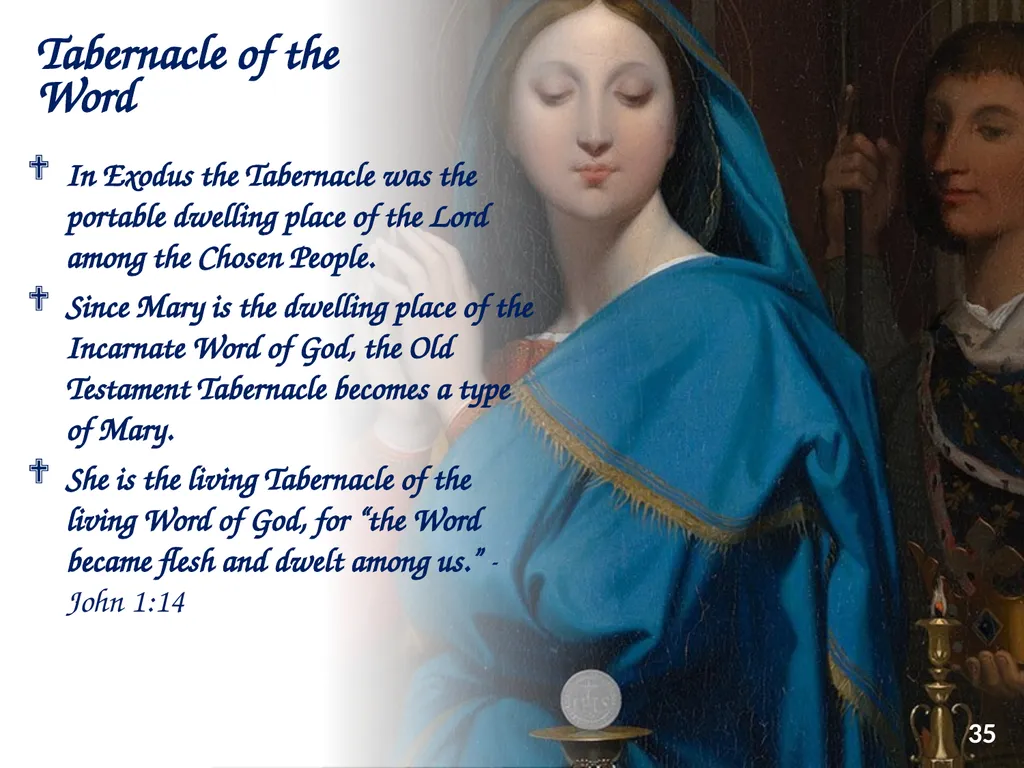
Tabernacle of the Word In Exodus the Tabernacle was the portable dwelling place of the Lord among the Chosen People.
Since Mary is the dwelling place of the Incarnate Word of God, the Old Testament Tabernacle becomes a type of Mary.
She is the living Tabernacle of the living Word of God, for “the Word became flesh and dwelt among us.” - John 1:14 35<br>
Since Mary is the dwelling place of the Incarnate Word of God, the Old Testament Tabernacle becomes a type of Mary.
She is the living Tabernacle of the living Word of God, for “the Word became flesh and dwelt among us.” - John 1:14 35<br>
36
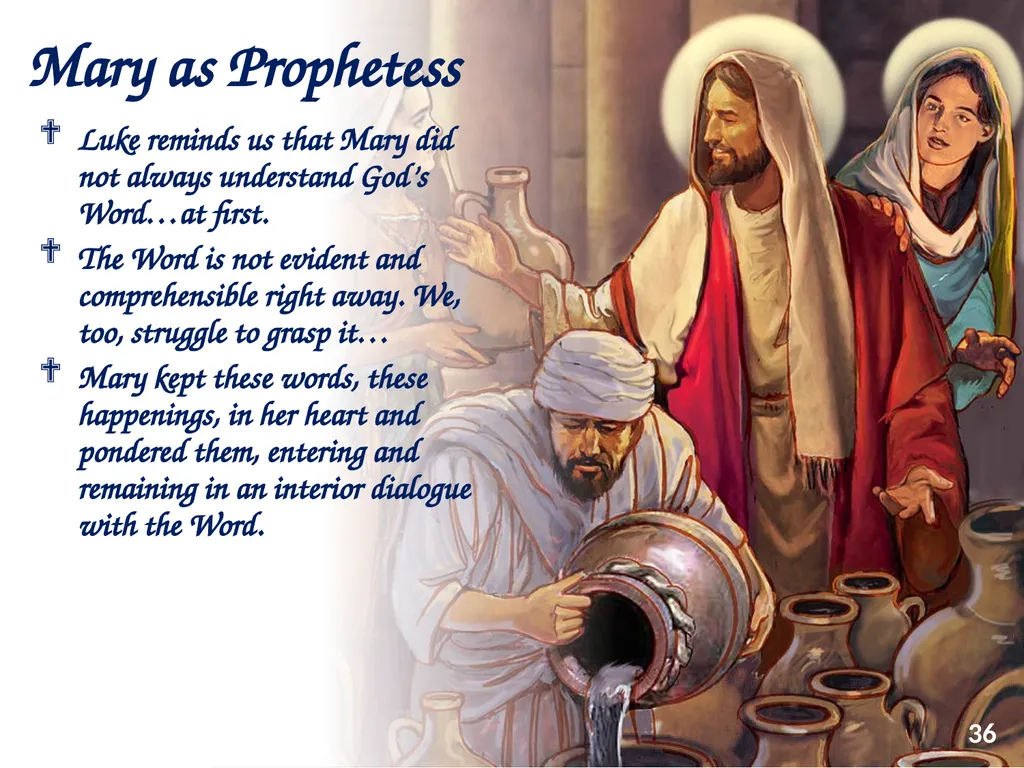
Mary as Prophetess Luke reminds us that Mary did not always understand God’s Word…at first.
The Word is not evident and comprehensible right away. We, too, struggle to grasp it…
Mary kept these words, these happenings, in her heart and pondered them, entering and remaining in an interior dialogue with the Word. 36<br>
The Word is not evident and comprehensible right away. We, too, struggle to grasp it…
Mary kept these words, these happenings, in her heart and pondered them, entering and remaining in an interior dialogue with the Word. 36<br>
37
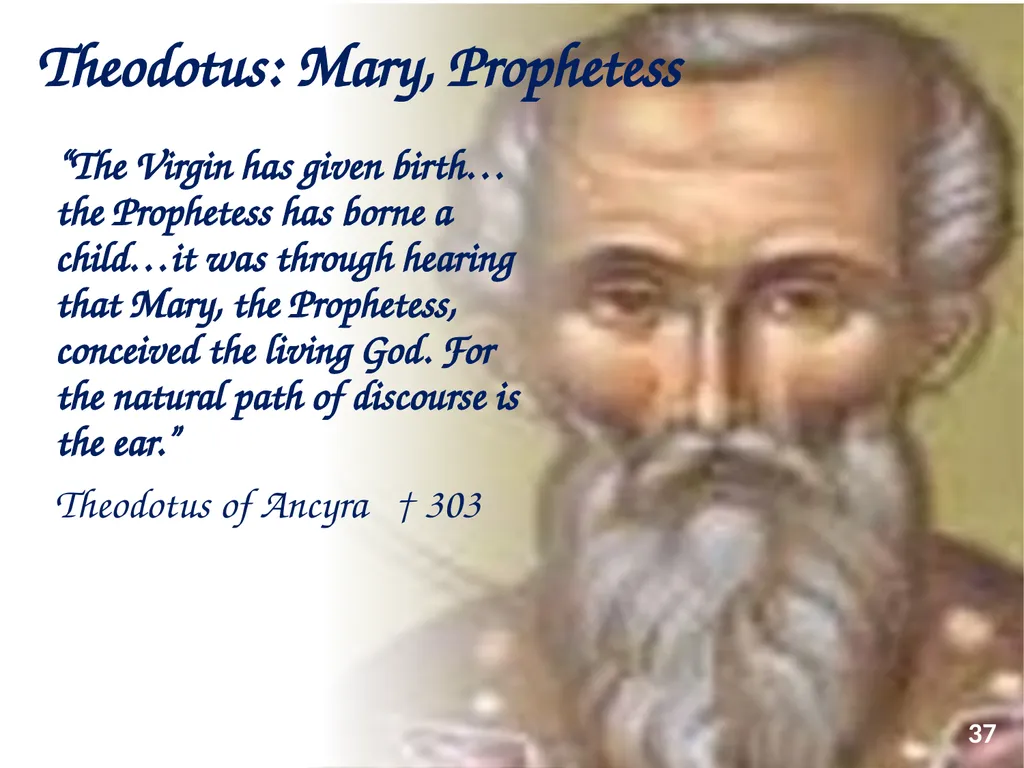
Theodotus: Mary, Prophetess “The Virgin has given birth…the Prophetess has borne a child…it was through hearing that Mary, the Prophetess, conceived the living God. For the natural path of discourse is the ear.”
Theodotus of Ancyra † 303 37<br>
Theodotus of Ancyra † 303 37<br>
38
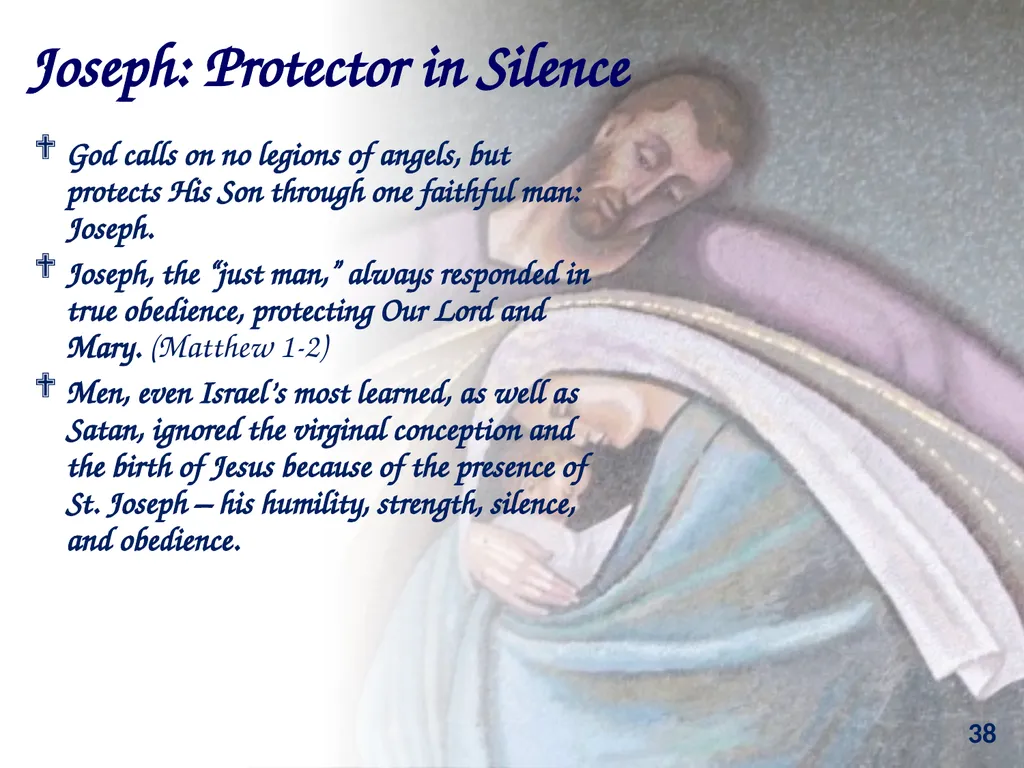
Joseph: Protector in Silence God calls on no legions of angels, but protects His Son through one faithful man: Joseph.
Joseph, the “just man,” always responded in true obedience, protecting Our Lord and Mary. (Matthew 1-2)
Men, even Israel’s most learned, as well as Satan, ignored the virginal conception and the birth of Jesus because of the presence of St. Joseph – his humility, strength, silence, and obedience. 38<br>
39
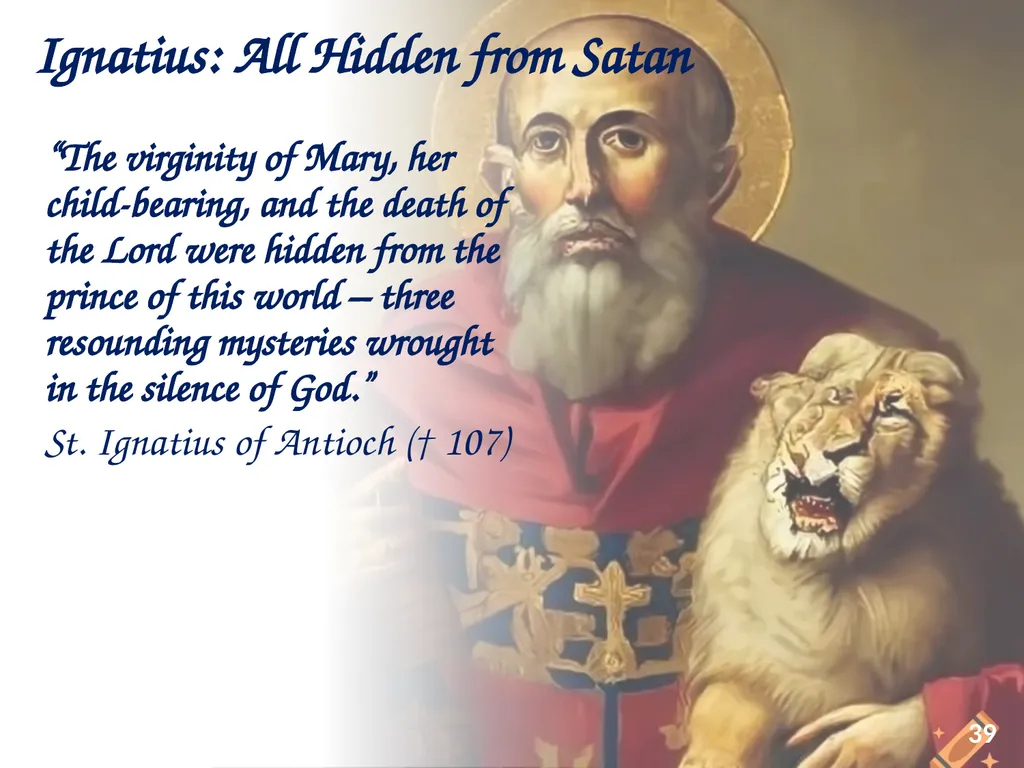
Ignatius: All Hidden from Satan “The virginity of Mary, her child-bearing, and the death of the Lord were hidden from the prince of this world – three resounding mysteries wrought in the silence of God.”
St. Ignatius of Antioch († 107) 39<br>
St. Ignatius of Antioch († 107) 39<br>
40
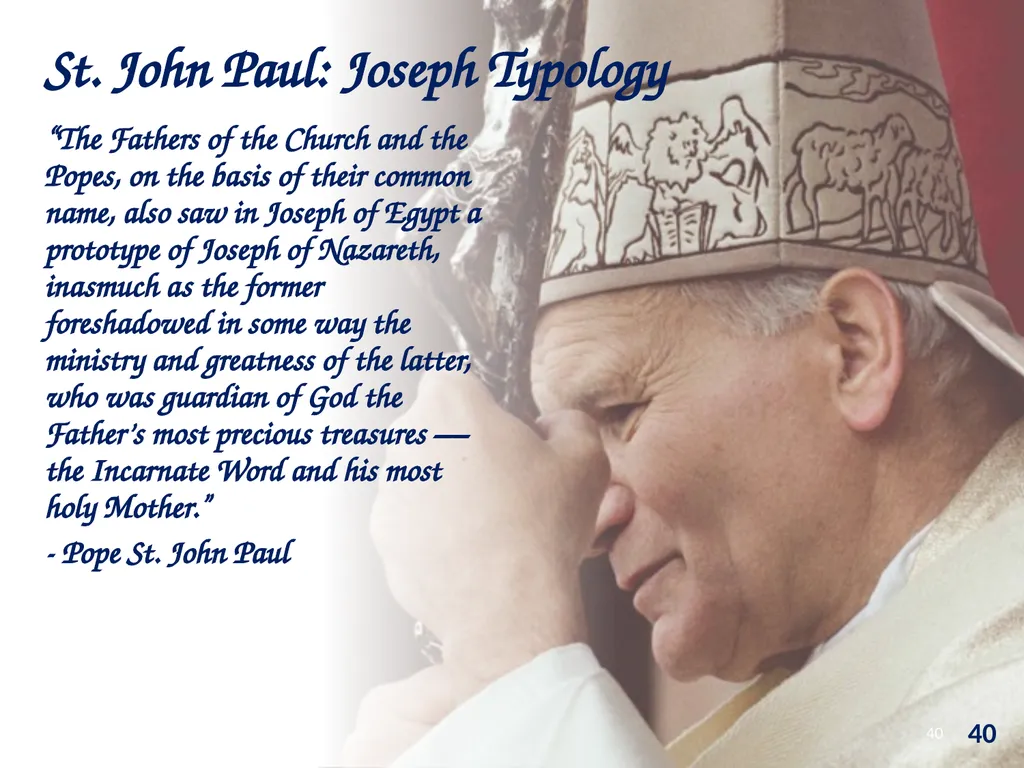
St. John Paul: Joseph Typology “The Fathers of the Church and the Popes, on the basis of their common name, also saw in Joseph of Egypt a prototype of Joseph of Nazareth, inasmuch as the former foreshadowed in some way the ministry and greatness of the latter, who was guardian of God the Father’s most precious treasures — the Incarnate Word and his most holy Mother.”
- Pope St. John Paul 40 40<br>
- Pope St. John Paul 40 40<br>
41
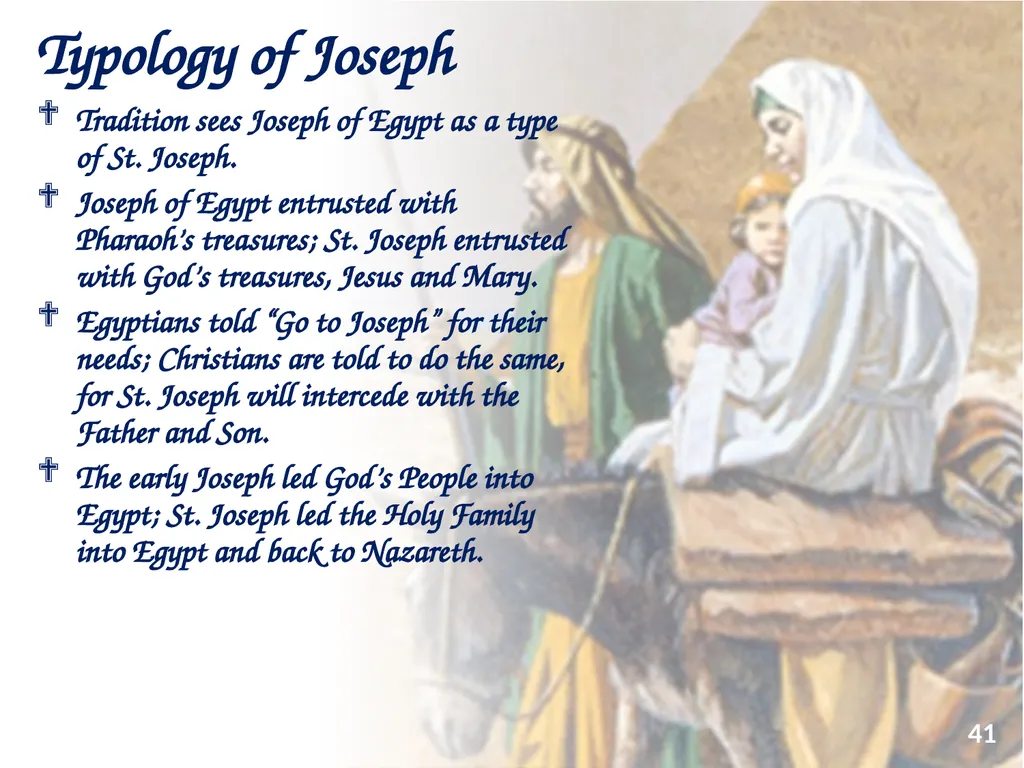
Typology of Joseph Tradition sees Joseph of Egypt as a type of St. Joseph.
Joseph of Egypt entrusted with Pharaoh’s treasures; St. Joseph entrusted with God’s treasures, Jesus and Mary.
Egyptians told “Go to Joseph” for their needs; Christians are told to do the same, for St. Joseph will intercede with the Father and Son.
The early Joseph led God’s People into Egypt; St. Joseph led the Holy Family into Egypt and back to Nazareth. 41<br>
42
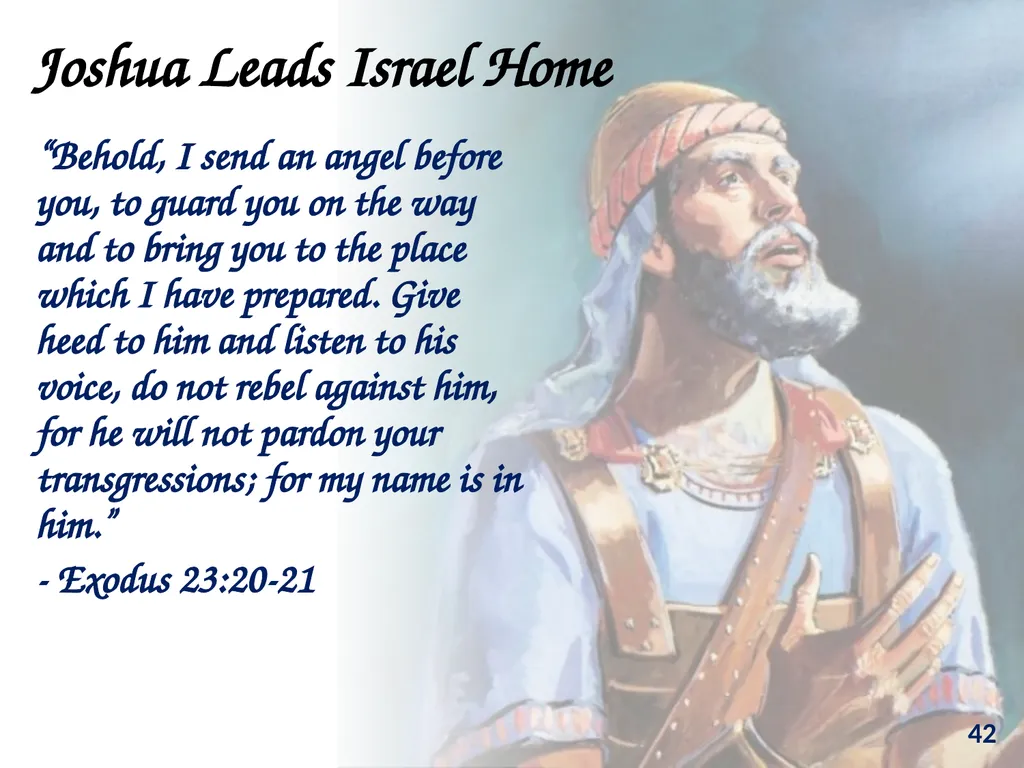
Joshua Leads Israel Home “Behold, I send an angel before you, to guard you on the way and to bring you to the place which I have prepared. Give heed to him and listen to his voice, do not rebel against him, for he will not pardon your transgressions; for my name is in him.”
- Exodus 23:20-21 42<br>
- Exodus 23:20-21 42<br>
43
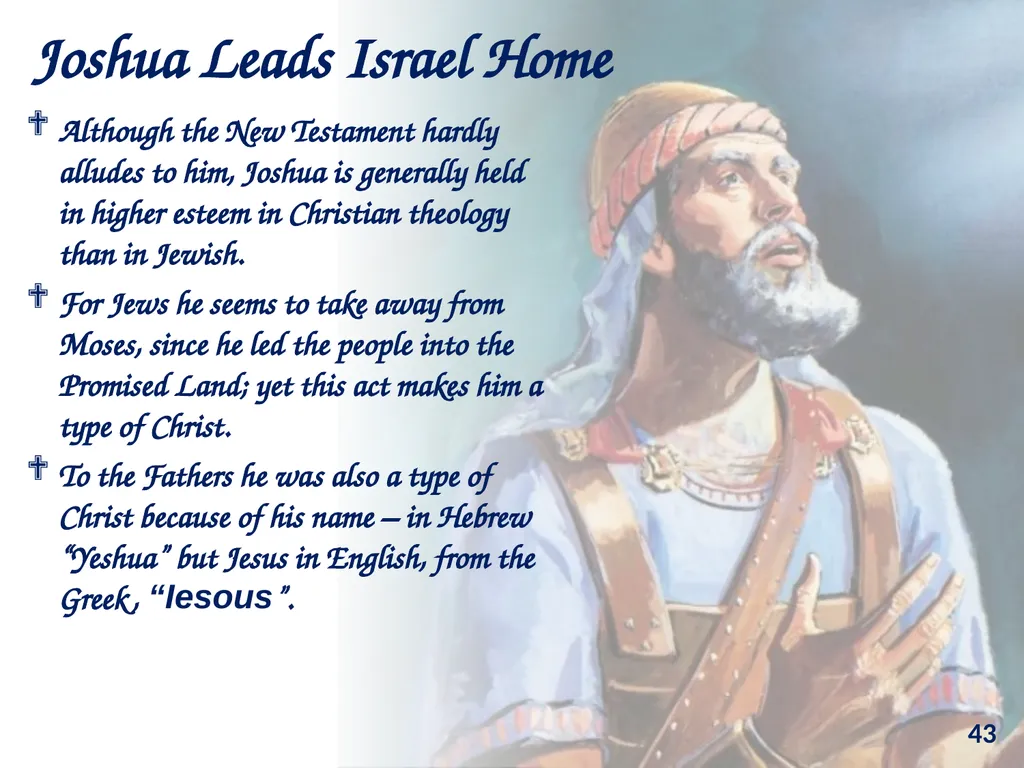
Joshua Leads Israel Home Although the New Testament hardly alludes to him, Joshua is generally held in higher esteem in Christian theology than in Jewish.
For Jews he seems to take away from Moses, since he led the people into the Promised Land; yet this act makes him a type of Christ.
To the Fathers he was also a type of Christ because of his name – in Hebrew “Yeshua” but Jesus in English, from the Greek, “Iesous”. 43<br>
For Jews he seems to take away from Moses, since he led the people into the Promised Land; yet this act makes him a type of Christ.
To the Fathers he was also a type of Christ because of his name – in Hebrew “Yeshua” but Jesus in English, from the Greek, “Iesous”. 43<br>
44
Justin Martyr on Joshua “Who then is he who led your fathers into this land? Understand that he is called by the name Jesus…for if you understand this, you shall also understand that the name of him who said to Moses, for my name is in him, was Jesus.”
- St. Justin Martyr 44<br>
- St. Justin Martyr 44<br>
45
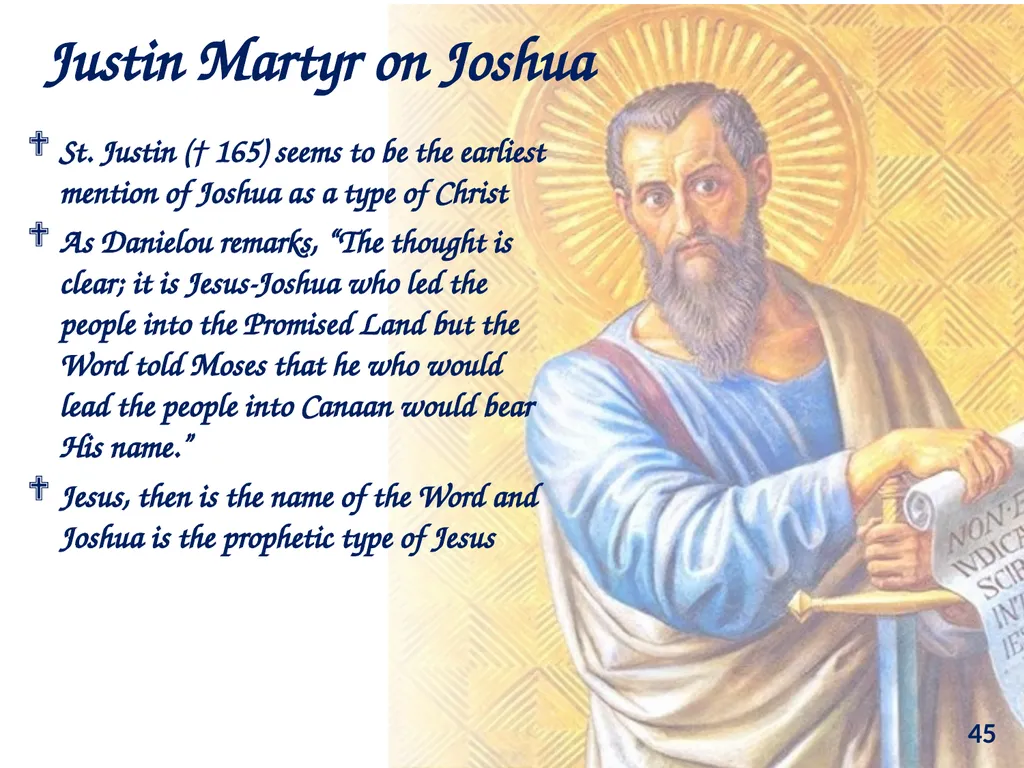
Justin Martyr on Joshua St. Justin († 165) seems to be the earliest mention of Joshua as a type of Christ
As Danielou remarks, “The thought is clear; it is Jesus-Joshua who led the people into the Promised Land but the Word told Moses that he who would lead the people into Canaan would bear His name.”
Jesus, then is the name of the Word and Joshua is the prophetic type of Jesus 45<br>
As Danielou remarks, “The thought is clear; it is Jesus-Joshua who led the people into the Promised Land but the Word told Moses that he who would lead the people into Canaan would bear His name.”
Jesus, then is the name of the Word and Joshua is the prophetic type of Jesus 45<br>
46
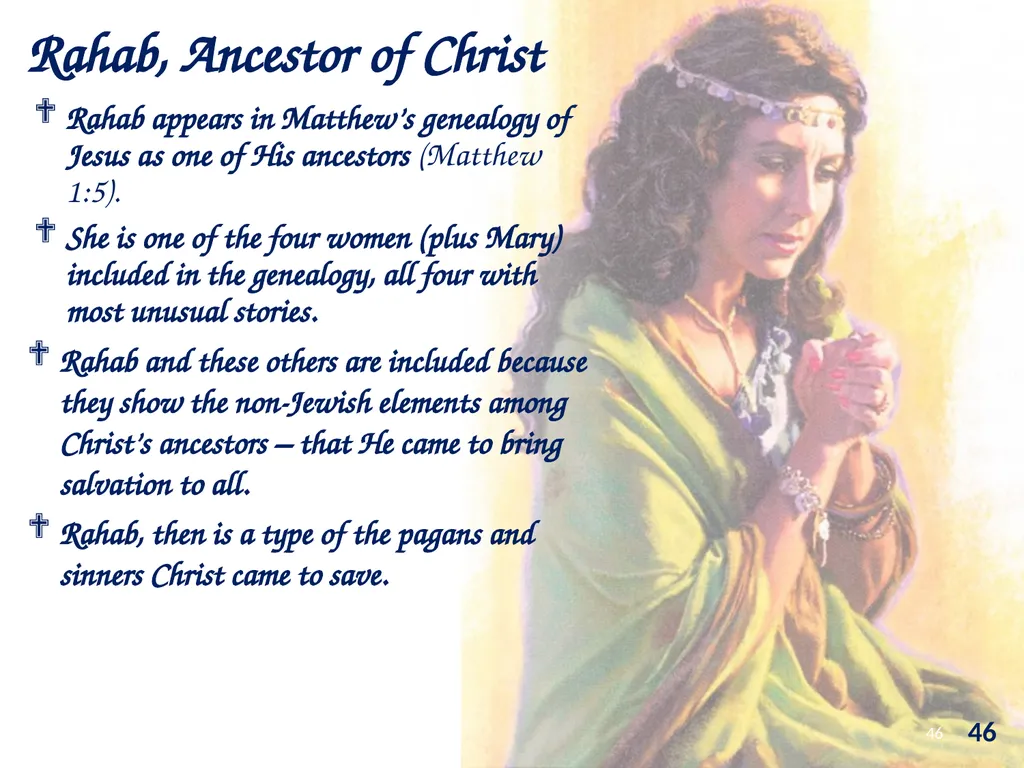
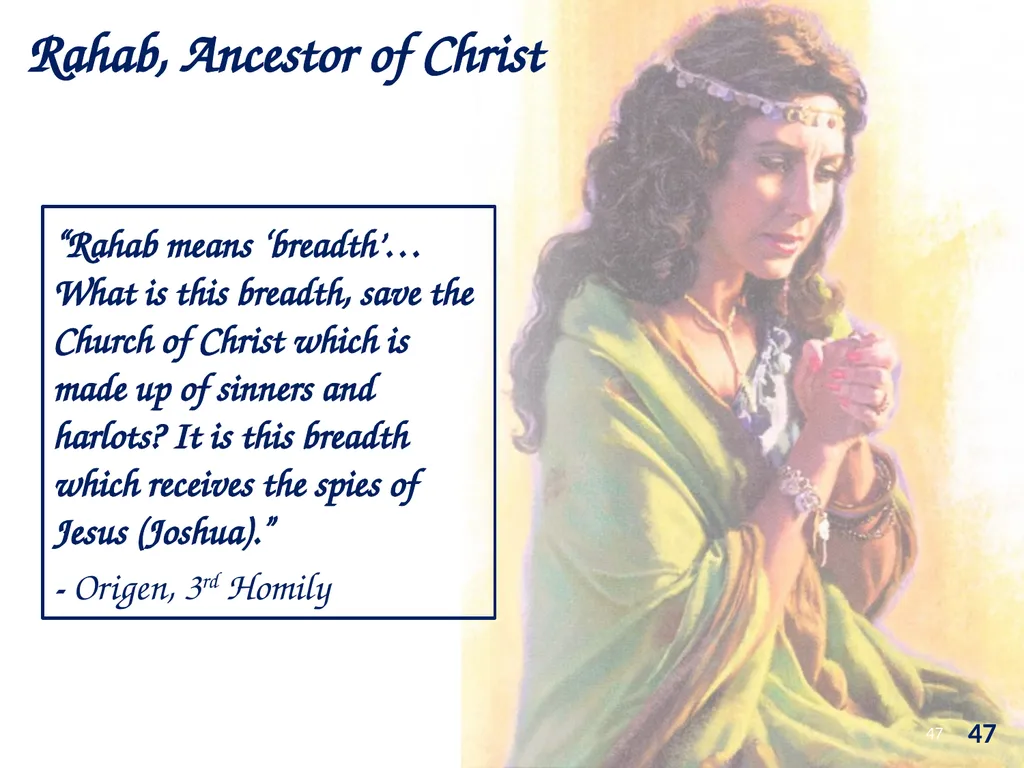
Rahab, Ancestor of Christ Rahab appears in Matthew’s genealogy of Jesus as one of His ancestors (Matthew 1:5).
She is one of the four women (plus Mary) included in the genealogy, all four with most unusual stories.
Rahab and these others are included because they show the non-Jewish elements among Christ’s ancestors – that He came to bring salvation to all.
Rahab, then is a type of the pagans and sinners Christ came to save. 46 46<br>
47
Rahab, Ancestor of Christ 47 “Rahab means ‘breadth’… What is this breadth, save the Church of Christ which is made up of sinners and harlots? It is this breadth which receives the spies of Jesus (Joshua).”
- Origen, 3rd Homily 47<br>
- Origen, 3rd Homily 47<br>
48
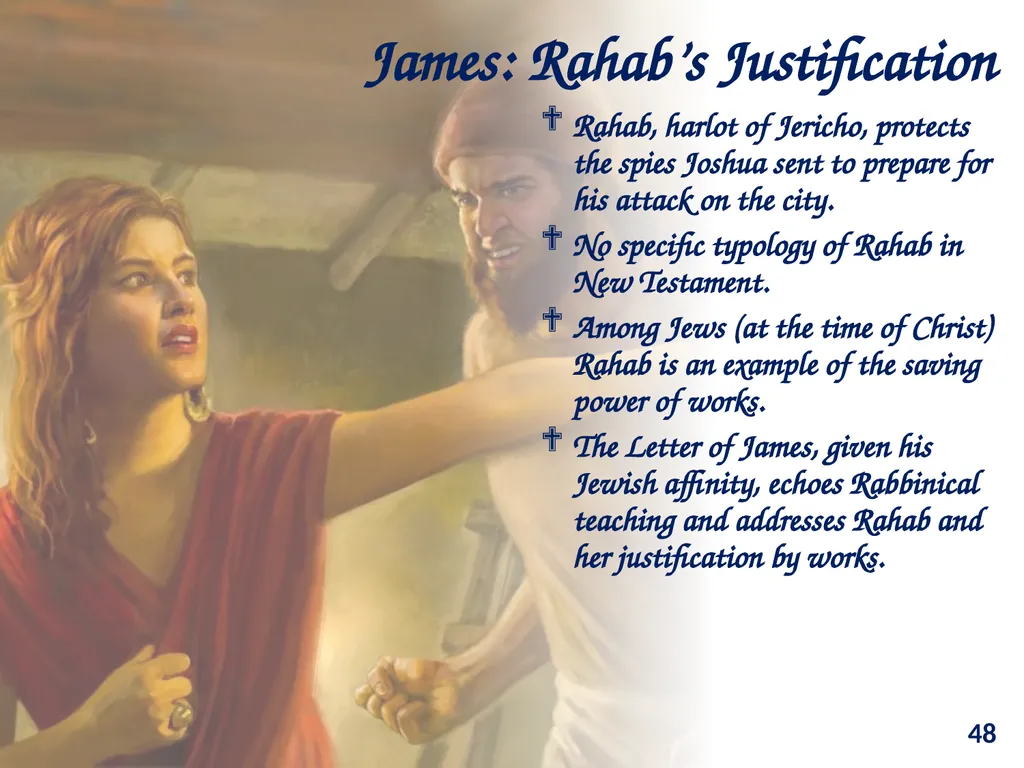
James: Rahab’s Justification Rahab, harlot of Jericho, protects the spies Joshua sent to prepare for his attack on the city.
No specific typology of Rahab in New Testament.
Among Jews (at the time of Christ) Rahab is an example of the saving power of works.
The Letter of James, given his Jewish affinity, echoes Rabbinical teaching and addresses Rahab and her justification by works. 48<br>
No specific typology of Rahab in New Testament.
Among Jews (at the time of Christ) Rahab is an example of the saving power of works.
The Letter of James, given his Jewish affinity, echoes Rabbinical teaching and addresses Rahab and her justification by works. 48<br>
49
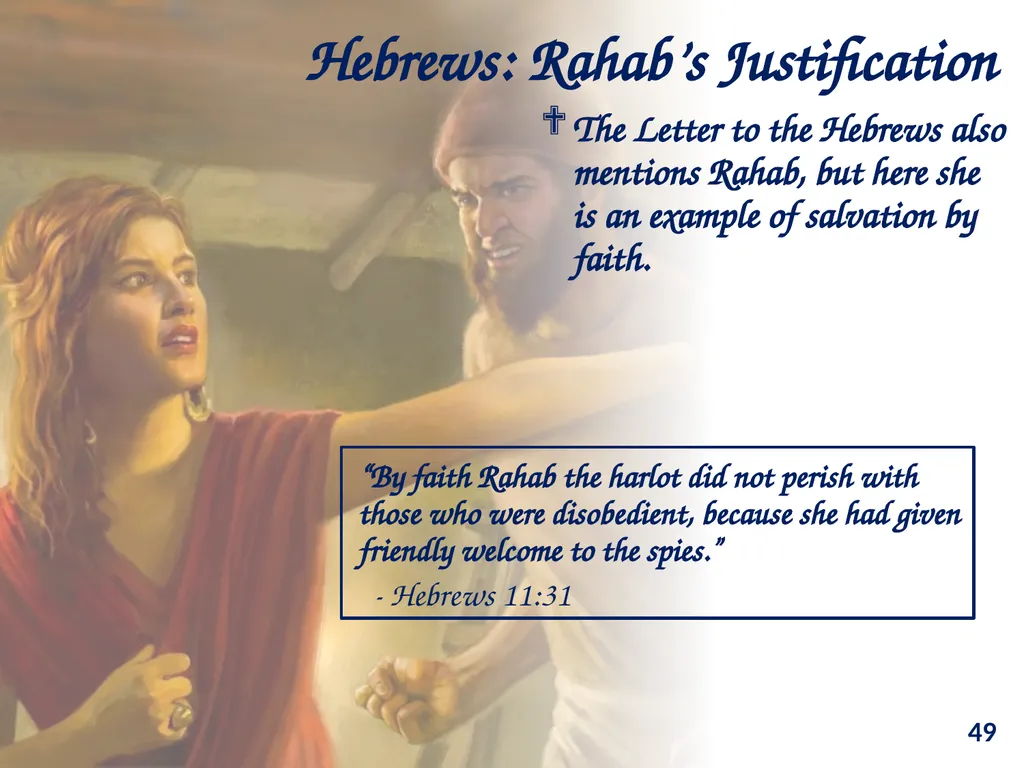
Hebrews: Rahab’s Justification The Letter to the Hebrews also mentions Rahab, but here she is an example of salvation by faith. 49 “By faith Rahab the harlot did not perish with those who were disobedient, because she had given friendly welcome to the spies.”
- Hebrews 11:31<br>
- Hebrews 11:31<br>
50
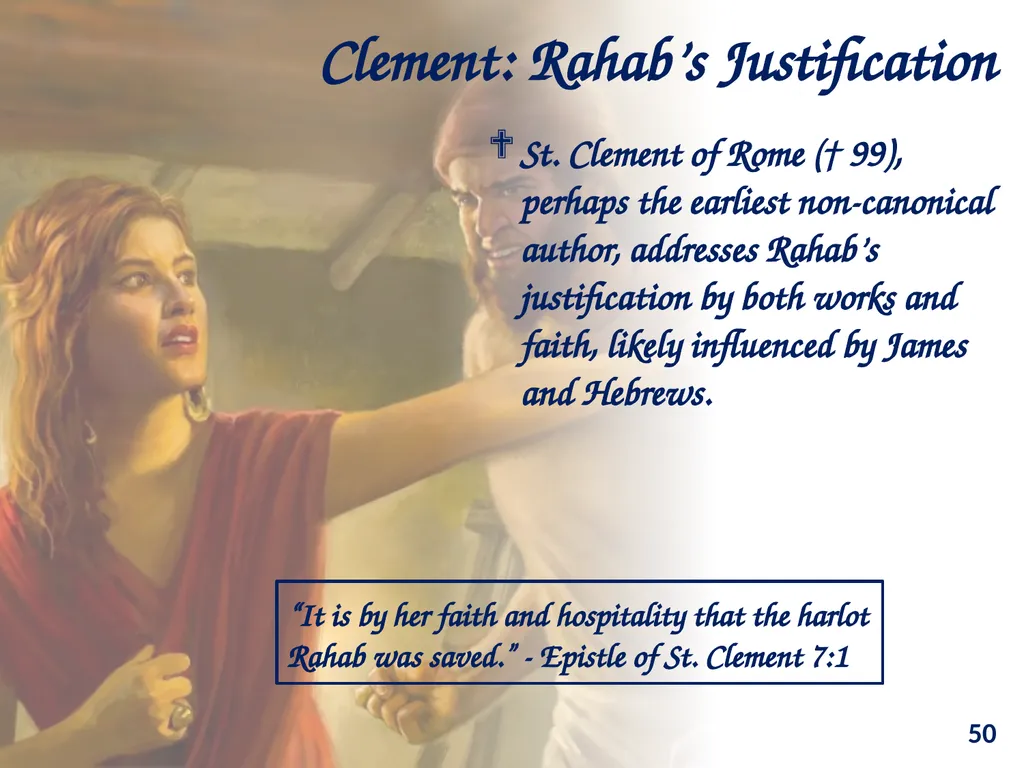
Clement: Rahab’s Justification St. Clement of Rome († 99), perhaps the earliest non-canonical author, addresses Rahab’s justification by both works and faith, likely influenced by James and Hebrews. “It is by her faith and hospitality that the harlot Rahab was saved.” - Epistle of St. Clement 7:1 50<br>
51
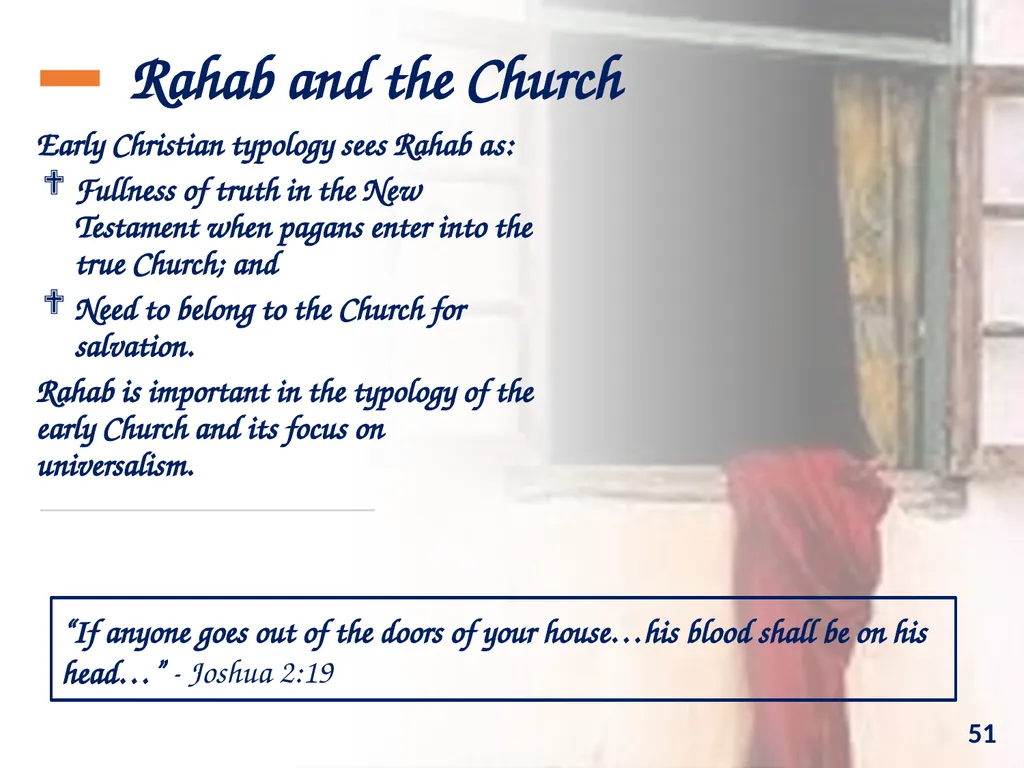
51 Rahab and the Church Early Christian typology sees Rahab as:
Fullness of truth in the New Testament when pagans enter into the true Church; and
Need to belong to the Church for salvation.
Rahab is important in the typology of the early Church and its focus on universalism. “If anyone goes out of the doors of your house…his blood shall be on his head…” - Joshua 2:19 51<br>
52
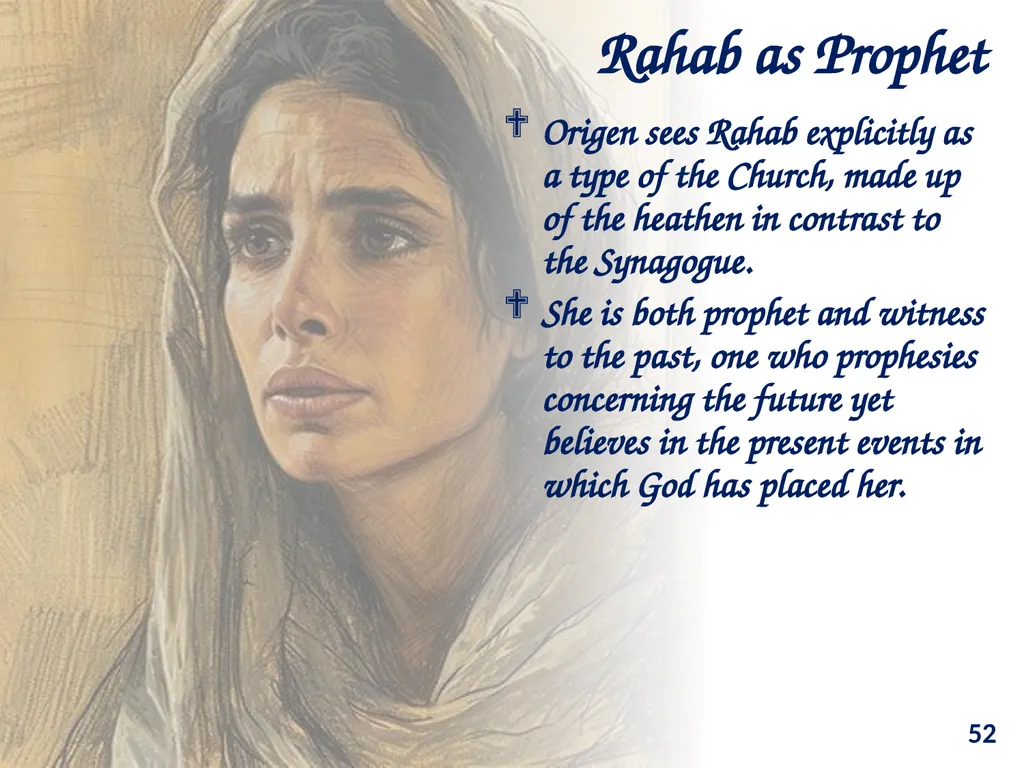
Rahab as Prophet Origen sees Rahab explicitly as a type of the Church, made up of the heathen in contrast to the Synagogue.
She is both prophet and witness to the past, one who prophesies concerning the future yet believes in the present events in which God has placed her. 52<br>
She is both prophet and witness to the past, one who prophesies concerning the future yet believes in the present events in which God has placed her. 52<br>
53
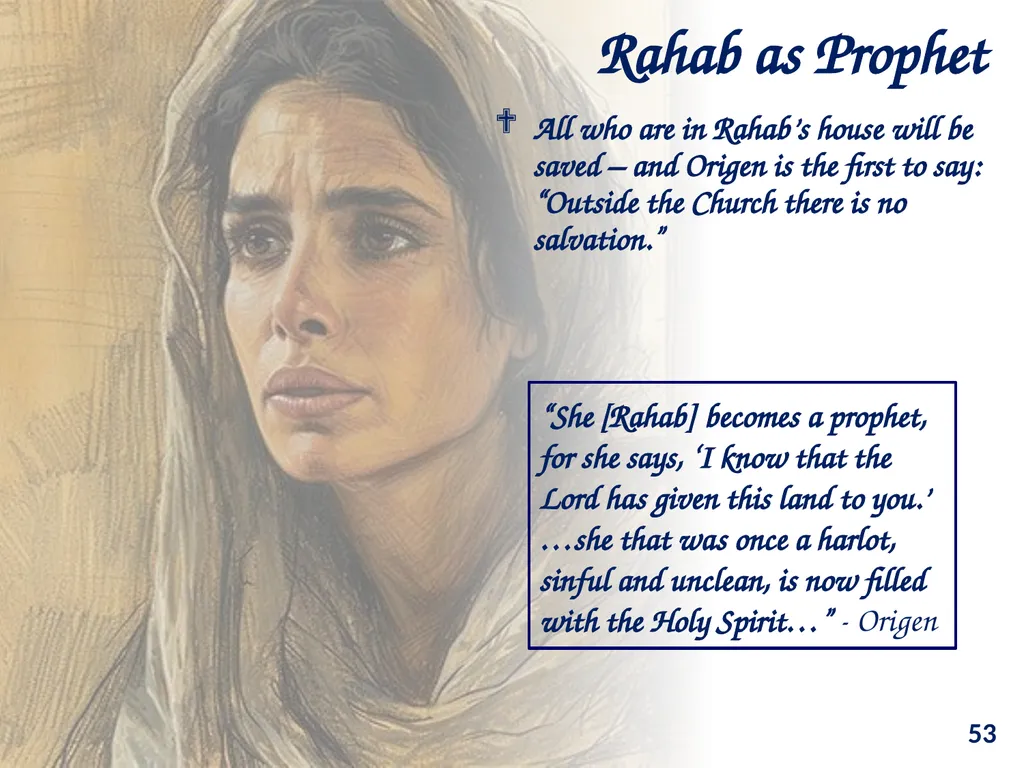
Rahab as Prophet All who are in Rahab’s house will be saved – and Origen is the first to say: “Outside the Church there is no salvation.” “She [Rahab] becomes a prophet, for she says, ‘I know that the Lord has given this land to you.’ …she that was once a harlot, sinful and unclean, is now filled with the Holy Spirit…” - Origen 53<br>
54
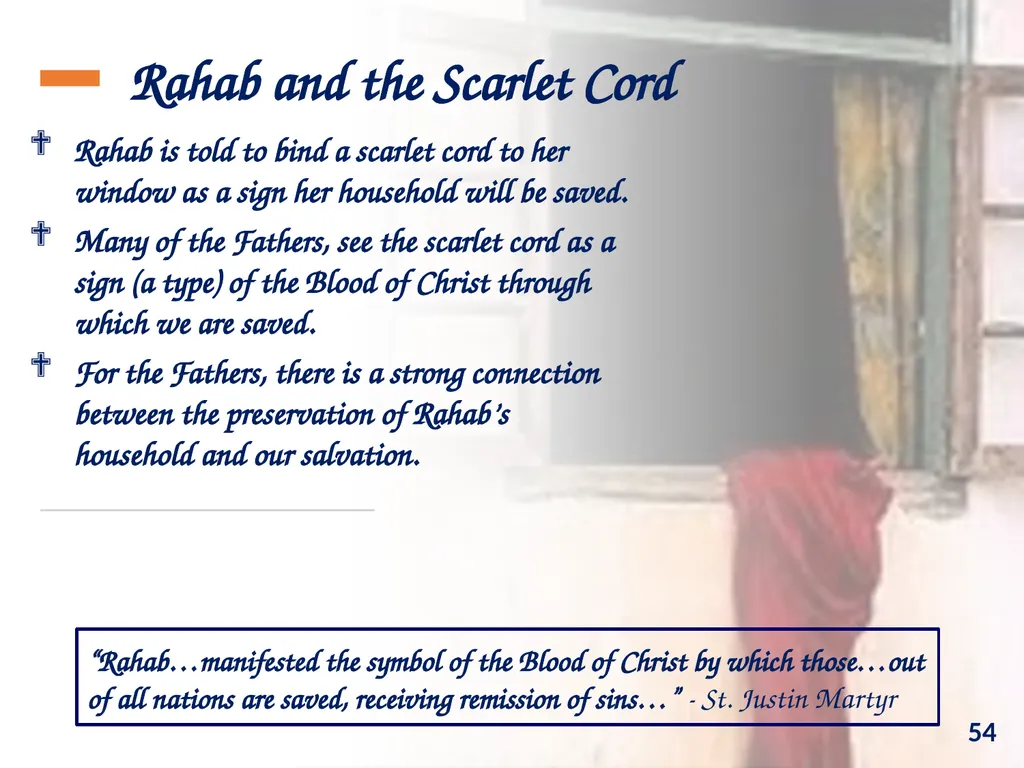
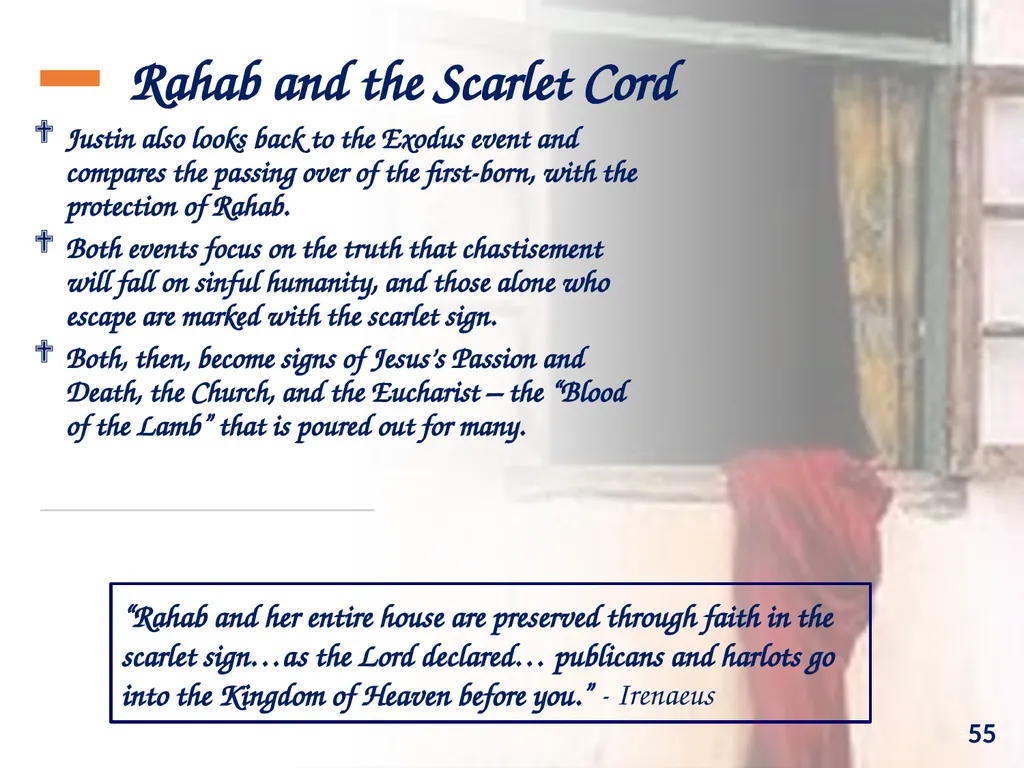
54 Rahab and the Scarlet Cord Rahab is told to bind a scarlet cord to her window as a sign her household will be saved.
Many of the Fathers, see the scarlet cord as a sign (a type) of the Blood of Christ through which we are saved.
For the Fathers, there is a strong connection between the preservation of Rahab’s household and our salvation. “Rahab…manifested the symbol of the Blood of Christ by which those…out of all nations are saved, receiving remission of sins…” - St. Justin Martyr 54<br>
55
55 Rahab and the Scarlet Cord Justin also looks back to the Exodus event and compares the passing over of the first-born, with the protection of Rahab.
Both events focus on the truth that chastisement will fall on sinful humanity, and those alone who escape are marked with the scarlet sign.
Both, then, become signs of Jesus’s Passion and Death, the Church, and the Eucharist – the “Blood of the Lamb” that is poured out for many. “Rahab and her entire house are preserved through faith in the scarlet sign…as the Lord declared… publicans and harlots go into the Kingdom of Heaven before you.” - Irenaeus 55<br>
56
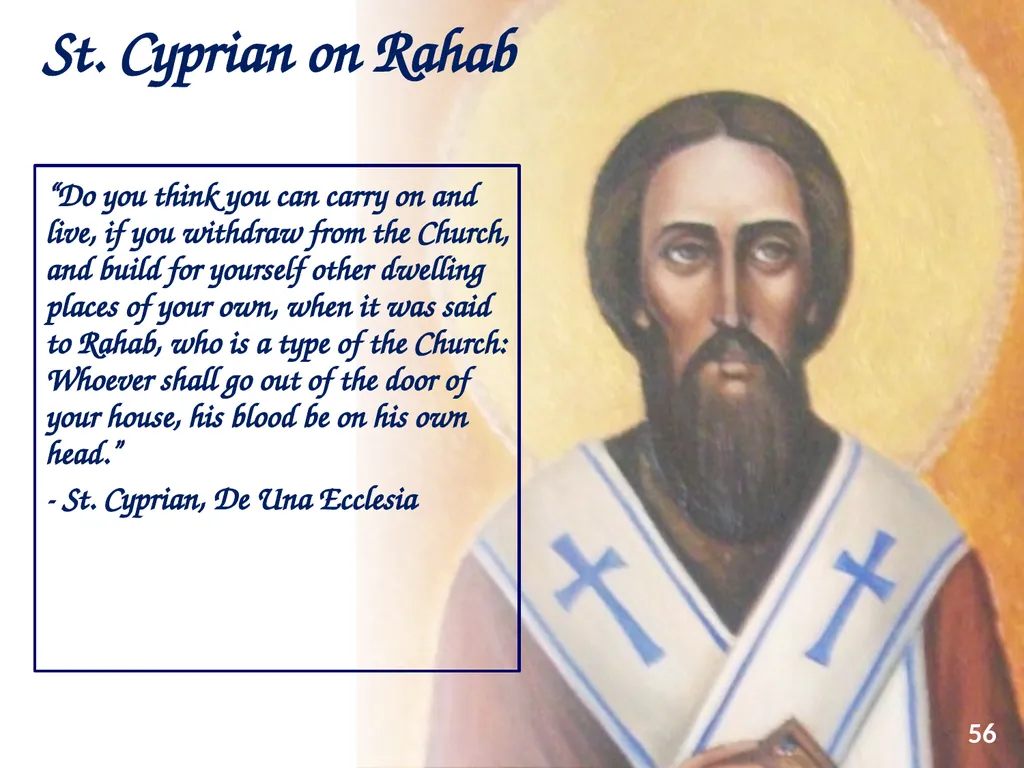
St. Cyprian on Rahab “Do you think you can carry on and live, if you withdraw from the Church, and build for yourself other dwelling places of your own, when it was said to Rahab, who is a type of the Church: Whoever shall go out of the door of your house, his blood be on his own head.”
- St. Cyprian, De Una Ecclesia 56<br>
- St. Cyprian, De Una Ecclesia 56<br>
57
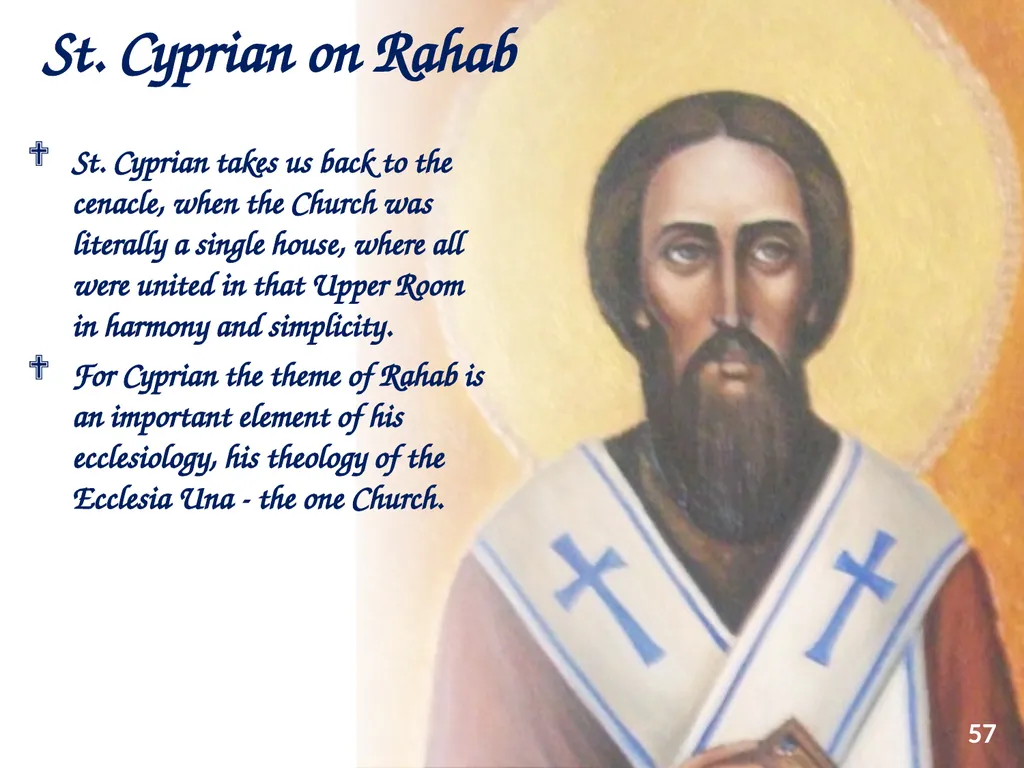
St. Cyprian on Rahab St. Cyprian takes us back to the cenacle, when the Church was literally a single house, where all were united in that Upper Room in harmony and simplicity.
For Cyprian the theme of Rahab is an important element of his ecclesiology, his theology of the Ecclesia Una - the one Church. 57<br>
For Cyprian the theme of Rahab is an important element of his ecclesiology, his theology of the Ecclesia Una - the one Church. 57<br>
58
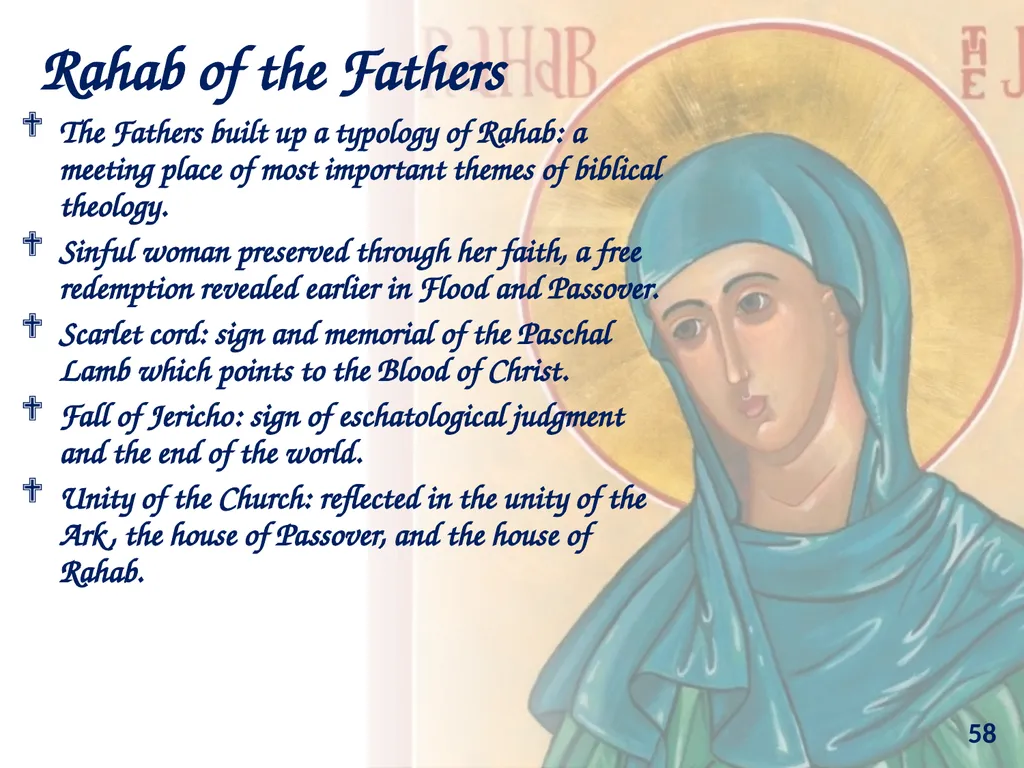
Rahab of the Fathers The Fathers built up a typology of Rahab: a meeting place of most important themes of biblical theology.
Sinful woman preserved through her faith, a free redemption revealed earlier in Flood and Passover.
Scarlet cord: sign and memorial of the Paschal Lamb which points to the Blood of Christ.
Fall of Jericho: sign of eschatological judgment and the end of the world.
Unity of the Church: reflected in the unity of the Ark, the house of Passover, and the house of Rahab. 58<br>
59
Typology: Just a Taste I hope this brief course has encouraged you to open your Bible daily, to read and study both the Old and New Testaments, so you will recognize the unity of Sacred Scripture, how it all points to the fulfilment of Revelation in Jesus Christ. Rev: 4/24/2017 59<br>