
Uganda REDD-Plus Readiness Preparation Proposal
Description: Uganda REDD-Plus Readiness Preparation Proposal (R-PP) Presented to the 8th Meeting of the Participants Committee of the FCPF in Da Lat, Vietnam March 25, 2010 By Xavier Mugumya GENERAL INFORMATION The Objectives of Ugandas REDD-Plus
Related Topics
Download Presentation
"Uganda REDD-Plus Readiness Preparation Proposal" is the property of its rightful owner. Permission is granted to download and print the materials on this website for personal, non-commercial use only, and to display it on your personal computer provided you do not modify the materials and that you retain all copyright notices contained in the materials. By downloading content from our website, you accept the terms of this agreement.
Presentation Transcript
slide1. Uganda REDD-Plus Readiness Preparation Proposal (R-PP) Presented to the 8th Meeting of the Participants Committee of the FCPF in Da Lat, Vietnam
March 25, 2010
By Xavier Mugumya<br>
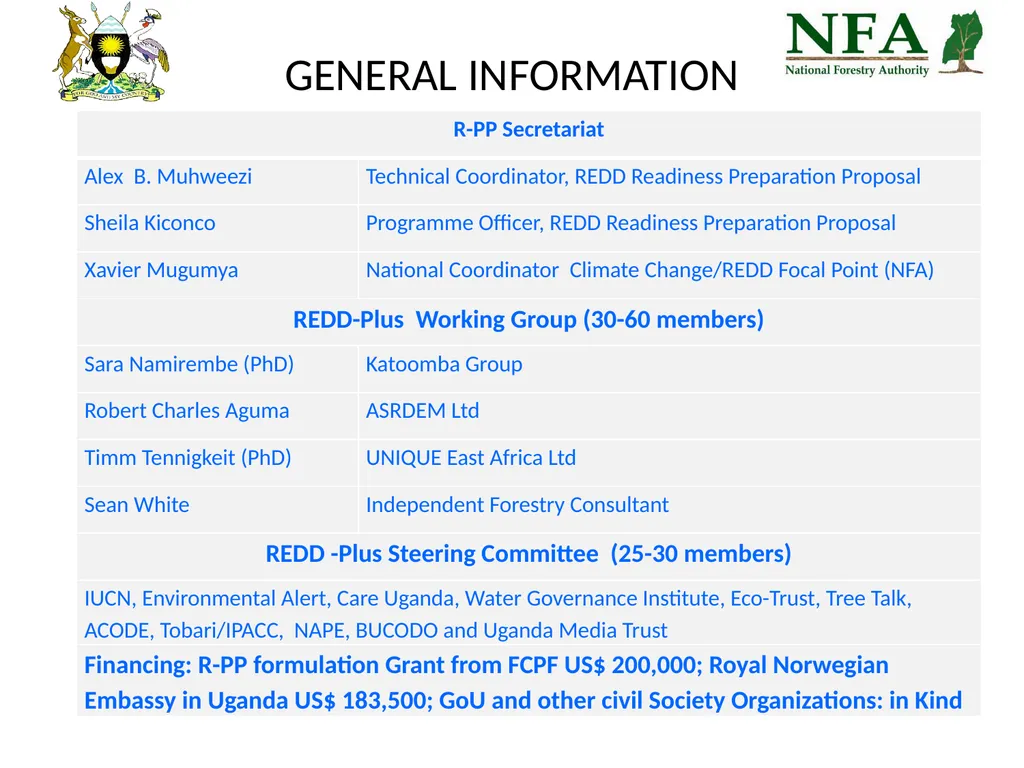
slide2. GENERAL INFORMATION<br>
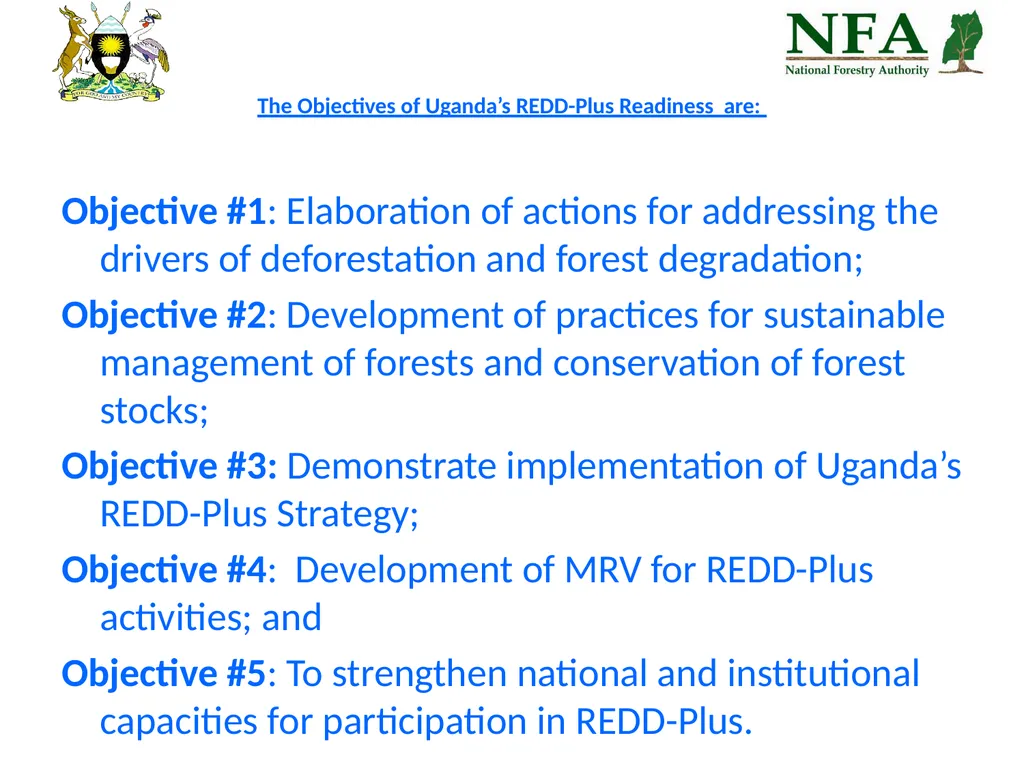
slide3. The Objectives of Uganda’s REDD-Plus Readiness are: Objective #1: Elaboration of actions for addressing the drivers of deforestation and forest degradation;
Objective #2: Development of practices for sustainable management of forests and conservation of forest stocks;
Objective #3: Demonstrate implementation of Uganda’s REDD-Plus Strategy;
Objective #4: Development of MRV for REDD-Plus activities; and
Objective #5: To strengthen national and institutional capacities for participation in REDD-Plus.<br>
slide4. Priority Actions and Measures for Uganda’s REDD-Plus Readiness will be: Defining institutional arrangements
Developing operational procedures and guidelines.
Capacity building
Defining strategies for addressing the drivers
Establishing a forest reference emissions levels and an MRV
Developing framework for assessing likely social and environment impacts of REDD-Plus.<br>
slide5. Uganda’s REDD-Plus Readiness will be have the following outputs: Institutional arrangements for implementing Uganda’s REDD - Plus Strategy in place.
Procedures and guidelines for conducive REDD- Plus implementation in place.
Capacity for REDD-Plus implementation .
Strategies for addressing deforestation and forest degradation, the role of conservation, sustainable forest management and building Carbon Stock adopted
Forest reference emissions levels published and an MRV in place.
Framework for assessing likely environment and social impacts of REDD-Plus.<br>
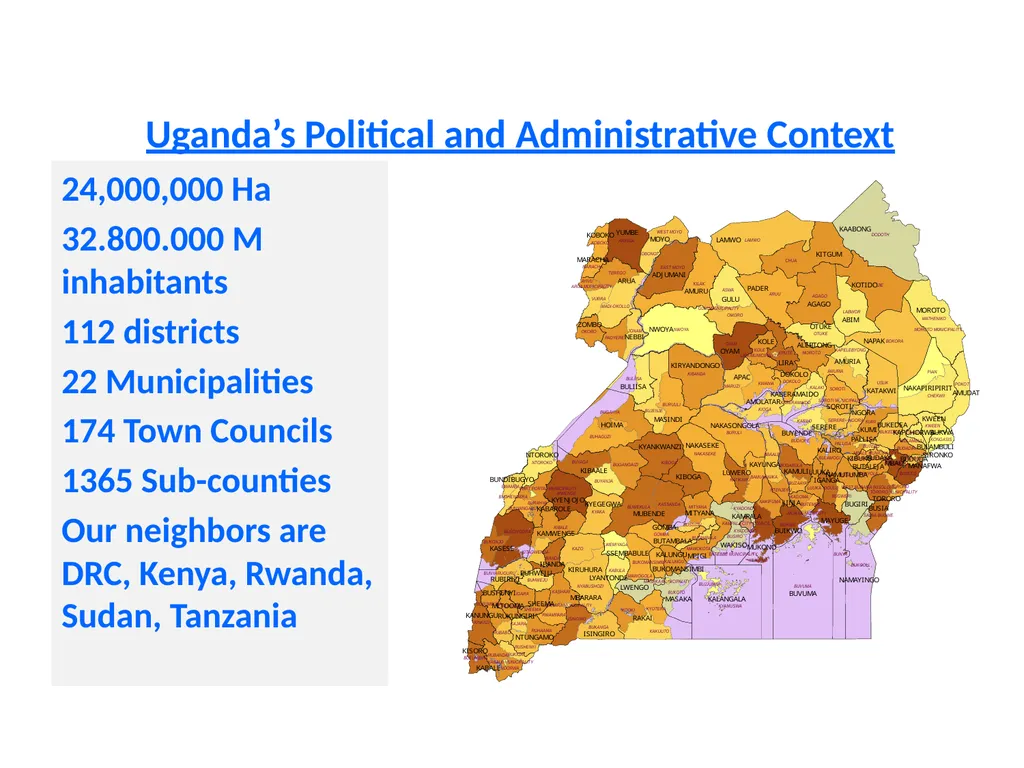
slide6. Uganda’s Political and Administrative Context 24,000,000 Ha
32.800.000 M inhabitants
112 districts
22 Municipalities
174 Town Councils
1365 Sub-counties
Our neighbors are DRC, Kenya, Rwanda, Sudan, Tanzania<br>
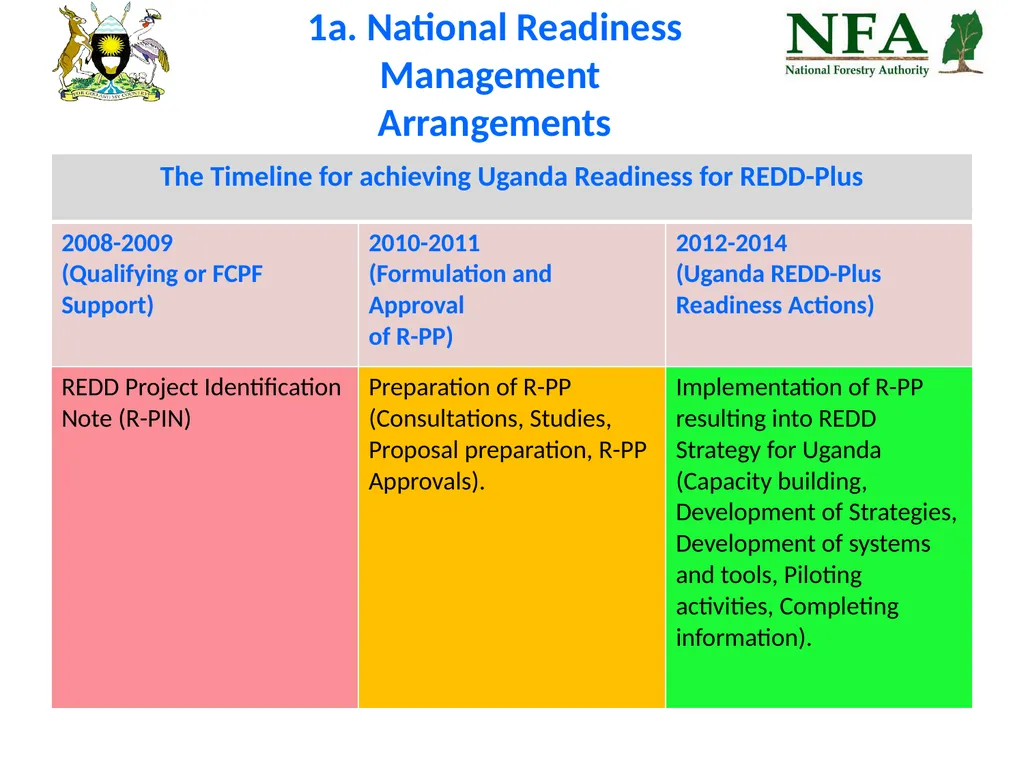
slide7. 1a. National Readiness Management Arrangements<br>
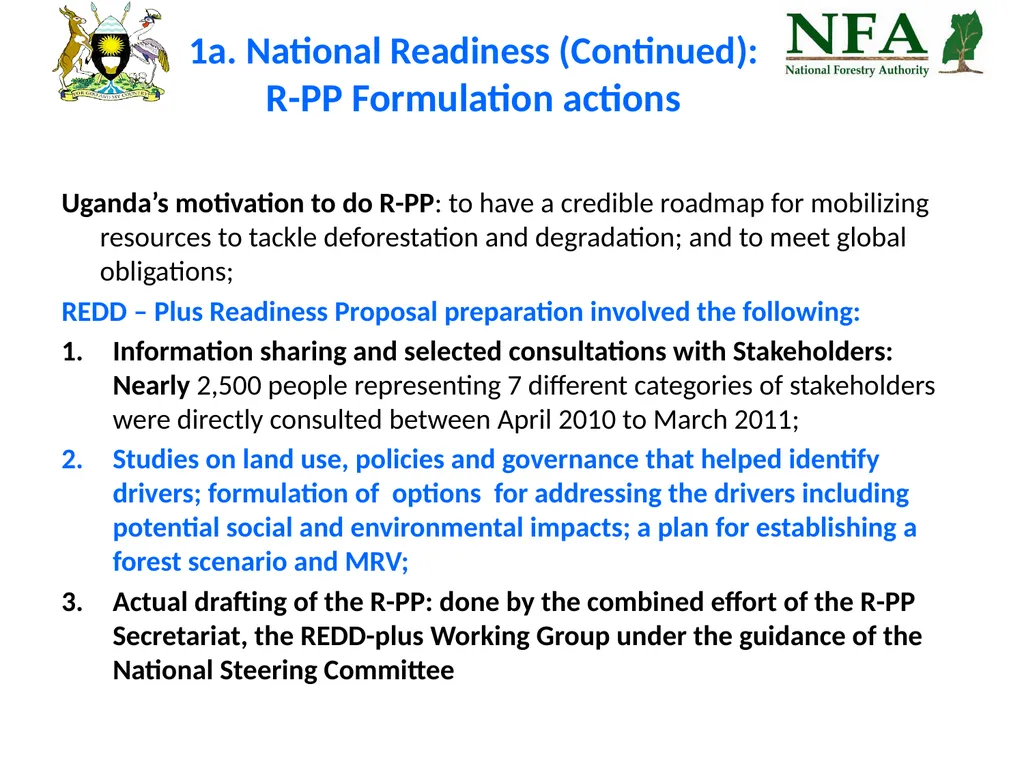
slide8. 1a. National Readiness (Continued): R-PP Formulation actions Uganda’s motivation to do R-PP: to have a credible roadmap for mobilizing resources to tackle deforestation and degradation; and to meet global obligations;
REDD – Plus Readiness Proposal preparation involved the following:
Information sharing and selected consultations with Stakeholders: Nearly 2,500 people representing 7 different categories of stakeholders were directly consulted between April 2010 to March 2011;
Studies on land use, policies and governance that helped identify drivers; formulation of options for addressing the drivers including potential social and environmental impacts; a plan for establishing a forest scenario and MRV;
Actual drafting of the R-PP: done by the combined effort of the R-PP Secretariat, the REDD-plus Working Group under the guidance of the National Steering Committee<br>
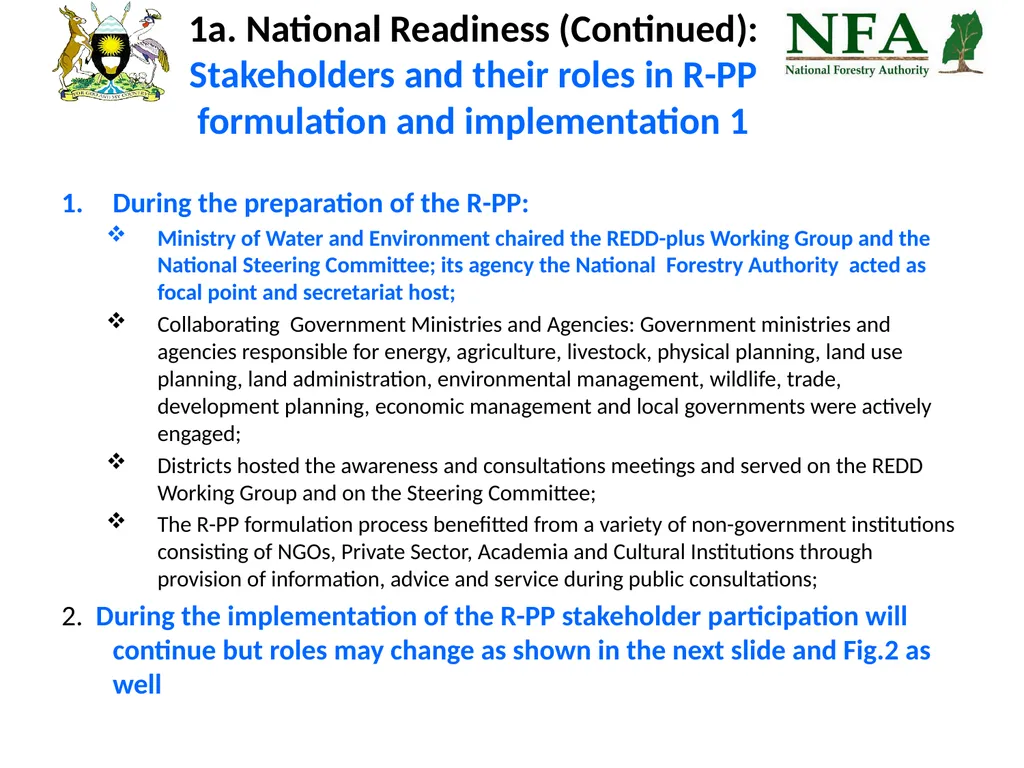
slide9. 1a. National Readiness (Continued): Stakeholders and their roles in R-PP formulation and implementation 1 During the preparation of the R-PP:
Ministry of Water and Environment chaired the REDD-plus Working Group and the National Steering Committee; its agency the National Forestry Authority acted as focal point and secretariat host;
Collaborating Government Ministries and Agencies: Government ministries and agencies responsible for energy, agriculture, livestock, physical planning, land use planning, land administration, environmental management, wildlife, trade, development planning, economic management and local governments were actively engaged;
Districts hosted the awareness and consultations meetings and served on the REDD Working Group and on the Steering Committee;
The R-PP formulation process benefitted from a variety of non-government institutions consisting of NGOs, Private Sector, Academia and Cultural Institutions through provision of information, advice and service during public consultations;
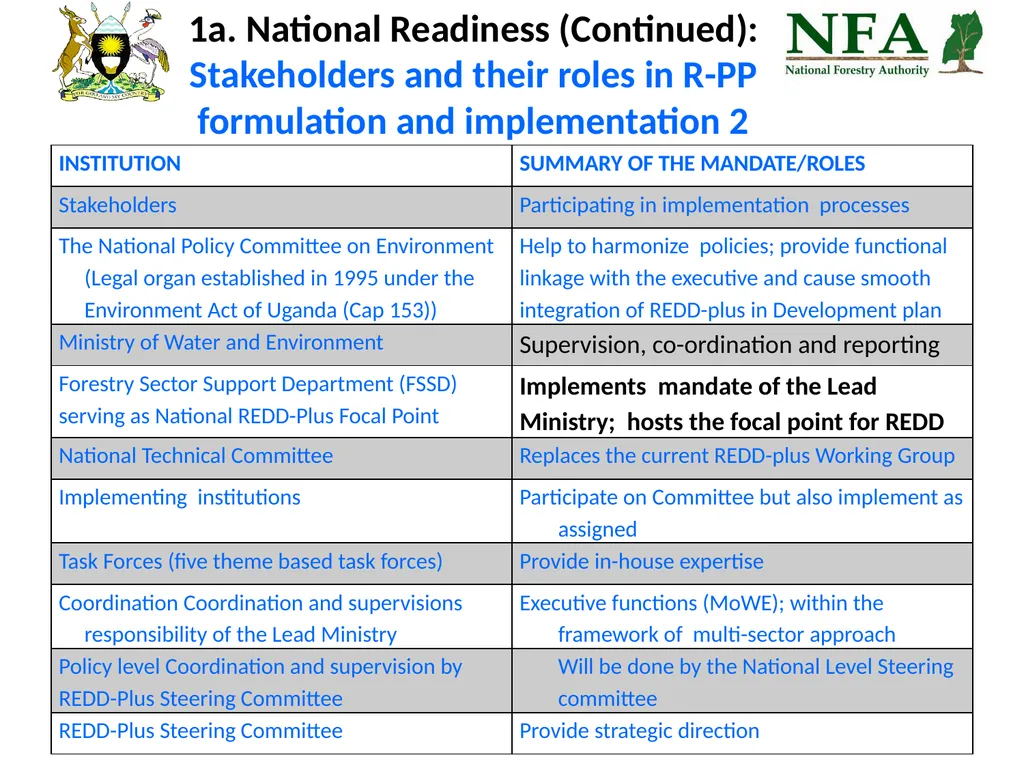
2. During the implementation of the R-PP stakeholder participation will continue but roles may change as shown in the next slide and Fig.2 as well<br>
slide10. 1a. National Readiness (Continued): Stakeholders and their roles in R-PP formulation and implementation 2<br>
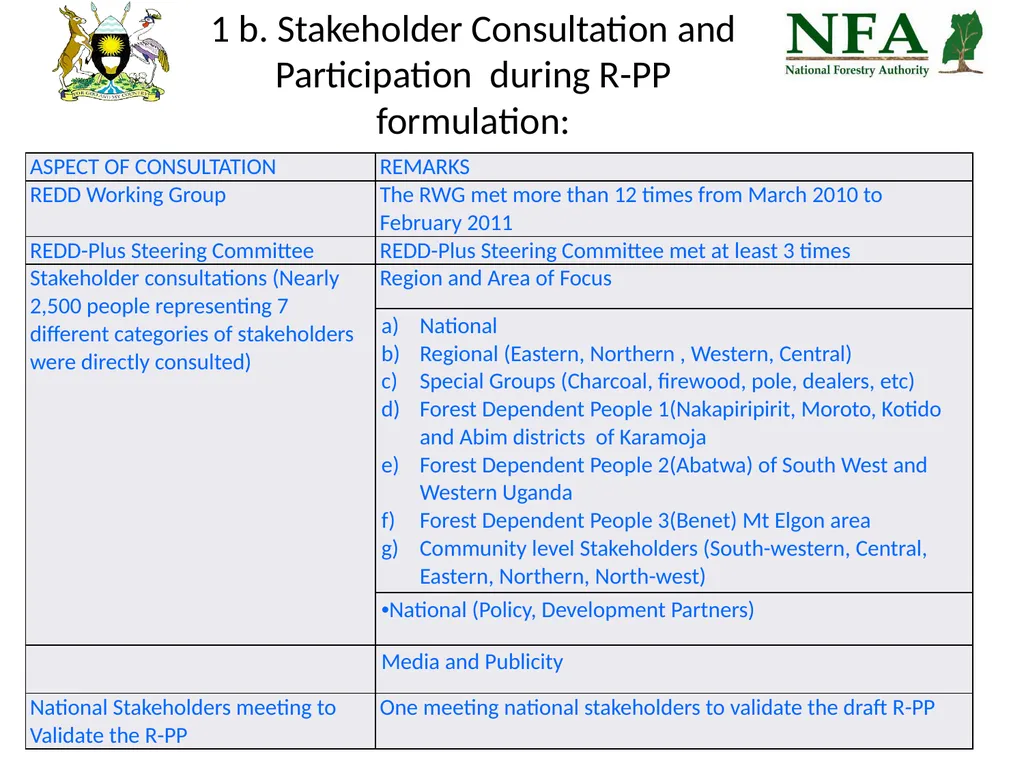
slide11. 1 b. Stakeholder Consultation and Participation during R-PP formulation:<br>
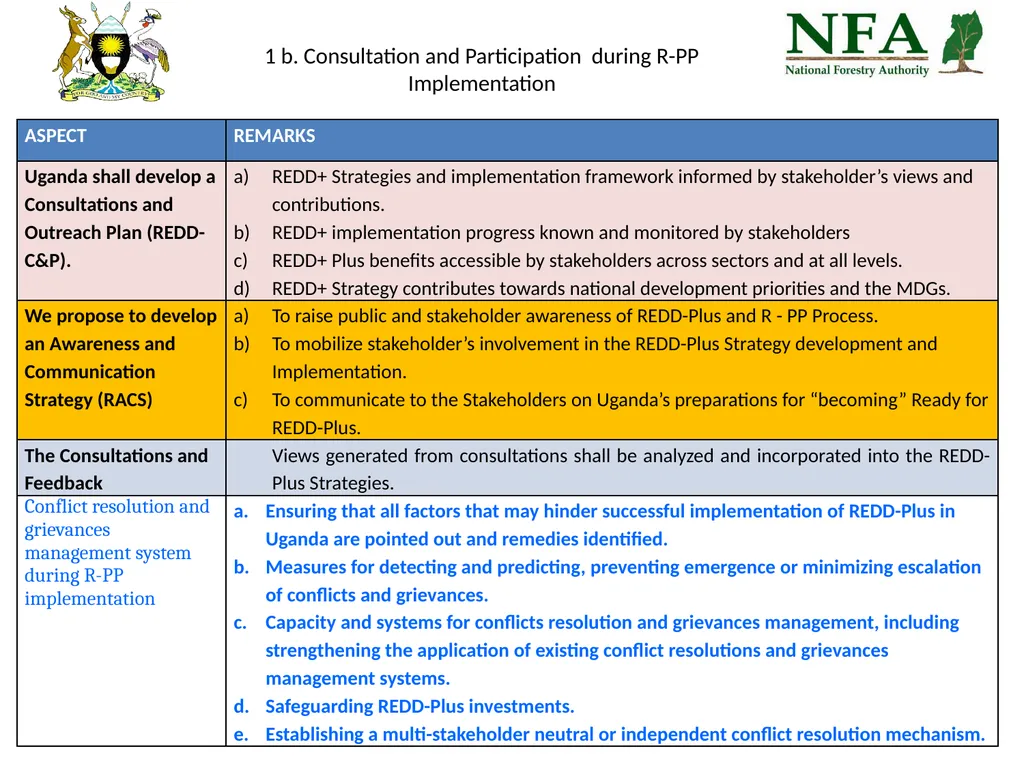
slide12. 1 b. Consultation and Participation during R-PP Implementation<br>
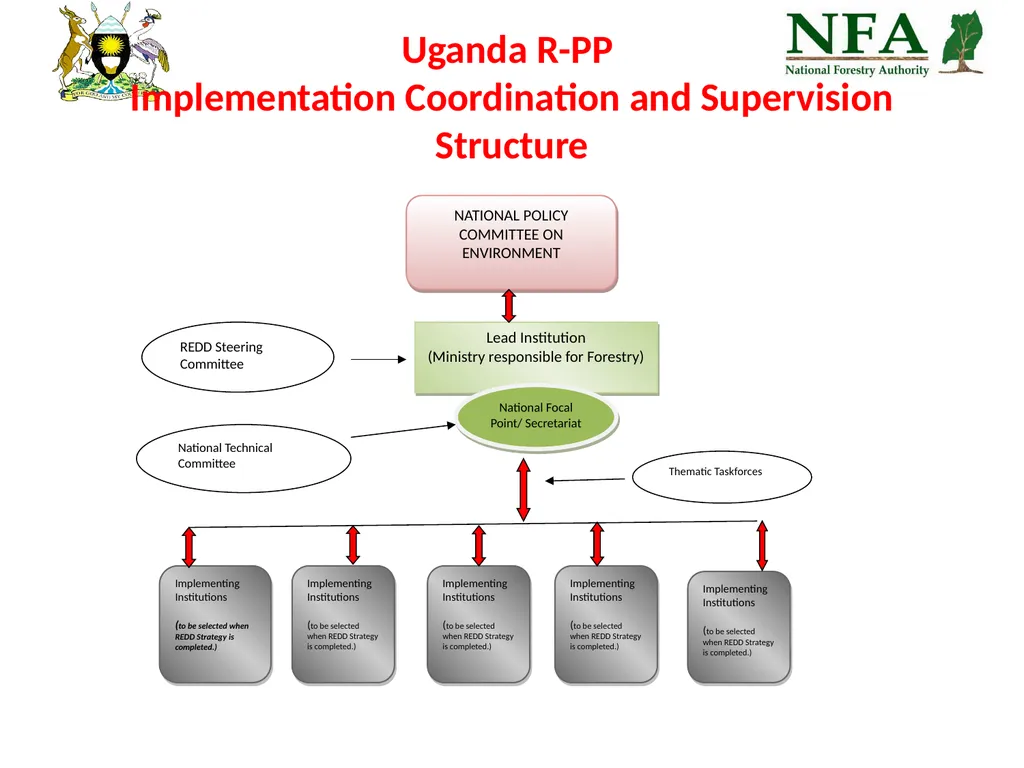
slide13. Uganda R-PP Implementation Coordination and Supervision Structure Lead Institution
(Ministry responsible for Forestry) National Focal Point/ Secretariat Implementing Institutions
(to be selected when REDD Strategy is completed.) Implementing Institutions
(to be selected when REDD Strategy is completed.) Implementing Institutions
(to be selected when REDD Strategy is completed.) Implementing Institutions
(to be selected when REDD Strategy is completed.) Implementing Institutions
(to be selected when REDD Strategy is completed.) NATIONAL POLICY COMMITTEE ON ENVIRONMENT REDD Steering Committee National Technical Committee Thematic Taskforces<br>
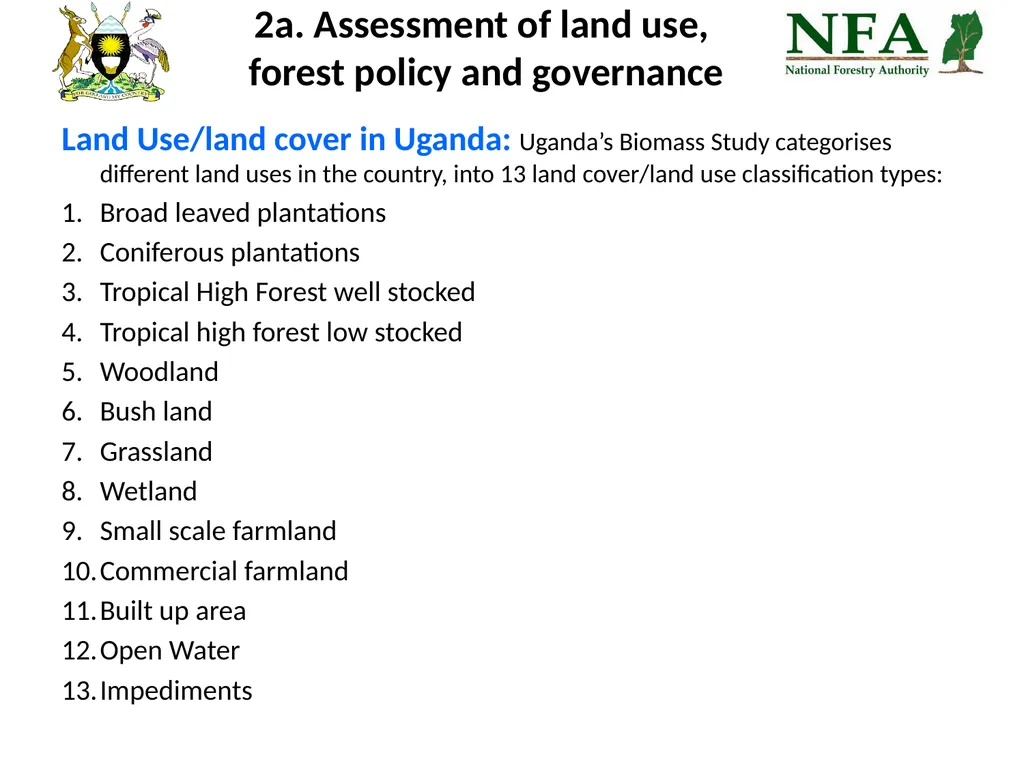
slide14. 2a. Assessment of land use, forest policy and governance Land Use/land cover in Uganda: Uganda’s Biomass Study categorises different land uses in the country, into 13 land cover/land use classification types:
Broad leaved plantations
Coniferous plantations
Tropical High Forest well stocked
Tropical high forest low stocked
Woodland
Bush land
Grassland
Wetland
Small scale farmland
Commercial farmland
Built up area
Open Water
Impediments<br>
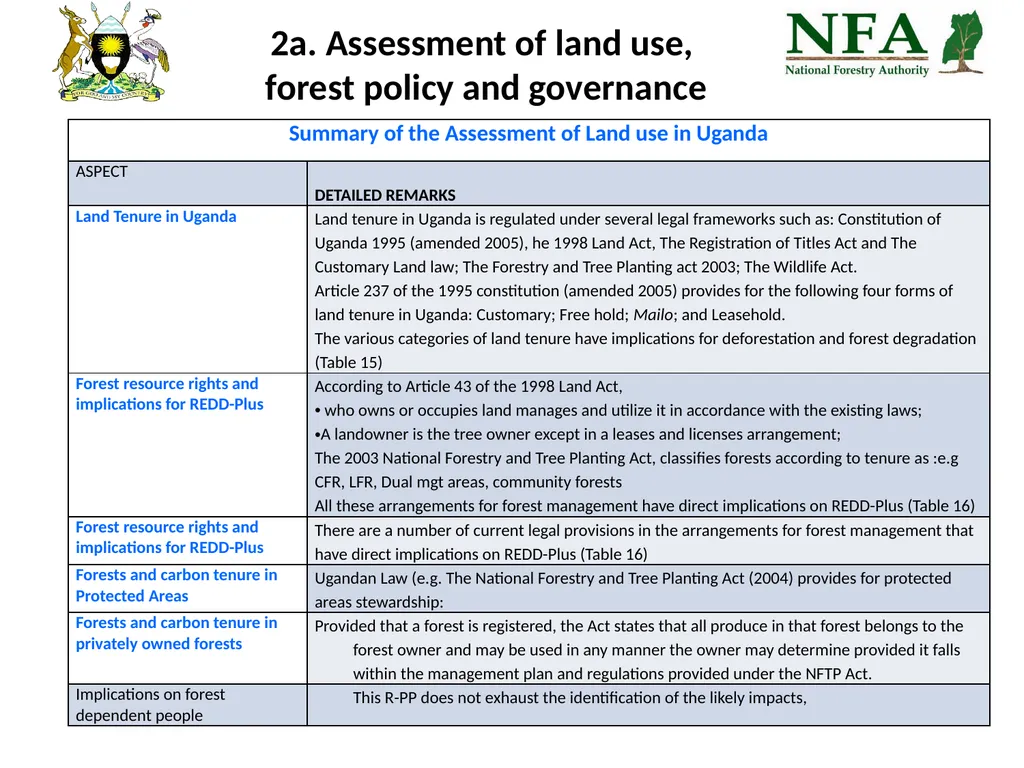
slide15. 2a. Assessment of land use, forest policy and governance<br>
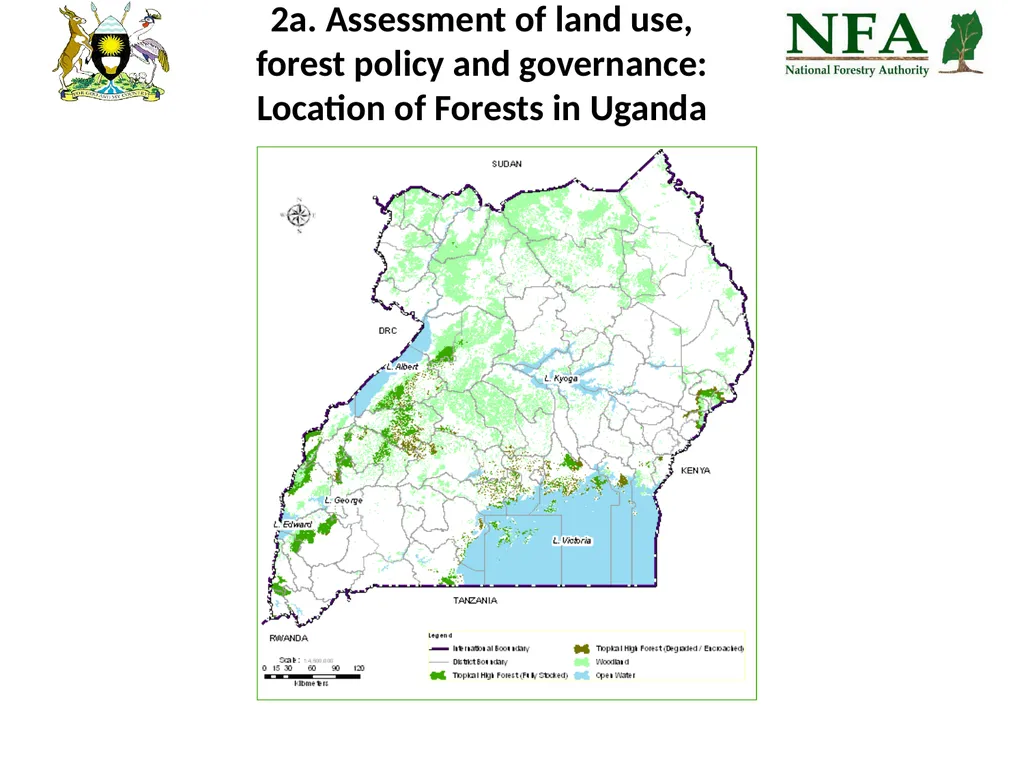
slide16. 2a. Assessment of land use, forest policy and governance: Location of Forests in Uganda<br>
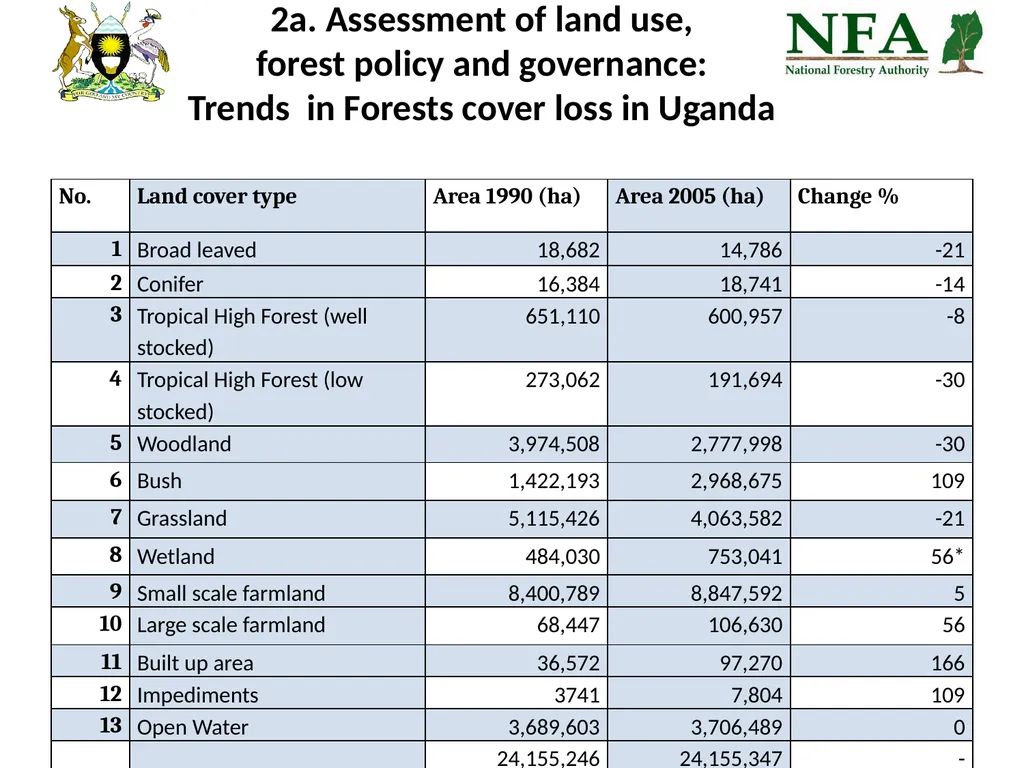
slide17. 2a. Assessment of land use, forest policy and governance: Trends in Forests cover loss in Uganda<br>
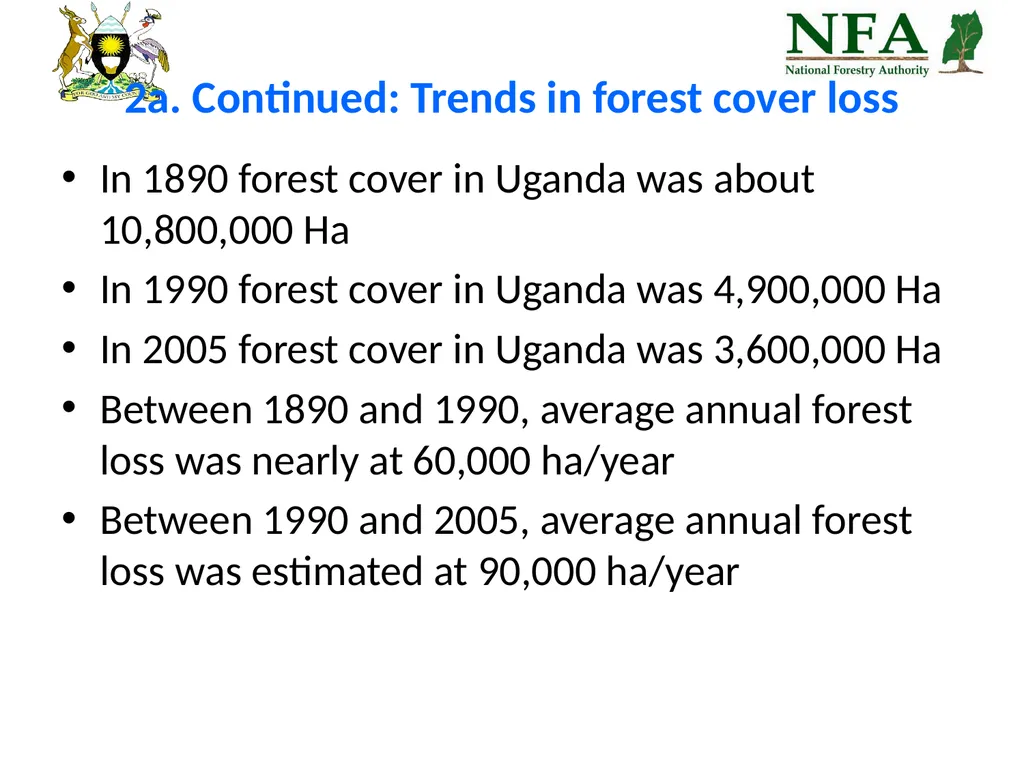
slide18. 2a. Continued: Trends in forest cover loss In 1890 forest cover in Uganda was about 10,800,000 Ha
In 1990 forest cover in Uganda was 4,900,000 Ha
In 2005 forest cover in Uganda was 3,600,000 Ha
Between 1890 and 1990, average annual forest loss was nearly at 60,000 ha/year
Between 1990 and 2005, average annual forest loss was estimated at 90,000 ha/year<br>
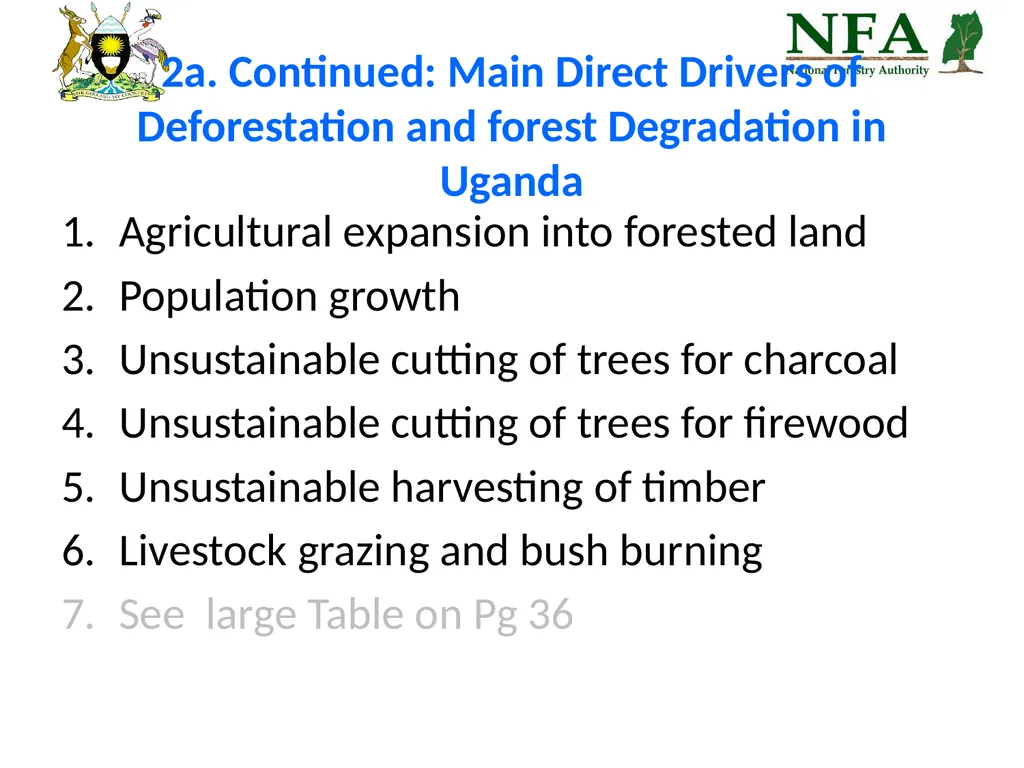
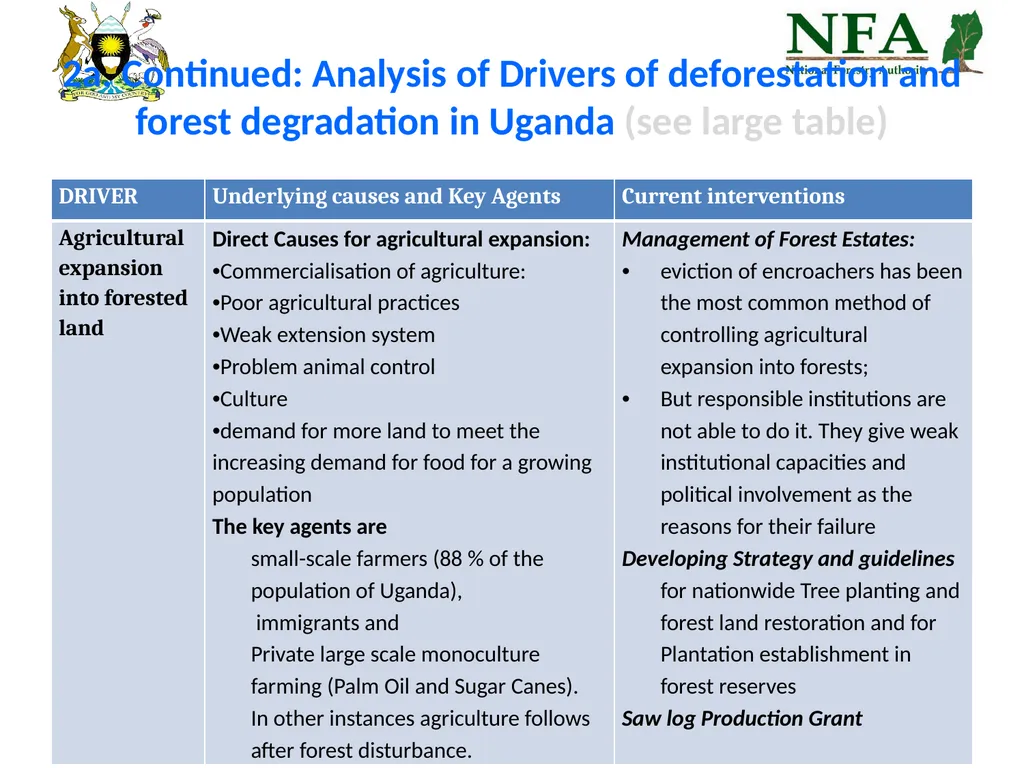
slide19. 2a. Continued: Main Direct Drivers of Deforestation and forest Degradation in Uganda Agricultural expansion into forested land
Population growth
Unsustainable cutting of trees for charcoal
Unsustainable cutting of trees for firewood
Unsustainable harvesting of timber
Livestock grazing and bush burning
See large Table on Pg 36<br>
slide20. 2a. Continued: Analysis of Drivers of deforestation and forest degradation in Uganda (see large table)<br>
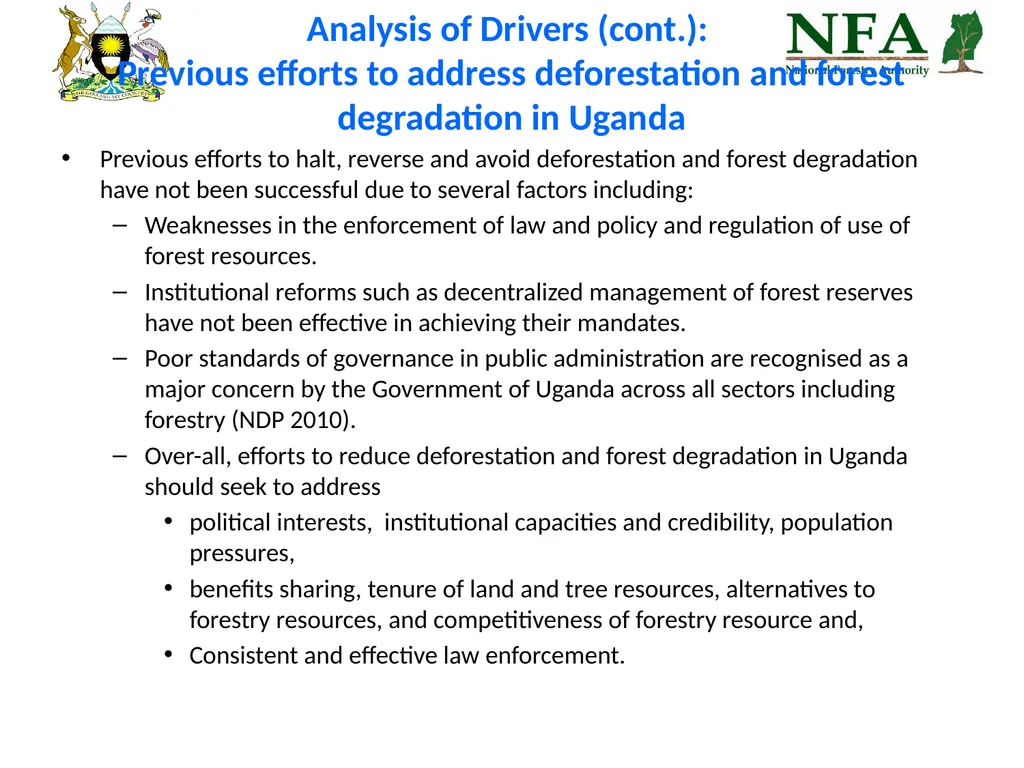
slide21. Analysis of Drivers (cont.): Previous efforts to address deforestation and forest degradation in Uganda Previous efforts to halt, reverse and avoid deforestation and forest degradation have not been successful due to several factors including:
Weaknesses in the enforcement of law and policy and regulation of use of forest resources.
Institutional reforms such as decentralized management of forest reserves have not been effective in achieving their mandates.
Poor standards of governance in public administration are recognised as a major concern by the Government of Uganda across all sectors including forestry (NDP 2010).
Over-all, efforts to reduce deforestation and forest degradation in Uganda should seek to address
political interests, institutional capacities and credibility, population pressures,
benefits sharing, tenure of land and tree resources, alternatives to forestry resources, and competitiveness of forestry resource and,
Consistent and effective law enforcement.<br>
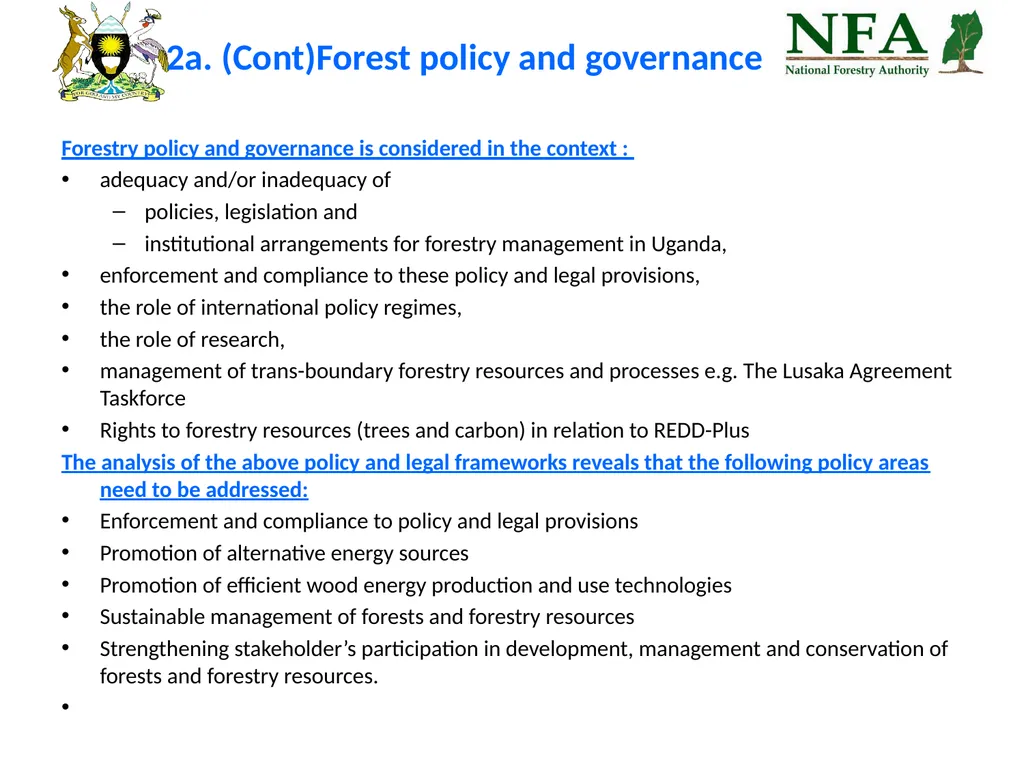
slide22. 2a. (Cont)Forest policy and governance Forestry policy and governance is considered in the context :
adequacy and/or inadequacy of
policies, legislation and
institutional arrangements for forestry management in Uganda,
enforcement and compliance to these policy and legal provisions,
the role of international policy regimes,
the role of research,
management of trans-boundary forestry resources and processes e.g. The Lusaka Agreement Taskforce
Rights to forestry resources (trees and carbon) in relation to REDD-Plus
The analysis of the above policy and legal frameworks reveals that the following policy areas need to be addressed:
Enforcement and compliance to policy and legal provisions
Promotion of alternative energy sources
Promotion of efficient wood energy production and use technologies
Sustainable management of forests and forestry resources
Strengthening stakeholder’s participation in development, management and conservation of forests and forestry resources.<br>
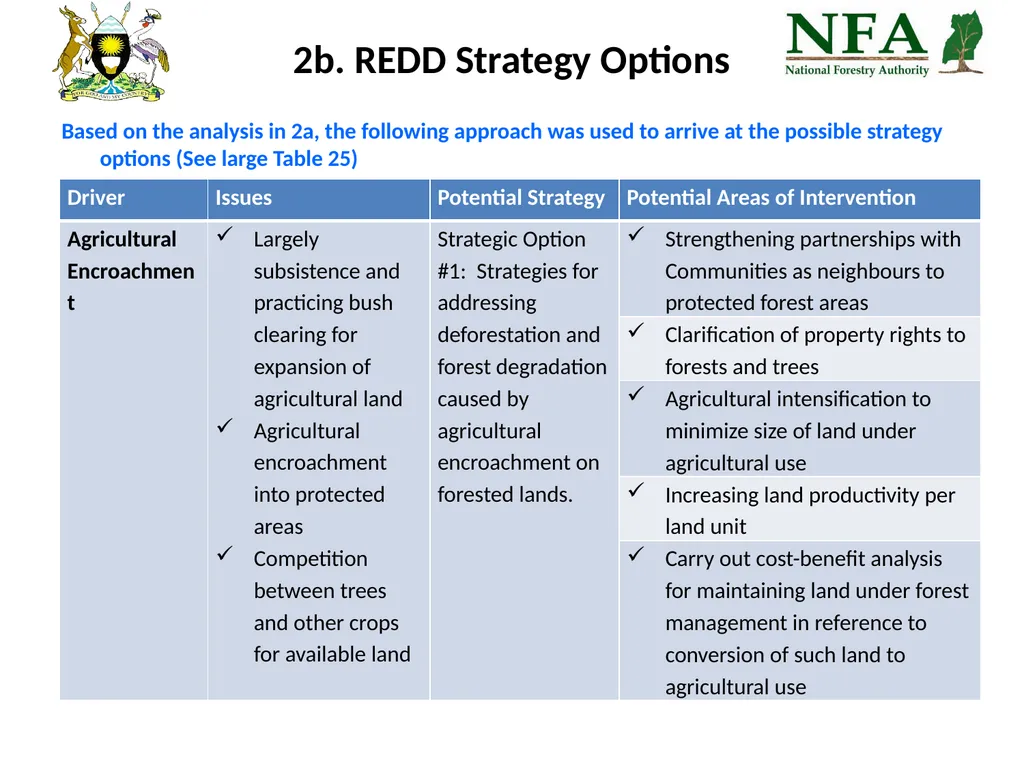
slide23. 2b. REDD Strategy Options Based on the analysis in 2a, the following approach was used to arrive at the possible strategy options (See large Table 25)<br>
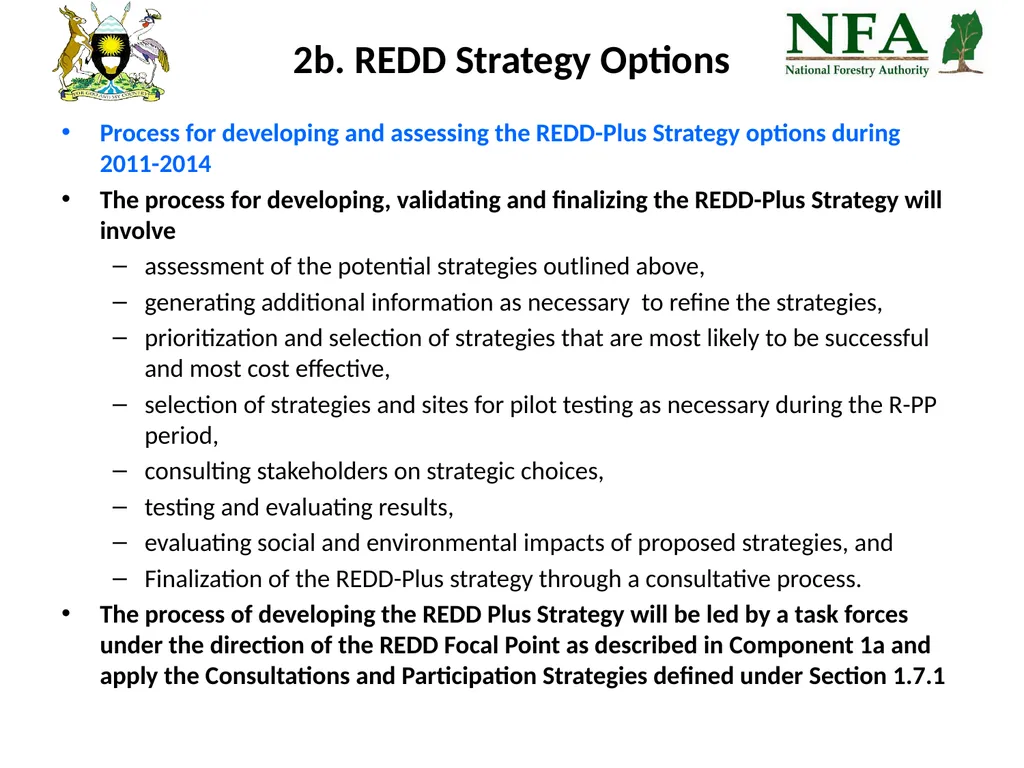
slide24. 2b. REDD Strategy Options Process for developing and assessing the REDD-Plus Strategy options during 2011-2014
The process for developing, validating and finalizing the REDD-Plus Strategy will involve
assessment of the potential strategies outlined above,
generating additional information as necessary to refine the strategies,
prioritization and selection of strategies that are most likely to be successful and most cost effective,
selection of strategies and sites for pilot testing as necessary during the R-PP period,
consulting stakeholders on strategic choices,
testing and evaluating results,
evaluating social and environmental impacts of proposed strategies, and
Finalization of the REDD-Plus strategy through a consultative process.
The process of developing the REDD Plus Strategy will be led by a task forces under the direction of the REDD Focal Point as described in Component 1a and apply the Consultations and Participation Strategies defined under Section 1.7.1<br>
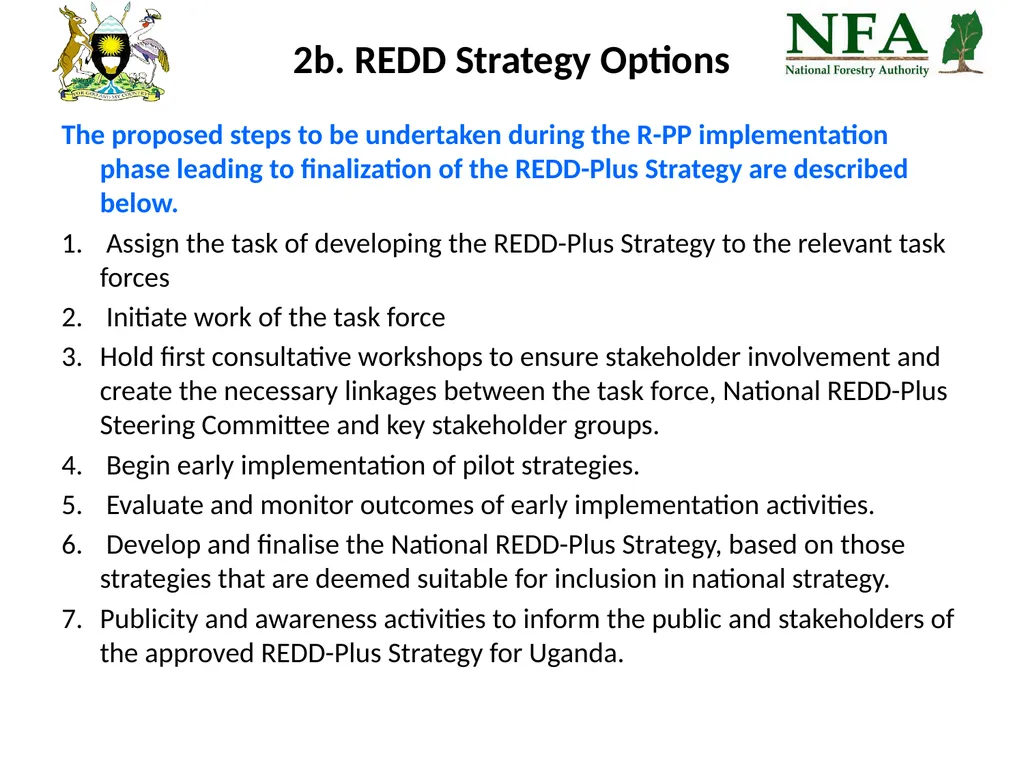
slide25. 2b. REDD Strategy Options The proposed steps to be undertaken during the R-PP implementation phase leading to finalization of the REDD-Plus Strategy are described below.
Assign the task of developing the REDD-Plus Strategy to the relevant task forces
Initiate work of the task force
Hold first consultative workshops to ensure stakeholder involvement and create the necessary linkages between the task force, National REDD-Plus Steering Committee and key stakeholder groups.
Begin early implementation of pilot strategies.
Evaluate and monitor outcomes of early implementation activities.
Develop and finalise the National REDD-Plus Strategy, based on those strategies that are deemed suitable for inclusion in national strategy.
Publicity and awareness activities to inform the public and stakeholders of the approved REDD-Plus Strategy for Uganda.<br>
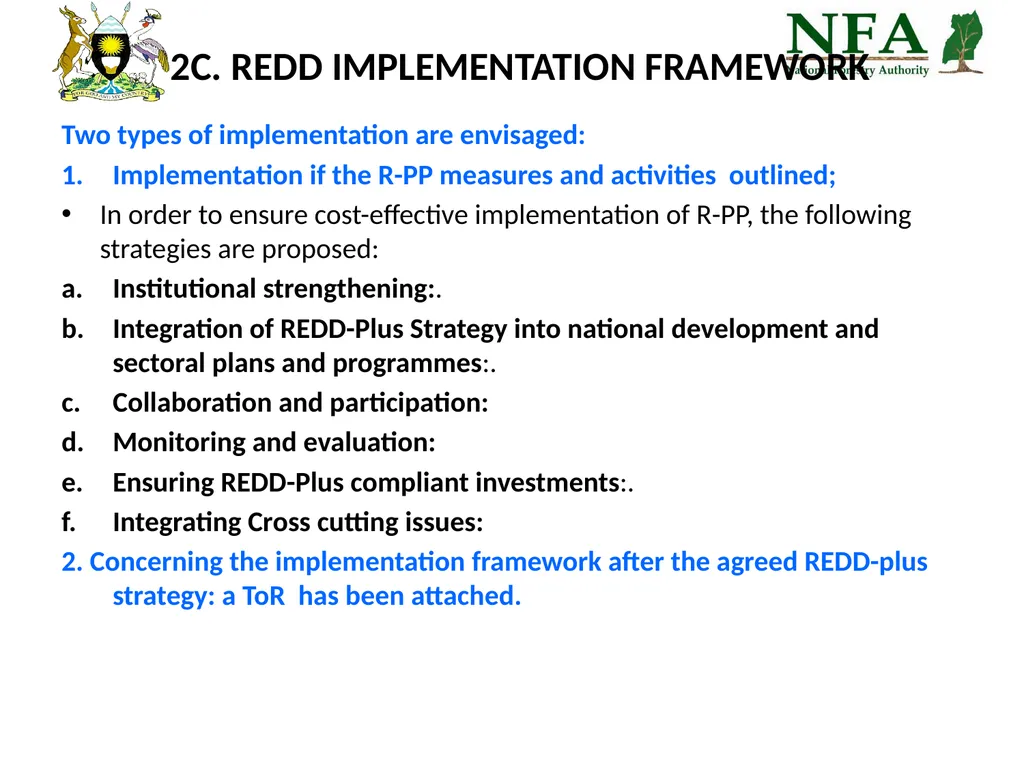
slide26. 2C. REDD IMPLEMENTATION FRAMEWORK Two types of implementation are envisaged:
Implementation if the R-PP measures and activities outlined;
In order to ensure cost-effective implementation of R-PP, the following strategies are proposed:
Institutional strengthening:.
Integration of REDD-Plus Strategy into national development and sectoral plans and programmes:.
Collaboration and participation:
Monitoring and evaluation:
Ensuring REDD-Plus compliant investments:.
Integrating Cross cutting issues:
2. Concerning the implementation framework after the agreed REDD-plus strategy: a ToR has been attached.<br>
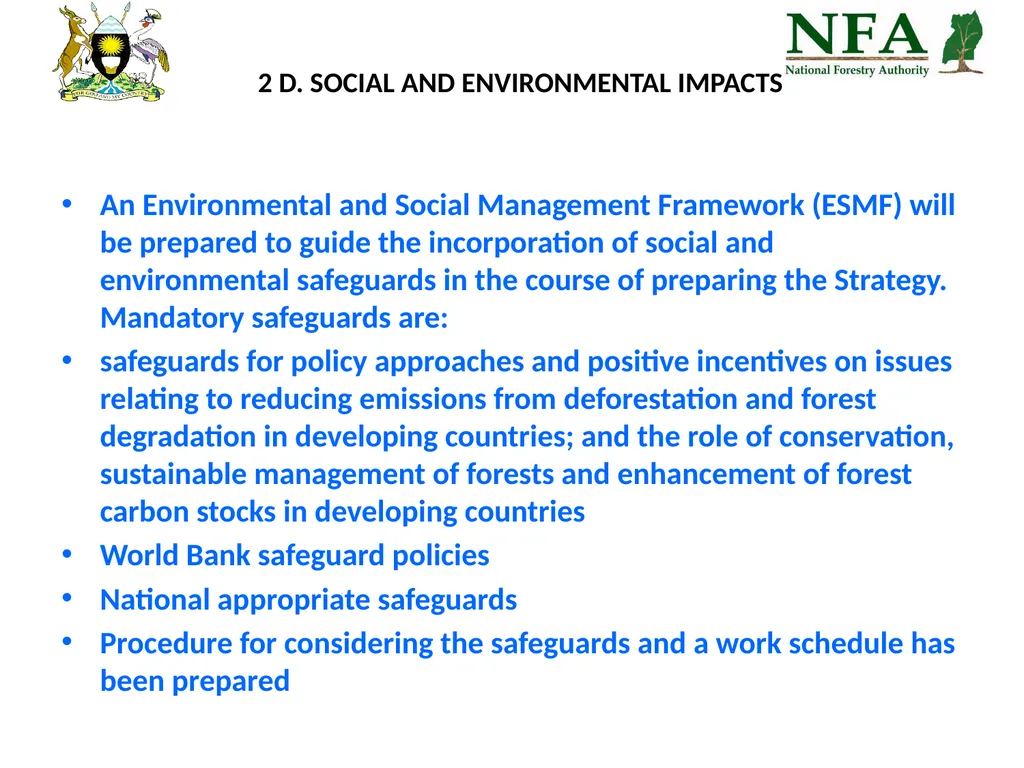
slide27. 2 D. SOCIAL AND ENVIRONMENTAL IMPACTS An Environmental and Social Management Framework (ESMF) will be prepared to guide the incorporation of social and environmental safeguards in the course of preparing the Strategy. Mandatory safeguards are:
safeguards for policy approaches and positive incentives on issues relating to reducing emissions from deforestation and forest degradation in developing countries; and the role of conservation, sustainable management of forests and enhancement of forest carbon stocks in developing countries
World Bank safeguard policies
National appropriate safeguards
Procedure for considering the safeguards and a work schedule has been prepared<br>
slide28. COMPONENT 3: DEVELOP A REFERENCE SCENARIO: Uganda’s Approach and work flow for setting the reference scenario (Fig.6) Data Availability and Gaps
The main activity data set in Uganda on land use changes is the National Biomass Study (NFA, 2009). It is based on:
the interpretation of two sets of satellite images (SPOT XS from 1990-1993 and Landsat TM from 2004-2005) using the FAO Land Cover Classification System (LCCS) and
a national grid based biomass field inventory with 2 to 4 data points per forested sampling point from the period between 1990-2005.
From this study the available data and some of the gaps are as follows:
Historic deforestation and forest degradation activity data and emissions can be extracted. This is the data that will be used to estimate the initial emissions.
For some sample points additional remote sensing analysis is required and the NFA is currently preparing to analyse Landsat data for 2010. This will help meet the minimum of three data points in time as recommended (GOFC-GOLD Sourcebook, 2009)
The accuracy level of the remote sensing and the biomass field inventory is unclear and needs to be analysed.
The reporting must be aligned with IPCC guidelines.
Depending on the accuracy level historic information may not be suitable for developing REDD+ scenarios and/or the inventory design needs to be modified.
A number of sub-national data sets exist that needs to be assessed in terms of its quality and integrated into a national database.<br>
slide29. COMPONENT 3: DEVELOP A REFERENCE SCENARIO: Uganda’s Approach and work flow for setting the reference scenario Data Availability and Gaps (Table 32)
Carbon emission data and emission factors
In the framework of a comprehensive study (National Biomass Study phase I)
3000 trees from 123 species were sampled destructively and for
4,500 trees green and dry weight were measured and single tree biomass functions were developed.
Almost 4,000 permanent sampling plots were established in Uganda to estimate woody biomass for different forest types.
10 % of these sample plots have been revisited several times to gain information on biomass dynamics, reflecting degradation and growth.
However, the quality of the emission data is uncertain and needs to be assessed before it can be used to develop the reference scenario.
In the framework of the National Biomass Inventory only for the living above ground carbon pool Tier 3 data is available.
Historical emissions: we shall use the IPCC Guidance
Consideration of influence of identified drivers<br>
slide30. COMPONENT 3: DEVELOP A REFERENCE SCENARIO: Uganda’s Approach and work flow for setting the reference scenario This is the summary of proposed actions and measures:
Design and Coordination
Capacity building
Evaluate and modify the NBS for Accuracy assessment of NBS, and Methodology modification to match REDD+ requirements
Acquisition to the remote sensing data, Acquisition of equipment (hardware & software), Data processing, analysis & interpretation and Acquisition of remote sensing data including the assessment of their accuracy
Field inventory (gather and evaluate emission data)
Historical emissions considerations especially Combination of activity and emission data
Reference Scenario including peer review including a possible consideration of the development of national reference scenarios<br>
slide31. Scope of MRV: we shall have a national approach with a possibility for sub-national possibilities;
Procedure for planning:
Setting the foundations : the country strives for Tier 3 but will begin with Tier 2 at the national level and then for sub-national or projects level we shall work for the third tier.
Defining mandates: FSSD will coordinate all the REDD-plus actions but the appropriate agencies will be assigned work on the MRV;
Planning a monitoring system: the current National Biomass Study will be adjusted to take care of UNFCCC requirements
Design of sub-national monitoring systems: this will depend on the requirements of UNFCCC and other competent bodies.
Data collection
Remote sensing and ground truthing shall be used to collect the data required. Social and other qualitative data may need a special way of collection, collation and analysis
Data management and reporting will be in accordance with UNFCCC guidance. But specific institutions shall take lead in areas of their competence.
Community involvement in forest monitoring: it is planned that appropriate MRVs will be designed to take care of the unique circumstances of communities COMPONENT 4: DESIGNING A MONITORING SYSTEM<br>
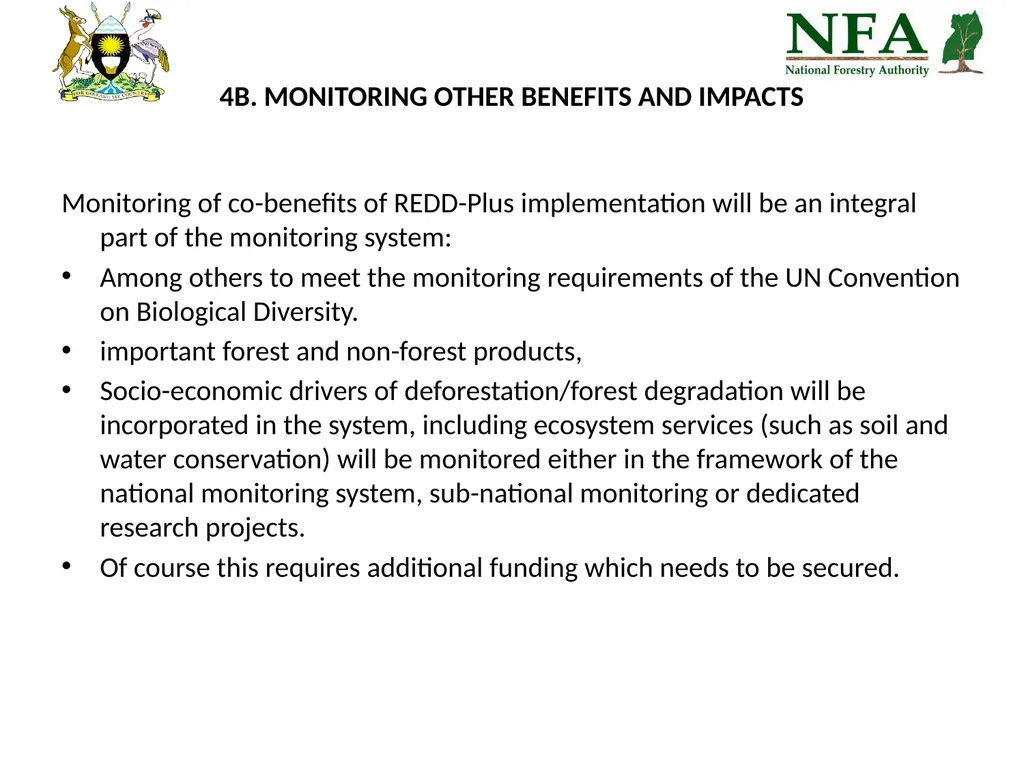
slide32. 4B. MONITORING OTHER BENEFITS AND IMPACTS Monitoring of co-benefits of REDD-Plus implementation will be an integral part of the monitoring system:
Among others to meet the monitoring requirements of the UN Convention on Biological Diversity.
important forest and non-forest products,
Socio-economic drivers of deforestation/forest degradation will be incorporated in the system, including ecosystem services (such as soil and water conservation) will be monitored either in the framework of the national monitoring system, sub-national monitoring or dedicated research projects.
Of course this requires additional funding which needs to be secured.<br>
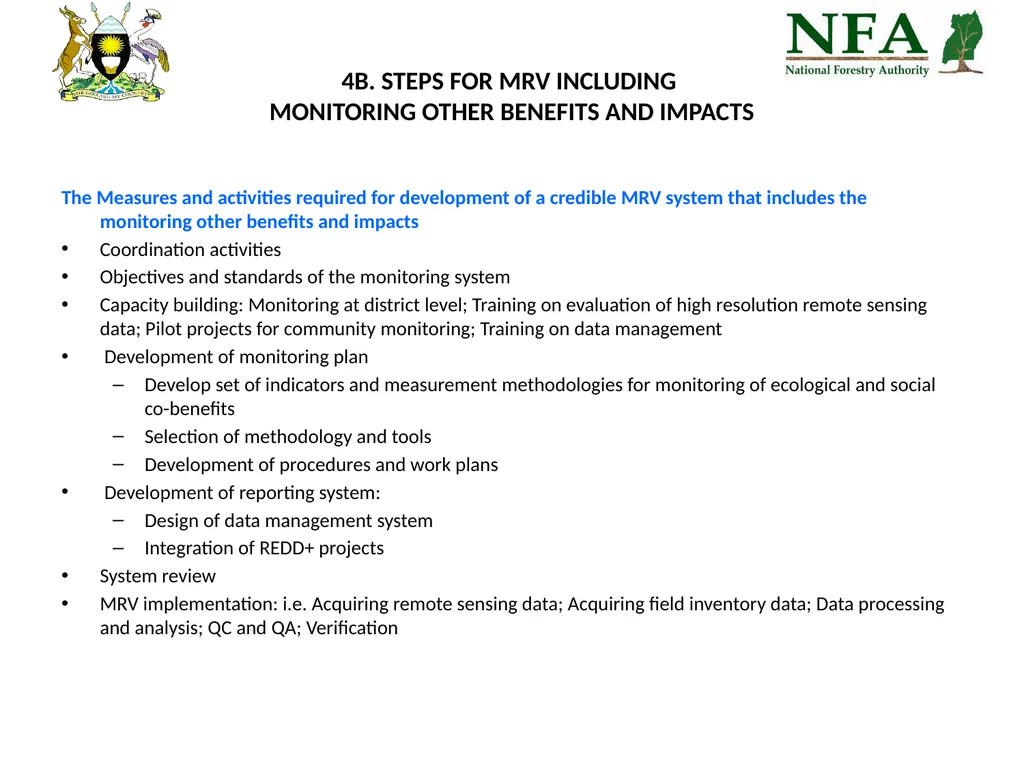
slide33. 4B. STEPS FOR MRV INCLUDING MONITORING OTHER BENEFITS AND IMPACTS The Measures and activities required for development of a credible MRV system that includes the monitoring other benefits and impacts
Coordination activities
Objectives and standards of the monitoring system
Capacity building: Monitoring at district level; Training on evaluation of high resolution remote sensing data; Pilot projects for community monitoring; Training on data management
Development of monitoring plan
Develop set of indicators and measurement methodologies for monitoring of ecological and social co-benefits
Selection of methodology and tools
Development of procedures and work plans
Development of reporting system:
Design of data management system
Integration of REDD+ projects
System review
MRV implementation: i.e. Acquiring remote sensing data; Acquiring field inventory data; Data processing and analysis; QC and QA; Verification<br>
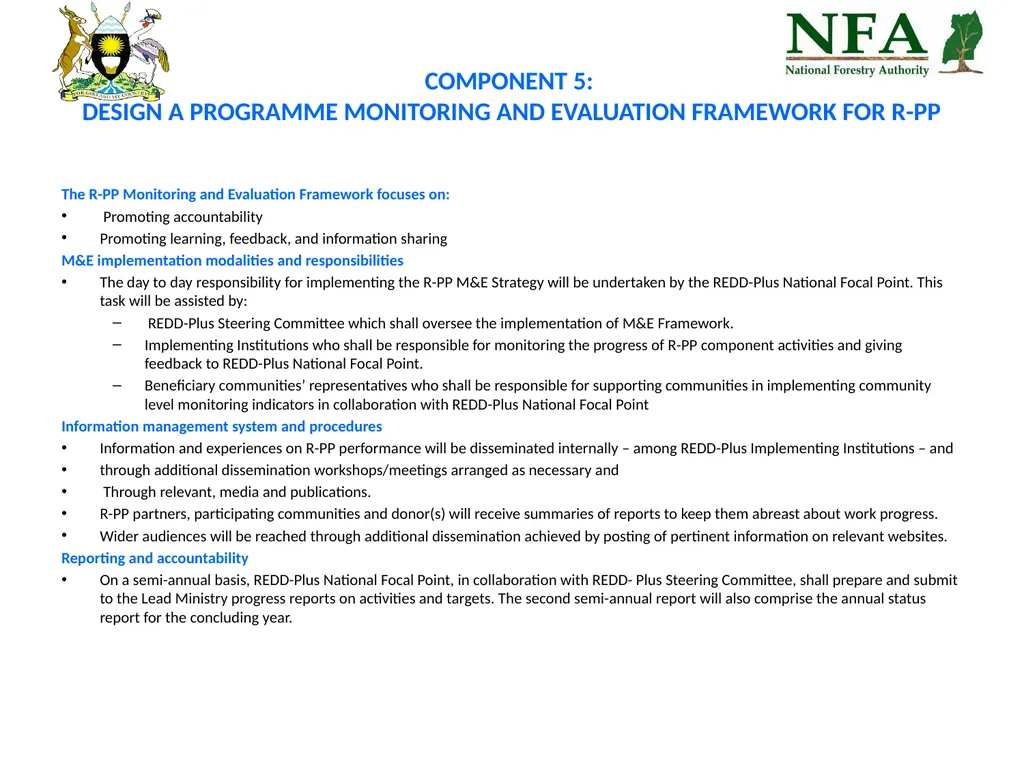
slide34. COMPONENT 5: DESIGN A PROGRAMME MONITORING AND EVALUATION FRAMEWORK FOR R-PP The R-PP Monitoring and Evaluation Framework focuses on:
Promoting accountability
Promoting learning, feedback, and information sharing
M&E implementation modalities and responsibilities
The day to day responsibility for implementing the R-PP M&E Strategy will be undertaken by the REDD-Plus National Focal Point. This task will be assisted by:
REDD-Plus Steering Committee which shall oversee the implementation of M&E Framework.
Implementing Institutions who shall be responsible for monitoring the progress of R-PP component activities and giving feedback to REDD-Plus National Focal Point.
Beneficiary communities’ representatives who shall be responsible for supporting communities in implementing community level monitoring indicators in collaboration with REDD-Plus National Focal Point
Information management system and procedures
Information and experiences on R-PP performance will be disseminated internally – among REDD-Plus Implementing Institutions – and
through additional dissemination workshops/meetings arranged as necessary and
Through relevant, media and publications.
R-PP partners, participating communities and donor(s) will receive summaries of reports to keep them abreast about work progress.
Wider audiences will be reached through additional dissemination achieved by posting of pertinent information on relevant websites.
Reporting and accountability
On a semi-annual basis, REDD-Plus National Focal Point, in collaboration with REDD- Plus Steering Committee, shall prepare and submit to the Lead Ministry progress reports on activities and targets. The second semi-annual report will also comprise the annual status report for the concluding year.<br>
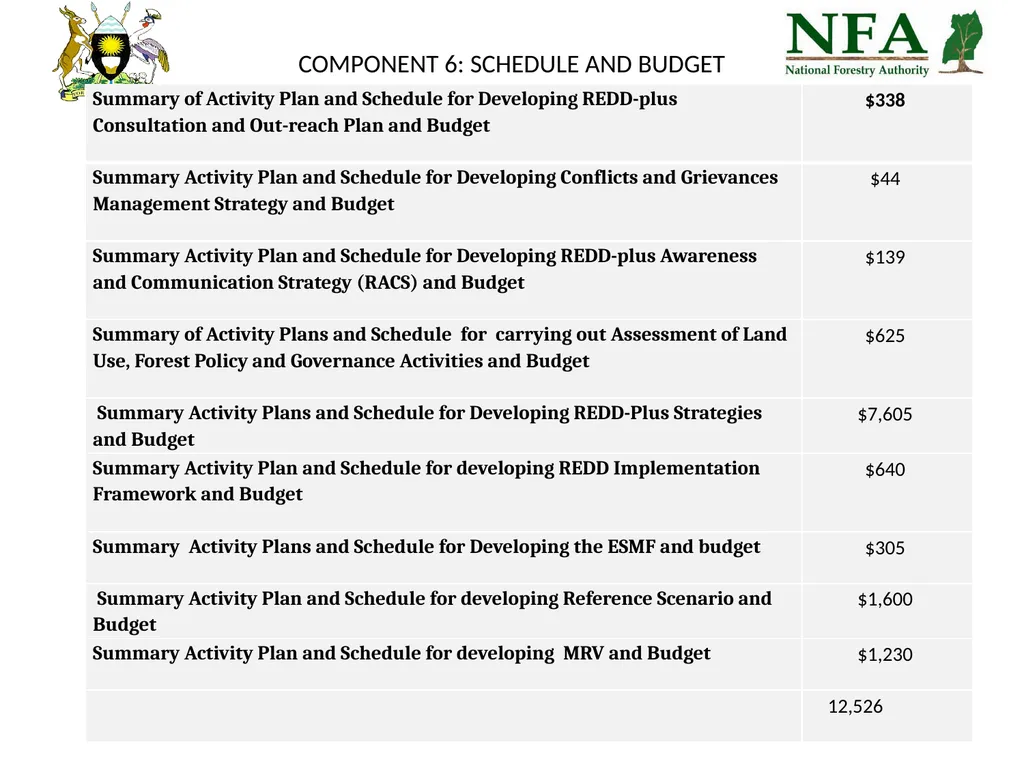
slide35. COMPONENT 6: SCHEDULE AND BUDGET<br>
March 25, 2010
By Xavier Mugumya<br>
slide2. GENERAL INFORMATION<br>
slide3. The Objectives of Uganda’s REDD-Plus Readiness are: Objective #1: Elaboration of actions for addressing the drivers of deforestation and forest degradation;
Objective #2: Development of practices for sustainable management of forests and conservation of forest stocks;
Objective #3: Demonstrate implementation of Uganda’s REDD-Plus Strategy;
Objective #4: Development of MRV for REDD-Plus activities; and
Objective #5: To strengthen national and institutional capacities for participation in REDD-Plus.<br>
slide4. Priority Actions and Measures for Uganda’s REDD-Plus Readiness will be: Defining institutional arrangements
Developing operational procedures and guidelines.
Capacity building
Defining strategies for addressing the drivers
Establishing a forest reference emissions levels and an MRV
Developing framework for assessing likely social and environment impacts of REDD-Plus.<br>
slide5. Uganda’s REDD-Plus Readiness will be have the following outputs: Institutional arrangements for implementing Uganda’s REDD - Plus Strategy in place.
Procedures and guidelines for conducive REDD- Plus implementation in place.
Capacity for REDD-Plus implementation .
Strategies for addressing deforestation and forest degradation, the role of conservation, sustainable forest management and building Carbon Stock adopted
Forest reference emissions levels published and an MRV in place.
Framework for assessing likely environment and social impacts of REDD-Plus.<br>
slide6. Uganda’s Political and Administrative Context 24,000,000 Ha
32.800.000 M inhabitants
112 districts
22 Municipalities
174 Town Councils
1365 Sub-counties
Our neighbors are DRC, Kenya, Rwanda, Sudan, Tanzania<br>
slide7. 1a. National Readiness Management Arrangements<br>
slide8. 1a. National Readiness (Continued): R-PP Formulation actions Uganda’s motivation to do R-PP: to have a credible roadmap for mobilizing resources to tackle deforestation and degradation; and to meet global obligations;
REDD – Plus Readiness Proposal preparation involved the following:
Information sharing and selected consultations with Stakeholders: Nearly 2,500 people representing 7 different categories of stakeholders were directly consulted between April 2010 to March 2011;
Studies on land use, policies and governance that helped identify drivers; formulation of options for addressing the drivers including potential social and environmental impacts; a plan for establishing a forest scenario and MRV;
Actual drafting of the R-PP: done by the combined effort of the R-PP Secretariat, the REDD-plus Working Group under the guidance of the National Steering Committee<br>
slide9. 1a. National Readiness (Continued): Stakeholders and their roles in R-PP formulation and implementation 1 During the preparation of the R-PP:
Ministry of Water and Environment chaired the REDD-plus Working Group and the National Steering Committee; its agency the National Forestry Authority acted as focal point and secretariat host;
Collaborating Government Ministries and Agencies: Government ministries and agencies responsible for energy, agriculture, livestock, physical planning, land use planning, land administration, environmental management, wildlife, trade, development planning, economic management and local governments were actively engaged;
Districts hosted the awareness and consultations meetings and served on the REDD Working Group and on the Steering Committee;
The R-PP formulation process benefitted from a variety of non-government institutions consisting of NGOs, Private Sector, Academia and Cultural Institutions through provision of information, advice and service during public consultations;
2. During the implementation of the R-PP stakeholder participation will continue but roles may change as shown in the next slide and Fig.2 as well<br>
slide10. 1a. National Readiness (Continued): Stakeholders and their roles in R-PP formulation and implementation 2<br>
slide11. 1 b. Stakeholder Consultation and Participation during R-PP formulation:<br>
slide12. 1 b. Consultation and Participation during R-PP Implementation<br>
slide13. Uganda R-PP Implementation Coordination and Supervision Structure Lead Institution
(Ministry responsible for Forestry) National Focal Point/ Secretariat Implementing Institutions
(to be selected when REDD Strategy is completed.) Implementing Institutions
(to be selected when REDD Strategy is completed.) Implementing Institutions
(to be selected when REDD Strategy is completed.) Implementing Institutions
(to be selected when REDD Strategy is completed.) Implementing Institutions
(to be selected when REDD Strategy is completed.) NATIONAL POLICY COMMITTEE ON ENVIRONMENT REDD Steering Committee National Technical Committee Thematic Taskforces<br>
slide14. 2a. Assessment of land use, forest policy and governance Land Use/land cover in Uganda: Uganda’s Biomass Study categorises different land uses in the country, into 13 land cover/land use classification types:
Broad leaved plantations
Coniferous plantations
Tropical High Forest well stocked
Tropical high forest low stocked
Woodland
Bush land
Grassland
Wetland
Small scale farmland
Commercial farmland
Built up area
Open Water
Impediments<br>
slide15. 2a. Assessment of land use, forest policy and governance<br>
slide16. 2a. Assessment of land use, forest policy and governance: Location of Forests in Uganda<br>
slide17. 2a. Assessment of land use, forest policy and governance: Trends in Forests cover loss in Uganda<br>
slide18. 2a. Continued: Trends in forest cover loss In 1890 forest cover in Uganda was about 10,800,000 Ha
In 1990 forest cover in Uganda was 4,900,000 Ha
In 2005 forest cover in Uganda was 3,600,000 Ha
Between 1890 and 1990, average annual forest loss was nearly at 60,000 ha/year
Between 1990 and 2005, average annual forest loss was estimated at 90,000 ha/year<br>
slide19. 2a. Continued: Main Direct Drivers of Deforestation and forest Degradation in Uganda Agricultural expansion into forested land
Population growth
Unsustainable cutting of trees for charcoal
Unsustainable cutting of trees for firewood
Unsustainable harvesting of timber
Livestock grazing and bush burning
See large Table on Pg 36<br>
slide20. 2a. Continued: Analysis of Drivers of deforestation and forest degradation in Uganda (see large table)<br>
slide21. Analysis of Drivers (cont.): Previous efforts to address deforestation and forest degradation in Uganda Previous efforts to halt, reverse and avoid deforestation and forest degradation have not been successful due to several factors including:
Weaknesses in the enforcement of law and policy and regulation of use of forest resources.
Institutional reforms such as decentralized management of forest reserves have not been effective in achieving their mandates.
Poor standards of governance in public administration are recognised as a major concern by the Government of Uganda across all sectors including forestry (NDP 2010).
Over-all, efforts to reduce deforestation and forest degradation in Uganda should seek to address
political interests, institutional capacities and credibility, population pressures,
benefits sharing, tenure of land and tree resources, alternatives to forestry resources, and competitiveness of forestry resource and,
Consistent and effective law enforcement.<br>
slide22. 2a. (Cont)Forest policy and governance Forestry policy and governance is considered in the context :
adequacy and/or inadequacy of
policies, legislation and
institutional arrangements for forestry management in Uganda,
enforcement and compliance to these policy and legal provisions,
the role of international policy regimes,
the role of research,
management of trans-boundary forestry resources and processes e.g. The Lusaka Agreement Taskforce
Rights to forestry resources (trees and carbon) in relation to REDD-Plus
The analysis of the above policy and legal frameworks reveals that the following policy areas need to be addressed:
Enforcement and compliance to policy and legal provisions
Promotion of alternative energy sources
Promotion of efficient wood energy production and use technologies
Sustainable management of forests and forestry resources
Strengthening stakeholder’s participation in development, management and conservation of forests and forestry resources.<br>
slide23. 2b. REDD Strategy Options Based on the analysis in 2a, the following approach was used to arrive at the possible strategy options (See large Table 25)<br>
slide24. 2b. REDD Strategy Options Process for developing and assessing the REDD-Plus Strategy options during 2011-2014
The process for developing, validating and finalizing the REDD-Plus Strategy will involve
assessment of the potential strategies outlined above,
generating additional information as necessary to refine the strategies,
prioritization and selection of strategies that are most likely to be successful and most cost effective,
selection of strategies and sites for pilot testing as necessary during the R-PP period,
consulting stakeholders on strategic choices,
testing and evaluating results,
evaluating social and environmental impacts of proposed strategies, and
Finalization of the REDD-Plus strategy through a consultative process.
The process of developing the REDD Plus Strategy will be led by a task forces under the direction of the REDD Focal Point as described in Component 1a and apply the Consultations and Participation Strategies defined under Section 1.7.1<br>
slide25. 2b. REDD Strategy Options The proposed steps to be undertaken during the R-PP implementation phase leading to finalization of the REDD-Plus Strategy are described below.
Assign the task of developing the REDD-Plus Strategy to the relevant task forces
Initiate work of the task force
Hold first consultative workshops to ensure stakeholder involvement and create the necessary linkages between the task force, National REDD-Plus Steering Committee and key stakeholder groups.
Begin early implementation of pilot strategies.
Evaluate and monitor outcomes of early implementation activities.
Develop and finalise the National REDD-Plus Strategy, based on those strategies that are deemed suitable for inclusion in national strategy.
Publicity and awareness activities to inform the public and stakeholders of the approved REDD-Plus Strategy for Uganda.<br>
slide26. 2C. REDD IMPLEMENTATION FRAMEWORK Two types of implementation are envisaged:
Implementation if the R-PP measures and activities outlined;
In order to ensure cost-effective implementation of R-PP, the following strategies are proposed:
Institutional strengthening:.
Integration of REDD-Plus Strategy into national development and sectoral plans and programmes:.
Collaboration and participation:
Monitoring and evaluation:
Ensuring REDD-Plus compliant investments:.
Integrating Cross cutting issues:
2. Concerning the implementation framework after the agreed REDD-plus strategy: a ToR has been attached.<br>
slide27. 2 D. SOCIAL AND ENVIRONMENTAL IMPACTS An Environmental and Social Management Framework (ESMF) will be prepared to guide the incorporation of social and environmental safeguards in the course of preparing the Strategy. Mandatory safeguards are:
safeguards for policy approaches and positive incentives on issues relating to reducing emissions from deforestation and forest degradation in developing countries; and the role of conservation, sustainable management of forests and enhancement of forest carbon stocks in developing countries
World Bank safeguard policies
National appropriate safeguards
Procedure for considering the safeguards and a work schedule has been prepared<br>
slide28. COMPONENT 3: DEVELOP A REFERENCE SCENARIO: Uganda’s Approach and work flow for setting the reference scenario (Fig.6) Data Availability and Gaps
The main activity data set in Uganda on land use changes is the National Biomass Study (NFA, 2009). It is based on:
the interpretation of two sets of satellite images (SPOT XS from 1990-1993 and Landsat TM from 2004-2005) using the FAO Land Cover Classification System (LCCS) and
a national grid based biomass field inventory with 2 to 4 data points per forested sampling point from the period between 1990-2005.
From this study the available data and some of the gaps are as follows:
Historic deforestation and forest degradation activity data and emissions can be extracted. This is the data that will be used to estimate the initial emissions.
For some sample points additional remote sensing analysis is required and the NFA is currently preparing to analyse Landsat data for 2010. This will help meet the minimum of three data points in time as recommended (GOFC-GOLD Sourcebook, 2009)
The accuracy level of the remote sensing and the biomass field inventory is unclear and needs to be analysed.
The reporting must be aligned with IPCC guidelines.
Depending on the accuracy level historic information may not be suitable for developing REDD+ scenarios and/or the inventory design needs to be modified.
A number of sub-national data sets exist that needs to be assessed in terms of its quality and integrated into a national database.<br>
slide29. COMPONENT 3: DEVELOP A REFERENCE SCENARIO: Uganda’s Approach and work flow for setting the reference scenario Data Availability and Gaps (Table 32)
Carbon emission data and emission factors
In the framework of a comprehensive study (National Biomass Study phase I)
3000 trees from 123 species were sampled destructively and for
4,500 trees green and dry weight were measured and single tree biomass functions were developed.
Almost 4,000 permanent sampling plots were established in Uganda to estimate woody biomass for different forest types.
10 % of these sample plots have been revisited several times to gain information on biomass dynamics, reflecting degradation and growth.
However, the quality of the emission data is uncertain and needs to be assessed before it can be used to develop the reference scenario.
In the framework of the National Biomass Inventory only for the living above ground carbon pool Tier 3 data is available.
Historical emissions: we shall use the IPCC Guidance
Consideration of influence of identified drivers<br>
slide30. COMPONENT 3: DEVELOP A REFERENCE SCENARIO: Uganda’s Approach and work flow for setting the reference scenario This is the summary of proposed actions and measures:
Design and Coordination
Capacity building
Evaluate and modify the NBS for Accuracy assessment of NBS, and Methodology modification to match REDD+ requirements
Acquisition to the remote sensing data, Acquisition of equipment (hardware & software), Data processing, analysis & interpretation and Acquisition of remote sensing data including the assessment of their accuracy
Field inventory (gather and evaluate emission data)
Historical emissions considerations especially Combination of activity and emission data
Reference Scenario including peer review including a possible consideration of the development of national reference scenarios<br>
slide31. Scope of MRV: we shall have a national approach with a possibility for sub-national possibilities;
Procedure for planning:
Setting the foundations : the country strives for Tier 3 but will begin with Tier 2 at the national level and then for sub-national or projects level we shall work for the third tier.
Defining mandates: FSSD will coordinate all the REDD-plus actions but the appropriate agencies will be assigned work on the MRV;
Planning a monitoring system: the current National Biomass Study will be adjusted to take care of UNFCCC requirements
Design of sub-national monitoring systems: this will depend on the requirements of UNFCCC and other competent bodies.
Data collection
Remote sensing and ground truthing shall be used to collect the data required. Social and other qualitative data may need a special way of collection, collation and analysis
Data management and reporting will be in accordance with UNFCCC guidance. But specific institutions shall take lead in areas of their competence.
Community involvement in forest monitoring: it is planned that appropriate MRVs will be designed to take care of the unique circumstances of communities COMPONENT 4: DESIGNING A MONITORING SYSTEM<br>
slide32. 4B. MONITORING OTHER BENEFITS AND IMPACTS Monitoring of co-benefits of REDD-Plus implementation will be an integral part of the monitoring system:
Among others to meet the monitoring requirements of the UN Convention on Biological Diversity.
important forest and non-forest products,
Socio-economic drivers of deforestation/forest degradation will be incorporated in the system, including ecosystem services (such as soil and water conservation) will be monitored either in the framework of the national monitoring system, sub-national monitoring or dedicated research projects.
Of course this requires additional funding which needs to be secured.<br>
slide33. 4B. STEPS FOR MRV INCLUDING MONITORING OTHER BENEFITS AND IMPACTS The Measures and activities required for development of a credible MRV system that includes the monitoring other benefits and impacts
Coordination activities
Objectives and standards of the monitoring system
Capacity building: Monitoring at district level; Training on evaluation of high resolution remote sensing data; Pilot projects for community monitoring; Training on data management
Development of monitoring plan
Develop set of indicators and measurement methodologies for monitoring of ecological and social co-benefits
Selection of methodology and tools
Development of procedures and work plans
Development of reporting system:
Design of data management system
Integration of REDD+ projects
System review
MRV implementation: i.e. Acquiring remote sensing data; Acquiring field inventory data; Data processing and analysis; QC and QA; Verification<br>
slide34. COMPONENT 5: DESIGN A PROGRAMME MONITORING AND EVALUATION FRAMEWORK FOR R-PP The R-PP Monitoring and Evaluation Framework focuses on:
Promoting accountability
Promoting learning, feedback, and information sharing
M&E implementation modalities and responsibilities
The day to day responsibility for implementing the R-PP M&E Strategy will be undertaken by the REDD-Plus National Focal Point. This task will be assisted by:
REDD-Plus Steering Committee which shall oversee the implementation of M&E Framework.
Implementing Institutions who shall be responsible for monitoring the progress of R-PP component activities and giving feedback to REDD-Plus National Focal Point.
Beneficiary communities’ representatives who shall be responsible for supporting communities in implementing community level monitoring indicators in collaboration with REDD-Plus National Focal Point
Information management system and procedures
Information and experiences on R-PP performance will be disseminated internally – among REDD-Plus Implementing Institutions – and
through additional dissemination workshops/meetings arranged as necessary and
Through relevant, media and publications.
R-PP partners, participating communities and donor(s) will receive summaries of reports to keep them abreast about work progress.
Wider audiences will be reached through additional dissemination achieved by posting of pertinent information on relevant websites.
Reporting and accountability
On a semi-annual basis, REDD-Plus National Focal Point, in collaboration with REDD- Plus Steering Committee, shall prepare and submit to the Lead Ministry progress reports on activities and targets. The second semi-annual report will also comprise the annual status report for the concluding year.<br>
slide35. COMPONENT 6: SCHEDULE AND BUDGET<br>