UL and EE Standards: A US Perspective February 27 - 28, 2012 Derek Greenauer Global Government Affairs Manager UL LLC Derek.Greenauerul.com WE ARE A GLOBAL FORCE FOR GOOD At UL, our mission of working for a safer world since 1894 is at the
Related Topics
Share
Embed code
Download this presentation From Below
"UL and EE Standards: A US Perspective February 27" is the property of its rightful owner. Permission is granted to
download and print the materials on this website for personal, non-commercial use only, and to display it
on your personal computer provided you do not modify the materials and that you retain all copyright
notices contained in the materials. By downloading content from our website, you accept the terms of this
agreement.
Presentation Transcript
01
UL and EE Standards: A US Perspective February 27 - 28, 2012
Derek Greenauer
Global Government Affairs Manager
UL LLC
Derek.Greenauer@ul.com<br>
02
WE ARE A GLOBAL FORCE
FOR GOOD At UL, our mission of working for a safer world since 1894 is at the core of everything we do.
Advancing safety through careful research and investigation
Preventing or reducing loss of life and property
Promoting safe living and working environments for all people 2<br>
03
DELIVERING UNMATCHED EXPERTISE & THOUGHT
LEADERSHIP From the adoption of electricity to the advent of wireless interoperability, UL is the leading voice for global safety. Our deep knowledge and expertise make us invaluable in:
Our Marks are on more than 23 billion products worldwide, per year, signaling peace of mind to consumers, customers, businesses and governments. WE PROVIDE GLOBAL MARKET
ACCEPTANCE 4<br>
05
UL helps you navigate:
Complex country compliance issues
Regulatory and trade challenges
Marketplace demands
Supply chain management AND HELP YOU NAVIGATE
GLOBAL TRADE 5<br>
06
Safety is evolving. Complex issues of today have replaced concerns of the past. And the safety landscape of tomorrow is yet to be defined.
Chemicals
Food and water
Infrastructure
Initial adoption of electricity
Medical devices
Nanotechnology
New sustainability breakthroughs
Renewable energy
Wireless integration THE DEFINITION OF SAFETY IS CONSTANTLY
EVOLVING 6<br>
07
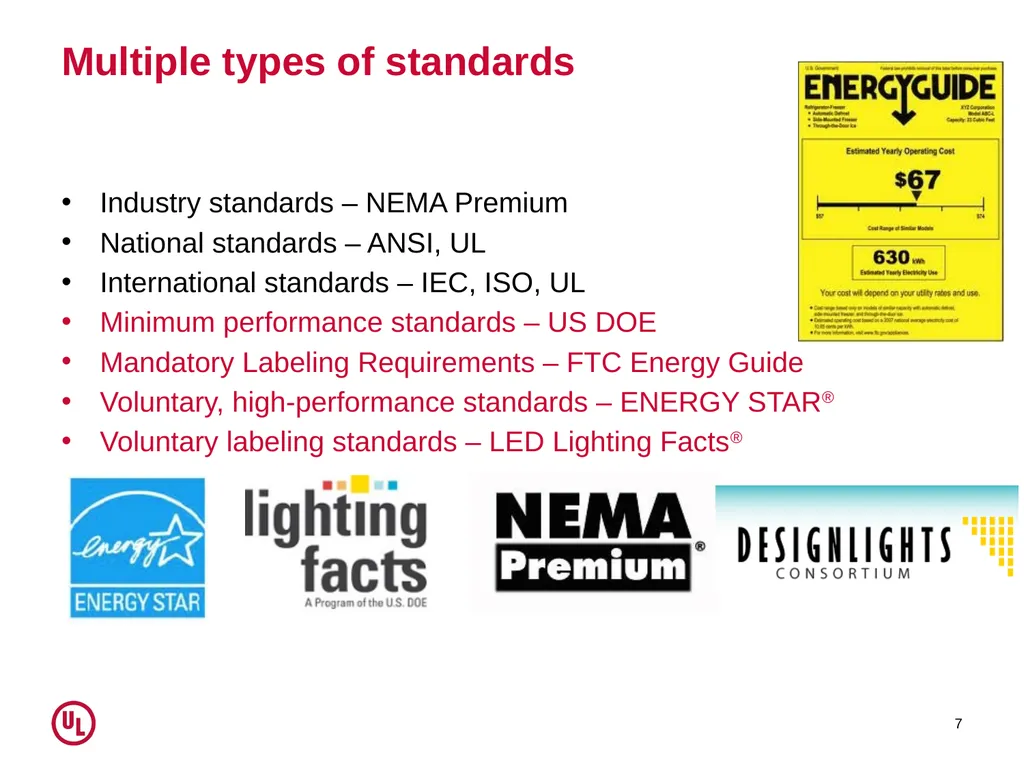
Multiple types of standards Industry standards – NEMA Premium
National standards – ANSI, UL
International standards – IEC, ISO, UL
Minimum performance standards – US DOE
Mandatory Labeling Requirements – FTC Energy Guide
Voluntary, high-performance standards – ENERGY STAR®
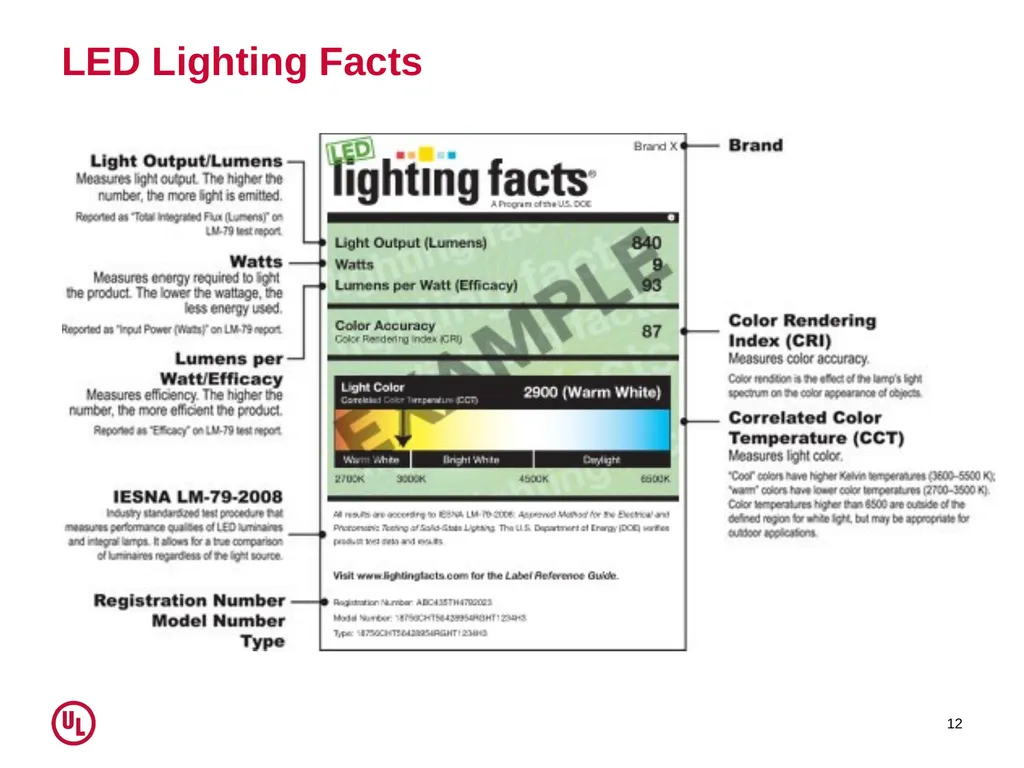
Voluntary labeling standards – LED Lighting Facts® 7<br>
08
Abridged history of energy efficiency standards - US Late 1960s - early 1970s – Individual states began setting minimum requirements for energy-using products – California, New York
1975 – Congress passed EPACT 1975, creating national minimum standards for some products.
1980s – DOE practiced the use of “no-standard standards” until the passage of NAECA in 1988
1992 – ENERGY STAR program created for computers
2010 – GAO Report cites shortcomings of ENERGY STAR
2011 – Federal Government increases verification efforts (Standards & ENERGY STAR) 8<br>
09
US federal standards development process Advanced Notice of Proposed Rulemaking (ANOPR) – informs stakeholders of DOE’s intentions to change/create a standard and outlines how the analysis will be conducted.
Notice of Proposed Rulemaking (NOPR) – Publishes the results of DOE’s analysis and proposes a draft standard.
Public Involvement – DOE collects comments and suggestions from the public through a formal comment period (30 – 60 days) and a public stakeholder meeting.
Final Rulemaking – DOE issues a Final Rulemaking that addresses the formal comments submitted and formally adopts the new standard. Usually, three years is provided before the standard takes effect. 9<br>
10
Compliance Process – DOE Standards Requirements depend on the product type
Basically…
Manufacturer submits certification reports and/or product templates
Compliance doesn’t require third-party testing
Results also sent to FTC for issuance of an Energy Guide Label, if applicable
Verification Testing – aftermarket testing commissioned by DOE to ensure products meet minimum standard. Failures can result in fines and other penalties. Failures may also be reported to FTC for additional enforcement.
Round Robin Testing – DOE program to ensure repeatability of DOE test procedures and reproducibility of results among labs.
Ultimate goal is to reduce variance in results 10<br>
11
ENERGY STAR Process Prior to 2010, EPA process was product-specific.
CFLs for instance, required test results from accredited labs & manufacturer funded verification testing
Computers, on the other hand, allowed for manufacturer self-declaration and little - to – no verification
Post GAO Report, EPA overhauled the program
Requires manufacturers to use accredited labs for testing
Requires product approval by a Certification Body (ISO/IEC Guide 65)
CB verification testing – 20% of qualified products per year 11<br>
12
LED Lighting Facts 12<br>
13
LED Lighting Facts Process Manufacturers test their products in accredited labs (NVLAP)
Submit results to Lighting Facts Program for issuance of label
No performance requirements, “Truth in Labeling” program
Lighting Facts conducts verification testing to ensure performance is accurately reported. 13<br>
14
Best Practices “Standards” are transparent in their establishment and management.
Standards are needed for testing facilities (labs) as well as products
Consumer confidence must be protected:
99% of manufacturers are honest
However, the 1% can severely damage the reputation of the entire effort
Leverage the work of independent 3rd parties
Most are already serving the needs of manufacturer testing and certification, so allowing 3rd party participation helps to streamline manufacturer’s go-to-market efforts 14<br>