
Umbrella Hub Arrangement Value Proposition
JO
Published · 30 slides · 0 views
1 / 1
Description
Umbrella Hub Arrangement Value Proposition Workshop JULY 2022 Value Proposition Workshop Description WHAT is this resource? This deck provides instructions and examples on outlining the list of services and supports partners of an umbrella
Related Topics
Share
Embed code
Download this presentation From Below
"Umbrella Hub Arrangement Value Proposition" is the property of its rightful owner. Permission is granted to download and print the materials on this website for personal, non-commercial use only, and to display it on your personal computer provided you do not modify the materials and that you retain all copyright notices contained in the materials. By downloading content from our website, you accept the terms of this agreement.
Presentation Transcript
01
Umbrella Hub Arrangement Value Proposition Workshop JULY 2022<br>
02
Value Proposition Workshop Description WHAT is this resource?
This deck provides instructions and examples on outlining the list of services and supports partners of an umbrella hub arrangement (UHA) can expect to receive from the UHA (also known as the value proposition).
WHO is this resource for?
This resource has been developed by NACDD and Leavitt Partners for umbrella hub organizations (UHOs). The resource may be useful to the project team responsible for building the business strategy for the UHO as well as for staff responsible for marketing, communications, and partner engagement.
WHEN would this resource be helpful?
It is recommended UHOs develop and outline the various value propositions of the UHA during planning phases prior to UHA operationalization. It is also useful to revisit value propositions before engaging with potential partners of the UHA.
HOW should this resource be used?
It is recommended the value proposition be used during group planning sessions when developing the UHA business plan or business strategy.
WHY should this resource be used?
Partners including subsidiary organizations, state health departments, payers, and referring organizations are essential to the success of the UHO. In order to build relationships with partners, each UHO must be able to articulate the reasons why partners should choose to engage with its UHA.<br>
This deck provides instructions and examples on outlining the list of services and supports partners of an umbrella hub arrangement (UHA) can expect to receive from the UHA (also known as the value proposition).
WHO is this resource for?
This resource has been developed by NACDD and Leavitt Partners for umbrella hub organizations (UHOs). The resource may be useful to the project team responsible for building the business strategy for the UHO as well as for staff responsible for marketing, communications, and partner engagement.
WHEN would this resource be helpful?
It is recommended UHOs develop and outline the various value propositions of the UHA during planning phases prior to UHA operationalization. It is also useful to revisit value propositions before engaging with potential partners of the UHA.
HOW should this resource be used?
It is recommended the value proposition be used during group planning sessions when developing the UHA business plan or business strategy.
WHY should this resource be used?
Partners including subsidiary organizations, state health departments, payers, and referring organizations are essential to the success of the UHO. In order to build relationships with partners, each UHO must be able to articulate the reasons why partners should choose to engage with its UHA.<br>
03
Understanding the UHA Value Proposition Building a sustainable UHA is dependent on identifying, communicating, and recruiting partners.
Potential partners may include subsidiary organizations, payers, referral partners such as physician practices, state health departments, 1705 organizations, and others.
Understanding the value proposition, what makes the UHA attractive to partners, is essential to effectively communicating with those partners. By creating and illustrating the value proposition during partner recruitment, the UHO can better understand their partners’ needs and create effective strategies for addressing those needs.
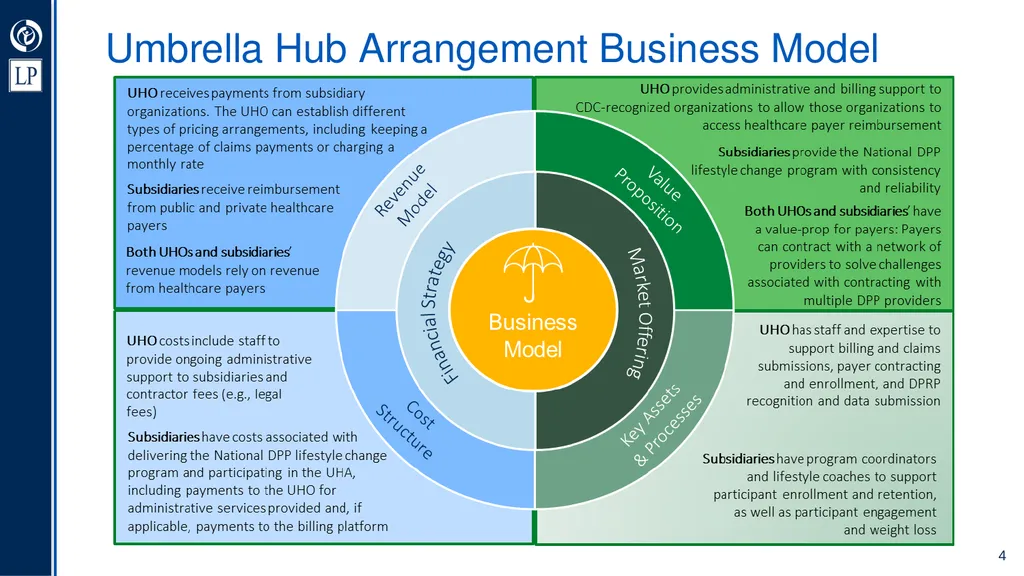
The value proposition is one of the four key components of the UHA Business Model, as illustrated on slide 4. Developing a project plan that encompasses each of the four components can assist in streamlining operationalization of the UHA.<br>
Potential partners may include subsidiary organizations, payers, referral partners such as physician practices, state health departments, 1705 organizations, and others.
Understanding the value proposition, what makes the UHA attractive to partners, is essential to effectively communicating with those partners. By creating and illustrating the value proposition during partner recruitment, the UHO can better understand their partners’ needs and create effective strategies for addressing those needs.
The value proposition is one of the four key components of the UHA Business Model, as illustrated on slide 4. Developing a project plan that encompasses each of the four components can assist in streamlining operationalization of the UHA.<br>
04
Umbrella Hub Arrangement Business Model<br>
05
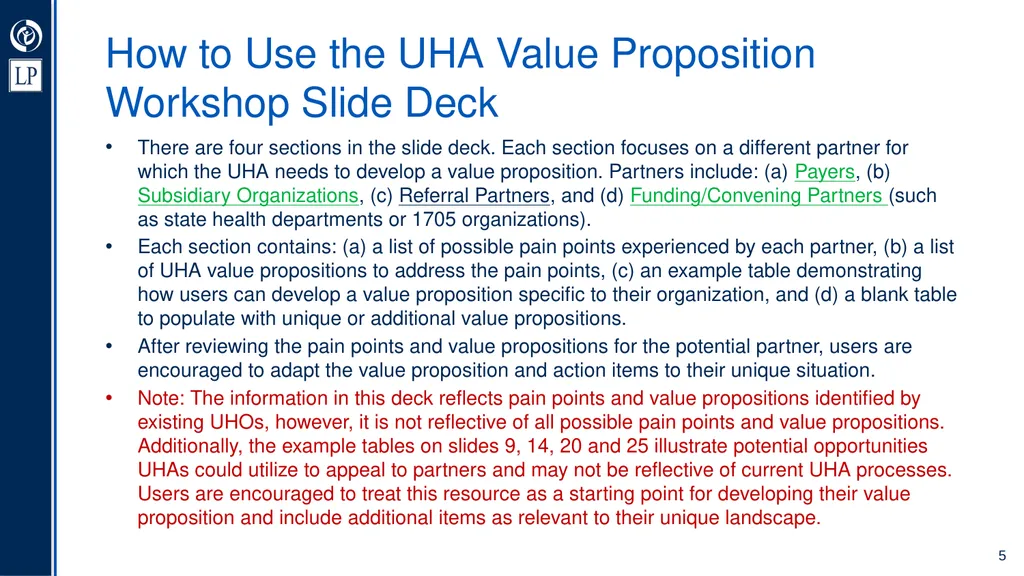
How to Use the UHA Value Proposition Workshop Slide Deck There are four sections in the slide deck. Each section focuses on a different partner for which the UHA needs to develop a value proposition. Partners include: (a) Payers, (b) Subsidiary Organizations, (c) Referral Partners, and (d) Funding/Convening Partners (such as state health departments or 1705 organizations).
Each section contains: (a) a list of possible pain points experienced by each partner, (b) a list of UHA value propositions to address the pain points, (c) an example table demonstrating how users can develop a value proposition specific to their organization, and (d) a blank table to populate with unique or additional value propositions.
After reviewing the pain points and value propositions for the potential partner, users are encouraged to adapt the value proposition and action items to their unique situation.
Note: The information in this deck reflects pain points and value propositions identified by existing UHOs, however, it is not reflective of all possible pain points and value propositions. Additionally, the example tables on slides 9, 14, 20 and 25 illustrate potential opportunities UHAs could utilize to appeal to partners and may not be reflective of current UHA processes. Users are encouraged to treat this resource as a starting point for developing their value proposition and include additional items as relevant to their unique landscape.<br>
Each section contains: (a) a list of possible pain points experienced by each partner, (b) a list of UHA value propositions to address the pain points, (c) an example table demonstrating how users can develop a value proposition specific to their organization, and (d) a blank table to populate with unique or additional value propositions.
After reviewing the pain points and value propositions for the potential partner, users are encouraged to adapt the value proposition and action items to their unique situation.
Note: The information in this deck reflects pain points and value propositions identified by existing UHOs, however, it is not reflective of all possible pain points and value propositions. Additionally, the example tables on slides 9, 14, 20 and 25 illustrate potential opportunities UHAs could utilize to appeal to partners and may not be reflective of current UHA processes. Users are encouraged to treat this resource as a starting point for developing their value proposition and include additional items as relevant to their unique landscape.<br>
06
UHA Value Proposition Payer Focus<br>
07
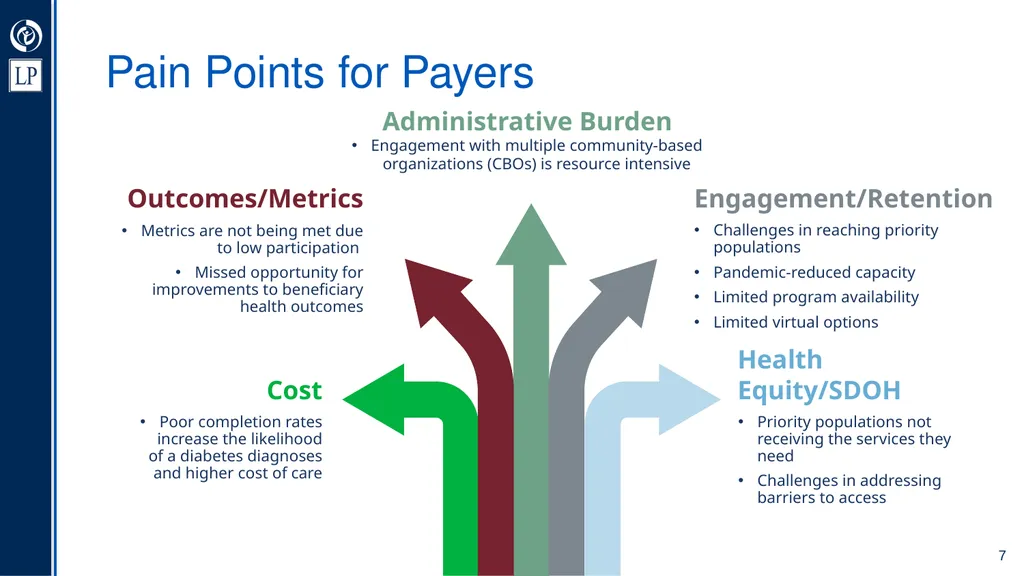
Administrative Burden
Engagement with multiple community-based organizations (CBOs) is resource intensive Pain Points for Payers<br>
Engagement with multiple community-based organizations (CBOs) is resource intensive Pain Points for Payers<br>
08
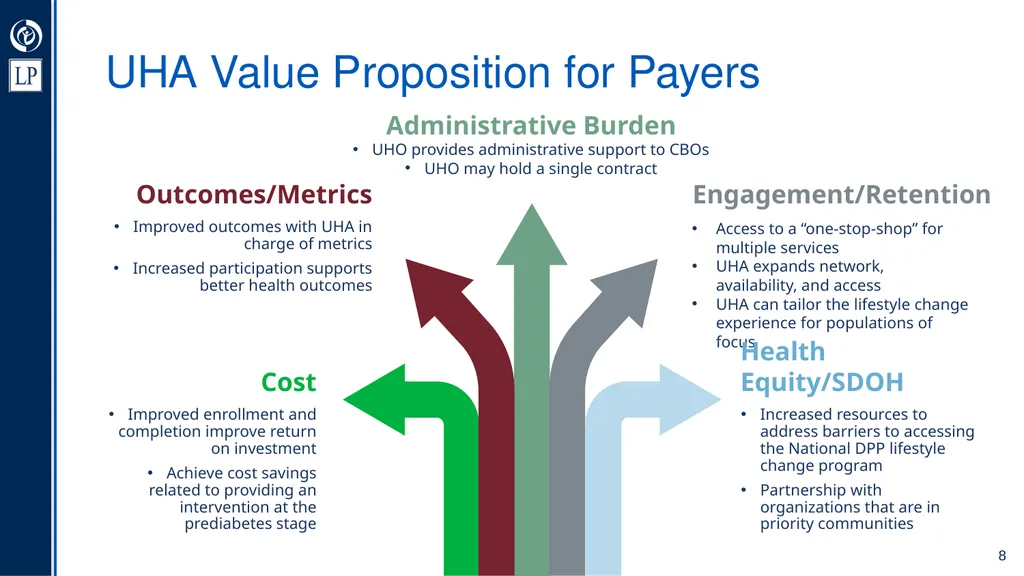
UHA Value Proposition for Payers Administrative Burden
UHO provides administrative support to CBOs
UHO may hold a single contract<br>
UHO provides administrative support to CBOs
UHO may hold a single contract<br>
09
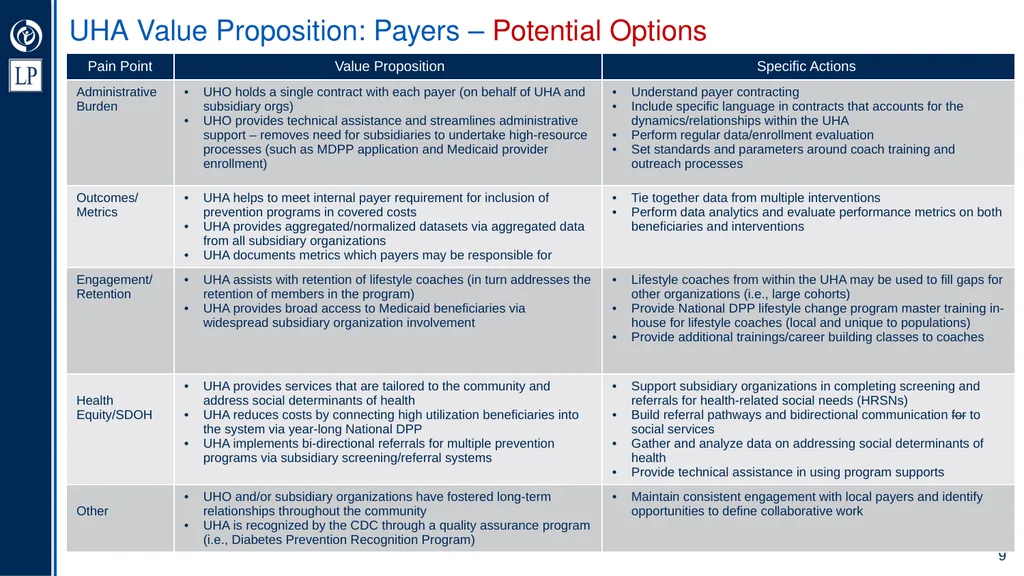
UHA Value Proposition: Payers – Potential Options<br>
10
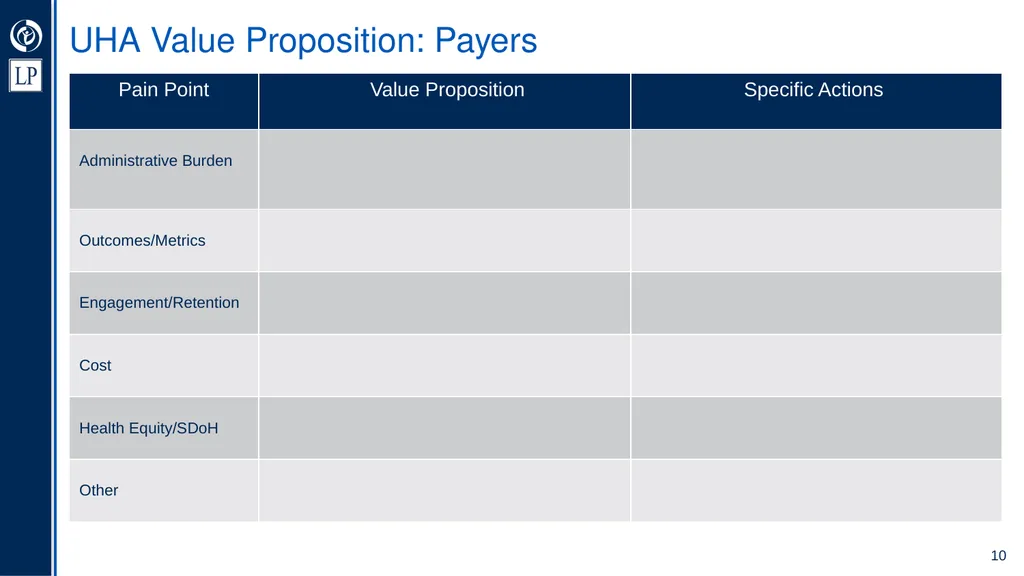
UHA Value Proposition: Payers<br>
11
UHA Value Proposition Subsidiary Organization Focus<br>
12
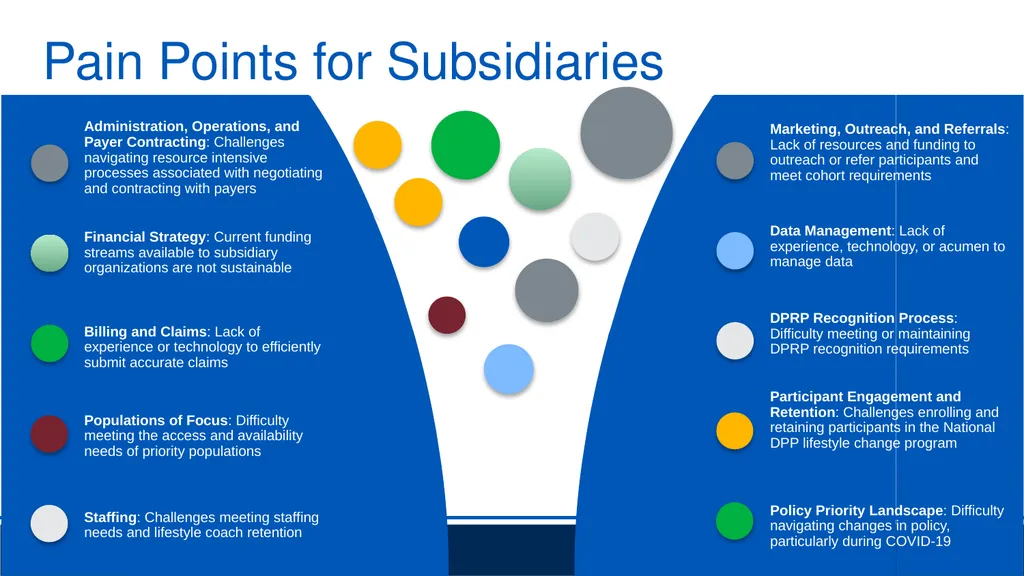
Pain Points for Subsidiaries Administration, Operations, and Payer Contracting: Challenges navigating resource intensive processes associated with negotiating and contracting with payers Financial Strategy: Current funding streams available to subsidiary organizations are not sustainable Populations of Focus: Difficulty meeting the access and availability needs of priority populations Policy Priority Landscape: Difficulty navigating changes in policy, particularly during COVID-19 Data Management: Lack of experience, technology, or acumen to manage data Billing and Claims: Lack of experience or technology to efficiently submit accurate claims DPRP Recognition Process: Difficulty meeting or maintaining DPRP recognition requirements Participant Engagement and Retention: Challenges enrolling and retaining participants in the National DPP lifestyle change program Staffing: Challenges meeting staffing needs and lifestyle coach retention Marketing, Outreach, and Referrals: Lack of resources and funding to outreach or refer participants and meet cohort requirements<br>
13
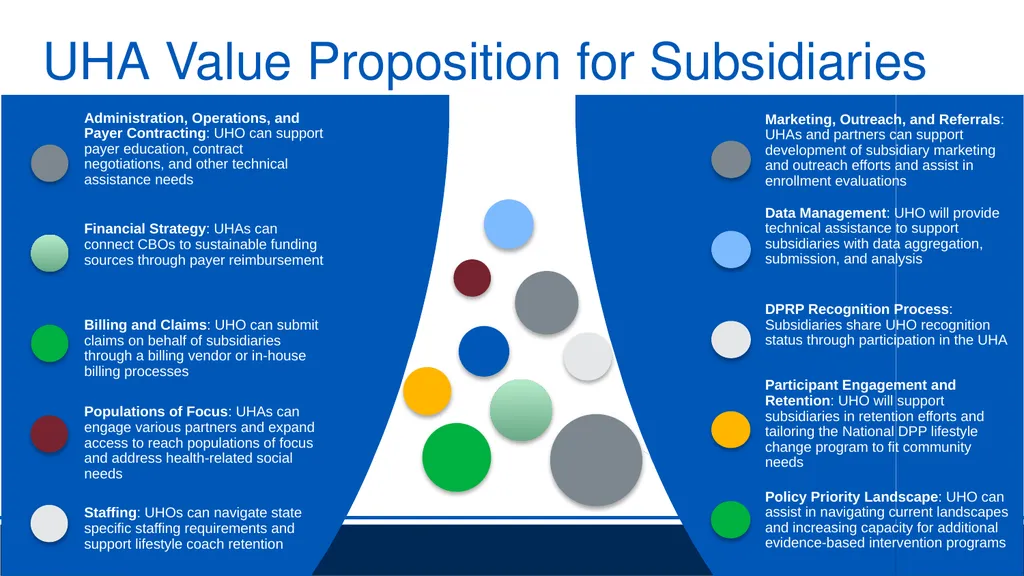
UHA Value Proposition for Subsidiaries Administration, Operations, and Payer Contracting: UHO can support payer education, contract negotiations, and other technical assistance needs Financial Strategy: UHAs can connect CBOs to sustainable funding sources through payer reimbursement Populations of Focus: UHAs can engage various partners and expand access to reach populations of focus and address health-related social needs Policy Priority Landscape: UHO can assist in navigating current landscapes and increasing capacity for additional evidence-based intervention programs Data Management: UHO will provide technical assistance to support subsidiaries with data aggregation, submission, and analysis Billing and Claims: UHO can submit claims on behalf of subsidiaries through a billing vendor or in-house billing processes DPRP Recognition Process: Subsidiaries share UHO recognition status through participation in the UHA Participant Engagement and Retention: UHO will support subsidiaries in retention efforts and tailoring the National DPP lifestyle change program to fit community needs Staffing: UHOs can navigate state specific staffing requirements and support lifestyle coach retention Marketing, Outreach, and Referrals: UHAs and partners can support development of subsidiary marketing and outreach efforts and assist in enrollment evaluations<br>
14
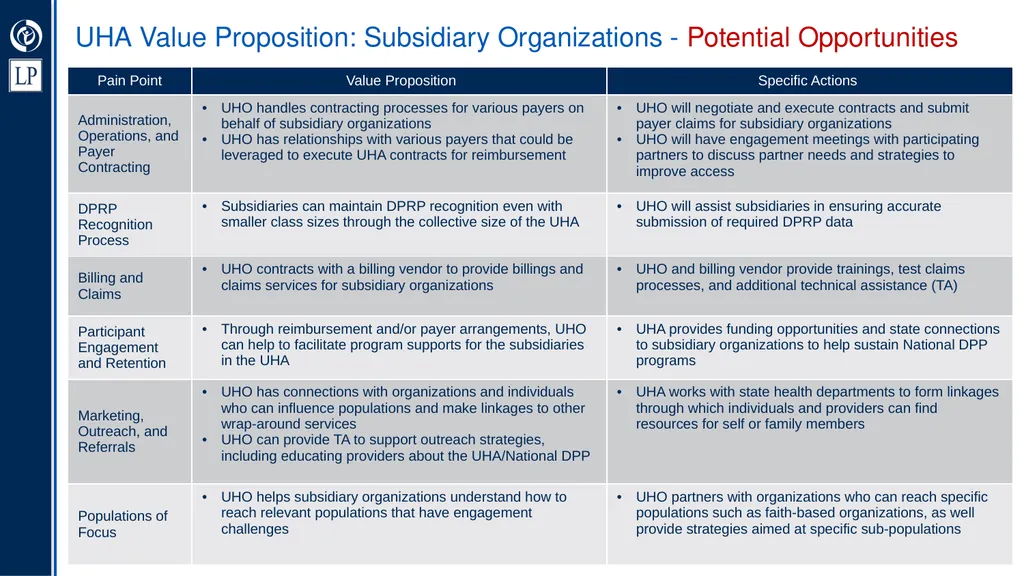
UHA Value Proposition: Subsidiary Organizations - Potential Opportunities<br>
15
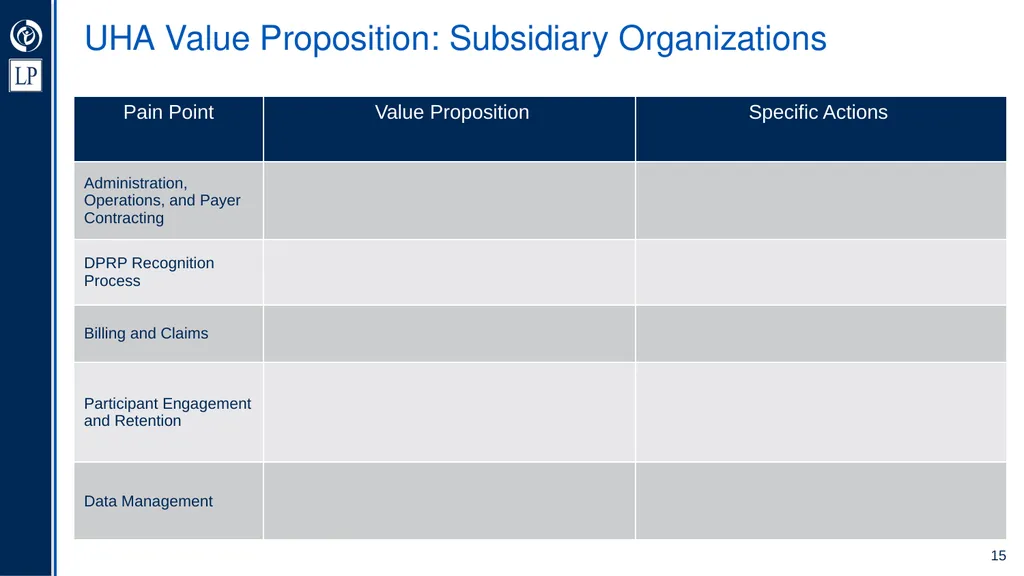
UHA Value Proposition: Subsidiary Organizations<br>
16
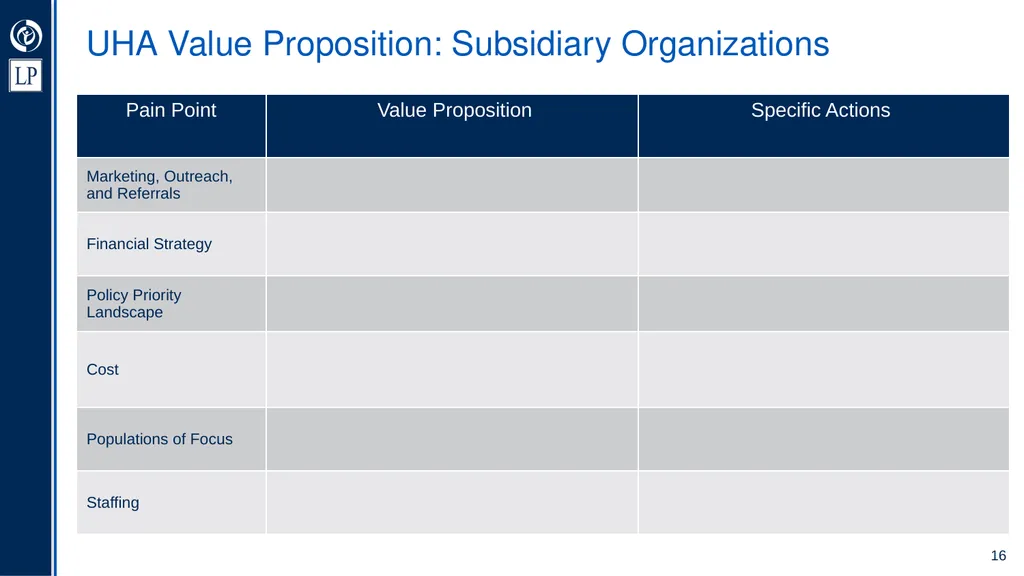
UHA Value Proposition: Subsidiary Organizations<br>
17
UHA Value Proposition Referral Partner Focus<br>
18
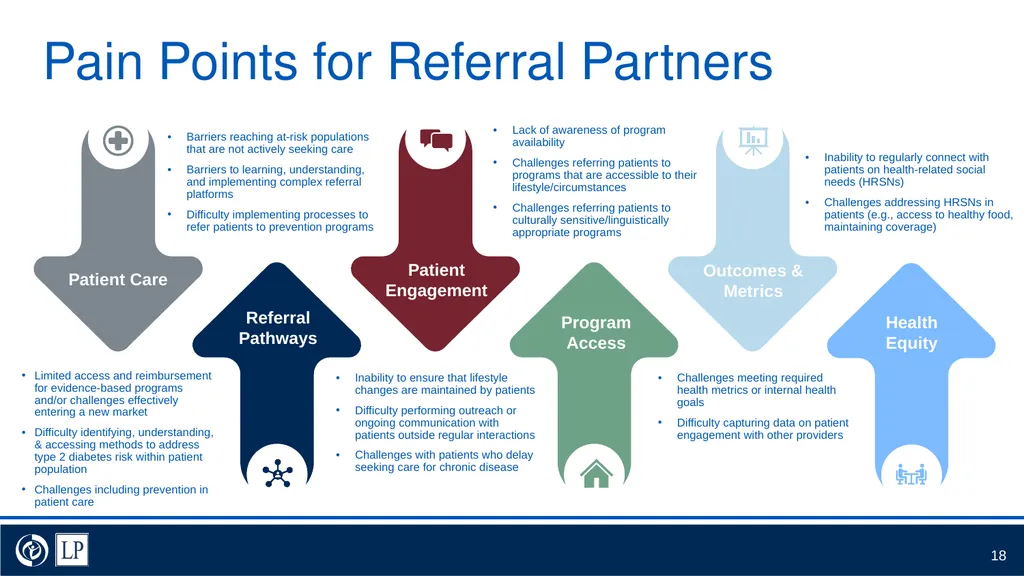
Patient Care Health Equity Referral Pathways Program Access Patient Engagement Outcomes & Metrics Limited access and reimbursement for evidence-based programs and/or challenges effectively entering a new market
Difficulty identifying, understanding, & accessing methods to address type 2 diabetes risk within patient population
Challenges including prevention in patient care Inability to ensure that lifestyle changes are maintained by patients
Difficulty performing outreach or ongoing communication with patients outside regular interactions
Challenges with patients who delay seeking care for chronic disease Barriers reaching at-risk populations that are not actively seeking care
Barriers to learning, understanding, and implementing complex referral platforms
Difficulty implementing processes to refer patients to prevention programs Lack of awareness of program availability
Challenges referring patients to programs that are accessible to their lifestyle/circumstances
Challenges referring patients to culturally sensitive/linguistically appropriate programs Inability to regularly connect with patients on health-related social needs (HRSNs)
Challenges addressing HRSNs in patients (e.g., access to healthy food, maintaining coverage) Pain Points for Referral Partners Challenges meeting required health metrics or internal health goals
Difficulty capturing data on patient engagement with other providers<br>
Difficulty identifying, understanding, & accessing methods to address type 2 diabetes risk within patient population
Challenges including prevention in patient care Inability to ensure that lifestyle changes are maintained by patients
Difficulty performing outreach or ongoing communication with patients outside regular interactions
Challenges with patients who delay seeking care for chronic disease Barriers reaching at-risk populations that are not actively seeking care
Barriers to learning, understanding, and implementing complex referral platforms
Difficulty implementing processes to refer patients to prevention programs Lack of awareness of program availability
Challenges referring patients to programs that are accessible to their lifestyle/circumstances
Challenges referring patients to culturally sensitive/linguistically appropriate programs Inability to regularly connect with patients on health-related social needs (HRSNs)
Challenges addressing HRSNs in patients (e.g., access to healthy food, maintaining coverage) Pain Points for Referral Partners Challenges meeting required health metrics or internal health goals
Difficulty capturing data on patient engagement with other providers<br>
19
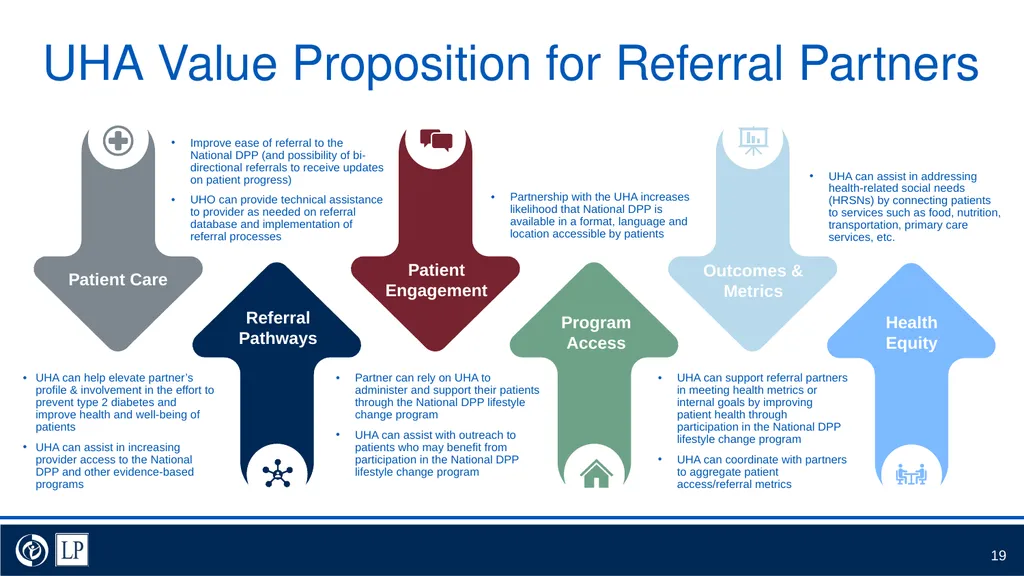
Patient Care Health Equity Referral Pathways Program Access Patient Engagement Outcomes & Metrics UHA can help elevate partner’s profile & involvement in the effort to prevent type 2 diabetes and improve health and well-being of patients
UHA can assist in increasing provider access to the National DPP and other evidence-based programs Partner can rely on UHA to administer and support their patients through the National DPP lifestyle change program
UHA can assist with outreach to patients who may benefit from participation in the National DPP lifestyle change program Improve ease of referral to the National DPP (and possibility of bi-directional referrals to receive updates on patient progress)
UHO can provide technical assistance to provider as needed on referral database and implementation of referral processes Partnership with the UHA increases likelihood that National DPP is available in a format, language and location accessible by patients UHA can assist in addressing health-related social needs (HRSNs) by connecting patients to services such as food, nutrition, transportation, primary care services, etc. UHA Value Proposition for Referral Partners UHA can support referral partners in meeting health metrics or internal goals by improving patient health through participation in the National DPP lifestyle change program
UHA can coordinate with partners to aggregate patient access/referral metrics<br>
UHA can assist in increasing provider access to the National DPP and other evidence-based programs Partner can rely on UHA to administer and support their patients through the National DPP lifestyle change program
UHA can assist with outreach to patients who may benefit from participation in the National DPP lifestyle change program Improve ease of referral to the National DPP (and possibility of bi-directional referrals to receive updates on patient progress)
UHO can provide technical assistance to provider as needed on referral database and implementation of referral processes Partnership with the UHA increases likelihood that National DPP is available in a format, language and location accessible by patients UHA can assist in addressing health-related social needs (HRSNs) by connecting patients to services such as food, nutrition, transportation, primary care services, etc. UHA Value Proposition for Referral Partners UHA can support referral partners in meeting health metrics or internal goals by improving patient health through participation in the National DPP lifestyle change program
UHA can coordinate with partners to aggregate patient access/referral metrics<br>
20
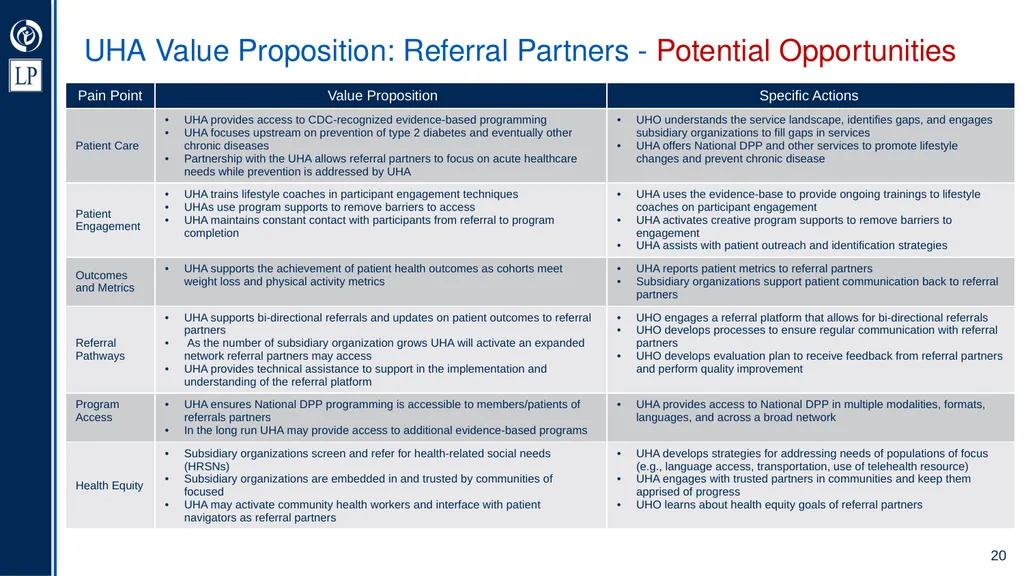
UHA Value Proposition: Referral Partners - Potential Opportunities<br>
21
UHA Value Proposition: Referral Partners<br>
22
UHA Value Proposition Funding/Convening (1705 organizations, State Health Departments, etc.)
Partner Focus<br>
Partner Focus<br>
23
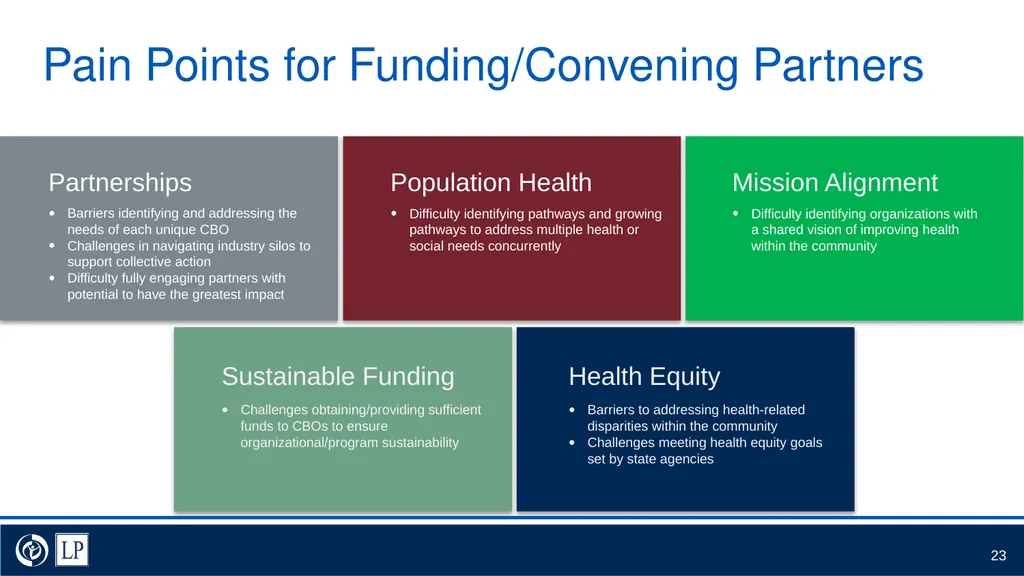
Partnerships Barriers identifying and addressing the needs of each unique CBO
Challenges in navigating industry silos to support collective action
Difficulty fully engaging partners with potential to have the greatest impact Population Health Difficulty identifying pathways and growing pathways to address multiple health or social needs concurrently Mission Alignment Difficulty identifying organizations with a shared vision of improving health within the community Sustainable Funding Challenges obtaining/providing sufficient funds to CBOs to ensure organizational/program sustainability Pain Points for Funding/Convening Partners Health Equity Barriers to addressing health-related disparities within the community
Challenges meeting health equity goals set by state agencies<br>
Challenges in navigating industry silos to support collective action
Difficulty fully engaging partners with potential to have the greatest impact Population Health Difficulty identifying pathways and growing pathways to address multiple health or social needs concurrently Mission Alignment Difficulty identifying organizations with a shared vision of improving health within the community Sustainable Funding Challenges obtaining/providing sufficient funds to CBOs to ensure organizational/program sustainability Pain Points for Funding/Convening Partners Health Equity Barriers to addressing health-related disparities within the community
Challenges meeting health equity goals set by state agencies<br>
24
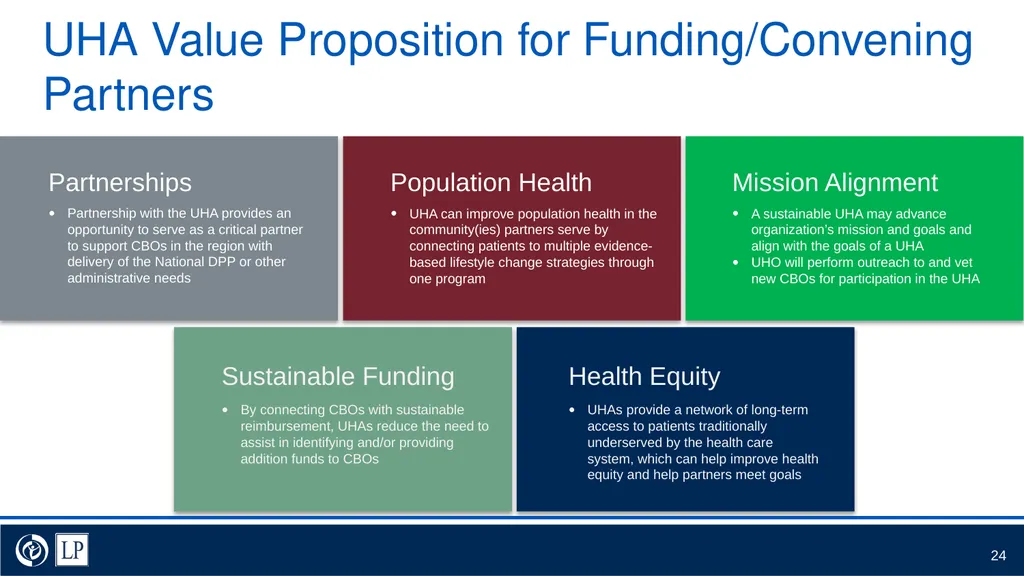
Partnerships Partnership with the UHA provides an opportunity to serve as a critical partner to support CBOs in the region with delivery of the National DPP or other administrative needs Population Health UHA can improve population health in the community(ies) partners serve by connecting patients to multiple evidence-based lifestyle change strategies through one program Mission Alignment A sustainable UHA may advance organization’s mission and goals and align with the goals of a UHA
UHO will perform outreach to and vet new CBOs for participation in the UHA Sustainable Funding By connecting CBOs with sustainable reimbursement, UHAs reduce the need to assist in identifying and/or providing addition funds to CBOs UHA Value Proposition for Funding/Convening Partners Health Equity UHAs provide a network of long-term access to patients traditionally underserved by the health care system, which can help improve health equity and help partners meet goals<br>
UHO will perform outreach to and vet new CBOs for participation in the UHA Sustainable Funding By connecting CBOs with sustainable reimbursement, UHAs reduce the need to assist in identifying and/or providing addition funds to CBOs UHA Value Proposition for Funding/Convening Partners Health Equity UHAs provide a network of long-term access to patients traditionally underserved by the health care system, which can help improve health equity and help partners meet goals<br>
25
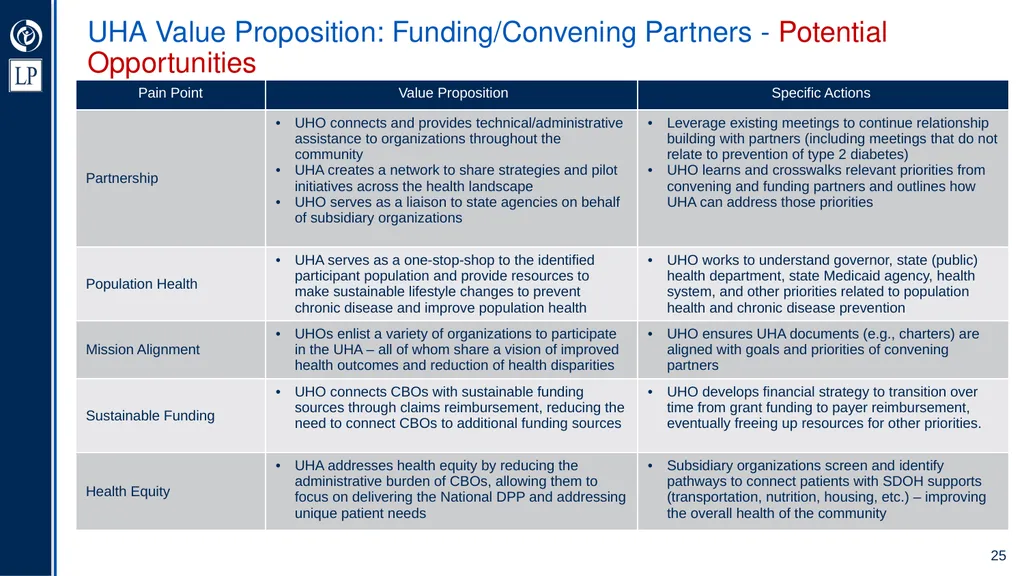
UHA Value Proposition: Funding/Convening Partners - Potential Opportunities<br>
26
UHA Value Proposition: Funding/Convening Partners<br>
27
Creating a Unique Value Proposition: Next Steps<br>
28
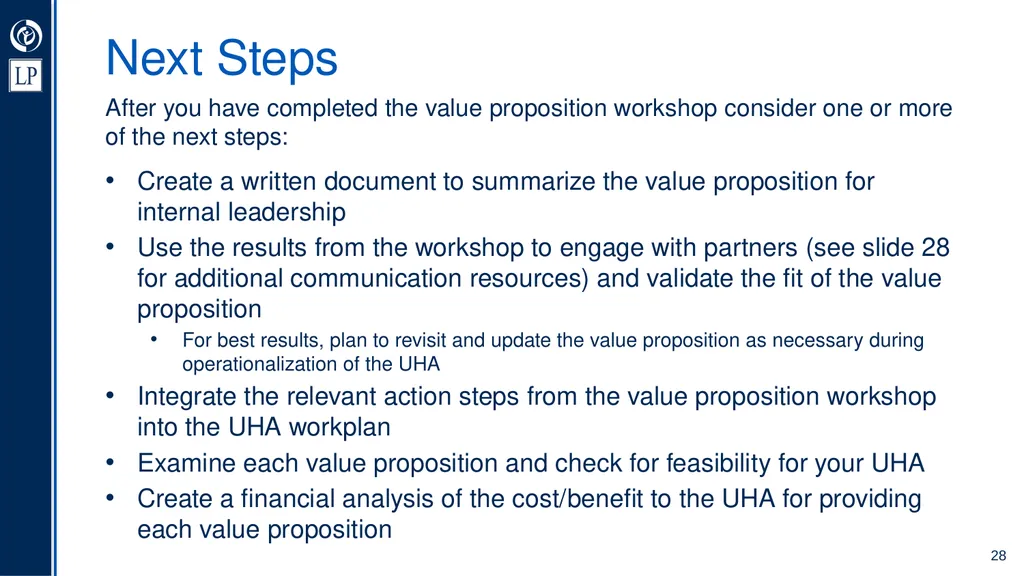
Next Steps Create a written document to summarize the value proposition for internal leadership
Use the results from the workshop to engage with partners (see slide 28 for additional communication resources) and validate the fit of the value proposition
For best results, plan to revisit and update the value proposition as necessary during operationalization of the UHA
Integrate the relevant action steps from the value proposition workshop into the UHA workplan
Examine each value proposition and check for feasibility for your UHA
Create a financial analysis of the cost/benefit to the UHA for providing each value proposition After you have completed the value proposition workshop consider one or more of the next steps:<br>
Use the results from the workshop to engage with partners (see slide 28 for additional communication resources) and validate the fit of the value proposition
For best results, plan to revisit and update the value proposition as necessary during operationalization of the UHA
Integrate the relevant action steps from the value proposition workshop into the UHA workplan
Examine each value proposition and check for feasibility for your UHA
Create a financial analysis of the cost/benefit to the UHA for providing each value proposition After you have completed the value proposition workshop consider one or more of the next steps:<br>
29
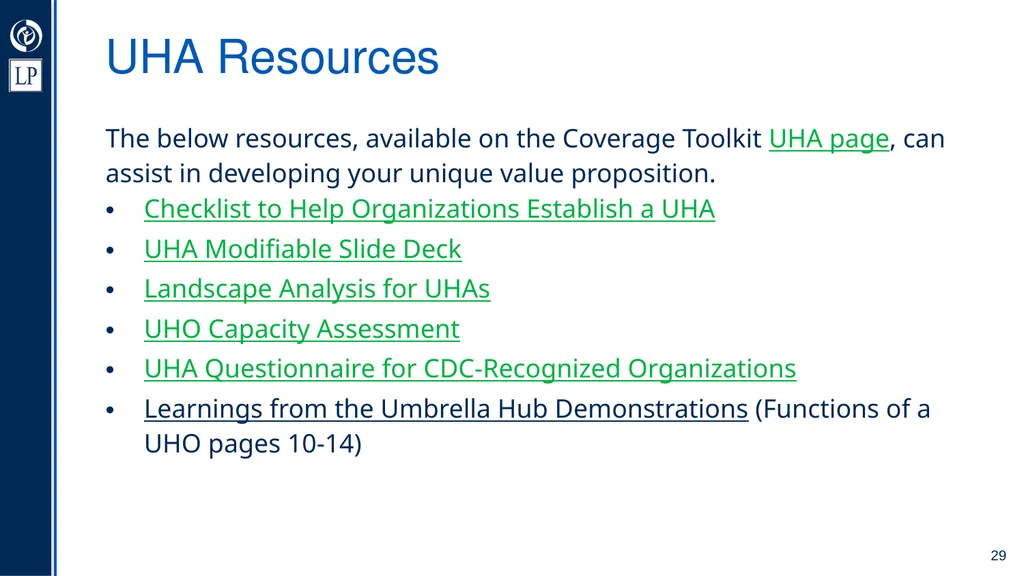
UHA Resources The below resources, available on the Coverage Toolkit UHA page, can assist in developing your unique value proposition.
Checklist to Help Organizations Establish a UHA
UHA Modifiable Slide Deck
Landscape Analysis for UHAs
UHO Capacity Assessment
UHA Questionnaire for CDC-Recognized Organizations
Learnings from the Umbrella Hub Demonstrations (Functions of a UHO pages 10-14)<br>
Checklist to Help Organizations Establish a UHA
UHA Modifiable Slide Deck
Landscape Analysis for UHAs
UHO Capacity Assessment
UHA Questionnaire for CDC-Recognized Organizations
Learnings from the Umbrella Hub Demonstrations (Functions of a UHO pages 10-14)<br>
30
The “Building the Delivery Infrastructure for the National DPP Through Strategic Partner Convenings” project is supported by the Centers for Disease Control and Prevention of the U.S. Department of Health and Human Services (HHS) as part of a financial assistance award totaling $900,000 with 100 percent funded by CDC/HHS. The contents are those of the author(s) and do not necessarily represent the official views of, nor an endorsement, by CDC/HHS, or the U.S. Government.
The National Association of Chronic Disease Directors - Promoting Health. Preventing Disease.
The National Association of Chronic Disease Directors (NACDD) and its more than 7,000 Members seek to strengthen state-based leadership and expertise for chronic disease prevention and control in states and nationally. Established in1988, in partnership with the U.S. Centers for Disease Control and Prevention, NACDD is the only membership association of its kind to serve and represent every chronic disease division in all states and U.S. territories. For more information, visit chronicdisease.org.
If you require this document in an alternative format, such as large print or a colored background, please contact the Communications Department at publications@chronicdisease.org. Alternate formats can be made available within two weeks of a request.<br>
The National Association of Chronic Disease Directors - Promoting Health. Preventing Disease.
The National Association of Chronic Disease Directors (NACDD) and its more than 7,000 Members seek to strengthen state-based leadership and expertise for chronic disease prevention and control in states and nationally. Established in1988, in partnership with the U.S. Centers for Disease Control and Prevention, NACDD is the only membership association of its kind to serve and represent every chronic disease division in all states and U.S. territories. For more information, visit chronicdisease.org.
If you require this document in an alternative format, such as large print or a colored background, please contact the Communications Department at publications@chronicdisease.org. Alternate formats can be made available within two weeks of a request.<br>