
UNCITRAL draft model law on IdM and trust services
Description: UNCITRAL draft model law on IdM and trust services Luca Castellani UNCITRAL Secretariat The views expressed are those of the author and do not necessarily reflect the views of the United Nations and of UNCITRAL The draft UNCITRAL Model Law
Related Topics
Download Presentation
"UNCITRAL draft model law on IdM and trust services" is the property of its rightful owner. Permission is granted to download and print the materials on this website for personal, non-commercial use only, and to display it on your personal computer provided you do not modify the materials and that you retain all copyright notices contained in the materials. By downloading content from our website, you accept the terms of this agreement.
Presentation Transcript
slide1. UNCITRAL draft model law
on IdM and trust services Luca Castellani
UNCITRAL Secretariat
The views expressed are those of the author and do not necessarily reflect the views of the United Nations and of UNCITRAL<br>
slide2. The draft UNCITRAL Model Law on IdM and Trust Services UNCITRAL WG IV has prepared a model law on the use and cross-border recognition of IdM and trust services
Project started in 2017 at the request of certain EU member States and with a broad scope:
build on shared principles and terminology to provide a uniform legal treatment for:
private and public IdM systems and schemes
a broad range of trust services
Respects general principles of commercial and e-commerce law
Takes into consideration prior UNCITRAL provisions and eIDAS regulation<br>
slide3. The draft UNCITRAL Model Law on IdM and Trust Services All preparatory documents available on UNCITRAL website in all UN official languages
Draft provisions and explanatory note are submitted to the Commission for consideration and possible adoption in July 2022
Latest version available in document A/CN.9/1112 - Draft Model Law on the Use and Cross-border Recognition of Identity Management and Trust Services<br>
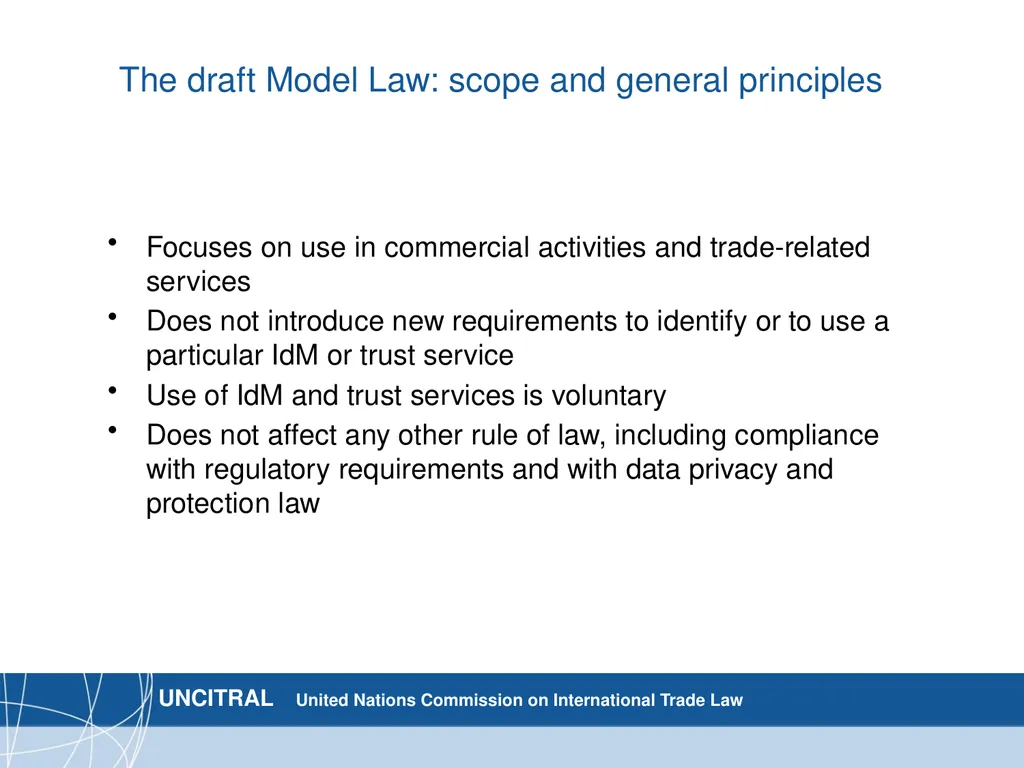
slide4. The draft Model Law: scope and general principles Focuses on use in commercial activities and trade-related services
Does not introduce new requirements to identify or to use a particular IdM or trust service
Use of IdM and trust services is voluntary
Does not affect any other rule of law, including compliance with regulatory requirements and with data privacy and protection law<br>
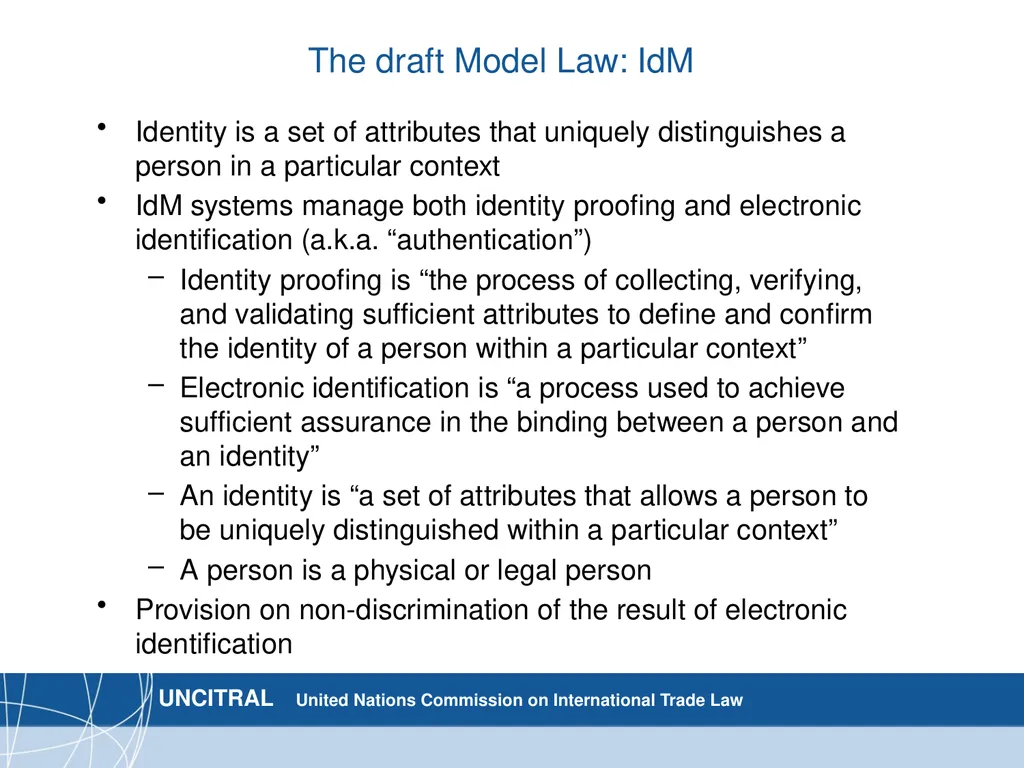
slide5. The draft Model Law: IdM Identity is a set of attributes that uniquely distinguishes a person in a particular context
IdM systems manage both identity proofing and electronic identification (a.k.a. “authentication”)
Identity proofing is “the process of collecting, verifying, and validating sufficient attributes to define and confirm the identity of a person within a particular context”
Electronic identification is “a process used to achieve sufficient assurance in the binding between a person and an identity”
An identity is “a set of attributes that allows a person to be uniquely distinguished within a particular context”
A person is a physical or legal person
Provision on non-discrimination of the result of electronic identification<br>
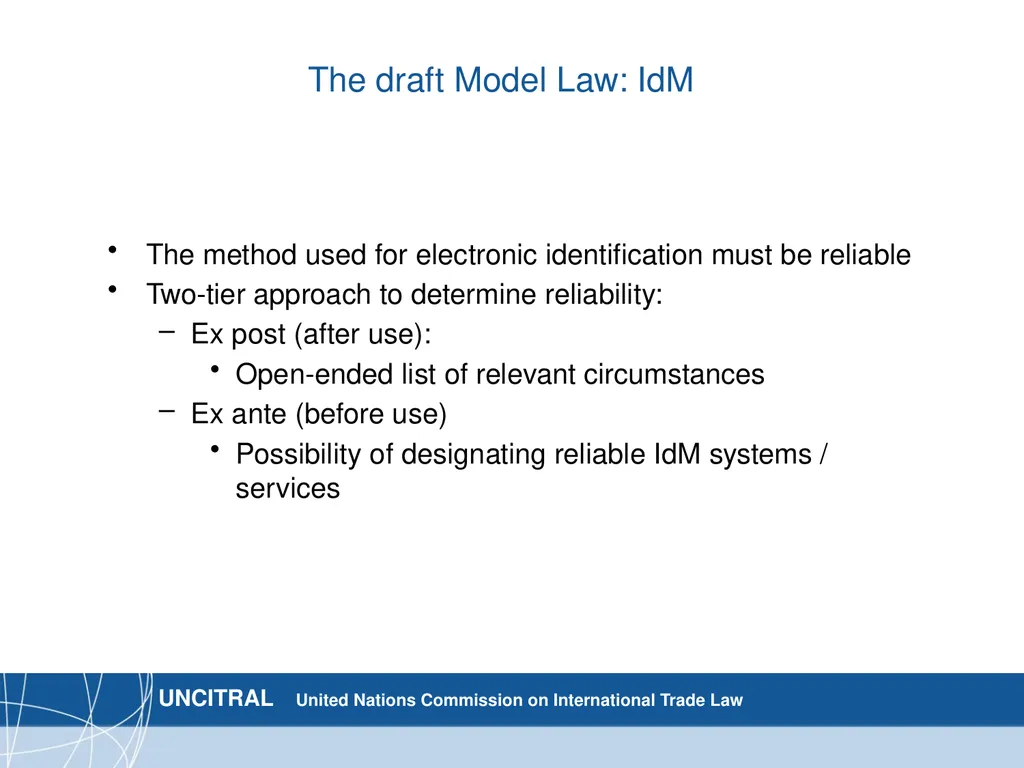
slide6. The draft Model Law: IdM The method used for electronic identification must be reliable
Two-tier approach to determine reliability:
Ex post (after use):
Open-ended list of relevant circumstances
Ex ante (before use)
Possibility of designating reliable IdM systems / services<br>
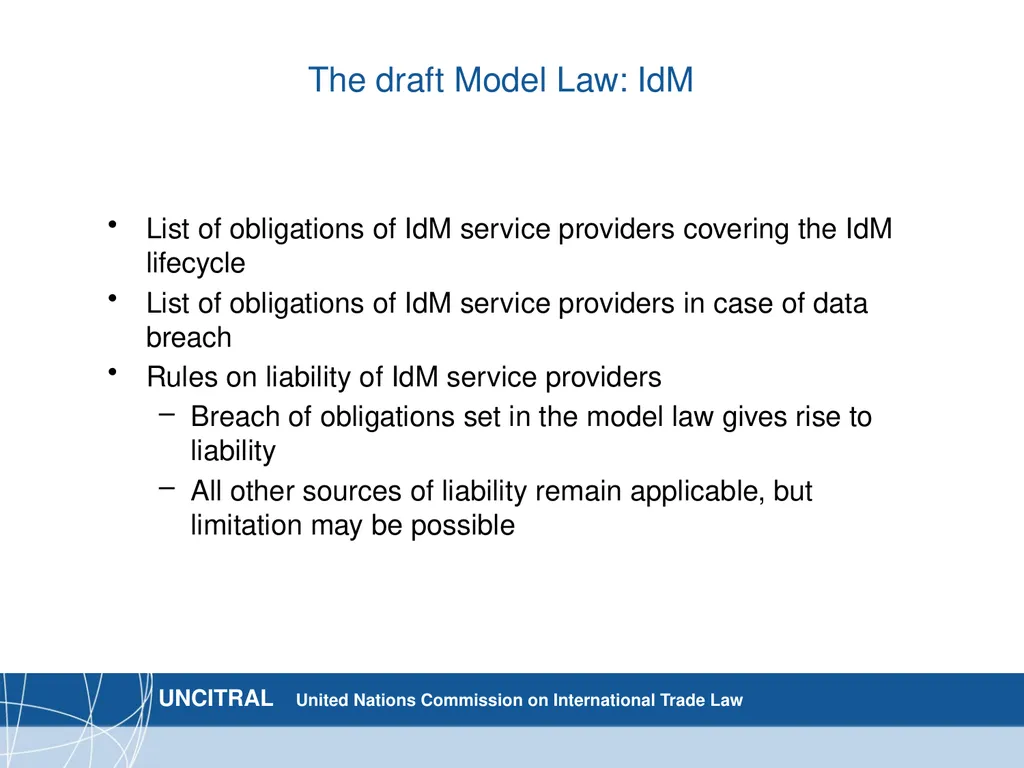
slide7. The draft Model Law: IdM List of obligations of IdM service providers covering the IdM lifecycle
List of obligations of IdM service providers in case of data breach
Rules on liability of IdM service providers
Breach of obligations set in the model law gives rise to liability
All other sources of liability remain applicable, but limitation may be possible<br>
slide8. The draft Model Law: trust services A trust service is an electronic service that provides assurance of certain qualities of a data message
who, what, when, where, and why of data
Includes the methods for creating and managing electronic signatures, electronic seals, electronic time stamps, website authentication, electronic archiving and electronic registered delivery services (same as eIDAS)
List of trust services is open-ended
Rule on non-discrimination against use of trust services<br>
slide9. The draft Model Law: trust services Each trust service (except website authentication) has a dedicated provision drafted as a functional equivalence rule referring to the paper-based function
Same “two tier” approach as for IdM
ex ante designation + ex post assessment
List of obligations of trust service providers
Liability of trust service providers<br>
slide10. The draft Model Law: cross-border aspects Geographic-neutral rules on the assessment of reliability of the method used and on the designation of reliable systems and services
Apply to both IdM and trust services
Dedicated provisions on cross-border recognition and on international cooperation
Does not foresee, but is compatible with the establishment of a centrally-managed mutual recognition mechanism
The model law may be used as a template for bilateral and plurilateral agreements<br>
slide11. Further considerations The draft model law has maintained the double structure of eIDAS based on IdM / trust services
However, identity information may raise several diverse issues
IdM – especially foundational identity – raises privacy concerns that call for stricter regulation
Trust services – including those incorporating functional identity – aim to support dataflows and require an enabling environment rather than a regulatory one
Issues for further consideration:
Use of trust services with respect to object-generated data<br>
UNCITRAL Secretariat
The views expressed are those of the author and do not necessarily reflect the views of the United Nations and of UNCITRAL<br>
slide2. The draft UNCITRAL Model Law on IdM and Trust Services UNCITRAL WG IV has prepared a model law on the use and cross-border recognition of IdM and trust services
Project started in 2017 at the request of certain EU member States and with a broad scope:
build on shared principles and terminology to provide a uniform legal treatment for:
private and public IdM systems and schemes
a broad range of trust services
Respects general principles of commercial and e-commerce law
Takes into consideration prior UNCITRAL provisions and eIDAS regulation<br>
slide3. The draft UNCITRAL Model Law on IdM and Trust Services All preparatory documents available on UNCITRAL website in all UN official languages
Draft provisions and explanatory note are submitted to the Commission for consideration and possible adoption in July 2022
Latest version available in document A/CN.9/1112 - Draft Model Law on the Use and Cross-border Recognition of Identity Management and Trust Services<br>
slide4. The draft Model Law: scope and general principles Focuses on use in commercial activities and trade-related services
Does not introduce new requirements to identify or to use a particular IdM or trust service
Use of IdM and trust services is voluntary
Does not affect any other rule of law, including compliance with regulatory requirements and with data privacy and protection law<br>
slide5. The draft Model Law: IdM Identity is a set of attributes that uniquely distinguishes a person in a particular context
IdM systems manage both identity proofing and electronic identification (a.k.a. “authentication”)
Identity proofing is “the process of collecting, verifying, and validating sufficient attributes to define and confirm the identity of a person within a particular context”
Electronic identification is “a process used to achieve sufficient assurance in the binding between a person and an identity”
An identity is “a set of attributes that allows a person to be uniquely distinguished within a particular context”
A person is a physical or legal person
Provision on non-discrimination of the result of electronic identification<br>
slide6. The draft Model Law: IdM The method used for electronic identification must be reliable
Two-tier approach to determine reliability:
Ex post (after use):
Open-ended list of relevant circumstances
Ex ante (before use)
Possibility of designating reliable IdM systems / services<br>
slide7. The draft Model Law: IdM List of obligations of IdM service providers covering the IdM lifecycle
List of obligations of IdM service providers in case of data breach
Rules on liability of IdM service providers
Breach of obligations set in the model law gives rise to liability
All other sources of liability remain applicable, but limitation may be possible<br>
slide8. The draft Model Law: trust services A trust service is an electronic service that provides assurance of certain qualities of a data message
who, what, when, where, and why of data
Includes the methods for creating and managing electronic signatures, electronic seals, electronic time stamps, website authentication, electronic archiving and electronic registered delivery services (same as eIDAS)
List of trust services is open-ended
Rule on non-discrimination against use of trust services<br>
slide9. The draft Model Law: trust services Each trust service (except website authentication) has a dedicated provision drafted as a functional equivalence rule referring to the paper-based function
Same “two tier” approach as for IdM
ex ante designation + ex post assessment
List of obligations of trust service providers
Liability of trust service providers<br>
slide10. The draft Model Law: cross-border aspects Geographic-neutral rules on the assessment of reliability of the method used and on the designation of reliable systems and services
Apply to both IdM and trust services
Dedicated provisions on cross-border recognition and on international cooperation
Does not foresee, but is compatible with the establishment of a centrally-managed mutual recognition mechanism
The model law may be used as a template for bilateral and plurilateral agreements<br>
slide11. Further considerations The draft model law has maintained the double structure of eIDAS based on IdM / trust services
However, identity information may raise several diverse issues
IdM – especially foundational identity – raises privacy concerns that call for stricter regulation
Trust services – including those incorporating functional identity – aim to support dataflows and require an enabling environment rather than a regulatory one
Issues for further consideration:
Use of trust services with respect to object-generated data<br>