
UNDERSTANDING ANALYSIS Interpretation Techniques
CS
Published · 43 slides · 0 views

1 / 1

Description
UNDERSTANDING ANALYSIS Interpretation Techniques for Looking Below the Surface Analysis is More than just a set of skills, analysis is a frame of mind, an attitude toward experience. It is a form of detective work that typically pursues
Related Topics
Share
Embed code
Download this presentation From Below
"UNDERSTANDING ANALYSIS Interpretation Techniques" is the property of its rightful owner. Permission is granted to download and print the materials on this website for personal, non-commercial use only, and to display it on your personal computer provided you do not modify the materials and that you retain all copyright notices contained in the materials. By downloading content from our website, you accept the terms of this agreement.
Presentation Transcript
01
UNDERSTANDING ANALYSIS Interpretation Techniques for Looking Below the Surface<br>
02
Analysis is… “More than just a set of skills, analysis is a frame of mind, an attitude toward experience. It is a form of detective work that typically pursues something puzzling, something you are seeking to understand rather than something you are already sure you have the answers to. Analysis finds questions where there seemed not to be any, and it makes connections that might not have been evident at first.”
(Rosenwasser and Stephen, 4)<br>
(Rosenwasser and Stephen, 4)<br>
03
Preview Rationale
Defining analysis
Analysis Thought Processes
Achieving Analysis
Practicing Analysis
Conclusion<br>
Defining analysis
Analysis Thought Processes
Achieving Analysis
Practicing Analysis
Conclusion<br>
04
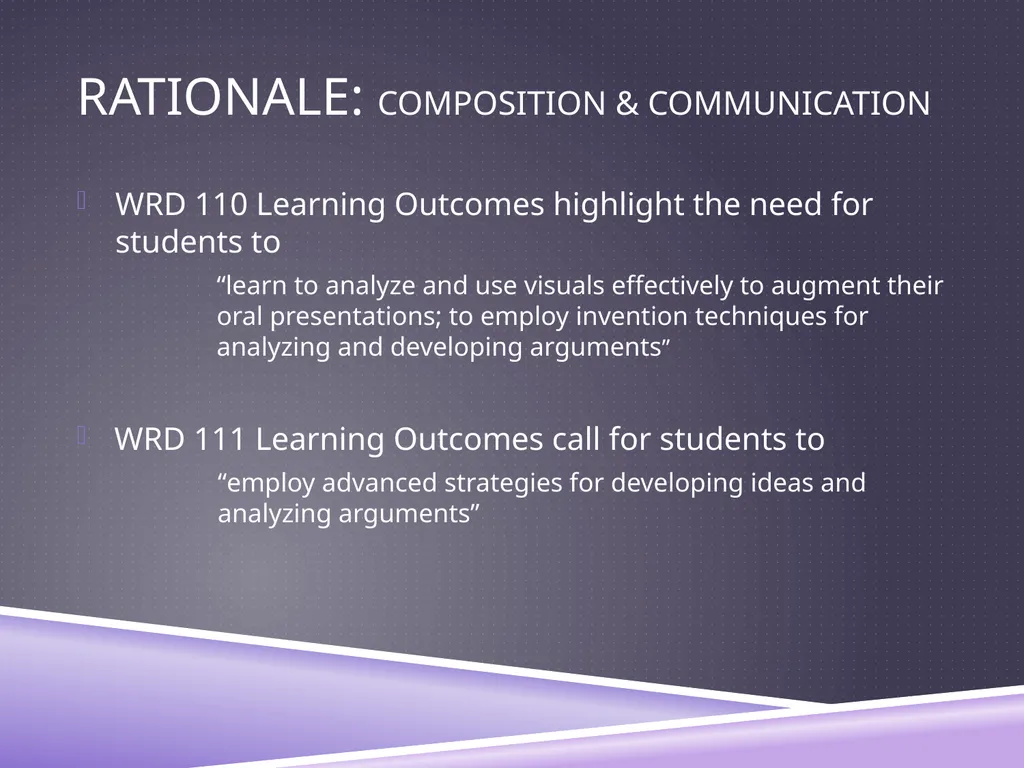
RATIONALE: COMPOSITION & COMMUNICATION WRD 110 Learning Outcomes highlight the need for students to
“learn to analyze and use visuals effectively to augment their oral presentations; to employ invention techniques for analyzing and developing arguments”
WRD 111 Learning Outcomes call for students to
“employ advanced strategies for developing ideas and analyzing arguments”<br>
“learn to analyze and use visuals effectively to augment their oral presentations; to employ invention techniques for analyzing and developing arguments”
WRD 111 Learning Outcomes call for students to
“employ advanced strategies for developing ideas and analyzing arguments”<br>
05
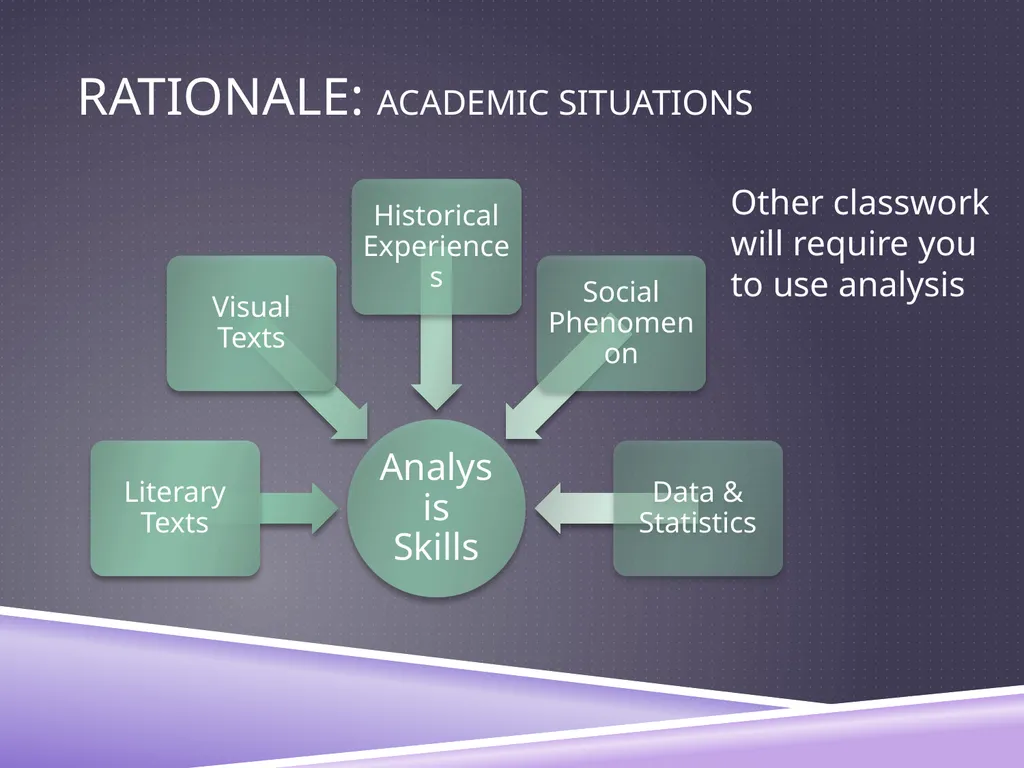
Rationale: Academic Situations Other classwork will require you to use analysis<br>
06
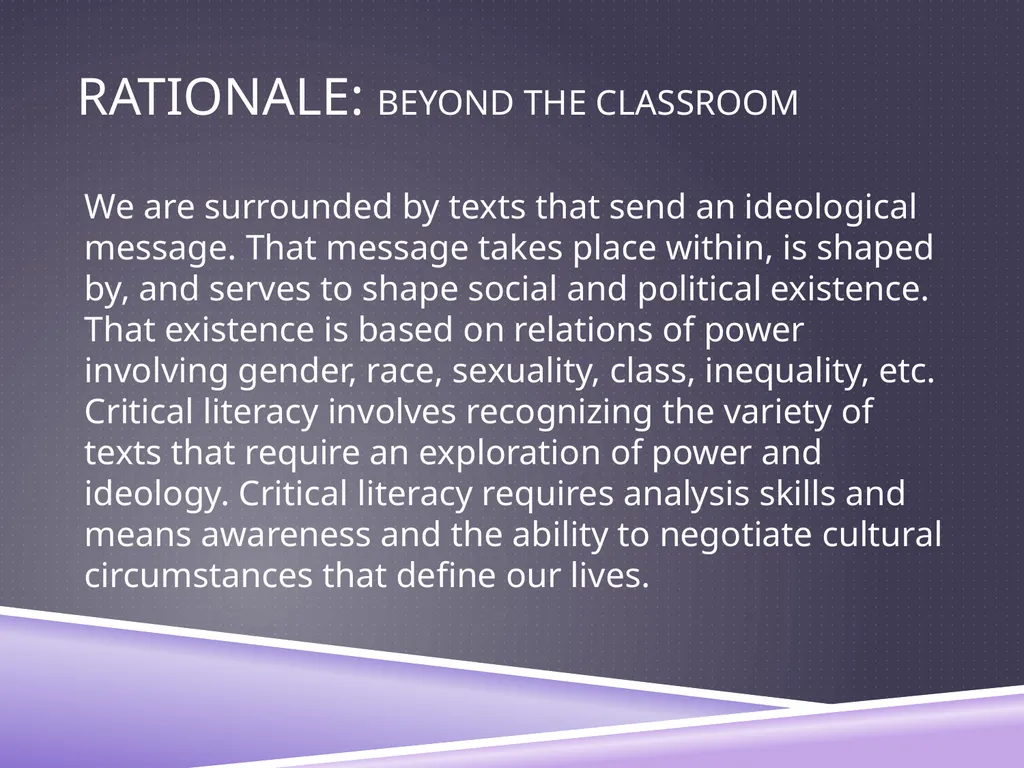
Rationale: Beyond the Classroom We are surrounded by texts that send an ideological message. That message takes place within, is shaped by, and serves to shape social and political existence. That existence is based on relations of power involving gender, race, sexuality, class, inequality, etc. Critical literacy involves recognizing the variety of texts that require an exploration of power and ideology. Critical literacy requires analysis skills and means awareness and the ability to negotiate cultural circumstances that define our lives.<br>
07
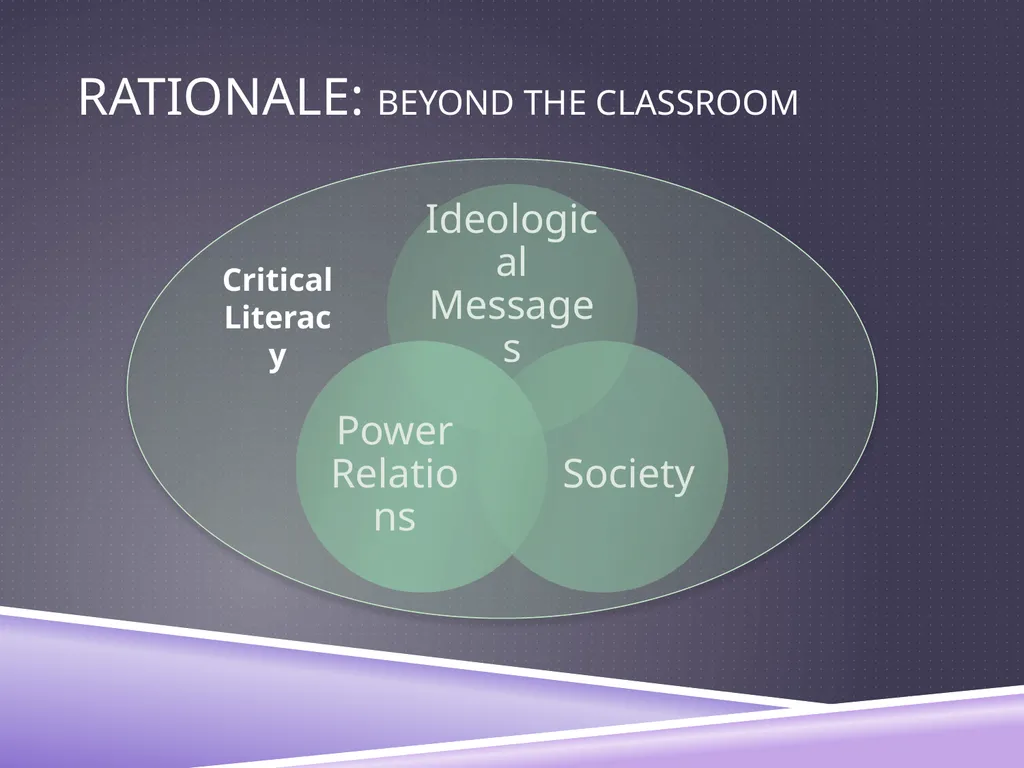
Rationale: Beyond the Classroom Critical Literacy<br>
08
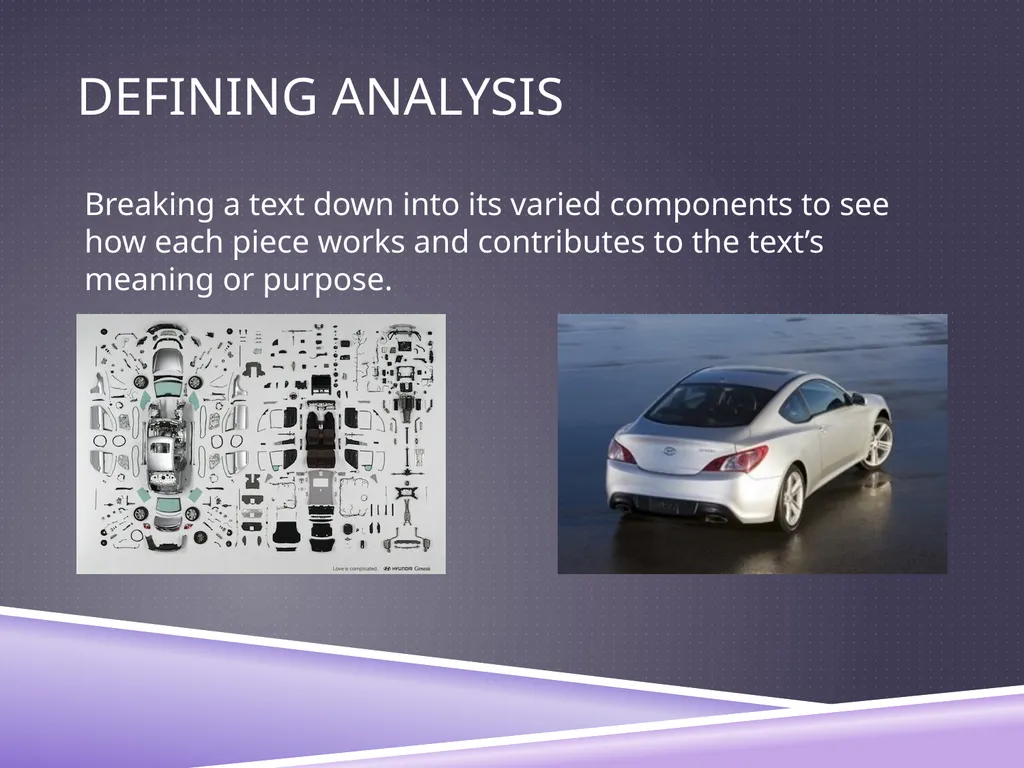
DEFINING ANALYSIS Breaking a text down into its varied components to see how each piece works and contributes to the text’s meaning or purpose.<br>
09
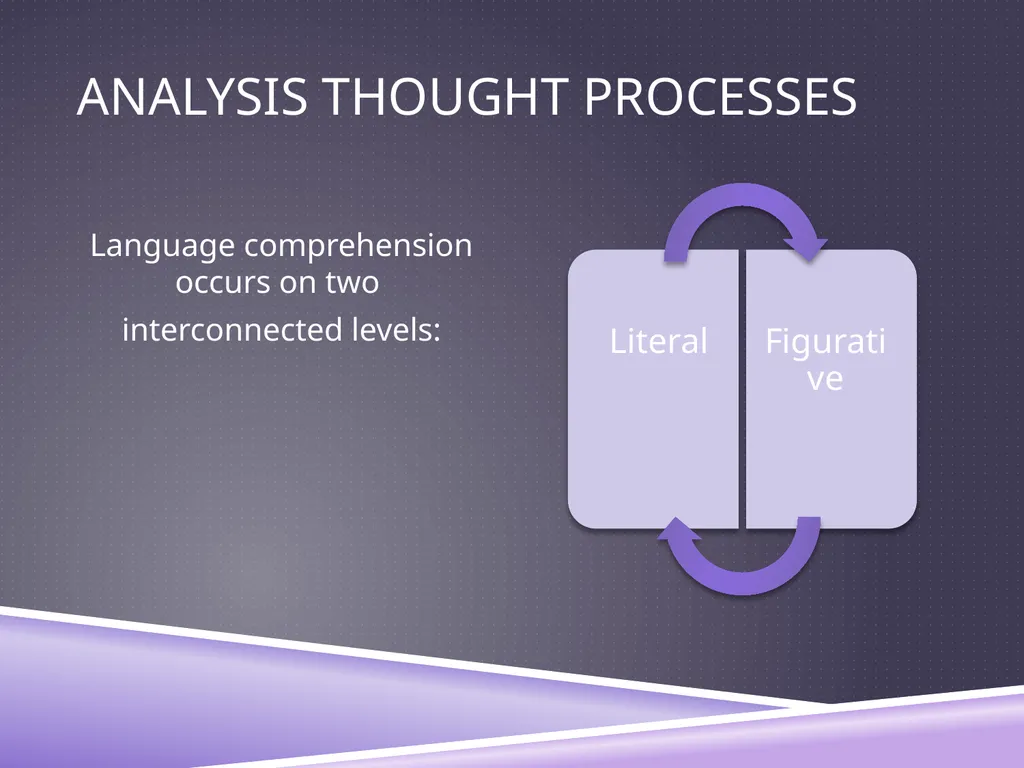
ANALYSIS THOUGHT PROCESSES Language comprehension occurs on two
interconnected levels:<br>
interconnected levels:<br>
10
ANALYSIS THOUGHT PROCESSES On some levels, we analyze automatically, as part of our basic comprehension, whenever we use language. If we break down this process using language as an example, we can see how analysis works and apply that to any type of text.<br>
11
Analysis thought processes LITERAL: the explicit, surface meaning based on the denotative purpose of words (the dictionary definition that does not change by circumstance).
A literal reading =
a summary, stating what a text says or does outright.
“I am hungry” says “I am in need of food”
Remember the critical reading PPT? Before you can analyze, you summarize to show you comprehend the message.<br>
A literal reading =
a summary, stating what a text says or does outright.
“I am hungry” says “I am in need of food”
Remember the critical reading PPT? Before you can analyze, you summarize to show you comprehend the message.<br>
12
Analysis Thought processes FIGURATIVE: the implicit, underlying or obscured meaning based on the connotative purpose of words (the symbolic definition based on specific circumstances).
A figurative reading =
interpretation, explaining the inferred or implied message.
“I am hungry” implies “I want to eat right now”
Remember figurative description on the narration & description PPT? They require thinking through to understand the connection between the ideas.<br>
A figurative reading =
interpretation, explaining the inferred or implied message.
“I am hungry” implies “I want to eat right now”
Remember figurative description on the narration & description PPT? They require thinking through to understand the connection between the ideas.<br>
13
ANALYSIS THOUGHT PROCESSES Slowing things down a bit…
Let’s see how this works by
imagining you are a non-native English speaker
newly arrived in an English-speaking country.<br>
Let’s see how this works by
imagining you are a non-native English speaker
newly arrived in an English-speaking country.<br>
14
ANALYSIS THOUGHT PROCESSES You hear…
“She totally nailed that PowerPoint presentation”<br>
“She totally nailed that PowerPoint presentation”<br>
15
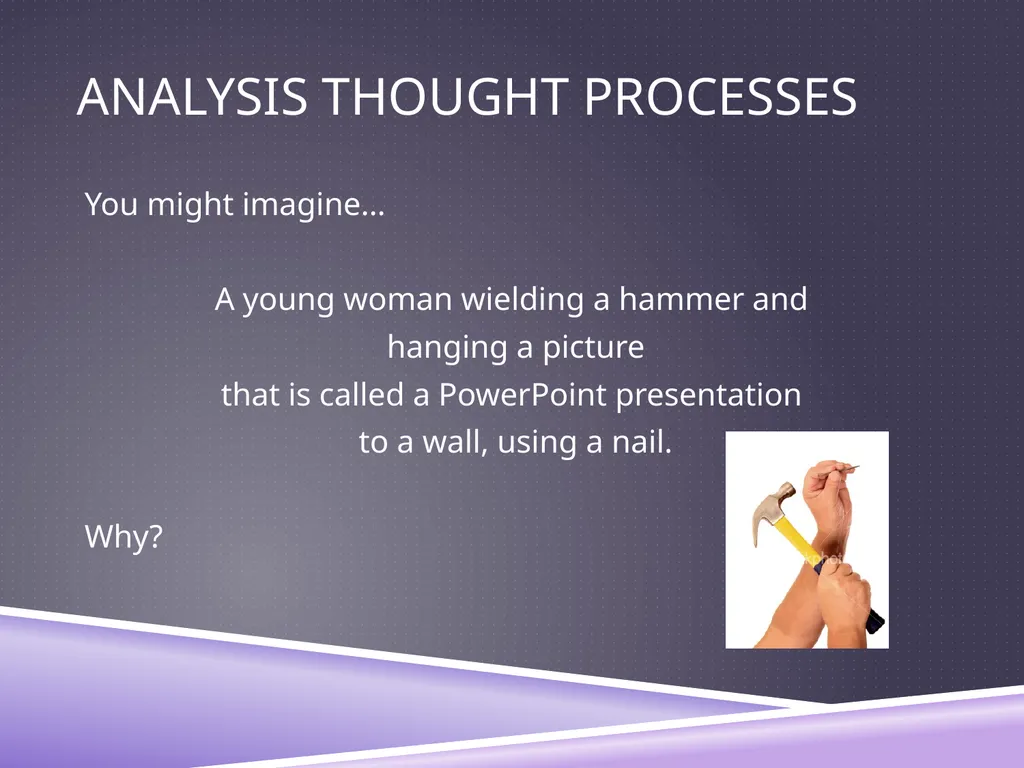
ANALYSIS THOUGHT PROCESSES You might imagine…
A young woman wielding a hammer and
hanging a picture
that is called a PowerPoint presentation
to a wall, using a nail.
Why?<br>
A young woman wielding a hammer and
hanging a picture
that is called a PowerPoint presentation
to a wall, using a nail.
Why?<br>
16
ANALYSIS THOUGHT PROCESSES Because you have the skills to comprehend the literal meaning, but you lack the experience and cultural knowledge that helped you make the analytical leap that native English speakers would have made without having to think about it. For non-native English speakers, that process from literal meaning to implicit message can be slower, depending on their level of fluency and cultural background. This is why understanding jokes in a language we are studying can be difficult. We lack the context.<br>
17
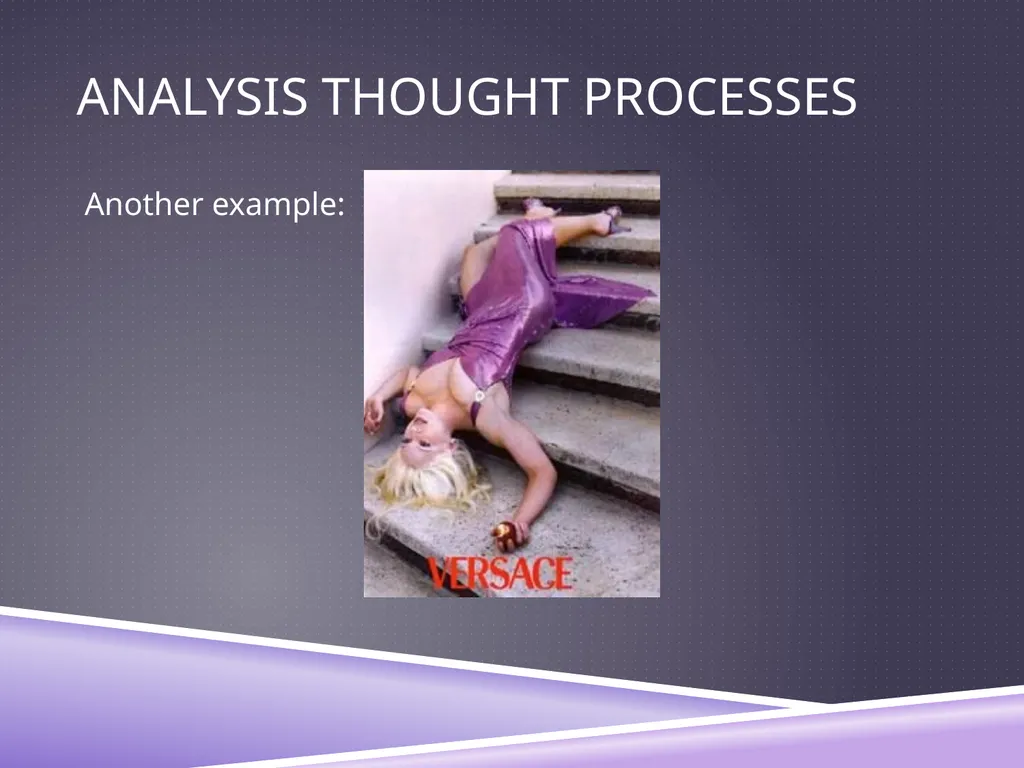
ANALYSIS THOUGHT PROCESSES Another example:<br>
18
ANALYSIS THOUGHT PROCESSES Literally, we have a woman strewn on a staircase, which looks like an accident, a tragic fall for one who doesn’t have the context. For all an uninformed viewer might think, Versace could translate into caution or tragedy. But then, figuratively, this is an advertisement to sell Versace clothing. One could look even deeper into this and interpret a message about fashion an violence toward women, as do viewers who argue about controversial photos like this whenever campaigns use them. No matter your interpretation, when we see photos like this in our everyday lives, we make analytical leaps almost automatically.<br>
19
ANALYSIS THOUGHT PROCESSES Sounds easy, right?
For people like us, the comprehension process becomes much more apparent when we read more complicated messages, like those in academic texts, because our comprehension skills work harder, and we have to slow down to consider the message. If we don’t, we might not get the real meaning.<br>
For people like us, the comprehension process becomes much more apparent when we read more complicated messages, like those in academic texts, because our comprehension skills work harder, and we have to slow down to consider the message. If we don’t, we might not get the real meaning.<br>
20
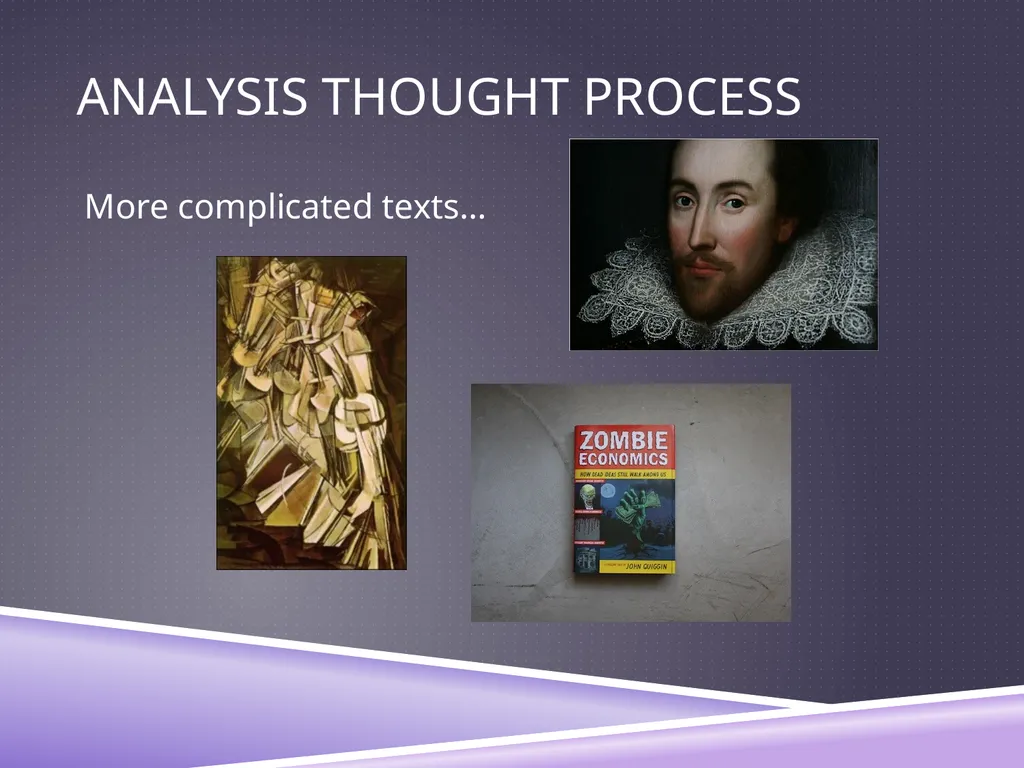
Analysis Thought Process More complicated texts…<br>
21
Achieving analysis There are five moves that analysis involves:
Suspend judgment
Avoid evaluation
Recognize and account for bias
Remember the rhetorical situations we have addressed so often?
This becomes critical at this stage<br>
Suspend judgment
Avoid evaluation
Recognize and account for bias
Remember the rhetorical situations we have addressed so often?
This becomes critical at this stage<br>
22
Achieving analysis There are five moves that analysis involves:
Suspend judgment
Look for patterns to discern context
Within the text
Outside the text<br>
Suspend judgment
Look for patterns to discern context
Within the text
Outside the text<br>
23
Achieving analysis There are five moves that analysis involves:
Suspend judgment
Look for patterns to discern context
Define significant parts and how they’re related
Pinpoint key objects, details, examples
Organize their relationship around analytical claims
Relate the connections to the patterns and context<br>
Suspend judgment
Look for patterns to discern context
Define significant parts and how they’re related
Pinpoint key objects, details, examples
Organize their relationship around analytical claims
Relate the connections to the patterns and context<br>
24
Achieving analysis There are five moves that analysis involves:
Suspend judgment
Look for patterns to discern context
Define significant parts and how they’re related
Make the implicit explicit
Look beneath the surface
Explain the what, the how, and the why
Leave breadcrumbs from the literal to the figurative<br>
Suspend judgment
Look for patterns to discern context
Define significant parts and how they’re related
Make the implicit explicit
Look beneath the surface
Explain the what, the how, and the why
Leave breadcrumbs from the literal to the figurative<br>
25
Achieving analysis There are five moves that analysis involves:
Suspend judgment
Look for patterns to discern context
Define significant parts and how they’re related
Make the implicit explicit
Keep reformulating questions and explanations<br>
Suspend judgment
Look for patterns to discern context
Define significant parts and how they’re related
Make the implicit explicit
Keep reformulating questions and explanations<br>
26
Achieving Analysis: Tips Analysis can be seen as an argument in that it makes a claim or gives an opinion about the communicator’s interpretation. With any good argument, then, you must prove your point with reasons and evidence that support the claim. In other words, you have to show the audience how you came to this interpretation in a way they can follow and, hopefully, come to the same interpretation or at least believe yours.
There are many different ways to interpret, ranging from the obvious to the outlandish. If you try to think of a few different ways that something could be interpreted, and address or refute those ways in your own analysis, you will make a stronger point and also prove a more credible analyzer.<br>
There are many different ways to interpret, ranging from the obvious to the outlandish. If you try to think of a few different ways that something could be interpreted, and address or refute those ways in your own analysis, you will make a stronger point and also prove a more credible analyzer.<br>
27
PRACTICING ANALYSIS Breaking down the process of breaking down texts:
Receive (be open, non-evaluative)
Again, this should bring you back to the critical reading skills you learned earlier this semester. The process is the same, only here, we are breaking it down to help you follow and practice in your own upcoming analysis<br>
Receive (be open, non-evaluative)
Again, this should bring you back to the critical reading skills you learned earlier this semester. The process is the same, only here, we are breaking it down to help you follow and practice in your own upcoming analysis<br>
28
PRACTICING ANALYSIS Breaking down the process of breaking down texts:
Receive
Collect (details and information)
Preview (consider)
Observe (read or view)
Note (list details and record impressions)<br>
Receive
Collect (details and information)
Preview (consider)
Observe (read or view)
Note (list details and record impressions)<br>
29
PRACTICING ANALYSIS Breaking down the process of breaking down texts:
Receive
Collect
Summarize (for literal meanings): this is where you note what things explicitly say and do
Details
Overall
Look for the obvious<br>
Receive
Collect
Summarize (for literal meanings): this is where you note what things explicitly say and do
Details
Overall
Look for the obvious<br>
30
PRACTICING ANALYSIS Breaking down the process of breaking down texts:
Receive
Collect
Summarize
Interpret (for figurative messages): this is where you explain the implicit
Details
Overall
The what, how, and why<br>
Receive
Collect
Summarize
Interpret (for figurative messages): this is where you explain the implicit
Details
Overall
The what, how, and why<br>
31
PRACTICING ANALYSIS Breaking down the process of breaking down texts:
Receive
Collect
Summarize
Interpret
Engage (develop your claims)
The text’s message(s)
The relevance of your interpretation<br>
Receive
Collect
Summarize
Interpret
Engage (develop your claims)
The text’s message(s)
The relevance of your interpretation<br>
32
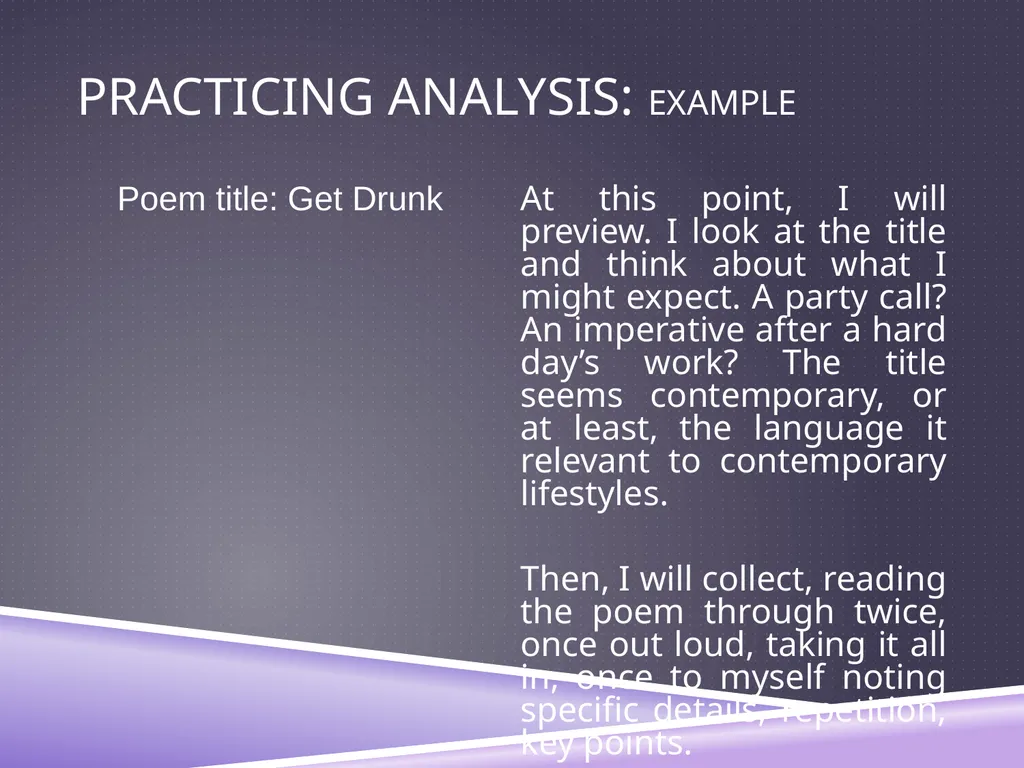
PRACTICING ANALYSIS: EXAMPLE Poem title: Get Drunk At this point, I will preview. I look at the title and think about what I might expect. A party call? An imperative after a hard day’s work? The title seems contemporary, or at least, the language it relevant to contemporary lifestyles.
Then, I will collect, reading the poem through twice, once out loud, taking it all in, once to myself noting specific details, repetition, key points.<br>
Then, I will collect, reading the poem through twice, once out loud, taking it all in, once to myself noting specific details, repetition, key points.<br>
33
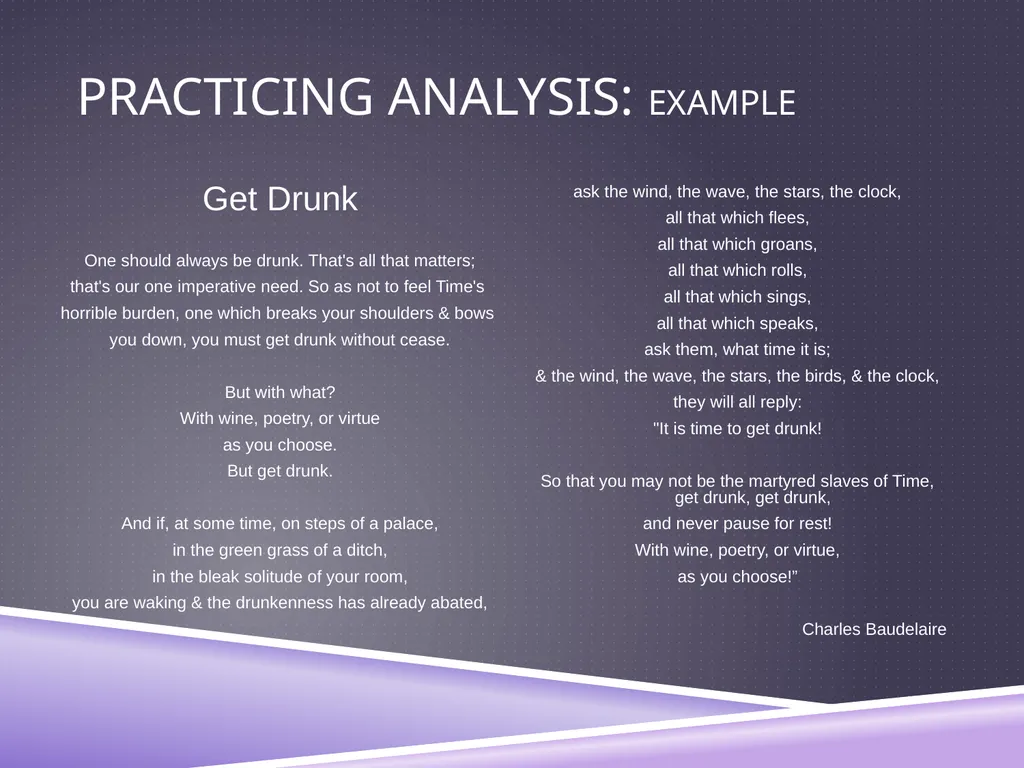
PRACTICING ANALYSIS: EXAMPLE Get Drunk
One should always be drunk. That's all that matters;
that's our one imperative need. So as not to feel Time's
horrible burden, one which breaks your shoulders & bows
you down, you must get drunk without cease.
But with what?
With wine, poetry, or virtue
as you choose.
But get drunk.
And if, at some time, on steps of a palace,
in the green grass of a ditch,
in the bleak solitude of your room,
you are waking & the drunkenness has already abated, ask the wind, the wave, the stars, the clock,
all that which flees,
all that which groans,
all that which rolls,
all that which sings,
all that which speaks,
ask them, what time it is;
& the wind, the wave, the stars, the birds, & the clock,
they will all reply:
"It is time to get drunk!
So that you may not be the martyred slaves of Time, get drunk, get drunk,
and never pause for rest!
With wine, poetry, or virtue,
as you choose!”
Charles Baudelaire<br>
34
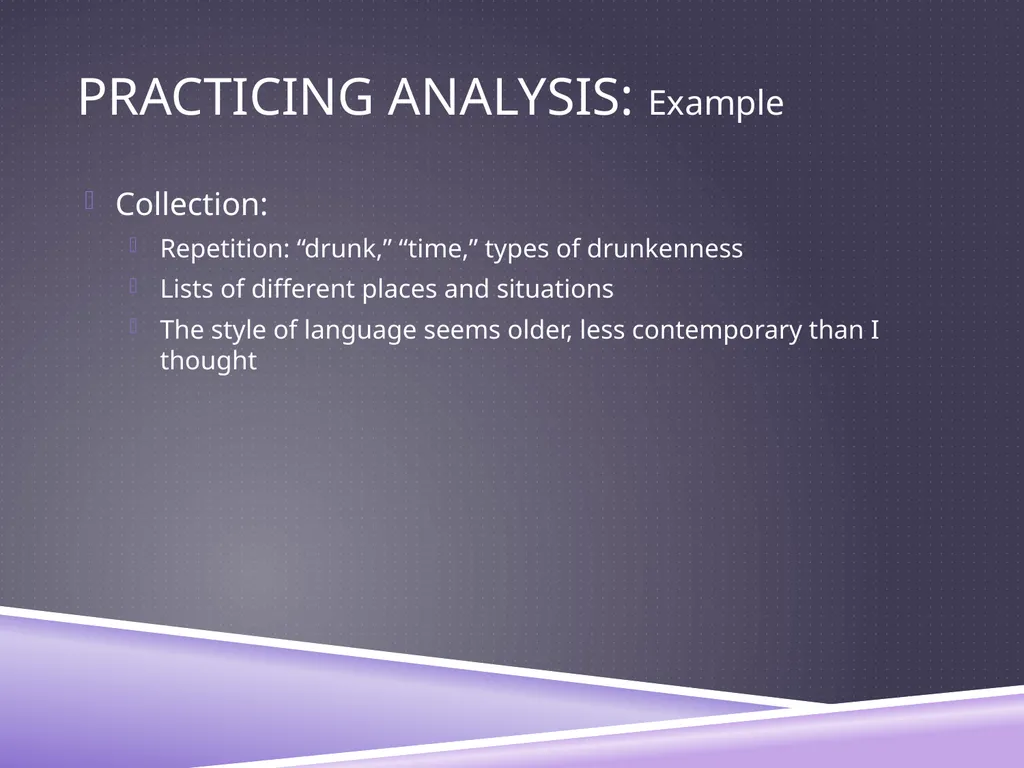
PRACTICING ANALYSIS: Example Collection:
Repetition: “drunk,” “time,” types of drunkenness
Lists of different places and situations
The style of language seems older, less contemporary than I thought<br>
Repetition: “drunk,” “time,” types of drunkenness
Lists of different places and situations
The style of language seems older, less contemporary than I thought<br>
35
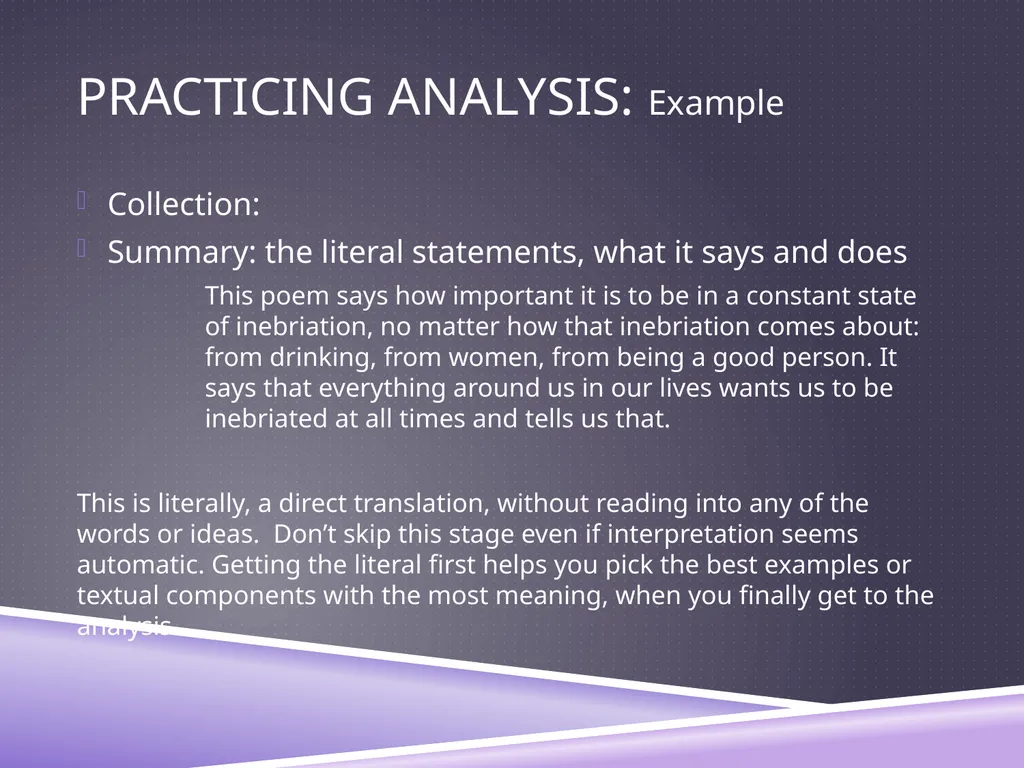
PRACTICING ANALYSIS: Example Collection:
Summary: the literal statements, what it says and does
This poem says how important it is to be in a constant state of inebriation, no matter how that inebriation comes about: from drinking, from women, from being a good person. It says that everything around us in our lives wants us to be inebriated at all times and tells us that.
This is literally, a direct translation, without reading into any of the words or ideas. Don’t skip this stage even if interpretation seems automatic. Getting the literal first helps you pick the best examples or textual components with the most meaning, when you finally get to the analysis.<br>
36
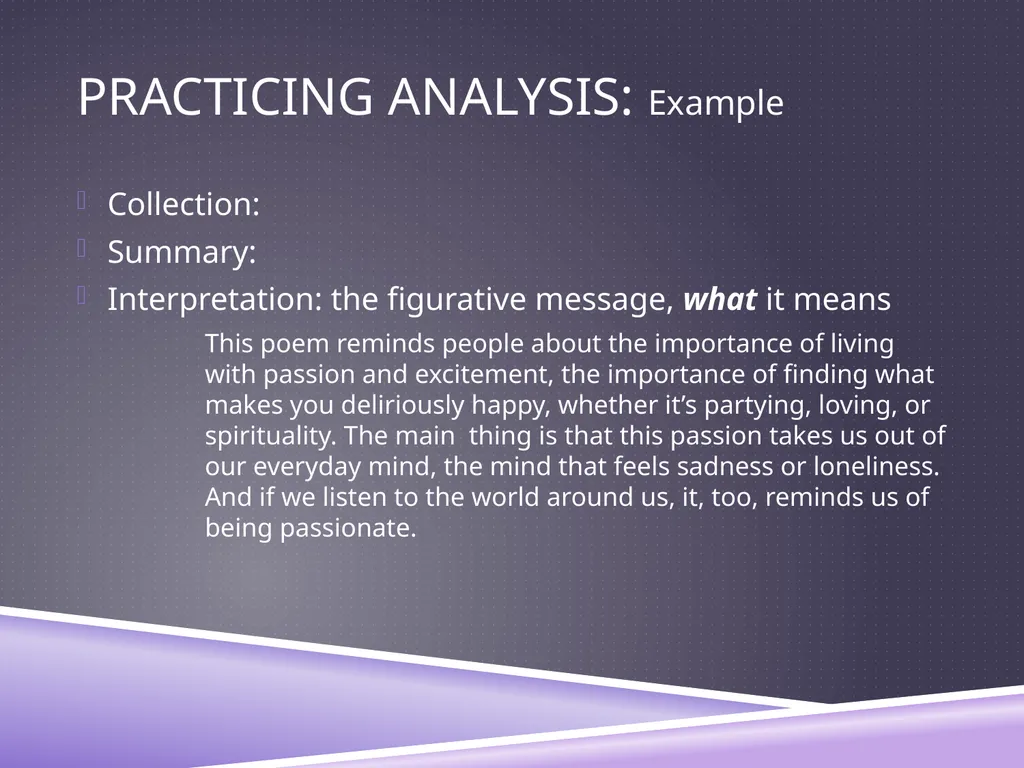
PRACTICING ANALYSIS: Example Collection:
Summary:
Interpretation: the figurative message, what it means
This poem reminds people about the importance of living with passion and excitement, the importance of finding what makes you deliriously happy, whether it’s partying, loving, or spirituality. The main thing is that this passion takes us out of our everyday mind, the mind that feels sadness or loneliness. And if we listen to the world around us, it, too, reminds us of being passionate.<br>
37
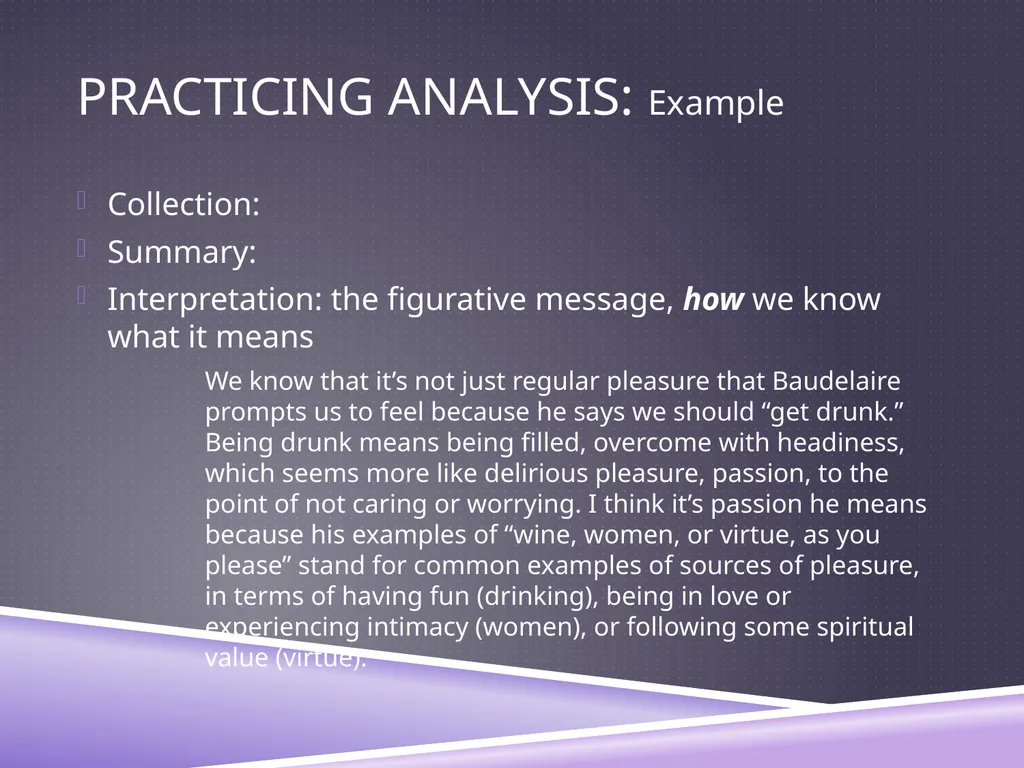
PRACTICING ANALYSIS: Example Collection:
Summary:
Interpretation: the figurative message, how we know what it means
We know that it’s not just regular pleasure that Baudelaire prompts us to feel because he says we should “get drunk.” Being drunk means being filled, overcome with headiness, which seems more like delirious pleasure, passion, to the point of not caring or worrying. I think it’s passion he means because his examples of “wine, women, or virtue, as you please” stand for common examples of sources of pleasure, in terms of having fun (drinking), being in love or experiencing intimacy (women), or following some spiritual value (virtue).<br>
38
PRACTICING ANALYSIS: Example Collection:
Summary:
Interpretation: the figurative message, why we think the communicator sends this message
For Baudelaire, experiencing this deep passion helps us deal with the weight of our humanity, our mortality. That’s why he keeps repeating references to time and “Time’s burden,” which is the clock, the habitual passing of days toward the end of our lives which can only be broken up, dealt with, or even ignored, by getting drunk with something we truly enjoy.<br>
39
PRACTICING ANALYSIS: Example Collection:
Summary:
Interpretation:
Engagement: how does knowing what this text offers contribute something useful or relevant to the audience?
For all intents and purposes, Baudelaire’s advice to find a way to live a life of delirious passion seems negatively self-involved. I mean, after all, shall we--so inextricably linked to our social circumstances and unable to really live for ourselves without touching the lives of others--really live only for our own pleasures? But looking deeper into his message, the answer seems not to be in “wine, women, or virtue” (emphasis added) but rather in all three, in finding one’s pleasure in fun, in love, and in a deeper connection to goodness that will make a better life for all, in the long run.<br>
40
Analysis: Tip Engagement,
or making the message meaningful for others,
is as integral to an analysis of a 19th century French poem
as it is for a 21st century film or video or
book or article analysis.<br>
or making the message meaningful for others,
is as integral to an analysis of a 19th century French poem
as it is for a 21st century film or video or
book or article analysis.<br>
41
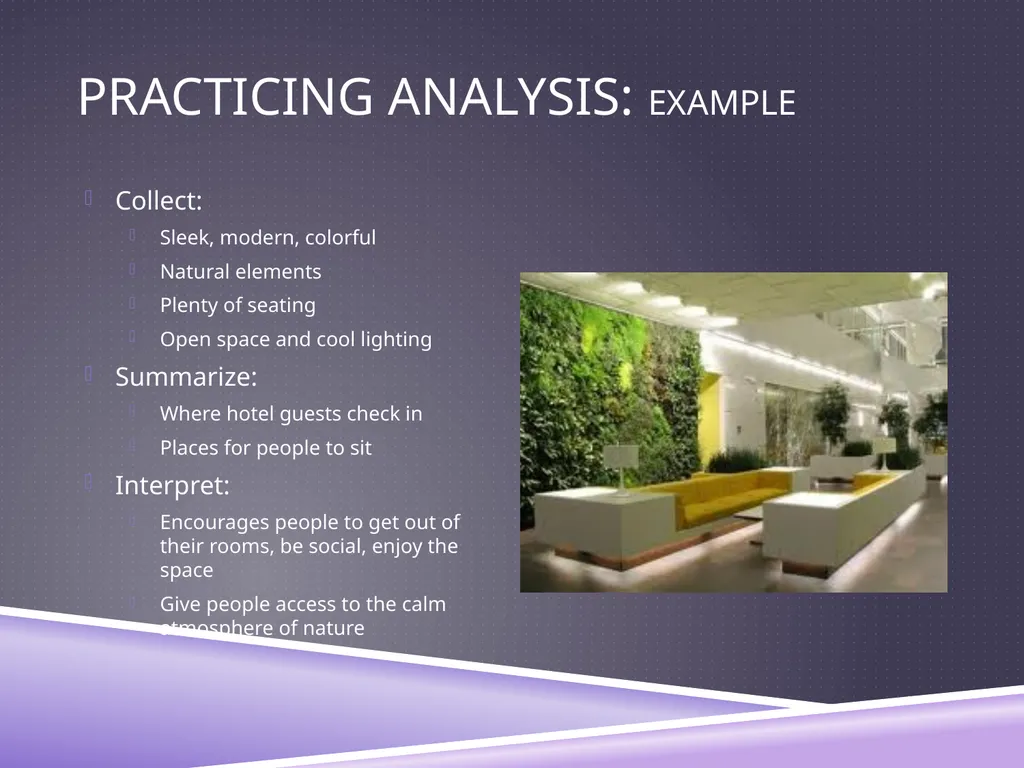
PRACTICING ANALYSIS: EXAMPLE Collect:
Sleek, modern, colorful
Natural elements
Plenty of seating
Open space and cool lighting
Summarize:
Where hotel guests check in
Places for people to sit
Interpret:
Encourages people to get out of their rooms, be social, enjoy the space
Give people access to the calm atmosphere of nature<br>
Sleek, modern, colorful
Natural elements
Plenty of seating
Open space and cool lighting
Summarize:
Where hotel guests check in
Places for people to sit
Interpret:
Encourages people to get out of their rooms, be social, enjoy the space
Give people access to the calm atmosphere of nature<br>
42
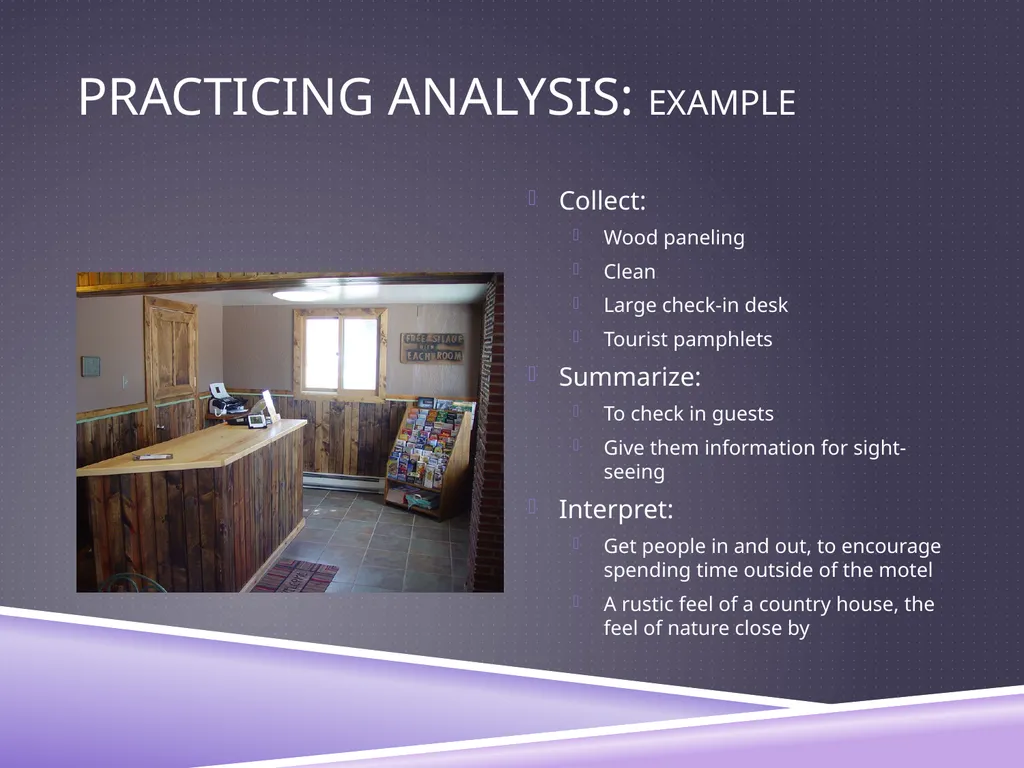
PRACTICING ANALYSIS: EXAMPLE Collect:
Wood paneling
Clean
Large check-in desk
Tourist pamphlets
Summarize:
To check in guests
Give them information for sight-seeing
Interpret:
Get people in and out, to encourage spending time outside of the motel
A rustic feel of a country house, the feel of nature close by<br>
Wood paneling
Clean
Large check-in desk
Tourist pamphlets
Summarize:
To check in guests
Give them information for sight-seeing
Interpret:
Get people in and out, to encourage spending time outside of the motel
A rustic feel of a country house, the feel of nature close by<br>
43
conclusion The world is full of texts to interpret, and there are myriad ways to interpret each and every one. Being critically literate just means engaging with that world and those texts in thoughtful ways to understand just how many possible ways of being and thinking there are.<br>