
Understanding Culture, Understanding Students:
CS
Published · 20 slides · 0 views
1 / 1
Description
Understanding Culture, Understanding Students: International Student Experiences in an Uncertain World Meri Linn McCollum, Assistant Professor of Education Muskingum University What is Culture? A community or population sufficiently large
Related Topics
Share
Embed code
Download this presentation From Below
"Understanding Culture, Understanding Students:" is the property of its rightful owner. Permission is granted to download and print the materials on this website for personal, non-commercial use only, and to display it on your personal computer provided you do not modify the materials and that you retain all copyright notices contained in the materials. By downloading content from our website, you accept the terms of this agreement.
Presentation Transcript
01
Understanding Culture, Understanding Students: International Student Experiences in an Uncertain World Meri Linn McCollum, Assistant Professor of Education
Muskingum University<br>
Muskingum University<br>
02
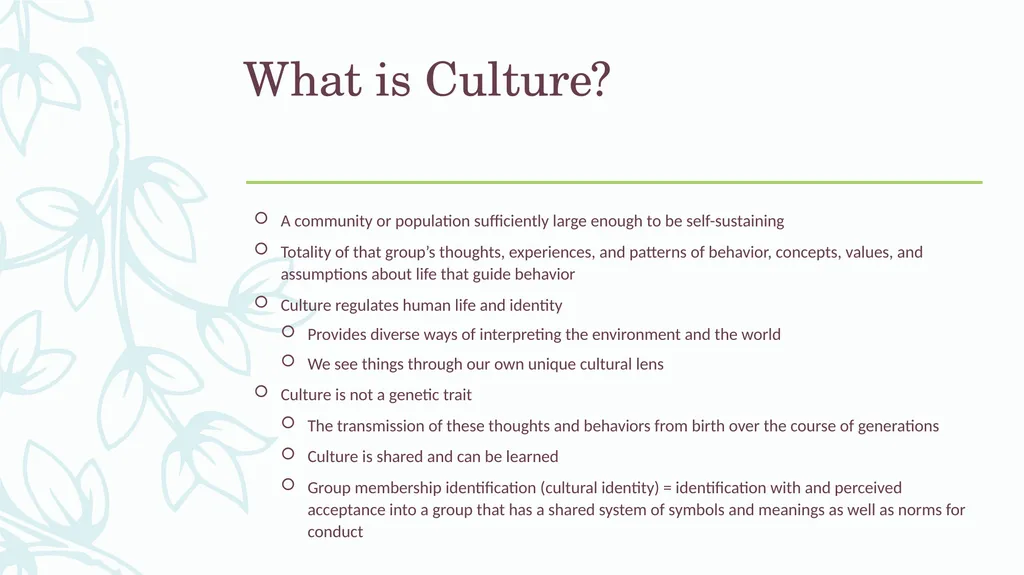
What is Culture? A community or population sufficiently large enough to be self-sustaining
Totality of that group’s thoughts, experiences, and patterns of behavior, concepts, values, and assumptions about life that guide behavior
Culture regulates human life and identity
Provides diverse ways of interpreting the environment and the world
We see things through our own unique cultural lens
Culture is not a genetic trait
The transmission of these thoughts and behaviors from birth over the course of generations
Culture is shared and can be learned
Group membership identification (cultural identity) = identification with and perceived acceptance into a group that has a shared system of symbols and meanings as well as norms for conduct<br>
Totality of that group’s thoughts, experiences, and patterns of behavior, concepts, values, and assumptions about life that guide behavior
Culture regulates human life and identity
Provides diverse ways of interpreting the environment and the world
We see things through our own unique cultural lens
Culture is not a genetic trait
The transmission of these thoughts and behaviors from birth over the course of generations
Culture is shared and can be learned
Group membership identification (cultural identity) = identification with and perceived acceptance into a group that has a shared system of symbols and meanings as well as norms for conduct<br>
03
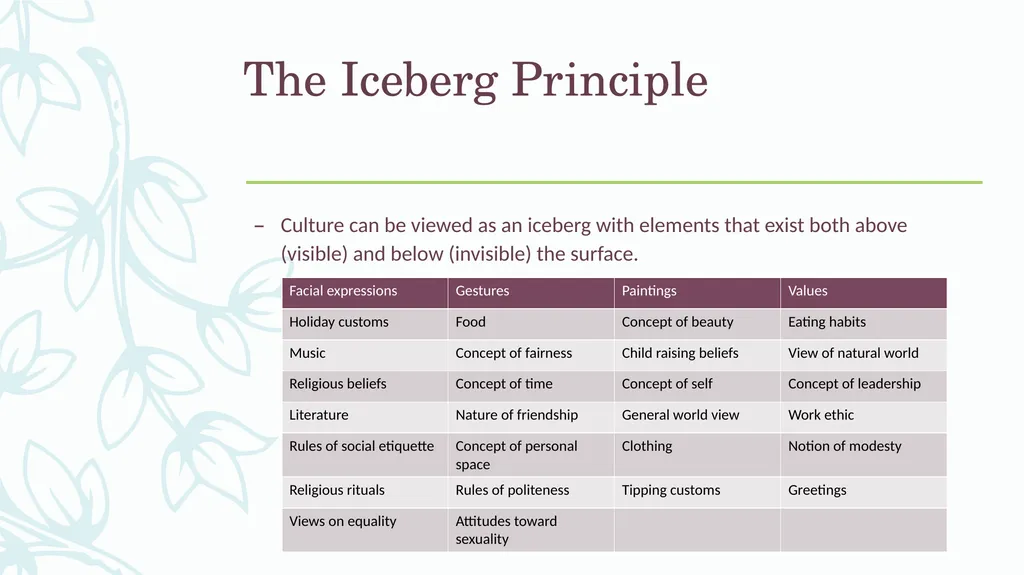
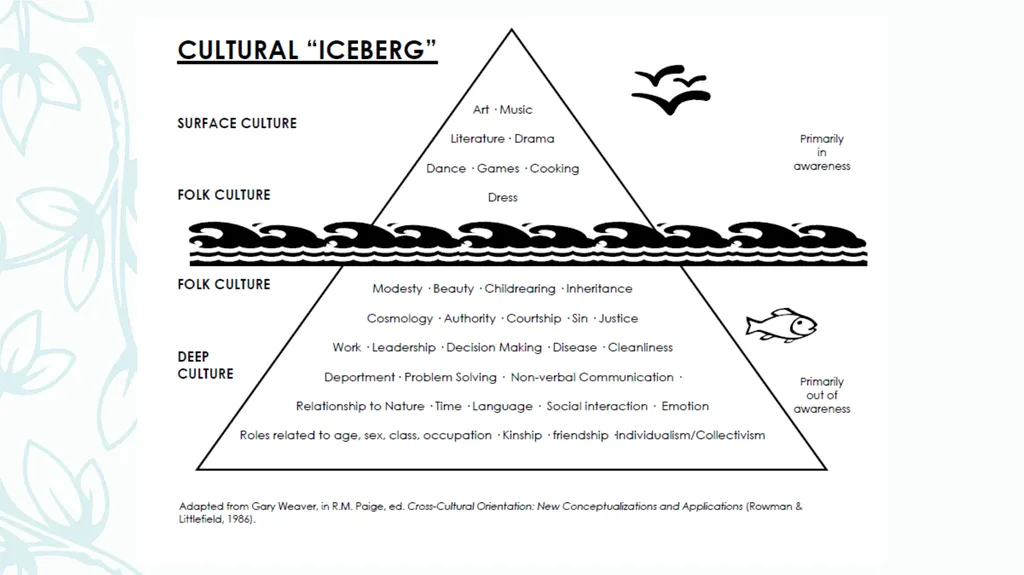
The Iceberg Principle Culture can be viewed as an iceberg with elements that exist both above (visible) and below (invisible) the surface.<br>
04
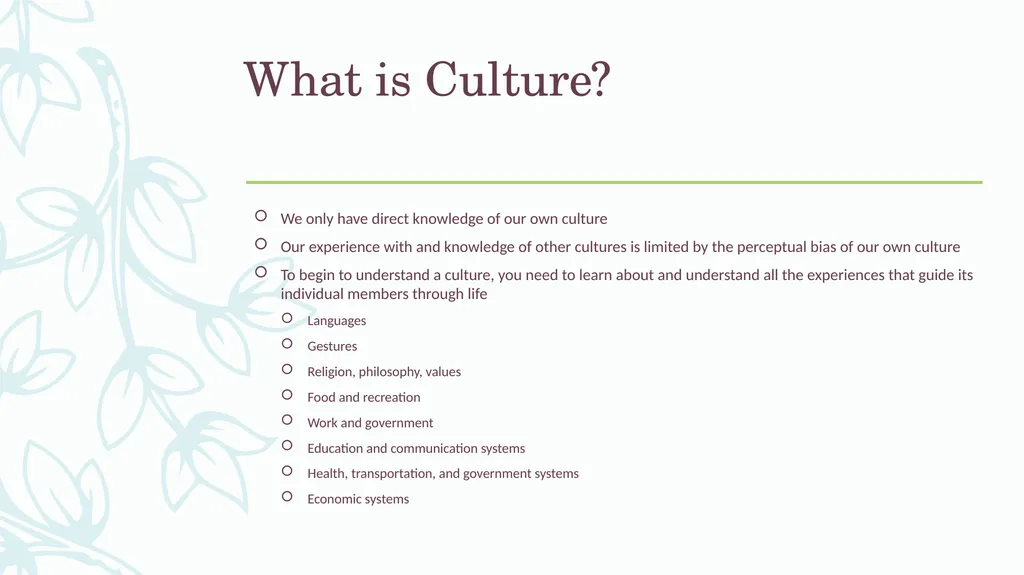
What is Culture? We only have direct knowledge of our own culture
Our experience with and knowledge of other cultures is limited by the perceptual bias of our own culture
To begin to understand a culture, you need to learn about and understand all the experiences that guide its individual members through life
Languages
Gestures
Religion, philosophy, values
Food and recreation
Work and government
Education and communication systems
Health, transportation, and government systems
Economic systems<br>
Our experience with and knowledge of other cultures is limited by the perceptual bias of our own culture
To begin to understand a culture, you need to learn about and understand all the experiences that guide its individual members through life
Languages
Gestures
Religion, philosophy, values
Food and recreation
Work and government
Education and communication systems
Health, transportation, and government systems
Economic systems<br>
05
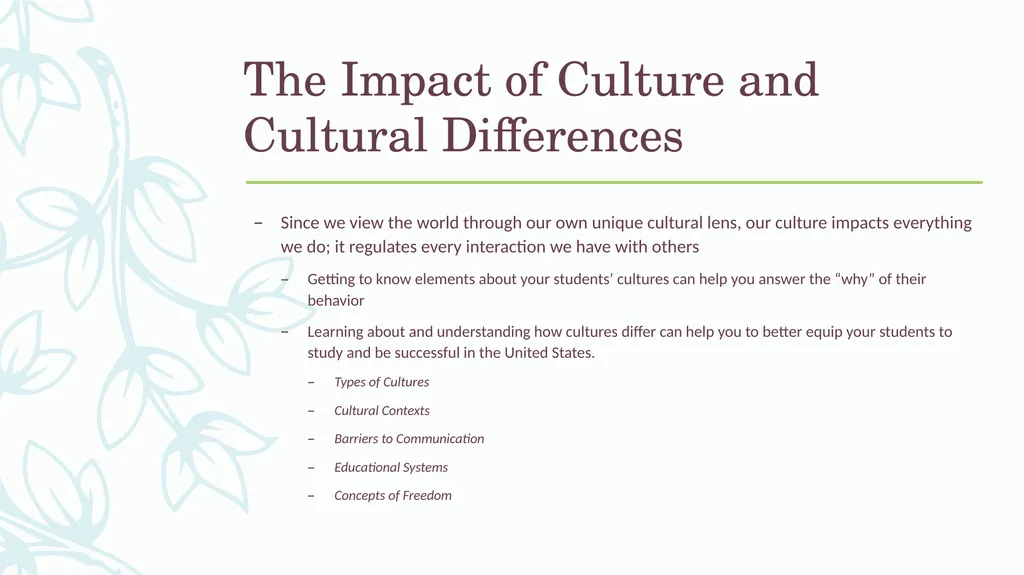
The Impact of Culture and Cultural Differences Since we view the world through our own unique cultural lens, our culture impacts everything we do; it regulates every interaction we have with others
Getting to know elements about your students’ cultures can help you answer the “why” of their behavior
Learning about and understanding how cultures differ can help you to better equip your students to study and be successful in the United States.
Types of Cultures
Cultural Contexts
Barriers to Communication
Educational Systems
Concepts of Freedom<br>
Getting to know elements about your students’ cultures can help you answer the “why” of their behavior
Learning about and understanding how cultures differ can help you to better equip your students to study and be successful in the United States.
Types of Cultures
Cultural Contexts
Barriers to Communication
Educational Systems
Concepts of Freedom<br>
06
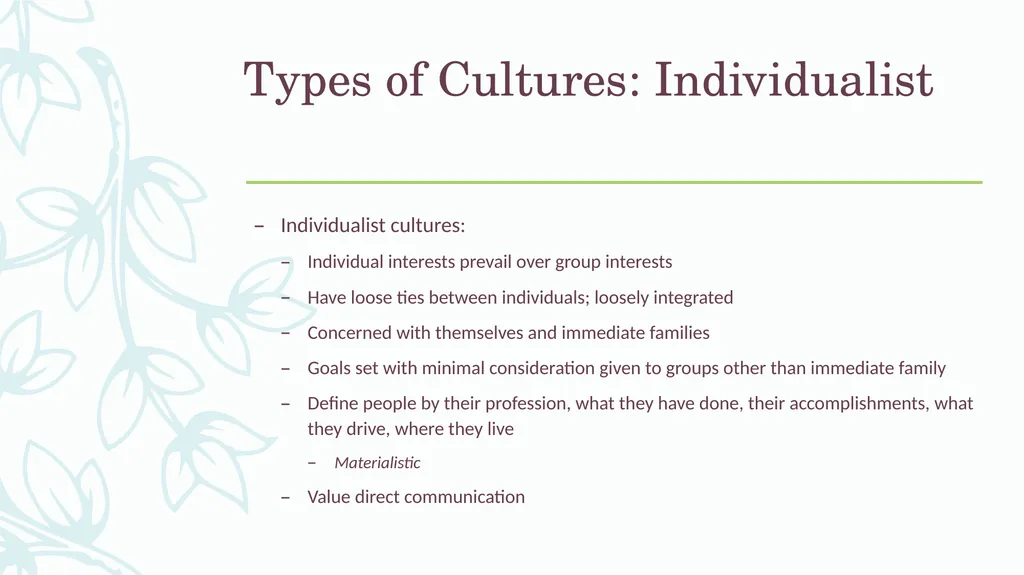
Types of Cultures: Individualist Individualist cultures:
Individual interests prevail over group interests
Have loose ties between individuals; loosely integrated
Concerned with themselves and immediate families
Goals set with minimal consideration given to groups other than immediate family
Define people by their profession, what they have done, their accomplishments, what they drive, where they live
Materialistic
Value direct communication<br>
Individual interests prevail over group interests
Have loose ties between individuals; loosely integrated
Concerned with themselves and immediate families
Goals set with minimal consideration given to groups other than immediate family
Define people by their profession, what they have done, their accomplishments, what they drive, where they live
Materialistic
Value direct communication<br>
07
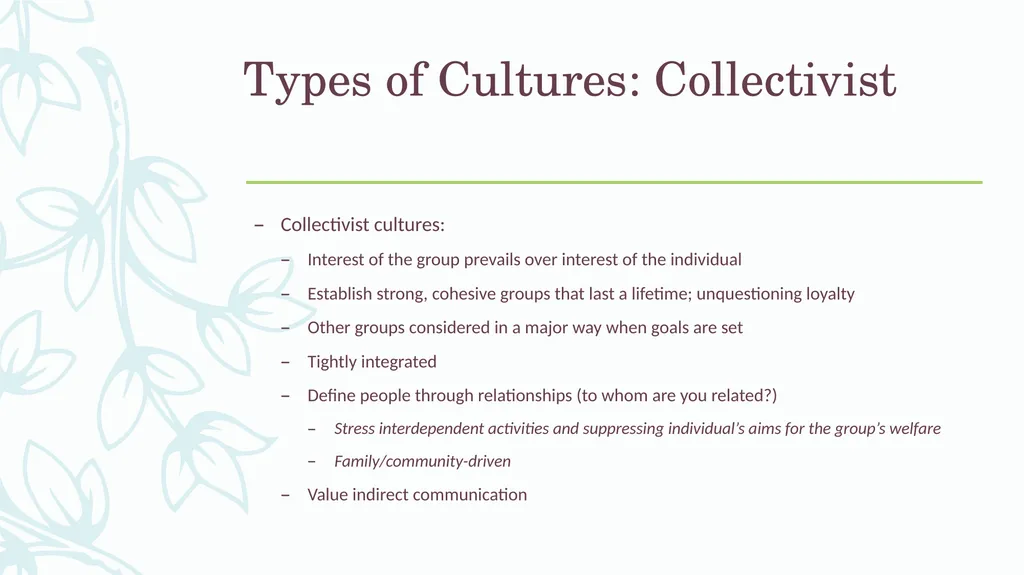
Types of Cultures: Collectivist Collectivist cultures:
Interest of the group prevails over interest of the individual
Establish strong, cohesive groups that last a lifetime; unquestioning loyalty
Other groups considered in a major way when goals are set
Tightly integrated
Define people through relationships (to whom are you related?)
Stress interdependent activities and suppressing individual’s aims for the group’s welfare
Family/community-driven
Value indirect communication<br>
Interest of the group prevails over interest of the individual
Establish strong, cohesive groups that last a lifetime; unquestioning loyalty
Other groups considered in a major way when goals are set
Tightly integrated
Define people through relationships (to whom are you related?)
Stress interdependent activities and suppressing individual’s aims for the group’s welfare
Family/community-driven
Value indirect communication<br>
08
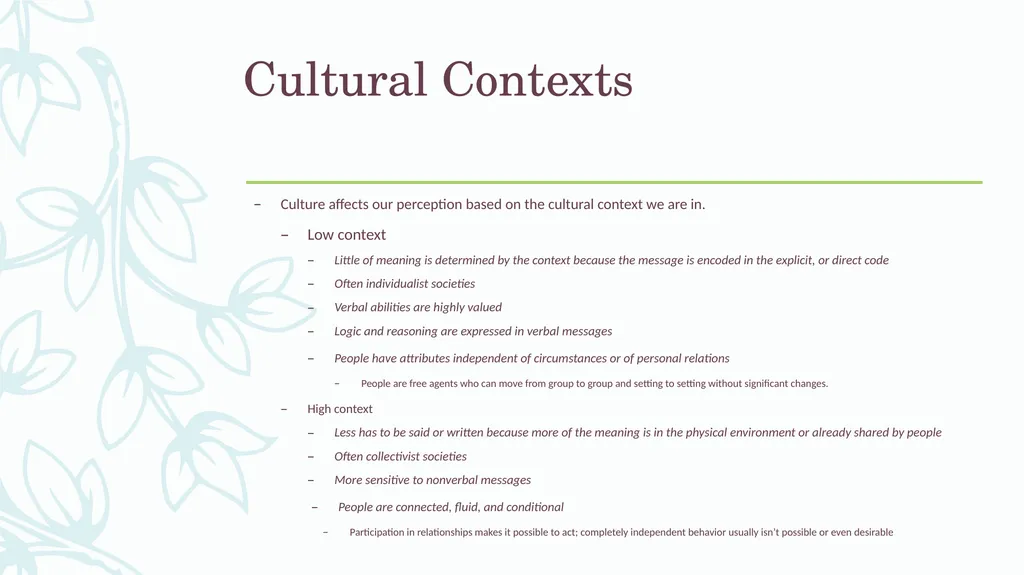
Cultural Contexts Culture affects our perception based on the cultural context we are in.
Low context
Little of meaning is determined by the context because the message is encoded in the explicit, or direct code
Often individualist societies
Verbal abilities are highly valued
Logic and reasoning are expressed in verbal messages
People have attributes independent of circumstances or of personal relations
People are free agents who can move from group to group and setting to setting without significant changes.
High context
Less has to be said or written because more of the meaning is in the physical environment or already shared by people
Often collectivist societies
More sensitive to nonverbal messages
People are connected, fluid, and conditional
Participation in relationships makes it possible to act; completely independent behavior usually isn’t possible or even desirable<br>
Low context
Little of meaning is determined by the context because the message is encoded in the explicit, or direct code
Often individualist societies
Verbal abilities are highly valued
Logic and reasoning are expressed in verbal messages
People have attributes independent of circumstances or of personal relations
People are free agents who can move from group to group and setting to setting without significant changes.
High context
Less has to be said or written because more of the meaning is in the physical environment or already shared by people
Often collectivist societies
More sensitive to nonverbal messages
People are connected, fluid, and conditional
Participation in relationships makes it possible to act; completely independent behavior usually isn’t possible or even desirable<br>
09
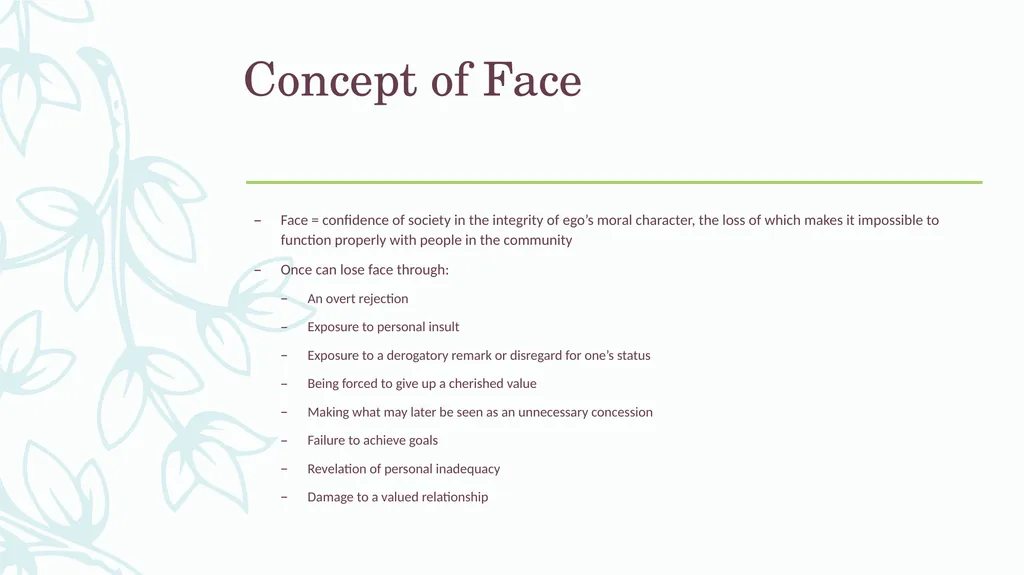
Concept of Face Face = confidence of society in the integrity of ego’s moral character, the loss of which makes it impossible to function properly with people in the community
Once can lose face through:
An overt rejection
Exposure to personal insult
Exposure to a derogatory remark or disregard for one’s status
Being forced to give up a cherished value
Making what may later be seen as an unnecessary concession
Failure to achieve goals
Revelation of personal inadequacy
Damage to a valued relationship<br>
Once can lose face through:
An overt rejection
Exposure to personal insult
Exposure to a derogatory remark or disregard for one’s status
Being forced to give up a cherished value
Making what may later be seen as an unnecessary concession
Failure to achieve goals
Revelation of personal inadequacy
Damage to a valued relationship<br>
10
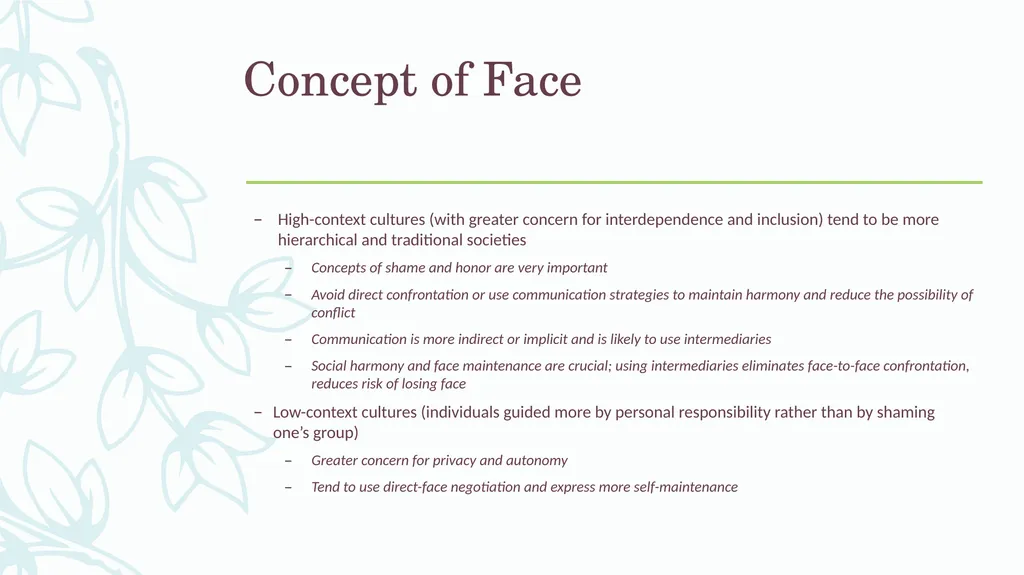
Concept of Face High-context cultures (with greater concern for interdependence and inclusion) tend to be more hierarchical and traditional societies
Concepts of shame and honor are very important
Avoid direct confrontation or use communication strategies to maintain harmony and reduce the possibility of conflict
Communication is more indirect or implicit and is likely to use intermediaries
Social harmony and face maintenance are crucial; using intermediaries eliminates face-to-face confrontation, reduces risk of losing face
Low-context cultures (individuals guided more by personal responsibility rather than by shaming one’s group)
Greater concern for privacy and autonomy
Tend to use direct-face negotiation and express more self-maintenance<br>
Concepts of shame and honor are very important
Avoid direct confrontation or use communication strategies to maintain harmony and reduce the possibility of conflict
Communication is more indirect or implicit and is likely to use intermediaries
Social harmony and face maintenance are crucial; using intermediaries eliminates face-to-face confrontation, reduces risk of losing face
Low-context cultures (individuals guided more by personal responsibility rather than by shaming one’s group)
Greater concern for privacy and autonomy
Tend to use direct-face negotiation and express more self-maintenance<br>
11
Barriers to Communication Every culture and subgroup provides its members with rules specifying appropriate and inappropriate behavior
There is no way you could learn all the rules governing appropriate and inappropriate behavior for every culture and subgroup with which you come into contact
What you can do is to examine the barriers to international communication:
Anxiety
Assuming similarity
Ethnocentrism
Stereotypes and Prejudice
Nonverbal misinterpretations
Language<br>
There is no way you could learn all the rules governing appropriate and inappropriate behavior for every culture and subgroup with which you come into contact
What you can do is to examine the barriers to international communication:
Anxiety
Assuming similarity
Ethnocentrism
Stereotypes and Prejudice
Nonverbal misinterpretations
Language<br>
12
Educational Systems Deeply held cultural beliefs are reflected in educational systems around the world in terms of:
Curricular choices (what is taught)
Teaching styles (how it’s taught)
Learning environments (student-centered vs. teacher-centered)
Assessment/evaluation methods (memory recall vs. application of critical thinking skills)
Learning Skills (memorization vs. construction of knowledge)
Teacher/Student roles
Academic writing styles
Importance of grades vs. importance of knowledge
Academic freedoms (what they study, when they study)
Students are expected to adapt to the educational environment they find themselves in, even though this may be the opposite of what they have experienced through most of their lives<br>
Curricular choices (what is taught)
Teaching styles (how it’s taught)
Learning environments (student-centered vs. teacher-centered)
Assessment/evaluation methods (memory recall vs. application of critical thinking skills)
Learning Skills (memorization vs. construction of knowledge)
Teacher/Student roles
Academic writing styles
Importance of grades vs. importance of knowledge
Academic freedoms (what they study, when they study)
Students are expected to adapt to the educational environment they find themselves in, even though this may be the opposite of what they have experienced through most of their lives<br>
13
Concepts of Freedom As is the case with most students, attending university often results in a brand-new sense of freedom:
Absence of parents/guardians
Need for self-regulation and self-reliance
Freedom of expression
Freedom of choice
For international students, attending university in the United States can result in an even deeper sense of freedom but not necessarily a greater sense of responsibility<br>
Absence of parents/guardians
Need for self-regulation and self-reliance
Freedom of expression
Freedom of choice
For international students, attending university in the United States can result in an even deeper sense of freedom but not necessarily a greater sense of responsibility<br>
14
Freedom International students often struggle to adapt to their new freedoms; they may exercise more freedom or a deeper degree of freedom than is good for them
Most students find a good balance of freedom and restraint
When students begin to exhibit an imbalance of freedom and restrain, it might be time to talk to them
If it gets to the level where you feel their academic well-being is in danger, it might be time to talk to parents or guardians
Students’ behavior can reflect the belief that they are so far away from home that their parents will never know what they are doing
Parents are often unaware/uninformed of FERPA regulations, how the US educational system operates, and what is expected of their children
Have a plan to communicate basic information to parents BEFORE classes start
Have a plan to communicate with parents AFTER classes start
This often means using a liaison with knowledge of the students’ home language and culture<br>
Most students find a good balance of freedom and restraint
When students begin to exhibit an imbalance of freedom and restrain, it might be time to talk to them
If it gets to the level where you feel their academic well-being is in danger, it might be time to talk to parents or guardians
Students’ behavior can reflect the belief that they are so far away from home that their parents will never know what they are doing
Parents are often unaware/uninformed of FERPA regulations, how the US educational system operates, and what is expected of their children
Have a plan to communicate basic information to parents BEFORE classes start
Have a plan to communicate with parents AFTER classes start
This often means using a liaison with knowledge of the students’ home language and culture<br>
15
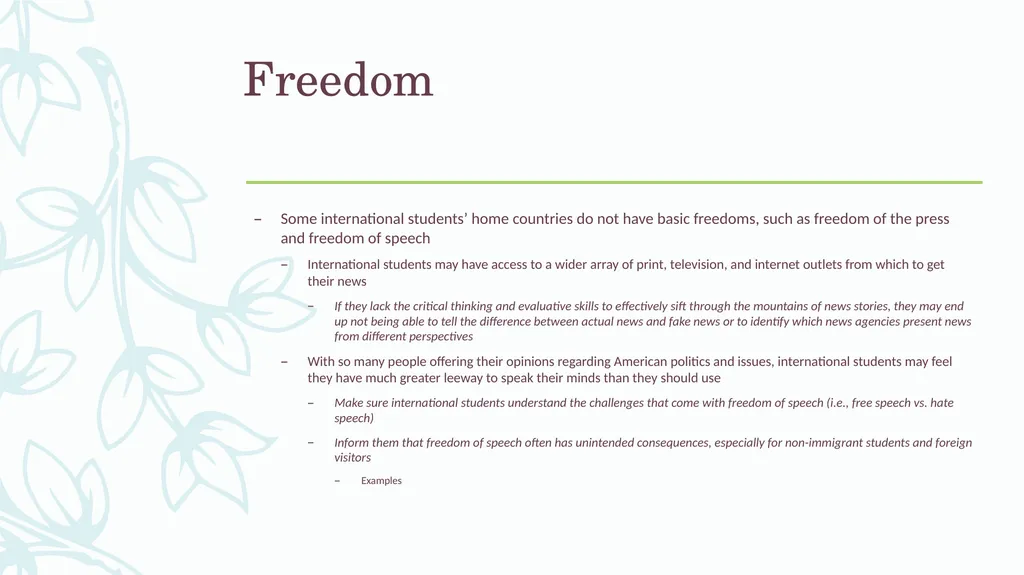
Freedom Some international students’ home countries do not have basic freedoms, such as freedom of the press and freedom of speech
International students may have access to a wider array of print, television, and internet outlets from which to get their news
If they lack the critical thinking and evaluative skills to effectively sift through the mountains of news stories, they may end up not being able to tell the difference between actual news and fake news or to identify which news agencies present news from different perspectives
With so many people offering their opinions regarding American politics and issues, international students may feel they have much greater leeway to speak their minds than they should use
Make sure international students understand the challenges that come with freedom of speech (i.e., free speech vs. hate speech)
Inform them that freedom of speech often has unintended consequences, especially for non-immigrant students and foreign visitors
Examples<br>
International students may have access to a wider array of print, television, and internet outlets from which to get their news
If they lack the critical thinking and evaluative skills to effectively sift through the mountains of news stories, they may end up not being able to tell the difference between actual news and fake news or to identify which news agencies present news from different perspectives
With so many people offering their opinions regarding American politics and issues, international students may feel they have much greater leeway to speak their minds than they should use
Make sure international students understand the challenges that come with freedom of speech (i.e., free speech vs. hate speech)
Inform them that freedom of speech often has unintended consequences, especially for non-immigrant students and foreign visitors
Examples<br>
16
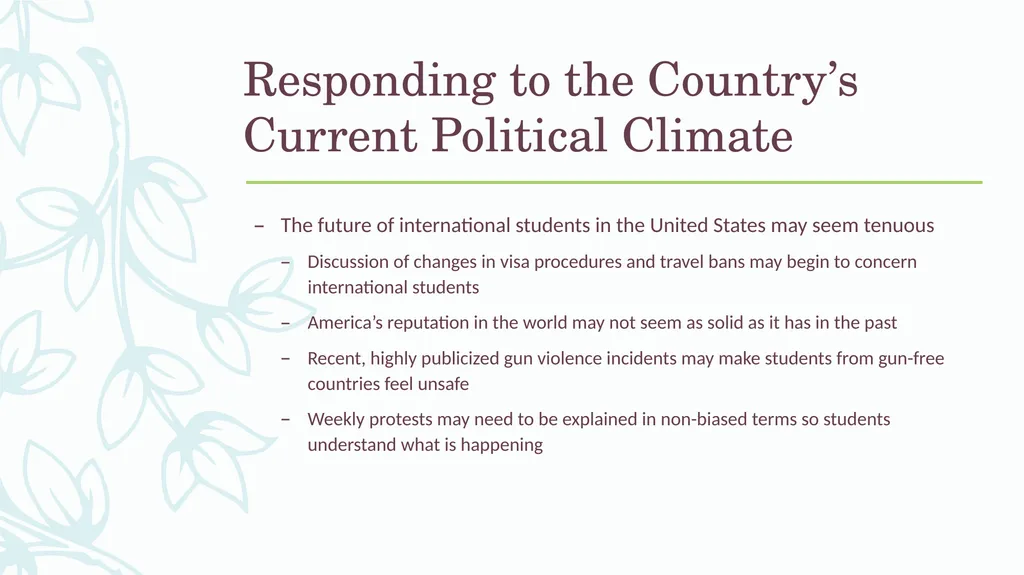
Responding to the Country’s Current Political Climate The future of international students in the United States may seem tenuous
Discussion of changes in visa procedures and travel bans may begin to concern international students
America’s reputation in the world may not seem as solid as it has in the past
Recent, highly publicized gun violence incidents may make students from gun-free countries feel unsafe
Weekly protests may need to be explained in non-biased terms so students understand what is happening<br>
Discussion of changes in visa procedures and travel bans may begin to concern international students
America’s reputation in the world may not seem as solid as it has in the past
Recent, highly publicized gun violence incidents may make students from gun-free countries feel unsafe
Weekly protests may need to be explained in non-biased terms so students understand what is happening<br>
17
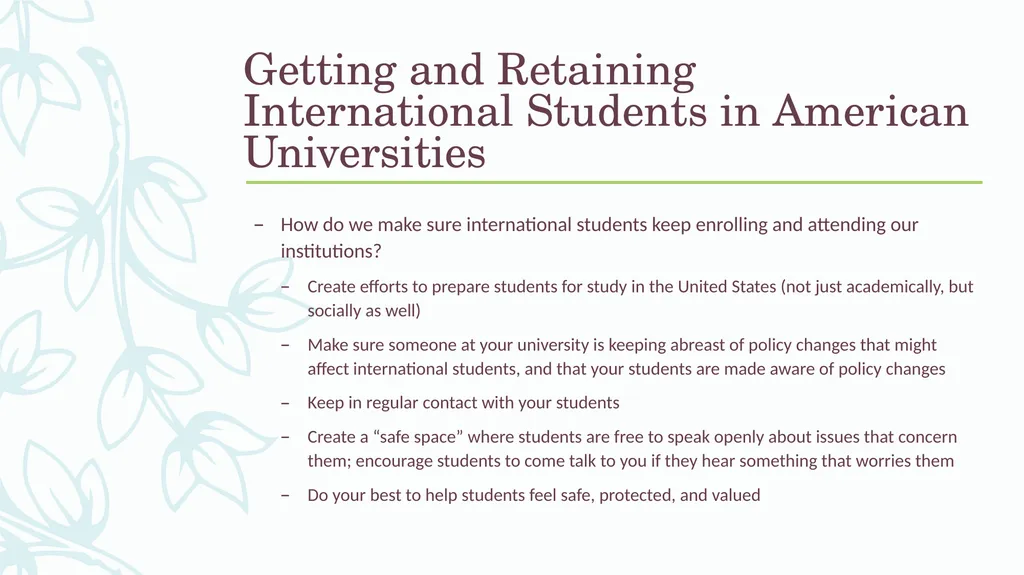
Getting and Retaining International Students in American Universities How do we make sure international students keep enrolling and attending our institutions?
Create efforts to prepare students for study in the United States (not just academically, but socially as well)
Make sure someone at your university is keeping abreast of policy changes that might affect international students, and that your students are made aware of policy changes
Keep in regular contact with your students
Create a “safe space” where students are free to speak openly about issues that concern them; encourage students to come talk to you if they hear something that worries them
Do your best to help students feel safe, protected, and valued<br>
Create efforts to prepare students for study in the United States (not just academically, but socially as well)
Make sure someone at your university is keeping abreast of policy changes that might affect international students, and that your students are made aware of policy changes
Keep in regular contact with your students
Create a “safe space” where students are free to speak openly about issues that concern them; encourage students to come talk to you if they hear something that worries them
Do your best to help students feel safe, protected, and valued<br>
18
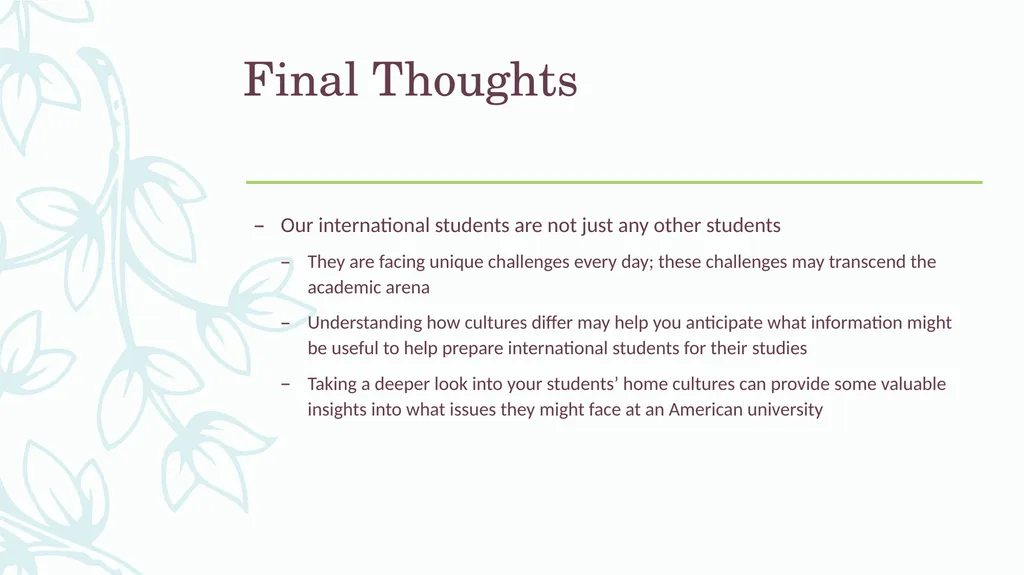
Final Thoughts Our international students are not just any other students
They are facing unique challenges every day; these challenges may transcend the academic arena
Understanding how cultures differ may help you anticipate what information might be useful to help prepare international students for their studies
Taking a deeper look into your students’ home cultures can provide some valuable insights into what issues they might face at an American university<br>
They are facing unique challenges every day; these challenges may transcend the academic arena
Understanding how cultures differ may help you anticipate what information might be useful to help prepare international students for their studies
Taking a deeper look into your students’ home cultures can provide some valuable insights into what issues they might face at an American university<br>
19
Questions?<br>