
Understanding… Local Government Pension Scheme Ill
SN
Published · 50 slides · 0 views

1 / 1



Description
Understanding Local Government Pension Scheme Ill Health Retirements Introduction Important protection for eligible active, deferred members and tier 3 pensioners of the LGPS. Three tiers of protection for active members One tier of
Related Topics
Share
Embed code
Download this presentation From Below
"Understanding… Local Government Pension Scheme Ill" is the property of its rightful owner. Permission is granted to download and print the materials on this website for personal, non-commercial use only, and to display it on your personal computer provided you do not modify the materials and that you retain all copyright notices contained in the materials. By downloading content from our website, you accept the terms of this agreement.
Presentation Transcript
01
Understanding…
Local Government Pension Scheme Ill Health Retirements<br>
02
Introduction Important protection for eligible active, deferred members and tier 3 pensioners of the LGPS.
Three tiers of protection for active members
One tier of protection for deferred members
It is the employers responsibility to make ill health pension decisions.
Popular subject for disputes – Important to get it right.<br>
Three tiers of protection for active members
One tier of protection for deferred members
It is the employers responsibility to make ill health pension decisions.
Popular subject for disputes – Important to get it right.<br>
03
Agenda Regulations and guidance
Active members
Deferred members
Tier 3 review
Where to find out more<br>
Active members
Deferred members
Tier 3 review
Where to find out more<br>
04
Fantastic regulations and where to find them… Active member who leaves after 31 March 2014 Regulations 32(8), 35, 36 and 39 of the LGPS Regulations 2013
Regulation 12 of the LGPS (Transitional Provisions, Savings and Amendment) Regulations 2014<br>
Regulation 12 of the LGPS (Transitional Provisions, Savings and Amendment) Regulations 2014<br>
05
Fantastic regulations and where to find them… Deferred members Leavers after 31 March 2014
LGPS Regulations 2013 regulations 36, 38, 39 and Schedule 1 Leavers between 1 April 1998 and 31 March 2008
Regulation 31 of the LGPS Regulations 1997 (as amended) Leavers between 1 April 2008 and 31 March 2014
Regulation 31 of the Benefits Regulations 2007
Regulation 56 of the Administration Regulations 2008 Leavers before 1 April 1998
Regulation D11 of the LGPS Regulations 1995 (as amended)<br>
LGPS Regulations 2013 regulations 36, 38, 39 and Schedule 1 Leavers between 1 April 1998 and 31 March 2008
Regulation 31 of the LGPS Regulations 1997 (as amended) Leavers between 1 April 2008 and 31 March 2014
Regulation 31 of the Benefits Regulations 2007
Regulation 56 of the Administration Regulations 2008 Leavers before 1 April 1998
Regulation D11 of the LGPS Regulations 1995 (as amended)<br>
06
Fantastic regulations and where to find them… Tier 3 pensioners Leavers after 31 March 2014
LGPS Regulations 2013 –regulations 37, 38, 39 and Schedule 1 Leavers between 1 April 2008 and 31 March 2014
Regulations 20 and 31 of the LGPS Benefits Regulations 2007
Regulation 56 of the LGPS Administration Regulations 2008<br>
LGPS Regulations 2013 –regulations 37, 38, 39 and Schedule 1 Leavers between 1 April 2008 and 31 March 2014
Regulations 20 and 31 of the LGPS Benefits Regulations 2007
Regulation 56 of the LGPS Administration Regulations 2008<br>
07
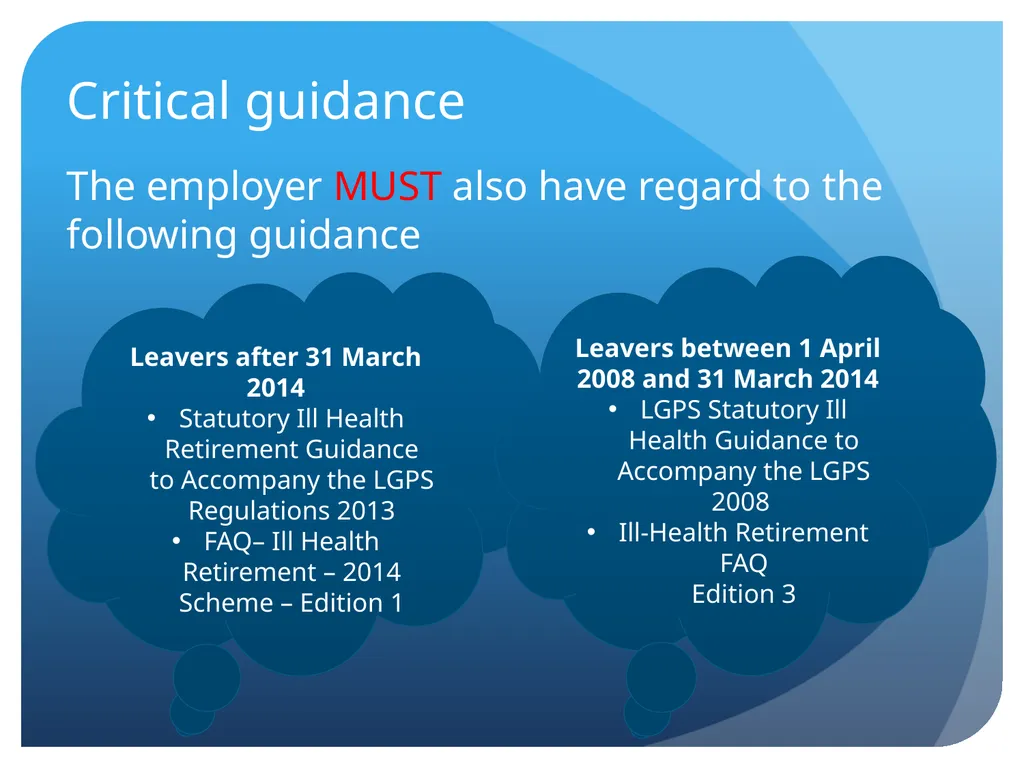
Critical guidance The employer MUST also have regard to the following guidance Leavers after 31 March 2014
Statutory Ill Health Retirement Guidance to Accompany the LGPS Regulations 2013
FAQ– Ill Health Retirement – 2014 Scheme – Edition 1 Leavers between 1 April 2008 and 31 March 2014
LGPS Statutory Ill Health Guidance to Accompany the LGPS 2008
Ill-Health Retirement FAQ Edition 3<br>
Statutory Ill Health Retirement Guidance to Accompany the LGPS Regulations 2013
FAQ– Ill Health Retirement – 2014 Scheme – Edition 1 Leavers between 1 April 2008 and 31 March 2014
LGPS Statutory Ill Health Guidance to Accompany the LGPS 2008
Ill-Health Retirement FAQ Edition 3<br>
08
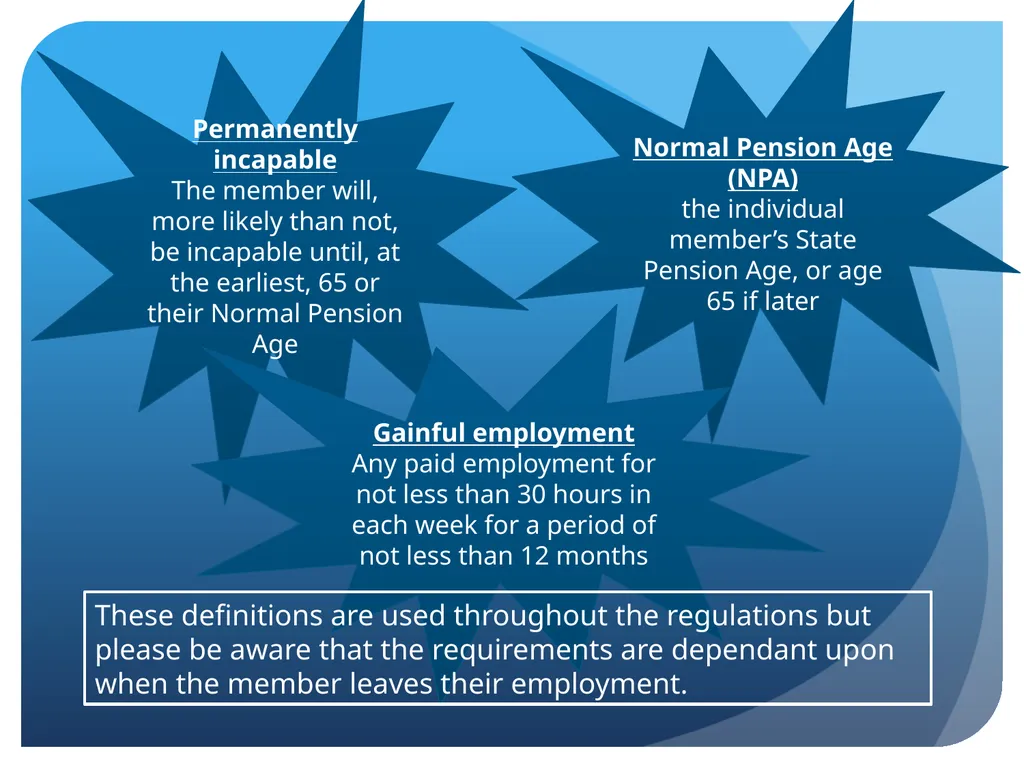
Normal Pension Age (NPA)
the individual member’s State Pension Age, or age 65 if later Permanently incapable
The member will, more likely than not, be incapable until, at the earliest, 65 or their Normal Pension Age Gainful employment
Any paid employment for not less than 30 hours in each week for a period of not less than 12 months These definitions are used throughout the regulations but please be aware that the requirements are dependant upon when the member leaves their employment.<br>
the individual member’s State Pension Age, or age 65 if later Permanently incapable
The member will, more likely than not, be incapable until, at the earliest, 65 or their Normal Pension Age Gainful employment
Any paid employment for not less than 30 hours in each week for a period of not less than 12 months These definitions are used throughout the regulations but please be aware that the requirements are dependant upon when the member leaves their employment.<br>
09
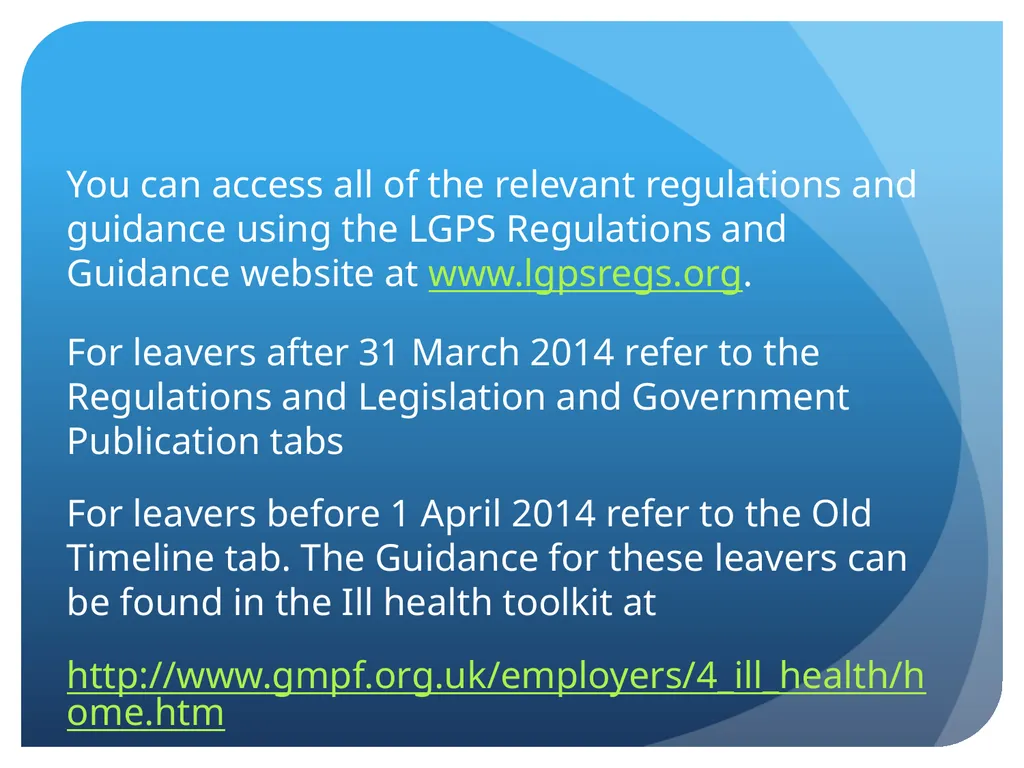
You can access all of the relevant regulations and guidance using the LGPS Regulations and Guidance website at www.lgpsregs.org.
For leavers after 31 March 2014 refer to the Regulations and Legislation and Government Publication tabs
For leavers before 1 April 2014 refer to the Old Timeline tab. The Guidance for these leavers can be found in the Ill health toolkit at
http://www.gmpf.org.uk/employers/4_ill_health/home.htm<br>
For leavers after 31 March 2014 refer to the Regulations and Legislation and Government Publication tabs
For leavers before 1 April 2014 refer to the Old Timeline tab. The Guidance for these leavers can be found in the Ill health toolkit at
http://www.gmpf.org.uk/employers/4_ill_health/home.htm<br>
10
Active Members<br>
11
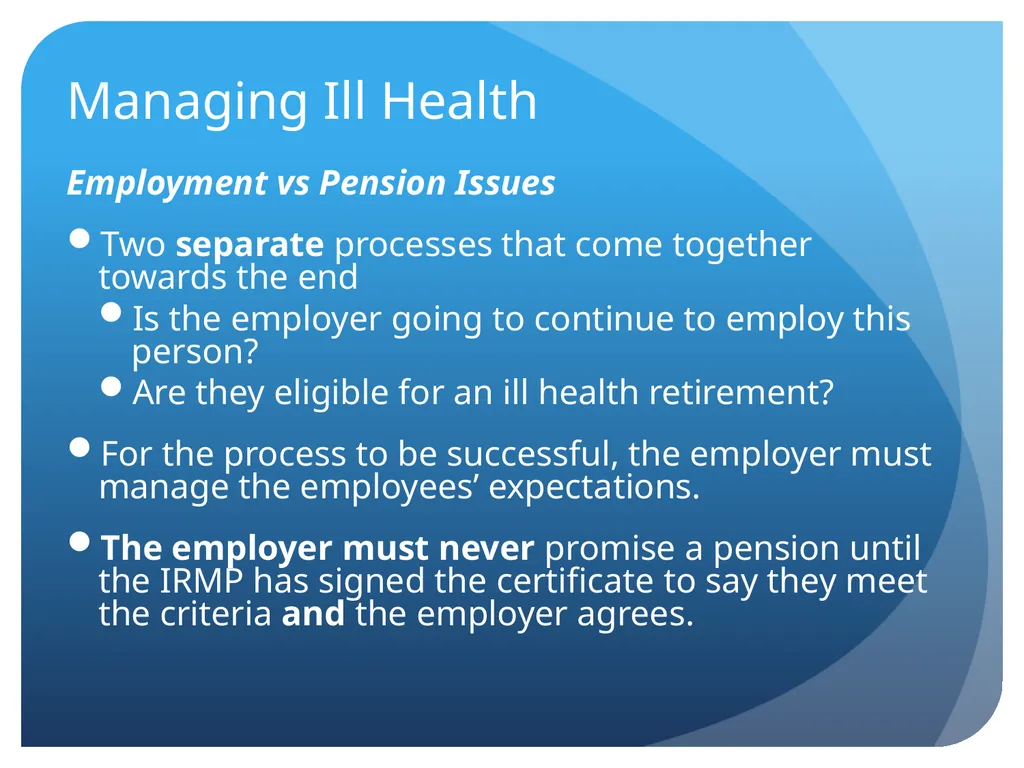
Managing Ill Health Employment vs Pension Issues
Two separate processes that come together towards the end
Is the employer going to continue to employ this person?
Are they eligible for an ill health retirement?
For the process to be successful, the employer must manage the employees’ expectations.
The employer must never promise a pension until the IRMP has signed the certificate to say they meet the criteria and the employer agrees.<br>
Two separate processes that come together towards the end
Is the employer going to continue to employ this person?
Are they eligible for an ill health retirement?
For the process to be successful, the employer must manage the employees’ expectations.
The employer must never promise a pension until the IRMP has signed the certificate to say they meet the criteria and the employer agrees.<br>
12
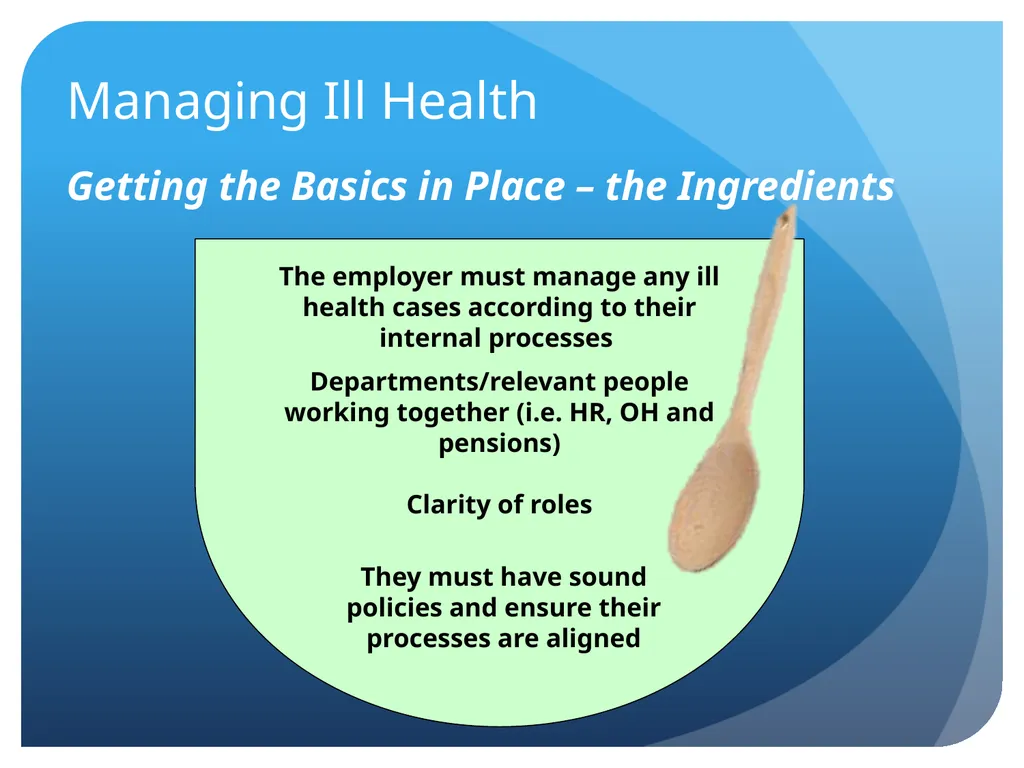
Managing Ill Health Getting the Basics in Place – the Ingredients The employer must manage any ill health cases according to their internal processes Departments/relevant people working together (i.e. HR, OH and pensions) Clarity of roles They must have sound policies and ensure their processes are aligned<br>
13
The employers responsibilities The employer must separately decide:
Is the employee fit to continue in their current employment?
Are they entitled to an ill health pension?
What tier of benefits should they receive?
Their decision must be informed by the opinion of the IRMP
But ultimately these are employer decisions<br>
Is the employee fit to continue in their current employment?
Are they entitled to an ill health pension?
What tier of benefits should they receive?
Their decision must be informed by the opinion of the IRMP
But ultimately these are employer decisions<br>
14
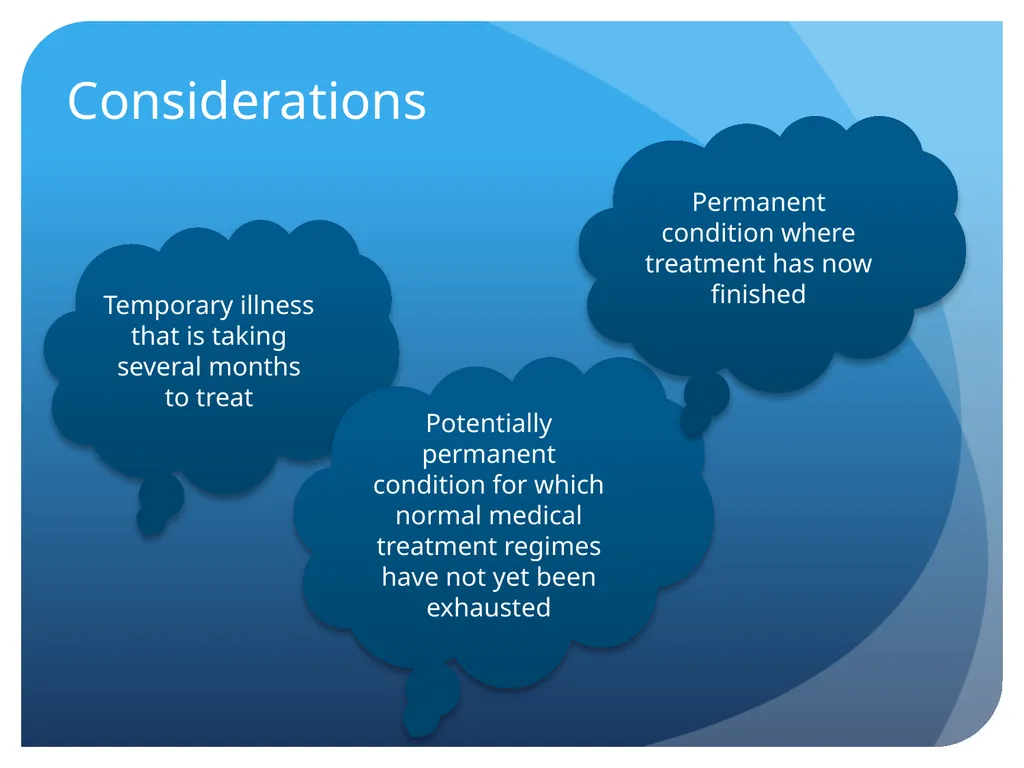
Considerations Temporary illness that is taking several months to treat Potentially permanent condition for which normal medical treatment regimes have not yet been exhausted Permanent condition where treatment has now finished<br>
15
Entitlement to ill health retirement benefits Eligibility Criteria
To be entitled to a ill health pension the employee must:
be dismissed on the grounds of ill health;
be below normal pension age (NPA);
have a least two years qualifying service*;
be permanently incapable of discharging efficiently, the duties of their current employment
not be immediately capable of undertaking gainful employment
have been certified by the IRMP as meeting the ill health pension criteria. *Not just two years in current employment, they may have other qualifying service.<br>
To be entitled to a ill health pension the employee must:
be dismissed on the grounds of ill health;
be below normal pension age (NPA);
have a least two years qualifying service*;
be permanently incapable of discharging efficiently, the duties of their current employment
not be immediately capable of undertaking gainful employment
have been certified by the IRMP as meeting the ill health pension criteria. *Not just two years in current employment, they may have other qualifying service.<br>
16
Referral to the IRMP What the employer should include in their referral pack?<br>
17
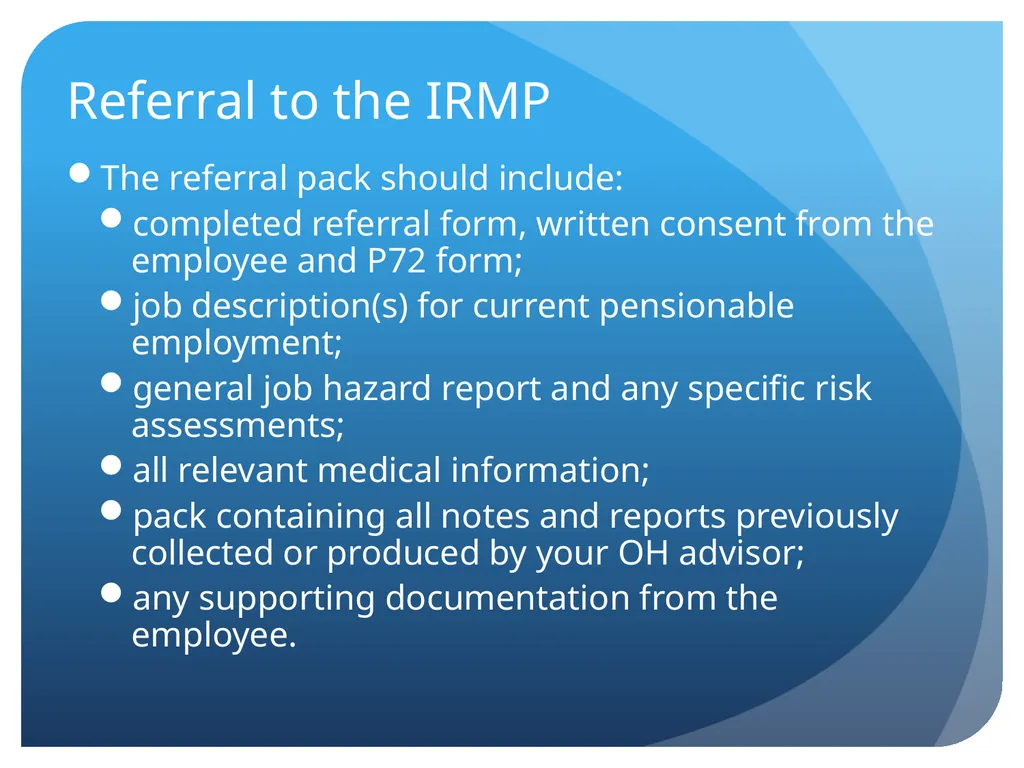
Referral to the IRMP The referral pack should include:
completed referral form, written consent from the employee and P72 form;
job description(s) for current pensionable employment;
general job hazard report and any specific risk assessments;
all relevant medical information;
pack containing all notes and reports previously collected or produced by your OH advisor;
any supporting documentation from the employee.<br>
completed referral form, written consent from the employee and P72 form;
job description(s) for current pensionable employment;
general job hazard report and any specific risk assessments;
all relevant medical information;
pack containing all notes and reports previously collected or produced by your OH advisor;
any supporting documentation from the employee.<br>
18
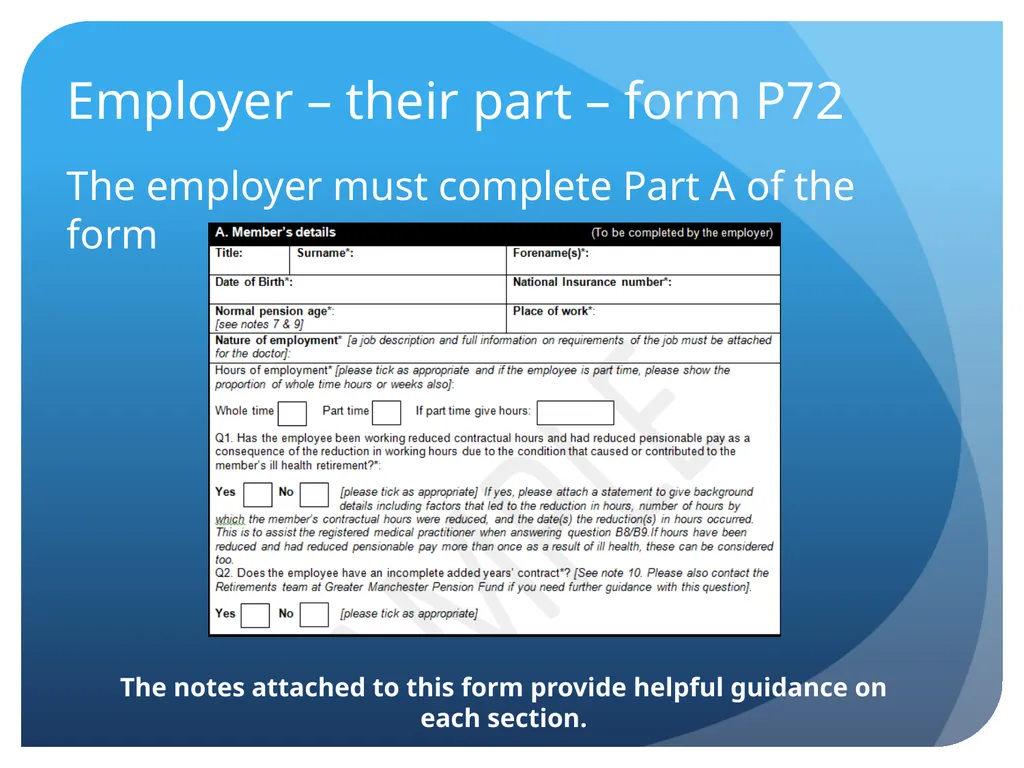
Employer – their part – form P72 The employer must complete Part A of the form The notes attached to this form provide helpful guidance on each section.<br>
19
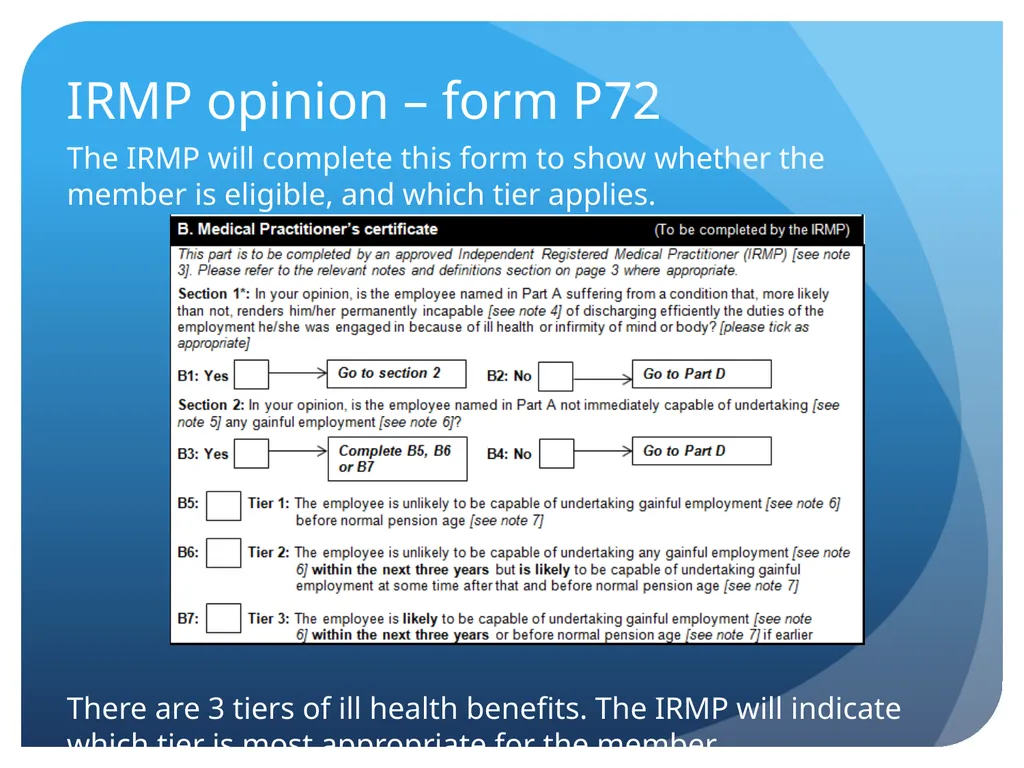
IRMP opinion – form P72 The IRMP will complete this form to show whether the member is eligible, and which tier applies.
There are 3 tiers of ill health benefits. The IRMP will indicate which tier is most appropriate for the member.<br>
There are 3 tiers of ill health benefits. The IRMP will indicate which tier is most appropriate for the member.<br>
20
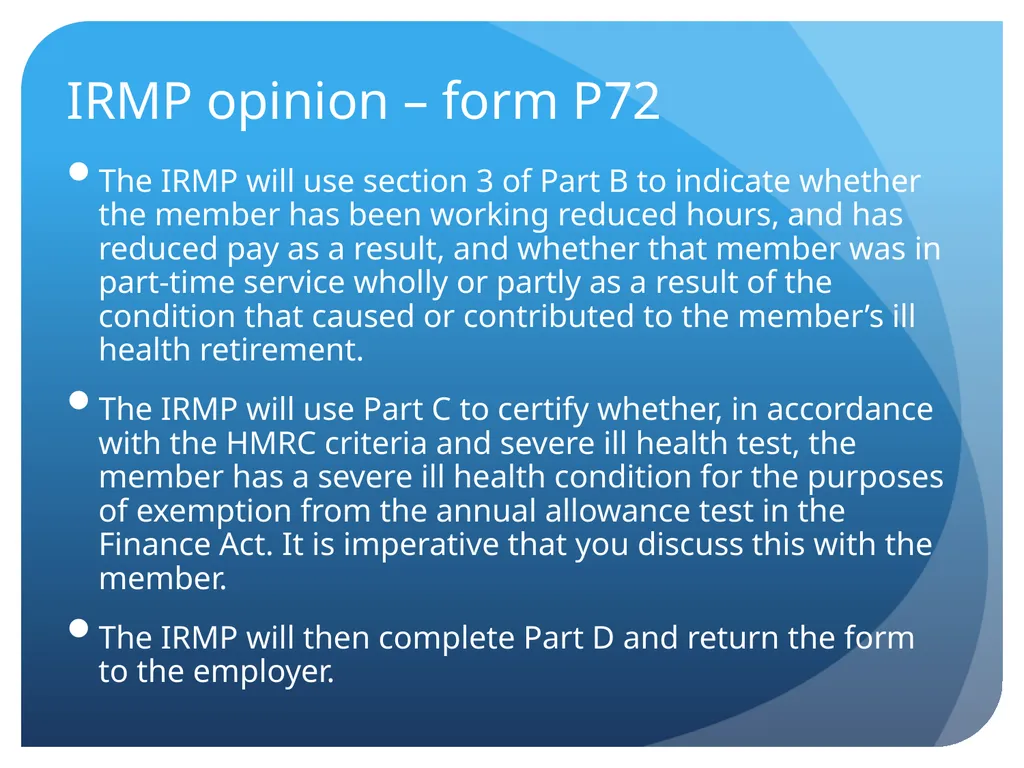
IRMP opinion – form P72 The IRMP will use section 3 of Part B to indicate whether the member has been working reduced hours, and has reduced pay as a result, and whether that member was in part-time service wholly or partly as a result of the condition that caused or contributed to the member’s ill health retirement.
The IRMP will use Part C to certify whether, in accordance with the HMRC criteria and severe ill health test, the member has a severe ill health condition for the purposes of exemption from the annual allowance test in the Finance Act. It is imperative that you discuss this with the member.
The IRMP will then complete Part D and return the form to the employer.<br>
The IRMP will use Part C to certify whether, in accordance with the HMRC criteria and severe ill health test, the member has a severe ill health condition for the purposes of exemption from the annual allowance test in the Finance Act. It is imperative that you discuss this with the member.
The IRMP will then complete Part D and return the form to the employer.<br>
21
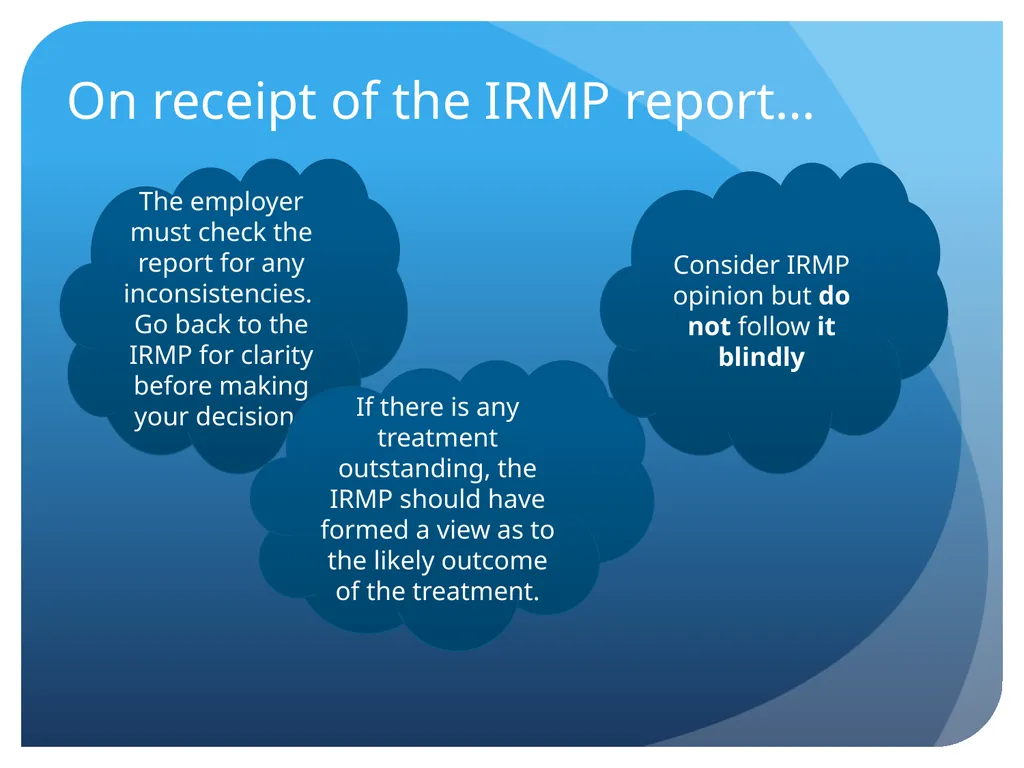
On receipt of the IRMP report… The employer must check the report for any inconsistencies. Go back to the IRMP for clarity before making your decision. If there is any treatment outstanding, the IRMP should have formed a view as to the likely outcome of the treatment. Consider IRMP opinion but do not follow it blindly<br>
22
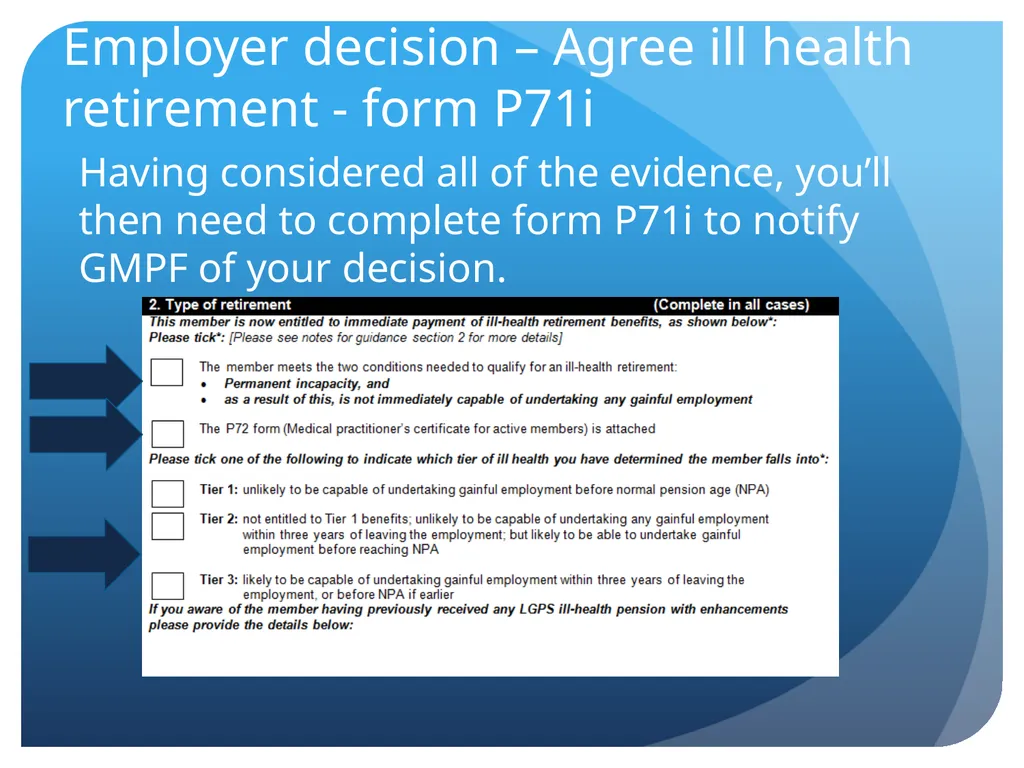
Employer decision – Agree ill health retirement - form P71i Having considered all of the evidence, you’ll then need to complete form P71i to notify GMPF of your decision.<br>
23
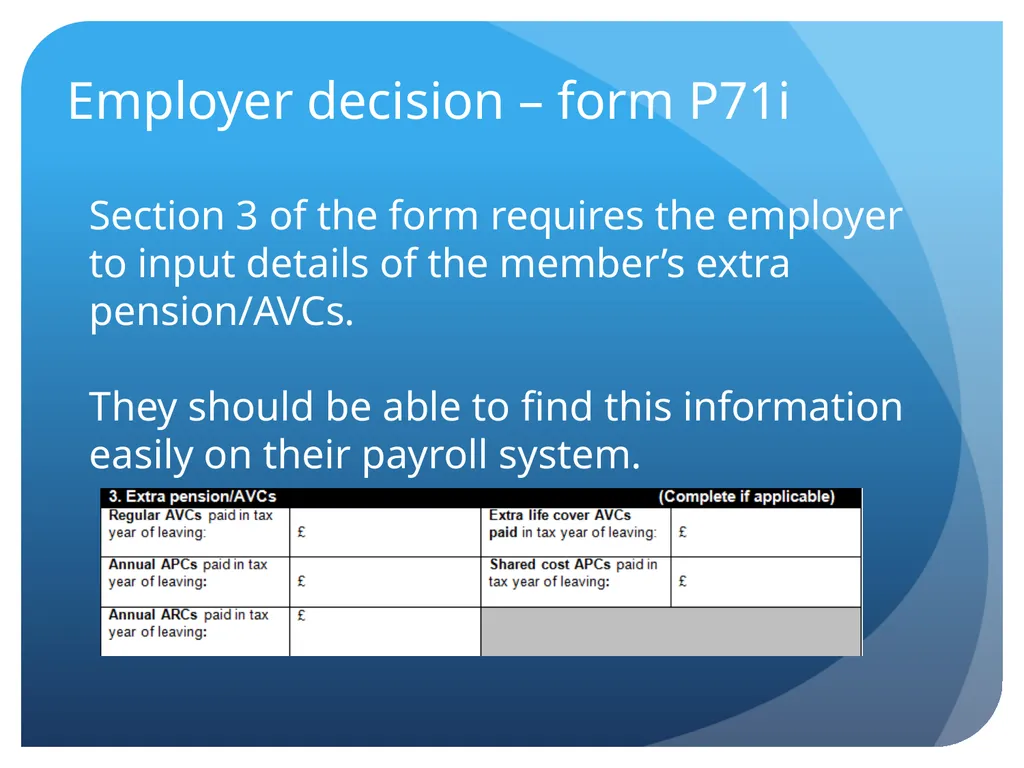
Employer decision – form P71i Section 3 of the form requires the employer to input details of the member’s extra pension/AVCs.
They should be able to find this information easily on their payroll system.<br>
They should be able to find this information easily on their payroll system.<br>
24
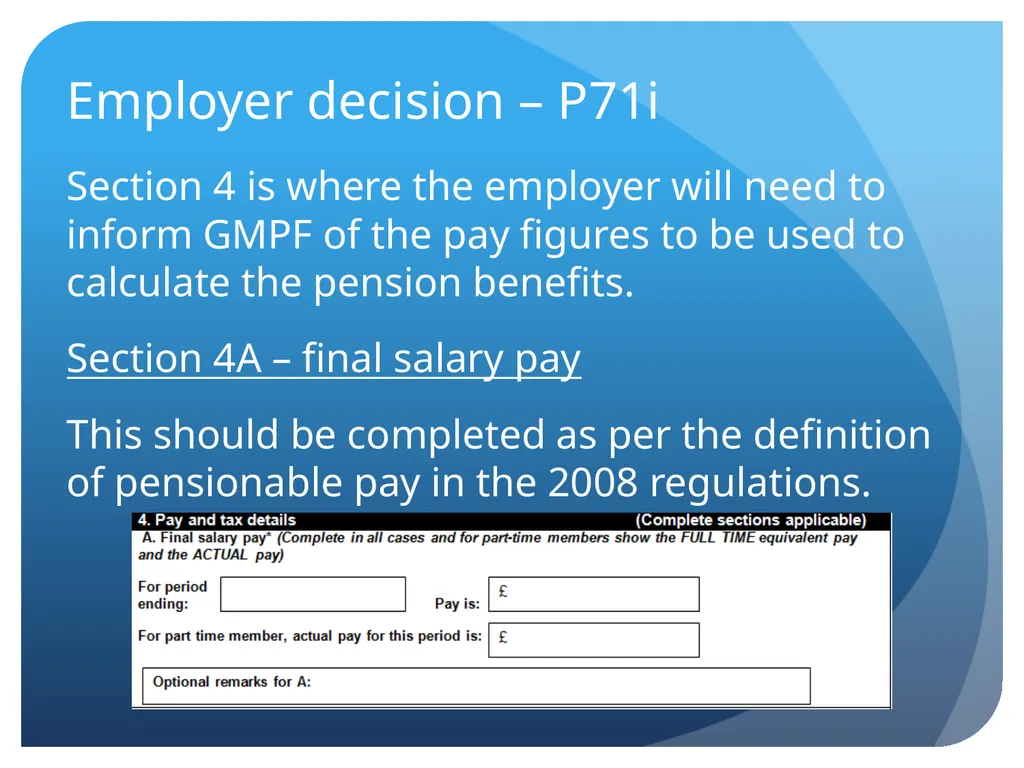
Employer decision – P71i Section 4 is where the employer will need to inform GMPF of the pay figures to be used to calculate the pension benefits.
Section 4A – final salary pay
This should be completed as per the definition of pensionable pay in the 2008 regulations.<br>
Section 4A – final salary pay
This should be completed as per the definition of pensionable pay in the 2008 regulations.<br>
25
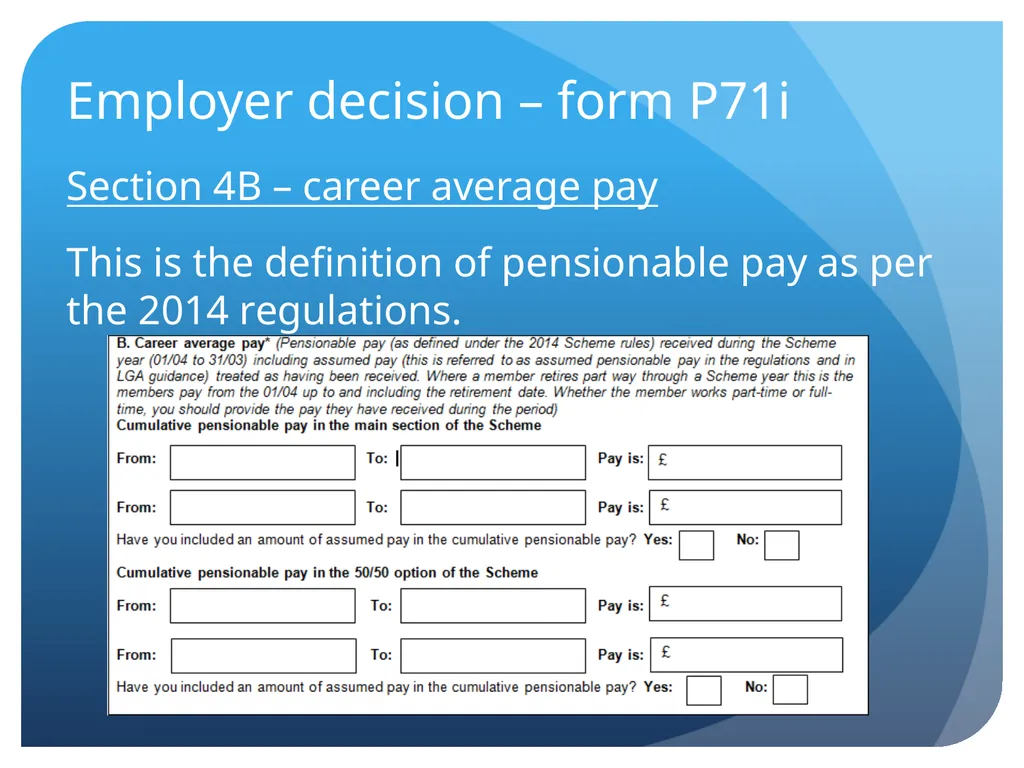
Employer decision – form P71i Section 4B – career average pay
This is the definition of pensionable pay as per the 2014 regulations.<br>
This is the definition of pensionable pay as per the 2014 regulations.<br>
26
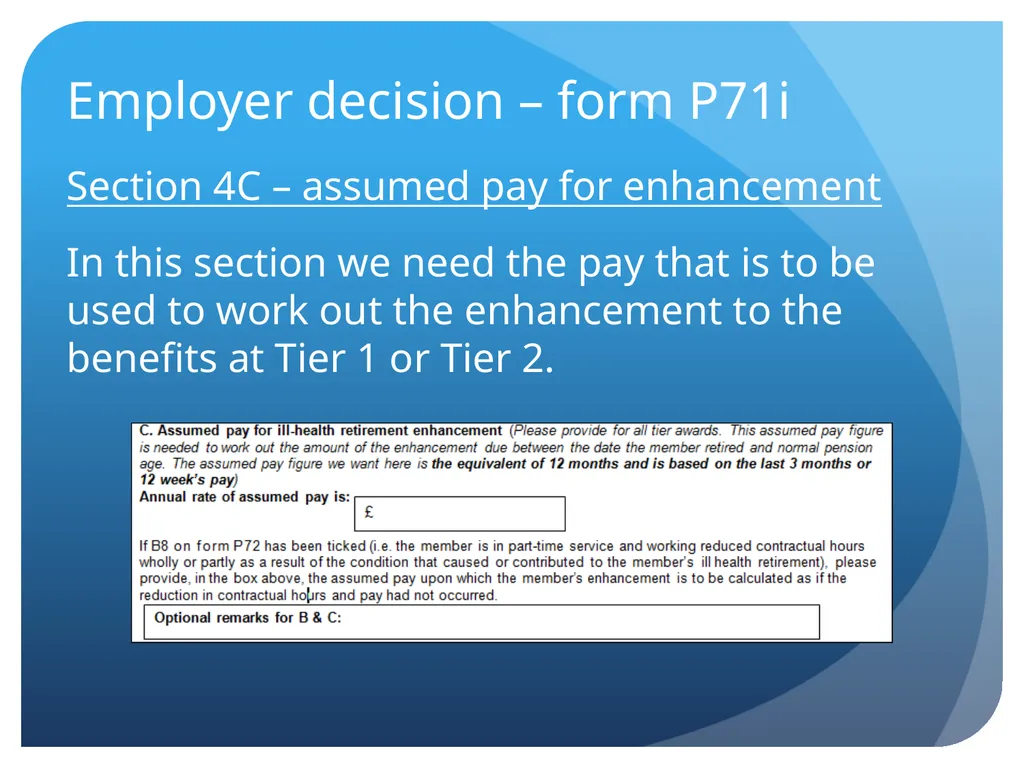
Employer decision – form P71i Section 4C – assumed pay for enhancement
In this section we need the pay that is to be used to work out the enhancement to the benefits at Tier 1 or Tier 2.<br>
In this section we need the pay that is to be used to work out the enhancement to the benefits at Tier 1 or Tier 2.<br>
27
Employer decision – notifying the member Whether the employers decision is to agree to an ill health pension or to decline they need to notify the member and include both employment and pension right of appeal information. They should do this as soon as possible after making their decision.
Template letters are available in the Ill Health Toolkit at http://www.gmpf.org.uk/employers/4_ill_health/home.htm<br>
Template letters are available in the Ill Health Toolkit at http://www.gmpf.org.uk/employers/4_ill_health/home.htm<br>
28
Employer decision – notifying the member If the employer doesn’t award ill health retirement but offer the member an alternative way of terminating their employment (for example, voluntary retirement) they must make sure the member is aware that they are unable to appeal the ill health decision using the provisions under the LGPS Regulations.
An appeal in this case would need to be dealt with under your own employment appeals process.<br>
An appeal in this case would need to be dealt with under your own employment appeals process.<br>
29
Deferred Members<br>
30
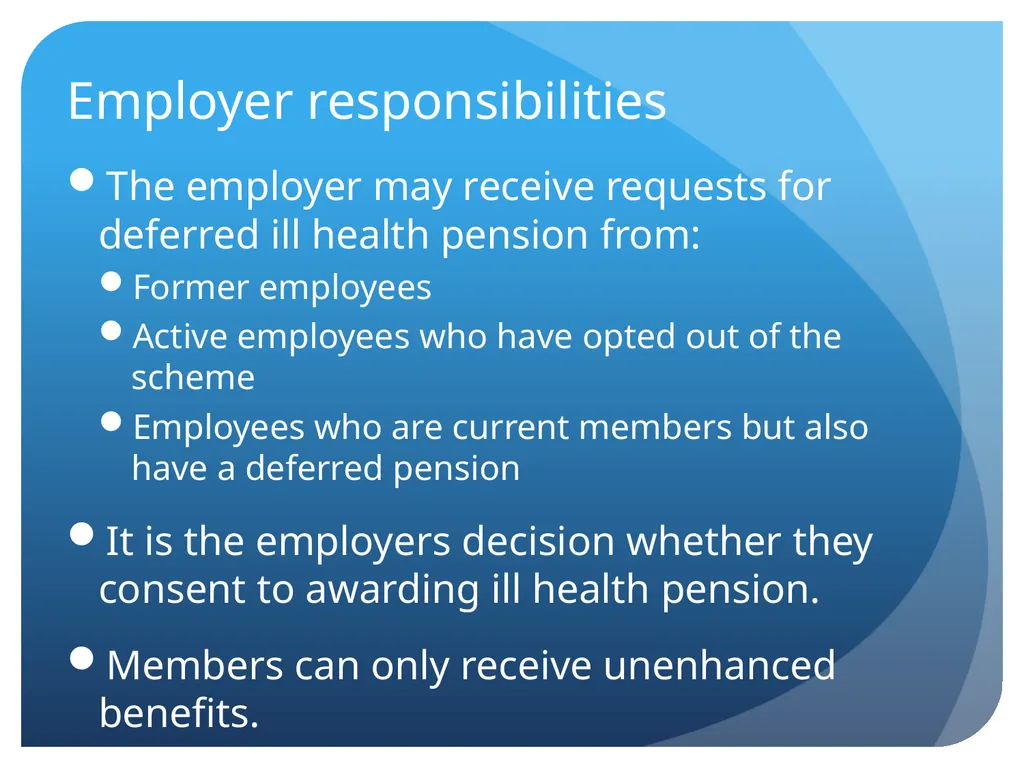
Employer responsibilities The employer may receive requests for deferred ill health pension from:
Former employees
Active employees who have opted out of the scheme
Employees who are current members but also have a deferred pension
It is the employers decision whether they consent to awarding ill health pension.
Members can only receive unenhanced benefits.<br>
Former employees
Active employees who have opted out of the scheme
Employees who are current members but also have a deferred pension
It is the employers decision whether they consent to awarding ill health pension.
Members can only receive unenhanced benefits.<br>
31
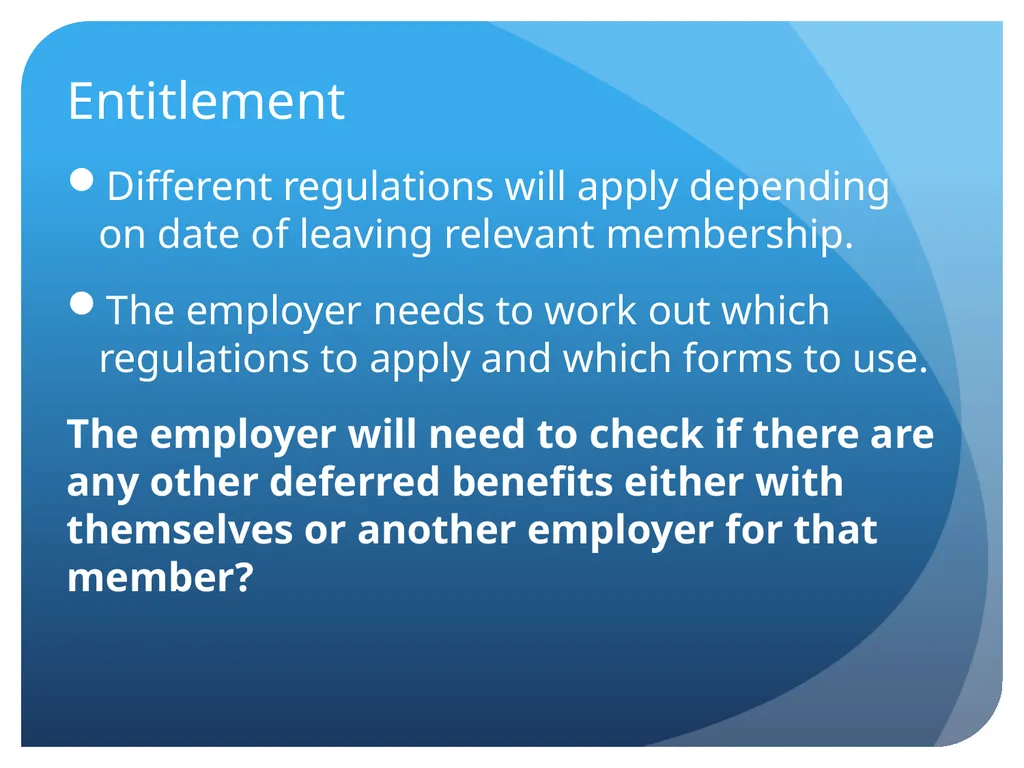
Entitlement Different regulations will apply depending on date of leaving relevant membership.
The employer needs to work out which regulations to apply and which forms to use.
The employer will need to check if there are any other deferred benefits either with themselves or another employer for that member?<br>
The employer needs to work out which regulations to apply and which forms to use.
The employer will need to check if there are any other deferred benefits either with themselves or another employer for that member?<br>
32
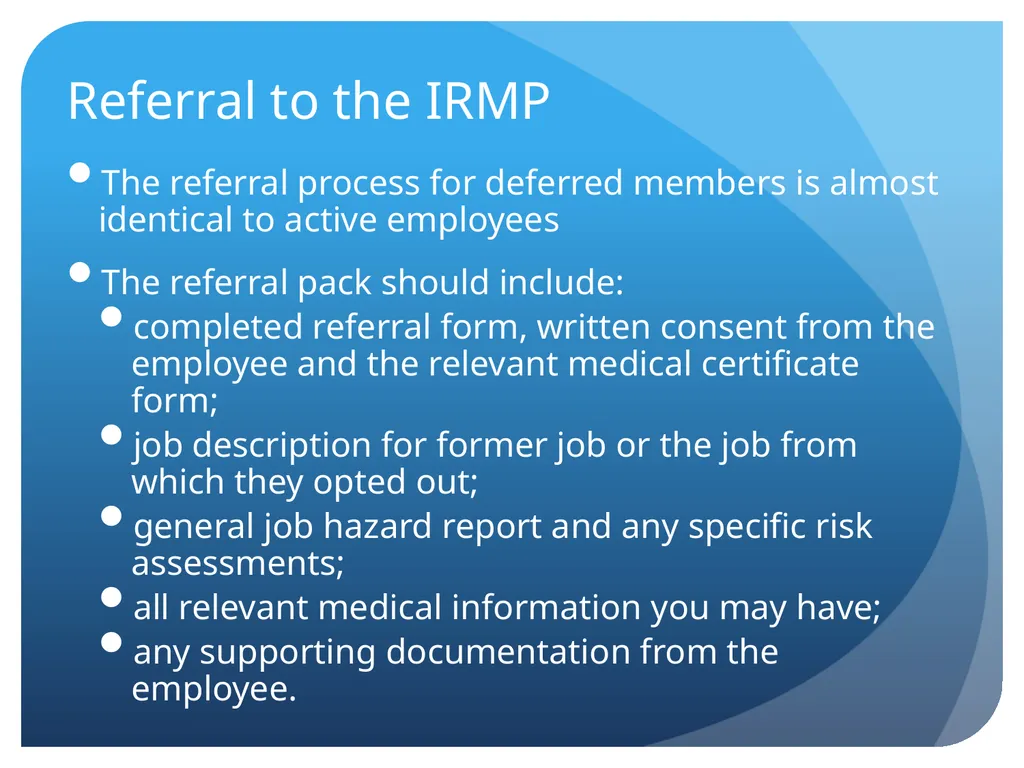
Referral to the IRMP The referral process for deferred members is almost identical to active employees
The referral pack should include:
completed referral form, written consent from the employee and the relevant medical certificate form;
job description for former job or the job from which they opted out;
general job hazard report and any specific risk assessments;
all relevant medical information you may have;
any supporting documentation from the employee.<br>
The referral pack should include:
completed referral form, written consent from the employee and the relevant medical certificate form;
job description for former job or the job from which they opted out;
general job hazard report and any specific risk assessments;
all relevant medical information you may have;
any supporting documentation from the employee.<br>
33
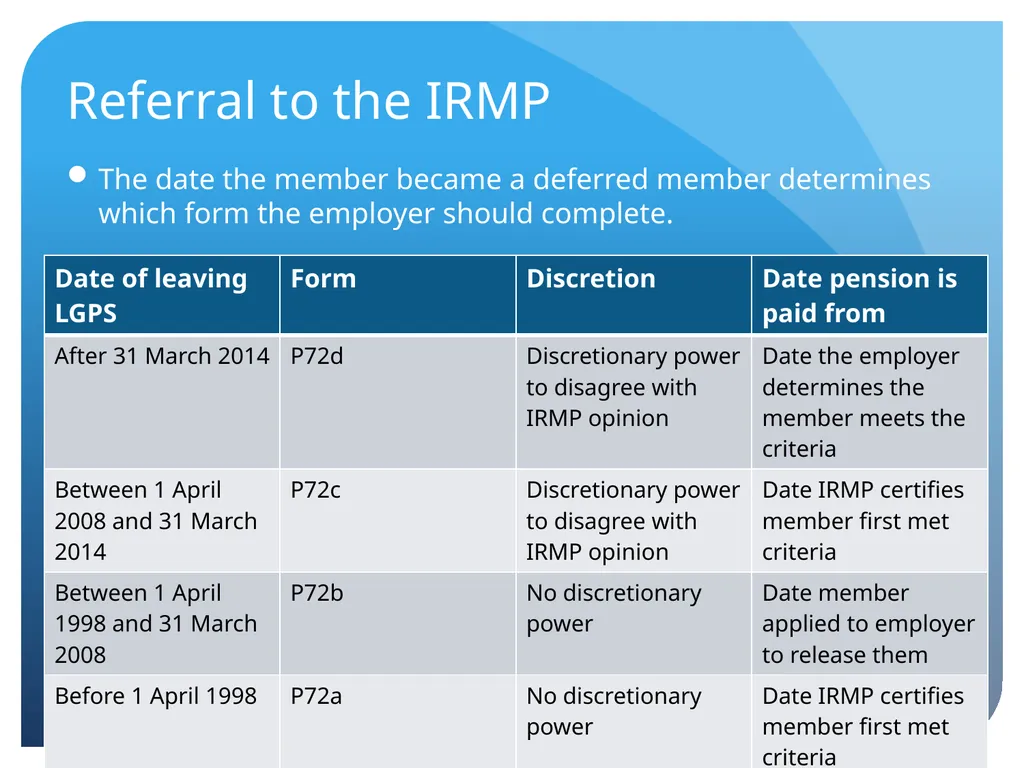
Referral to the IRMP The date the member became a deferred member determines which form the employer should complete.<br>
34
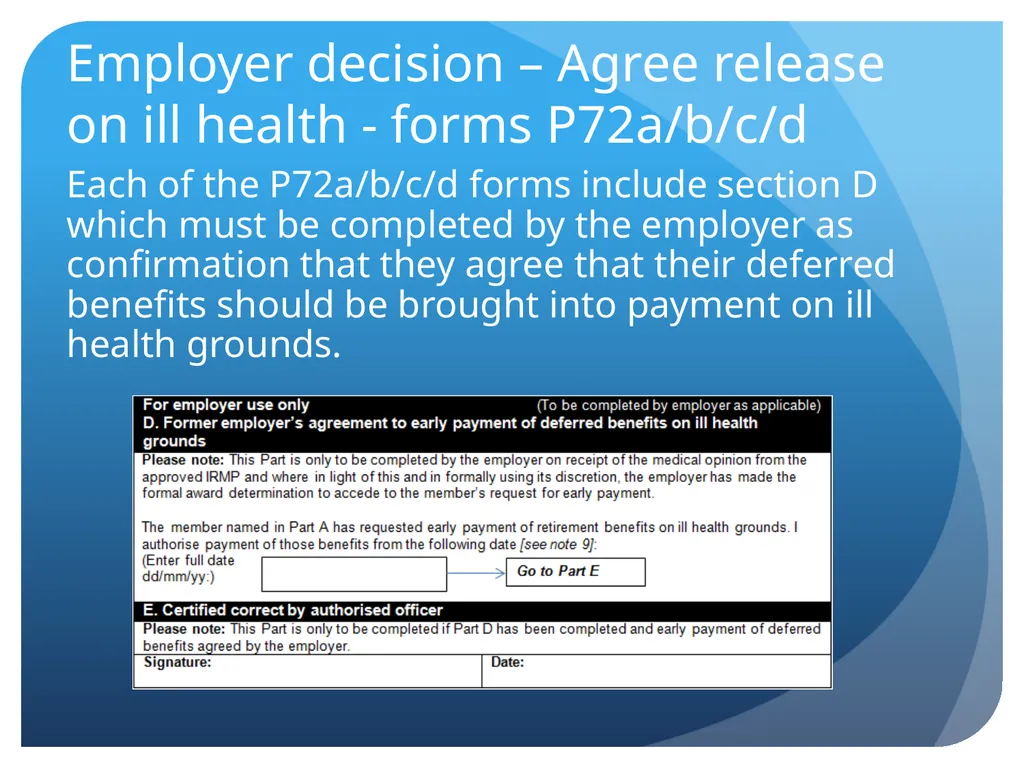
Employer decision – Agree release on ill health - forms P72a/b/c/d Each of the P72a/b/c/d forms include section D which must be completed by the employer as confirmation that they agree that their deferred benefits should be brought into payment on ill health grounds.<br>
35
Employer decision – notifying the member Whether the employers decision is to agree or decline the release of the deferred benefits on ill health, they need to notify the member and include right of appeal information. They should do this as soon as possible after making your decision.
Template letters are available in the Ill Health Toolkit at http://www.gmpf.org.uk/employers/4_ill_health/home.htm<br>
Template letters are available in the Ill Health Toolkit at http://www.gmpf.org.uk/employers/4_ill_health/home.htm<br>
36
Tier 3 Review<br>
37
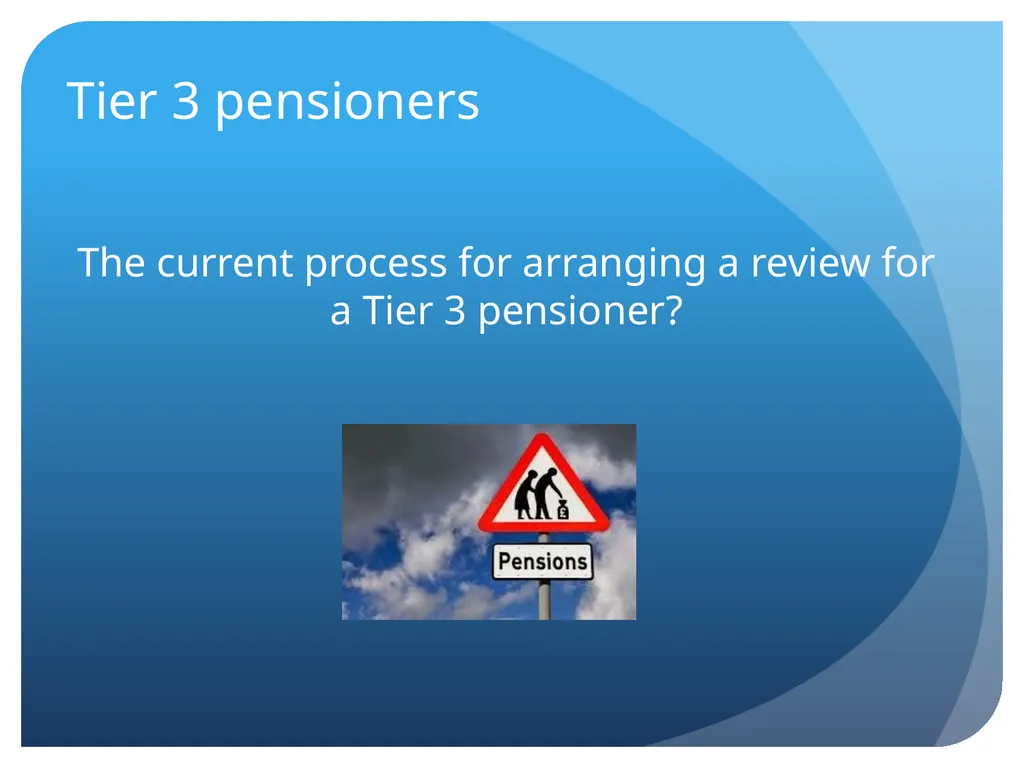
Tier 3 pensioners The current process for arranging a review for a Tier 3 pensioner?<br>
38
Tier 3 Pensioners Tier 3 ill health pensions are a temporary award for a maximum of three years.
18 month review
The employer must decide if the member is in gainful employment.
If the person is not in gainful employment they must obtain a further medical certificate from an IRMP and decide if the member is capable of undertaking gainful employment.
The employer decides whether or not payments stop, continue or are enhanced to Tier 2.<br>
18 month review
The employer must decide if the member is in gainful employment.
If the person is not in gainful employment they must obtain a further medical certificate from an IRMP and decide if the member is capable of undertaking gainful employment.
The employer decides whether or not payments stop, continue or are enhanced to Tier 2.<br>
39
Employers responsibilities The employer may receive other review requests from:
Current Tier 3 pensioners
Deferred pensioner members
As with deferred members, there are different forms dependent upon when the member left and the type of review - P72r(1) to P72r(6).
The outcome of a Tier 3 review is an employer decision.
You must do an 18 month review.<br>
Current Tier 3 pensioners
Deferred pensioner members
As with deferred members, there are different forms dependent upon when the member left and the type of review - P72r(1) to P72r(6).
The outcome of a Tier 3 review is an employer decision.
You must do an 18 month review.<br>
40
Tier 3 Pensioners Current Tier 3 pensioner medical review
A member can ask for a Tier 2 pension to be considered.
The employer must refer to IRMP (form P72r(5)).
The employer must decide if the pension is enhanced to Tier 2.
The employer has the discretionary power to disagree with IRMP opinion.
If they do agree to the member’s request, the Tier 2 pension is payable from the date of the employer’s decision.
If the employer decides to make the enhancement to Tier 2, the pension payments do not cease.<br>
A member can ask for a Tier 2 pension to be considered.
The employer must refer to IRMP (form P72r(5)).
The employer must decide if the pension is enhanced to Tier 2.
The employer has the discretionary power to disagree with IRMP opinion.
If they do agree to the member’s request, the Tier 2 pension is payable from the date of the employer’s decision.
If the employer decides to make the enhancement to Tier 2, the pension payments do not cease.<br>
41
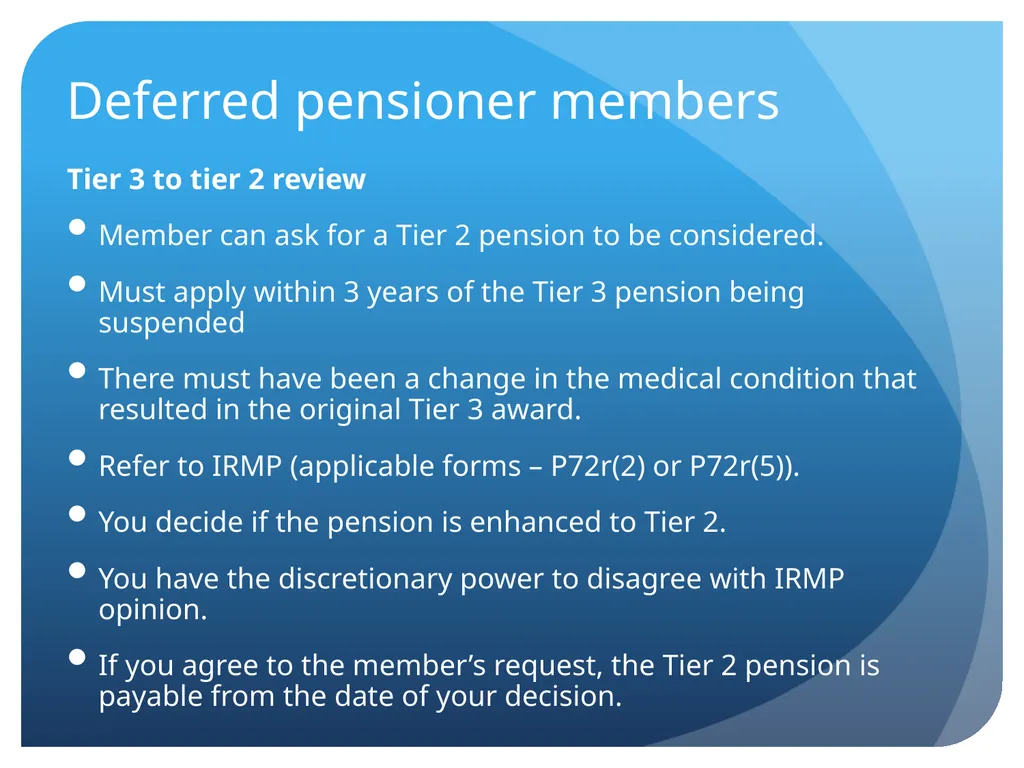
Deferred pensioner members Tier 3 to tier 2 review
Member can ask for a Tier 2 pension to be considered.
Must apply within 3 years of the Tier 3 pension being suspended
There must have been a change in the medical condition that resulted in the original Tier 3 award.
Refer to IRMP (applicable forms – P72r(2) or P72r(5)).
You decide if the pension is enhanced to Tier 2.
You have the discretionary power to disagree with IRMP opinion.
If you agree to the member’s request, the Tier 2 pension is payable from the date of your decision.<br>
Member can ask for a Tier 2 pension to be considered.
Must apply within 3 years of the Tier 3 pension being suspended
There must have been a change in the medical condition that resulted in the original Tier 3 award.
Refer to IRMP (applicable forms – P72r(2) or P72r(5)).
You decide if the pension is enhanced to Tier 2.
You have the discretionary power to disagree with IRMP opinion.
If you agree to the member’s request, the Tier 2 pension is payable from the date of your decision.<br>
42
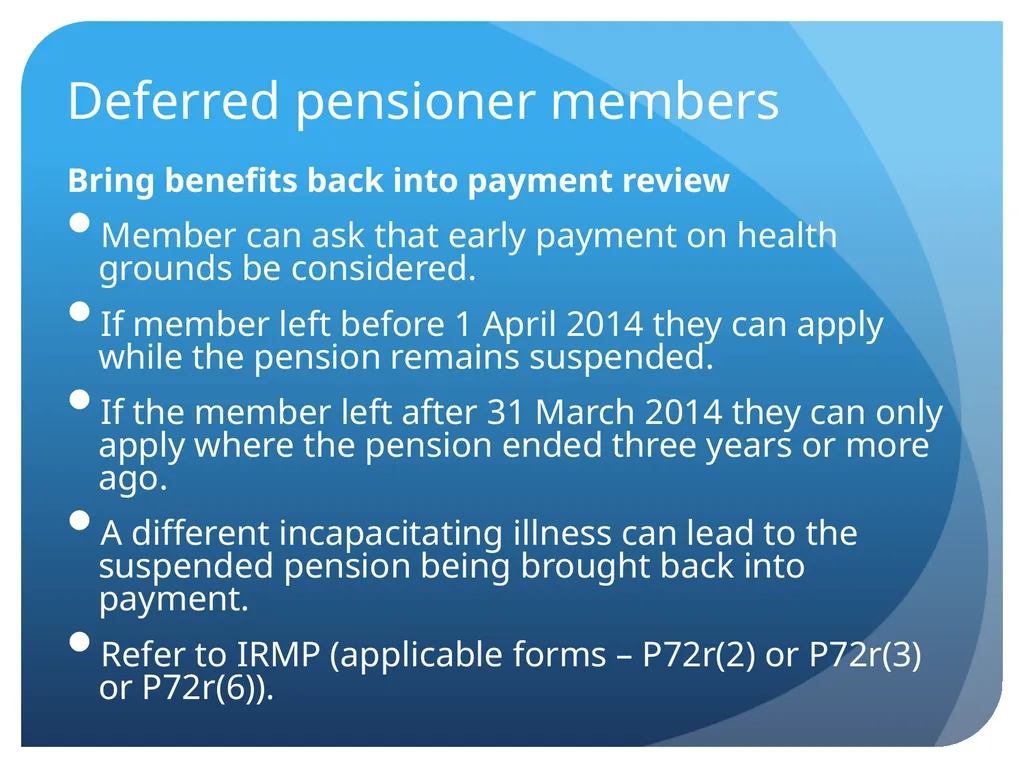
Deferred pensioner members Bring benefits back into payment review
Member can ask that early payment on health grounds be considered.
If member left before 1 April 2014 they can apply while the pension remains suspended.
If the member left after 31 March 2014 they can only apply where the pension ended three years or more ago.
A different incapacitating illness can lead to the suspended pension being brought back into payment.
Refer to IRMP (applicable forms – P72r(2) or P72r(3) or P72r(6)).<br>
Member can ask that early payment on health grounds be considered.
If member left before 1 April 2014 they can apply while the pension remains suspended.
If the member left after 31 March 2014 they can only apply where the pension ended three years or more ago.
A different incapacitating illness can lead to the suspended pension being brought back into payment.
Refer to IRMP (applicable forms – P72r(2) or P72r(3) or P72r(6)).<br>
43
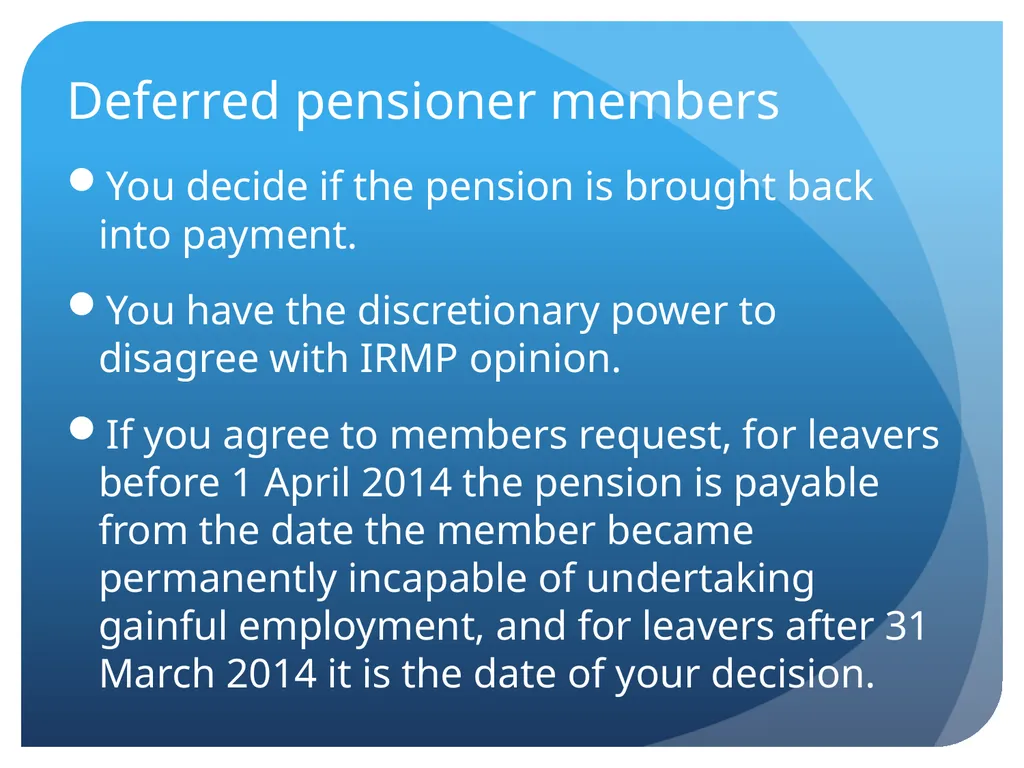
Deferred pensioner members You decide if the pension is brought back into payment.
You have the discretionary power to disagree with IRMP opinion.
If you agree to members request, for leavers before 1 April 2014 the pension is payable from the date the member became permanently incapable of undertaking gainful employment, and for leavers after 31 March 2014 it is the date of your decision.<br>
You have the discretionary power to disagree with IRMP opinion.
If you agree to members request, for leavers before 1 April 2014 the pension is payable from the date the member became permanently incapable of undertaking gainful employment, and for leavers after 31 March 2014 it is the date of your decision.<br>
44
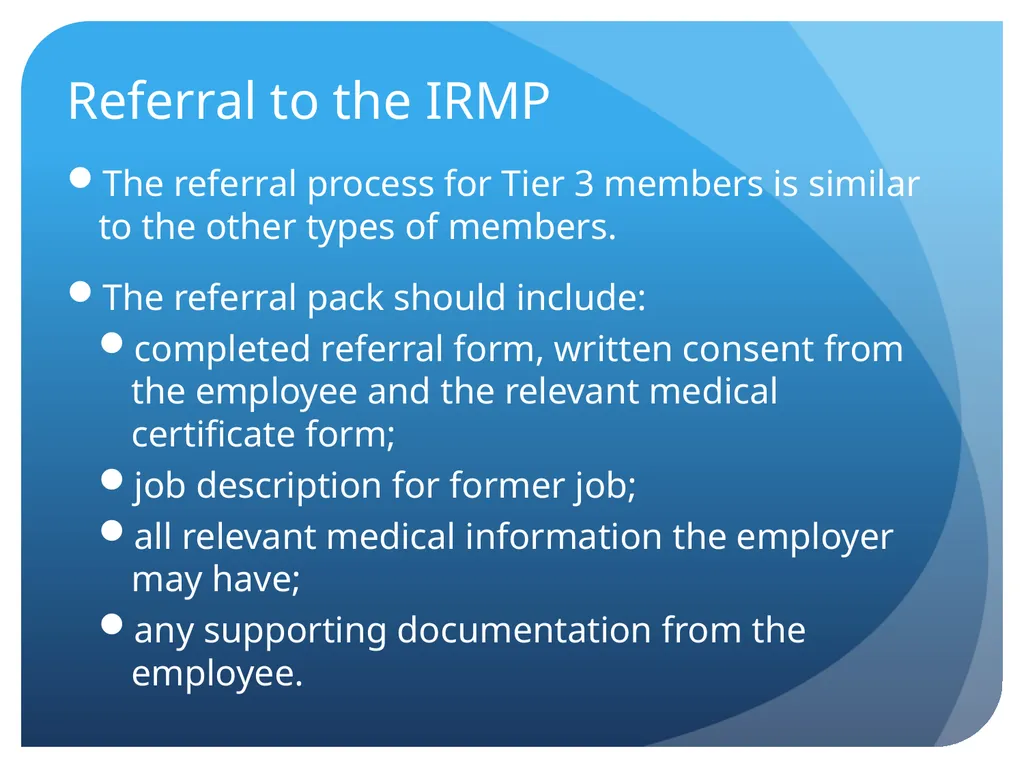
Referral to the IRMP The referral process for Tier 3 members is similar to the other types of members.
The referral pack should include:
completed referral form, written consent from the employee and the relevant medical certificate form;
job description for former job;
all relevant medical information the employer may have;
any supporting documentation from the employee.<br>
The referral pack should include:
completed referral form, written consent from the employee and the relevant medical certificate form;
job description for former job;
all relevant medical information the employer may have;
any supporting documentation from the employee.<br>
45
Referral to the IRMP – forms P72r(1to 6) Each of the P72r(1 to 6) forms include section A which must be completed by the employer before the referral pack is sent to the IRMP<br>
46
Employer decision – 18 month review Complete relevant sections on form P73b(2) and send to pensions office.<br>
47
Employer decision – Agree Tier 2 or Release on ill health - forms P73b(1) and (2) The relevant sections of the P73b(1) and P73b(2) must be completed by the employer as confirmation that you agree to a Tier 2 or that benefits should be brought into payment on ill health grounds.<br>
48
Employer decision – notifying the member Inform the member of your decision, whether you agree or decline and include right of appeal information.
We are currently developing template letters and will add these to the employer website as soon as possible.<br>
We are currently developing template letters and will add these to the employer website as soon as possible.<br>
49
Further information This session is intended to give you an overview of the LGPS and ill health. There is more in depth information available in the Ill health toolkit at http://www.gmpf.org.uk/employers/4_ill_health/home.htm<br>
50
Contact If you have any queries about the LGPS and ill health, or you are watching a recording of this webinar and have a question, please email us.
The Compliance team can be reached at:
Email – compliance@gmpf.org.uk<br>
The Compliance team can be reached at:
Email – compliance@gmpf.org.uk<br>