UNDERSTANDING NORMALITY, MOLARITY, AND MOLALITY Mr.Ranjit S.Jadhav Assistant Professor Department of Pharmaceutical chemistry, Krishna Institute of Pharmacy, Krishna Vishwa Vidyapeeth (Deemed to be University), Karad, Maharashtra, INDIA
"UNDERSTANDING NORMALITY, MOLARITY, AND MOLALITY" is the property of its rightful owner. Permission is granted to
download and print the materials on this website for personal, non-commercial use only, and to display it
on your personal computer provided you do not modify the materials and that you retain all copyright
notices contained in the materials. By downloading content from our website, you accept the terms of this
agreement.
Presentation Transcript
01
UNDERSTANDING NORMALITY, MOLARITY, AND MOLALITY Mr.Ranjit S.Jadhav
Assistant Professor
Department of Pharmaceutical chemistry,
Krishna Institute of Pharmacy,
Krishna Vishwa Vidyapeeth (Deemed to be University), Karad, Maharashtra, INDIA Resource Person<br>
02
Learning Outcomes After completing this session, students will be able to:
Students will be able to clearly define and differentiate between normality (N), molarity (M), and molality (m), including their units and significance in solution chemistry.
Students will be able to accurately calculate the normality, molarity, and molality of solutions using appropriate formulas and given data.
Students will be able to analyze experimental data and accurately interpret solution concentrations in practical laboratory scenarios.<br>
03
Contents Introduction 01 Define Normality, Molality ,Molarity 02 Comparision of Normality, Molality, Molarity 03 Applications of Normality, Molality, Molarity 04 Example of Normality, Molality, Molarity 05<br>
04
Introduction Normality, Molarity, and Molality are three important concentration terms in chemistry. Three key concentration units: Normality, Molarity, and Molality. Each has distinct applications and formulas.<br>
05
Normality (N)
Definition: The number of gram equivalents of solute per liter of solution.
Formula: N = equivalents of solute / liters of solution
Unit: eq/L
Example:
1 M H2SO4 = 2 N because it donates 2 H+ ions per molecule.<br>
06
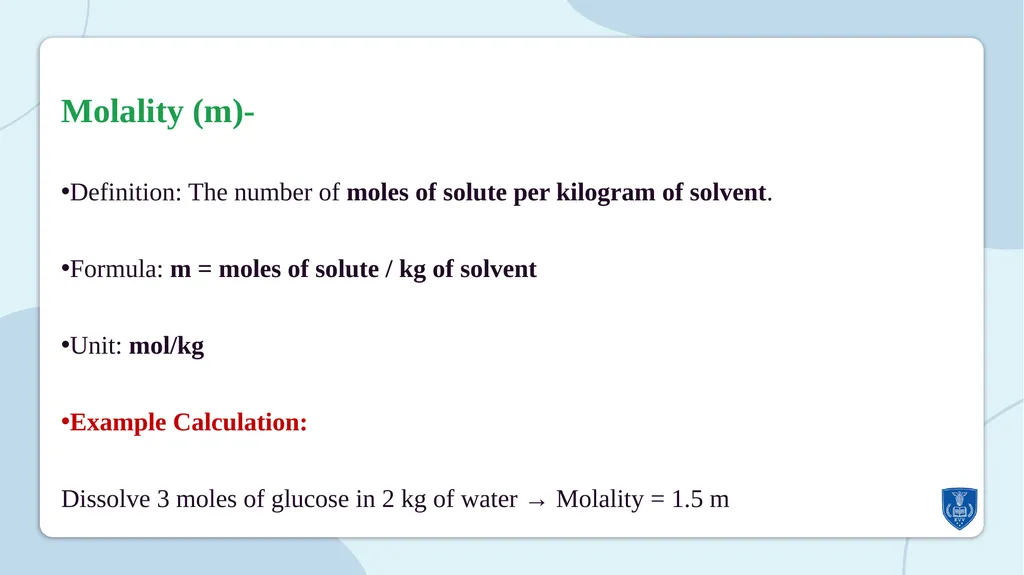
Molality (m)-
Definition: The number of moles of solute per kilogram of solvent.
Formula: m = moles of solute / kg of solvent
Unit: mol/kg
Example Calculation:
Dissolve 3 moles of glucose in 2 kg of water → Molality = 1.5 m<br>
07
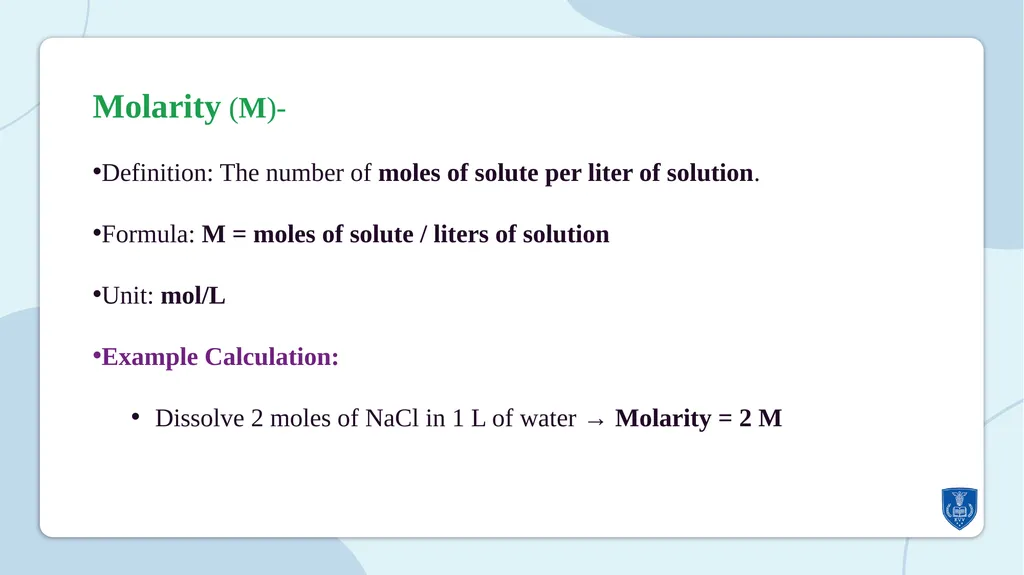
Molarity (M)-
Definition: The number of moles of solute per liter of solution.
Formula: M = moles of solute / liters of solution
Unit: mol/L
Example Calculation:
Dissolve 2 moles of NaCl in 1 L of water → Molarity = 2 M<br>
08
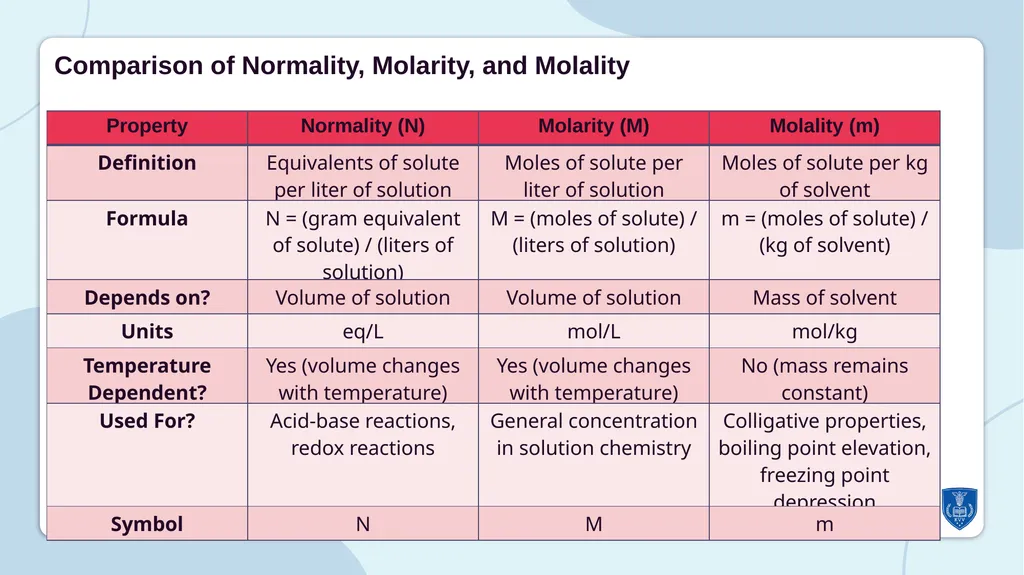
Comparison of Normality, Molarity, and Molality<br>
09
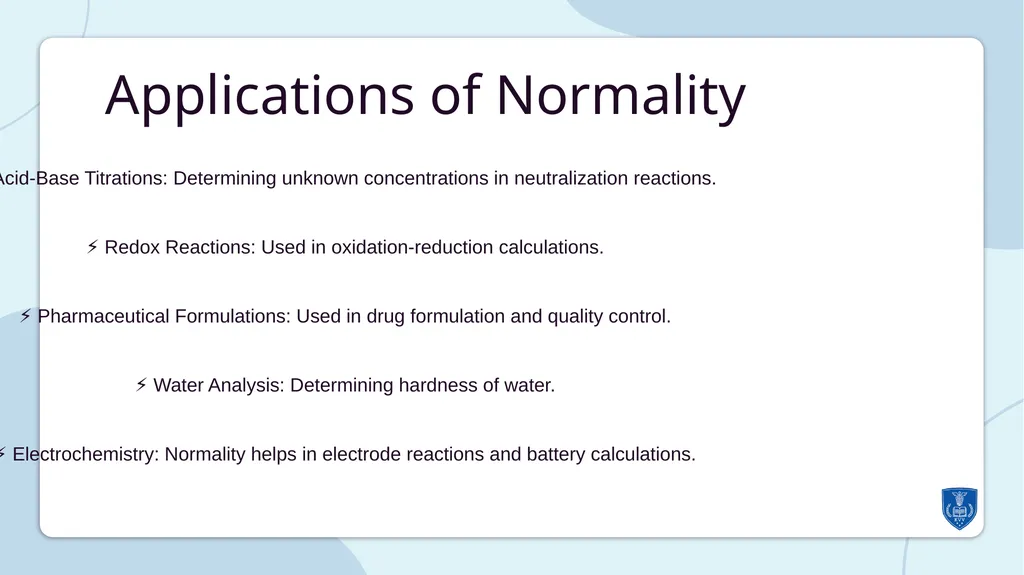
Applications of Normality ⚡ Acid-Base Titrations: Determining unknown concentrations in neutralization reactions. ⚡ Redox Reactions: Used in oxidation-reduction calculations. ⚡ Pharmaceutical Formulations: Used in drug formulation and quality control. ⚡ Water Analysis: Determining hardness of water. ⚡ Electrochemistry: Normality helps in electrode reactions and battery calculations.<br>
10
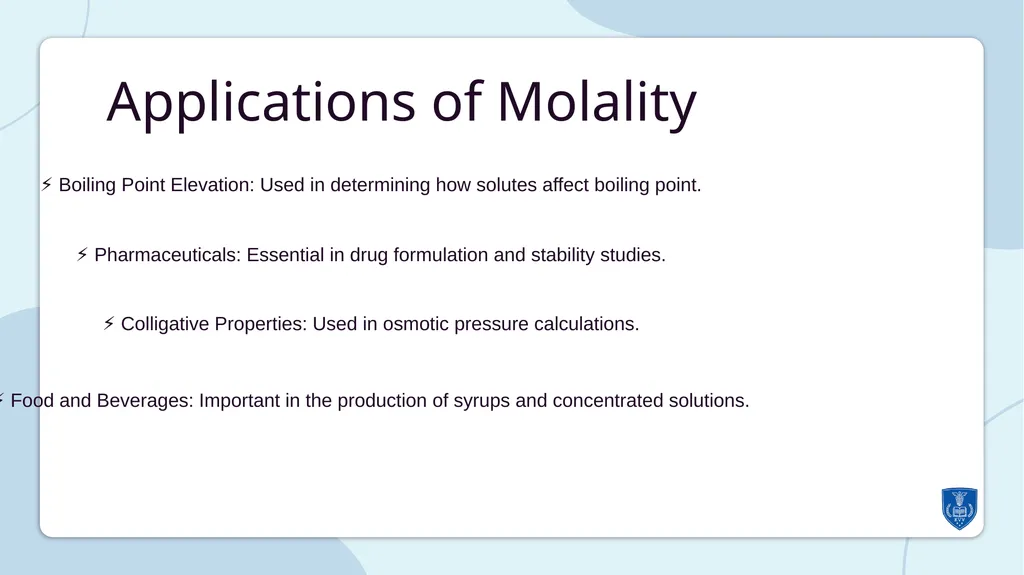
Applications of Molality ⚡ Boiling Point Elevation: Used in determining how solutes affect boiling point. ⚡ Pharmaceuticals: Essential in drug formulation and stability studies. ⚡ Colligative Properties: Used in osmotic pressure calculations. ⚡ Food and Beverages: Important in the production of syrups and concentrated solutions.<br>
11
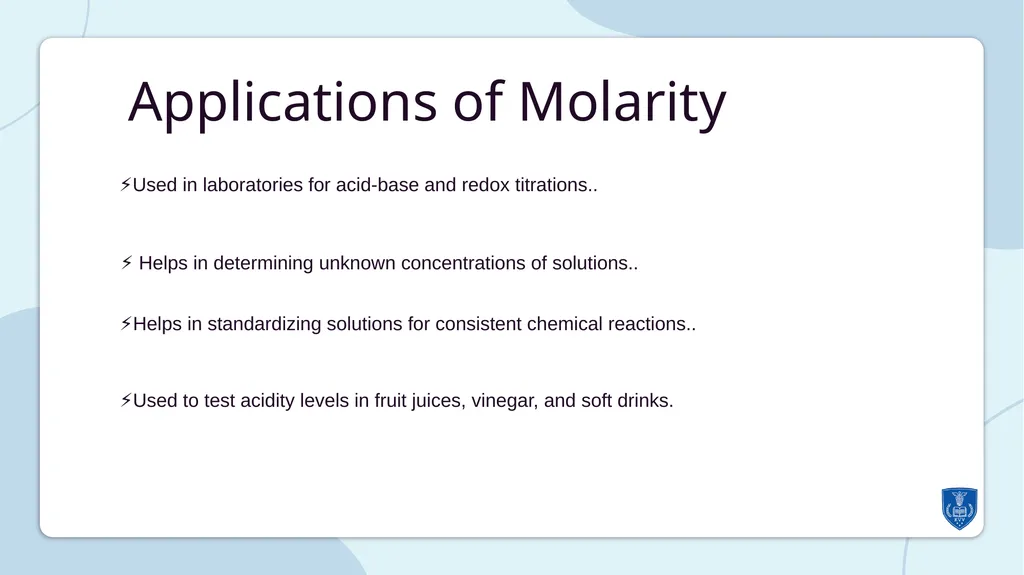
Applications of Molarity ⚡Used in laboratories for acid-base and redox titrations.. ⚡Helps in standardizing solutions for consistent chemical reactions.. ⚡Used to test acidity levels in fruit juices, vinegar, and soft drinks. ⚡ Helps in determining unknown concentrations of solutions..<br>
12
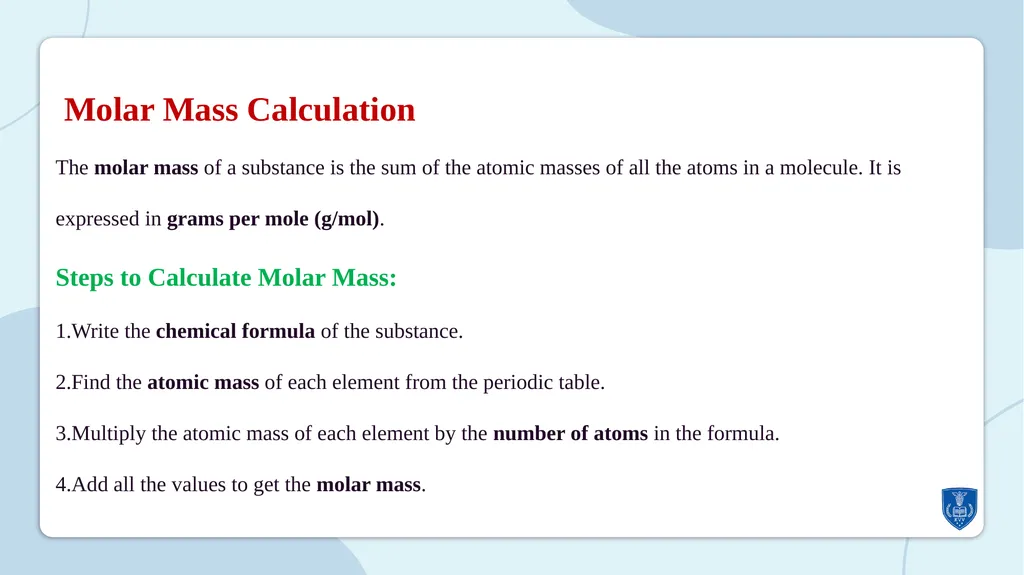
Molar Mass Calculation
The molar mass of a substance is the sum of the atomic masses of all the atoms in a molecule. It is expressed in grams per mole (g/mol).
Steps to Calculate Molar Mass:
Write the chemical formula of the substance.
Find the atomic mass of each element from the periodic table.
Multiply the atomic mass of each element by the number of atoms in the formula.
Add all the values to get the molar mass.<br>
13
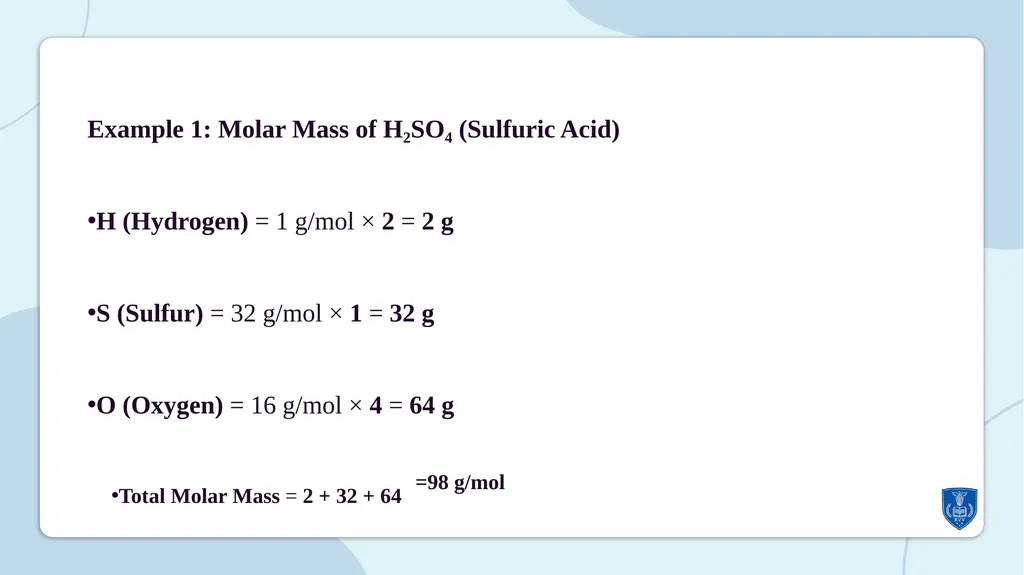
Example 1: Molar Mass of H₂SO₄ (Sulfuric Acid)
H (Hydrogen) = 1 g/mol × 2 = 2 g
S (Sulfur) = 32 g/mol × 1 = 32 g
O (Oxygen) = 16 g/mol × 4 = 64 g Total Molar Mass = 2 + 32 + 64 =98 g/mol<br>
14
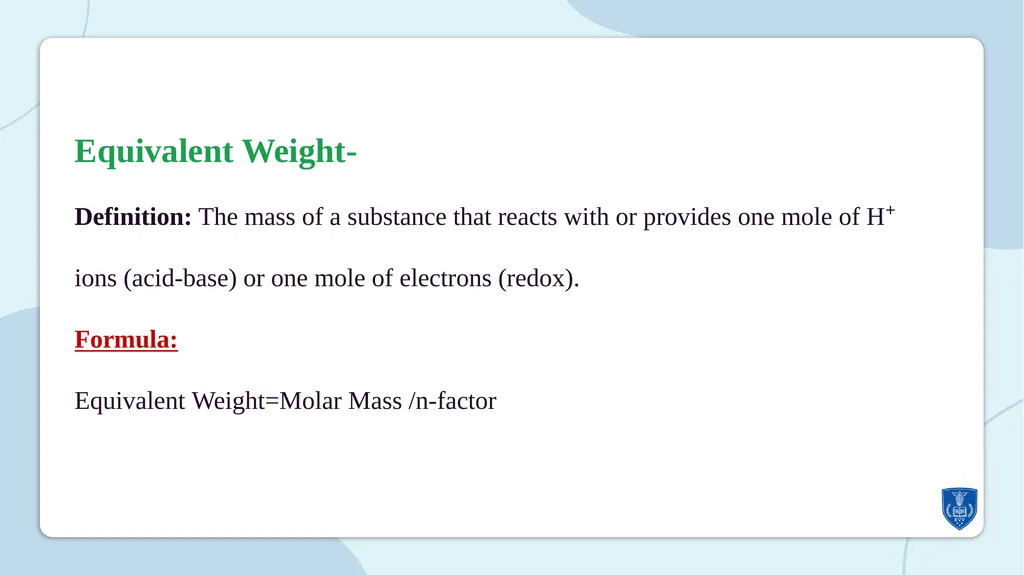
Equivalent Weight-
Definition: The mass of a substance that reacts with or provides one mole of H⁺ ions (acid-base) or one mole of electrons (redox).
Formula:
Equivalent Weight=Molar Mass /n-factor<br>
15
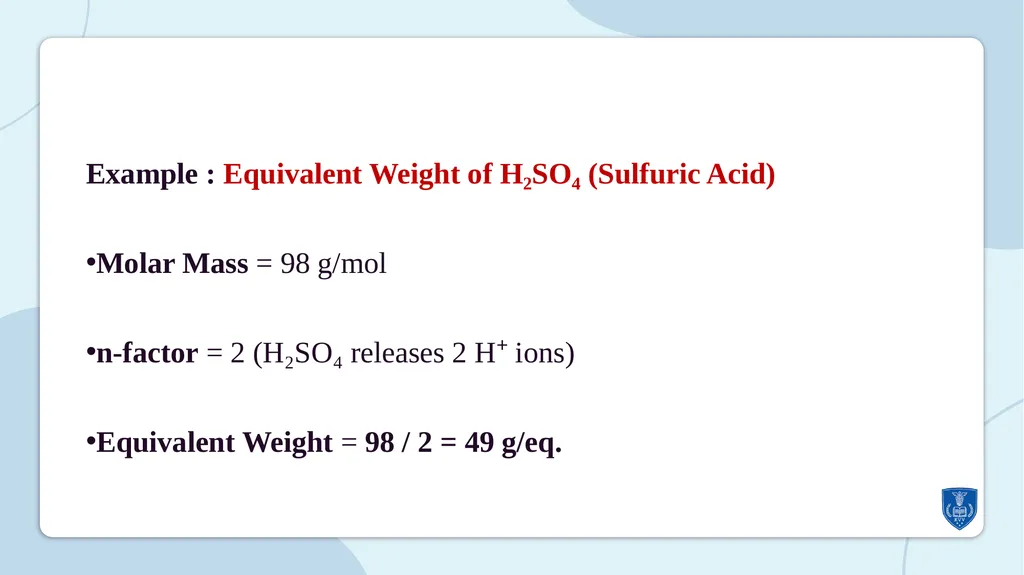
Example : Equivalent Weight of H₂SO₄ (Sulfuric Acid)
Molar Mass = 98 g/mol
n-factor = 2 (H₂SO₄ releases 2 H⁺ ions)
Equivalent Weight = 98 / 2 = 49 g/eq.<br>