
Understanding the FRC’s Audit Regulations 2020:
DP
Published · 41 slides · 0 views

1 / 1












Description
Understanding the FRCs Audit Regulations 2020: Presented by Ambassador Shuaibu Adamu Ahmed Executive SecretaryCEO: Financial Reporting Council of Nigeria Agile Auditing: The Future of Internal Audit Outline Learning Outcomes Introduction
Related Topics
Share
Embed code
Download this presentation From Below
"Understanding the FRC’s Audit Regulations 2020:" is the property of its rightful owner. Permission is granted to download and print the materials on this website for personal, non-commercial use only, and to display it on your personal computer provided you do not modify the materials and that you retain all copyright notices contained in the materials. By downloading content from our website, you accept the terms of this agreement.
Presentation Transcript
01
Understanding the FRC’s Audit Regulations 2020: Presented by
Ambassador Shuaibu Adamu Ahmed
Executive Secretary/CEO: Financial Reporting Council of Nigeria Agile Auditing: The Future of Internal Audit<br>
Executive Secretary/CEO: Financial Reporting Council of Nigeria Agile Auditing: The Future of Internal Audit<br>
02
Outline Learning Outcomes
Introduction
Functions and Powers of FRC
Overview of the Audit Regulations 2020
Internal Audit function
Prospect and Challenges
Conclusion<br>
Introduction
Functions and Powers of FRC
Overview of the Audit Regulations 2020
Internal Audit function
Prospect and Challenges
Conclusion<br>
03
Learning Outcomes At the end of the session, participants should be able to:
Understand the legal framework that empowers the Council to issue and enforce audit regulations.
Have an overview of the Provisions of the Audit Regulations 2020.
Understand the Internal Audit Function under the Audit Regulations 2020.
Understand Challenges and Prospect associated with Audit Regulations.<br>
Understand the legal framework that empowers the Council to issue and enforce audit regulations.
Have an overview of the Provisions of the Audit Regulations 2020.
Understand the Internal Audit Function under the Audit Regulations 2020.
Understand Challenges and Prospect associated with Audit Regulations.<br>
04
Introduction “The financial reporting supply chain refers to the people and processes involved in the preparation, approval, audit, analysis and use of financial reports. All the links in the chain need to be of high quality and closely connected to supply high quality financial reporting”
IFAC 2009 4<br>
IFAC 2009 4<br>
05
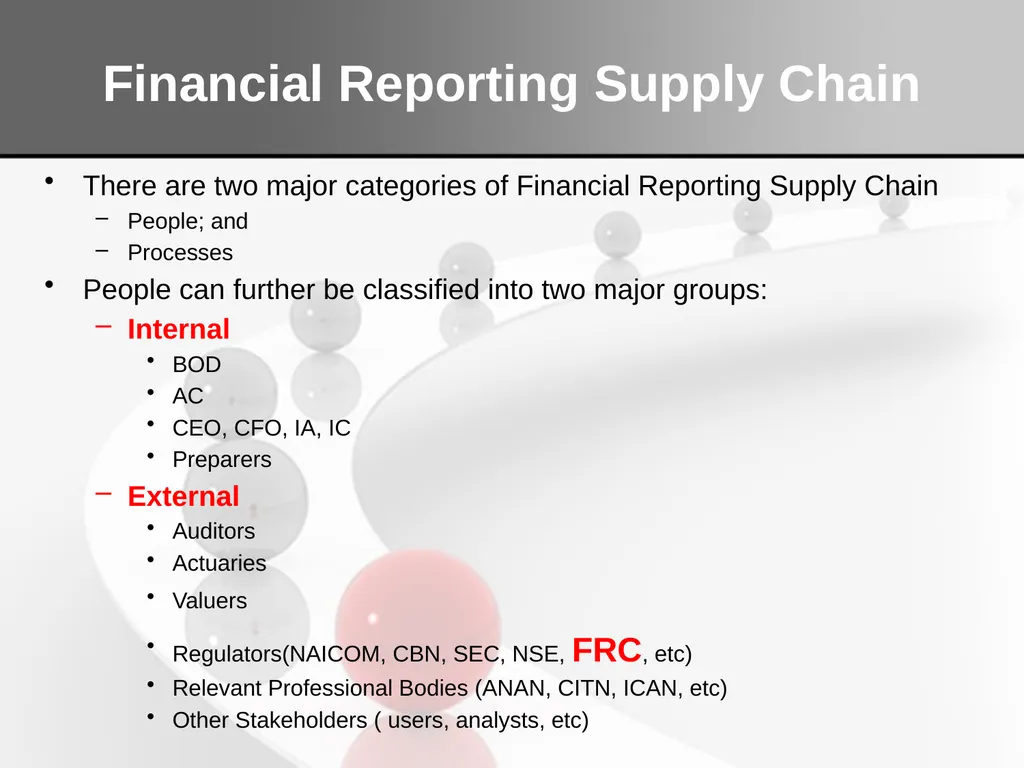
Financial Reporting Supply Chain There are two major categories of Financial Reporting Supply Chain
People; and
Processes
People can further be classified into two major groups:
Internal
BOD
AC
CEO, CFO, IA, IC
Preparers
External
Auditors
Actuaries
Valuers
Regulators(NAICOM, CBN, SEC, NSE, FRC, etc)
Relevant Professional Bodies (ANAN, CITN, ICAN, etc)
Other Stakeholders ( users, analysts, etc)<br>
People; and
Processes
People can further be classified into two major groups:
Internal
BOD
AC
CEO, CFO, IA, IC
Preparers
External
Auditors
Actuaries
Valuers
Regulators(NAICOM, CBN, SEC, NSE, FRC, etc)
Relevant Professional Bodies (ANAN, CITN, ICAN, etc)
Other Stakeholders ( users, analysts, etc)<br>
06
Introduction Our focus on audit quality is at the heart of the audit regulation.
The Council’s goal is to improve the quality of statutory audits in Nigeria by establishing and enforcing applicable rules and regulations that will:
1. Improve the independence of statutory audit firms and
auditors from the entity being audited;
2. Enhance the informational value to investors of audit
reporting;
3. Enhance the quality of audit work.
4. Promote a more dynamic and competitive audit market in
Nigeria; 6<br>
The Council’s goal is to improve the quality of statutory audits in Nigeria by establishing and enforcing applicable rules and regulations that will:
1. Improve the independence of statutory audit firms and
auditors from the entity being audited;
2. Enhance the informational value to investors of audit
reporting;
3. Enhance the quality of audit work.
4. Promote a more dynamic and competitive audit market in
Nigeria; 6<br>
07
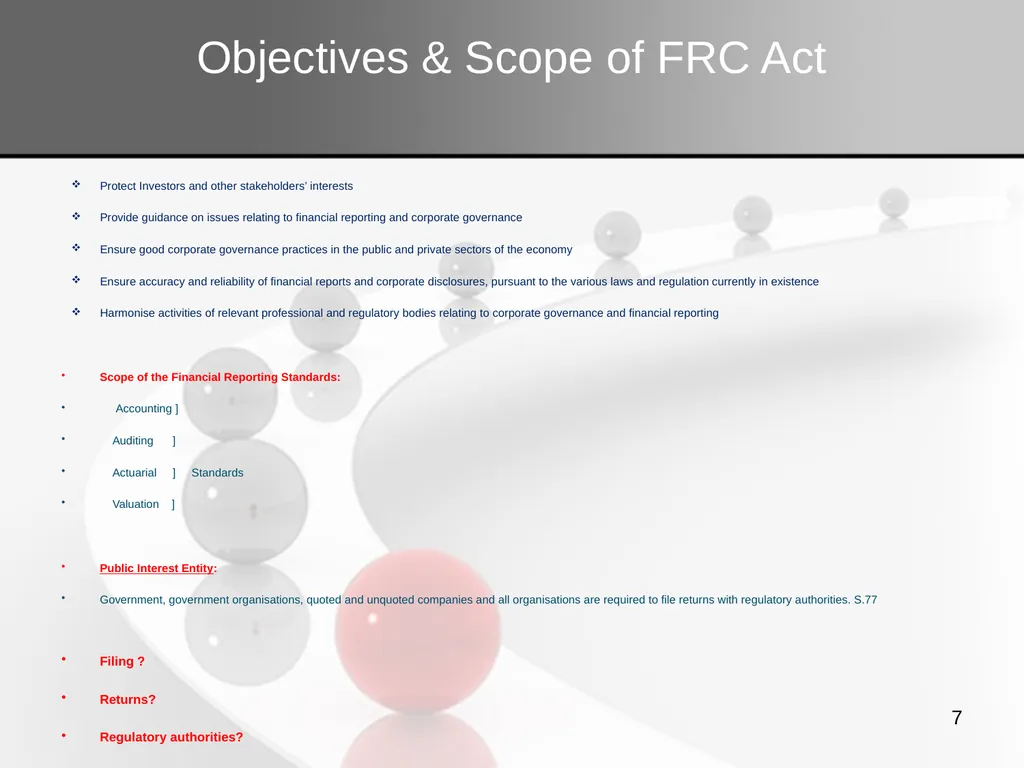
Objectives & Scope of FRC Act Protect Investors and other stakeholders’ interests
Provide guidance on issues relating to financial reporting and corporate governance
Ensure good corporate governance practices in the public and private sectors of the economy
Ensure accuracy and reliability of financial reports and corporate disclosures, pursuant to the various laws and regulation currently in existence
Harmonise activities of relevant professional and regulatory bodies relating to corporate governance and financial reporting
Scope of the Financial Reporting Standards:
Accounting ]
Auditing ]
Actuarial ] Standards
Valuation ]
Public Interest Entity:
Government, government organisations, quoted and unquoted companies and all organisations are required to file returns with regulatory authorities. S.77
Filing ?
Returns?
Regulatory authorities? 7<br>
Provide guidance on issues relating to financial reporting and corporate governance
Ensure good corporate governance practices in the public and private sectors of the economy
Ensure accuracy and reliability of financial reports and corporate disclosures, pursuant to the various laws and regulation currently in existence
Harmonise activities of relevant professional and regulatory bodies relating to corporate governance and financial reporting
Scope of the Financial Reporting Standards:
Accounting ]
Auditing ]
Actuarial ] Standards
Valuation ]
Public Interest Entity:
Government, government organisations, quoted and unquoted companies and all organisations are required to file returns with regulatory authorities. S.77
Filing ?
Returns?
Regulatory authorities? 7<br>
08
Functions and Powers of FRC The Financial Reporting Council is established to operate through Directorates;
Private Sector Accounting
Public Sector Accounting
Auditing Practice Standards
Actuarial Standards
Valuation Standards
Inspection/monitoring ; and
Corporate Governance. 8<br>
Private Sector Accounting
Public Sector Accounting
Auditing Practice Standards
Actuarial Standards
Valuation Standards
Inspection/monitoring ; and
Corporate Governance. 8<br>
09
Functions of the Council S8.1(f ) maintain a register of professional accountants and other professionals engaged in the financial reporting process;
S8.1(g) monitor compliance with the reporting requirements specified in the adopted code of corporate governance;
S8.1(h) promote compliance with the adopted standards issued by the International Federation of Accountants and International Accounting Standards Board;
S8.1(j) conduct practice reviews of registered professionals;<br>
S8.1(g) monitor compliance with the reporting requirements specified in the adopted code of corporate governance;
S8.1(h) promote compliance with the adopted standards issued by the International Federation of Accountants and International Accounting Standards Board;
S8.1(j) conduct practice reviews of registered professionals;<br>
10
Functions and Powers of FRC FRC Oversight Powers
By its establishment, the FRC has oversight powers covering:
Ethics:- Develop or liaise with relevant professional bodies on auditing and ethical standards set by it [26a]
Corporate Governance:-Issue code of corporate governance and guidelines, and develop a mechanism for periodic assessment of the codes and guidelines
Accounting Standards:- Adopt and keep up to date accounting and financial reporting standards, and ensure consistency between standards issued and the International Financial Reporting Standards
Auditing Standards:- Develop or adopt and keep up to date auditing standards issued by relevant professional bodies and ensure consistency between the standards issued and auditing standards and pronouncements of the IAASB [8:1(q)] 10<br>
By its establishment, the FRC has oversight powers covering:
Ethics:- Develop or liaise with relevant professional bodies on auditing and ethical standards set by it [26a]
Corporate Governance:-Issue code of corporate governance and guidelines, and develop a mechanism for periodic assessment of the codes and guidelines
Accounting Standards:- Adopt and keep up to date accounting and financial reporting standards, and ensure consistency between standards issued and the International Financial Reporting Standards
Auditing Standards:- Develop or adopt and keep up to date auditing standards issued by relevant professional bodies and ensure consistency between the standards issued and auditing standards and pronouncements of the IAASB [8:1(q)] 10<br>
11
Functions and Powers of FRC FRC’s Oversight Powers
Practice Review and Quality Assurance; - Conduct annual practice review of registered professionals that audits more than 20 public interest entities. Others every three years [61.1]
Audit Reports - Required an auditor to express a clear written opinion in his report, giving details on whether [44(1a&b)]:
The financial statement as a whole give a true and fair view of the state of affairs of the entity to which they relate; and
The financial statements comply with the provisions of this Act; or any other relevant enactments
Other Professionals;- S.41(2) “A person shall not hold any appointment or offer any service for remuneration as a professional for public interest entities, unless he is registered under this Act”<br>
Practice Review and Quality Assurance; - Conduct annual practice review of registered professionals that audits more than 20 public interest entities. Others every three years [61.1]
Audit Reports - Required an auditor to express a clear written opinion in his report, giving details on whether [44(1a&b)]:
The financial statement as a whole give a true and fair view of the state of affairs of the entity to which they relate; and
The financial statements comply with the provisions of this Act; or any other relevant enactments
Other Professionals;- S.41(2) “A person shall not hold any appointment or offer any service for remuneration as a professional for public interest entities, unless he is registered under this Act”<br>
12
Functions and Powers of FRC FRC’s Oversight Powers – All Accounting/Financial Reporting Issues
The accounts, financial reports or annual returns and other documents required under the following Acts, or amendments thereafter, shall be adopted for that purpose by the Council -
Banks and other Financial Institutions (Amendment) Act CAP. B3 LFN, 2004
Companies and Allied Matters Act Cap. C20 LFN, 2004
Investments and Securities Act Cap. I24 LFN, 2004
Nigerian Investment Promotion Commission Act Cap. N117, 2004
Insurance Act Cap. 117 LFN, 2004
Pension Reform Act No. 2, 2004
Federal Mortgage Bank of Nigeria Act, Cap. F16 LFN, 2004
Where there is any conflict between the financial reports or annual returns and other documents required or prepared in fulfillment of the relevant Sections of the Acts listed above and other Acts which deal with financial reporting, the standards and guidelines adopted for that purpose by the Council shall to the extent of the inconsistency, prevail. Section 59 refers. 12<br>
The accounts, financial reports or annual returns and other documents required under the following Acts, or amendments thereafter, shall be adopted for that purpose by the Council -
Banks and other Financial Institutions (Amendment) Act CAP. B3 LFN, 2004
Companies and Allied Matters Act Cap. C20 LFN, 2004
Investments and Securities Act Cap. I24 LFN, 2004
Nigerian Investment Promotion Commission Act Cap. N117, 2004
Insurance Act Cap. 117 LFN, 2004
Pension Reform Act No. 2, 2004
Federal Mortgage Bank of Nigeria Act, Cap. F16 LFN, 2004
Where there is any conflict between the financial reports or annual returns and other documents required or prepared in fulfillment of the relevant Sections of the Acts listed above and other Acts which deal with financial reporting, the standards and guidelines adopted for that purpose by the Council shall to the extent of the inconsistency, prevail. Section 59 refers. 12<br>
13
Overview
of Audit Regulations 2020<br>
of Audit Regulations 2020<br>
14
Agenda Current Status
Steps Taken
ARWG: Modus Operandi
Journey so far
Overview of the audit regulations 2020
Internal Audit Function
Conclusion Overview of Audit Regulations 2020<br>
Steps Taken
ARWG: Modus Operandi
Journey so far
Overview of the audit regulations 2020
Internal Audit Function
Conclusion Overview of Audit Regulations 2020<br>
15
CURRENT STATUS OF AUDIT REGULATION IN NIGERIA Up until January 2021 No Regulation in Nigeria
BIG Audit firms are not regulated in Nigeria
Smaller firms are regulated by Professional Accounting Organisations (PAOs).
Professionals regulations by PAOs is weak and ineffective; sanctions are almost nil and criminal acts hardly reported nor prosecuted.
Professional misconducts are difficult to sanction
Quality of Audit becomes eroded
Lack of confidence on the works of auditors Overview of Audit Regulations 2020<br>
BIG Audit firms are not regulated in Nigeria
Smaller firms are regulated by Professional Accounting Organisations (PAOs).
Professionals regulations by PAOs is weak and ineffective; sanctions are almost nil and criminal acts hardly reported nor prosecuted.
Professional misconducts are difficult to sanction
Quality of Audit becomes eroded
Lack of confidence on the works of auditors Overview of Audit Regulations 2020<br>
16
Implications of Lack of Audit Regulations Makes it difficult to sanction unwholesome/unprofessional conducts.
Makes adoption of audit and ethical standards meaningless.
Entry and Exit cannot be monitored.
Subsector uncontrollably dominated by bigger firms
Quality of Audit practice and good governance become issues
Many professional auditors practice and failed to register with FRC as the law demands
The lack of audit practice regulations make it difficult to bring the FRC Act into full effect. Overview of Audit Regulations 2020<br>
Makes adoption of audit and ethical standards meaningless.
Entry and Exit cannot be monitored.
Subsector uncontrollably dominated by bigger firms
Quality of Audit practice and good governance become issues
Many professional auditors practice and failed to register with FRC as the law demands
The lack of audit practice regulations make it difficult to bring the FRC Act into full effect. Overview of Audit Regulations 2020<br>
17
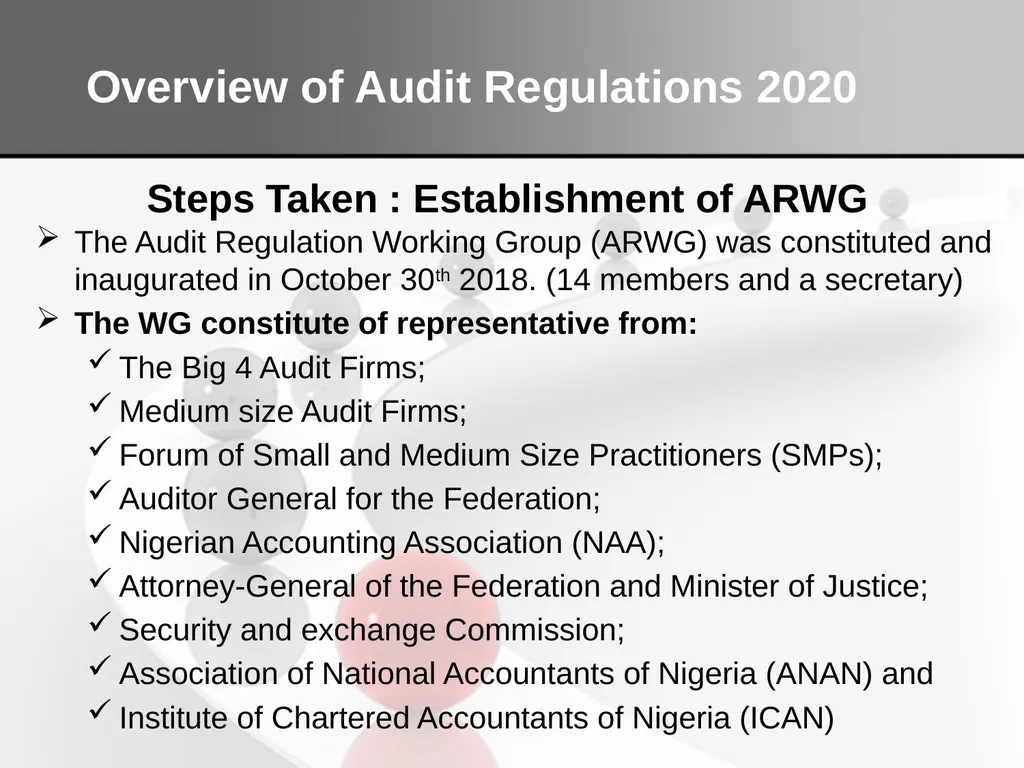
Steps Taken : Establishment of ARWG The Audit Regulation Working Group (ARWG) was constituted and inaugurated in October 30th 2018. (14 members and a secretary)
The WG constitute of representative from:
The Big 4 Audit Firms;
Medium size Audit Firms;
Forum of Small and Medium Size Practitioners (SMPs);
Auditor General for the Federation;
Nigerian Accounting Association (NAA);
Attorney-General of the Federation and Minister of Justice;
Security and exchange Commission;
Association of National Accountants of Nigeria (ANAN) and
Institute of Chartered Accountants of Nigeria (ICAN) Overview of Audit Regulations 2020<br>
The WG constitute of representative from:
The Big 4 Audit Firms;
Medium size Audit Firms;
Forum of Small and Medium Size Practitioners (SMPs);
Auditor General for the Federation;
Nigerian Accounting Association (NAA);
Attorney-General of the Federation and Minister of Justice;
Security and exchange Commission;
Association of National Accountants of Nigeria (ANAN) and
Institute of Chartered Accountants of Nigeria (ICAN) Overview of Audit Regulations 2020<br>
18
ARWG: Mandate/Terms of Reference To provide Technical Assistance to the Council in its development of rules and regulations for statutory audits in Nigeria (Audit Regulation);
Develop requirements for (i) registration, (ii) withdrawal of registration and (iii) maintenance of up-to-date register of auditors;
Develop requirements for regulation of other accountants and professionals providing assurance services in the financial reporting and auditing process;
Develop guidelines for the practice reviews and inspections provided for in Sections 60 and 61 of the FRC Act 2011 and for monitoring generally, compliance with the Audit Regulations, including any required arrangements for delegation of such supervisory tasks to Recognised Supervisory Bodies; and;
Develop requirements for the conduct of the different types and aspects of audit and assurance engagements. Overview of Audit Regulations 2020<br>
Develop requirements for (i) registration, (ii) withdrawal of registration and (iii) maintenance of up-to-date register of auditors;
Develop requirements for regulation of other accountants and professionals providing assurance services in the financial reporting and auditing process;
Develop guidelines for the practice reviews and inspections provided for in Sections 60 and 61 of the FRC Act 2011 and for monitoring generally, compliance with the Audit Regulations, including any required arrangements for delegation of such supervisory tasks to Recognised Supervisory Bodies; and;
Develop requirements for the conduct of the different types and aspects of audit and assurance engagements. Overview of Audit Regulations 2020<br>
19
The Journey so far: Rule Making Process The Audit Regulation Working Group (ARWG) was inaugurated on October 30, 2018 and met severally and presented a Draft Exposure Draft
The Technical and Oversight Committee of the Board (TOC) met severally on the documents and approved the Exposure Draft(ED)
The Audit Regulations ED exposed for 2months
Several engagements with relevant stakeholders including meeting the Audit Firms
ARWG met and considered the inputs including comments received before the expiration of the Exposure period
The Technical and Oversight Committee of the Board met and considered the final document
The Governing Board of FRC considered the document as recommended by TOC and approved it.
The Board approved document was transmitted to the Honourable Minister, FMITI
Final Approval by the Honourable Minister of Industry, Trade and Investments on January 25, 2021. 19 Overview of Audit Regulations 2020<br>
The Technical and Oversight Committee of the Board (TOC) met severally on the documents and approved the Exposure Draft(ED)
The Audit Regulations ED exposed for 2months
Several engagements with relevant stakeholders including meeting the Audit Firms
ARWG met and considered the inputs including comments received before the expiration of the Exposure period
The Technical and Oversight Committee of the Board met and considered the final document
The Governing Board of FRC considered the document as recommended by TOC and approved it.
The Board approved document was transmitted to the Honourable Minister, FMITI
Final Approval by the Honourable Minister of Industry, Trade and Investments on January 25, 2021. 19 Overview of Audit Regulations 2020<br>
20
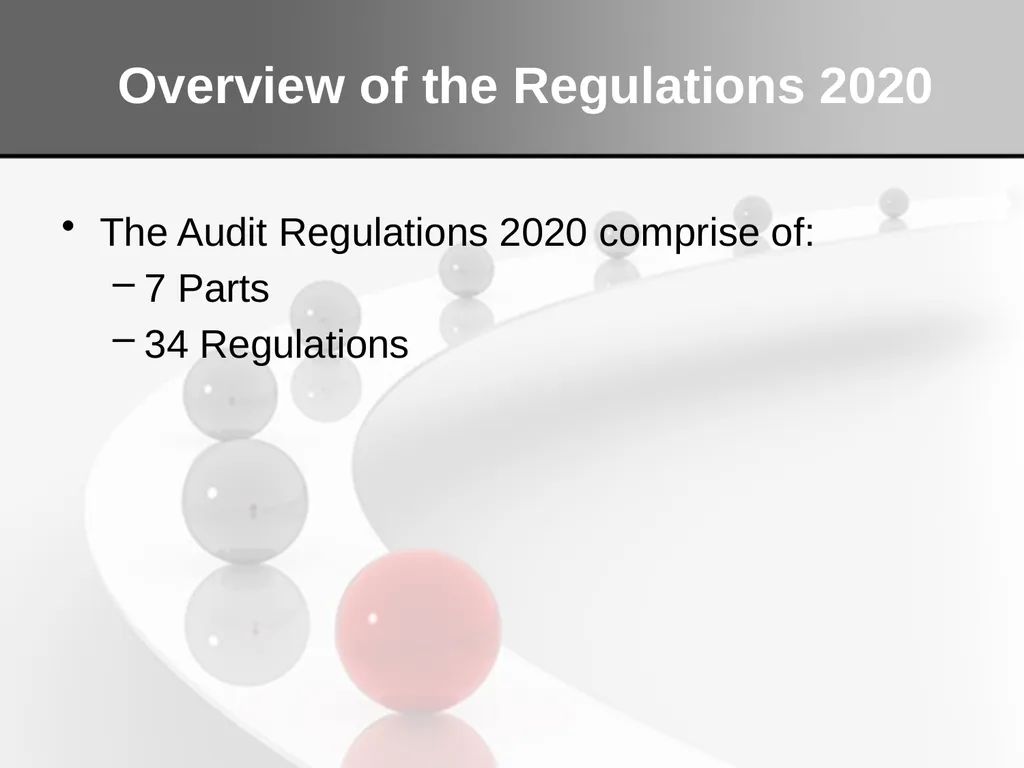
Overview of the Regulations 2020 The Audit Regulations 2020 comprise of:
7 Parts
34 Regulations<br>
7 Parts
34 Regulations<br>
21
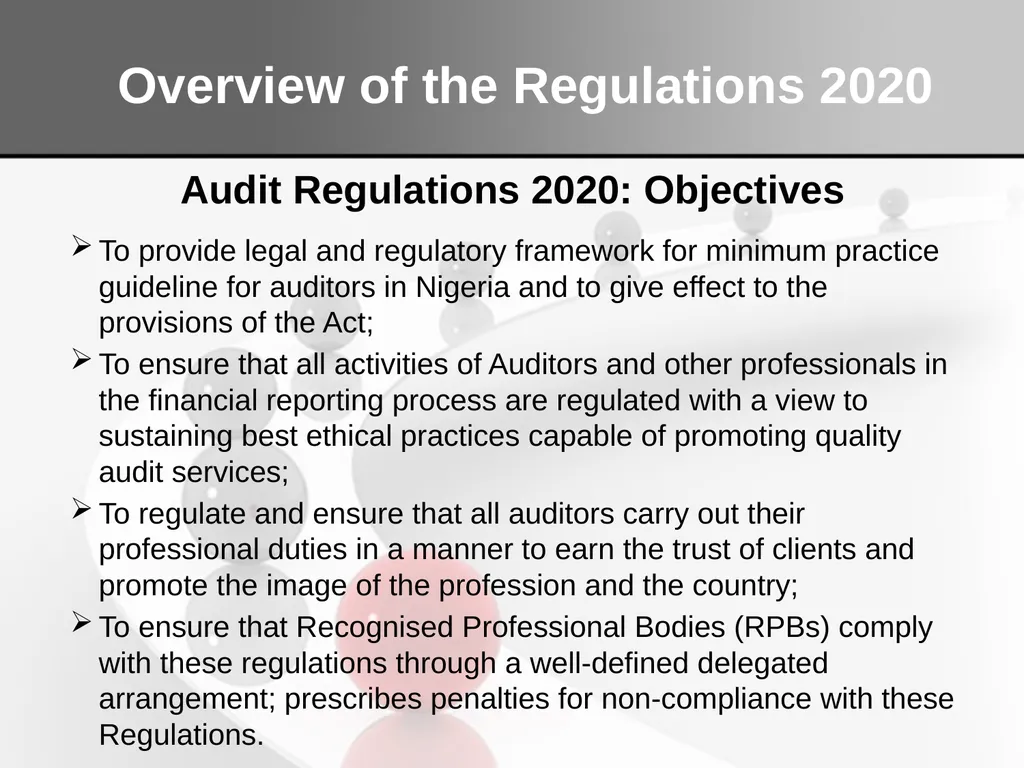
Audit Regulations 2020: Objectives To provide legal and regulatory framework for minimum practice guideline for auditors in Nigeria and to give effect to the provisions of the Act;
To ensure that all activities of Auditors and other professionals in the financial reporting process are regulated with a view to sustaining best ethical practices capable of promoting quality audit services;
To regulate and ensure that all auditors carry out their professional duties in a manner to earn the trust of clients and promote the image of the profession and the country;
To ensure that Recognised Professional Bodies (RPBs) comply with these regulations through a well-defined delegated arrangement; prescribes penalties for non-compliance with these Regulations. Overview of the Regulations 2020<br>
To ensure that all activities of Auditors and other professionals in the financial reporting process are regulated with a view to sustaining best ethical practices capable of promoting quality audit services;
To regulate and ensure that all auditors carry out their professional duties in a manner to earn the trust of clients and promote the image of the profession and the country;
To ensure that Recognised Professional Bodies (RPBs) comply with these regulations through a well-defined delegated arrangement; prescribes penalties for non-compliance with these Regulations. Overview of the Regulations 2020<br>
22
Overview of Audit Regulations 2020: PART 1 - Application and Scope
Applicable in the Federal Republic of Nigeria;
To regulate all statutory Auditors, other assurance providers and audit committees.
These Regulations shall not apply to the offices of the Auditors-General except appointed external auditors of public sector entities.<br>
Applicable in the Federal Republic of Nigeria;
To regulate all statutory Auditors, other assurance providers and audit committees.
These Regulations shall not apply to the offices of the Auditors-General except appointed external auditors of public sector entities.<br>
23
Overview of Audit Regulations 2020 Other Assurance Service Providers” means independent professionals (other than external auditors) who provide independent and professional opinions or reports that reduce information risk and improve the quality or context of information for decision-makers.
Other Assurance services providers are classified into Internal and external assurance services providers.
Internal assurance service providers include Audit Committees, Internal Auditors and Internal Control Professionals.
External Assurance Services include all professionals engaged by management in the financial reporting process. Such professionals include actuaries, property valuers, valuation specialists, tax consultants, information technology specialists, legal counsel, corporate governance specialist, and so on.<br>
Other Assurance services providers are classified into Internal and external assurance services providers.
Internal assurance service providers include Audit Committees, Internal Auditors and Internal Control Professionals.
External Assurance Services include all professionals engaged by management in the financial reporting process. Such professionals include actuaries, property valuers, valuation specialists, tax consultants, information technology specialists, legal counsel, corporate governance specialist, and so on.<br>
24
Overview of Audit Regulations 2020 PART II – REGISTRATION REQUIREMENTS
Registration
Requirements for Registration
Deregistration
PART III – AUDIT EXECUTION
Auditing Standards
Prohibited Non-Audit Services
Responsibilities of Auditors
Mandatory Audit Firm Rotation for Auditors of PIEs
Organisation of Audit Work
Audit Reporting
Statutory Audits of Consolidated Financial Statements
Document Retention<br>
Registration
Requirements for Registration
Deregistration
PART III – AUDIT EXECUTION
Auditing Standards
Prohibited Non-Audit Services
Responsibilities of Auditors
Mandatory Audit Firm Rotation for Auditors of PIEs
Organisation of Audit Work
Audit Reporting
Statutory Audits of Consolidated Financial Statements
Document Retention<br>
25
Overview of Audit Regulations 2020 PART IV – ENFORCEMENT AND COMPLIANCE
Monitoring of Auditors
Enforcement of Regulations
Procedure for Regulatory Sanction and Appeal
Administrative Sanctions
Publication of Sanctions and Measures
Enforcement of Sanctions
Recovery of Financial Penalties
PART V – QUALITY ASSURANCE
Quality Assurance (in line ISQC1 now ISQM)
Internal Organisation of Auditors
Quality Assurance Systems for Auditors.
Delegation Arrangements for Supervisory Tasks<br>
Monitoring of Auditors
Enforcement of Regulations
Procedure for Regulatory Sanction and Appeal
Administrative Sanctions
Publication of Sanctions and Measures
Enforcement of Sanctions
Recovery of Financial Penalties
PART V – QUALITY ASSURANCE
Quality Assurance (in line ISQC1 now ISQM)
Internal Organisation of Auditors
Quality Assurance Systems for Auditors.
Delegation Arrangements for Supervisory Tasks<br>
26
Overview of Audit Regulations 2020 PART VI – AUDIT COMMITTEE & INTERNAL AUDIT FUNCTION
Audit Committee
Qualification of Audit Committee Members
Appointment and Composition of Audit Committee
Duties and Responsibilities of Audit Committee
Sanctions for Audit Committee Members
Internal Audit Function
PART VII – MISCELLANEOUS PROVISIONS
Power to Make Guidelines
Transitional Provisions and Support Structure
Transitional Arrangements for Mandatory Audit Firm Rotation for PIEs
Interpretation
Citation<br>
Audit Committee
Qualification of Audit Committee Members
Appointment and Composition of Audit Committee
Duties and Responsibilities of Audit Committee
Sanctions for Audit Committee Members
Internal Audit Function
PART VII – MISCELLANEOUS PROVISIONS
Power to Make Guidelines
Transitional Provisions and Support Structure
Transitional Arrangements for Mandatory Audit Firm Rotation for PIEs
Interpretation
Citation<br>
27
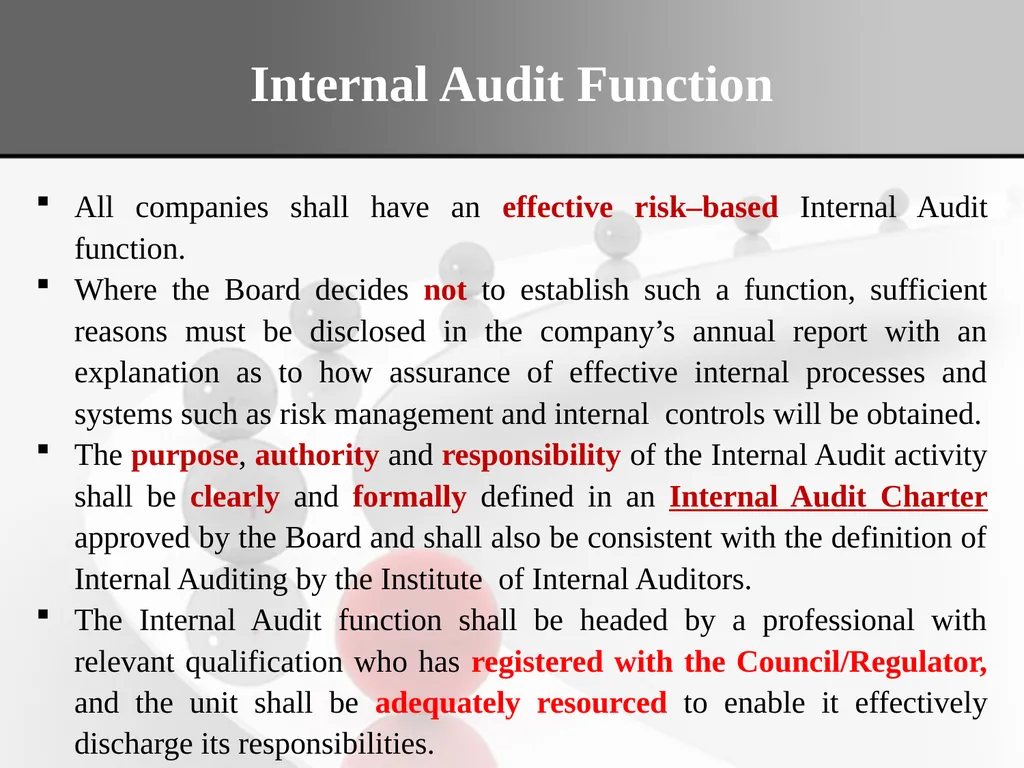
Internal Audit Function All companies shall have an effective risk–based Internal Audit function.
Where the Board decides not to establish such a function, sufficient reasons must be disclosed in the company’s annual report with an explanation as to how assurance of effective internal processes and systems such as risk management and internal controls will be obtained.
The purpose, authority and responsibility of the Internal Audit activity shall be clearly and formally defined in an Internal Audit Charter approved by the Board and shall also be consistent with the definition of Internal Auditing by the Institute of Internal Auditors.
The Internal Audit function shall be headed by a professional with relevant qualification who has registered with the Council/Regulator, and the unit shall be adequately resourced to enable it effectively discharge its responsibilities.<br>
Where the Board decides not to establish such a function, sufficient reasons must be disclosed in the company’s annual report with an explanation as to how assurance of effective internal processes and systems such as risk management and internal controls will be obtained.
The purpose, authority and responsibility of the Internal Audit activity shall be clearly and formally defined in an Internal Audit Charter approved by the Board and shall also be consistent with the definition of Internal Auditing by the Institute of Internal Auditors.
The Internal Audit function shall be headed by a professional with relevant qualification who has registered with the Council/Regulator, and the unit shall be adequately resourced to enable it effectively discharge its responsibilities.<br>
28
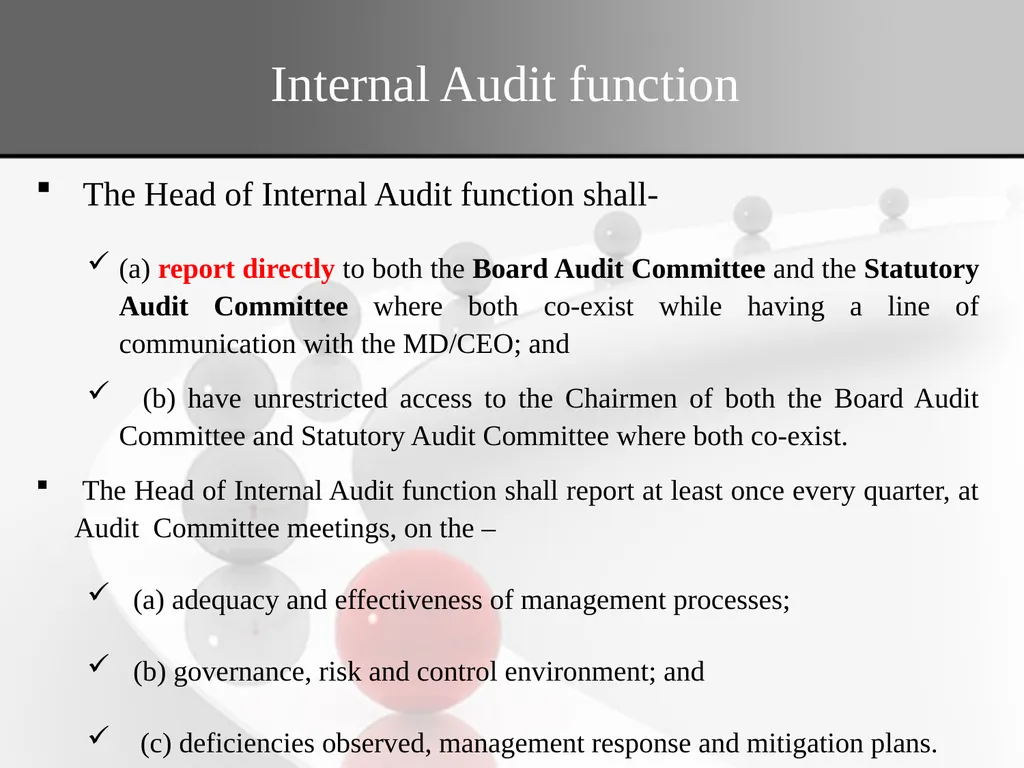
Internal Audit function The Head of Internal Audit function shall-
(a) report directly to both the Board Audit Committee and the Statutory Audit Committee where both co-exist while having a line of communication with the MD/CEO; and
(b) have unrestricted access to the Chairmen of both the Board Audit Committee and Statutory Audit Committee where both co-exist.
The Head of Internal Audit function shall report at least once every quarter, at Audit Committee meetings, on the –
(a) adequacy and effectiveness of management processes;
(b) governance, risk and control environment; and
(c) deficiencies observed, management response and mitigation plans.<br>
(a) report directly to both the Board Audit Committee and the Statutory Audit Committee where both co-exist while having a line of communication with the MD/CEO; and
(b) have unrestricted access to the Chairmen of both the Board Audit Committee and Statutory Audit Committee where both co-exist.
The Head of Internal Audit function shall report at least once every quarter, at Audit Committee meetings, on the –
(a) adequacy and effectiveness of management processes;
(b) governance, risk and control environment; and
(c) deficiencies observed, management response and mitigation plans.<br>
29
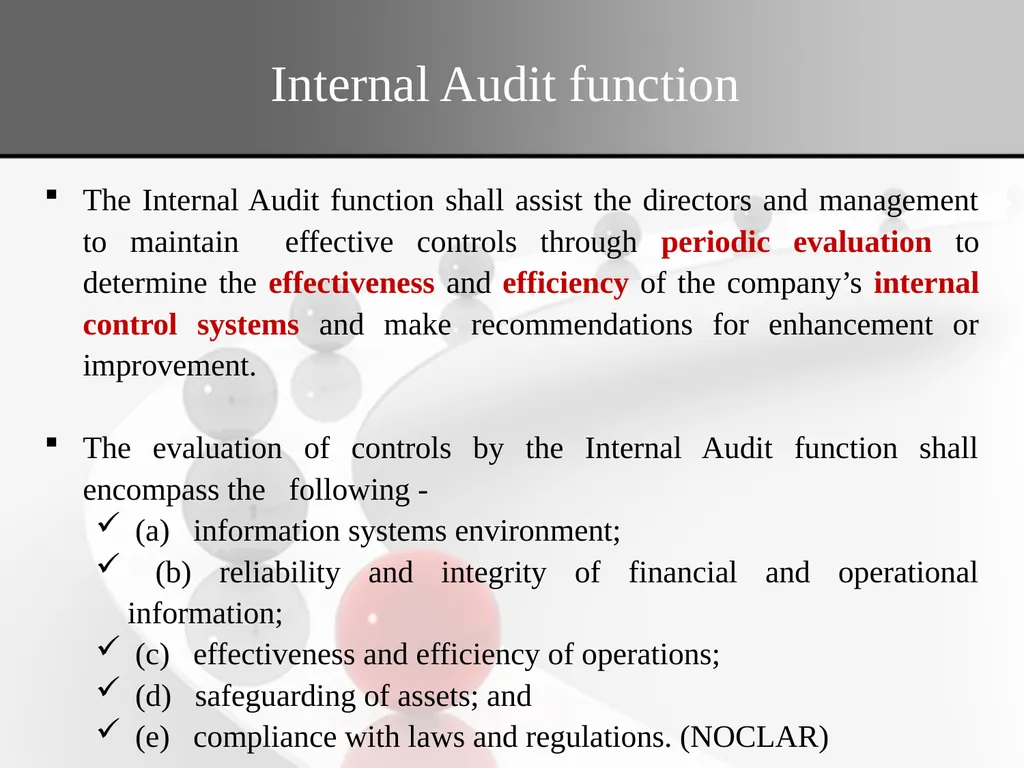
Internal Audit function The Internal Audit function shall assist the directors and management to maintain effective controls through periodic evaluation to determine the effectiveness and efficiency of the company’s internal control systems and make recommendations for enhancement or improvement.
The evaluation of controls by the Internal Audit function shall encompass the following -
(a) information systems environment;
(b) reliability and integrity of financial and operational information;
(c) effectiveness and efficiency of operations;
(d) safeguarding of assets; and
(e) compliance with laws and regulations. (NOCLAR)<br>
The evaluation of controls by the Internal Audit function shall encompass the following -
(a) information systems environment;
(b) reliability and integrity of financial and operational information;
(c) effectiveness and efficiency of operations;
(d) safeguarding of assets; and
(e) compliance with laws and regulations. (NOCLAR)<br>
30
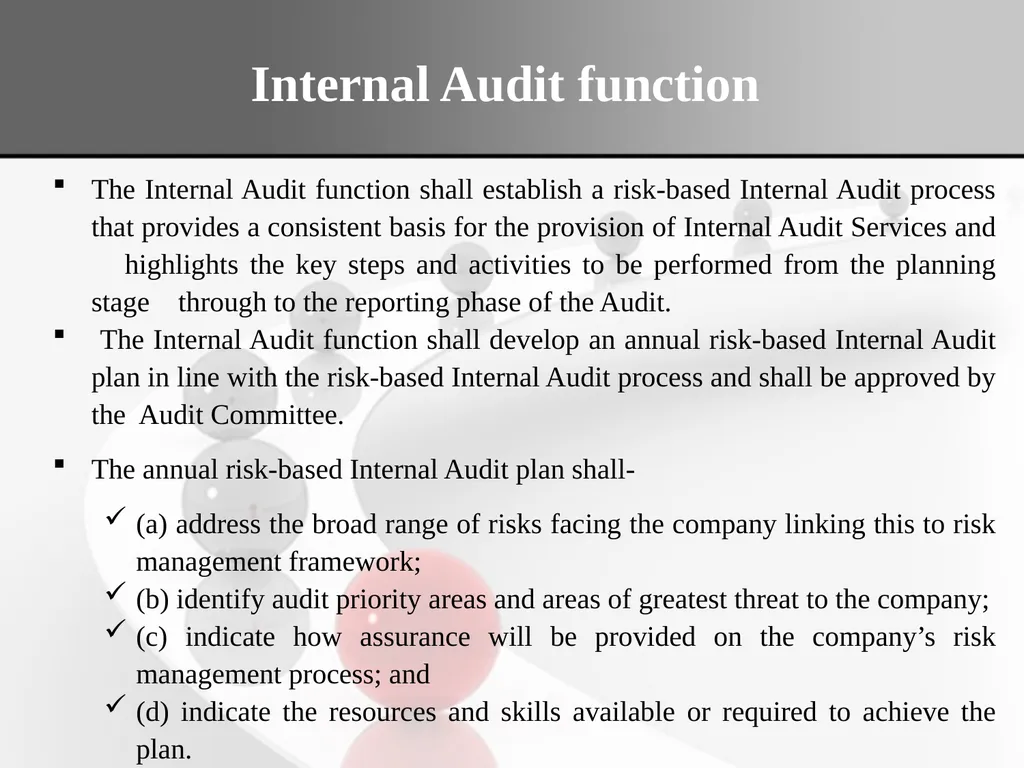
Internal Audit function The Internal Audit function shall establish a risk-based Internal Audit process that provides a consistent basis for the provision of Internal Audit Services and highlights the key steps and activities to be performed from the planning stage through to the reporting phase of the Audit.
The Internal Audit function shall develop an annual risk-based Internal Audit plan in line with the risk-based Internal Audit process and shall be approved by the Audit Committee.
The annual risk-based Internal Audit plan shall-
(a) address the broad range of risks facing the company linking this to risk management framework;
(b) identify audit priority areas and areas of greatest threat to the company;
(c) indicate how assurance will be provided on the company’s risk management process; and
(d) indicate the resources and skills available or required to achieve the plan.<br>
The Internal Audit function shall develop an annual risk-based Internal Audit plan in line with the risk-based Internal Audit process and shall be approved by the Audit Committee.
The annual risk-based Internal Audit plan shall-
(a) address the broad range of risks facing the company linking this to risk management framework;
(b) identify audit priority areas and areas of greatest threat to the company;
(c) indicate how assurance will be provided on the company’s risk management process; and
(d) indicate the resources and skills available or required to achieve the plan.<br>
31
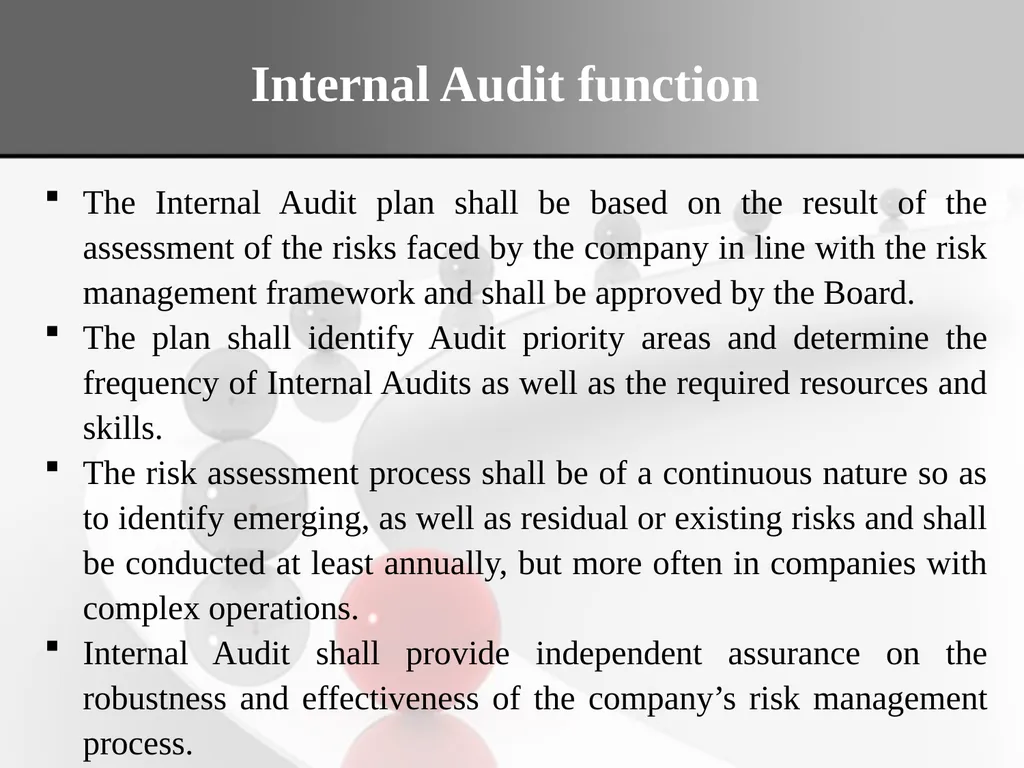
Internal Audit function The Internal Audit plan shall be based on the result of the assessment of the risks faced by the company in line with the risk management framework and shall be approved by the Board.
The plan shall identify Audit priority areas and determine the frequency of Internal Audits as well as the required resources and skills.
The risk assessment process shall be of a continuous nature so as to identify emerging, as well as residual or existing risks and shall be conducted at least annually, but more often in companies with complex operations.
Internal Audit shall provide independent assurance on the robustness and effectiveness of the company’s risk management process.<br>
The plan shall identify Audit priority areas and determine the frequency of Internal Audits as well as the required resources and skills.
The risk assessment process shall be of a continuous nature so as to identify emerging, as well as residual or existing risks and shall be conducted at least annually, but more often in companies with complex operations.
Internal Audit shall provide independent assurance on the robustness and effectiveness of the company’s risk management process.<br>
32
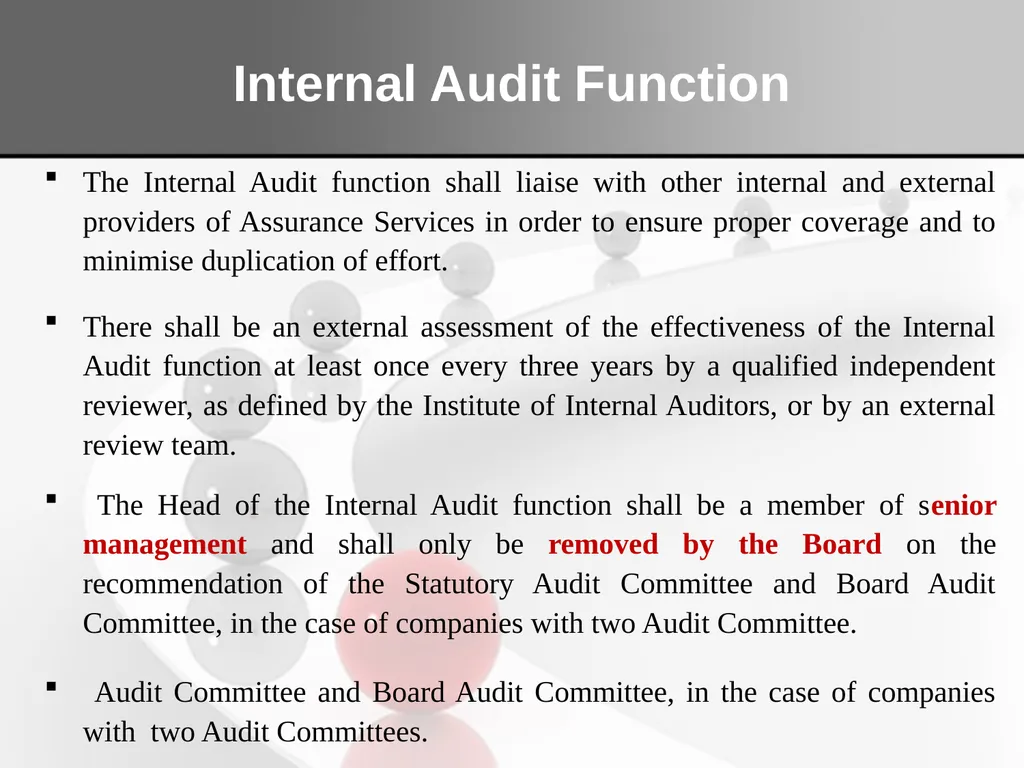
Internal Audit Function The Internal Audit function shall liaise with other internal and external providers of Assurance Services in order to ensure proper coverage and to minimise duplication of effort.
There shall be an external assessment of the effectiveness of the Internal Audit function at least once every three years by a qualified independent reviewer, as defined by the Institute of Internal Auditors, or by an external review team.
The Head of the Internal Audit function shall be a member of senior management and shall only be removed by the Board on the recommendation of the Statutory Audit Committee and Board Audit Committee, in the case of companies with two Audit Committee.
Audit Committee and Board Audit Committee, in the case of companies with two Audit Committees.<br>
There shall be an external assessment of the effectiveness of the Internal Audit function at least once every three years by a qualified independent reviewer, as defined by the Institute of Internal Auditors, or by an external review team.
The Head of the Internal Audit function shall be a member of senior management and shall only be removed by the Board on the recommendation of the Statutory Audit Committee and Board Audit Committee, in the case of companies with two Audit Committee.
Audit Committee and Board Audit Committee, in the case of companies with two Audit Committees.<br>
33
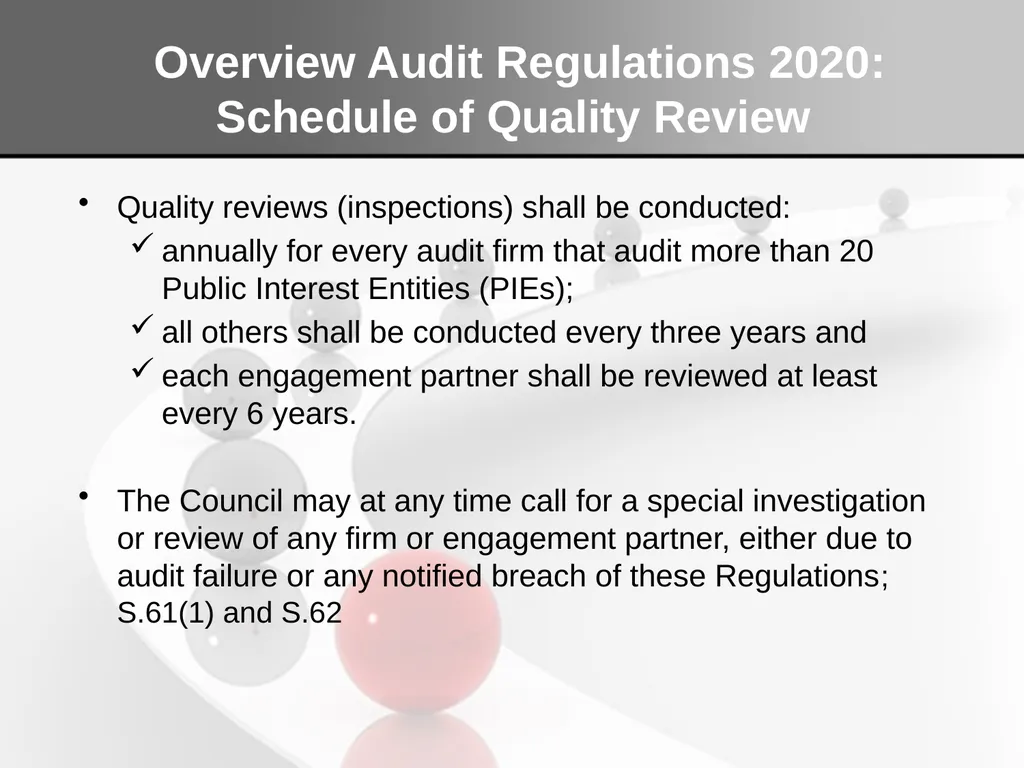
Overview Audit Regulations 2020: Schedule of Quality Review Quality reviews (inspections) shall be conducted:
annually for every audit firm that audit more than 20 Public Interest Entities (PIEs);
all others shall be conducted every three years and
each engagement partner shall be reviewed at least every 6 years.
The Council may at any time call for a special investigation or review of any firm or engagement partner, either due to audit failure or any notified breach of these Regulations; S.61(1) and S.62<br>
annually for every audit firm that audit more than 20 Public Interest Entities (PIEs);
all others shall be conducted every three years and
each engagement partner shall be reviewed at least every 6 years.
The Council may at any time call for a special investigation or review of any firm or engagement partner, either due to audit failure or any notified breach of these Regulations; S.61(1) and S.62<br>
34
Overview Audit Regulations:
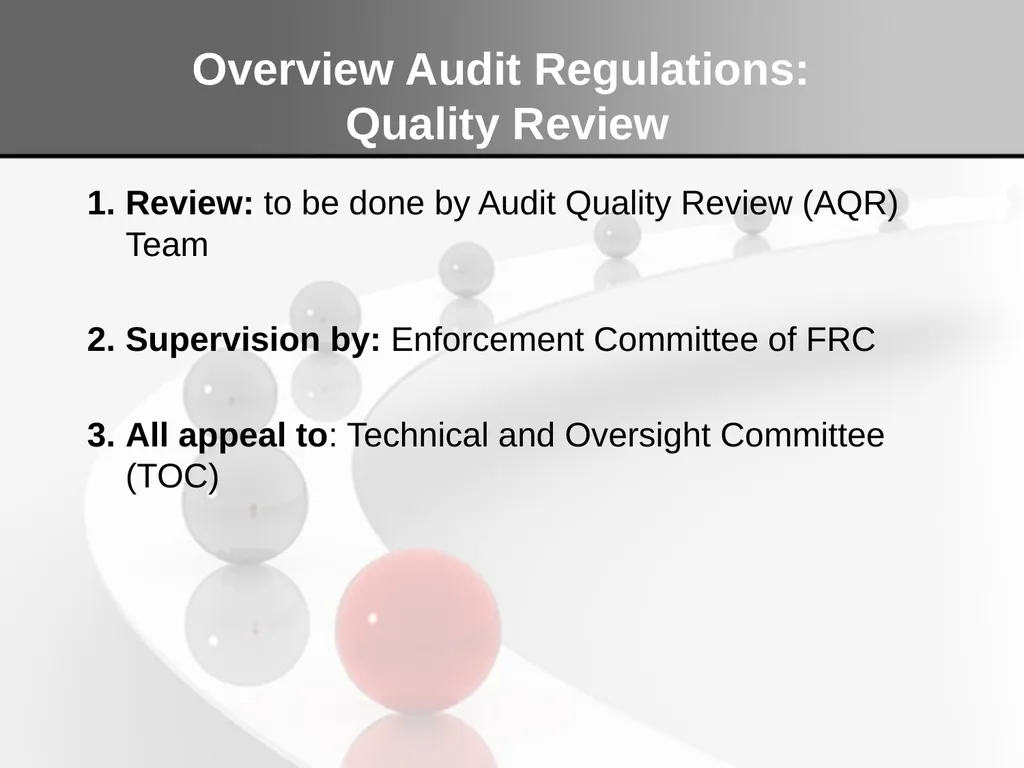
Quality Review Review: to be done by Audit Quality Review (AQR) Team
Supervision by: Enforcement Committee of FRC
All appeal to: Technical and Oversight Committee (TOC)<br>
Supervision by: Enforcement Committee of FRC
All appeal to: Technical and Oversight Committee (TOC)<br>
35
Overview of Audit Regulations: Possible Sanctions Restrictions and /or Conditions
Regulatory Penalty
Suspension of Registration
Withdrawal of Registration<br>
Regulatory Penalty
Suspension of Registration
Withdrawal of Registration<br>
36
Challenges and Prospect of Audit Regulations 2020 Having examined some of the provisions of the FRC Act and Audit Regulations 2020, it is apparent that the Regulations comes with some Challenges and Prospects. 36<br>
37
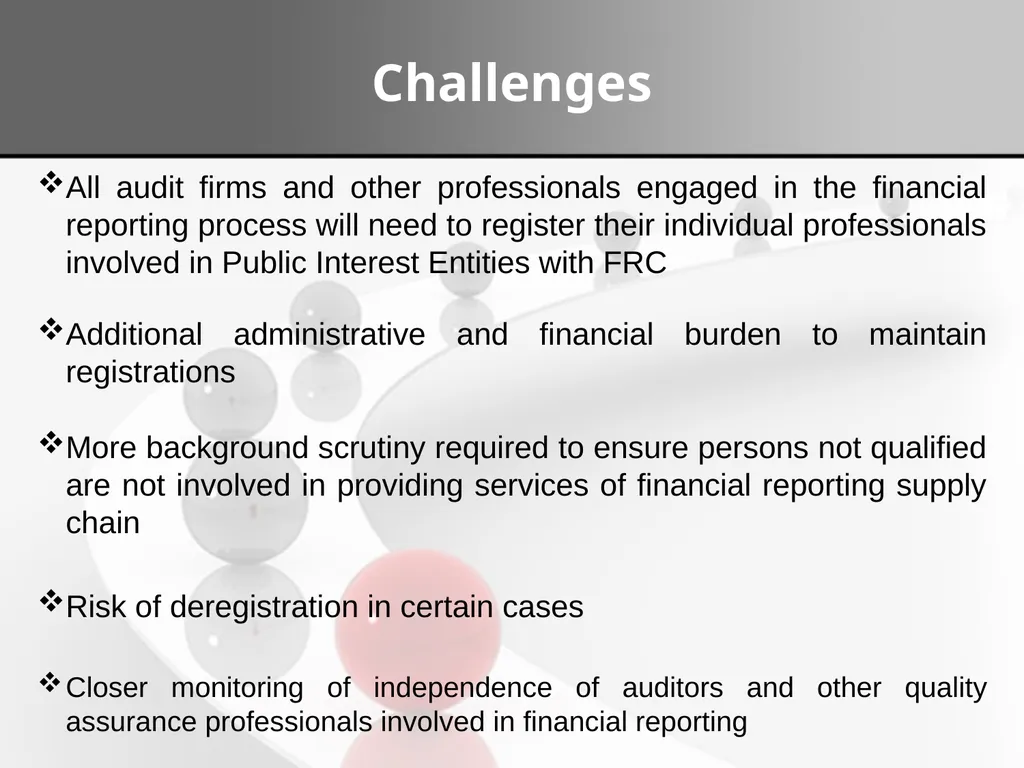
Challenges All audit firms and other professionals engaged in the financial reporting process will need to register their individual professionals involved in Public Interest Entities with FRC
Additional administrative and financial burden to maintain registrations
More background scrutiny required to ensure persons not qualified are not involved in providing services of financial reporting supply chain
Risk of deregistration in certain cases
Closer monitoring of independence of auditors and other quality assurance professionals involved in financial reporting<br>
Additional administrative and financial burden to maintain registrations
More background scrutiny required to ensure persons not qualified are not involved in providing services of financial reporting supply chain
Risk of deregistration in certain cases
Closer monitoring of independence of auditors and other quality assurance professionals involved in financial reporting<br>
38
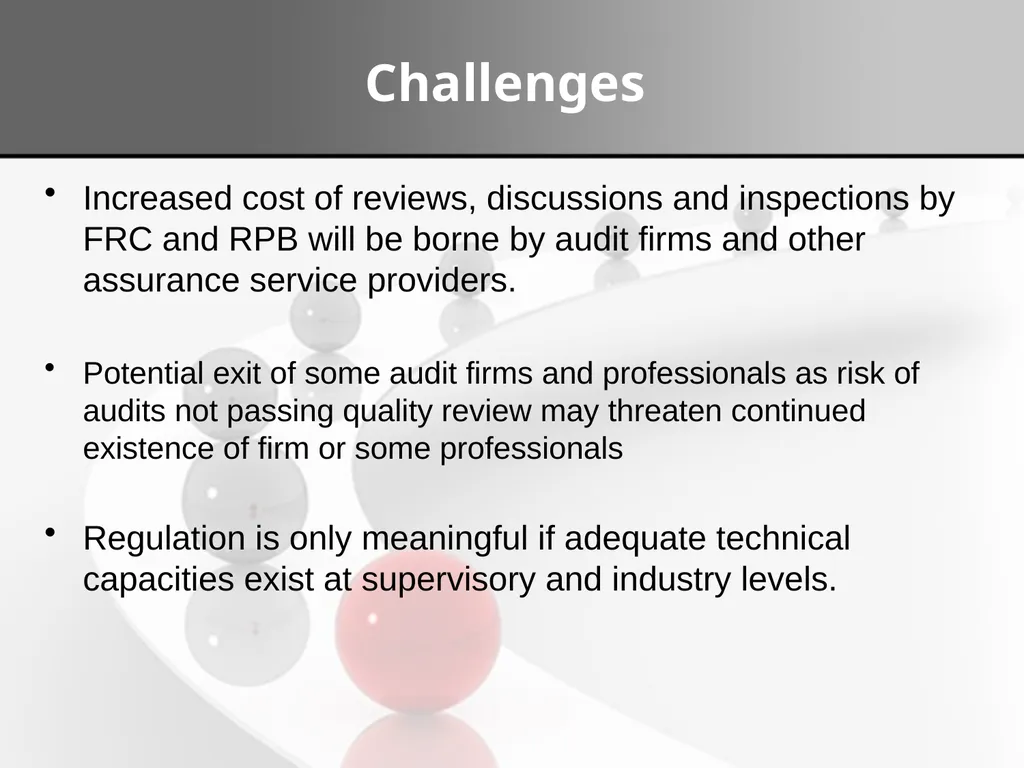
Challenges Increased cost of reviews, discussions and inspections by FRC and RPB will be borne by audit firms and other assurance service providers.
Potential exit of some audit firms and professionals as risk of audits not passing quality review may threaten continued existence of firm or some professionals
Regulation is only meaningful if adequate technical capacities exist at supervisory and industry levels.<br>
Potential exit of some audit firms and professionals as risk of audits not passing quality review may threaten continued existence of firm or some professionals
Regulation is only meaningful if adequate technical capacities exist at supervisory and industry levels.<br>
39
Prospects Overall development and improvement in the quality of audit practices in Nigeria and financial reporting
Overall development in the regulation of all professional service providers involved in financial reporting.
Reduction of risk of high incidence of audit failure will accrue from practice review.
All the parties in the financial reporting supply chain to embark on significant investment in training and capacity building.<br>
Overall development in the regulation of all professional service providers involved in financial reporting.
Reduction of risk of high incidence of audit failure will accrue from practice review.
All the parties in the financial reporting supply chain to embark on significant investment in training and capacity building.<br>
40
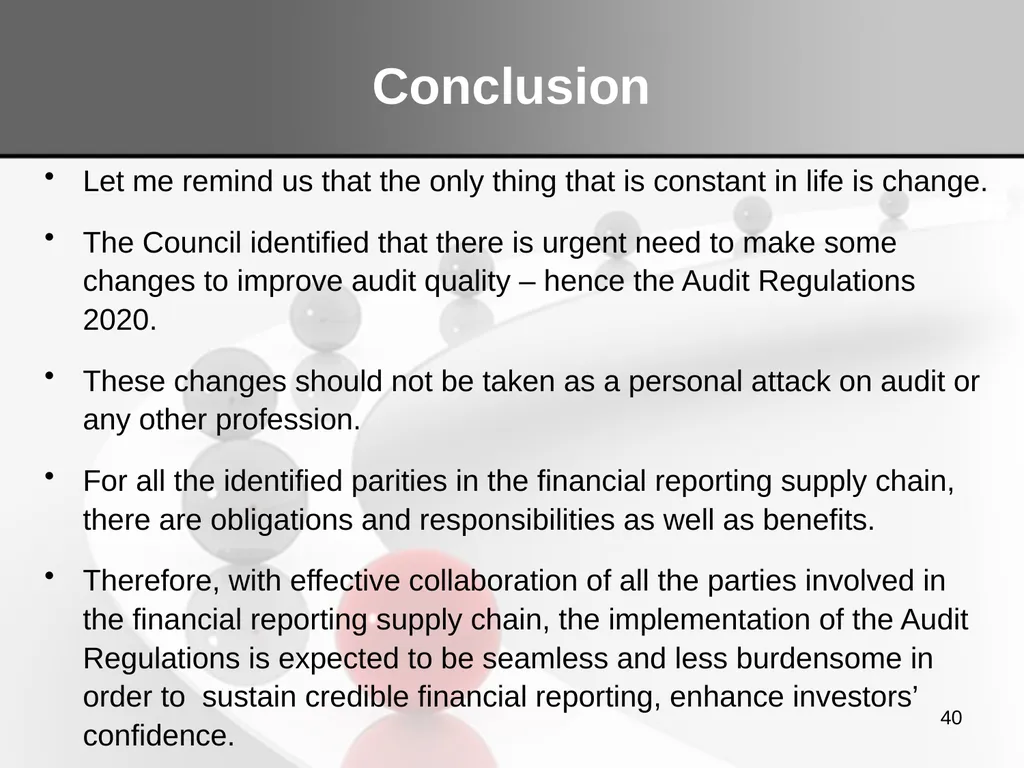
Conclusion Let me remind us that the only thing that is constant in life is change.
The Council identified that there is urgent need to make some changes to improve audit quality – hence the Audit Regulations 2020.
These changes should not be taken as a personal attack on audit or any other profession.
For all the identified parities in the financial reporting supply chain, there are obligations and responsibilities as well as benefits.
Therefore, with effective collaboration of all the parties involved in the financial reporting supply chain, the implementation of the Audit Regulations is expected to be seamless and less burdensome in order to sustain credible financial reporting, enhance investors’ confidence. 40<br>
The Council identified that there is urgent need to make some changes to improve audit quality – hence the Audit Regulations 2020.
These changes should not be taken as a personal attack on audit or any other profession.
For all the identified parities in the financial reporting supply chain, there are obligations and responsibilities as well as benefits.
Therefore, with effective collaboration of all the parties involved in the financial reporting supply chain, the implementation of the Audit Regulations is expected to be seamless and less burdensome in order to sustain credible financial reporting, enhance investors’ confidence. 40<br>
41
41 Thanks for your rapt attention<br>