Unified Modeling Language 9152019 B.Ramamurthy 1 The Unified Modeling Language (UML) was developed jointly by Grady Booch, Ivar Jacobson, and Jim Rumbaugh with contributions from other leading methodologists, software vendors, and many
"Unified Modeling Language 9/15/2019 B.Ramamurthy 1" is the property of its rightful owner. Permission is granted to
download and print the materials on this website for personal, non-commercial use only, and to display it
on your personal computer provided you do not modify the materials and that you retain all copyright
notices contained in the materials. By downloading content from our website, you accept the terms of this
agreement.
Presentation Transcript
01
Unified Modeling Language 9/15/2019 B.Ramamurthy 1 The Unified Modeling Language™ (UML) was developed jointly by Grady Booch, Ivar Jacobson, and Jim Rumbaugh with contributions from other leading methodologists, software vendors, and many users. The UML provides the application modeling language for:
Process modeling/ Requirement Analysis with Use-cases.
Static Design with Class and object modeling.
Dynamic Design with sequence, collaboration and activity diagrams.
Realtime Systems design models
Distribution and deployment modeling.
See
http://www.omg.org/uml<br>
02
Phases of System Development Requirement Analysis
The functionality users require from the system
Use-case model
OO Analysis
Discovering classes and relationships
Class diagram
OO Design
Result of Analysis expanded into technical solution
Sequence diagram, state diagram, etc.
Results in detailed specs for the coding phase
Implementation (Programming/coding)
Models are converted into code
Testing
Unit tests, integration tests, system tests and acceptance tests. 9/15/2019 B.Ramamurthy 2<br>
03
Use-Case Modeling In use-case modeling, the system is looked upon as a black box whose boundaries are defined by its functionality to external stimuli.
The actual description of the use-case is usually given in plain text. A popular notation promoted by UML is the stick figure notation.
We will look into the details of text representation later. Both visual and text representation are needed for a complete view.
A use-case model represents the use-case view of the system. A use-case view of a system may consist of many Use-case diagrams.
An use-case diagram shows (the system), the actors, the use-cases and the relationship among them. 9/15/2019 B.Ramamurthy 3<br>
04
Components of Use-case Model The components of a Use-case model are:
System Modeled
Actors
Use-cases
Stimulus 9/15/2019 B.Ramamurthy 4 System Name name Use-case<br>
05
System As a part of the use-case modeling, the boundaries of the system are developed.
System in the use-case diagram is a box with the name appearing on the top.
Define the scope of the system that you are going to design. For example, in the drone project, you are not learning to drive but programming the drone to do something. 9/15/2019 B.Ramamurthy 5 Drone API programming<br>
06
Actors An actor is something or someone that interacts with the system.
Actor communicates with the system by sending and receiving messages.
An actor provides the stimulus to activate an Use-case.
Message sent by an actor may result in more messages to actors and to Use-cases.
Actors can be ranked: primary and secondary; passive and active.
Actor is a role not an individual instance. 9/15/2019 B.Ramamurthy 6<br>
07
Finding Actors The actors of a system can be identified by answering a number of questions:
Who will use the functionality of the system?
Who will maintain the system?
What devices does the system need to handle?
What other system does this system need to interact?
Who or what has interest in the results of this system? 9/15/2019 B.Ramamurthy 7<br>
08
Use-cases A Use-case in UML is defined as a set of sequences of actions a system performs that yield an observable result of value to a particular actor.
Actions can involve communicating with number of actors as well as performing calculations and work inside the system.
A Use-case
is always initiated by an actor.
provides a value to an actor.
must always be connected to at least one actor.
must be a complete description. 9/15/2019 B.Ramamurthy 8<br>
09
Finding Use-cases For each actor ask these questions:
Which functions does the actor require from the system?
What does the actor need to do?
Could the actor’s work be simplified or made efficient by new functions in the system?
What events are needed in the system?
What are the problems with the existing systems?
What are the inputs and outputs of the system? 9/15/2019 B.Ramamurthy 9<br>
10
Describing Use-cases Use-case Name:
Use-case Number: system#.diagram#.Use-case#
Authors:
Event(Stimulus):
Actors:
Overview: brief statement
Related Use-cases:
Typical Process description: Algorithm
Exceptions and how to handle exceptions: 9/15/2019 B.Ramamurthy 10<br>
11
Example Number: A.132.4
Name: Buy book online
Author: B.Ramamurthy
Event: Customer request one or more books
System: Amazon.com
Overview: Captures the process of purchasing one or more books and the transactions associated with it.
Related Use-case: A.132.5, A.132.8
Typical Process Description with exceptions handled.
NOTE : All these can be in a tabular form, say, in an Excel worksheet for example. 9/15/2019 B.Ramamurthy 11<br>
12
Realizing Use-cases Validation is done up front. As soon as the model is ready it has to be presented and discussed with the customers.
Use-cases are implementation independent descriptions of the functionality of the system.
Use-case can be realized in the next stages of software development using, say, a class diagram. 9/15/2019 B.Ramamurthy 12<br>
13
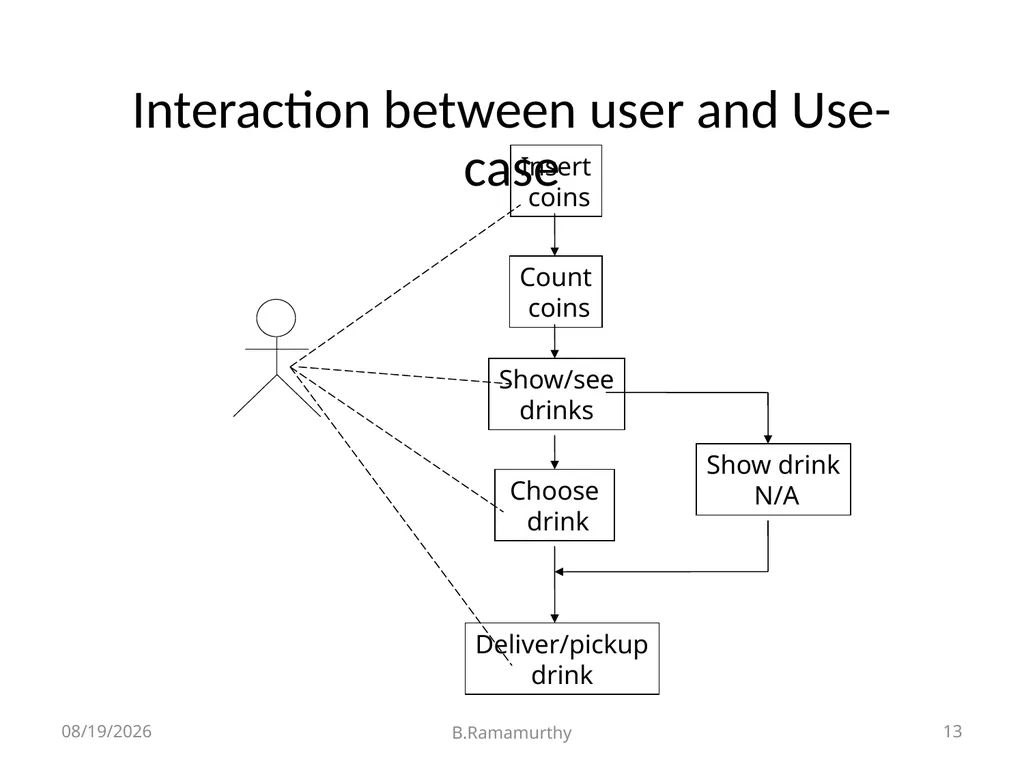
Interaction between user and Use-case 9/15/2019 B.Ramamurthy 13 Count
coins Show/see
drinks Choose
drink Show drink
N/A Deliver/pickup
drink Insert
coins<br>
14
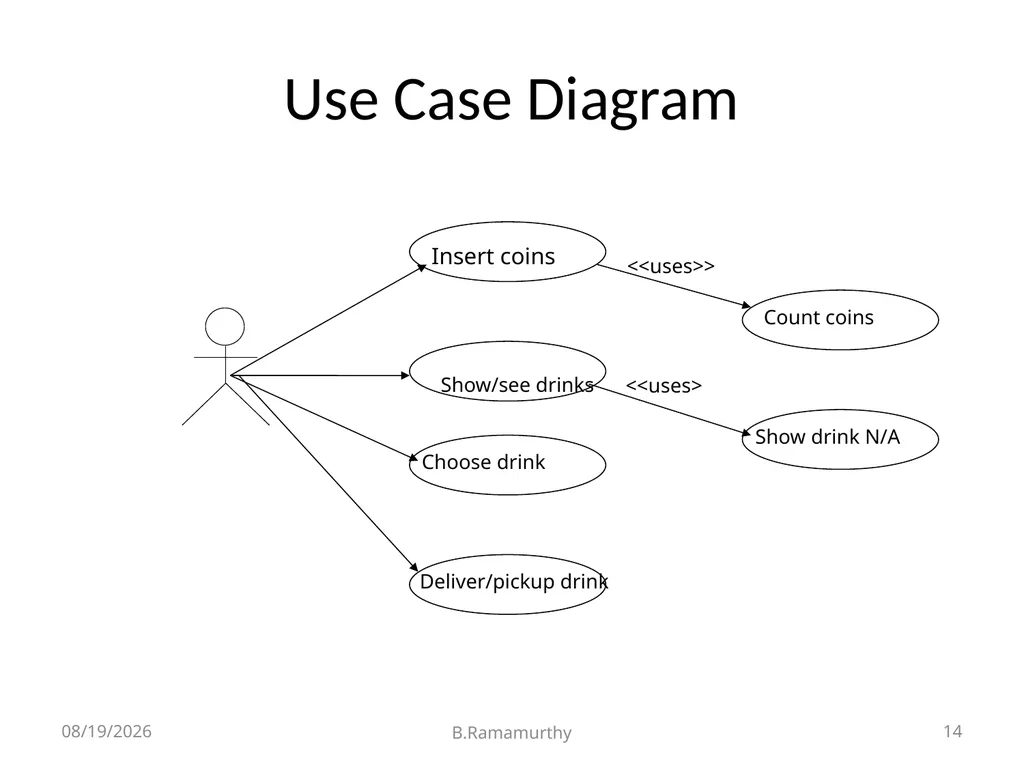
Use Case Diagram 9/15/2019 B.Ramamurthy 14 Insert coins Show/see drinks Choose drink Deliver/pickup drink Count coins Show drink N/A <<uses>> <<uses><br>
15
Case Studies Ticket counter for basketball game
TIVO: Video recorder/controller
Weather Station.
ATM Machine: Description given as data dictionary.
4-cycle lawnmower engine
Burger queen fast food restaurant’s hand-held order device 9/15/2019 B.Ramamurthy 15<br>
16
Use Case Example: Counseling 9/15/2019 B.Ramamurthy 16<br>
17
Example Carry out a use-case analysis of the operations performed by a parking ticket vending machine. Consider end-user (motorist), maintenance technician, auditor, and coin (money) collector.
Use tools such as draw.io or other UML tools. 9/15/2019 B.Ramamurthy 17<br>
18
Summary : Use case model We studied the Use-case Model of Unified Modeling Language.
Use-case model provides a formal mechanism for carrying out a requirement analysis with active participation from domain experts and users who may or may not be software savvy.
Use-case model can be used not only for requirement analysis of software systems, hardware systems and hybrid (combination) systems.
Now armed with these information, go ahead analyze your problem and obtain the use case diagram. 9/15/2019 B.Ramamurthy 18<br>