04
3-01 Rotation Angle and Centripetal Acceleration<br>
05
3-01 Rotation Angle and Centripetal Acceleration<br>
06
3-01 Rotation Angle and Centripetal Acceleration Convert 60° to radians Convert 2 revolutions to radians<br>
07
3-01 Rotation Angle and Centripetal Acceleration<br>
08
3-01 Rotation Angle and Centripetal Acceleration A CD rotates 320 times in 2.4 s. What is its angular velocity in rad/s? What is the linear velocity of a point 5 cm from the center?<br>
09
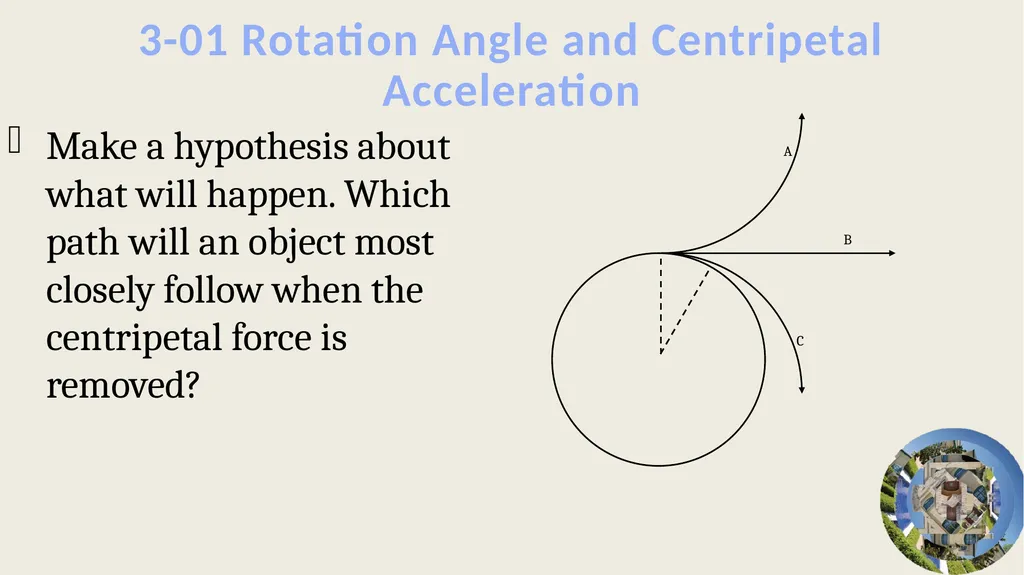
3-01 Rotation Angle and Centripetal Acceleration Make a hypothesis about what will happen. Which path will an object most closely follow when the centripetal force is removed?<br>
10
3-01 Rotation Angle and Centripetal Acceleration Put the plate on a flat surface and put a marble in the ridge.
Push the marble in the ridge so that it travels around the plate and then out of the removed section.
What is providing the centripetal force? i.e. what is keeping the marble traveling in a circle?
Perform the test several times and record your results.
Which of Newton’s Laws explains the results?
This would have been more complicated if the object moved in a vertical circle. Why?<br>
11
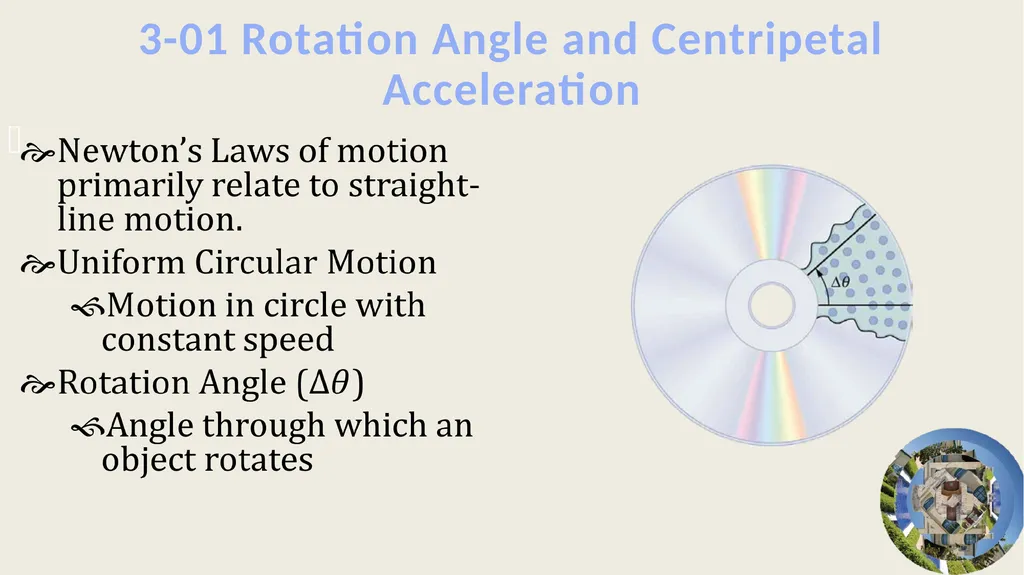
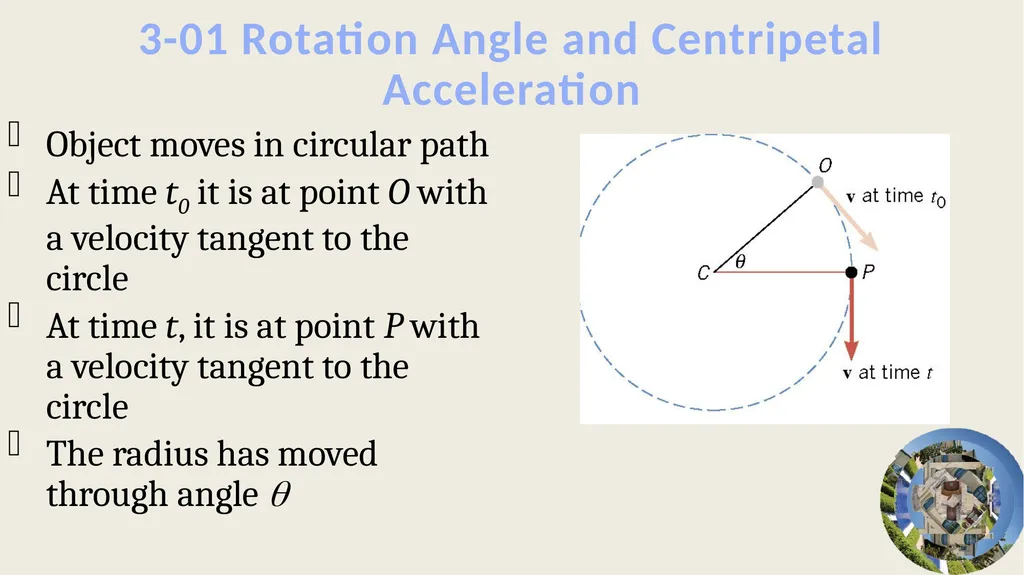
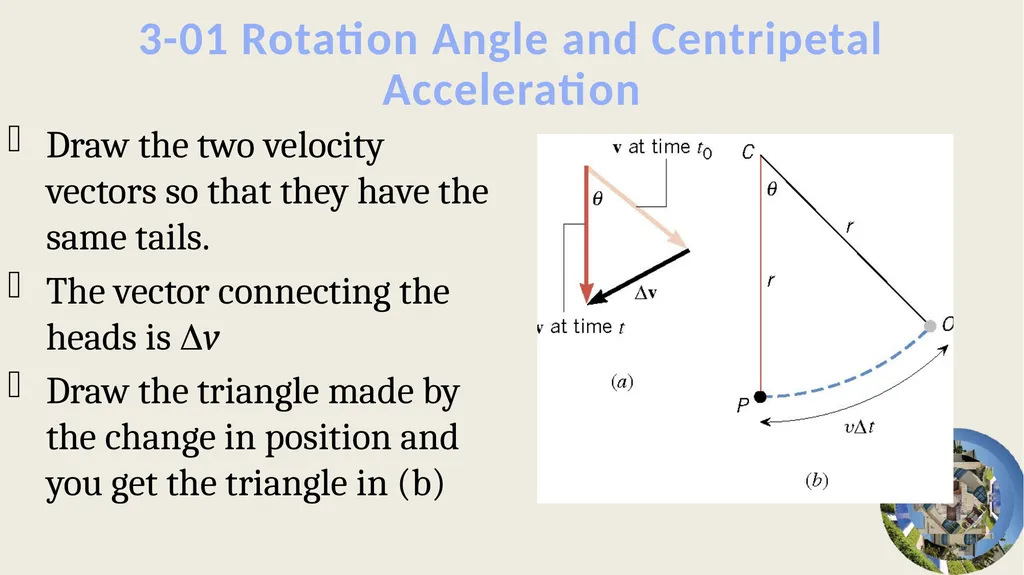
3-01 Rotation Angle and Centripetal Acceleration Object moves in circular path
At time t0 it is at point O with a velocity tangent to the circle
At time t, it is at point P with a velocity tangent to the circle
The radius has moved through angle <br>
12
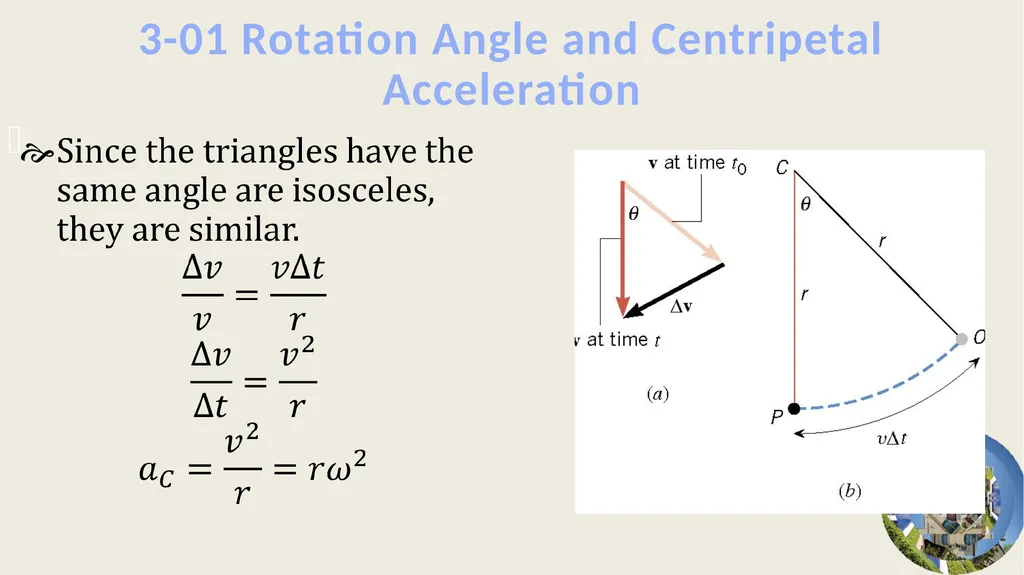
3-01 Rotation Angle and Centripetal Acceleration Draw the two velocity vectors so that they have the same tails.
The vector connecting the heads is v
Draw the triangle made by the change in position and you get the triangle in (b)<br>
13
3-01 Rotation Angle and Centripetal Acceleration<br>
14
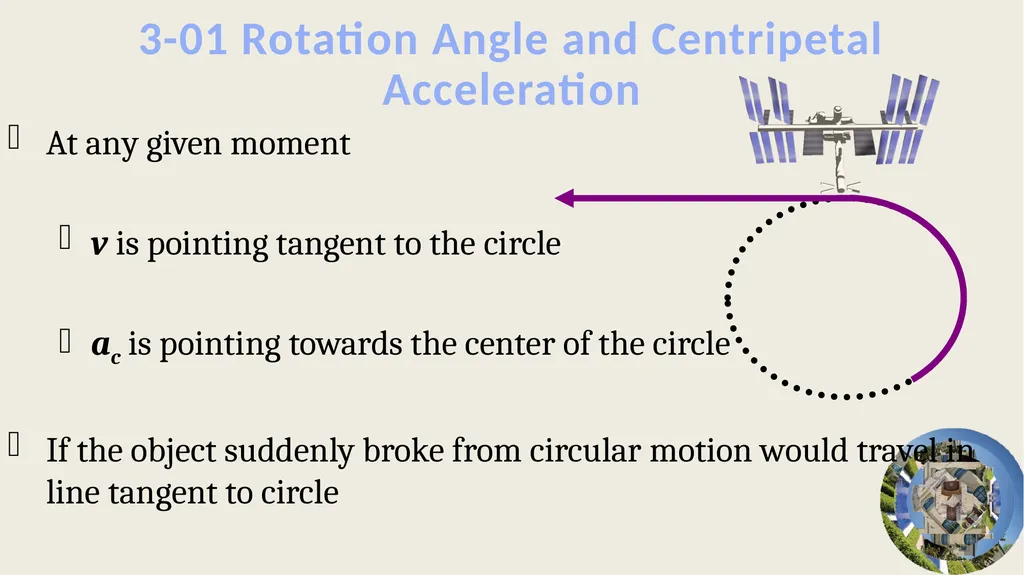
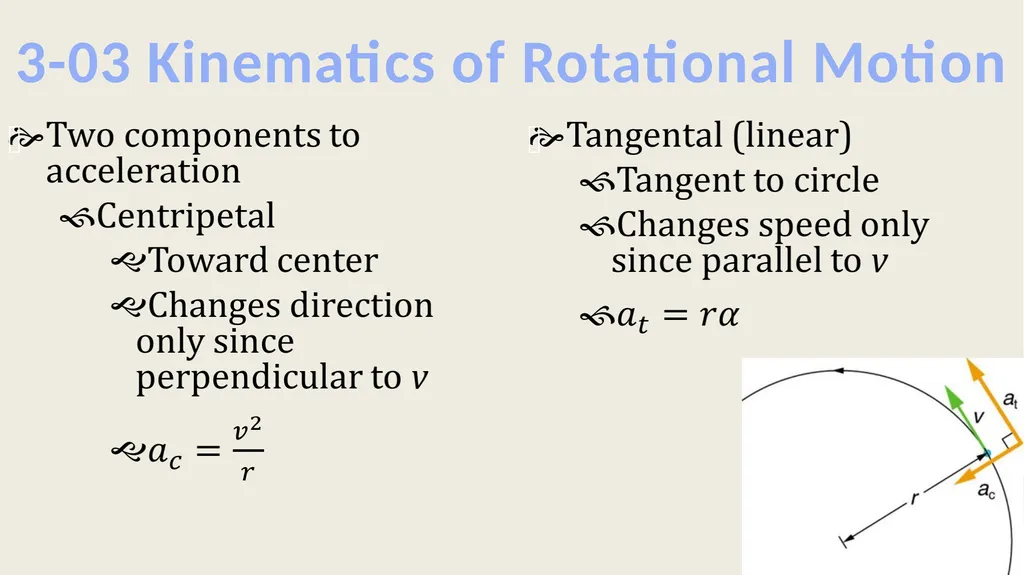
3-01 Rotation Angle and Centripetal Acceleration At any given moment
v is pointing tangent to the circle
ac is pointing towards the center of the circle
If the object suddenly broke from circular motion would travel in line tangent to circle<br>
15
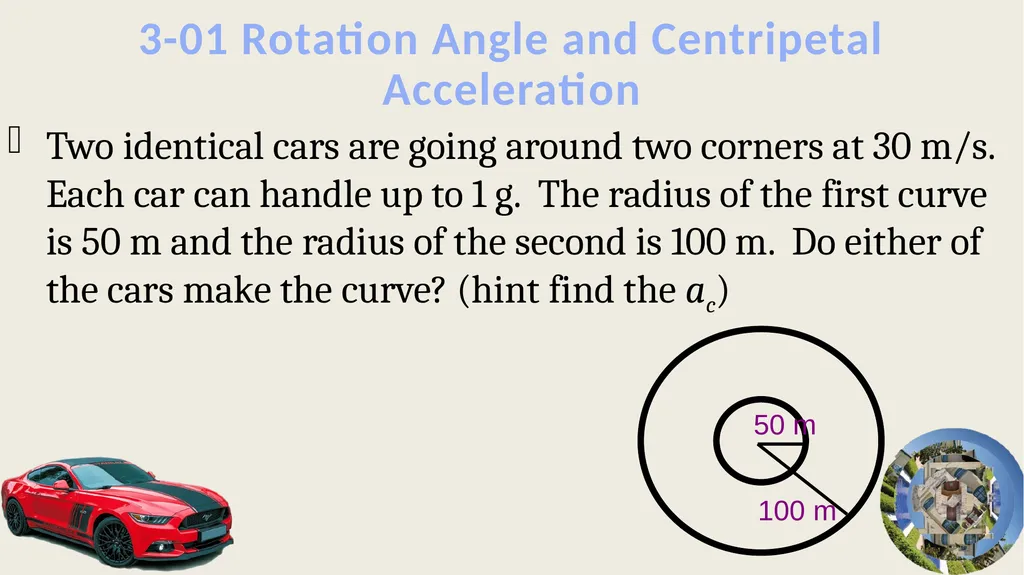
3-01 Rotation Angle and Centripetal Acceleration Two identical cars are going around two corners at 30 m/s. Each car can handle up to 1 g. The radius of the first curve is 50 m and the radius of the second is 100 m. Do either of the cars make the curve? (hint find the ac)<br>
16
3-02 Centripetal Force After this lesson you will…
Apply centripetal force F = ma<br>
17
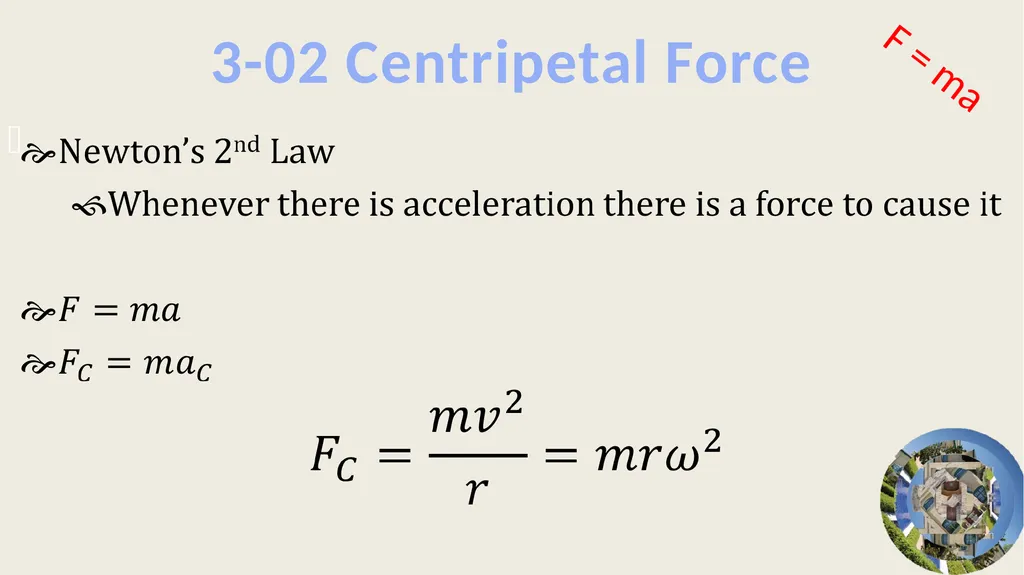
3-02 Centripetal Force F = ma<br>
18
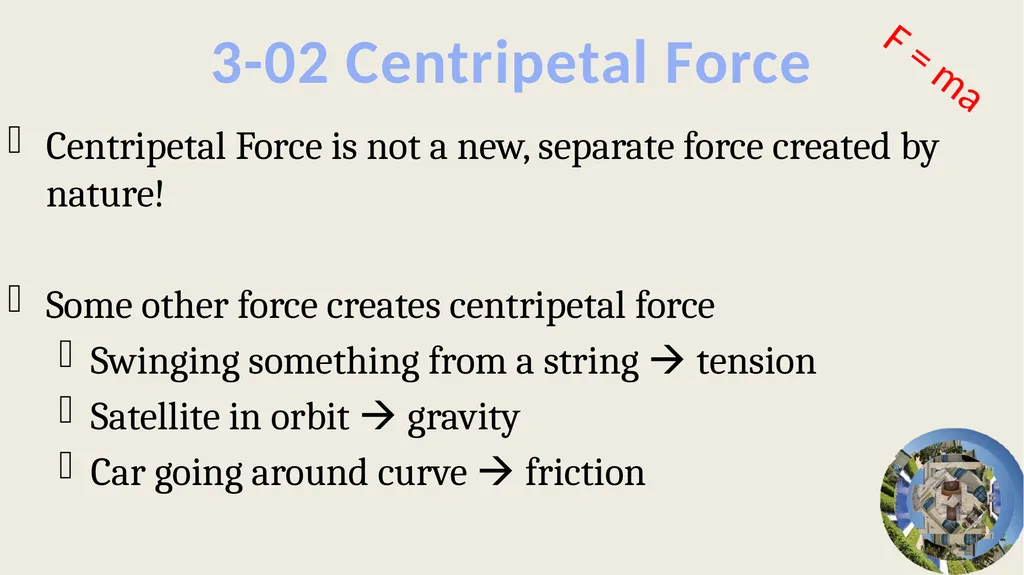
3-02 Centripetal Force Centripetal Force is not a new, separate force created by nature!
Some other force creates centripetal force
Swinging something from a string tension
Satellite in orbit gravity
Car going around curve friction F = ma<br>
19
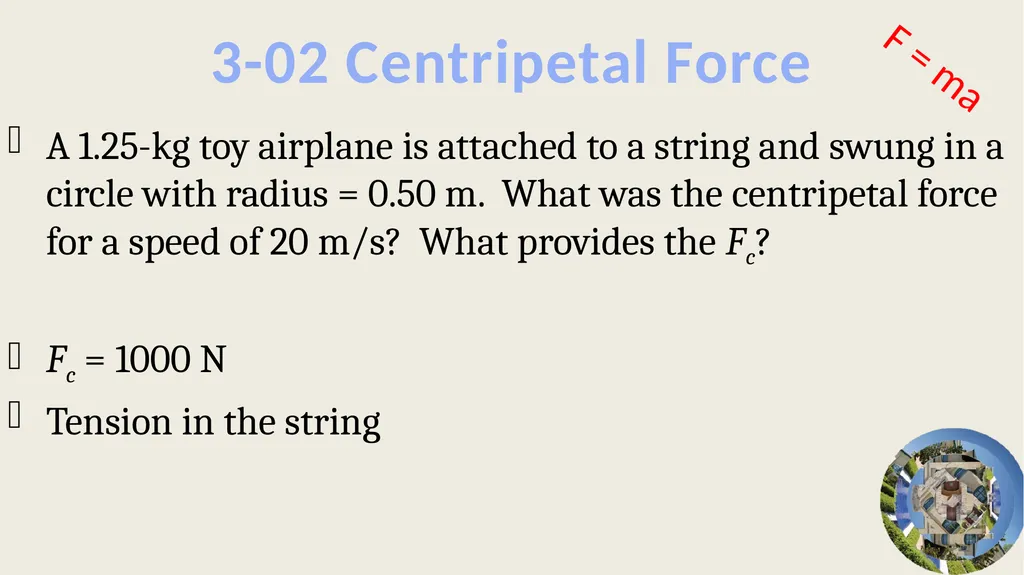
3-02 Centripetal Force A 1.25-kg toy airplane is attached to a string and swung in a circle with radius = 0.50 m. What was the centripetal force for a speed of 20 m/s? What provides the Fc?
Fc = 1000 N
Tension in the string F = ma<br>
20
3-02 Centripetal Force What affects Fc more: a change in mass, a change in radius, or a change in speed?
A change in speed since it is squared and the others aren’t. F = ma<br>
21
3-02 Centripetal Force Why do objects seem to fly away from circular motion?
They really go in a straight line according to Newton's First Law. F = ma<br>
22
3-02 Centripetal Force How does the spin cycle in a washing machine work?
The drum’s normal forces makes the clothes to travel in a circle. The water can go through the holes, so it goes in a straight line. The water is not spun out, the clothes are moved away from the water. F = ma<br>
23
3-02 Centripetal Force Remember the good old days when cars were big, the seats were vinyl bench seats, and there were no seat belts? Well when a guy would take a girl out on a date and he wanted to get cozy, he would put his arm on the back of the seat then make a right hand turn. The car and the guy would turn since the tires and steering wheel provided the centripetal force. The friction between the seat and the girl was not enough, so the girl would continue in a straight path while the car turned underneath her. She would end up in the guy’s arms. F = ma<br>
24
3-03 Kinematics of Rotational Motion After this lesson you will…
Describe uniform circular motion.
Calculate angular acceleration of an object.
Observe the link between linear and angular acceleration.
Observe the kinematics of rotational motion.
Derive rotational kinematic equations.<br>
25
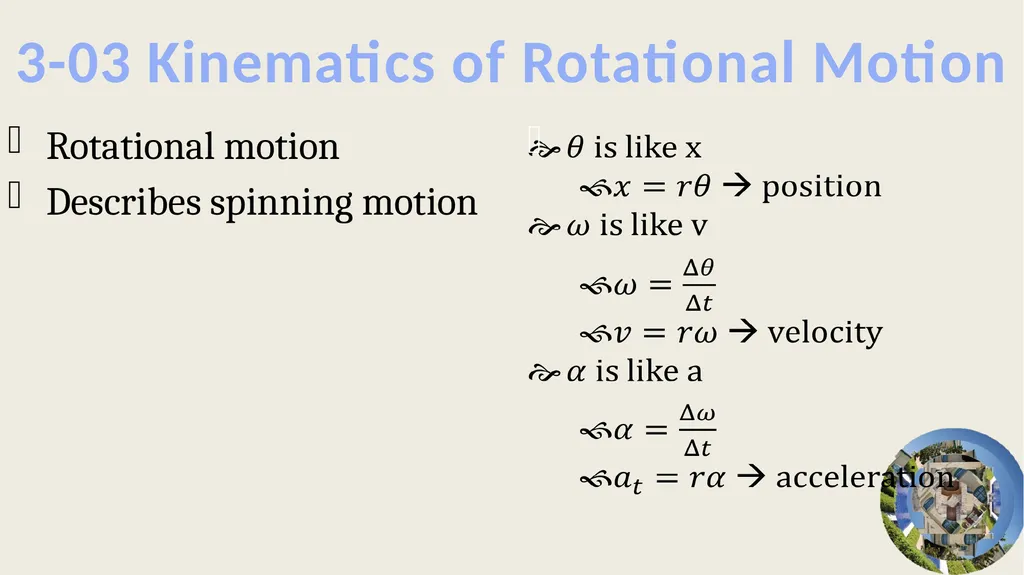
3-03 Kinematics of Rotational Motion Rotational motion
Describes spinning motion<br>
26
3-03 Kinematics of Rotational Motion<br>
27
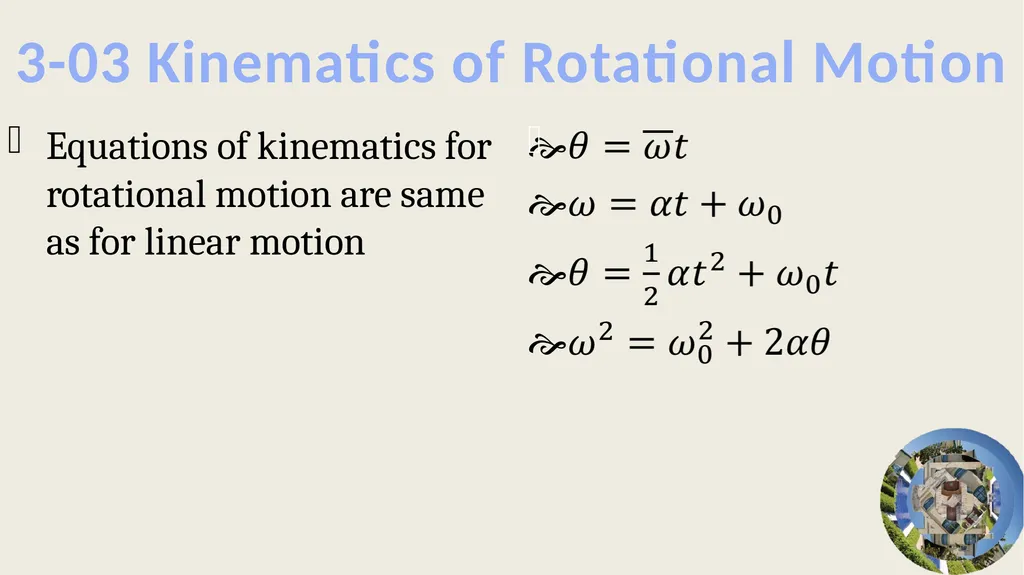
3-03 Kinematics of Rotational Motion Equations of kinematics for rotational motion are same as for linear motion<br>
28
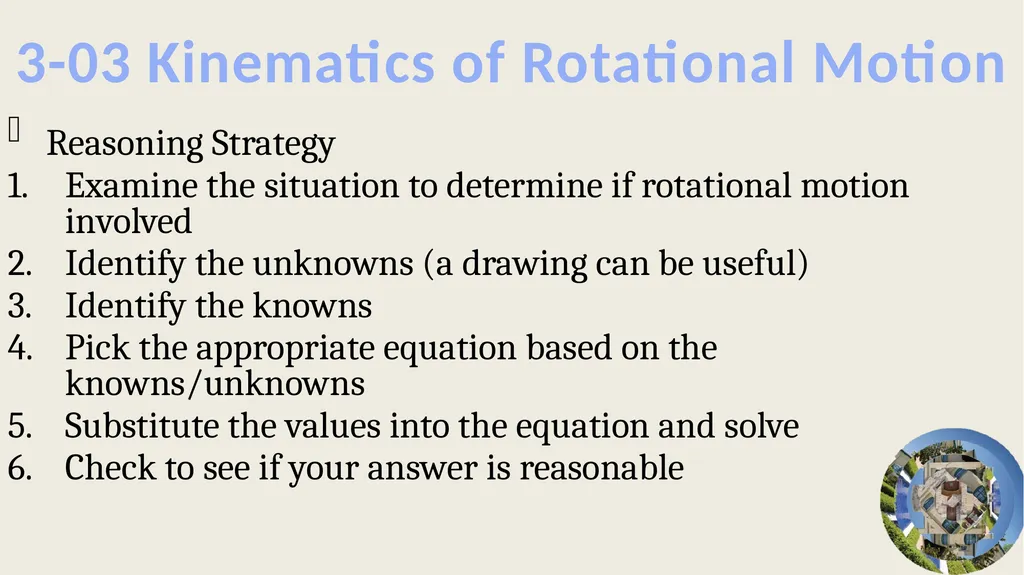
3-03 Kinematics of Rotational Motion Reasoning Strategy
Examine the situation to determine if rotational motion involved
Identify the unknowns (a drawing can be useful)
Identify the knowns
Pick the appropriate equation based on the knowns/unknowns
Substitute the values into the equation and solve
Check to see if your answer is reasonable<br>
29
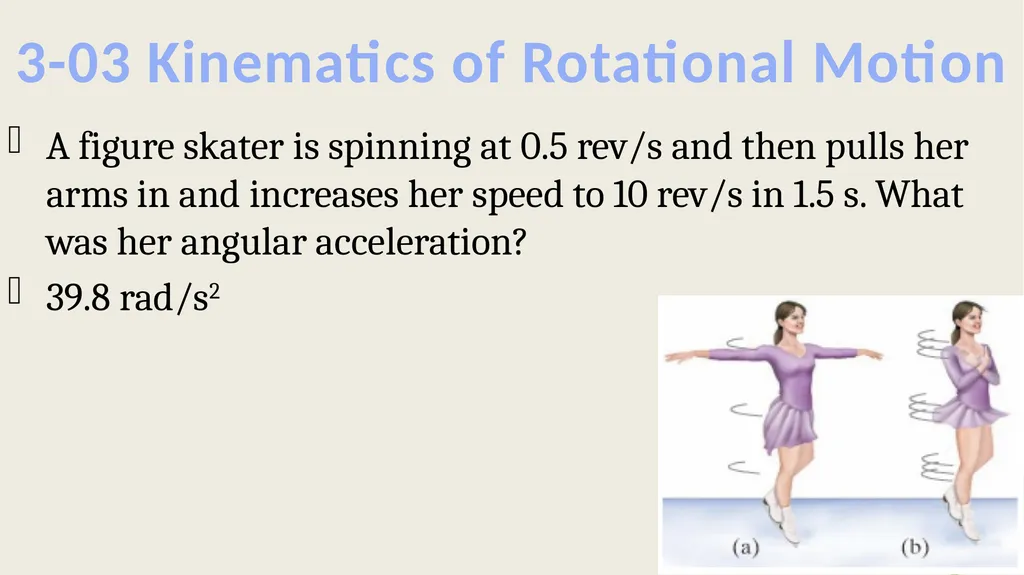
3-03 Kinematics of Rotational Motion A figure skater is spinning at 0.5 rev/s and then pulls her arms in and increases her speed to 10 rev/s in 1.5 s. What was her angular acceleration?
39.8 rad/s2<br>
30
3-03 Kinematics of Rotational Motion<br>
31
3-04 Torque After this lesson you will…
Calculate torque
Apply torque to equilibrium problems τ = rF sin θ<br>
32
3-04 Torque τ = rF sin θ<br>
33
3-04 Torque τ = rF sin θ<br>
34
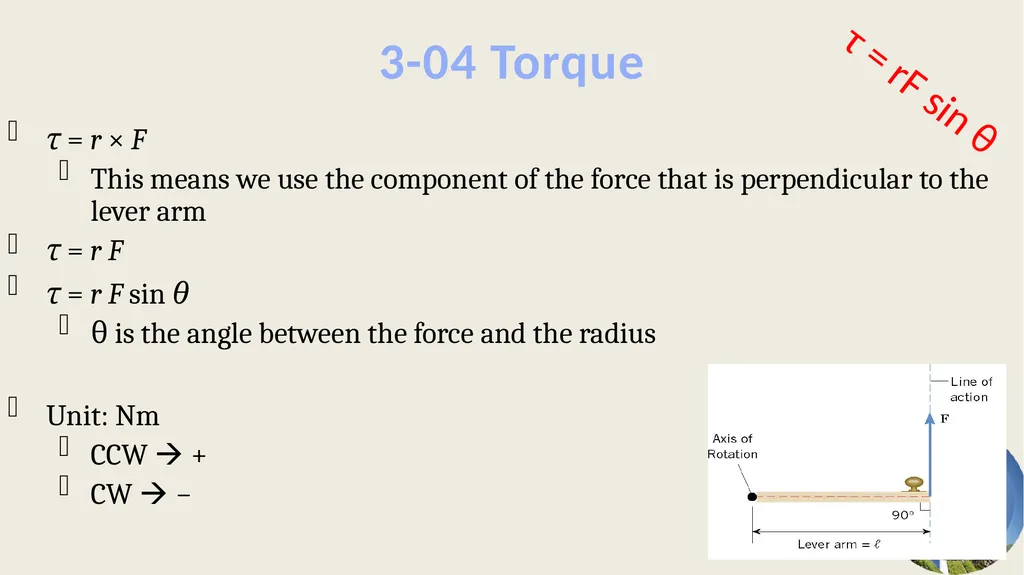
3-04 Torque τ = r × F
This means we use the component of the force that is perpendicular to the lever arm
τ = r F
τ = r F sin θ
θ is the angle between the force and the radius
Unit: Nm
CCW +
CW − τ = rF sin θ<br>
35
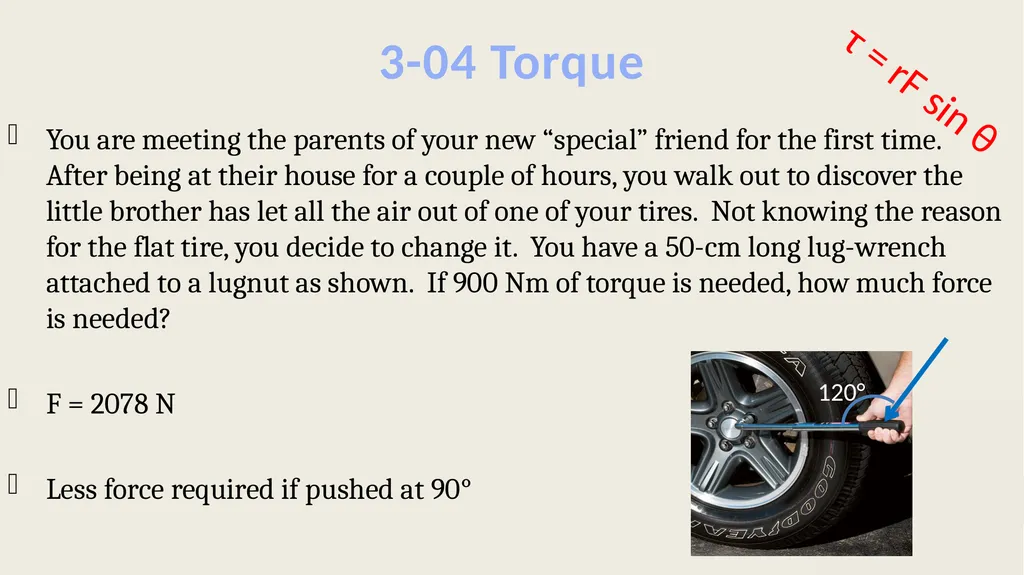
3-04 Torque You are meeting the parents of your new “special” friend for the first time. After being at their house for a couple of hours, you walk out to discover the little brother has let all the air out of one of your tires. Not knowing the reason for the flat tire, you decide to change it. You have a 50-cm long lug-wrench attached to a lugnut as shown. If 900 Nm of torque is needed, how much force is needed?
F = 2078 N
Less force required if pushed at 90° τ = rF sin θ<br>
36
3-04 Torque Second condition of equilibrium
Net torque = 0 τ = rF sin θ<br>
37
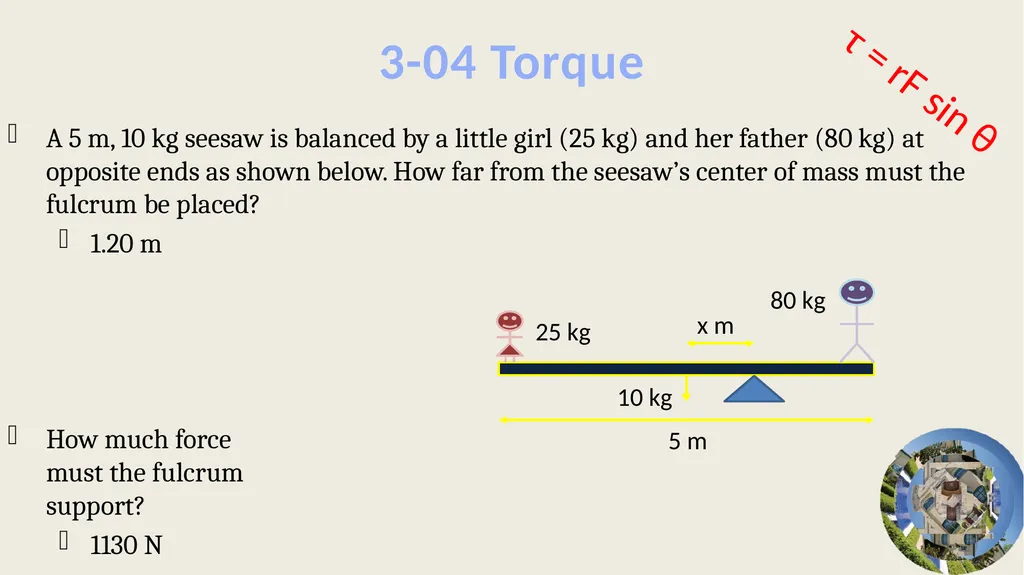
3-04 Torque A 5 m, 10 kg seesaw is balanced by a little girl (25 kg) and her father (80 kg) at opposite ends as shown below. How far from the seesaw’s center of mass must the fulcrum be placed?
1.20 m
How much force�must the fulcrum �support?
1130 N τ = rF sin θ<br>
38
3-05 Moment of Inertia After this lesson you will…
Understand how the moment of inertia affects angular acceleration
Apply Newton’s Second Law for torques (τ = I α) τ = rF sin θ<br>
39
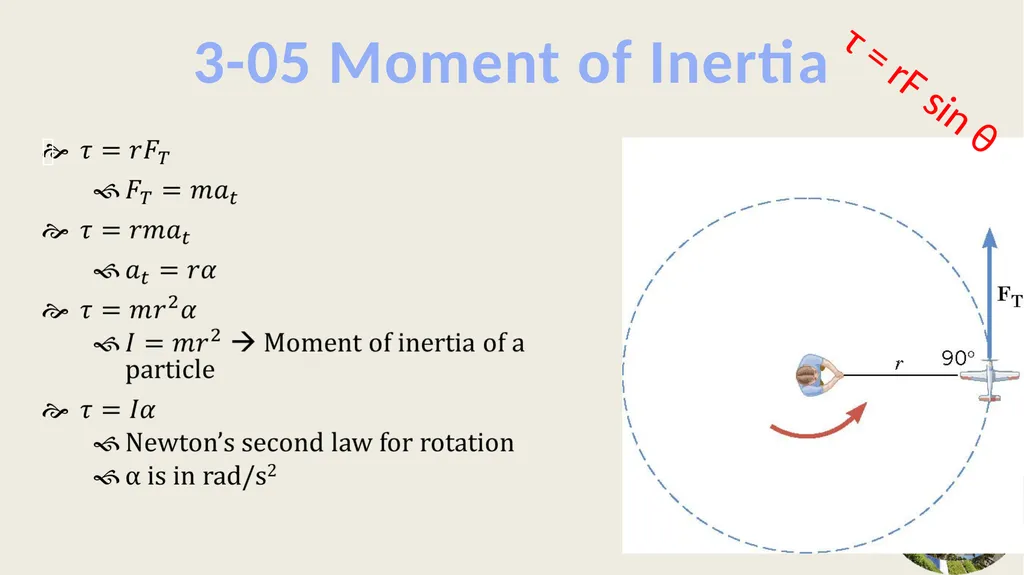
3-05 Moment of Inertia τ = rF sin θ<br>
40
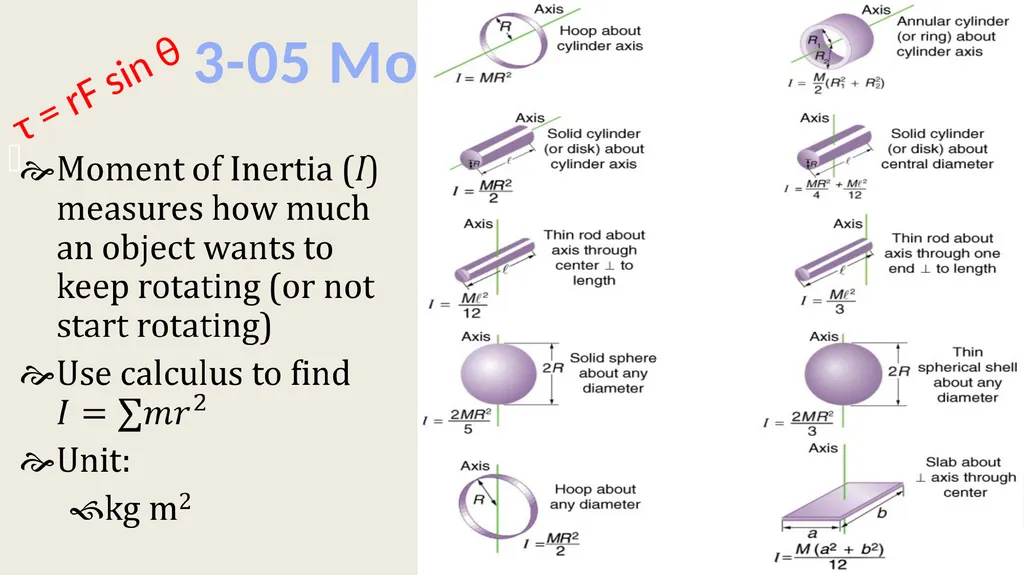
3-05 Moment of Inertia τ = rF sin θ<br>
41
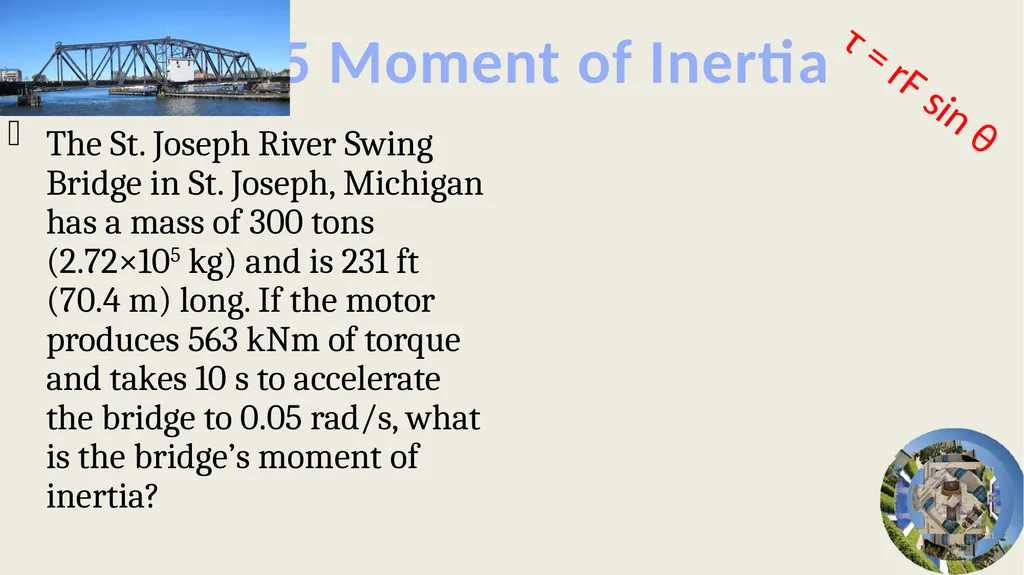
3-05 Moment of Inertia The St. Joseph River Swing Bridge in St. Joseph, Michigan has a mass of 300 tons (2.72×10⁵ kg) and is 231 ft (70.4 m) long. If the motor produces 563 kNm of torque and takes 10 s to accelerate the bridge to 0.05 rad/s, what is the bridge’s moment of inertia? τ = rF sin θ<br>
42
3-05 Moment of Inertia A spinning ride at a carnival is accelerating at 4 rad/s2. If the ride is shaped like a hoop, and the motor is exerting 128000 Nm of torque, what is the radius of the 500 kg ride? τ = rF sin θ<br>