Uniform Grant Guidance Roundtable Risk Assessments February10, 2016 A risk assessment is the process of identifying potential hazards an organization may face and analyzing methods of response if exposure occurs. What is a Risk Assessment?
"Uniform Grant Guidance Roundtable Risk Assessments" is the property of its rightful owner. Permission is granted to
download and print the materials on this website for personal, non-commercial use only, and to display it
on your personal computer provided you do not modify the materials and that you retain all copyright
notices contained in the materials. By downloading content from our website, you accept the terms of this
agreement.
Presentation Transcript
01
Uniform Grant Guidance Roundtable Risk Assessments February10, 2016<br>
02
A risk assessment is the process of identifying potential hazards an organization may face and analyzing methods of response if exposure occurs. What is a Risk Assessment?<br>
03
In regards to compliance, a risk assessment measures two quantities:
Magnitude of the potential non-compliance
Probability that the non-compliance will occur What is a Risk Assessment?<br>
04
The overall risk assessment determines:
Frequency of monitoring
Depth of monitoring What is a Risk Assessment?<br>
05
There are two levels to the risk requirements in the Uniform Grant Guidance:
Requirements for Federal awarding agencies
Requirements for Pass-through entities Uniform Grant Guidance-Risk Requirements<br>
06
Per CFR 200.205, the Federal awarding agency is required to conduct a pre-award review for all awards in order to determine:
Eligibility qualifications
Financial integrity information Federal Awarding Agency Requirements<br>
07
Additionally, agency pre-award risk evaluation for competitive grants or cooperative agreements must have risk evaluation framework in place that:
Identifies if risk review incorporates applicant evaluations, results of eligibility, and/or application quality
Risk evaluation criteria must be described in the announcement of funding opportunity Federal Awarding Agency Requirements<br>
08
In evaluating risks for applicants, the Federal awarding agency may consider the following items:
Financial stability
Quality of management systems and ability to meet management standards
History of performance
Audit findings
Ability to implement requirements Federal Awarding Agency Requirements<br>
09
Pass-through entities can impose requirements on subrecipients in order to:
Ensure the federal award is used in accordance with federal statutes, regulations and terms and conditions of the award
Ensure pass-through entity can meet its own responsibility to the federal awarding agency Requirements for Pass-Through Entities<br>
10
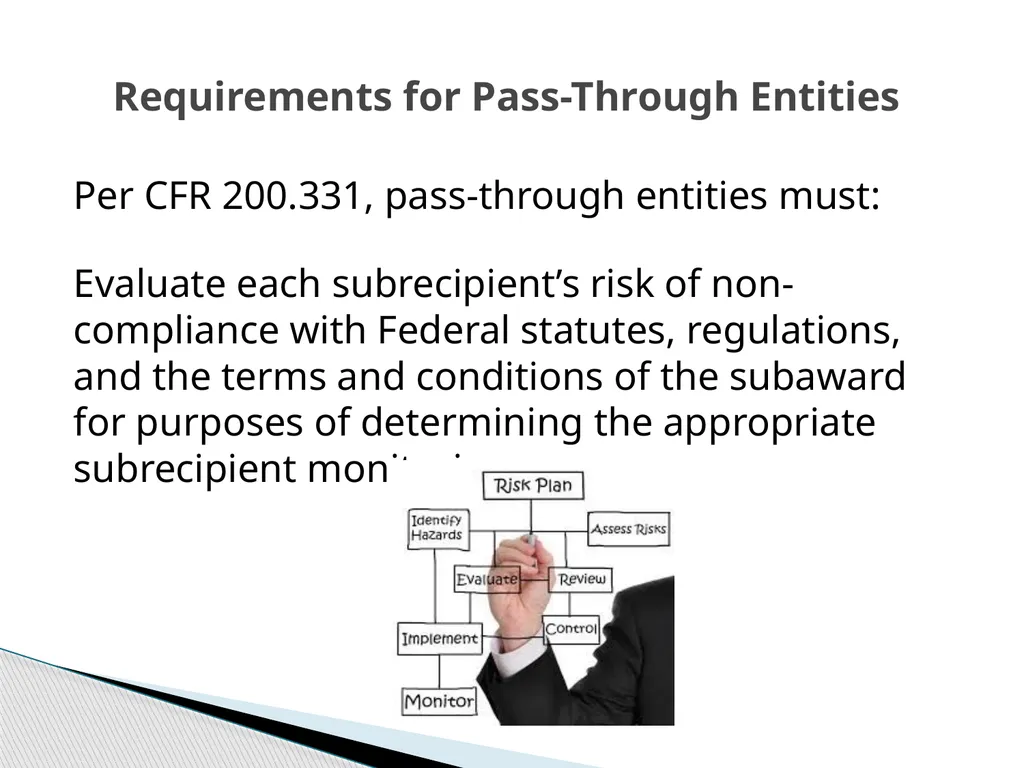
Per CFR 200.331, pass-through entities must:
Evaluate each subrecipient’s risk of non-compliance with Federal statutes, regulations, and the terms and conditions of the subaward for purposes of determining the appropriate subrecipient monitoring Requirements for Pass-Through Entities<br>
11
The following factors should be considered when evaluating subrecipient risk:
Subrecipient experience with the same or similar subawards
Results of previous audits, including whether the subrecipient receives a single audit and the extent to which the subaward has been audited
Whether subrecipient has new personnel or substantially changed systems
Extent and results of Federal awarding agency monitoring Requirements for Pass-Through Entities<br>
12
A pass-through entity must assess risk to determine the best monitoring approach. Monitoring must include:
Review of financial and performance reports
Issuance of management decisions for audit findings on subrecipients
Follow up activities ensuring subrecipients take timely, appropriate action to cure deficiencies Requirements for Pass-Through Entities<br>
13
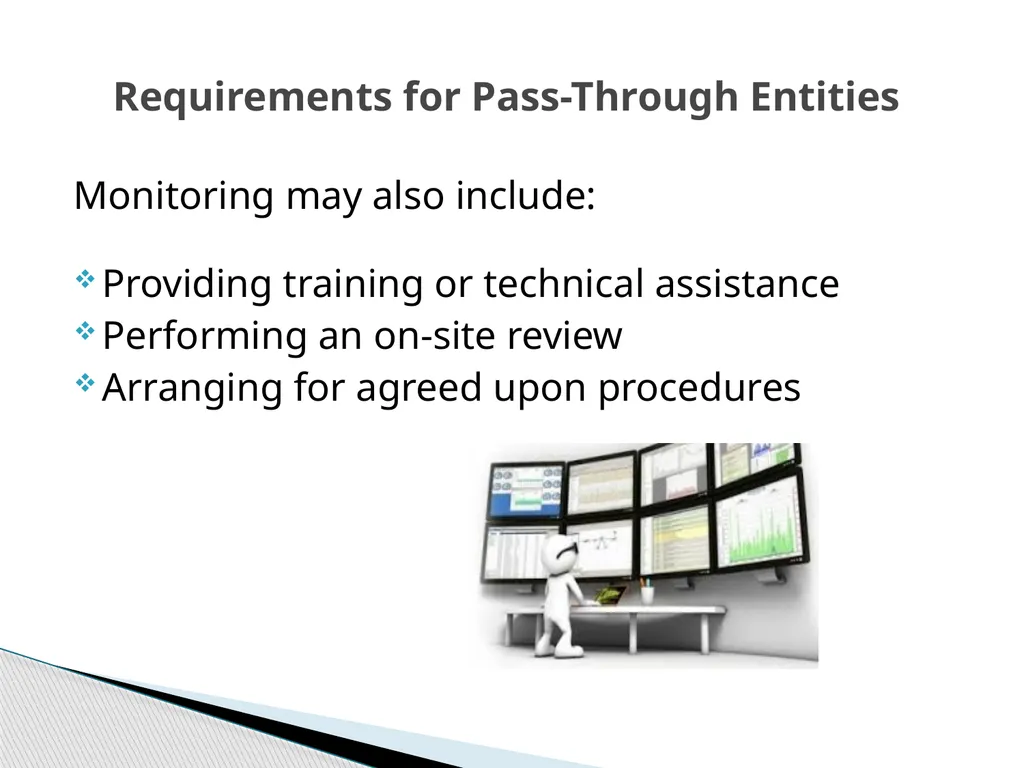
Monitoring may also include:
Providing training or technical assistance
Performing an on-site review
Arranging for agreed upon procedures Requirements for Pass-Through Entities<br>
14
Per CFR 200.207, special award conditions may be imposed when a recipient and/or subrecipient has failed to:
Comply with general or specific terms and conditions of an award
Meet performance requirements
Be responsible for managing an award Federal Awarding Agencies and Pass-Through Entities<br>
15
The Federal awarding agency or pass-through entity may impose additional specific award conditions which could include any of the following:
Requiring payments be made as reimbursements rather than advance payments
Requiring approval to move to the next phase of project/activity
Additional detailed financial reports
Additional project monitoring
Technical or management assistance
Additional prior approval Federal Awarding Agencies and Pass-Through Entities<br>
16
The Federal awarding agency or pass-through entity must notify applicant of special award conditions by identifying:
Nature of additional requirements
Reason for imposition of additional requirements
Action needed to remove additional requirement
Timeframe allowed for completing action
Method or how to request a reconsideration of the imposed additional requirements
*Note: Any special conditions must be promptly removed once they have been corrected Federal Awarding Agencies and Pass-Through Entities<br>
17
Per CFR 200.338, if the Federal awarding agency or pass-through entity determines that non-compliance cannot be remedied by imposing additional conditions, the Federal awarding agency or pass through entity may take one or more of the following actions:
Temporarily withhold cash payments pending correction of the deficiency
Disallow all or part of the cost activity or action not in compliance
Wholly or partially suspend or terminate the award
Initiate suspension or debarment proceedings
Withhold further Federal awards for the project/program
Take other remedies that may be legally available Federal Awarding Agencies and Pass-Through Entities<br>
18
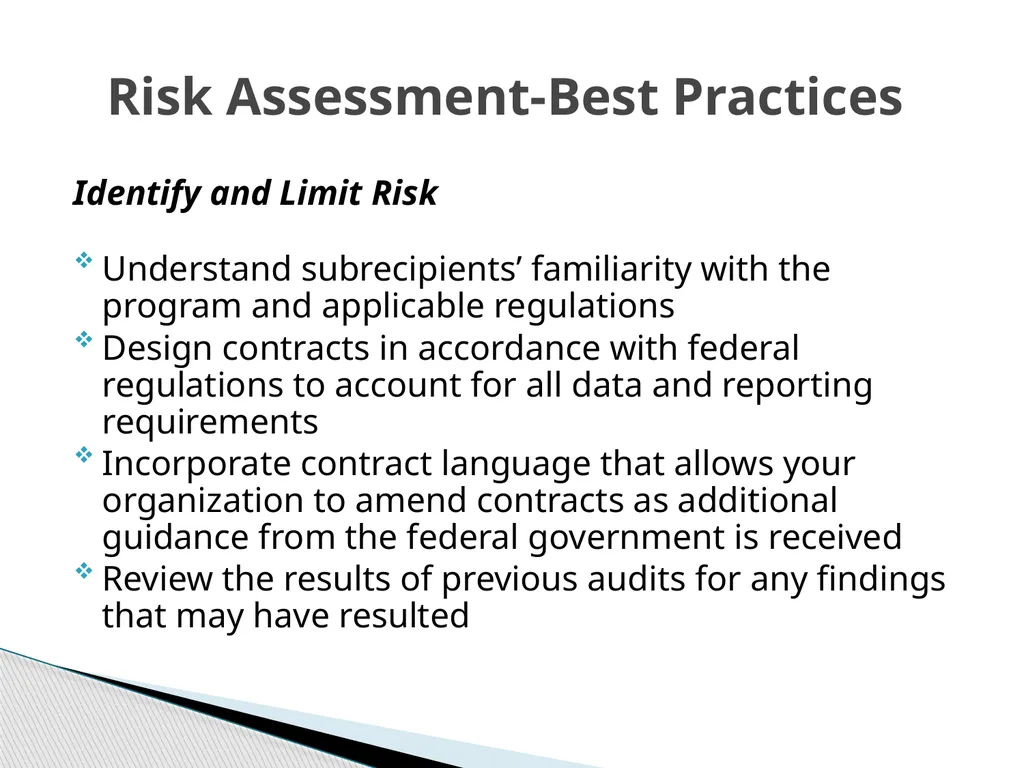
Identify and Limit Risk
Understand subrecipients’ familiarity with the program and applicable regulations
Design contracts in accordance with federal regulations to account for all data and reporting requirements
Incorporate contract language that allows your organization to amend contracts as additional guidance from the federal government is received
Review the results of previous audits for any findings that may have resulted Risk Assessment-Best Practices<br>
19
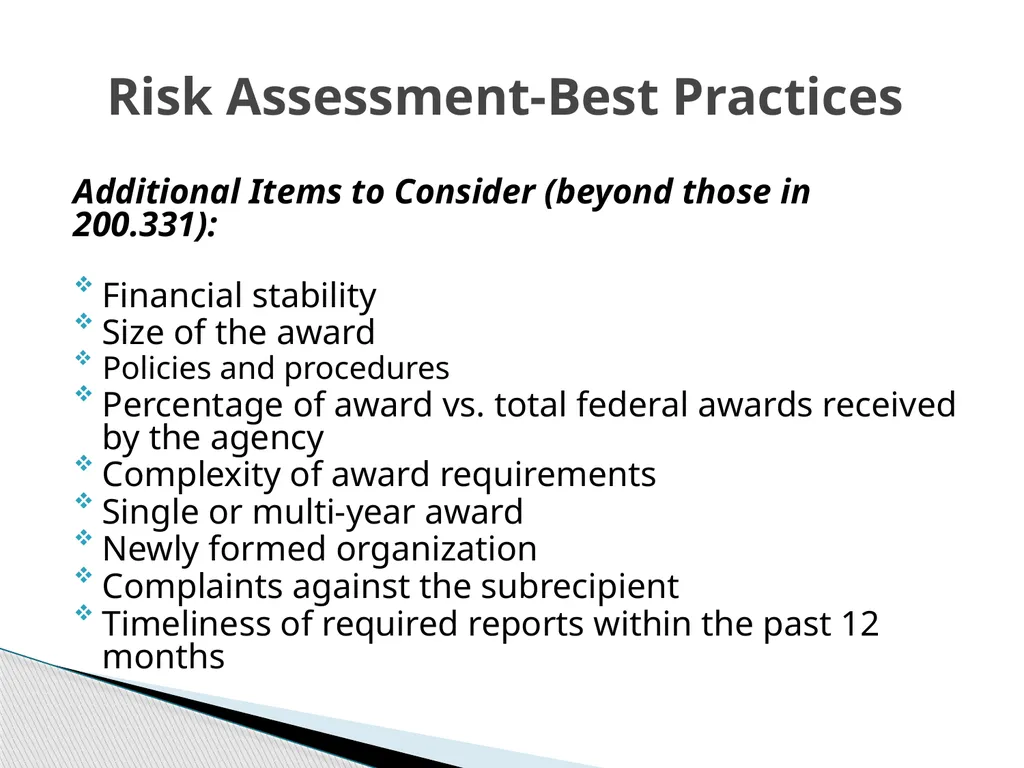
Additional Items to Consider (beyond those in 200.331):
Financial stability
Size of the award
Policies and procedures
Percentage of award vs. total federal awards received by the agency
Complexity of award requirements
Single or multi-year award
Newly formed organization
Complaints against the subrecipient
Timeliness of required reports within the past 12 months Risk Assessment-Best Practices<br>
20
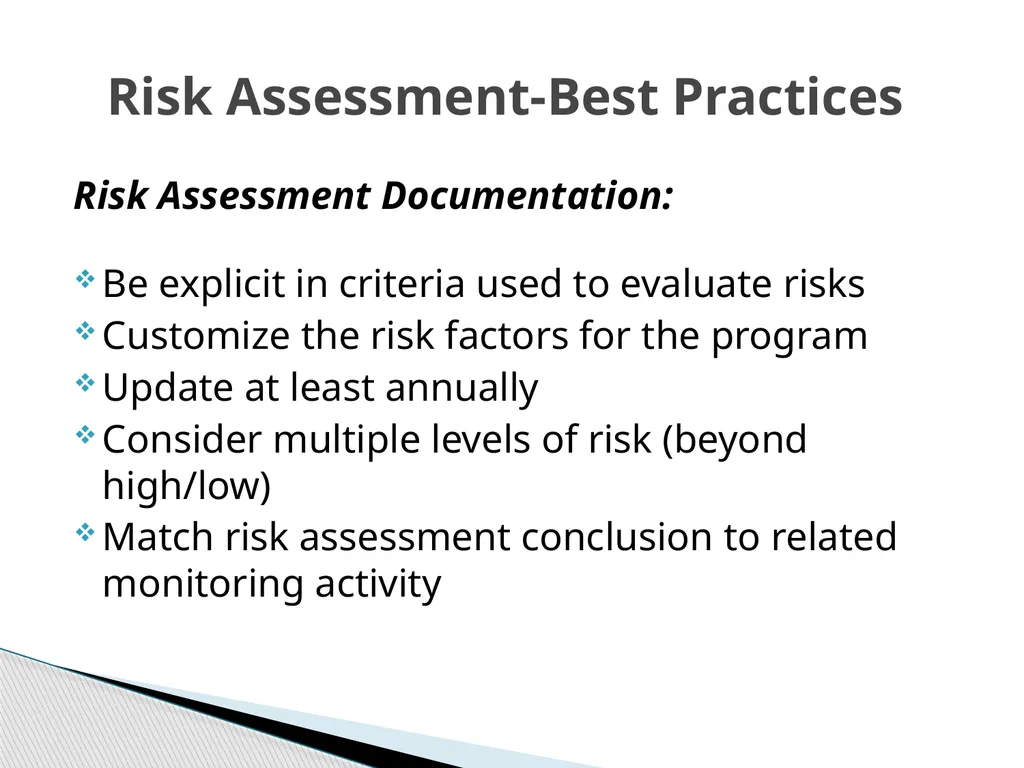
Risk Assessment Documentation:
Be explicit in criteria used to evaluate risks
Customize the risk factors for the program
Update at least annually
Consider multiple levels of risk (beyond high/low)
Match risk assessment conclusion to related monitoring activity Risk Assessment-Best Practices<br>
21
Kansas University- Office of Research
Alicia Reed & Kristi Billinger