
Unit 10: Tour Operations Management CLASS 4 TOPICS


Description: Unit 10: Tour Operations Management CLASS 4 TOPICS Identify the different stages in developing a package holiday Term Paper Review What are the stages of planning and managing a tour? Fourteen Stages Of Planning And Managing A Tour Stages
Related Topics
Download Presentation
"Unit 10: Tour Operations Management CLASS 4 TOPICS" is the property of its rightful owner. Permission is granted to download and print the materials on this website for personal, non-commercial use only, and to display it on your personal computer provided you do not modify the materials and that you retain all copyright notices contained in the materials. By downloading content from our website, you accept the terms of this agreement.
Presentation Transcript
slide1. Unit 10: Tour Operations Management CLASS 4 TOPICS
Identify the different stages in developing a package holiday
Term Paper Review<br>
slide2. What are the stages of planning and managing a tour?<br>
slide3. Fourteen Stages Of Planning And Managing A Tour<br>
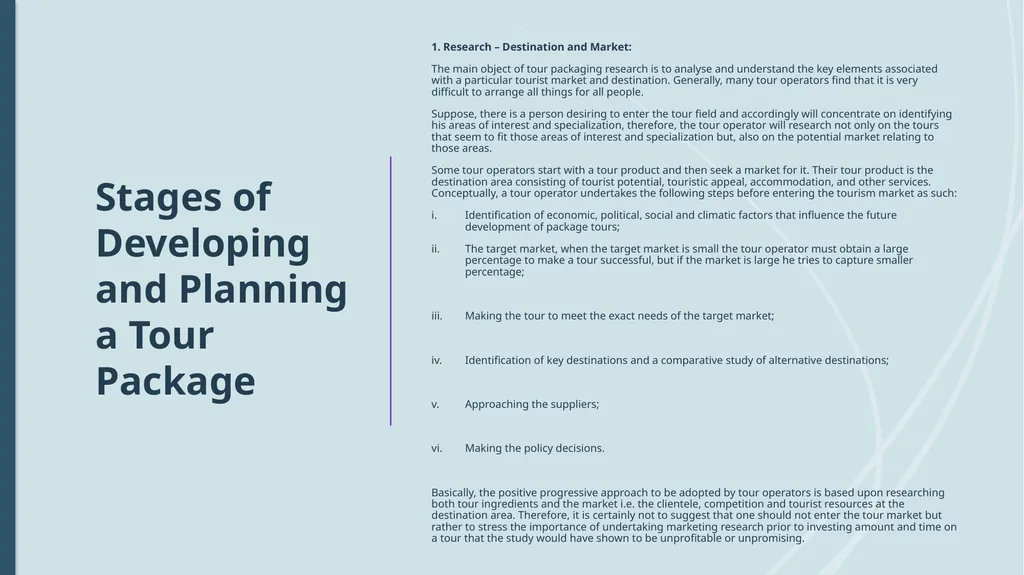
slide4. Stages of Developing and Planning a Tour Package 1. Research – Destination and Market:
The main object of tour packaging research is to analyse and understand the key elements associated with a particular tourist market and destination. Generally, many tour operators find that it is very difficult to arrange all things for all people.
Suppose, there is a person desiring to enter the tour field and accordingly will concentrate on identifying his areas of interest and specialization, therefore, the tour operator will research not only on the tours that seem to fit those areas of interest and specialization but, also on the potential market relating to those areas.
Some tour operators start with a tour product and then seek a market for it. Their tour product is the destination area consisting of tourist potential, touristic appeal, accommodation, and other services. Conceptually, a tour operator undertakes the following steps before entering the tourism market as such:
Identification of economic, political, social and climatic factors that influence the future development of package tours;
The target market, when the target market is small the tour operator must obtain a large percentage to make a tour successful, but if the market is large he tries to capture smaller percentage;
Making the tour to meet the exact needs of the target market;
Identification of key destinations and a comparative study of alternative destinations;
Approaching the suppliers;
Making the policy decisions.
Basically, the positive progressive approach to be adopted by tour operators is based upon researching both tour ingredients and the market i.e. the clientele, competition and tourist resources at the destination area. Therefore, it is certainly not to suggest that one should not enter the tour market but rather to stress the importance of undertaking marketing research prior to investing amount and time on a tour that the study would have shown to be unprofitable or unpromising.<br>
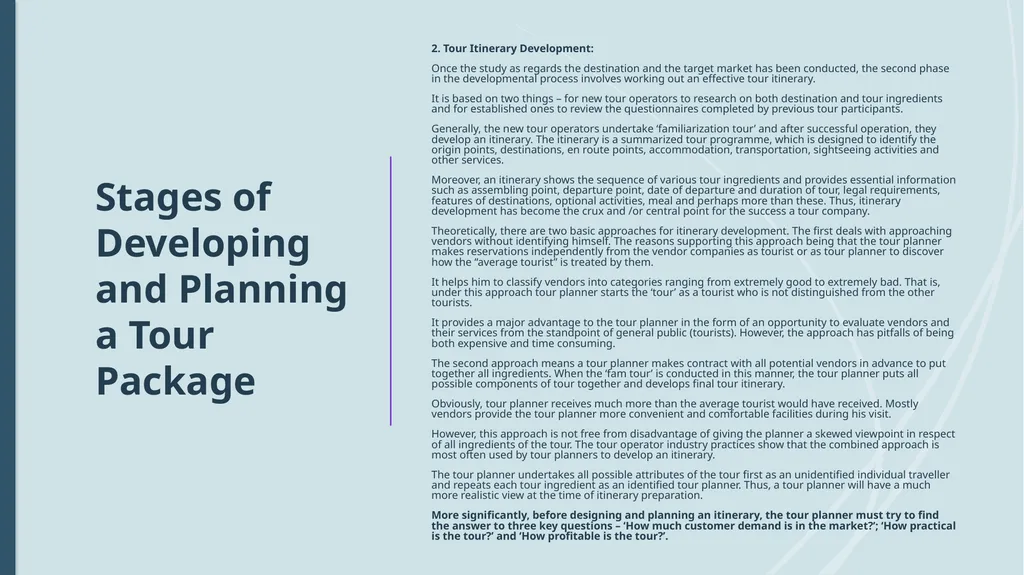
slide5. Stages of Developing and Planning a Tour Package 2. Tour Itinerary Development:
Once the study as regards the destination and the target market has been conducted, the second phase in the developmental process involves working out an effective tour itinerary.
It is based on two things – for new tour operators to research on both destination and tour ingredients and for established ones to review the questionnaires completed by previous tour participants.
Generally, the new tour operators undertake ‘familiarization tour’ and after successful operation, they develop an itinerary. The itinerary is a summarized tour programme, which is designed to identify the origin points, destinations, en route points, accommodation, transportation, sightseeing activities and other services.
Moreover, an itinerary shows the sequence of various tour ingredients and provides essential information such as assembling point, departure point, date of departure and duration of tour, legal requirements, features of destinations, optional activities, meal and perhaps more than these. Thus, itinerary development has become the crux and /or central point for the success a tour company.
Theoretically, there are two basic approaches for itinerary development. The first deals with approaching vendors without identifying himself. The reasons supporting this approach being that the tour planner makes reservations independently from the vendor companies as tourist or as tour planner to discover how the “average tourist” is treated by them.
It helps him to classify vendors into categories ranging from extremely good to extremely bad. That is, under this approach tour planner starts the ‘tour’ as a tourist who is not distinguished from the other tourists.
It provides a major advantage to the tour planner in the form of an opportunity to evaluate vendors and their services from the standpoint of general public (tourists). However, the approach has pitfalls of being both expensive and time consuming.
The second approach means a tour planner makes contract with all potential vendors in advance to put together all ingredients. When the ‘fam tour’ is conducted in this manner, the tour planner puts all possible components of tour together and develops final tour itinerary.
Obviously, tour planner receives much more than the average tourist would have received. Mostly vendors provide the tour planner more convenient and comfortable facilities during his visit.
However, this approach is not free from disadvantage of giving the planner a skewed viewpoint in respect of all ingredients of the tour. The tour operator industry practices show that the combined approach is most often used by tour planners to develop an itinerary.
The tour planner undertakes all possible attributes of the tour first as an unidentified individual traveller and repeats each tour ingredient as an identified tour planner. Thus, a tour planner will have a much more realistic view at the time of itinerary preparation.
More significantly, before designing and planning an itinerary, the tour planner must try to find the answer to three key questions – ‘How much customer demand is in the market?’; ‘How practical is the tour?’ and ‘How profitable is the tour?’.<br>
slide6. Stages of Developing and Planning a Tour Package 3. Negotiations with Tourism Suppliers/Vendors:
Once the itinerary is finalized, the next step is to negotiate with prospective vendors. The tour planner works with many vendors depending upon the nature and size of the tour. The major ones are airlines, lodging companies, transport operators, car rentals, ground operators, sightseeing vendors and so forth.
A tour planner has an option to negotiate with air carrier directly or through a travel agency. If the tour company has a long history of operating large number of inclusive air tours, the tour planner will usually be better placed to negotiate a better price and better terms/conditions than the tour planner/company could obtain through travel agency.
Travel agencies buy considerably more airline seats from airlines than tour operators especially, small scale. Practically, a tour company works on several air tours and purchases a substantial number of air carrier seats, the tour planner is in a position to meet with airline’s marketing executives and negotiate future tour group fares and ticketing.
Hotel negotiations are generally more informal than in case of air carriers. Negotiations with lodging properties should be initiated on an appointment basis, meeting with top executives in each property if at all possible.
It is suggested that the negotiated arrangements agreed upon through discussions with property executives be detailed immediately after each meeting and the tour planner must strike a balance in obtaining quality accommodation at a price that is affordable for the target market being solicited for participation in the tour.
It is always better if the executive with whom the negotiation is undertaken agrees to sign a binding contract with a penalty clause included in case the hotel fails to provide stated services and facilities.
Further, a tour operator also negotiates with other vendors such as ground operators, restaurants, transport operators, sightseeing vendors, insurance companies, banking companies, cruise organizations and even others who are indirectly dealing with tourist services, which are the part of a tour package.
The ground operators tend to be umbrella companies that provide a variety of tourism services under one roof. Each of the vendors range in its degree of sophistication based primarily on factors relating to their size of activities and the number of tourists handled every year.
Moreover, the reliability and honesty of these vendors is an important issue which must be considered by the tour planner. Therefore, in selecting and negotiating these vendors, tour planner should be wary of potential problems that occur when finalizing the contracts. Once negotiations have been successfully agreed upon contracts (may be both national and international) are drawn up with these vendors.
Normally, having a letter of contracts, especially one that includes penalty clauses for non-performance or for performance to a lesser standard than that agreed to in the contract is one of the best ways of assuring that the vendor’s performance will be at least of expected standards. Thus, the main aim of negotiations is obviously to reach the best competitive price for a satisfactory quality-price ratio.<br>
slide7. Stages of Developing and Planning a Tour Package 4. Costing of a Package Tour:
The concept of ‘tour cost’ is focal to understanding the connotation and practices of tour management in determining the monetary value of a tour package. In simple terms, ‘cost’ means the total expenses incurred to change the shape of individual ingredients into a tour package.
Since a tour company does not manufacture a tourism product (tour package) itself, rather it assembles or purchases individual ingredients/components from the various tourism vendors to form tour package. Therefore, the cost of a tour package can be determined as per clients/market requirements or organizational strategies,
As a general rule, the elements that make up the total cost of a tour package can be broken into various categories as, air travel cost, accommodation cost, local arrangement cost, payroll cost, research cost, marketing cost and other expenses.
Further, the cost sheet is designed to show the total cost/cost structure along with the break up of individual cost elements. It gives an idea how the profit margin is to be fixed.
Till today, there is no specific costing approach which is used in tour operator industry. However, as per the prevailing costing practices, one can visualize the following step-by-step procedure widely used in the tour operator industry.
The costing process involves several steps. Even though, these steps are not standard or generalized ones but can be changed/modified to meet the individual needs of the tour company.
However, it is suggested that, new tour operator must adopt step-by-step approach of costing a tour package. Because the cost is the basis for the determination of ‘right’ amount of profit and so is a biggest challenge for the tour planner.<br>
slide8. Stages of Developing and Planning a Tour Package 5. Financial Evaluation and Pricing:
After costing of a package tour, tour planner determines exchange rates, estimates future selling prices and finalizes tour prices. The tour planner has to finalize price structure some ten months or more before the departure of a tour.
Therefore, apart from the usual hazards of determining the tour price in advance, tour operators must evaluate the financial risks such as foreign exchange, for payment of airlines, hotels, and other destination agencies.
The tour price is not solely determined in terms of the cost but also on the basis of expected goals such as Rate of return, Market share (both domestic and international) and Price competitiveness of the tour package.
Tour pricing is a very complex decision especially in view of the facts like the degree and intensity of linkages, the nature of tour ingredients, competitive tourism marl et, and problems involved in tourist demand.
Moreover, due to number of external and non- controllable factors – Government policies, climate, terrorism, inflation, competitive prices, market segments, exchange rate fluctuations and so forth.
Thereby as such no generalized tour pricing approach exists in the tour operator industry, and in actual practice, the approaches/methods adopted vary from one tour company to another.
James M. Poynter (1993) has developed a tour pricing formula and has described the various steps involved in it. As per the formula the tour price can be obtained by adding projected profit margin into the total tour cost.
Initially, the Tour Costing & Pricing Manager, determines the per pax break-even point tour price by dividing the break even number of tour participants and compares the calculated per person break-even point tour price (after adding the per person profit) to the budgeted projected per person tour price and modify accordingly.
To some extent this approach is useful for new tour planners or new tour packages but for established tour operators or existing tour products/services, this approach does not operate effectively as the tour planners are forced by competitive environment particularly suppliers and sophisticated clients to reduce their profit margins.
Holloway (1992) opines that specialist tour operators whose product is unique may have more flexibility here and may determine prices largely on the basis of cost plus mark-up whereas majority of tour operators take into account the prices of their competitors.
However, it has been noticed that in case of specialist tour operators, prices reflect market demand at different periods of the year and there is no equal distribution of overheads i.e. administrative costs.<br>
slide9. Stages of Developing and Planning a Tour Package 5. Financial Evaluation and Pricing (CONTINUED):
Generally, administrative overheads are recovered in the peak season. In practice, the following tour pricing approaches are now being favoured for adoption by the tour operators.
i. Cost-oriented tour pricing
Mark-up;
Total cost/absorption cost;
Product cost;
Rate of Return.
ii. Market-oriented tour pricing
Skimming;
Going
Differential;
Penetrating;
Backward.
Poynter states that professional tour operators believe that a tour should not be operated unless it can be run profitably. It is important for the new tour operators to overcome the price obstacle on the very first tour so that the new comer will not be underpricing himself consistently.
Avoid running tours at below cost, making do with inferior quality and giving yourself too little remuneration and avoid unrealistic overpricing fears. Thus, tour operators must constantly keep in mind that with every rupee increase in the price of their tour, a percentage of potential tourists may be excluded from the tour market.<br>
slide10. Stages of Developing and Planning a Tour Package 6. Administrative Staff:
Since the tour operation business is seasonal in nature, it requires extra personnel to meet the increasing needs. Tour operators are usually clear about what they want while selecting administrative staff to perform the extra activities, may be at a particular destination or at a resort.
Tour operators recruit persons with friendly and sociable personalities, organizational skills, good humour, a sense of ethics, the ability to make decisions and a love for people, places and travel.
Tour managers see themselves in much the same way, but they also consider it important to oversee the whole tour, deal with problems, guide tour members in the culture and language, and generate business.
Generally, the same staff come and works for the same operator every year, which reduces the need for training. Many tour operators recruit mostly reservation staff, guides, resort staff, sales representatives, international agents, and so forth on a part-time basis or at the most for a season.<br>
slide11. Stages of Developing and Planning a Tour Package 7. Marketing of a Tour Package:
The tour operators strategic position between the various vendors encompassing airlines, transport operators, hotels, etc. and the ability to combine the various elements of travel industry into relatively affordable and standardized tour package, have emerged as the key manipulators of tourism industry.
When tourists choose to book a package or decide to go on holiday, how do they determine which package to buy especially in view of the consumer’s inability to inspect the ingredients making up the tour package prior to travel?
It is the tour ‘marketing’ which applies much more sophisticated strategies of trying to know what the tourist will want and satisfying the needs of the clients by means of the services rendered as well as the other customer’s value satisfactions associated with planning, preparing, and experiencing his travels.
Marketing is the creation of a demand that results in satisfying consumers and accomplishing corporate objectives. Thus, the most important aspect that should be central to any marketing definition is based not only on identifying different consumer needs, but also on delivering a tourist product/service whose experiences provide sets of satisfactions which are preferable to those of the competitors.
Tour package marketing is significantly different from the marketing of other tourism elements. This is because of the nature and types of tour packages offered by tour operators.
Moreover, in the tour industry the marketing strategies that are effective and profitable for the mass tour operators, will often be substantially different than the marketing strategies adopted by tour specialists.
For example marketing strategies of adventure tour operators will be different from strategies used by ground operators/or inbound tour operators. Even the marketing strategies of multiple tours involving multi-destinations will usually be different from the one day/one destination tours.
Thus, it has become imperative for a tour operator (if wants to be effective in marketing) to analyse profoundly what has been beneficial or productive for other tour companies in the same tour/similar destinations.<br>
slide12. Stages of Developing and Planning a Tour Package 8. Developing a Tour Marketing Plan:
Tour marketing plan is centred on organizational objectives. It is important to have a clear understanding of what the tour operator desires to achieve through marketing plan.
In fact, a tour company needs to understand both its product and its market before developing a marketing plan. For many tour companies, budget is the first step in the process of developing a tour marketing plan.
The tour marketing plan is normally a short term plan which guides the tour operator for one to three years. It provides a clear direction of the tour marketing operation based upon a systematic approach to planning and action.
It also coordinates the resources of the tour company to achieve the set targets. Recognizing the importance of tour marketing, tour operator develops the required mechanism to build effective tour marketing strategies. It illustrates how the tour marketing planning process should function and ensure that marketing activities match the resources, time requirements and objectives of the tour company.
To decide on the tour marketing strategies is perhaps the most complicated stage in the planning process. The working out of an appropriate strategy is directly related to the nature and type of the tour i.e., which strategy is most befitting for inbound tours, outbound tours, or incentive tours is based on its ability to provide a substantial return on investment.
For example, tour operators, in case of outbound tours generally target travel agencies through a combination of strategies. Large scale tour operators add a few new strategies, each year to maximize their return.
Some strategies are used for only a specific season/ destination while some strategies will be undertaken on a regular basis and reviewed or monitored periodically or at regular intervals of time.
After identifying marketing strategies, tour operator develops annual media plan, advertising plan, sales plan, direct mail plan, and telemarketing plan. Practically, tour operator develops marketing plans in a number of ways namely, annual marketing plan i.e. blueprint for the whole year and individual tour marketing plan.
It is of utmost significance that all marketing plan components need to be coordinated in a manner that they fit together easily and effectively and, consequently can be implemented economically.<br>
slide13. Stages of Developing and Planning a Tour Package 9. Marketing Inbound and Outbound Tours:
Generally, the international tour marketing is relatively more complex and difficult than domestic tour marketing. International tour market is composed mainly of tours organized and planned in another country and operated in other countries.
Although the tour components in different types of tours are different but the tour marketing is similar to much extent. As an inbound tour operator handles these tours in different countries/destinations.
In many cases a tour operator undertakes substantial contracting with inbound tour operators or ground operators to provide services as prescribed in the tour programme.
However, for marketing inbound tours, a tour operator procures lists of those tour companies and travel agencies which are interested in travel business from the destinations served by the inbound tour operators.
This is generally achieved through participation in international meets, marts, conferences and other associations. Practically, these events are so planned that international tour companies and travel agencies may purchase from the different country based inbound tour operators those travel ingredients required in order to operate their tours during the coming years.
Thus, it is clear that tour operator will either offer his tours directly to the market or sell them through travel agencies. Whichever method of distribution he chooses, sales will hinge on products being presented in brochures designed by the tour operators and marketing techniques as well as promotional campaigns being applied.<br>
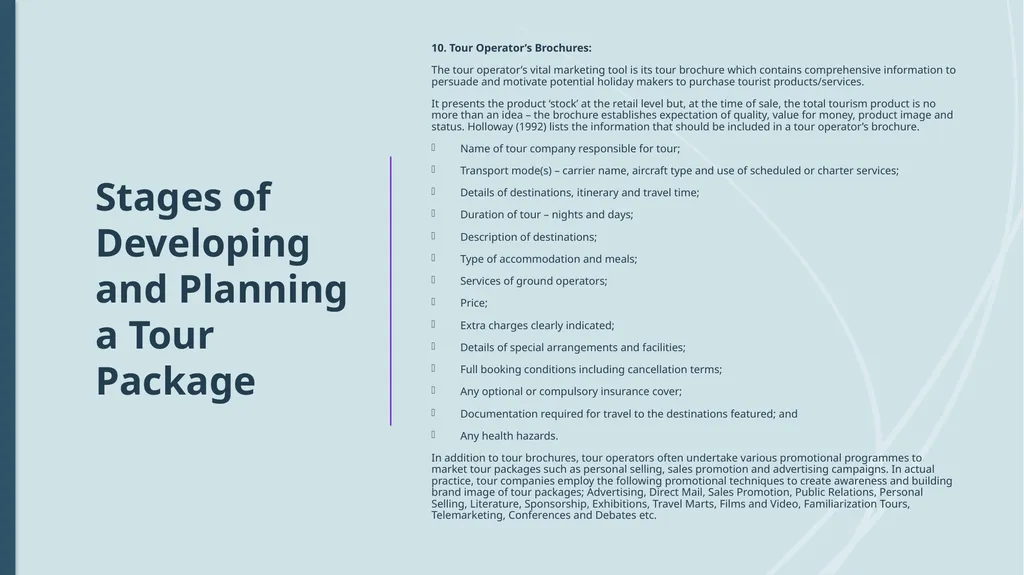
slide14. Stages of Developing and Planning a Tour Package 10. Tour Operator’s Brochures:
The tour operator’s vital marketing tool is its tour brochure which contains comprehensive information to persuade and motivate potential holiday makers to purchase tourist products/services.
It presents the product ‘stock’ at the retail level but, at the time of sale, the total tourism product is no more than an idea – the brochure establishes expectation of quality, value for money, product image and status. Holloway (1992) lists the information that should be included in a tour operator’s brochure.
Name of tour company responsible for tour;
Transport mode(s) – carrier name, aircraft type and use of scheduled or charter services;
Details of destinations, itinerary and travel time;
Duration of tour – nights and days;
Description of destinations;
Type of accommodation and meals;
Services of ground operators;
Price;
Extra charges clearly indicated;
Details of special arrangements and facilities;
Full booking conditions including cancellation terms;
Any optional or compulsory insurance cover;
Documentation required for travel to the destinations featured; and
Any health hazards.
In addition to tour brochures, tour operators often undertake various promotional programmes to market tour packages such as personal selling, sales promotion and advertising campaigns. In actual practice, tour companies employ the following promotional techniques to create awareness and building brand image of tour packages; Advertising, Direct Mail, Sales Promotion, Public Relations, Personal Selling, Literature, Sponsorship, Exhibitions, Travel Marts, Films and Video, Familiarization Tours, Telemarketing, Conferences and Debates etc.<br>
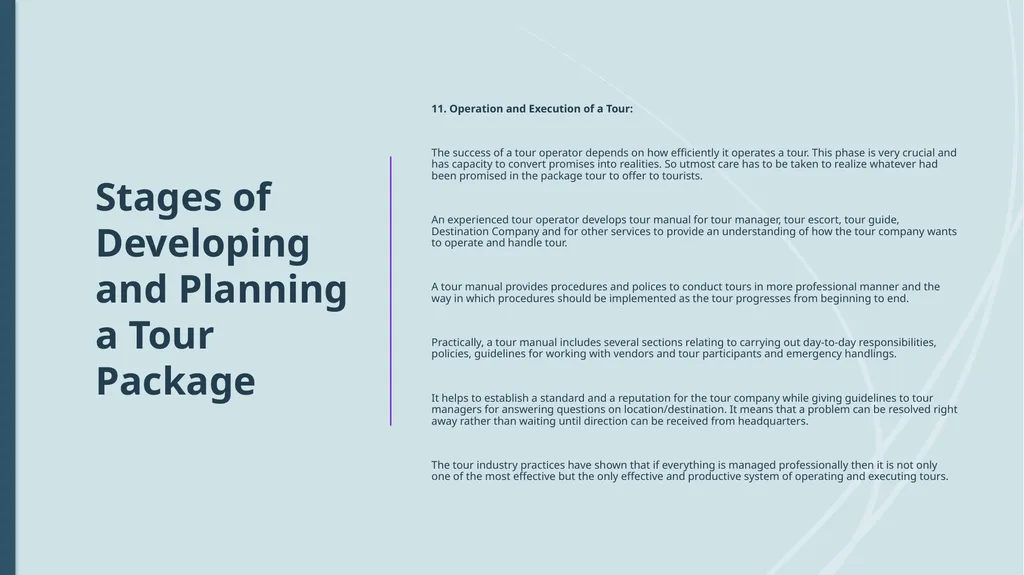
slide15. Stages of Developing and Planning a Tour Package 11. Operation and Execution of a Tour:
The success of a tour operator depends on how efficiently it operates a tour. This phase is very crucial and has capacity to convert promises into realities. So utmost care has to be taken to realize whatever had been promised in the package tour to offer to tourists.
An experienced tour operator develops tour manual for tour manager, tour escort, tour guide, Destination Company and for other services to provide an understanding of how the tour company wants to operate and handle tour.
A tour manual provides procedures and polices to conduct tours in more professional manner and the way in which procedures should be implemented as the tour progresses from beginning to end.
Practically, a tour manual includes several sections relating to carrying out day-to-day responsibilities, policies, guidelines for working with vendors and tour participants and emergency handlings.
It helps to establish a standard and a reputation for the tour company while giving guidelines to tour managers for answering questions on location/destination. It means that a problem can be resolved right away rather than waiting until direction can be received from headquarters.
The tour industry practices have shown that if everything is managed professionally then it is not only one of the most effective but the only effective and productive system of operating and executing tours.<br>
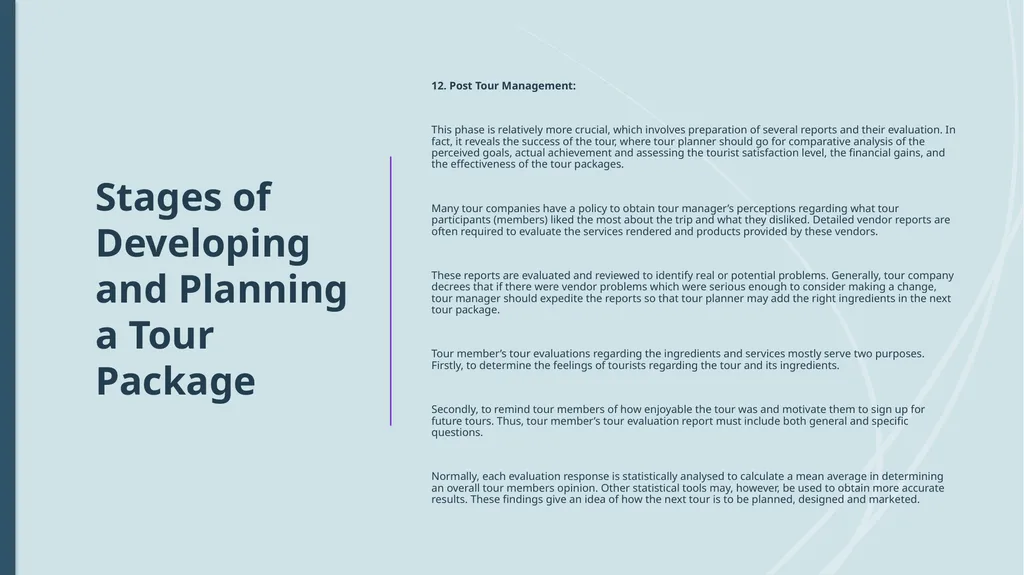
slide16. Stages of Developing and Planning a Tour Package 12. Post Tour Management:
This phase is relatively more crucial, which involves preparation of several reports and their evaluation. In fact, it reveals the success of the tour, where tour planner should go for comparative analysis of the perceived goals, actual achievement and assessing the tourist satisfaction level, the financial gains, and the effectiveness of the tour packages.
Many tour companies have a policy to obtain tour manager’s perceptions regarding what tour participants (members) liked the most about the trip and what they disliked. Detailed vendor reports are often required to evaluate the services rendered and products provided by these vendors.
These reports are evaluated and reviewed to identify real or potential problems. Generally, tour company decrees that if there were vendor problems which were serious enough to consider making a change, tour manager should expedite the reports so that tour planner may add the right ingredients in the next tour package.
Tour member’s tour evaluations regarding the ingredients and services mostly serve two purposes. Firstly, to determine the feelings of tourists regarding the tour and its ingredients.
Secondly, to remind tour members of how enjoyable the tour was and motivate them to sign up for future tours. Thus, tour member’s tour evaluation report must include both general and specific questions.
Normally, each evaluation response is statistically analysed to calculate a mean average in determining an overall tour members opinion. Other statistical tools may, however, be used to obtain more accurate results. These findings give an idea of how the next tour is to be planned, designed and marketed.<br>
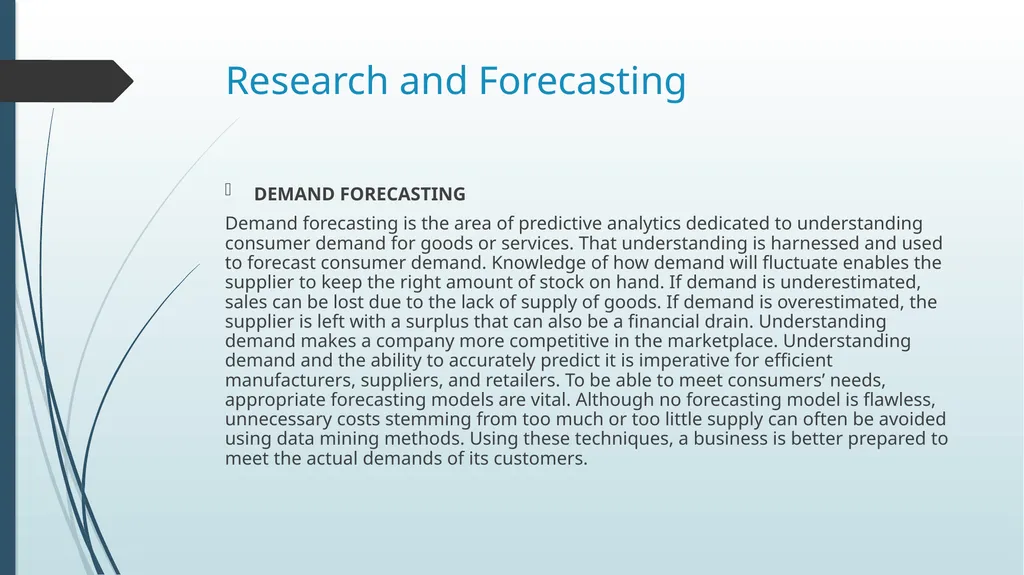
slide17. Research and Forecasting DEMAND FORECASTING
Demand forecasting is the area of predictive analytics dedicated to understanding consumer demand for goods or services. That understanding is harnessed and used to forecast consumer demand. Knowledge of how demand will fluctuate enables the supplier to keep the right amount of stock on hand. If demand is underestimated, sales can be lost due to the lack of supply of goods. If demand is overestimated, the supplier is left with a surplus that can also be a financial drain. Understanding demand makes a company more competitive in the marketplace. Understanding demand and the ability to accurately predict it is imperative for efficient manufacturers, suppliers, and retailers. To be able to meet consumers’ needs, appropriate forecasting models are vital. Although no forecasting model is flawless, unnecessary costs stemming from too much or too little supply can often be avoided using data mining methods. Using these techniques, a business is better prepared to meet the actual demands of its customers.<br>
slide18. Research and Forecasting: Understanding Consumer Demand Performing an underestimation of demand levels can also be disastrous for your company. When you introduce a new product into the market, you have to market it in order to generate demand for the product. In case you are incapable of delivering just the right amount of product as demanded by the market, then your market share is in danger of being snatched away from you by your competitors. If your competitors’ products can match or exceed yours in quality, then you might never be able to recover your market share.
Your marketing department has to do a lot more than simply generate sales forecasts. Their forecasts have to be a little more elaborate because there will be many factors that will determine how much your company will be able to sell. These factors, such the reaction of your competitors, the cost of the products, and others should be considered to determine how much you are likely to sell. As the factors change over time, you will also have to change your forecasts. A sales forecast is therefore really a special forecast that is the composite of a variety of estimates and it has to be dynamic enough to change.<br>
slide19. Research and Forecasting: Understanding Consumer Demand Usually, the first step to take is to determine something called market potential. This is an estimate of the total sales expected across the industry for a given product category within a certain time frame. It could be a month, a quarter, a year, and so on. The key idea here is the market potential is an estimate of what the market can take in total, from all the companies within it, so it includes both you and your competitors.
Once you have a good idea of what the market potential is, you can estimate the sales potential. This is an estimate of the maximum revenue you are likely to generate from the sale of a product. Alternatively, you can estimate it as the maximum number of units of the product that your company can hope to sell in a given market over a given time period. The sales potential is typically represented in percentage terms, where it is a percentage of the market potential. It is also the same as the estimate of the markets total market share in a given time period. Any method that forecasts sales potential is therefore also a market share forecasting method.<br>
slide20. Survey and Judgement Forecasting Techniques Channel and Customer Surveys: In some kinds of markets, such as business to business markets, research companies tend to ask customers how much they are likely to spend on given products in a given time period. The answers are used to make a forecast. The research companies will then sell the research to companies. Sometimes the companies will conduct their own surveys to produce their own forecasts. These surveys are generally better at determining the market potential than the sales potential. They are, therefore, market potential forecasting methods. After all, a consumer probably knows what they’ll buy, but isn’t always so sure of which brand they’ll buy from.
Sales Force Composite: This is a type of forecast based on information gathered from the sales force of a company. Salespeople usually have a good intuition of how much of a product can reasonably sell in a given time period. They’re close to the customer and therefore know firsthand what is realistically possible. It’s usually harder for salespeople to estimate sales of a new product, however, unless they have sold such products before. This method of forecasting is therefore not suitable to new products. It is typically best used for existing products and near-term estimates.
Executive Opinion: This is pretty much the best guess of the company executives. It is usually the starting point of many forecasts. It can be made even more thorough and accurate by basing the bonuses of executives on the amount of sales they make. They will, therefore, have an incentive to generate well-thought-out opinions on the sales potential of a product. Nonetheless, executive opinion should always be backed by quantitative techniques and research.
Expert Opinion: This is just like executive opinion, only the expert is a third party from outside the company. Just like executive opinion, it should also be backed by research and quantitative methods.<br>
slide21. Survey and Judgement Forecasting Techniques Time Series Forecasting Techniques
Time series techniques observe patterns in sales. One of these techniques, trend analysis, can be used to measure the rate of growth of sales in the past and extrapolate it to the future. A past growth of 3 percent in sales year over year might be a good basis to estimate future growth at 3 percent, as well. Time series analysis is most useful in a stable market. A market that either fluctuates or frequently gets disrupted will not lend itself very well to this method.
Correlates Techniques
There are a variety of highly sophisticated forecasting models that can be used to forecast sales. One of these is correlational analysis, which is a special form of trend analysis. It bases sales forecasts on the trend patterns of related variables. For example, furniture making companies frequently base their future furniture sales on the rate at which new houses are being built.
Response Models
Sometimes a company will base its forecasts based on past responses of customers to marketing techniques. They can then estimate when customers are price sensitive, how they respond to offers, and so on.
Market Tests
This isn’t as much a forecasting method as it is an experiment. The company launches a new product in a small market in order to gain knowledge of how the larger market would respond to the product based on the reaction of the smaller market. Such an experiment will typically show how the marketing plan can influence sales. That is why it is called a response model. Once data has been gained from the limited market, it can easily be extrapolated to the larger market.<br>
slide22. Pricing Strategies Pricing strategy is a way of finding a competitive price of a product or a service. This strategy is combined with the other marketing pricing strategies that are the 4P strategy (products, price, place and promotion) economic patterns, competition, market demand and finally product characteristic. This strategy comprises of one of the most significant ingredients of the mix of marketing as it is focused on generating and increasing the revenue for an organization, which ultimately becomes profit making for the company. Understanding the market conditions and the unmet desires of the consumers along with the price that the consumer is willing to pay to fulfill his unmet desires is the ultimate way of gaining success in the pricing strategy of a product or a service.
Do not forget the ultimate goal of the company is to maximize profit being in competition and sustaining the competitive market. However to maximize profits along with retaining your consumer you have to make sure you choose the right pricing strategy. The correct strategy will help you attain your objectives as an organization.<br>
slide23. Pricing Strategies Seasonal Pricing / Yield Management Pricing
With a cunning pricing strategy, seasonal businesses can make profitable gains during the peak times that leaves them in a more competitive position. By implementing a yield management pricing strategy, it will help businesses capitalize on profits from a good or service depending on demand. A good example of yield management pricing is within the travel industry. Hotels and airlines implement prices that spike during the peak season and decrease when travelling isn’t as desirable.
During school holidays, there is a finite amount of time that people can use to take their families on a vacation when school is out. This means there is demand to travel. The main principle is that since there is demand for a limited resource, in this case flights or hotels, people will pay a premium to have it. They really want to use this time and they are willing to fork out more money to secure that resource. The ordering cost is higher for consumers to get this service.
However, during the slow season, when kids are back in school, the demand decreases for flights and hotels. This means that the consumers need some form of incentive or price reduction to buy. Often you will see promotional sales or discounts given to reduce the ordering cost for the consumer. If the overall ordering cost is lower, then you might attract more people.<br>
slide24. Pricing Strategies Competitive Pricing
Competitive pricing is the process of selecting strategic price points to best take advantage of a product or service based market relative to competition. This pricing method is used more often by businesses selling similar products, since services can vary from business to business, while the attributes of a product remain similar. This type of pricing strategy is generally used once a price for a product or service has reached a level of equilibrium, which occurs when a product has been on the market for a long time and there are many substitutes for the product.
Businesses have three options when setting the price for a good or service: set it below the competition, at the competition or above the competition. Above the competition pricing requires the business to create an environment that warrants the premium, such as generous payment terms or extra features. A business may set the price below the market and potentially take a loss if the business believes that the customer will purchase additional products from their business once the customer is exposed to the other offerings.<br>
slide25. Pricing Strategies Skimming
Price skimming is a product pricing strategy by which a firm charges the highest initial price that customers will pay and then lowers it over time. As the demand of the first customers is satisfied and competition enters the market, the firm lowers the price to attract another, more price-sensitive segment of the population. The skimming strategy gets its name from "skimming" successive layers of cream, or customer segments, as prices are lowered over time.
Price skimming is often used when a new type of product enters the market. The goal is to gather as much revenue as possible while consumer demand is high and competition has not entered the market. Once those goals are met, the original product creator can lower prices to attract more cost-conscious buyers while remaining competitive toward any lower-cost copycat items entering the market.<br>
slide26. Q&A What is the last stage in package development and what does this stage entail?
What is the importance of Demand Forecasting?
What were some of the forecasting techniques discussed?
Briefly summarize the following pricing strategies:
(a) Seasonal/Yield Management Pricing
(b) Competitive Pricing
(c) Skimming<br>
Identify the different stages in developing a package holiday
Term Paper Review<br>
slide2. What are the stages of planning and managing a tour?<br>
slide3. Fourteen Stages Of Planning And Managing A Tour<br>
slide4. Stages of Developing and Planning a Tour Package 1. Research – Destination and Market:
The main object of tour packaging research is to analyse and understand the key elements associated with a particular tourist market and destination. Generally, many tour operators find that it is very difficult to arrange all things for all people.
Suppose, there is a person desiring to enter the tour field and accordingly will concentrate on identifying his areas of interest and specialization, therefore, the tour operator will research not only on the tours that seem to fit those areas of interest and specialization but, also on the potential market relating to those areas.
Some tour operators start with a tour product and then seek a market for it. Their tour product is the destination area consisting of tourist potential, touristic appeal, accommodation, and other services. Conceptually, a tour operator undertakes the following steps before entering the tourism market as such:
Identification of economic, political, social and climatic factors that influence the future development of package tours;
The target market, when the target market is small the tour operator must obtain a large percentage to make a tour successful, but if the market is large he tries to capture smaller percentage;
Making the tour to meet the exact needs of the target market;
Identification of key destinations and a comparative study of alternative destinations;
Approaching the suppliers;
Making the policy decisions.
Basically, the positive progressive approach to be adopted by tour operators is based upon researching both tour ingredients and the market i.e. the clientele, competition and tourist resources at the destination area. Therefore, it is certainly not to suggest that one should not enter the tour market but rather to stress the importance of undertaking marketing research prior to investing amount and time on a tour that the study would have shown to be unprofitable or unpromising.<br>
slide5. Stages of Developing and Planning a Tour Package 2. Tour Itinerary Development:
Once the study as regards the destination and the target market has been conducted, the second phase in the developmental process involves working out an effective tour itinerary.
It is based on two things – for new tour operators to research on both destination and tour ingredients and for established ones to review the questionnaires completed by previous tour participants.
Generally, the new tour operators undertake ‘familiarization tour’ and after successful operation, they develop an itinerary. The itinerary is a summarized tour programme, which is designed to identify the origin points, destinations, en route points, accommodation, transportation, sightseeing activities and other services.
Moreover, an itinerary shows the sequence of various tour ingredients and provides essential information such as assembling point, departure point, date of departure and duration of tour, legal requirements, features of destinations, optional activities, meal and perhaps more than these. Thus, itinerary development has become the crux and /or central point for the success a tour company.
Theoretically, there are two basic approaches for itinerary development. The first deals with approaching vendors without identifying himself. The reasons supporting this approach being that the tour planner makes reservations independently from the vendor companies as tourist or as tour planner to discover how the “average tourist” is treated by them.
It helps him to classify vendors into categories ranging from extremely good to extremely bad. That is, under this approach tour planner starts the ‘tour’ as a tourist who is not distinguished from the other tourists.
It provides a major advantage to the tour planner in the form of an opportunity to evaluate vendors and their services from the standpoint of general public (tourists). However, the approach has pitfalls of being both expensive and time consuming.
The second approach means a tour planner makes contract with all potential vendors in advance to put together all ingredients. When the ‘fam tour’ is conducted in this manner, the tour planner puts all possible components of tour together and develops final tour itinerary.
Obviously, tour planner receives much more than the average tourist would have received. Mostly vendors provide the tour planner more convenient and comfortable facilities during his visit.
However, this approach is not free from disadvantage of giving the planner a skewed viewpoint in respect of all ingredients of the tour. The tour operator industry practices show that the combined approach is most often used by tour planners to develop an itinerary.
The tour planner undertakes all possible attributes of the tour first as an unidentified individual traveller and repeats each tour ingredient as an identified tour planner. Thus, a tour planner will have a much more realistic view at the time of itinerary preparation.
More significantly, before designing and planning an itinerary, the tour planner must try to find the answer to three key questions – ‘How much customer demand is in the market?’; ‘How practical is the tour?’ and ‘How profitable is the tour?’.<br>
slide6. Stages of Developing and Planning a Tour Package 3. Negotiations with Tourism Suppliers/Vendors:
Once the itinerary is finalized, the next step is to negotiate with prospective vendors. The tour planner works with many vendors depending upon the nature and size of the tour. The major ones are airlines, lodging companies, transport operators, car rentals, ground operators, sightseeing vendors and so forth.
A tour planner has an option to negotiate with air carrier directly or through a travel agency. If the tour company has a long history of operating large number of inclusive air tours, the tour planner will usually be better placed to negotiate a better price and better terms/conditions than the tour planner/company could obtain through travel agency.
Travel agencies buy considerably more airline seats from airlines than tour operators especially, small scale. Practically, a tour company works on several air tours and purchases a substantial number of air carrier seats, the tour planner is in a position to meet with airline’s marketing executives and negotiate future tour group fares and ticketing.
Hotel negotiations are generally more informal than in case of air carriers. Negotiations with lodging properties should be initiated on an appointment basis, meeting with top executives in each property if at all possible.
It is suggested that the negotiated arrangements agreed upon through discussions with property executives be detailed immediately after each meeting and the tour planner must strike a balance in obtaining quality accommodation at a price that is affordable for the target market being solicited for participation in the tour.
It is always better if the executive with whom the negotiation is undertaken agrees to sign a binding contract with a penalty clause included in case the hotel fails to provide stated services and facilities.
Further, a tour operator also negotiates with other vendors such as ground operators, restaurants, transport operators, sightseeing vendors, insurance companies, banking companies, cruise organizations and even others who are indirectly dealing with tourist services, which are the part of a tour package.
The ground operators tend to be umbrella companies that provide a variety of tourism services under one roof. Each of the vendors range in its degree of sophistication based primarily on factors relating to their size of activities and the number of tourists handled every year.
Moreover, the reliability and honesty of these vendors is an important issue which must be considered by the tour planner. Therefore, in selecting and negotiating these vendors, tour planner should be wary of potential problems that occur when finalizing the contracts. Once negotiations have been successfully agreed upon contracts (may be both national and international) are drawn up with these vendors.
Normally, having a letter of contracts, especially one that includes penalty clauses for non-performance or for performance to a lesser standard than that agreed to in the contract is one of the best ways of assuring that the vendor’s performance will be at least of expected standards. Thus, the main aim of negotiations is obviously to reach the best competitive price for a satisfactory quality-price ratio.<br>
slide7. Stages of Developing and Planning a Tour Package 4. Costing of a Package Tour:
The concept of ‘tour cost’ is focal to understanding the connotation and practices of tour management in determining the monetary value of a tour package. In simple terms, ‘cost’ means the total expenses incurred to change the shape of individual ingredients into a tour package.
Since a tour company does not manufacture a tourism product (tour package) itself, rather it assembles or purchases individual ingredients/components from the various tourism vendors to form tour package. Therefore, the cost of a tour package can be determined as per clients/market requirements or organizational strategies,
As a general rule, the elements that make up the total cost of a tour package can be broken into various categories as, air travel cost, accommodation cost, local arrangement cost, payroll cost, research cost, marketing cost and other expenses.
Further, the cost sheet is designed to show the total cost/cost structure along with the break up of individual cost elements. It gives an idea how the profit margin is to be fixed.
Till today, there is no specific costing approach which is used in tour operator industry. However, as per the prevailing costing practices, one can visualize the following step-by-step procedure widely used in the tour operator industry.
The costing process involves several steps. Even though, these steps are not standard or generalized ones but can be changed/modified to meet the individual needs of the tour company.
However, it is suggested that, new tour operator must adopt step-by-step approach of costing a tour package. Because the cost is the basis for the determination of ‘right’ amount of profit and so is a biggest challenge for the tour planner.<br>
slide8. Stages of Developing and Planning a Tour Package 5. Financial Evaluation and Pricing:
After costing of a package tour, tour planner determines exchange rates, estimates future selling prices and finalizes tour prices. The tour planner has to finalize price structure some ten months or more before the departure of a tour.
Therefore, apart from the usual hazards of determining the tour price in advance, tour operators must evaluate the financial risks such as foreign exchange, for payment of airlines, hotels, and other destination agencies.
The tour price is not solely determined in terms of the cost but also on the basis of expected goals such as Rate of return, Market share (both domestic and international) and Price competitiveness of the tour package.
Tour pricing is a very complex decision especially in view of the facts like the degree and intensity of linkages, the nature of tour ingredients, competitive tourism marl et, and problems involved in tourist demand.
Moreover, due to number of external and non- controllable factors – Government policies, climate, terrorism, inflation, competitive prices, market segments, exchange rate fluctuations and so forth.
Thereby as such no generalized tour pricing approach exists in the tour operator industry, and in actual practice, the approaches/methods adopted vary from one tour company to another.
James M. Poynter (1993) has developed a tour pricing formula and has described the various steps involved in it. As per the formula the tour price can be obtained by adding projected profit margin into the total tour cost.
Initially, the Tour Costing & Pricing Manager, determines the per pax break-even point tour price by dividing the break even number of tour participants and compares the calculated per person break-even point tour price (after adding the per person profit) to the budgeted projected per person tour price and modify accordingly.
To some extent this approach is useful for new tour planners or new tour packages but for established tour operators or existing tour products/services, this approach does not operate effectively as the tour planners are forced by competitive environment particularly suppliers and sophisticated clients to reduce their profit margins.
Holloway (1992) opines that specialist tour operators whose product is unique may have more flexibility here and may determine prices largely on the basis of cost plus mark-up whereas majority of tour operators take into account the prices of their competitors.
However, it has been noticed that in case of specialist tour operators, prices reflect market demand at different periods of the year and there is no equal distribution of overheads i.e. administrative costs.<br>
slide9. Stages of Developing and Planning a Tour Package 5. Financial Evaluation and Pricing (CONTINUED):
Generally, administrative overheads are recovered in the peak season. In practice, the following tour pricing approaches are now being favoured for adoption by the tour operators.
i. Cost-oriented tour pricing
Mark-up;
Total cost/absorption cost;
Product cost;
Rate of Return.
ii. Market-oriented tour pricing
Skimming;
Going
Differential;
Penetrating;
Backward.
Poynter states that professional tour operators believe that a tour should not be operated unless it can be run profitably. It is important for the new tour operators to overcome the price obstacle on the very first tour so that the new comer will not be underpricing himself consistently.
Avoid running tours at below cost, making do with inferior quality and giving yourself too little remuneration and avoid unrealistic overpricing fears. Thus, tour operators must constantly keep in mind that with every rupee increase in the price of their tour, a percentage of potential tourists may be excluded from the tour market.<br>
slide10. Stages of Developing and Planning a Tour Package 6. Administrative Staff:
Since the tour operation business is seasonal in nature, it requires extra personnel to meet the increasing needs. Tour operators are usually clear about what they want while selecting administrative staff to perform the extra activities, may be at a particular destination or at a resort.
Tour operators recruit persons with friendly and sociable personalities, organizational skills, good humour, a sense of ethics, the ability to make decisions and a love for people, places and travel.
Tour managers see themselves in much the same way, but they also consider it important to oversee the whole tour, deal with problems, guide tour members in the culture and language, and generate business.
Generally, the same staff come and works for the same operator every year, which reduces the need for training. Many tour operators recruit mostly reservation staff, guides, resort staff, sales representatives, international agents, and so forth on a part-time basis or at the most for a season.<br>
slide11. Stages of Developing and Planning a Tour Package 7. Marketing of a Tour Package:
The tour operators strategic position between the various vendors encompassing airlines, transport operators, hotels, etc. and the ability to combine the various elements of travel industry into relatively affordable and standardized tour package, have emerged as the key manipulators of tourism industry.
When tourists choose to book a package or decide to go on holiday, how do they determine which package to buy especially in view of the consumer’s inability to inspect the ingredients making up the tour package prior to travel?
It is the tour ‘marketing’ which applies much more sophisticated strategies of trying to know what the tourist will want and satisfying the needs of the clients by means of the services rendered as well as the other customer’s value satisfactions associated with planning, preparing, and experiencing his travels.
Marketing is the creation of a demand that results in satisfying consumers and accomplishing corporate objectives. Thus, the most important aspect that should be central to any marketing definition is based not only on identifying different consumer needs, but also on delivering a tourist product/service whose experiences provide sets of satisfactions which are preferable to those of the competitors.
Tour package marketing is significantly different from the marketing of other tourism elements. This is because of the nature and types of tour packages offered by tour operators.
Moreover, in the tour industry the marketing strategies that are effective and profitable for the mass tour operators, will often be substantially different than the marketing strategies adopted by tour specialists.
For example marketing strategies of adventure tour operators will be different from strategies used by ground operators/or inbound tour operators. Even the marketing strategies of multiple tours involving multi-destinations will usually be different from the one day/one destination tours.
Thus, it has become imperative for a tour operator (if wants to be effective in marketing) to analyse profoundly what has been beneficial or productive for other tour companies in the same tour/similar destinations.<br>
slide12. Stages of Developing and Planning a Tour Package 8. Developing a Tour Marketing Plan:
Tour marketing plan is centred on organizational objectives. It is important to have a clear understanding of what the tour operator desires to achieve through marketing plan.
In fact, a tour company needs to understand both its product and its market before developing a marketing plan. For many tour companies, budget is the first step in the process of developing a tour marketing plan.
The tour marketing plan is normally a short term plan which guides the tour operator for one to three years. It provides a clear direction of the tour marketing operation based upon a systematic approach to planning and action.
It also coordinates the resources of the tour company to achieve the set targets. Recognizing the importance of tour marketing, tour operator develops the required mechanism to build effective tour marketing strategies. It illustrates how the tour marketing planning process should function and ensure that marketing activities match the resources, time requirements and objectives of the tour company.
To decide on the tour marketing strategies is perhaps the most complicated stage in the planning process. The working out of an appropriate strategy is directly related to the nature and type of the tour i.e., which strategy is most befitting for inbound tours, outbound tours, or incentive tours is based on its ability to provide a substantial return on investment.
For example, tour operators, in case of outbound tours generally target travel agencies through a combination of strategies. Large scale tour operators add a few new strategies, each year to maximize their return.
Some strategies are used for only a specific season/ destination while some strategies will be undertaken on a regular basis and reviewed or monitored periodically or at regular intervals of time.
After identifying marketing strategies, tour operator develops annual media plan, advertising plan, sales plan, direct mail plan, and telemarketing plan. Practically, tour operator develops marketing plans in a number of ways namely, annual marketing plan i.e. blueprint for the whole year and individual tour marketing plan.
It is of utmost significance that all marketing plan components need to be coordinated in a manner that they fit together easily and effectively and, consequently can be implemented economically.<br>
slide13. Stages of Developing and Planning a Tour Package 9. Marketing Inbound and Outbound Tours:
Generally, the international tour marketing is relatively more complex and difficult than domestic tour marketing. International tour market is composed mainly of tours organized and planned in another country and operated in other countries.
Although the tour components in different types of tours are different but the tour marketing is similar to much extent. As an inbound tour operator handles these tours in different countries/destinations.
In many cases a tour operator undertakes substantial contracting with inbound tour operators or ground operators to provide services as prescribed in the tour programme.
However, for marketing inbound tours, a tour operator procures lists of those tour companies and travel agencies which are interested in travel business from the destinations served by the inbound tour operators.
This is generally achieved through participation in international meets, marts, conferences and other associations. Practically, these events are so planned that international tour companies and travel agencies may purchase from the different country based inbound tour operators those travel ingredients required in order to operate their tours during the coming years.
Thus, it is clear that tour operator will either offer his tours directly to the market or sell them through travel agencies. Whichever method of distribution he chooses, sales will hinge on products being presented in brochures designed by the tour operators and marketing techniques as well as promotional campaigns being applied.<br>
slide14. Stages of Developing and Planning a Tour Package 10. Tour Operator’s Brochures:
The tour operator’s vital marketing tool is its tour brochure which contains comprehensive information to persuade and motivate potential holiday makers to purchase tourist products/services.
It presents the product ‘stock’ at the retail level but, at the time of sale, the total tourism product is no more than an idea – the brochure establishes expectation of quality, value for money, product image and status. Holloway (1992) lists the information that should be included in a tour operator’s brochure.
Name of tour company responsible for tour;
Transport mode(s) – carrier name, aircraft type and use of scheduled or charter services;
Details of destinations, itinerary and travel time;
Duration of tour – nights and days;
Description of destinations;
Type of accommodation and meals;
Services of ground operators;
Price;
Extra charges clearly indicated;
Details of special arrangements and facilities;
Full booking conditions including cancellation terms;
Any optional or compulsory insurance cover;
Documentation required for travel to the destinations featured; and
Any health hazards.
In addition to tour brochures, tour operators often undertake various promotional programmes to market tour packages such as personal selling, sales promotion and advertising campaigns. In actual practice, tour companies employ the following promotional techniques to create awareness and building brand image of tour packages; Advertising, Direct Mail, Sales Promotion, Public Relations, Personal Selling, Literature, Sponsorship, Exhibitions, Travel Marts, Films and Video, Familiarization Tours, Telemarketing, Conferences and Debates etc.<br>
slide15. Stages of Developing and Planning a Tour Package 11. Operation and Execution of a Tour:
The success of a tour operator depends on how efficiently it operates a tour. This phase is very crucial and has capacity to convert promises into realities. So utmost care has to be taken to realize whatever had been promised in the package tour to offer to tourists.
An experienced tour operator develops tour manual for tour manager, tour escort, tour guide, Destination Company and for other services to provide an understanding of how the tour company wants to operate and handle tour.
A tour manual provides procedures and polices to conduct tours in more professional manner and the way in which procedures should be implemented as the tour progresses from beginning to end.
Practically, a tour manual includes several sections relating to carrying out day-to-day responsibilities, policies, guidelines for working with vendors and tour participants and emergency handlings.
It helps to establish a standard and a reputation for the tour company while giving guidelines to tour managers for answering questions on location/destination. It means that a problem can be resolved right away rather than waiting until direction can be received from headquarters.
The tour industry practices have shown that if everything is managed professionally then it is not only one of the most effective but the only effective and productive system of operating and executing tours.<br>
slide16. Stages of Developing and Planning a Tour Package 12. Post Tour Management:
This phase is relatively more crucial, which involves preparation of several reports and their evaluation. In fact, it reveals the success of the tour, where tour planner should go for comparative analysis of the perceived goals, actual achievement and assessing the tourist satisfaction level, the financial gains, and the effectiveness of the tour packages.
Many tour companies have a policy to obtain tour manager’s perceptions regarding what tour participants (members) liked the most about the trip and what they disliked. Detailed vendor reports are often required to evaluate the services rendered and products provided by these vendors.
These reports are evaluated and reviewed to identify real or potential problems. Generally, tour company decrees that if there were vendor problems which were serious enough to consider making a change, tour manager should expedite the reports so that tour planner may add the right ingredients in the next tour package.
Tour member’s tour evaluations regarding the ingredients and services mostly serve two purposes. Firstly, to determine the feelings of tourists regarding the tour and its ingredients.
Secondly, to remind tour members of how enjoyable the tour was and motivate them to sign up for future tours. Thus, tour member’s tour evaluation report must include both general and specific questions.
Normally, each evaluation response is statistically analysed to calculate a mean average in determining an overall tour members opinion. Other statistical tools may, however, be used to obtain more accurate results. These findings give an idea of how the next tour is to be planned, designed and marketed.<br>
slide17. Research and Forecasting DEMAND FORECASTING
Demand forecasting is the area of predictive analytics dedicated to understanding consumer demand for goods or services. That understanding is harnessed and used to forecast consumer demand. Knowledge of how demand will fluctuate enables the supplier to keep the right amount of stock on hand. If demand is underestimated, sales can be lost due to the lack of supply of goods. If demand is overestimated, the supplier is left with a surplus that can also be a financial drain. Understanding demand makes a company more competitive in the marketplace. Understanding demand and the ability to accurately predict it is imperative for efficient manufacturers, suppliers, and retailers. To be able to meet consumers’ needs, appropriate forecasting models are vital. Although no forecasting model is flawless, unnecessary costs stemming from too much or too little supply can often be avoided using data mining methods. Using these techniques, a business is better prepared to meet the actual demands of its customers.<br>
slide18. Research and Forecasting: Understanding Consumer Demand Performing an underestimation of demand levels can also be disastrous for your company. When you introduce a new product into the market, you have to market it in order to generate demand for the product. In case you are incapable of delivering just the right amount of product as demanded by the market, then your market share is in danger of being snatched away from you by your competitors. If your competitors’ products can match or exceed yours in quality, then you might never be able to recover your market share.
Your marketing department has to do a lot more than simply generate sales forecasts. Their forecasts have to be a little more elaborate because there will be many factors that will determine how much your company will be able to sell. These factors, such the reaction of your competitors, the cost of the products, and others should be considered to determine how much you are likely to sell. As the factors change over time, you will also have to change your forecasts. A sales forecast is therefore really a special forecast that is the composite of a variety of estimates and it has to be dynamic enough to change.<br>
slide19. Research and Forecasting: Understanding Consumer Demand Usually, the first step to take is to determine something called market potential. This is an estimate of the total sales expected across the industry for a given product category within a certain time frame. It could be a month, a quarter, a year, and so on. The key idea here is the market potential is an estimate of what the market can take in total, from all the companies within it, so it includes both you and your competitors.
Once you have a good idea of what the market potential is, you can estimate the sales potential. This is an estimate of the maximum revenue you are likely to generate from the sale of a product. Alternatively, you can estimate it as the maximum number of units of the product that your company can hope to sell in a given market over a given time period. The sales potential is typically represented in percentage terms, where it is a percentage of the market potential. It is also the same as the estimate of the markets total market share in a given time period. Any method that forecasts sales potential is therefore also a market share forecasting method.<br>
slide20. Survey and Judgement Forecasting Techniques Channel and Customer Surveys: In some kinds of markets, such as business to business markets, research companies tend to ask customers how much they are likely to spend on given products in a given time period. The answers are used to make a forecast. The research companies will then sell the research to companies. Sometimes the companies will conduct their own surveys to produce their own forecasts. These surveys are generally better at determining the market potential than the sales potential. They are, therefore, market potential forecasting methods. After all, a consumer probably knows what they’ll buy, but isn’t always so sure of which brand they’ll buy from.
Sales Force Composite: This is a type of forecast based on information gathered from the sales force of a company. Salespeople usually have a good intuition of how much of a product can reasonably sell in a given time period. They’re close to the customer and therefore know firsthand what is realistically possible. It’s usually harder for salespeople to estimate sales of a new product, however, unless they have sold such products before. This method of forecasting is therefore not suitable to new products. It is typically best used for existing products and near-term estimates.
Executive Opinion: This is pretty much the best guess of the company executives. It is usually the starting point of many forecasts. It can be made even more thorough and accurate by basing the bonuses of executives on the amount of sales they make. They will, therefore, have an incentive to generate well-thought-out opinions on the sales potential of a product. Nonetheless, executive opinion should always be backed by quantitative techniques and research.
Expert Opinion: This is just like executive opinion, only the expert is a third party from outside the company. Just like executive opinion, it should also be backed by research and quantitative methods.<br>
slide21. Survey and Judgement Forecasting Techniques Time Series Forecasting Techniques
Time series techniques observe patterns in sales. One of these techniques, trend analysis, can be used to measure the rate of growth of sales in the past and extrapolate it to the future. A past growth of 3 percent in sales year over year might be a good basis to estimate future growth at 3 percent, as well. Time series analysis is most useful in a stable market. A market that either fluctuates or frequently gets disrupted will not lend itself very well to this method.
Correlates Techniques
There are a variety of highly sophisticated forecasting models that can be used to forecast sales. One of these is correlational analysis, which is a special form of trend analysis. It bases sales forecasts on the trend patterns of related variables. For example, furniture making companies frequently base their future furniture sales on the rate at which new houses are being built.
Response Models
Sometimes a company will base its forecasts based on past responses of customers to marketing techniques. They can then estimate when customers are price sensitive, how they respond to offers, and so on.
Market Tests
This isn’t as much a forecasting method as it is an experiment. The company launches a new product in a small market in order to gain knowledge of how the larger market would respond to the product based on the reaction of the smaller market. Such an experiment will typically show how the marketing plan can influence sales. That is why it is called a response model. Once data has been gained from the limited market, it can easily be extrapolated to the larger market.<br>
slide22. Pricing Strategies Pricing strategy is a way of finding a competitive price of a product or a service. This strategy is combined with the other marketing pricing strategies that are the 4P strategy (products, price, place and promotion) economic patterns, competition, market demand and finally product characteristic. This strategy comprises of one of the most significant ingredients of the mix of marketing as it is focused on generating and increasing the revenue for an organization, which ultimately becomes profit making for the company. Understanding the market conditions and the unmet desires of the consumers along with the price that the consumer is willing to pay to fulfill his unmet desires is the ultimate way of gaining success in the pricing strategy of a product or a service.
Do not forget the ultimate goal of the company is to maximize profit being in competition and sustaining the competitive market. However to maximize profits along with retaining your consumer you have to make sure you choose the right pricing strategy. The correct strategy will help you attain your objectives as an organization.<br>
slide23. Pricing Strategies Seasonal Pricing / Yield Management Pricing
With a cunning pricing strategy, seasonal businesses can make profitable gains during the peak times that leaves them in a more competitive position. By implementing a yield management pricing strategy, it will help businesses capitalize on profits from a good or service depending on demand. A good example of yield management pricing is within the travel industry. Hotels and airlines implement prices that spike during the peak season and decrease when travelling isn’t as desirable.
During school holidays, there is a finite amount of time that people can use to take their families on a vacation when school is out. This means there is demand to travel. The main principle is that since there is demand for a limited resource, in this case flights or hotels, people will pay a premium to have it. They really want to use this time and they are willing to fork out more money to secure that resource. The ordering cost is higher for consumers to get this service.
However, during the slow season, when kids are back in school, the demand decreases for flights and hotels. This means that the consumers need some form of incentive or price reduction to buy. Often you will see promotional sales or discounts given to reduce the ordering cost for the consumer. If the overall ordering cost is lower, then you might attract more people.<br>
slide24. Pricing Strategies Competitive Pricing
Competitive pricing is the process of selecting strategic price points to best take advantage of a product or service based market relative to competition. This pricing method is used more often by businesses selling similar products, since services can vary from business to business, while the attributes of a product remain similar. This type of pricing strategy is generally used once a price for a product or service has reached a level of equilibrium, which occurs when a product has been on the market for a long time and there are many substitutes for the product.
Businesses have three options when setting the price for a good or service: set it below the competition, at the competition or above the competition. Above the competition pricing requires the business to create an environment that warrants the premium, such as generous payment terms or extra features. A business may set the price below the market and potentially take a loss if the business believes that the customer will purchase additional products from their business once the customer is exposed to the other offerings.<br>
slide25. Pricing Strategies Skimming
Price skimming is a product pricing strategy by which a firm charges the highest initial price that customers will pay and then lowers it over time. As the demand of the first customers is satisfied and competition enters the market, the firm lowers the price to attract another, more price-sensitive segment of the population. The skimming strategy gets its name from "skimming" successive layers of cream, or customer segments, as prices are lowered over time.
Price skimming is often used when a new type of product enters the market. The goal is to gather as much revenue as possible while consumer demand is high and competition has not entered the market. Once those goals are met, the original product creator can lower prices to attract more cost-conscious buyers while remaining competitive toward any lower-cost copycat items entering the market.<br>
slide26. Q&A What is the last stage in package development and what does this stage entail?
What is the importance of Demand Forecasting?
What were some of the forecasting techniques discussed?
Briefly summarize the following pricing strategies:
(a) Seasonal/Yield Management Pricing
(b) Competitive Pricing
(c) Skimming<br>