
UNIT 15: FINANCIAL MANAGEMENT Unit code M/508/0527
LO
Published · 28 slides · 0 views
1 / 1



Description
UNIT 15: FINANCIAL MANAGEMENT Unit code M5080527 Credit value 15 UNIT 15: FINANCIAL MANAGEMENT Learning Outcome 3: Evaluate the role of management accountants and accounting control systems. THE BASIC SYLLABUS 1 Apply different approaches
Related Topics
Share
Embed code
Download this presentation From Below
"UNIT 15: FINANCIAL MANAGEMENT Unit code M/508/0527" is the property of its rightful owner. Permission is granted to download and print the materials on this website for personal, non-commercial use only, and to display it on your personal computer provided you do not modify the materials and that you retain all copyright notices contained in the materials. By downloading content from our website, you accept the terms of this agreement.
Presentation Transcript
01
UNIT 15: FINANCIAL MANAGEMENT Unit code M/508/0527
Credit value 15<br>
Credit value 15<br>
02
UNIT 15: FINANCIAL MANAGEMENT Learning Outcome 3: Evaluate the role of management accountants and accounting control systems.<br>
03
THE BASIC SYLLABUS 1 Apply different approaches used to support effective decision-making.
2 Analyse financial management principles which are used to support effective financial strategies.
3 Evaluate the role of management accountants and accounting control systems.
4 Evaluate ways in which financial decision-making supports sustainable performance.<br>
2 Analyse financial management principles which are used to support effective financial strategies.
3 Evaluate the role of management accountants and accounting control systems.
4 Evaluate ways in which financial decision-making supports sustainable performance.<br>
04
LEARNING OUTCOMES LO 3: Evaluate the role of management accountants and accounting control systems
P3: Evaluate the role of management accountants and their value as part of an integrated system.<br>
P3: Evaluate the role of management accountants and their value as part of an integrated system.<br>
05
Management accounting combines accounting, finance and management with the business skills and techniques you’ll need to add real value to any organisation. Management accountants are qualified to work across the business, not just in finance, advising managers on the financial implications of big decisions, formulating business strategy and monitoring risk – much more than just crunching numbers. OVERVIEW<br>
06
Management accountant used to work in the accounting department, additionally; they used to report to the controller (who is responsible of general financial accounting, managerial accounting and tax reporting, and he or she reports directly to the chief financial officer who is in return charge of all the organization financial concern and plays an important roles in overseeing the organization's financial matters) KEY FUNCTIONS OF A MANAGEMENT ACCOUNTANT<br>
07
Management accountant is located throughout the company and works in the cross functional teams which consist of employees presenting various function of the organization such as: R&D, design, production, marketing, distribution & consumer services, and they report to the vice presidents of various operations (Bamber et al, 2008) KEY FUNCTIONS OF A MANAGEMENT ACCOUNTANT<br>
08
The management accounting function exists to provide information to decision-makers, and to provide advice based on information that is provided. The information provided by management accounting covers all areas of strategy and operations, and includes information to assist with planning, control and other decision-making by management.
The role of the management accountant today is more concerned with providing complex analysis and information to support business management than with providing routine reports, since much routine work is now computerised. KEY FUNCTIONS OF A MANAGEMENT ACCOUNTANT<br>
The role of the management accountant today is more concerned with providing complex analysis and information to support business management than with providing routine reports, since much routine work is now computerised. KEY FUNCTIONS OF A MANAGEMENT ACCOUNTANT<br>
09
Developments in technology have also made it easier to provide accounting information to non-financial managers. At the same time the areas covered by management accounting have extended and broadened to include strategic information and non-financial information, and information to support risk management. Developments in technology have also made it easier to provide accounting information to non-financial managers. KEY FUNCTIONS OF A MANAGEMENT ACCOUNTANT<br>
10
A function of management is decision-making. Managers at all levels within an organisation make decisions. Decisions may be taken within the routine planning and control processes. In addition, there are many other decisions, both long term and short term, and routine and occasional, that managers have to
make at all levels within the management hierarchy. Decision making always involves a choice between alternative courses of action and it is the role of the management accountant to provide information so that management can reach an informed decision. KEY FUNCTIONS OF A MANAGEMENT ACCOUNTANT<br>
make at all levels within the management hierarchy. Decision making always involves a choice between alternative courses of action and it is the role of the management accountant to provide information so that management can reach an informed decision. KEY FUNCTIONS OF A MANAGEMENT ACCOUNTANT<br>
11
For example, when comparing actual results against a
target when actual results are poor, management needs to decide whether corrective action should be taken or not. A decision to take corrective action may involve considering the different ways in which
control may be applied, and choosing the preferred course of action from the available alternatives. Budgeting decisions often involve making a choice between different ways of using the organisation’s scarce resources (such as cash, equipment and manpower).
Many other decisions arise that face management. It is therefore vital that management accountants understand the decision-making process so that they can supply the appropriate type of information. KEY FUNCTIONS OF A MANAGEMENT ACCOUNTANT<br>
target when actual results are poor, management needs to decide whether corrective action should be taken or not. A decision to take corrective action may involve considering the different ways in which
control may be applied, and choosing the preferred course of action from the available alternatives. Budgeting decisions often involve making a choice between different ways of using the organisation’s scarce resources (such as cash, equipment and manpower).
Many other decisions arise that face management. It is therefore vital that management accountants understand the decision-making process so that they can supply the appropriate type of information. KEY FUNCTIONS OF A MANAGEMENT ACCOUNTANT<br>
12
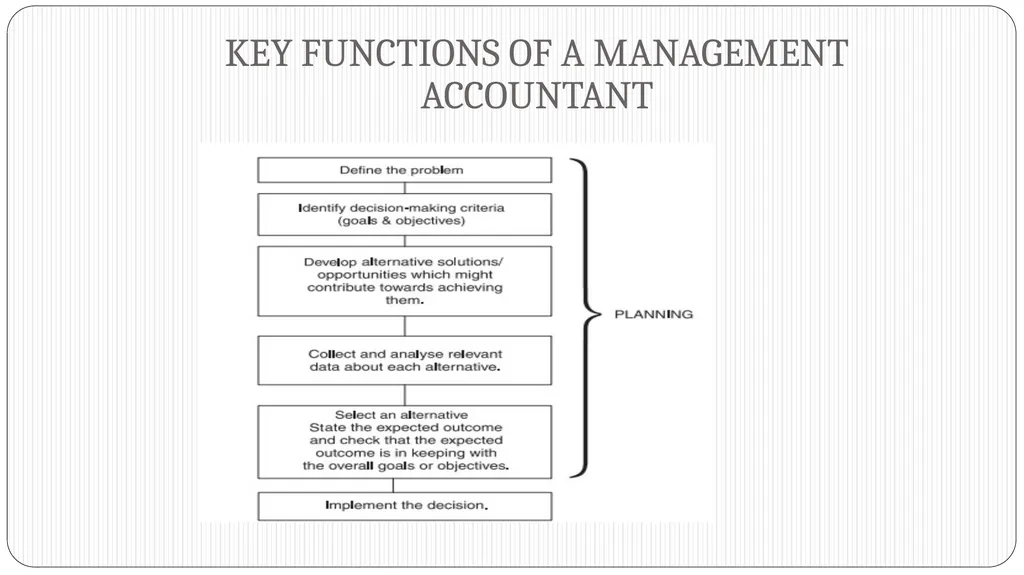
Decision-making process
It is possible to analyse the decision-making process into a sequence of steps. These apply no matter whether the decision is taken immediately, or whether the matter is carefully considered before a decision is reached. KEY FUNCTIONS OF A MANAGEMENT ACCOUNTANT<br>
It is possible to analyse the decision-making process into a sequence of steps. These apply no matter whether the decision is taken immediately, or whether the matter is carefully considered before a decision is reached. KEY FUNCTIONS OF A MANAGEMENT ACCOUNTANT<br>
13
KEY FUNCTIONS OF A MANAGEMENT ACCOUNTANT<br>
14
A financial management system is the methodology and software that an organization uses to oversee and govern its income, expenses, and assets with the objectives of maximizing profits and ensuring sustainability. An effective financial management system improves short- and long-term business performance by streamlining invoicing and bill collection, eliminating accounting errors, minimizing record-keeping redundancy, ensuring compliance with tax and accounting regulations, helping personnel to quantify budget planning, and offering flexibility and expandability to accommodate change and growth. FINANCIAL MANAGEMENT SYSTEMS<br>
15
Benefits of financial management systems
Automates the quote-to-cash cycle in one end-to-end process on the Salesforce cloud, to increase efficiency and improve cycle
Streamline ordering and billing processes online by using information already stored in Salesforce CRM - so there's no need for manual rekeying, customer account synchronizations, or complex integrations FINANCIAL MANAGEMENT SYSTEMS<br>
Automates the quote-to-cash cycle in one end-to-end process on the Salesforce cloud, to increase efficiency and improve cycle
Streamline ordering and billing processes online by using information already stored in Salesforce CRM - so there's no need for manual rekeying, customer account synchronizations, or complex integrations FINANCIAL MANAGEMENT SYSTEMS<br>
16
Provides flexible ways to capture and store financial information, so you can accurately model and report on your businesses
Offers a real time system that eliminates the need for A/P and A/R reconciliations and shortens period closes
Enables Chatter integration to facilitate frequent and effective collaboration across your organization on any business issue FINANCIAL MANAGEMENT SYSTEMS<br>
Offers a real time system that eliminates the need for A/P and A/R reconciliations and shortens period closes
Enables Chatter integration to facilitate frequent and effective collaboration across your organization on any business issue FINANCIAL MANAGEMENT SYSTEMS<br>
17
Risk management is "The total process of identifying, controlling, and mitigating information system–related risks. It includes risk assessment; cost benefit analysis; and the selection, implementation, test, and security evaluation of safeguards." (Stoneburner,Goguen & Feringa, 2002). We cannot be avoided from risk, but at least we can minimize it. FINANCIAL MANAGEMENT SYSTEMS<br>
18
The Community team provide some suggestion in order to minimize risk management, for instance, stuff screening, financial controls and ensure that all the premises are covered by their insurance policies. While The Our Community team emphasizes that the insurance is not a substitute for risk management, insurance comes after doing what the management can do to minimize the risk. Meanwhile, management accountant's report covers an overview of risk management (CIAM). FINANCIAL MANAGEMENT SYSTEMS<br>
19
Financial risks create the possibility of losses arising from
the failure to achieve a financial objective. The risk reflects
uncertainty about foreign exchange rates, interest rates,
commodity prices, equity prices, credit quality, liquidity,
and an organization’s access to financing. These financial
risks are not necessarily independent of each other. For
instance, exchange rates and interest rates are often strongly linked, and this interdependence should be recognized when managers are designing risk management systems FINANCIAL MANAGEMENT SYSTEMS<br>
the failure to achieve a financial objective. The risk reflects
uncertainty about foreign exchange rates, interest rates,
commodity prices, equity prices, credit quality, liquidity,
and an organization’s access to financing. These financial
risks are not necessarily independent of each other. For
instance, exchange rates and interest rates are often strongly linked, and this interdependence should be recognized when managers are designing risk management systems FINANCIAL MANAGEMENT SYSTEMS<br>
20
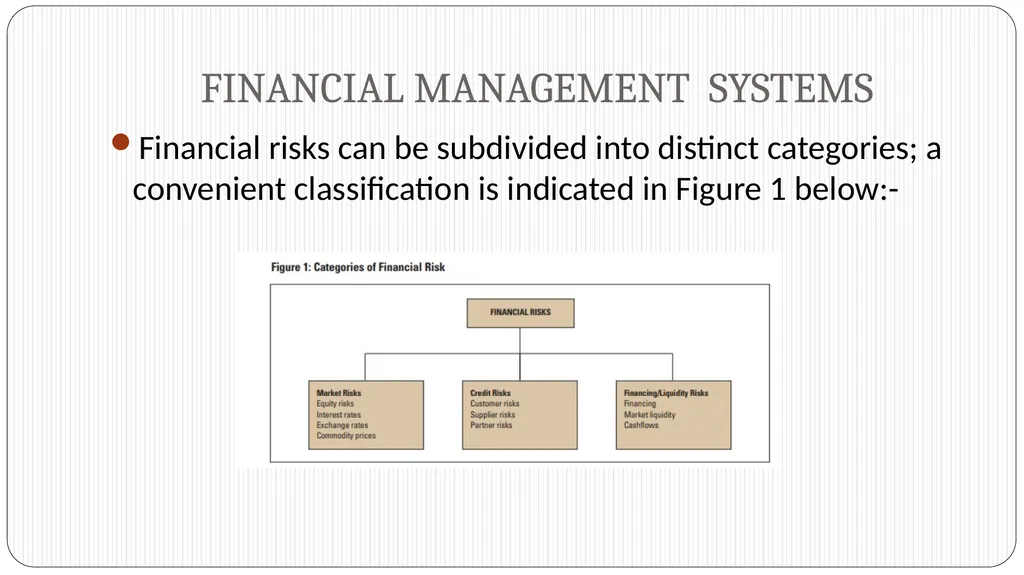
Financial risks can be subdivided into distinct categories; a convenient classification is indicated in Figure 1 below:- FINANCIAL MANAGEMENT SYSTEMS<br>
21
Market risks: These are the financial risks that arise
because of possible losses due to changes in future
market prices or rates. The price changes will often relate
to interest or foreign exchange rate movements, but also
include the price of basic commodities that are vital to
the business. FINANCIAL MANAGEMENT SYSTEMS<br>
because of possible losses due to changes in future
market prices or rates. The price changes will often relate
to interest or foreign exchange rate movements, but also
include the price of basic commodities that are vital to
the business. FINANCIAL MANAGEMENT SYSTEMS<br>
22
Credit risks: Financial risks associated with the possibility of default by a counter-party. Credit risks typically arise because customers fail to pay for goods supplied on credit.
Credit risk exposure increases substantially when a firm depends heavily upon a small number of large customers who have been granted access to a significant amount
of credit. The significance of credit risk varies between sectors, and is high in the area of financial services, where short- and long-term lending are fundamental to the
business.
A firm can also be exposed to the credit risks of other firms with which it is heavily connected. For example, a firm may suffer losses if a key supplier or partner in a joint
venture has difficulty accessing credit to continue trading. FINANCIAL MANAGEMENT SYSTEMS<br>
Credit risk exposure increases substantially when a firm depends heavily upon a small number of large customers who have been granted access to a significant amount
of credit. The significance of credit risk varies between sectors, and is high in the area of financial services, where short- and long-term lending are fundamental to the
business.
A firm can also be exposed to the credit risks of other firms with which it is heavily connected. For example, a firm may suffer losses if a key supplier or partner in a joint
venture has difficulty accessing credit to continue trading. FINANCIAL MANAGEMENT SYSTEMS<br>
23
Financing, liquidity and cash flow risks: Financing risks
affect an organization’s ability to obtain ongoing financing.
An obvious example is the dependence of a firm on its
access to credit from its bank. Liquidity risk refers to
uncertainty regarding the ability of a firm to unwind a
position at little or no cost, and also relates to the availability
of sufficient funds to meet financial commitments
when they fall due. Cashflow risks relate to the volatility
of the firm’s day-to-day operating cash flow. FINANCIAL MANAGEMENT SYSTEMS<br>
affect an organization’s ability to obtain ongoing financing.
An obvious example is the dependence of a firm on its
access to credit from its bank. Liquidity risk refers to
uncertainty regarding the ability of a firm to unwind a
position at little or no cost, and also relates to the availability
of sufficient funds to meet financial commitments
when they fall due. Cashflow risks relate to the volatility
of the firm’s day-to-day operating cash flow. FINANCIAL MANAGEMENT SYSTEMS<br>
24
Firms can benefit from financial risk management in many
different ways, but perhaps the most important benefit is
to protect the firm’s ability to attend to its core business
and achieve its strategic objectives. By making stakeholders
more secure, a good risk management policy
helps encourage equity investors, creditors, managers,
workers, suppliers, and customers to remain loyal to the
business. In short, the firm’s goodwill is strengthened in
all manner of diverse and mutually reinforcing ways. FINANCIAL MANAGEMENT SYSTEMS<br>
different ways, but perhaps the most important benefit is
to protect the firm’s ability to attend to its core business
and achieve its strategic objectives. By making stakeholders
more secure, a good risk management policy
helps encourage equity investors, creditors, managers,
workers, suppliers, and customers to remain loyal to the
business. In short, the firm’s goodwill is strengthened in
all manner of diverse and mutually reinforcing ways. FINANCIAL MANAGEMENT SYSTEMS<br>
25
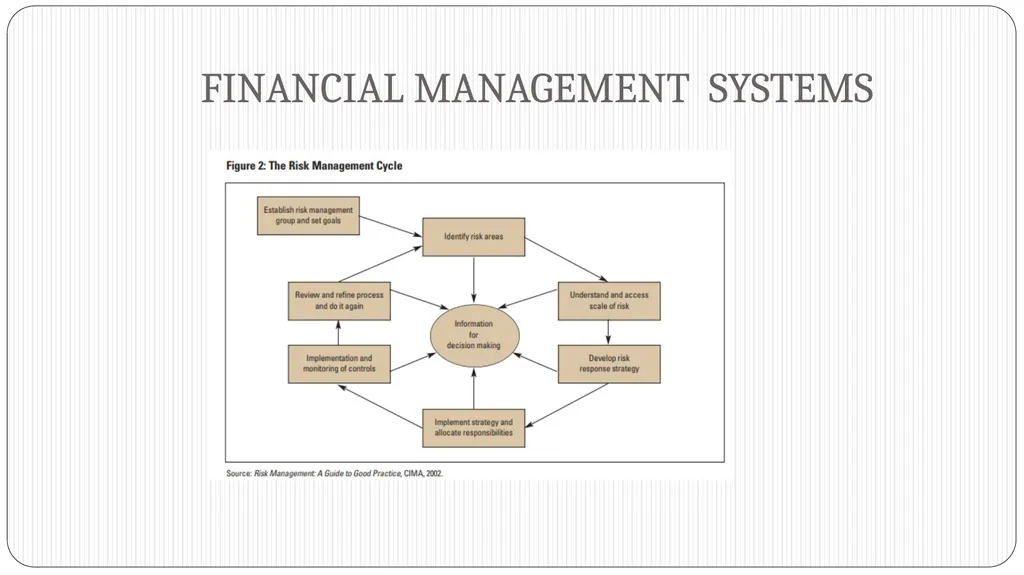
Organizations face many different types of risks, but they
can all be managed using a common framework1
. The framework summarized in this section therefore directly
applies to financial risk management, and provides a
context for subsequent sections that (a) outline the
different types of financial risks, and (b) explain how
financial risks may be identified and assessed before
implementing appropriate strategies and control systems. FINANCIAL MANAGEMENT SYSTEMS<br>
can all be managed using a common framework1
. The framework summarized in this section therefore directly
applies to financial risk management, and provides a
context for subsequent sections that (a) outline the
different types of financial risks, and (b) explain how
financial risks may be identified and assessed before
implementing appropriate strategies and control systems. FINANCIAL MANAGEMENT SYSTEMS<br>
26
FINANCIAL MANAGEMENT SYSTEMS<br>
27
REFERENCES Cimaglobal.com. (2018). CIMA - What is management accounting?. [online] Available at: https://www.cimaglobal.com/Starting-CIMA/Why-CIMA/what-is-management-accounting/ [Accessed 10 Mar. 2018].
Global Journal of Management and Business Research Volume 12 Issue 15 Version 1.0 Year 2012 Type: Double Blind Peer Reviewed International Research Journal Publisher: Global Journals Inc. (USA) Online ISSN: 2249-4588 & Print ISSN: 0975-5853
Cpaaustralia.com.au. (2018). [online] Available at: https://www.cpaaustralia.com.au/documents/study-manual-management-accounting.pdf [Accessed 10 Mar. 2018].<br>
Global Journal of Management and Business Research Volume 12 Issue 15 Version 1.0 Year 2012 Type: Double Blind Peer Reviewed International Research Journal Publisher: Global Journals Inc. (USA) Online ISSN: 2249-4588 & Print ISSN: 0975-5853
Cpaaustralia.com.au. (2018). [online] Available at: https://www.cpaaustralia.com.au/documents/study-manual-management-accounting.pdf [Accessed 10 Mar. 2018].<br>
28
REFERENCES SearchERP. (2018). What is financial management system? - Definition from WhatIs.com. [online] Available at: http://searcherp.techtarget.com/definition/financial-management-system [Accessed 10 Mar. 2018].
FinancialForce. (2018). Financial Management System - FinancialForce. [online] Available at: https://www.financialforce.com/info/financial-management-system/ [Accessed 10 Mar. 2018].
Cimaglobal.com. (2018). Cite a Website - Cite This For Me. [online] Available at: https://www.cimaglobal.com/Documents/ImportedDocuments/cid_mag_financial_risk_jan09.pdf [Accessed 10 Mar. 2018].<br>
FinancialForce. (2018). Financial Management System - FinancialForce. [online] Available at: https://www.financialforce.com/info/financial-management-system/ [Accessed 10 Mar. 2018].
Cimaglobal.com. (2018). Cite a Website - Cite This For Me. [online] Available at: https://www.cimaglobal.com/Documents/ImportedDocuments/cid_mag_financial_risk_jan09.pdf [Accessed 10 Mar. 2018].<br>