04
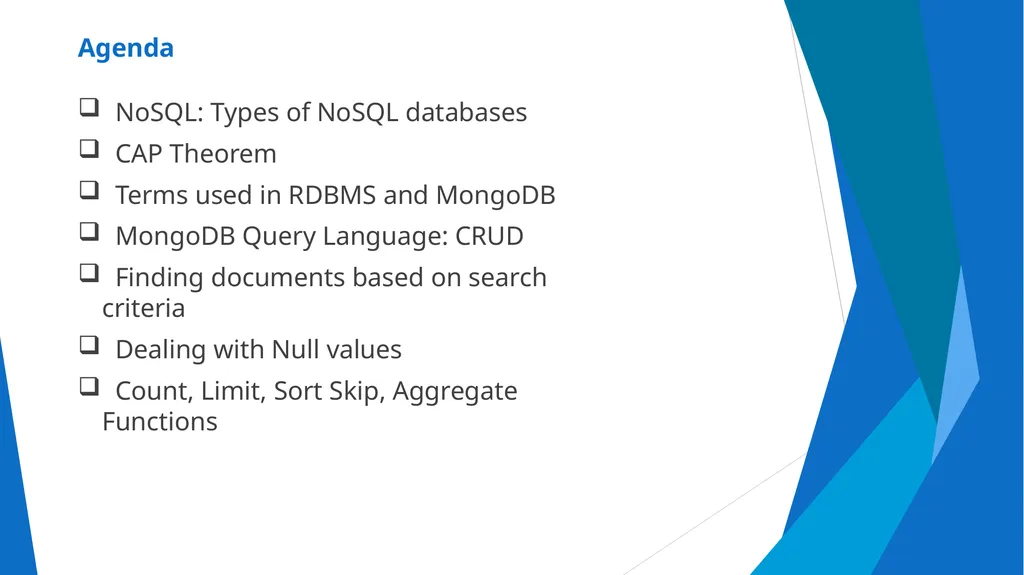
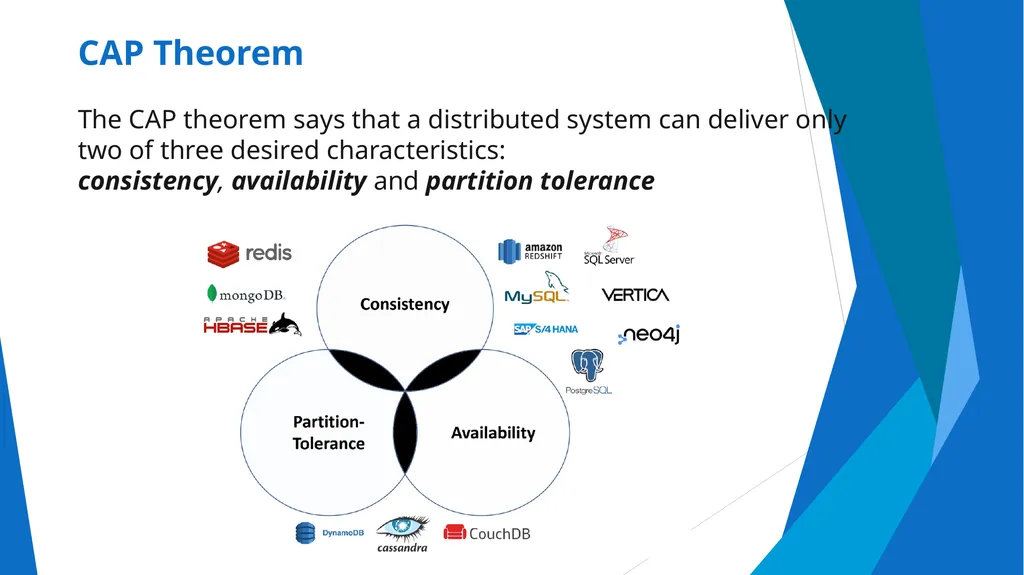
CAP Theorem The CAP theorem says that a distributed system can deliver only two of three desired characteristics:
consistency, availability and partition tolerance<br>
05
What is MongoDB? MongoDB is:
Cross-Platform.
Open Source.
Non-relational.
Distributed.
NoSQL.
Document-oriented data store.<br>
07
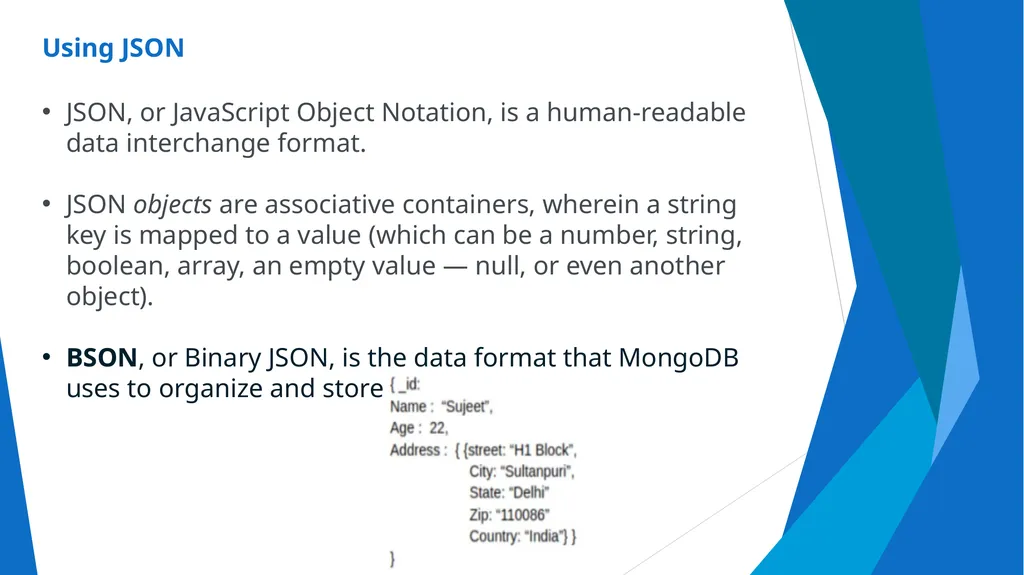
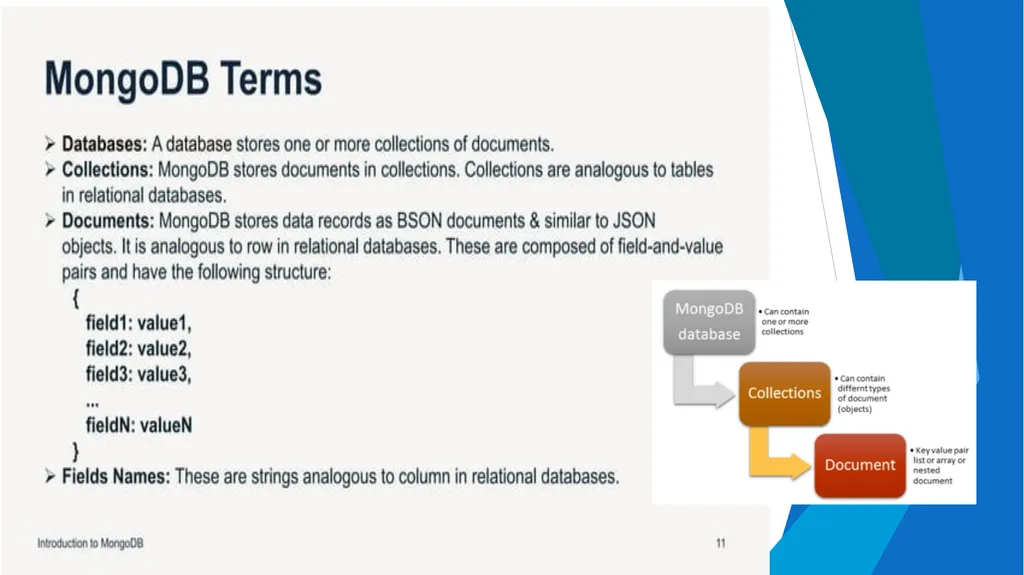
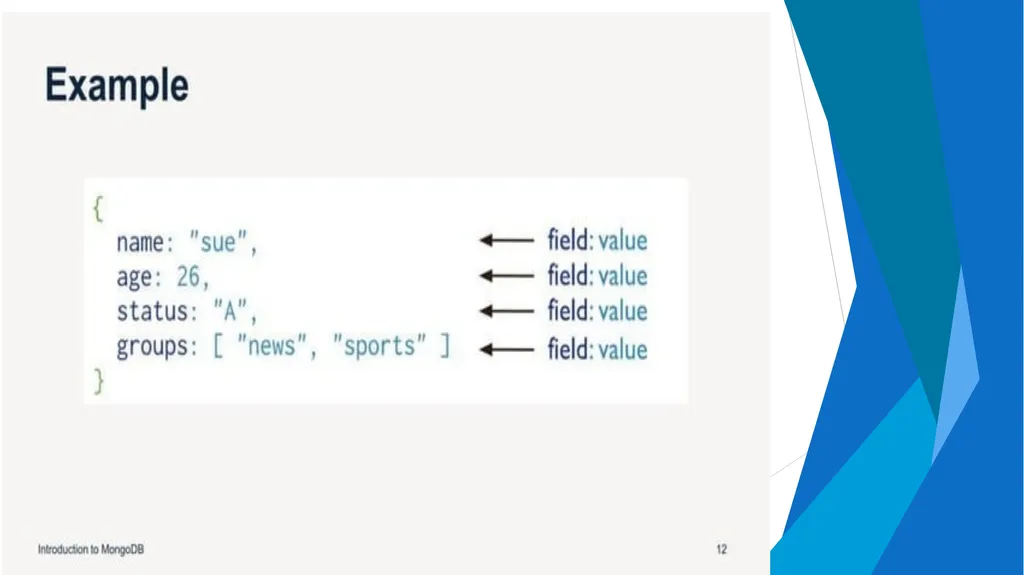
Using JSON JSON, or JavaScript Object Notation, is a human-readable data interchange format.
JSON objects are associative containers, wherein a string key is mapped to a value (which can be a number, string, boolean, array, an empty value — null, or even another object).
BSON, or Binary JSON, is the data format that MongoDB uses to organize and store data.<br>
08
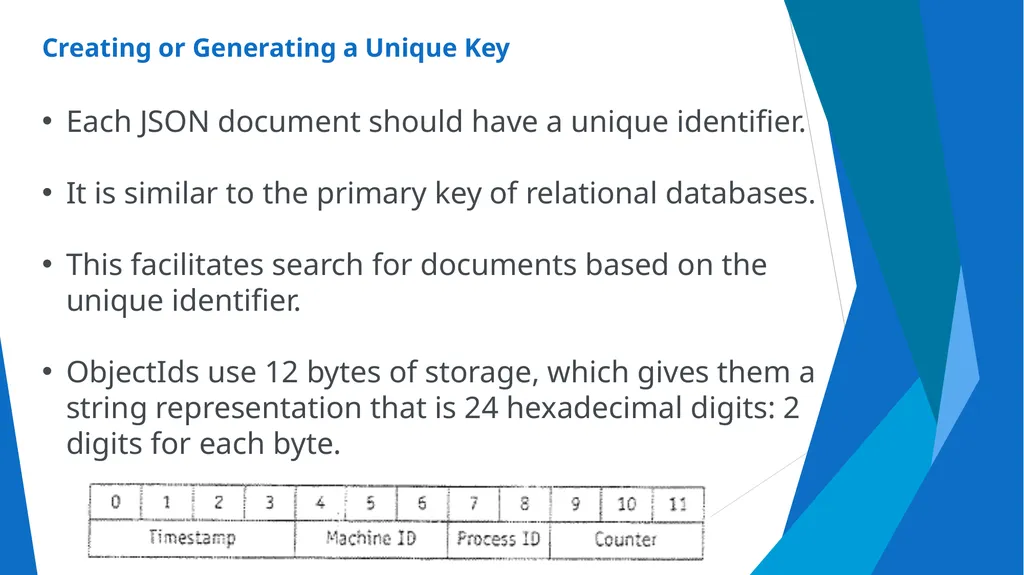
Creating or Generating a Unique Key Each JSON document should have a unique identifier.
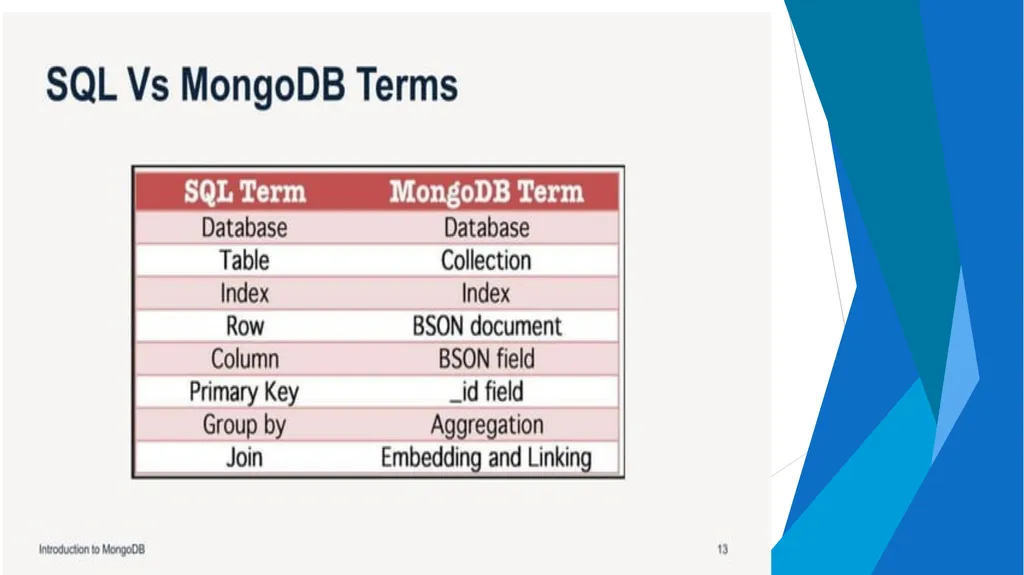
It is similar to the primary key of relational databases.
This facilitates search for documents based on the unique identifier.
ObjectIds use 12 bytes of storage, which gives them a string representation that is 24 hexadecimal digits: 2 digits for each byte.<br>
09
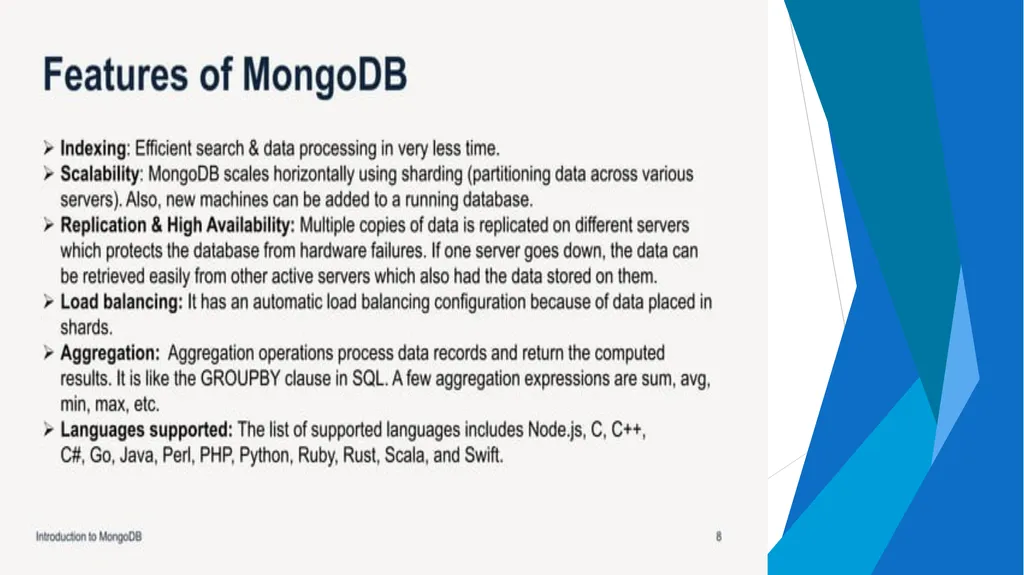
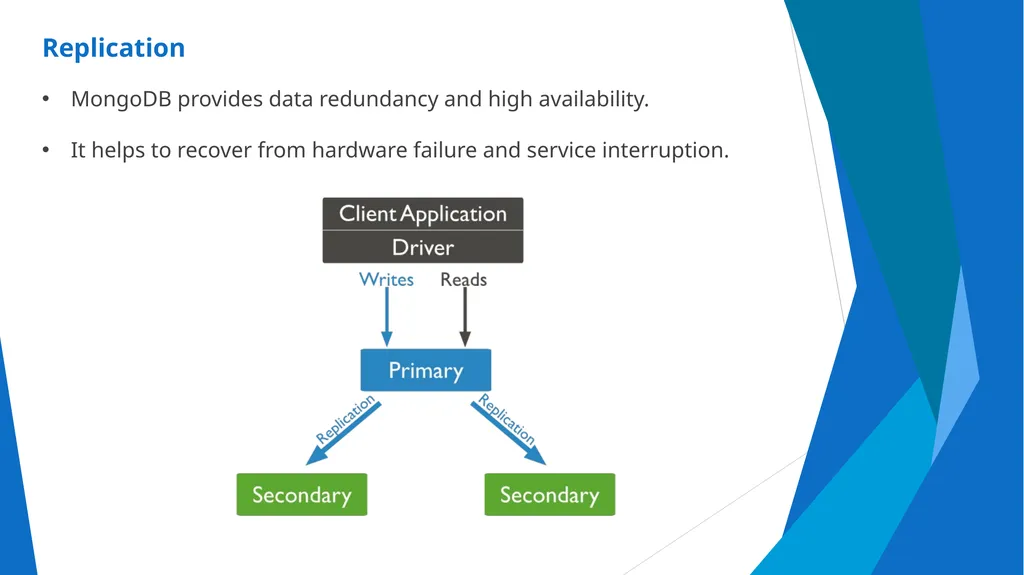
Replication MongoDB provides data redundancy and high availability.
It helps to recover from hardware failure and service interruption.<br>
10
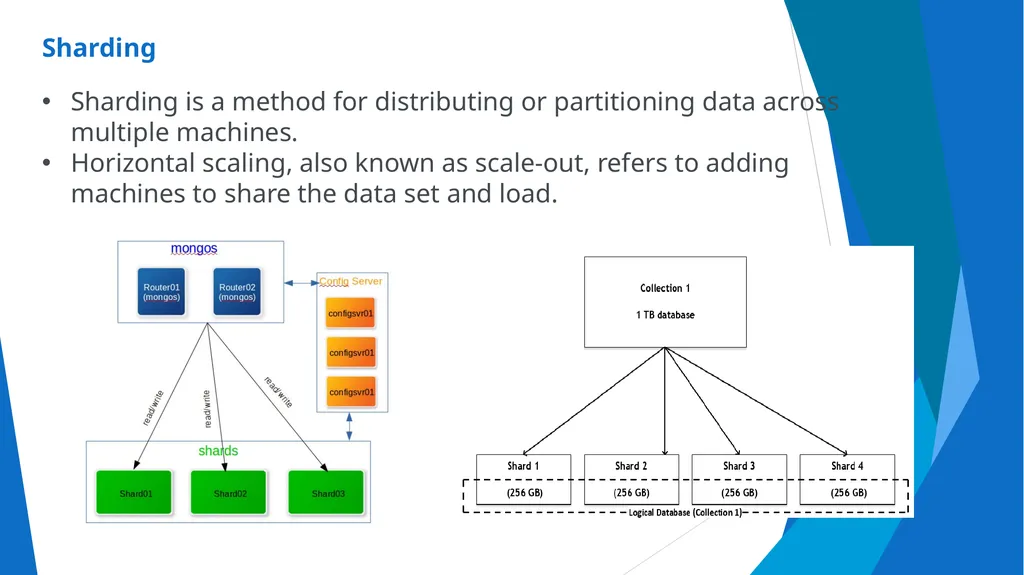
Sharding Sharding is a method for distributing or partitioning data across multiple machines.
Horizontal scaling, also known as scale-out, refers to adding machines to share the data set and load.<br>
11
Advantages of Sharding Increased read/write throughput.
Increased storage capacity.
Data Locality.<br>
12
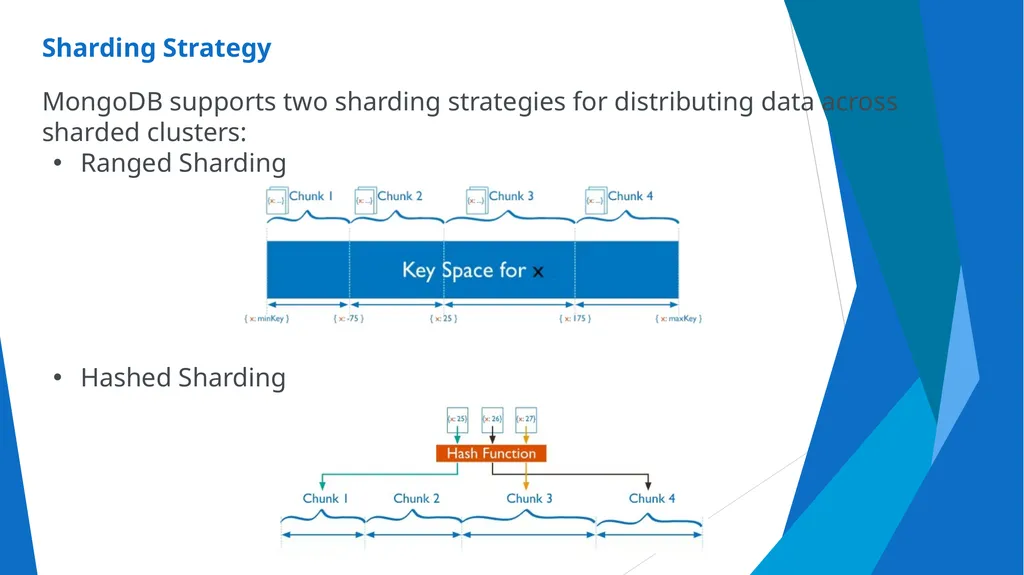
Sharding Strategy MongoDB supports two sharding strategies for distributing data across sharded clusters:
Ranged Sharding
Hashed Sharding<br>
13
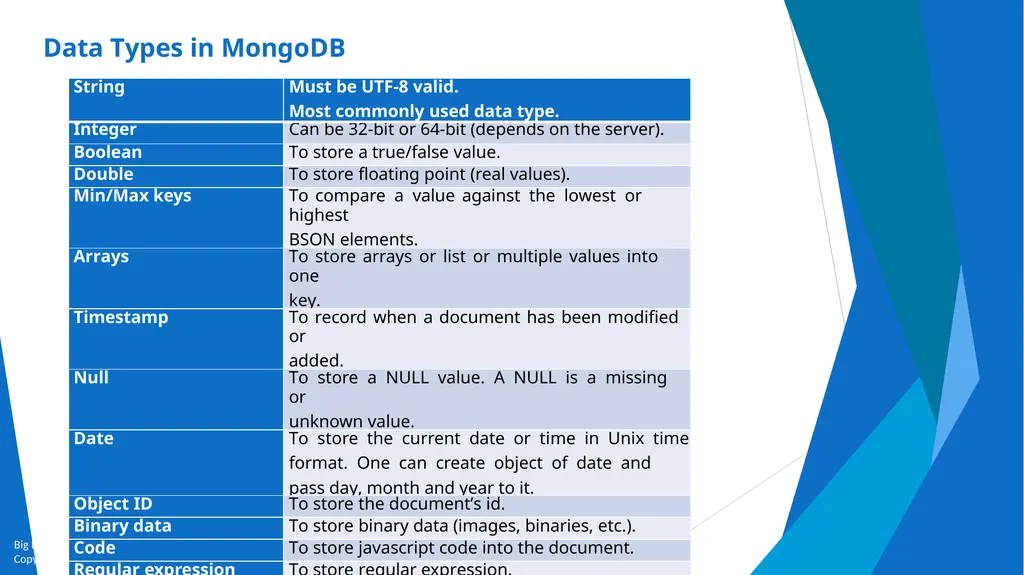
Data Types in MongoDB Big Data and Analytics by Seema Acharya and Subhashini Chellappan
Copyright 2015, WILEY INDIA PVT. LTD.<br>
14
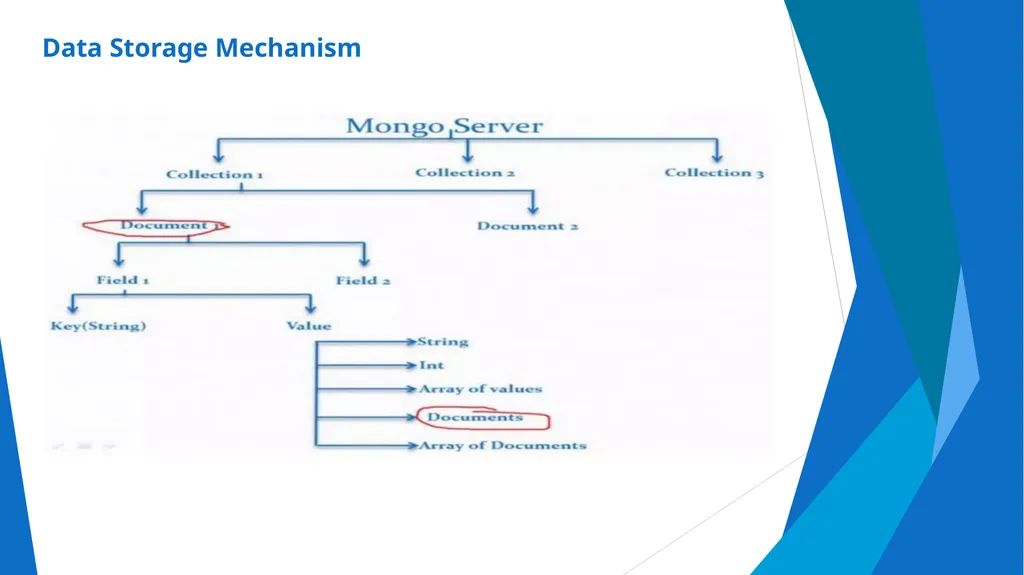
Data Storage Mechanism<br>
15
Collections Big Data and Analytics by Seema Acharya and Subhashini Chellappan
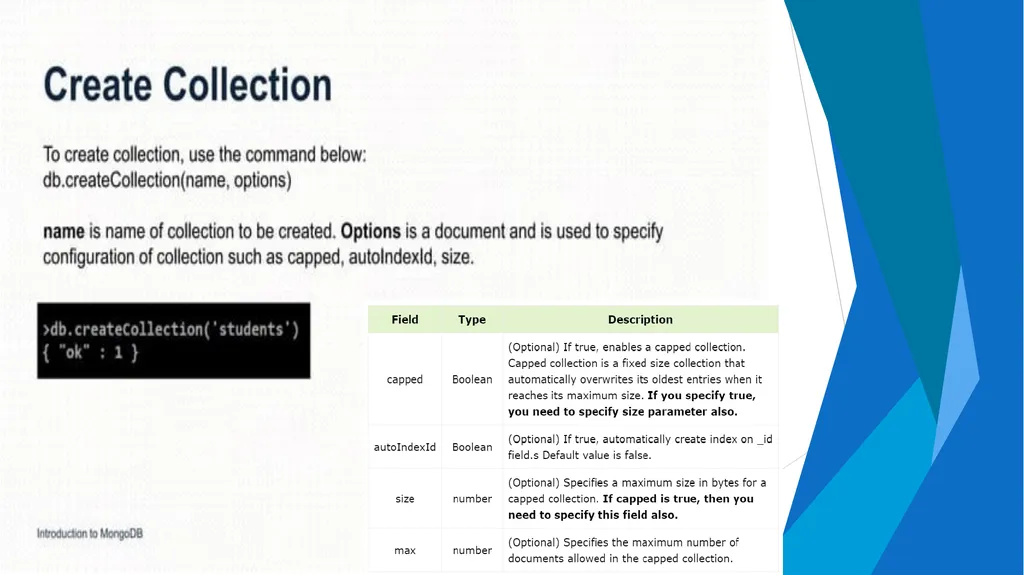
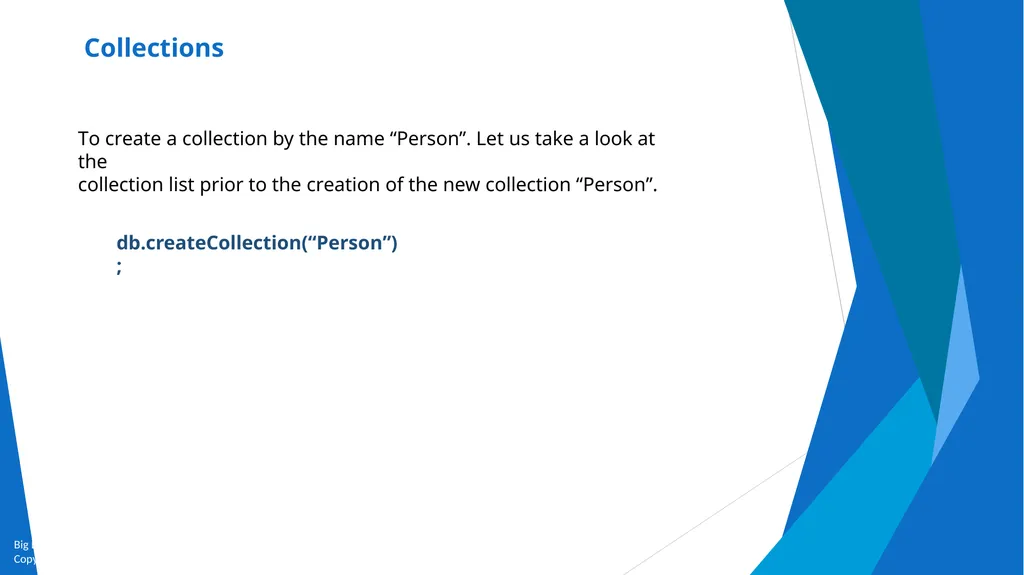
Copyright 2015, WILEY INDIA PVT. LTD. To create a collection by the name “Person”. Let us take a look at the
collection list prior to the creation of the new collection “Person”. db.createCollection(“Person”);<br>
16
Collections Big Data and Analytics by Seema Acharya and Subhashini Chellappan
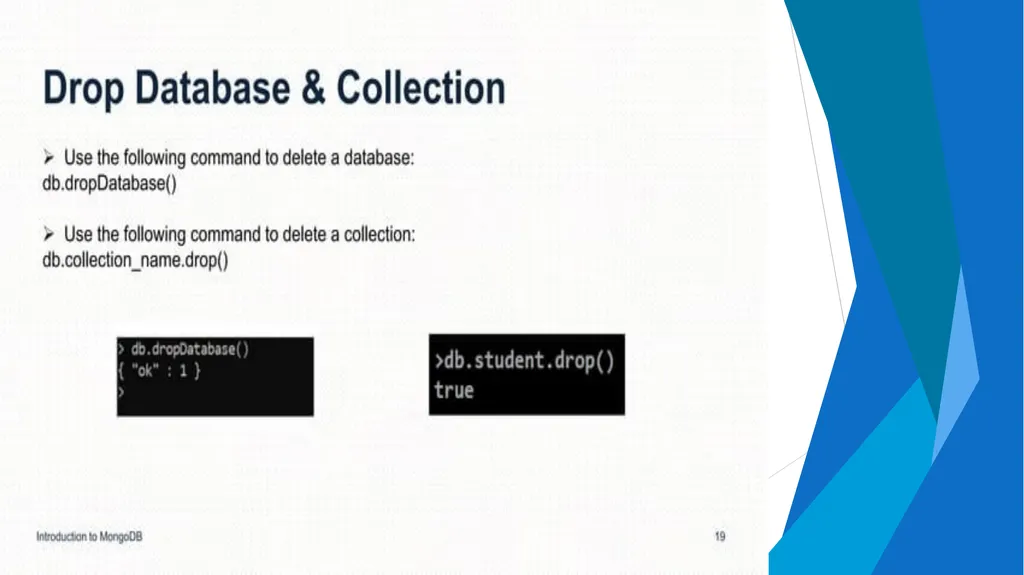
Copyright 2015, WILEY INDIA PVT. LTD. To drop a collection by the name “food”. db.food.drop();<br>
17
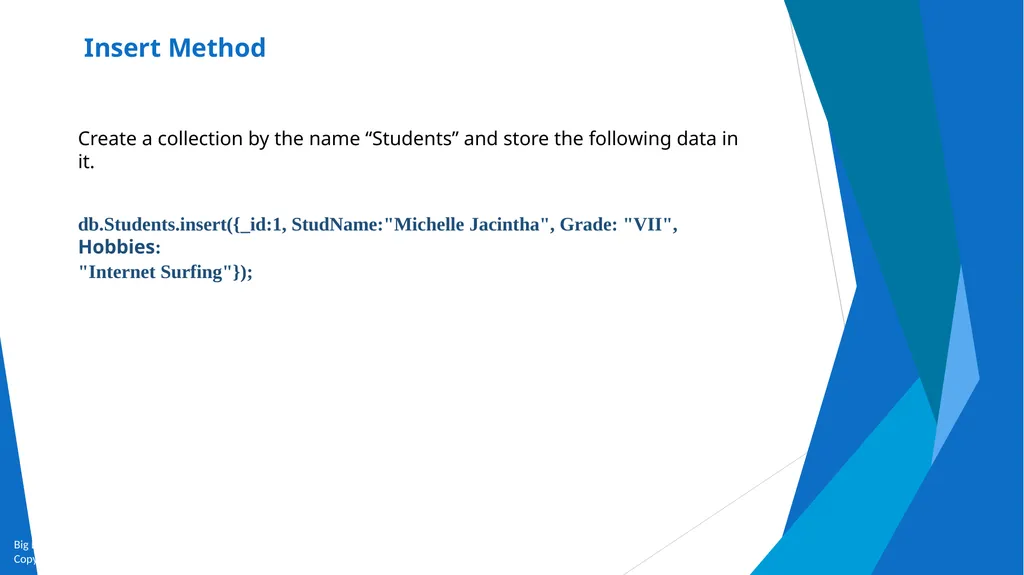
Insert Method Big Data and Analytics by Seema Acharya and Subhashini Chellappan
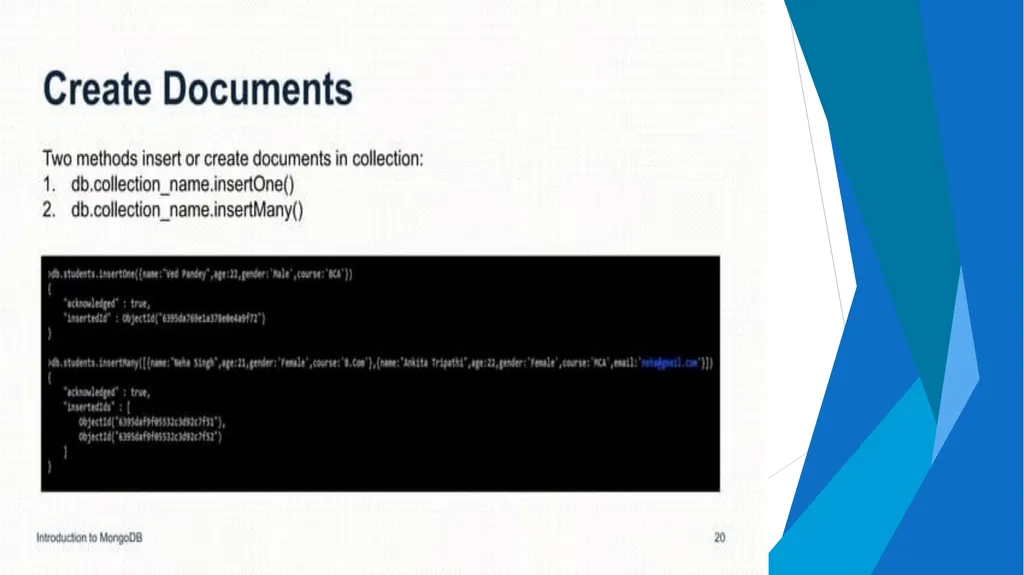
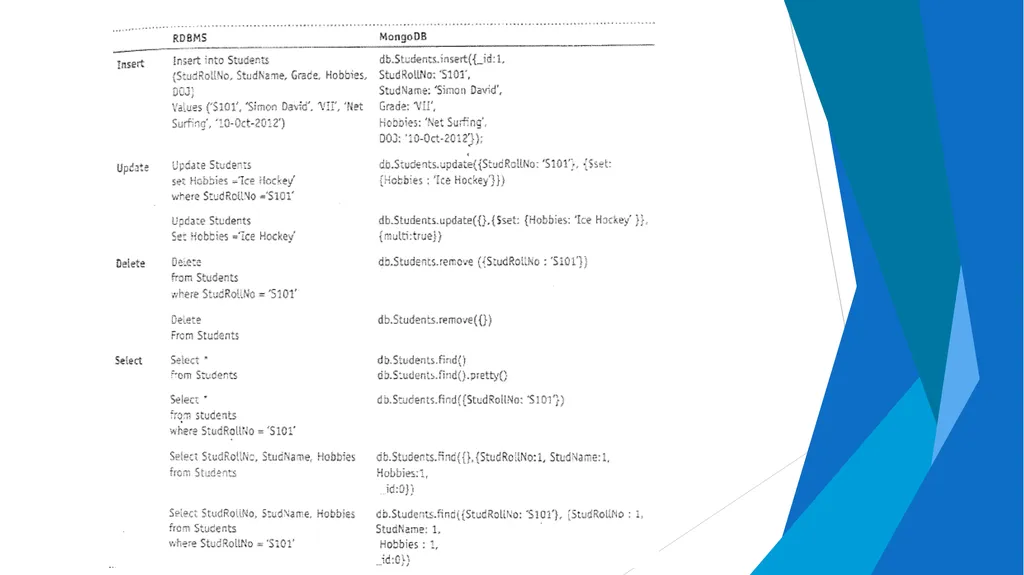
Copyright 2015, WILEY INDIA PVT. LTD. Create a collection by the name “Students” and store the following data in it. db.Students.insert({_id:1, StudName:"Michelle Jacintha", Grade: "VII", Hobbies:
"Internet Surfing"});<br>
18
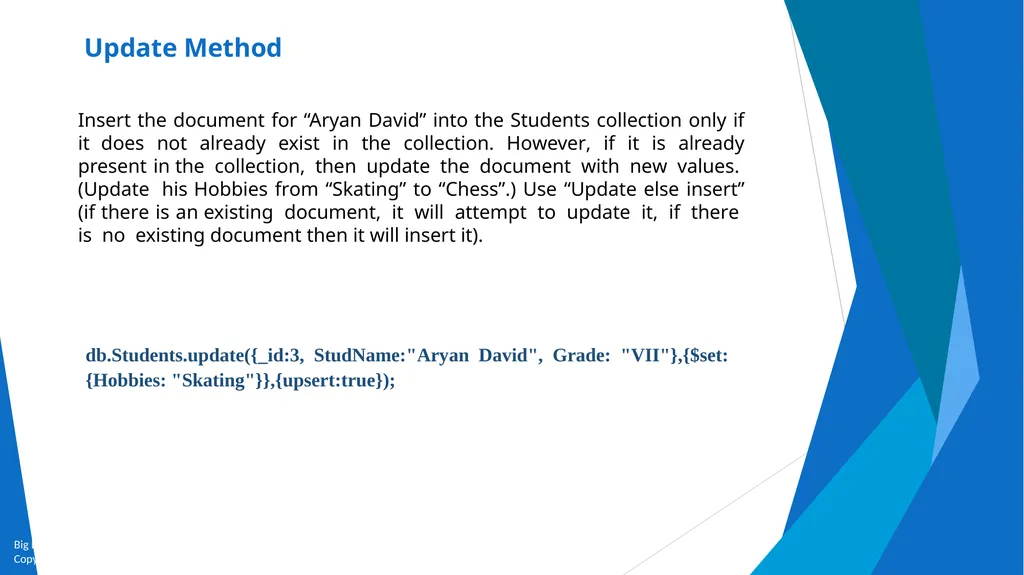
Update Method Big Data and Analytics by Seema Acharya and Subhashini Chellappan
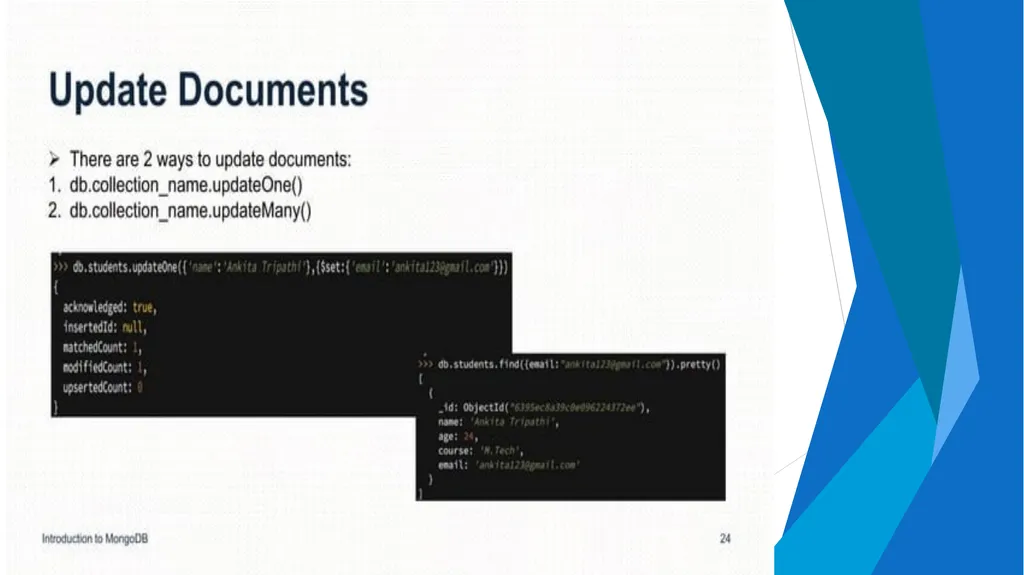
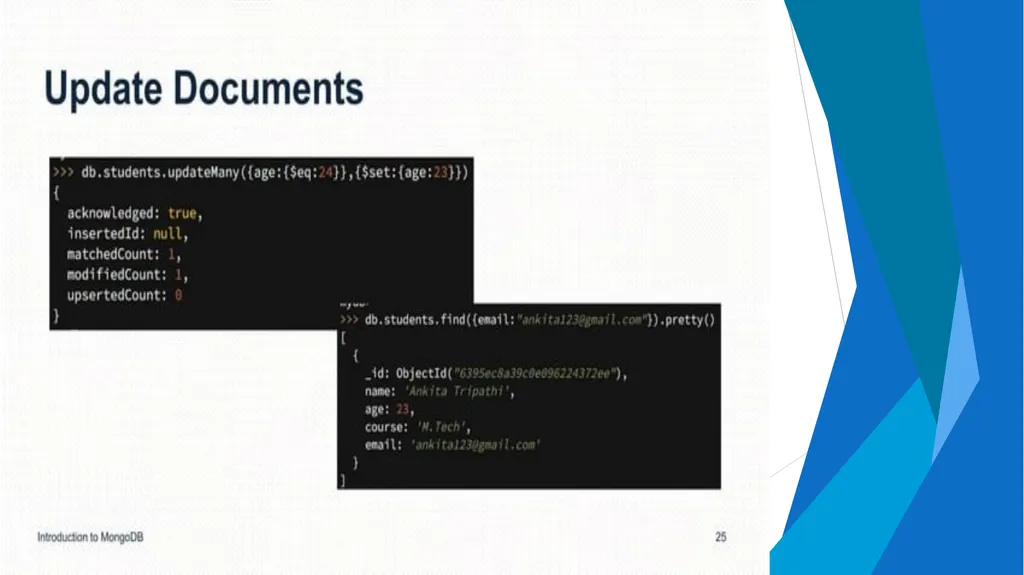
Copyright 2015, WILEY INDIA PVT. LTD. Insert the document for “Aryan David” into the Students collection only if it does not already exist in the collection. However, if it is already present in the collection, then update the document with new values. (Update his Hobbies from “Skating” to “Chess”.) Use “Update else insert” (if there is an existing document, it will attempt to update it, if there is no existing document then it will insert it). db.Students.update({_id:3, StudName:"Aryan David", Grade: "VII"},{$set:{Hobbies: "Skating"}},{upsert:true});<br>
19
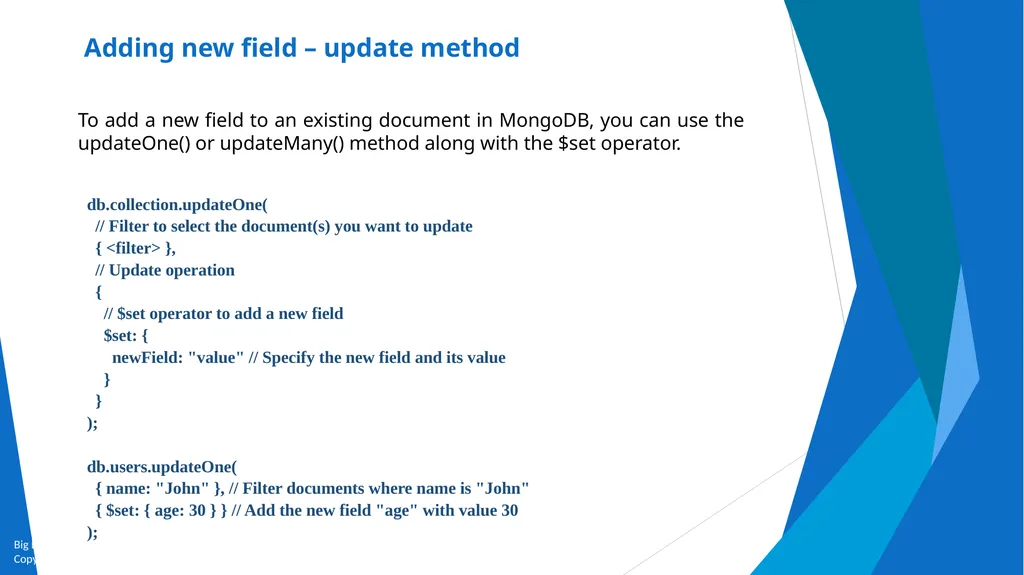
Adding new field – update method Big Data and Analytics by Seema Acharya and Subhashini Chellappan
Copyright 2015, WILEY INDIA PVT. LTD. To add a new field to an existing document in MongoDB, you can use the updateOne() or updateMany() method along with the $set operator. db.collection.updateOne(
// Filter to select the document(s) you want to update
{ <filter> },
// Update operation
{
// $set operator to add a new field
$set: {
newField: "value" // Specify the new field and its value
}
}
);
db.users.updateOne(
{ name: "John" }, // Filter documents where name is "John"
{ $set: { age: 30 } } // Add the new field "age" with value 30
);<br>
20
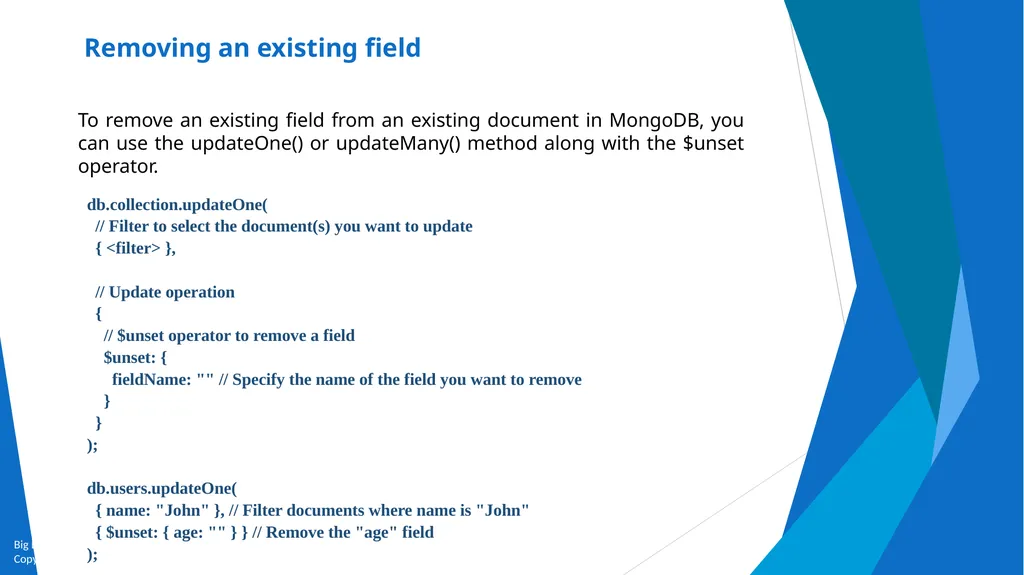
Removing an existing field Big Data and Analytics by Seema Acharya and Subhashini Chellappan
Copyright 2015, WILEY INDIA PVT. LTD. To remove an existing field from an existing document in MongoDB, you can use the updateOne() or updateMany() method along with the $unset operator. db.collection.updateOne(
// Filter to select the document(s) you want to update
{ <filter> },
// Update operation
{
// $unset operator to remove a field
$unset: {
fieldName: "" // Specify the name of the field you want to remove
}
}
);
db.users.updateOne(
{ name: "John" }, // Filter documents where name is "John"
{ $unset: { age: "" } } // Remove the "age" field
);<br>
21
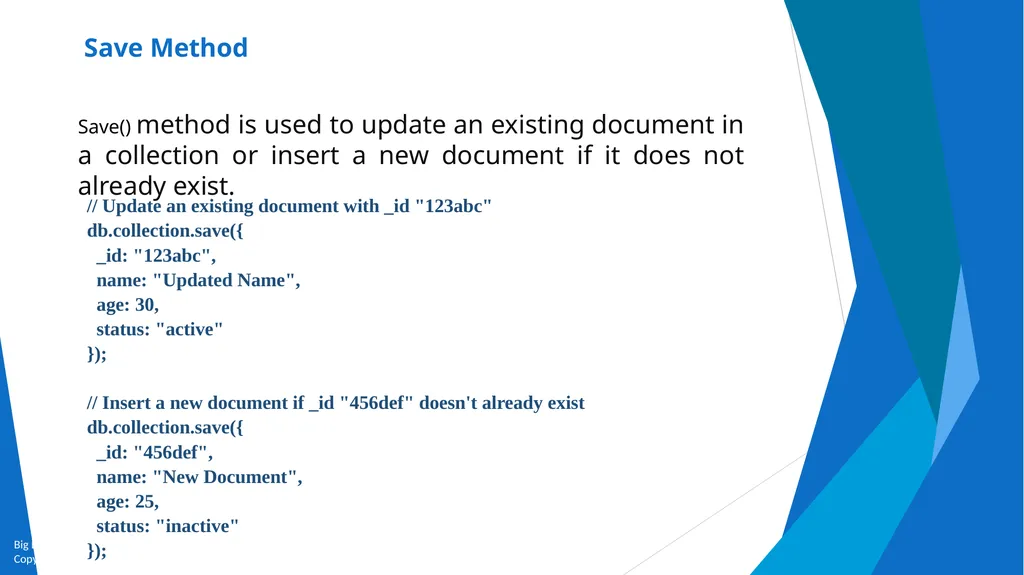
Save Method Big Data and Analytics by Seema Acharya and Subhashini Chellappan
Copyright 2015, WILEY INDIA PVT. LTD. Save() method is used to update an existing document in a collection or insert a new document if it does not already exist. // Update an existing document with _id "123abc"
db.collection.save({
_id: "123abc",
name: "Updated Name",
age: 30,
status: "active"
});
// Insert a new document if _id "456def" doesn't already exist
db.collection.save({
_id: "456def",
name: "New Document",
age: 25,
status: "inactive"
});<br>
22
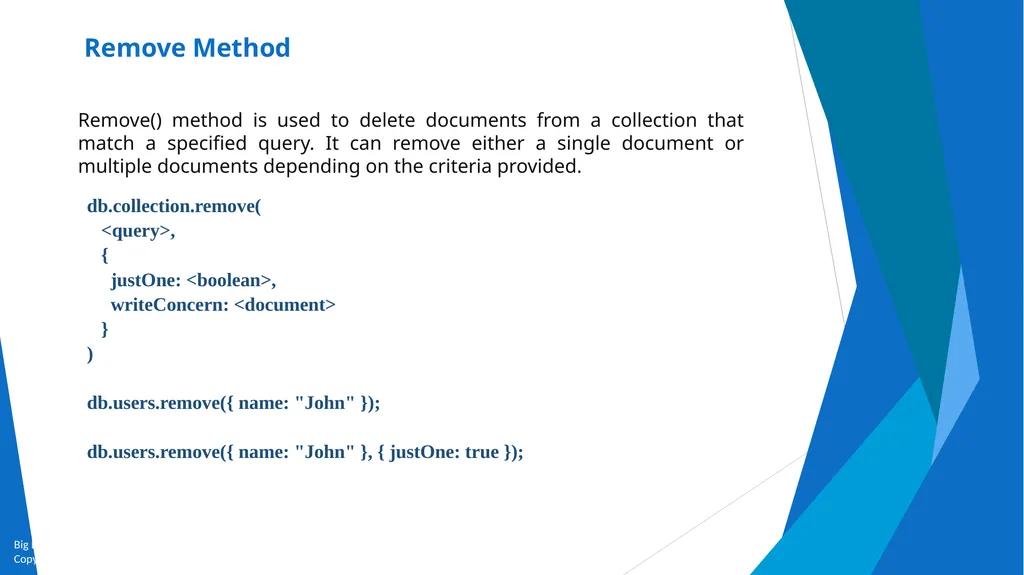
Remove Method Big Data and Analytics by Seema Acharya and Subhashini Chellappan
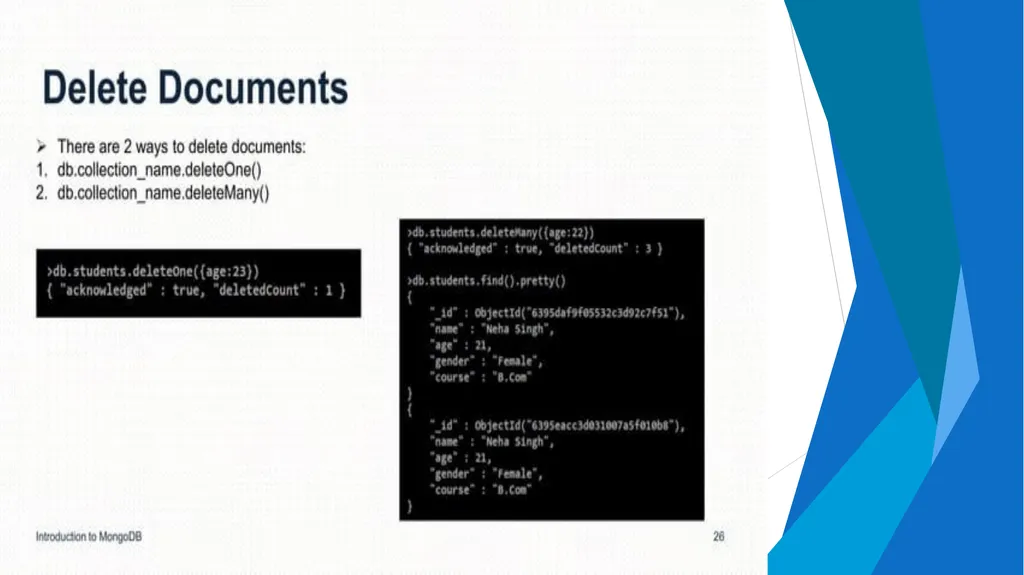
Copyright 2015, WILEY INDIA PVT. LTD. Remove() method is used to delete documents from a collection that match a specified query. It can remove either a single document or multiple documents depending on the criteria provided. db.collection.remove(
<query>,
{
justOne: <boolean>,
writeConcern: <document>
}
)
db.users.remove({ name: "John" });
db.users.remove({ name: "John" }, { justOne: true });<br>
23
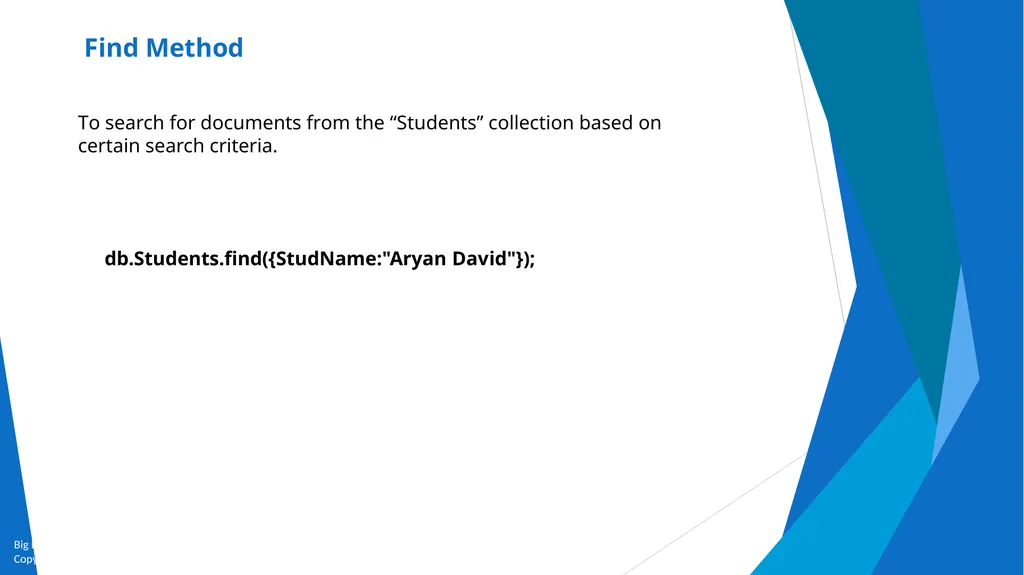
Find Method Big Data and Analytics by Seema Acharya and Subhashini Chellappan
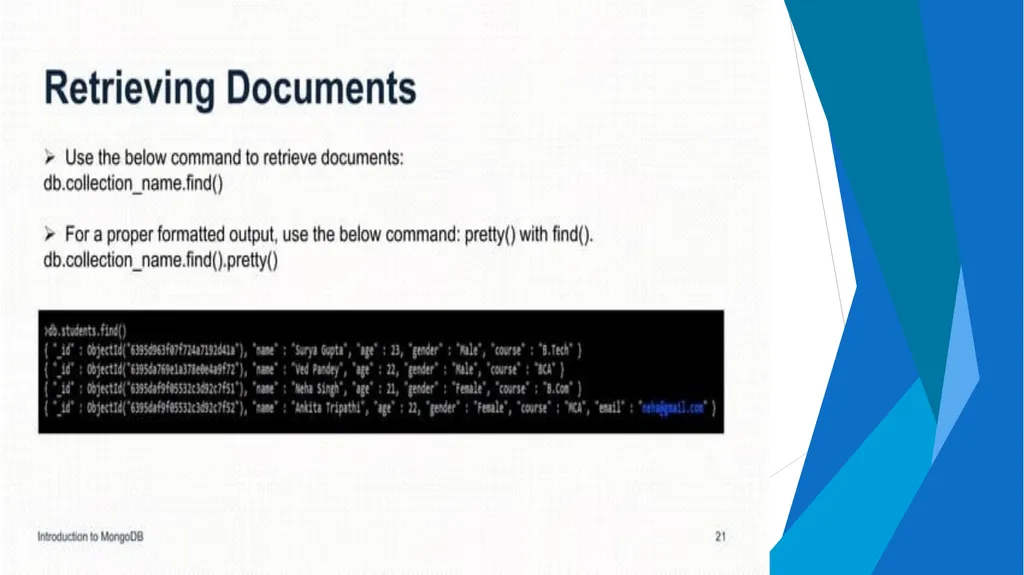
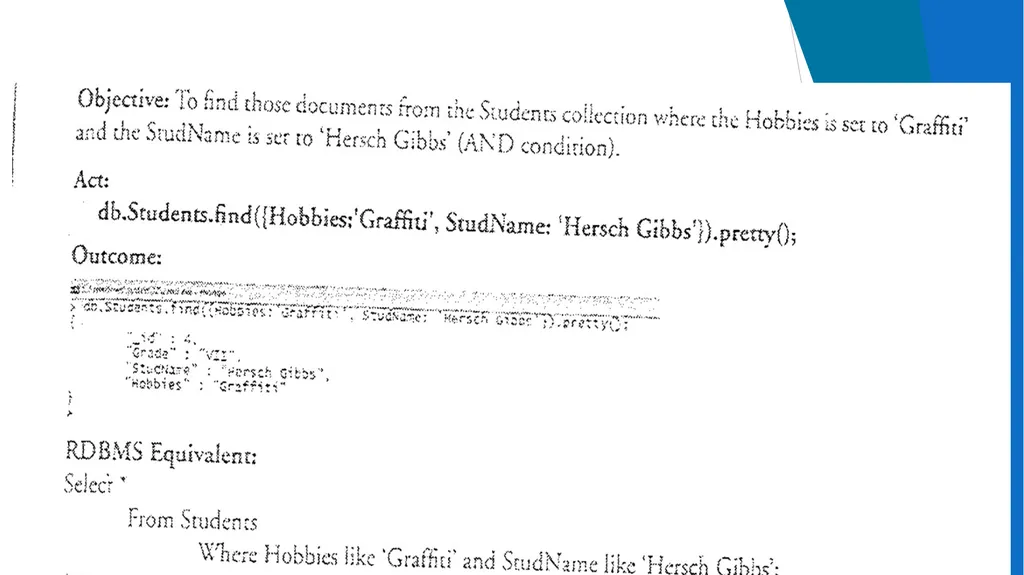
Copyright 2015, WILEY INDIA PVT. LTD. To search for documents from the “Students” collection based on certain search criteria. db.Students.find({StudName:"Aryan David"});<br>
24
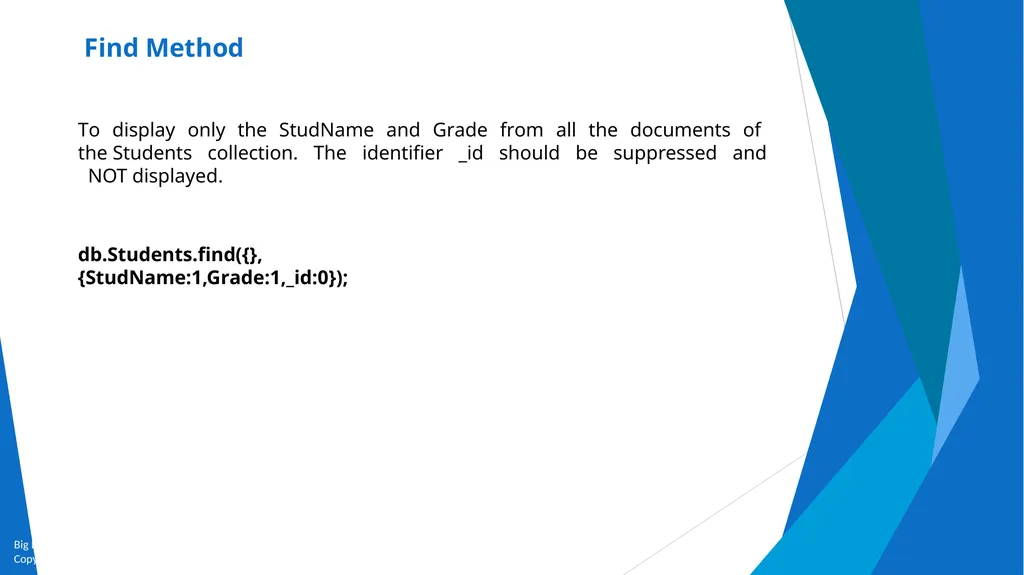
Find Method Big Data and Analytics by Seema Acharya and Subhashini Chellappan
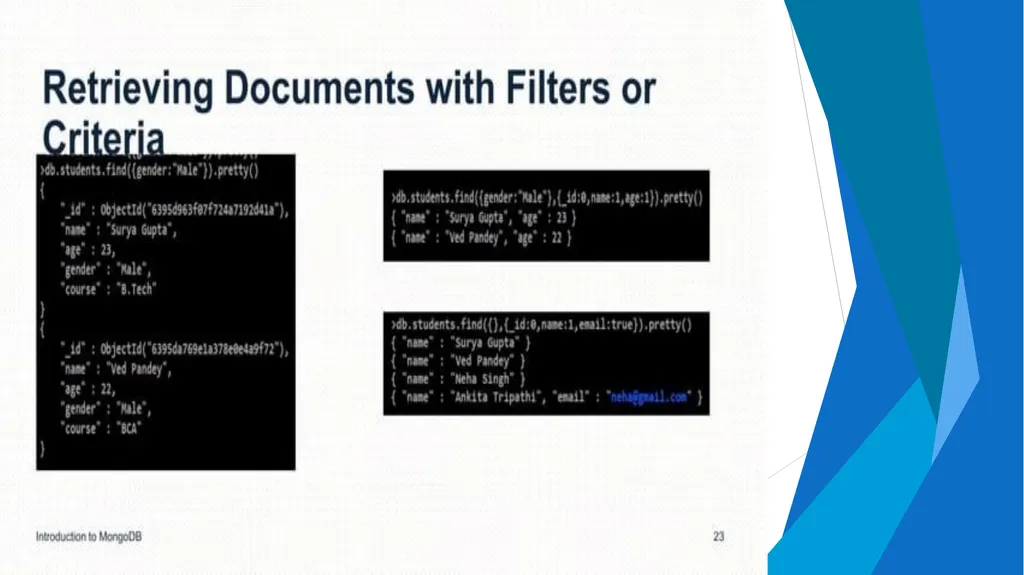
Copyright 2015, WILEY INDIA PVT. LTD. To display only the StudName and Grade from all the documents of the Students collection. The identifier _id should be suppressed and NOT displayed. db.Students.find({},{StudName:1,Grade:1,_id:0});<br>
25
Find Method Big Data and Analytics by Seema Acharya and Subhashini Chellappan
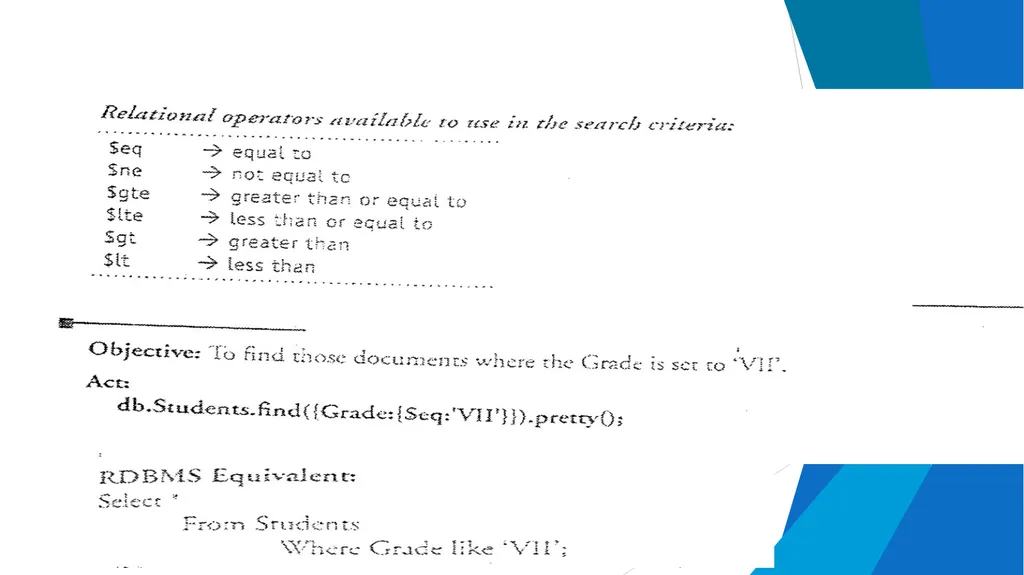
Copyright 2015, WILEY INDIA PVT. LTD. To find those documents where the Grade is set to ‘VII’ db.Students.find({Grade:{$eq:'VII'}}).pretty();<br>
26
Find Method Big Data and Analytics by Seema Acharya and Subhashini Chellappan
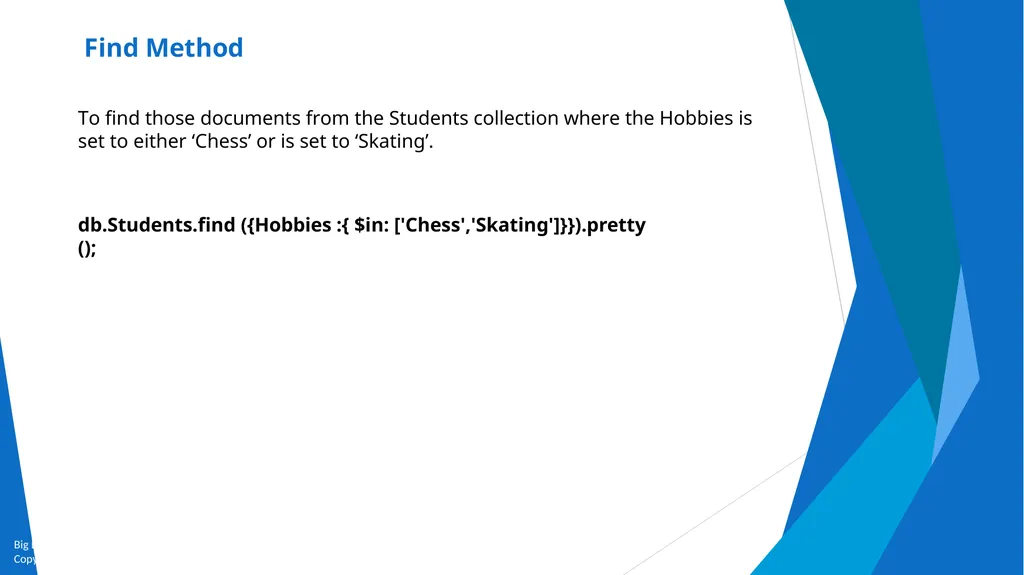
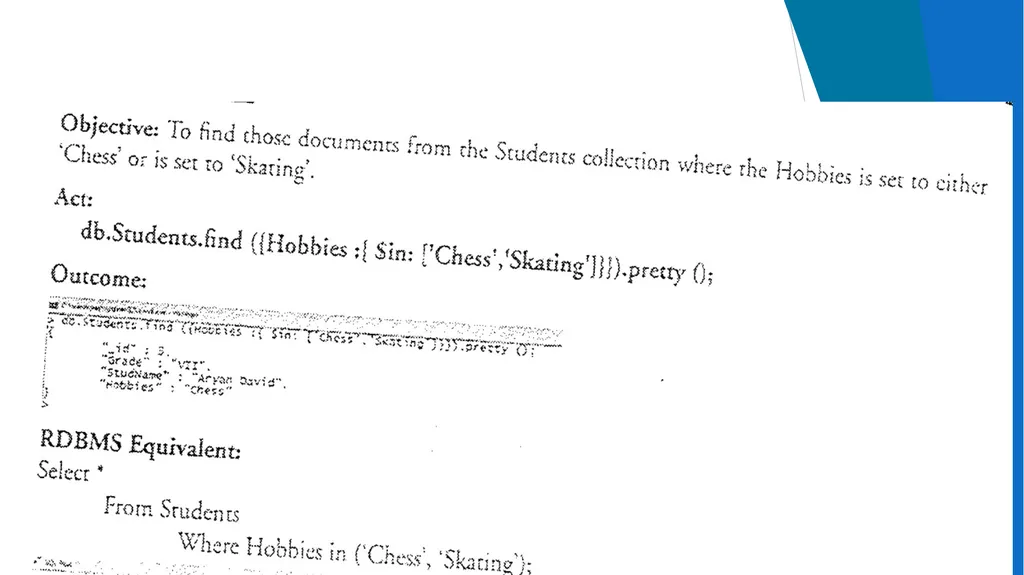
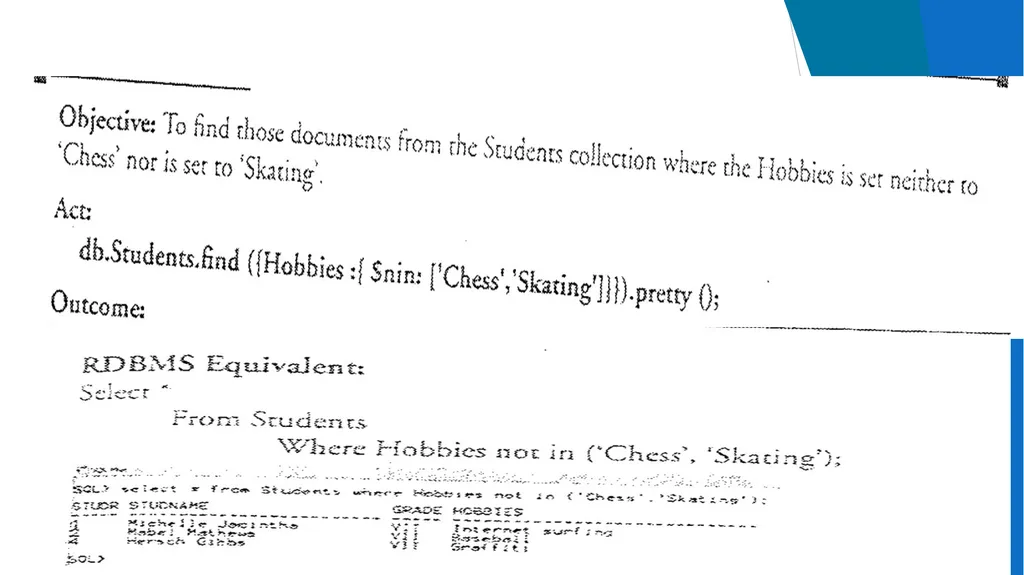
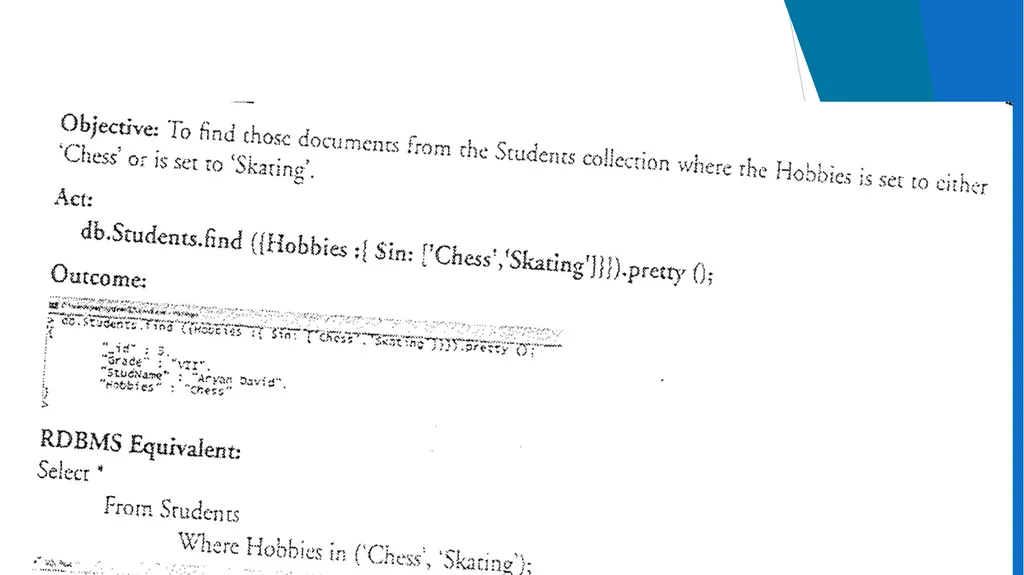
Copyright 2015, WILEY INDIA PVT. LTD. To find those documents from the Students collection where the Hobbies is set to either ‘Chess’ or is set to ‘Skating’. db.Students.find ({Hobbies :{ $in: ['Chess','Skating']}}).pretty ();<br>
27
Find Method Big Data and Analytics by Seema Acharya and Subhashini Chellappan
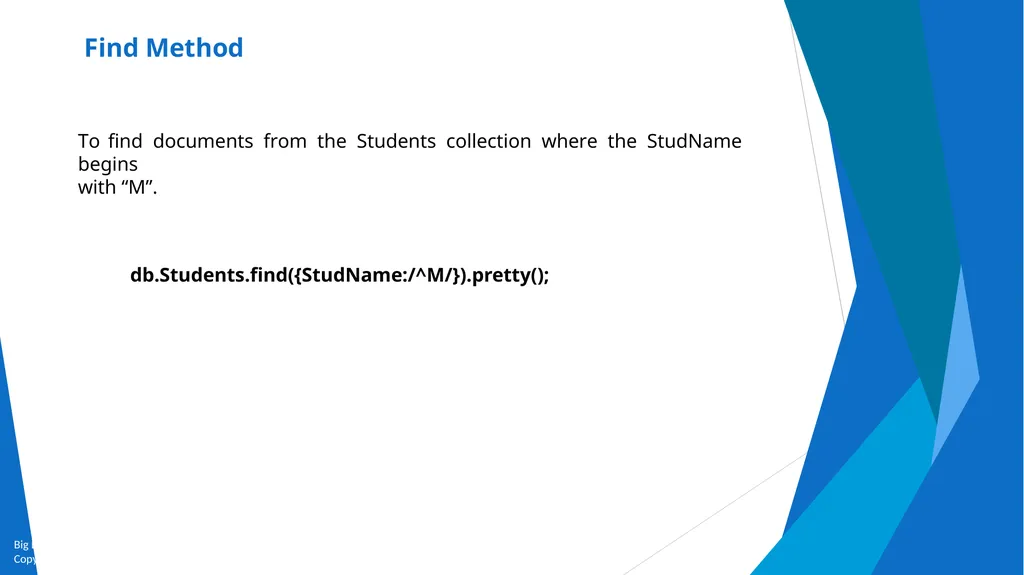
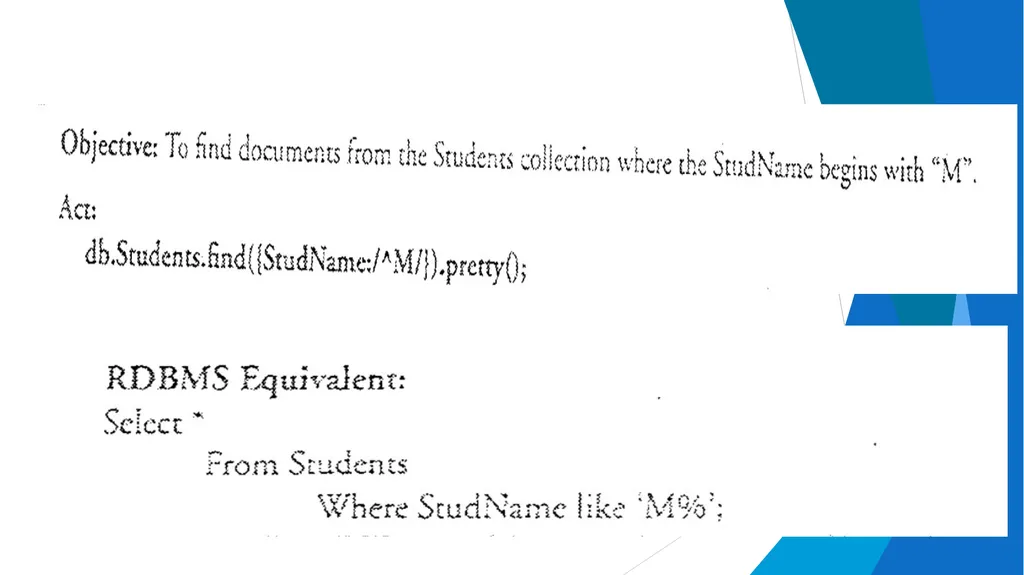
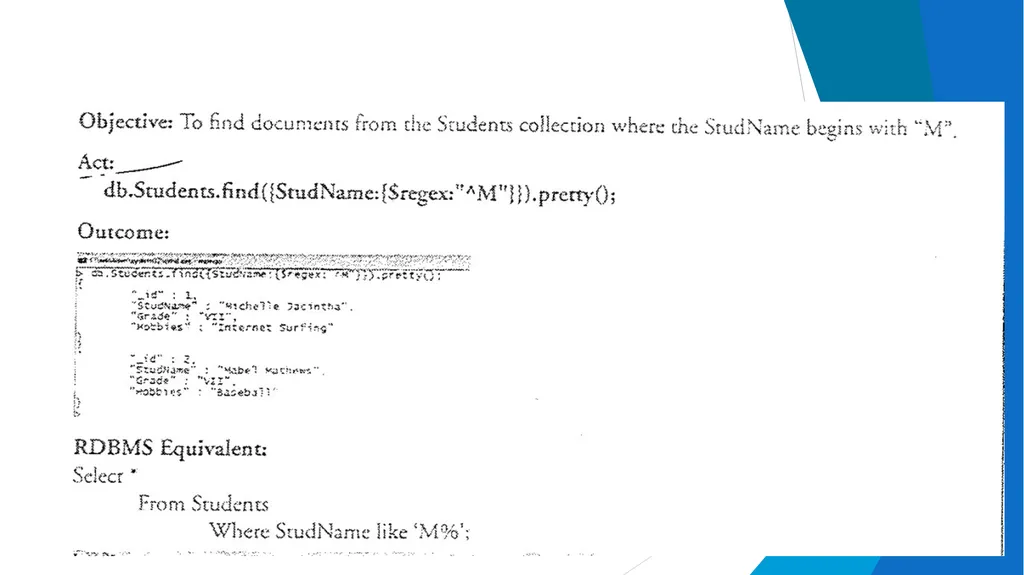
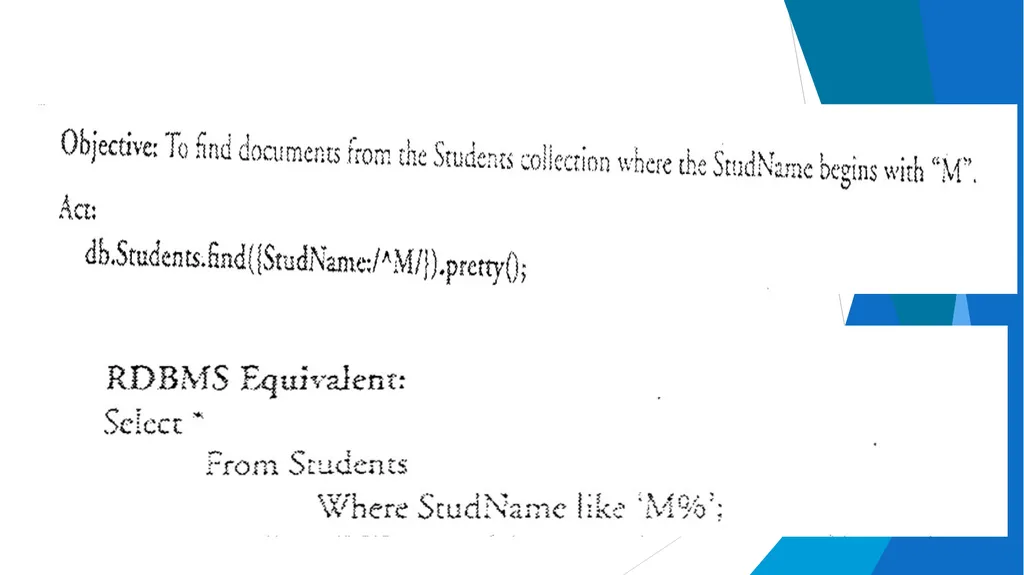
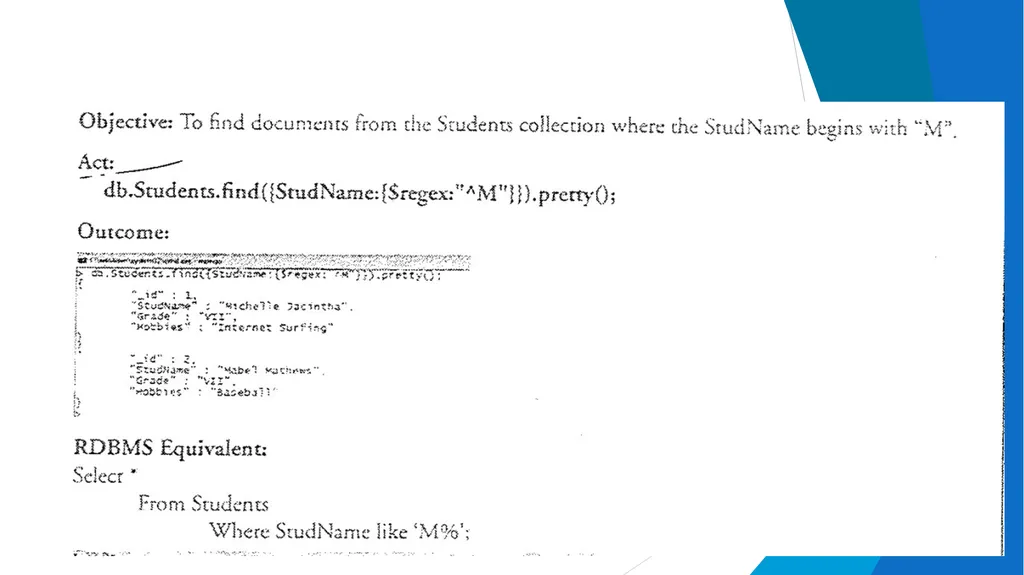
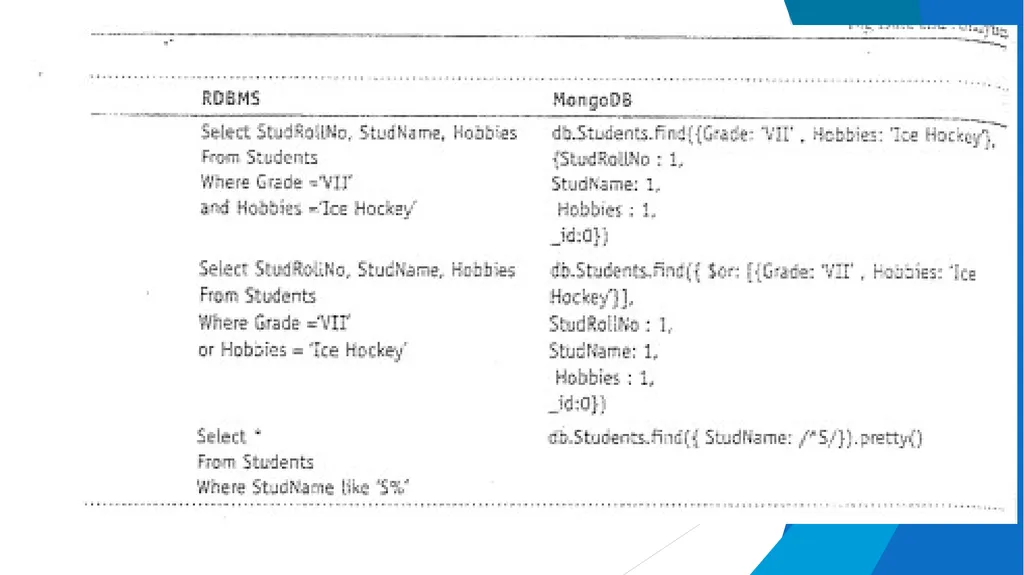
Copyright 2015, WILEY INDIA PVT. LTD. To find documents from the Students collection where the StudName begins
with “M”. db.Students.find({StudName:/^M/}).pretty();<br>
28
Find Method Big Data and Analytics by Seema Acharya and Subhashini Chellappan
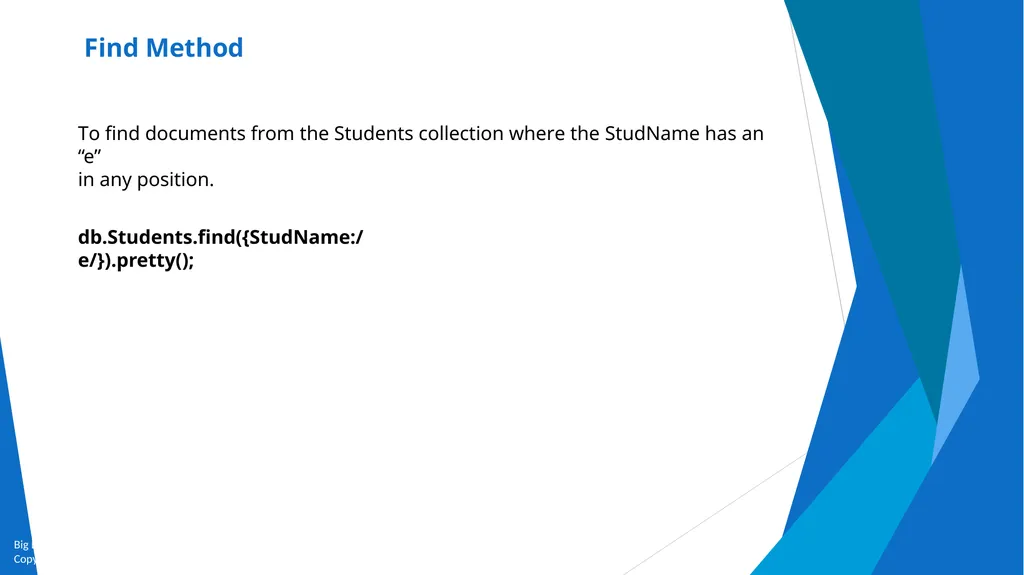
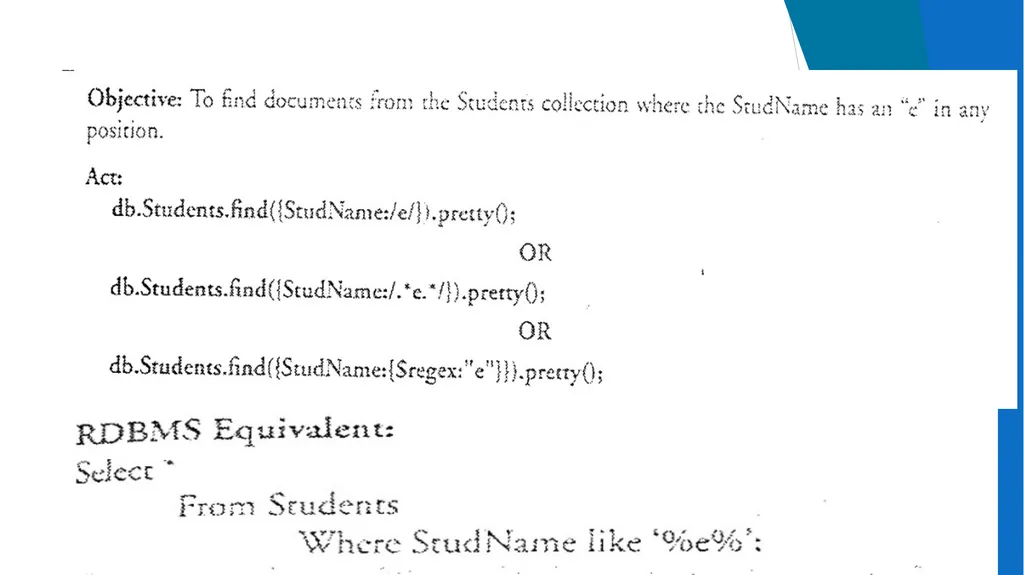
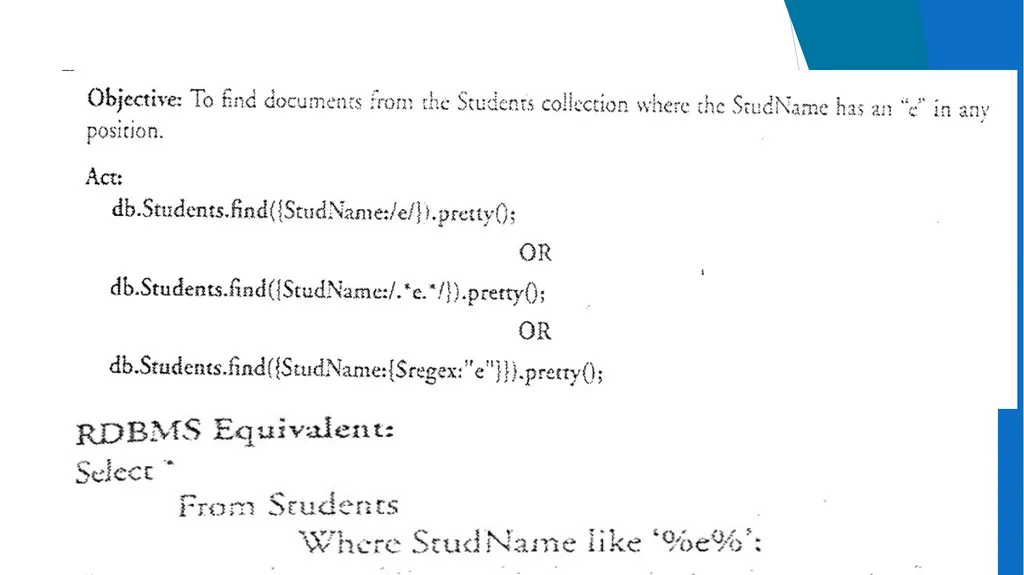
Copyright 2015, WILEY INDIA PVT. LTD. To find documents from the Students collection where the StudName has an “e”
in any position. db.Students.find({StudName:/e/}).pretty();<br>
29
Find Method Big Data and Analytics by Seema Acharya and Subhashini Chellappan
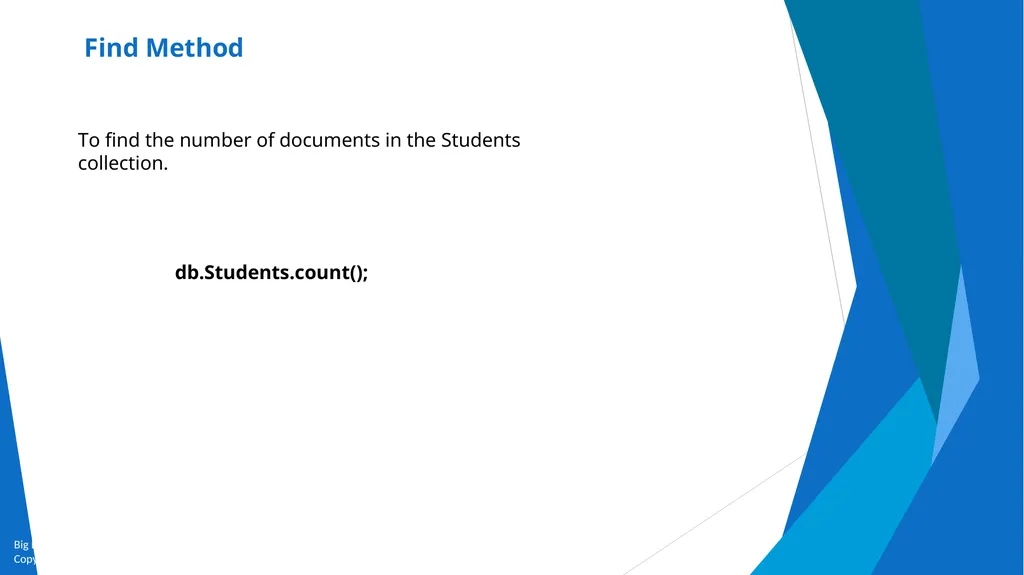
Copyright 2015, WILEY INDIA PVT. LTD. To find the number of documents in the Students collection. db.Students.count();<br>
30
Find Method Big Data and Analytics by Seema Acharya and Subhashini Chellappan
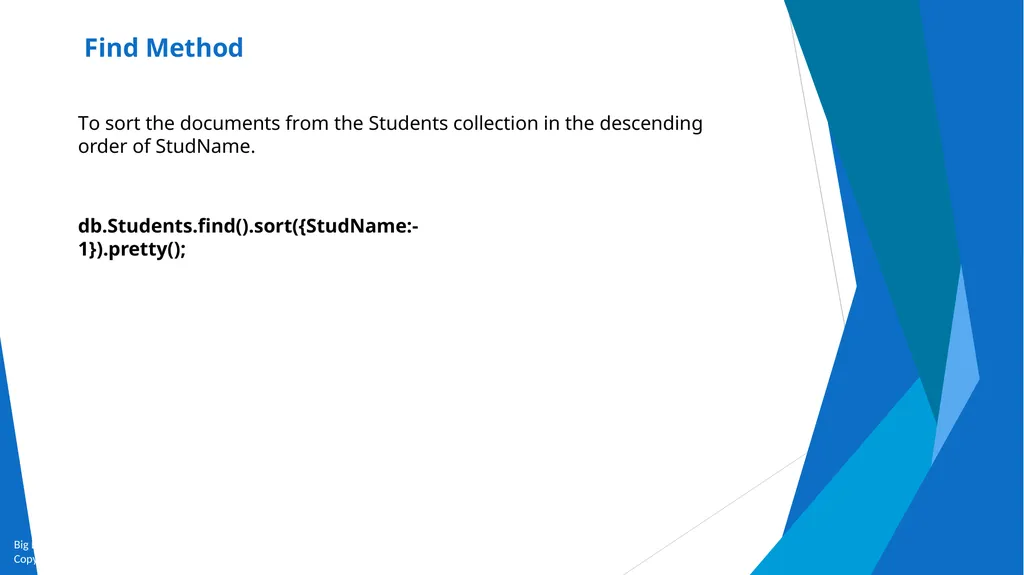
Copyright 2015, WILEY INDIA PVT. LTD. To sort the documents from the Students collection in the descending order of StudName. db.Students.find().sort({StudName:-1}).pretty();<br>
31
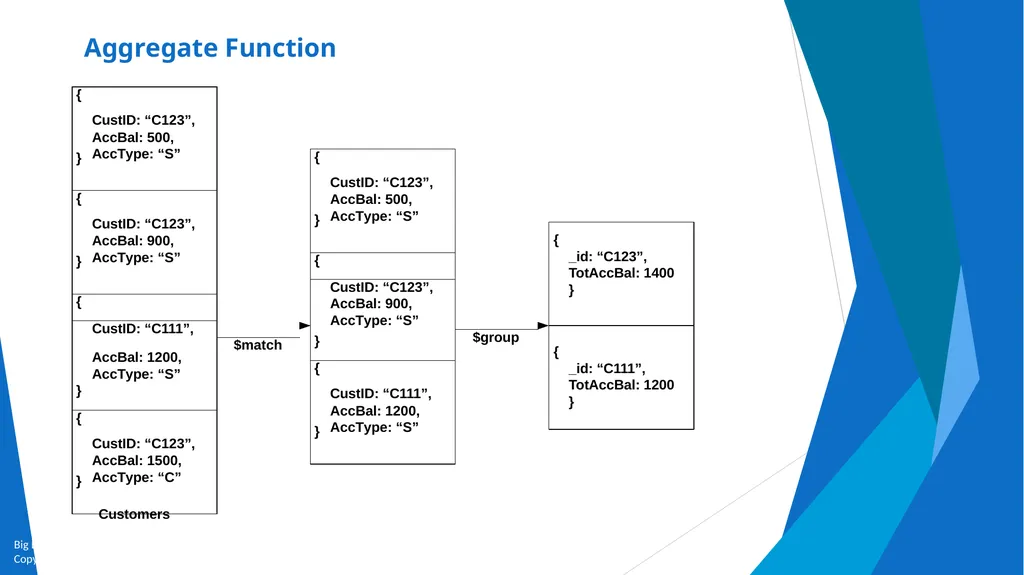
Aggregate Function Big Data and Analytics by Seema Acharya and Subhashini Chellappan
Copyright 2015, WILEY INDIA PVT. LTD.<br>
32
Aggregate Function {
_id: “C123”,
TotAccBal: 1400
} {
_id: “C111”,
TotAccBal: 1200
} Big Data and Analytics by Seema Acharya and Subhashini Chellappan
Copyright 2015, WILEY INDIA PVT. LTD. Customers<br>
33
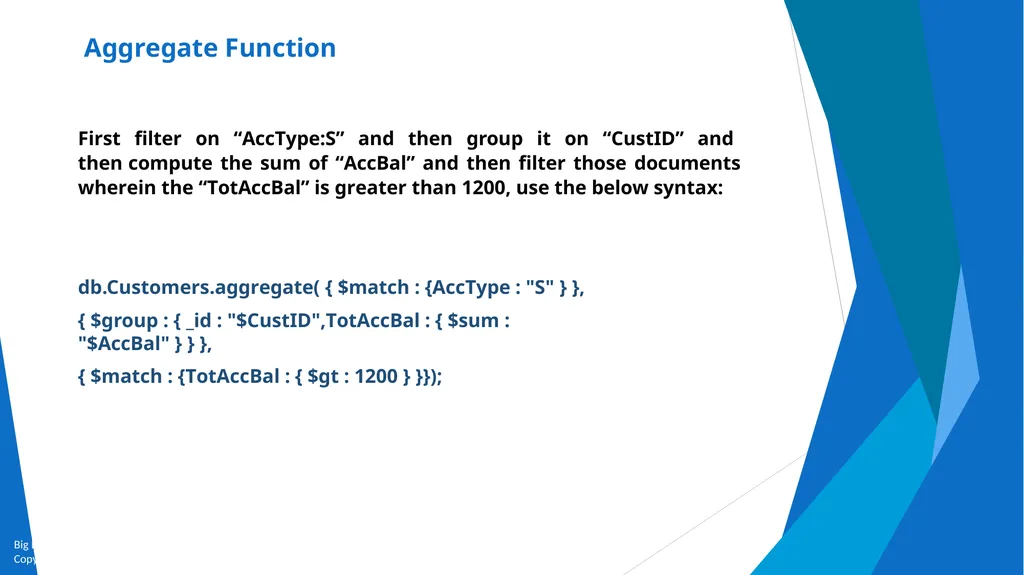
Aggregate Function Big Data and Analytics by Seema Acharya and Subhashini Chellappan
Copyright 2015, WILEY INDIA PVT. LTD. First filter on “AccType:S” and then group it on “CustID” and then compute the sum of “AccBal” and then filter those documents wherein the “TotAccBal” is greater than 1200, use the below syntax: db.Customers.aggregate( { $match : {AccType : "S" } },
{ $group : { _id : "$CustID",TotAccBal : { $sum : "$AccBal" } } },
{ $match : {TotAccBal : { $gt : 1200 } }});<br>
34
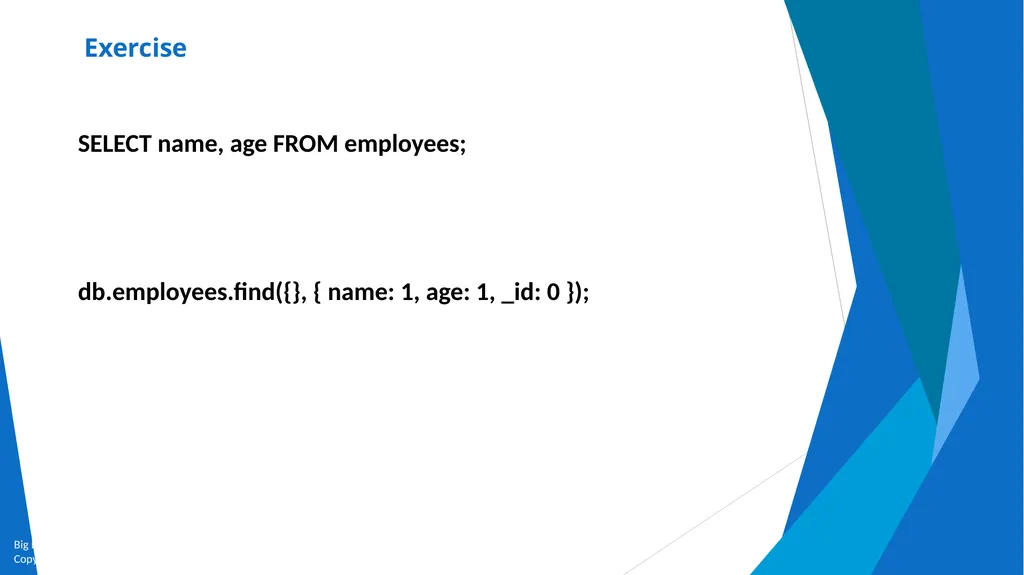
Exercise Big Data and Analytics by Seema Acharya and Subhashini Chellappan
Copyright 2015, WILEY INDIA PVT. LTD. SELECT name, age FROM employees; db.employees.find({}, { name: 1, age: 1, _id: 0 });<br>
35
Exercise Big Data and Analytics by Seema Acharya and Subhashini Chellappan
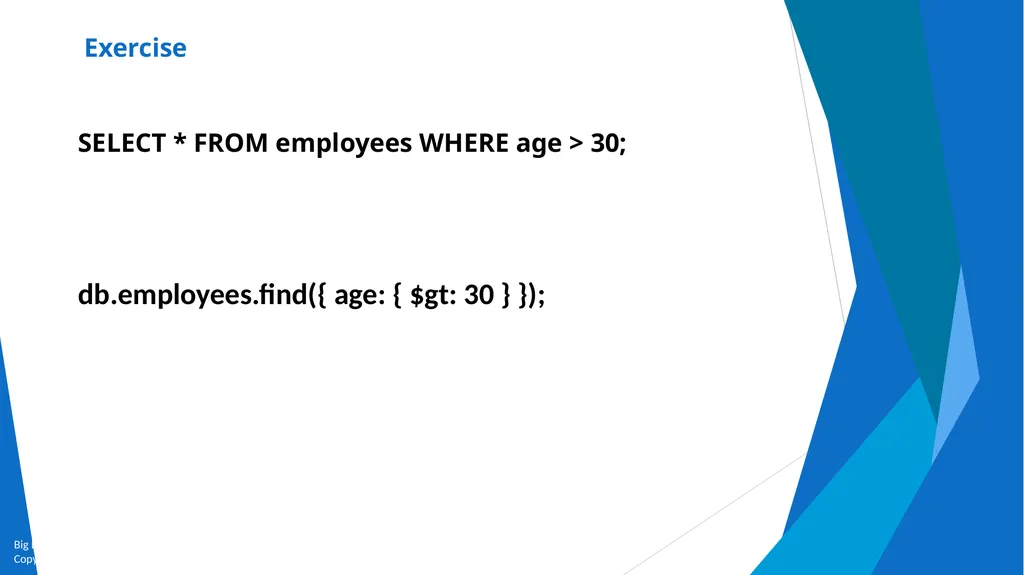
Copyright 2015, WILEY INDIA PVT. LTD. SELECT * FROM employees WHERE age > 30; db.employees.find({ age: { $gt: 30 } });<br>
36
Exercise Big Data and Analytics by Seema Acharya and Subhashini Chellappan
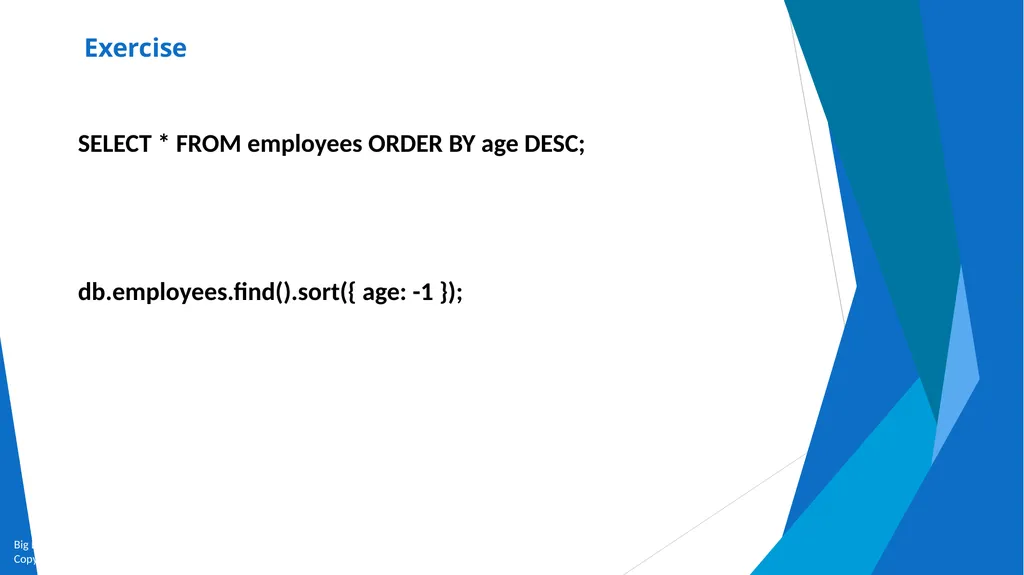
Copyright 2015, WILEY INDIA PVT. LTD. SELECT * FROM employees ORDER BY age DESC; db.employees.find().sort({ age: -1 });<br>
37
Exercise Big Data and Analytics by Seema Acharya and Subhashini Chellappan
Copyright 2015, WILEY INDIA PVT. LTD. SELECT * FROM employees LIMIT 10; db.employees.find().limit(10);<br>
38
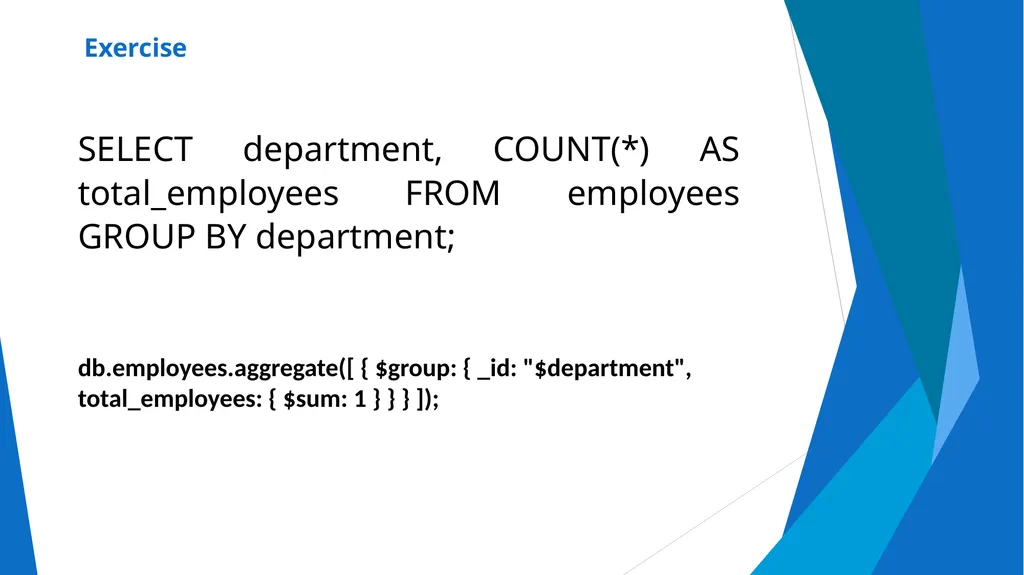
Exercise SELECT department, COUNT(*) AS total_employees FROM employees GROUP BY department; db.employees.aggregate([ { $group: { _id: "$department", total_employees: { $sum: 1 } } } ]);<br>
39
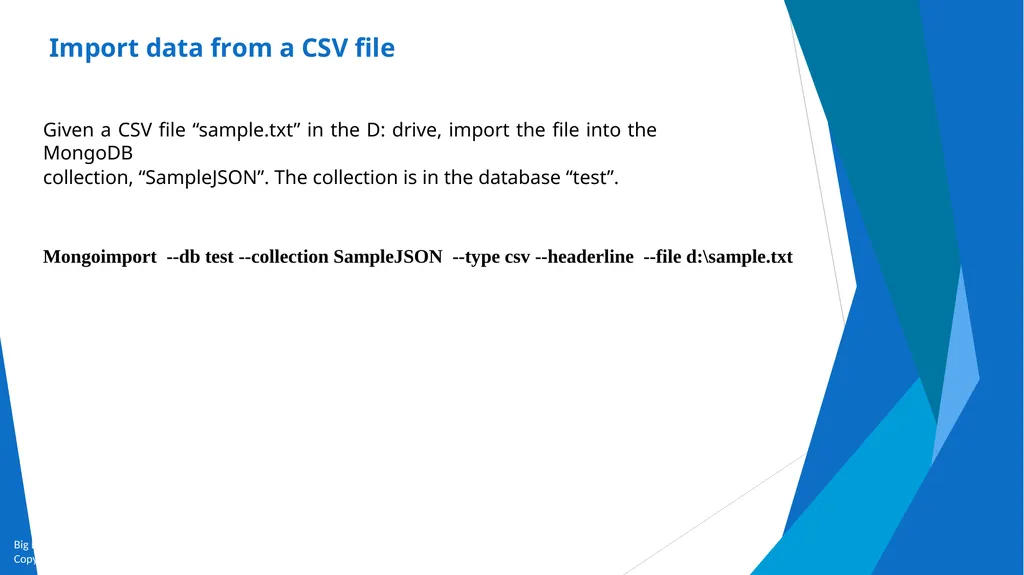
Import data from a CSV file Big Data and Analytics by Seema Acharya and Subhashini Chellappan
Copyright 2015, WILEY INDIA PVT. LTD. Given a CSV file “sample.txt” in the D: drive, import the file into the MongoDB
collection, “SampleJSON”. The collection is in the database “test”. Mongoimport --db test --collection SampleJSON --type csv --headerline --file d:\sample.txt<br>
40
Export data to a CSV file Big Data and Analytics by Seema Acharya and Subhashini Chellappan
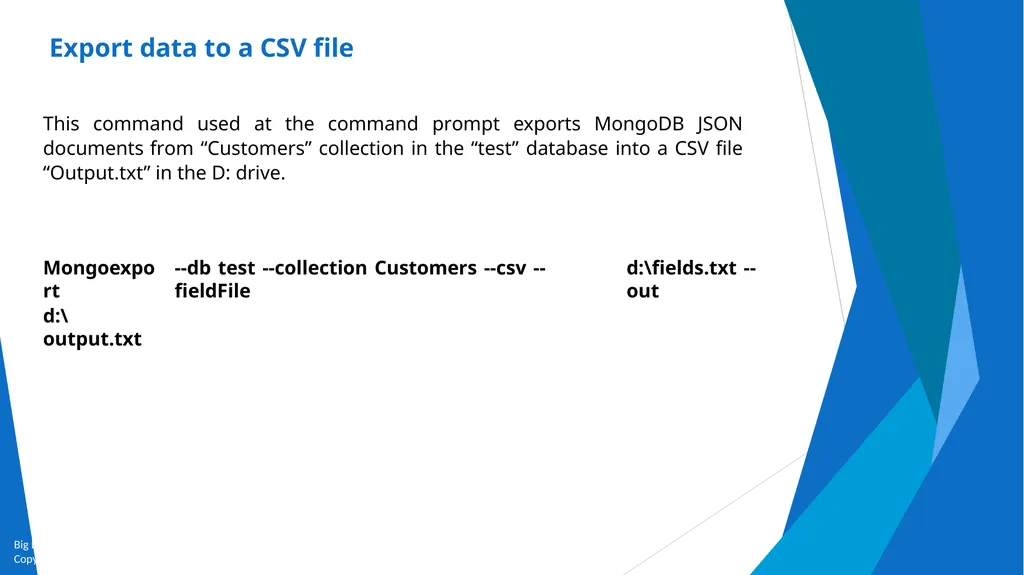
Copyright 2015, WILEY INDIA PVT. LTD. This command used at the command prompt exports MongoDB JSON documents from “Customers” collection in the “test” database into a CSV file “Output.txt” in the D: drive. --db test --collection Customers --csv --fieldFile d:\fields.txt --out Mongoexport
d:\output.txt<br>
41
Assignment-1 You are tasked with developing a blogging platform where users can create posts, comment on posts, and like posts. Each post can have multiple comments and likes. Design a MongoDB schema to handle this scenario efficiently.<br>
42
Assignment-2 You are developing a social media analytics platform that tracks user engagement metrics for posts on various social media platforms. Each post contains information such as the platform it was posted on, the number of likes, shares, and comments it received, as well as the timestamp of the post. Design a MongoDB schema to efficiently store and query this data.
How would you retrieve posts made on Facebook with more than 200 likes and sort them in descending order based on the number of shares they received?<br>
43
Assignment-3 You are developing an e-commerce platform where users can browse and purchase products. Each product has a unique identifier, a name, a category, a price, and available quantity. Additionally, users can add products to their cart and place orders. Design a MongoDB schema to efficiently handle product information, user carts, and orders.
Query to
Retrieve All Products.
Retrieve Products in a Specific Category (e.g., Electronics).
Retrieve Products with Quantity Greater Than 0.
Retrieve Products Sorted by Price in Ascending Order.
Retrieve Products with Price Less Than or Equal to $100.
Retrieve Products Added to a User's Cart (User with ID "789ghi...")
Retrieve Orders Placed by a User (User with ID "123abc...")
Retrieve Total Price of Orders Placed by a User (User with ID "123abc...")<br>
44
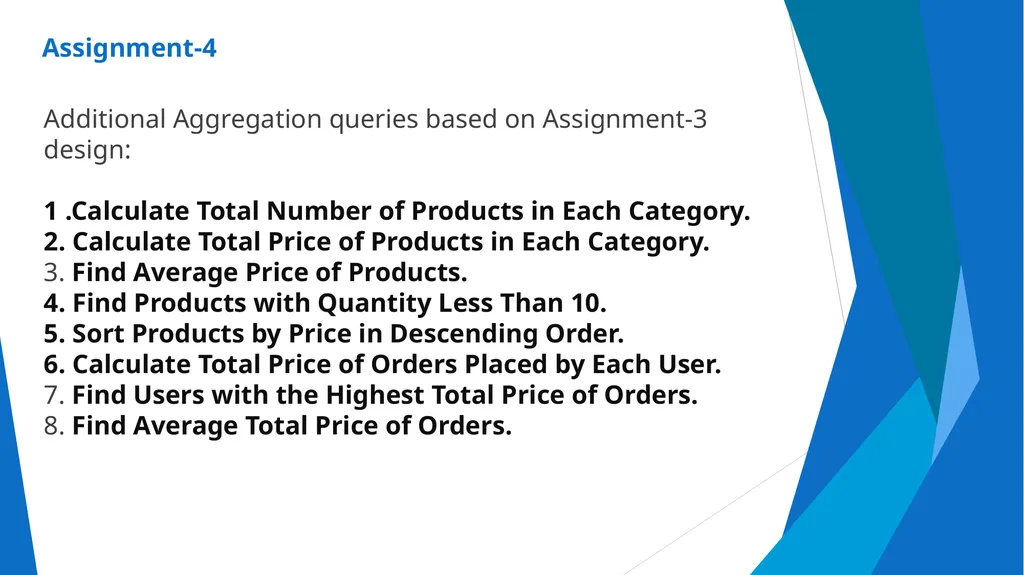
Assignment-4 Additional Aggregation queries based on Assignment-3 design:
1 .Calculate Total Number of Products in Each Category.
2. Calculate Total Price of Products in Each Category.
3. Find Average Price of Products.
4. Find Products with Quantity Less Than 10.
5. Sort Products by Price in Descending Order.
6. Calculate Total Price of Orders Placed by Each User.
7. Find Users with the Highest Total Price of Orders.
8. Find Average Total Price of Orders.<br>
45
Crossword Big Data and Analytics by Seema Acharya and Subhashini Chellappan
Copyright 2015, WILEY INDIA PVT. LTD.<br>
46
Further Readings Big Data and Analytics by Seema Acharya and Subhashini Chellappan
Copyright 2015, WILEY INDIA PVT. LTD. http://www.mongodb.org/ https://university.mongodb.com/ http://www.tutorialspoint.com/mongodb/<br>
47
Thank you Big Data and Analytics by Seema Acharya and Subhashini Chellappan
Copyright 2015, WILEY INDIA PVT. LTD.<br>