
UNIT-3 FUNCTIONAL DEPENDENCY Functional Dependency

Description: UNIT-3 FUNCTIONAL DEPENDENCY Functional Dependency The functional dependency is a relationship that exists between two attributes. It typically exists between the primary key and non-key attribute within a table. X Y The left side of FD
Related Topics
Download Presentation
"UNIT-3 FUNCTIONAL DEPENDENCY Functional Dependency" is the property of its rightful owner. Permission is granted to download and print the materials on this website for personal, non-commercial use only, and to display it on your personal computer provided you do not modify the materials and that you retain all copyright notices contained in the materials. By downloading content from our website, you accept the terms of this agreement.
Presentation Transcript
slide1. UNIT-3 FUNCTIONAL DEPENDENCY<br>
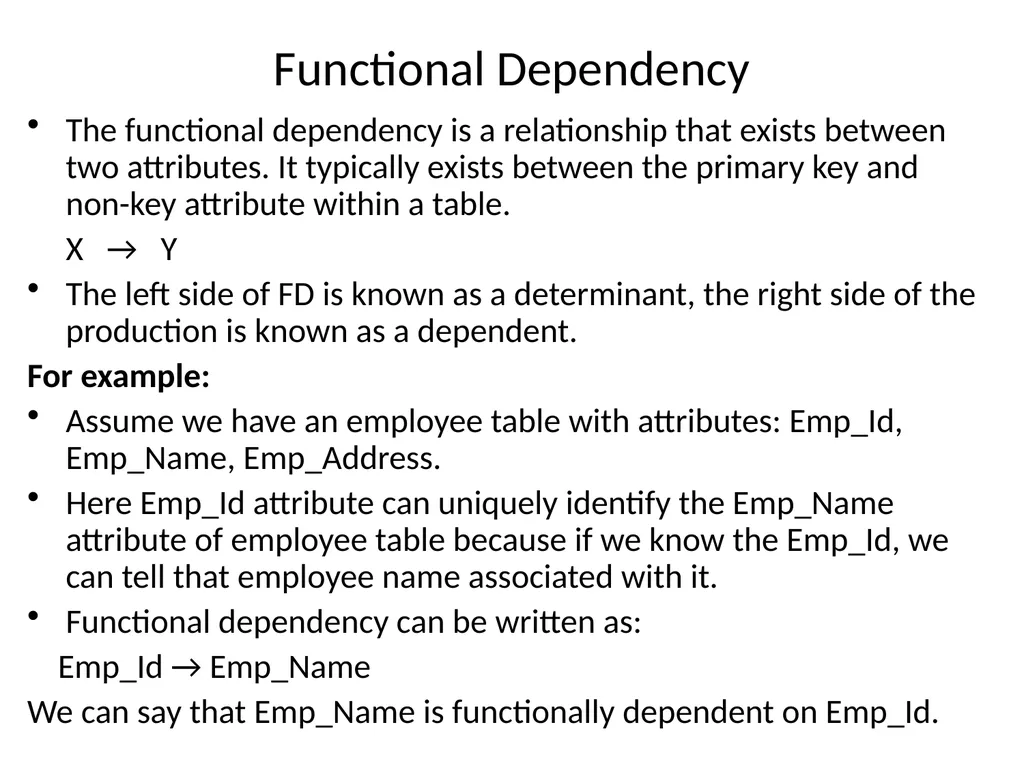
slide2. Functional Dependency The functional dependency is a relationship that exists between two attributes. It typically exists between the primary key and non-key attribute within a table.
X → Y
The left side of FD is known as a determinant, the right side of the production is known as a dependent.
For example:
Assume we have an employee table with attributes: Emp_Id, Emp_Name, Emp_Address.
Here Emp_Id attribute can uniquely identify the Emp_Name attribute of employee table because if we know the Emp_Id, we can tell that employee name associated with it.
Functional dependency can be written as:
Emp_Id → Emp_Name
We can say that Emp_Name is functionally dependent on Emp_Id.<br>
slide3. Types of Functional dependency 1. Trivial functional dependency
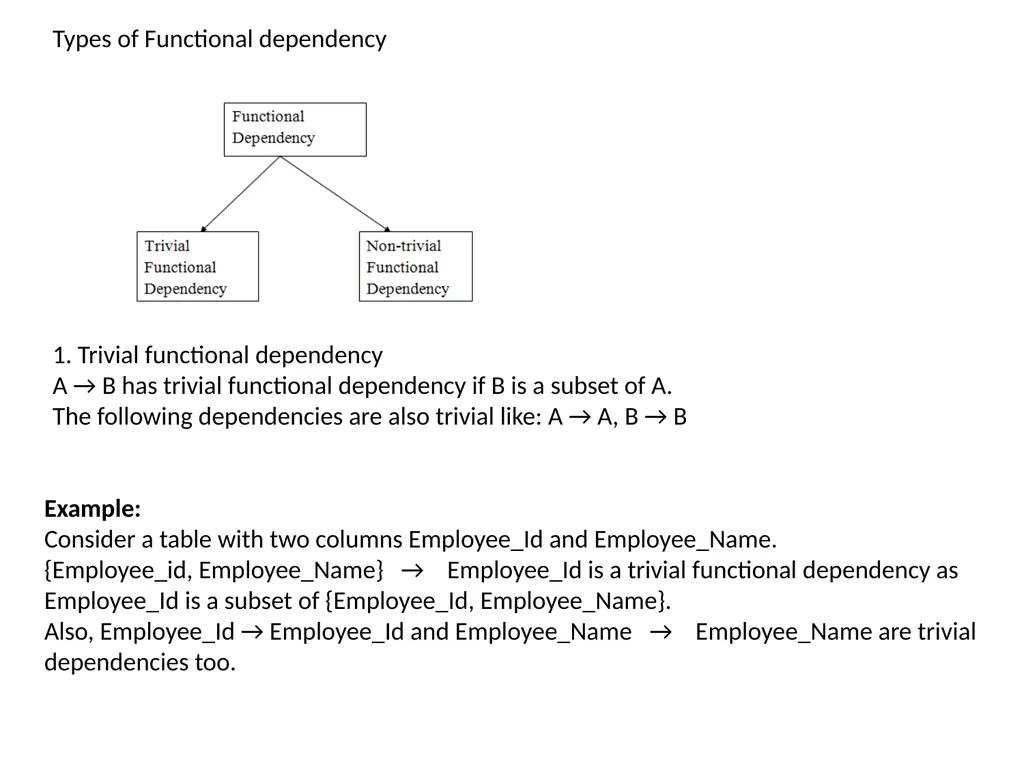
A → B has trivial functional dependency if B is a subset of A.
The following dependencies are also trivial like: A → A, B → B Example:
Consider a table with two columns Employee_Id and Employee_Name.
{Employee_id, Employee_Name} → Employee_Id is a trivial functional dependency as
Employee_Id is a subset of {Employee_Id, Employee_Name}.
Also, Employee_Id → Employee_Id and Employee_Name → Employee_Name are trivial
dependencies too.<br>
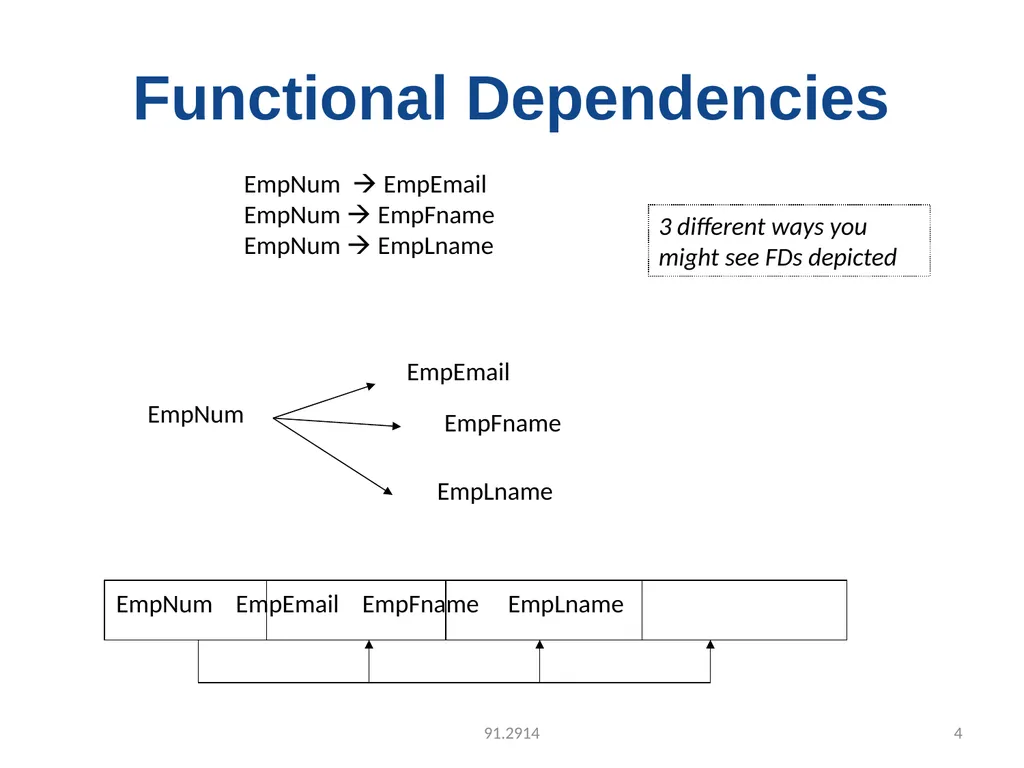
slide4. Functional Dependencies 91.2914 4 EmpNum EmpEmail
EmpNum EmpFname
EmpNum EmpLname EmpNum EmpEmail EmpFname EmpLname EmpNum EmpEmail EmpFname EmpLname 3 different ways you might see FDs depicted<br>
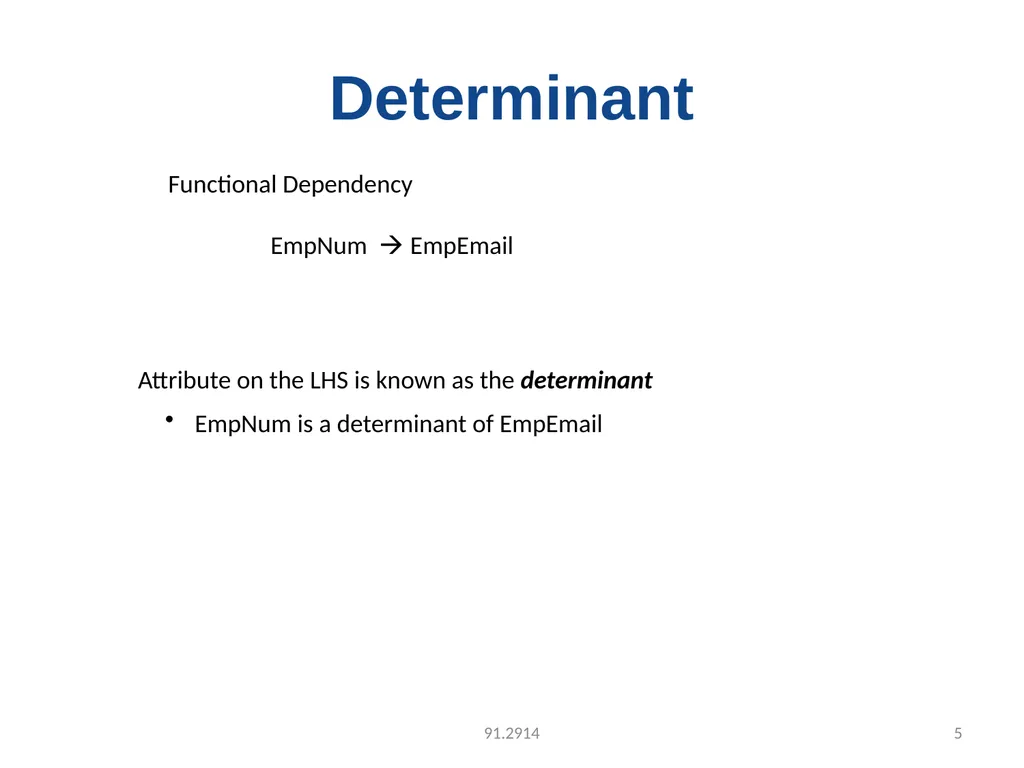
slide5. Determinant 91.2914 5 Functional Dependency
EmpNum EmpEmail Attribute on the LHS is known as the determinant
EmpNum is a determinant of EmpEmail<br>
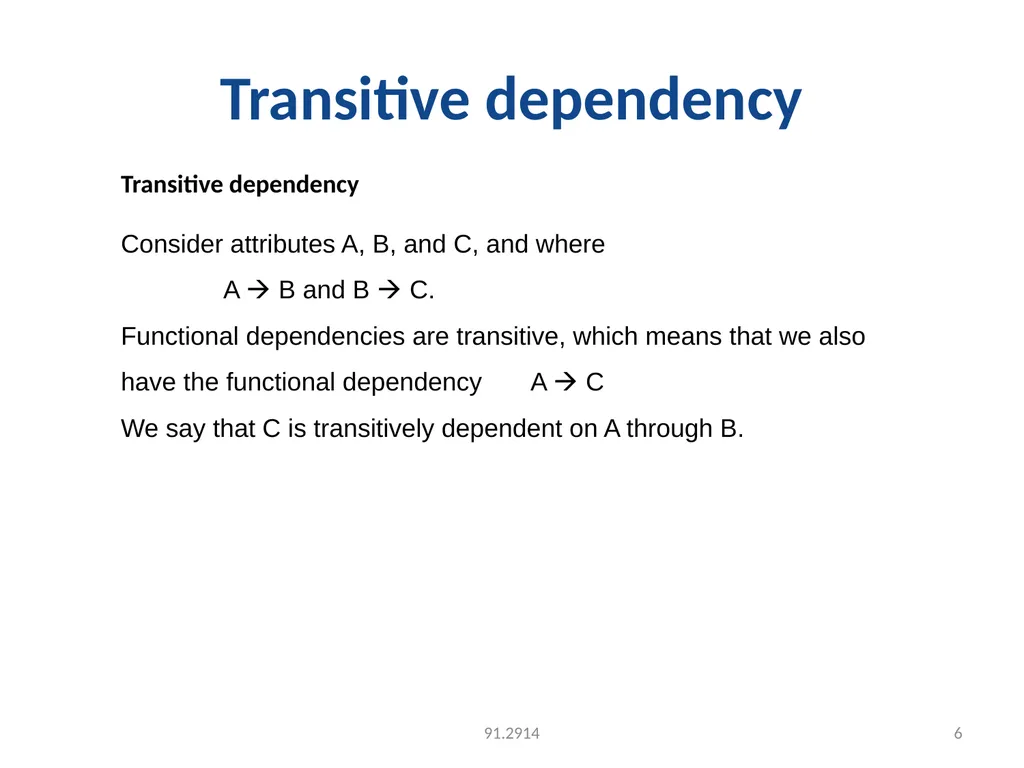
slide6. Transitive dependency 91.2914 6 Transitive dependency
Consider attributes A, B, and C, and where
A B and B C.
Functional dependencies are transitive, which means that we also have the functional dependency A C
We say that C is transitively dependent on A through B.<br>
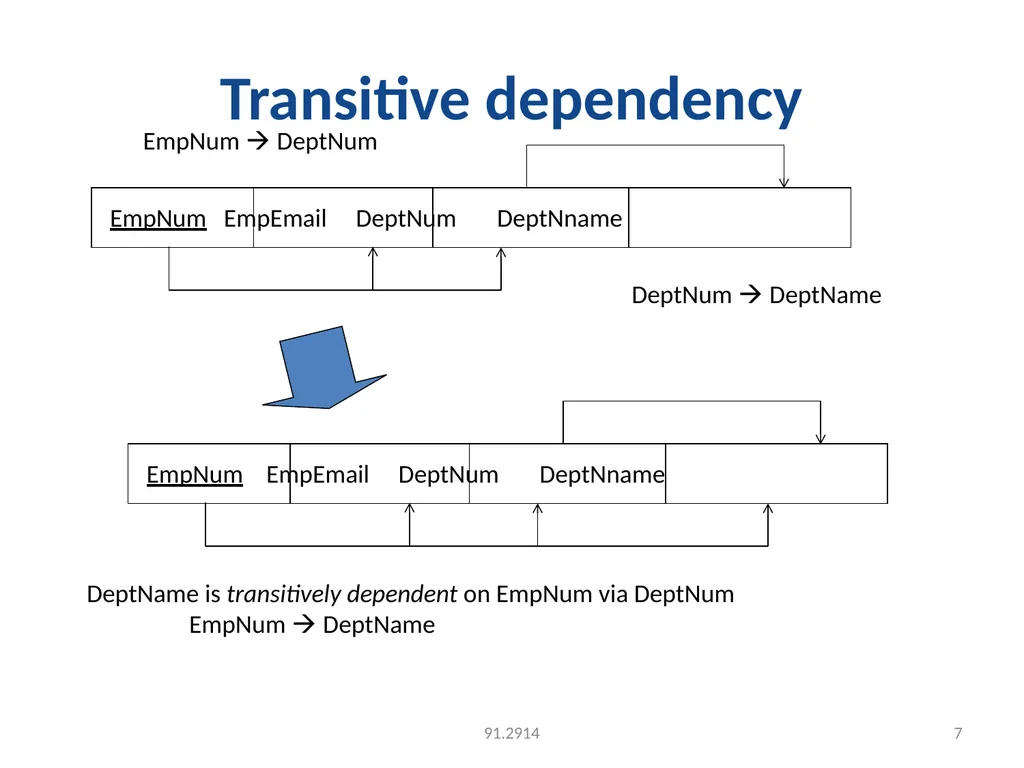
slide7. Transitive dependency 91.2914 7 EmpNum EmpEmail DeptNum DeptNname EmpNum EmpEmail DeptNum DeptNname DeptName is transitively dependent on EmpNum via DeptNum
EmpNum DeptName EmpNum DeptNum DeptNum DeptName<br>
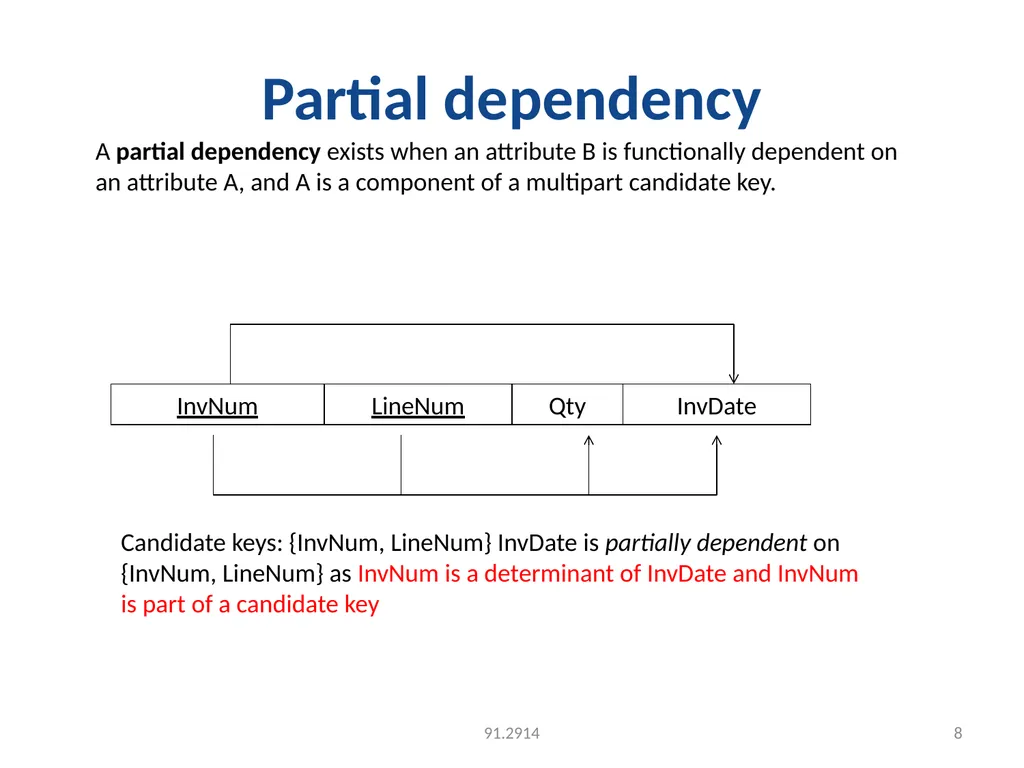
slide8. Partial dependency 91.2914 8 A partial dependency exists when an attribute B is functionally dependent on an attribute A, and A is a component of a multipart candidate key. InvNum LineNum Qty InvDate Candidate keys: {InvNum, LineNum} InvDate is partially dependent on {InvNum, LineNum} as InvNum is a determinant of InvDate and InvNum is part of a candidate key<br>
slide9. 2. Non-trivial functional dependency
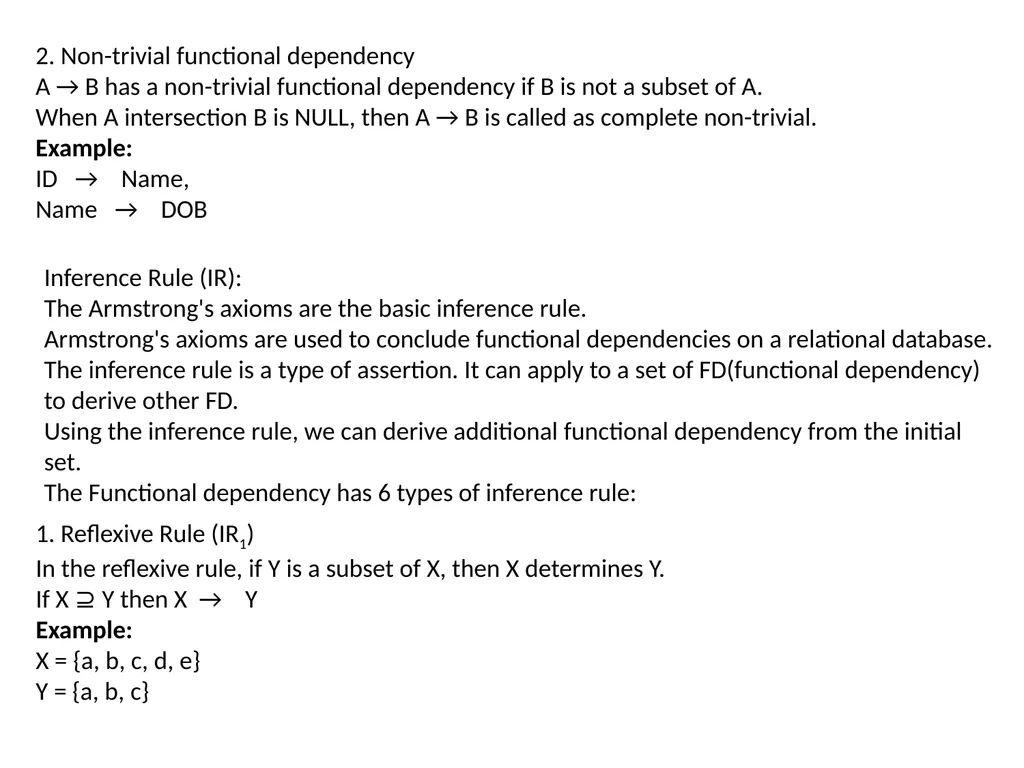
A → B has a non-trivial functional dependency if B is not a subset of A.
When A intersection B is NULL, then A → B is called as complete non-trivial.
Example:
ID → Name,
Name → DOB Inference Rule (IR):
The Armstrong's axioms are the basic inference rule.
Armstrong's axioms are used to conclude functional dependencies on a relational database.
The inference rule is a type of assertion. It can apply to a set of FD(functional dependency) to derive other FD.
Using the inference rule, we can derive additional functional dependency from the initial set.
The Functional dependency has 6 types of inference rule: 1. Reflexive Rule (IR1)
In the reflexive rule, if Y is a subset of X, then X determines Y.
If X ⊇ Y then X → Y
Example:
X = {a, b, c, d, e}
Y = {a, b, c}<br>
slide10. 2. Augmentation Rule (IR2)
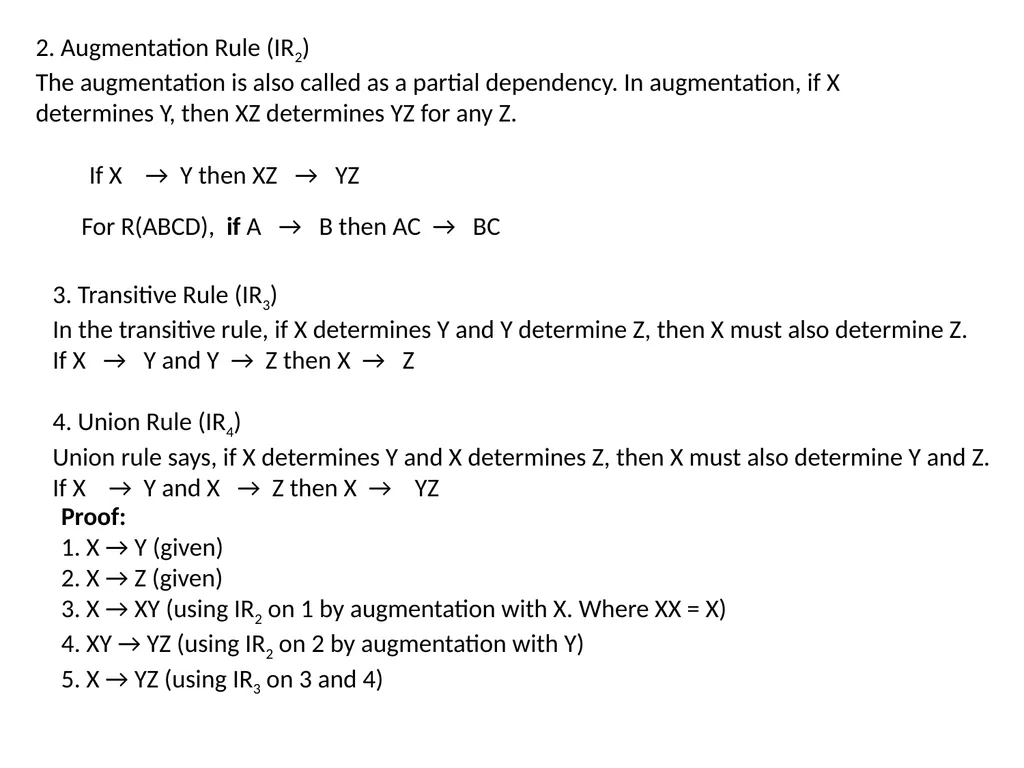
The augmentation is also called as a partial dependency. In augmentation, if X determines Y, then XZ determines YZ for any Z. If X → Y then XZ → YZ For R(ABCD), if A → B then AC → BC 3. Transitive Rule (IR3)
In the transitive rule, if X determines Y and Y determine Z, then X must also determine Z.
If X → Y and Y → Z then X → Z
4. Union Rule (IR4)
Union rule says, if X determines Y and X determines Z, then X must also determine Y and Z.
If X → Y and X → Z then X → YZ Proof:
1. X → Y (given) 2. X → Z (given) 3. X → XY (using IR2 on 1 by augmentation with X. Where XX = X) 4. XY → YZ (using IR2 on 2 by augmentation with Y) 5. X → YZ (using IR3 on 3 and 4)<br>
slide11. 5. Decomposition Rule (IR5)
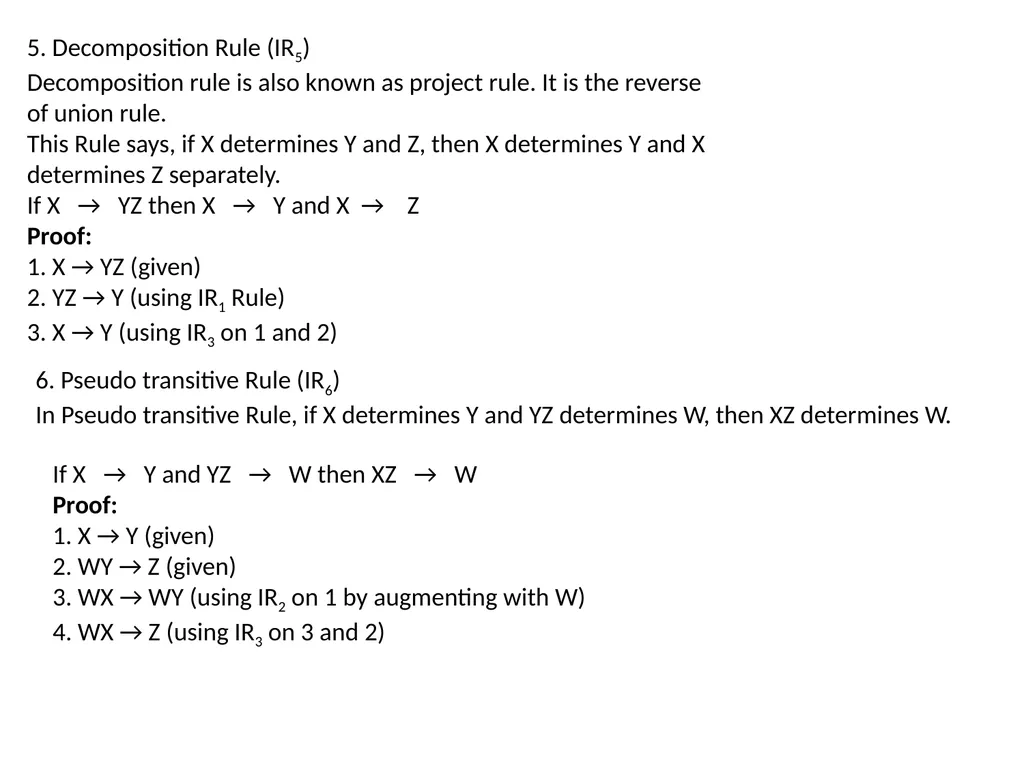
Decomposition rule is also known as project rule. It is the reverse of union rule.
This Rule says, if X determines Y and Z, then X determines Y and X determines Z separately.
If X → YZ then X → Y and X → Z
Proof:
1. X → YZ (given) 2. YZ → Y (using IR1 Rule) 3. X → Y (using IR3 on 1 and 2) 6. Pseudo transitive Rule (IR6)
In Pseudo transitive Rule, if X determines Y and YZ determines W, then XZ determines W. If X → Y and YZ → W then XZ → W
Proof:
1. X → Y (given) 2. WY → Z (given) 3. WX → WY (using IR2 on 1 by augmenting with W) 4. WX → Z (using IR3 on 3 and 2)<br>
slide12. Normalization
Normalization is the process of organizing the data in the database.
Normalization is used to minimize the redundancy from a relation or set of relations. It is also used to eliminate the undesirable characteristics like Insertion, Update and Deletion Anomalies.
Normalization divides the larger table into the smaller table and links them using relationship.
The normal form is used to reduce redundancy from the database table.
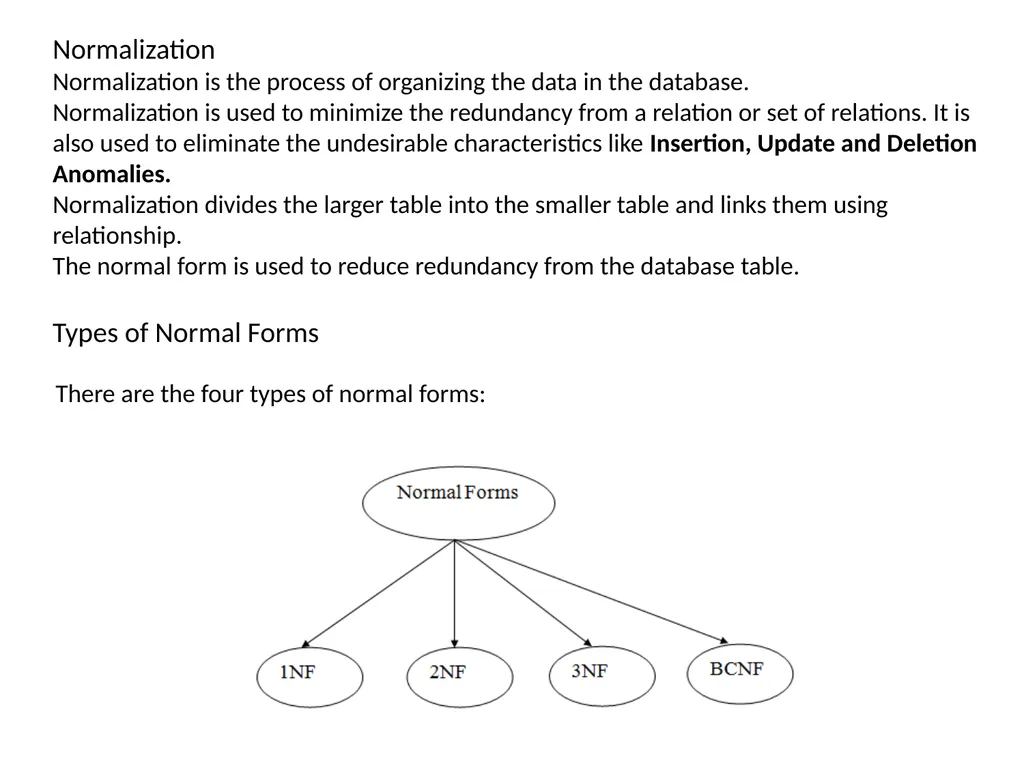
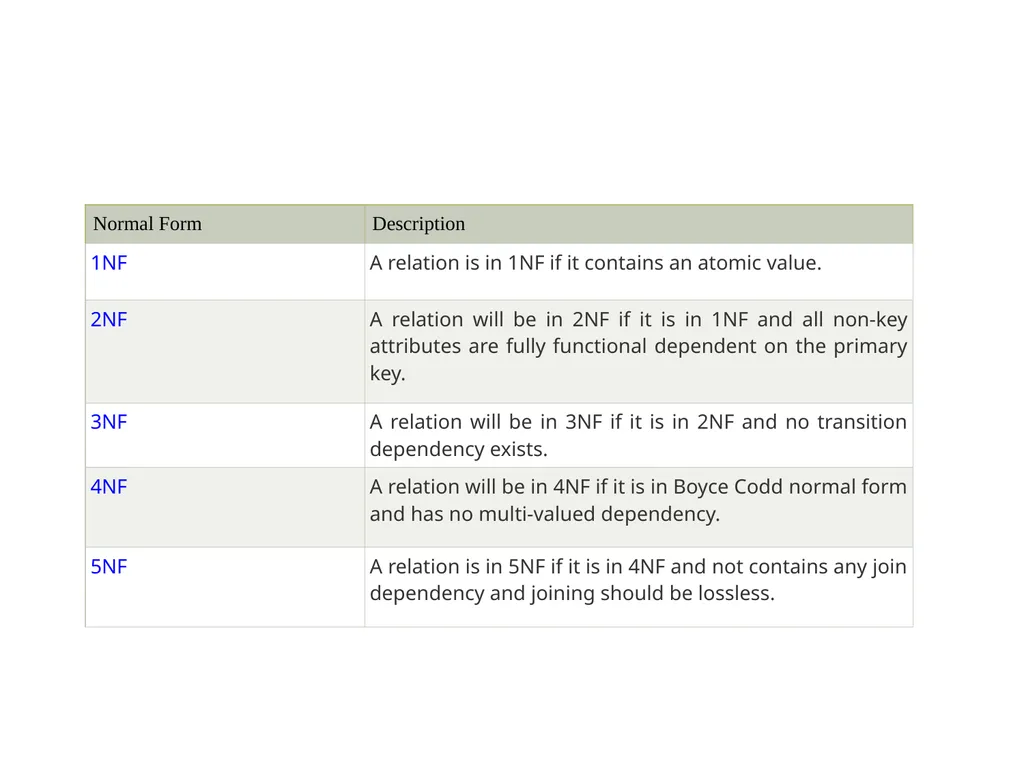
Types of Normal Forms There are the four types of normal forms:<br>
slide14. First Normal Form 91.2914 14 First Normal Form
We say a relation is in 1NF if all values stored in the relation are single-valued and atomic.
1NF places restrictions on the structure of relations. Values must be simple.<br>
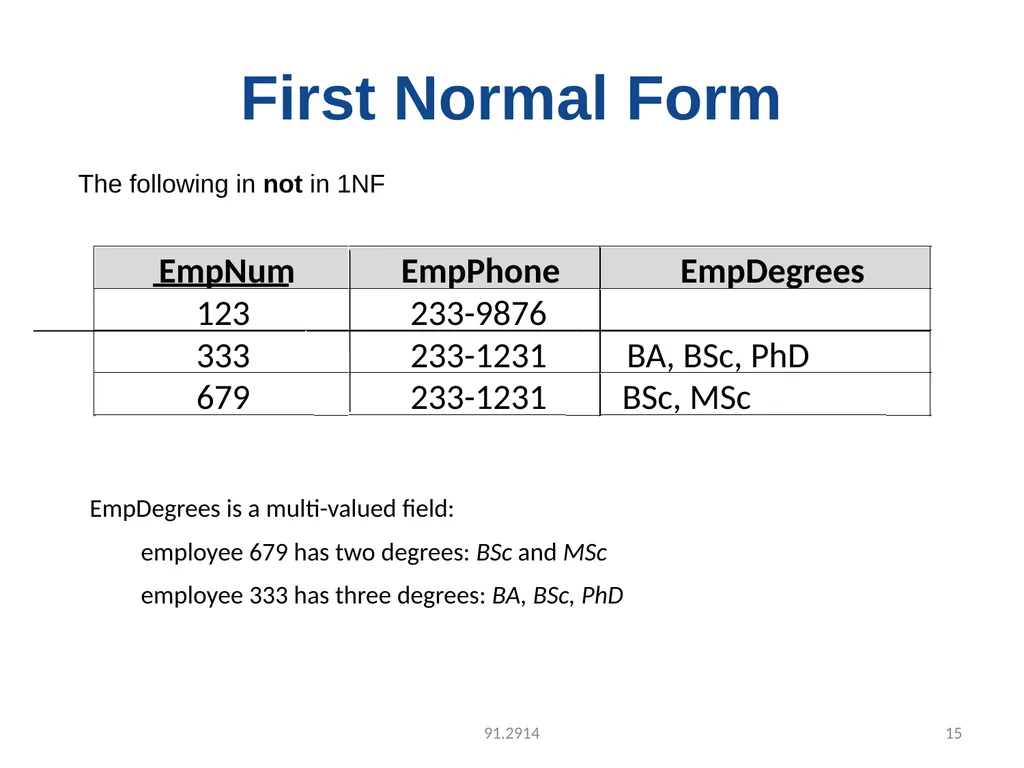
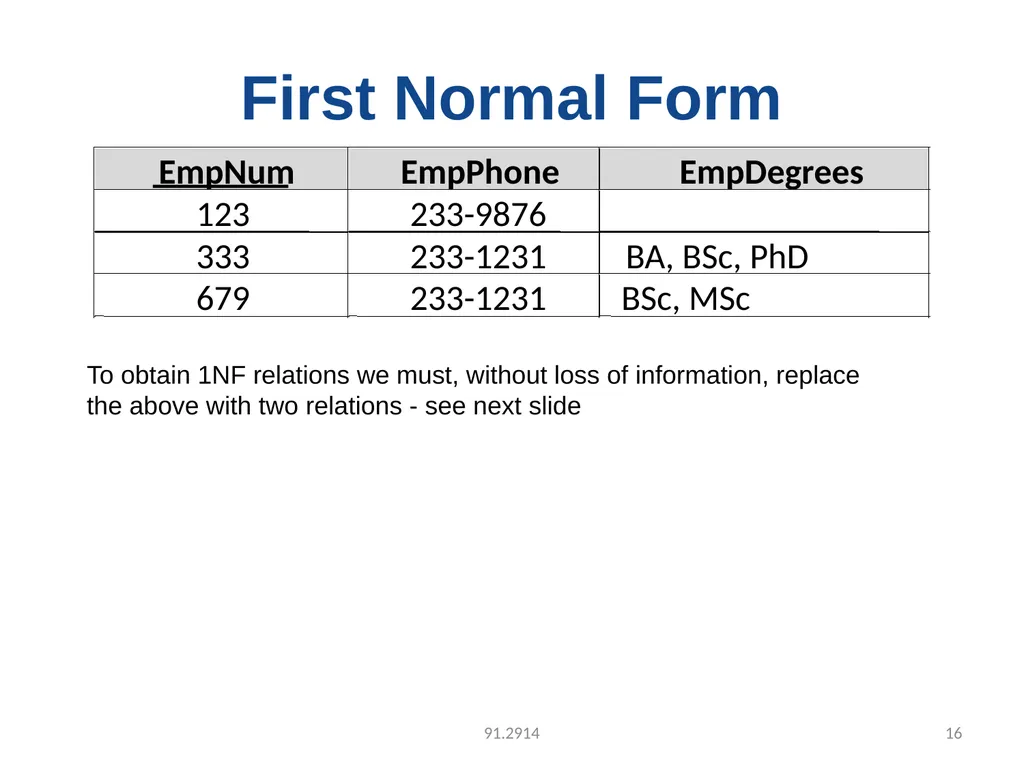
slide15. First Normal Form 91.2914 15 The following in not in 1NF EmpNum EmpPhone EmpDegrees 123 233-9876 333 233-1231 BA, BSc, PhD 679 233-1231 BSc, MSc EmpDegrees is a multi-valued field:
employee 679 has two degrees: BSc and MSc
employee 333 has three degrees: BA, BSc, PhD<br>
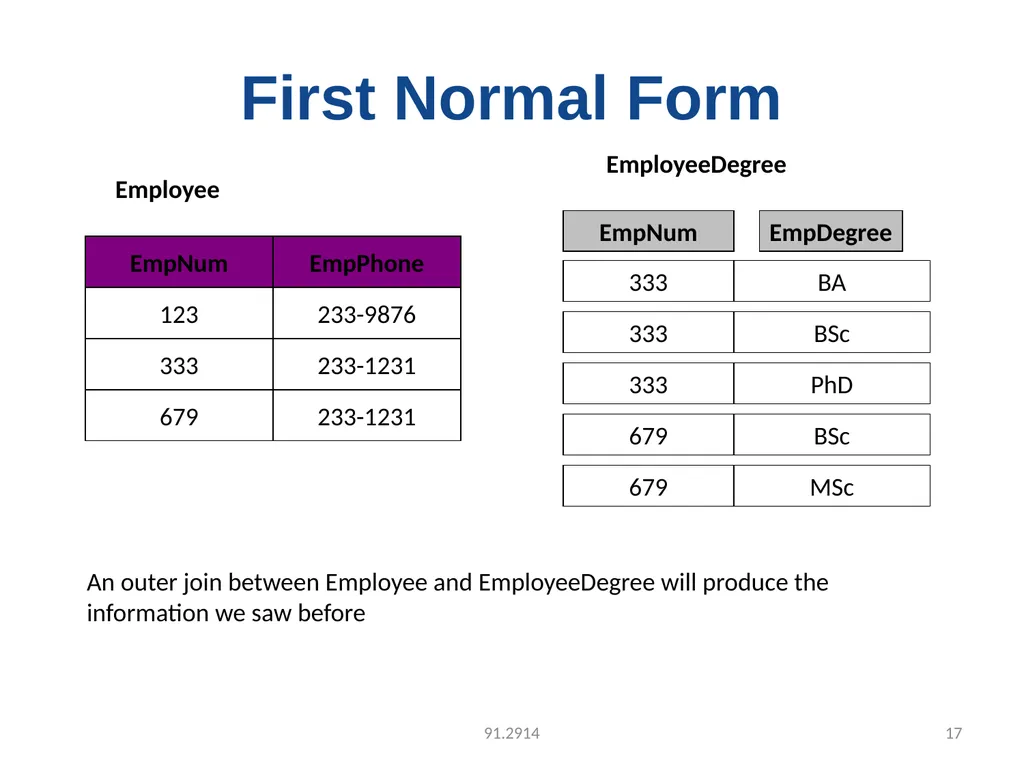
slide16. First Normal Form 91.2914 16 To obtain 1NF relations we must, without loss of information, replace the above with two relations - see next slide<br>
slide17. First Normal Form 91.2914 17 EmpNum EmpDegree 333 BA 333 BSc 333 PhD 679 BSc MSc 679 EmpNum EmpPhone 123 233-9876 333 233-1231 679 233-1231 An outer join between Employee and EmployeeDegree will produce the information we saw before Employee EmployeeDegree<br>
slide18. Second Normal Form 91.2914 18 Second Normal Form
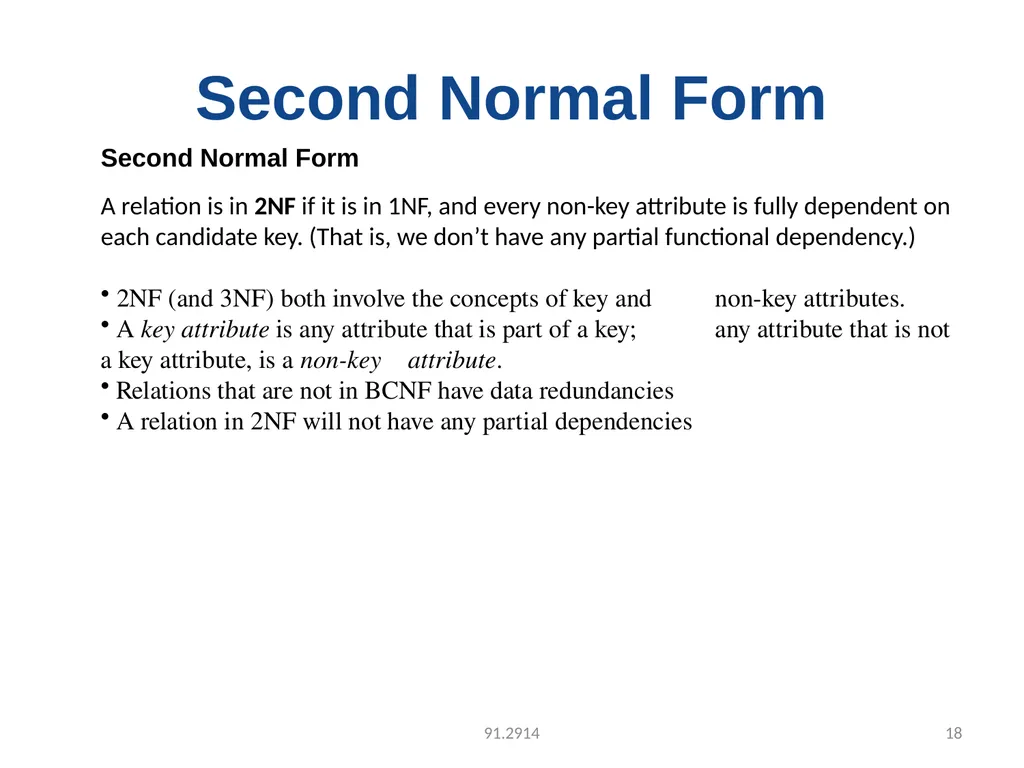
A relation is in 2NF if it is in 1NF, and every non-key attribute is fully dependent on each candidate key. (That is, we don’t have any partial functional dependency.)
2NF (and 3NF) both involve the concepts of key and non-key attributes.
A key attribute is any attribute that is part of a key; any attribute that is not a key attribute, is a non-key attribute.
Relations that are not in BCNF have data redundancies
A relation in 2NF will not have any partial dependencies<br>
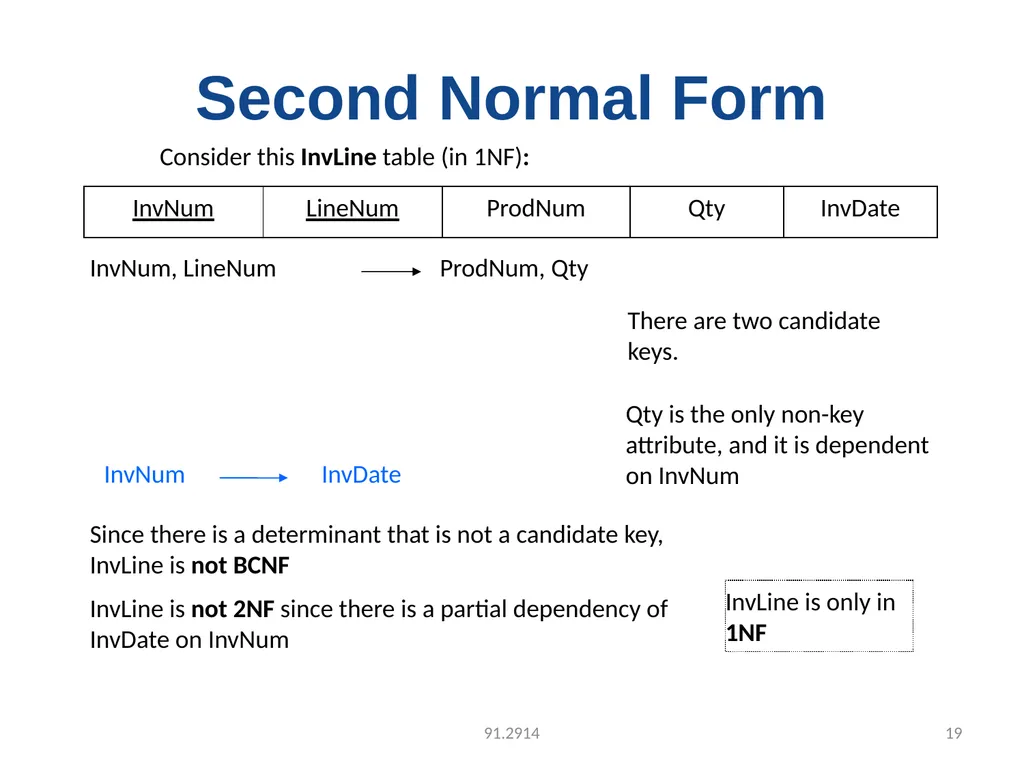
slide19. Second Normal Form 91.2914 19 LineNum ProdNum Qty InvNum InvNum, LineNum ProdNum, Qty Since there is a determinant that is not a candidate key, InvLine is not BCNF
InvLine is not 2NF since there is a partial dependency of InvDate on InvNum InvDate InvDate InvNum There are two candidate keys. Qty is the only non-key attribute, and it is dependent on InvNum InvLine is only in 1NF Consider this InvLine table (in 1NF):<br>
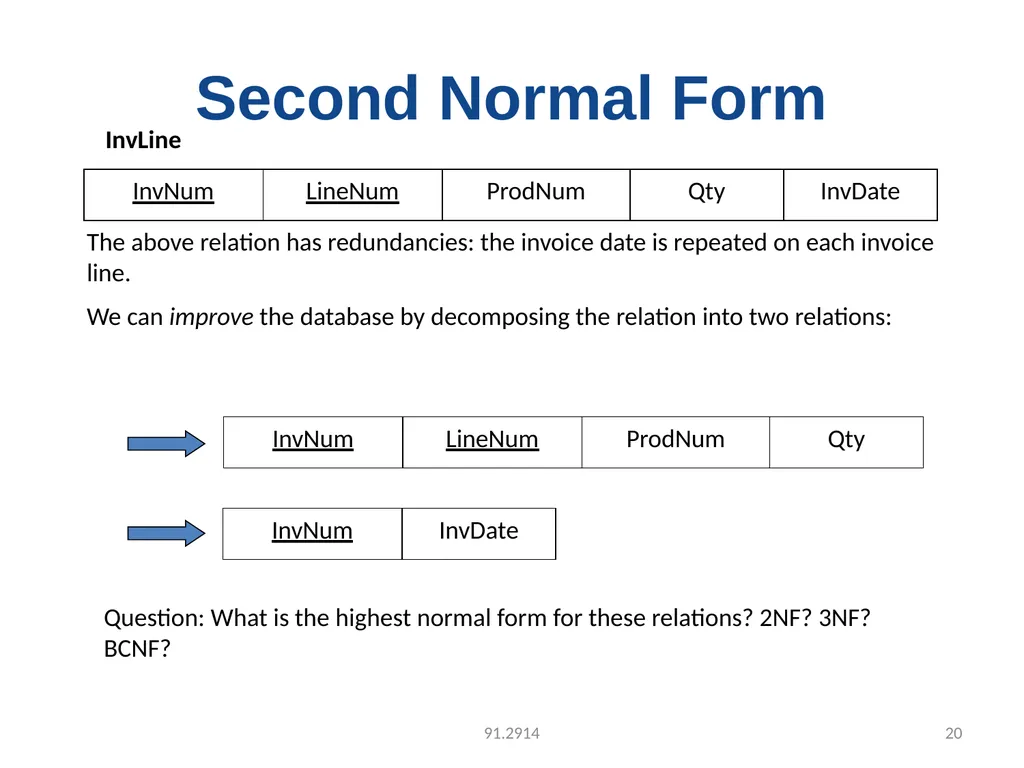
slide20. Second Normal Form 91.2914 20 LineNum ProdNum Qty InvNum InvDate InvLine The above relation has redundancies: the invoice date is repeated on each invoice line.
We can improve the database by decomposing the relation into two relations: LineNum ProdNum Qty InvNum InvDate InvNum Question: What is the highest normal form for these relations? 2NF? 3NF? BCNF?<br>
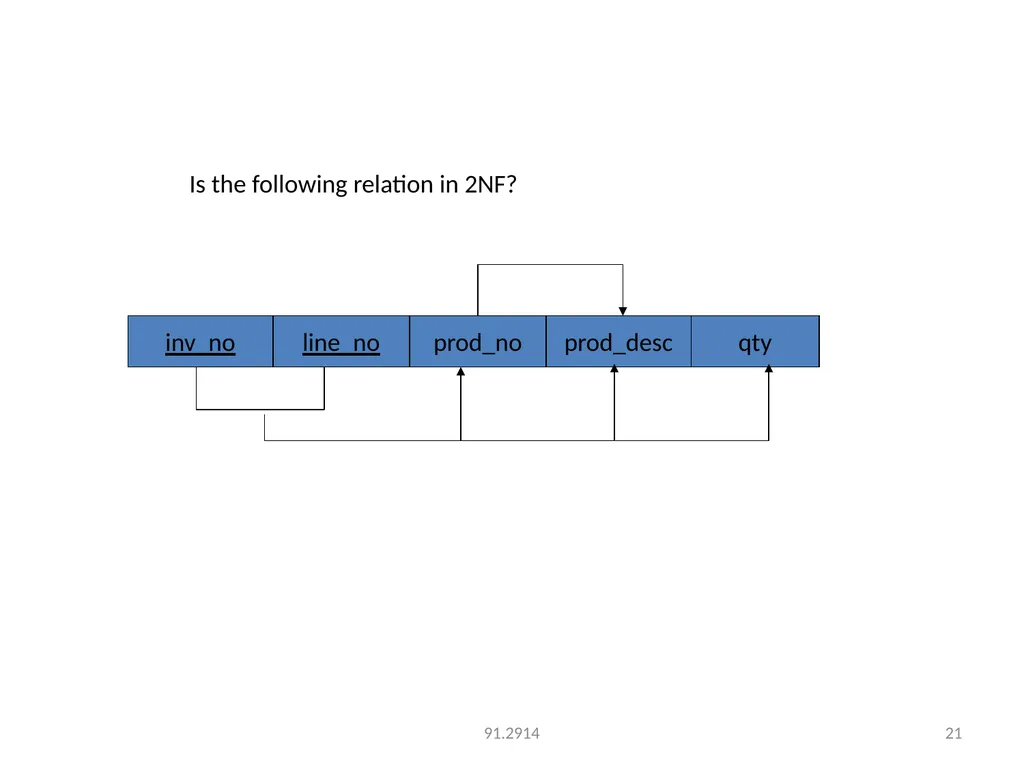
slide21. 91.2914 21 Is the following relation in 2NF?<br>
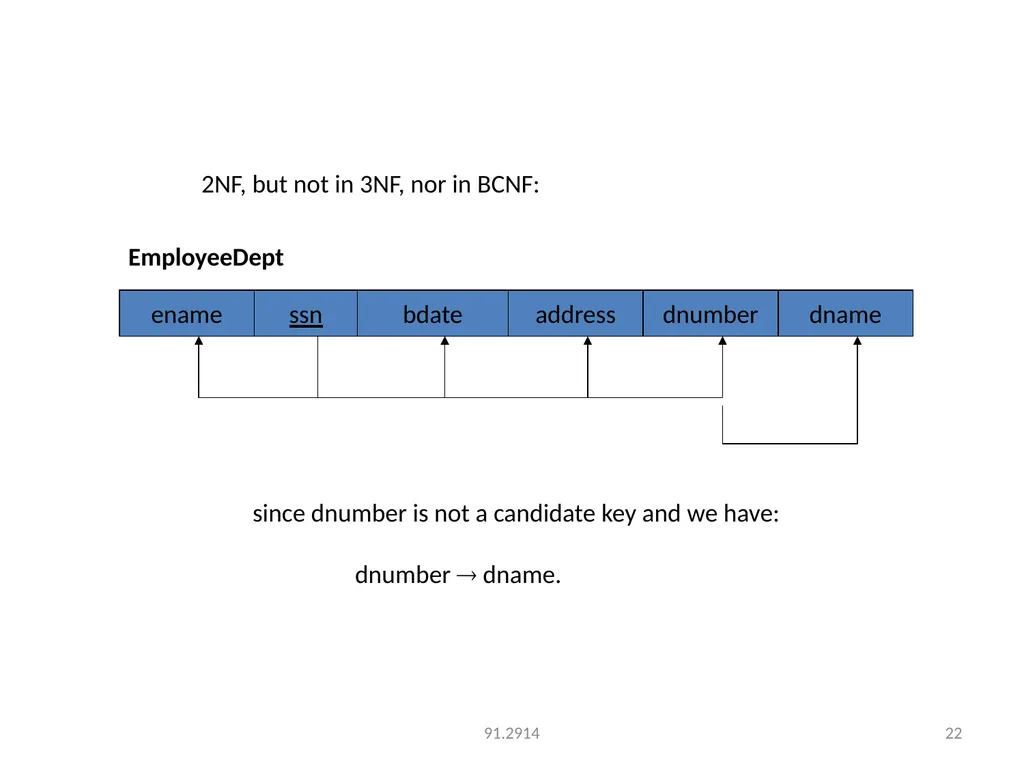
slide22. 91.2914 22 2NF, but not in 3NF, nor in BCNF: since dnumber is not a candidate key and we have:
dnumber dname.<br>
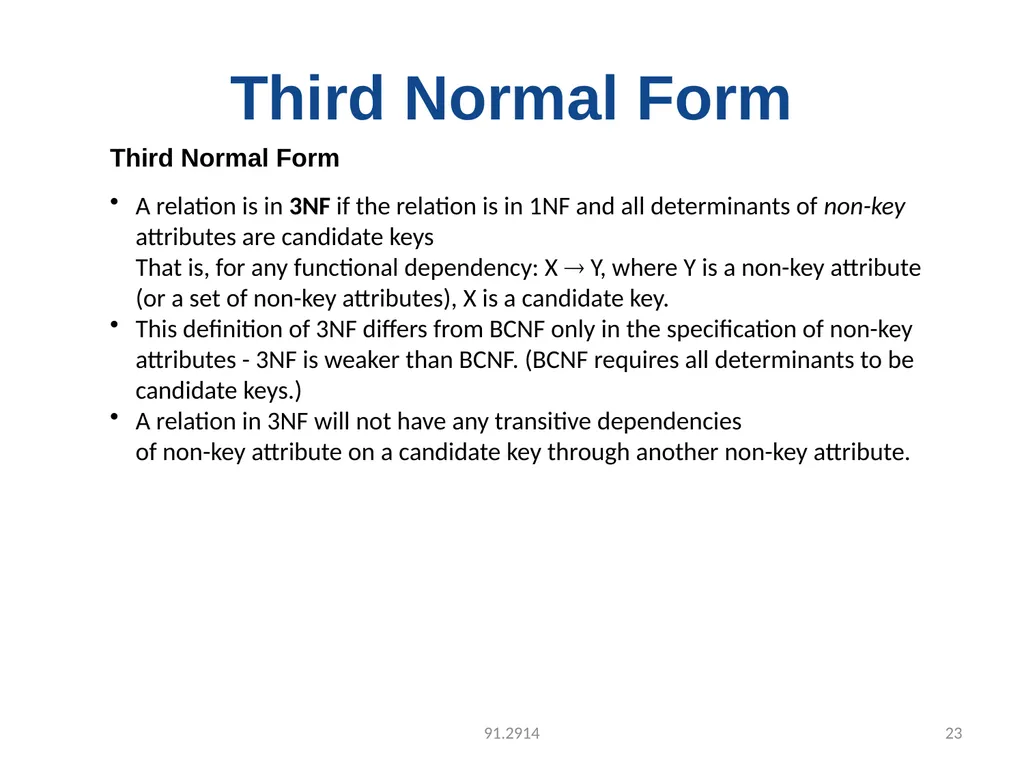
slide23. Third Normal Form 91.2914 23 Third Normal Form
A relation is in 3NF if the relation is in 1NF and all determinants of non-key attributes are candidate keys
That is, for any functional dependency: X Y, where Y is a non-key attribute (or a set of non-key attributes), X is a candidate key.
This definition of 3NF differs from BCNF only in the specification of non-key attributes - 3NF is weaker than BCNF. (BCNF requires all determinants to be candidate keys.)
A relation in 3NF will not have any transitive dependencies
of non-key attribute on a candidate key through another non-key attribute.<br>
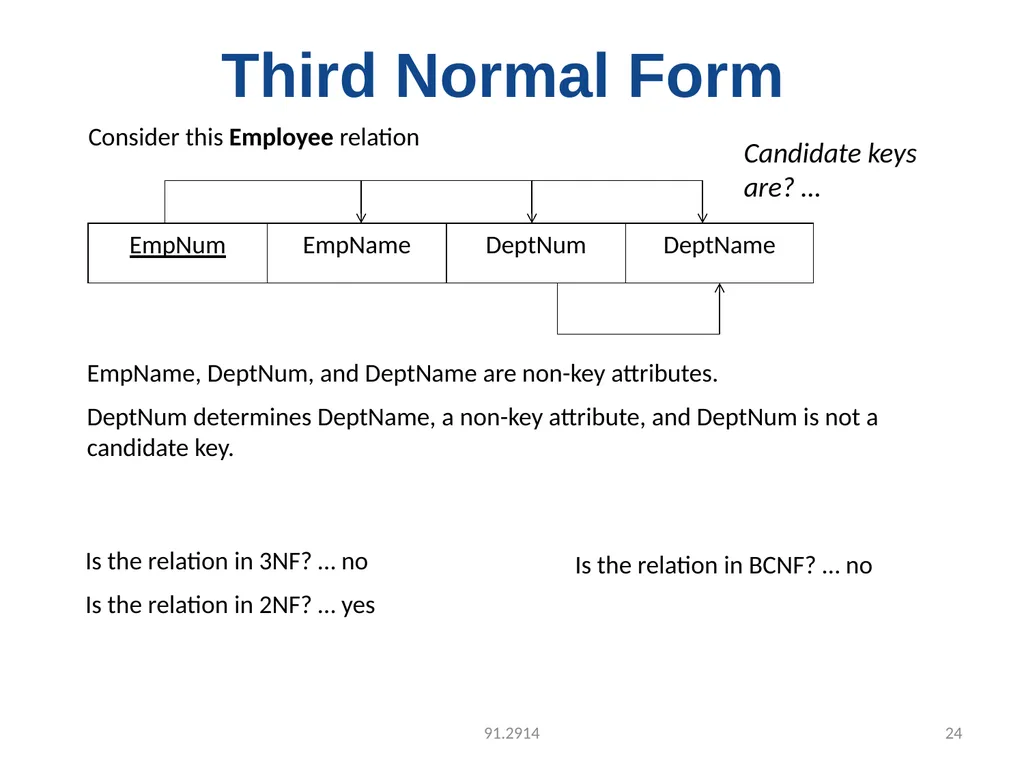
slide24. Third Normal Form 91.2914 24 EmpNum EmpName DeptNum DeptName EmpName, DeptNum, and DeptName are non-key attributes.
DeptNum determines DeptName, a non-key attribute, and DeptNum is not a candidate key. Consider this Employee relation Is the relation in 3NF? … no
Is the relation in 2NF? … yes Is the relation in BCNF? … no Candidate keys are? …<br>
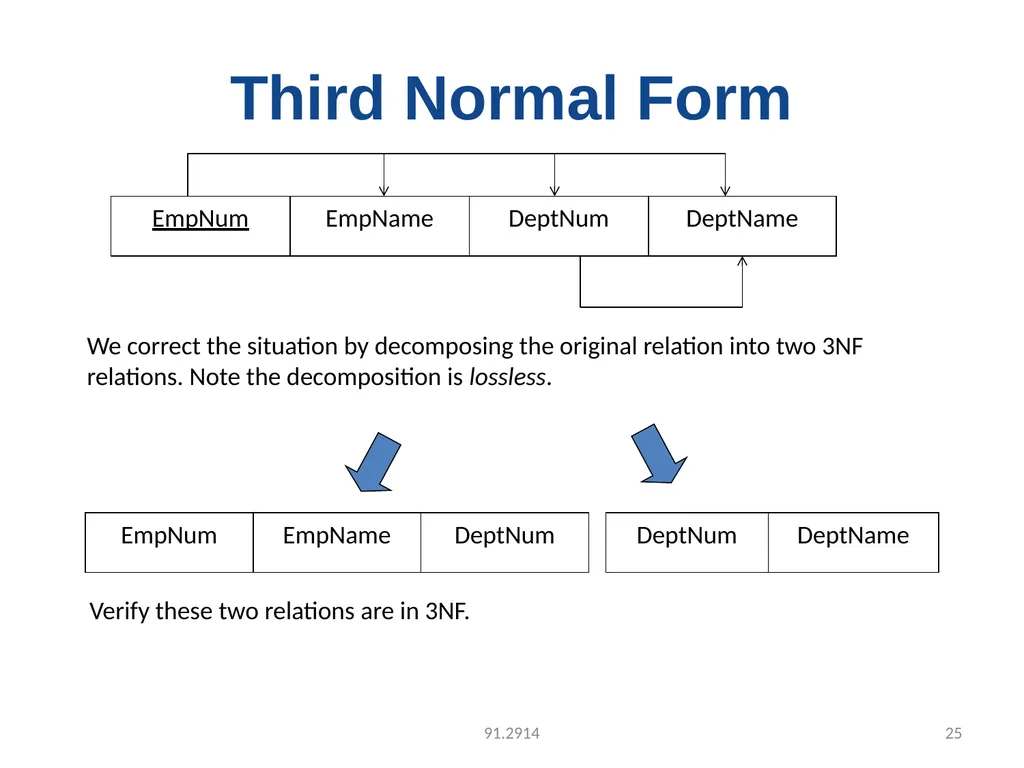
slide25. Third Normal Form 91.2914 25 Verify these two relations are in 3NF.<br>
slide26. First Normal Form (1NF)
A relation will be 1NF if it contains an atomic value.
It states that an attribute of a table cannot hold multiple values. It must hold only single-valued attribute.
First normal form disallows the multi-valued attribute, composite attribute, and their combinations.
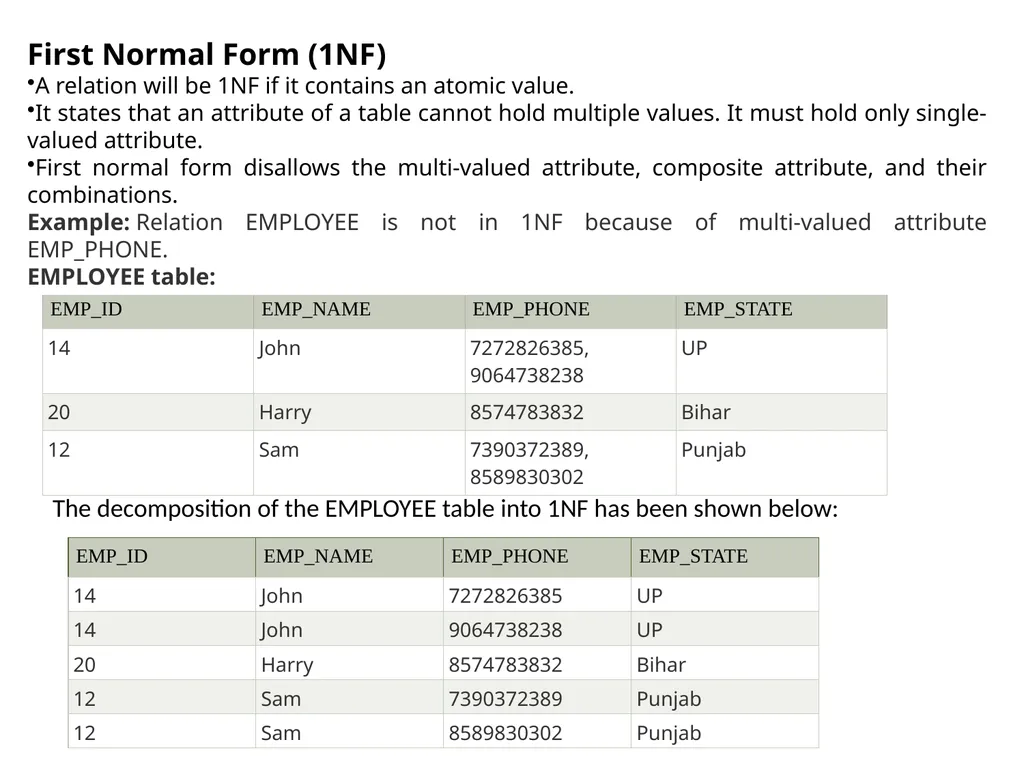
Example: Relation EMPLOYEE is not in 1NF because of multi-valued attribute EMP_PHONE.
EMPLOYEE table: The decomposition of the EMPLOYEE table into 1NF has been shown below:<br>
slide27. Second Normal Form (2NF)
In the 2NF, relational must be in 1NF.
In the second normal form, all non-key attributes are fully functional dependent on the primary key
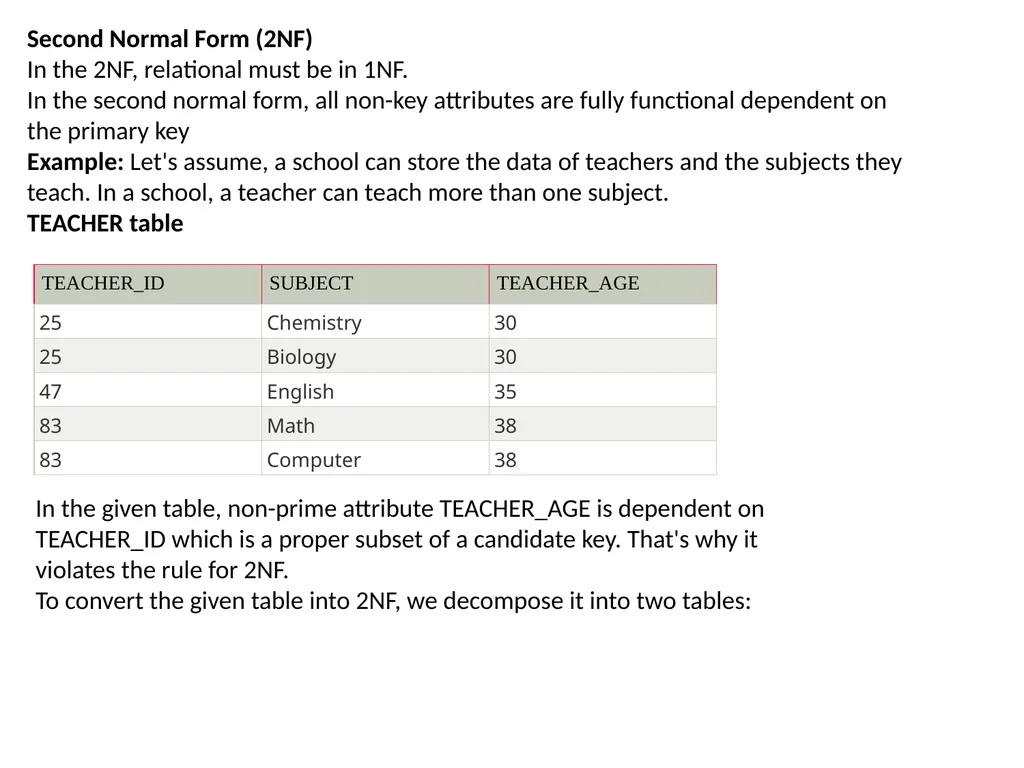
Example: Let's assume, a school can store the data of teachers and the subjects they teach. In a school, a teacher can teach more than one subject.
TEACHER table In the given table, non-prime attribute TEACHER_AGE is dependent on TEACHER_ID which is a proper subset of a candidate key. That's why it violates the rule for 2NF.
To convert the given table into 2NF, we decompose it into two tables:<br>
slide28. TEACHER_DETAIL table: TEACHER_SUBJECT table:<br>
slide29. Third Normal Form (3NF)
A relation will be in 3NF if it is in 2NF and not contain any transitive partial dependency.
3NF is used to reduce the data duplication. It is also used to achieve the data integrity.
If there is no transitive dependency for non-prime attributes, then the relation must be in third normal form.
A relation is in third normal form if it holds atleast one of the following conditions for every non-trivial function dependency X → Y.
X is a super key.
Y is a prime attribute, i.e., each element of Y is part of some candidate key. Example:
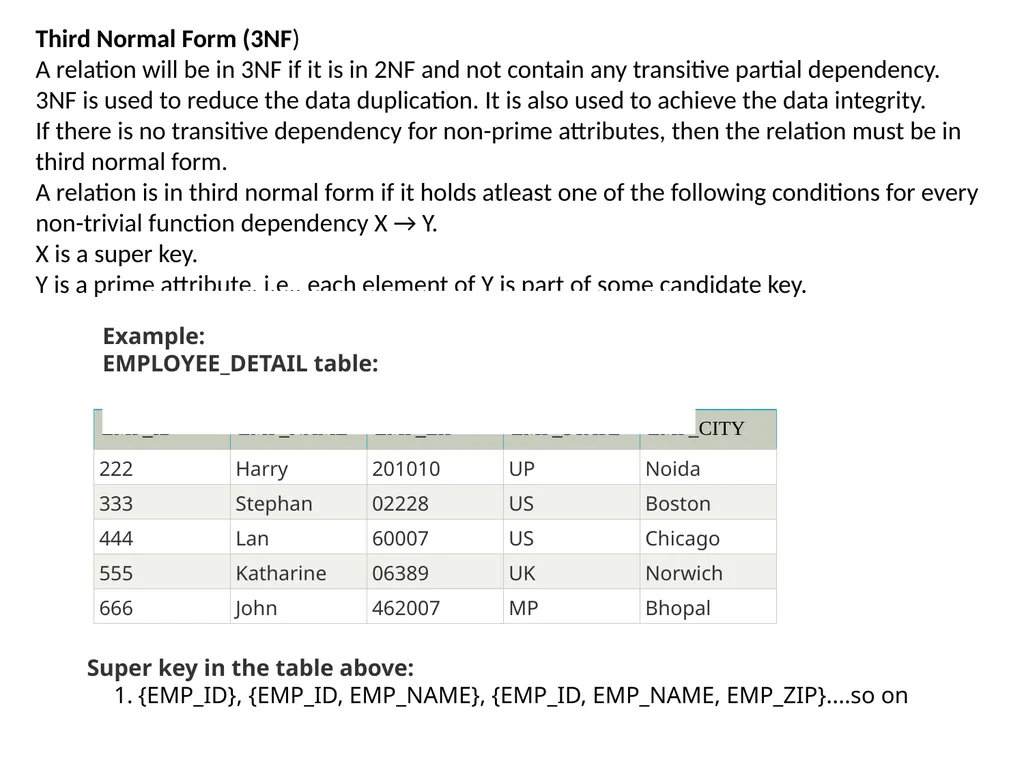
EMPLOYEE_DETAIL table: Super key in the table above:
{EMP_ID}, {EMP_ID, EMP_NAME}, {EMP_ID, EMP_NAME, EMP_ZIP}....so on<br>
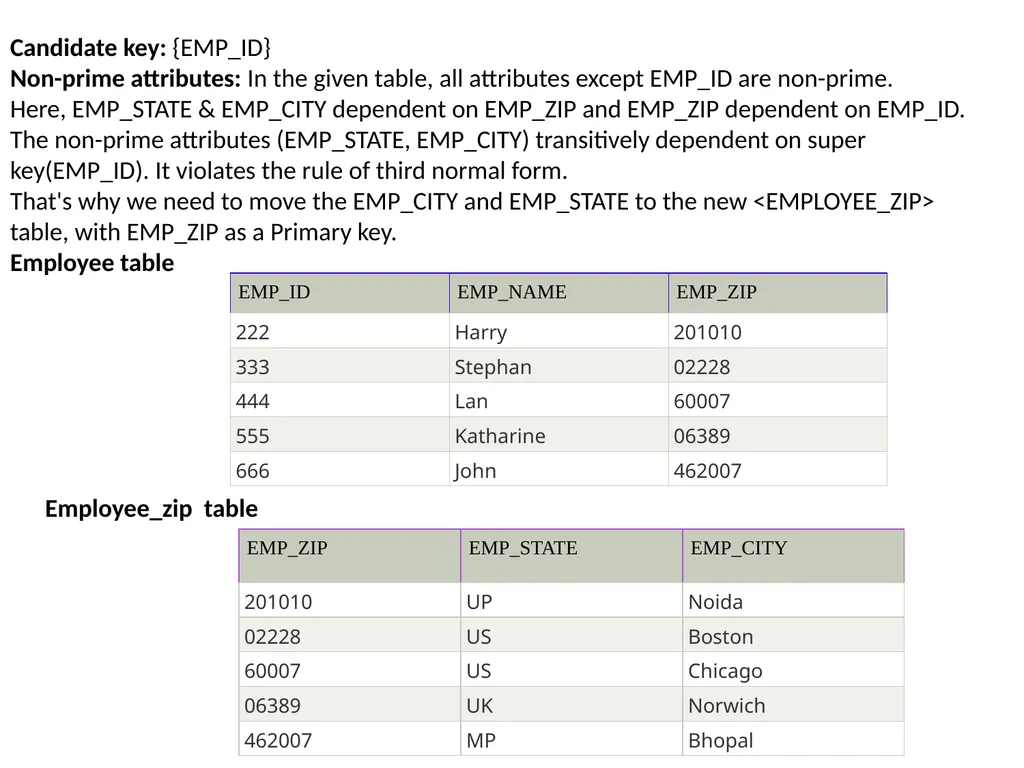
slide30. Candidate key: {EMP_ID}
Non-prime attributes: In the given table, all attributes except EMP_ID are non-prime.
Here, EMP_STATE & EMP_CITY dependent on EMP_ZIP and EMP_ZIP dependent on EMP_ID. The non-prime attributes (EMP_STATE, EMP_CITY) transitively dependent on super key(EMP_ID). It violates the rule of third normal form.
That's why we need to move the EMP_CITY and EMP_STATE to the new <EMPLOYEE_ZIP> table, with EMP_ZIP as a Primary key.
Employee table Employee_zip table<br>
slide2. Functional Dependency The functional dependency is a relationship that exists between two attributes. It typically exists between the primary key and non-key attribute within a table.
X → Y
The left side of FD is known as a determinant, the right side of the production is known as a dependent.
For example:
Assume we have an employee table with attributes: Emp_Id, Emp_Name, Emp_Address.
Here Emp_Id attribute can uniquely identify the Emp_Name attribute of employee table because if we know the Emp_Id, we can tell that employee name associated with it.
Functional dependency can be written as:
Emp_Id → Emp_Name
We can say that Emp_Name is functionally dependent on Emp_Id.<br>
slide3. Types of Functional dependency 1. Trivial functional dependency
A → B has trivial functional dependency if B is a subset of A.
The following dependencies are also trivial like: A → A, B → B Example:
Consider a table with two columns Employee_Id and Employee_Name.
{Employee_id, Employee_Name} → Employee_Id is a trivial functional dependency as
Employee_Id is a subset of {Employee_Id, Employee_Name}.
Also, Employee_Id → Employee_Id and Employee_Name → Employee_Name are trivial
dependencies too.<br>
slide4. Functional Dependencies 91.2914 4 EmpNum EmpEmail
EmpNum EmpFname
EmpNum EmpLname EmpNum EmpEmail EmpFname EmpLname EmpNum EmpEmail EmpFname EmpLname 3 different ways you might see FDs depicted<br>
slide5. Determinant 91.2914 5 Functional Dependency
EmpNum EmpEmail Attribute on the LHS is known as the determinant
EmpNum is a determinant of EmpEmail<br>
slide6. Transitive dependency 91.2914 6 Transitive dependency
Consider attributes A, B, and C, and where
A B and B C.
Functional dependencies are transitive, which means that we also have the functional dependency A C
We say that C is transitively dependent on A through B.<br>
slide7. Transitive dependency 91.2914 7 EmpNum EmpEmail DeptNum DeptNname EmpNum EmpEmail DeptNum DeptNname DeptName is transitively dependent on EmpNum via DeptNum
EmpNum DeptName EmpNum DeptNum DeptNum DeptName<br>
slide8. Partial dependency 91.2914 8 A partial dependency exists when an attribute B is functionally dependent on an attribute A, and A is a component of a multipart candidate key. InvNum LineNum Qty InvDate Candidate keys: {InvNum, LineNum} InvDate is partially dependent on {InvNum, LineNum} as InvNum is a determinant of InvDate and InvNum is part of a candidate key<br>
slide9. 2. Non-trivial functional dependency
A → B has a non-trivial functional dependency if B is not a subset of A.
When A intersection B is NULL, then A → B is called as complete non-trivial.
Example:
ID → Name,
Name → DOB Inference Rule (IR):
The Armstrong's axioms are the basic inference rule.
Armstrong's axioms are used to conclude functional dependencies on a relational database.
The inference rule is a type of assertion. It can apply to a set of FD(functional dependency) to derive other FD.
Using the inference rule, we can derive additional functional dependency from the initial set.
The Functional dependency has 6 types of inference rule: 1. Reflexive Rule (IR1)
In the reflexive rule, if Y is a subset of X, then X determines Y.
If X ⊇ Y then X → Y
Example:
X = {a, b, c, d, e}
Y = {a, b, c}<br>
slide10. 2. Augmentation Rule (IR2)
The augmentation is also called as a partial dependency. In augmentation, if X determines Y, then XZ determines YZ for any Z. If X → Y then XZ → YZ For R(ABCD), if A → B then AC → BC 3. Transitive Rule (IR3)
In the transitive rule, if X determines Y and Y determine Z, then X must also determine Z.
If X → Y and Y → Z then X → Z
4. Union Rule (IR4)
Union rule says, if X determines Y and X determines Z, then X must also determine Y and Z.
If X → Y and X → Z then X → YZ Proof:
1. X → Y (given) 2. X → Z (given) 3. X → XY (using IR2 on 1 by augmentation with X. Where XX = X) 4. XY → YZ (using IR2 on 2 by augmentation with Y) 5. X → YZ (using IR3 on 3 and 4)<br>
slide11. 5. Decomposition Rule (IR5)
Decomposition rule is also known as project rule. It is the reverse of union rule.
This Rule says, if X determines Y and Z, then X determines Y and X determines Z separately.
If X → YZ then X → Y and X → Z
Proof:
1. X → YZ (given) 2. YZ → Y (using IR1 Rule) 3. X → Y (using IR3 on 1 and 2) 6. Pseudo transitive Rule (IR6)
In Pseudo transitive Rule, if X determines Y and YZ determines W, then XZ determines W. If X → Y and YZ → W then XZ → W
Proof:
1. X → Y (given) 2. WY → Z (given) 3. WX → WY (using IR2 on 1 by augmenting with W) 4. WX → Z (using IR3 on 3 and 2)<br>
slide12. Normalization
Normalization is the process of organizing the data in the database.
Normalization is used to minimize the redundancy from a relation or set of relations. It is also used to eliminate the undesirable characteristics like Insertion, Update and Deletion Anomalies.
Normalization divides the larger table into the smaller table and links them using relationship.
The normal form is used to reduce redundancy from the database table.
Types of Normal Forms There are the four types of normal forms:<br>
slide14. First Normal Form 91.2914 14 First Normal Form
We say a relation is in 1NF if all values stored in the relation are single-valued and atomic.
1NF places restrictions on the structure of relations. Values must be simple.<br>
slide15. First Normal Form 91.2914 15 The following in not in 1NF EmpNum EmpPhone EmpDegrees 123 233-9876 333 233-1231 BA, BSc, PhD 679 233-1231 BSc, MSc EmpDegrees is a multi-valued field:
employee 679 has two degrees: BSc and MSc
employee 333 has three degrees: BA, BSc, PhD<br>
slide16. First Normal Form 91.2914 16 To obtain 1NF relations we must, without loss of information, replace the above with two relations - see next slide<br>
slide17. First Normal Form 91.2914 17 EmpNum EmpDegree 333 BA 333 BSc 333 PhD 679 BSc MSc 679 EmpNum EmpPhone 123 233-9876 333 233-1231 679 233-1231 An outer join between Employee and EmployeeDegree will produce the information we saw before Employee EmployeeDegree<br>
slide18. Second Normal Form 91.2914 18 Second Normal Form
A relation is in 2NF if it is in 1NF, and every non-key attribute is fully dependent on each candidate key. (That is, we don’t have any partial functional dependency.)
2NF (and 3NF) both involve the concepts of key and non-key attributes.
A key attribute is any attribute that is part of a key; any attribute that is not a key attribute, is a non-key attribute.
Relations that are not in BCNF have data redundancies
A relation in 2NF will not have any partial dependencies<br>
slide19. Second Normal Form 91.2914 19 LineNum ProdNum Qty InvNum InvNum, LineNum ProdNum, Qty Since there is a determinant that is not a candidate key, InvLine is not BCNF
InvLine is not 2NF since there is a partial dependency of InvDate on InvNum InvDate InvDate InvNum There are two candidate keys. Qty is the only non-key attribute, and it is dependent on InvNum InvLine is only in 1NF Consider this InvLine table (in 1NF):<br>
slide20. Second Normal Form 91.2914 20 LineNum ProdNum Qty InvNum InvDate InvLine The above relation has redundancies: the invoice date is repeated on each invoice line.
We can improve the database by decomposing the relation into two relations: LineNum ProdNum Qty InvNum InvDate InvNum Question: What is the highest normal form for these relations? 2NF? 3NF? BCNF?<br>
slide21. 91.2914 21 Is the following relation in 2NF?<br>
slide22. 91.2914 22 2NF, but not in 3NF, nor in BCNF: since dnumber is not a candidate key and we have:
dnumber dname.<br>
slide23. Third Normal Form 91.2914 23 Third Normal Form
A relation is in 3NF if the relation is in 1NF and all determinants of non-key attributes are candidate keys
That is, for any functional dependency: X Y, where Y is a non-key attribute (or a set of non-key attributes), X is a candidate key.
This definition of 3NF differs from BCNF only in the specification of non-key attributes - 3NF is weaker than BCNF. (BCNF requires all determinants to be candidate keys.)
A relation in 3NF will not have any transitive dependencies
of non-key attribute on a candidate key through another non-key attribute.<br>
slide24. Third Normal Form 91.2914 24 EmpNum EmpName DeptNum DeptName EmpName, DeptNum, and DeptName are non-key attributes.
DeptNum determines DeptName, a non-key attribute, and DeptNum is not a candidate key. Consider this Employee relation Is the relation in 3NF? … no
Is the relation in 2NF? … yes Is the relation in BCNF? … no Candidate keys are? …<br>
slide25. Third Normal Form 91.2914 25 Verify these two relations are in 3NF.<br>
slide26. First Normal Form (1NF)
A relation will be 1NF if it contains an atomic value.
It states that an attribute of a table cannot hold multiple values. It must hold only single-valued attribute.
First normal form disallows the multi-valued attribute, composite attribute, and their combinations.
Example: Relation EMPLOYEE is not in 1NF because of multi-valued attribute EMP_PHONE.
EMPLOYEE table: The decomposition of the EMPLOYEE table into 1NF has been shown below:<br>
slide27. Second Normal Form (2NF)
In the 2NF, relational must be in 1NF.
In the second normal form, all non-key attributes are fully functional dependent on the primary key
Example: Let's assume, a school can store the data of teachers and the subjects they teach. In a school, a teacher can teach more than one subject.
TEACHER table In the given table, non-prime attribute TEACHER_AGE is dependent on TEACHER_ID which is a proper subset of a candidate key. That's why it violates the rule for 2NF.
To convert the given table into 2NF, we decompose it into two tables:<br>
slide28. TEACHER_DETAIL table: TEACHER_SUBJECT table:<br>
slide29. Third Normal Form (3NF)
A relation will be in 3NF if it is in 2NF and not contain any transitive partial dependency.
3NF is used to reduce the data duplication. It is also used to achieve the data integrity.
If there is no transitive dependency for non-prime attributes, then the relation must be in third normal form.
A relation is in third normal form if it holds atleast one of the following conditions for every non-trivial function dependency X → Y.
X is a super key.
Y is a prime attribute, i.e., each element of Y is part of some candidate key. Example:
EMPLOYEE_DETAIL table: Super key in the table above:
{EMP_ID}, {EMP_ID, EMP_NAME}, {EMP_ID, EMP_NAME, EMP_ZIP}....so on<br>
slide30. Candidate key: {EMP_ID}
Non-prime attributes: In the given table, all attributes except EMP_ID are non-prime.
Here, EMP_STATE & EMP_CITY dependent on EMP_ZIP and EMP_ZIP dependent on EMP_ID. The non-prime attributes (EMP_STATE, EMP_CITY) transitively dependent on super key(EMP_ID). It violates the rule of third normal form.
That's why we need to move the EMP_CITY and EMP_STATE to the new <EMPLOYEE_ZIP> table, with EMP_ZIP as a Primary key.
Employee table Employee_zip table<br>