
UNIT -3 THE OLYMPIC GAMES Who’s responsible for
MT
Published · 15 slides · 0 views

1 / 1



Description
UNIT -3 THE OLYMPIC GAMES Whos responsible for the Olympics? There are three main constituents of the Olympic Movement: the International Olympic Committee (IOC), the International Sports Federations, and the National Olympic Committees.
Related Topics
Share
Embed code
Download this presentation From Below
"UNIT -3 THE OLYMPIC GAMES Who’s responsible for" is the property of its rightful owner. Permission is granted to download and print the materials on this website for personal, non-commercial use only, and to display it on your personal computer provided you do not modify the materials and that you retain all copyright notices contained in the materials. By downloading content from our website, you accept the terms of this agreement.
Presentation Transcript
01
UNIT -3 THE OLYMPIC GAMES<br>
02
Who’s responsible for the Olympics?
There are three main constituents of the Olympic Movement: the International Olympic Committee (IOC), the International Sports Federations, and the National Olympic Committees. Importantly, from the standpoint of this article, there are also the Organising Committees of the Olympic Games (OGOC).
Firstly, the International Olympic Committee selects a city to stage the Games. Then, this city and the National Olympic Committee of the host country create an OCOG responsible for organizing the Games. All this happens seven years before the event. The IOC and the OCOG work together over the preparations.<br>
There are three main constituents of the Olympic Movement: the International Olympic Committee (IOC), the International Sports Federations, and the National Olympic Committees. Importantly, from the standpoint of this article, there are also the Organising Committees of the Olympic Games (OGOC).
Firstly, the International Olympic Committee selects a city to stage the Games. Then, this city and the National Olympic Committee of the host country create an OCOG responsible for organizing the Games. All this happens seven years before the event. The IOC and the OCOG work together over the preparations.<br>
03
As the authors state, the Games organizers have a challenging task: planning, organizing, and coordinating an infinite number of tasks. But they must do it in a way that the stadium and television spectators would not realize the extent of the entire organizational complexity.<br>
04
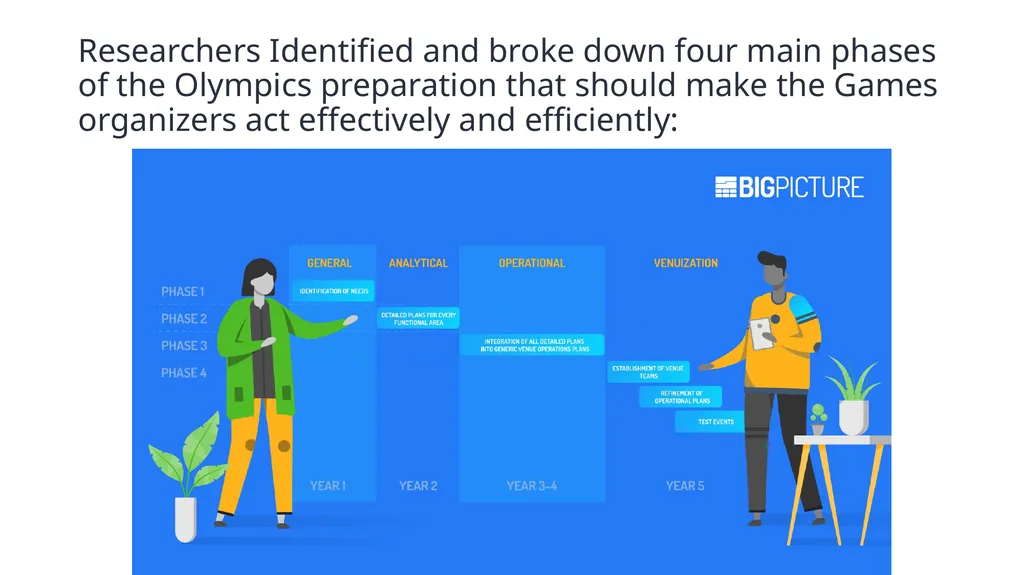
Researchers Identified and broke down four main phases of the Olympics preparation that should make the Games organizers act effectively and efficiently:<br>
05
“Approximately three months before the Games, a 1-week simulation exercise, involving all key managers of the Games at the venue level administration, was conducted. Since the entire Games can be organized only once, a number of possible Games time scenarios were tested in simulated real conditions and challenges, as well a number of people involved in the decision-making process of the Games, were asked daily to resolve a number of issues, communicate their decisions, and run the Games as if they were actually happening.<br>
06
How is bidding done for hosting the Olympics As per the procedure followed by International Olympic Committee (IOC), the process to elect the host city for the Olympics generally begins at least 7-9 years prior to that Olympic year and the final decision is generally made by all the member nations of the IOC along with the executive board of IOC after a detailed<br>
07
Initiation The bidding process generally starts with IOC sending invitational letters to all the National Olympic Committees (NOCs) to submit the bids for the Olympic games.
After getting confirmatory letters, a time of approximately one month is given to the NOCs to submit the names of the cities interested in hosting the Olympics. There are few conditions that need to be fulfilled by the candidate city in order for NOC to consider its candidature valid such as Approval from the country's NOC is mandatory for the city to submit its bid. In case there are several potential candidatures in the same country for the same edition of the Olympic Games, NOC reserves the right to decide upon the one city that will represent that country during the bidding process<br>
After getting confirmatory letters, a time of approximately one month is given to the NOCs to submit the names of the cities interested in hosting the Olympics. There are few conditions that need to be fulfilled by the candidate city in order for NOC to consider its candidature valid such as Approval from the country's NOC is mandatory for the city to submit its bid. In case there are several potential candidatures in the same country for the same edition of the Olympic Games, NOC reserves the right to decide upon the one city that will represent that country during the bidding process<br>
08
Submission of application files and guarantee letters Cities interested in bidding for the games are then asked to submit the application file/docket to the executive board of IOC along with financial guarantees and letters of guarantees from various stakeholders.
These guarantees include many assurances like no other event will take place during the Olympic games or one week before or after it, along with a guarantee that all the Olympic-related goods will be imported without any customs duty.
The application files and the guarantees received from all the interesting cities are then examine thoroughly by IOC during the period of 3-4 months, and based on their assessment, the official announcement regarding the official candidate cities is made by the Executive Board of IOC. This announcement is usually based on the critical assessment of the application files.
IOC scores all the applicants based on different parameters to assess the quality and feasibility of the applicant cities. The parameters include the basic concept of the game, Accommodation facilities, Transport facilities, safety & security, telecommunication, government and public support, Finance & marketing, etc.<br>
These guarantees include many assurances like no other event will take place during the Olympic games or one week before or after it, along with a guarantee that all the Olympic-related goods will be imported without any customs duty.
The application files and the guarantees received from all the interesting cities are then examine thoroughly by IOC during the period of 3-4 months, and based on their assessment, the official announcement regarding the official candidate cities is made by the Executive Board of IOC. This announcement is usually based on the critical assessment of the application files.
IOC scores all the applicants based on different parameters to assess the quality and feasibility of the applicant cities. The parameters include the basic concept of the game, Accommodation facilities, Transport facilities, safety & security, telecommunication, government and public support, Finance & marketing, etc.<br>
09
Submission of the candidature files & IOC Visit All the official candidate cities are then required to present a detailed proposal regarding their Olympic project, which is captured in the candidature file.
The files are normally presented in English as well as the French language in a specifically drafted format as specified by the IOC.
The submission of these files is then followed by the visit by the IOC evaluation committee to all the candidate cities within a span of a month. Each city makes a most of this opportunity to explain why it wishes to be selected to organize the Olympic games and how it offers a unique vision and opportunity to contribute to the Olympic movement.
Based on these visits, the evaluation commission of IOC then files a detailed report.<br>
The files are normally presented in English as well as the French language in a specifically drafted format as specified by the IOC.
The submission of these files is then followed by the visit by the IOC evaluation committee to all the candidate cities within a span of a month. Each city makes a most of this opportunity to explain why it wishes to be selected to organize the Olympic games and how it offers a unique vision and opportunity to contribute to the Olympic movement.
Based on these visits, the evaluation commission of IOC then files a detailed report.<br>
10
The Final Vote Now all the IOC members vote for the candidate cities to elect the host in a democratic way. The voting is a part of the IOC session celebrating the international meet of all the IOC members.
During the session, each city is generally provided with an opportunity to give a 45 minutes presentation to the members, which is then followed by 15 minutes of Q&A. Then opened for the voting process. As per IOC voting regulations, in each round, each participating IOC member can vote for only one city and only those IOC members who are not nationals of the countries of the candidature cities are permitted to vote.
After the first round of voting, if none of the candidature cities are able to obtain the majority, the city which has received the least votes leaves the competition and the voting continues till the majority of the votes are received by any of the candidates. The winning city thus guaranteed to host the games, then officially announced by the IOC president and the NOC & city then signs the Host City Contract.<br>
During the session, each city is generally provided with an opportunity to give a 45 minutes presentation to the members, which is then followed by 15 minutes of Q&A. Then opened for the voting process. As per IOC voting regulations, in each round, each participating IOC member can vote for only one city and only those IOC members who are not nationals of the countries of the candidature cities are permitted to vote.
After the first round of voting, if none of the candidature cities are able to obtain the majority, the city which has received the least votes leaves the competition and the voting continues till the majority of the votes are received by any of the candidates. The winning city thus guaranteed to host the games, then officially announced by the IOC president and the NOC & city then signs the Host City Contract.<br>
11
For the 2020 edition, IOC confirmed that it had received bids from six cities which included Istanbul (Turkey), Baku (Azerbaijan), Doha (Qatar), Madrid (Spain) and Rome (Italy), along with Tokyo (Japan). For these cities, IOC generally holds an informatory seminar explaining the IOC rules and regulations to the bidders.
The file presented by the Tokyo organizing committee was a report spread across 200 pages and three volumes.<br>
The file presented by the Tokyo organizing committee was a report spread across 200 pages and three volumes.<br>
12
PARTICIPATION Athletes participating in Olympics one of three ways.
Firstly, they can earn quota places for their respective countries or attain individual qualification through performances at designated competitions during the qualification period.
The second method is through respective Olympic Rankings, which are based on cumulative performances at various authorized events throughout the qualification windows set for each sport.
The third only applies to specific sports like athletics and swimming, where meeting a pre-set qualifying standard in any event at an authorised competition, held during the qualification<br>
Firstly, they can earn quota places for their respective countries or attain individual qualification through performances at designated competitions during the qualification period.
The second method is through respective Olympic Rankings, which are based on cumulative performances at various authorized events throughout the qualification windows set for each sport.
The third only applies to specific sports like athletics and swimming, where meeting a pre-set qualifying standard in any event at an authorised competition, held during the qualification<br>
13
WOMENS AND SPORTS At the first modern Olympic Games in Athens 1896, no women competed, Women participated for the first time at the 1900 Paris Games with the inclusion of women's events in lawn tennis and golf. Women's athletics and gymnastics debuted at the 1928 Olympics. Over time more women's events were added. In 2012, women's boxing was introduced, resulting in no remaining sports that do not included
It is commonly believed that first woman to win an Olympic event was England's Charlotte Cooper, who won the tennis singles title, however Swiss sailor Hélène de Pourtalès won a gold medal as part of a team in sailing earlier than this.
In 1928, women competed in track and field events for the first time. The first woman to win an Olympic gold medal in track and field was Poland's Halina Konopacka when she broke her own world record with a throw of 39.62 metres to win the discus at Amsterdam 1928.
However, there are still several sporting disciplines that are solely for women: synchronized swimming, greco-roman wrestling and rhythmic gymnastics.
Equality in the available sports is one thing, but in many countries, women do not have equal rights to participate in sports and the opportunity to participate in the Olympic Games. Prior to the 2012 Olympics in London, three Muslim countries have never before sent a female athlete: Qatar, Brunei, and Saudi Arabia. However, they all sent female athletes to London. Now every national Olympic committee has sent women to the Olympic Games.
The Tokyo Olympics in 2021, almost 49 per cent of the athletes participating will be women, (according to the IOC quota allocation). For the first time ever, all 206 National Olympic Committees (NOCs) should have at least one female and one male athlete in their respective Olympic teams. All 206 NOCs and the IOC Refugee Olympic Team will be encouraged to have their flag carried by one female and one male athlete at the Opening Ceremony.<br>
It is commonly believed that first woman to win an Olympic event was England's Charlotte Cooper, who won the tennis singles title, however Swiss sailor Hélène de Pourtalès won a gold medal as part of a team in sailing earlier than this.
In 1928, women competed in track and field events for the first time. The first woman to win an Olympic gold medal in track and field was Poland's Halina Konopacka when she broke her own world record with a throw of 39.62 metres to win the discus at Amsterdam 1928.
However, there are still several sporting disciplines that are solely for women: synchronized swimming, greco-roman wrestling and rhythmic gymnastics.
Equality in the available sports is one thing, but in many countries, women do not have equal rights to participate in sports and the opportunity to participate in the Olympic Games. Prior to the 2012 Olympics in London, three Muslim countries have never before sent a female athlete: Qatar, Brunei, and Saudi Arabia. However, they all sent female athletes to London. Now every national Olympic committee has sent women to the Olympic Games.
The Tokyo Olympics in 2021, almost 49 per cent of the athletes participating will be women, (according to the IOC quota allocation). For the first time ever, all 206 National Olympic Committees (NOCs) should have at least one female and one male athlete in their respective Olympic teams. All 206 NOCs and the IOC Refugee Olympic Team will be encouraged to have their flag carried by one female and one male athlete at the Opening Ceremony.<br>