
Unit 315 Unit 315 Supervisory skills for the
KL
Published · 51 slides · 0 views

1 / 1










Description
Unit 315 Unit 315 Supervisory skills for the professional kitchen Demonstrate knowledge and understanding of the principles, processes and procedures for food safety and health and safety in the workplace Apply knowledge and understanding
Related Topics
Share
Embed code
Download this presentation From Below
"Unit 315 Unit 315 Supervisory skills for the" is the property of its rightful owner. Permission is granted to download and print the materials on this website for personal, non-commercial use only, and to display it on your personal computer provided you do not modify the materials and that you retain all copyright notices contained in the materials. By downloading content from our website, you accept the terms of this agreement.
Presentation Transcript
01
Unit 315 Unit 315 Supervisory skills for the professional kitchen<br>
02
Demonstrate knowledge and understanding of the principles, processes and procedures for food safety and health and safety in the workplace
Apply knowledge and understanding of the principles, processes and procedures used in food safety and health and safety in a range of hospitality contexts
Analyse, interpret and evaluate food safety and health and safety information to predict probable consequences and provide reasonable alternatives and solutions to food safety and health and safety issues in the workplace
Make connections, use and integrate different principles, processes and procedures for food safety and health and safety in the workplace in order to justify and support judgements being made Aims<br>
Apply knowledge and understanding of the principles, processes and procedures used in food safety and health and safety in a range of hospitality contexts
Analyse, interpret and evaluate food safety and health and safety information to predict probable consequences and provide reasonable alternatives and solutions to food safety and health and safety issues in the workplace
Make connections, use and integrate different principles, processes and procedures for food safety and health and safety in the workplace in order to justify and support judgements being made Aims<br>
03
A The role of the legislation in ensuring food safety in the workplace Food safety legislation Food safety legislation, its purpose and aims, and the role of the supervisor in its application.
The main legal frameworks, laws and offences relating to food safety and health and safety in the workplace:
The Food Hygiene Regulations 2006, Regulation (EC) No. 852/2004 on the hygiene of foodstuffs, the Food Safety Act 1990, Food Premises (Registration) Regulations 1991.<br>
The main legal frameworks, laws and offences relating to food safety and health and safety in the workplace:
The Food Hygiene Regulations 2006, Regulation (EC) No. 852/2004 on the hygiene of foodstuffs, the Food Safety Act 1990, Food Premises (Registration) Regulations 1991.<br>
04
Write down what you feel the role of a supervisor is in the work place
What is the role of the legislation that is in place
Explain what HACCP is
What is the role of the Government with food safety? Task<br>
What is the role of the legislation that is in place
Explain what HACCP is
What is the role of the Government with food safety? Task<br>
05
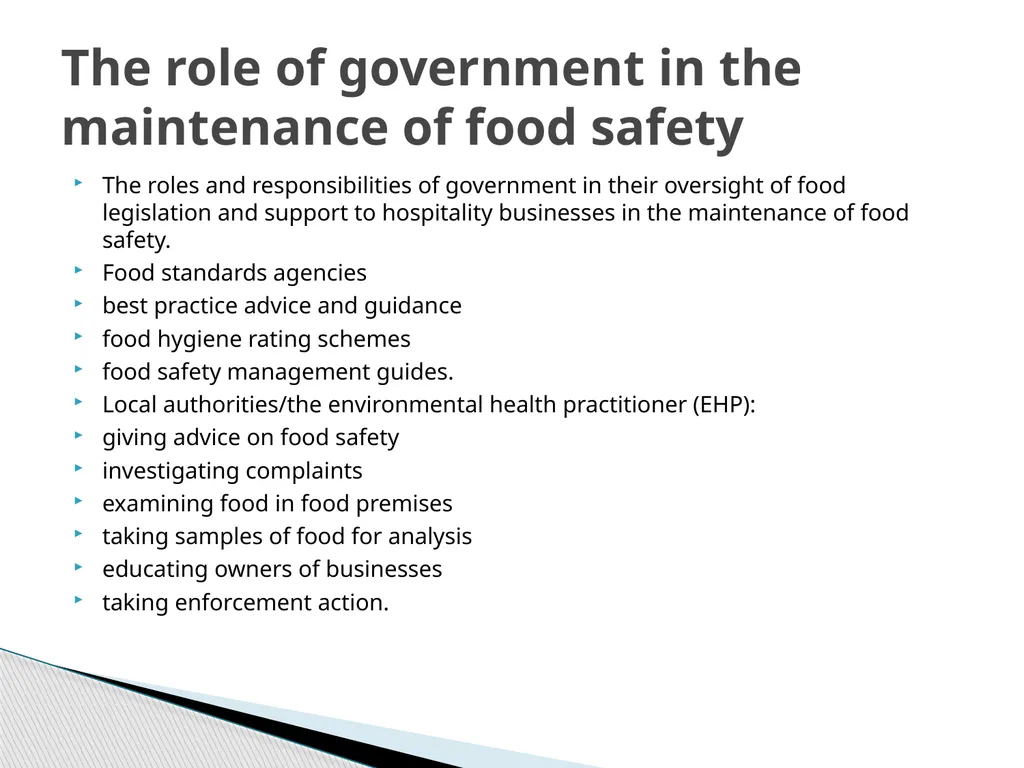
The roles and responsibilities of government in their oversight of food legislation and support to hospitality businesses in the maintenance of food safety.
Food standards agencies
best practice advice and guidance
food hygiene rating schemes
food safety management guides.
Local authorities/the environmental health practitioner (EHP):
giving advice on food safety
investigating complaints
examining food in food premises
taking samples of food for analysis
educating owners of businesses
taking enforcement action. The role of government in the maintenance of food safety<br>
Food standards agencies
best practice advice and guidance
food hygiene rating schemes
food safety management guides.
Local authorities/the environmental health practitioner (EHP):
giving advice on food safety
investigating complaints
examining food in food premises
taking samples of food for analysis
educating owners of businesses
taking enforcement action. The role of government in the maintenance of food safety<br>
06
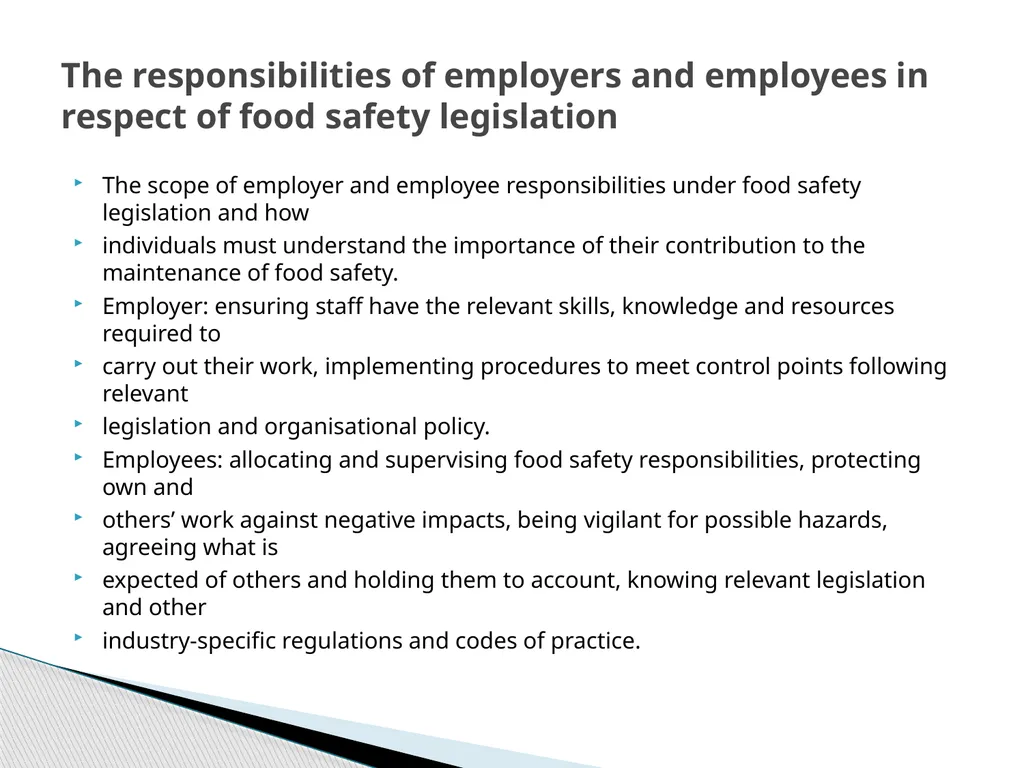
The scope of employer and employee responsibilities under food safety legislation and how
individuals must understand the importance of their contribution to the maintenance of food safety.
Employer: ensuring staff have the relevant skills, knowledge and resources required to
carry out their work, implementing procedures to meet control points following relevant
legislation and organisational policy.
Employees: allocating and supervising food safety responsibilities, protecting own and
others’ work against negative impacts, being vigilant for possible hazards, agreeing what is
expected of others and holding them to account, knowing relevant legislation and other
industry-specific regulations and codes of practice. The responsibilities of employers and employees in respect of food safety legislation<br>
individuals must understand the importance of their contribution to the maintenance of food safety.
Employer: ensuring staff have the relevant skills, knowledge and resources required to
carry out their work, implementing procedures to meet control points following relevant
legislation and organisational policy.
Employees: allocating and supervising food safety responsibilities, protecting own and
others’ work against negative impacts, being vigilant for possible hazards, agreeing what is
expected of others and holding them to account, knowing relevant legislation and other
industry-specific regulations and codes of practice. The responsibilities of employers and employees in respect of food safety legislation<br>
07
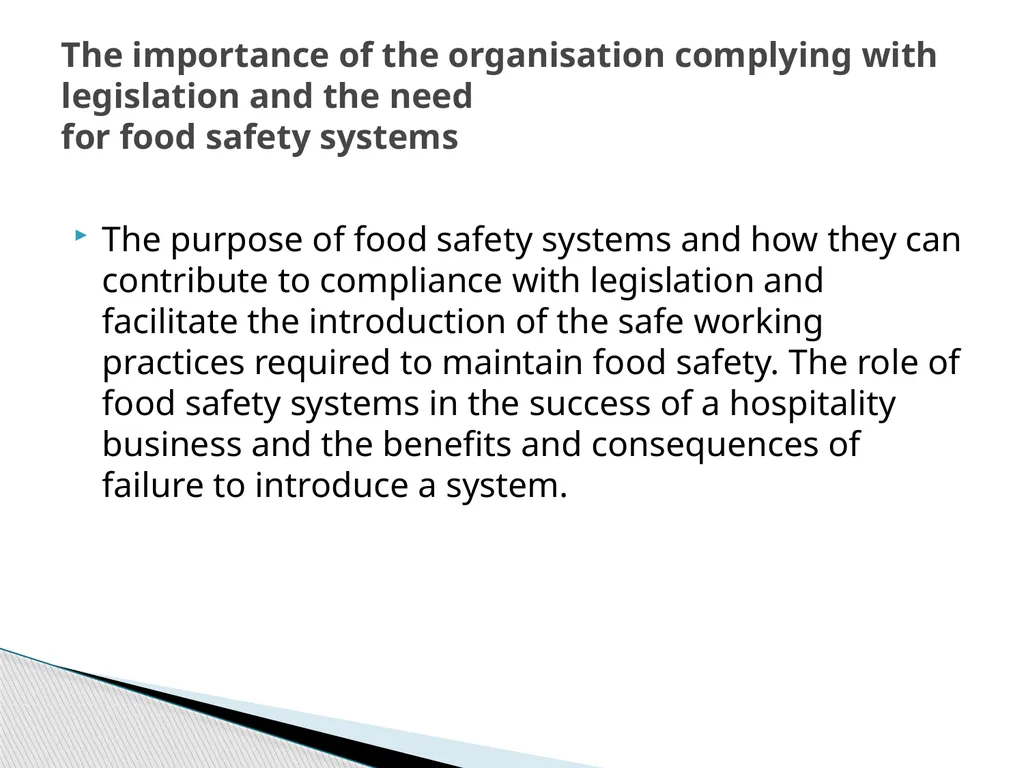
The purpose of food safety systems and how they can contribute to compliance with legislation and facilitate the introduction of the safe working practices required to maintain food safety. The role of food safety systems in the success of a hospitality business and the benefits and consequences of failure to introduce a system. The importance of the organisation complying with legislation and the need
for food safety systems<br>
08
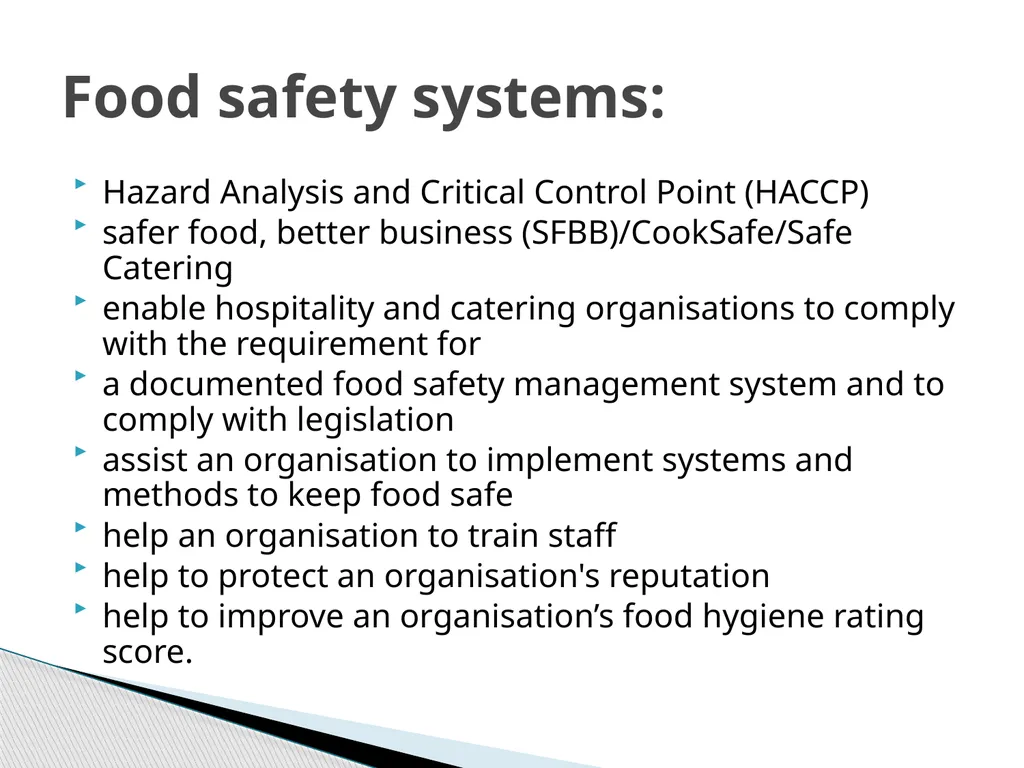
Hazard Analysis and Critical Control Point (HACCP)
safer food, better business (SFBB)/CookSafe/Safe Catering
enable hospitality and catering organisations to comply with the requirement for
a documented food safety management system and to comply with legislation
assist an organisation to implement systems and methods to keep food safe
help an organisation to train staff
help to protect an organisation's reputation
help to improve an organisation’s food hygiene rating score. Food safety systems:<br>
safer food, better business (SFBB)/CookSafe/Safe Catering
enable hospitality and catering organisations to comply with the requirement for
a documented food safety management system and to comply with legislation
assist an organisation to implement systems and methods to keep food safe
help an organisation to train staff
help to protect an organisation's reputation
help to improve an organisation’s food hygiene rating score. Food safety systems:<br>
09
ensuring that proper safe working and food handling practices are in place and applied
monitoring and recording of safe working and food handling practices
the identification of critical control points and critical limits
ensuring the effectiveness of control measures for different hazards
knowing how different conditions impact on the effectiveness of control measures
taking corrective actions and introducing measures for improvement. Methods and procedures for controlling food safety:<br>
monitoring and recording of safe working and food handling practices
the identification of critical control points and critical limits
ensuring the effectiveness of control measures for different hazards
knowing how different conditions impact on the effectiveness of control measures
taking corrective actions and introducing measures for improvement. Methods and procedures for controlling food safety:<br>
10
the need for adjustment to food safety management procedures when a review indicates that
control methods are ineffective, or if enforcement officers recommend or require changes
factors or events that may require an immediate review and evaluation of the food safety
procedures
the importance of communicating to relevant staff any changes to the procedures and of
monitoring and verifying new procedures. The methods for, and the importance of, evaluating food safety controls and procedures:<br>
control methods are ineffective, or if enforcement officers recommend or require changes
factors or events that may require an immediate review and evaluation of the food safety
procedures
the importance of communicating to relevant staff any changes to the procedures and of
monitoring and verifying new procedures. The methods for, and the importance of, evaluating food safety controls and procedures:<br>
11
The benefits of high standards of food safety and health and safety to the organisation.
The consequences and costs associated with food poisoning outbreaks, accidents and ill health. Group discussion<br>
The consequences and costs associated with food poisoning outbreaks, accidents and ill health. Group discussion<br>
12
Types of contaminate:
microbial
physical
chemical contaminants
the transference of allergens. The causes and sources of contamination<br>
microbial
physical
chemical contaminants
the transference of allergens. The causes and sources of contamination<br>
13
raw food
people
equipment
packaging
air, dust and soil
pests
water. Sources of contamination:<br>
people
equipment
packaging
air, dust and soil
pests
water. Sources of contamination:<br>
14
The different types of bacteria, their characteristics, the conditions for their growth and the groups most susceptible to food poisoning. The types of food poisoning bacteria and conditions required for multiplication<br>
15
the bacteria that cause food spoilage, not food poisoning – yeasts, moulds, fungi or bacteria.
Pathogenic bacteria:
the bacteria that cause ill health when present in large numbers in food. Spoilage bacteria:<br>
Pathogenic bacteria:
the bacteria that cause ill health when present in large numbers in food. Spoilage bacteria:<br>
16
nutrients
warmth
time
moisture
pH. Conditions required for growth and how these can be reduced or removed:<br>
warmth
time
moisture
pH. Conditions required for growth and how these can be reduced or removed:<br>
17
pregnant women
the elderly
young children
people with chronic illness. High-risk groups, the reasons why and ways to manage risk:<br>
the elderly
young children
people with chronic illness. High-risk groups, the reasons why and ways to manage risk:<br>
18
Salmonella:
sources – present in human and animal intestines
foods commonly involved – meat, poultry, milk, eggs, raw fruits and vegetables
cause of and illness – large number of bacteria on food, onset period of 12–72 hours
with diarrhoea, fever, headache, abdominal cramps, vomiting lasting 1–7 days
carrier status – common
control measures – separation of raw and cooked foods, thorough cooking of meat and
poultry, good personal hygiene, effective pest control, effective cleaning and disinfection. Bacterial food poisoning and food-borne disease<br>
sources – present in human and animal intestines
foods commonly involved – meat, poultry, milk, eggs, raw fruits and vegetables
cause of and illness – large number of bacteria on food, onset period of 12–72 hours
with diarrhoea, fever, headache, abdominal cramps, vomiting lasting 1–7 days
carrier status – common
control measures – separation of raw and cooked foods, thorough cooking of meat and
poultry, good personal hygiene, effective pest control, effective cleaning and disinfection. Bacterial food poisoning and food-borne disease<br>
19
sources – present in human and animal intestines, soil, dust
foods commonly involved – meat products such as stews, casseroles and gravy
cause of and illness – toxins produced by bacteria multiplying quickly in meats that are slowly
cooked, cooled slowly or cooked meat stored at ambient temperatures. Toxins produced when
bacteria reach the intestines, causing a person to become sick. Onset period 8–22 hours,
with abdominal pain and diarrhoea lasting 1–2 days
carrier status – not common
control measures – effective temperature controls when storing and cooking meat,
separation of raw and cooked foods, effective cleaning and disinfection. Clostridium perfringens:<br>
foods commonly involved – meat products such as stews, casseroles and gravy
cause of and illness – toxins produced by bacteria multiplying quickly in meats that are slowly
cooked, cooled slowly or cooked meat stored at ambient temperatures. Toxins produced when
bacteria reach the intestines, causing a person to become sick. Onset period 8–22 hours,
with abdominal pain and diarrhoea lasting 1–2 days
carrier status – not common
control measures – effective temperature controls when storing and cooking meat,
separation of raw and cooked foods, effective cleaning and disinfection. Clostridium perfringens:<br>
20
sources – skin, ear, nose and throat of food handlers, raw milk
foods commonly involved – cooked meats, salads, cream
cause of and illness – toxins produced by the bacteria as they multiply on food.
Onset period of 2–4 hours, with nausea, vomiting, diarrhoea, loss of appetite,
severe abdominal cramps, mild fever lasting 24 hours
carrier status – common
control measures – good personal hygiene, temperature controls, effective cleaning and disinfection. Staphylococcus aureus:<br>
foods commonly involved – cooked meats, salads, cream
cause of and illness – toxins produced by the bacteria as they multiply on food.
Onset period of 2–4 hours, with nausea, vomiting, diarrhoea, loss of appetite,
severe abdominal cramps, mild fever lasting 24 hours
carrier status – common
control measures – good personal hygiene, temperature controls, effective cleaning and disinfection. Staphylococcus aureus:<br>
21
sources – cereals, soil, dust
foods commonly involved – rice and rice dishes
cause of and illness – heat-resistant toxin caused by bacteria as they multiply in food.
Onset period 1–5 hours, with nausea, vomiting, abdominal pain and some diarrhoea,
lasting 12–24 hours
carrier status – none
control measures – thorough cooking and cooling of food, safe storage,
effective cleaning and disinfection. Bacillus cereus:<br>
foods commonly involved – rice and rice dishes
cause of and illness – heat-resistant toxin caused by bacteria as they multiply in food.
Onset period 1–5 hours, with nausea, vomiting, abdominal pain and some diarrhoea,
lasting 12–24 hours
carrier status – none
control measures – thorough cooking and cooling of food, safe storage,
effective cleaning and disinfection. Bacillus cereus:<br>
22
sources – present in human and animal intestines, soil and sewage
foods commonly involved – raw meat, undercooked beefburgers, gravy, raw milk
cause of and illness – a toxin produced in the intestines. Onset period of
12–24 hours, with nausea carrier status – common
control measures – separation of raw and cooked foods, good personal hygiene,
effective temperature controls, effective cleaning and disinfection. Escherichia coli:<br>
foods commonly involved – raw meat, undercooked beefburgers, gravy, raw milk
cause of and illness – a toxin produced in the intestines. Onset period of
12–24 hours, with nausea carrier status – common
control measures – separation of raw and cooked foods, good personal hygiene,
effective temperature controls, effective cleaning and disinfection. Escherichia coli:<br>
23
The importance of, and the procedures and processes for, the safe and effective storage and temperature control of ingredients for customers’ consumption. The role of the supervisor in the application, checking, monitoring and compliance of these controls. The corrective actions required to maintain controls and the consequences of inadequate control. Procedures for storage and temperature control<br>
24
the importance of stock rotation
use-by dates
best-before dates
stock rotation systems: first in, first out (FIFO)/last in, last out (LILO)
foods exempt from date marking
receiving deliveries and checking for damage
product traceability. Stock rotation:<br>
use-by dates
best-before dates
stock rotation systems: first in, first out (FIFO)/last in, last out (LILO)
foods exempt from date marking
receiving deliveries and checking for damage
product traceability. Stock rotation:<br>
25
cool and dry
dark but with adequate artificial lighting
adequate ventilation
storage off the floor and away from walls
storage in lidded containers. Dry food storage:<br>
dark but with adequate artificial lighting
adequate ventilation
storage off the floor and away from walls
storage in lidded containers. Dry food storage:<br>
26
siting
access
prevention of cross-contamination
maintenance and cleaning.
• Freezers:
siting
access
prevention of cross-contamination
maintenance and cleaning
defrosting.
• Thawing frozen food:
defrost in a fridge or thawing cabinet
protect thawing food against contamination
cook immediately following thawing. Refrigerated storage:<br>
access
prevention of cross-contamination
maintenance and cleaning.
• Freezers:
siting
access
prevention of cross-contamination
maintenance and cleaning
defrosting.
• Thawing frozen food:
defrost in a fridge or thawing cabinet
protect thawing food against contamination
cook immediately following thawing. Refrigerated storage:<br>
27
use of vehicles and/or containers
transporting different types of food at the same time
effective cleaning between loads
keeping food at appropriate temperatures and allowing those temperatures to be monitored. Transporting food:<br>
transporting different types of food at the same time
effective cleaning between loads
keeping food at appropriate temperatures and allowing those temperatures to be monitored. Transporting food:<br>
28
follow the manufacturer’s cooking instructions for food products (where applicable)
preheat equipment before cooking
never use the same utensils, plates or containers for raw and cooked or ready-to-eat food
use of whole cuts or joints and cuts and joints of appropriate size
ensure liquid dishes, gravy, soups, sauces and stews are simmering and stir them frequently
ensure one of the following temperatures has been reached: 80 °C for at least
6 seconds, 75 °C for at least 30 seconds, 70 °C for at least 2 minutes,
65 °C for at least 10 minutes, 60 °C for at least 45 minutes. Cooking safely:<br>
preheat equipment before cooking
never use the same utensils, plates or containers for raw and cooked or ready-to-eat food
use of whole cuts or joints and cuts and joints of appropriate size
ensure liquid dishes, gravy, soups, sauces and stews are simmering and stir them frequently
ensure one of the following temperatures has been reached: 80 °C for at least
6 seconds, 75 °C for at least 30 seconds, 70 °C for at least 2 minutes,
65 °C for at least 10 minutes, 60 °C for at least 45 minutes. Cooking safely:<br>
29
to prevent the growth of food poisoning bacteria
complying with legislation
maintaining safe standards
maintaining the reputation of the business. Importance of temperature control:<br>
complying with legislation
maintaining safe standards
maintaining the reputation of the business. Importance of temperature control:<br>
30
below 8 °C and above 63 °C
reheated food 82 °C (Scotland) 75 C (England)
exceptions to temperature controls and regional variations. Legal temperature requirements:<br>
reheated food 82 °C (Scotland) 75 C (England)
exceptions to temperature controls and regional variations. Legal temperature requirements:<br>
31
in-place devices
air temperature monitoring systems
electronic probe thermometers
methods of calibration. Methods for measuring temperature:<br>
air temperature monitoring systems
electronic probe thermometers
methods of calibration. Methods for measuring temperature:<br>
32
taking fridge and freezer temperature daily
taking product temperatures as required
cleaning and disinfecting probe
inserting probe between packs for fridge and freezer temperatures
inserting into thickest part of products if undertaking product sampling
recording all routine and product sampling temperatures
reporting temperatures out of acceptable range. Taking and recording temperature readings:<br>
taking product temperatures as required
cleaning and disinfecting probe
inserting probe between packs for fridge and freezer temperatures
inserting into thickest part of products if undertaking product sampling
recording all routine and product sampling temperatures
reporting temperatures out of acceptable range. Taking and recording temperature readings:<br>
33
The importance of, and the procedures and processes for, achieving and maintaining high
standards of personal hygiene across all areas of a hospitality business. The role of the supervisor in the application, monitoring and correction of standards and the consequences of inadequate control. Procedures for maintaining high standards of personal hygiene<br>
standards of personal hygiene across all areas of a hospitality business. The role of the supervisor in the application, monitoring and correction of standards and the consequences of inadequate control. Procedures for maintaining high standards of personal hygiene<br>
34
Personal grooming:
hair
jewellery
perfume
makeup
• Clothing:
washable or disposable
light coloured
no external pockets
no outside clothing in food areas.
• Exclusion of food handlers:
if suffering from sickness or diarrhoea
with serious skin infections. personal hygiene<br>
hair
jewellery
perfume
makeup
• Clothing:
washable or disposable
light coloured
no external pockets
no outside clothing in food areas.
• Exclusion of food handlers:
if suffering from sickness or diarrhoea
with serious skin infections. personal hygiene<br>
35
The importance of, and the procedures and processes for, the effective cleaning and disinfection of
food production and service, areas, equipment and machinery, and the role of the supervisor in the
application, checking and monitoring of cleanliness, and professional waste disposal in hospitality organisations. Procedures for cleaning, disinfection and waste disposal<br>
food production and service, areas, equipment and machinery, and the role of the supervisor in the
application, checking and monitoring of cleanliness, and professional waste disposal in hospitality organisations. Procedures for cleaning, disinfection and waste disposal<br>
36
food preparation areas
work surfaces
equipment
utensils.
Methods of cleaning and use of cleaning materials:
detergents
disinfecting
sanitising
disposable cloths
colour-coded equipment – cloths, brushes, mops
correct use and storage of cleaning chemicals
use of dishwashing machines. Cleanliness and good hygiene:<br>
work surfaces
equipment
utensils.
Methods of cleaning and use of cleaning materials:
detergents
disinfecting
sanitising
disposable cloths
colour-coded equipment – cloths, brushes, mops
correct use and storage of cleaning chemicals
use of dishwashing machines. Cleanliness and good hygiene:<br>
37
pre-clean
main clean
intermediate rinse
disinfection
final rinse
dry. Six-stage cleaning process:<br>
main clean
intermediate rinse
disinfection
final rinse
dry. Six-stage cleaning process:<br>
38
breaking the contamination chain
what needs to be cleaned
how the cleaning will be carried out
when cleaning needs to be done – daily, weekly, monthly, as required
who will carry out the cleaning.
• Disposal of waste:
use of suitable containers
disposal of food
recycling
hazardous waste
external collection and general waste. Cleaning and disinfecting schedules:<br>
what needs to be cleaned
how the cleaning will be carried out
when cleaning needs to be done – daily, weekly, monthly, as required
who will carry out the cleaning.
• Disposal of waste:
use of suitable containers
disposal of food
recycling
hazardous waste
external collection and general waste. Cleaning and disinfecting schedules:<br>
39
The importance of, and the processes and procedures for, the prevention of infestation by common
pests in different hospitality situations, how to spot the signs of infestation and the role of the
supervisor in implementing the necessary controls for eradication. Pests and pest control<br>
pests in different hospitality situations, how to spot the signs of infestation and the role of the
supervisor in implementing the necessary controls for eradication. Pests and pest control<br>
40
reducing spread of bacteria and cross-contamination (chemical, physical)
complying with current food safety legislation
maintaining food safety (food storage, food handling)
maintaining a healthy environment
creating a good first impression. Importance of pest control and the impacts of infestation:<br>
complying with current food safety legislation
maintaining food safety (food storage, food handling)
maintaining a healthy environment
creating a good first impression. Importance of pest control and the impacts of infestation:<br>
41
Common pests, signs of pests and specific hazards from pests:
rodents, birds, flies and flying insects, cockroaches, ants, beetles and weevils.
• Supervisor’s role in controlling and eradicating pests:
good housekeeping
taking action to reduce harm
checking for problems and infestation
investigating reports of pest sightings
reporting problems
physical and chemical controls
use of private contractors. Importance of pest control and the impacts of infestation:<br>
rodents, birds, flies and flying insects, cockroaches, ants, beetles and weevils.
• Supervisor’s role in controlling and eradicating pests:
good housekeeping
taking action to reduce harm
checking for problems and infestation
investigating reports of pest sightings
reporting problems
physical and chemical controls
use of private contractors. Importance of pest control and the impacts of infestation:<br>
42
Health and safety legislation, its purpose, requirements, main aims and role.
• Health and Safety at Work etc. Act 1974.
• Management of Health and Safety at Work Regulations 1999.
• Workplace (Health, Safety and Welfare) Regulations 1992.
• Reporting of Injuries, Diseases and Dangerous Occurrences Regulations (RIDDOR) 2013.
• Control of Substances Hazardous to Health (COSHH) Regulations 2002.
• Electricity at Work Regulations 1989.
• Manual Handling Operations Regulations (MHOR) 1992.
• Health and Safety (First Aid) Regulations 1981.
• Health and Safety Executive (HSE):
best practice advice and guidance
codes of practice. Health and safety legislation<br>
• Health and Safety at Work etc. Act 1974.
• Management of Health and Safety at Work Regulations 1999.
• Workplace (Health, Safety and Welfare) Regulations 1992.
• Reporting of Injuries, Diseases and Dangerous Occurrences Regulations (RIDDOR) 2013.
• Control of Substances Hazardous to Health (COSHH) Regulations 2002.
• Electricity at Work Regulations 1989.
• Manual Handling Operations Regulations (MHOR) 1992.
• Health and Safety (First Aid) Regulations 1981.
• Health and Safety Executive (HSE):
best practice advice and guidance
codes of practice. Health and safety legislation<br>
43
The common facilities and provisions required by law to ensure the provision of a safe and
healthy working environment, the supervisor’s role in providing and maintaining them and
the consequences of failure to provide. The supervisor’s role in health, safety and welfare in the workplace<br>
healthy working environment, the supervisor’s role in providing and maintaining them and
the consequences of failure to provide. The supervisor’s role in health, safety and welfare in the workplace<br>
44
definition of incident
definition of accident
definition of occupational ill health.
• Welfare provisions that should be made by the employer:
toilets and handbasins, with soap and towels or a hand dryer
drinking water
a place to store clothing (and somewhere to change if special clothing is worn for work)
somewhere to rest and eat meals. The terms ‘incident’, ‘accident’ and ‘occupational ill health’:<br>
definition of accident
definition of occupational ill health.
• Welfare provisions that should be made by the employer:
toilets and handbasins, with soap and towels or a hand dryer
drinking water
a place to store clothing (and somewhere to change if special clothing is worn for work)
somewhere to rest and eat meals. The terms ‘incident’, ‘accident’ and ‘occupational ill health’:<br>
45
Purpose and procedures for conducting risk assessments and the use of information and data from
previous incidents to implement health and safety control procedures that will reduce accidents in a
range of hospitality situations. The risks and control methods for common workplace hazards<br>
previous incidents to implement health and safety control procedures that will reduce accidents in a
range of hospitality situations. The risks and control methods for common workplace hazards<br>
46
faulty machinery, slippery/uneven surfaces, hazardous substances, equipment, activities, gas
leaks, fires, flooding, electrical equipment, overexposure to substances/fumes/bright lights,
untrained staff, lack of supervision, poor lighting, lack of signage, cables, volatile customers,
trips, falls. The main causes of injuries and ill health at work:<br>
leaks, fires, flooding, electrical equipment, overexposure to substances/fumes/bright lights,
untrained staff, lack of supervision, poor lighting, lack of signage, cables, volatile customers,
trips, falls. The main causes of injuries and ill health at work:<br>
47
How the supervisor can contribute to the investigation and management of accidents and
incidents in the workplace and the impacts accidents and incidents can have on the business.
• How simple accident investigation techniques can reveal immediate and root causes:
provide a true snapshot of what really happens and how work is really done
improve the management of risk in the future
help other parts of the organisation learn
demonstrate commitment to effective health and safety and improving employee morale and thinking towards health and safety.
• Purpose and process of reporting incidents:
duties under RIDDOR 2013 – work-related injuries, cases of ill health and dangerous occurrences How to manage accidents and incidents<br>
incidents in the workplace and the impacts accidents and incidents can have on the business.
• How simple accident investigation techniques can reveal immediate and root causes:
provide a true snapshot of what really happens and how work is really done
improve the management of risk in the future
help other parts of the organisation learn
demonstrate commitment to effective health and safety and improving employee morale and thinking towards health and safety.
• Purpose and process of reporting incidents:
duties under RIDDOR 2013 – work-related injuries, cases of ill health and dangerous occurrences How to manage accidents and incidents<br>
48
and in providing guidance and staff training
How the supervisor can contribute to the observance of workplace safety systems and procedures
by effective monitoring, communication and delivery of a range of training initiatives and the
impacts this can have on the business. The role of the supervisor in the monitoring of food safety systems<br>
How the supervisor can contribute to the observance of workplace safety systems and procedures
by effective monitoring, communication and delivery of a range of training initiatives and the
impacts this can have on the business. The role of the supervisor in the monitoring of food safety systems<br>
49
Purpose and process of monitoring and control techniques:
carrying out inspections and audits
completing and supervising the completion of monitoring documentation
checking the work of others to ensure compliance.
• Purpose, process and importance of effective communication of food safety and health and safety procedures:
communication methods – training sessions, training materials, staff meetings, appraisal, noticeboards, staff newsletters, signs and notices
training methods – induction, on-the-job training, internal, external, bespoke, qualification driven
importance of communicating health and safety procedures and information – reducing
mistakes, gaining clarification, ensuring understanding, maintaining standards. The role of the supervisor in the monitoring of food safety systems<br>
carrying out inspections and audits
completing and supervising the completion of monitoring documentation
checking the work of others to ensure compliance.
• Purpose, process and importance of effective communication of food safety and health and safety procedures:
communication methods – training sessions, training materials, staff meetings, appraisal, noticeboards, staff newsletters, signs and notices
training methods – induction, on-the-job training, internal, external, bespoke, qualification driven
importance of communicating health and safety procedures and information – reducing
mistakes, gaining clarification, ensuring understanding, maintaining standards. The role of the supervisor in the monitoring of food safety systems<br>
50
legal and regulatory requirements
providing new staff with the information they need
ensuring new staff are fully trained
providing food safety refresher training as required
consequences to the business of providing adequate or inadequate training. Purpose, process and importance of providing training of staff:<br>
providing new staff with the information they need
ensuring new staff are fully trained
providing food safety refresher training as required
consequences to the business of providing adequate or inadequate training. Purpose, process and importance of providing training of staff:<br>
51
good ventilation
a reasonable working temperature
lighting suitable for the work being carried out
enough room space, suitable workstations and seating
a clean workplace with appropriate waste containers.
• Process of providing a safe workplace:
properly maintain premises and work equipment
keep floors and traffic routes free from obstruction
have windows that can be opened and also cleaned safely
provide safety glass if applicable. Process of providing a healthy working environment:<br>
a reasonable working temperature
lighting suitable for the work being carried out
enough room space, suitable workstations and seating
a clean workplace with appropriate waste containers.
• Process of providing a safe workplace:
properly maintain premises and work equipment
keep floors and traffic routes free from obstruction
have windows that can be opened and also cleaned safely
provide safety glass if applicable. Process of providing a healthy working environment:<br>