
Unit-4 International Marketing Research



Description: Unit-4 International Marketing Research International Marketing Research Process a. Conduct Preliminary Research Carry out some preliminary research by going online and searching for existing survey reports on your topic of interest. There
Related Topics
Download Presentation
"Unit-4 International Marketing Research" is the property of its rightful owner. Permission is granted to download and print the materials on this website for personal, non-commercial use only, and to display it on your personal computer provided you do not modify the materials and that you retain all copyright notices contained in the materials. By downloading content from our website, you accept the terms of this agreement.
Presentation Transcript
slide1. Unit-4 International Marketing Research<br>
slide2. International Marketing Research Process a. Conduct Preliminary Research
Carry out some preliminary research by going online and searching for existing survey reports on your topic of interest. There might not be much especially if you are looking for very specific information, but you might find something close either for a different country or a report that gives you some ideas on how to go about your primary research.
b. Develop a Research Brief
To get the most out of your marketing research project, put together a brief with the objectives of your data collection. What exactly do you want to understand better? Be as specific as possible, for example: “What percentage of adult working females aged between 25 and above living in urban areas use my product brand?”<br>
slide3. International Marketing Research Process c. Identify the Right Marketing Research Agency
Research agencies come in all shapes and sizes. It often helps to understand an agency’s main data collection method which, more often than not, tells you what their strengths are. What you will note is that many of the international marketing research agencies have wide-ranging capabilities in data collection and use multiple data collection modes. However, often the cost for these agencies is higher than for agencies that only specialize in one data collection method. For you as the consumer, the scope of your project will determine which agency you will work with.<br>
slide4. International Marketing Research Process d. Determine Your Data Collection Mode
Once you have listed your objectives, deciding on which of the following research methodologies to utilize becomes easier. Deciding on which type of research to run also helps further narrow down the agency best suited based on their capabilities. The data collection mode you use will impact both the type of data you collect and how it is collected.
Data is generally grouped into two categories, qualitative and quantitative. Simply put, qualitative data is unstructured and is often exploratory by nature. When analyzed, responses may be grouped into similar categories but they cannot be ranked in the same way quantitative data can.<br>
slide5. International Marketing Research Process e. Conduct Data Analysis
The most important aspect of market research is being able to analyze the data once it has been collected. A thorough analysis should guide you on how to act on the insights you have gathered. It is therefore crucial that the research agency, through their insights report, address the questions you had set out at the start of your survey. For example: What is my product’s current position in the market, who are my actual customers, and which aspects of my 4 Ps do I need to work on? Analysis capabilities of the agency and the tools being used by the analysts and if they meet your needs<br>
slide6. International Marketing Research Process f. Complete A Post Project Review
Having a session with the research team after completion of your project to share feedback and discuss the project execution is sometimes overlooked. Such an undertaking involves various departments but is important to understand why a project did or did not go as smoothly as planned. A post-project review session helps in both parties knowing what areas worked and which ones the agency or the client will need to improve for their next project.<br>
slide7. Challenges in international marketing research 1. International markets are incredibly diverse
Some business fail to appreciate the diversity within a region or indeed a country. Only by rooting out the nuances of different geographical areas, cultures and consumers, can you get an accurate picture of what people value and whether your products and services might succeed.<br>
slide8. Challenges in international marketing research 2. There can be a temptation to go too broad
Linked to this, sometimes when companies set out on international marketing research projects, they make the mistake of going too broad and trying to understand a region as a whole. Another error we see is firms commissioning research to target one market and then using this as a jumping off point into others with “similar” attributes. This inevitably leads in costly mistakes as brands map their assumptions about one market onto another.<br>
slide9. Challenges in international marketing research 3. Finding the right research partner
The next big question is whether you have the research capabilities to conduct meaningful projects internationally. Most brands and their research partners can run domestic research projects with ease. But if you’re in the UK, say, even going as far afield as France or Germany requires different sensibilities and capabilities. The more international you get, the harder you need to look for that kind of experience and expertise<br>
slide10. Challenges in international marketing research 4. Bringing together local and global expertise
This is one of the biggest challenges in international marketing research and there has to be a collaborative effort and a shared understanding of the mission, the methodology and the insights to overcome this. A research team at HQ might working with a local marketing team to understand how to position a product for success in an emerging market. But if the teams are siloed and don’t have a consistent understanding of the brief, their approach to researching the market and their findings might not actually help deliver on the challenge at hand.<br>
slide11. Challenges in international marketing research 5. Ensuring that the project is realistic from the outset
This is where all the other challenges in international marketing research come together: which markets, what purpose, the capabilities available, and the effectiveness of the output – all within a budget that makes sense. There are always going to be limits to what’s practical – and the last thing any client needs is to be spending large sums testing international markets to no effect.<br>
slide12. Challenges in international marketing research 6. Costs and Technological capabilities
Cost is a pressing matter for stakeholders and organizations who want to maximize every dollar spent on their research investment. Global market researchers are usually faced with challenges stemming from factors such as differences in currencies, logistics issues, and limited technological capabilities. These are typically encountered in emerging markets in countries that have insufficient infrastructures such as lack of telecommunication devices, shortage in electricity, poor transportation, and road systems, and sometimes low levels of literacy. Because of these factors, some companies are hesitant to finance global research studies.<br>
slide13. Challenges in international marketing research 7. Cultural and language barriers
One of the most distinct challenges to global market studies is often translating research questions into the language of its subjects. After surveys and questionnaires have been answered, responses must then be translated back into the original language for interpretation and analysis. Confusion also arises from words, phrases, or idioms that mean different things in different cultures. There are instances where it will be hard for researchers to communicate complex ideas and must rely on visual cues such as photographs to help the respondents obtain a better understanding of what you are trying to convey. You are required to understand how each of these cultures will respond to your brand. Basically, there is a need to modify the market research process in such a way that it does not conflict with any of the countries’ cultural values.<br>
slide14. Challenges in international marketing research 8. Government Bureaucracy
There are countries that have laws requiring research permits. Some government bodies often require researchers to provide them a copy of the survey questions before giving them the approval to conduct in their city or country. These permits can take several days, even weeks, before it is released which slows down the progress of your study.<br>
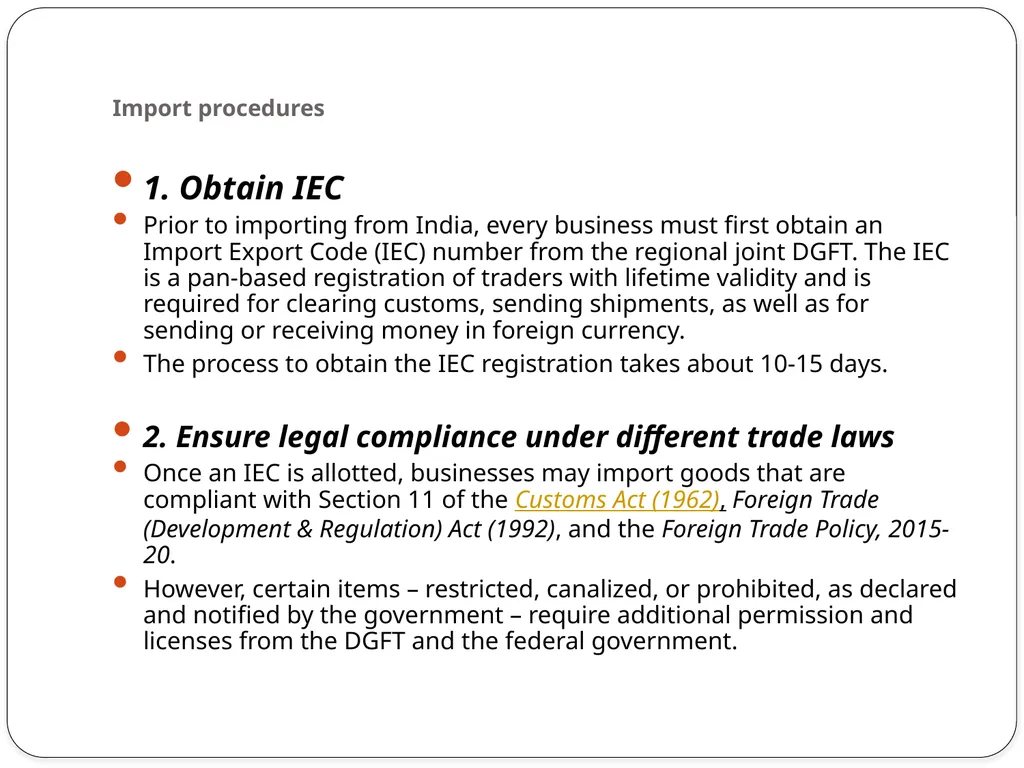
slide15. Import procedures 1. Obtain IEC
Prior to importing from India, every business must first obtain an Import Export Code (IEC) number from the regional joint DGFT. The IEC is a pan-based registration of traders with lifetime validity and is required for clearing customs, sending shipments, as well as for sending or receiving money in foreign currency.
The process to obtain the IEC registration takes about 10-15 days.
2. Ensure legal compliance under different trade laws
Once an IEC is allotted, businesses may import goods that are compliant with Section 11 of the Customs Act (1962), Foreign Trade (Development & Regulation) Act (1992), and the Foreign Trade Policy, 2015-20.
However, certain items – restricted, canalized, or prohibited, as declared and notified by the government – require additional permission and licenses from the DGFT and the federal government.<br>
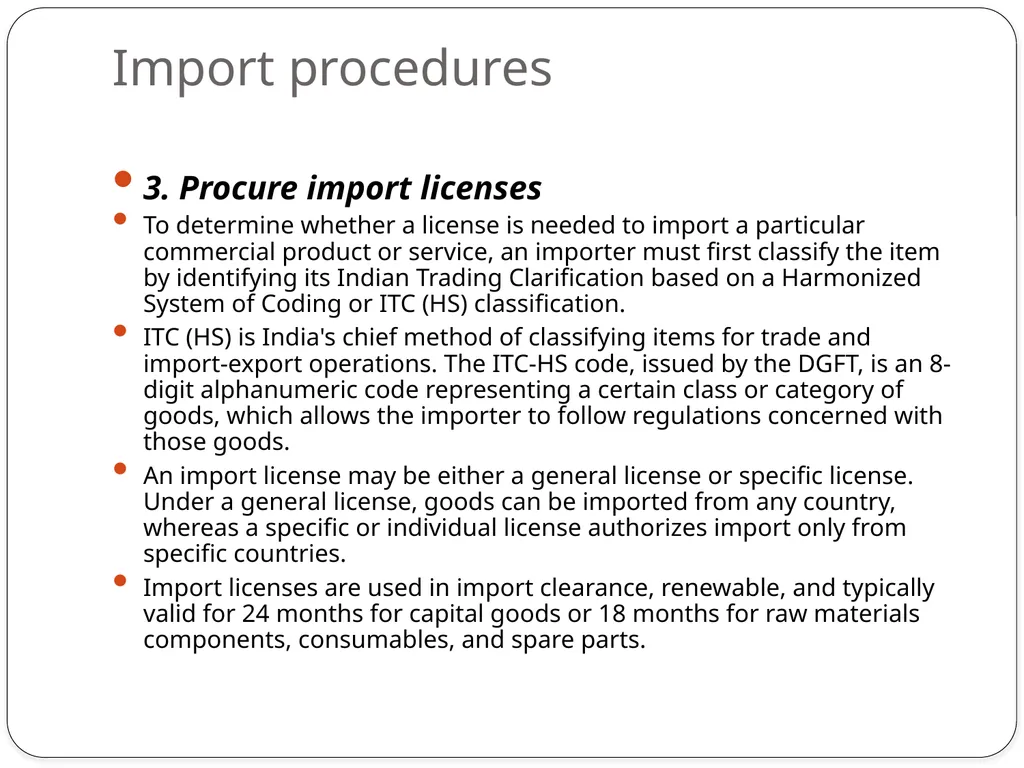
slide16. Import procedures 3. Procure import licenses
To determine whether a license is needed to import a particular commercial product or service, an importer must first classify the item by identifying its Indian Trading Clarification based on a Harmonized System of Coding or ITC (HS) classification.
ITC (HS) is India's chief method of classifying items for trade and import-export operations. The ITC-HS code, issued by the DGFT, is an 8-digit alphanumeric code representing a certain class or category of goods, which allows the importer to follow regulations concerned with those goods.
An import license may be either a general license or specific license. Under a general license, goods can be imported from any country, whereas a specific or individual license authorizes import only from specific countries.
Import licenses are used in import clearance, renewable, and typically valid for 24 months for capital goods or 18 months for raw materials components, consumables, and spare parts.<br>
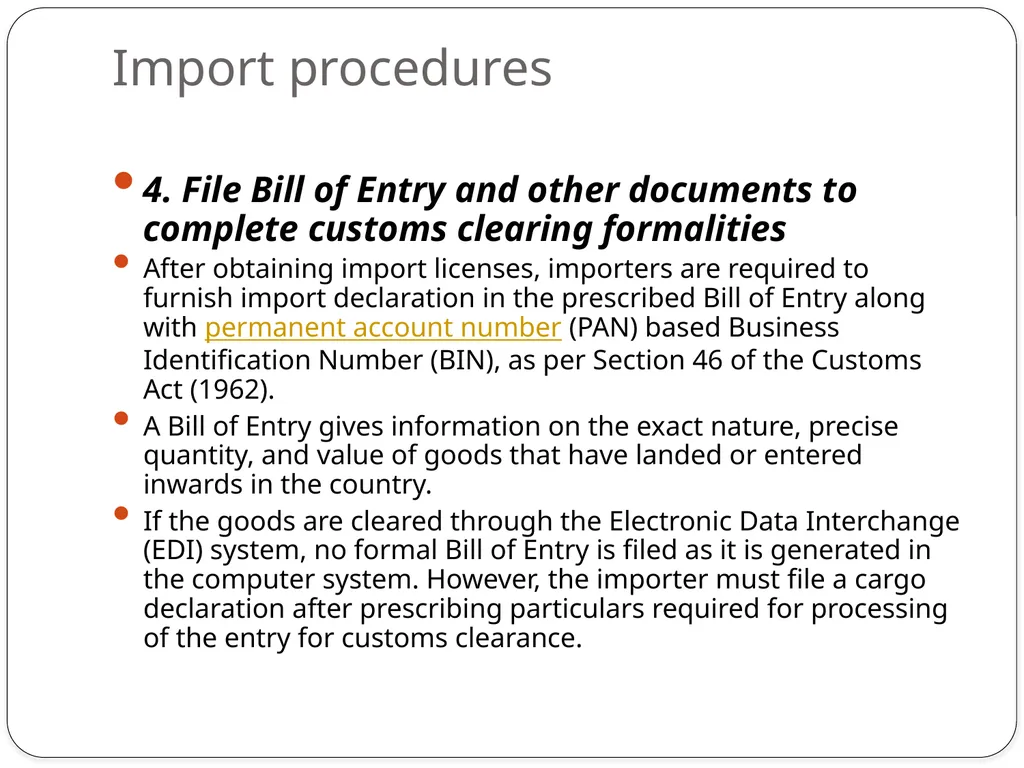
slide17. Import procedures 4. File Bill of Entry and other documents to complete customs clearing formalities
After obtaining import licenses, importers are required to furnish import declaration in the prescribed Bill of Entry along with permanent account number (PAN) based Business Identification Number (BIN), as per Section 46 of the Customs Act (1962).
A Bill of Entry gives information on the exact nature, precise quantity, and value of goods that have landed or entered inwards in the country.
If the goods are cleared through the Electronic Data Interchange (EDI) system, no formal Bill of Entry is filed as it is generated in the computer system. However, the importer must file a cargo declaration after prescribing particulars required for processing of the entry for customs clearance.<br>
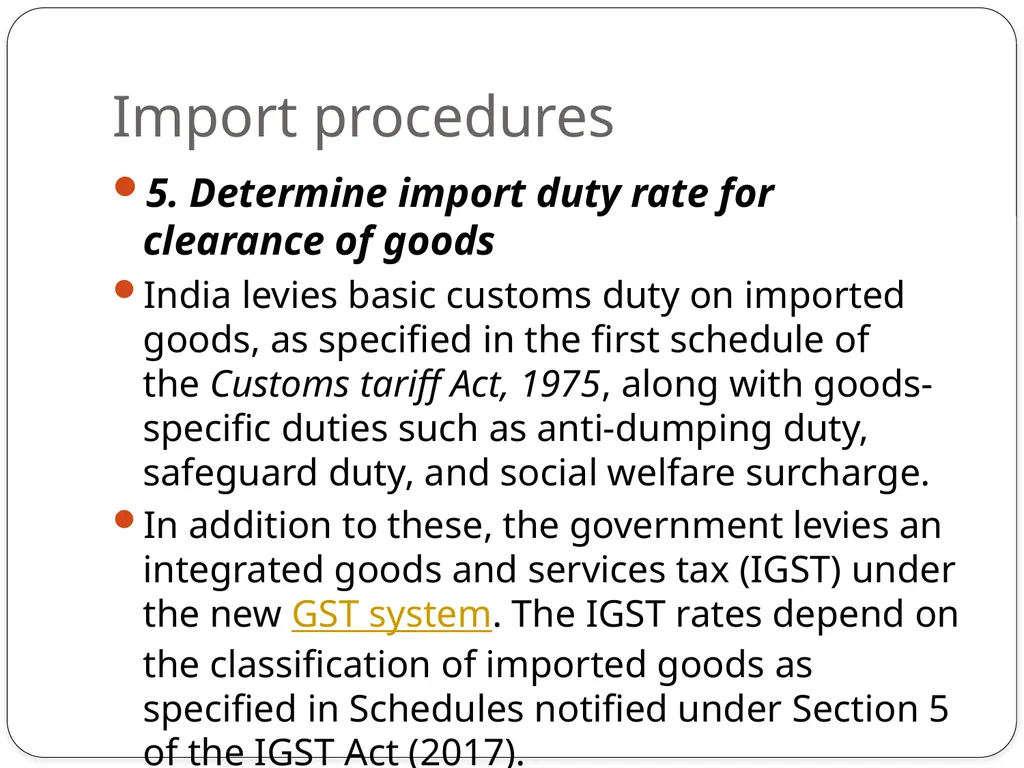
slide18. Import procedures 5. Determine import duty rate for clearance of goods
India levies basic customs duty on imported goods, as specified in the first schedule of the Customs tariff Act, 1975, along with goods-specific duties such as anti-dumping duty, safeguard duty, and social welfare surcharge.
In addition to these, the government levies an integrated goods and services tax (IGST) under the new GST system. The IGST rates depend on the classification of imported goods as specified in Schedules notified under Section 5 of the IGST Act (2017).<br>
slide19. Export procedures Just as for imports, a company planning to engage in export activities is required to obtain an IEC number from the regional joint DGFT. After obtaining the IEC, the exporter needs to ensure that all the legal compliances are met under different trade laws.
Further, the exporter must check if an export license is required, and accordingly apply for the license to the DGFT.
An exporter is also required to register with the Indian Chamber of Commerce (ICC), which issues the Non-Preferential Certificates of Origin certifying that the exported goods are originated in India.<br>
slide20. Import and export documents Businesses are required to submit a set of documents for carrying out export and import activities in India.
These include commercial documents – the ones exchanged between the buyer and seller, and regulatory documents that deal with various regulatory authorities such as the customs, excise, licensing authorities, as well as the export promotion bodies that help avail export import benefits.
The Foreign Trade Policy, 2015-2020 mandates the following commercial documents for carrying out importing and exporting activities:
Bill of lading or airway bill;
Commercial invoice cum packing list;
Shipping bill or bill of export, or bill of entry (for imports).<br>
slide21. Import and export documents Additional documents like certificate of origin and inspection certificate may be required as per the case.
The important regulatory documents include:
GST return forms (GSTR 1 and GSTR 2);
GSTR refund form;
Exchange Control Declaration;
Bank Realization Certificate; and
Registration cum Membership Certificate (RCMC).
The RCMC helps exporters and importers avail benefit or concession under the Foreign Trade Policy 2015-20.<br>
slide22. Methods of Payment for IM 1. Cash in Advance
The cash in advance method is the safest for exporters because they are securely paid before goods are shipped and ownership is transferred.
Typically payments are made by wire transfers or credit cards.
This is the least desirable method for importers because they have the risk of goods not being shipped, and it is also not favorable for business cash flow.
Cash in advance is usually only used for small purchases. No exporter who requires only this method of payment can be competitive.<br>
slide23. Methods of Payment for IM 2. Documentary Credit or Letter of Credit
A documentary credit, or letter of credit, is basically a promise by a bank to pay an exporter if all terms of the contract are executed properly. This is one of the most secure methods of payment.
It is used if the importer has not established credit with the exporter, but the exporter is comfortable with the importer’s bank.
Here are the general steps in a documentary credit transaction:
The contract is negotiated and confirmed.<br>
slide24. Methods of Payment for IM 2. Documentary Credit or Letter of Credit
The importer applies for the documentary credit with their bank.
The documentary credit is set up by the issuing bank and the exporter and the exporter’s bank (the collecting bank) are notified by the importer’s bank.
The goods are shipped.
Documents verifying the shipment and all terms of the sale are provided by the exporter to the exporter’s bank and the exporter’s bank sends the documents to the importer’s issuing bank.
The issuing bank verifies the documents and issues payment to the exporter’s bank.
The importer collects the goods.<br>
slide25. Methods of Payment for IM 3. Documentary Collection
A documentary collection is when the exporter instructs their bank to forward documents related to the sale to the importer’s bank with a request to present the documents to the buyer as a request for payment, indicating when and on what conditions these documents can be released to the buyer.
The importer may obtain possession of goods if the importer has the shipping documents.
The documents are only released to the buyer after payment has been made.<br>
slide26. Methods of Payment for IM 3. Documentary Collection
This can be done in two ways.
Documents Against Payment
The exporter gives the ownership documents of an asset to their bank, which then presents them to the importer after payment is received.
The importer can then use the documents to take possession of the merchandise.
The risk for the exporter is that the importer will refuse to pay, and even though the importer won’t be able to collect the goods, the exporter has very little recourse to collect.<br>
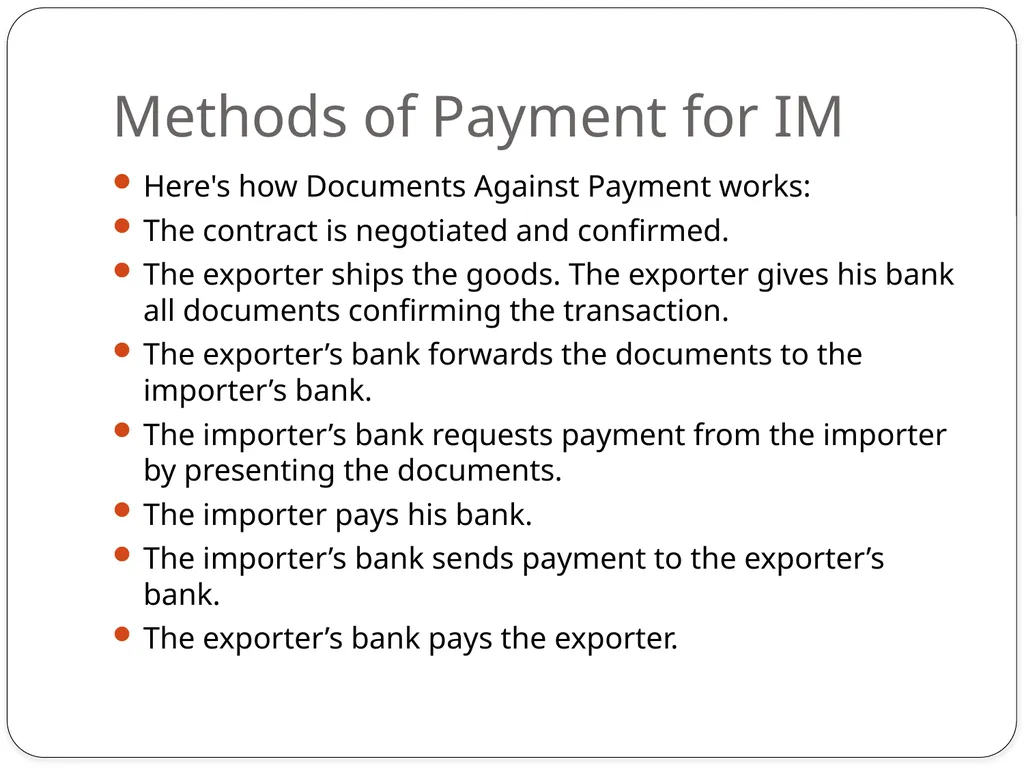
slide27. Methods of Payment for IM Here's how Documents Against Payment works:
The contract is negotiated and confirmed.
The exporter ships the goods. The exporter gives his bank all documents confirming the transaction.
The exporter’s bank forwards the documents to the importer’s bank.
The importer’s bank requests payment from the importer by presenting the documents.
The importer pays his bank.
The importer’s bank sends payment to the exporter’s bank.
The exporter’s bank pays the exporter.<br>
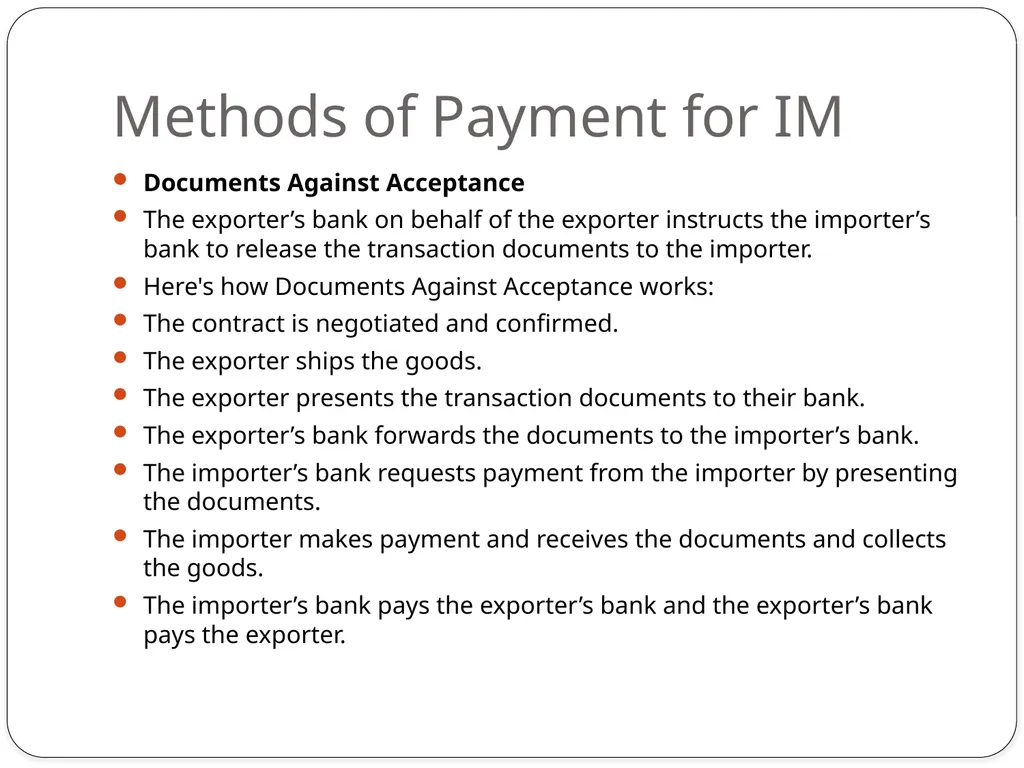
slide28. Methods of Payment for IM Documents Against Acceptance
The exporter’s bank on behalf of the exporter instructs the importer’s bank to release the transaction documents to the importer.
Here's how Documents Against Acceptance works:
The contract is negotiated and confirmed.
The exporter ships the goods.
The exporter presents the transaction documents to their bank.
The exporter’s bank forwards the documents to the importer’s bank.
The importer’s bank requests payment from the importer by presenting the documents.
The importer makes payment and receives the documents and collects the goods.
The importer’s bank pays the exporter’s bank and the exporter’s bank pays the exporter.<br>
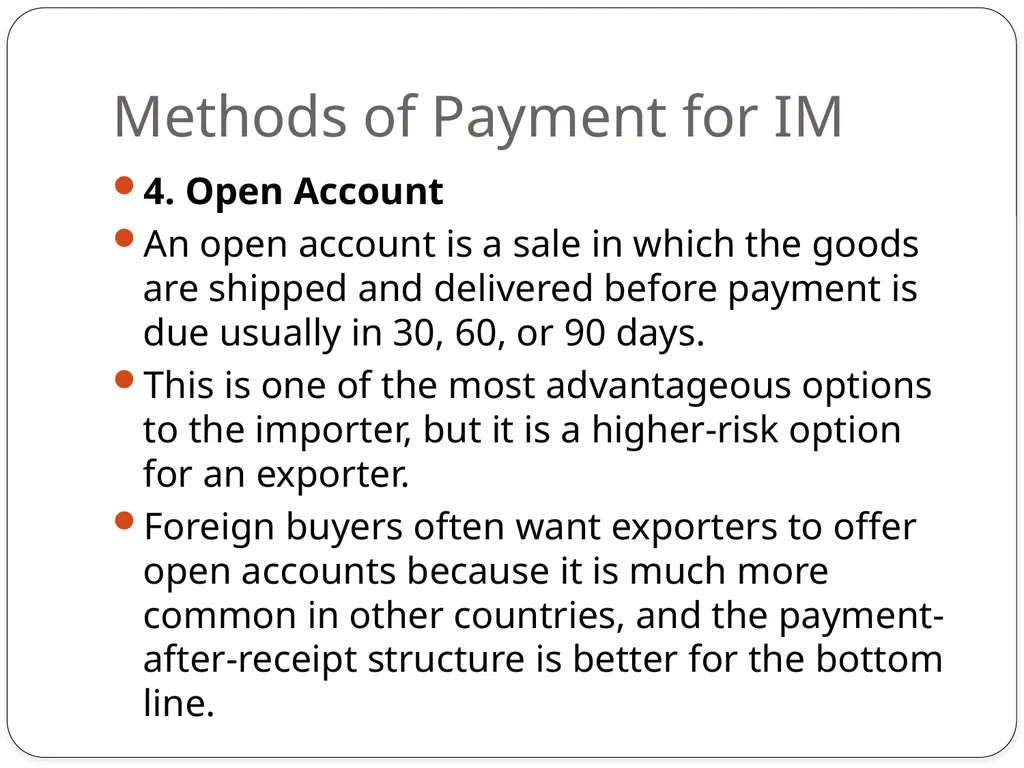
slide29. Methods of Payment for IM 4. Open Account
An open account is a sale in which the goods are shipped and delivered before payment is due usually in 30, 60, or 90 days.
This is one of the most advantageous options to the importer, but it is a higher-risk option for an exporter.
Foreign buyers often want exporters to offer open accounts because it is much more common in other countries, and the payment-after-receipt structure is better for the bottom line.<br>
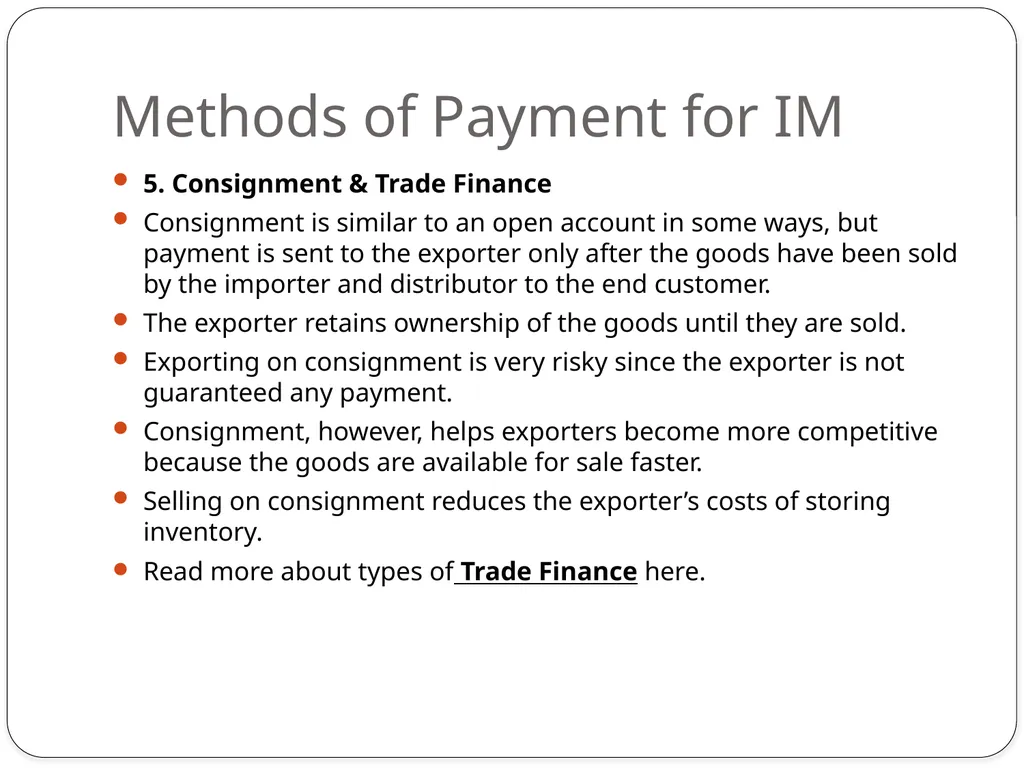
slide30. Methods of Payment for IM 5. Consignment & Trade Finance
Consignment is similar to an open account in some ways, but payment is sent to the exporter only after the goods have been sold by the importer and distributor to the end customer.
The exporter retains ownership of the goods until they are sold.
Exporting on consignment is very risky since the exporter is not guaranteed any payment.
Consignment, however, helps exporters become more competitive because the goods are available for sale faster.
Selling on consignment reduces the exporter’s costs of storing inventory.
Read more about types of Trade Finance here.<br>
slide2. International Marketing Research Process a. Conduct Preliminary Research
Carry out some preliminary research by going online and searching for existing survey reports on your topic of interest. There might not be much especially if you are looking for very specific information, but you might find something close either for a different country or a report that gives you some ideas on how to go about your primary research.
b. Develop a Research Brief
To get the most out of your marketing research project, put together a brief with the objectives of your data collection. What exactly do you want to understand better? Be as specific as possible, for example: “What percentage of adult working females aged between 25 and above living in urban areas use my product brand?”<br>
slide3. International Marketing Research Process c. Identify the Right Marketing Research Agency
Research agencies come in all shapes and sizes. It often helps to understand an agency’s main data collection method which, more often than not, tells you what their strengths are. What you will note is that many of the international marketing research agencies have wide-ranging capabilities in data collection and use multiple data collection modes. However, often the cost for these agencies is higher than for agencies that only specialize in one data collection method. For you as the consumer, the scope of your project will determine which agency you will work with.<br>
slide4. International Marketing Research Process d. Determine Your Data Collection Mode
Once you have listed your objectives, deciding on which of the following research methodologies to utilize becomes easier. Deciding on which type of research to run also helps further narrow down the agency best suited based on their capabilities. The data collection mode you use will impact both the type of data you collect and how it is collected.
Data is generally grouped into two categories, qualitative and quantitative. Simply put, qualitative data is unstructured and is often exploratory by nature. When analyzed, responses may be grouped into similar categories but they cannot be ranked in the same way quantitative data can.<br>
slide5. International Marketing Research Process e. Conduct Data Analysis
The most important aspect of market research is being able to analyze the data once it has been collected. A thorough analysis should guide you on how to act on the insights you have gathered. It is therefore crucial that the research agency, through their insights report, address the questions you had set out at the start of your survey. For example: What is my product’s current position in the market, who are my actual customers, and which aspects of my 4 Ps do I need to work on? Analysis capabilities of the agency and the tools being used by the analysts and if they meet your needs<br>
slide6. International Marketing Research Process f. Complete A Post Project Review
Having a session with the research team after completion of your project to share feedback and discuss the project execution is sometimes overlooked. Such an undertaking involves various departments but is important to understand why a project did or did not go as smoothly as planned. A post-project review session helps in both parties knowing what areas worked and which ones the agency or the client will need to improve for their next project.<br>
slide7. Challenges in international marketing research 1. International markets are incredibly diverse
Some business fail to appreciate the diversity within a region or indeed a country. Only by rooting out the nuances of different geographical areas, cultures and consumers, can you get an accurate picture of what people value and whether your products and services might succeed.<br>
slide8. Challenges in international marketing research 2. There can be a temptation to go too broad
Linked to this, sometimes when companies set out on international marketing research projects, they make the mistake of going too broad and trying to understand a region as a whole. Another error we see is firms commissioning research to target one market and then using this as a jumping off point into others with “similar” attributes. This inevitably leads in costly mistakes as brands map their assumptions about one market onto another.<br>
slide9. Challenges in international marketing research 3. Finding the right research partner
The next big question is whether you have the research capabilities to conduct meaningful projects internationally. Most brands and their research partners can run domestic research projects with ease. But if you’re in the UK, say, even going as far afield as France or Germany requires different sensibilities and capabilities. The more international you get, the harder you need to look for that kind of experience and expertise<br>
slide10. Challenges in international marketing research 4. Bringing together local and global expertise
This is one of the biggest challenges in international marketing research and there has to be a collaborative effort and a shared understanding of the mission, the methodology and the insights to overcome this. A research team at HQ might working with a local marketing team to understand how to position a product for success in an emerging market. But if the teams are siloed and don’t have a consistent understanding of the brief, their approach to researching the market and their findings might not actually help deliver on the challenge at hand.<br>
slide11. Challenges in international marketing research 5. Ensuring that the project is realistic from the outset
This is where all the other challenges in international marketing research come together: which markets, what purpose, the capabilities available, and the effectiveness of the output – all within a budget that makes sense. There are always going to be limits to what’s practical – and the last thing any client needs is to be spending large sums testing international markets to no effect.<br>
slide12. Challenges in international marketing research 6. Costs and Technological capabilities
Cost is a pressing matter for stakeholders and organizations who want to maximize every dollar spent on their research investment. Global market researchers are usually faced with challenges stemming from factors such as differences in currencies, logistics issues, and limited technological capabilities. These are typically encountered in emerging markets in countries that have insufficient infrastructures such as lack of telecommunication devices, shortage in electricity, poor transportation, and road systems, and sometimes low levels of literacy. Because of these factors, some companies are hesitant to finance global research studies.<br>
slide13. Challenges in international marketing research 7. Cultural and language barriers
One of the most distinct challenges to global market studies is often translating research questions into the language of its subjects. After surveys and questionnaires have been answered, responses must then be translated back into the original language for interpretation and analysis. Confusion also arises from words, phrases, or idioms that mean different things in different cultures. There are instances where it will be hard for researchers to communicate complex ideas and must rely on visual cues such as photographs to help the respondents obtain a better understanding of what you are trying to convey. You are required to understand how each of these cultures will respond to your brand. Basically, there is a need to modify the market research process in such a way that it does not conflict with any of the countries’ cultural values.<br>
slide14. Challenges in international marketing research 8. Government Bureaucracy
There are countries that have laws requiring research permits. Some government bodies often require researchers to provide them a copy of the survey questions before giving them the approval to conduct in their city or country. These permits can take several days, even weeks, before it is released which slows down the progress of your study.<br>
slide15. Import procedures 1. Obtain IEC
Prior to importing from India, every business must first obtain an Import Export Code (IEC) number from the regional joint DGFT. The IEC is a pan-based registration of traders with lifetime validity and is required for clearing customs, sending shipments, as well as for sending or receiving money in foreign currency.
The process to obtain the IEC registration takes about 10-15 days.
2. Ensure legal compliance under different trade laws
Once an IEC is allotted, businesses may import goods that are compliant with Section 11 of the Customs Act (1962), Foreign Trade (Development & Regulation) Act (1992), and the Foreign Trade Policy, 2015-20.
However, certain items – restricted, canalized, or prohibited, as declared and notified by the government – require additional permission and licenses from the DGFT and the federal government.<br>
slide16. Import procedures 3. Procure import licenses
To determine whether a license is needed to import a particular commercial product or service, an importer must first classify the item by identifying its Indian Trading Clarification based on a Harmonized System of Coding or ITC (HS) classification.
ITC (HS) is India's chief method of classifying items for trade and import-export operations. The ITC-HS code, issued by the DGFT, is an 8-digit alphanumeric code representing a certain class or category of goods, which allows the importer to follow regulations concerned with those goods.
An import license may be either a general license or specific license. Under a general license, goods can be imported from any country, whereas a specific or individual license authorizes import only from specific countries.
Import licenses are used in import clearance, renewable, and typically valid for 24 months for capital goods or 18 months for raw materials components, consumables, and spare parts.<br>
slide17. Import procedures 4. File Bill of Entry and other documents to complete customs clearing formalities
After obtaining import licenses, importers are required to furnish import declaration in the prescribed Bill of Entry along with permanent account number (PAN) based Business Identification Number (BIN), as per Section 46 of the Customs Act (1962).
A Bill of Entry gives information on the exact nature, precise quantity, and value of goods that have landed or entered inwards in the country.
If the goods are cleared through the Electronic Data Interchange (EDI) system, no formal Bill of Entry is filed as it is generated in the computer system. However, the importer must file a cargo declaration after prescribing particulars required for processing of the entry for customs clearance.<br>
slide18. Import procedures 5. Determine import duty rate for clearance of goods
India levies basic customs duty on imported goods, as specified in the first schedule of the Customs tariff Act, 1975, along with goods-specific duties such as anti-dumping duty, safeguard duty, and social welfare surcharge.
In addition to these, the government levies an integrated goods and services tax (IGST) under the new GST system. The IGST rates depend on the classification of imported goods as specified in Schedules notified under Section 5 of the IGST Act (2017).<br>
slide19. Export procedures Just as for imports, a company planning to engage in export activities is required to obtain an IEC number from the regional joint DGFT. After obtaining the IEC, the exporter needs to ensure that all the legal compliances are met under different trade laws.
Further, the exporter must check if an export license is required, and accordingly apply for the license to the DGFT.
An exporter is also required to register with the Indian Chamber of Commerce (ICC), which issues the Non-Preferential Certificates of Origin certifying that the exported goods are originated in India.<br>
slide20. Import and export documents Businesses are required to submit a set of documents for carrying out export and import activities in India.
These include commercial documents – the ones exchanged between the buyer and seller, and regulatory documents that deal with various regulatory authorities such as the customs, excise, licensing authorities, as well as the export promotion bodies that help avail export import benefits.
The Foreign Trade Policy, 2015-2020 mandates the following commercial documents for carrying out importing and exporting activities:
Bill of lading or airway bill;
Commercial invoice cum packing list;
Shipping bill or bill of export, or bill of entry (for imports).<br>
slide21. Import and export documents Additional documents like certificate of origin and inspection certificate may be required as per the case.
The important regulatory documents include:
GST return forms (GSTR 1 and GSTR 2);
GSTR refund form;
Exchange Control Declaration;
Bank Realization Certificate; and
Registration cum Membership Certificate (RCMC).
The RCMC helps exporters and importers avail benefit or concession under the Foreign Trade Policy 2015-20.<br>
slide22. Methods of Payment for IM 1. Cash in Advance
The cash in advance method is the safest for exporters because they are securely paid before goods are shipped and ownership is transferred.
Typically payments are made by wire transfers or credit cards.
This is the least desirable method for importers because they have the risk of goods not being shipped, and it is also not favorable for business cash flow.
Cash in advance is usually only used for small purchases. No exporter who requires only this method of payment can be competitive.<br>
slide23. Methods of Payment for IM 2. Documentary Credit or Letter of Credit
A documentary credit, or letter of credit, is basically a promise by a bank to pay an exporter if all terms of the contract are executed properly. This is one of the most secure methods of payment.
It is used if the importer has not established credit with the exporter, but the exporter is comfortable with the importer’s bank.
Here are the general steps in a documentary credit transaction:
The contract is negotiated and confirmed.<br>
slide24. Methods of Payment for IM 2. Documentary Credit or Letter of Credit
The importer applies for the documentary credit with their bank.
The documentary credit is set up by the issuing bank and the exporter and the exporter’s bank (the collecting bank) are notified by the importer’s bank.
The goods are shipped.
Documents verifying the shipment and all terms of the sale are provided by the exporter to the exporter’s bank and the exporter’s bank sends the documents to the importer’s issuing bank.
The issuing bank verifies the documents and issues payment to the exporter’s bank.
The importer collects the goods.<br>
slide25. Methods of Payment for IM 3. Documentary Collection
A documentary collection is when the exporter instructs their bank to forward documents related to the sale to the importer’s bank with a request to present the documents to the buyer as a request for payment, indicating when and on what conditions these documents can be released to the buyer.
The importer may obtain possession of goods if the importer has the shipping documents.
The documents are only released to the buyer after payment has been made.<br>
slide26. Methods of Payment for IM 3. Documentary Collection
This can be done in two ways.
Documents Against Payment
The exporter gives the ownership documents of an asset to their bank, which then presents them to the importer after payment is received.
The importer can then use the documents to take possession of the merchandise.
The risk for the exporter is that the importer will refuse to pay, and even though the importer won’t be able to collect the goods, the exporter has very little recourse to collect.<br>
slide27. Methods of Payment for IM Here's how Documents Against Payment works:
The contract is negotiated and confirmed.
The exporter ships the goods. The exporter gives his bank all documents confirming the transaction.
The exporter’s bank forwards the documents to the importer’s bank.
The importer’s bank requests payment from the importer by presenting the documents.
The importer pays his bank.
The importer’s bank sends payment to the exporter’s bank.
The exporter’s bank pays the exporter.<br>
slide28. Methods of Payment for IM Documents Against Acceptance
The exporter’s bank on behalf of the exporter instructs the importer’s bank to release the transaction documents to the importer.
Here's how Documents Against Acceptance works:
The contract is negotiated and confirmed.
The exporter ships the goods.
The exporter presents the transaction documents to their bank.
The exporter’s bank forwards the documents to the importer’s bank.
The importer’s bank requests payment from the importer by presenting the documents.
The importer makes payment and receives the documents and collects the goods.
The importer’s bank pays the exporter’s bank and the exporter’s bank pays the exporter.<br>
slide29. Methods of Payment for IM 4. Open Account
An open account is a sale in which the goods are shipped and delivered before payment is due usually in 30, 60, or 90 days.
This is one of the most advantageous options to the importer, but it is a higher-risk option for an exporter.
Foreign buyers often want exporters to offer open accounts because it is much more common in other countries, and the payment-after-receipt structure is better for the bottom line.<br>
slide30. Methods of Payment for IM 5. Consignment & Trade Finance
Consignment is similar to an open account in some ways, but payment is sent to the exporter only after the goods have been sold by the importer and distributor to the end customer.
The exporter retains ownership of the goods until they are sold.
Exporting on consignment is very risky since the exporter is not guaranteed any payment.
Consignment, however, helps exporters become more competitive because the goods are available for sale faster.
Selling on consignment reduces the exporter’s costs of storing inventory.
Read more about types of Trade Finance here.<br>