04
ASSUME: Assume logical segment name
Syntax: ASSUMEsegreg:segname,…segreg:segname Ex: ASSUME CS:CODE
ASSUME CS:CODE,DS:DATA,SS:STACK<br>
05
2.DB: Define Byte
The DB directive is used to reserve byte or bytes of memory locations in the available memory.
Syntax: Name of variable DB initialization value. Ex: MARKS DB 35H,30H,35H,40H
NAME DB “VARDHAMAN<br>
06
3.DW: Define Word
The DW directive serves the same purposes as the DB directive, but it now makes the assembler reserve the number of memory words(16-bit) instead of bytes.
Syntax: variable name DW initialization values. Ex: WORDS DW 1234H,4567H,2367H
WDATA DW 5 Dup(522h)
(or) Dup(?)<br>
07
4. DD: Define Double:
The directive DD is used to define a double word (4bytes) variable.
Syntax: variable name DD 12345678H Ex: Data1 DD 12345678H<br>
08
5. DQ: Define Quad Word
This directive is used to direct the assembler to reserve 4 words (8 bytes) of memory for the specified variable and may initialize it with the specified values.
Syntax: Name of variable DQ initialize values. Ex: Data1 DQ 123456789ABCDEF2H<br>
09
6.DT: Define Ten Bytes
The DT directive directs the assembler to define the specified variable requiring 10 bytes for its storage and initialize the 10-bytes with the specified values.
Syntax: Name of variable DT initialize values. Ex: Data1 DT 123456789ABCDEF34567H<br>
10
7. END: End of Program
The END directive marks the end of an ALP. The statement after the directive END will be ignored by the assembler.<br>
11
8. ENDP: End of Procedure
The ENDP directive is used to indicate the end of procedure. In the AL programming the subroutines are called procedures.
Ex: Procedure Start
:
�Start ENDP<br>
12
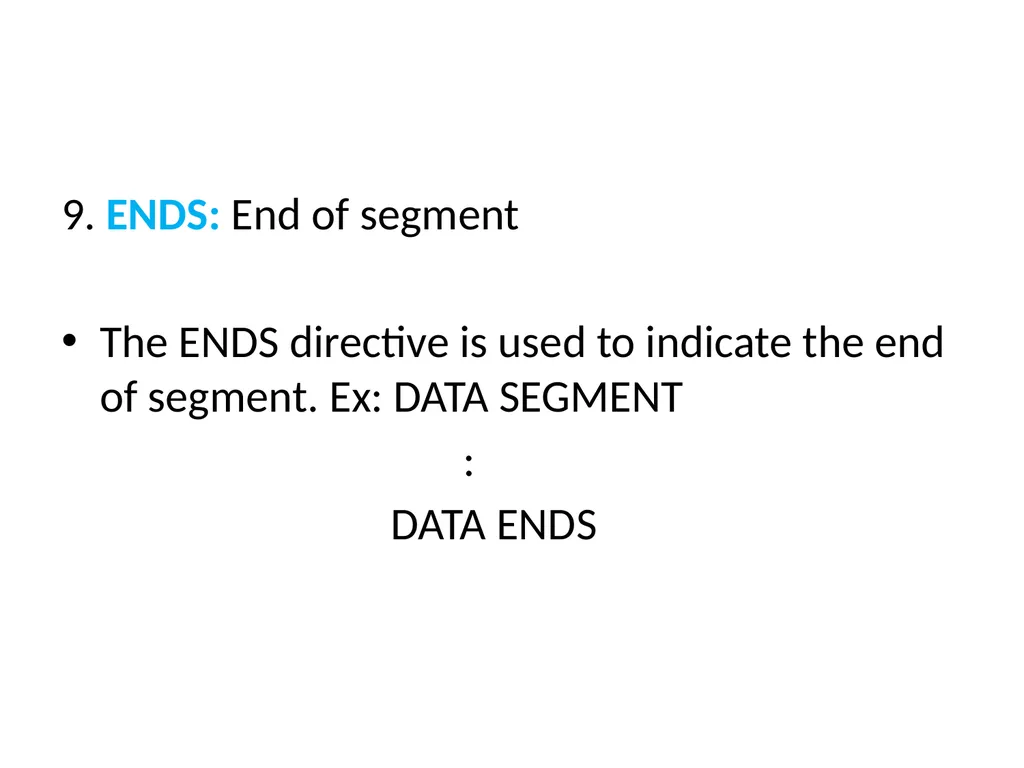
9. ENDS: End of segment
The ENDS directive is used to indicate the end of segment. Ex: DATA SEGMENT
:
DATA ENDS<br>
13
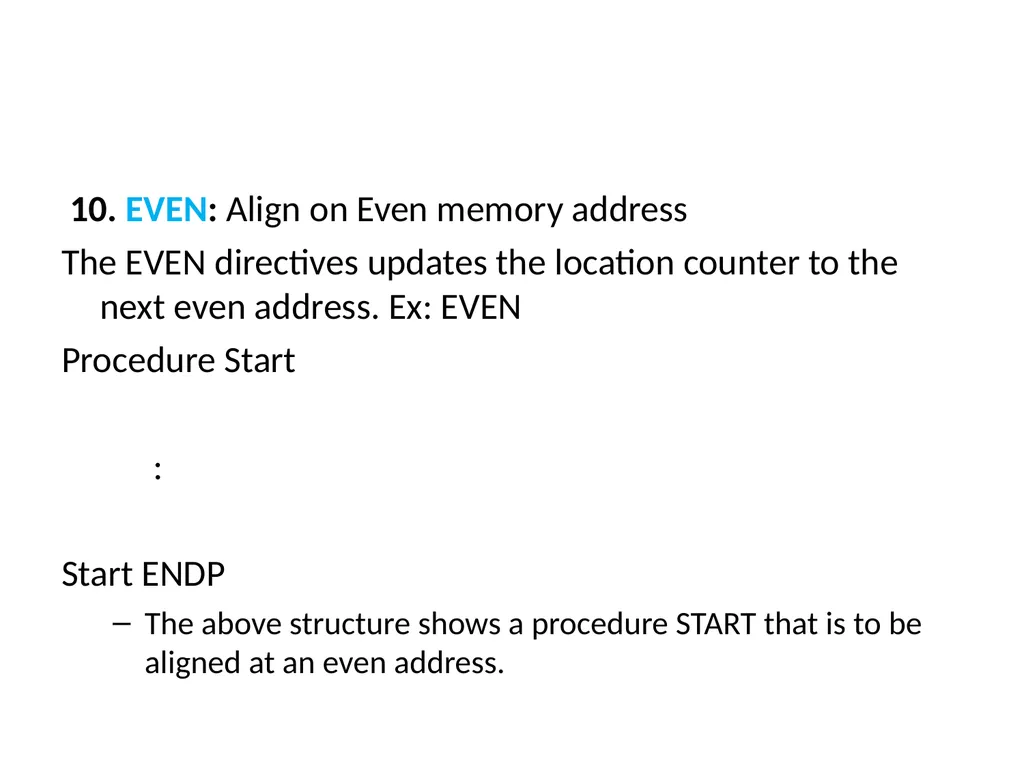
10. EVEN: Align on Even memory address
The EVEN directives updates the location counter to the next even address. Ex: EVEN
Procedure Start
:
Start ENDP
The above structure shows a procedure START that is to be aligned at an even address.<br>
14
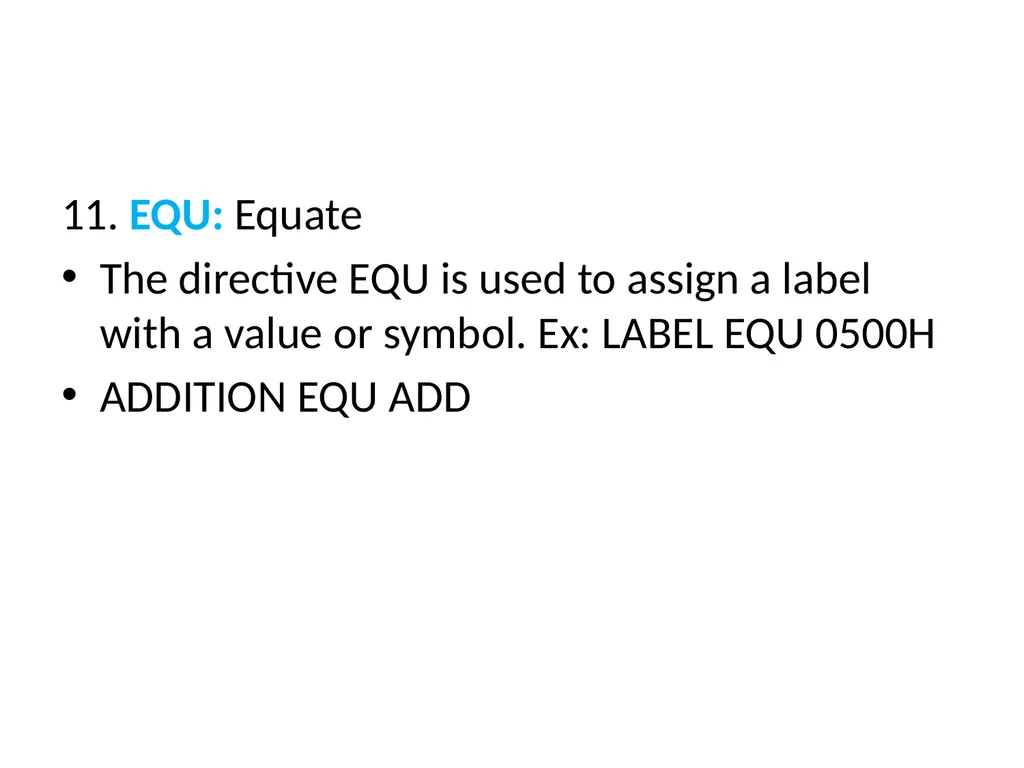
11. EQU: Equate
The directive EQU is used to assign a label with a value or symbol. Ex: LABEL EQU 0500H
ADDITION EQU ADD<br>
15
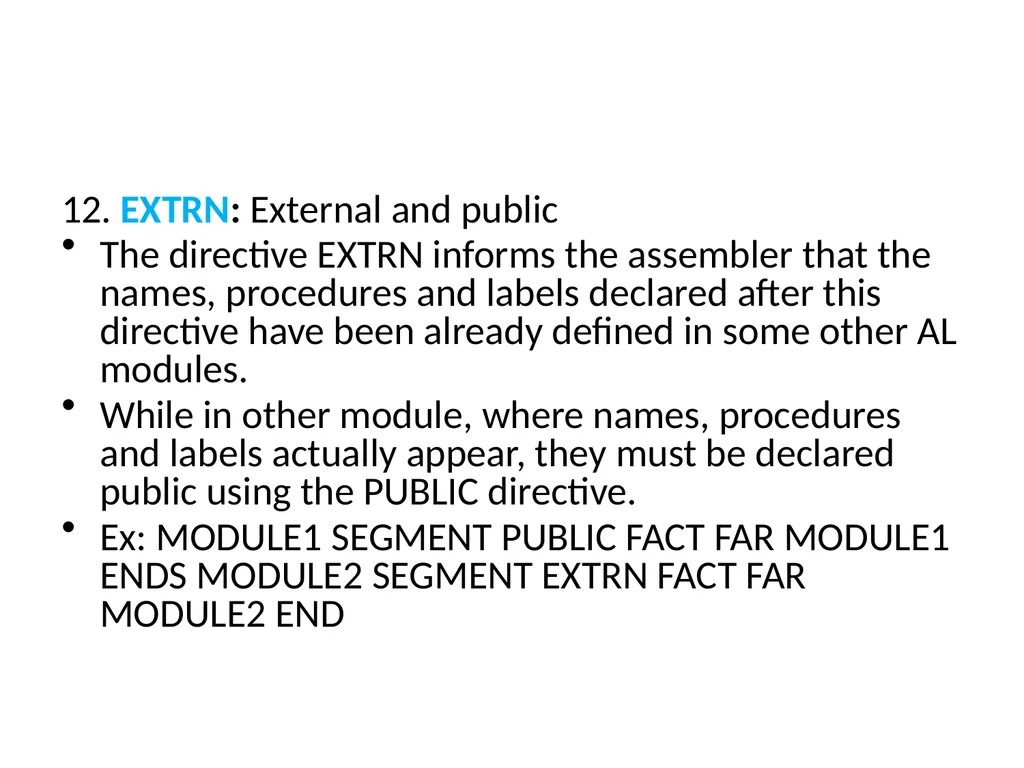
12. EXTRN: External and public
The directive EXTRN informs the assembler that the names, procedures and labels declared after this directive have been already defined in some other AL modules.
While in other module, where names, procedures and labels actually appear, they must be declared public using the PUBLIC directive.
Ex: MODULE1 SEGMENT PUBLIC FACT FAR MODULE1 ENDS MODULE2 SEGMENT EXTRN FACT FAR MODULE2 END<br>
16
13. GROUP: Group the related segments
This directive is used to form logical groups of segments with similar purpose or type. Ex: PROGRAM GROUP CODE, DATA, STACK*CODE, DATA and STACK segments lie within a 64KB memory segment that is named as PROGRAM.<br>
17
14. LABEL: label
The label is used to assign name to the current content of the location counter.
Ex: CONTINUE LABEL FAR
The label CONTINUE can be used for a FAR jump, if the program contains the above statement.<br>
18
15. LENGTH: Byte length of a label
This is used to refer to the length of a data array or a string Ex : MOV CX, LENGTH ARRAY<br>
19
16. LOCAL: The labels, variables, constant or procedures are declared LOCAL in a module are to be used only by the particular module.
Ex : LOCAL a, b, Data1, Array, Routine<br>
20
17.NAME: logical name of a module
The name directive is used to assign a name to an assembly language program module. The module may now be refer to by its declared name.
Ex : Name “addition”<br>
21
18. OFFSET: offset of a label
When the assembler comes across the OFFSET operator along with a label, it first computing the 16-bit offset address of a particular label and replace the string ‘OFFSET LABEL’ by the computed offset address.
Ex : MOV SI, offset list<br>
22
19. ORG: origin
The ORG directive directs the assembler to start the memory allotment for the particular segment, block or code from the declared address in the ORG statement.
Ex: ORG 1000H<br>
23
20. PROC: Procedure
The PROC directive marks the start of a named procedure in the statement. Ex: RESULT PROC NEAR
ROUTINE PROC FAR<br>
24
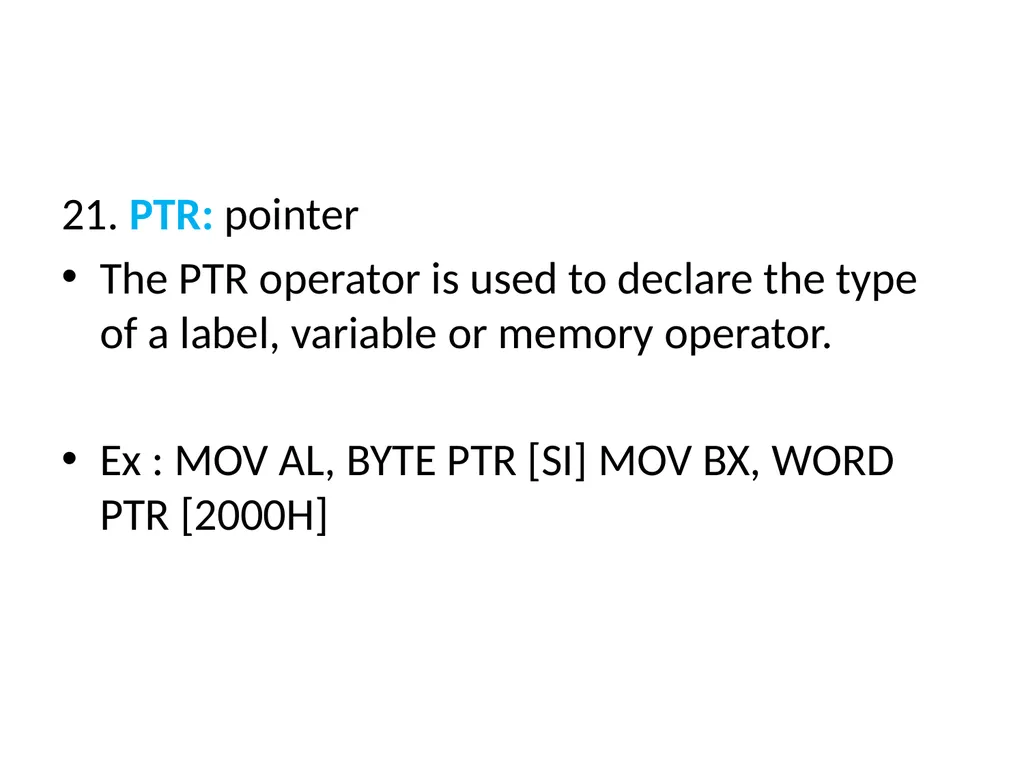
21. PTR: pointer
The PTR operator is used to declare the type of a label, variable or memory operator.
Ex : MOV AL, BYTE PTR [SI] MOV BX, WORD PTR [2000H]<br>
25
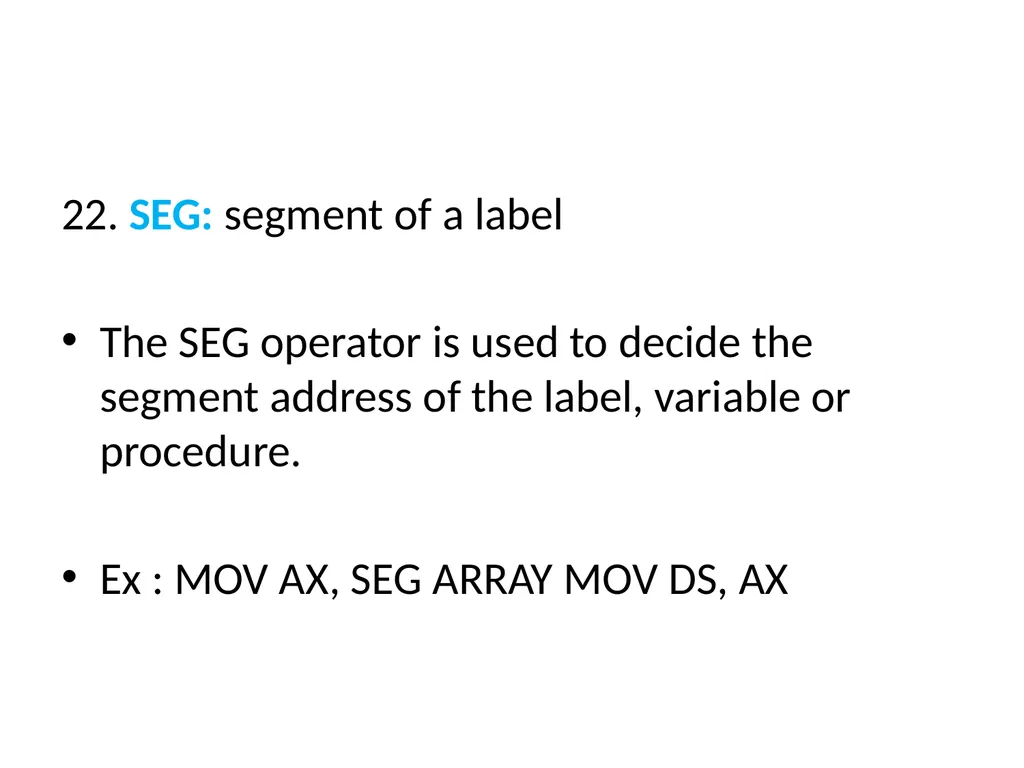
22. SEG: segment of a label
The SEG operator is used to decide the segment address of the label, variable or procedure.
Ex : MOV AX, SEG ARRAY MOV DS, AX<br>
26
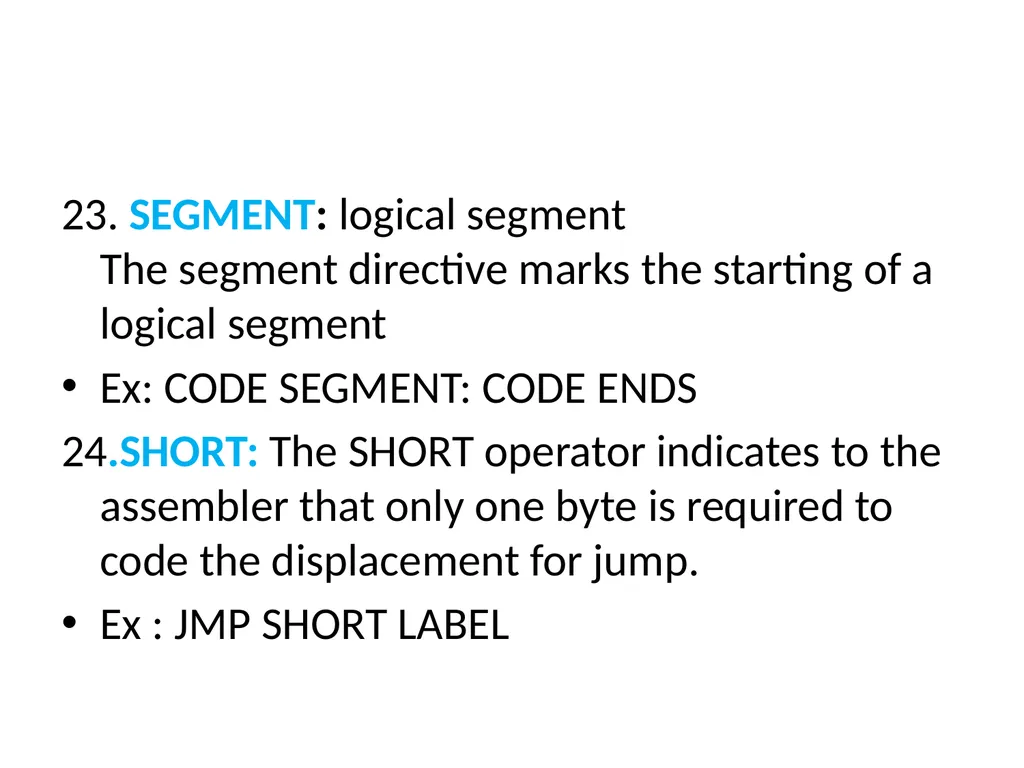
23. SEGMENT: logical segment�The segment directive marks the starting of a logical segment
Ex: CODE SEGMENT: CODE ENDS
24.SHORT: The SHORT operator indicates to the assembler that only one byte is required to code the displacement for jump.
Ex : JMP SHORT LABEL<br>
27
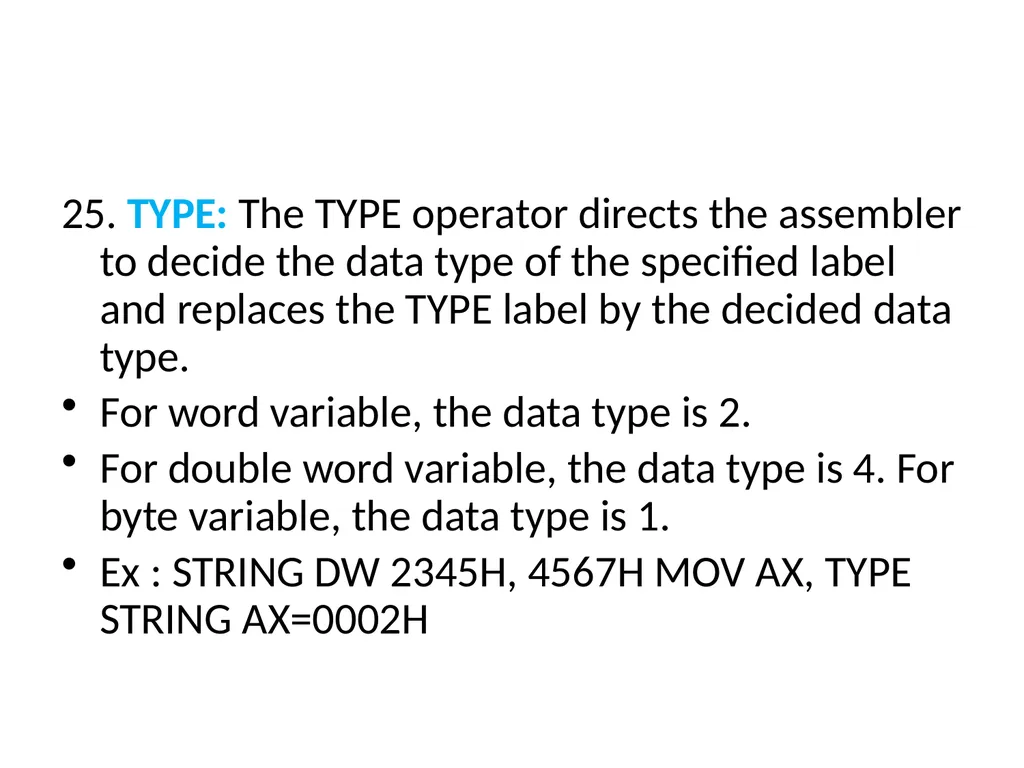
25. TYPE: The TYPE operator directs the assembler to decide the data type of the specified label and replaces the TYPE label by the decided data type.
For word variable, the data type is 2.
For double word variable, the data type is 4. For byte variable, the data type is 1.
Ex : STRING DW 2345H, 4567H MOV AX, TYPE STRING AX=0002H<br>
28
26. GLOBAL: The labels, variables, constants or procedures declared GLOBAL may be used by other modules of the program.
Ex : ROUTINE PROC GLOBAL.
27. FAR PTR: This directive indicates the assembler that the label following FAR PTR is not available within the same segment and the address of the label is of 32-bits i.e 2-bytes of offset followed by 2-bytes of segment address.
Ex : JMP FAR PTR LABEL<br>
29
28. NEAR PTR: This directive indicates that the label following NEAR PTR is in the same segment and needs only 16-bit
i.e 2-byte offset to address it Ex : JMP NEAR PTR LABEL CALL NEAR PTR ROUTINE<br>