
Unit VI Antimicrobial chemotherapy The term
BR
Published · 30 slides · 0 views
1 / 1



Description
Unit VI Antimicrobial chemotherapy The term chemotherapeutic agent applies to chemical substances used for the treatment of infectious diseases or the prevention of disease. Treatment of diseases using chemotherapeutic agent is called
Related Topics
Share
Embed code
Download this presentation From Below
"Unit VI Antimicrobial chemotherapy The term" is the property of its rightful owner. Permission is granted to download and print the materials on this website for personal, non-commercial use only, and to display it on your personal computer provided you do not modify the materials and that you retain all copyright notices contained in the materials. By downloading content from our website, you accept the terms of this agreement.
Presentation Transcript
01
Unit VI Antimicrobial chemotherapy The term chemotherapeutic agent applies to chemical substances used for the treatment of infectious diseases or the prevention of disease.
Treatment of diseases using chemotherapeutic agent is called chemotherapy.
There are three types of chemotherapeutic agents:-
Chemotherapeutic agents:
1. Antibiotics: natural products
2. Semi-synthetic antibiotics: modified natural products
3. Synthetic drugs<br>
Treatment of diseases using chemotherapeutic agent is called chemotherapy.
There are three types of chemotherapeutic agents:-
Chemotherapeutic agents:
1. Antibiotics: natural products
2. Semi-synthetic antibiotics: modified natural products
3. Synthetic drugs<br>
02
UNIT – VI
Antimicrobial chemotherapy
Mr. S. N. Mendhe
Department of Microbiology,
Shri Shivaji Science and Arts College, Chikhli<br>
Antimicrobial chemotherapy
Mr. S. N. Mendhe
Department of Microbiology,
Shri Shivaji Science and Arts College, Chikhli<br>
03
i) Antibiotic:-
It is a chemical substance produced by one organism that kills or inhibits the growth of another pathogenic organism.
Antibiotics are called natural chemotherapeutic agents.
Penicillin, Streptomycin, Chloramphenicol etc
ii) Semi-synthetic antibiotics: These are modified natural products. e.g. Rifampicin
iii) Synthetic chemotherapeutic agents:-
These are the chemical drugs which are synthesized in the laboratory, e,g. Sulfonamides, AZT, etc.<br>
It is a chemical substance produced by one organism that kills or inhibits the growth of another pathogenic organism.
Antibiotics are called natural chemotherapeutic agents.
Penicillin, Streptomycin, Chloramphenicol etc
ii) Semi-synthetic antibiotics: These are modified natural products. e.g. Rifampicin
iii) Synthetic chemotherapeutic agents:-
These are the chemical drugs which are synthesized in the laboratory, e,g. Sulfonamides, AZT, etc.<br>
04
Ideal Characteristics of a chemotherapeutic agent Selective toxicity:- The drug should be selectively toxic i.e. it should be toxic for the microorganism not for host.
Antimicrobial spectrum:- The drug should be able to destroy or inhibit many kinds of pathogenic microorganisms.
No side effects:- The drug should not produce undesirable side effects.
No killing effect on normal flora: - The drug should not destroy the normal flora of the body.<br>
Antimicrobial spectrum:- The drug should be able to destroy or inhibit many kinds of pathogenic microorganisms.
No side effects:- The drug should not produce undesirable side effects.
No killing effect on normal flora: - The drug should not destroy the normal flora of the body.<br>
05
No inactivation :- When the drug is given orally, it should not be inactivated by stomach acids.
Solubility in body fluids :- A drug must have solubility in body fluids.
Sufficient concentration of the drug in target tissues :- The drug must be able to reach sufficiently in high concentration in the tissues or the blood of the patient.
Low break down rate of drug :- Break down rate of drug must be low so that it will remain in the tissues long enough to exert its effects.
Availability :- Easily availability at affordable cost or prices.<br>
Solubility in body fluids :- A drug must have solubility in body fluids.
Sufficient concentration of the drug in target tissues :- The drug must be able to reach sufficiently in high concentration in the tissues or the blood of the patient.
Low break down rate of drug :- Break down rate of drug must be low so that it will remain in the tissues long enough to exert its effects.
Availability :- Easily availability at affordable cost or prices.<br>
06
Effectiveness Of Drugs –
Drugs vary considerably in their range of effectiveness. Many are narrow-spectrum drugs i.e. that are effective only against a limited number of microorganisms. Others are broad spectrum & attack many different kinds of pathogens.
Drugs may also be classified on the basis of general microbial group they act against-
Antibacterial (Bacitracin),
Antifungal (Ketoconazole, Fluconazole)
Antimycotic ( Amphotericin B )
Antiprotozoan (Metronidazole),
Antihelminthic (Benzimidazoles) &
Antiviral (Acyclovir).<br>
Drugs vary considerably in their range of effectiveness. Many are narrow-spectrum drugs i.e. that are effective only against a limited number of microorganisms. Others are broad spectrum & attack many different kinds of pathogens.
Drugs may also be classified on the basis of general microbial group they act against-
Antibacterial (Bacitracin),
Antifungal (Ketoconazole, Fluconazole)
Antimycotic ( Amphotericin B )
Antiprotozoan (Metronidazole),
Antihelminthic (Benzimidazoles) &
Antiviral (Acyclovir).<br>
07
Antibacterial agents
Rifampicin –
Rifampicin is a bactericidal antibiotic drug of the rifamycin group. It is a semisynthetic compound derived from Amycolatopsis rifamycinica.
MODE OF ACTION:
Rifampicin inhibits bacterial RNA synthesis by inhibiting bacterial RNA Polymerase.
CLINICAL USE:
Rifampicin is used to treat Mycobacterium infections, including Tuberculosis and Hansen’s disease.
It is also used to treat infection by Listeria species, Neisseria gonorrhoeae, Haemophilus influenzae and Neisseria meningitidis.
Rifampicin is used in the treatment of methicillin-resistant Staphylococcus aureus (MRSA) including osteomyelitis.
Rifampicin has some effectiveness against Vaccinia virus.<br>
Rifampicin –
Rifampicin is a bactericidal antibiotic drug of the rifamycin group. It is a semisynthetic compound derived from Amycolatopsis rifamycinica.
MODE OF ACTION:
Rifampicin inhibits bacterial RNA synthesis by inhibiting bacterial RNA Polymerase.
CLINICAL USE:
Rifampicin is used to treat Mycobacterium infections, including Tuberculosis and Hansen’s disease.
It is also used to treat infection by Listeria species, Neisseria gonorrhoeae, Haemophilus influenzae and Neisseria meningitidis.
Rifampicin is used in the treatment of methicillin-resistant Staphylococcus aureus (MRSA) including osteomyelitis.
Rifampicin has some effectiveness against Vaccinia virus.<br>
08
Chloramphenicol
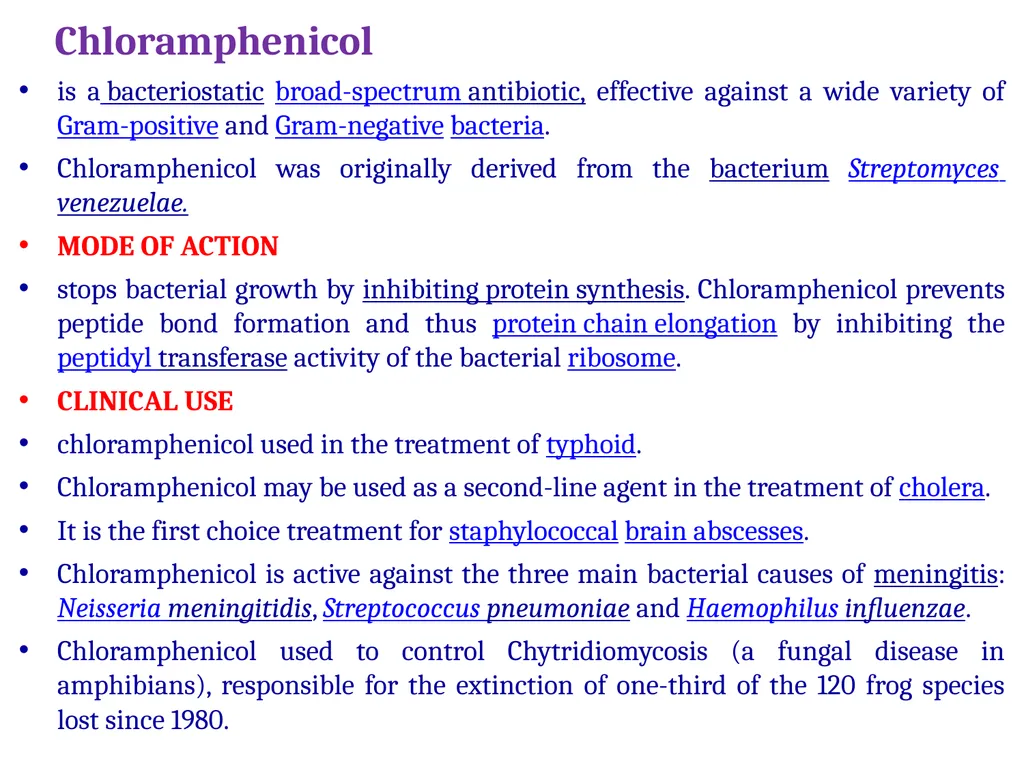
is a bacteriostatic broad-spectrum antibiotic, effective against a wide variety of Gram-positive and Gram-negative bacteria.
Chloramphenicol was originally derived from the bacterium Streptomyces venezuelae.
MODE OF ACTION
stops bacterial growth by inhibiting protein synthesis. Chloramphenicol prevents peptide bond formation and thus protein chain elongation by inhibiting the peptidyl transferase activity of the bacterial ribosome.
CLINICAL USE
chloramphenicol used in the treatment of typhoid.
Chloramphenicol may be used as a second-line agent in the treatment of cholera.
It is the first choice treatment for staphylococcal brain abscesses.
Chloramphenicol is active against the three main bacterial causes of meningitis: Neisseria meningitidis, Streptococcus pneumoniae and Haemophilus influenzae.
Chloramphenicol used to control Chytridiomycosis (a fungal disease in amphibians), responsible for the extinction of one-third of the 120 frog species lost since 1980.<br>
is a bacteriostatic broad-spectrum antibiotic, effective against a wide variety of Gram-positive and Gram-negative bacteria.
Chloramphenicol was originally derived from the bacterium Streptomyces venezuelae.
MODE OF ACTION
stops bacterial growth by inhibiting protein synthesis. Chloramphenicol prevents peptide bond formation and thus protein chain elongation by inhibiting the peptidyl transferase activity of the bacterial ribosome.
CLINICAL USE
chloramphenicol used in the treatment of typhoid.
Chloramphenicol may be used as a second-line agent in the treatment of cholera.
It is the first choice treatment for staphylococcal brain abscesses.
Chloramphenicol is active against the three main bacterial causes of meningitis: Neisseria meningitidis, Streptococcus pneumoniae and Haemophilus influenzae.
Chloramphenicol used to control Chytridiomycosis (a fungal disease in amphibians), responsible for the extinction of one-third of the 120 frog species lost since 1980.<br>
09
Streptomycin
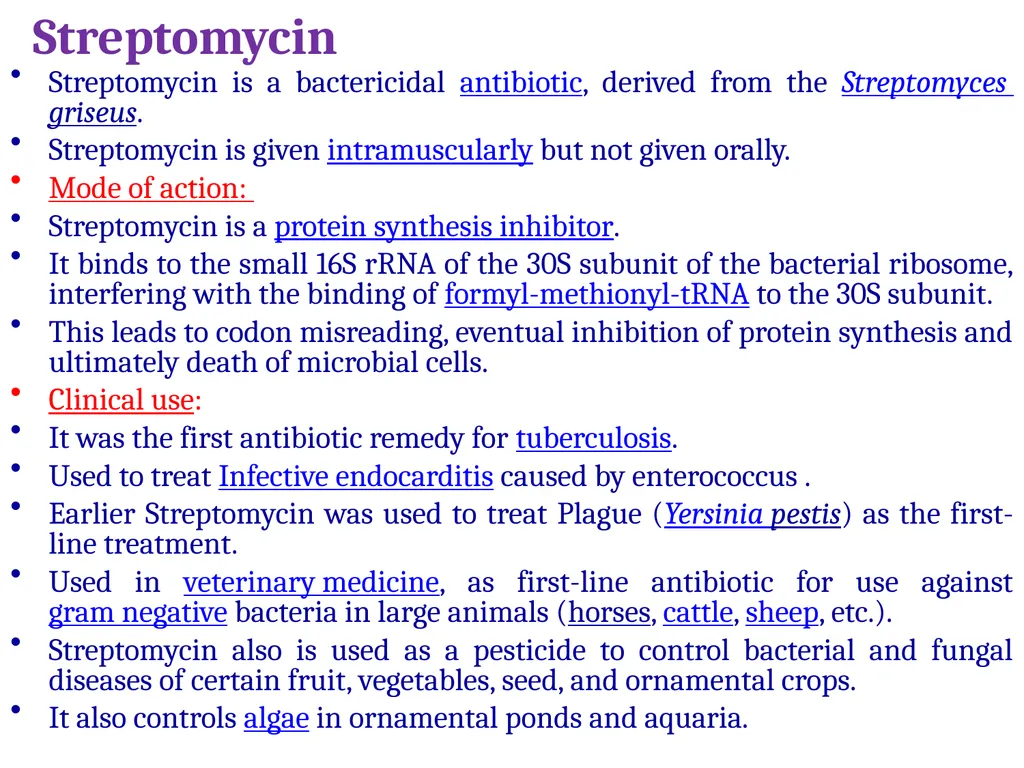
Streptomycin is a bactericidal antibiotic, derived from the Streptomyces griseus.
Streptomycin is given intramuscularly but not given orally.
Mode of action:
Streptomycin is a protein synthesis inhibitor.
It binds to the small 16S rRNA of the 30S subunit of the bacterial ribosome, interfering with the binding of formyl-methionyl-tRNA to the 30S subunit.
This leads to codon misreading, eventual inhibition of protein synthesis and ultimately death of microbial cells.
Clinical use:
It was the first antibiotic remedy for tuberculosis.
Used to treat Infective endocarditis caused by enterococcus .
Earlier Streptomycin was used to treat Plague (Yersinia pestis) as the first-line treatment.
Used in veterinary medicine, as first-line antibiotic for use against gram negative bacteria in large animals (horses, cattle, sheep, etc.).
Streptomycin also is used as a pesticide to control bacterial and fungal diseases of certain fruit, vegetables, seed, and ornamental crops.
It also controls algae in ornamental ponds and aquaria.<br>
Streptomycin is a bactericidal antibiotic, derived from the Streptomyces griseus.
Streptomycin is given intramuscularly but not given orally.
Mode of action:
Streptomycin is a protein synthesis inhibitor.
It binds to the small 16S rRNA of the 30S subunit of the bacterial ribosome, interfering with the binding of formyl-methionyl-tRNA to the 30S subunit.
This leads to codon misreading, eventual inhibition of protein synthesis and ultimately death of microbial cells.
Clinical use:
It was the first antibiotic remedy for tuberculosis.
Used to treat Infective endocarditis caused by enterococcus .
Earlier Streptomycin was used to treat Plague (Yersinia pestis) as the first-line treatment.
Used in veterinary medicine, as first-line antibiotic for use against gram negative bacteria in large animals (horses, cattle, sheep, etc.).
Streptomycin also is used as a pesticide to control bacterial and fungal diseases of certain fruit, vegetables, seed, and ornamental crops.
It also controls algae in ornamental ponds and aquaria.<br>
10
Ciprofloxacin –
Ciprofloxacin is a broad spectrum antibiotic in a group of drugs called fluoroquinolones, active against both Gram-positive and Gram-negative bacteria. Ciprofloxacin is used alone or in combination with other antibacterial drugs treatment of infections.
Mode of action:
It functions by inhibiting DNA gyrase (topoisomerase) enzymes which removes super coils formed during DNA unwinding process during DNA replication.
Clinical use:
Ciprofloxacin is used to treat a number of infections, including
Urinary tract infections
Respiratory Tract Infections
Gastrointestinal, and abdominal infections
Acute cystitis in females
Acute Sinusitis
Skin infections
Bone and joint infections
Infectious diarrhea
Typhoid Fever (enteric fever) caused by Salmonella typhi
Cervical and urethral gonorrhea (due to Neisseria gonorrhoeae)<br>
Ciprofloxacin is a broad spectrum antibiotic in a group of drugs called fluoroquinolones, active against both Gram-positive and Gram-negative bacteria. Ciprofloxacin is used alone or in combination with other antibacterial drugs treatment of infections.
Mode of action:
It functions by inhibiting DNA gyrase (topoisomerase) enzymes which removes super coils formed during DNA unwinding process during DNA replication.
Clinical use:
Ciprofloxacin is used to treat a number of infections, including
Urinary tract infections
Respiratory Tract Infections
Gastrointestinal, and abdominal infections
Acute cystitis in females
Acute Sinusitis
Skin infections
Bone and joint infections
Infectious diarrhea
Typhoid Fever (enteric fever) caused by Salmonella typhi
Cervical and urethral gonorrhea (due to Neisseria gonorrhoeae)<br>
11
Antiviral agents Azidothymidine-
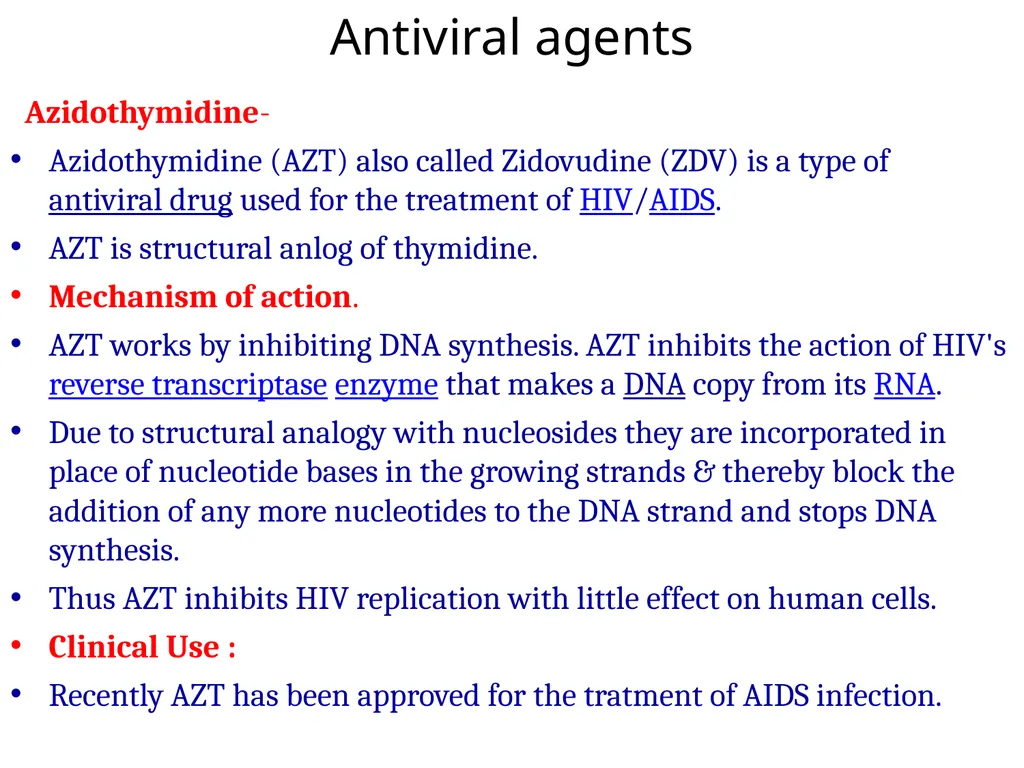
Azidothymidine (AZT) also called Zidovudine (ZDV) is a type of antiviral drug used for the treatment of HIV/AIDS.
AZT is structural anlog of thymidine.
Mechanism of action.
AZT works by inhibiting DNA synthesis. AZT inhibits the action of HIV's reverse transcriptase enzyme that makes a DNA copy from its RNA.
Due to structural analogy with nucleosides they are incorporated in place of nucleotide bases in the growing strands & thereby block the addition of any more nucleotides to the DNA strand and stops DNA synthesis.
Thus AZT inhibits HIV replication with little effect on human cells.
Clinical Use :
Recently AZT has been approved for the tratment of AIDS infection.<br>
Azidothymidine (AZT) also called Zidovudine (ZDV) is a type of antiviral drug used for the treatment of HIV/AIDS.
AZT is structural anlog of thymidine.
Mechanism of action.
AZT works by inhibiting DNA synthesis. AZT inhibits the action of HIV's reverse transcriptase enzyme that makes a DNA copy from its RNA.
Due to structural analogy with nucleosides they are incorporated in place of nucleotide bases in the growing strands & thereby block the addition of any more nucleotides to the DNA strand and stops DNA synthesis.
Thus AZT inhibits HIV replication with little effect on human cells.
Clinical Use :
Recently AZT has been approved for the tratment of AIDS infection.<br>
12
Amantadine-
Amantadine is a drug that has been approved for use both as an antiviral and an antiparkinsonian drug.
It is the organic compound 1-adamantylamine.
Mechanism of action
The mechanism of activity involves interference with a viral protein, M2 (an ion channel), which is required for the viral particle to become "uncoated" once taken inside a cell.
Clinical use
Amantadine is used for therapy of Parkinson's disease (disorder of the central nervous system).
Amantadine is frequently used to treat the chronic fatigue often experienced by patients with multiple sclerosis (an inflammatory disease in which the fatty myelin sheaths around the axons of the brain and spinal cord are damaged).
Amantadine used to treat ADHD (Attention deficit-hyperactivity disorder) is a mental disorder and neurobehavioral disorder. Children with ADHD find it more difficult to focus and to complete their schoolwork.<br>
Amantadine is a drug that has been approved for use both as an antiviral and an antiparkinsonian drug.
It is the organic compound 1-adamantylamine.
Mechanism of action
The mechanism of activity involves interference with a viral protein, M2 (an ion channel), which is required for the viral particle to become "uncoated" once taken inside a cell.
Clinical use
Amantadine is used for therapy of Parkinson's disease (disorder of the central nervous system).
Amantadine is frequently used to treat the chronic fatigue often experienced by patients with multiple sclerosis (an inflammatory disease in which the fatty myelin sheaths around the axons of the brain and spinal cord are damaged).
Amantadine used to treat ADHD (Attention deficit-hyperactivity disorder) is a mental disorder and neurobehavioral disorder. Children with ADHD find it more difficult to focus and to complete their schoolwork.<br>
13
Antifungal agents Griseofulvin
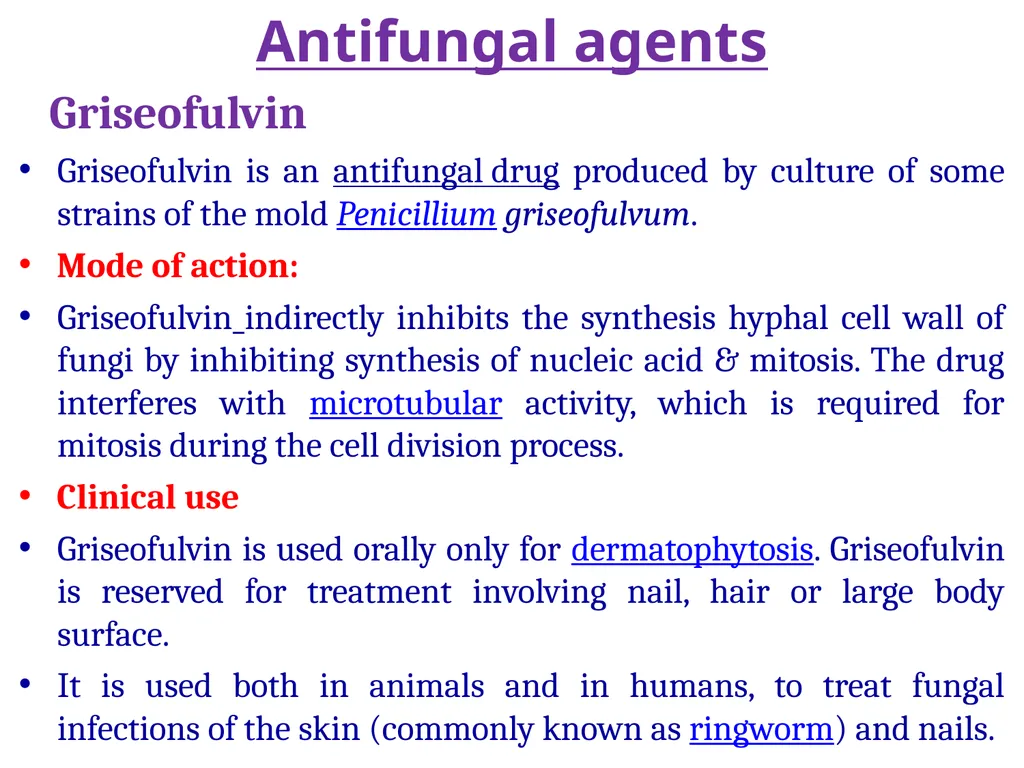
Griseofulvin is an antifungal drug produced by culture of some strains of the mold Penicillium griseofulvum.
Mode of action:
Griseofulvin indirectly inhibits the synthesis hyphal cell wall of fungi by inhibiting synthesis of nucleic acid & mitosis. The drug interferes with microtubular activity, which is required for mitosis during the cell division process.
Clinical use
Griseofulvin is used orally only for dermatophytosis. Griseofulvin is reserved for treatment involving nail, hair or large body surface.
It is used both in animals and in humans, to treat fungal infections of the skin (commonly known as ringworm) and nails.<br>
Griseofulvin is an antifungal drug produced by culture of some strains of the mold Penicillium griseofulvum.
Mode of action:
Griseofulvin indirectly inhibits the synthesis hyphal cell wall of fungi by inhibiting synthesis of nucleic acid & mitosis. The drug interferes with microtubular activity, which is required for mitosis during the cell division process.
Clinical use
Griseofulvin is used orally only for dermatophytosis. Griseofulvin is reserved for treatment involving nail, hair or large body surface.
It is used both in animals and in humans, to treat fungal infections of the skin (commonly known as ringworm) and nails.<br>
14
Amphotericin B
It is antifungal drug produced by Streptomyces nodosus. It is fungicidal, broad spectrum drug.
Mode of action
Amphotericin B binds with ergosterol, a component of fungal cell membranes, and forms pores in the fungal membrane (transmembrane channel) that leads to monovalent ion (K+, Na+, H+ and Cl−) leakage, which causes fungal cell death.
Clinical uses: –
Despite its toxicity, it is widely used for the treatment of systematic fungal infections like Cryptococcosis, Histoplasmosis, Blastomycosis, Candidiasis etc.
The potential side effect of drug is kidney damage.<br>
It is antifungal drug produced by Streptomyces nodosus. It is fungicidal, broad spectrum drug.
Mode of action
Amphotericin B binds with ergosterol, a component of fungal cell membranes, and forms pores in the fungal membrane (transmembrane channel) that leads to monovalent ion (K+, Na+, H+ and Cl−) leakage, which causes fungal cell death.
Clinical uses: –
Despite its toxicity, it is widely used for the treatment of systematic fungal infections like Cryptococcosis, Histoplasmosis, Blastomycosis, Candidiasis etc.
The potential side effect of drug is kidney damage.<br>
15
Antimicrobial susceptibility testing Introduction to Clinical and Laboratory Standards Institute (CLSI)
Clinical and Laboratory Standards Institute (CLSI) is a global, volunteer driven, membership supported, nonprofit, standards-developing organization.
It is located in USA. Its contact address is clinical and Laboratory Standards Institute, 950 West Valley Road, Suite 2500, Wayne, PA 19087 USA.
It is dedicated to developing standards and guidelines for health care community.
Formerly this institute was called as “National committee on clinical laboratory standards” (NCCLS). On 1st January 2005, NCCLS officially changed its name to Clinical and Laboratory Standards Institute (CLSI).<br>
Clinical and Laboratory Standards Institute (CLSI) is a global, volunteer driven, membership supported, nonprofit, standards-developing organization.
It is located in USA. Its contact address is clinical and Laboratory Standards Institute, 950 West Valley Road, Suite 2500, Wayne, PA 19087 USA.
It is dedicated to developing standards and guidelines for health care community.
Formerly this institute was called as “National committee on clinical laboratory standards” (NCCLS). On 1st January 2005, NCCLS officially changed its name to Clinical and Laboratory Standards Institute (CLSI).<br>
16
CLSI works to promote the excellence in health care for current and future generations.
CLSI is concerned with improving quality in the medical testing and health care field.
Clinical and Laboratory Standards Institute's (CLSI) core business is the development of globally applicable consensus documents for health care testing.
Vision of CLSI: to be the leader in clinical and laboratory standards to improve quality of medical care.
Mission of CLSI – To develop best practices in clinical and laboratory testing and promote their use through out the world, using a consensus process that balances the viewpoints of industry, government and health care professions.<br>
CLSI is concerned with improving quality in the medical testing and health care field.
Clinical and Laboratory Standards Institute's (CLSI) core business is the development of globally applicable consensus documents for health care testing.
Vision of CLSI: to be the leader in clinical and laboratory standards to improve quality of medical care.
Mission of CLSI – To develop best practices in clinical and laboratory testing and promote their use through out the world, using a consensus process that balances the viewpoints of industry, government and health care professions.<br>
17
CLSI has set up different committee’s to develop a consensus process in different branches of health care and medical testing.
1) Consensus Committee on Microbiology.
2) Consensus Committee on evaluation protocols.
3) Consensus Committee on clinical chemistry and toxicology.
4) Consensus Committee on haematology.
5) Consensus Committee on molecular methods.<br>
1) Consensus Committee on Microbiology.
2) Consensus Committee on evaluation protocols.
3) Consensus Committee on clinical chemistry and toxicology.
4) Consensus Committee on haematology.
5) Consensus Committee on molecular methods.<br>
18
CLSI has developed standardized methods for in vitro susceptibility testing of antifungal agents in 1982.
In 1993, CLSI published a document (M2-A5 document) on performance standard for antimicrobial disc susceptibility test.
In 1997, CLSI has published a standardized reference method for broth dilution antifungal susceptibility testing of yeast.
Standardized methods published by CLSI made inter laboratory data comparison possible.<br>
In 1993, CLSI published a document (M2-A5 document) on performance standard for antimicrobial disc susceptibility test.
In 1997, CLSI has published a standardized reference method for broth dilution antifungal susceptibility testing of yeast.
Standardized methods published by CLSI made inter laboratory data comparison possible.<br>
19
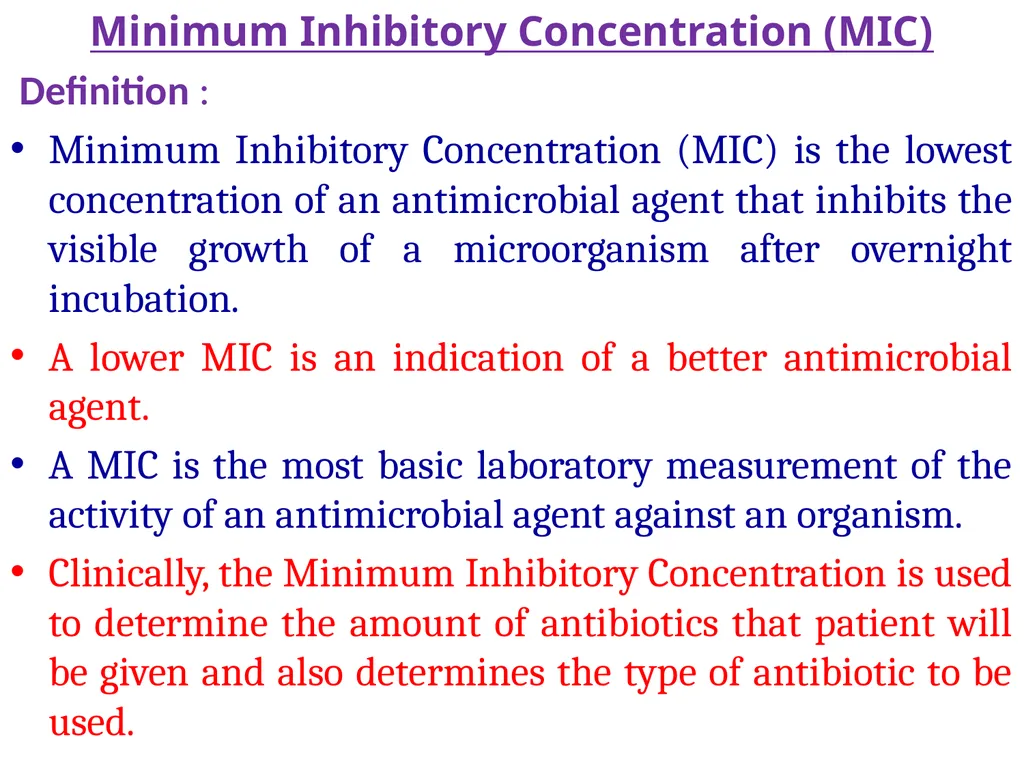
Minimum Inhibitory Concentration (MIC)
Definition :
Minimum Inhibitory Concentration (MIC) is the lowest concentration of an antimicrobial agent that inhibits the visible growth of a microorganism after overnight incubation.
A lower MIC is an indication of a better antimicrobial agent.
A MIC is the most basic laboratory measurement of the activity of an antimicrobial agent against an organism.
Clinically, the Minimum Inhibitory Concentration is used to determine the amount of antibiotics that patient will be given and also determines the type of antibiotic to be used.<br>
Definition :
Minimum Inhibitory Concentration (MIC) is the lowest concentration of an antimicrobial agent that inhibits the visible growth of a microorganism after overnight incubation.
A lower MIC is an indication of a better antimicrobial agent.
A MIC is the most basic laboratory measurement of the activity of an antimicrobial agent against an organism.
Clinically, the Minimum Inhibitory Concentration is used to determine the amount of antibiotics that patient will be given and also determines the type of antibiotic to be used.<br>
20
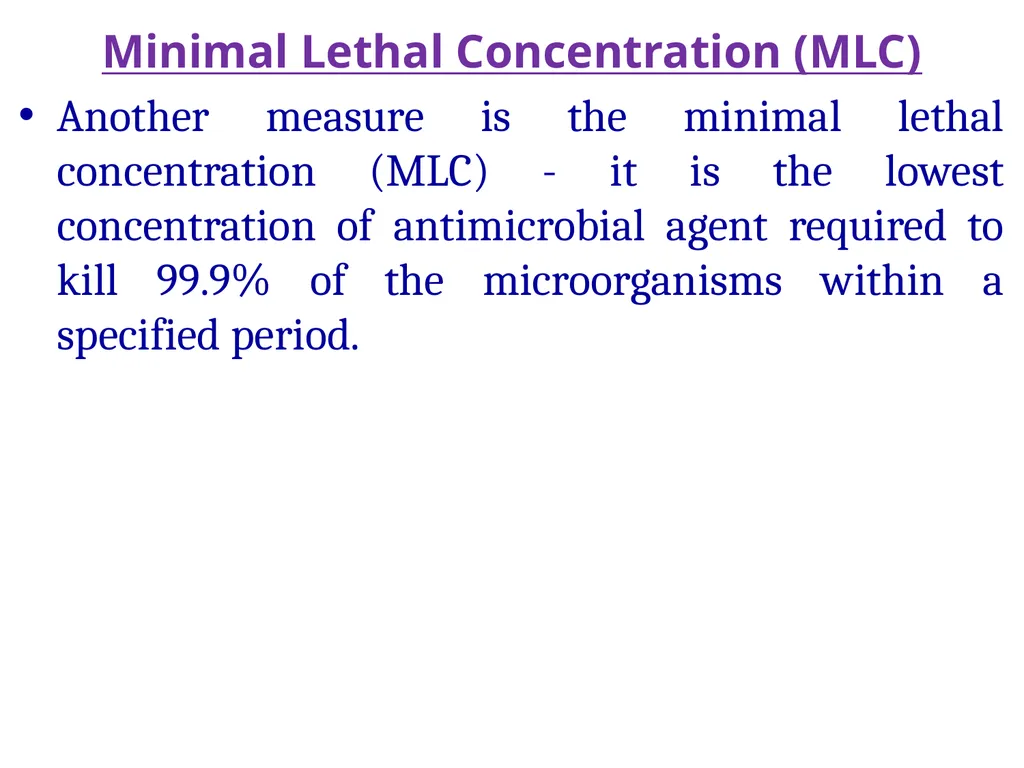
Minimal Lethal Concentration (MLC)
Another measure is the minimal lethal concentration (MLC) - it is the lowest concentration of antimicrobial agent required to kill 99.9% of the microorganisms within a specified period.<br>
Another measure is the minimal lethal concentration (MLC) - it is the lowest concentration of antimicrobial agent required to kill 99.9% of the microorganisms within a specified period.<br>
21
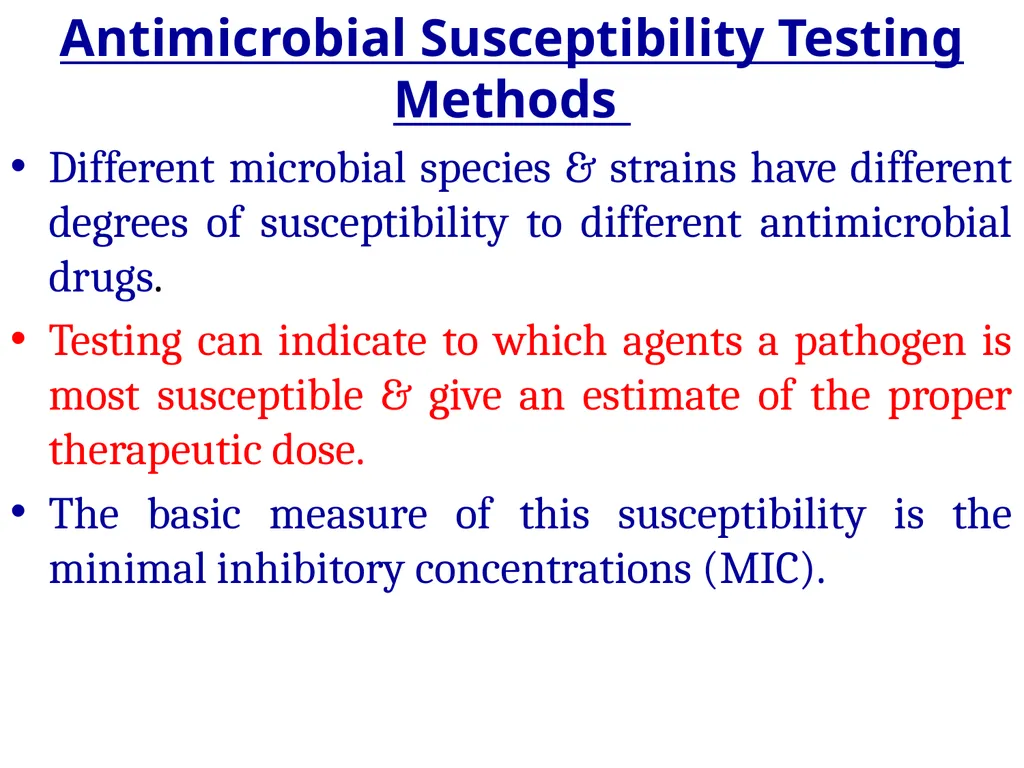
Antimicrobial Susceptibility Testing Methods
Different microbial species & strains have different degrees of susceptibility to different antimicrobial drugs.
Testing can indicate to which agents a pathogen is most susceptible & give an estimate of the proper therapeutic dose.
The basic measure of this susceptibility is the minimal inhibitory concentrations (MIC).<br>
Different microbial species & strains have different degrees of susceptibility to different antimicrobial drugs.
Testing can indicate to which agents a pathogen is most susceptible & give an estimate of the proper therapeutic dose.
The basic measure of this susceptibility is the minimal inhibitory concentrations (MIC).<br>
22
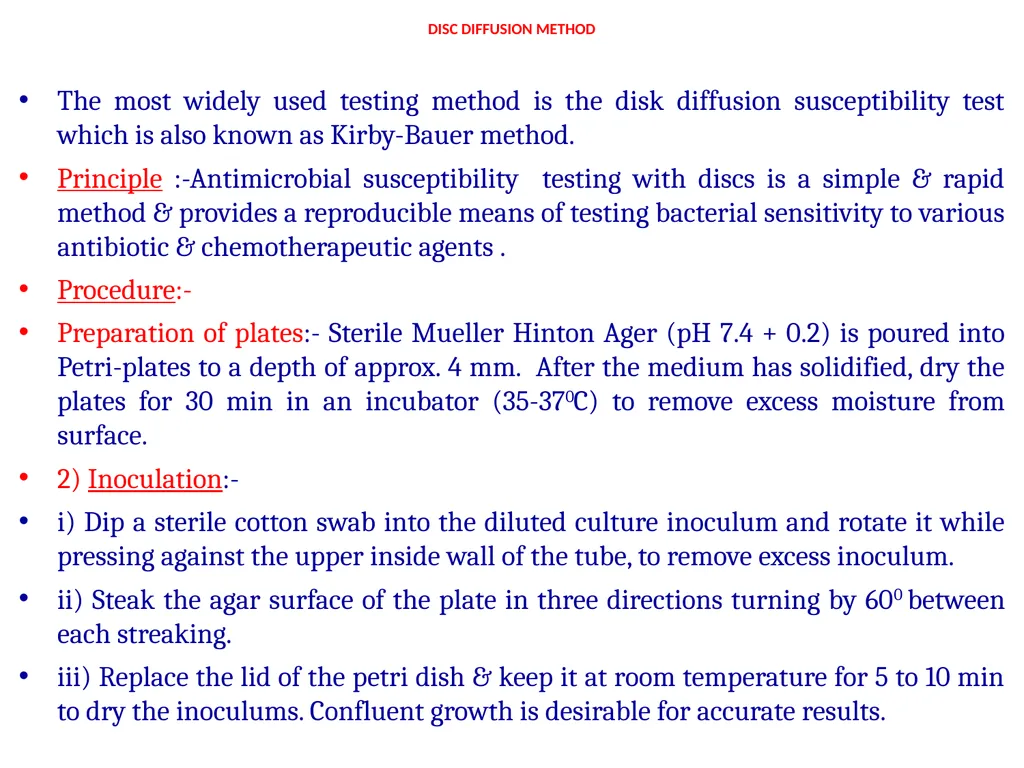
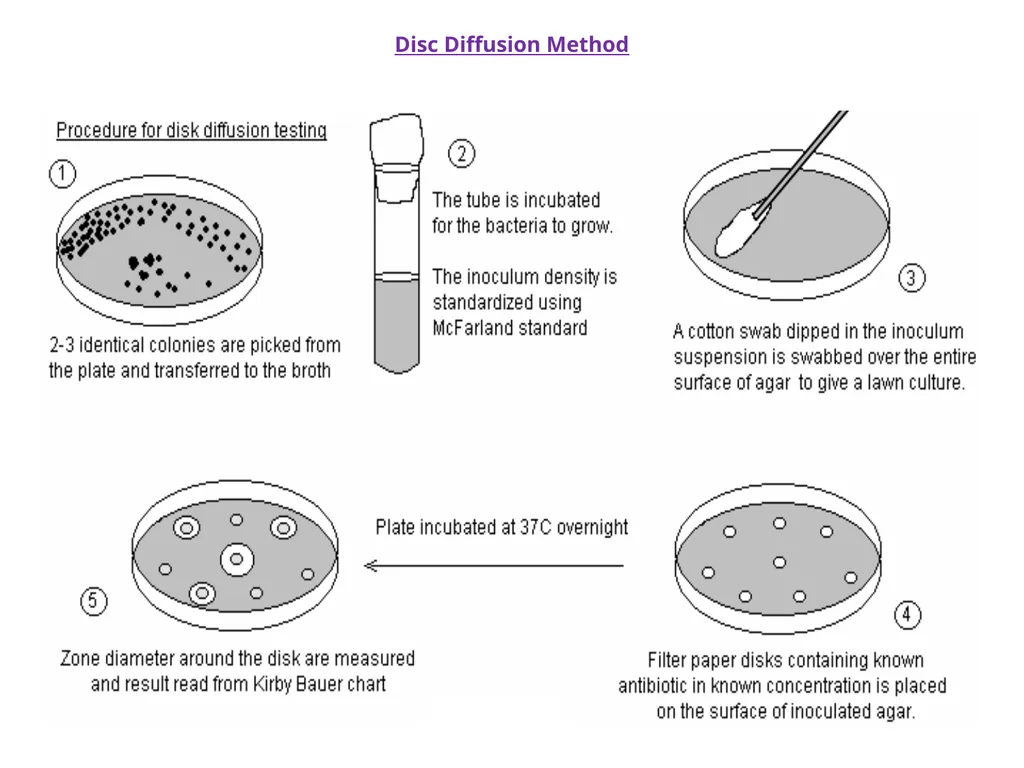
DISC DIFFUSION METHOD The most widely used testing method is the disk diffusion susceptibility test which is also known as Kirby-Bauer method.
Principle :-Antimicrobial susceptibility testing with discs is a simple & rapid method & provides a reproducible means of testing bacterial sensitivity to various antibiotic & chemotherapeutic agents .
Procedure:-
Preparation of plates:- Sterile Mueller Hinton Ager (pH 7.4 + 0.2) is poured into Petri-plates to a depth of approx. 4 mm. After the medium has solidified, dry the plates for 30 min in an incubator (35-370C) to remove excess moisture from surface.
2) Inoculation:-
i) Dip a sterile cotton swab into the diluted culture inoculum and rotate it while pressing against the upper inside wall of the tube, to remove excess inoculum.
ii) Steak the agar surface of the plate in three directions turning by 600 between each streaking.
iii) Replace the lid of the petri dish & keep it at room temperature for 5 to 10 min to dry the inoculums. Confluent growth is desirable for accurate results.<br>
Principle :-Antimicrobial susceptibility testing with discs is a simple & rapid method & provides a reproducible means of testing bacterial sensitivity to various antibiotic & chemotherapeutic agents .
Procedure:-
Preparation of plates:- Sterile Mueller Hinton Ager (pH 7.4 + 0.2) is poured into Petri-plates to a depth of approx. 4 mm. After the medium has solidified, dry the plates for 30 min in an incubator (35-370C) to remove excess moisture from surface.
2) Inoculation:-
i) Dip a sterile cotton swab into the diluted culture inoculum and rotate it while pressing against the upper inside wall of the tube, to remove excess inoculum.
ii) Steak the agar surface of the plate in three directions turning by 600 between each streaking.
iii) Replace the lid of the petri dish & keep it at room temperature for 5 to 10 min to dry the inoculums. Confluent growth is desirable for accurate results.<br>
23
3) Application of discs:-
Remove the disc with the help of a flamed forceps and carefully place it on the surface of the medium.
Finally press it lightly with the forcep to make complete contact with the surface of the medium. Allow the plates to stand at room temperature of 30 min (Prediffusion time).
4) Incubation:-
Incubate the plates at 35–370 C for 16 to 18 hours.
During incubation the chemotherapeutic agent diffuse from the disk into the agar.
5) Reading of zones:-
Measure the diameter of the zone of inhibition at the end of the incubation period.
If the drug is effective a zone of inhibition formed immediately around the disk.
The diameter of zone of inhibition can be measured.
The zone diameter is compared to standard chart for that drug & concentration, & report the result whether the organisms is sensitive, intermediate or resistant to the chemotherapeutic agent.<br>
Remove the disc with the help of a flamed forceps and carefully place it on the surface of the medium.
Finally press it lightly with the forcep to make complete contact with the surface of the medium. Allow the plates to stand at room temperature of 30 min (Prediffusion time).
4) Incubation:-
Incubate the plates at 35–370 C for 16 to 18 hours.
During incubation the chemotherapeutic agent diffuse from the disk into the agar.
5) Reading of zones:-
Measure the diameter of the zone of inhibition at the end of the incubation period.
If the drug is effective a zone of inhibition formed immediately around the disk.
The diameter of zone of inhibition can be measured.
The zone diameter is compared to standard chart for that drug & concentration, & report the result whether the organisms is sensitive, intermediate or resistant to the chemotherapeutic agent.<br>
24
Disc Diffusion Method<br>
25
Antimicrobial Susceptibility Testing Methods for Determination of Minimum Inhibitory Concentration (MIC) In these tests, the minimum amount of antibiotic that inhibits the visible growth of an isolate or minimum inhibitory concentration (MIC) is determined.
Bacterial isolates are exposed to various dilutions of antibiotics.
The highest dilution of antibiotic that has inhibited the growth of bacteria is considered as MIC.
These tests can be performed on broth or agar. The methods are -
1) Broth dilution methods –
a) Macrobroth dilution
b) Microbroth dilution
2) Agar dilution methods<br>
Bacterial isolates are exposed to various dilutions of antibiotics.
The highest dilution of antibiotic that has inhibited the growth of bacteria is considered as MIC.
These tests can be performed on broth or agar. The methods are -
1) Broth dilution methods –
a) Macrobroth dilution
b) Microbroth dilution
2) Agar dilution methods<br>
26
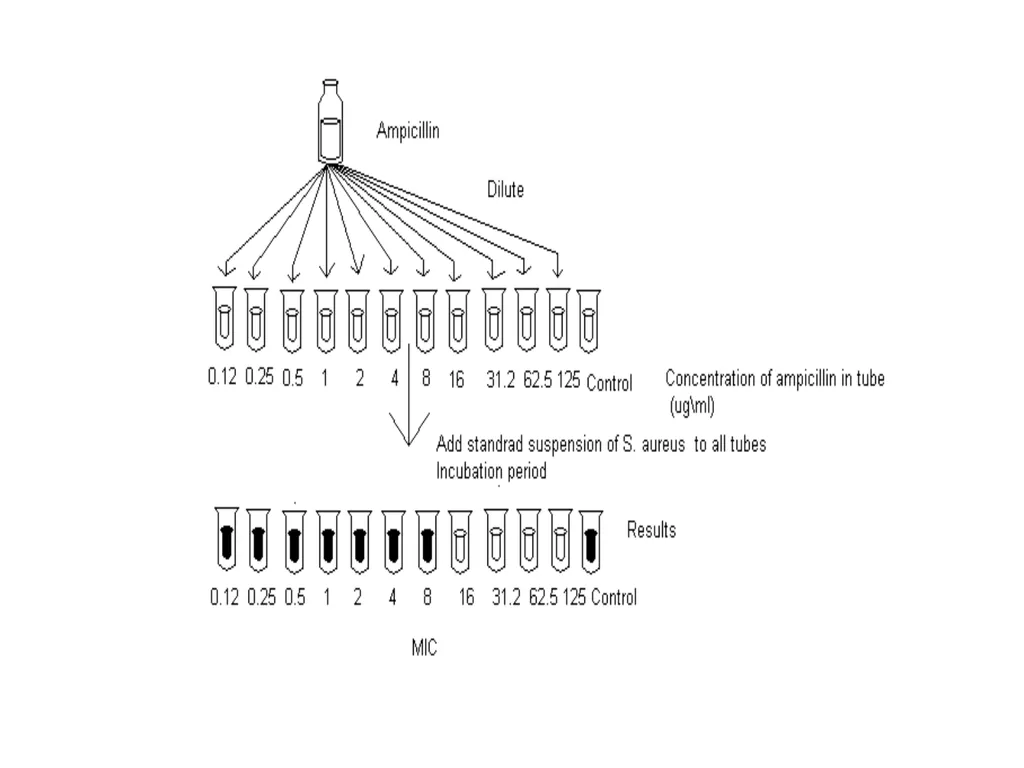
Macrobroth dilution susceptibility tests
The broth macrodilution test is performed in round bottom sterile glass tubes (1275 mm).
Two fold dilutions of the drug are prepared in broth tubes (Muller Hinton broth) from 0 to maximum concentration.
The bacterial inoculum is standardized according to McFarland standard. The suspension should have a final inoculum of 5x10⁵ cfu/ml.
Each tube is inoculated with 1ml. of standardized inoculums of test organism including control tube that does not contain drug.
Tubes are incubated at 370C overnight.
The lowest concentration of antibiotic that completely inhibits visual growth of bacteria (no turbidity) is recorded as MIC.<br>
The broth macrodilution test is performed in round bottom sterile glass tubes (1275 mm).
Two fold dilutions of the drug are prepared in broth tubes (Muller Hinton broth) from 0 to maximum concentration.
The bacterial inoculum is standardized according to McFarland standard. The suspension should have a final inoculum of 5x10⁵ cfu/ml.
Each tube is inoculated with 1ml. of standardized inoculums of test organism including control tube that does not contain drug.
Tubes are incubated at 370C overnight.
The lowest concentration of antibiotic that completely inhibits visual growth of bacteria (no turbidity) is recorded as MIC.<br>
27
Microbroth dilution susceptibility tests
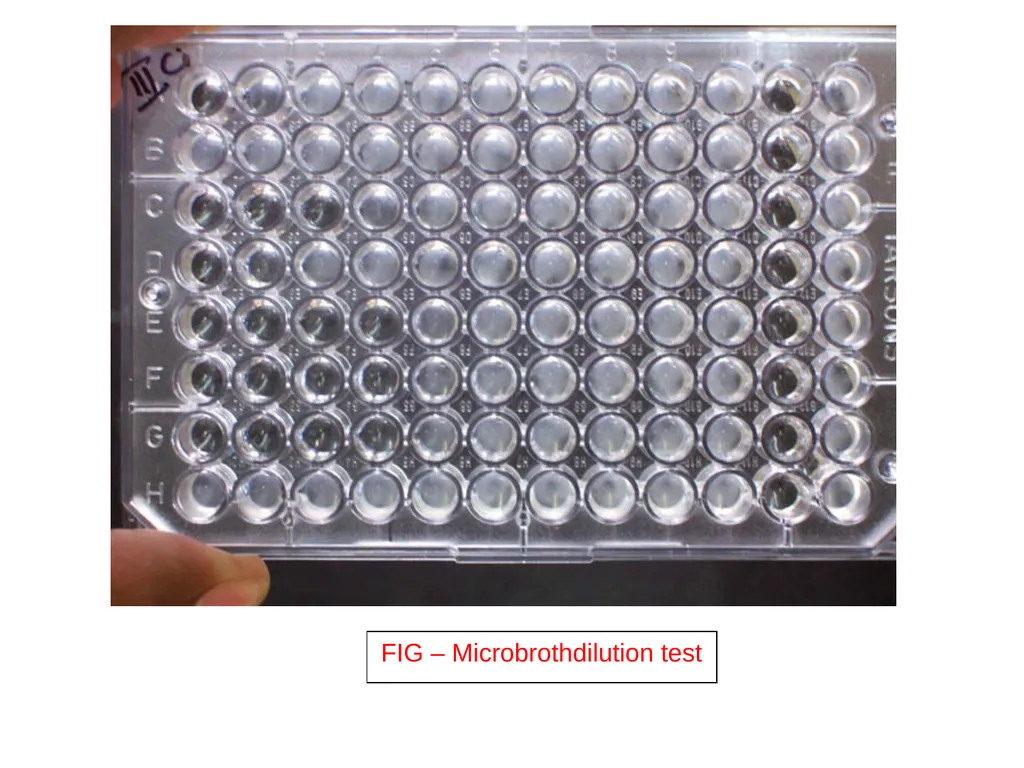
The microbroth dilution test is performed by using sterile, disposable, multiwell microdilution plates (96 U – shaped wells).
The serial two fold dilutions of different antibiotics/drugs are prepared in Muller Hinton broth in the wells of microdilution plate.
The bacterial inoculum is standardized according to McFarland standard.
The bacterial inoculum is then inoculated into the wells and incubated at 370C overnight.
The lowest concentration of antibiotic that completely inhibits visual growth of bacteria (no turbidity) is recorded as MIC.<br>
The microbroth dilution test is performed by using sterile, disposable, multiwell microdilution plates (96 U – shaped wells).
The serial two fold dilutions of different antibiotics/drugs are prepared in Muller Hinton broth in the wells of microdilution plate.
The bacterial inoculum is standardized according to McFarland standard.
The bacterial inoculum is then inoculated into the wells and incubated at 370C overnight.
The lowest concentration of antibiotic that completely inhibits visual growth of bacteria (no turbidity) is recorded as MIC.<br>
28
FIG – Microbrothdilution test<br>
29
Agar dilution method
A serial two-fold dilution of the antibiotic is prepared in Mueller-Hinton agar.
The bacterial inoculum is standardized according to McFarland standard.
Using calibrated loops a volume of 0.001-0.002 ml is inoculated on the surface of agar and incubated at 370C overnight.
The lowest concentration of antibiotic that inhibits visible growth on surface of agar is taken as MIC.<br>
A serial two-fold dilution of the antibiotic is prepared in Mueller-Hinton agar.
The bacterial inoculum is standardized according to McFarland standard.
Using calibrated loops a volume of 0.001-0.002 ml is inoculated on the surface of agar and incubated at 370C overnight.
The lowest concentration of antibiotic that inhibits visible growth on surface of agar is taken as MIC.<br>