
United Nations Space Law Conference 2020
LV
Published · 16 slides · 0 views

1 / 1
Description
United Nations Space Law Conference 2020 Fundamental Principles of Space Law 8 December 2020 Michael Newman, Legal Officer, UNOOSA Five UN Treaties and Principles on Outer Space status as of 1 January 2020 Outer Space Treaty, 1967 (110
Related Topics
Share
Embed code
Download this presentation From Below
"United Nations Space Law Conference 2020" is the property of its rightful owner. Permission is granted to download and print the materials on this website for personal, non-commercial use only, and to display it on your personal computer provided you do not modify the materials and that you retain all copyright notices contained in the materials. By downloading content from our website, you accept the terms of this agreement.
Presentation Transcript
01
United Nations Space Law Conference 2020
Fundamental Principles of Space Law
8 December 2020
Michael Newman, Legal Officer, UNOOSA<br>
Fundamental Principles of Space Law
8 December 2020
Michael Newman, Legal Officer, UNOOSA<br>
02
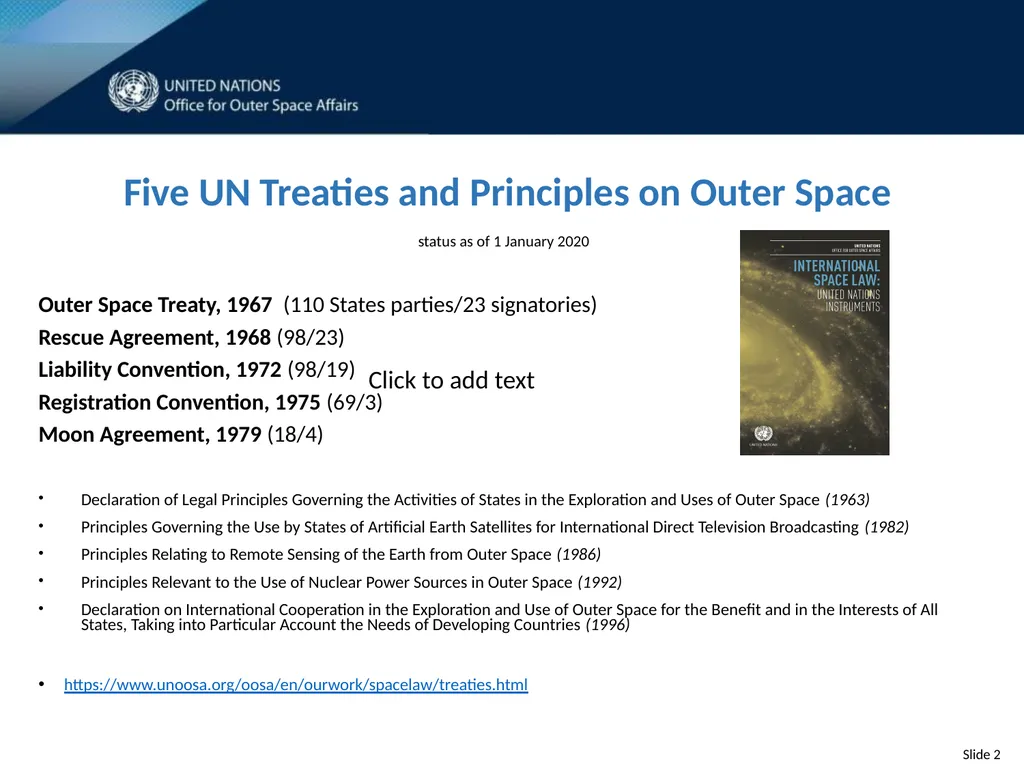
Five UN Treaties and Principles on Outer Space status as of 1 January 2020
Outer Space Treaty, 1967 (110 States parties/23 signatories)
Rescue Agreement, 1968 (98/23)
Liability Convention, 1972 (98/19)
Registration Convention, 1975 (69/3)
Moon Agreement, 1979 (18/4)
Declaration of Legal Principles Governing the Activities of States in the Exploration and Uses of Outer Space (1963)
Principles Governing the Use by States of Artificial Earth Satellites for International Direct Television Broadcasting (1982)
Principles Relating to Remote Sensing of the Earth from Outer Space (1986)
Principles Relevant to the Use of Nuclear Power Sources in Outer Space (1992)
Declaration on International Cooperation in the Exploration and Use of Outer Space for the Benefit and in the Interests of All States, Taking into Particular Account the Needs of Developing Countries (1996)
https://www.unoosa.org/oosa/en/ourwork/spacelaw/treaties.html Click to add text<br>
03
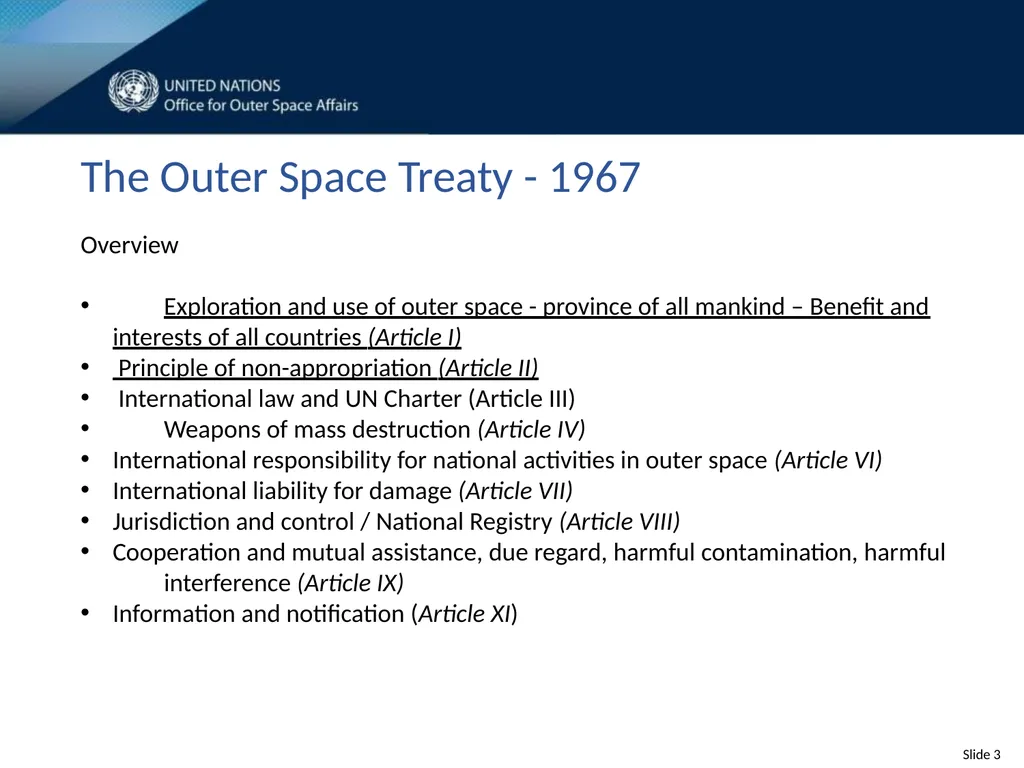
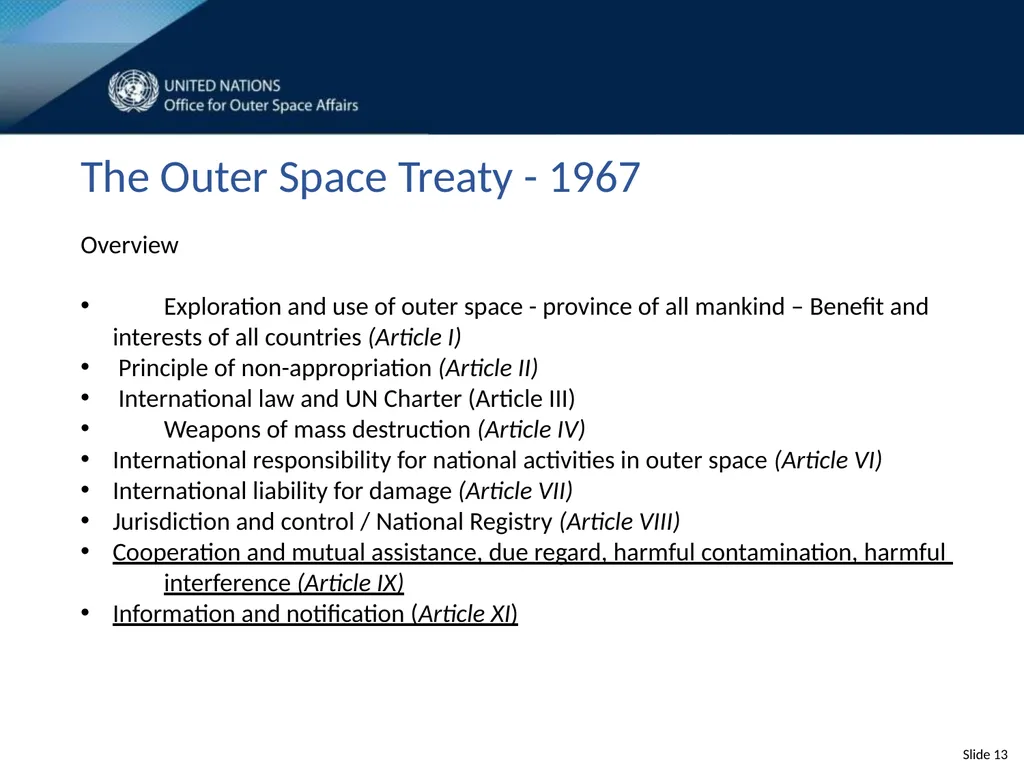
The Outer Space Treaty - 1967 Overview
Exploration and use of outer space - province of all mankind – Benefit and interests of all countries (Article I)
Principle of non-appropriation (Article II)
International law and UN Charter (Article III)
Weapons of mass destruction (Article IV)
International responsibility for national activities in outer space (Article VI)
International liability for damage (Article VII)
Jurisdiction and control / National Registry (Article VIII)
Cooperation and mutual assistance, due regard, harmful contamination, harmful interference (Article IX)
Information and notification (Article XI)<br>
04
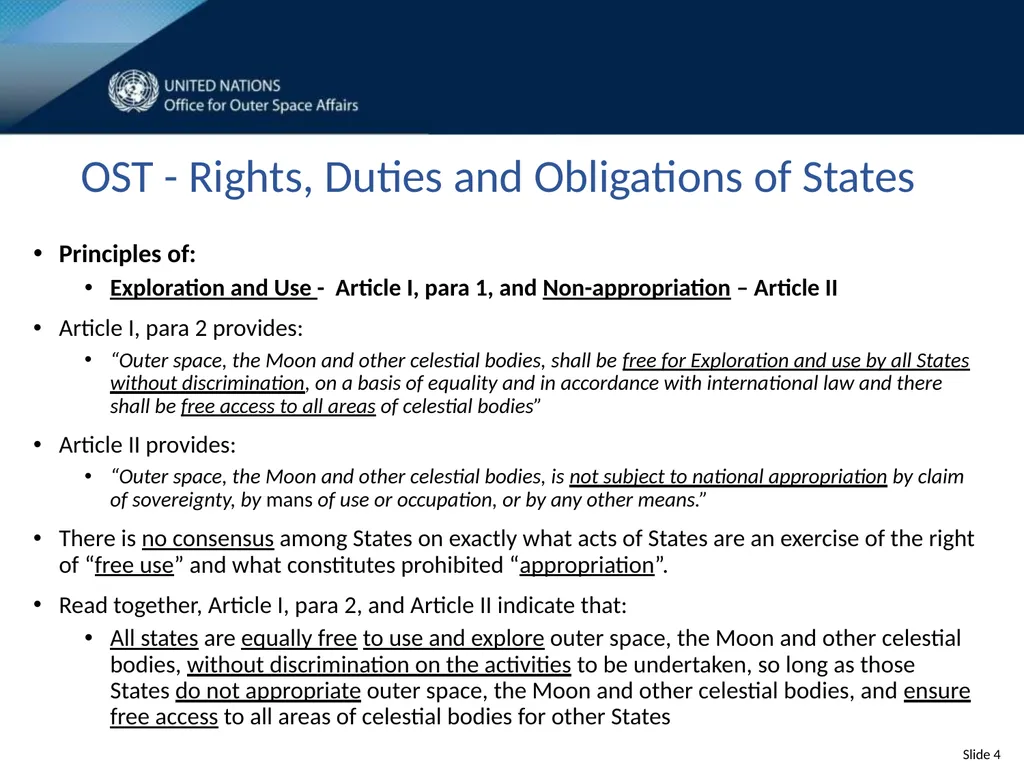
Principles of:
Exploration and Use - Article I, para 1, and Non-appropriation – Article II
Article I, para 2 provides:
“Outer space, the Moon and other celestial bodies, shall be free for Exploration and use by all States without discrimination, on a basis of equality and in accordance with international law and there shall be free access to all areas of celestial bodies”
Article II provides:
“Outer space, the Moon and other celestial bodies, is not subject to national appropriation by claim of sovereignty, by mans of use or occupation, or by any other means.”
There is no consensus among States on exactly what acts of States are an exercise of the right of “free use” and what constitutes prohibited “appropriation”.
Read together, Article I, para 2, and Article II indicate that:
All states are equally free to use and explore outer space, the Moon and other celestial bodies, without discrimination on the activities to be undertaken, so long as those States do not appropriate outer space, the Moon and other celestial bodies, and ensure free access to all areas of celestial bodies for other States OST - Rights, Duties and Obligations of States<br>
05
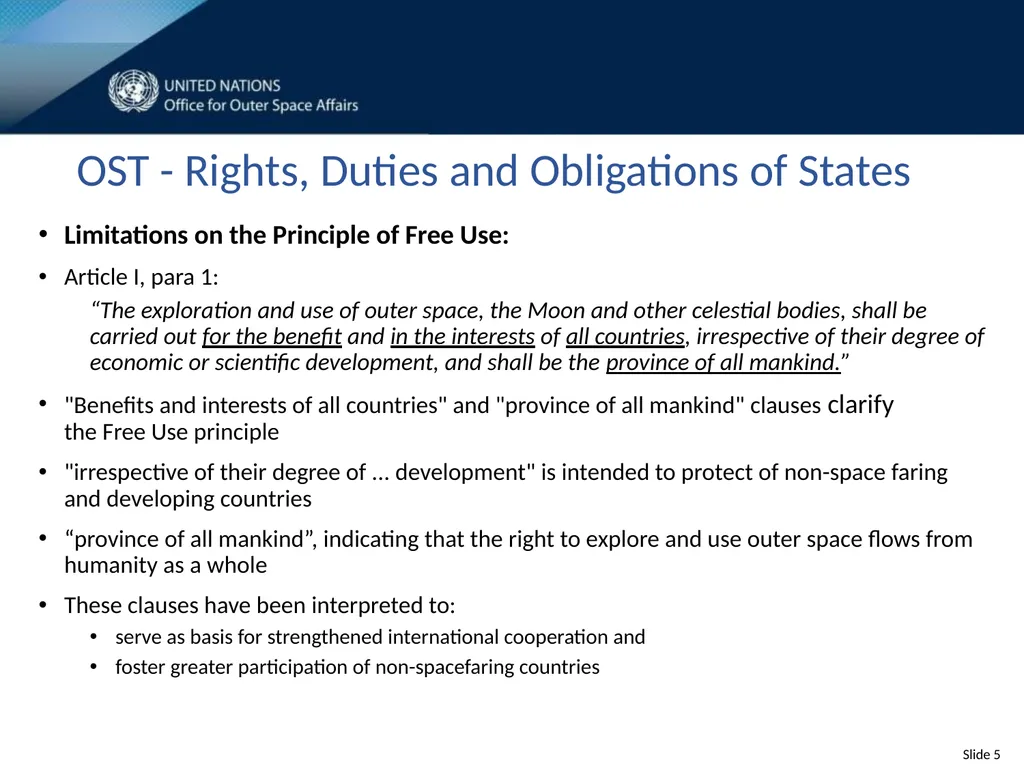
Limitations on the Principle of Free Use:
Article I, para 1:
“The exploration and use of outer space, the Moon and other celestial bodies, shall be carried out for the benefit and in the interests of all countries, irrespective of their degree of economic or scientific development, and shall be the province of all mankind.”
"Benefits and interests of all countries" and "province of all mankind" clauses clarify the Free Use principle
"irrespective of their degree of ... development" is intended to protect of non-space faring and developing countries
“province of all mankind”, indicating that the right to explore and use outer space flows from humanity as a whole
These clauses have been interpreted to:
serve as basis for strengthened international cooperation and
foster greater participation of non-spacefaring countries OST - Rights, Duties and Obligations of States<br>
06
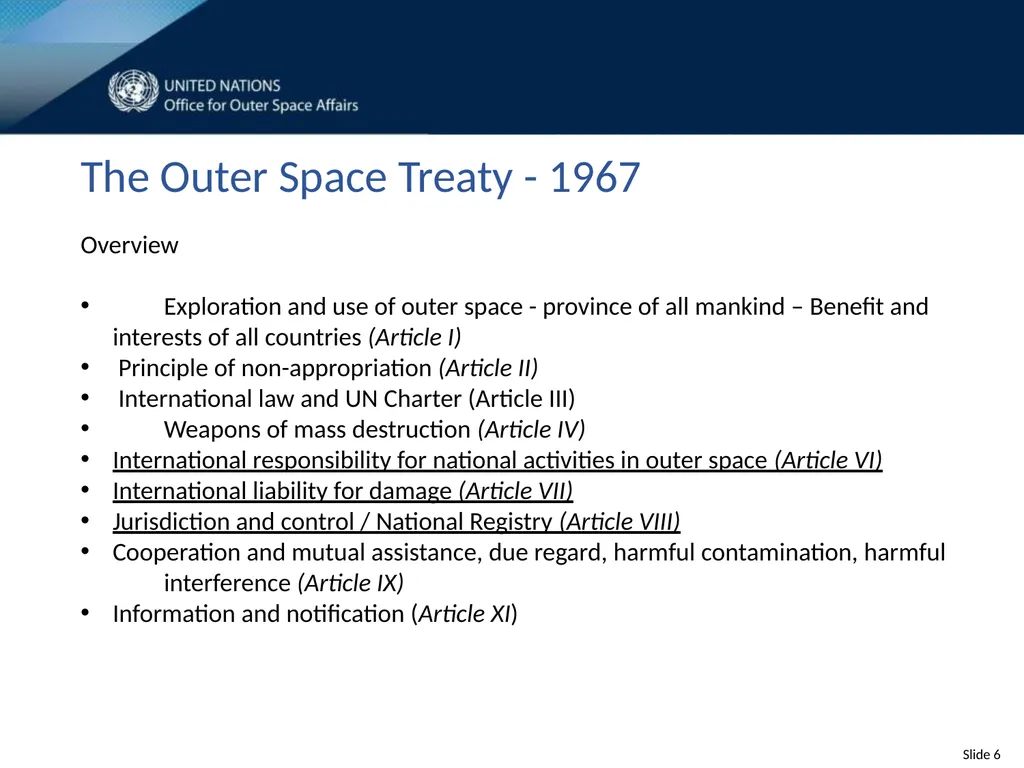
The Outer Space Treaty - 1967 Overview
Exploration and use of outer space - province of all mankind – Benefit and interests of all countries (Article I)
Principle of non-appropriation (Article II)
International law and UN Charter (Article III)
Weapons of mass destruction (Article IV)
International responsibility for national activities in outer space (Article VI)
International liability for damage (Article VII)
Jurisdiction and control / National Registry (Article VIII)
Cooperation and mutual assistance, due regard, harmful contamination, harmful interference (Article IX)
Information and notification (Article XI)<br>
Exploration and use of outer space - province of all mankind – Benefit and interests of all countries (Article I)
Principle of non-appropriation (Article II)
International law and UN Charter (Article III)
Weapons of mass destruction (Article IV)
International responsibility for national activities in outer space (Article VI)
International liability for damage (Article VII)
Jurisdiction and control / National Registry (Article VIII)
Cooperation and mutual assistance, due regard, harmful contamination, harmful interference (Article IX)
Information and notification (Article XI)<br>
07
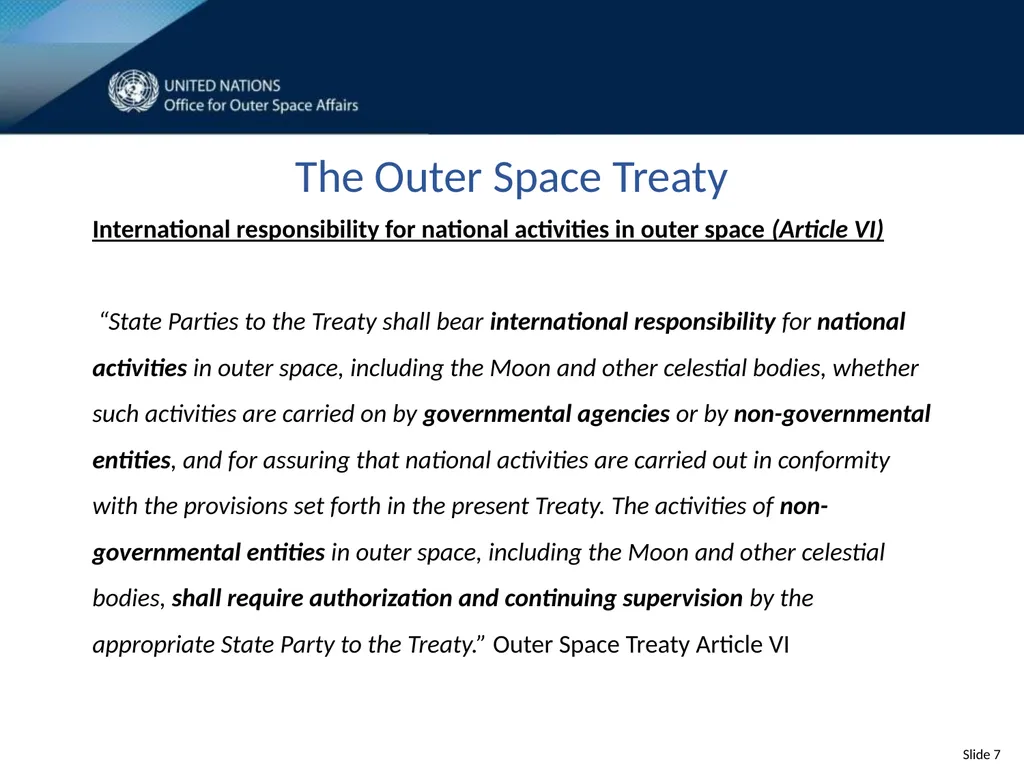
The Outer Space Treaty International responsibility for national activities in outer space (Article VI)
“State Parties to the Treaty shall bear international responsibility for national activities in outer space, including the Moon and other celestial bodies, whether such activities are carried on by governmental agencies or by non-governmental entities, and for assuring that national activities are carried out in conformity with the provisions set forth in the present Treaty. The activities of non-governmental entities in outer space, including the Moon and other celestial bodies, shall require authorization and continuing supervision by the appropriate State Party to the Treaty.” Outer Space Treaty Article VI<br>
“State Parties to the Treaty shall bear international responsibility for national activities in outer space, including the Moon and other celestial bodies, whether such activities are carried on by governmental agencies or by non-governmental entities, and for assuring that national activities are carried out in conformity with the provisions set forth in the present Treaty. The activities of non-governmental entities in outer space, including the Moon and other celestial bodies, shall require authorization and continuing supervision by the appropriate State Party to the Treaty.” Outer Space Treaty Article VI<br>
08
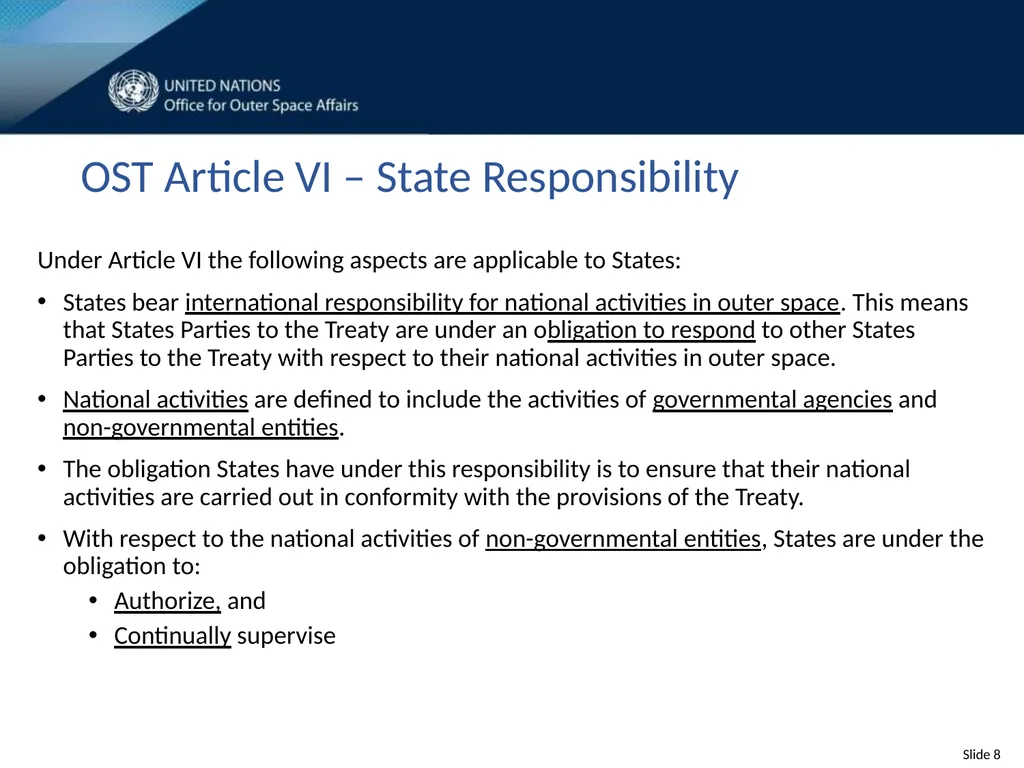
Under Article VI the following aspects are applicable to States:
States bear international responsibility for national activities in outer space. This means that States Parties to the Treaty are under an obligation to respond to other States Parties to the Treaty with respect to their national activities in outer space.
National activities are defined to include the activities of governmental agencies and non-governmental entities.
The obligation States have under this responsibility is to ensure that their national activities are carried out in conformity with the provisions of the Treaty.
With respect to the national activities of non-governmental entities, States are under the obligation to:
Authorize, and
Continually supervise OST Article VI – State Responsibility<br>
09
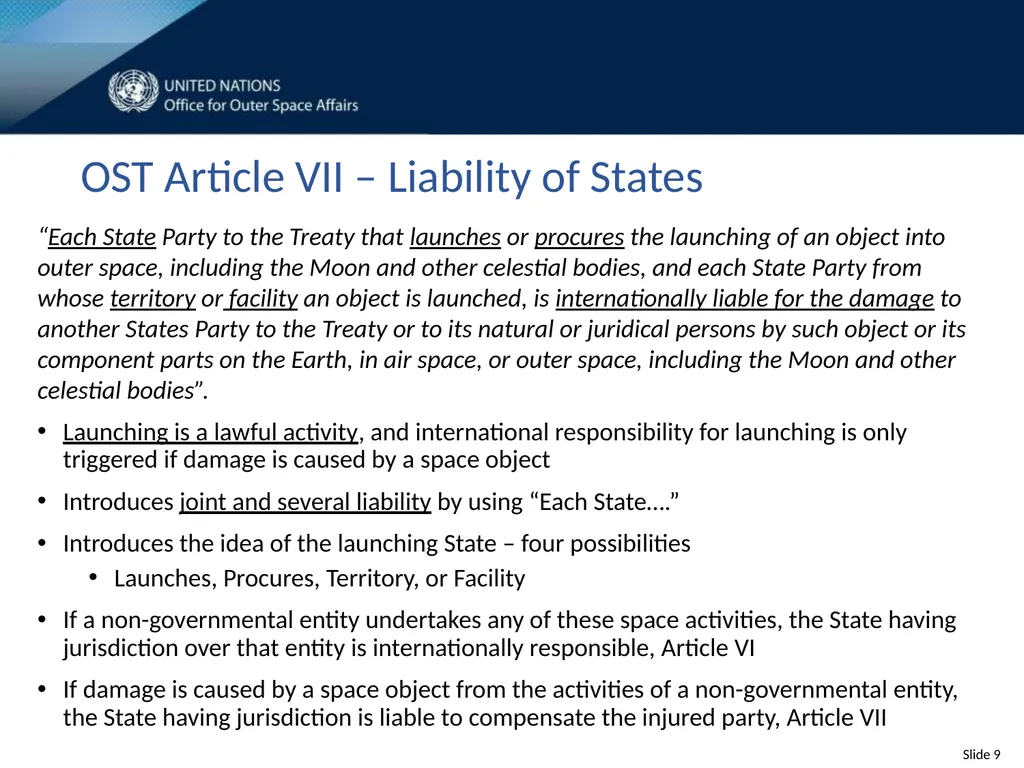
“Each State Party to the Treaty that launches or procures the launching of an object into outer space, including the Moon and other celestial bodies, and each State Party from whose territory or facility an object is launched, is internationally liable for the damage to another States Party to the Treaty or to its natural or juridical persons by such object or its component parts on the Earth, in air space, or outer space, including the Moon and other celestial bodies”.
Launching is a lawful activity, and international responsibility for launching is only triggered if damage is caused by a space object
Introduces joint and several liability by using “Each State….”
Introduces the idea of the launching State – four possibilities
Launches, Procures, Territory, or Facility
If a non-governmental entity undertakes any of these space activities, the State having jurisdiction over that entity is internationally responsible, Article VI
If damage is caused by a space object from the activities of a non-governmental entity, the State having jurisdiction is liable to compensate the injured party, Article VII OST Article VII – Liability of States<br>
10
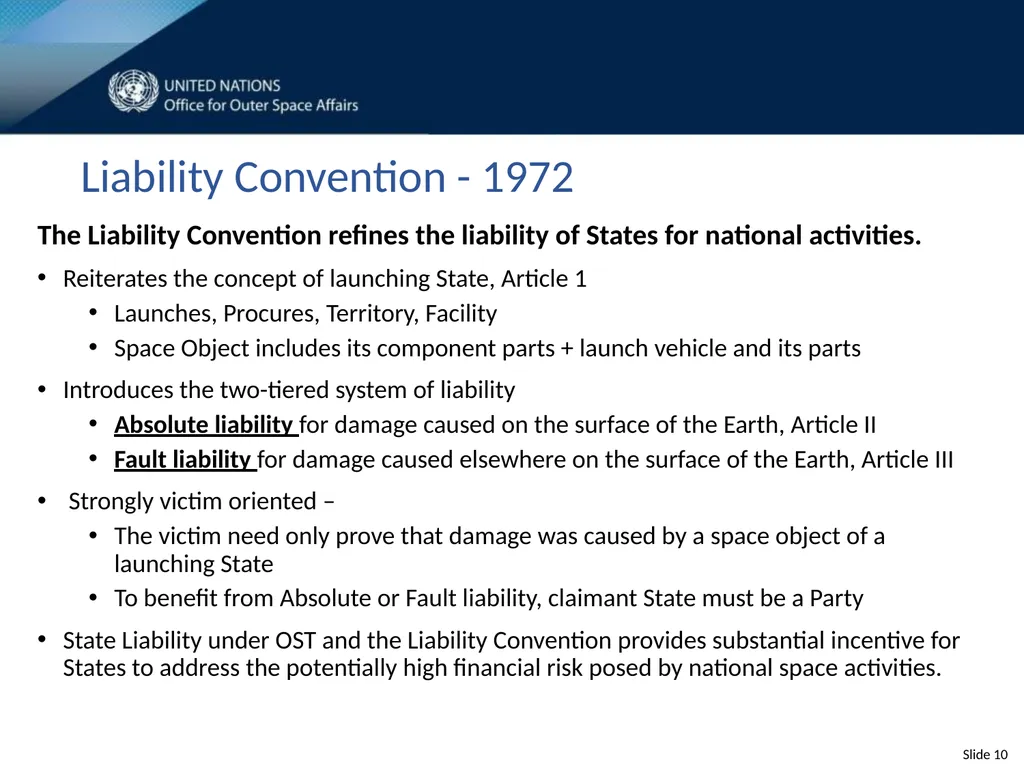
The Liability Convention refines the liability of States for national activities.
Reiterates the concept of launching State, Article 1
Launches, Procures, Territory, Facility
Space Object includes its component parts + launch vehicle and its parts
Introduces the two-tiered system of liability
Absolute liability for damage caused on the surface of the Earth, Article II
Fault liability for damage caused elsewhere on the surface of the Earth, Article III
Strongly victim oriented –
The victim need only prove that damage was caused by a space object of a launching State
To benefit from Absolute or Fault liability, claimant State must be a Party
State Liability under OST and the Liability Convention provides substantial incentive for States to address the potentially high financial risk posed by national space activities. Liability Convention - 1972<br>
11
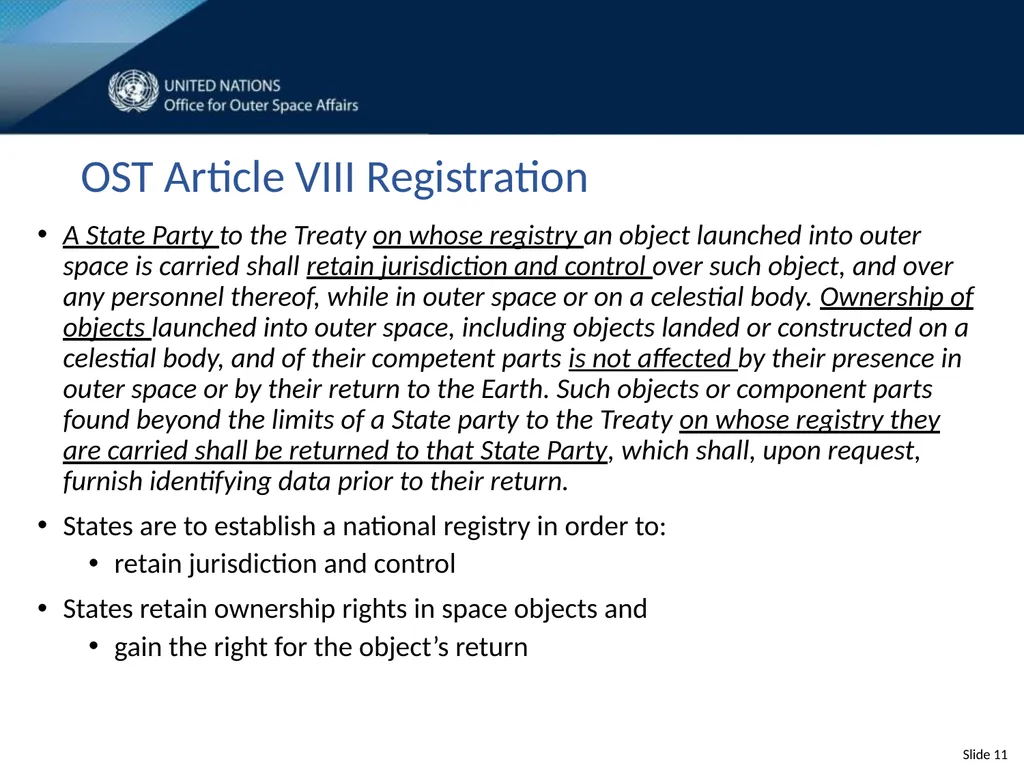
A State Party to the Treaty on whose registry an object launched into outer space is carried shall retain jurisdiction and control over such object, and over any personnel thereof, while in outer space or on a celestial body. Ownership of objects launched into outer space, including objects landed or constructed on a celestial body, and of their competent parts is not affected by their presence in outer space or by their return to the Earth. Such objects or component parts found beyond the limits of a State party to the Treaty on whose registry they are carried shall be returned to that State Party, which shall, upon request, furnish identifying data prior to their return.
States are to establish a national registry in order to:
retain jurisdiction and control
States retain ownership rights in space objects and
gain the right for the object’s return OST Article VIII Registration<br>
States are to establish a national registry in order to:
retain jurisdiction and control
States retain ownership rights in space objects and
gain the right for the object’s return OST Article VIII Registration<br>
12
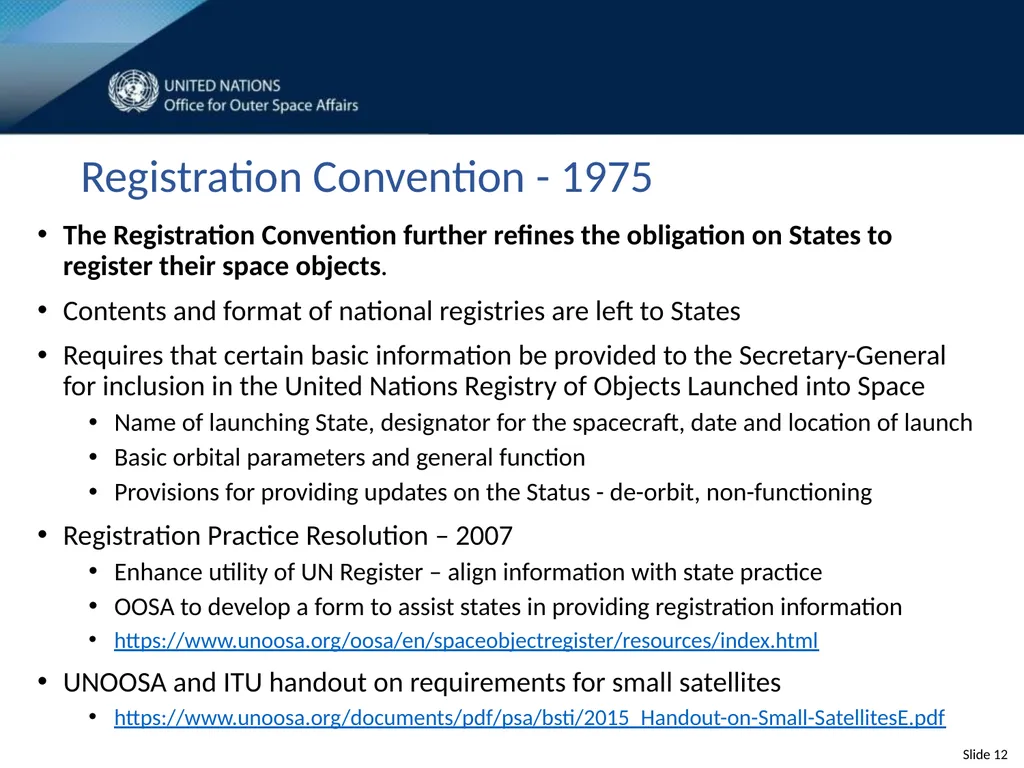
The Registration Convention further refines the obligation on States to register their space objects.
Contents and format of national registries are left to States
Requires that certain basic information be provided to the Secretary-General for inclusion in the United Nations Registry of Objects Launched into Space
Name of launching State, designator for the spacecraft, date and location of launch
Basic orbital parameters and general function
Provisions for providing updates on the Status - de-orbit, non-functioning
Registration Practice Resolution – 2007
Enhance utility of UN Register – align information with state practice
OOSA to develop a form to assist states in providing registration information
https://www.unoosa.org/oosa/en/spaceobjectregister/resources/index.html
UNOOSA and ITU handout on requirements for small satellites
https://www.unoosa.org/documents/pdf/psa/bsti/2015_Handout-on-Small-SatellitesE.pdf Registration Convention - 1975<br>
13
The Outer Space Treaty - 1967 Overview
Exploration and use of outer space - province of all mankind – Benefit and interests of all countries (Article I)
Principle of non-appropriation (Article II)
International law and UN Charter (Article III)
Weapons of mass destruction (Article IV)
International responsibility for national activities in outer space (Article VI)
International liability for damage (Article VII)
Jurisdiction and control / National Registry (Article VIII)
Cooperation and mutual assistance, due regard, harmful contamination, harmful interference (Article IX)
Information and notification (Article XI)<br>
Exploration and use of outer space - province of all mankind – Benefit and interests of all countries (Article I)
Principle of non-appropriation (Article II)
International law and UN Charter (Article III)
Weapons of mass destruction (Article IV)
International responsibility for national activities in outer space (Article VI)
International liability for damage (Article VII)
Jurisdiction and control / National Registry (Article VIII)
Cooperation and mutual assistance, due regard, harmful contamination, harmful interference (Article IX)
Information and notification (Article XI)<br>
14
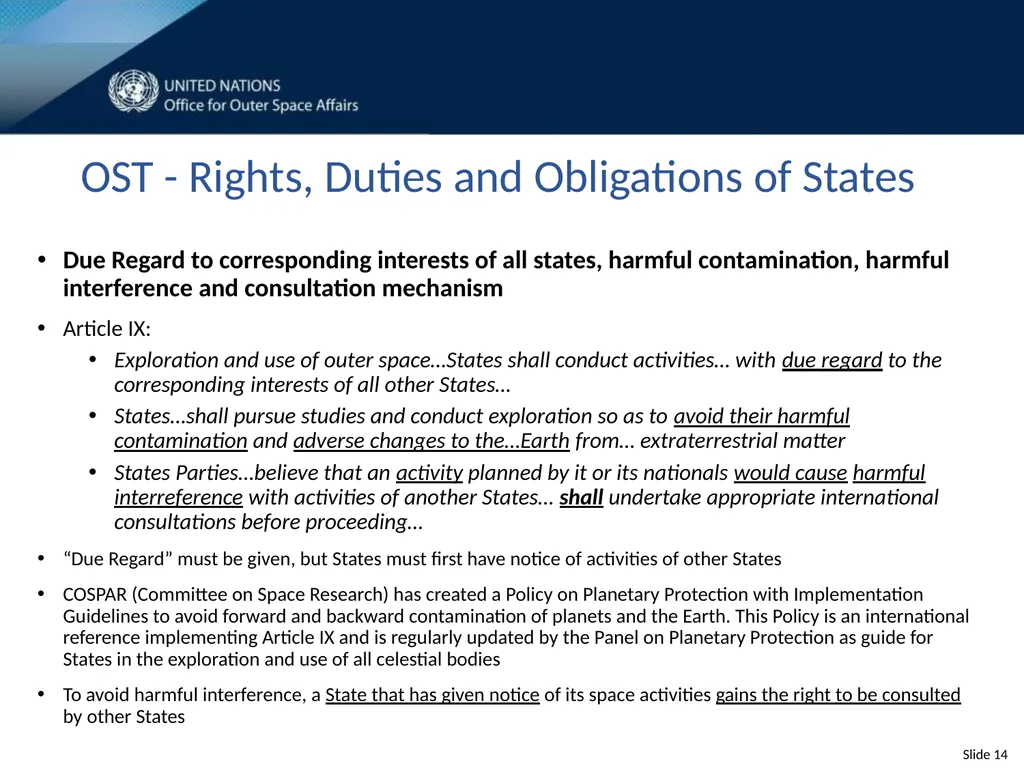
Due Regard to corresponding interests of all states, harmful contamination, harmful interference and consultation mechanism
Article IX:
Exploration and use of outer space…States shall conduct activities… with due regard to the corresponding interests of all other States…
States…shall pursue studies and conduct exploration so as to avoid their harmful contamination and adverse changes to the…Earth from… extraterrestrial matter
States Parties…believe that an activity planned by it or its nationals would cause harmful interreference with activities of another States… shall undertake appropriate international consultations before proceeding…
“Due Regard” must be given, but States must first have notice of activities of other States
COSPAR (Committee on Space Research) has created a Policy on Planetary Protection with Implementation Guidelines to avoid forward and backward contamination of planets and the Earth. This Policy is an international reference implementing Article IX and is regularly updated by the Panel on Planetary Protection as guide for States in the exploration and use of all celestial bodies
To avoid harmful interference, a State that has given notice of its space activities gains the right to be consulted by other States OST - Rights, Duties and Obligations of States<br>
15
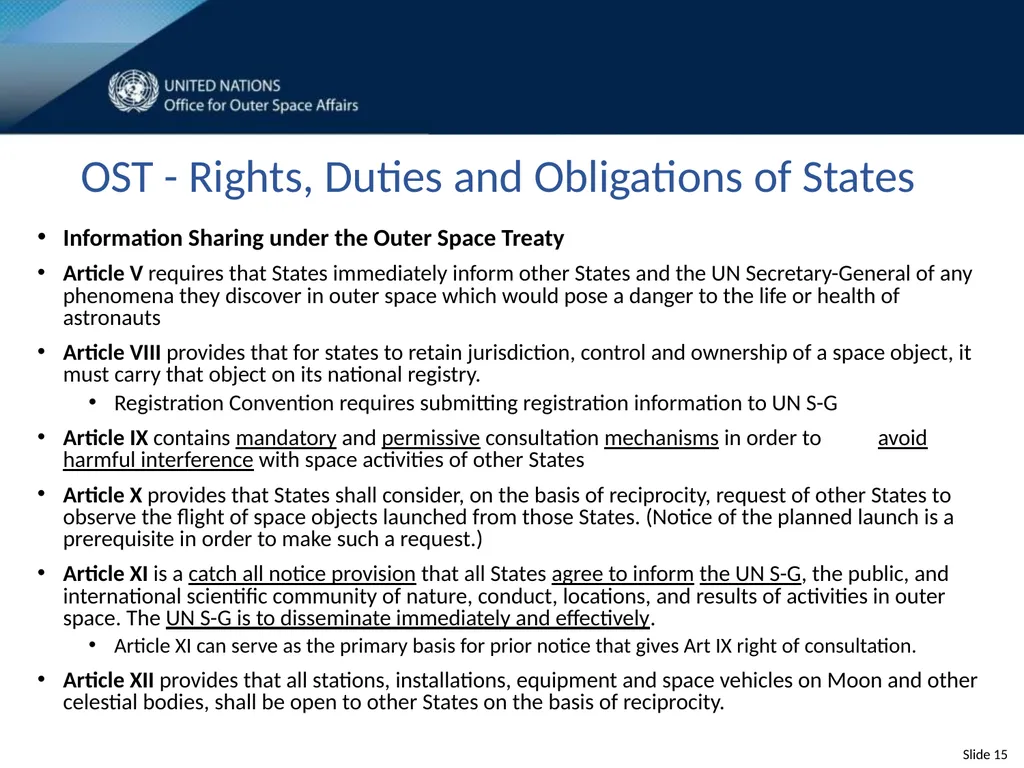
Information Sharing under the Outer Space Treaty
Article V requires that States immediately inform other States and the UN Secretary-General of any phenomena they discover in outer space which would pose a danger to the life or health of astronauts
Article VIII provides that for states to retain jurisdiction, control and ownership of a space object, it must carry that object on its national registry.
Registration Convention requires submitting registration information to UN S-G
Article IX contains mandatory and permissive consultation mechanisms in order to avoid harmful interference with space activities of other States
Article X provides that States shall consider, on the basis of reciprocity, request of other States to observe the flight of space objects launched from those States. (Notice of the planned launch is a prerequisite in order to make such a request.)
Article XI is a catch all notice provision that all States agree to inform the UN S-G, the public, and international scientific community of nature, conduct, locations, and results of activities in outer space. The UN S-G is to disseminate immediately and effectively.
Article XI can serve as the primary basis for prior notice that gives Art IX right of consultation.
Article XII provides that all stations, installations, equipment and space vehicles on Moon and other celestial bodies, shall be open to other States on the basis of reciprocity. OST - Rights, Duties and Obligations of States<br>
16
Thank you
Michael Newman, Legal Officer, UNOOSA
Michael.Newman@un.org<br>
Michael Newman, Legal Officer, UNOOSA
Michael.Newman@un.org<br>