04
Solving Problems in Physics All of the Problem-Solving Strategies and Examples in this book will follow these four steps:
Identify the relevant concepts, target variables, and known quantities, as stated or implied in the problem.
Set Up the problem: Choose the equations that you’ll use to solve the problem, and draw a sketch of the situation.
Execute the solution: This is where you “do the math.”
Evaluate your answer: Compare your answer with your estimates, and reconsider things if there’s a discrepancy.<br>
05
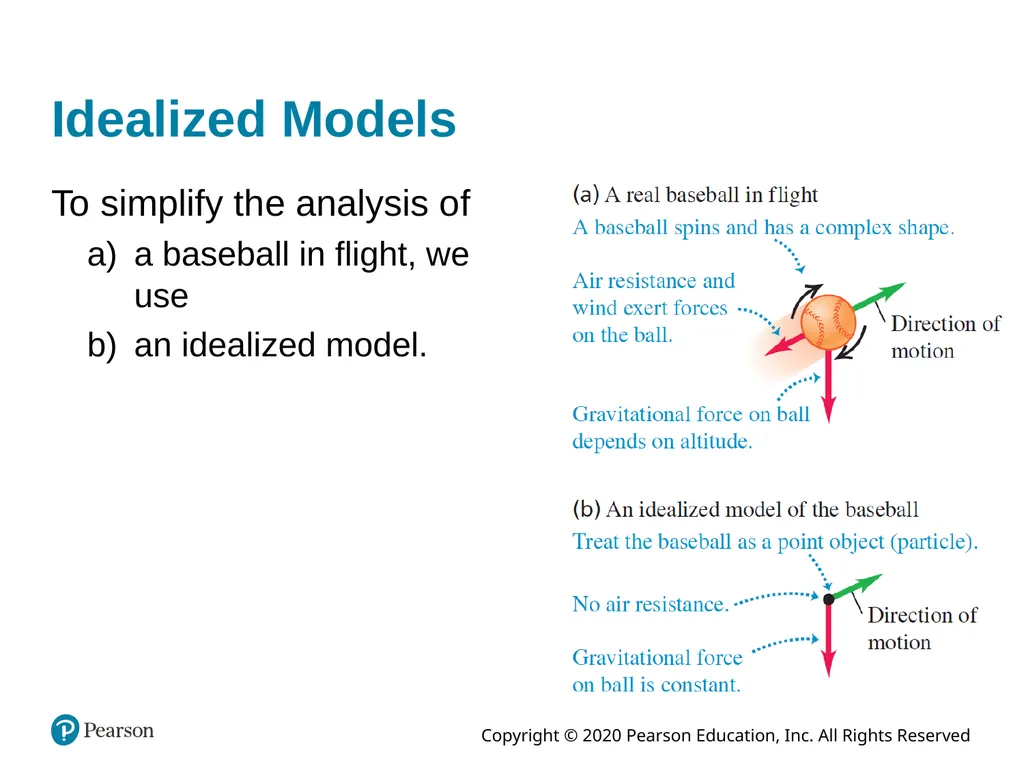
Idealized Models To simplify the analysis of
a baseball in flight, we use
an idealized model.<br>
06
Standards and Units Length, time, and mass are three fundamental quantities of physics.
The International System (SI for Système International) is the most widely used system of units.
In SI units, length is measured in meters, time in seconds, and mass in kilograms.<br>
07
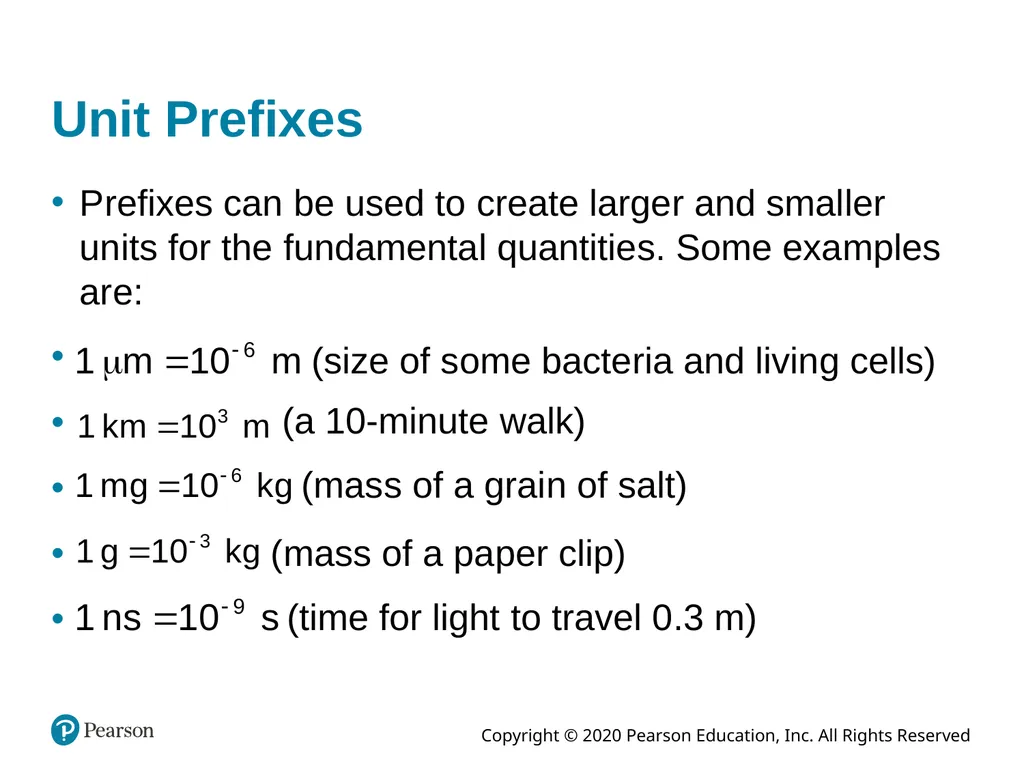
Unit Prefixes Prefixes can be used to create larger and smaller units for the fundamental quantities. Some examples are: (size of some bacteria and living cells) (a 10-minute walk) (mass of a grain of salt) (mass of a paper clip) (time for light to travel 0.3 m)<br>
08
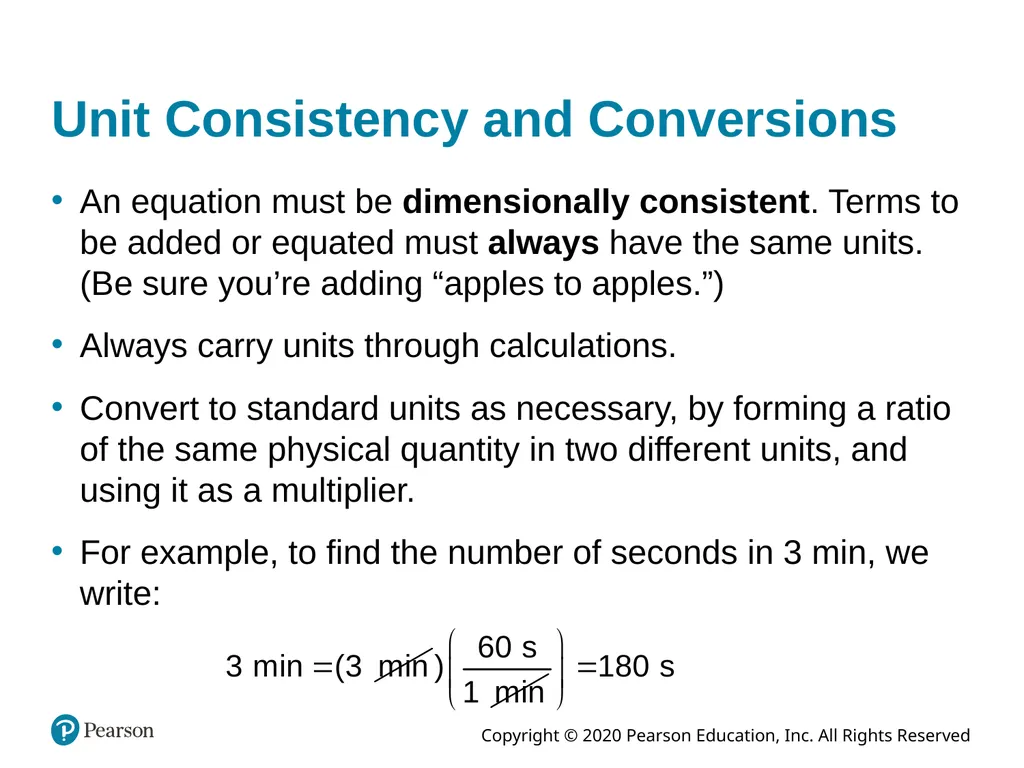
Unit Consistency and Conversions An equation must be dimensionally consistent. Terms to be added or equated must always have the same units. (Be sure you’re adding “apples to apples.”)
Always carry units through calculations.
Convert to standard units as necessary, by forming a ratio of the same physical quantity in two different units, and using it as a multiplier.
For example, to find the number of seconds in 3 min, we write:<br>
09
Uncertainty and Significant Figures The uncertainty of a measured quantity is indicated by its number of significant figures.
For multiplication and division, the answer can have no more significant figures than the smallest number of significant figures in the factors.
For addition and subtraction, the number of significant figures is determined by the term having the fewest digits to the right of the decimal point.
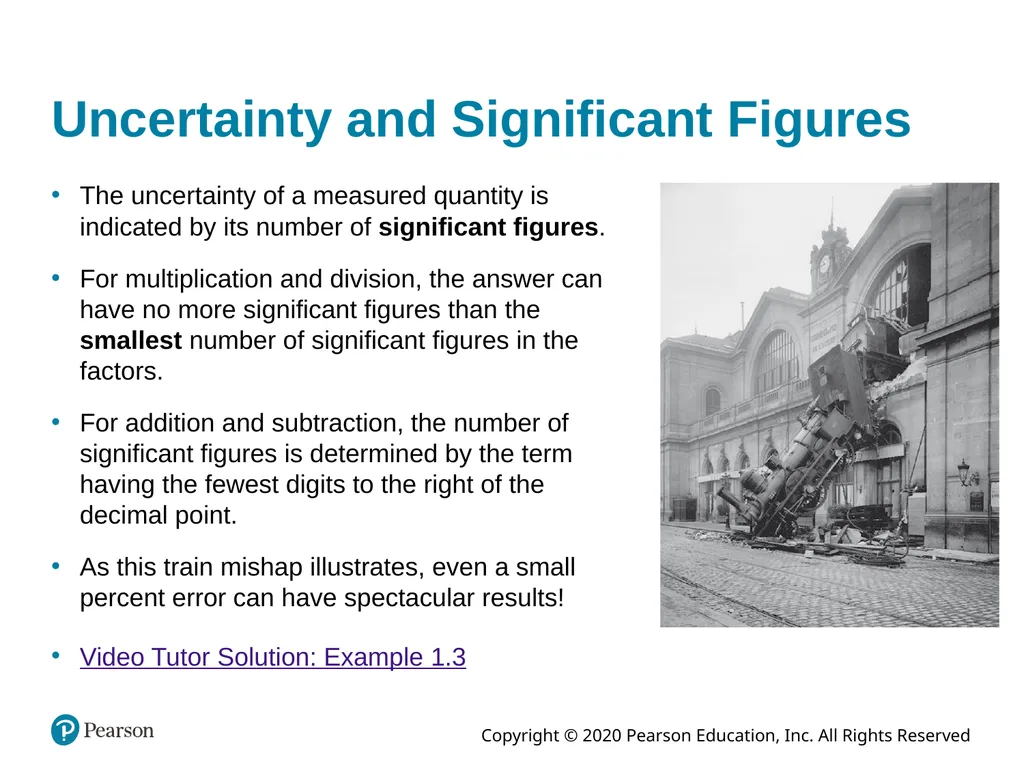
As this train mishap illustrates, even a small percent error can have spectacular results! Video Tutor Solution: Example 1.3<br>
10
Vectors and Scalars A scalar quantity can be described by a single number.
A vector quantity has both a magnitude and a direction in space.
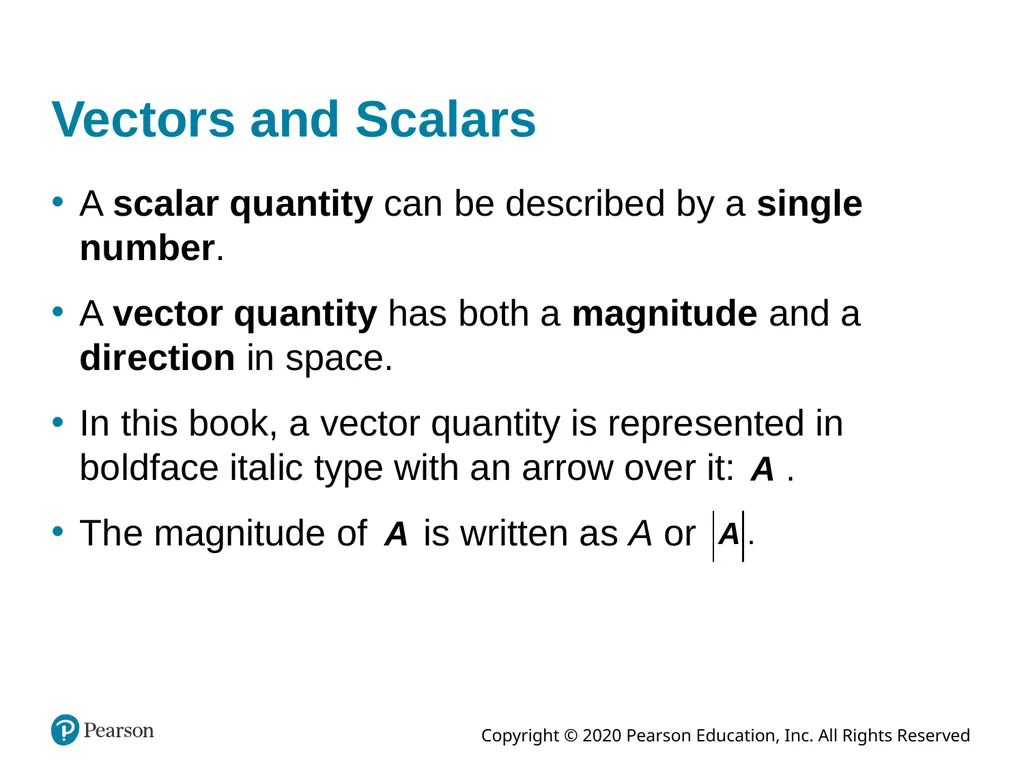
In this book, a vector quantity is represented in boldface italic type with an arrow over it: The magnitude of is written as A or<br>
11
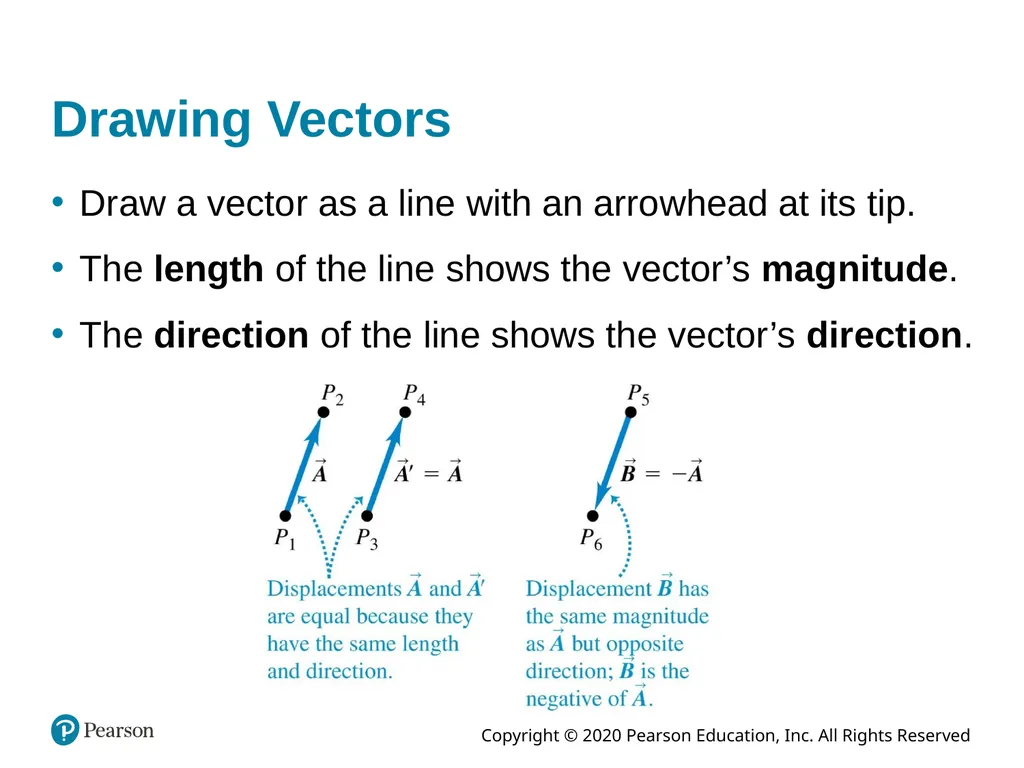
Drawing Vectors Draw a vector as a line with an arrowhead at its tip.
The length of the line shows the vector’s magnitude.
The direction of the line shows the vector’s direction.<br>
12
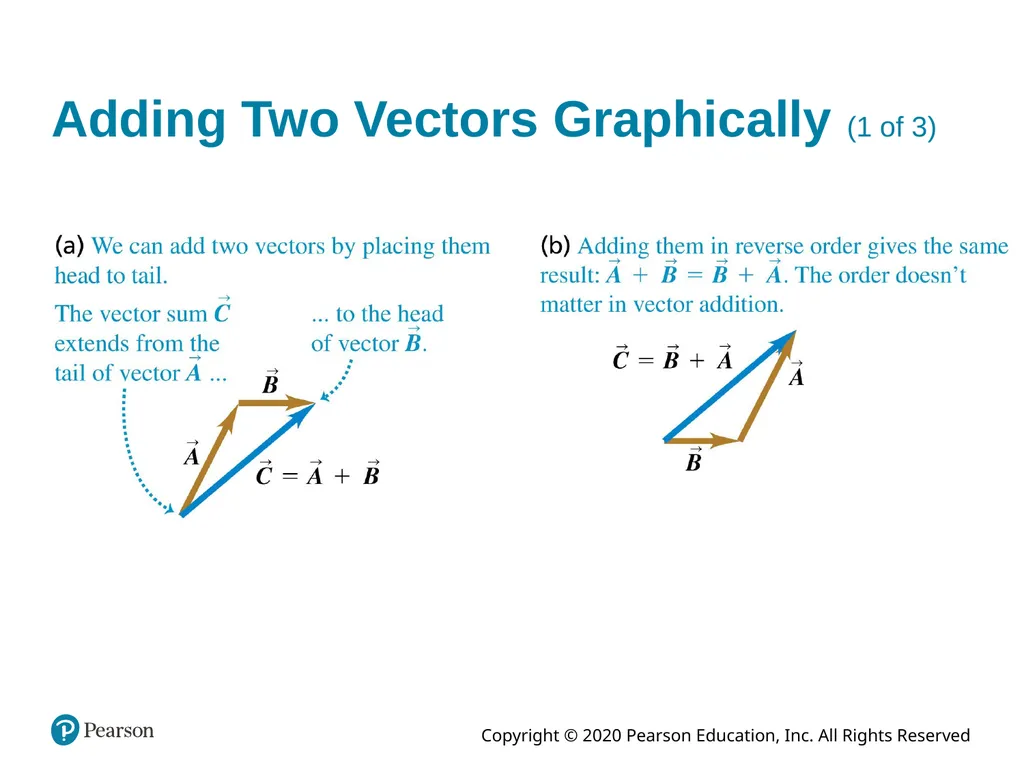
Adding Two Vectors Graphically (1 of 3)<br>
13
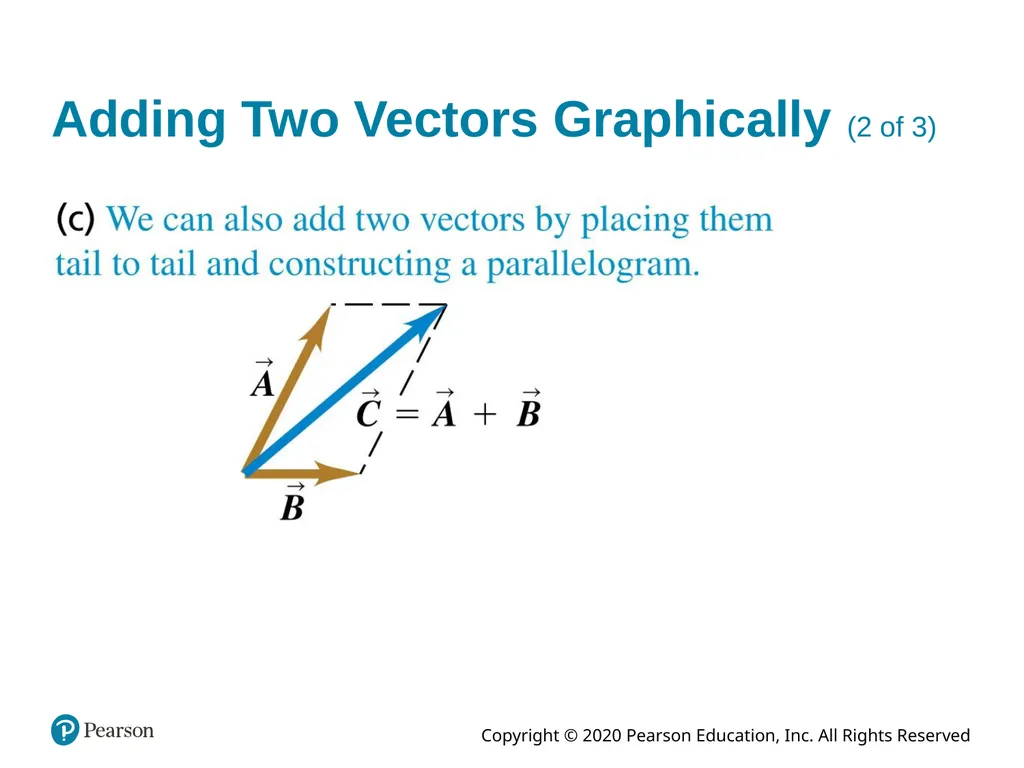
Adding Two Vectors Graphically (2 of 3)<br>
14
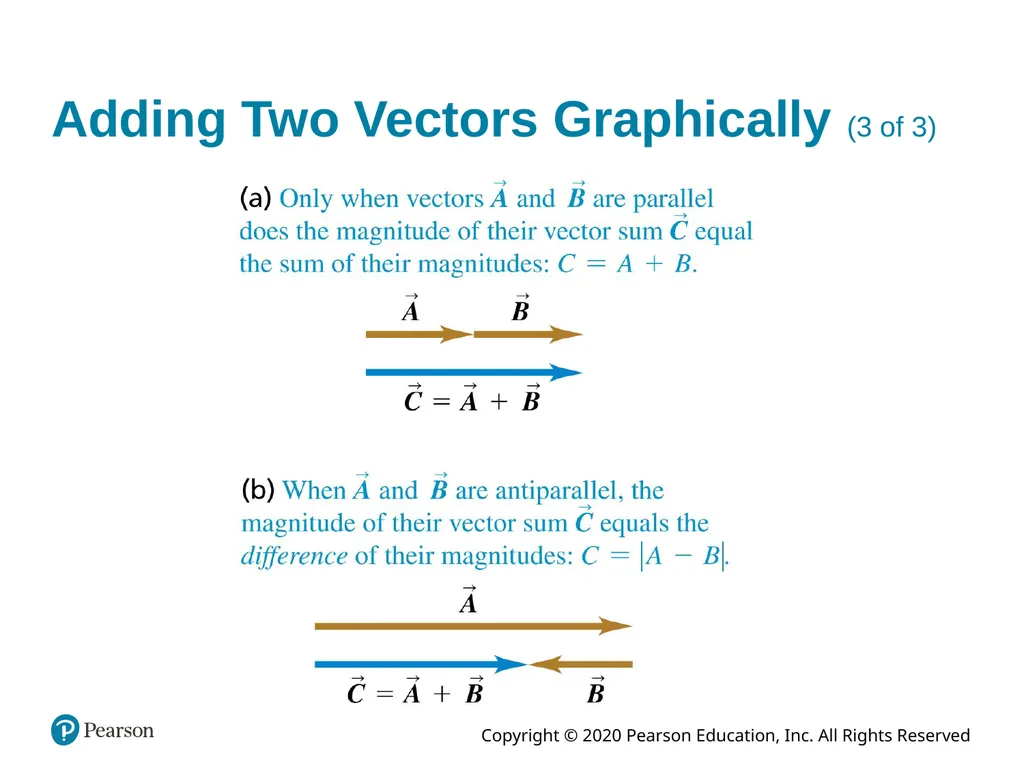
Adding Two Vectors Graphically (3 of 3)<br>
15
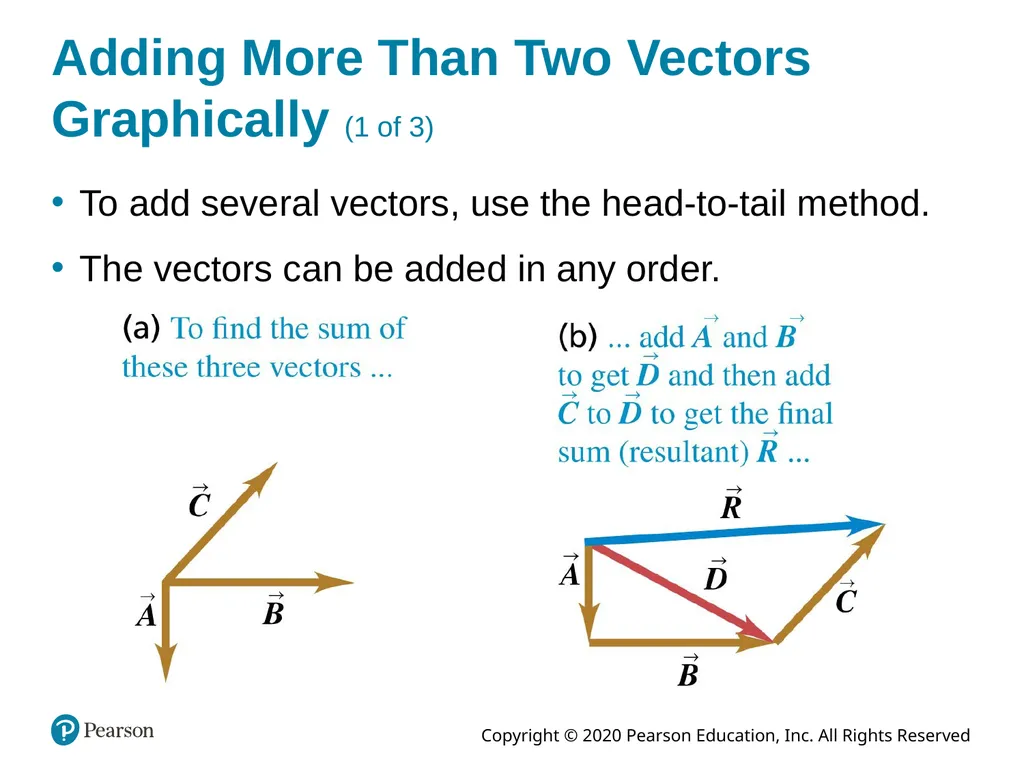
Adding More Than Two Vectors Graphically (1 of 3) To add several vectors, use the head-to-tail method.
The vectors can be added in any order.<br>
16
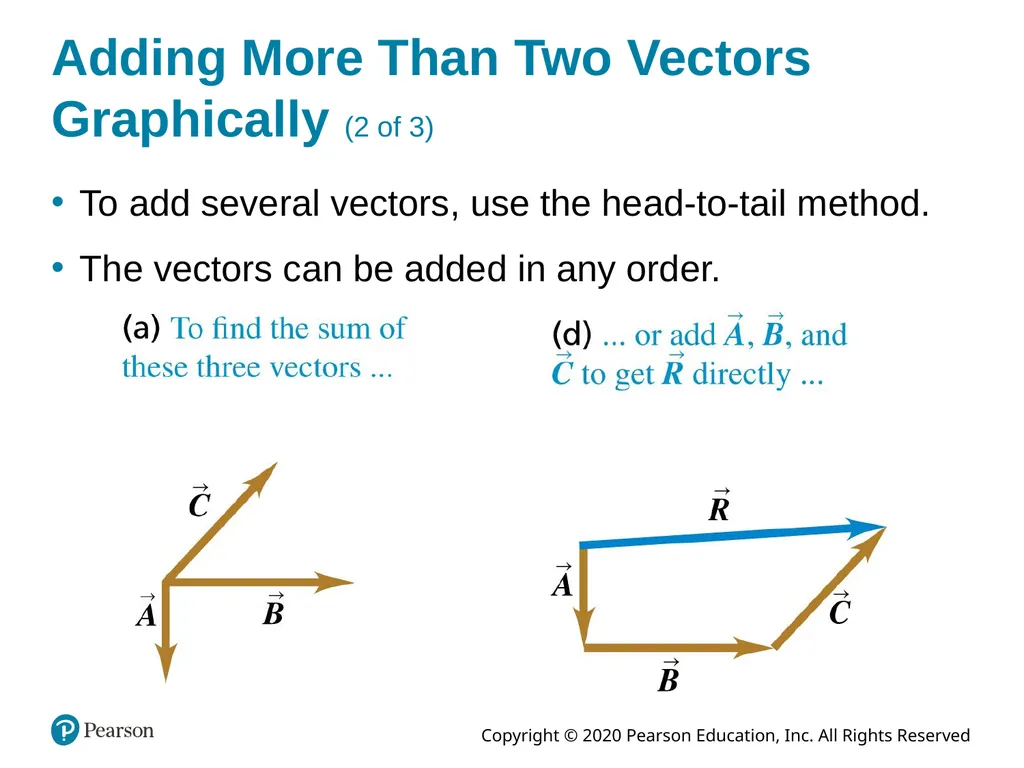
Adding More Than Two Vectors Graphically (2 of 3) To add several vectors, use the head-to-tail method.
The vectors can be added in any order.<br>
17
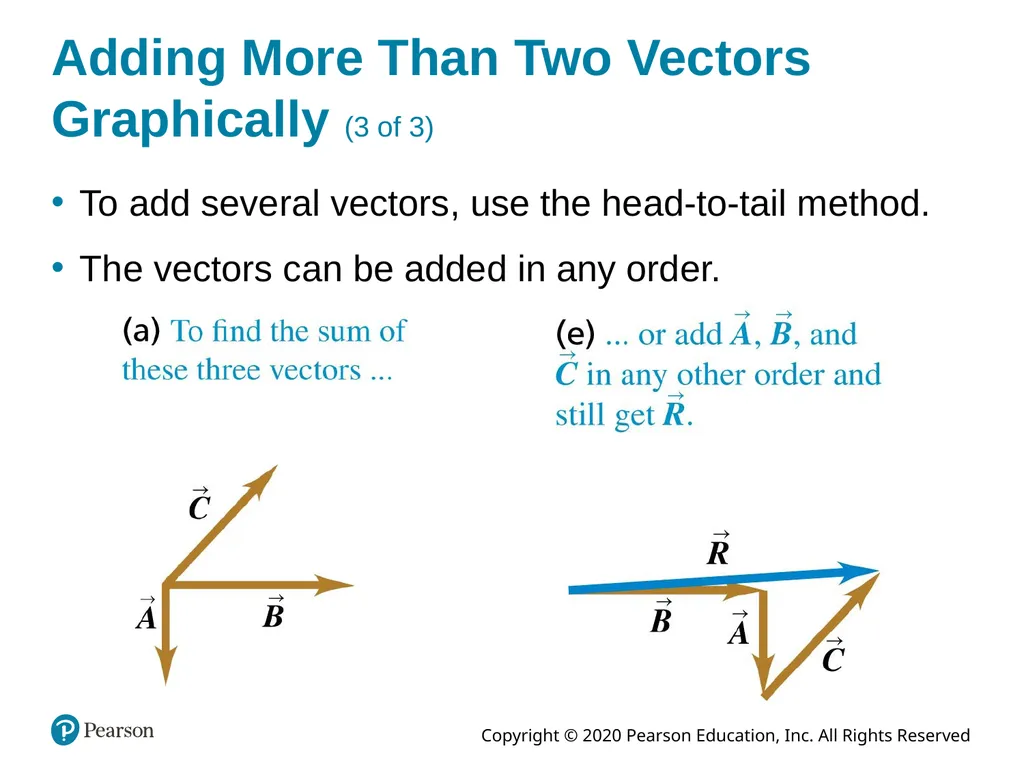
Adding More Than Two Vectors Graphically (3 of 3) To add several vectors, use the head-to-tail method.
The vectors can be added in any order.<br>
18
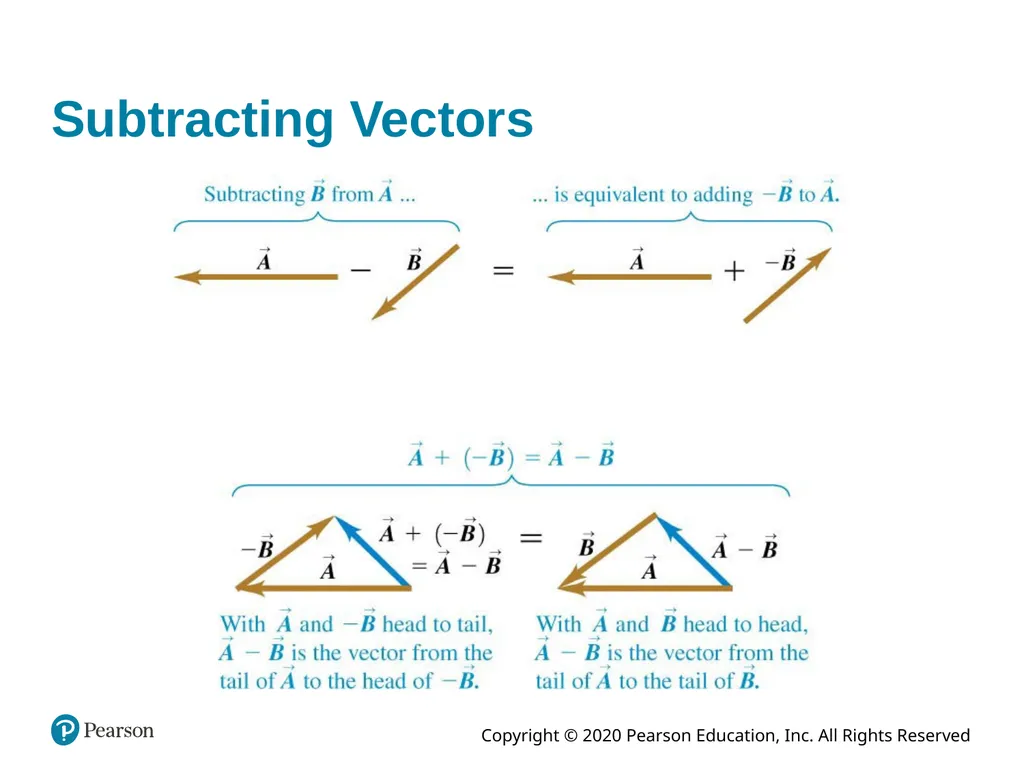
Subtracting Vectors<br>
19
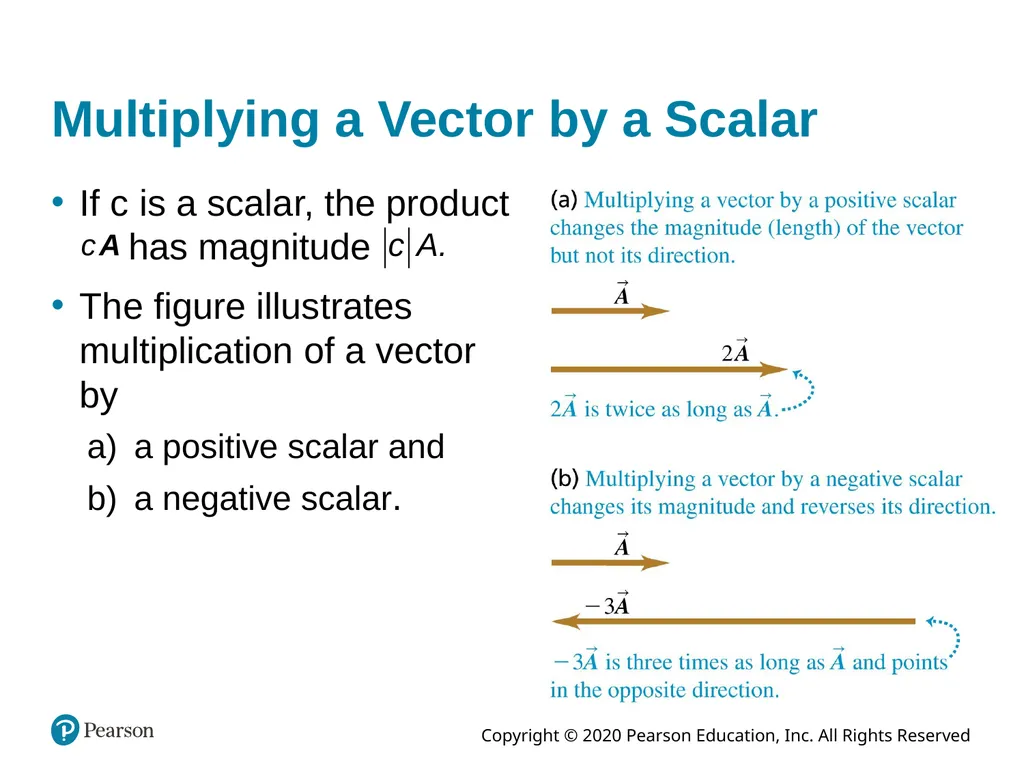
Multiplying a Vector by a Scalar If c is a scalar, the product has magnitude The figure illustrates multiplication of a vector by
a positive scalar and
a negative scalar.<br>
20
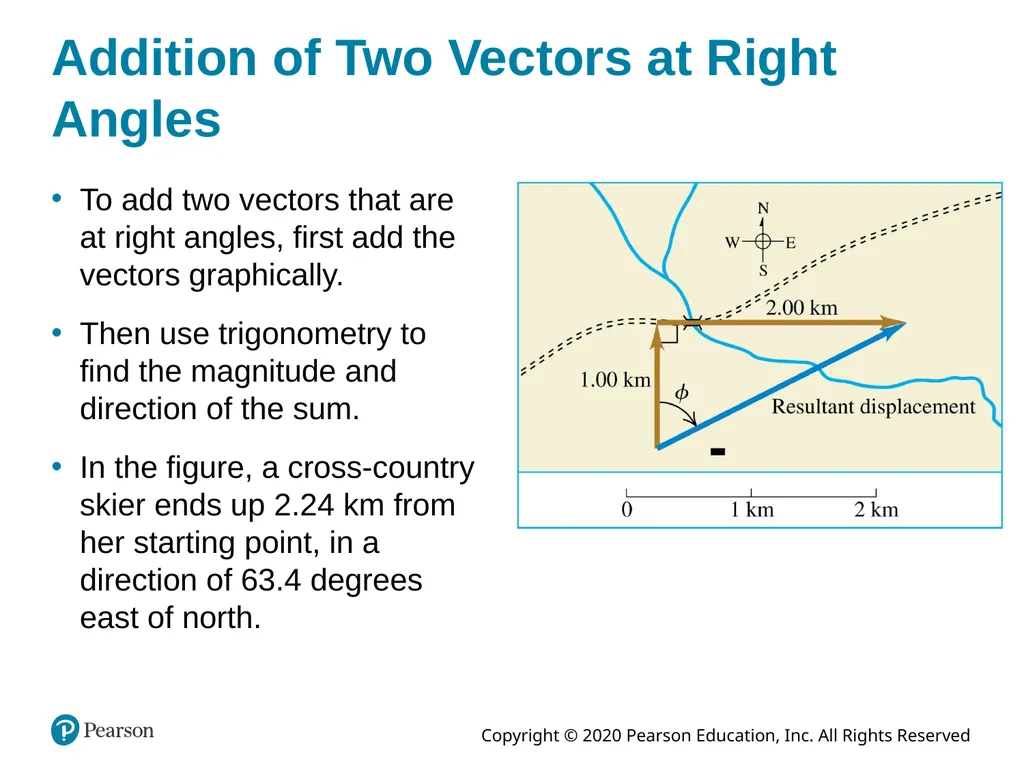
Addition of Two Vectors at Right Angles To add two vectors that are at right angles, first add the vectors graphically.
Then use trigonometry to find the magnitude and direction of the sum.
In the figure, a cross-country skier ends up 2.24 km from her starting point, in a direction of 63.4 degrees east of north.<br>
21
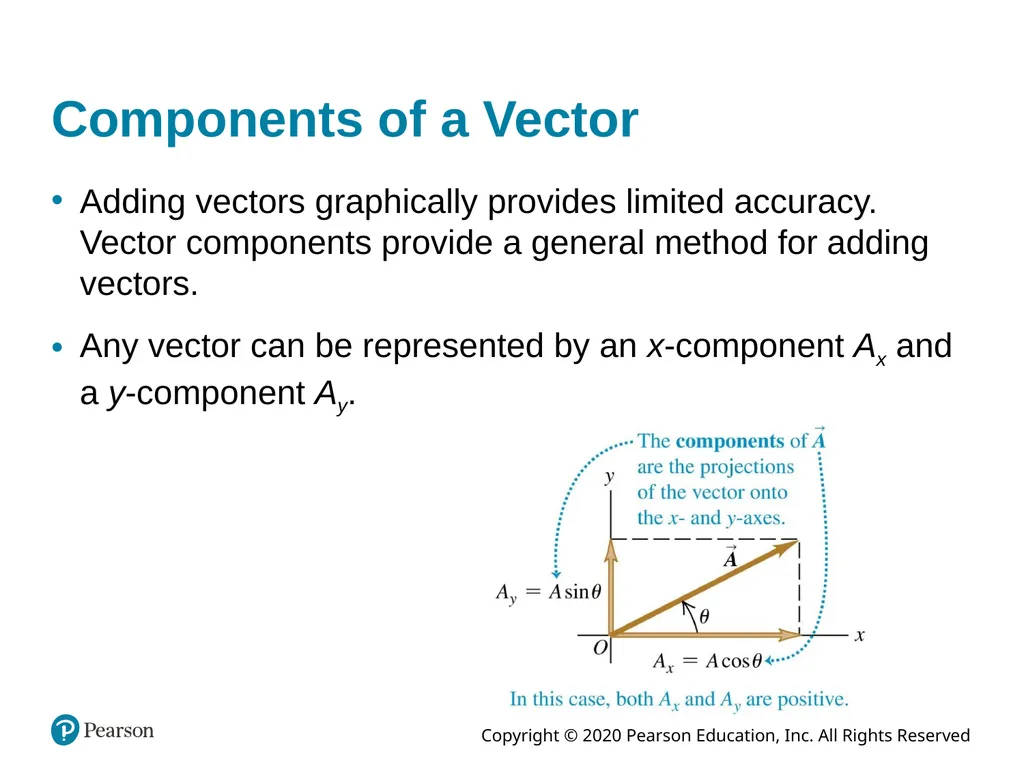
Components of a Vector Adding vectors graphically provides limited accuracy. Vector components provide a general method for adding vectors.
Any vector can be represented by an x-component Ax and a y-component Ay.<br>
22
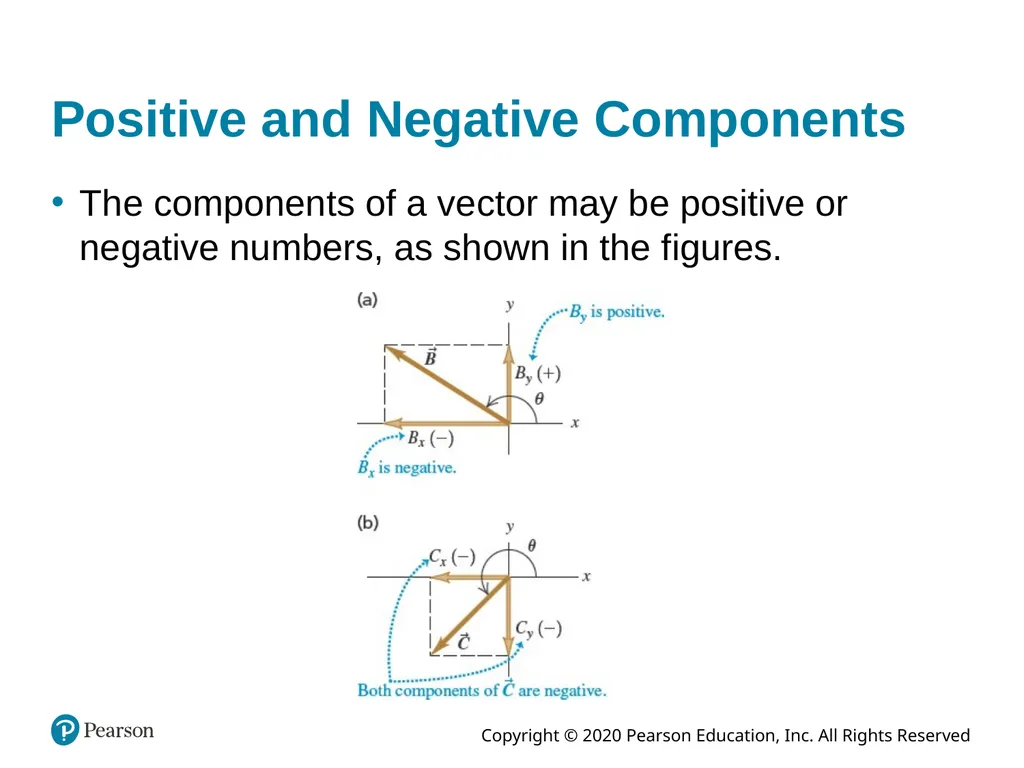
Positive and Negative Components The components of a vector may be positive or negative numbers, as shown in the figures.<br>
23
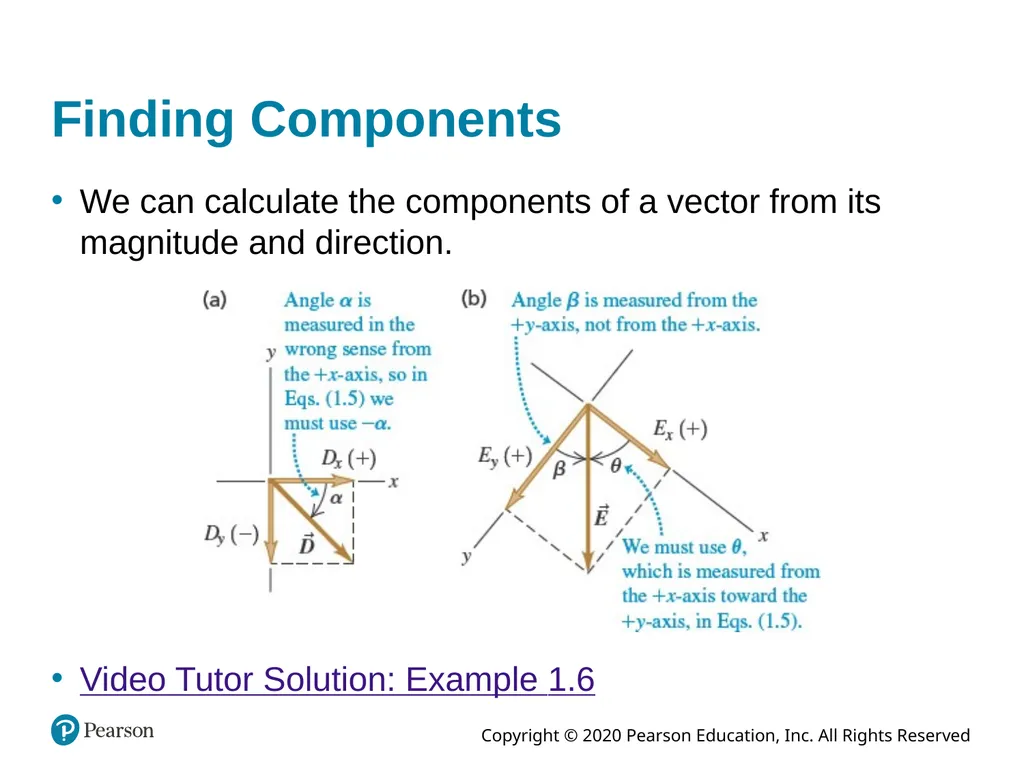
Finding Components We can calculate the components of a vector from its magnitude and direction. Video Tutor Solution: Example 1.6<br>
24
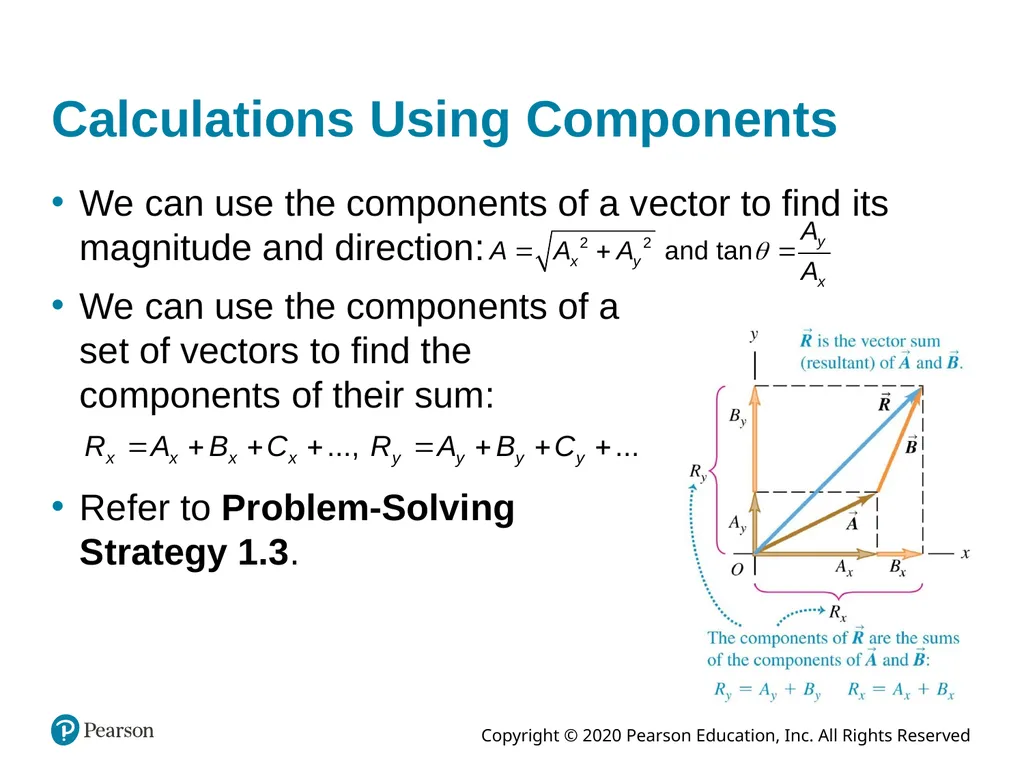
Calculations Using Components We can use the components of a vector to find its magnitude and direction: We can use the components of a set of vectors to find the components of their sum: Refer to Problem-Solving Strategy 1.3.<br>
25
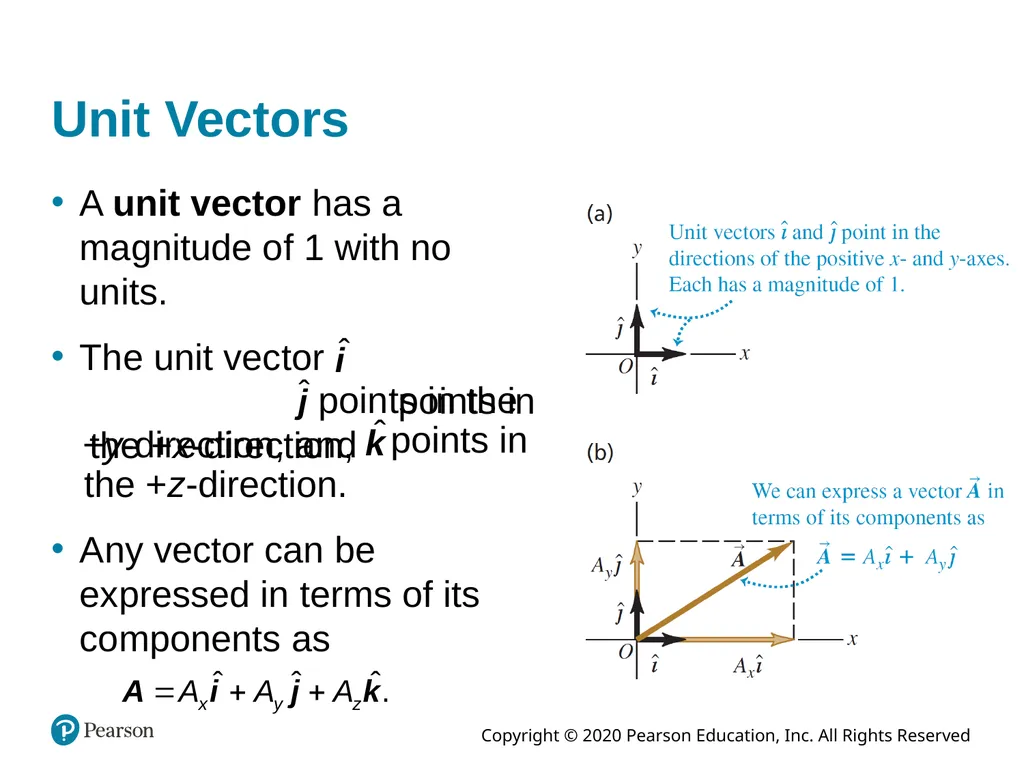
Unit Vectors A unit vector has a magnitude of 1 with no units.
The unit vector points in the +x-direction, points in the +y-direction, and points in the +z-direction.
Any vector can be expressed in terms of its components as<br>
26
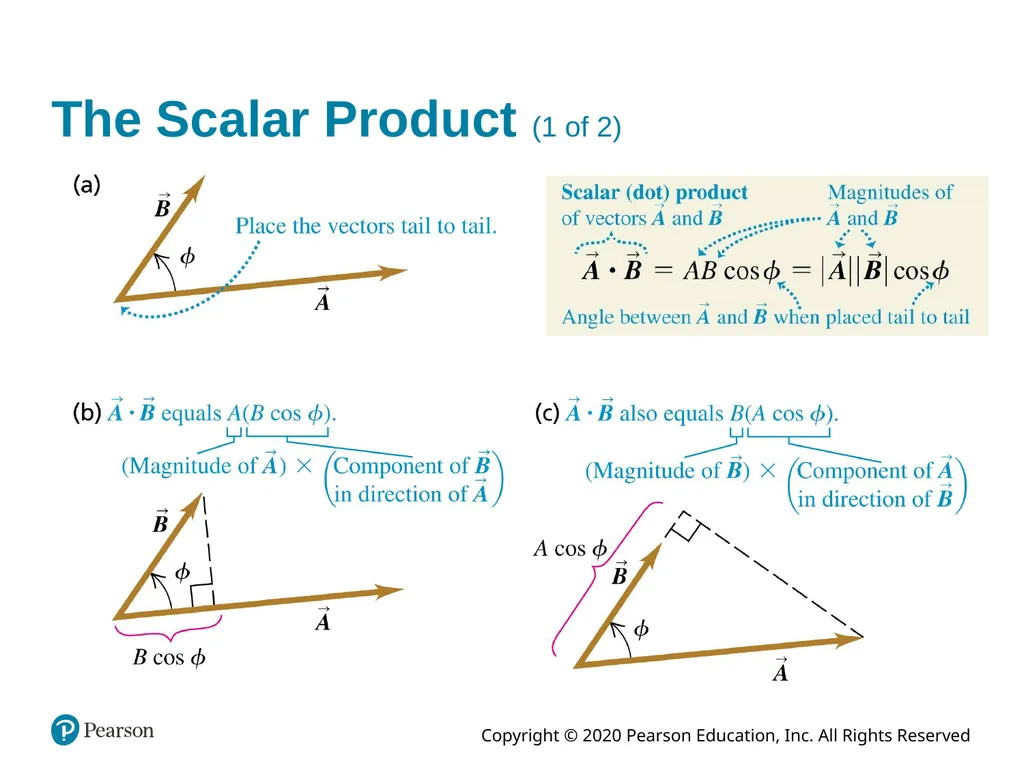
The Scalar Product (1 of 2)<br>
27
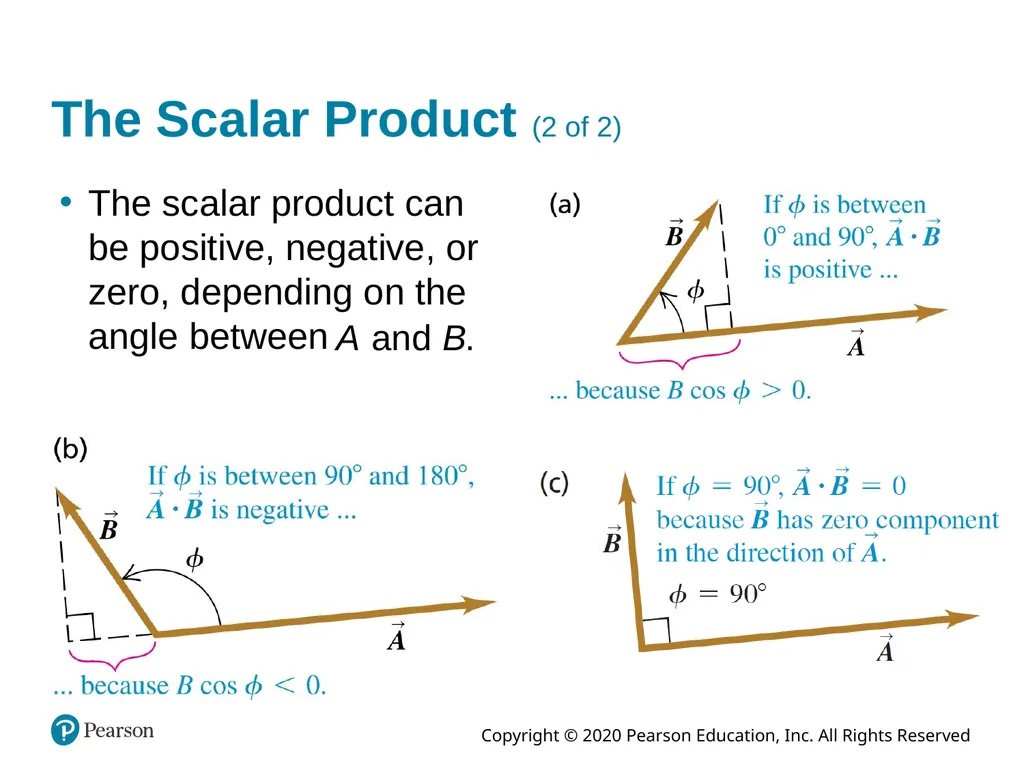
The Scalar Product (2 of 2) The scalar product can be positive, negative, or zero, depending on the angle between<br>
28
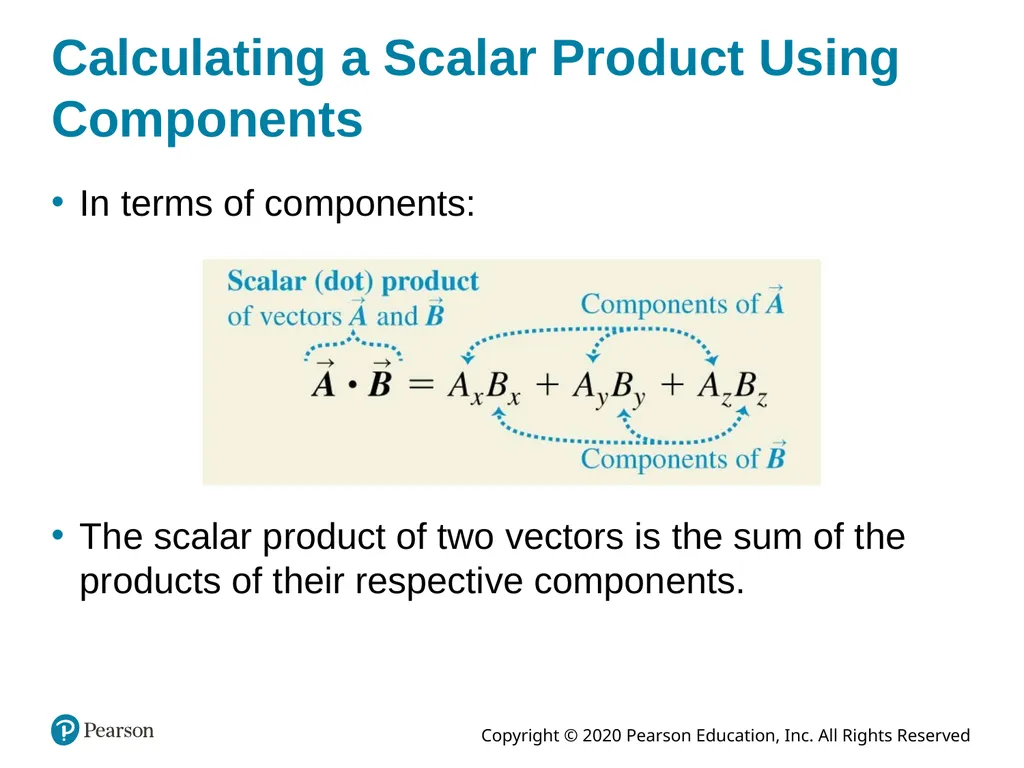
Calculating a Scalar Product Using Components In terms of components: The scalar product of two vectors is the sum of the products of their respective components.<br>
29
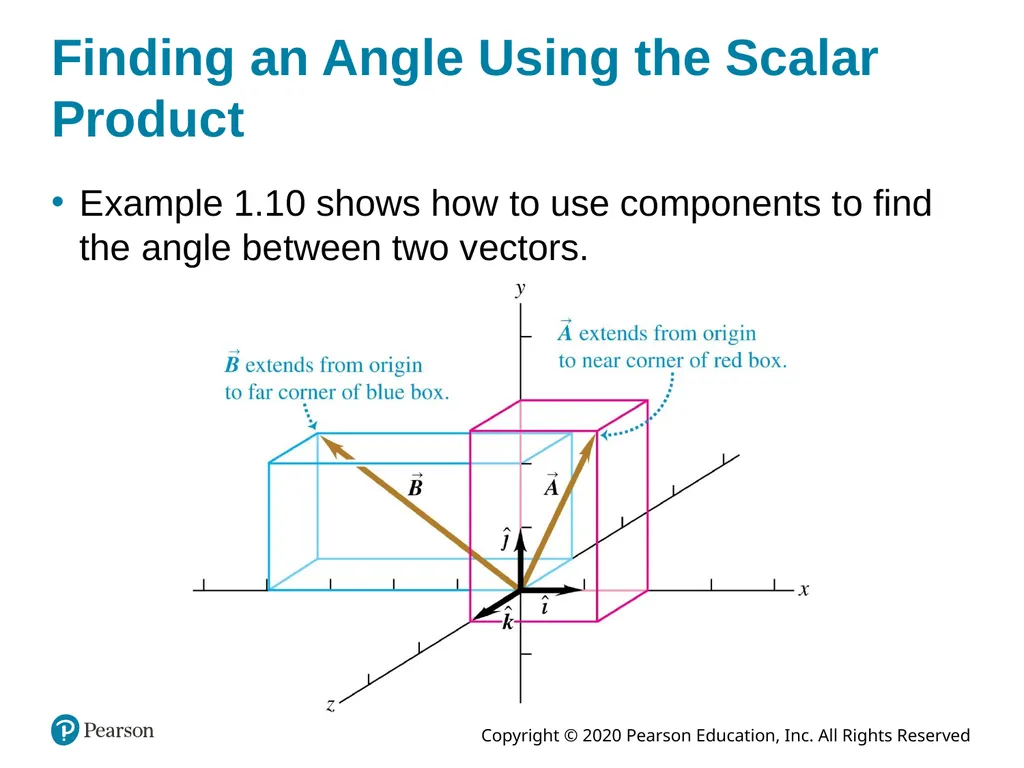
Finding an Angle Using the Scalar Product Example 1.10 shows how to use components to find the angle between two vectors.<br>
30
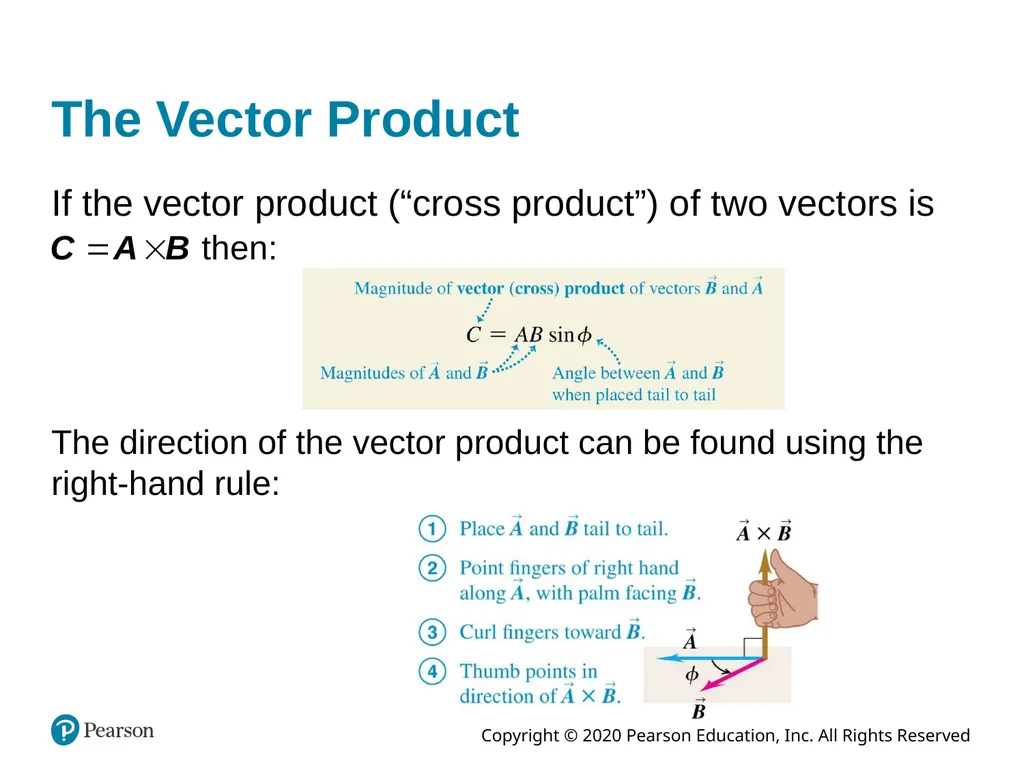
The Vector Product If the vector product (“cross product”) of two vectors is The direction of the vector product can be found using the right-hand rule:<br>
31
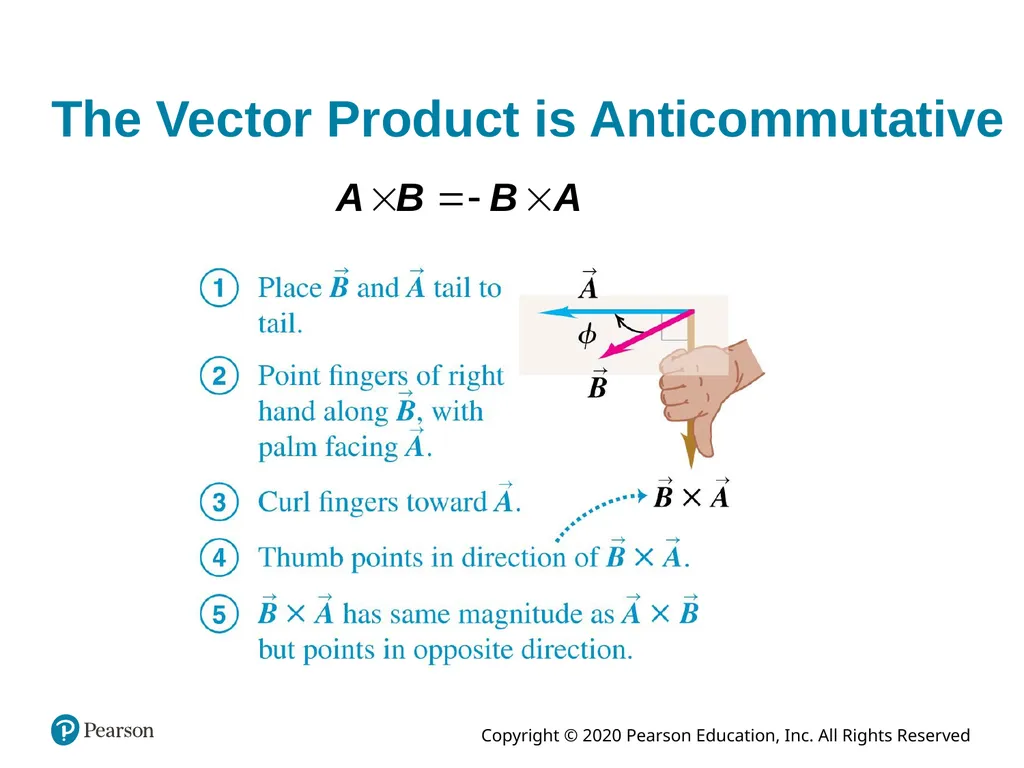
The Vector Product is Anticommutative<br>
32
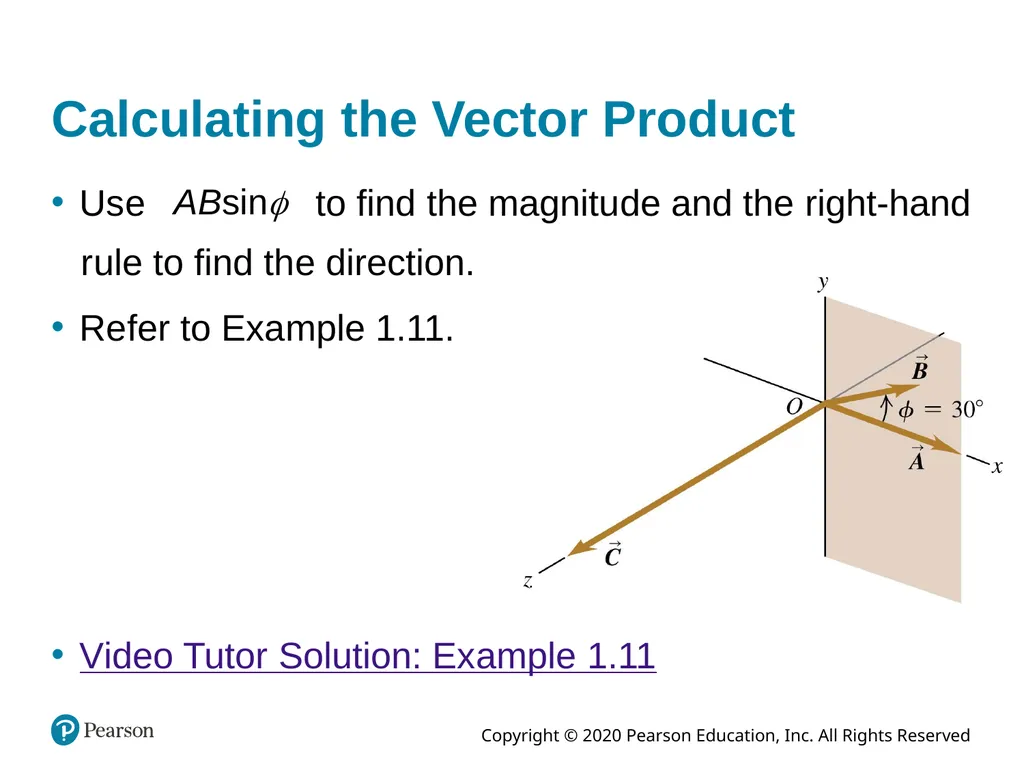
Calculating the Vector Product Use to find the magnitude and the right-hand rule to find the direction.
Refer to Example 1.11. Video Tutor Solution: Example 1.11<br>