Unpacking SAs Foreign Economic Engagements: Aligning to and Addressing the socio-economic challenges of Inequality, Poverty and Unemployment Presentation PC on International Relations and Cooperation 16 February 2022 By Institute for
Related Topics
Share
Embed code
Download this presentation From Below
"Unpacking SA’s Foreign Economic Engagements:" is the property of its rightful owner. Permission is granted to
download and print the materials on this website for personal, non-commercial use only, and to display it
on your personal computer provided you do not modify the materials and that you retain all copyright
notices contained in the materials. By downloading content from our website, you accept the terms of this
agreement.
Presentation Transcript
01
Unpacking SA’s Foreign Economic Engagements: Aligning to and Addressing the socio-economic challenges of Inequality, Poverty and Unemployment Presentation
PC on International Relations and Cooperation
16 February 2022
By
Institute for Global Dialogue<br>
02
The Mainstream Optics: Foreign Economic Relations The focused has been since 1994 focused on generating investment opportunities and improving confidence in South African markets.
Export led growth model but what been the linkages back into the domestic value demand and supply value chain
What do investors remain want?
- Security of interests
- But also policy certainty
Foreign Economic Objectives align to
- The Growth with Development Approach
Versus
- The Growth Through Development Approach<br>
03
The bigger global structural question is whether the model of foreign economic engagements serves markets and hence the trickle down effect to development
Or should there be a more state centric approach?
This has been the debate since the introduction of Reagan and Thatcherite economics
So what we essentially dealing with is what model works best.
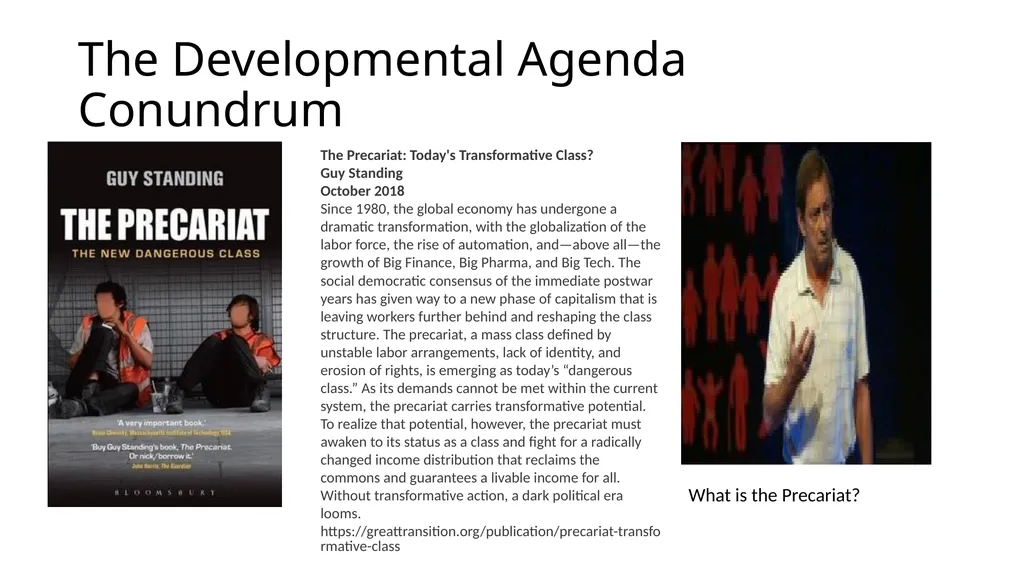
This is best captured by the book by Guy Standing called The Precariat The Developmental Agenda Approach<br>
04
The Developmental Agenda Conundrum What is the Precariat? The Precariat: Today's Transformative Class?
Guy Standing
October 2018 Since 1980, the global economy has undergone a dramatic transformation, with the globalization of the labor force, the rise of automation, and—above all—the growth of Big Finance, Big Pharma, and Big Tech. The social democratic consensus of the immediate postwar years has given way to a new phase of capitalism that is leaving workers further behind and reshaping the class structure. The precariat, a mass class defined by unstable labor arrangements, lack of identity, and erosion of rights, is emerging as today’s “dangerous class.” As its demands cannot be met within the current system, the precariat carries transformative potential. To realize that potential, however, the precariat must awaken to its status as a class and fight for a radically changed income distribution that reclaims the commons and guarantees a livable income for all. Without transformative action, a dark political era looms.
https://greattransition.org/publication/precariat-transformative-class<br>
05
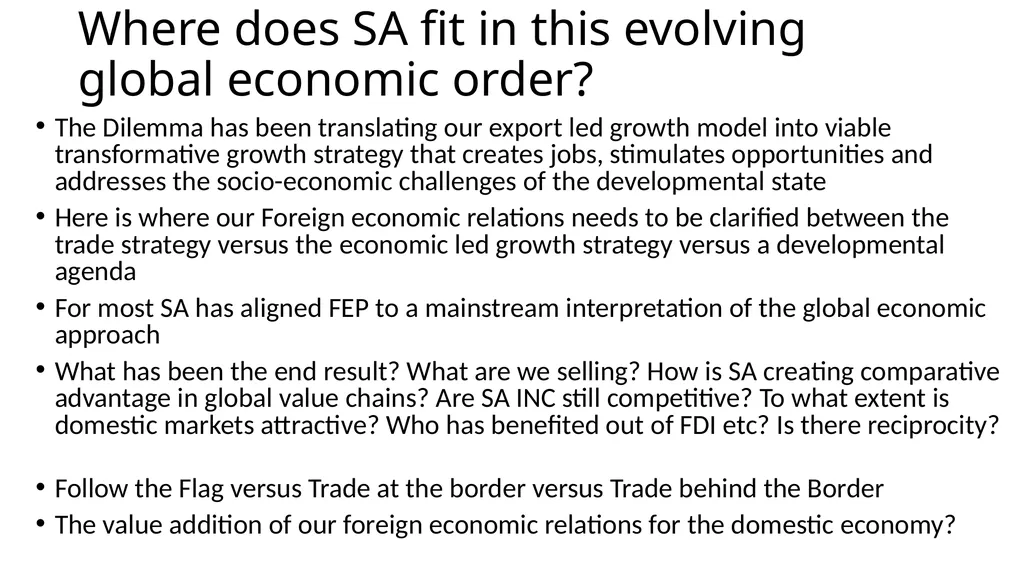
Where does SA fit in this evolving global economic order? The Dilemma has been translating our export led growth model into viable transformative growth strategy that creates jobs, stimulates opportunities and addresses the socio-economic challenges of the developmental state
Here is where our Foreign economic relations needs to be clarified between the trade strategy versus the economic led growth strategy versus a developmental agenda
For most SA has aligned FEP to a mainstream interpretation of the global economic approach
What has been the end result? What are we selling? How is SA creating comparative advantage in global value chains? Are SA INC still competitive? To what extent is domestic markets attractive? Who has benefited out of FDI etc? Is there reciprocity?
Follow the Flag versus Trade at the border versus Trade behind the Border
The value addition of our foreign economic relations for the domestic economy?<br>
06
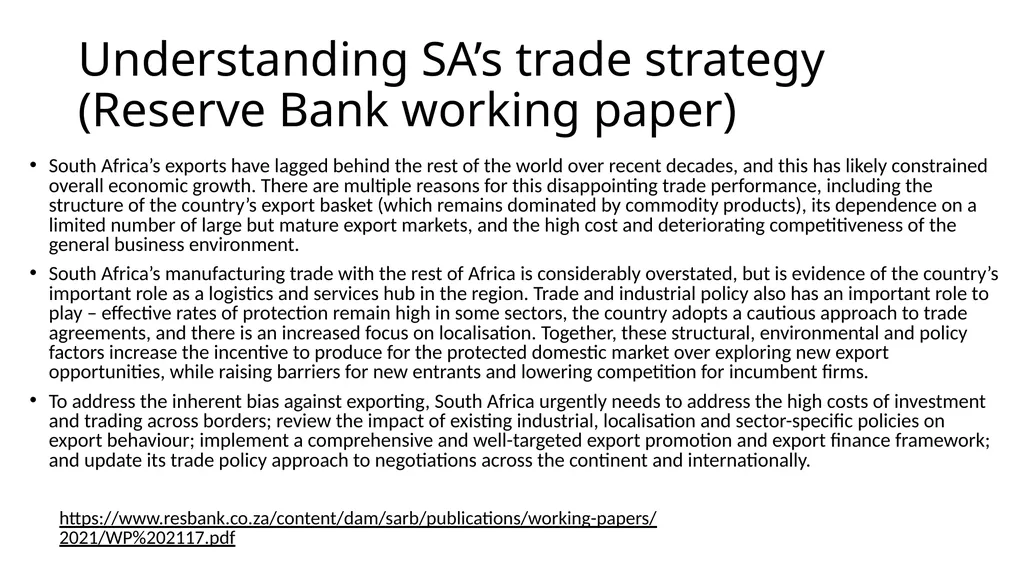
Understanding SA’s trade strategy (Reserve Bank working paper) South Africa’s exports have lagged behind the rest of the world over recent decades, and this has likely constrained overall economic growth. There are multiple reasons for this disappointing trade performance, including the structure of the country’s export basket (which remains dominated by commodity products), its dependence on a limited number of large but mature export markets, and the high cost and deteriorating competitiveness of the general business environment.
South Africa’s manufacturing trade with the rest of Africa is considerably overstated, but is evidence of the country’s important role as a logistics and services hub in the region. Trade and industrial policy also has an important role to play – effective rates of protection remain high in some sectors, the country adopts a cautious approach to trade agreements, and there is an increased focus on localisation. Together, these structural, environmental and policy factors increase the incentive to produce for the protected domestic market over exploring new export opportunities, while raising barriers for new entrants and lowering competition for incumbent firms.
To address the inherent bias against exporting, South Africa urgently needs to address the high costs of investment and trading across borders; review the impact of existing industrial, localisation and sector-specific policies on export behaviour; implement a comprehensive and well-targeted export promotion and export finance framework; and update its trade policy approach to negotiations across the continent and internationally. https://www.resbank.co.za/content/dam/sarb/publications/working-papers/2021/WP%202117.pdf<br>
07
Contexualising SA’s global trade footprint IMPORTS
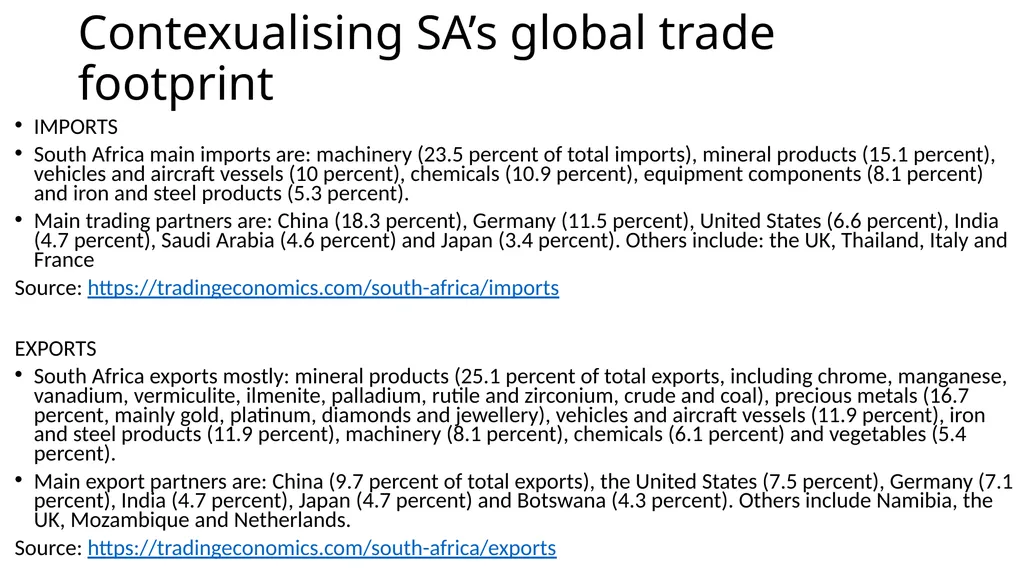
South Africa main imports are: machinery (23.5 percent of total imports), mineral products (15.1 percent), vehicles and aircraft vessels (10 percent), chemicals (10.9 percent), equipment components (8.1 percent) and iron and steel products (5.3 percent).
Main trading partners are: China (18.3 percent), Germany (11.5 percent), United States (6.6 percent), India (4.7 percent), Saudi Arabia (4.6 percent) and Japan (3.4 percent). Others include: the UK, Thailand, Italy and France
Source: https://tradingeconomics.com/south-africa/imports
EXPORTS
South Africa exports mostly: mineral products (25.1 percent of total exports, including chrome, manganese, vanadium, vermiculite, ilmenite, palladium, rutile and zirconium, crude and coal), precious metals (16.7 percent, mainly gold, platinum, diamonds and jewellery), vehicles and aircraft vessels (11.9 percent), iron and steel products (11.9 percent), machinery (8.1 percent), chemicals (6.1 percent) and vegetables (5.4 percent).
Main export partners are: China (9.7 percent of total exports), the United States (7.5 percent), Germany (7.1 percent), India (4.7 percent), Japan (4.7 percent) and Botswana (4.3 percent). Others include Namibia, the UK, Mozambique and Netherlands.
Source: https://tradingeconomics.com/south-africa/exports<br>