
UNV Partnerships and RESOURCE MOBILIZATION
SN
Published · 18 slides · 0 views

1 / 1

Description
UNV Partnerships and RESOURCE MOBILIZATION strategy Private Sector SSC TC 2018-2021 21 November 2018 PARTNERSHIPS AND RESOURCE MOBILIZATION STRATEGY 2018-21 1. Why? 2. What? 3. Who? 4. How? 5. What is new? 6. Tools and Resources 7.
Related Topics
Share
Embed code
Download this presentation From Below
"UNV Partnerships and RESOURCE MOBILIZATION" is the property of its rightful owner. Permission is granted to download and print the materials on this website for personal, non-commercial use only, and to display it on your personal computer provided you do not modify the materials and that you retain all copyright notices contained in the materials. By downloading content from our website, you accept the terms of this agreement.
Presentation Transcript
01
UNV Partnerships and RESOURCE MOBILIZATION strategy
+ Private Sector + SSC &TC
2018-2021
21 November 2018<br>
+ Private Sector + SSC &TC
2018-2021
21 November 2018<br>
02
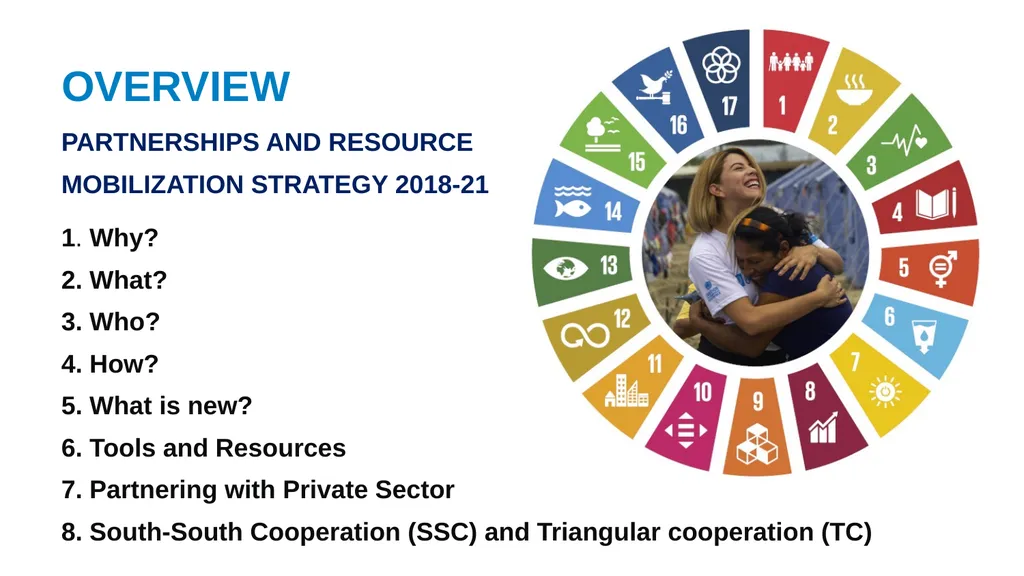
PARTNERSHIPS AND RESOURCE
MOBILIZATION STRATEGY 2018-21
1. Why?
2. What?
3. Who?
4. How?
5. What is new?
6. Tools and Resources
7. Partnering with Private Sector
8. South-South Cooperation (SSC) and Triangular cooperation (TC) oVERVIEW<br>
MOBILIZATION STRATEGY 2018-21
1. Why?
2. What?
3. Who?
4. How?
5. What is new?
6. Tools and Resources
7. Partnering with Private Sector
8. South-South Cooperation (SSC) and Triangular cooperation (TC) oVERVIEW<br>
03
1. OBJECTIVE AND RATIONALE – WHY? Partnerships is at heart of UNV and SF 2018-21
SF needs to be resourced (financial target of USD 60 million): Focus on decentralized resource mobilization > need to stabilize and increase contributions from diverse base of external partners > contribute to UNV’s financial sustainability (in 2018: USD 16,5m received as of today)
Resource Mobilization is closely linked to MMM (in 2018: 540+ FF)
Complementing UN partnerships and advocacy partnerships at all levels
Position UNV as a relevant trusted partner contributing to the implementation of the Sustainable Development Goals through UNV services and offers<br>
SF needs to be resourced (financial target of USD 60 million): Focus on decentralized resource mobilization > need to stabilize and increase contributions from diverse base of external partners > contribute to UNV’s financial sustainability (in 2018: USD 16,5m received as of today)
Resource Mobilization is closely linked to MMM (in 2018: 540+ FF)
Complementing UN partnerships and advocacy partnerships at all levels
Position UNV as a relevant trusted partner contributing to the implementation of the Sustainable Development Goals through UNV services and offers<br>
04
2. CONTENT - WHAT? Guidance to diversify UNV’s donor base and increase mobilization of resources from traditional and non-traditional partners, and beyond governments, with a focus on innovative partnerships, South-South and triangular cooperation and private sector.
Partnership approaches and key messages/value propositions
Context (2030 Agenda, QCPR, UN reform) > Objective and rationale > UNV and external partnerships > UNV’s added value > Innovative partnerships > How to partner with UNV > Key partners > Key approaches > Accountability > Annex: Tools and Resources.<br>
Partnership approaches and key messages/value propositions
Context (2030 Agenda, QCPR, UN reform) > Objective and rationale > UNV and external partnerships > UNV’s added value > Innovative partnerships > How to partner with UNV > Key partners > Key approaches > Accountability > Annex: Tools and Resources.<br>
05
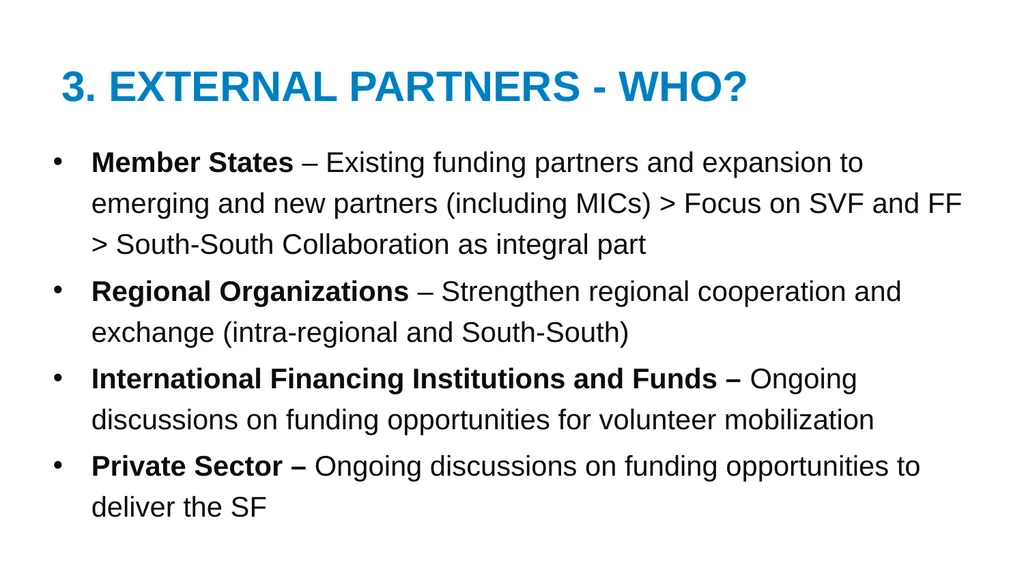
3. EXTERNAL PARTNERS - WHO? Member States – Existing funding partners and expansion to emerging and new partners (including MICs) > Focus on SVF and FF > South-South Collaboration as integral part
Regional Organizations – Strengthen regional cooperation and exchange (intra-regional and South-South)
International Financing Institutions and Funds – Ongoing discussions on funding opportunities for volunteer mobilization
Private Sector – Ongoing discussions on funding opportunities to deliver the SF<br>
Regional Organizations – Strengthen regional cooperation and exchange (intra-regional and South-South)
International Financing Institutions and Funds – Ongoing discussions on funding opportunities for volunteer mobilization
Private Sector – Ongoing discussions on funding opportunities to deliver the SF<br>
06
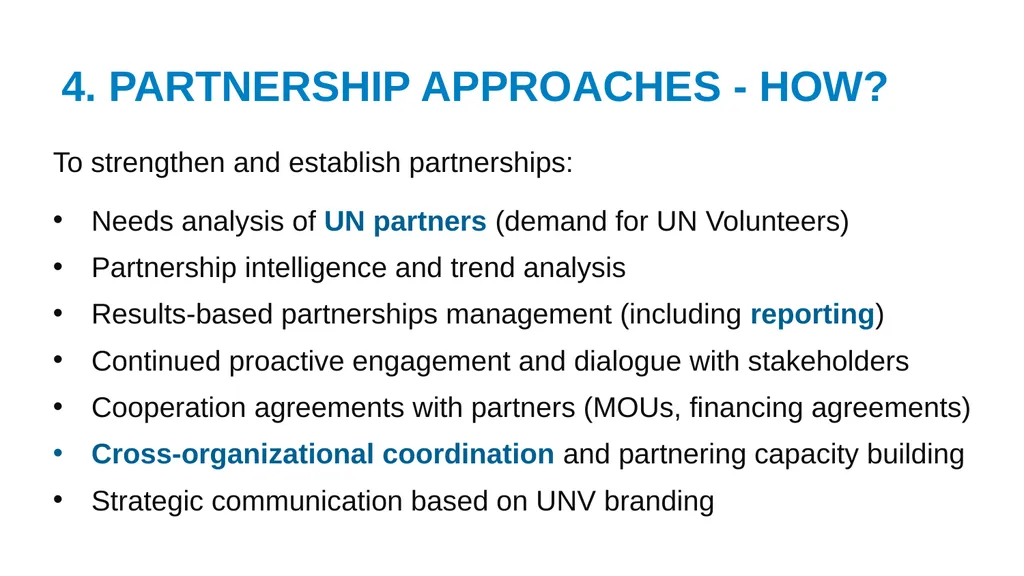
4. PARTNERSHIP APPROACHES - HOW? To strengthen and establish partnerships:
Needs analysis of UN partners (demand for UN Volunteers)
Partnership intelligence and trend analysis
Results-based partnerships management (including reporting)
Continued proactive engagement and dialogue with stakeholders
Cooperation agreements with partners (MOUs, financing agreements)
Cross-organizational coordination and partnering capacity building
Strategic communication based on UNV branding<br>
Needs analysis of UN partners (demand for UN Volunteers)
Partnership intelligence and trend analysis
Results-based partnerships management (including reporting)
Continued proactive engagement and dialogue with stakeholders
Cooperation agreements with partners (MOUs, financing agreements)
Cross-organizational coordination and partnering capacity building
Strategic communication based on UNV branding<br>
07
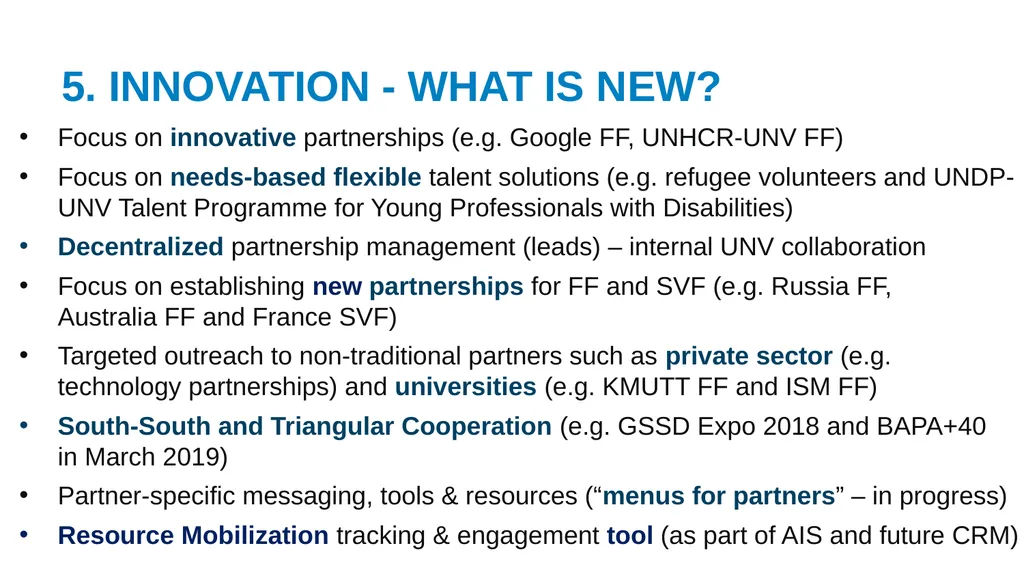
5. INNOVATION - WHAT IS NEW? Focus on innovative partnerships (e.g. Google FF, UNHCR-UNV FF)
Focus on needs-based flexible talent solutions (e.g. refugee volunteers and UNDP-UNV Talent Programme for Young Professionals with Disabilities)
Decentralized partnership management (leads) – internal UNV collaboration
Focus on establishing new partnerships for FF and SVF (e.g. Russia FF, Australia FF and France SVF)
Targeted outreach to non-traditional partners such as private sector (e.g. technology partnerships) and universities (e.g. KMUTT FF and ISM FF)
South-South and Triangular Cooperation (e.g. GSSD Expo 2018 and BAPA+40 in March 2019)
Partner-specific messaging, tools & resources (“menus for partners” – in progress)
Resource Mobilization tracking & engagement tool (as part of AIS and future CRM)<br>
Focus on needs-based flexible talent solutions (e.g. refugee volunteers and UNDP-UNV Talent Programme for Young Professionals with Disabilities)
Decentralized partnership management (leads) – internal UNV collaboration
Focus on establishing new partnerships for FF and SVF (e.g. Russia FF, Australia FF and France SVF)
Targeted outreach to non-traditional partners such as private sector (e.g. technology partnerships) and universities (e.g. KMUTT FF and ISM FF)
South-South and Triangular Cooperation (e.g. GSSD Expo 2018 and BAPA+40 in March 2019)
Partner-specific messaging, tools & resources (“menus for partners” – in progress)
Resource Mobilization tracking & engagement tool (as part of AIS and future CRM)<br>
08
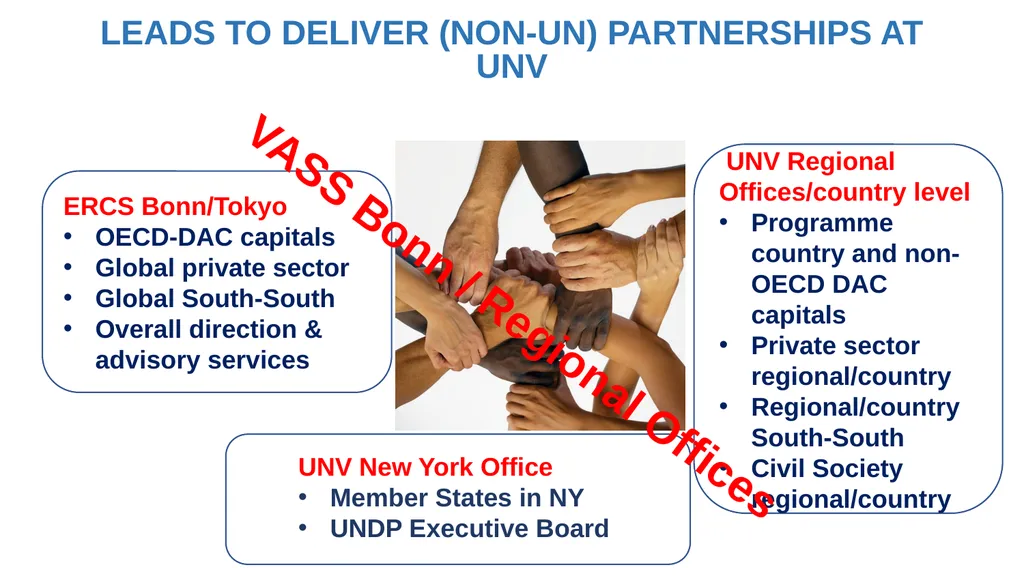
LEADS TO DELIVER (NON-UN) PARTNERSHIPS AT UNV ERCS Bonn/Tokyo
OECD-DAC capitals
Global private sector
Global South-South
Overall direction & advisory services UNV Regional Offices/country level
Programme country and non-OECD DAC capitals
Private sector regional/country
Regional/country South-South
Civil Society regional/country UNV New York Office
Member States in NY
UNDP Executive Board VASS Bonn / Regional Offices<br>
OECD-DAC capitals
Global private sector
Global South-South
Overall direction & advisory services UNV Regional Offices/country level
Programme country and non-OECD DAC capitals
Private sector regional/country
Regional/country South-South
Civil Society regional/country UNV New York Office
Member States in NY
UNDP Executive Board VASS Bonn / Regional Offices<br>
09
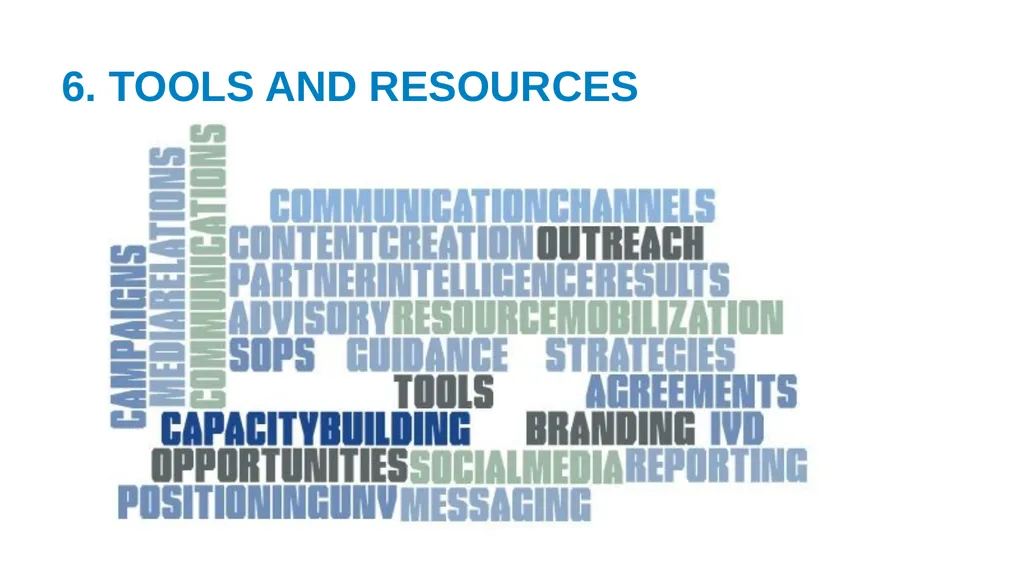
6. TOOLS AND RESOURCES<br>
10
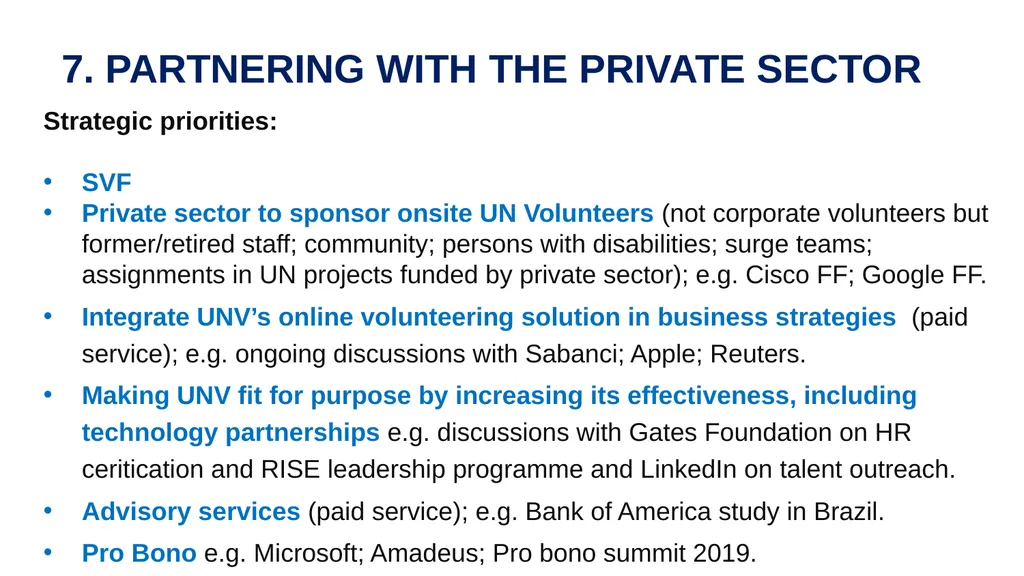
Strategic priorities:
SVF
Private sector to sponsor onsite UN Volunteers (not corporate volunteers but former/retired staff; community; persons with disabilities; surge teams; assignments in UN projects funded by private sector); e.g. Cisco FF; Google FF.
Integrate UNV’s online volunteering solution in business strategies (paid service); e.g. ongoing discussions with Sabanci; Apple; Reuters.
Making UNV fit for purpose by increasing its effectiveness, including technology partnerships e.g. discussions with Gates Foundation on HR ceritication and RISE leadership programme and LinkedIn on talent outreach.
Advisory services (paid service); e.g. Bank of America study in Brazil.
Pro Bono e.g. Microsoft; Amadeus; Pro bono summit 2019. 7. Partnering with the private Sector<br>
SVF
Private sector to sponsor onsite UN Volunteers (not corporate volunteers but former/retired staff; community; persons with disabilities; surge teams; assignments in UN projects funded by private sector); e.g. Cisco FF; Google FF.
Integrate UNV’s online volunteering solution in business strategies (paid service); e.g. ongoing discussions with Sabanci; Apple; Reuters.
Making UNV fit for purpose by increasing its effectiveness, including technology partnerships e.g. discussions with Gates Foundation on HR ceritication and RISE leadership programme and LinkedIn on talent outreach.
Advisory services (paid service); e.g. Bank of America study in Brazil.
Pro Bono e.g. Microsoft; Amadeus; Pro bono summit 2019. 7. Partnering with the private Sector<br>
11
UNV Ask:
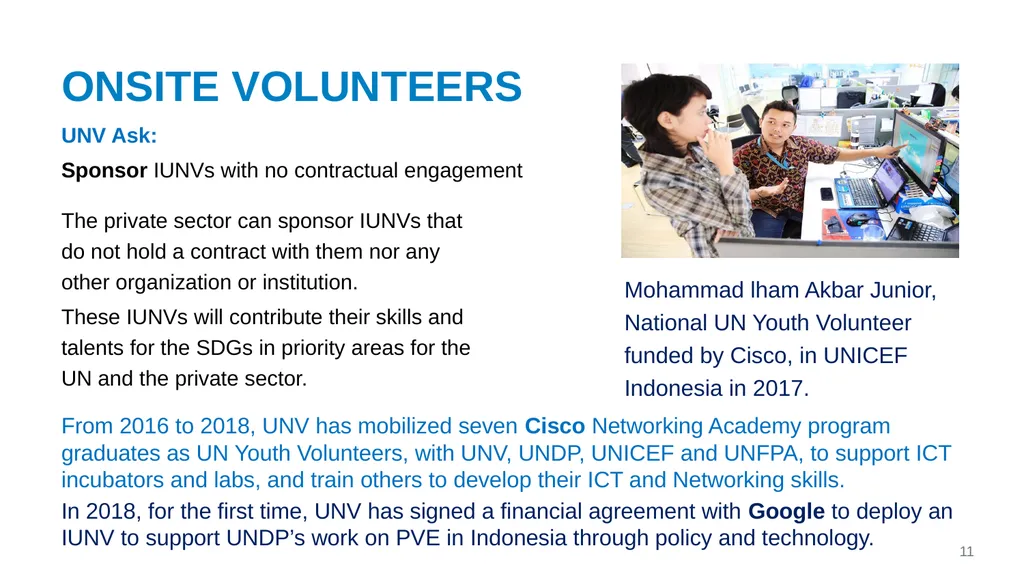
Sponsor IUNVs with no contractual engagement Onsite Volunteers The private sector can sponsor IUNVs that do not hold a contract with them nor any other organization or institution.
These IUNVs will contribute their skills and talents for the SDGs in priority areas for the UN and the private sector. Mohammad lham Akbar Junior, National UN Youth Volunteer funded by Cisco, in UNICEF Indonesia in 2017. From 2016 to 2018, UNV has mobilized seven Cisco Networking Academy program graduates as UN Youth Volunteers, with UNV, UNDP, UNICEF and UNFPA, to support ICT incubators and labs, and train others to develop their ICT and Networking skills.
In 2018, for the first time, UNV has signed a financial agreement with Google to deploy an IUNV to support UNDP’s work on PVE in Indonesia through policy and technology.<br>
Sponsor IUNVs with no contractual engagement Onsite Volunteers The private sector can sponsor IUNVs that do not hold a contract with them nor any other organization or institution.
These IUNVs will contribute their skills and talents for the SDGs in priority areas for the UN and the private sector. Mohammad lham Akbar Junior, National UN Youth Volunteer funded by Cisco, in UNICEF Indonesia in 2017. From 2016 to 2018, UNV has mobilized seven Cisco Networking Academy program graduates as UN Youth Volunteers, with UNV, UNDP, UNICEF and UNFPA, to support ICT incubators and labs, and train others to develop their ICT and Networking skills.
In 2018, for the first time, UNV has signed a financial agreement with Google to deploy an IUNV to support UNDP’s work on PVE in Indonesia through policy and technology.<br>
12
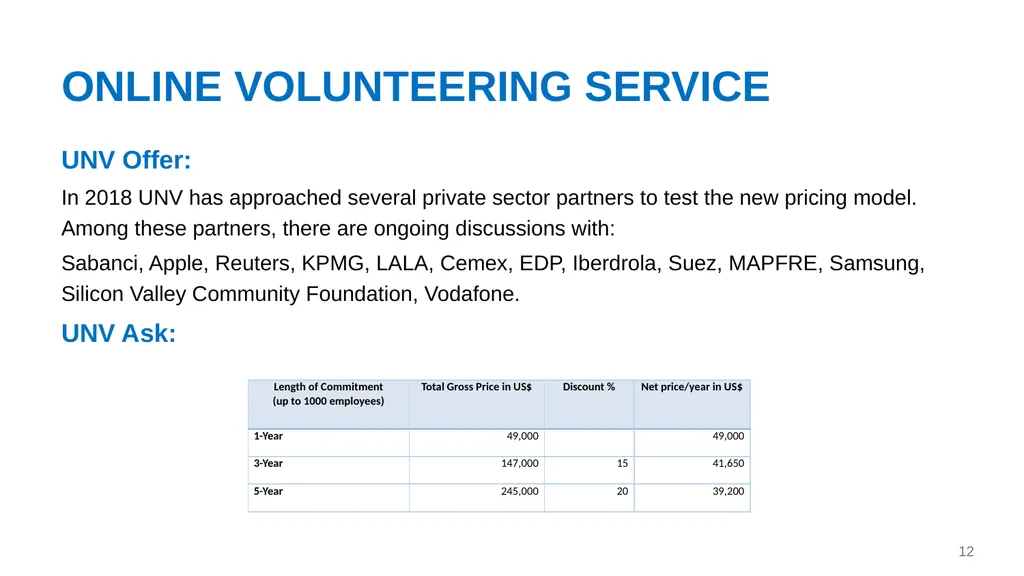
UNV Offer:
In 2018 UNV has approached several private sector partners to test the new pricing model. Among these partners, there are ongoing discussions with:
Sabanci, Apple, Reuters, KPMG, LALA, Cemex, EDP, Iberdrola, Suez, MAPFRE, Samsung, Silicon Valley Community Foundation, Vodafone.
UNV Ask: Online Volunteering service<br>
In 2018 UNV has approached several private sector partners to test the new pricing model. Among these partners, there are ongoing discussions with:
Sabanci, Apple, Reuters, KPMG, LALA, Cemex, EDP, Iberdrola, Suez, MAPFRE, Samsung, Silicon Valley Community Foundation, Vodafone.
UNV Ask: Online Volunteering service<br>
13
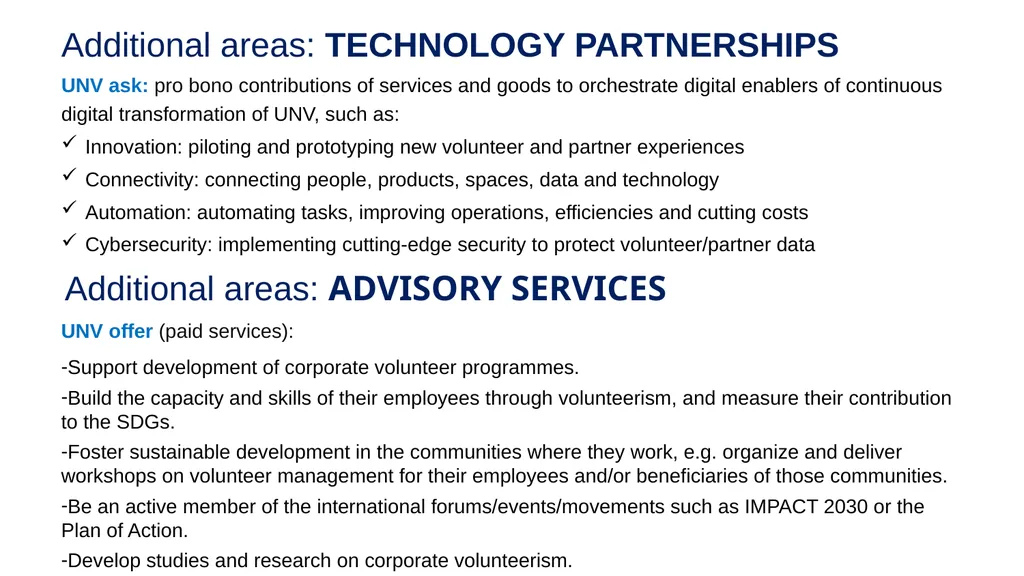
UNV ask: pro bono contributions of services and goods to orchestrate digital enablers of continuous digital transformation of UNV, such as:
Innovation: piloting and prototyping new volunteer and partner experiences
Connectivity: connecting people, products, spaces, data and technology
Automation: automating tasks, improving operations, efficiencies and cutting costs
Cybersecurity: implementing cutting-edge security to protect volunteer/partner data Additional areas: TECHNOLOGY PARTNERSHIPS UNV offer (paid services):
Support development of corporate volunteer programmes.
Build the capacity and skills of their employees through volunteerism, and measure their contribution to the SDGs.
Foster sustainable development in the communities where they work, e.g. organize and deliver workshops on volunteer management for their employees and/or beneficiaries of those communities.
Be an active member of the international forums/events/movements such as IMPACT 2030 or the Plan of Action.
Develop studies and research on corporate volunteerism. Additional areas: ADVISORY SERVICES<br>
Innovation: piloting and prototyping new volunteer and partner experiences
Connectivity: connecting people, products, spaces, data and technology
Automation: automating tasks, improving operations, efficiencies and cutting costs
Cybersecurity: implementing cutting-edge security to protect volunteer/partner data Additional areas: TECHNOLOGY PARTNERSHIPS UNV offer (paid services):
Support development of corporate volunteer programmes.
Build the capacity and skills of their employees through volunteerism, and measure their contribution to the SDGs.
Foster sustainable development in the communities where they work, e.g. organize and deliver workshops on volunteer management for their employees and/or beneficiaries of those communities.
Be an active member of the international forums/events/movements such as IMPACT 2030 or the Plan of Action.
Develop studies and research on corporate volunteerism. Additional areas: ADVISORY SERVICES<br>
14
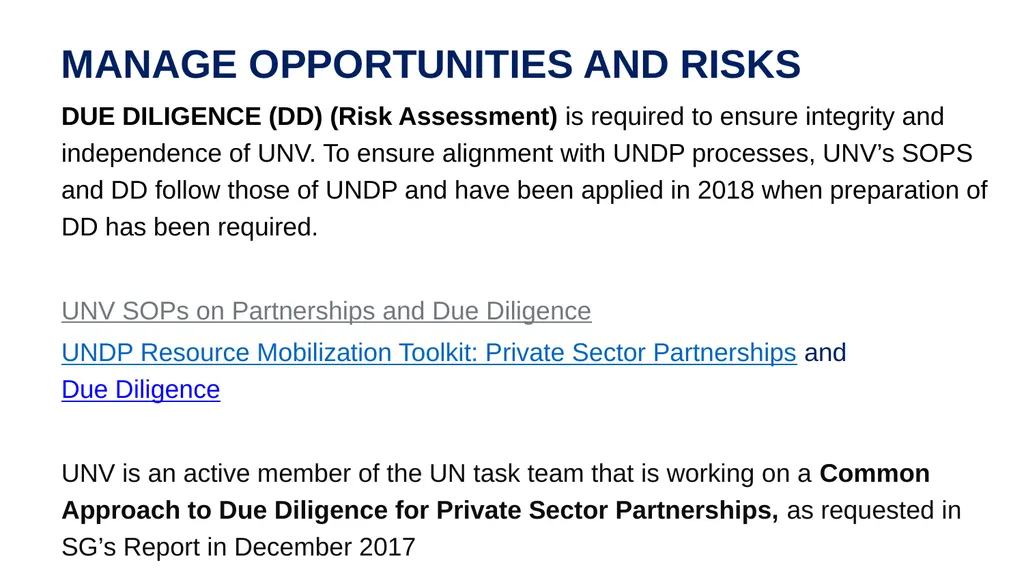
DUE DILIGENCE (DD) (Risk Assessment) is required to ensure integrity and independence of UNV. To ensure alignment with UNDP processes, UNV’s SOPS and DD follow those of UNDP and have been applied in 2018 when preparation of DD has been required.
UNV SOPs on Partnerships and Due Diligence
UNDP Resource Mobilization Toolkit: Private Sector Partnerships and Due Diligence
UNV is an active member of the UN task team that is working on a Common Approach to Due Diligence for Private Sector Partnerships, as requested in SG’s Report in December 2017 MANAGE OPPORTUNITIES AND RISKS<br>
UNV SOPs on Partnerships and Due Diligence
UNDP Resource Mobilization Toolkit: Private Sector Partnerships and Due Diligence
UNV is an active member of the UN task team that is working on a Common Approach to Due Diligence for Private Sector Partnerships, as requested in SG’s Report in December 2017 MANAGE OPPORTUNITIES AND RISKS<br>
15
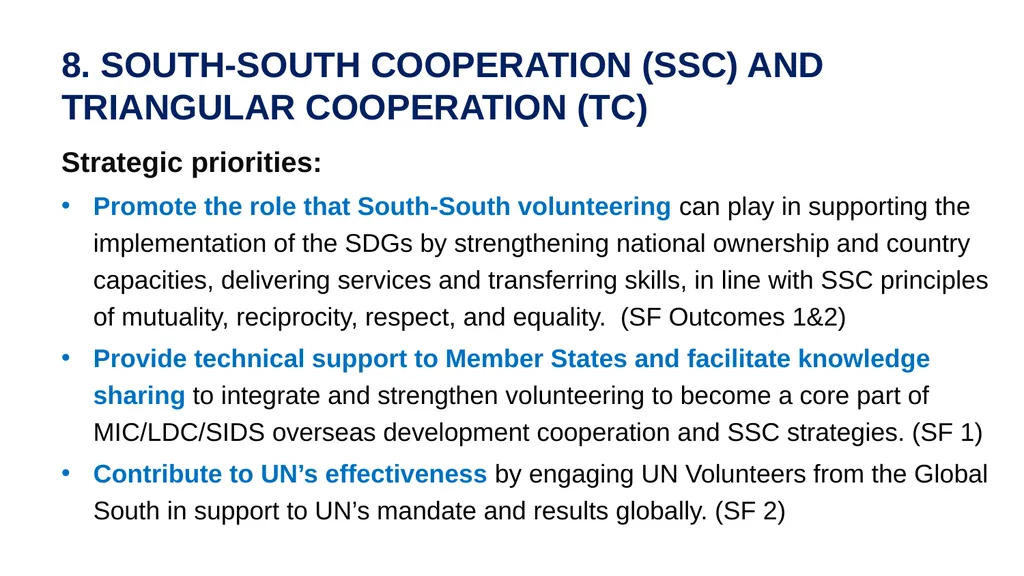
Strategic priorities:
Promote the role that South-South volunteering can play in supporting the implementation of the SDGs by strengthening national ownership and country capacities, delivering services and transferring skills, in line with SSC principles of mutuality, reciprocity, respect, and equality. (SF Outcomes 1&2)
Provide technical support to Member States and facilitate knowledge sharing to integrate and strengthen volunteering to become a core part of MIC/LDC/SIDS overseas development cooperation and SSC strategies. (SF 1)
Contribute to UN’s effectiveness by engaging UN Volunteers from the Global South in support to UN’s mandate and results globally. (SF 2) 8. South-South Cooperation (SSC) and Triangular cooperation (TC)<br>
Promote the role that South-South volunteering can play in supporting the implementation of the SDGs by strengthening national ownership and country capacities, delivering services and transferring skills, in line with SSC principles of mutuality, reciprocity, respect, and equality. (SF Outcomes 1&2)
Provide technical support to Member States and facilitate knowledge sharing to integrate and strengthen volunteering to become a core part of MIC/LDC/SIDS overseas development cooperation and SSC strategies. (SF 1)
Contribute to UN’s effectiveness by engaging UN Volunteers from the Global South in support to UN’s mandate and results globally. (SF 2) 8. South-South Cooperation (SSC) and Triangular cooperation (TC)<br>
16
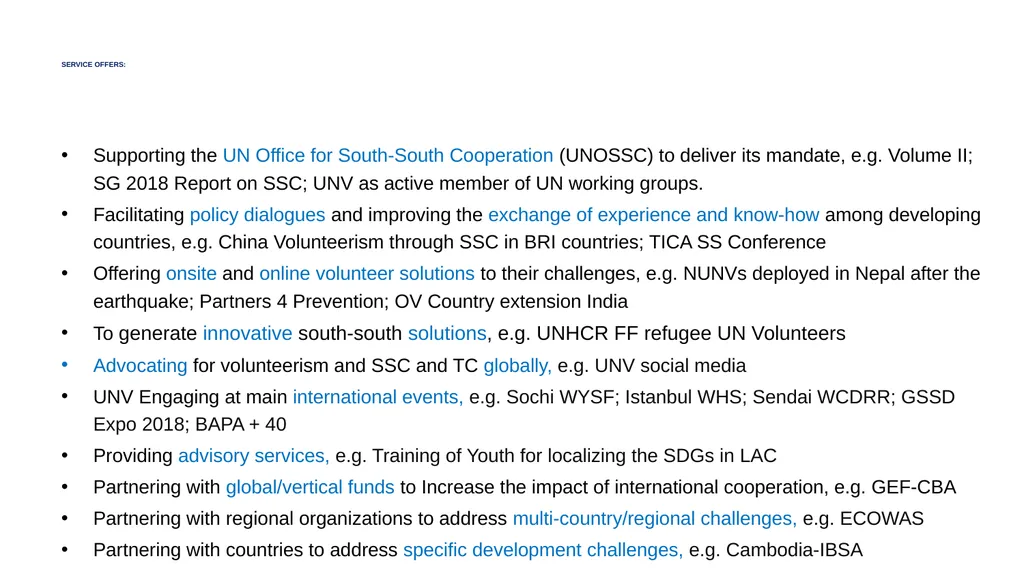
Service offers: Supporting the UN Office for South-South Cooperation (UNOSSC) to deliver its mandate, e.g. Volume II; SG 2018 Report on SSC; UNV as active member of UN working groups.
Facilitating policy dialogues and improving the exchange of experience and know-how among developing countries, e.g. China Volunteerism through SSC in BRI countries; TICA SS Conference
Offering onsite and online volunteer solutions to their challenges, e.g. NUNVs deployed in Nepal after the earthquake; Partners 4 Prevention; OV Country extension India
To generate innovative south-south solutions, e.g. UNHCR FF refugee UN Volunteers
Advocating for volunteerism and SSC and TC globally, e.g. UNV social media
UNV Engaging at main international events, e.g. Sochi WYSF; Istanbul WHS; Sendai WCDRR; GSSD Expo 2018; BAPA + 40
Providing advisory services, e.g. Training of Youth for localizing the SDGs in LAC
Partnering with global/vertical funds to Increase the impact of international cooperation, e.g. GEF-CBA
Partnering with regional organizations to address multi-country/regional challenges, e.g. ECOWAS
Partnering with countries to address specific development challenges, e.g. Cambodia-IBSA<br>
Facilitating policy dialogues and improving the exchange of experience and know-how among developing countries, e.g. China Volunteerism through SSC in BRI countries; TICA SS Conference
Offering onsite and online volunteer solutions to their challenges, e.g. NUNVs deployed in Nepal after the earthquake; Partners 4 Prevention; OV Country extension India
To generate innovative south-south solutions, e.g. UNHCR FF refugee UN Volunteers
Advocating for volunteerism and SSC and TC globally, e.g. UNV social media
UNV Engaging at main international events, e.g. Sochi WYSF; Istanbul WHS; Sendai WCDRR; GSSD Expo 2018; BAPA + 40
Providing advisory services, e.g. Training of Youth for localizing the SDGs in LAC
Partnering with global/vertical funds to Increase the impact of international cooperation, e.g. GEF-CBA
Partnering with regional organizations to address multi-country/regional challenges, e.g. ECOWAS
Partnering with countries to address specific development challenges, e.g. Cambodia-IBSA<br>
17
Page 13. Asia Youth Volunteer Exchange Programme in the United Republic of Tanzania and Zambia. The exchange of volunteers for capacity-building to promote poverty eradication through agricultural innovation and economic growth “Good Practices in South-South and Triangular Cooperation for Sustainable Development - Vol 2”. Page 219. Strengthening China’s Involvement in the Development of International Volunteer Service. Volunteering as a driving force to support the SDGs and South-South cooperation UNV features volunteerism with two good practices https://www.unsouthsouth.org/<br>
18
Thank you<br>