UofG Library Cataloguing Harriet Sweatman Questions? Cataloguing All books and articles are given metadata information that describes it: Who wrote it and when? What is it? What subject is it about? This information is kept on a Machine
"UofG Library Cataloguing Harriet Sweatman" is the property of its rightful owner. Permission is granted to
download and print the materials on this website for personal, non-commercial use only, and to display it
on your personal computer provided you do not modify the materials and that you retain all copyright
notices contained in the materials. By downloading content from our website, you accept the terms of this
agreement.
Presentation Transcript
01
UofG Library Cataloguing Harriet Sweatman<br>
02
Questions?<br>
03
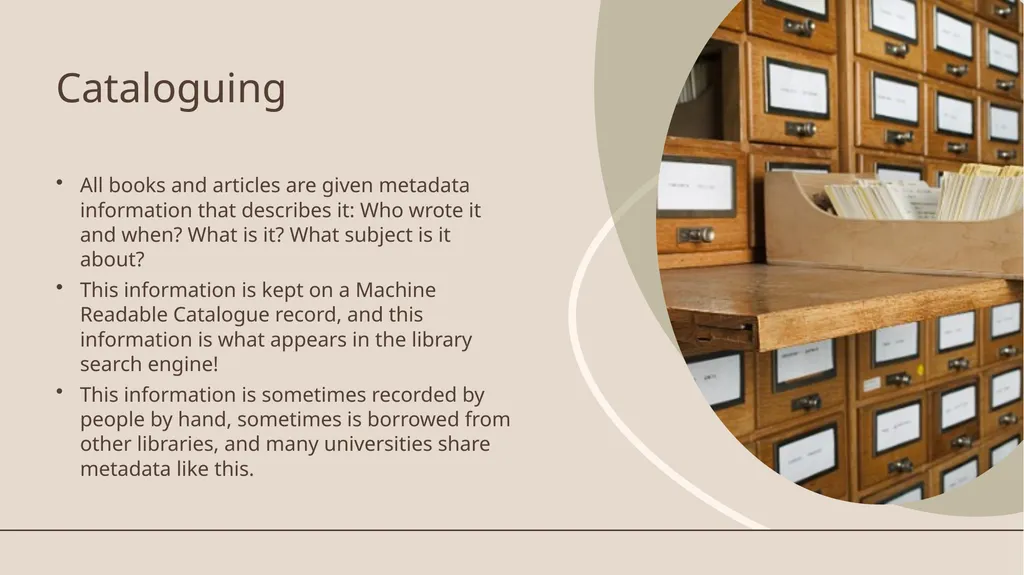
Cataloguing All books and articles are given metadata information that describes it: Who wrote it and when? What is it? What subject is it about?
This information is kept on a Machine Readable Catalogue record, and this information is what appears in the library search engine!
This information is sometimes recorded by people by hand, sometimes is borrowed from other libraries, and many universities share metadata like this.<br>
04
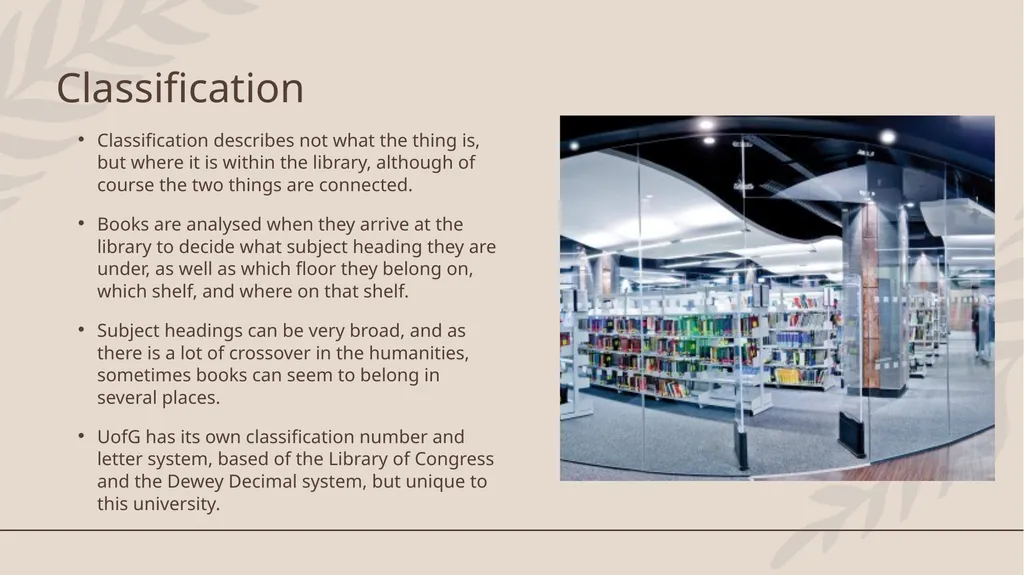
Classification describes not what the thing is, but where it is within the library, although of course the two things are connected.
Books are analysed when they arrive at the library to decide what subject heading they are under, as well as which floor they belong on, which shelf, and where on that shelf.
Subject headings can be very broad, and as there is a lot of crossover in the humanities, sometimes books can seem to belong in several places.
UofG has its own classification number and letter system, based of the Library of Congress and the Dewey Decimal system, but unique to this university. Classification<br>
05
Some problems… Offensive terms As the system has been in place a long time, there are several outdated terms still in use in the catalogue.
The library time is working to remove them where possible, but with so many books and articles, progress can be slow Systematic Bias The cataloguing system is very anglocentric, with a towards America and Britain, making it trickier to catalogue books by or about other cultures, but this will also gradually change over time. The Author’s Perspective? Record cards are supposed to be written from the authors perspective about their work, something that poses a serious problem when dealing with serious and controversial matters.
History can be written from so many different perspectives, how can this be represented in the system?<br>
06
What next? Further moves can be made towards diversifying collections, trying to ensure that more voices are represented, using smaller publishers that push different views
If books are classified incorrectly or offensively based on the outdated system, they should be moved to their proper place in the library.
The new ethic standards in cataloguing should be followed, no more neutrality on controversial topics<br>