
Update on biodiversity and indigenous and local

Description: Update on biodiversity and indigenous and local community benefits in REDD pilot and demonstration activities The UN-REDD Programme CBD Latin America and Caribbean Regional Consultation and Capacity-Building Workshop on REDD, including on
Related Topics
Download Presentation
"Update on biodiversity and indigenous and local" is the property of its rightful owner. Permission is granted to download and print the materials on this website for personal, non-commercial use only, and to display it on your personal computer provided you do not modify the materials and that you retain all copyright notices contained in the materials. By downloading content from our website, you accept the terms of this agreement.
Presentation Transcript
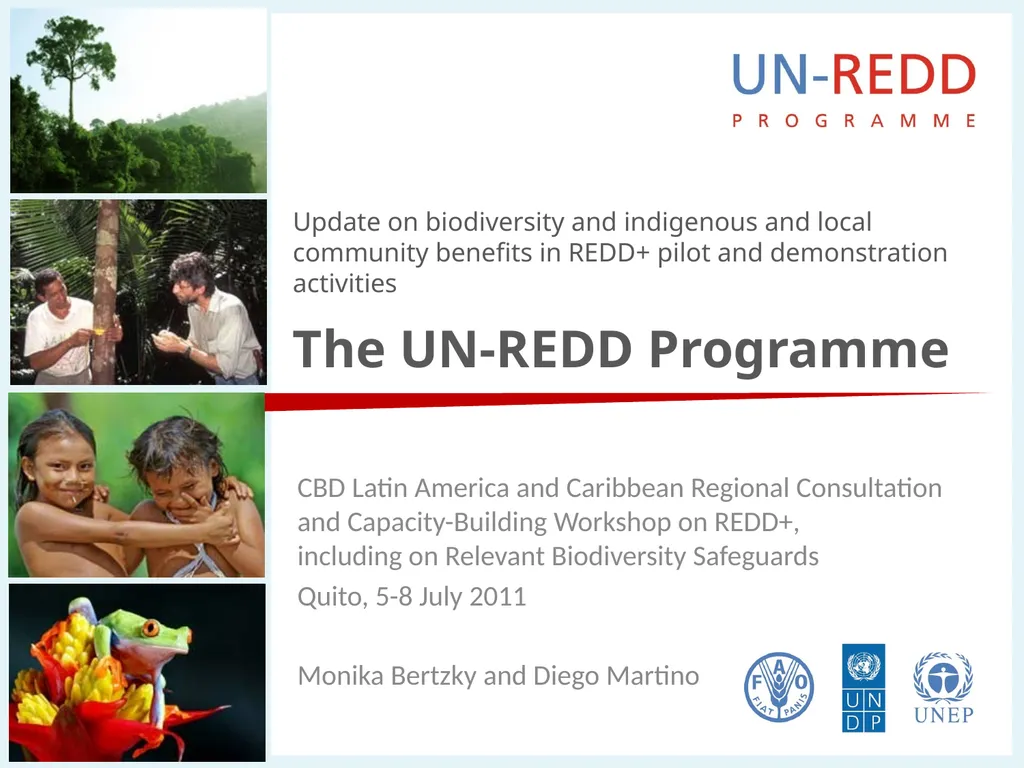
slide1. Update on biodiversity and indigenous and local community benefits in REDD+ pilot and demonstration activities
The UN-REDD Programme CBD Latin America and Caribbean Regional Consultation and Capacity-Building Workshop on REDD+,
including on Relevant Biodiversity Safeguards
Quito, 5-8 July 2011
Monika Bertzky and Diego Martino<br>
slide2. UN-REDD Programme Supports countries to benefit from REDD+
National REDD+ Strategies and Readiness, capacity building
Established in 2008 by FAO, UNDP & UNEP
Response to UNFCCC Bali Action Plan
Offers UN Joint Programme: Delivering as One UN
Agreed delivery platform with FCPF and FIP
Builds on wider UN agency roles
E.g. National programs; GEF Implementing Agencies<br>
slide3. What is UN-REDD? Two components: National Programmes
Capacity building for readiness
13 countries receiving direct UN-REDD funding support:
Africa: DRC, Tanzania, Zambia
Asia & Pacific: Cambodia, Indonesia, PNG, Philippines, Solomon Islands, Vietnam
LA & Caribbean: Bolivia, Ecuador, Panama, Paraguay Global Programme
Guidelines, advice, regional/ international dialogue, analyses
⇒ to support country action
⇒ to support the UNFCCC process on a global scale<br>
slide4. Social and Environmental Principles & Criteria Risks and opportunities from REDD+
UN-REDD Programme response: development of
Social & Environmental Principles and Criteria
to assist countries address those risks and opportunities
Coherent with and drawn from Cancun safeguards
Intended to help countries meet their commitments under Multilateral Agreements, such as the CBD<br>
slide5. Purpose of Principles & Criteria - 1 The Principles and Criteria will serve:
To provide the UN-REDD Programme with a framework to ensure that its activities promote social and environmental benefits and reduce risks from REDD+. In particular, the P&C will be used by the UN-REDD Programme:
as an aid in formulating national REDD+ programmes and initiatives that seek UN-REDD funding
in the review of national programmes prior to submission for UN-REDD funding
to assess national programme delivery<br>
slide6. Purpose of Principles & Criteria - 2 The Principles and Criteria will serve:
To support countries in operationalizing UNFCCC agreements on safeguards for REDD+. Countries can use these P&C for various purposes, such as:
to promote, apply and build on the Cancun safeguards
in devising a national system for information on how the UNFCCC safeguards are being addressed and respected in REDD+ implementation
in demonstrating their achievements beyond carbon, for example in reference to efforts on poverty alleviation and biodiversity conservation<br>
slide7. Process for developing Principles & Criteria Developed in collaboration between UNDP and UNEP, under the UN-REDD Programme.
First draft presented to UN-REDD Policy Board in March 2011 and comments invited.
Based on input received, second draft for consultation released on 30 June
A finalised version will be produced for presentation to the Policy Board in October 2011
In addition, a Risk Identification and Mitigation Tool is being developed to assist national REDD+ teams in developing national programmes in accordance with Cancun safeguards<br>
slide8. Principle 1 Comply with standards of democratic governance
Criterion 1 – Ensure the integrity and transparency of fiduciary and fund management systems
Criterion 2 – Develop and implement activities in a transparent, accountable, legitimate and responsive manner
Criterion 3 – Ensure the full and effective participation of relevant stakeholders in policy design and implementation, with special attention to the most vulnerable and marginalized groups UN-REDD Social and Environmental Principles and Criteria, second draft, July 2011<br>
slide9. Principle 2 Respect and protect stakeholder rights
Criterion 4 – Promote and enhance gender equality and women’s empowerment
Criterion 5 – Seek free, prior and informed consent of indigenous peoples and other forest dependent communities
Criterion 6 – Avoid involuntary resettlement as a result of REDD+
Criterion 7 – Respect and protect cultural heritage and traditional knowledge UN-REDD Social and Environmental Principles and Criteria, second draft, July 2011<br>
slide10. Principle 3 Promote and enhance sustainable livelihoods
Criterion 8 – Ensure equitable and transparent benefit distribution among relevant stakeholders
Criterion 9 – Respect and enhance economic, social and political well-being UN-REDD Social and Environmental Principles and Criteria, second draft, July 2011<br>
slide11. Principle 4 Contribute to coherent low-carbon, climate-resilient and environmentally sound development policy, consistent with commitments under international conventions and agreements
Criterion 10 – Ensure consistency with and contribution to national climate policy objectives, including mitigation and adaptation strategies and international commitments
Criterion 11 – Address the risk of reversals including potential future risks to forest carbon stocks and other benefits to ensure the efficiency and effectiveness of REDD+ UN-REDD Social and Environmental Principles and Criteria, second draft, July 2011<br>
slide12. Principle 4 - continued Criterion 12 – Ensure consistency with and contribution to national poverty reduction strategies and other sustainable development goals
Criterion 13 – Ensure consistency with and contribution to national biodiversity conservation, other environmental and natural resource management policy objectives, national forest programmes, and international commitments UN-REDD Social and Environmental Principles and Criteria, second draft, July 2011<br>
slide13. Protect natural forest from degradation or conversion to other land uses, including plantation forest
Criterion 14 – Ensure that REDD+ activities do not cause the conversion of natural forest to other land uses, including plantation forest, and make reducing conversion due to other causes (e.g. agriculture, timber and fuelwood extraction, infrastructure development) a REDD+ priority
Criterion 15 – Minimise degradation of natural forest by REDD+ activities and make reducing degradation due to other causes (e.g. agriculture, timber and fuelwood extraction, infrastructure development) a REDD+ priority Principle 5 UN-REDD Social and Environmental Principles and Criteria, second draft, July 2011<br>
slide14. Maintain and enhance multiple functions of forest to deliver benefits including biodiversity conservation and ecosystem services
Criterion 16 – Ensure that land use planning for REDD+ explicitly takes account of ecosystem services and biodiversity conservation in relation to local and other stakeholders’ values, and potential trade-offs between different benefits
Criterion 17 – Ensure that new and existing forests are managed to maintain and enhance ecosystem services and biodiversity important in both local and national contexts Principle 6 UN-REDD Social and Environmental Principles and Criteria, second draft, July 2011<br>
slide15. Minimise indirect adverse impacts on ecosystem services and biodiversity
Criterion 18 – Minimise harmful effects on carbon stocks of forest and non-forest ecosystems resulting from displacement of changes in land use (including extractive activities)
Criterion 19 – Minimise harmful effects on biodiversity and other ecosystem services of forest and non-forest ecosystems resulting from displacement of changes in land use (including extractive activities)
Criterion 20 - Minimise other indirect impacts on biodiversity, such as those resulting from intensification of land use Principle 7 UN-REDD Social and Environmental Principles and Criteria, second draft, July 2011<br>
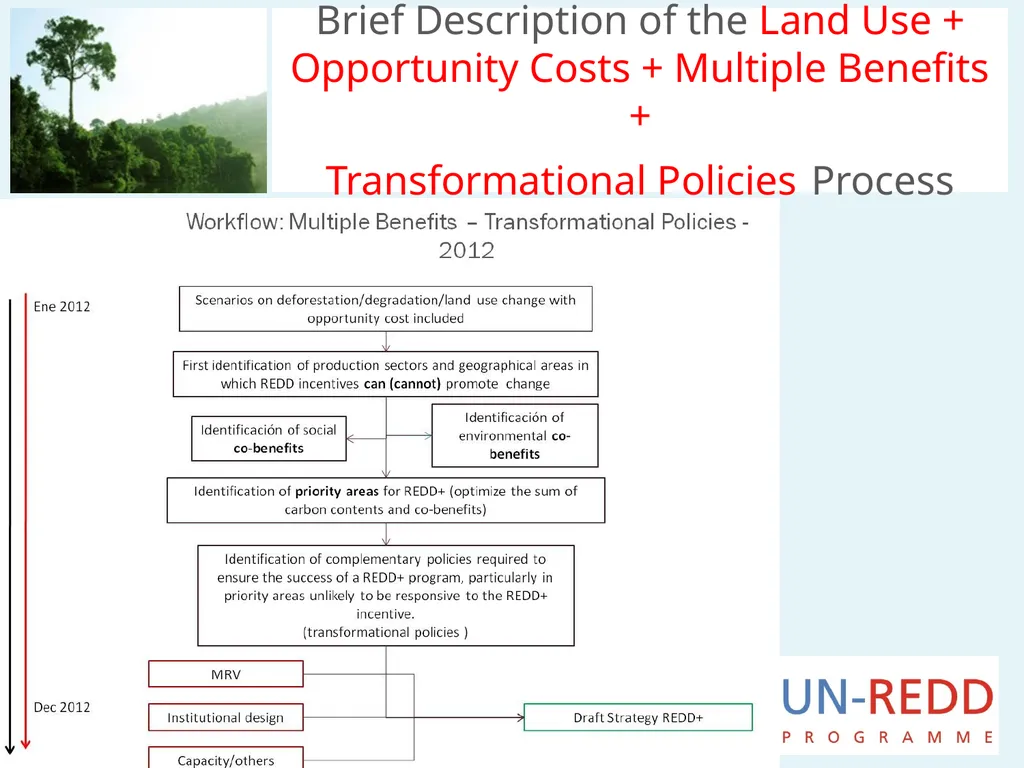
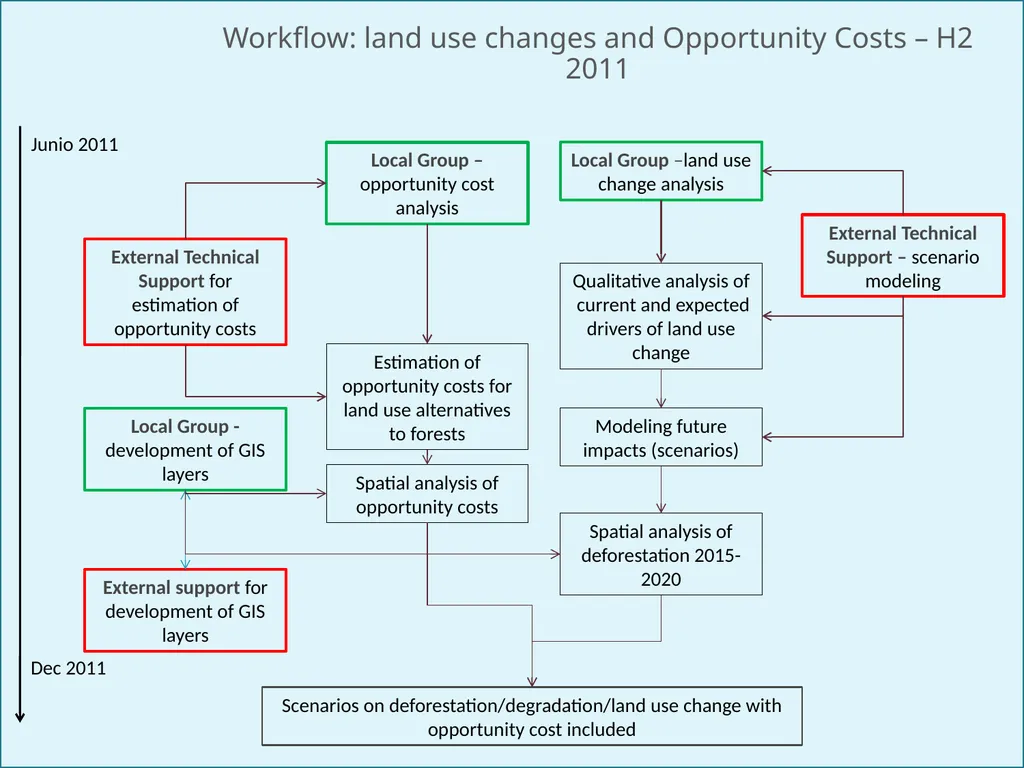
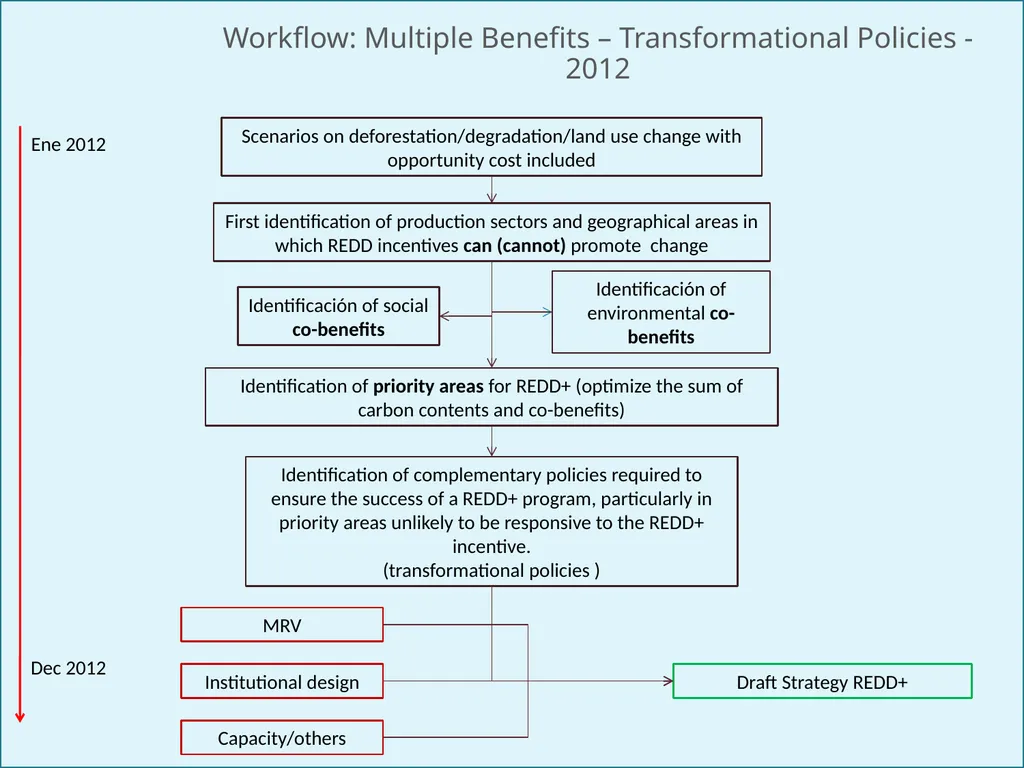
slide16. Brief Description of the Land Use + Opportunity Costs + Multiple Benefits + Transformational Policies Process<br>
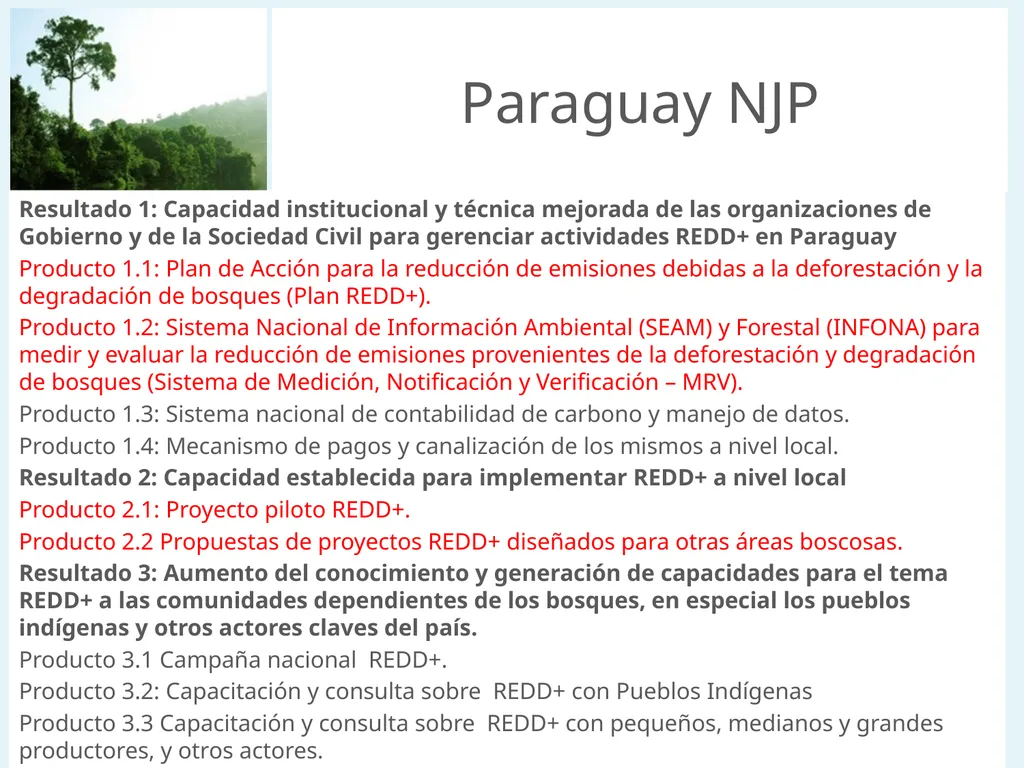
slide17. Resultado 1: Capacidad institucional y técnica mejorada de las organizaciones de Gobierno y de la Sociedad Civil para gerenciar actividades REDD+ en Paraguay
Producto 1.1: Plan de Acción para la reducción de emisiones debidas a la deforestación y la degradación de bosques (Plan REDD+).
Producto 1.2: Sistema Nacional de Información Ambiental (SEAM) y Forestal (INFONA) para medir y evaluar la reducción de emisiones provenientes de la deforestación y degradación de bosques (Sistema de Medición, Notificación y Verificación – MRV).
Producto 1.3: Sistema nacional de contabilidad de carbono y manejo de datos.
Producto 1.4: Mecanismo de pagos y canalización de los mismos a nivel local.
Resultado 2: Capacidad establecida para implementar REDD+ a nivel local
Producto 2.1: Proyecto piloto REDD+.
Producto 2.2 Propuestas de proyectos REDD+ diseñados para otras áreas boscosas.
Resultado 3: Aumento del conocimiento y generación de capacidades para el tema REDD+ a las comunidades dependientes de los bosques, en especial los pueblos indígenas y otros actores claves del país.
Producto 3.1 Campaña nacional REDD+.
Producto 3.2: Capacitación y consulta sobre REDD+ con Pueblos Indígenas
Producto 3.3 Capacitación y consulta sobre REDD+ con pequeños, medianos y grandes productores, y otros actores. Paraguay NJP<br>
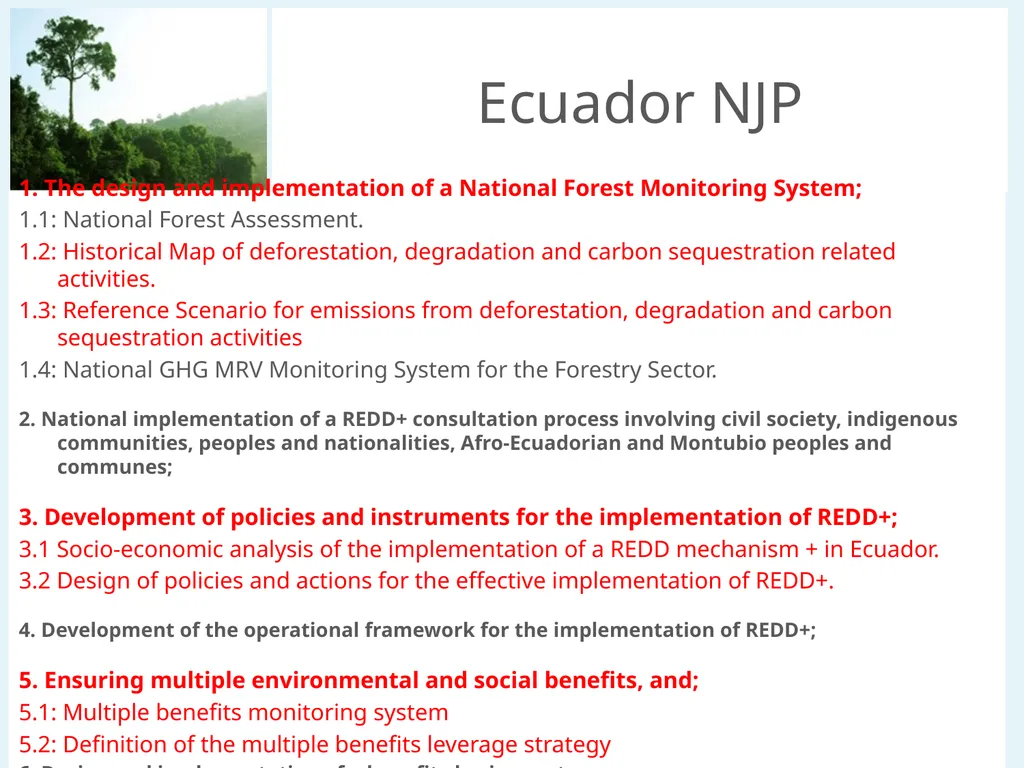
slide18. 1. The design and implementation of a National Forest Monitoring System;
1.1: National Forest Assessment.
1.2: Historical Map of deforestation, degradation and carbon sequestration related activities.
1.3: Reference Scenario for emissions from deforestation, degradation and carbon sequestration activities
1.4: National GHG MRV Monitoring System for the Forestry Sector.
2. National implementation of a REDD+ consultation process involving civil society, indigenous communities, peoples and nationalities, Afro-Ecuadorian and Montubio peoples and communes;
3. Development of policies and instruments for the implementation of REDD+;
3.1 Socio-economic analysis of the implementation of a REDD mechanism + in Ecuador.
3.2 Design of policies and actions for the effective implementation of REDD+.
4. Development of the operational framework for the implementation of REDD+;
5. Ensuring multiple environmental and social benefits, and;
5.1: Multiple benefits monitoring system
5.2: Definition of the multiple benefits leverage strategy
6. Design and implementation of a benefit-sharing system. Ecuador NJP<br>
slide19. Local Group –land use change analysis Qualitative analysis of current and expected drivers of land use change Modeling future impacts (scenarios) Spatial analysis of deforestation 2015-2020 Scenarios on deforestation/degradation/land use change with opportunity cost included External Technical Support – scenario modeling Local Group – opportunity cost analysis Estimation of opportunity costs for land use alternatives to forests External support for development of GIS layers External Technical Support for estimation of opportunity costs Spatial analysis of opportunity costs Workflow: land use changes and Opportunity Costs – H2 2011 Junio 2011 Dec 2011 Local Group - development of GIS layers<br>
slide20. Identificación of social co-benefits Identification of complementary policies required to ensure the success of a REDD+ program, particularly in priority areas unlikely to be responsive to the REDD+ incentive.
(transformational policies ) Scenarios on deforestation/degradation/land use change with opportunity cost included Identificación of environmental co-benefits First identification of production sectors and geographical areas in which REDD incentives can (cannot) promote change Workflow: Multiple Benefits – Transformational Policies - 2012 Ene 2012 Dec 2012 Identification of priority areas for REDD+ (optimize the sum of carbon contents and co-benefits) Draft Strategy REDD+ MRV Institutional design Capacity/others<br>
Quito, 5-8 July 2011
Monika Bertzky and Diego Martino<br>
slide2. UN-REDD Programme Supports countries to benefit from REDD+
National REDD+ Strategies and Readiness, capacity building
Established in 2008 by FAO, UNDP & UNEP
Response to UNFCCC Bali Action Plan
Offers UN Joint Programme: Delivering as One UN
Agreed delivery platform with FCPF and FIP
Builds on wider UN agency roles
E.g. National programs; GEF Implementing Agencies<br>
slide3. What is UN-REDD? Two components: National Programmes
Capacity building for readiness
13 countries receiving direct UN-REDD funding support:
Africa: DRC, Tanzania, Zambia
Asia & Pacific: Cambodia, Indonesia, PNG, Philippines, Solomon Islands, Vietnam
LA & Caribbean: Bolivia, Ecuador, Panama, Paraguay Global Programme
Guidelines, advice, regional/ international dialogue, analyses
⇒ to support country action
⇒ to support the UNFCCC process on a global scale<br>
slide4. Social and Environmental Principles & Criteria Risks and opportunities from REDD+
UN-REDD Programme response: development of
Social & Environmental Principles and Criteria
to assist countries address those risks and opportunities
Coherent with and drawn from Cancun safeguards
Intended to help countries meet their commitments under Multilateral Agreements, such as the CBD<br>
slide5. Purpose of Principles & Criteria - 1 The Principles and Criteria will serve:
To provide the UN-REDD Programme with a framework to ensure that its activities promote social and environmental benefits and reduce risks from REDD+. In particular, the P&C will be used by the UN-REDD Programme:
as an aid in formulating national REDD+ programmes and initiatives that seek UN-REDD funding
in the review of national programmes prior to submission for UN-REDD funding
to assess national programme delivery<br>
slide6. Purpose of Principles & Criteria - 2 The Principles and Criteria will serve:
To support countries in operationalizing UNFCCC agreements on safeguards for REDD+. Countries can use these P&C for various purposes, such as:
to promote, apply and build on the Cancun safeguards
in devising a national system for information on how the UNFCCC safeguards are being addressed and respected in REDD+ implementation
in demonstrating their achievements beyond carbon, for example in reference to efforts on poverty alleviation and biodiversity conservation<br>
slide7. Process for developing Principles & Criteria Developed in collaboration between UNDP and UNEP, under the UN-REDD Programme.
First draft presented to UN-REDD Policy Board in March 2011 and comments invited.
Based on input received, second draft for consultation released on 30 June
A finalised version will be produced for presentation to the Policy Board in October 2011
In addition, a Risk Identification and Mitigation Tool is being developed to assist national REDD+ teams in developing national programmes in accordance with Cancun safeguards<br>
slide8. Principle 1 Comply with standards of democratic governance
Criterion 1 – Ensure the integrity and transparency of fiduciary and fund management systems
Criterion 2 – Develop and implement activities in a transparent, accountable, legitimate and responsive manner
Criterion 3 – Ensure the full and effective participation of relevant stakeholders in policy design and implementation, with special attention to the most vulnerable and marginalized groups UN-REDD Social and Environmental Principles and Criteria, second draft, July 2011<br>
slide9. Principle 2 Respect and protect stakeholder rights
Criterion 4 – Promote and enhance gender equality and women’s empowerment
Criterion 5 – Seek free, prior and informed consent of indigenous peoples and other forest dependent communities
Criterion 6 – Avoid involuntary resettlement as a result of REDD+
Criterion 7 – Respect and protect cultural heritage and traditional knowledge UN-REDD Social and Environmental Principles and Criteria, second draft, July 2011<br>
slide10. Principle 3 Promote and enhance sustainable livelihoods
Criterion 8 – Ensure equitable and transparent benefit distribution among relevant stakeholders
Criterion 9 – Respect and enhance economic, social and political well-being UN-REDD Social and Environmental Principles and Criteria, second draft, July 2011<br>
slide11. Principle 4 Contribute to coherent low-carbon, climate-resilient and environmentally sound development policy, consistent with commitments under international conventions and agreements
Criterion 10 – Ensure consistency with and contribution to national climate policy objectives, including mitigation and adaptation strategies and international commitments
Criterion 11 – Address the risk of reversals including potential future risks to forest carbon stocks and other benefits to ensure the efficiency and effectiveness of REDD+ UN-REDD Social and Environmental Principles and Criteria, second draft, July 2011<br>
slide12. Principle 4 - continued Criterion 12 – Ensure consistency with and contribution to national poverty reduction strategies and other sustainable development goals
Criterion 13 – Ensure consistency with and contribution to national biodiversity conservation, other environmental and natural resource management policy objectives, national forest programmes, and international commitments UN-REDD Social and Environmental Principles and Criteria, second draft, July 2011<br>
slide13. Protect natural forest from degradation or conversion to other land uses, including plantation forest
Criterion 14 – Ensure that REDD+ activities do not cause the conversion of natural forest to other land uses, including plantation forest, and make reducing conversion due to other causes (e.g. agriculture, timber and fuelwood extraction, infrastructure development) a REDD+ priority
Criterion 15 – Minimise degradation of natural forest by REDD+ activities and make reducing degradation due to other causes (e.g. agriculture, timber and fuelwood extraction, infrastructure development) a REDD+ priority Principle 5 UN-REDD Social and Environmental Principles and Criteria, second draft, July 2011<br>
slide14. Maintain and enhance multiple functions of forest to deliver benefits including biodiversity conservation and ecosystem services
Criterion 16 – Ensure that land use planning for REDD+ explicitly takes account of ecosystem services and biodiversity conservation in relation to local and other stakeholders’ values, and potential trade-offs between different benefits
Criterion 17 – Ensure that new and existing forests are managed to maintain and enhance ecosystem services and biodiversity important in both local and national contexts Principle 6 UN-REDD Social and Environmental Principles and Criteria, second draft, July 2011<br>
slide15. Minimise indirect adverse impacts on ecosystem services and biodiversity
Criterion 18 – Minimise harmful effects on carbon stocks of forest and non-forest ecosystems resulting from displacement of changes in land use (including extractive activities)
Criterion 19 – Minimise harmful effects on biodiversity and other ecosystem services of forest and non-forest ecosystems resulting from displacement of changes in land use (including extractive activities)
Criterion 20 - Minimise other indirect impacts on biodiversity, such as those resulting from intensification of land use Principle 7 UN-REDD Social and Environmental Principles and Criteria, second draft, July 2011<br>
slide16. Brief Description of the Land Use + Opportunity Costs + Multiple Benefits + Transformational Policies Process<br>
slide17. Resultado 1: Capacidad institucional y técnica mejorada de las organizaciones de Gobierno y de la Sociedad Civil para gerenciar actividades REDD+ en Paraguay
Producto 1.1: Plan de Acción para la reducción de emisiones debidas a la deforestación y la degradación de bosques (Plan REDD+).
Producto 1.2: Sistema Nacional de Información Ambiental (SEAM) y Forestal (INFONA) para medir y evaluar la reducción de emisiones provenientes de la deforestación y degradación de bosques (Sistema de Medición, Notificación y Verificación – MRV).
Producto 1.3: Sistema nacional de contabilidad de carbono y manejo de datos.
Producto 1.4: Mecanismo de pagos y canalización de los mismos a nivel local.
Resultado 2: Capacidad establecida para implementar REDD+ a nivel local
Producto 2.1: Proyecto piloto REDD+.
Producto 2.2 Propuestas de proyectos REDD+ diseñados para otras áreas boscosas.
Resultado 3: Aumento del conocimiento y generación de capacidades para el tema REDD+ a las comunidades dependientes de los bosques, en especial los pueblos indígenas y otros actores claves del país.
Producto 3.1 Campaña nacional REDD+.
Producto 3.2: Capacitación y consulta sobre REDD+ con Pueblos Indígenas
Producto 3.3 Capacitación y consulta sobre REDD+ con pequeños, medianos y grandes productores, y otros actores. Paraguay NJP<br>
slide18. 1. The design and implementation of a National Forest Monitoring System;
1.1: National Forest Assessment.
1.2: Historical Map of deforestation, degradation and carbon sequestration related activities.
1.3: Reference Scenario for emissions from deforestation, degradation and carbon sequestration activities
1.4: National GHG MRV Monitoring System for the Forestry Sector.
2. National implementation of a REDD+ consultation process involving civil society, indigenous communities, peoples and nationalities, Afro-Ecuadorian and Montubio peoples and communes;
3. Development of policies and instruments for the implementation of REDD+;
3.1 Socio-economic analysis of the implementation of a REDD mechanism + in Ecuador.
3.2 Design of policies and actions for the effective implementation of REDD+.
4. Development of the operational framework for the implementation of REDD+;
5. Ensuring multiple environmental and social benefits, and;
5.1: Multiple benefits monitoring system
5.2: Definition of the multiple benefits leverage strategy
6. Design and implementation of a benefit-sharing system. Ecuador NJP<br>
slide19. Local Group –land use change analysis Qualitative analysis of current and expected drivers of land use change Modeling future impacts (scenarios) Spatial analysis of deforestation 2015-2020 Scenarios on deforestation/degradation/land use change with opportunity cost included External Technical Support – scenario modeling Local Group – opportunity cost analysis Estimation of opportunity costs for land use alternatives to forests External support for development of GIS layers External Technical Support for estimation of opportunity costs Spatial analysis of opportunity costs Workflow: land use changes and Opportunity Costs – H2 2011 Junio 2011 Dec 2011 Local Group - development of GIS layers<br>
slide20. Identificación of social co-benefits Identification of complementary policies required to ensure the success of a REDD+ program, particularly in priority areas unlikely to be responsive to the REDD+ incentive.
(transformational policies ) Scenarios on deforestation/degradation/land use change with opportunity cost included Identificación of environmental co-benefits First identification of production sectors and geographical areas in which REDD incentives can (cannot) promote change Workflow: Multiple Benefits – Transformational Policies - 2012 Ene 2012 Dec 2012 Identification of priority areas for REDD+ (optimize the sum of carbon contents and co-benefits) Draft Strategy REDD+ MRV Institutional design Capacity/others<br>