
Update on Pediatric Allergy & Immunology Focus on
JO
Published · 47 slides · 0 views

1 / 1





Description
Update on Pediatric Allergy Immunology Focus on Asthma and Food Allergy Maryland Assembly on School Based Health Manav Singla, MD Allergy Asthma Specialists of Maryland msinglamdallergy.net October 1, 2025 Manav Singla, MD Managing
Related Topics
Share
Embed code
Download this presentation From Below
"Update on Pediatric Allergy & Immunology Focus on" is the property of its rightful owner. Permission is granted to download and print the materials on this website for personal, non-commercial use only, and to display it on your personal computer provided you do not modify the materials and that you retain all copyright notices contained in the materials. By downloading content from our website, you accept the terms of this agreement.
Presentation Transcript
01
Update on Pediatric Allergy & Immunology
Focus on Asthma and Food Allergy Maryland Assembly on School Based Health
Manav Singla, MD
Allergy Asthma Specialists of Maryland
msingla@mdallergy.net
October 1, 2025<br>
Focus on Asthma and Food Allergy Maryland Assembly on School Based Health
Manav Singla, MD
Allergy Asthma Specialists of Maryland
msingla@mdallergy.net
October 1, 2025<br>
02
Manav Singla, MD Managing Partner, Allergy Asthma Specialists of Maryland
Volunteer faculty
Adjunct Assistant Professor, Department of Pediatrics, University of Maryland School of Medicine
Assistant Professor of Clinical Pediatrics, Georgetown University School of Medicine
Clinical Assistant Professor of Pediatrics, George Washington University School of Medicine and Health Sciences
Primary teaching allergist for multiple residency training programs in Baltimore<br>
Volunteer faculty
Adjunct Assistant Professor, Department of Pediatrics, University of Maryland School of Medicine
Assistant Professor of Clinical Pediatrics, Georgetown University School of Medicine
Clinical Assistant Professor of Pediatrics, George Washington University School of Medicine and Health Sciences
Primary teaching allergist for multiple residency training programs in Baltimore<br>
03
Session Objectives Translate 2024–2025 asthma & allergy updates into school‑day practice
Review rescue and controller strategies
Clarify food‑allergy risk reduction and emergency response
Navigate device options and Maryland school policies
Know when to escalate care or refer families<br>
Review rescue and controller strategies
Clarify food‑allergy risk reduction and emergency response
Navigate device options and Maryland school policies
Know when to escalate care or refer families<br>
04
Agenda Asthma management updates
SMART therapy, dexamethasone
Seasonal allergies as triggers; daily control priorities
Food allergy updates
OIT, omalizumab/Xolair®, devices incl. neffy®
Practical strategies for schools (Maryland specifics)
Q&A
Slides/recording will be shared<br>
SMART therapy, dexamethasone
Seasonal allergies as triggers; daily control priorities
Food allergy updates
OIT, omalizumab/Xolair®, devices incl. neffy®
Practical strategies for schools (Maryland specifics)
Q&A
Slides/recording will be shared<br>
05
Asthma Management Updates What changes for students during the school day?<br>
06
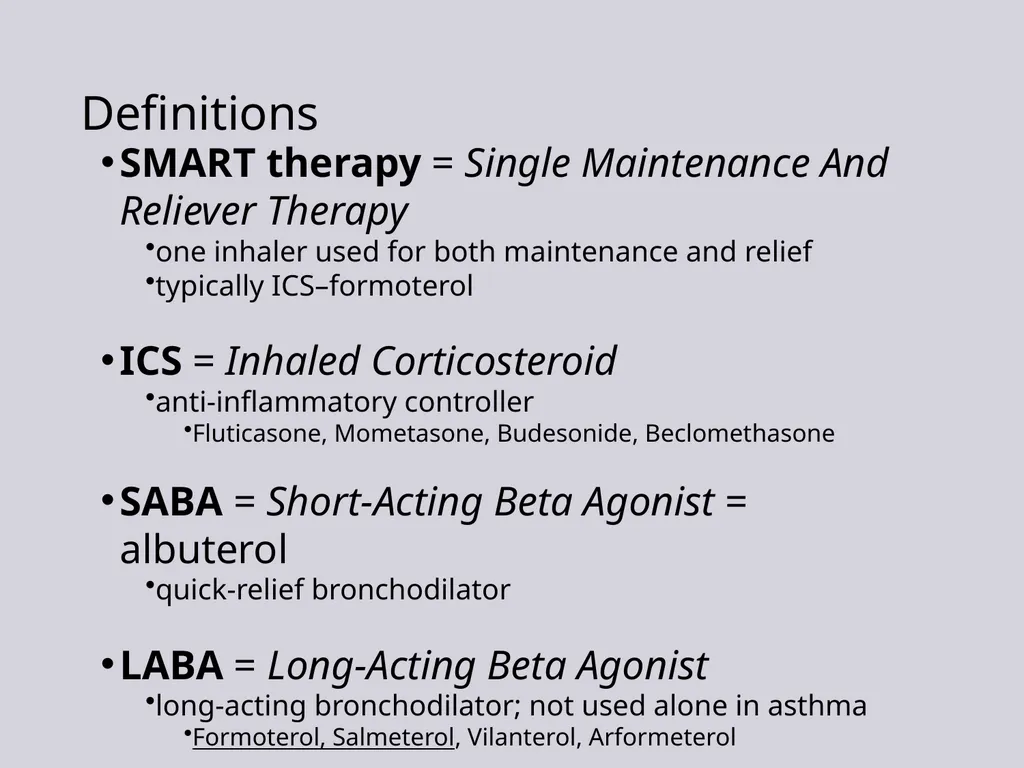
Definitions SMART therapy = Single Maintenance And Reliever Therapy
one inhaler used for both maintenance and relief
typically ICS–formoterol
ICS = Inhaled Corticosteroid
anti-inflammatory controller
Fluticasone, Mometasone, Budesonide, Beclomethasone
SABA = Short-Acting Beta Agonist = albuterol
quick-relief bronchodilator
LABA = Long-Acting Beta Agonist
long-acting bronchodilator; not used alone in asthma
Formoterol, Salmeterol, Vilanterol, Arformeterol<br>
one inhaler used for both maintenance and relief
typically ICS–formoterol
ICS = Inhaled Corticosteroid
anti-inflammatory controller
Fluticasone, Mometasone, Budesonide, Beclomethasone
SABA = Short-Acting Beta Agonist = albuterol
quick-relief bronchodilator
LABA = Long-Acting Beta Agonist
long-acting bronchodilator; not used alone in asthma
Formoterol, Salmeterol, Vilanterol, Arformeterol<br>
07
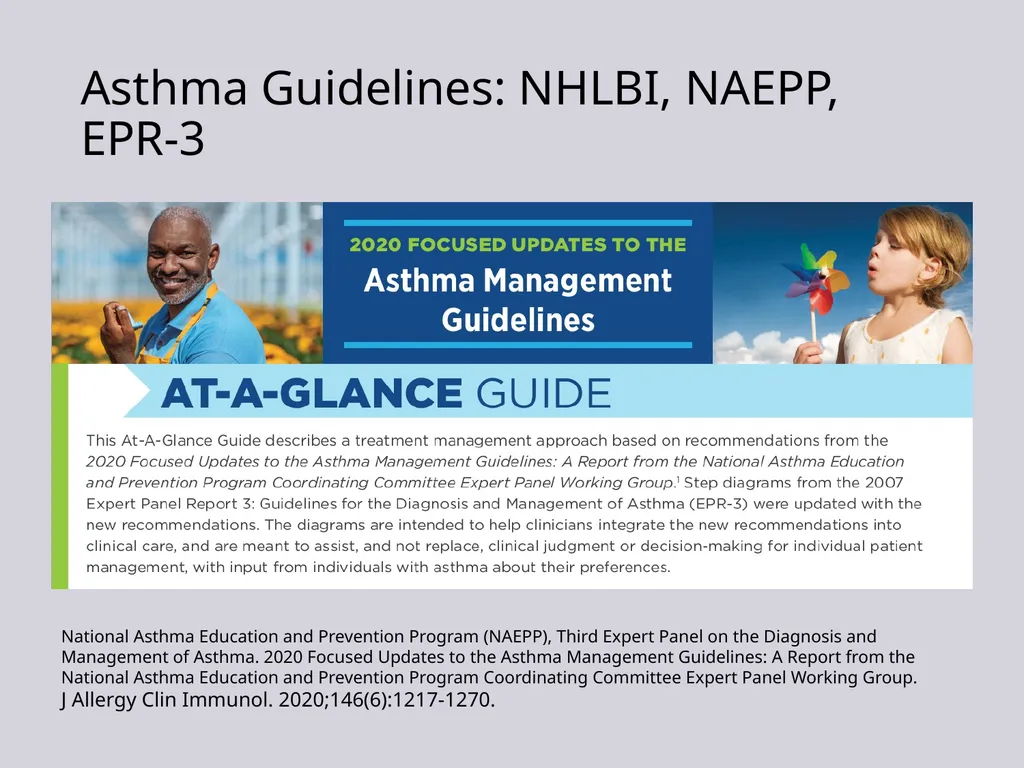
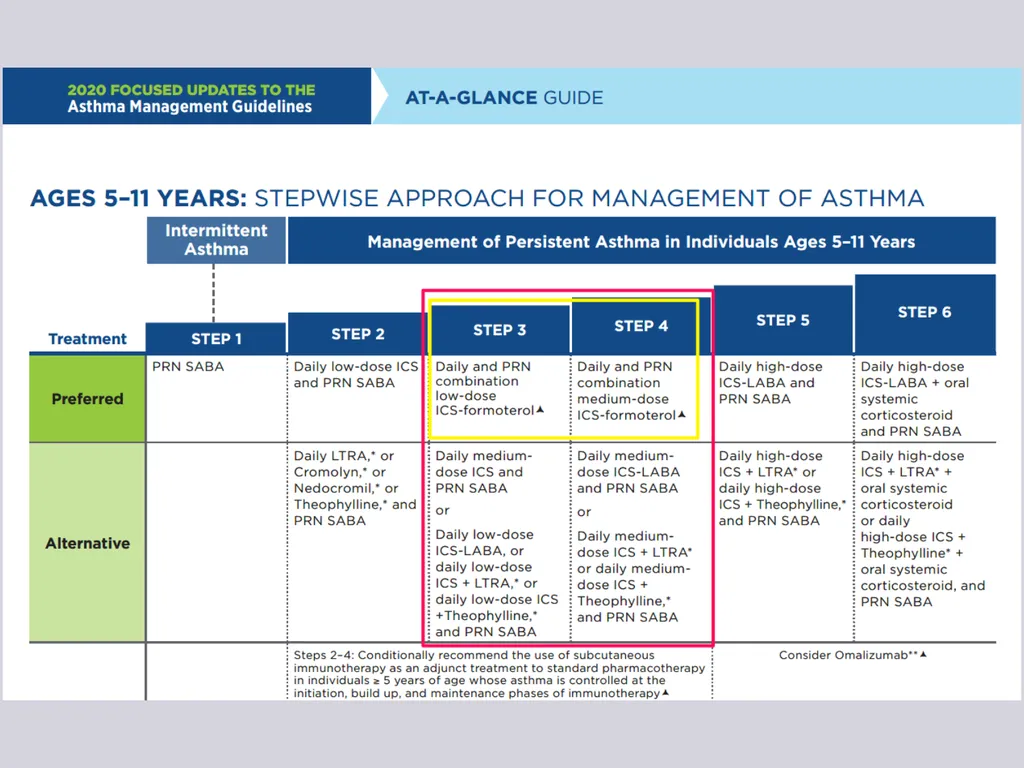
Asthma Guidelines: NHLBI, NAEPP, EPR-3 National Asthma Education and Prevention Program (NAEPP), Third Expert Panel on the Diagnosis and Management of Asthma. 2020 Focused Updates to the Asthma Management Guidelines: A Report from the National Asthma Education and Prevention Program Coordinating Committee Expert Panel Working Group.
J Allergy Clin Immunol. 2020;146(6):1217-1270.<br>
J Allergy Clin Immunol. 2020;146(6):1217-1270.<br>
08
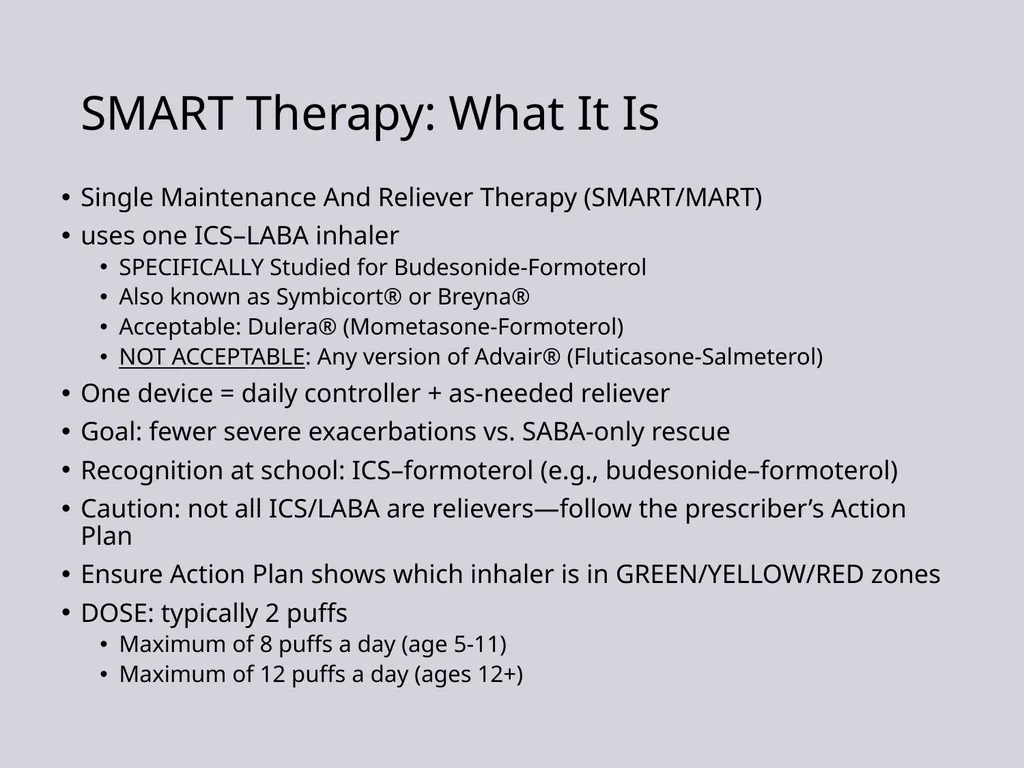
SMART Therapy: What It Is Single Maintenance And Reliever Therapy (SMART/MART)
uses one ICS–LABA inhaler
SPECIFICALLY Studied for Budesonide-Formoterol
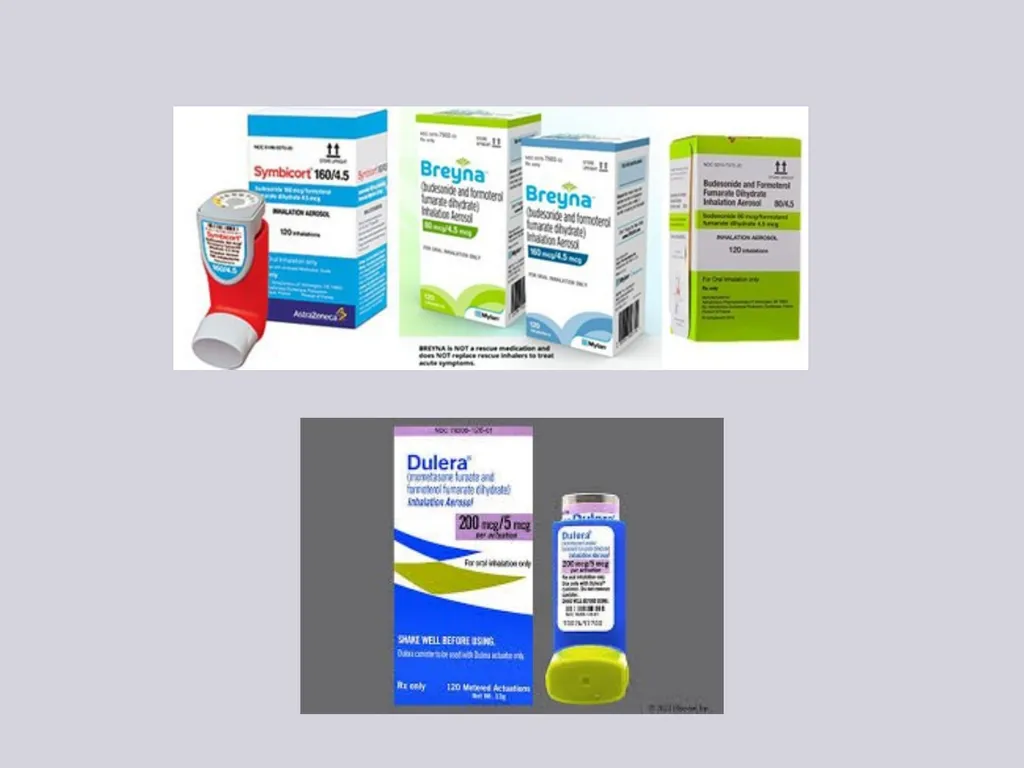
Also known as Symbicort® or Breyna®
Acceptable: Dulera® (Mometasone-Formoterol)
NOT ACCEPTABLE: Any version of Advair® (Fluticasone-Salmeterol)
One device = daily controller + as‑needed reliever
Goal: fewer severe exacerbations vs. SABA‑only rescue
Recognition at school: ICS–formoterol (e.g., budesonide–formoterol)
Caution: not all ICS/LABA are relievers—follow the prescriber’s Action Plan
Ensure Action Plan shows which inhaler is in GREEN/YELLOW/RED zones
DOSE: typically 2 puffs
Maximum of 8 puffs a day (age 5-11)
Maximum of 12 puffs a day (ages 12+)<br>
uses one ICS–LABA inhaler
SPECIFICALLY Studied for Budesonide-Formoterol
Also known as Symbicort® or Breyna®
Acceptable: Dulera® (Mometasone-Formoterol)
NOT ACCEPTABLE: Any version of Advair® (Fluticasone-Salmeterol)
One device = daily controller + as‑needed reliever
Goal: fewer severe exacerbations vs. SABA‑only rescue
Recognition at school: ICS–formoterol (e.g., budesonide–formoterol)
Caution: not all ICS/LABA are relievers—follow the prescriber’s Action Plan
Ensure Action Plan shows which inhaler is in GREEN/YELLOW/RED zones
DOSE: typically 2 puffs
Maximum of 8 puffs a day (age 5-11)
Maximum of 12 puffs a day (ages 12+)<br>
09
Moving Away from Albuterol‑Only Rescue Why: SABA‑only is linked with higher exacerbation risk
Preferred when prescribed: anti‑inflammatory reliever
Specifically: ICS–formoterol
If SABA is used, many plans add ICS with each SABA use
School action: follow the written Asthma Action Plan precisely<br>
Preferred when prescribed: anti‑inflammatory reliever
Specifically: ICS–formoterol
If SABA is used, many plans add ICS with each SABA use
School action: follow the written Asthma Action Plan precisely<br>
10
Examples OLD: Albuterol 2 puffs, repeat in 4 hours
NEW (1)
ICS/Formoterol 2 puffs PRN, max 8-12 puffs a day
NEW (2)
Albuterol Sulfate HFA 2 puffs PRN PLUS
Fluticasone Propionate HFA 2 puffs AT THE SAME TIME (or other ICS)<br>
NEW (1)
ICS/Formoterol 2 puffs PRN, max 8-12 puffs a day
NEW (2)
Albuterol Sulfate HFA 2 puffs PRN PLUS
Fluticasone Propionate HFA 2 puffs AT THE SAME TIME (or other ICS)<br>
11
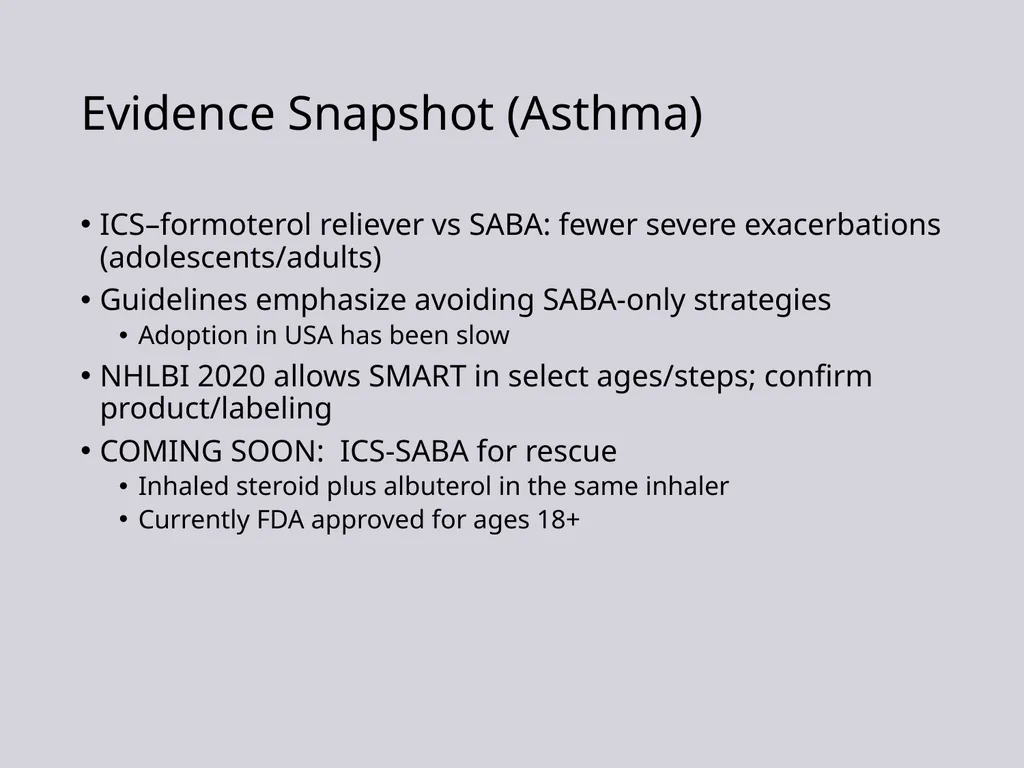
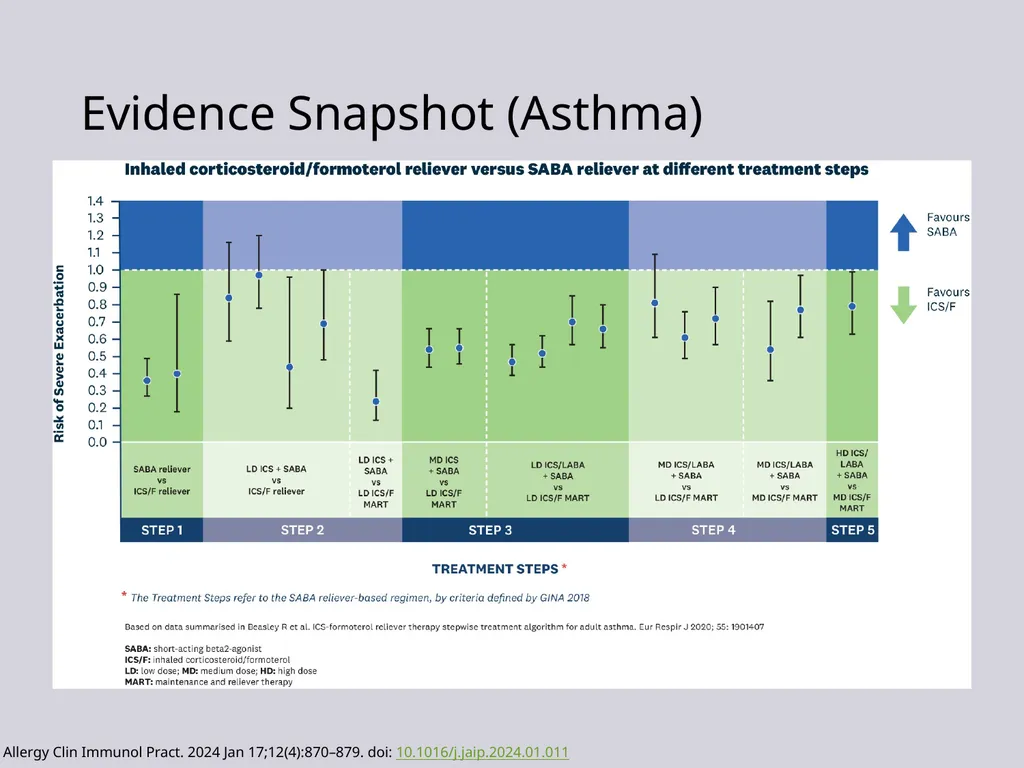
Evidence Snapshot (Asthma) ICS–formoterol reliever vs SABA: fewer severe exacerbations (adolescents/adults)
Guidelines emphasize avoiding SABA‑only strategies
Adoption in USA has been slow
NHLBI 2020 allows SMART in select ages/steps; confirm product/labeling
COMING SOON: ICS-SABA for rescue
Inhaled steroid plus albuterol in the same inhaler
Currently FDA approved for ages 18+<br>
Guidelines emphasize avoiding SABA‑only strategies
Adoption in USA has been slow
NHLBI 2020 allows SMART in select ages/steps; confirm product/labeling
COMING SOON: ICS-SABA for rescue
Inhaled steroid plus albuterol in the same inhaler
Currently FDA approved for ages 18+<br>
12
Evidence Snapshot (Asthma) J Allergy Clin Immunol Pract. 2024 Jan 17;12(4):870–879. doi: 10.1016/j.jaip.2024.01.011<br>
13
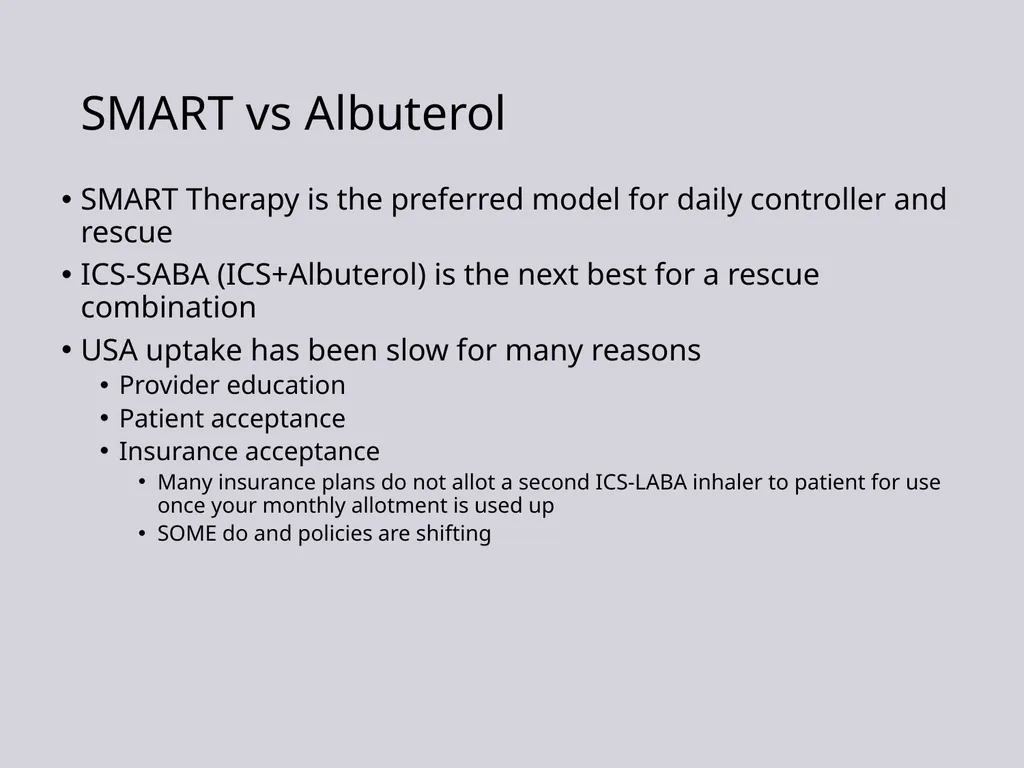
SMART vs Albuterol SMART Therapy is the preferred model for daily controller and rescue
ICS-SABA (ICS+Albuterol) is the next best for a rescue combination
USA uptake has been slow for many reasons
Provider education
Patient acceptance
Insurance acceptance
Many insurance plans do not allot a second ICS-LABA inhaler to patient for use once your monthly allotment is used up
SOME do and policies are shifting<br>
ICS-SABA (ICS+Albuterol) is the next best for a rescue combination
USA uptake has been slow for many reasons
Provider education
Patient acceptance
Insurance acceptance
Many insurance plans do not allot a second ICS-LABA inhaler to patient for use once your monthly allotment is used up
SOME do and policies are shifting<br>
14
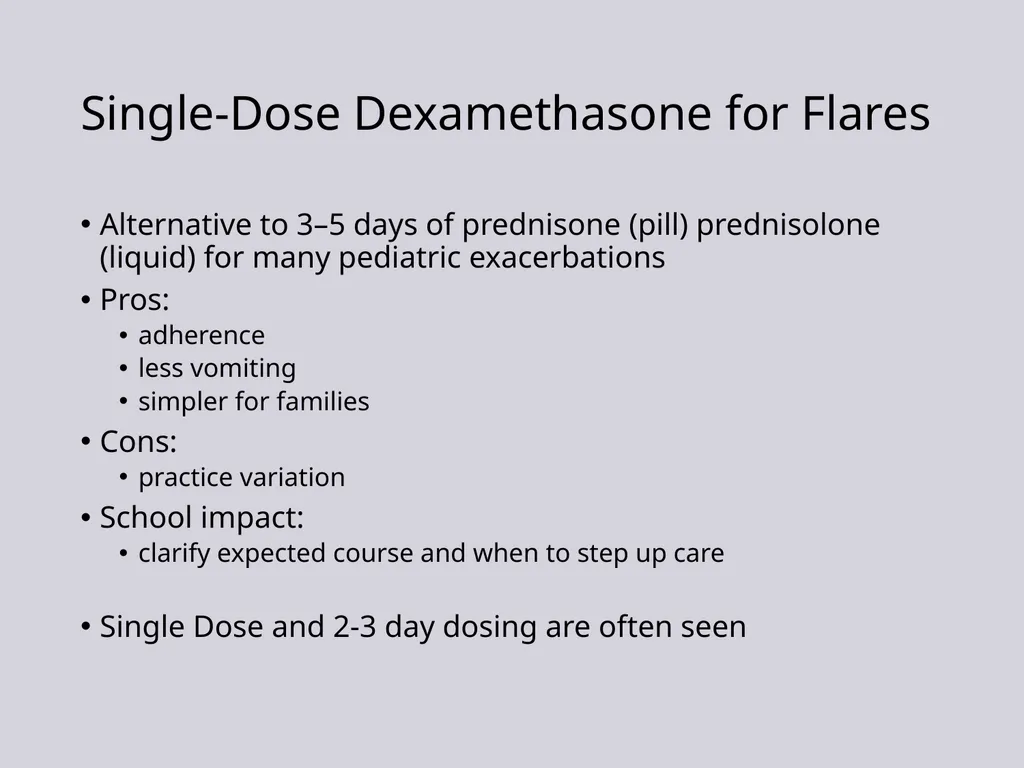
Single‑Dose Dexamethasone for Flares Alternative to 3–5 days of prednisone (pill) prednisolone (liquid) for many pediatric exacerbations
Pros:
adherence
less vomiting
simpler for families
Cons:
practice variation
School impact:
clarify expected course and when to step up care
Single Dose and 2-3 day dosing are often seen<br>
Pros:
adherence
less vomiting
simpler for families
Cons:
practice variation
School impact:
clarify expected course and when to step up care
Single Dose and 2-3 day dosing are often seen<br>
15
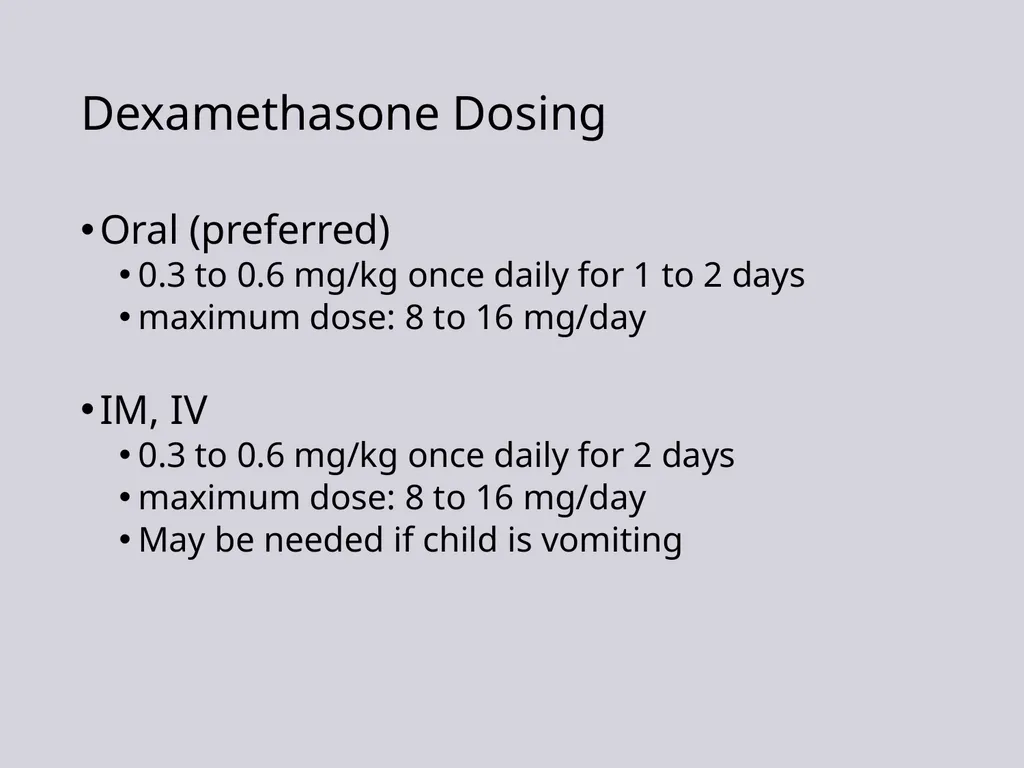
Dexamethasone Dosing Oral (preferred)
0.3 to 0.6 mg/kg once daily for 1 to 2 days
maximum dose: 8 to 16 mg/day
IM, IV
0.3 to 0.6 mg/kg once daily for 2 days
maximum dose: 8 to 16 mg/day
May be needed if child is vomiting<br>
0.3 to 0.6 mg/kg once daily for 1 to 2 days
maximum dose: 8 to 16 mg/day
IM, IV
0.3 to 0.6 mg/kg once daily for 2 days
maximum dose: 8 to 16 mg/day
May be needed if child is vomiting<br>
16
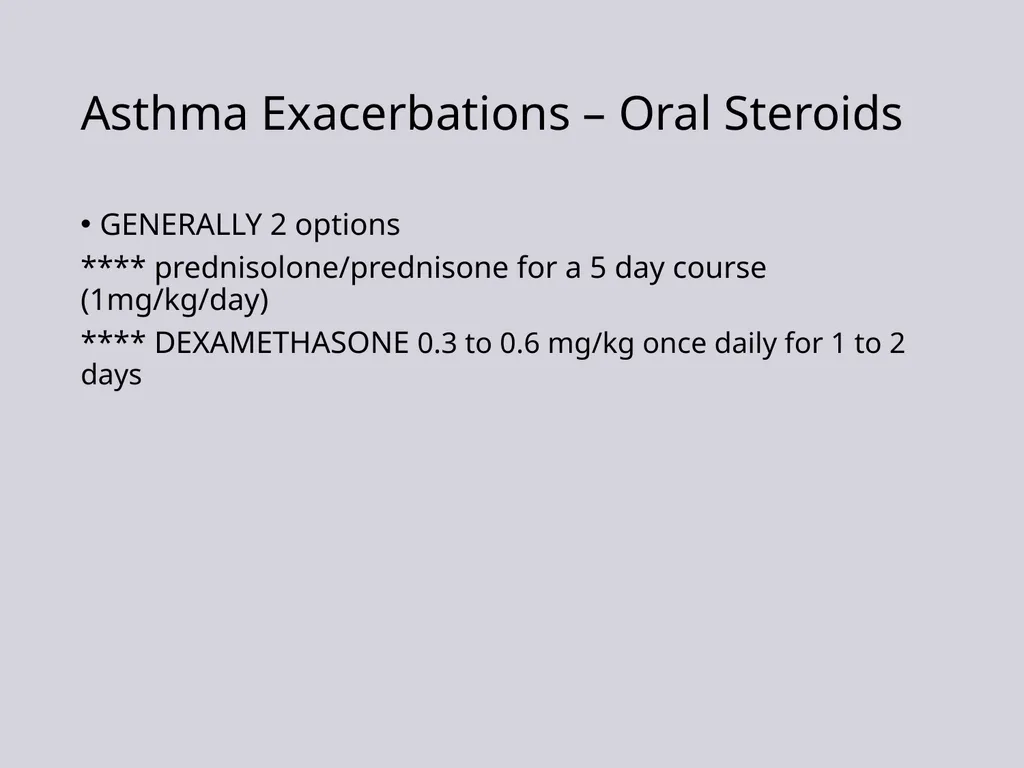
Asthma Exacerbations – Oral Steroids GENERALLY 2 options
**** prednisolone/prednisone for a 5 day course (1mg/kg/day)
**** DEXAMETHASONE 0.3 to 0.6 mg/kg once daily for 1 to 2 days<br>
**** prednisolone/prednisone for a 5 day course (1mg/kg/day)
**** DEXAMETHASONE 0.3 to 0.6 mg/kg once daily for 1 to 2 days<br>
17
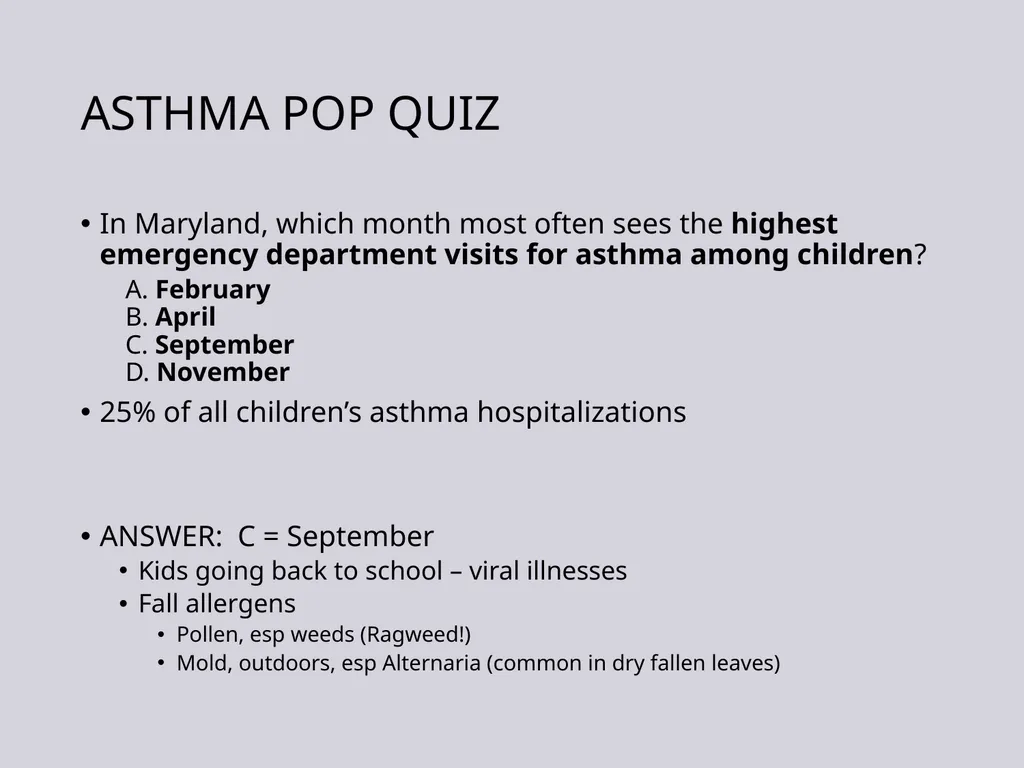
ASTHMA POP QUIZ In Maryland, which month most often sees the highest emergency department visits for asthma among children?
A. February B. April C. September D. November
25% of all children’s asthma hospitalizations
ANSWER: C = September
Kids going back to school – viral illnesses
Fall allergens
Pollen, esp weeds (Ragweed!)
Mold, outdoors, esp Alternaria (common in dry fallen leaves)<br>
A. February B. April C. September D. November
25% of all children’s asthma hospitalizations
ANSWER: C = September
Kids going back to school – viral illnesses
Fall allergens
Pollen, esp weeds (Ragweed!)
Mold, outdoors, esp Alternaria (common in dry fallen leaves)<br>
18
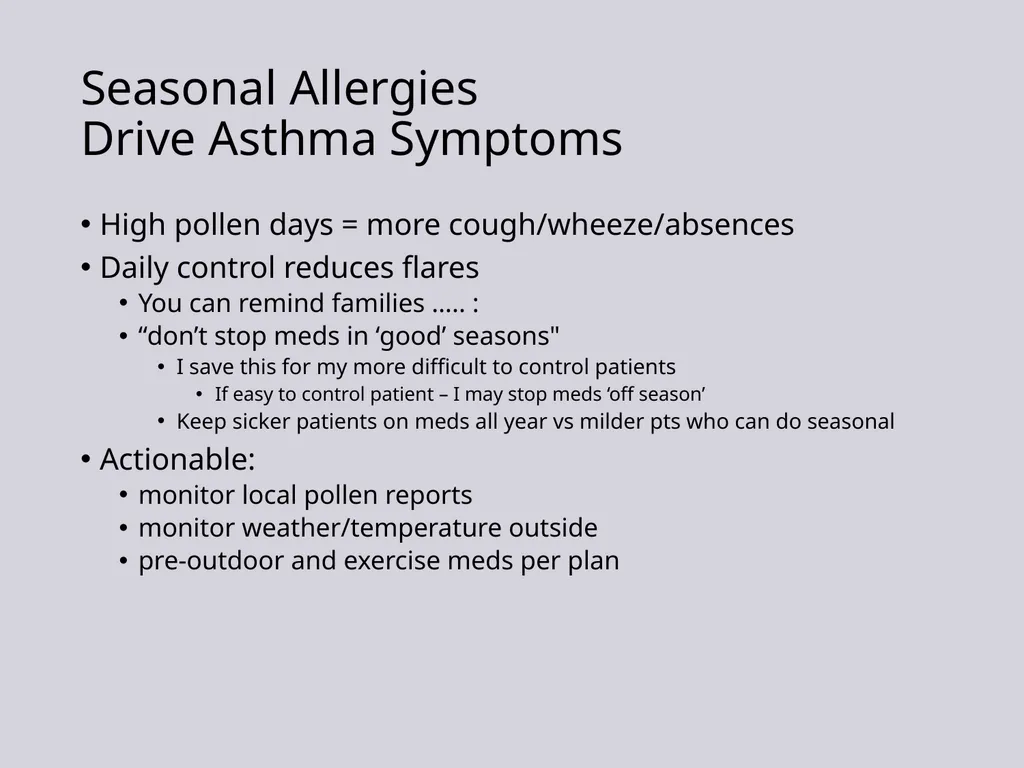
Seasonal Allergies
Drive Asthma Symptoms High pollen days = more cough/wheeze/absences
Daily control reduces flares
You can remind families ….. :
“don’t stop meds in ‘good’ seasons"
I save this for my more difficult to control patients
If easy to control patient – I may stop meds ‘off season’
Keep sicker patients on meds all year vs milder pts who can do seasonal
Actionable:
monitor local pollen reports
monitor weather/temperature outside
pre‑outdoor and exercise meds per plan<br>
Daily control reduces flares
You can remind families ….. :
“don’t stop meds in ‘good’ seasons"
I save this for my more difficult to control patients
If easy to control patient – I may stop meds ‘off season’
Keep sicker patients on meds all year vs milder pts who can do seasonal
Actionable:
monitor local pollen reports
monitor weather/temperature outside
pre‑outdoor and exercise meds per plan<br>
19
Allergy & Asthma Seasons in Maryland Spring
Tree & grass pollens peak
Changing weather fronts can trigger symptoms
POLLEN CAN START IN EARLY FEBRUARY!!!
Summer
Grass and weed pollens
Heat/hot weather can worsen airway reactivity
Fall
Weather shifts; back‑to‑school viral URIs increase
Outdoor airborne molds (e.g., Alternaria) and weed pollens
Winter
Cold air exposure; more time indoors
Higher indoor allergen load: house dust mite, pet dander
Flu / RSV / URIs in general<br>
Tree & grass pollens peak
Changing weather fronts can trigger symptoms
POLLEN CAN START IN EARLY FEBRUARY!!!
Summer
Grass and weed pollens
Heat/hot weather can worsen airway reactivity
Fall
Weather shifts; back‑to‑school viral URIs increase
Outdoor airborne molds (e.g., Alternaria) and weed pollens
Winter
Cold air exposure; more time indoors
Higher indoor allergen load: house dust mite, pet dander
Flu / RSV / URIs in general<br>
20
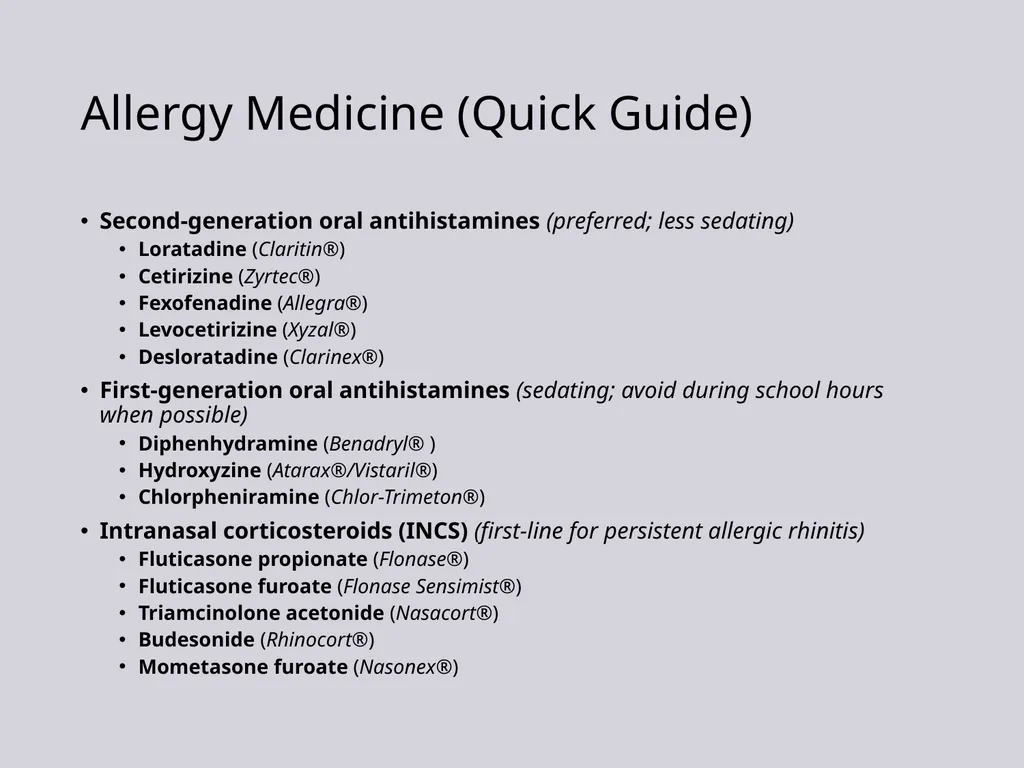
Allergy Medicine (Quick Guide) Second-generation oral antihistamines (preferred; less sedating)
Loratadine (Claritin®)
Cetirizine (Zyrtec®)
Fexofenadine (Allegra®)
Levocetirizine (Xyzal®)
Desloratadine (Clarinex®)
First-generation oral antihistamines (sedating; avoid during school hours when possible)
Diphenhydramine (Benadryl® )
Hydroxyzine (Atarax®/Vistaril®)
Chlorpheniramine (Chlor-Trimeton®)
Intranasal corticosteroids (INCS) (first-line for persistent allergic rhinitis)
Fluticasone propionate (Flonase®)
Fluticasone furoate (Flonase Sensimist®)
Triamcinolone acetonide (Nasacort®)
Budesonide (Rhinocort®)
Mometasone furoate (Nasonex®)<br>
Loratadine (Claritin®)
Cetirizine (Zyrtec®)
Fexofenadine (Allegra®)
Levocetirizine (Xyzal®)
Desloratadine (Clarinex®)
First-generation oral antihistamines (sedating; avoid during school hours when possible)
Diphenhydramine (Benadryl® )
Hydroxyzine (Atarax®/Vistaril®)
Chlorpheniramine (Chlor-Trimeton®)
Intranasal corticosteroids (INCS) (first-line for persistent allergic rhinitis)
Fluticasone propionate (Flonase®)
Fluticasone furoate (Flonase Sensimist®)
Triamcinolone acetonide (Nasacort®)
Budesonide (Rhinocort®)
Mometasone furoate (Nasonex®)<br>
21
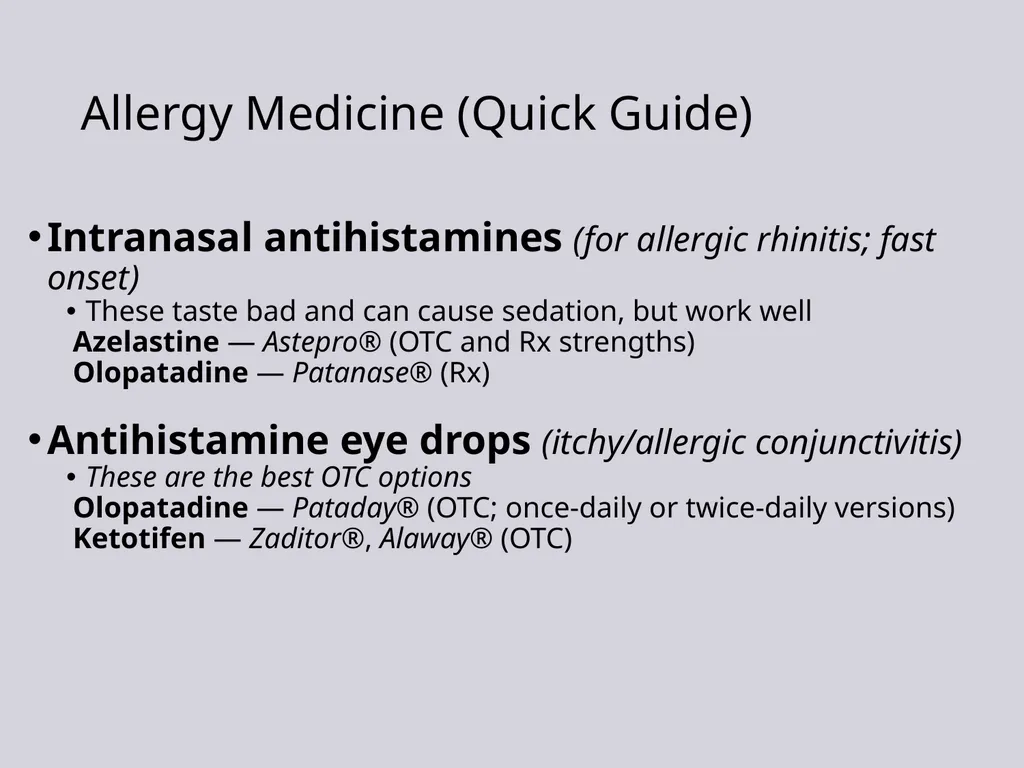
Allergy Medicine (Quick Guide) Intranasal antihistamines (for allergic rhinitis; fast onset)
These taste bad and can cause sedation, but work well
Azelastine — Astepro® (OTC and Rx strengths)
Olopatadine — Patanase® (Rx)
Antihistamine eye drops (itchy/allergic conjunctivitis)
These are the best OTC options
Olopatadine — Pataday® (OTC; once-daily or twice-daily versions)
Ketotifen — Zaditor®, Alaway® (OTC)<br>
These taste bad and can cause sedation, but work well
Azelastine — Astepro® (OTC and Rx strengths)
Olopatadine — Patanase® (Rx)
Antihistamine eye drops (itchy/allergic conjunctivitis)
These are the best OTC options
Olopatadine — Pataday® (OTC; once-daily or twice-daily versions)
Ketotifen — Zaditor®, Alaway® (OTC)<br>
22
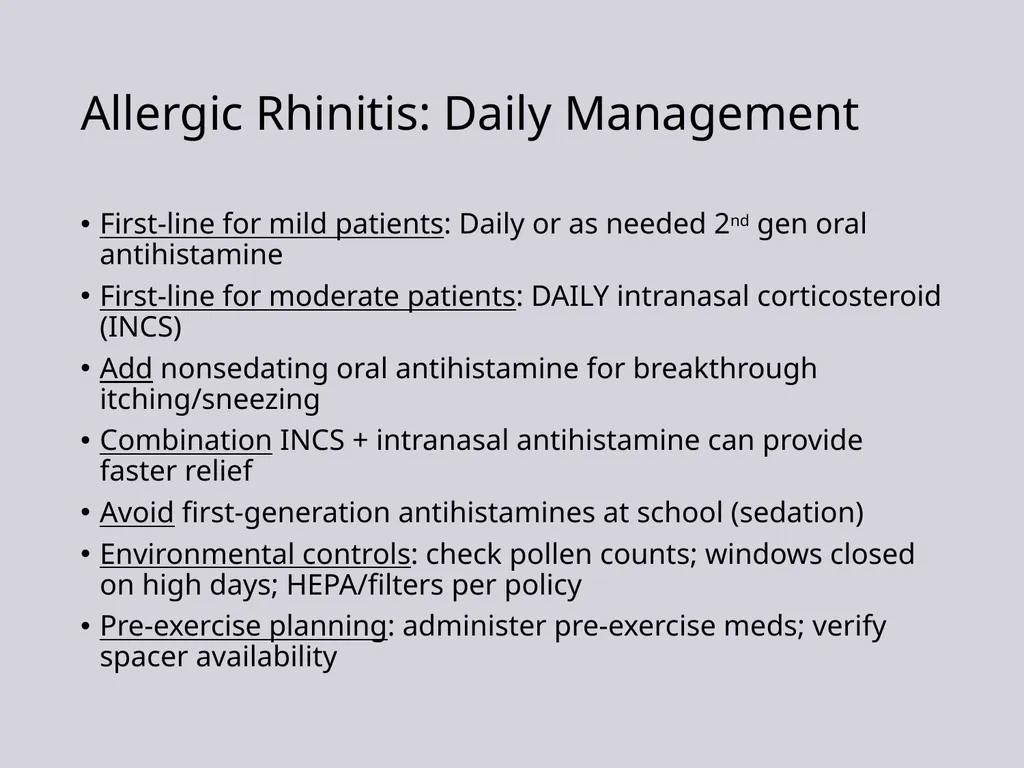
Allergic Rhinitis: Daily Management First-line for mild patients: Daily or as needed 2nd gen oral antihistamine
First‑line for moderate patients: DAILY intranasal corticosteroid (INCS)
Add nonsedating oral antihistamine for breakthrough itching/sneezing
Combination INCS + intranasal antihistamine can provide faster relief
Avoid first‑generation antihistamines at school (sedation)
Environmental controls: check pollen counts; windows closed on high days; HEPA/filters per policy
Pre‑exercise planning: administer pre‑exercise meds; verify spacer availability<br>
First‑line for moderate patients: DAILY intranasal corticosteroid (INCS)
Add nonsedating oral antihistamine for breakthrough itching/sneezing
Combination INCS + intranasal antihistamine can provide faster relief
Avoid first‑generation antihistamines at school (sedation)
Environmental controls: check pollen counts; windows closed on high days; HEPA/filters per policy
Pre‑exercise planning: administer pre‑exercise meds; verify spacer availability<br>
23
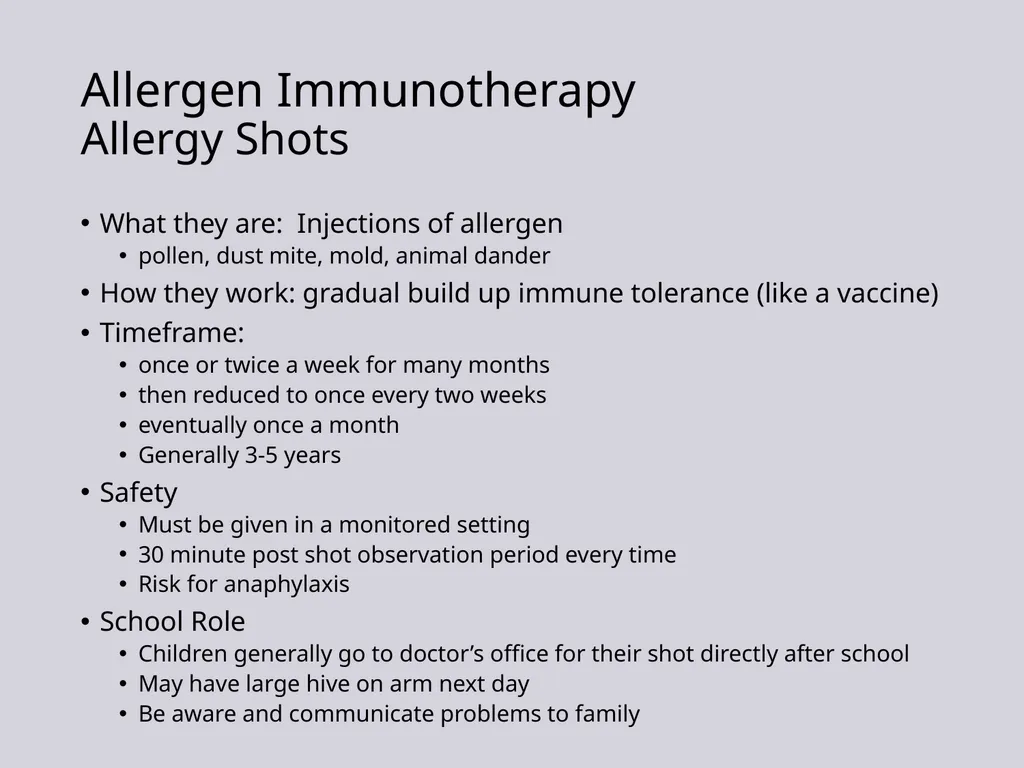
Allergen Immunotherapy
Allergy Shots What they are: Injections of allergen
pollen, dust mite, mold, animal dander
How they work: gradual build up immune tolerance (like a vaccine)
Timeframe:
once or twice a week for many months
then reduced to once every two weeks
eventually once a month
Generally 3-5 years
Safety
Must be given in a monitored setting
30 minute post shot observation period every time
Risk for anaphylaxis
School Role
Children generally go to doctor’s office for their shot directly after school
May have large hive on arm next day
Be aware and communicate problems to family<br>
pollen, dust mite, mold, animal dander
How they work: gradual build up immune tolerance (like a vaccine)
Timeframe:
once or twice a week for many months
then reduced to once every two weeks
eventually once a month
Generally 3-5 years
Safety
Must be given in a monitored setting
30 minute post shot observation period every time
Risk for anaphylaxis
School Role
Children generally go to doctor’s office for their shot directly after school
May have large hive on arm next day
Be aware and communicate problems to family<br>
24
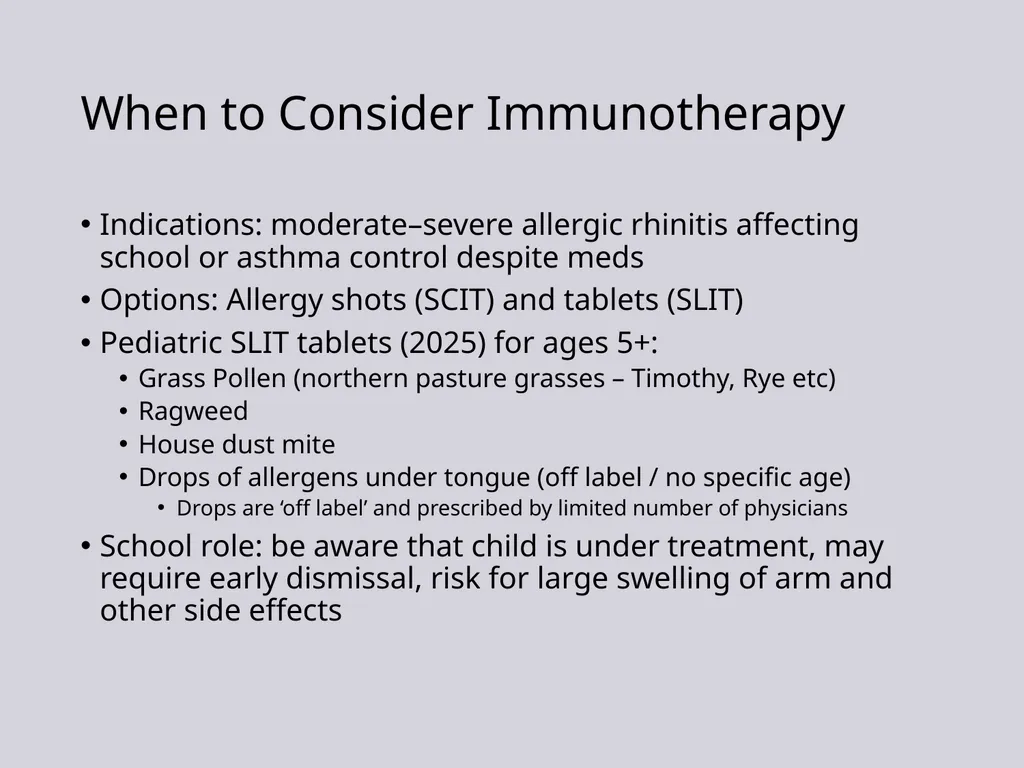
When to Consider Immunotherapy Indications: moderate–severe allergic rhinitis affecting school or asthma control despite meds
Options: Allergy shots (SCIT) and tablets (SLIT)
Pediatric SLIT tablets (2025) for ages 5+:
Grass Pollen (northern pasture grasses – Timothy, Rye etc)
Ragweed
House dust mite
Drops of allergens under tongue (off label / no specific age)
Drops are ‘off label’ and prescribed by limited number of physicians
School role: be aware that child is under treatment, may require early dismissal, risk for large swelling of arm and other side effects<br>
Options: Allergy shots (SCIT) and tablets (SLIT)
Pediatric SLIT tablets (2025) for ages 5+:
Grass Pollen (northern pasture grasses – Timothy, Rye etc)
Ragweed
House dust mite
Drops of allergens under tongue (off label / no specific age)
Drops are ‘off label’ and prescribed by limited number of physicians
School role: be aware that child is under treatment, may require early dismissal, risk for large swelling of arm and other side effects<br>
25
Benadryl (diphenhydramine):
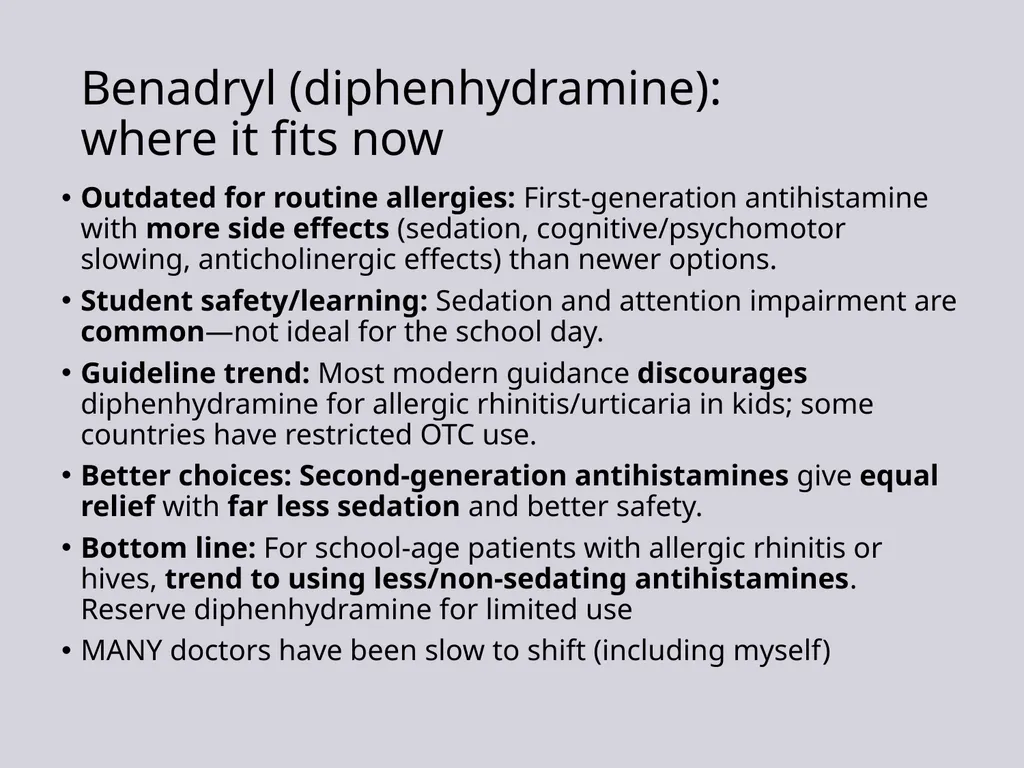
where it fits now Outdated for routine allergies: First-generation antihistamine with more side effects (sedation, cognitive/psychomotor slowing, anticholinergic effects) than newer options.
Student safety/learning: Sedation and attention impairment are common—not ideal for the school day.
Guideline trend: Most modern guidance discourages diphenhydramine for allergic rhinitis/urticaria in kids; some countries have restricted OTC use.
Better choices: Second-generation antihistamines give equal relief with far less sedation and better safety.
Bottom line: For school-age patients with allergic rhinitis or hives, trend to using less/non-sedating antihistamines. Reserve diphenhydramine for limited use
MANY doctors have been slow to shift (including myself)<br>
Student safety/learning: Sedation and attention impairment are common—not ideal for the school day.
Guideline trend: Most modern guidance discourages diphenhydramine for allergic rhinitis/urticaria in kids; some countries have restricted OTC use.
Better choices: Second-generation antihistamines give equal relief with far less sedation and better safety.
Bottom line: For school-age patients with allergic rhinitis or hives, trend to using less/non-sedating antihistamines. Reserve diphenhydramine for limited use
MANY doctors have been slow to shift (including myself)<br>
26
Food Allergy: Updates & Practical Management Risk reduction, treatment options, and emergency response<br>
27
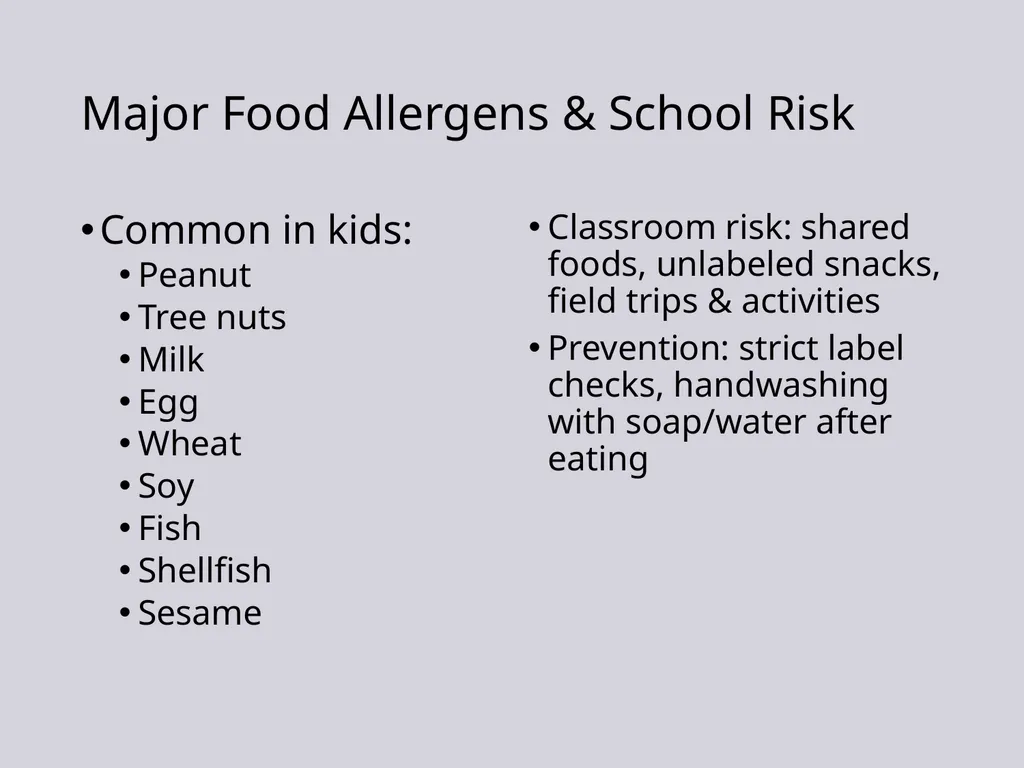
Major Food Allergens & School Risk Common in kids:
Peanut
Tree nuts
Milk
Egg
Wheat
Soy
Fish
Shellfish
Sesame Classroom risk: shared foods, unlabeled snacks, field trips & activities
Prevention: strict label checks, handwashing with soap/water after eating<br>
Peanut
Tree nuts
Milk
Egg
Wheat
Soy
Fish
Shellfish
Sesame Classroom risk: shared foods, unlabeled snacks, field trips & activities
Prevention: strict label checks, handwashing with soap/water after eating<br>
28
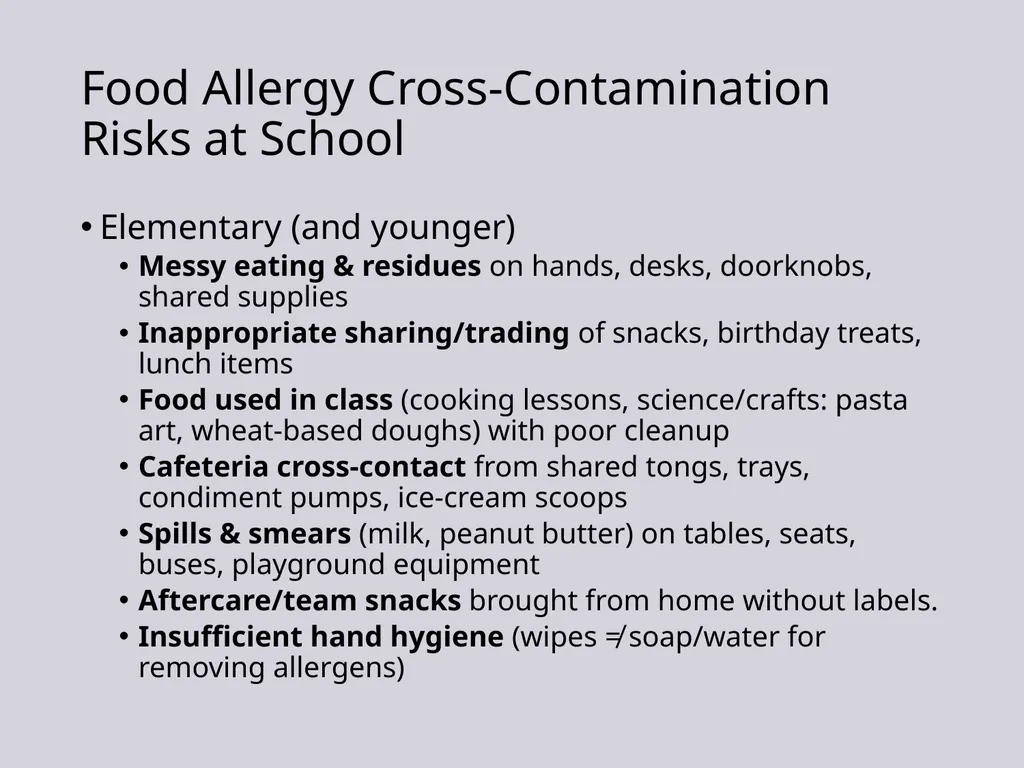
Food Allergy Cross-Contamination Risks at School Elementary (and younger)
Messy eating & residues on hands, desks, doorknobs, shared supplies
Inappropriate sharing/trading of snacks, birthday treats, lunch items
Food used in class (cooking lessons, science/crafts: pasta art, wheat-based doughs) with poor cleanup
Cafeteria cross-contact from shared tongs, trays, condiment pumps, ice-cream scoops
Spills & smears (milk, peanut butter) on tables, seats, buses, playground equipment
Aftercare/team snacks brought from home without labels.
Insufficient hand hygiene (wipes ≠ soap/water for removing allergens)<br>
Messy eating & residues on hands, desks, doorknobs, shared supplies
Inappropriate sharing/trading of snacks, birthday treats, lunch items
Food used in class (cooking lessons, science/crafts: pasta art, wheat-based doughs) with poor cleanup
Cafeteria cross-contact from shared tongs, trays, condiment pumps, ice-cream scoops
Spills & smears (milk, peanut butter) on tables, seats, buses, playground equipment
Aftercare/team snacks brought from home without labels.
Insufficient hand hygiene (wipes ≠ soap/water for removing allergens)<br>
29
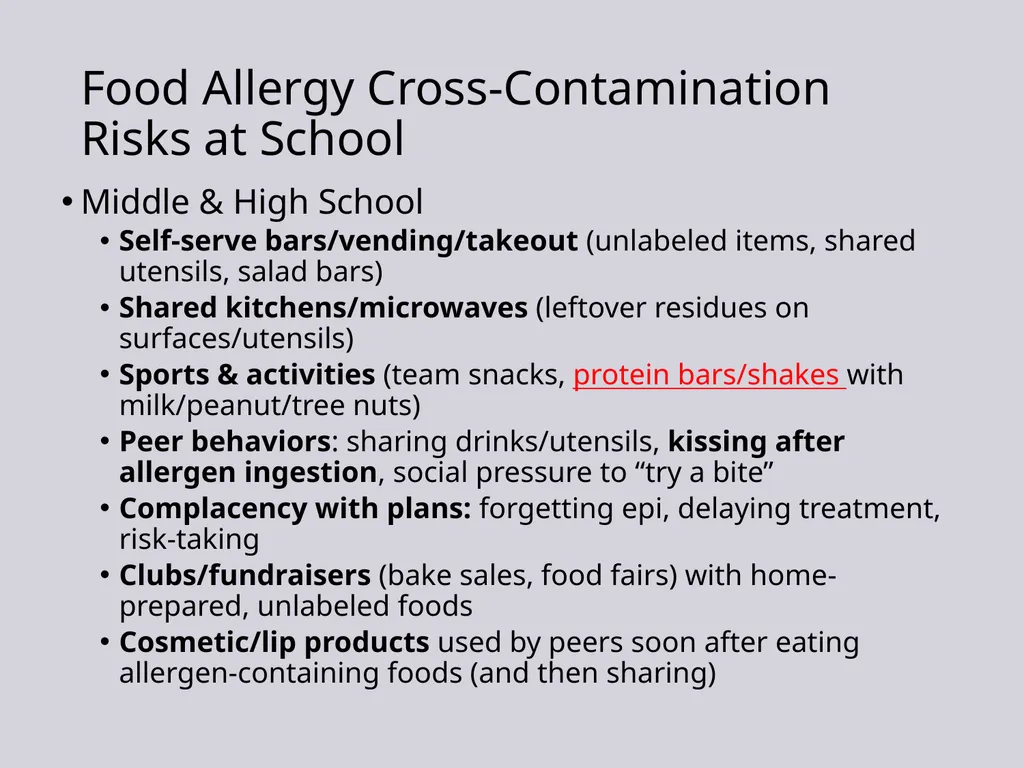
Food Allergy Cross-Contamination Risks at School Middle & High School
Self-serve bars/vending/takeout (unlabeled items, shared utensils, salad bars)
Shared kitchens/microwaves (leftover residues on surfaces/utensils)
Sports & activities (team snacks, protein bars/shakes with milk/peanut/tree nuts)
Peer behaviors: sharing drinks/utensils, kissing after allergen ingestion, social pressure to “try a bite”
Complacency with plans: forgetting epi, delaying treatment, risk-taking
Clubs/fundraisers (bake sales, food fairs) with home-prepared, unlabeled foods
Cosmetic/lip products used by peers soon after eating allergen-containing foods (and then sharing)<br>
Self-serve bars/vending/takeout (unlabeled items, shared utensils, salad bars)
Shared kitchens/microwaves (leftover residues on surfaces/utensils)
Sports & activities (team snacks, protein bars/shakes with milk/peanut/tree nuts)
Peer behaviors: sharing drinks/utensils, kissing after allergen ingestion, social pressure to “try a bite”
Complacency with plans: forgetting epi, delaying treatment, risk-taking
Clubs/fundraisers (bake sales, food fairs) with home-prepared, unlabeled foods
Cosmetic/lip products used by peers soon after eating allergen-containing foods (and then sharing)<br>
30
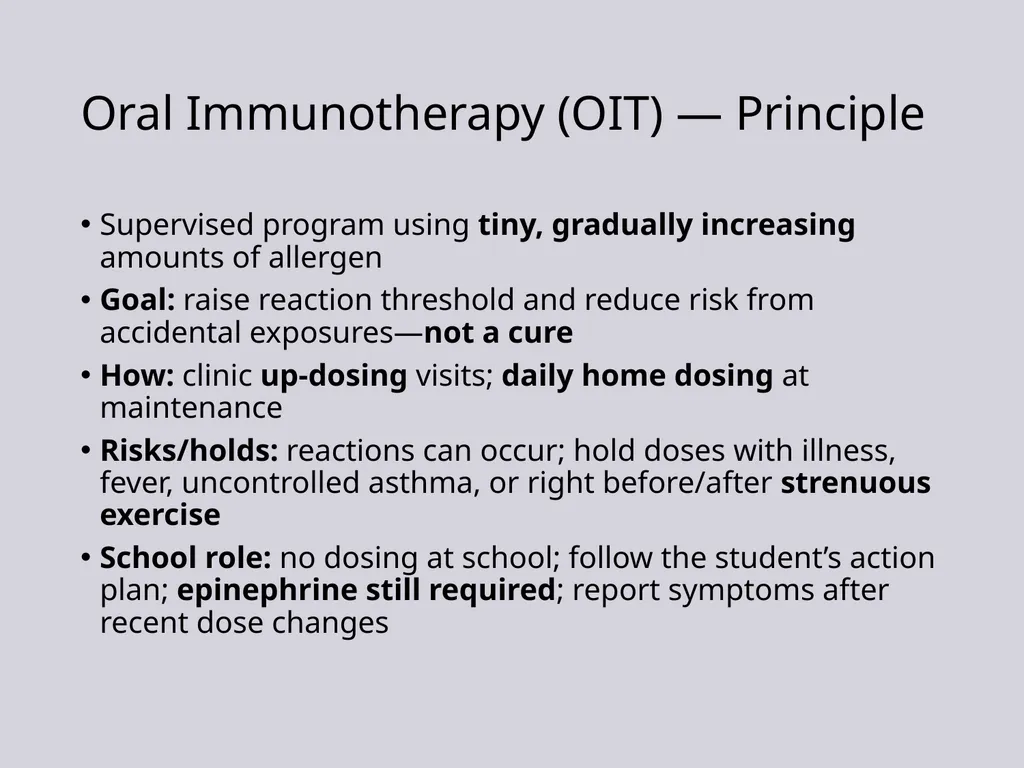
Oral Immunotherapy (OIT) — Principle Supervised program using tiny, gradually increasing amounts of allergen
Goal: raise reaction threshold and reduce risk from accidental exposures—not a cure
How: clinic up-dosing visits; daily home dosing at maintenance
Risks/holds: reactions can occur; hold doses with illness, fever, uncontrolled asthma, or right before/after strenuous exercise
School role: no dosing at school; follow the student’s action plan; epinephrine still required; report symptoms after recent dose changes<br>
Goal: raise reaction threshold and reduce risk from accidental exposures—not a cure
How: clinic up-dosing visits; daily home dosing at maintenance
Risks/holds: reactions can occur; hold doses with illness, fever, uncontrolled asthma, or right before/after strenuous exercise
School role: no dosing at school; follow the student’s action plan; epinephrine still required; report symptoms after recent dose changes<br>
31
Omalizumab (Xolair®) for Food Allergy FDA‑approved (2024) to reduce reactions from accidental exposure to multiple foods
For small ingestions (i.e. 3 peanuts) reduce risk for anaphylaxis by 70%
Ages ≥1 year; given as injections at 2-4 week intervals (clinic or home per plan)
Does not replace strict avoidance or epinephrine; adds safety margin
School plan: no change – continue to carry/use epinephrine per protocol<br>
For small ingestions (i.e. 3 peanuts) reduce risk for anaphylaxis by 70%
Ages ≥1 year; given as injections at 2-4 week intervals (clinic or home per plan)
Does not replace strict avoidance or epinephrine; adds safety margin
School plan: no change – continue to carry/use epinephrine per protocol<br>
32
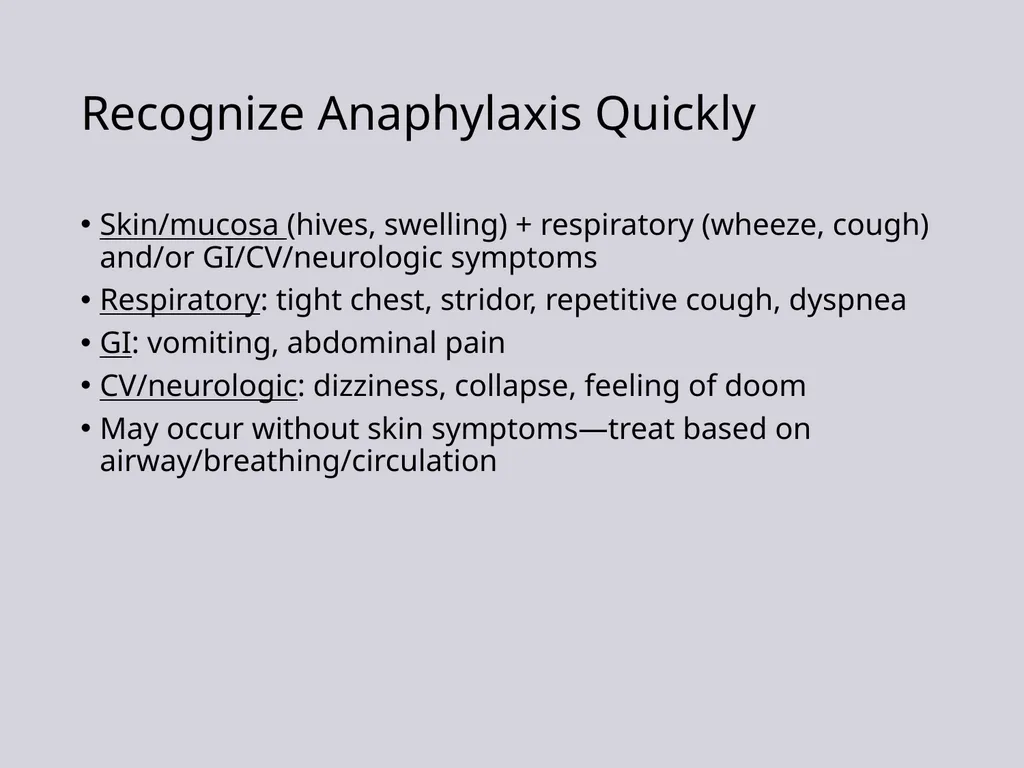
Recognize Anaphylaxis Quickly Skin/mucosa (hives, swelling) + respiratory (wheeze, cough) and/or GI/CV/neurologic symptoms
Respiratory: tight chest, stridor, repetitive cough, dyspnea
GI: vomiting, abdominal pain
CV/neurologic: dizziness, collapse, feeling of doom
May occur without skin symptoms—treat based on airway/breathing/circulation<br>
Respiratory: tight chest, stridor, repetitive cough, dyspnea
GI: vomiting, abdominal pain
CV/neurologic: dizziness, collapse, feeling of doom
May occur without skin symptoms—treat based on airway/breathing/circulation<br>
33
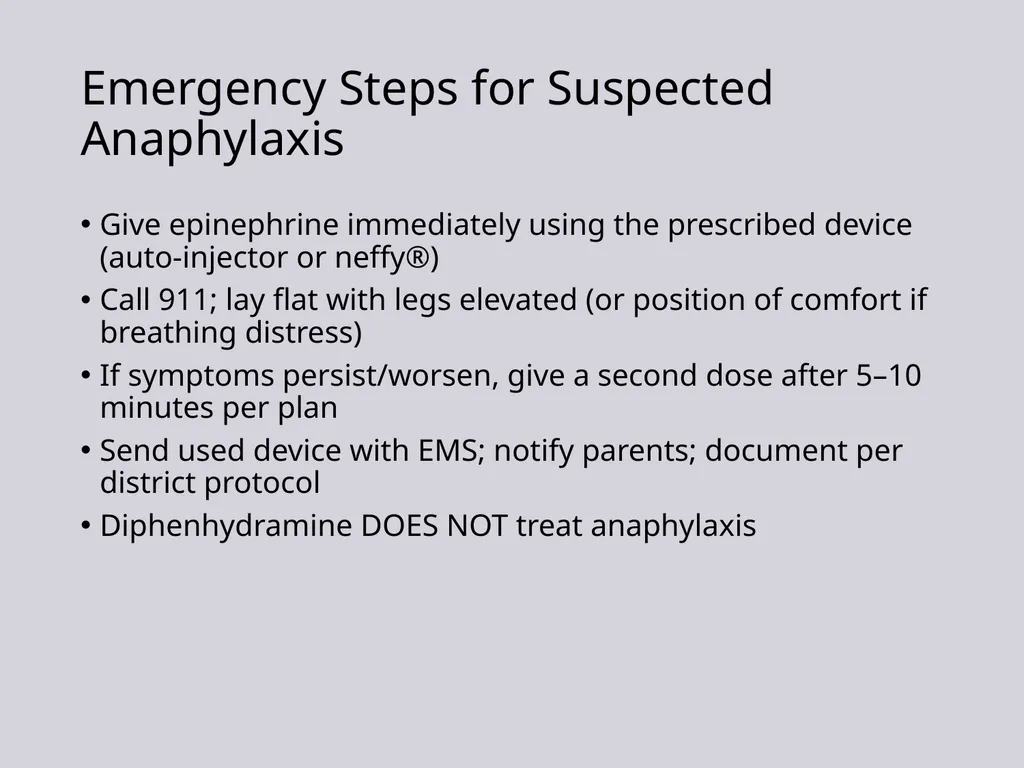
Emergency Steps for Suspected Anaphylaxis Give epinephrine immediately using the prescribed device (auto‑injector or neffy®)
Call 911; lay flat with legs elevated (or position of comfort if breathing distress)
If symptoms persist/worsen, give a second dose after 5–10 minutes per plan
Send used device with EMS; notify parents; document per district protocol
Diphenhydramine DOES NOT treat anaphylaxis<br>
Call 911; lay flat with legs elevated (or position of comfort if breathing distress)
If symptoms persist/worsen, give a second dose after 5–10 minutes per plan
Send used device with EMS; notify parents; document per district protocol
Diphenhydramine DOES NOT treat anaphylaxis<br>
34
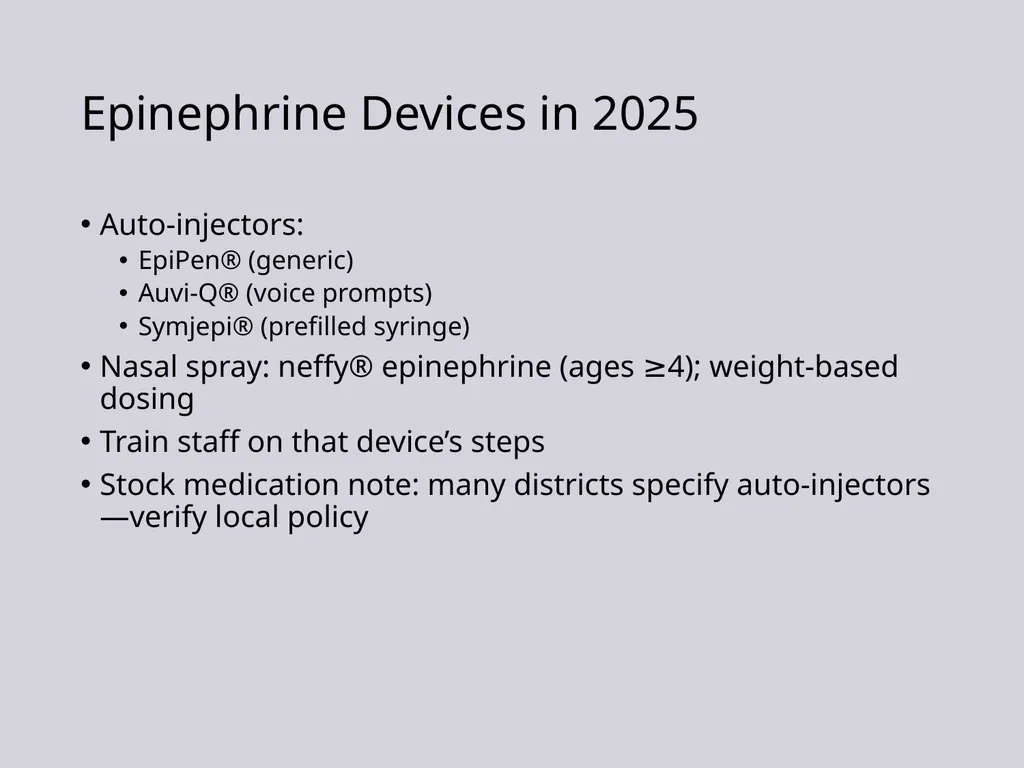
Epinephrine Devices in 2025 Auto‑injectors:
EpiPen® (generic)
Auvi‑Q® (voice prompts)
Symjepi® (prefilled syringe)
Nasal spray: neffy® epinephrine (ages ≥4); weight‑based dosing
Train staff on that device’s steps
Stock medication note: many districts specify auto‑injectors—verify local policy<br>
EpiPen® (generic)
Auvi‑Q® (voice prompts)
Symjepi® (prefilled syringe)
Nasal spray: neffy® epinephrine (ages ≥4); weight‑based dosing
Train staff on that device’s steps
Stock medication note: many districts specify auto‑injectors—verify local policy<br>
35
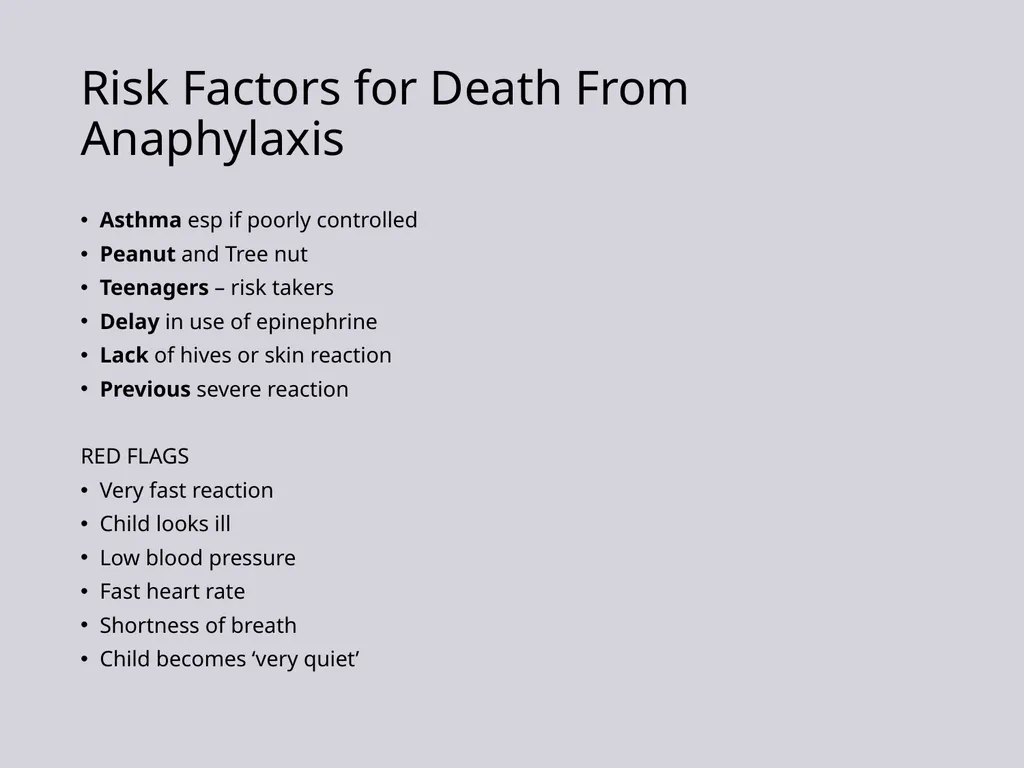
Risk Factors for Death From Anaphylaxis Asthma esp if poorly controlled
Peanut and Tree nut
Teenagers – risk takers
Delay in use of epinephrine
Lack of hives or skin reaction
Previous severe reaction
RED FLAGS
Very fast reaction
Child looks ill
Low blood pressure
Fast heart rate
Shortness of breath
Child becomes ‘very quiet’<br>
Peanut and Tree nut
Teenagers – risk takers
Delay in use of epinephrine
Lack of hives or skin reaction
Previous severe reaction
RED FLAGS
Very fast reaction
Child looks ill
Low blood pressure
Fast heart rate
Shortness of breath
Child becomes ‘very quiet’<br>
36
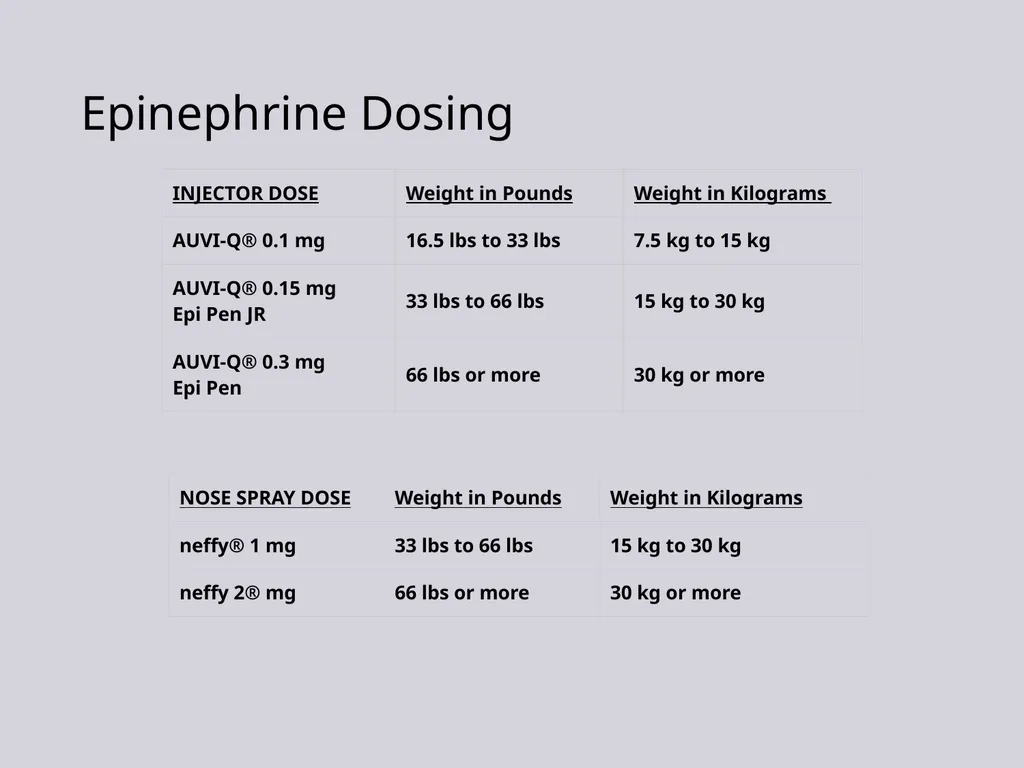
Epinephrine Dosing<br>
37
Practical Strategies for School Health Teams Make the school day safer and smoother<br>
38
Advising Families & Navigating Access Request a current Asthma/Anaphylaxis Action Plan each school year
Check inhaler/epinephrine expirations; request backups before they expire
For insurance denials: document school need (field trips, multiple storage sites)
Direct families to manufacturer copay programs and Medicaid MCO pharmacy lines<br>
Check inhaler/epinephrine expirations; request backups before they expire
For insurance denials: document school need (field trips, multiple storage sites)
Direct families to manufacturer copay programs and Medicaid MCO pharmacy lines<br>
39
When to Refer or Re‑Refer for Specialty Care to Allergist Asthma: frequent rescue use, night symptoms, ED/urgent visits, exercise limitation, frequent daytime cough
Rhinitis: daily impact despite meds; suspected comorbid asthma (cough with allergies)
Food allergy: any epinephrine use, unclear triggers
Device issues: student/staff can’t correctly use current device after training<br>
Rhinitis: daily impact despite meds; suspected comorbid asthma (cough with allergies)
Food allergy: any epinephrine use, unclear triggers
Device issues: student/staff can’t correctly use current device after training<br>
40
Maryland Policies to Know (2025) State law requires policies on emergency epinephrine in public schools (§7‑426.2)
MSDE School Health Services Guidelines: anaphylaxis, asthma, stock inhalers and epinephrine (2025 updates)
Follow your LEA’s stock medication protocols and reporting requirements<br>
MSDE School Health Services Guidelines: anaphylaxis, asthma, stock inhalers and epinephrine (2025 updates)
Follow your LEA’s stock medication protocols and reporting requirements<br>
41
Rapid Cases (for Discussion) 1) 2nd‑grade field trip, peanut‑allergic student—what’s your first move?
2) 10th grader with exercise‑induced symptoms in spring—prep for PE staff?
3) Allergy Shots started last month—what should the care plan include at school?<br>
2) 10th grader with exercise‑induced symptoms in spring—prep for PE staff?
3) Allergy Shots started last month—what should the care plan include at school?<br>
42
Resources for School Nurses MSDE School Health Services Guidelines (Anaphylaxis; Asthma; Stock bronchodilators)
American Academy of Allergy Asthma and Immunology
American College of Allergy Asthma and Immunology
American Academy of Pediatrics
CDC Healthy Schools – Food Allergy & Asthma
https://www.cdc.gov/school-health-conditions/food-allergies/toolkit.html
https://www.cdc.gov/school-health-conditions/chronic/asthma.html
Manufacturer trainer videos (EpiPen, Auvi‑Q, neffy®)
Templates: Individualized Health Plans (IHP), 504 Plans, standard Asthma/Anaphylaxis Action Plans<br>
American Academy of Allergy Asthma and Immunology
American College of Allergy Asthma and Immunology
American Academy of Pediatrics
CDC Healthy Schools – Food Allergy & Asthma
https://www.cdc.gov/school-health-conditions/food-allergies/toolkit.html
https://www.cdc.gov/school-health-conditions/chronic/asthma.html
Manufacturer trainer videos (EpiPen, Auvi‑Q, neffy®)
Templates: Individualized Health Plans (IHP), 504 Plans, standard Asthma/Anaphylaxis Action Plans<br>
43
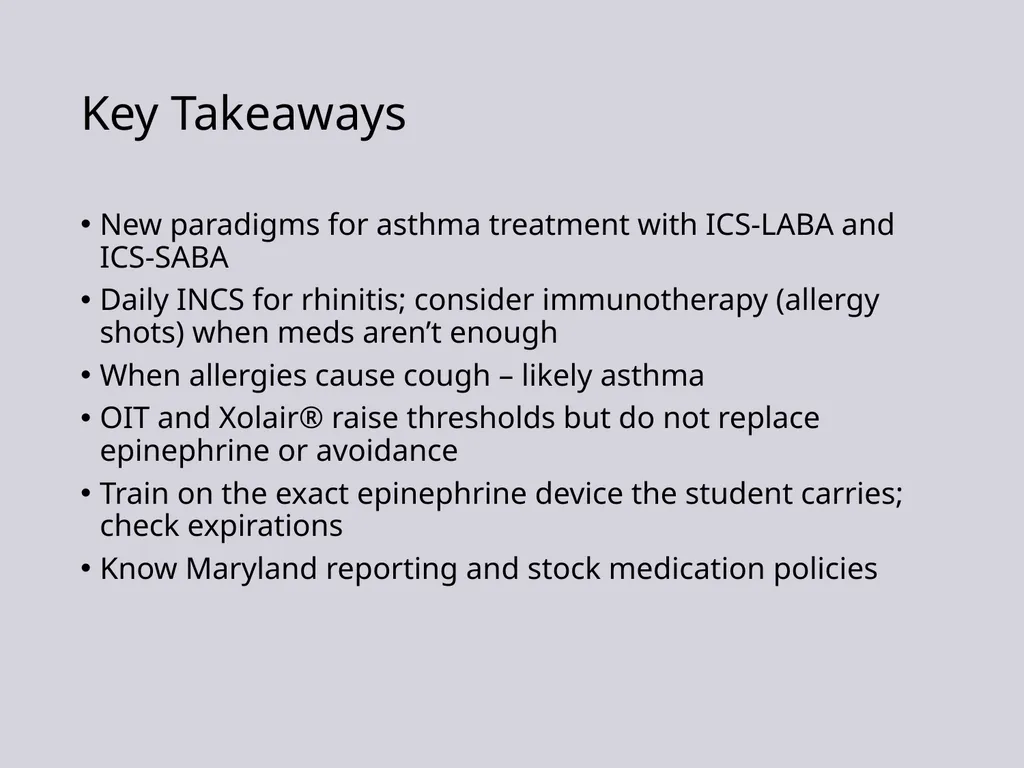
Key Takeaways New paradigms for asthma treatment with ICS-LABA and ICS-SABA
Daily INCS for rhinitis; consider immunotherapy (allergy shots) when meds aren’t enough
When allergies cause cough – likely asthma
OIT and Xolair® raise thresholds but do not replace epinephrine or avoidance
Train on the exact epinephrine device the student carries; check expirations
Know Maryland reporting and stock medication policies<br>
Daily INCS for rhinitis; consider immunotherapy (allergy shots) when meds aren’t enough
When allergies cause cough – likely asthma
OIT and Xolair® raise thresholds but do not replace epinephrine or avoidance
Train on the exact epinephrine device the student carries; check expirations
Know Maryland reporting and stock medication policies<br>
44
Contact & Follow‑Up Manav Singla, MD
Allergy Asthma Specialists of Maryland
msingla@mdallergy.net
Mobile 443-472-6528
Slides & one‑page summary will be shared after the session<br>
Allergy Asthma Specialists of Maryland
msingla@mdallergy.net
Mobile 443-472-6528
Slides & one‑page summary will be shared after the session<br>
45
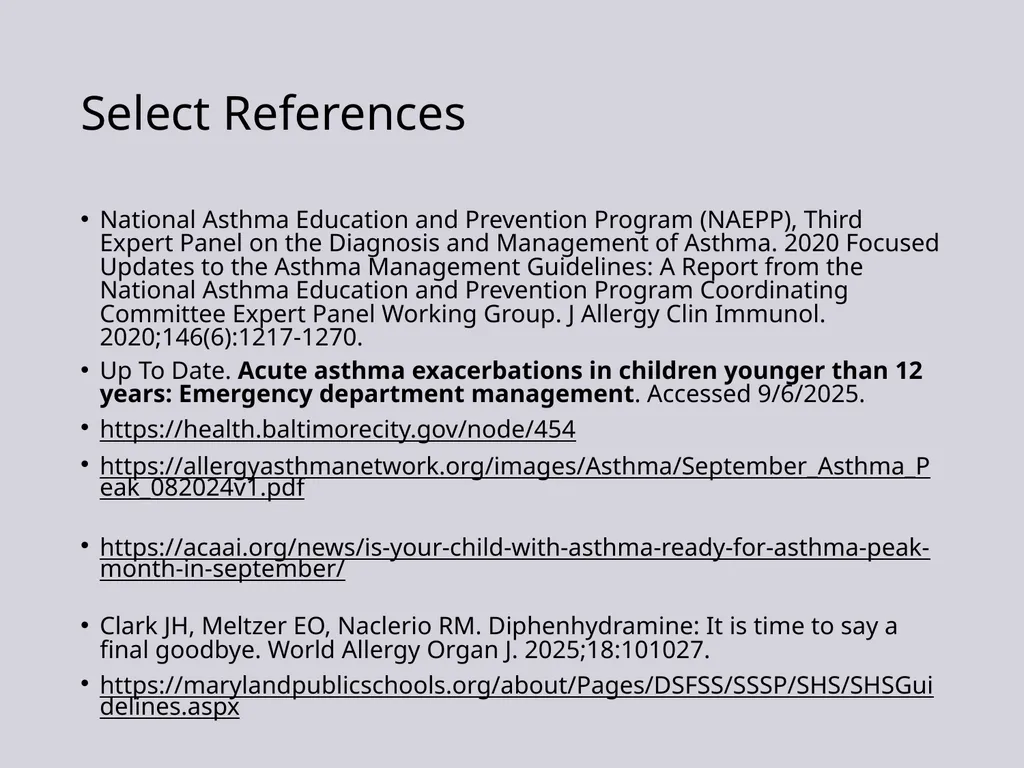
Select References National Asthma Education and Prevention Program (NAEPP), Third Expert Panel on the Diagnosis and Management of Asthma. 2020 Focused Updates to the Asthma Management Guidelines: A Report from the National Asthma Education and Prevention Program Coordinating Committee Expert Panel Working Group. J Allergy Clin Immunol. 2020;146(6):1217-1270.
Up To Date. Acute asthma exacerbations in children younger than 12 years: Emergency department management. Accessed 9/6/2025.
https://health.baltimorecity.gov/node/454
https://allergyasthmanetwork.org/images/Asthma/September_Asthma_Peak_082024v1.pdf
https://acaai.org/news/is-your-child-with-asthma-ready-for-asthma-peak-month-in-september/
Clark JH, Meltzer EO, Naclerio RM. Diphenhydramine: It is time to say a final goodbye. World Allergy Organ J. 2025;18:101027.
https://marylandpublicschools.org/about/Pages/DSFSS/SSSP/SHS/SHSGuidelines.aspx<br>
Up To Date. Acute asthma exacerbations in children younger than 12 years: Emergency department management. Accessed 9/6/2025.
https://health.baltimorecity.gov/node/454
https://allergyasthmanetwork.org/images/Asthma/September_Asthma_Peak_082024v1.pdf
https://acaai.org/news/is-your-child-with-asthma-ready-for-asthma-peak-month-in-september/
Clark JH, Meltzer EO, Naclerio RM. Diphenhydramine: It is time to say a final goodbye. World Allergy Organ J. 2025;18:101027.
https://marylandpublicschools.org/about/Pages/DSFSS/SSSP/SHS/SHSGuidelines.aspx<br>