Update on the Polarimeter Robert Kieffer, on behalf of the CERN FCC BI team. 1 02 Sept 2026 EPOL 2 For todays menu Update on the Compton electron sensor acceptance Impact on the vacuum chamber design for Z and W modes Proposal for the FCC
"Update on the Polarimeter Robert Kieffer, on" is the property of its rightful owner. Permission is granted to
download and print the materials on this website for personal, non-commercial use only, and to display it
on your personal computer provided you do not modify the materials and that you retain all copyright
notices contained in the materials. By downloading content from our website, you accept the terms of this
agreement.
Share
Embed code
Presentation Transcript
01
Update on the Polarimeter Robert Kieffer, on behalf of the CERN FCC BI team. 1 02 Sept 2026 EPOL<br>
02
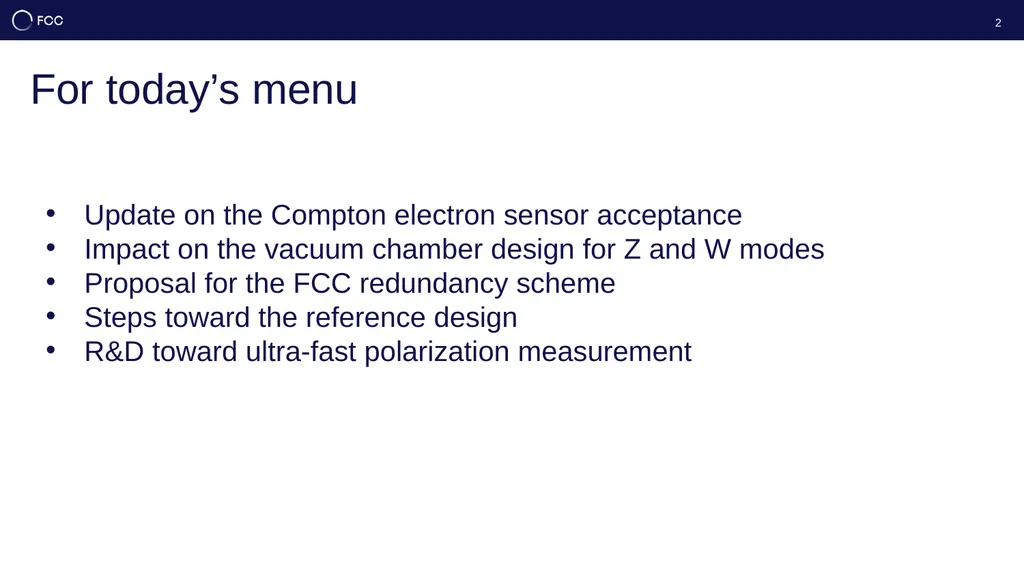
2 For today’s menu Update on the Compton electron sensor acceptance
Impact on the vacuum chamber design for Z and W modes
Proposal for the FCC redundancy scheme
Steps toward the reference design
R&D toward ultra-fast polarization measurement<br>
03
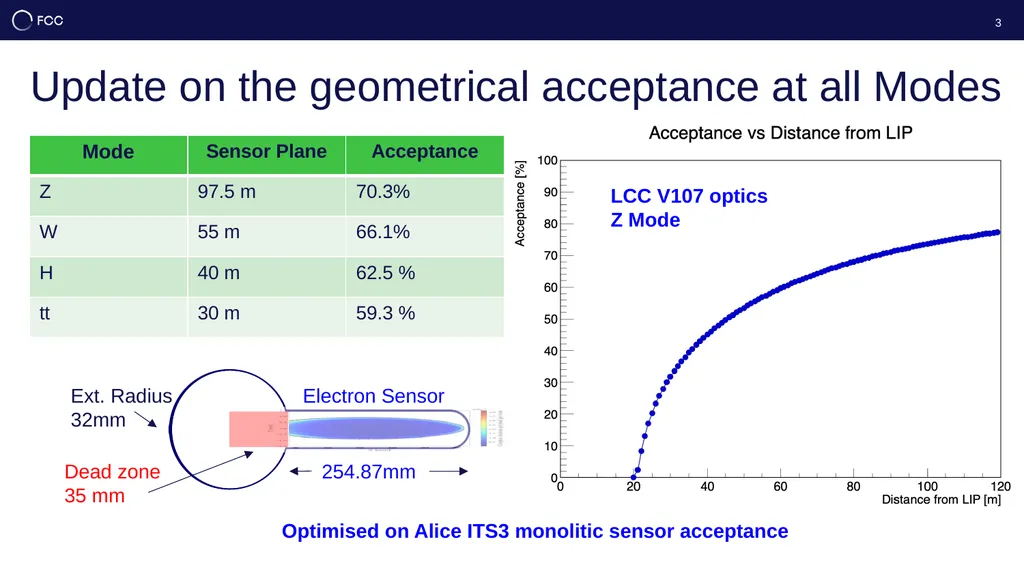
3 Update on the geometrical acceptance at all Modes Dead zone
35 mm Electron Sensor Ext. Radius 32mm 254.87mm Optimised on Alice ITS3 monolitic sensor acceptance LCC V107 optics
Z Mode<br>
04
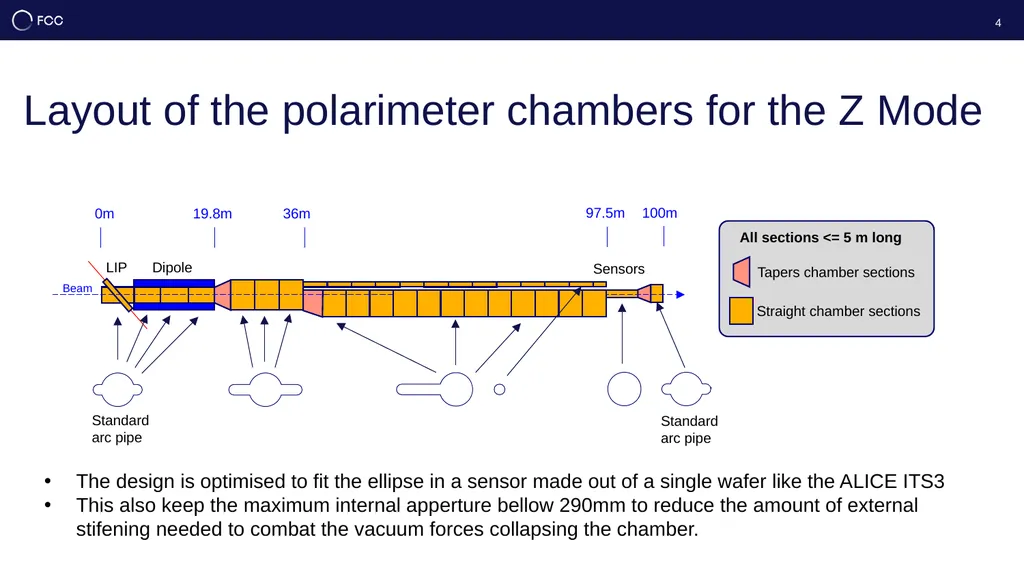
4 Layout of the polarimeter chambers for the Z Mode 0m 19.8m 36m 97.5m 100m Sensors Dipole LIP Standard
arc pipe Standard
arc pipe Tapers chamber sections Straight chamber sections All sections <= 5 m long Beam The design is optimised to fit the ellipse in a sensor made out of a single wafer like the ALICE ITS3
This also keep the maximum internal apperture bellow 290mm to reduce the amount of external stifening needed to combat the vacuum forces collapsing the chamber.<br>
05
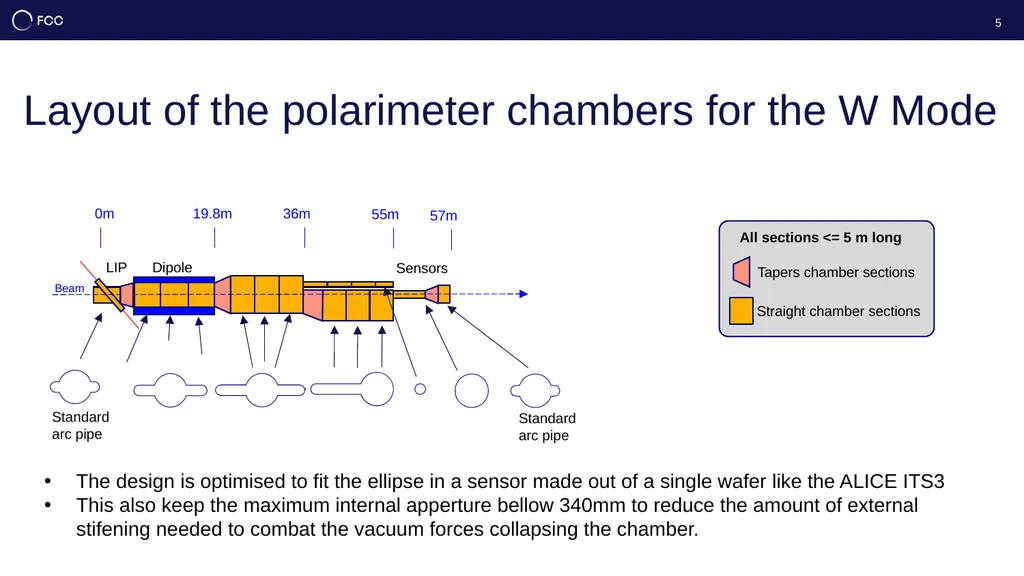
5 Layout of the polarimeter chambers for the W Mode 0m 19.8m 36m 55m 57m Sensors Dipole LIP Standard
arc pipe Standard
arc pipe Tapers chamber sections Straight chamber sections All sections <= 5 m long Beam The design is optimised to fit the ellipse in a sensor made out of a single wafer like the ALICE ITS3
This also keep the maximum internal apperture bellow 340mm to reduce the amount of external stifening needed to combat the vacuum forces collapsing the chamber.<br>
06
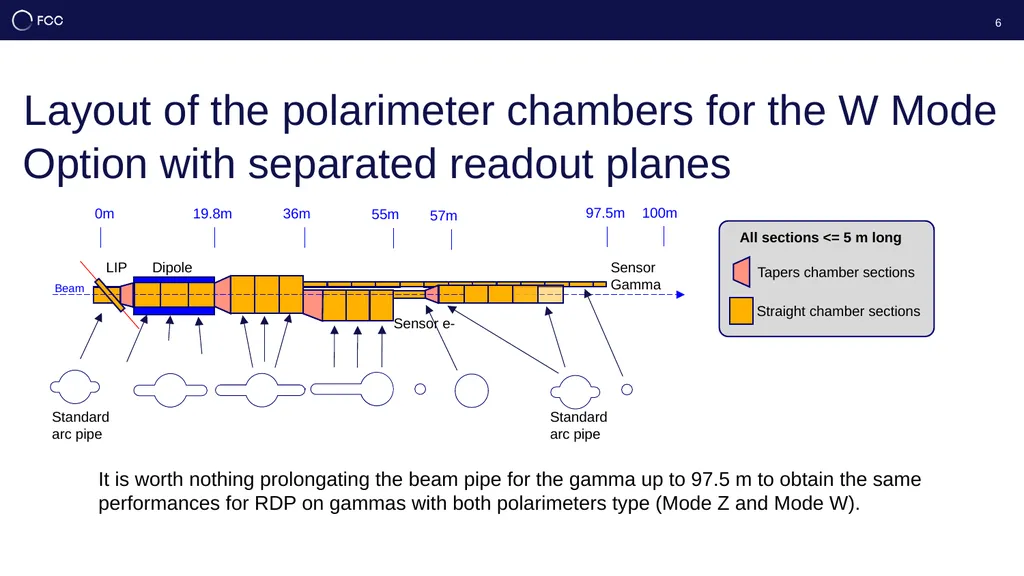
6 Layout of the polarimeter chambers for the W Mode 0m 19.8m 36m 97.5m 100m Sensor e- Dipole LIP Tapers chamber sections Straight chamber sections All sections <= 5 m long Beam Sensor Gamma 55m 57m Standard
arc pipe Standard
arc pipe Option with separated readout planes It is worth nothing prolongating the beam pipe for the gamma up to 97.5 m to obtain the same performances for RDP on gammas with both polarimeters type (Mode Z and Mode W).<br>
07
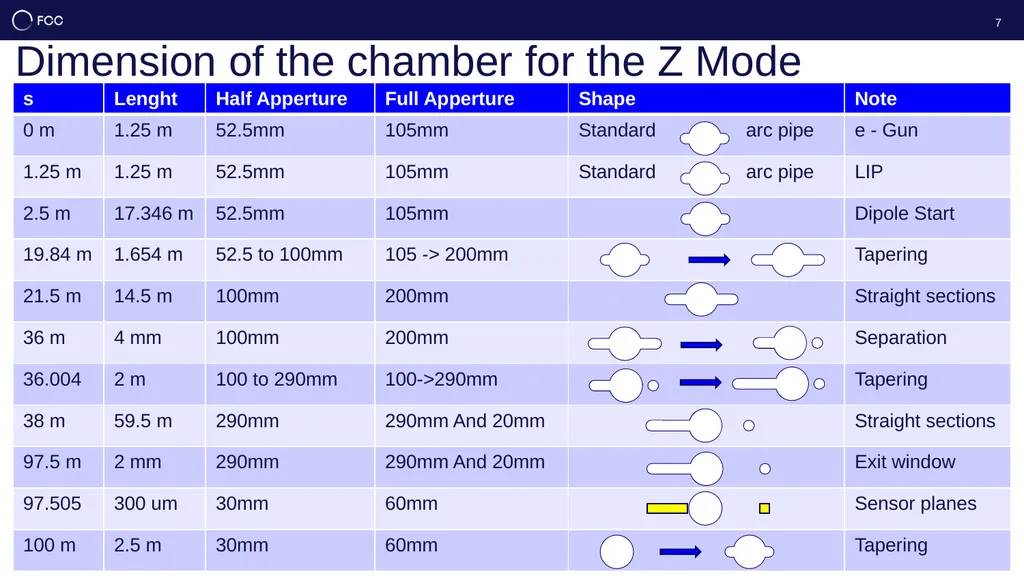
7 Dimension of the chamber for the Z Mode<br>
08
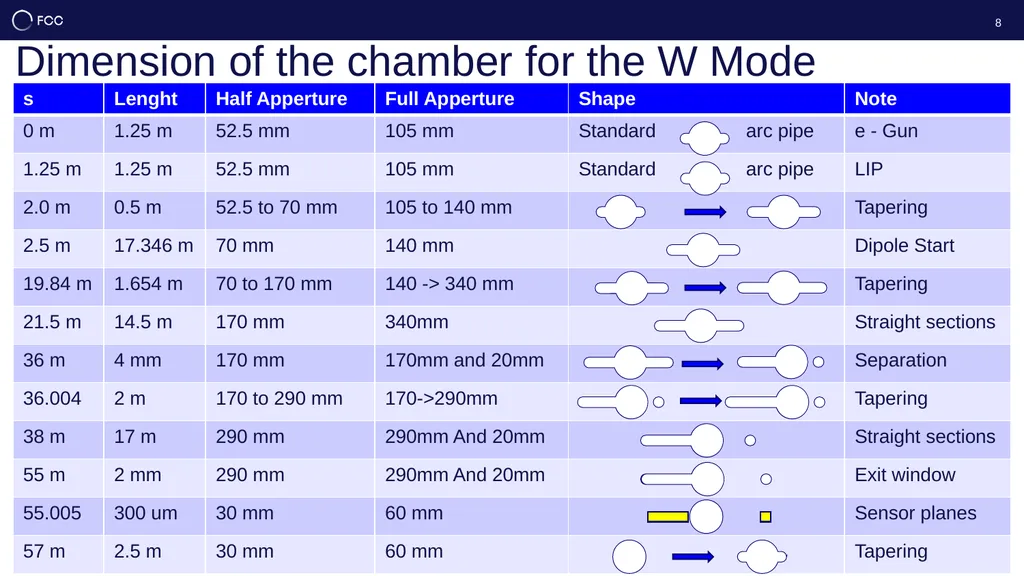
8 Dimension of the chamber for the W Mode<br>
09
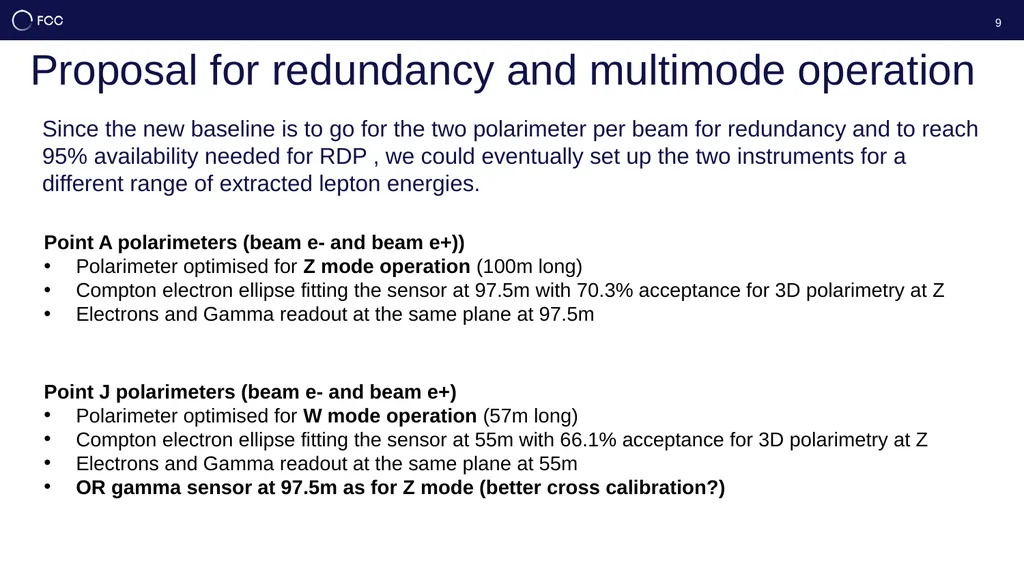
9 Proposal for redundancy and multimode operation Point A polarimeters (beam e- and beam e+))
Polarimeter optimised for Z mode operation (100m long)
Compton electron ellipse fitting the sensor at 97.5m with 70.3% acceptance for 3D polarimetry at Z
Electrons and Gamma readout at the same plane at 97.5m Point J polarimeters (beam e- and beam e+)
Polarimeter optimised for W mode operation (57m long)
Compton electron ellipse fitting the sensor at 55m with 66.1% acceptance for 3D polarimetry at Z
Electrons and Gamma readout at the same plane at 55m
OR gamma sensor at 97.5m as for Z mode (better cross calibration?) Since the new baseline is to go for the two polarimeter per beam for redundancy and to reach 95% availability needed for RDP , we could eventually set up the two instruments for a different range of extracted lepton energies.<br>
10
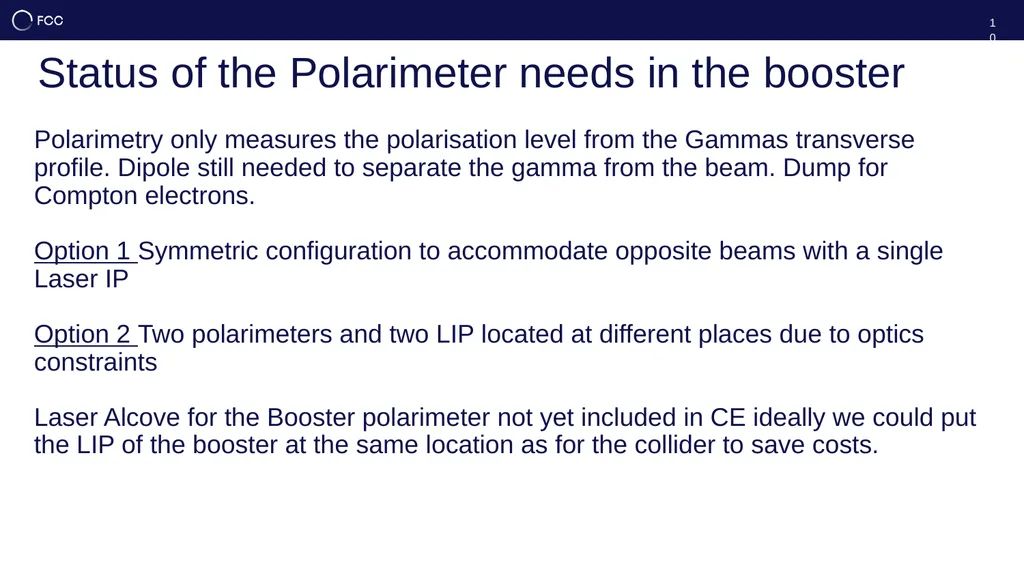
10 Status of the Polarimeter needs in the booster Polarimetry only measures the polarisation level from the Gammas transverse profile. Dipole still needed to separate the gamma from the beam. Dump for Compton electrons.
Option 1 Symmetric configuration to accommodate opposite beams with a single Laser IP
Option 2 Two polarimeters and two LIP located at different places due to optics constraints
Laser Alcove for the Booster polarimeter not yet included in CE ideally we could put the LIP of the booster at the same location as for the collider to save costs.<br>
11
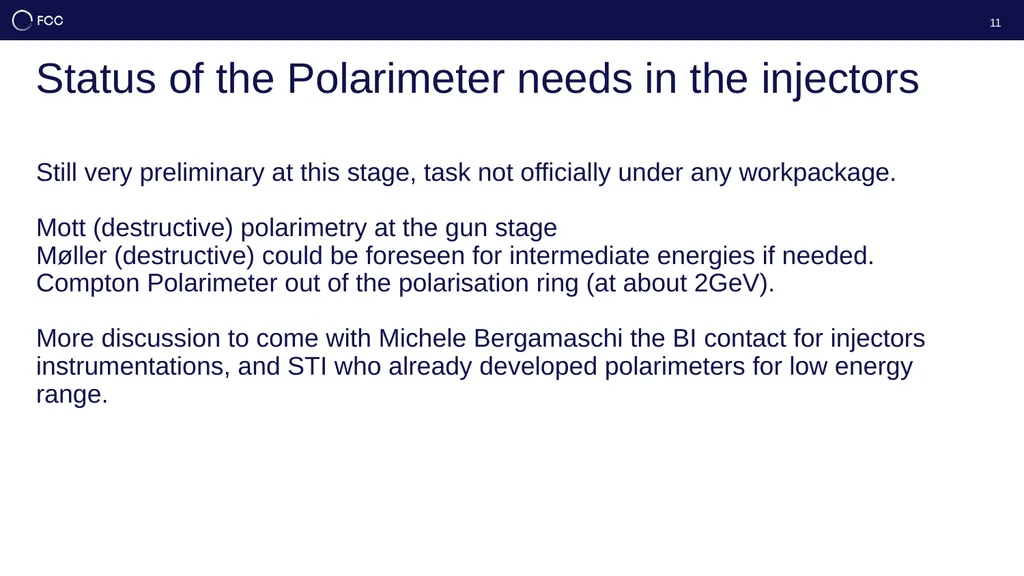
11 Status of the Polarimeter needs in the injectors Still very preliminary at this stage, task not officially under any workpackage.
Mott (destructive) polarimetry at the gun stage
Møller (destructive) could be foreseen for intermediate energies if needed.
Compton Polarimeter out of the polarisation ring (at about 2GeV).
More discussion to come with Michele Bergamaschi the BI contact for injectors instrumentations, and STI who already developed polarimeters for low energy range.<br>
12
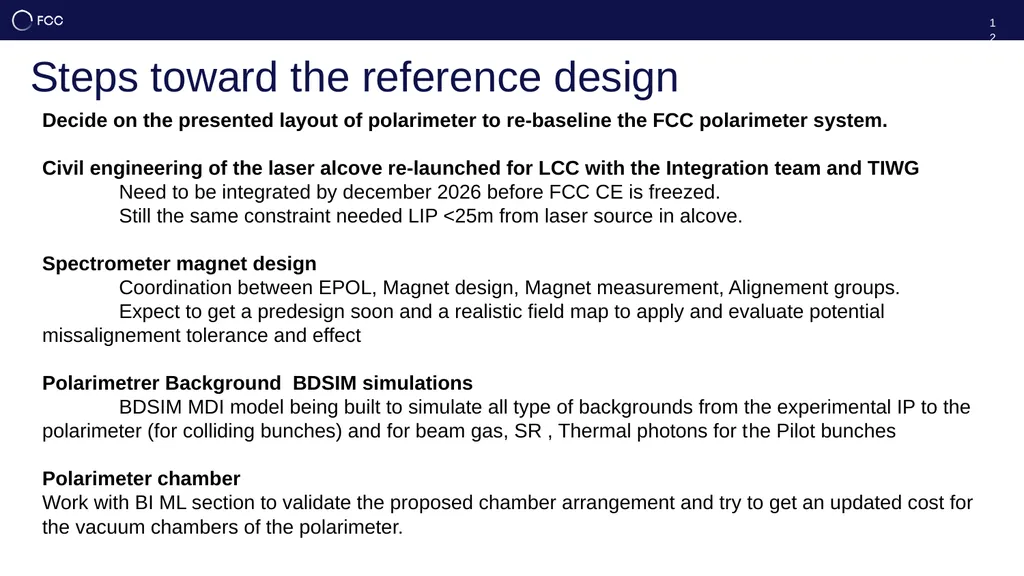
12 Steps toward the reference design Decide on the presented layout of polarimeter to re-baseline the FCC polarimeter system.
Civil engineering of the laser alcove re-launched for LCC with the Integration team and TIWG
Need to be integrated by december 2026 before FCC CE is freezed.
Still the same constraint needed LIP <25m from laser source in alcove.
Spectrometer magnet design
Coordination between EPOL, Magnet design, Magnet measurement, Alignement groups.
Expect to get a predesign soon and a realistic field map to apply and evaluate potential missalignement tolerance and effect
Polarimetrer Background BDSIM simulations
BDSIM MDI model being built to simulate all type of backgrounds from the experimental IP to the polarimeter (for colliding bunches) and for beam gas, SR , Thermal photons for the Pilot bunches
Polarimeter chamber
Work with BI ML section to validate the proposed chamber arrangement and try to get an updated cost for the vacuum chambers of the polarimeter.<br>
13
13 R&D toward ultra-fast polarization measurement CLEAR test beam
Device integrating the Timepix4 sensor-chip assembly is being developed in BI for NA Cons
We will participate in this development to probe the chip capabilties for the polarimeter.
One of the key element is the maximum readout rate and potential saturation effects.
BONN ELSA accelerator
We started the discussion with colleagues from Bonn.
Goal: to upgrade their polarimeter system on the ELSA facilty.
This would be an ideal test bed for ultra-fast polarization measurement and R&D for FCC
Topics and upgrades needed:
- Improved laser system
- Improved sensor system
- Improved kicker system<br>