
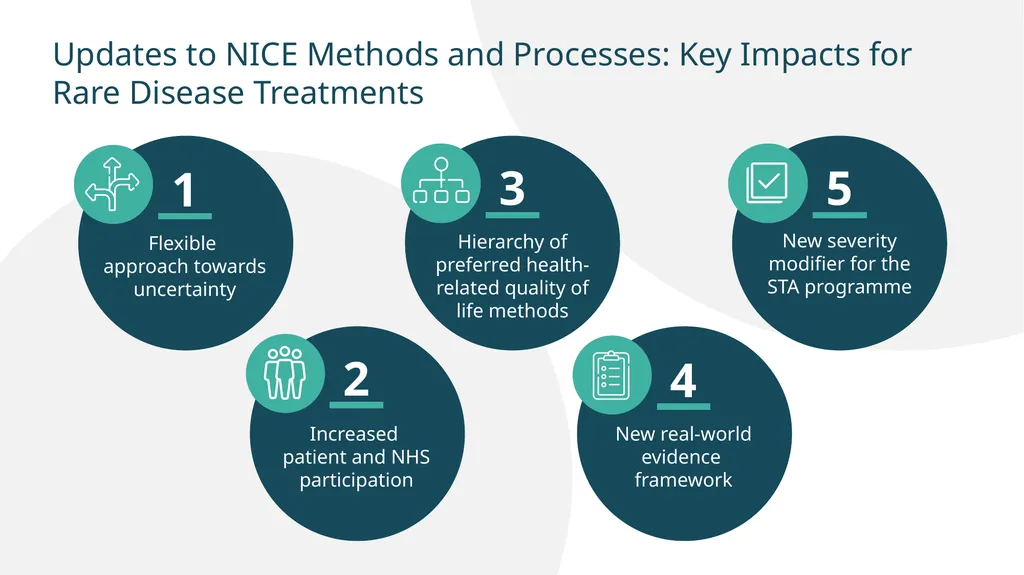
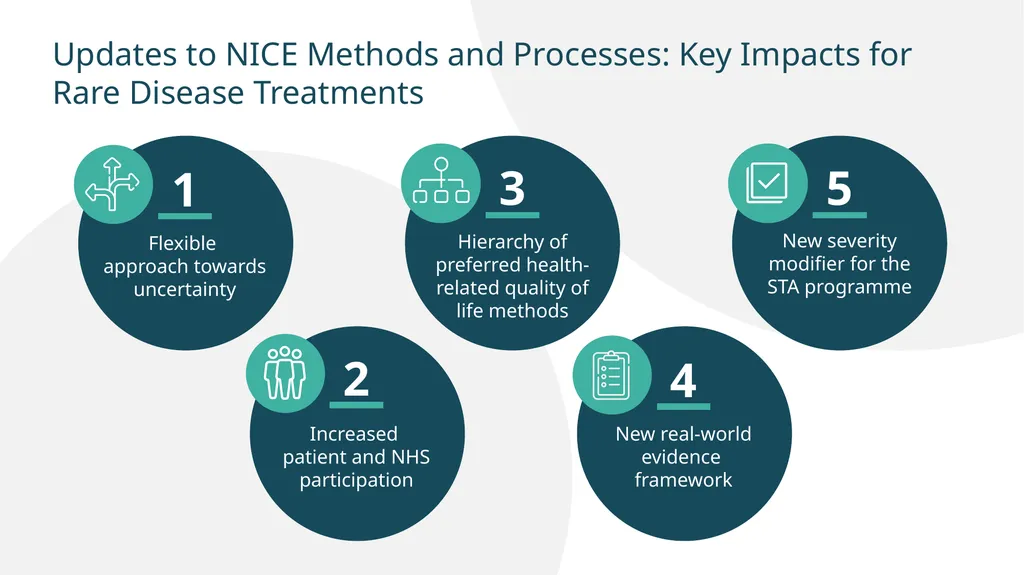
Updates to NICE Methods and Processes: Key Impacts
Description: Updates to NICE Methods and Processes: Key Impacts for Rare Disease Treatments Updates to NICE Methods: Impact for Rare Disease Treatments The updated methods and processes aim to enable earlier access to innovative new treatments by
Related Topics
Download Presentation
"Updates to NICE Methods and Processes: Key Impacts" is the property of its rightful owner. Permission is granted to download and print the materials on this website for personal, non-commercial use only, and to display it on your personal computer provided you do not modify the materials and that you retain all copyright notices contained in the materials. By downloading content from our website, you accept the terms of this agreement.
Presentation Transcript
slide1. Updates to NICE Methods and Processes: Key Impacts for
Rare Disease Treatments<br>
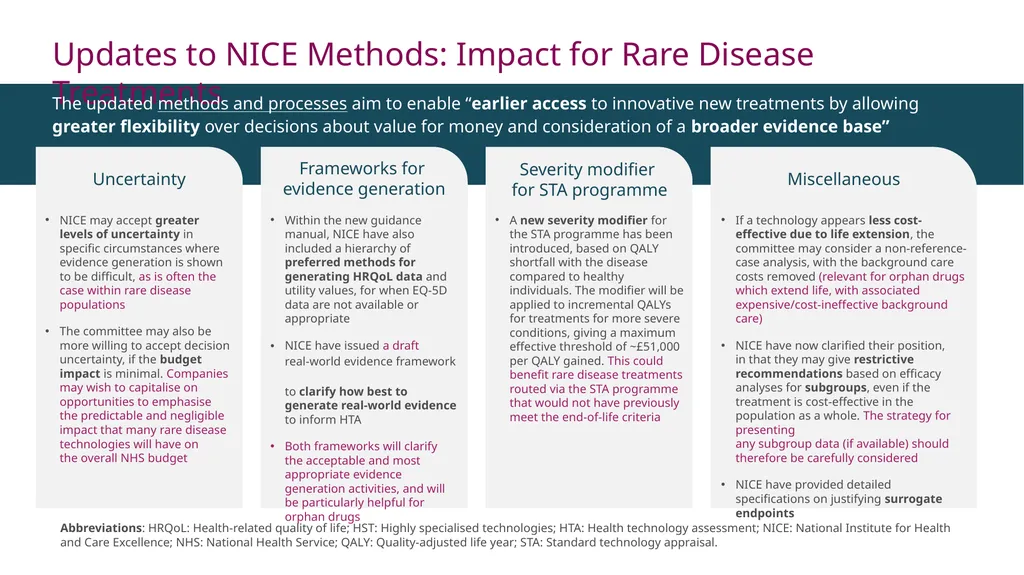
slide2. Updates to NICE Methods: Impact for Rare Disease Treatments The updated methods and processes aim to enable “earlier access to innovative new treatments by allowing greater flexibility over decisions about value for money and consideration of a broader evidence base” A new severity modifier for the STA programme has been introduced, based on QALY shortfall with the disease compared to healthy individuals. The modifier will be applied to incremental QALYs for treatments for more severe conditions, giving a maximum effective threshold of ~£51,000 per QALY gained. This could benefit rare disease treatments routed via the STA programme that would not have previously meet the end-of-life criteria Abbreviations: HRQoL: Health-related quality of life; HST: Highly specialised technologies; HTA: Health technology assessment; NICE: National Institute for Health and Care Excellence; NHS: National Health Service; QALY: Quality-adjusted life year; STA: Standard technology appraisal. Within the new guidance manual, NICE have also included a hierarchy of preferred methods for generating HRQoL data and utility values, for when EQ-5D data are not available or appropriate
NICE have issued a draft real-world evidence framework to clarify how best to generate real-world evidence to inform HTA
Both frameworks will clarify the acceptable and most appropriate evidence generation activities, and will be particularly helpful for orphan drugs If a technology appears less cost-effective due to life extension, the committee may consider a non-reference-case analysis, with the background care costs removed (relevant for orphan drugs which extend life, with associated expensive/cost-ineffective background care)
NICE have now clarified their position, in that they may give restrictive recommendations based on efficacy analyses for subgroups, even if the treatment is cost-effective in the population as a whole. The strategy for presenting any subgroup data (if available) should therefore be carefully considered
NICE have provided detailed specifications on justifying surrogate endpoints Severity modifier for STA programme Frameworks for evidence generation Miscellaneous NICE may accept greater levels of uncertainty in specific circumstances where evidence generation is shown to be difficult, as is often the case within rare disease populations
The committee may also be more willing to accept decision uncertainty, if the budget impact is minimal. Companies may wish to capitalise on opportunities to emphasise the predictable and negligible impact that many rare disease technologies will have on the overall NHS budget Uncertainty<br>
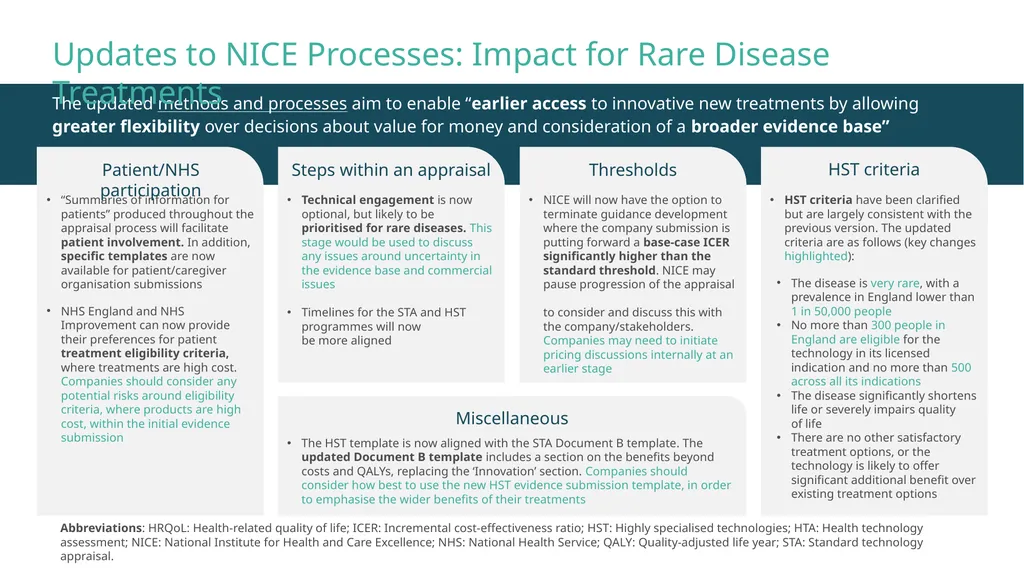
slide3. The updated methods and processes aim to enable “earlier access to innovative new treatments by allowing greater flexibility over decisions about value for money and consideration of a broader evidence base” Updates to NICE Processes: Impact for Rare Disease Treatments “Summaries of information for patients” produced throughout the appraisal process will facilitate patient involvement. In addition, specific templates are now available for patient/caregiver organisation submissions
NHS England and NHS Improvement can now provide their preferences for patient treatment eligibility criteria, where treatments are high cost. Companies should consider any potential risks around eligibility criteria, where products are high cost, within the initial evidence submission NICE will now have the option to terminate guidance development where the company submission is putting forward a base-case ICER significantly higher than the standard threshold. NICE may pause progression of the appraisal to consider and discuss this with the company/stakeholders. Companies may need to initiate pricing discussions internally at an earlier stage Technical engagement is now optional, but likely to be prioritised for rare diseases. This stage would be used to discuss any issues around uncertainty in the evidence base and commercial issues
Timelines for the STA and HST programmes will now be more aligned Abbreviations: HRQoL: Health-related quality of life; ICER: Incremental cost-effectiveness ratio; HST: Highly specialised technologies; HTA: Health technology assessment; NICE: National Institute for Health and Care Excellence; NHS: National Health Service; QALY: Quality-adjusted life year; STA: Standard technology appraisal. HST criteria have been clarified but are largely consistent with the previous version. The updated criteria are as follows (key changes highlighted):
The disease is very rare, with a prevalence in England lower than 1 in 50,000 people
No more than 300 people in England are eligible for the technology in its licensed indication and no more than 500 across all its indications
The disease significantly shortens life or severely impairs quality of life
There are no other satisfactory treatment options, or the technology is likely to offer significant additional benefit over existing treatment options The HST template is now aligned with the STA Document B template. The updated Document B template includes a section on the benefits beyond costs and QALYs, replacing the ‘Innovation’ section. Companies should consider how best to use the new HST evidence submission template, in order to emphasise the wider benefits of their treatments Patient/NHS participation Thresholds Steps within an appraisal HST criteria Miscellaneous<br>
slide2. Updates to NICE Methods: Impact for Rare Disease Treatments The updated methods and processes aim to enable “earlier access to innovative new treatments by allowing greater flexibility over decisions about value for money and consideration of a broader evidence base” A new severity modifier for the STA programme has been introduced, based on QALY shortfall with the disease compared to healthy individuals. The modifier will be applied to incremental QALYs for treatments for more severe conditions, giving a maximum effective threshold of ~£51,000 per QALY gained. This could benefit rare disease treatments routed via the STA programme that would not have previously meet the end-of-life criteria Abbreviations: HRQoL: Health-related quality of life; HST: Highly specialised technologies; HTA: Health technology assessment; NICE: National Institute for Health and Care Excellence; NHS: National Health Service; QALY: Quality-adjusted life year; STA: Standard technology appraisal. Within the new guidance manual, NICE have also included a hierarchy of preferred methods for generating HRQoL data and utility values, for when EQ-5D data are not available or appropriate
NICE have issued a draft real-world evidence framework to clarify how best to generate real-world evidence to inform HTA
Both frameworks will clarify the acceptable and most appropriate evidence generation activities, and will be particularly helpful for orphan drugs If a technology appears less cost-effective due to life extension, the committee may consider a non-reference-case analysis, with the background care costs removed (relevant for orphan drugs which extend life, with associated expensive/cost-ineffective background care)
NICE have now clarified their position, in that they may give restrictive recommendations based on efficacy analyses for subgroups, even if the treatment is cost-effective in the population as a whole. The strategy for presenting any subgroup data (if available) should therefore be carefully considered
NICE have provided detailed specifications on justifying surrogate endpoints Severity modifier for STA programme Frameworks for evidence generation Miscellaneous NICE may accept greater levels of uncertainty in specific circumstances where evidence generation is shown to be difficult, as is often the case within rare disease populations
The committee may also be more willing to accept decision uncertainty, if the budget impact is minimal. Companies may wish to capitalise on opportunities to emphasise the predictable and negligible impact that many rare disease technologies will have on the overall NHS budget Uncertainty<br>
slide3. The updated methods and processes aim to enable “earlier access to innovative new treatments by allowing greater flexibility over decisions about value for money and consideration of a broader evidence base” Updates to NICE Processes: Impact for Rare Disease Treatments “Summaries of information for patients” produced throughout the appraisal process will facilitate patient involvement. In addition, specific templates are now available for patient/caregiver organisation submissions
NHS England and NHS Improvement can now provide their preferences for patient treatment eligibility criteria, where treatments are high cost. Companies should consider any potential risks around eligibility criteria, where products are high cost, within the initial evidence submission NICE will now have the option to terminate guidance development where the company submission is putting forward a base-case ICER significantly higher than the standard threshold. NICE may pause progression of the appraisal to consider and discuss this with the company/stakeholders. Companies may need to initiate pricing discussions internally at an earlier stage Technical engagement is now optional, but likely to be prioritised for rare diseases. This stage would be used to discuss any issues around uncertainty in the evidence base and commercial issues
Timelines for the STA and HST programmes will now be more aligned Abbreviations: HRQoL: Health-related quality of life; ICER: Incremental cost-effectiveness ratio; HST: Highly specialised technologies; HTA: Health technology assessment; NICE: National Institute for Health and Care Excellence; NHS: National Health Service; QALY: Quality-adjusted life year; STA: Standard technology appraisal. HST criteria have been clarified but are largely consistent with the previous version. The updated criteria are as follows (key changes highlighted):
The disease is very rare, with a prevalence in England lower than 1 in 50,000 people
No more than 300 people in England are eligible for the technology in its licensed indication and no more than 500 across all its indications
The disease significantly shortens life or severely impairs quality of life
There are no other satisfactory treatment options, or the technology is likely to offer significant additional benefit over existing treatment options The HST template is now aligned with the STA Document B template. The updated Document B template includes a section on the benefits beyond costs and QALYs, replacing the ‘Innovation’ section. Companies should consider how best to use the new HST evidence submission template, in order to emphasise the wider benefits of their treatments Patient/NHS participation Thresholds Steps within an appraisal HST criteria Miscellaneous<br>