
Updating the Value Proposition: Using Services to
Description: Updating the Value Proposition: Using Services to Define Your IT Organization Mark Askren CIO, University of Nebraska Lincoln Kimberly Harper Director of Finance Portfolio Management, University of Nebraska Central Administration
Related Topics
Download Presentation
"Updating the Value Proposition: Using Services to" is the property of its rightful owner. Permission is granted to download and print the materials on this website for personal, non-commercial use only, and to display it on your personal computer provided you do not modify the materials and that you retain all copyright notices contained in the materials. By downloading content from our website, you accept the terms of this agreement.
Presentation Transcript
slide1. Updating the Value Proposition: Using Services to Define Your IT Organization Mark Askren – CIO, University of Nebraska – Lincoln
Kimberly Harper – Director of Finance & Portfolio Management, University of Nebraska – Central Administration<br>
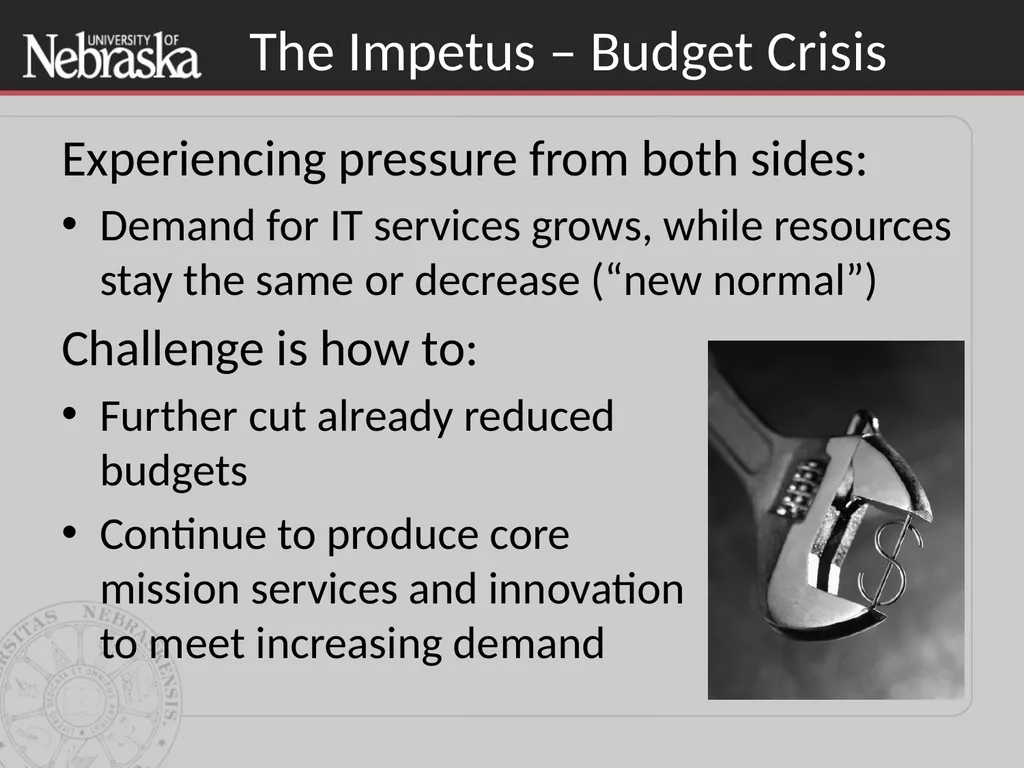
slide2. The Impetus – Budget Crisis Experiencing pressure from both sides:
Demand for IT services grows, while resources stay the same or decrease (“new normal”)
Challenge is how to:
Further cut already reduced budgets
Continue to produce core mission services and innovation to meet increasing demand<br>
slide3. Re-evaluation Our Goals
Create a better understanding of our IT organizations (including within our organizations)
Validate that our priorities are aligned and funding justified
Identify efficiency & collaborative opportunities
Improve strategic planning & decision-making, and invest accordingly
Weather the storm
Identify opportunities for improvement<br>
slide4. An Approach: Services Inventory Scope
Identify all services provided to both internal and external customers.
Identify all assets that support each service (e.g., software, applications, operating systems, hardware maintenance, connectivity charges, materials, contract charges, personnel).
Identify customers who utilize each service.
Identify total cost of all assets associated with each service.<br>
slide5. An Approach: Services Inventory Methodology
Consultant-led staff interviews
Development of service offering categories, descriptions and characteristics
Development of financial cost model<br>
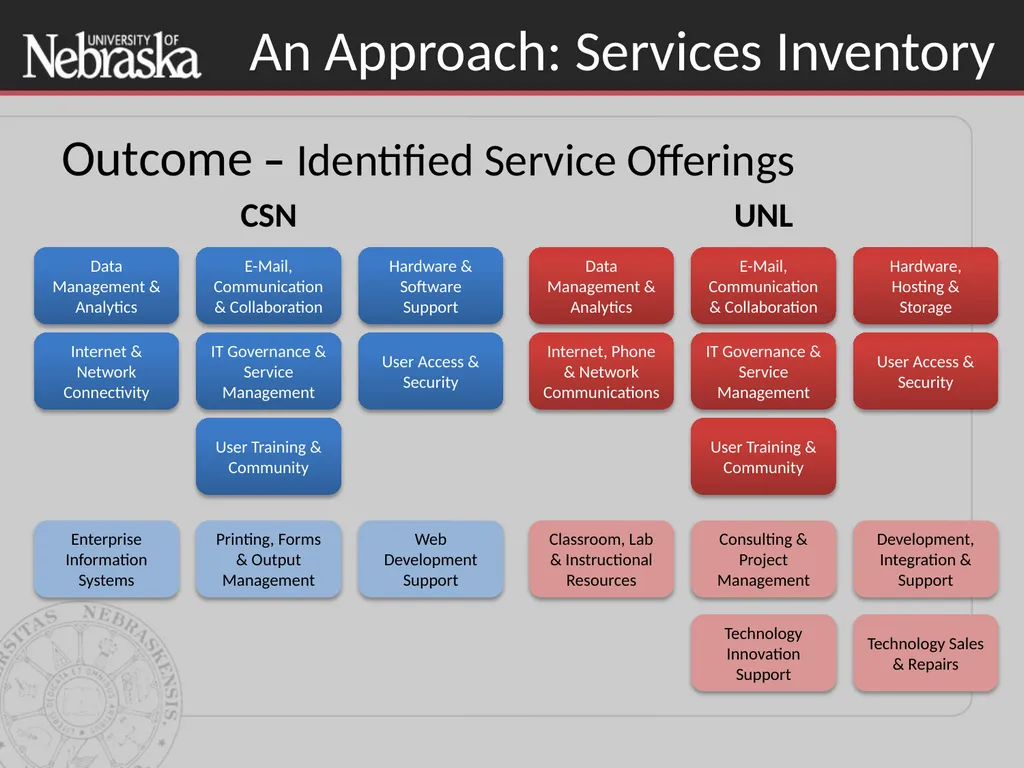
slide6. An Approach: Services Inventory Outcome – Identified Service Offerings User Access & Security Enterprise Information Systems Hardware & Software Support E-Mail, Communication & Collaboration Data Management & Analytics Internet & Network Connectivity IT Governance & Service Management User Training & Community Printing, Forms & Output Management Web Development Support CSN UNL User Access & Security Technology Innovation Support Hardware, Hosting & Storage E-Mail, Communication & Collaboration Data Management & Analytics Internet, Phone & Network Communications IT Governance & Service Management User Training & Community Classroom, Lab & Instructional Resources Consulting & Project Management Technology Sales & Repairs Development, Integration & Support<br>
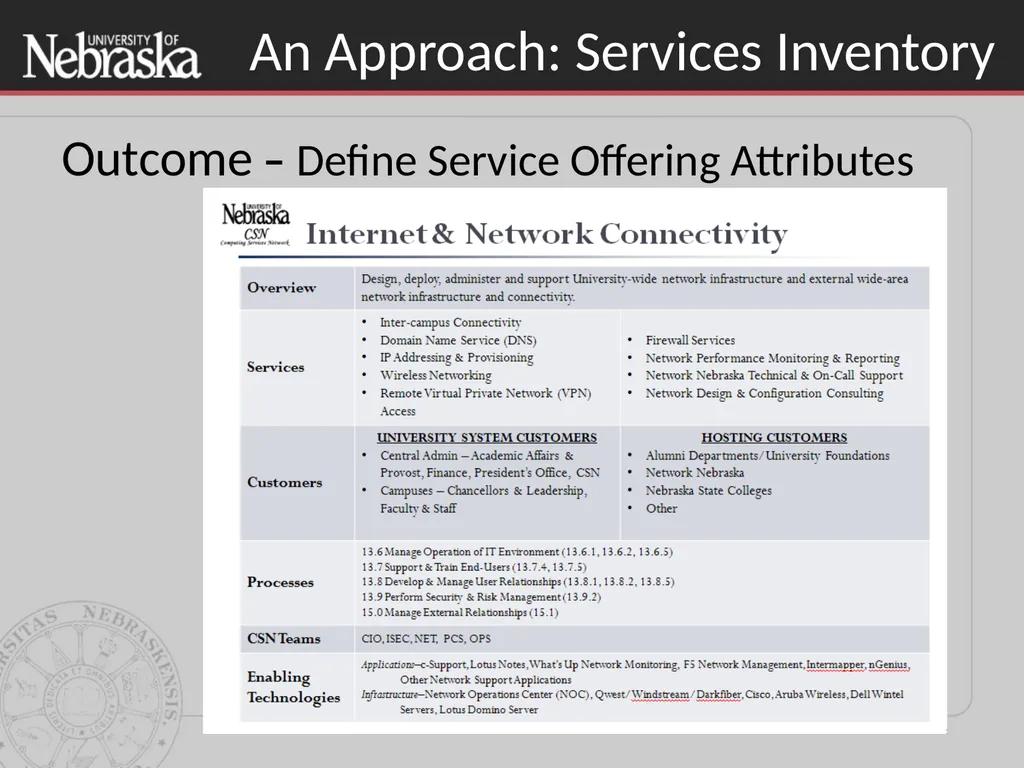
slide7. An Approach: Services Inventory Outcome – Define Service Offering Attributes<br>
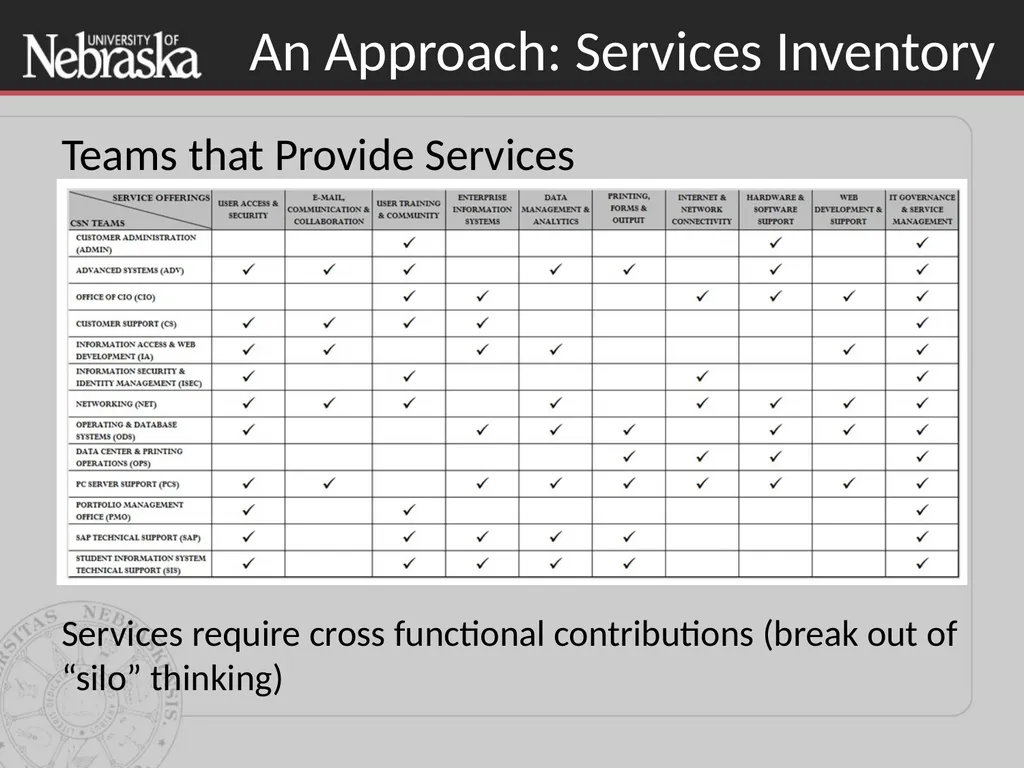
slide8. An Approach: Services Inventory Teams that Provide Services
Services require cross functional contributions (break out of “silo” thinking)<br>
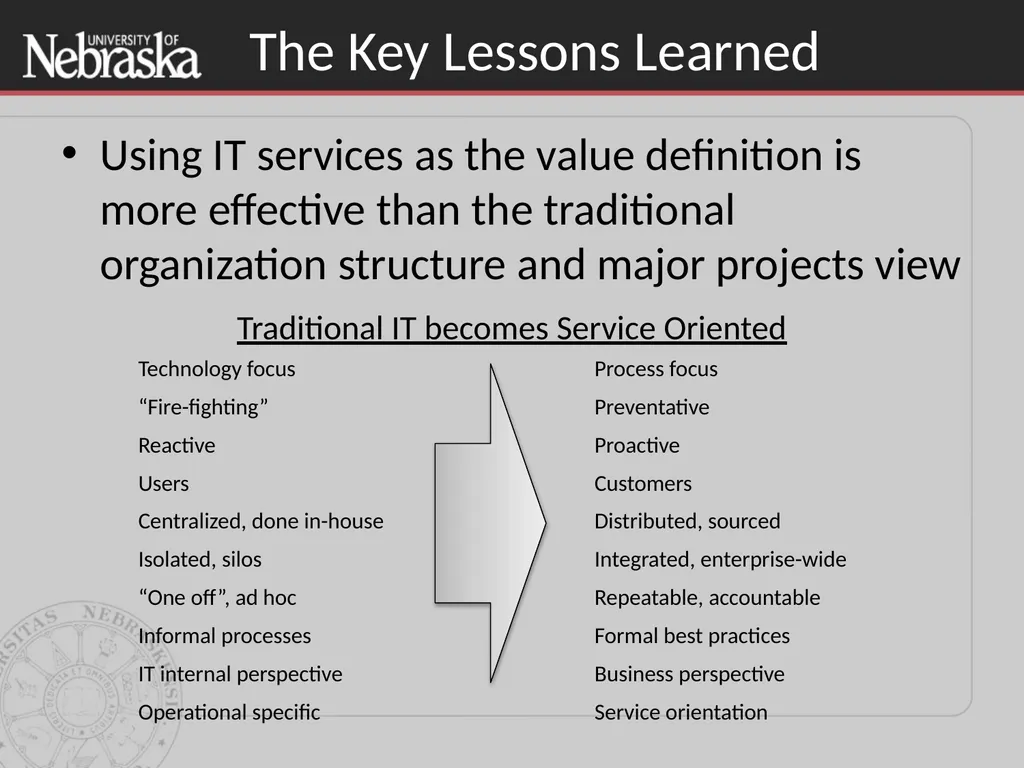
slide9. The Key Lessons Learned Using IT services as the value definition is more effective than the traditional organization structure and major projects view
Traditional IT becomes Service Oriented<br>
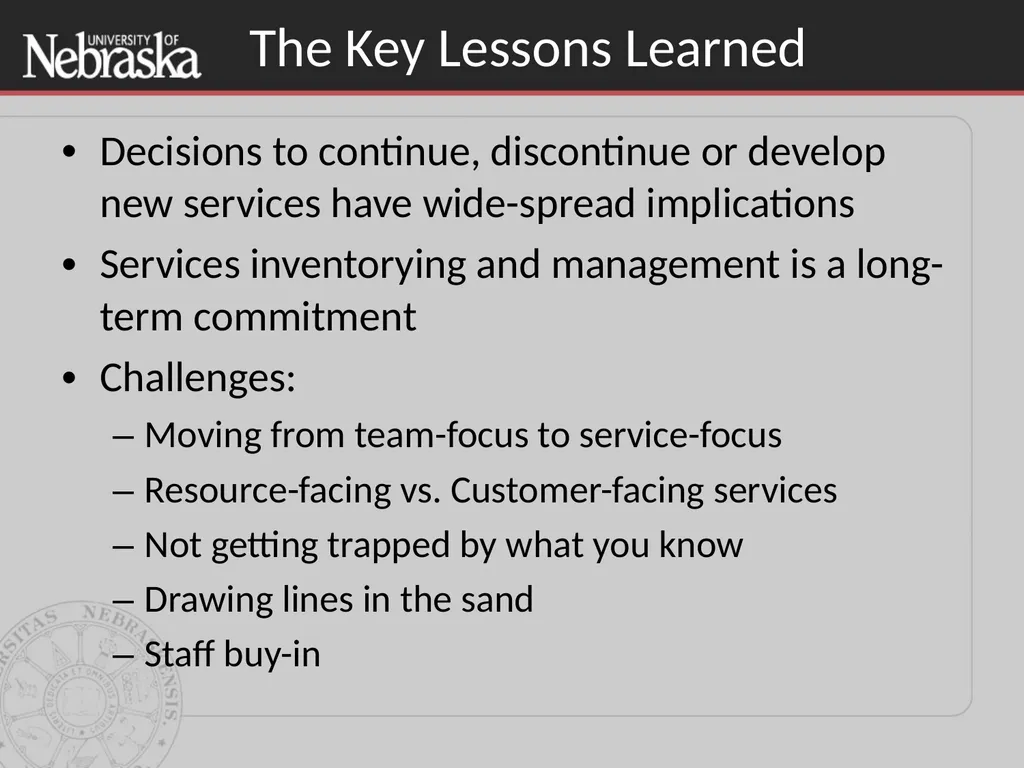
slide10. The Key Lessons Learned Decisions to continue, discontinue or develop new services have wide-spread implications
Services inventorying and management is a long-term commitment
Challenges:
Moving from team-focus to service-focus
Resource-facing vs. Customer-facing services
Not getting trapped by what you know
Drawing lines in the sand
Staff buy-in<br>
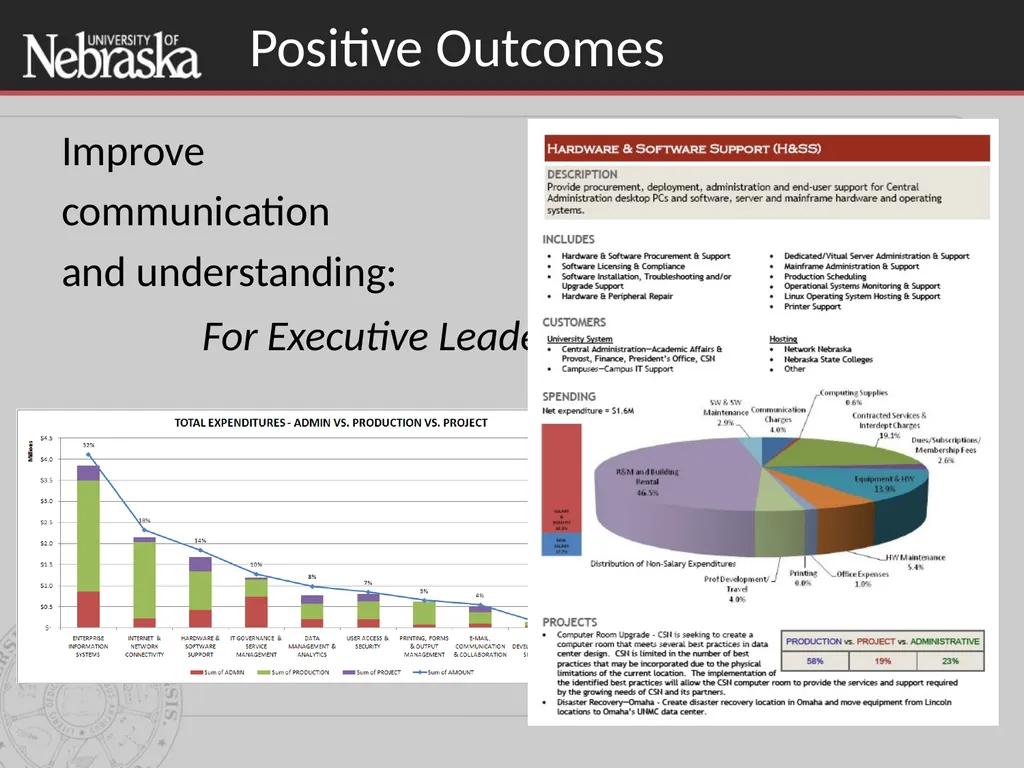
slide11. Positive Outcomes Improve
communication
and understanding:
For Executive Leadership<br>
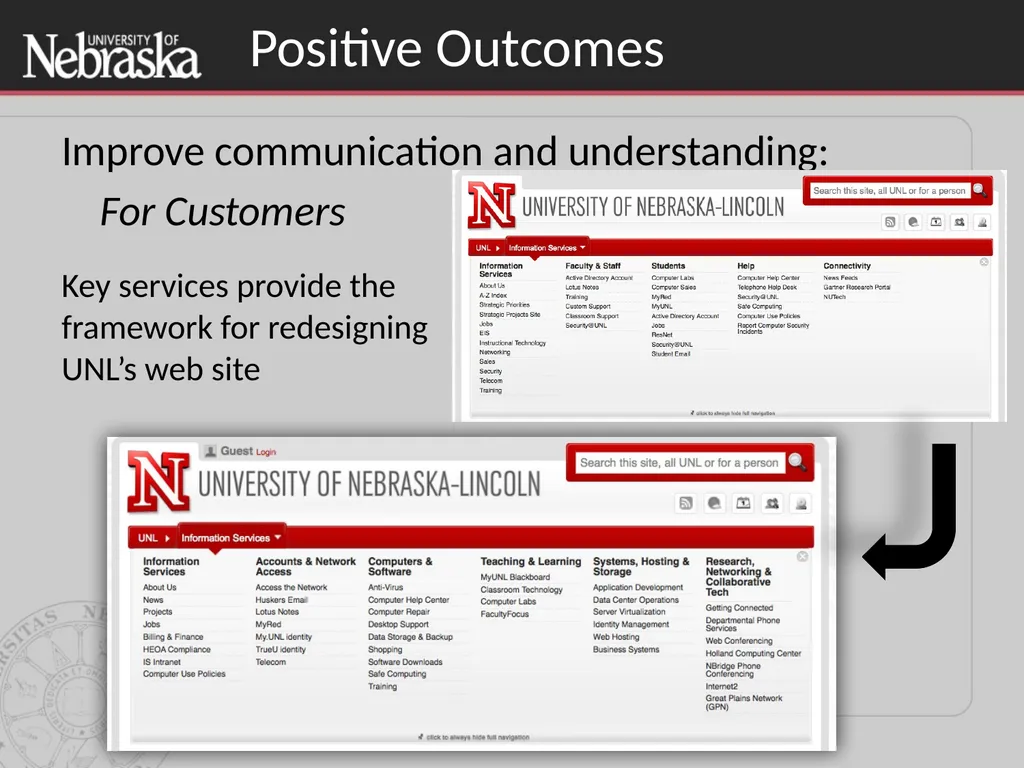
slide12. Positive Outcomes Improve communication and understanding:
For Customers
Key services provide the framework for redesigning UNL’s web site<br>
slide13. Practical Outcomes Enable Efficiency and Collaboration
Services are helping redefine campus-wide IT resources allocation & assess cost savings and greater efficiencies
Framework is key to looking at system-wide collaboration opportunities and community projects with Higher Ed IT organizations in the BigTen CIC, and on a national basis.<br>
slide14. Practical Outcomes Strategic Planning & Decision Making
Enables evaluation of how each service is aligned and supports overarching University initiatives.
Enables understanding of how changes in IT services impact the University (e.g., what functionality is affected, which customers are affected, does it have a global impact or is it focused to a small community)
Enables more accurate and timely analysis of alternatives
Re-evaluation of service offerings (create new, retire existing, combine, branch, etc.)<br>
slide15. Practical Outcomes Continual Improvement
Identifying and managing to performance metrics
Establishing Service Level Agreements (setting and managing expectations)
Developing Service Catalog and Request Processes
Implement ongoing customer feedback process
Evaluation of services and definitions is never finished<br>
slide16. Contact Information Mark Askren
maskren2@unl.edu
Kimberly Harper
kkharper@nebraska.edu<br>
Kimberly Harper – Director of Finance & Portfolio Management, University of Nebraska – Central Administration<br>
slide2. The Impetus – Budget Crisis Experiencing pressure from both sides:
Demand for IT services grows, while resources stay the same or decrease (“new normal”)
Challenge is how to:
Further cut already reduced budgets
Continue to produce core mission services and innovation to meet increasing demand<br>
slide3. Re-evaluation Our Goals
Create a better understanding of our IT organizations (including within our organizations)
Validate that our priorities are aligned and funding justified
Identify efficiency & collaborative opportunities
Improve strategic planning & decision-making, and invest accordingly
Weather the storm
Identify opportunities for improvement<br>
slide4. An Approach: Services Inventory Scope
Identify all services provided to both internal and external customers.
Identify all assets that support each service (e.g., software, applications, operating systems, hardware maintenance, connectivity charges, materials, contract charges, personnel).
Identify customers who utilize each service.
Identify total cost of all assets associated with each service.<br>
slide5. An Approach: Services Inventory Methodology
Consultant-led staff interviews
Development of service offering categories, descriptions and characteristics
Development of financial cost model<br>
slide6. An Approach: Services Inventory Outcome – Identified Service Offerings User Access & Security Enterprise Information Systems Hardware & Software Support E-Mail, Communication & Collaboration Data Management & Analytics Internet & Network Connectivity IT Governance & Service Management User Training & Community Printing, Forms & Output Management Web Development Support CSN UNL User Access & Security Technology Innovation Support Hardware, Hosting & Storage E-Mail, Communication & Collaboration Data Management & Analytics Internet, Phone & Network Communications IT Governance & Service Management User Training & Community Classroom, Lab & Instructional Resources Consulting & Project Management Technology Sales & Repairs Development, Integration & Support<br>
slide7. An Approach: Services Inventory Outcome – Define Service Offering Attributes<br>
slide8. An Approach: Services Inventory Teams that Provide Services
Services require cross functional contributions (break out of “silo” thinking)<br>
slide9. The Key Lessons Learned Using IT services as the value definition is more effective than the traditional organization structure and major projects view
Traditional IT becomes Service Oriented<br>
slide10. The Key Lessons Learned Decisions to continue, discontinue or develop new services have wide-spread implications
Services inventorying and management is a long-term commitment
Challenges:
Moving from team-focus to service-focus
Resource-facing vs. Customer-facing services
Not getting trapped by what you know
Drawing lines in the sand
Staff buy-in<br>
slide11. Positive Outcomes Improve
communication
and understanding:
For Executive Leadership<br>
slide12. Positive Outcomes Improve communication and understanding:
For Customers
Key services provide the framework for redesigning UNL’s web site<br>
slide13. Practical Outcomes Enable Efficiency and Collaboration
Services are helping redefine campus-wide IT resources allocation & assess cost savings and greater efficiencies
Framework is key to looking at system-wide collaboration opportunities and community projects with Higher Ed IT organizations in the BigTen CIC, and on a national basis.<br>
slide14. Practical Outcomes Strategic Planning & Decision Making
Enables evaluation of how each service is aligned and supports overarching University initiatives.
Enables understanding of how changes in IT services impact the University (e.g., what functionality is affected, which customers are affected, does it have a global impact or is it focused to a small community)
Enables more accurate and timely analysis of alternatives
Re-evaluation of service offerings (create new, retire existing, combine, branch, etc.)<br>
slide15. Practical Outcomes Continual Improvement
Identifying and managing to performance metrics
Establishing Service Level Agreements (setting and managing expectations)
Developing Service Catalog and Request Processes
Implement ongoing customer feedback process
Evaluation of services and definitions is never finished<br>
slide16. Contact Information Mark Askren
maskren2@unl.edu
Kimberly Harper
kkharper@nebraska.edu<br>