UREA cycle: Miss Farida Zai UREa cycle The urea cycle is a cycle of biochemical reactions that produces urea (NH₂)₂CO from ammonia. This cycle occurs in ureotelic organisms. The urea cycle converts highly toxic ammonia to urea for
"UREA cycle: Miss Farida Zai UREa cycle The urea" is the property of its rightful owner. Permission is granted to
download and print the materials on this website for personal, non-commercial use only, and to display it
on your personal computer provided you do not modify the materials and that you retain all copyright
notices contained in the materials. By downloading content from our website, you accept the terms of this
agreement.
Presentation Transcript
01
UREA cycle: Miss Farida Zai<br>
02
UREa cycle The urea cycle is a cycle of biochemical reactions that produces urea (NH₂)₂CO from ammonia. This cycle occurs in ureotelic organisms. The urea cycle converts highly toxic ammonia to urea for excretion.<br>
03
Purpose of urea cycle: The main purpose of the urea cycle is to eliminate toxic ammonia from the body. About 10 to 20 g of ammonia is removed from the body of a healthy adult every day. A dysfunctional urea cycle would mean excess amount of ammonia in the body, which can lead to hyperammonemia and related diseases.<br>
04
Steps of urea cycle: 1 Transport of nitrogen to the liver: Ammonia is very toxic, particularly to the central nervous system.
The concentration of ammonia and ammonium ions in the blood is normally very low.
(NH3 + H+ ↔ NH4+)
Ammonia travels to the liver from other tissues, mainly in the form of alanine and glutamine.
It is released from amino acids in the liver by a series of transamination and deamination reactions.
Ammonia is also produced by bacteria in the gut and travels to the liver via the hepatic portal vein.<br>
05
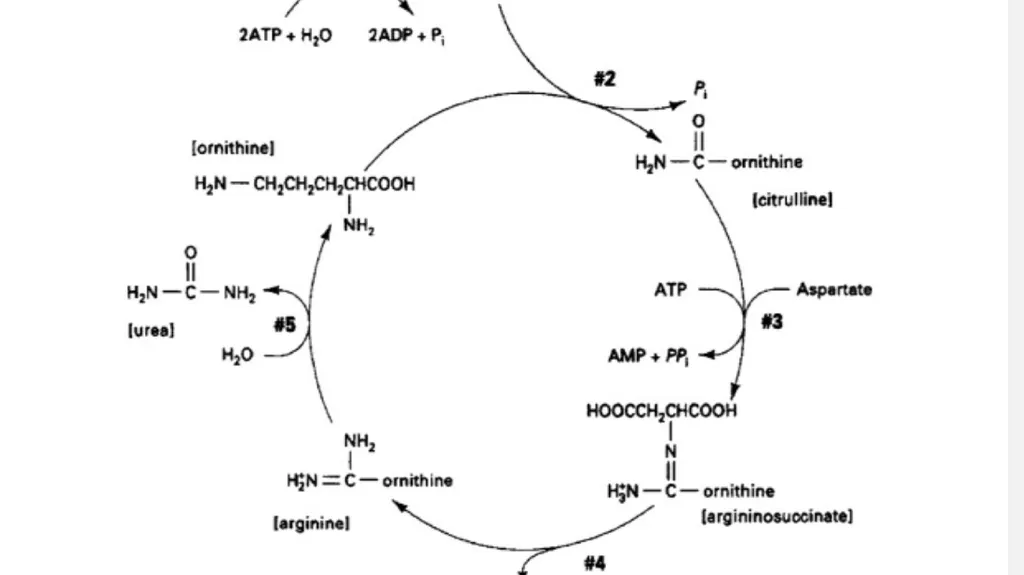
STEPS OF UREA CYCLE Reactions of the urea cycle
NH4+ and aspartate provide the nitrogen that is used to produce urea, and CO2 provides the carbon. Ornithine serves as a carrier that is regenerated by the cycle.
Carbamoyl phosphate is synthesized in the first reaction from NH4+, CO2, and two ATP. Inorganic phosphate and two ADP are also produced.
Enzyme: carbamoyl phosphate synthetase I, which is located in mitochondria and is activated by N-acetylglutamate.<br>
06
Steps of urea cycle Ornithine reacts with carbamoyl phosphate to form citrulline. Inorganic phosphate is released.
Enzyme: ornithine transcarbamoylase, which is found in mitochondria. The product, citrulline, is transported to the cytosol in exchange for cytoplasmic ornithine.
Citrulline combines with aspartate to form argininosuccinate in a reaction that is driven by the hydrolysis of ATP to AMP and inorganic pyrophosphate.
Enzyme: Argininosuccinate synthetase<br>
07
Steps of urea cycle Argininosuccinate is cleaved to form arginine and fumarate.
Enzyme: argininosuccinate lyase. This reaction occurs in the cytosol.
The carbons of fumarate, which are derived from the aspartate added in reaction 3, can be converted to malate.
In the fasting state in the liver, malate can be converted to glucose or to oxaloacetate, which is transaminated to regenerate the aspartate required for reaction 3.
Arginine is cleaved to form urea and regenerate ornithine.
Enzyme: arginase, which is located primarily in the liver and is inhibited by ornithine.
Urea passes into the blood and is excreted by the kidneys.
Ornithine is transported back into the mitochondrion (in exchange for citrulline) where it can be used for another round of the cycle.<br>
08
Steps of urea cycle When the cell requires additional ornithine, it is synthesized from glucose via glutamate.
Arginine is a nonessential amino acid in adults. It is synthesized from glucose via ornithine and the first four reactions of the urea cycle.<br>
09
Related diseases to urea cycle imbalance: The following conditions might take place;
Hyperammonemia occurs when there is a deficiency in one of more of the urea cycle enzymes, causing insufficient removal of NH4+.
Ammonia intoxication leads to CNS deterioration in the form of mental retardation, seizure, coma, and death.<br>