
Use of this presentation This presentation is
MS
Published · 66 slides · 0 views
1 / 1


Description
Use of this presentation This presentation is intended solely for referee training and education. The International Federation Icestocksport (IFI) permits the use and adaptation of the International Icestock Rules (IER) in PowerPoint
Related Topics
Share
Embed code
Download this presentation From Below
"Use of this presentation This presentation is" is the property of its rightful owner. Permission is granted to download and print the materials on this website for personal, non-commercial use only, and to display it on your personal computer provided you do not modify the materials and that you retain all copyright notices contained in the materials. By downloading content from our website, you accept the terms of this agreement.
Presentation Transcript
01
Use of this presentation
This presentation is intended solely for referee training and education.
The International Federation Icestocksport (IFI) permits the use and adaptation of the International Icestock Rules (IER) in PowerPoint presentations or similar formats solely for internal training and education.
Publication, reproduction, distribution or any other form of public access, including extracts, requires prior written permission from the IFI.
© IFI – All rights reserved 1 IER Rules 2026 Updated: 16 September 2026<br>
02
2 Introduction
TABLE OF CONTENTS Index (replaced by a table of contents)
A clearly structured table of contents replaces the former index. This makes navigation through the rules faster and more precise, particularly in digital versions. Users can go directly to individual chapters and rule sections, making specific content easier to find.<br>
A clearly structured table of contents replaces the former index. This makes navigation through the rules faster and more precise, particularly in digital versions. Users can go directly to individual chapters and rule sections, making specific content easier to find.<br>
03
3 IER 103 Disciplines
Added:
• Speed competition Section 1 GENERAL<br>
Added:
• Speed competition Section 1 GENERAL<br>
04
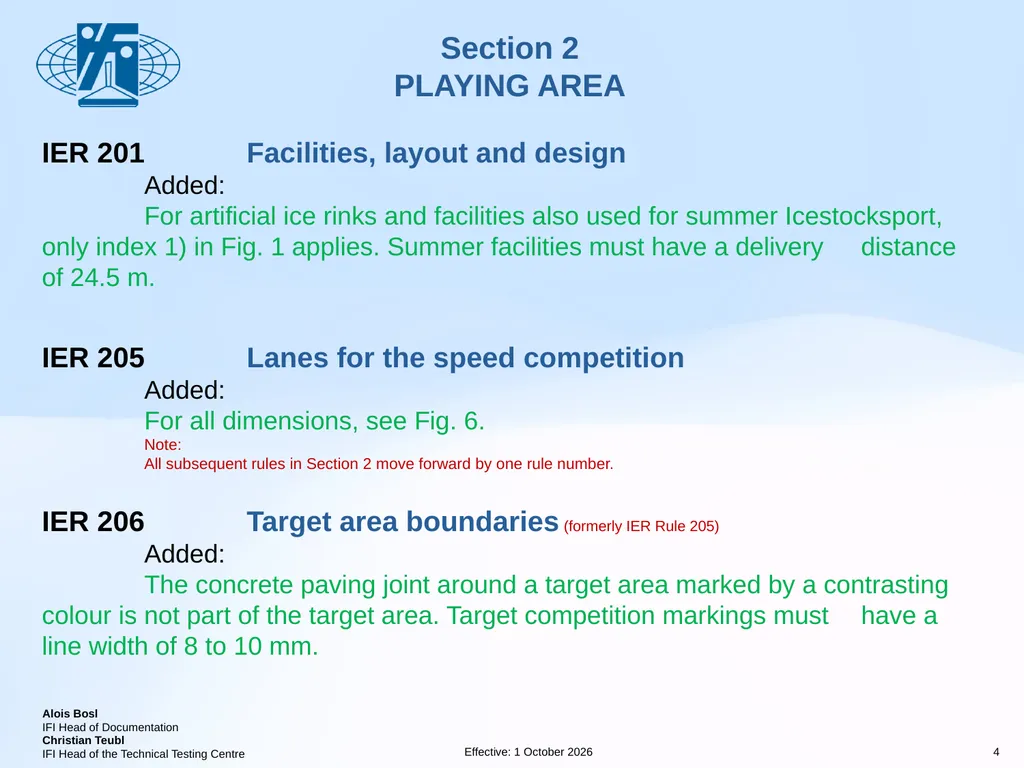
4 IER 201 Facilities, layout and design
Added:
For artificial ice rinks and facilities also used for summer Icestocksport, only index 1) in Fig. 1 applies. Summer facilities must have a delivery distance of 24.5 m. Section 2 PLAYING AREA IER 205 Lanes for the speed competition
Added:
For all dimensions, see Fig. 6.
Note:
All subsequent rules in Section 2 move forward by one rule number. IER 206 Target area boundaries (formerly IER Rule 205)
Added:
The concrete paving joint around a target area marked by a contrasting colour is not part of the target area. Target competition markings must have a line width of 8 to 10 mm.<br>
Added:
For artificial ice rinks and facilities also used for summer Icestocksport, only index 1) in Fig. 1 applies. Summer facilities must have a delivery distance of 24.5 m. Section 2 PLAYING AREA IER 205 Lanes for the speed competition
Added:
For all dimensions, see Fig. 6.
Note:
All subsequent rules in Section 2 move forward by one rule number. IER 206 Target area boundaries (formerly IER Rule 205)
Added:
The concrete paving joint around a target area marked by a contrasting colour is not part of the target area. Target competition markings must have a line width of 8 to 10 mm.<br>
05
5 Section 2
PLAYING AREA IER 207 Delivery point (formerly IER Rule 206)
Added:
.. and the speed competition.<br>
Added:
.. and the speed competition.<br>
06
6 Section 3
Playing and sports equipment IER 303 Stock body, handle and running soles
Added:
Note: Dismantling summer running soles or any other sports equipment components is reserved exclusively for the manufacturers and the IFI testing centre. Proven interference by players or third parties constitutes tampering in breach of the rules.
…
In pupils’ competitions (ISpO § 110 a)), only the Type E or Light pupils’ stock may be used. It is prohibited in all other playing classes (except in distance and speed competitions).<br>
07
7 Section 3
Playing and sports equipment IER 304 Light pupils’ stock
Added:
c) Light pupils’ stock body: The following simplified specifications apply:
- the outer diameter must be such that the running sole does not protrude
- the handle must fit easily into the handle socket
- the material of the intermediate plate is freely selectable - wood or aluminium permitted
- the cap must still be made of plastic
- the ring may be made of aluminium, in addition to the previously approved stainless steel and steel grades
- the ring height should be approximately the same as that of the current pupils’ stock model
- the two-digit manufacturer number, year code (JKB) and IFI pupils’ stock seal must be present
- all other dimensional tolerances are suspended<br>
08
8 Section 3
Playing and sports equipment IER 305 Handle
Added:
The handle must remain in a condition that complies with the rules throughout the competition. Should the handle no longer comply with the regulations due to external circumstances such as wetness or cold (e.g. weight or centre of gravity outside the permitted tolerances), the team will be penalised in accordance with IER-R 805 a). IER 308 Summer running sole
Added:
A running sole is permitted if it has force-fit and form-fit connections to the base plate, is undamaged, has no missing screws and exposes neither wear limiters nor damping inserts. The flatness tolerance of the active running surface is < 0.4 mm.
Raised areas within an active running surface of Ø120 mm are tolerated at ≤ 0.05 mm, while depressions are tolerated at < 0.4 mm.<br>
Added:
The handle must remain in a condition that complies with the rules throughout the competition. Should the handle no longer comply with the regulations due to external circumstances such as wetness or cold (e.g. weight or centre of gravity outside the permitted tolerances), the team will be penalised in accordance with IER-R 805 a). IER 308 Summer running sole
Added:
A running sole is permitted if it has force-fit and form-fit connections to the base plate, is undamaged, has no missing screws and exposes neither wear limiters nor damping inserts. The flatness tolerance of the active running surface is < 0.4 mm.
Raised areas within an active running surface of Ø120 mm are tolerated at ≤ 0.05 mm, while depressions are tolerated at < 0.4 mm.<br>
09
9 Section 3
Playing and sports equipment IER 308 Summer running soles - Continued
Added:
IFI No. 10 white > 86 Shore D
Note: If a summer running sole is used without the required IFI running sole seal, the team has 1 match point deducted.
This does not apply to red summer running soles with a negative tread pattern up to year code (JKB) “Q”.
During a competition, summer running soles may be cleaned only on concrete screed using smooth scrapers.
Cleaning is permitted only between matches and outside the playing area.
In the event of non-compliance, rules IER-R 435 i) and 803 b) shall apply, i.e. the attempt is invalid, and the team shall have 2 match points deducted from the final score!<br>
10
10 Section 3
Playing and sports equipment IER 309 Winter running soles
Added:
Note: Slight deviations in the prescribed flat diameter range > Ø120 mm are tolerated for winter running soles. Raised areas within this Ø120 mm range are tolerated at ≤ 0.05 mm, while depressions are tolerated at a maximum of < 0.2 mm.
Measurable using the feeler gauge in the IFI inspection kit. IER 311 Weights
Added:
Light pupils’ stock 2700–3000 g<br>
Added:
Note: Slight deviations in the prescribed flat diameter range > Ø120 mm are tolerated for winter running soles. Raised areas within this Ø120 mm range are tolerated at ≤ 0.05 mm, while depressions are tolerated at a maximum of < 0.2 mm.
Measurable using the feeler gauge in the IFI inspection kit. IER 311 Weights
Added:
Light pupils’ stock 2700–3000 g<br>
11
11 Section 3
Playing and sports equipment IER 312 Jack
Added:
The event operator decides whether a jack may be used for a purpose other than its intended one by placing it at the delivery point. IER 313 Inspection kit
Added:
The stated deviations and tolerances must demonstrably result from normal use. If it is apparent that a running sole has been deliberately tampered with or machined on a lathe contrary to the standard, for example from visible turning grooves or machining marks, the player concerned shall be penalised in accordance with IER-R 805 a). IER 314 Measuring
Added:
Suitable measuring devices must be used to measure distance in the distance competition and to measure time in target and speed competitions.<br>
Added:
The event operator decides whether a jack may be used for a purpose other than its intended one by placing it at the delivery point. IER 313 Inspection kit
Added:
The stated deviations and tolerances must demonstrably result from normal use. If it is apparent that a running sole has been deliberately tampered with or machined on a lathe contrary to the standard, for example from visible turning grooves or machining marks, the player concerned shall be penalised in accordance with IER-R 805 a). IER 314 Measuring
Added:
Suitable measuring devices must be used to measure distance in the distance competition and to measure time in target and speed competitions.<br>
12
12 Section 3
Playing and sports equipment IER 320 Running sole stands
Added and administratively revised:
Only running sole stands that can accommodate a maximum of eight running soles and do not exceed the following maximum dimensions may be used.
Attaching any accessories is prohibited and the running sole stand must be carried. IER 321 Upper-body clothing
Added:
A team’s players must wear matching upper-body clothing (short and long sleeves in the same colour are permitted).<br>
13
13 Section 4
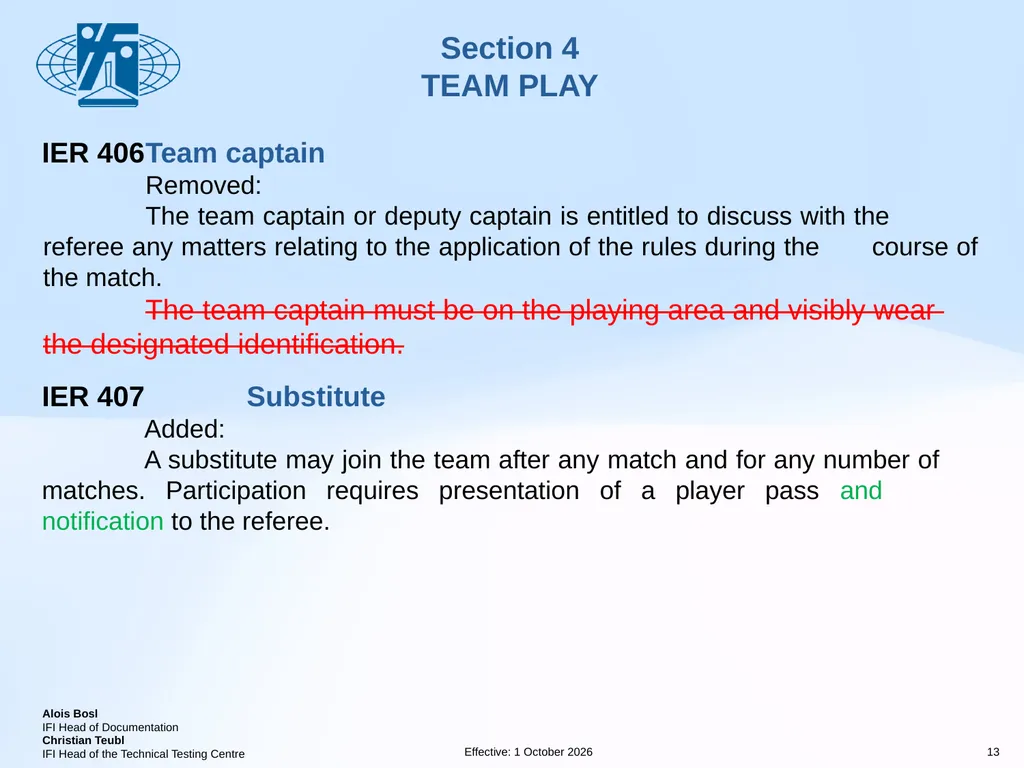
TEAM PLAY IER 406 Team captain
Removed:
The team captain or deputy captain is entitled to discuss with the referee any matters relating to the application of the rules during the course of the match.
The team captain must be on the playing area and visibly wear the designated identification. IER 407 Substitute
Added:
A substitute may join the team after any match and for any number of matches. Participation requires presentation of a player pass and notification to the referee.<br>
14
14 Section 4
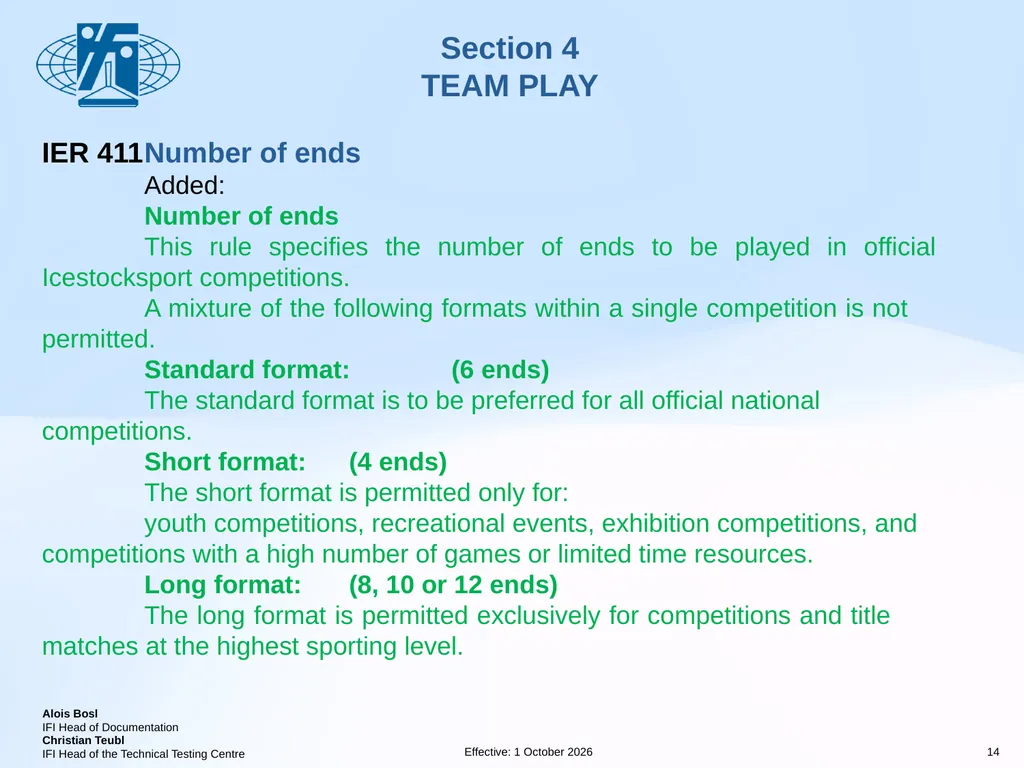
TEAM PLAY IER 411 Number of ends
Added:
Number of ends
This rule specifies the number of ends to be played in official Icestocksport competitions.
A mixture of the following formats within a single competition is not permitted.
Standard format: (6 ends)
The standard format is to be preferred for all official national competitions.
Short format: (4 ends)
The short format is permitted only for:
youth competitions, recreational events, exhibition competitions, and competitions with a high number of games or limited time resources.
Long format: (8, 10 or 12 ends)
The long format is permitted exclusively for competitions and title matches at the highest sporting level.<br>
15
15 Section 4
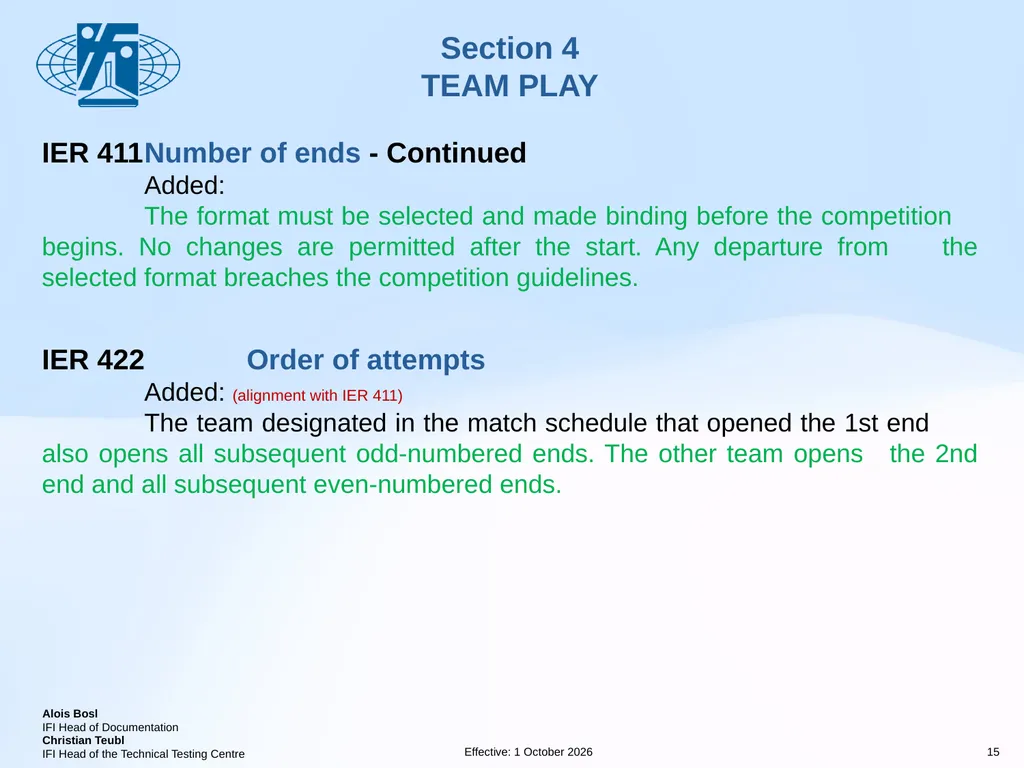
TEAM PLAY IER 411 Number of ends - Continued
Added:
The format must be selected and made binding before the competition begins. No changes are permitted after the start. Any departure from the selected format breaches the competition guidelines. IER 422 Order of attempts
Added: (alignment with IER 411)
The team designated in the match schedule that opened the 1st end also opens all subsequent odd-numbered ends. The other team opens the 2nd end and all subsequent even-numbered ends.<br>
16
16 Section 4
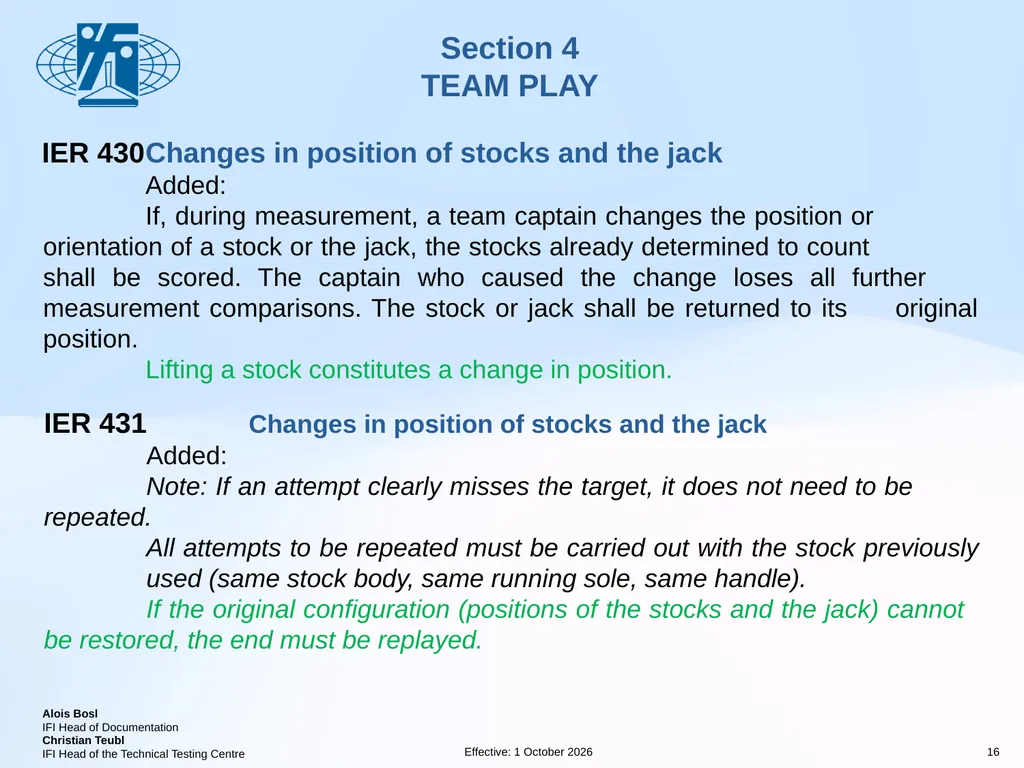
TEAM PLAY IER 430 Changes in position of stocks and the jack
Added:
If, during measurement, a team captain changes the position or orientation of a stock or the jack, the stocks already determined to count shall be scored. The captain who caused the change loses all further measurement comparisons. The stock or jack shall be returned to its original position.
Lifting a stock constitutes a change in position. IER 431 Changes in position of stocks and the jack
Added:
Note: If an attempt clearly misses the target, it does not need to be repeated.
All attempts to be repeated must be carried out with the stock previously used (same stock body, same running sole, same handle).
If the original configuration (positions of the stocks and the jack) cannot be restored, the end must be replayed.<br>
Added:
If, during measurement, a team captain changes the position or orientation of a stock or the jack, the stocks already determined to count shall be scored. The captain who caused the change loses all further measurement comparisons. The stock or jack shall be returned to its original position.
Lifting a stock constitutes a change in position. IER 431 Changes in position of stocks and the jack
Added:
Note: If an attempt clearly misses the target, it does not need to be repeated.
All attempts to be repeated must be carried out with the stock previously used (same stock body, same running sole, same handle).
If the original configuration (positions of the stocks and the jack) cannot be restored, the end must be replayed.<br>
17
17 Section 4
TEAM PLAY IER 443 Player conduct
Added:
Players and equipment must remain behind the delivery area on the side of the lane nearer the lane used in the preceding match. Only if space behind the delivery area is insufficient may players stand between the delivery areas, no further forward than the front boundary line. They may proceed to the target area only after the end is complete. IER 445 Player conduct
Added and removed:
Note: Recommended match duration: 25 to 30 minutes. Suitable timing systems for each team must be used when instructed by the competition director.
Note: The recommended match duration is 25 to 30 minutes. A maximum of 15 minutes per team is available only if suitable timing equipment is present or provided for each lane. Such equipment is provided on the instructions of the competition committee.<br>
18
18 Section 4
TEAM PLAY IER 446 Player conduct - Communication devices
Added:
The use of electronic communication devices is prohibited on the playing area. Exception: medical monitoring apps (e.g. for diabetics). IER 447 Player conduct - Smoking
Added:
Smoking is prohibited on the playing field. This rule also applies explicitly to e-cigarettes. Any breach of this rule will result in the match being declared a loss for the team concerned.<br>
Added:
The use of electronic communication devices is prohibited on the playing area. Exception: medical monitoring apps (e.g. for diabetics). IER 447 Player conduct - Smoking
Added:
Smoking is prohibited on the playing field. This rule also applies explicitly to e-cigarettes. Any breach of this rule will result in the match being declared a loss for the team concerned.<br>
19
19 Section 5
TARGET COMPETITION IER 501 Target competition formats
Added:
The target competition is a competition between individual players for the highest score.
There are 4 target competition formats:
Classic, Compact, Team and Head-to-Head
In all formats, all attempts must be made on one lane.
A maximum of 8 running soles, 2 handles and one stock body may be on the playing surface. These must not obstruct other players. IER 502 “Classic” target competition
Added:
The Classic target competition is held in accordance with IER Rules 503 to 506 over 4 rounds of 6 attempts each.
A maximum of 240 points can be scored.<br>
Added:
The target competition is a competition between individual players for the highest score.
There are 4 target competition formats:
Classic, Compact, Team and Head-to-Head
In all formats, all attempts must be made on one lane.
A maximum of 8 running soles, 2 handles and one stock body may be on the playing surface. These must not obstruct other players. IER 502 “Classic” target competition
Added:
The Classic target competition is held in accordance with IER Rules 503 to 506 over 4 rounds of 6 attempts each.
A maximum of 240 points can be scored.<br>
20
20 Section 5
TARGET COMPETITION IER 507 “Compact” target competition
Added:
The Compact target competition is conducted in accordance with IER regulations 503 to 506 in four rounds, each consisting of 4 attempts.
A maximum of 160 points can be scored.
The following variations apply to the Compact format:
1. Middle target rings - Round 1
In this round, participants complete 4 attempts at the middle target rings. Scoring is in accordance with IER guideline 503.
A maximum of 40 points can be scored.
2. Stock shooting - Round 2
In this section, 4 attempts are made at a target stock, with target stocks E and F not being used.
The target stock order is A, B, C, D.
Scoring follows IER 504.
A maximum of 40 points can be scored.<br>
21
21 Section 5
TARGET COMPETITION IER 507 “Compact” target competition - Continued
Added:
3. Rear target rings - Round 3
Participants complete 2 attempts each at the left and right rear target rings. Scoring is in accordance with IER 505.
A maximum of 40 points can be scored.
4. Combination - Round 4
Four attempts are made at the target stock; target stocks A and B are omitted in this round. Scoring is in accordance with IER 506.
A maximum of 40 points can be scored.
Ranking follows Rule 531.
For diagrams of the rounds, see Fig. 17.1.<br>
22
22 Section 5
TARGET COMPETITION IER 508 “Team” target competition
Added:
A team in the target competition consists of four players per competition.
The starting order and lane allocation are determined by drawing lots.
In the mixed competition, the team consists of 2 female and 2 male players, with the order of the players determined by the team.
The competition is conducted in accordance with the rules of the Classic variant. For warm-up time, see IER Rule 511.
The total score of all four players determines the ranking. In the event of a tie, the scoring is determined in accordance with Rule 531.<br>
23
23 Section 5
TARGET COMPETITION IER 509 “Head-to-Head” target competition
Added:
The target competition in Head-to-Head mode is held exclusively in the final rounds (round of 16, quarter-finals, semi-finals and final).
The competition consists of a minimum of 4 and a maximum of 7 rounds, each with 4 attempts, with all attempts to be made on one lane alternately with the opponent. The player with the lower start number (better ranking) has the right to choose the order of the attempts.
A maximum of 40 points is scored in each round.
The pairings are determined as follows based on the results of the preliminary round.
1st place versus 6th place
2nd place versus 15th place
3rd place versus 14th place, etc.
The remaining tournament bracket follows from these pairings.
Scoring follows IER Rules 503–506.
Note: IER Rules 512–517, 521 and 523 apply without restriction.<br>
24
24 Section 5
TARGET COMPETITION IER 509 “Head-to-Head” target competition - Continued
Added:
Rounds
1st round: 4 attempts each at the middle target rings
2nd round: 1 attempt each at A / B / C / D
3rd round: 2 attempts each at the rear target rings
4th round: 1 attempt each at G / H / E / F
See Fig. 17.1 for diagrams of the rounds.
Ranking
Round points (DZP):
Winner of each round: 2 DZP
Tie: 1 DZP for each player
The winner of the match after all rounds is the player who reaches 7 round points first.<br>
25
25 Section 5
TARGET COMPETITION IER 509 “Head-to-Head” target competition - Continued
Added:
Tie
If the scores are tied after all rounds:
1. The total points from all rounds determine the winner.
2. If the scores remain tied, a tie-break is held. The two participants alternate, making 1 attempt each at the middle target rings, until a winner is determined.<br>
Added:
Tie
If the scores are tied after all rounds:
1. The total points from all rounds determine the winner.
2. If the scores remain tied, a tie-break is held. The two participants alternate, making 1 attempt each at the middle target rings, until a winner is determined.<br>
26
26 Section 5
TARGET COMPETITION IER 511 Warm-up times and practice attempts
Added:
At the start of the competition, each player receives:
Individual Target Classic: 8 minutes of warm-up time
Individual Target Compact: 8 minutes of warm-up time
Target Team Competition: 6 practice attempts in ≤ 4 minutes
Target Mixed Competition: 6 practice attempts in ≤ 4 minutes
Head-to-Head: 8 practice attempts each alternating with the opponent
No practice attempts are permitted on the competition lanes before the start of the competition.
Time limits for scoring rounds:
Individual Target Classic: 18 minutes of scoring time
Individual Target Compact: 12 minutes of scoring time
Target Team Competition: 9 minutes of scoring time
Target Mixed Competition: 9 minutes of scoring time
Head-to-Head: ≤ 3 minutes of scoring time, per player, per round<br>
27
27 Section 5
TARGET COMPETITION IER 532 Team classification
Removed: (replaced by IER Rules 501, 507, 508, 509 and 511)
A target competition team consists of 4 players in women’s and men’s events. A mixed team consists of 2 female and 2 male players.
The starting order and allocation of competition lanes are determined by drawing lots.
Each player may make 6 practice attempts at the start of their round.
The total score of all four players determines the ranking. In the event of a tie, the scoring is determined in accordance with Rule 531.<br>
28
28 Section 6a
DISTANCE COMPETITION IER 604 Rules
Added:
The starting order in the 1st round follows the draw. Start numbers must be used and worn visibly.<br>
Added:
The starting order in the 1st round follows the draw. Start numbers must be used and worn visibly.<br>
29
29 Section 6b
SPEED COMPETITION IER 651- 691 (speed competition reinstated)
The speed competition is a competition between individual players to achieve the shortest times in which the stock covers a measured distance of 40 m.
The 12th edition of the International Icestock Rules (IER) officially reinstates the speed competition. Rules 651 to 691 set out all provisions for this event.
Reinstating the event aims to promote the speed competition as a distinct and attractive discipline of Icestocksport over the long term.
Rules 651 to 691 provide the complete basis for planning, organising and running this competition in international Icestocksport.<br>
30
30 Section 7
ELITE SPORT New section on elite sport
The 12th edition of the International Icestock Rules (IER) introduces Section 7, “Elite Sport”, for the first time.
This separate section clearly defines the specific requirements and conditions of international elite sport and incorporates them systematically into the rules. It reflects the growing professionalism of international competitions and establishes a consistent basis for events at the highest sporting level.
As a result of this structural expansion, the former Section 7, “Officials”, has been moved without substantive change and is now Section 9 of the IER.
The substantive provisions concerning officials generally remain in place. Only the structure and numbering have been adjusted to incorporate the new elite sport section into the IER.<br>
31
31 Section 7
ELITE SPORT IER 701 Elite sport
Added:
Elite sport in Icestocksport refers to the highest level of performance and competition at which athletes compete in accordance with national and international competition and association regulations.
It is characterised by a high degree of professionalism, technical precision and strict rules and codes of conduct.
Classification as elite sport is determined by the respective national federations.<br>
32
32 Section 7
ELITE SPORT IER 702 Conduct requirements
Added:
Athletes must treat opponents, referees and officials fairly and respectfully at all times. Unsporting behaviour, verbal aggression and any inappropriate discussions with officials are prohibited and will be punished.
Due to their role as role models for young and amateur athletes, elite athletes have an increased duty to uphold integrity and safeguard the reputation of the sport.
Athletes are required to be punctual, have a comprehensive knowledge of the rules, and demonstrate continuous readiness to perform and professionalism.
The WADA anti-doping regulations apply to all athletes. The use of prohibited substances or methods is prohibited.<br>
33
33 Section 7
ELITE SPORT IER 703 Alcohol ban
Added:
In the field of elite sport, there is an absolute zero-tolerance policy towards the consumption of alcoholic beverages.
The consumption of alcoholic beverages on the sports grounds is prohibited for participating athletes, coaches and officials both before and during the competition.
Random checks may be carried out at any of these times.
Any breach of this rule or refusal to undergo a test by athletes will result in automatic disqualification.
In the event of a breach, coaches and officials are prohibited from continuing to participate in or oversee the competition day in question.<br>
34
34 Section 7
ELITE SPORT IER 704 Prohibition of intoxicating substances
Added:
The consumption of illegal substances or substances that impair performance is prohibited. Breaches shall result in disqualification and further suspensions in accordance with the federations’ regulations. IER 705 Smoking regulations
Added:
Smoking is permitted only in designated areas. These areas must not be set up within sight of the playing area.
The competition director is responsible for checking compliance with these location requirements. This regulation expressly includes
e-cigarettes.<br>
Added:
The consumption of illegal substances or substances that impair performance is prohibited. Breaches shall result in disqualification and further suspensions in accordance with the federations’ regulations. IER 705 Smoking regulations
Added:
Smoking is permitted only in designated areas. These areas must not be set up within sight of the playing area.
The competition director is responsible for checking compliance with these location requirements. This regulation expressly includes
e-cigarettes.<br>
35
35 Section 7
ELITE SPORT IER 706 Dress code
Added:
In elite sport, uniform, functional and regulation-compliant team-sport clothing is mandatory. All team members must compete in identical clothing (jersey, trousers, jacket). The clothing must bear the club or national coat of arms as well as permitted sponsor logos in accordance with association guidelines.
Due to the specific climatic conditions in Icestocksport, such as cold or draughts in indoor and outdoor venues, players are permitted to choose their own clothing in terms of sleeve length and trouser style. This means that both short- and long-sleeved tops, as well as shorts or long trousers, may be worn. The decision regarding the length of sleeves and trousers may be made not only on the basis of personal preference, but also, in particular, for health reasons.<br>
36
36 Section 7
ELITE SPORT IER 706 Dress code - Continued
Added:
The prerequisite for this is that they are kept in a uniform colour. For example, black or the respective club colour may serve as permissible options. This ensures that, despite individual adjustments to weather conditions, a uniform appearance of the teams is maintained.
In case of doubt, the referee shall decide on the admissibility of individual items of clothing, taking into account health, safety and uniformity.
If, in the referee’s view, the kit of two teams in Icestocksport finals is not sufficiently distinguishable in terms of colour, the competition director shall decide which team must change their kit. A clear colour contrast in the outerwear is mandatory.
The wearing of smooth or unsuitable shoe soles is prohibited. Approved sports shoes with non-slip soles must be worn. This applies throughout the entire competition.<br>
37
37 Section 7
ELITE SPORT IER 707 Equipment requirements
Added:
All sports equipment used in competition must be IFI-approved and comply with the relevant testing regulations.
The stock body, handle and running sole must fall within the tolerances specified in Section 3. The minimum height of summer running soles must be ≥ 21.0 mm.
A 10-year phase-out period applies to stock bodies and running soles. In addition, the implementing regulations of the IFI and the respective national federations apply.
In IFI competitions, four stock bodies from the same manufacturer and of identical design (model and colour) must be used.
The competition director and authorised equipment inspectors are responsible for checking equipment compliance. All expired inspection stickers must be removed beforehand. All sports equipment components must be presented clean (except summer running soles) and dry.<br>
38
38 Section 7
ELITE SPORT IER 707 Equipment requirements - Continued
Added:
Breaches may result in the following sanctions:
Exclusion of the equipment component (reinspection if necessary),
Point deduction,
Disqualification,
Suspension of the athlete for that day of competition,
Exclusion from the squad.
If an equipment component that has been deliberately tampered with in breach of the rules is presented during the pre-competition equipment inspection, the player shall be disqualified immediately (as determined by the inspection commission).
In the event of serious breaches, disciplinary proceedings may be initiated by the relevant national federation.<br>
39
39 Section 7
ELITE SPORT IER 708 Binding nature
Added:
The provisions of this section are binding for all IFI competitions and all national leagues or competitions classified as elite sport.
Athletes, coaches and officials are obliged to comply fully with all regulations.
Breaches are penalised according to the nature and severity of the misconduct.<br>
40
40 Section 8
PENALTIES At the referee’s proper discretion and in accordance with the severity of the offence, the following penalties may be imposed:
- 1 penalty point = 1 stock point
- 1 match point deducted from the final score
= (5 stock points in final matches)
- 2 match points deducted from the final score
= (10 stock points in final matches)
- Time penalty:
Exclusion of a player from the current match or round. If exclusion is not possible, the match is forfeited.
- Match penalty:
Exclusion of a player for the remainder of the competition
- Disqualification of the entire team
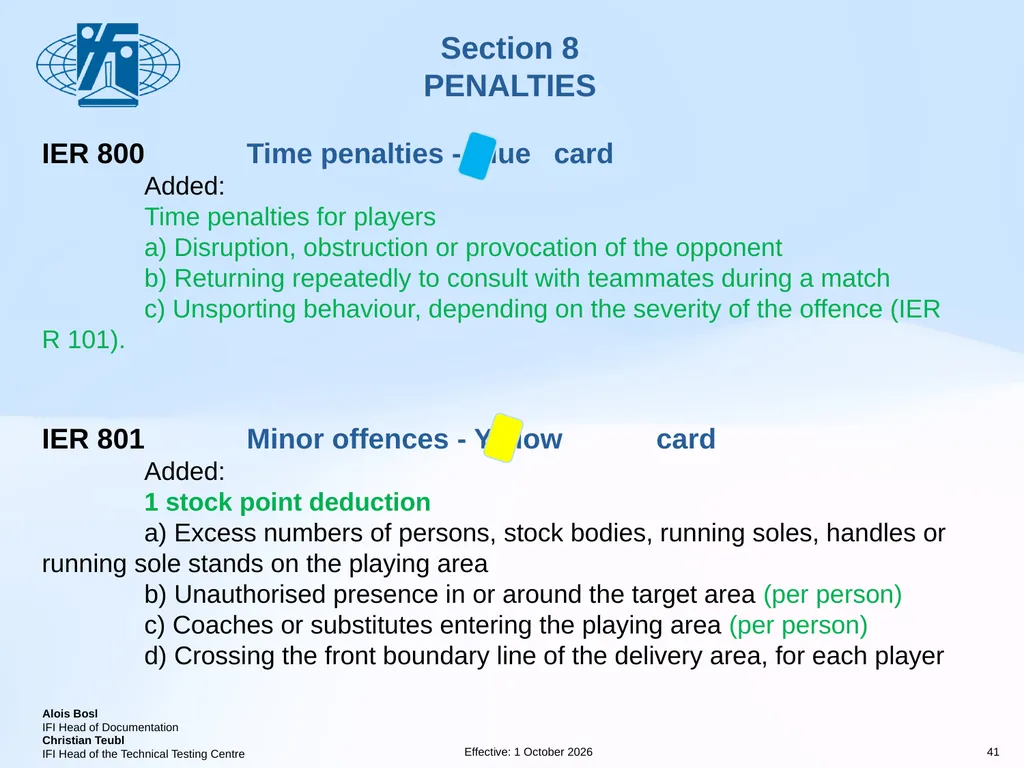
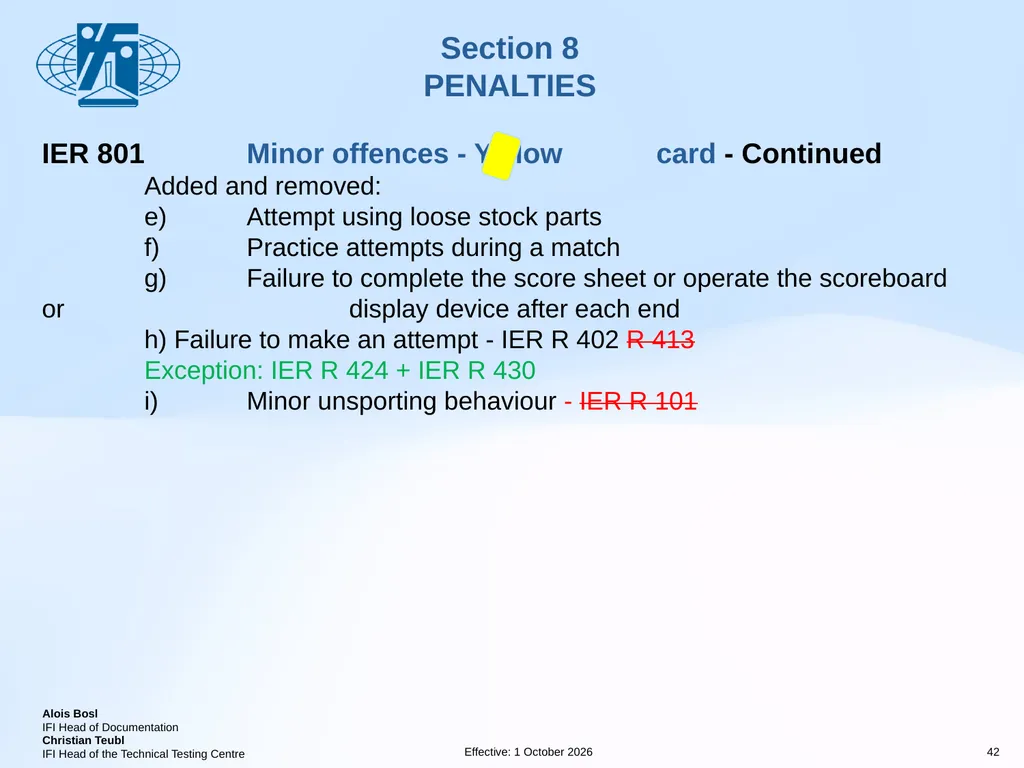
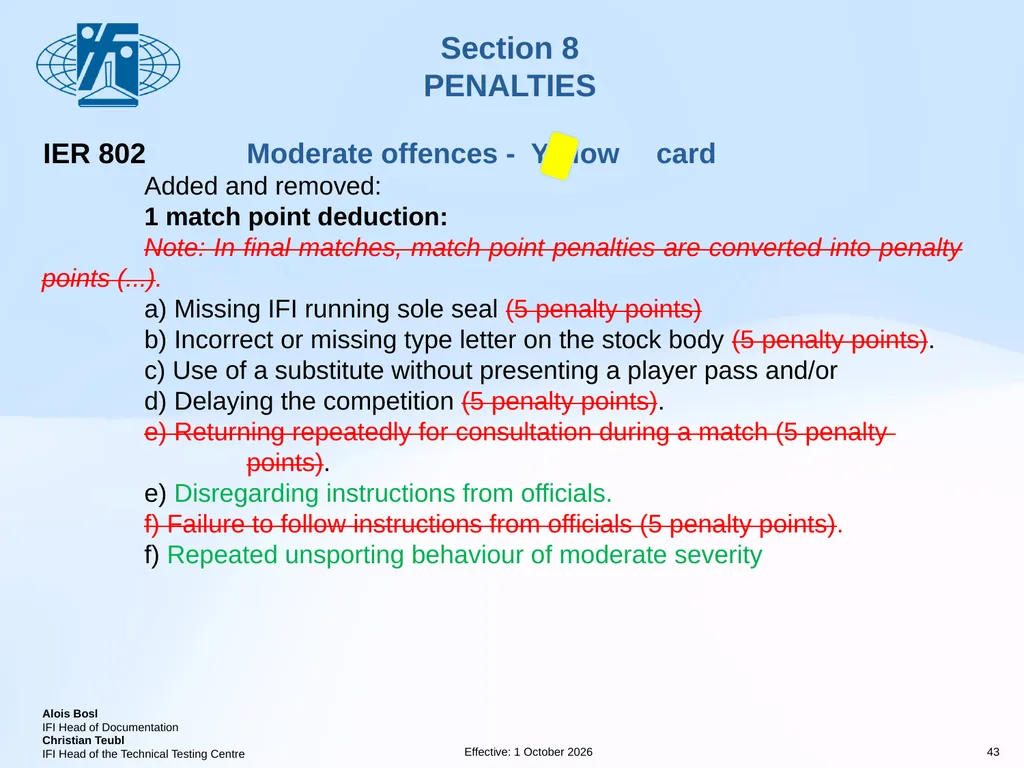
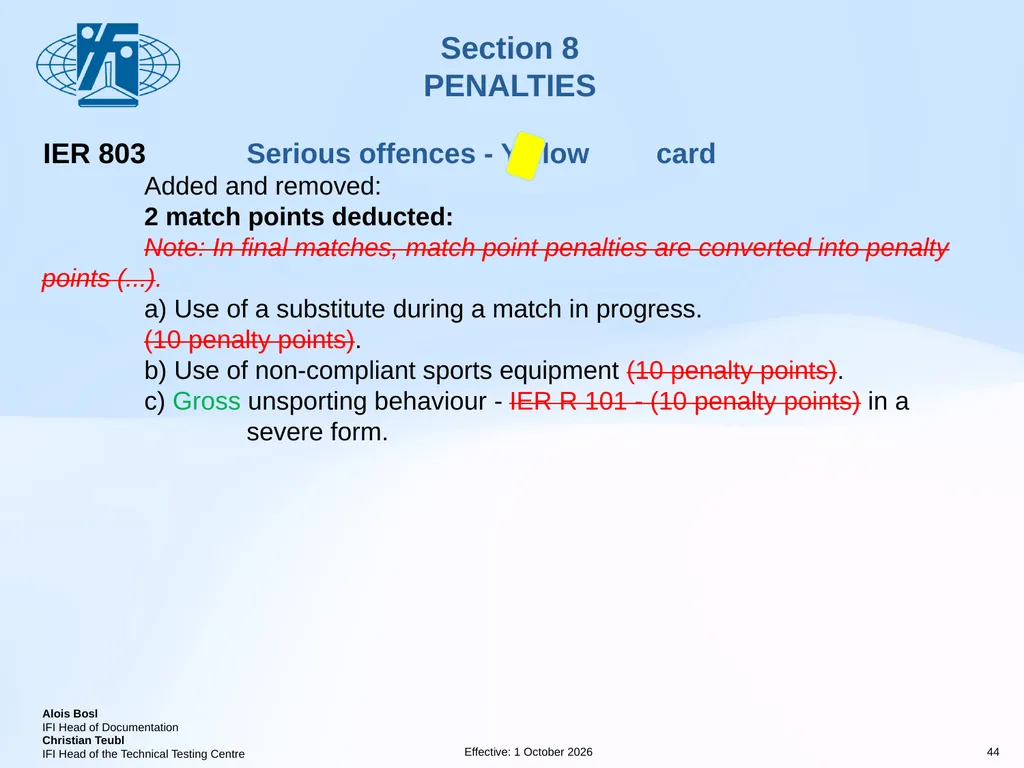
Penalties may be indicated by a blue, yellow or red card (approx. 110 × 80 mm). This is mandatory in elite sport. In final matches, match point penalties count directly as stock point deductions (..).
(Administrative revision)
The principle of fair play (IER R 101) forms the basis of all interventions by the referees.<br>
41
41 Section 8
PENALTIES<br>
42
42 Section 8
PENALTIES<br>
43
43 Section 8
PENALTIES<br>
44
44 Section 8
PENALTIES<br>
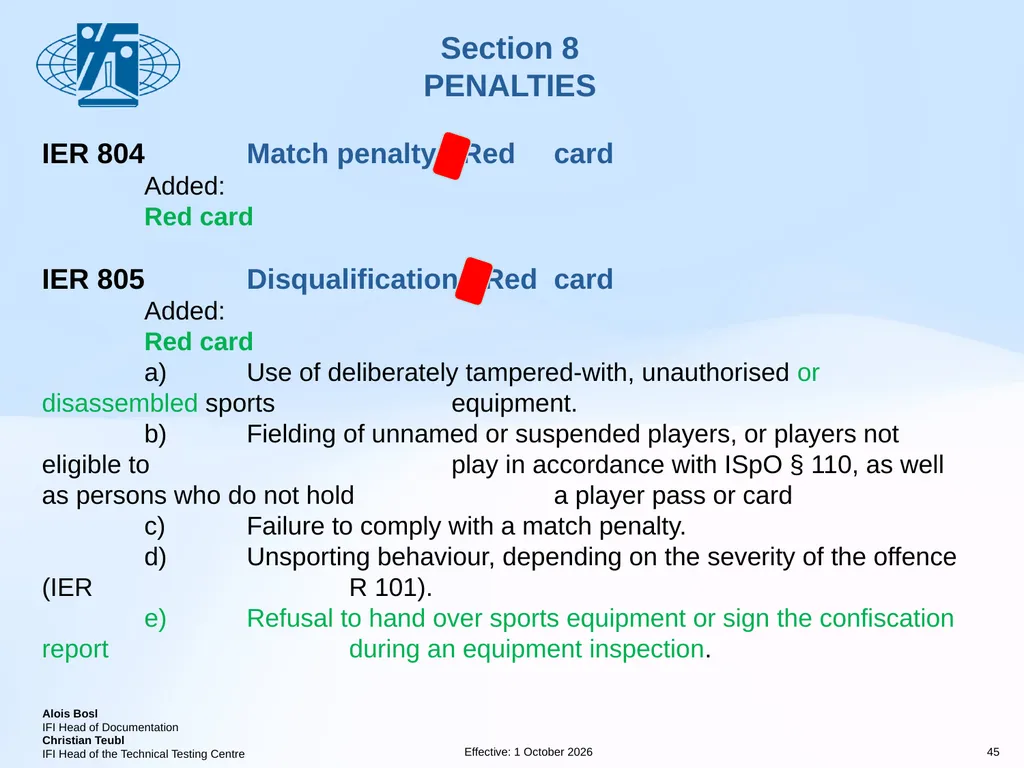
45
45 Section 8
PENALTIES<br>
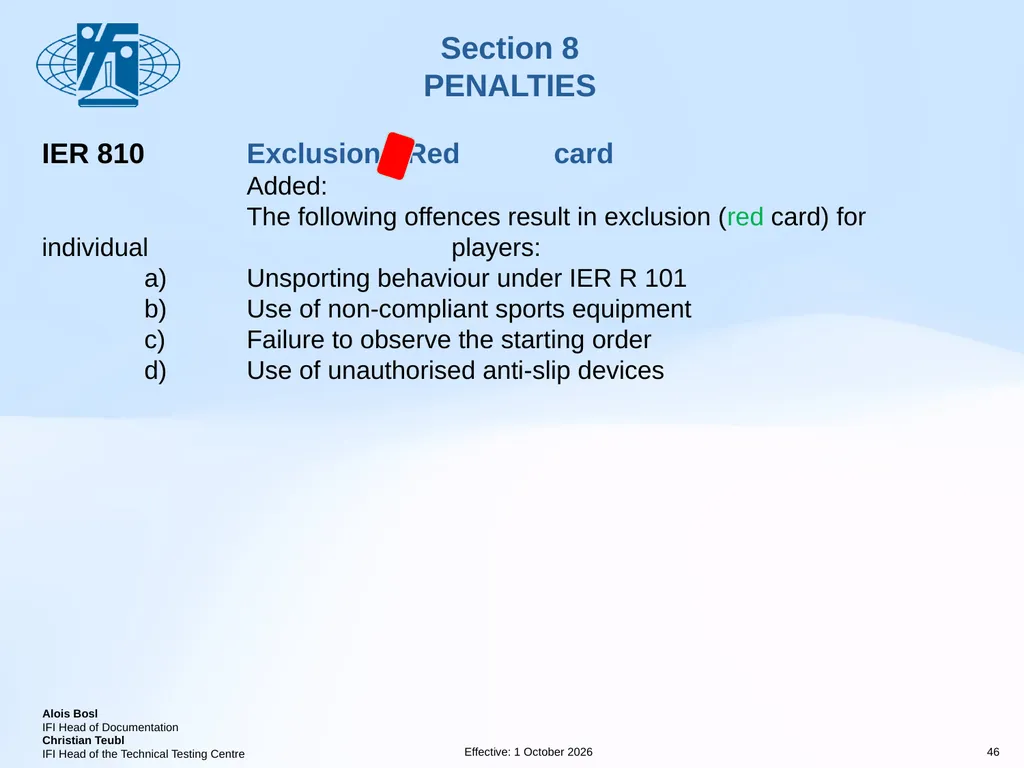
46
46 Section 8
PENALTIES<br>
47
47 Section 9
OFFICIALS IER 902 Competition director
Added and removed:
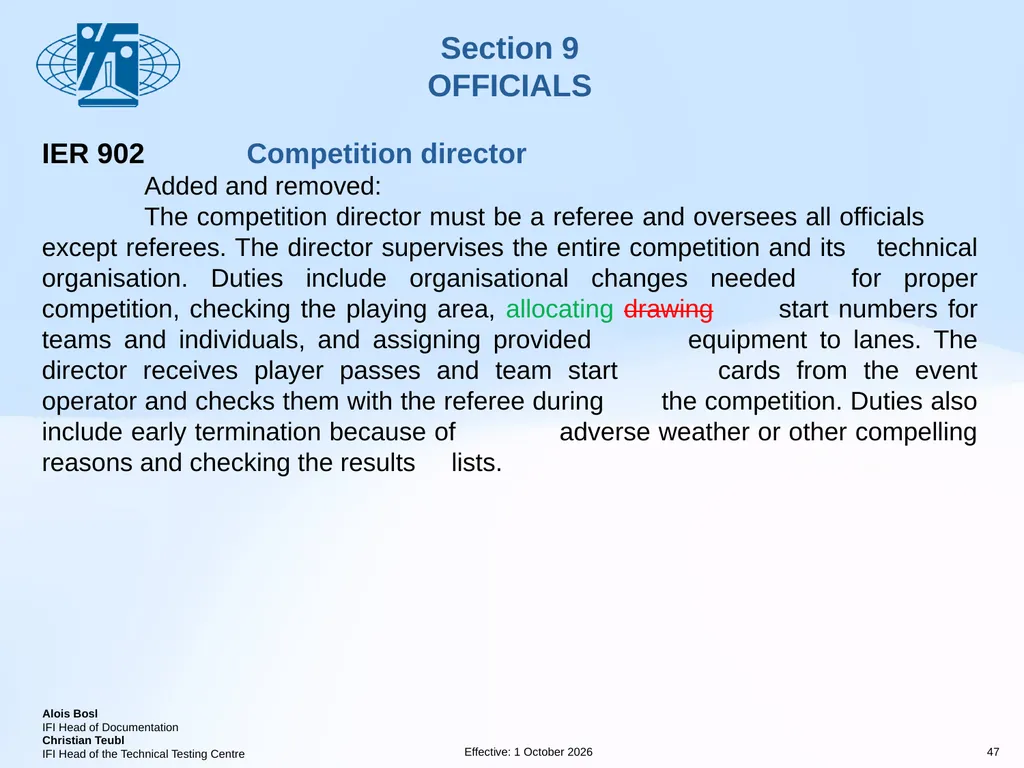
The competition director must be a referee and oversees all officials except referees. The director supervises the entire competition and its technical organisation. Duties include organisational changes needed for proper competition, checking the playing area, allocating drawing start numbers for teams and individuals, and assigning provided equipment to lanes. The director receives player passes and team start cards from the event operator and checks them with the referee during the competition. Duties also include early termination because of adverse weather or other compelling reasons and checking the results lists.<br>
48
48 Section 9
OFFICIALS IER 903 Referee
Added:
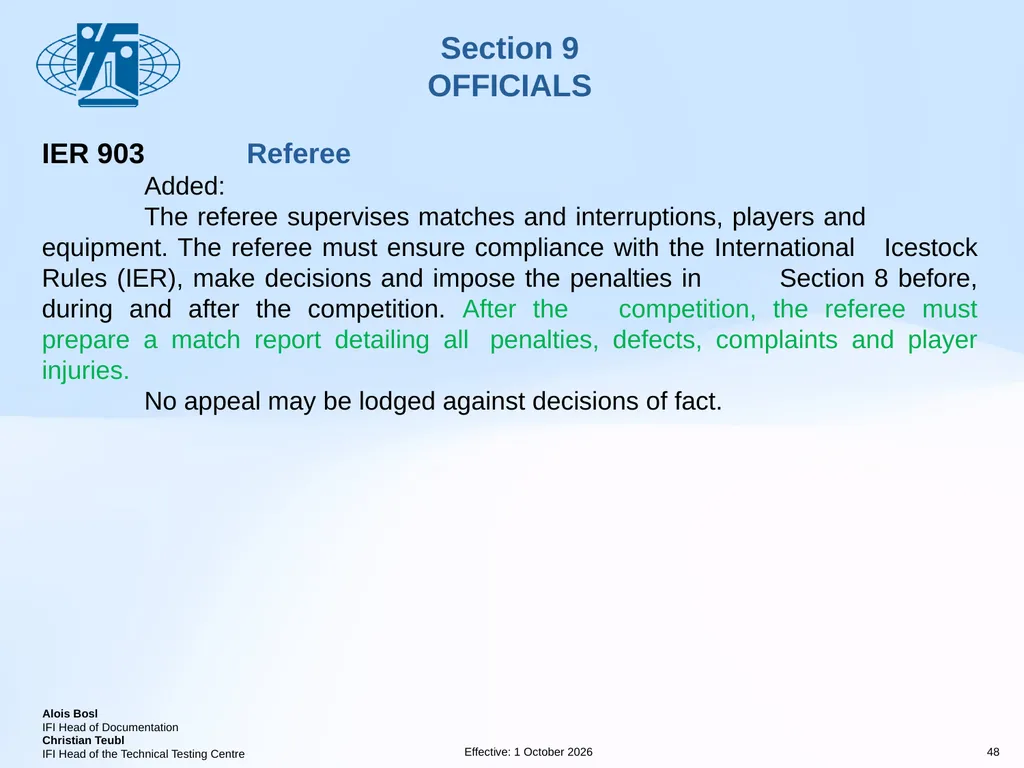
The referee supervises matches and interruptions, players and equipment. The referee must ensure compliance with the International Icestock Rules (IER), make decisions and impose the penalties in Section 8 before, during and after the competition. After the competition, the referee must prepare a match report detailing all penalties, defects, complaints and player injuries.
No appeal may be lodged against decisions of fact.<br>
49
49 Section 9
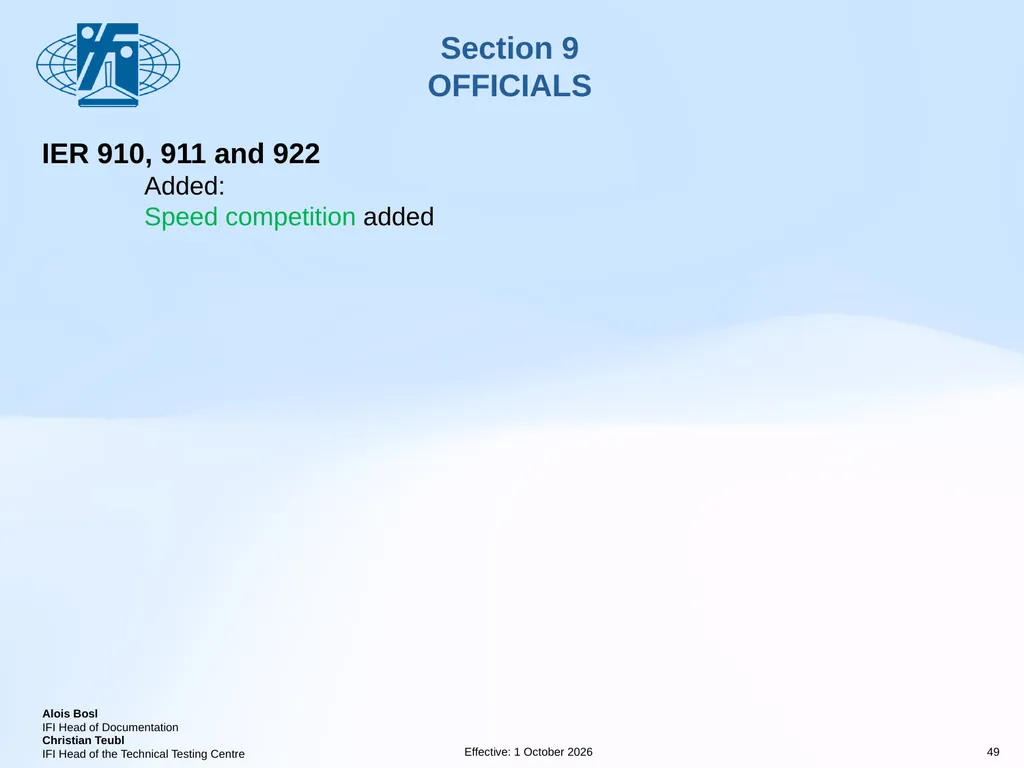
OFFICIALS IER 910, 911 and 922
Added:
Speed competition added<br>
Added:
Speed competition added<br>
50
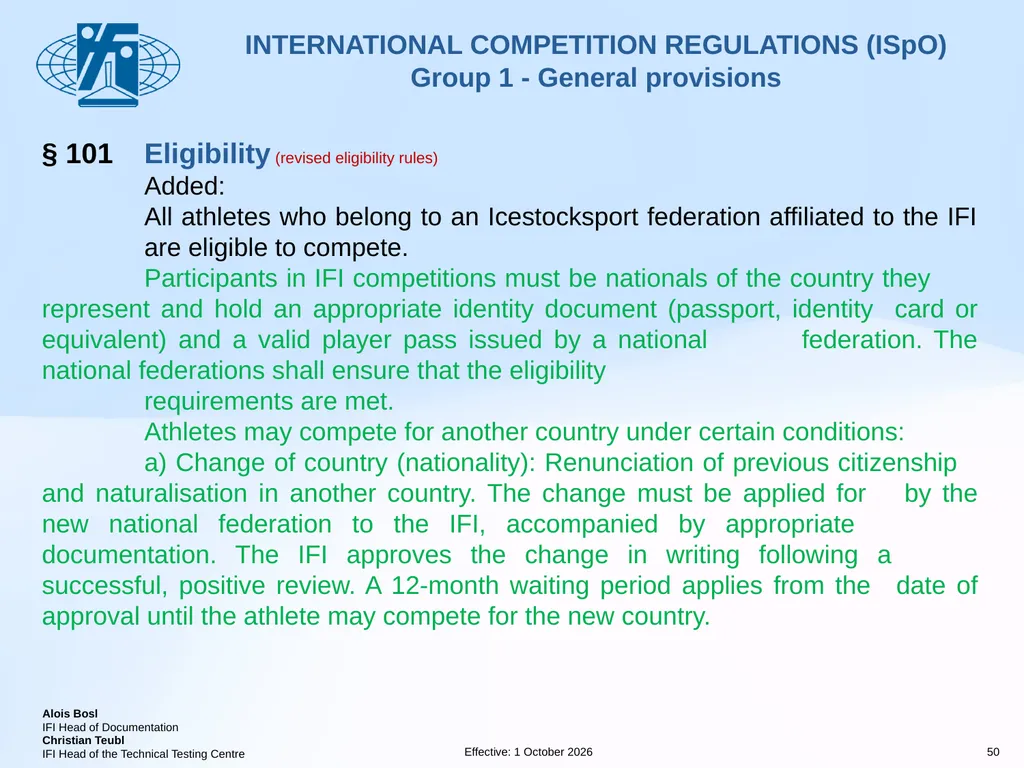
50 § 101 Eligibility (revised eligibility rules)
Added:
All athletes who belong to an Icestocksport federation affiliated to the IFI are eligible to compete.
Participants in IFI competitions must be nationals of the country they represent and hold an appropriate identity document (passport, identity card or equivalent) and a valid player pass issued by a national federation. The national federations shall ensure that the eligibility
requirements are met.
Athletes may compete for another country under certain conditions:
a) Change of country (nationality): Renunciation of previous citizenship and naturalisation in another country. The change must be applied for by the new national federation to the IFI, accompanied by appropriate documentation. The IFI approves the change in writing following a successful, positive review. A 12-month waiting period applies from the date of approval until the athlete may compete for the new country. INTERNATIONAL COMPETITION REGULATIONS (ISpO) Group 1 - General provisions<br>
51
51 § 101 Eligibility - Continued
b) Dual citizenship: A person holding dual citizenship must make a permanent written decision regarding which country they will compete for. A change may be made in accordance with § 101 a).
c) Legal principal residence: If a participant can prove that their legal principal residence or centre of life has been in the country for at least 3 years, an application to represent that country may be made to the IFI. The new national federation must submit the application with suitable documentation. The IFI shall approve a transfer in writing following a successful review. A waiting period of 12 months from the approval date applies before the athlete may compete for the new country. INTERNATIONAL COMPETITION REGULATIONS (ISpO) Group 1 - General provisions<br>
52
52 INTERNATIONAL COMPETITION REGULATIONS (ISpO)
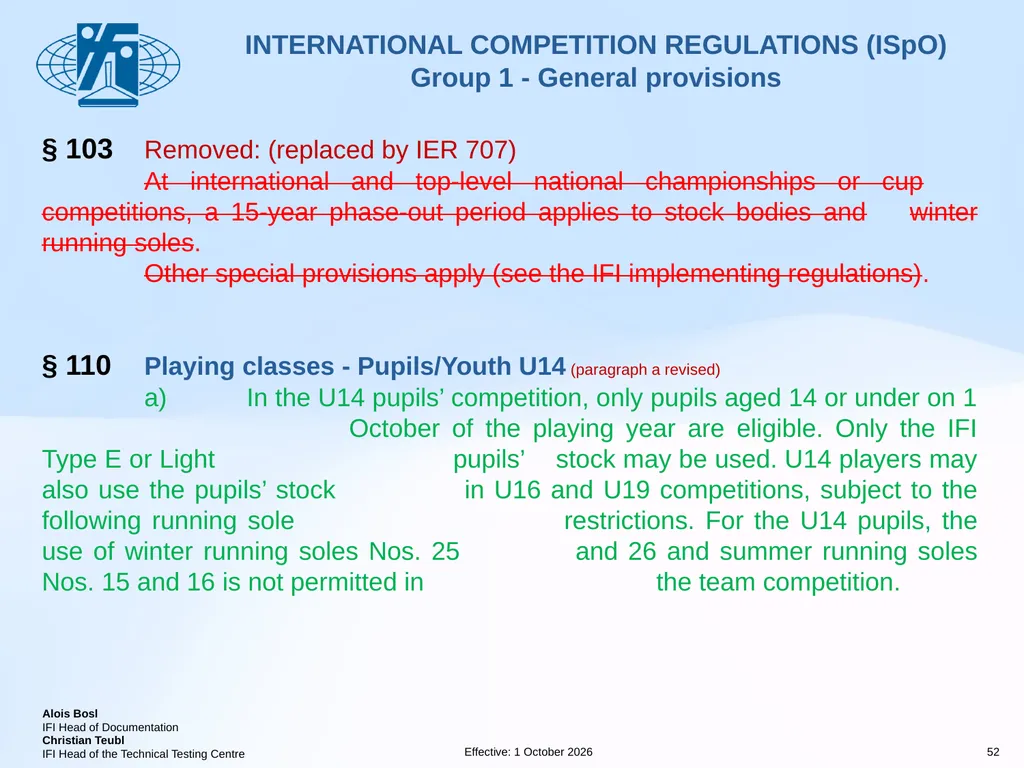
Group 1 - General provisions § 103 Removed: (replaced by IER 707)
At international and top-level national championships or cup competitions, a 15-year phase-out period applies to stock bodies and winter running soles.
Other special provisions apply (see the IFI implementing regulations). § 110 Playing classes - Pupils/Youth U14 (paragraph a revised)
a) In the U14 pupils’ competition, only pupils aged 14 or under on 1 October of the playing year are eligible. Only the IFI Type E or Light pupils’ stock may be used. U14 players may also use the pupils’ stock in U16 and U19 competitions, subject to the following running sole restrictions. For the U14 pupils, the use of winter running soles Nos. 25 and 26 and summer running soles Nos. 15 and 16 is not permitted in the team competition.<br>
53
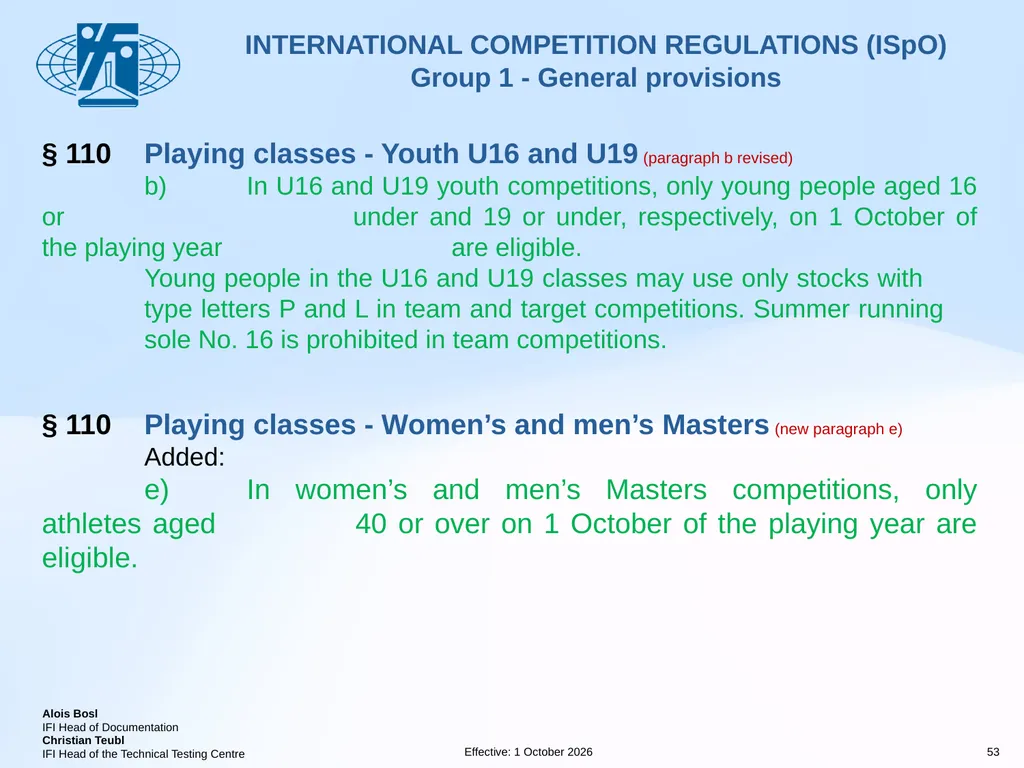
53 § 110 Playing classes - Youth U16 and U19 (paragraph b revised)
b) In U16 and U19 youth competitions, only young people aged 16 or under and 19 or under, respectively, on 1 October of the playing year are eligible.
Young people in the U16 and U19 classes may use only stocks with type letters P and L in team and target competitions. Summer running sole No. 16 is prohibited in team competitions. § 110 Playing classes - Women’s and men’s Masters (new paragraph e)
Added:
e) In women’s and men’s Masters competitions, only athletes aged 40 or over on 1 October of the playing year are eligible. INTERNATIONAL COMPETITION REGULATIONS (ISpO) Group 1 - General provisions<br>
54
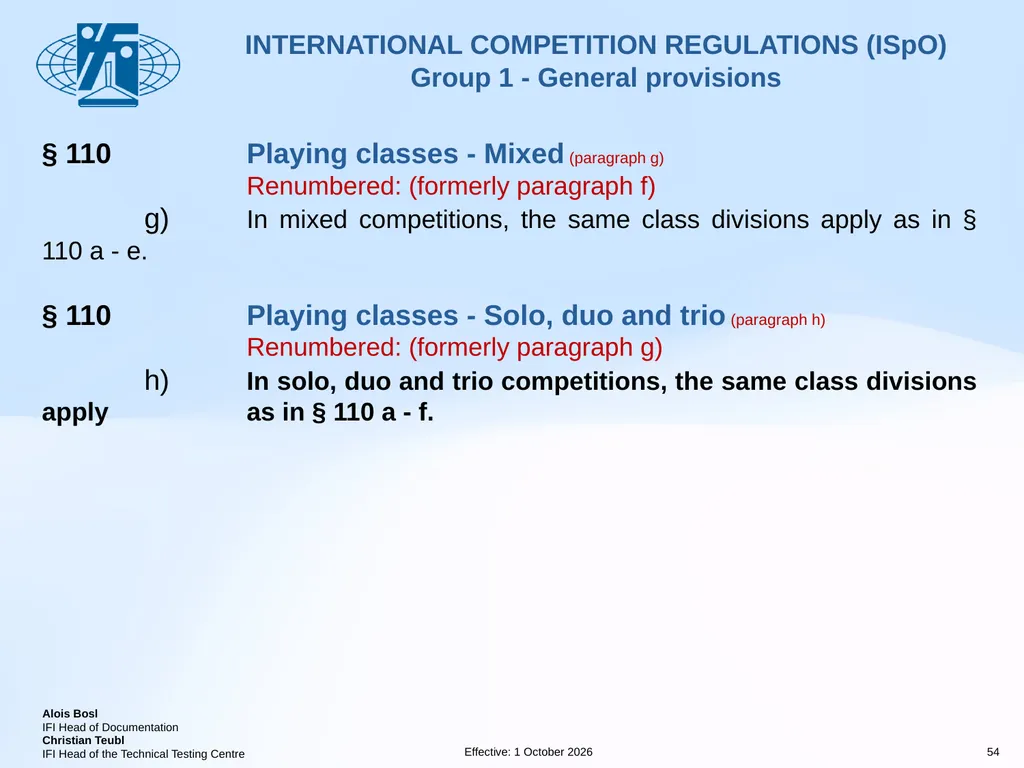
54 § 110 Playing classes - Mixed (paragraph g)
Renumbered: (formerly paragraph f)
g) In mixed competitions, the same class divisions apply as in § 110 a - e. § 110 Playing classes - Solo, duo and trio (paragraph h)
Renumbered: (formerly paragraph g)
h) In solo, duo and trio competitions, the same class divisions apply as in § 110 a - f. INTERNATIONAL COMPETITION REGULATIONS (ISpO) Group 1 - General provisions<br>
55
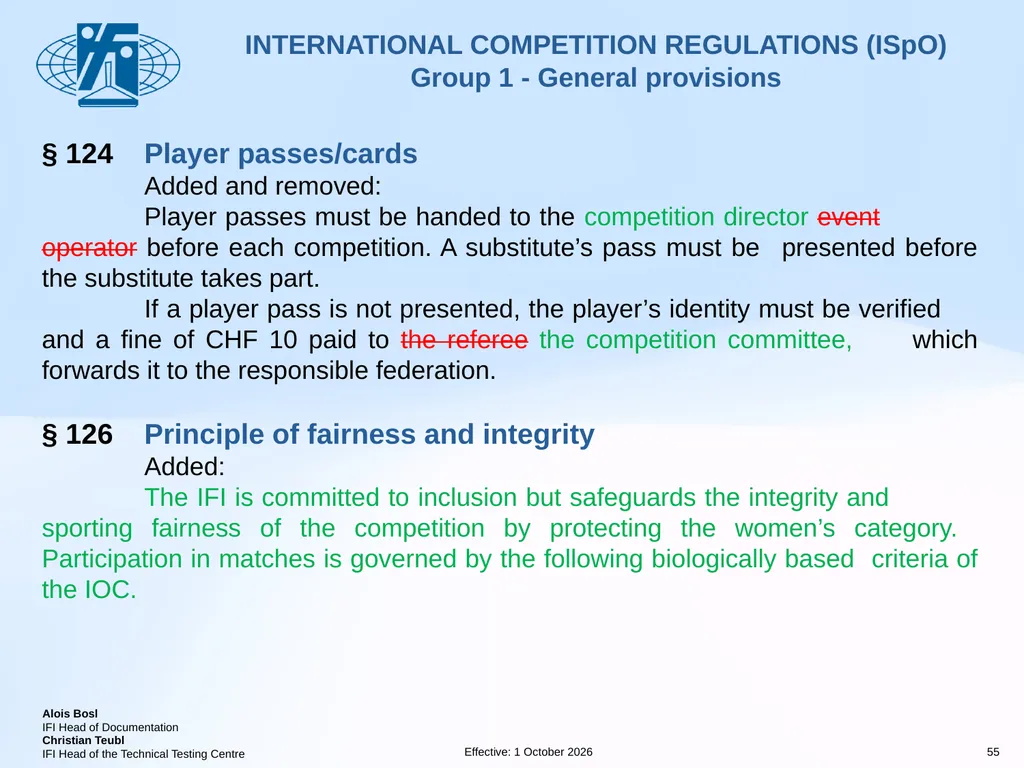
55 § 124 Player passes/cards
Added and removed:
Player passes must be handed to the competition director event operator before each competition. A substitute’s pass must be presented before the substitute takes part.
If a player pass is not presented, the player’s identity must be verified and a fine of CHF 10 paid to the referee the competition committee, which forwards it to the responsible federation. § 126 Principle of fairness and integrity
Added:
The IFI is committed to inclusion but safeguards the integrity and sporting fairness of the competition by protecting the women’s category. Participation in matches is governed by the following biologically based criteria of the IOC. INTERNATIONAL COMPETITION REGULATIONS (ISpO) Group 1 - General provisions<br>
56
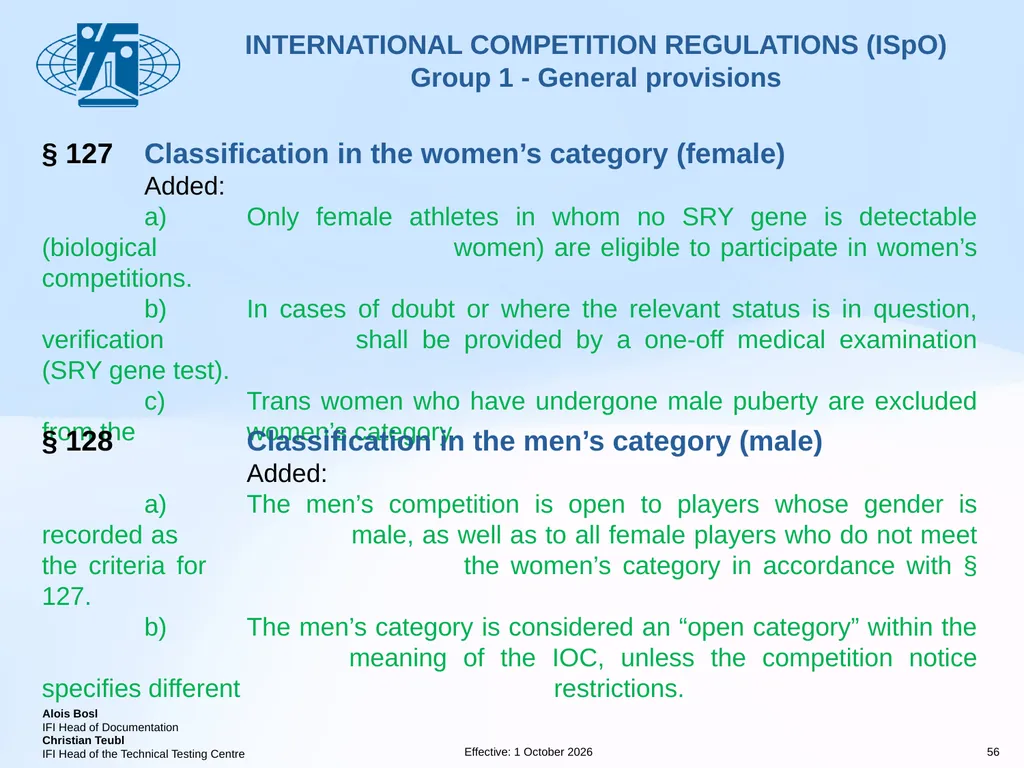
56 § 127 Classification in the women’s category (female)
Added:
a) Only female athletes in whom no SRY gene is detectable (biological women) are eligible to participate in women’s competitions.
b) In cases of doubt or where the relevant status is in question, verification shall be provided by a one-off medical examination (SRY gene test).
c) Trans women who have undergone male puberty are excluded from the women’s category. § 128 Classification in the men’s category (male)
Added:
a) The men’s competition is open to players whose gender is recorded as male, as well as to all female players who do not meet the criteria for the women’s category in accordance with § 127.
b) The men’s category is considered an “open category” within the meaning of the IOC, unless the competition notice specifies different restrictions. INTERNATIONAL COMPETITION REGULATIONS (ISpO) Group 1 - General provisions<br>
Added:
a) Only female athletes in whom no SRY gene is detectable (biological women) are eligible to participate in women’s competitions.
b) In cases of doubt or where the relevant status is in question, verification shall be provided by a one-off medical examination (SRY gene test).
c) Trans women who have undergone male puberty are excluded from the women’s category. § 128 Classification in the men’s category (male)
Added:
a) The men’s competition is open to players whose gender is recorded as male, as well as to all female players who do not meet the criteria for the women’s category in accordance with § 127.
b) The men’s category is considered an “open category” within the meaning of the IOC, unless the competition notice specifies different restrictions. INTERNATIONAL COMPETITION REGULATIONS (ISpO) Group 1 - General provisions<br>
57
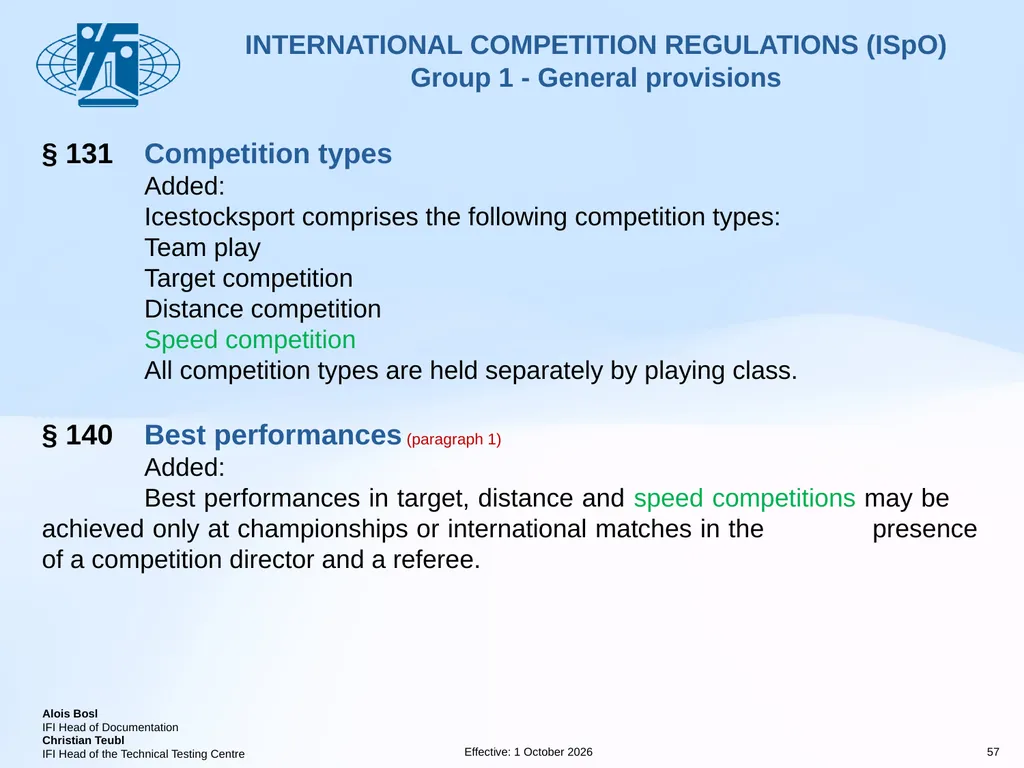
57 § 131 Competition types
Added:
Icestocksport comprises the following competition types:
Team play
Target competition
Distance competition
Speed competition
All competition types are held separately by playing class. § 140 Best performances (paragraph 1)
Added:
Best performances in target, distance and speed competitions may be achieved only at championships or international matches in the presence of a competition director and a referee. INTERNATIONAL COMPETITION REGULATIONS (ISpO) Group 1 - General provisions<br>
Added:
Icestocksport comprises the following competition types:
Team play
Target competition
Distance competition
Speed competition
All competition types are held separately by playing class. § 140 Best performances (paragraph 1)
Added:
Best performances in target, distance and speed competitions may be achieved only at championships or international matches in the presence of a competition director and a referee. INTERNATIONAL COMPETITION REGULATIONS (ISpO) Group 1 - General provisions<br>
58
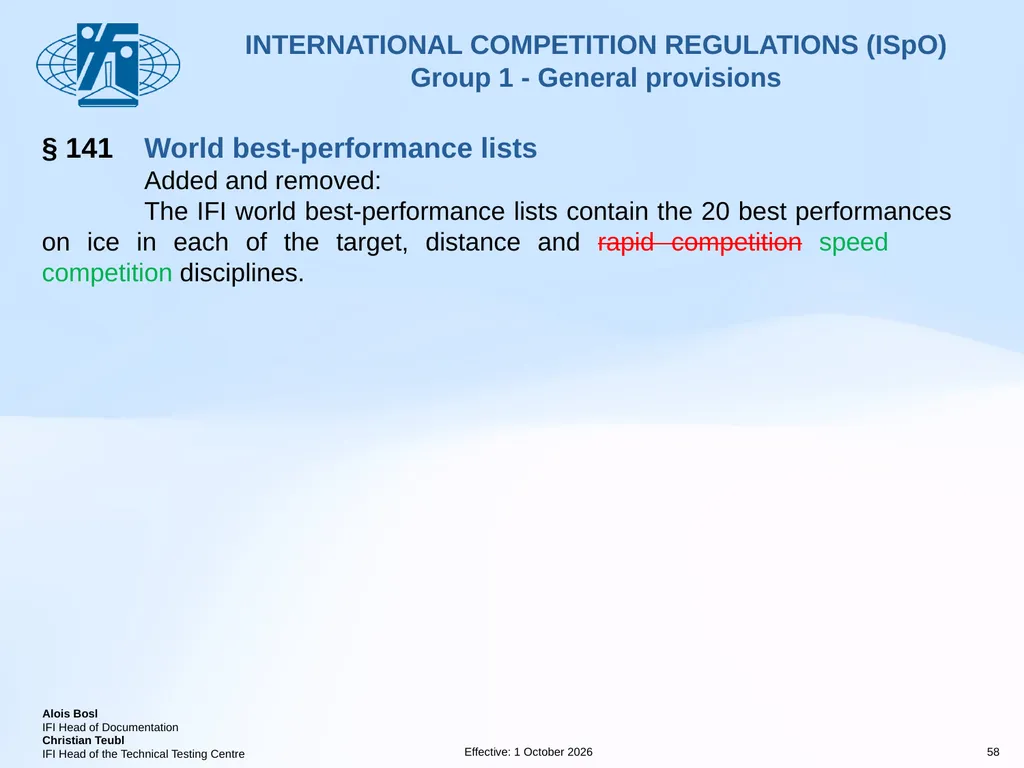
58 § 141 World best-performance lists
Added and removed:
The IFI world best-performance lists contain the 20 best performances on ice in each of the target, distance and rapid competition speed competition disciplines. INTERNATIONAL COMPETITION REGULATIONS (ISpO) Group 1 - General provisions<br>
Added and removed:
The IFI world best-performance lists contain the 20 best performances on ice in each of the target, distance and rapid competition speed competition disciplines. INTERNATIONAL COMPETITION REGULATIONS (ISpO) Group 1 - General provisions<br>
59
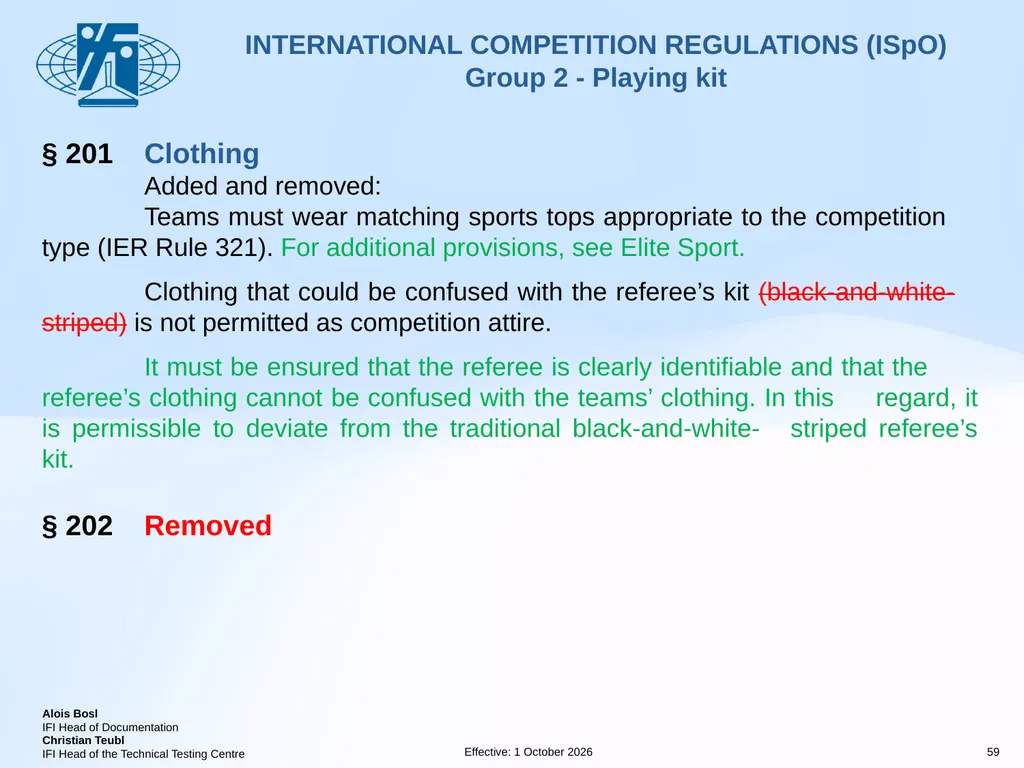
59 § 201 Clothing
Added and removed:
Teams must wear matching sports tops appropriate to the competition type (IER Rule 321). For additional provisions, see Elite Sport.
Clothing that could be confused with the referee’s kit (black-and-white- striped) is not permitted as competition attire.
It must be ensured that the referee is clearly identifiable and that the referee’s clothing cannot be confused with the teams’ clothing. In this regard, it is permissible to deviate from the traditional black-and-white- striped referee’s kit. INTERNATIONAL COMPETITION REGULATIONS (ISpO) Group 2 - Playing kit § 202 Removed<br>
60
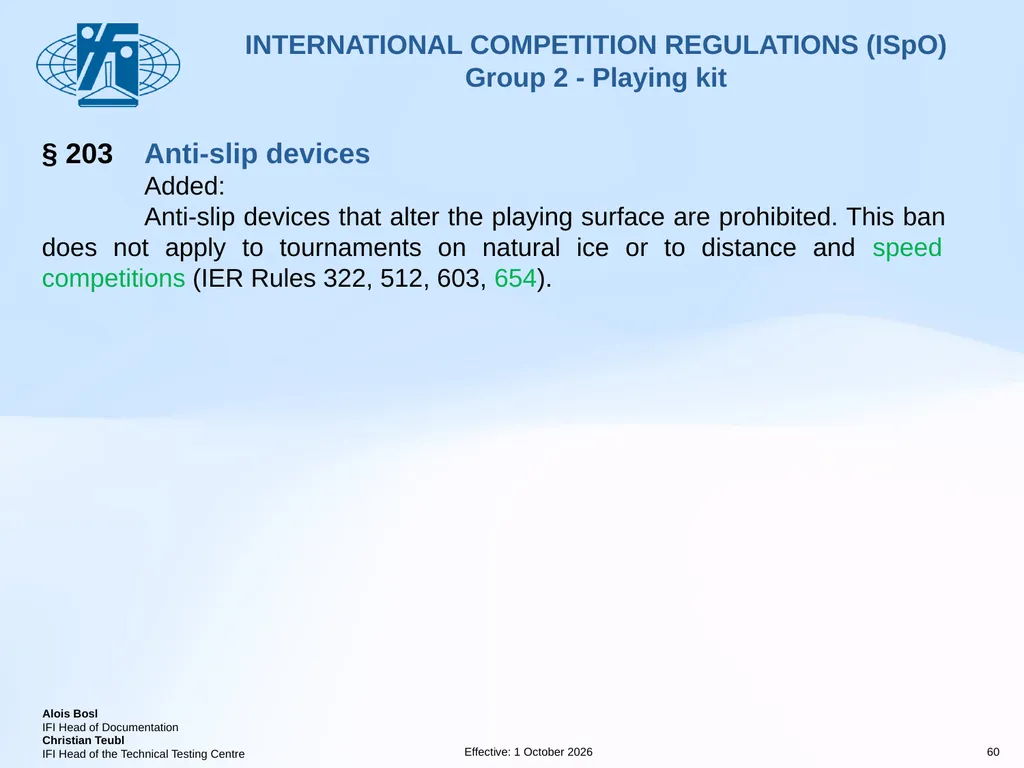
60 § 203 Anti-slip devices
Added:
Anti-slip devices that alter the playing surface are prohibited. This ban does not apply to tournaments on natural ice or to distance and speed competitions (IER Rules 322, 512, 603, 654). INTERNATIONAL COMPETITION REGULATIONS (ISpO) Group 2 - Playing kit<br>
Added:
Anti-slip devices that alter the playing surface are prohibited. This ban does not apply to tournaments on natural ice or to distance and speed competitions (IER Rules 322, 512, 603, 654). INTERNATIONAL COMPETITION REGULATIONS (ISpO) Group 2 - Playing kit<br>
61
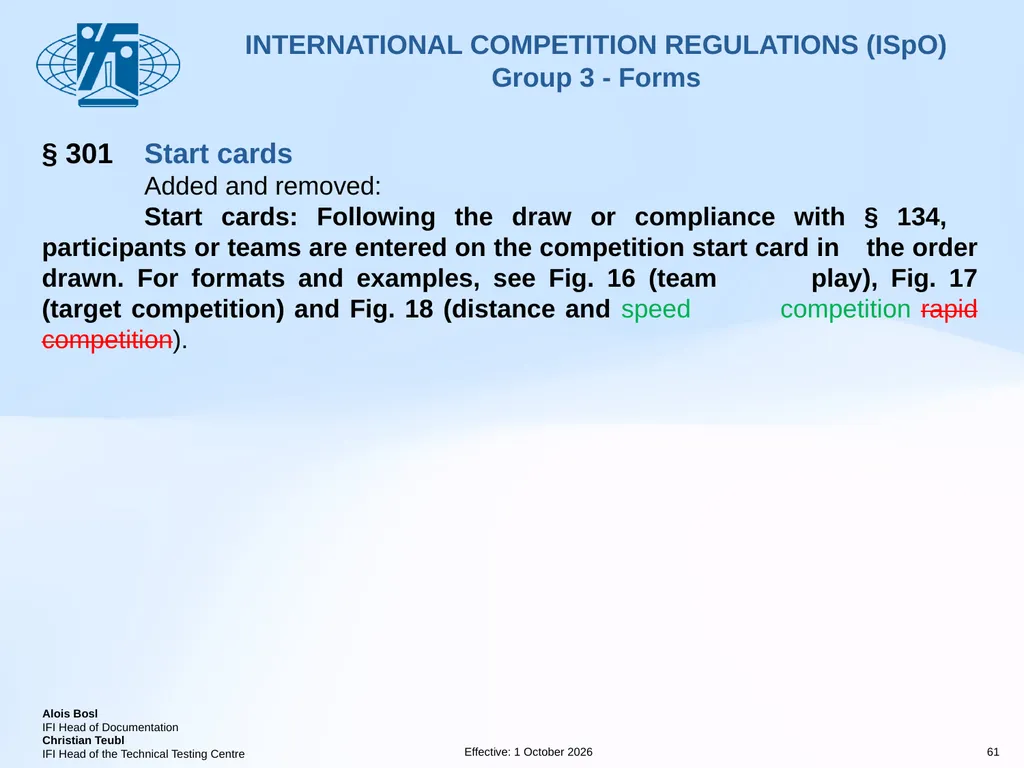
61 § 301 Start cards
Added and removed:
Start cards: Following the draw or compliance with § 134, participants or teams are entered on the competition start card in the order drawn. For formats and examples, see Fig. 16 (team play), Fig. 17 (target competition) and Fig. 18 (distance and speed competition rapid competition). INTERNATIONAL COMPETITION REGULATIONS (ISpO) Group 3 - Forms<br>
62
62 § 402 Awarding, organisation and scoring
Added:
World Championships in team play and target competition for women, men and junior women and men U23, and in distance or speed competition for women, men and junior men U23. INTERNATIONAL COMPETITION REGULATIONS (ISpO) Group 4 - Championships § 404 National championships
Added:
National championships at all levels in team play, target, distance and speed competition, for all playing classes.<br>
Added:
World Championships in team play and target competition for women, men and junior women and men U23, and in distance or speed competition for women, men and junior men U23. INTERNATIONAL COMPETITION REGULATIONS (ISpO) Group 4 - Championships § 404 National championships
Added:
National championships at all levels in team play, target, distance and speed competition, for all playing classes.<br>
63
63 § 417 Equipment inspection
Added:
The equipment used must bear the IFI-prescribed registration number and the IFI test and approval mark. See Figs. 22 and 23.
Inspections of the sports equipment may be carried out before, during and after the competition. The measuring tools from the IFI inspection kit should preferably be used for these inspections.
Each team’s stocks must be clearly marked.
The IFI is authorised at all competitions (limited to top-level competitions at national level) to inspect and confiscate sports equipment parts at any time through its inspection committee. INTERNATIONAL COMPETITION REGULATIONS (ISpO) Group 4 - Championships<br>
64
64 § 608 Number of teams
Added:
The number of teams admitted to a tournament is governed by the following provisions (maximum numbers of matches played, excluding breaks):
For men’s competitions:
One-day tournaments: Maximum 18 matches.
Two-day tournaments: Maximum 30 matches.
For women’s, youth and mixed competitions:
One-day tournaments: Maximum 14 matches.
Two-day tournaments: Maximum 26 matches.
Pupils/Youth U14 competitions:
Maximum 10 matches.
Note: The maximum number of matches per competition in the individual categories includes the preliminary round and any final matches. INTERNATIONAL COMPETITION REGULATIONS (ISpO) Group 6 - Tournaments<br>
65
65 § 703 Transfer periods
Added and removed:
Transfers may take place only from 1 March to 5 April and
25 September to 31 October 1 to 30 September each year. Only 1 transfer is permitted in each period. The responsible national federation decides. INTERNATIONAL COMPETITION REGULATIONS (ISpO) Group 7 - Transfers between federations and clubs<br>
66
66 § 808 Referee age (revised Class A referee rules)
Added and removed:
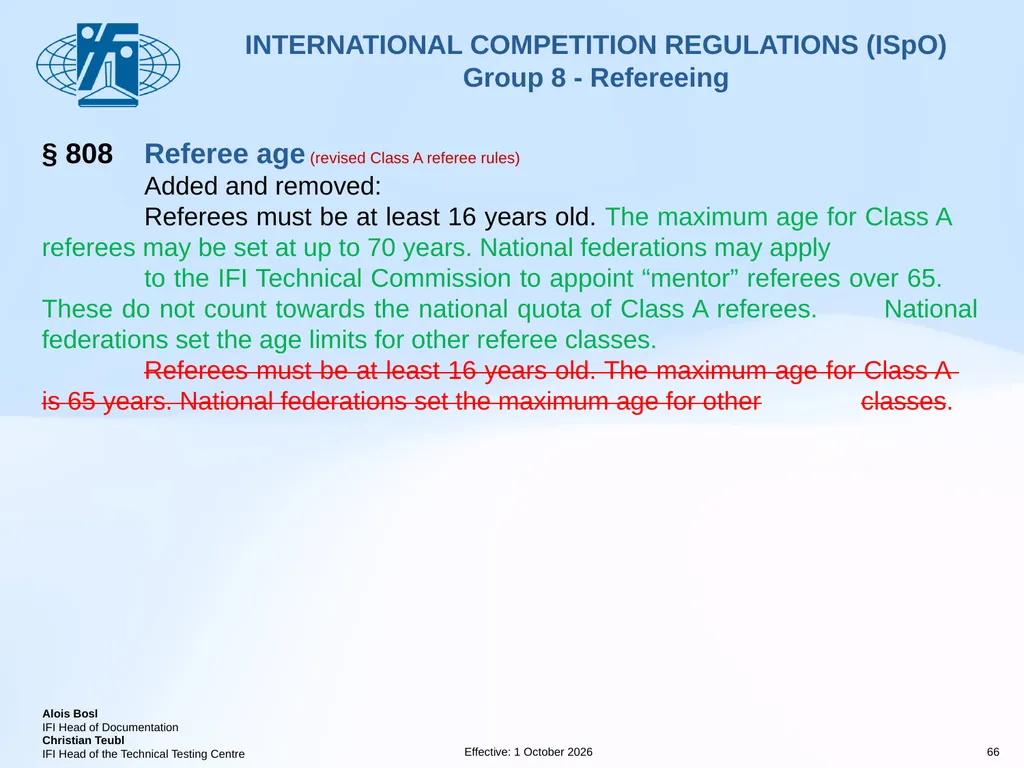
Referees must be at least 16 years old. The maximum age for Class A referees may be set at up to 70 years. National federations may apply
to the IFI Technical Commission to appoint “mentor” referees over 65. These do not count towards the national quota of Class A referees. National federations set the age limits for other referee classes.
Referees must be at least 16 years old. The maximum age for Class A is 65 years. National federations set the maximum age for other classes. INTERNATIONAL COMPETITION REGULATIONS (ISpO) Group 8 - Refereeing<br>