Using Action Research to Adapt Complicated Grief Therapy for People with Intellectual Disabilities Suzanne Guerin, Damien ORiordan, Emma Conway Philip Dodd Introduction Stroebe, Stroebe, Hansson (1993) define key concepts as follows:
"Using Action Research to Adapt Complicated Grief" is the property of its rightful owner. Permission is granted to
download and print the materials on this website for personal, non-commercial use only, and to display it
on your personal computer provided you do not modify the materials and that you retain all copyright
notices contained in the materials. By downloading content from our website, you accept the terms of this
agreement.
Presentation Transcript
01
Using Action Research to Adapt Complicated Grief Therapy for People with Intellectual Disabilities Suzanne Guerin, Damien O’Riordan, Emma Conway & Philip Dodd<br>
02
Introduction Stroebe, Stroebe, & Hansson (1993) define key concepts as follows:
Bereavement is the facts about the loss
Grief is the emotional response to the loss
Mourning as the ways in which grief is expressed.
Bereavement research has acknowledged the significant impact of bereavement and loss on the lives of people with intellectual disabilities.
Body of research on general bereavement experience in ID, as well as complicated grief reactions<br>
03
Complicated Grief Recognised as a distinct grief process and occurs in 10% of the population generally
Range of terms used in the area, with Prolonged Grief Disorder (ICD 11, 2019) and Persistent Complex Bereavement Disorder (DSM-5, 2013) common diagnostic terms.
Risk factors include: Attachment to the person, social support, family conflict, understanding, type of death, multiple losses (Mason et al., 2020)
Research has indicated the incidence of complicated grief as approximately 20% in people with ID (Dodd et al., 2008)
1/3 of bereaved people with ID experience 10 or more clinically apparent symptoms of CG (Dodd et al., 2008)<br>
04
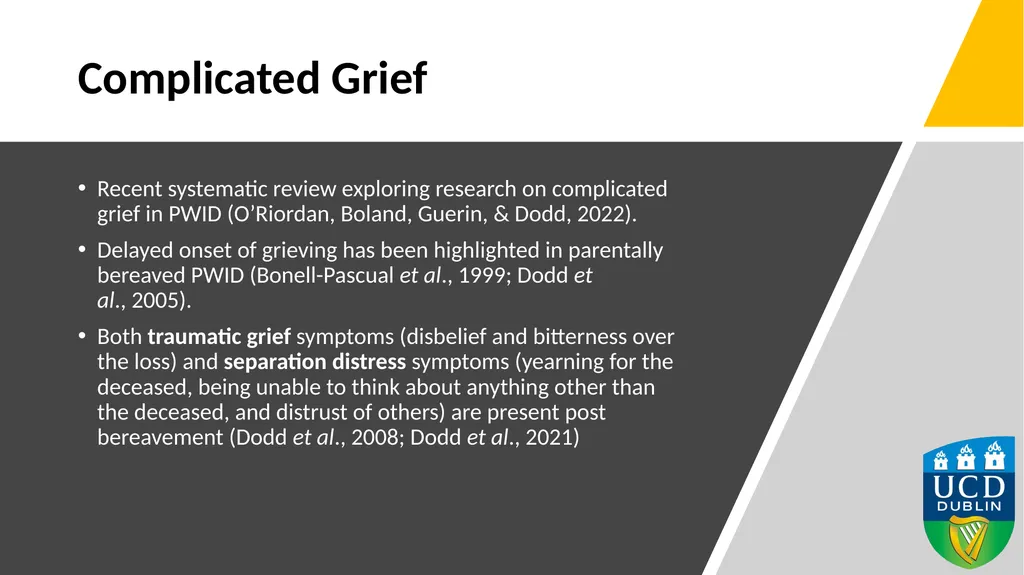
Complicated Grief Recent systematic review exploring research on complicated grief in PWID (O’Riordan, Boland, Guerin, & Dodd, 2022).
Delayed onset of grieving has been highlighted in parentally bereaved PWID (Bonell-Pascual et al., 1999; Dodd et al., 2005).
Both traumatic grief symptoms (disbelief and bitterness over the loss) and separation distress symptoms (yearning for the deceased, being unable to think about anything other than the deceased, and distrust of others) are present post bereavement (Dodd et al., 2008; Dodd et al., 2021)<br>
05
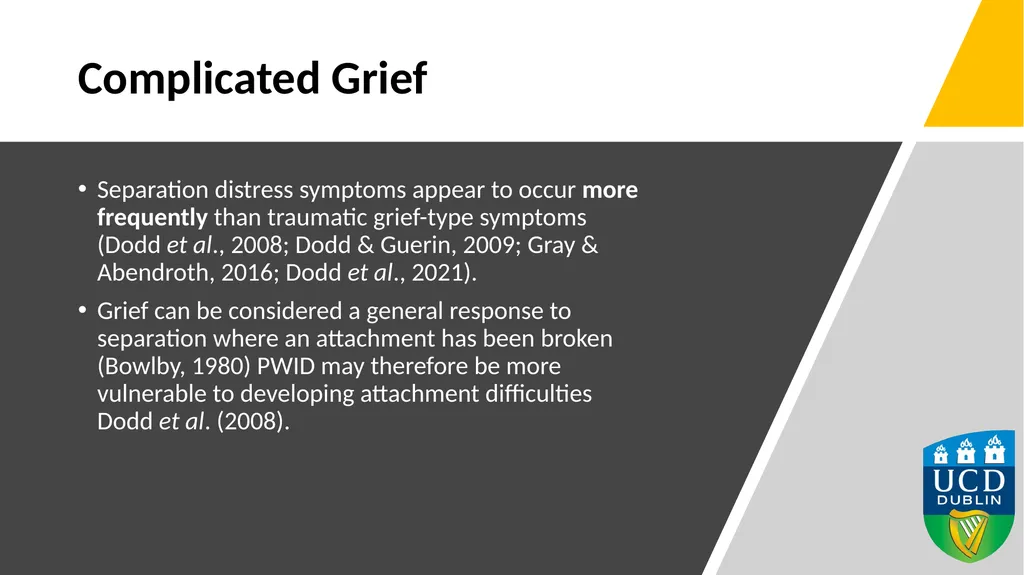
Complicated Grief Separation distress symptoms appear to occur more frequently than traumatic grief-type symptoms (Dodd et al., 2008; Dodd & Guerin, 2009; Gray & Abendroth, 2016; Dodd et al., 2021).
Grief can be considered a general response to separation where an attachment has been broken (Bowlby, 1980) PWID may therefore be more vulnerable to developing attachment difficulties Dodd et al. (2008).<br>
06
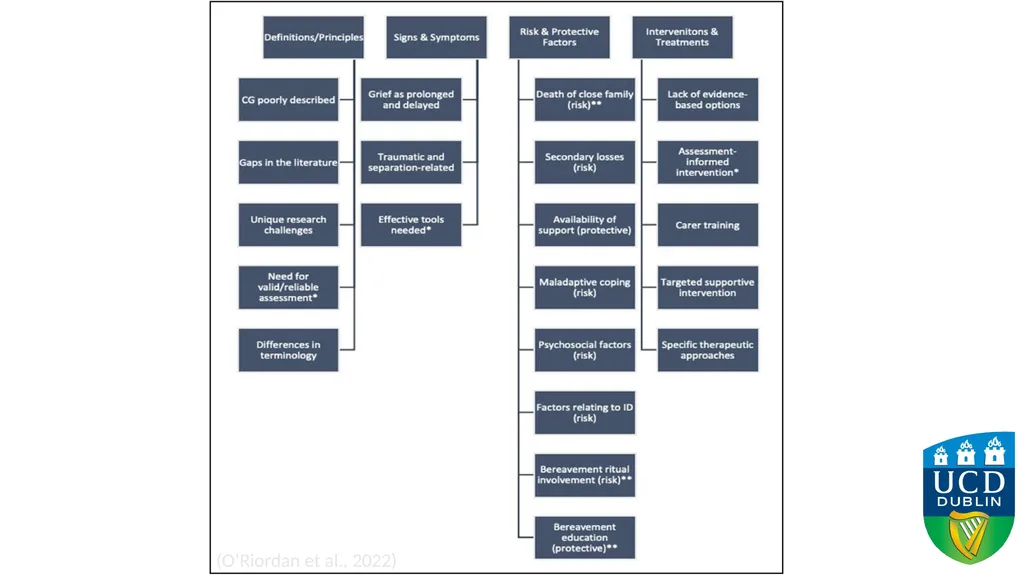
(O’Riordan et al., 2022)<br>
07
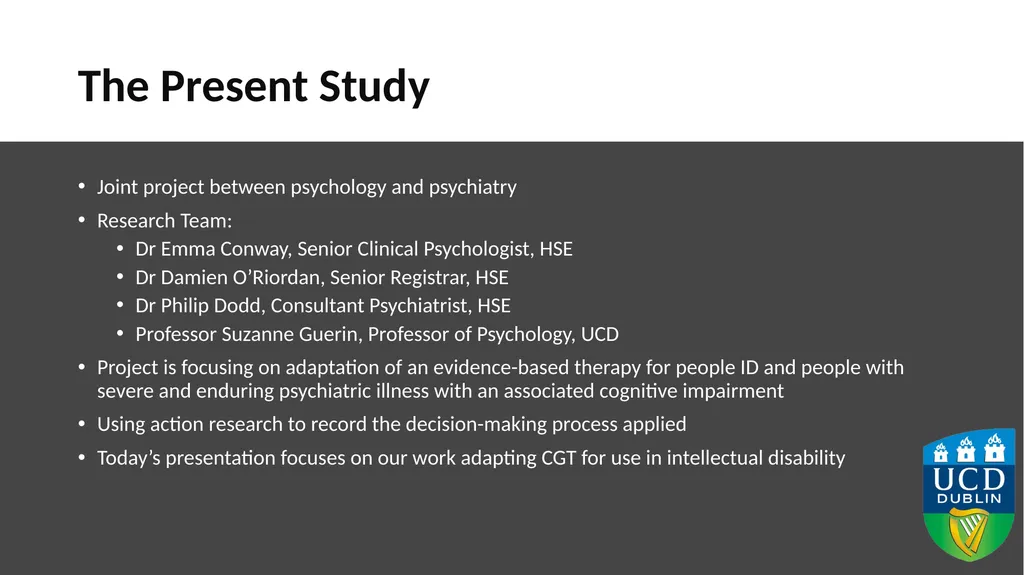
The Present Study Joint project between psychology and psychiatry
Research Team:
Dr Emma Conway, Senior Clinical Psychologist, HSE
Dr Damien O’Riordan, Senior Registrar, HSE
Dr Philip Dodd, Consultant Psychiatrist, HSE
Professor Suzanne Guerin, Professor of Psychology, UCD
Project is focusing on adaptation of an evidence-based therapy for people ID and people with severe and enduring psychiatric illness with an associated cognitive impairment
Using action research to record the decision-making process applied
Today’s presentation focuses on our work adapting CGT for use in intellectual disability<br>
08
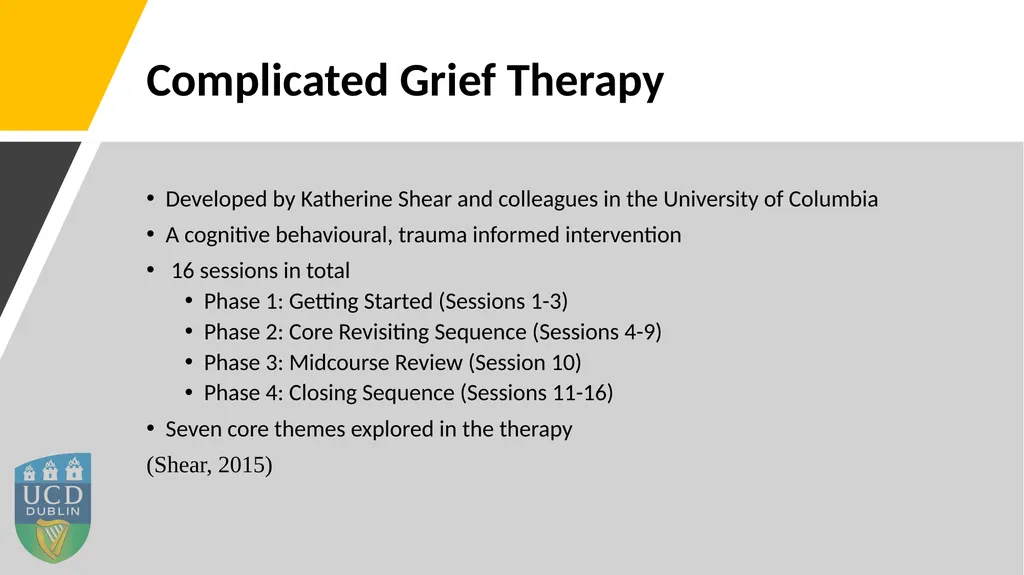
Complicated Grief Therapy Developed by Katherine Shear and colleagues in the University of Columbia
A cognitive behavioural, trauma informed intervention
16 sessions in total
Phase 1: Getting Started (Sessions 1-3)
Phase 2: Core Revisiting Sequence (Sessions 4-9)
Phase 3: Midcourse Review (Session 10)
Phase 4: Closing Sequence (Sessions 11-16)
Seven core themes explored in the therapy
(Shear, 2015)<br>
09
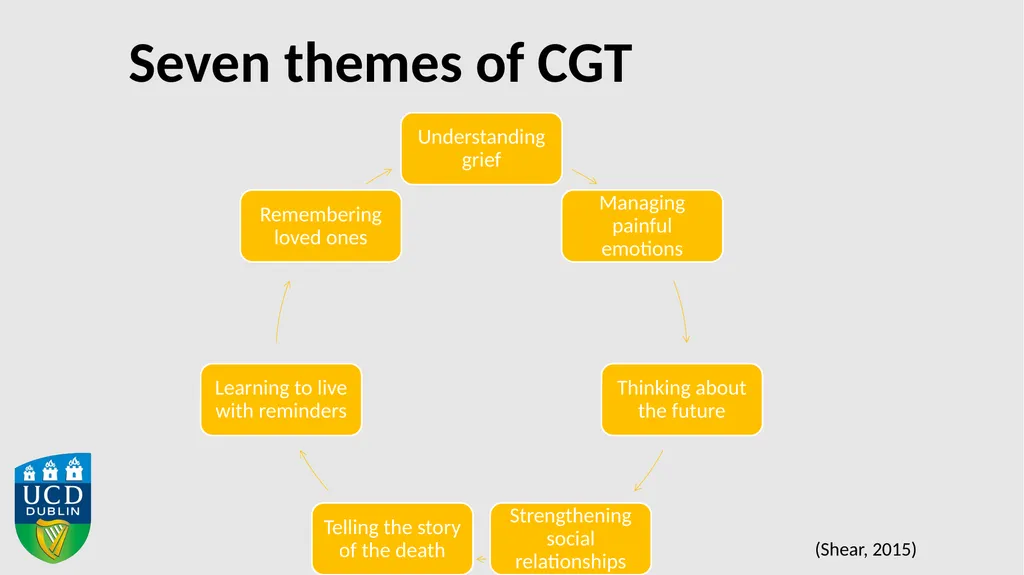
Seven themes of CGT (Shear, 2015)<br>
10
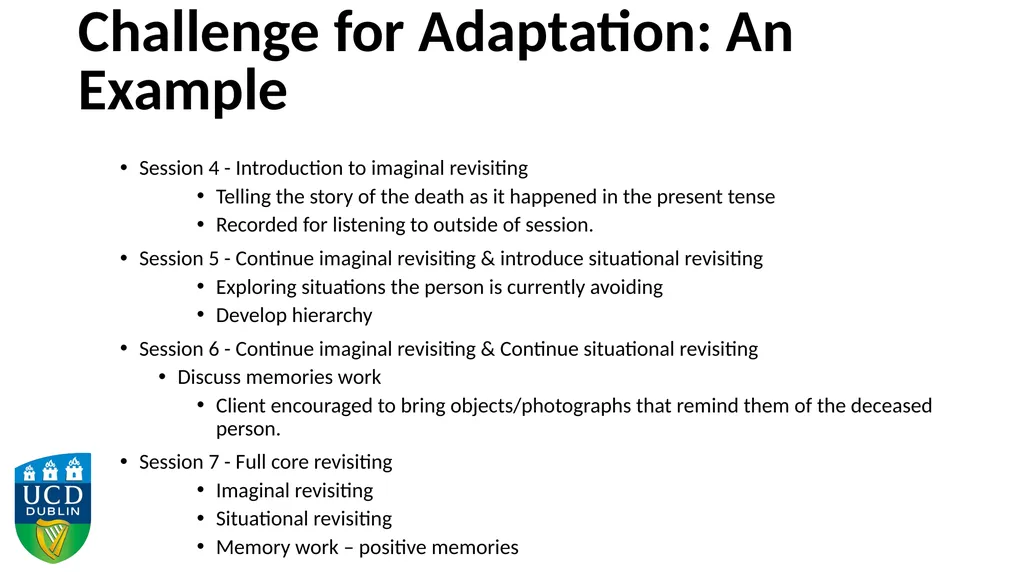
Challenge for Adaptation: An Example Session 4 - Introduction to imaginal revisiting
Telling the story of the death as it happened in the present tense
Recorded for listening to outside of session.
Session 5 - Continue imaginal revisiting & introduce situational revisiting
Exploring situations the person is currently avoiding
Develop hierarchy
Session 6 - Continue imaginal revisiting & Continue situational revisiting
Discuss memories work
Client encouraged to bring objects/photographs that remind them of the deceased person.
Session 7 - Full core revisiting
Imaginal revisiting
Situational revisiting
Memory work – positive memories<br>
11
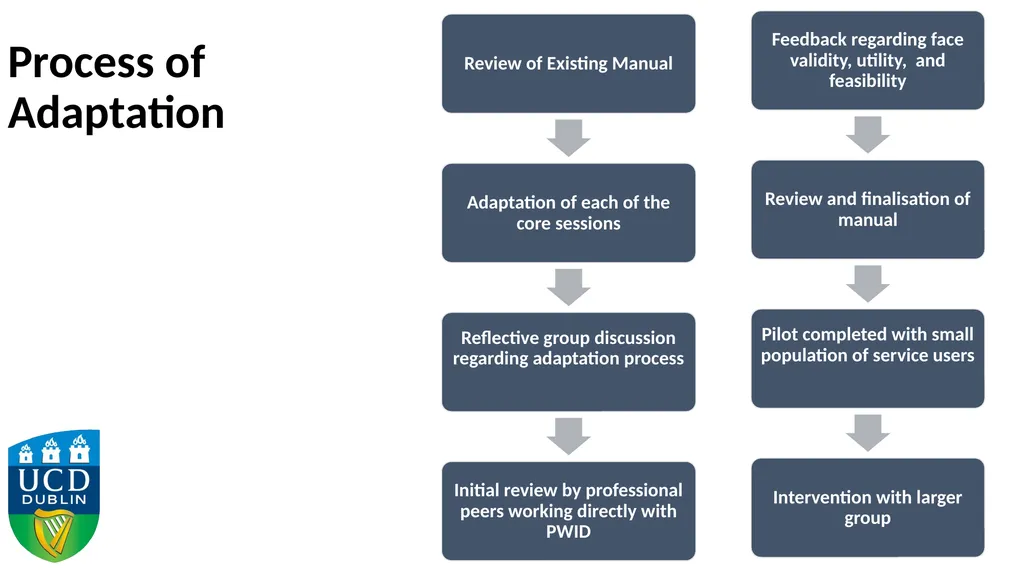
Process of Adaptation<br>
12
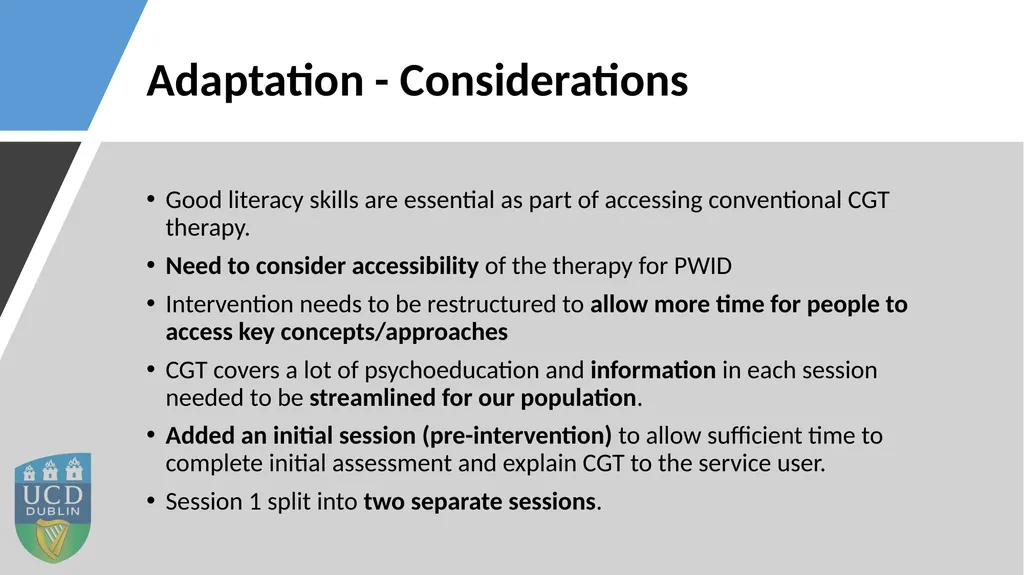
Adaptation - Considerations Good literacy skills are essential as part of accessing conventional CGT therapy.
Need to consider accessibility of the therapy for PWID
Intervention needs to be restructured to allow more time for people to access key concepts/approaches
CGT covers a lot of psychoeducation and information in each session needed to be streamlined for our population.
Added an initial session (pre-intervention) to allow sufficient time to complete initial assessment and explain CGT to the service user.
Session 1 split into two separate sessions.<br>
13
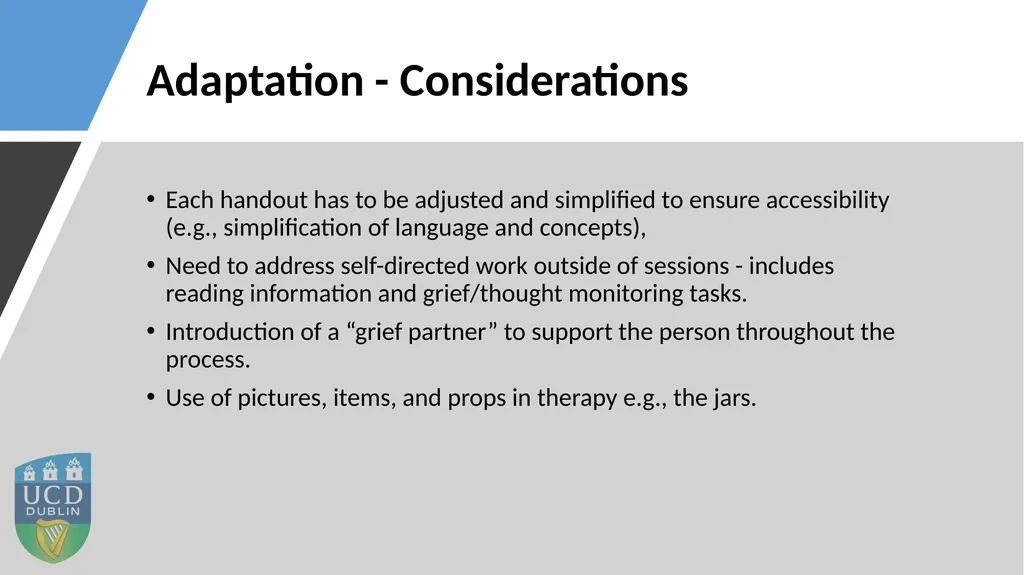
Adaptation - Considerations Each handout has to be adjusted and simplified to ensure accessibility (e.g., simplification of language and concepts),
Need to address self-directed work outside of sessions - includes reading information and grief/thought monitoring tasks.
Introduction of a “grief partner” to support the person throughout the process.
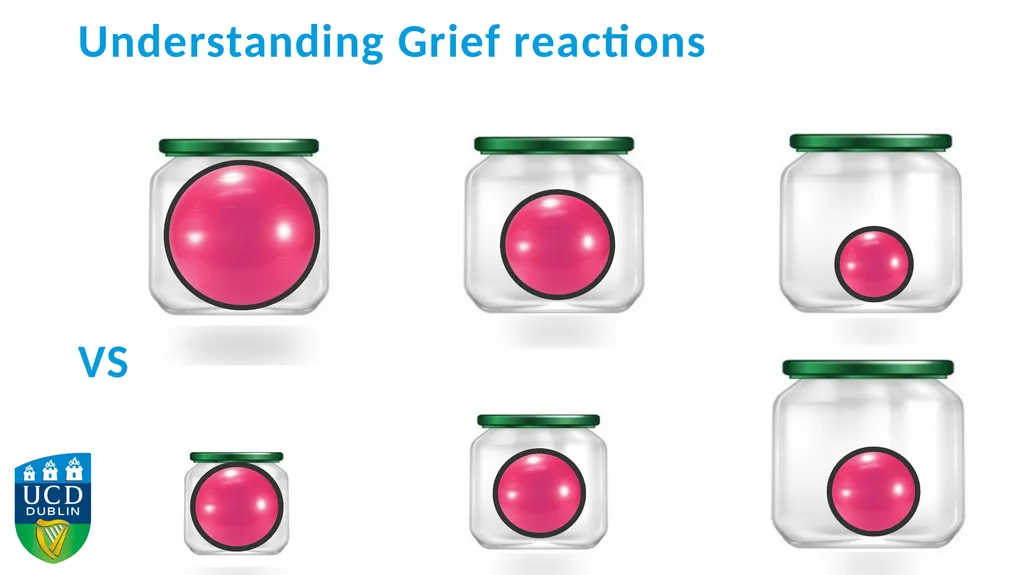
Use of pictures, items, and props in therapy e.g., the jars.<br>
14
Understanding Grief reactions VS<br>
15
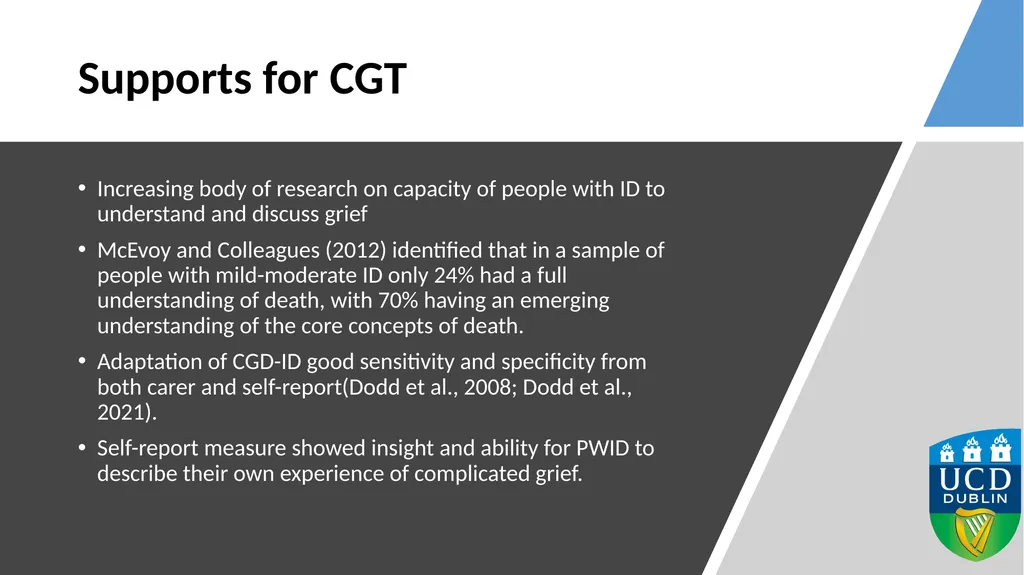
Supports for CGT Increasing body of research on capacity of people with ID to understand and discuss grief
McEvoy and Colleagues (2012) identified that in a sample of people with mild-moderate ID only 24% had a full understanding of death, with 70% having an emerging understanding of the core concepts of death.
Adaptation of CGD-ID good sensitivity and specificity from both carer and self-report(Dodd et al., 2008; Dodd et al., 2021).
Self-report measure showed insight and ability for PWID to describe their own experience of complicated grief.<br>
16
Current and Next Steps Reflections of experience to date:
Everything takes longer than expected! Both adaptation and delivery!
But confident that, with consideration, even difficult concepts can be adapted
Currently conducting interviews with professionals with experience in ID to explore initial assessment of adapted materials
Hope to conduct pilot study with a small number of adults with ID later in the year<br>