
Using gender data for policymaking ASIA-PACIFIC
TG
Published · 25 slides · 0 views
1 / 1


Description
Using gender data for policymaking ASIA-PACIFIC TRAINING CURRICULUM ON GENDER STATISTICS Learning objectives 1 Become familiar with how to integrate a gender perspective across policymaking Understand the need and rationale for using gender
Related Topics
Share
Embed code
Download this presentation From Below
"Using gender data for policymaking ASIA-PACIFIC" is the property of its rightful owner. Permission is granted to download and print the materials on this website for personal, non-commercial use only, and to display it on your personal computer provided you do not modify the materials and that you retain all copyright notices contained in the materials. By downloading content from our website, you accept the terms of this agreement.
Presentation Transcript
01
Using gender data for policymaking ASIA-PACIFIC TRAINING CURRICULUM ON GENDER STATISTICS<br>
02
Learning objectives 1 Become familiar with how to integrate a gender perspective across policymaking
Understand the need and rationale for using gender statistics in policymaking
Learn basic concepts of data and policy-integration for evidence-based policymaking
Learn key tips for writing evidence-based gender policy briefs<br>
Understand the need and rationale for using gender statistics in policymaking
Learn basic concepts of data and policy-integration for evidence-based policymaking
Learn key tips for writing evidence-based gender policy briefs<br>
03
Mainstreaming the use of gender data throughout the policymaking process 2<br>
04
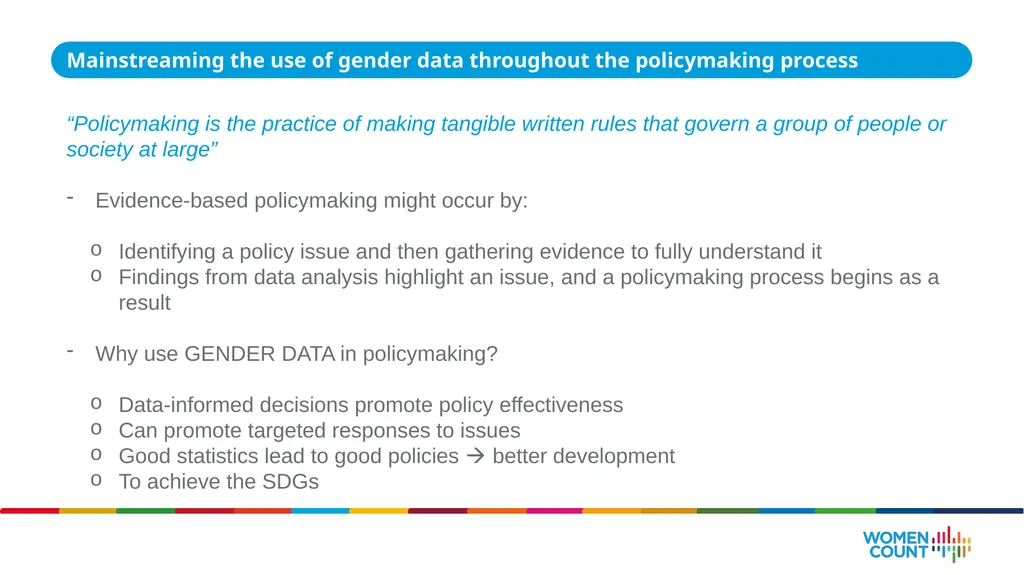
Mainstreaming the use of gender data throughout the policymaking process “Policymaking is the practice of making tangible written rules that govern a group of people or society at large”
Evidence-based policymaking might occur by:
Identifying a policy issue and then gathering evidence to fully understand it
Findings from data analysis highlight an issue, and a policymaking process begins as a result
Why use GENDER DATA in policymaking?
Data-informed decisions promote policy effectiveness
Can promote targeted responses to issues
Good statistics lead to good policies better development
To achieve the SDGs<br>
Evidence-based policymaking might occur by:
Identifying a policy issue and then gathering evidence to fully understand it
Findings from data analysis highlight an issue, and a policymaking process begins as a result
Why use GENDER DATA in policymaking?
Data-informed decisions promote policy effectiveness
Can promote targeted responses to issues
Good statistics lead to good policies better development
To achieve the SDGs<br>
05
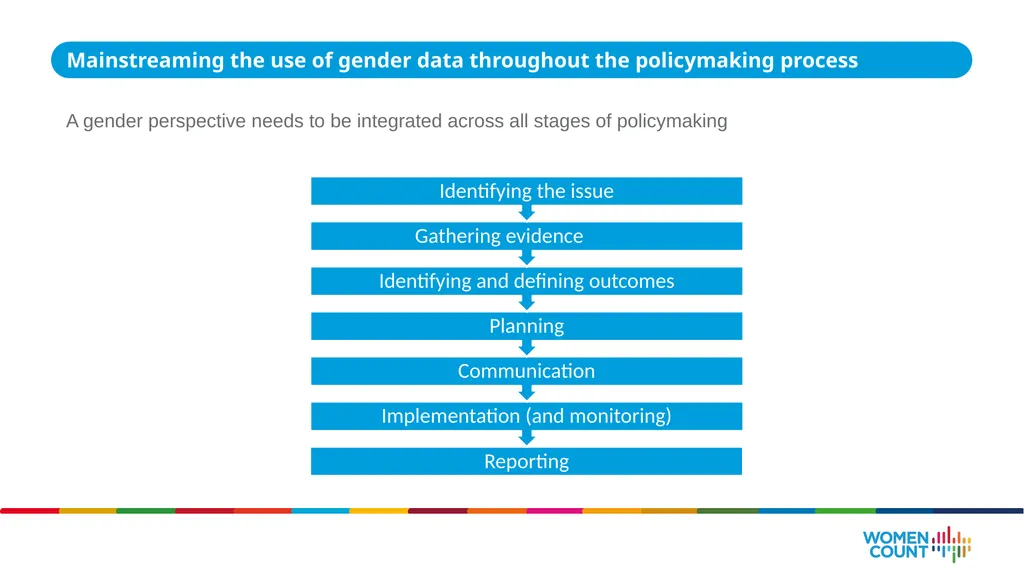
Mainstreaming the use of gender data throughout the policymaking process A gender perspective needs to be integrated across all stages of policymaking<br>
06
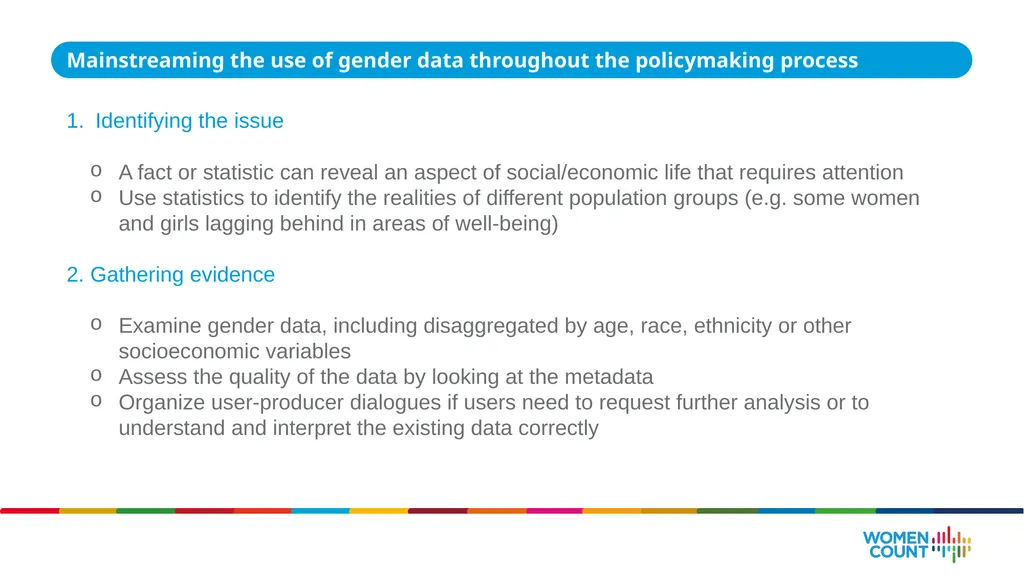
Mainstreaming the use of gender data throughout the policymaking process Identifying the issue
A fact or statistic can reveal an aspect of social/economic life that requires attention
Use statistics to identify the realities of different population groups (e.g. some women and girls lagging behind in areas of well-being)
2. Gathering evidence
Examine gender data, including disaggregated by age, race, ethnicity or other socioeconomic variables
Assess the quality of the data by looking at the metadata
Organize user-producer dialogues if users need to request further analysis or to understand and interpret the existing data correctly<br>
A fact or statistic can reveal an aspect of social/economic life that requires attention
Use statistics to identify the realities of different population groups (e.g. some women and girls lagging behind in areas of well-being)
2. Gathering evidence
Examine gender data, including disaggregated by age, race, ethnicity or other socioeconomic variables
Assess the quality of the data by looking at the metadata
Organize user-producer dialogues if users need to request further analysis or to understand and interpret the existing data correctly<br>
07
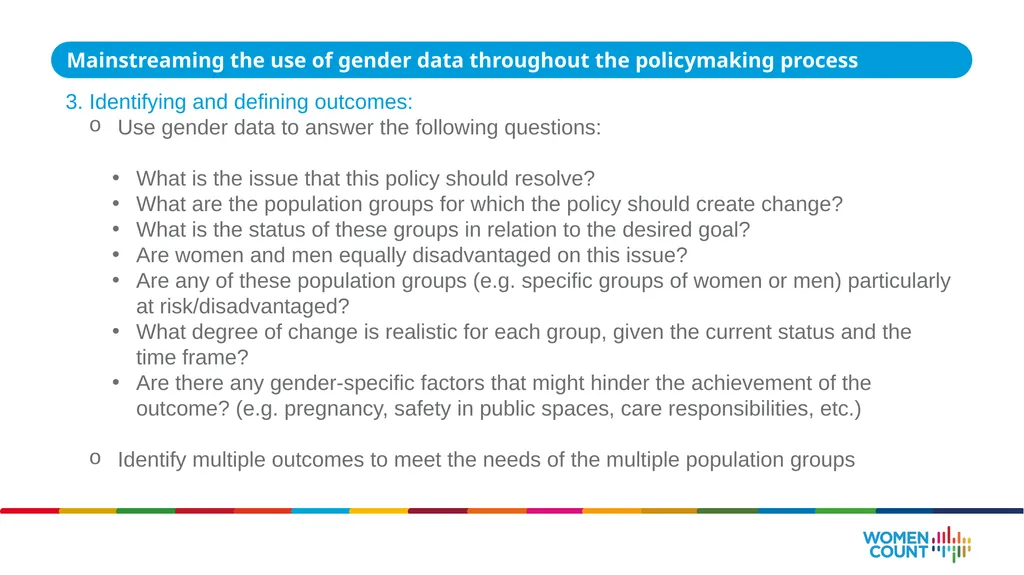
Mainstreaming the use of gender data throughout the policymaking process 3. Identifying and defining outcomes:
Use gender data to answer the following questions:
What is the issue that this policy should resolve?
What are the population groups for which the policy should create change?
What is the status of these groups in relation to the desired goal?
Are women and men equally disadvantaged on this issue?
Are any of these population groups (e.g. specific groups of women or men) particularly at risk/disadvantaged?
What degree of change is realistic for each group, given the current status and the time frame?
Are there any gender-specific factors that might hinder the achievement of the outcome? (e.g. pregnancy, safety in public spaces, care responsibilities, etc.)
Identify multiple outcomes to meet the needs of the multiple population groups<br>
Use gender data to answer the following questions:
What is the issue that this policy should resolve?
What are the population groups for which the policy should create change?
What is the status of these groups in relation to the desired goal?
Are women and men equally disadvantaged on this issue?
Are any of these population groups (e.g. specific groups of women or men) particularly at risk/disadvantaged?
What degree of change is realistic for each group, given the current status and the time frame?
Are there any gender-specific factors that might hinder the achievement of the outcome? (e.g. pregnancy, safety in public spaces, care responsibilities, etc.)
Identify multiple outcomes to meet the needs of the multiple population groups<br>
08
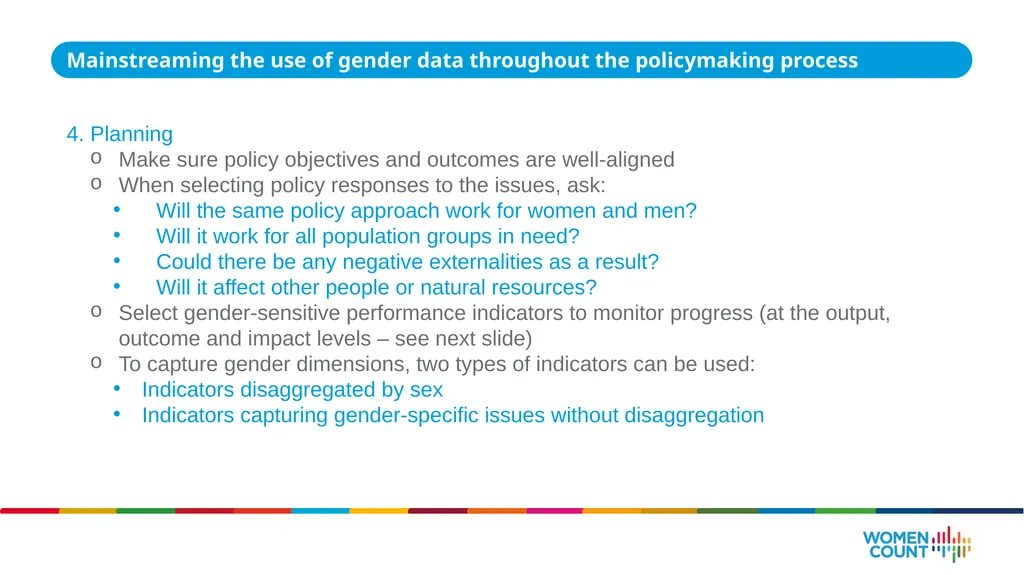
Mainstreaming the use of gender data throughout the policymaking process 4. Planning
Make sure policy objectives and outcomes are well-aligned
When selecting policy responses to the issues, ask:
Will the same policy approach work for women and men?
Will it work for all population groups in need?
Could there be any negative externalities as a result?
Will it affect other people or natural resources?
Select gender-sensitive performance indicators to monitor progress (at the output, outcome and impact levels – see next slide)
To capture gender dimensions, two types of indicators can be used:
Indicators disaggregated by sex
Indicators capturing gender-specific issues without disaggregation<br>
Make sure policy objectives and outcomes are well-aligned
When selecting policy responses to the issues, ask:
Will the same policy approach work for women and men?
Will it work for all population groups in need?
Could there be any negative externalities as a result?
Will it affect other people or natural resources?
Select gender-sensitive performance indicators to monitor progress (at the output, outcome and impact levels – see next slide)
To capture gender dimensions, two types of indicators can be used:
Indicators disaggregated by sex
Indicators capturing gender-specific issues without disaggregation<br>
09
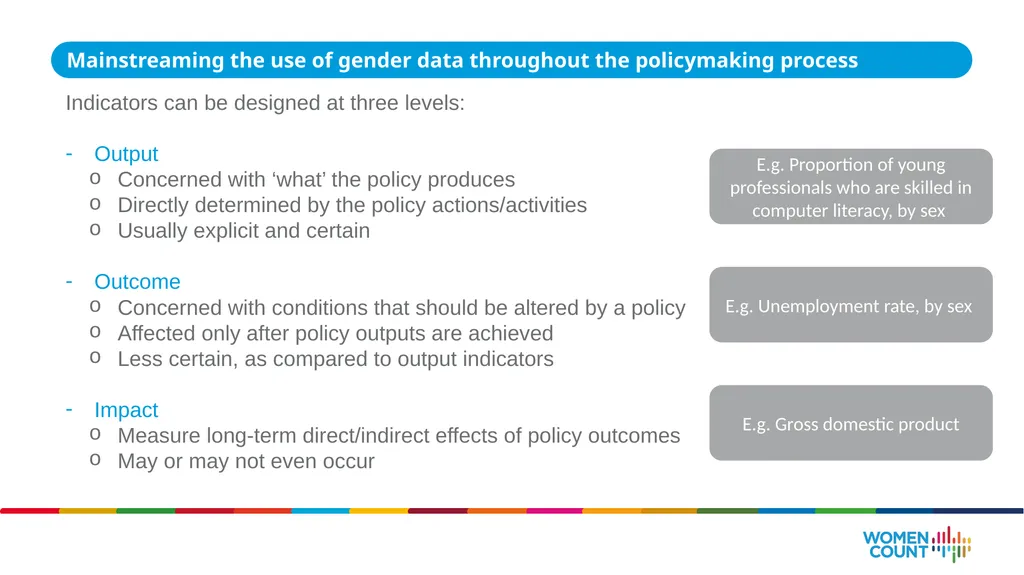
Mainstreaming the use of gender data throughout the policymaking process Indicators can be designed at three levels:
Output
Concerned with ‘what’ the policy produces
Directly determined by the policy actions/activities
Usually explicit and certain
Outcome
Concerned with conditions that should be altered by a policy
Affected only after policy outputs are achieved
Less certain, as compared to output indicators
Impact
Measure long-term direct/indirect effects of policy outcomes
May or may not even occur E.g. Proportion of young professionals who are skilled in computer literacy, by sex E.g. Unemployment rate, by sex E.g. Gross domestic product<br>
Output
Concerned with ‘what’ the policy produces
Directly determined by the policy actions/activities
Usually explicit and certain
Outcome
Concerned with conditions that should be altered by a policy
Affected only after policy outputs are achieved
Less certain, as compared to output indicators
Impact
Measure long-term direct/indirect effects of policy outcomes
May or may not even occur E.g. Proportion of young professionals who are skilled in computer literacy, by sex E.g. Unemployment rate, by sex E.g. Gross domestic product<br>
10
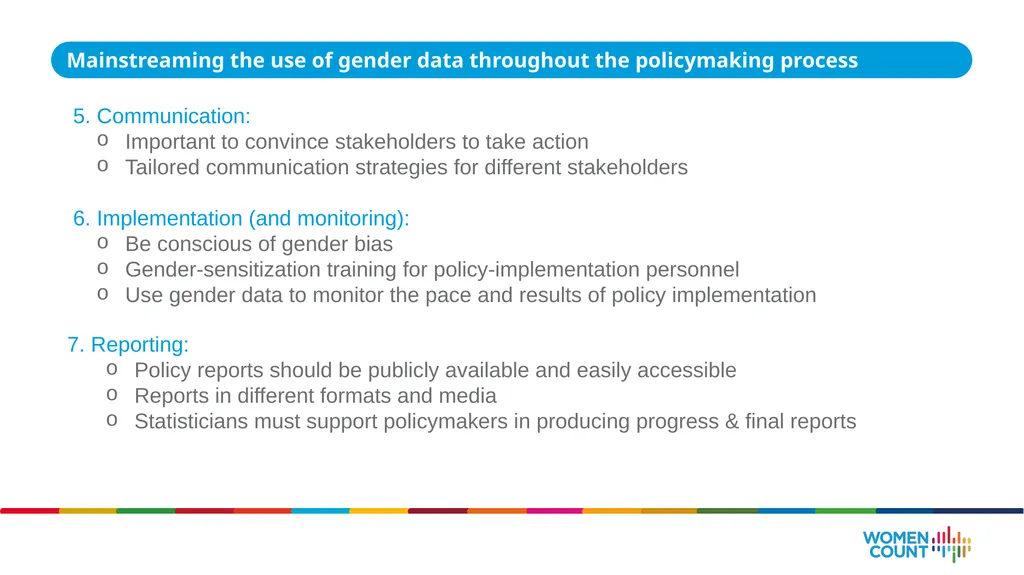
Mainstreaming the use of gender data throughout the policymaking process 7. Reporting:
Policy reports should be publicly available and easily accessible
Reports in different formats and media
Statisticians must support policymakers in producing progress & final reports 5. Communication:
Important to convince stakeholders to take action
Tailored communication strategies for different stakeholders
6. Implementation (and monitoring):
Be conscious of gender bias
Gender-sensitization training for policy-implementation personnel
Use gender data to monitor the pace and results of policy implementation<br>
Policy reports should be publicly available and easily accessible
Reports in different formats and media
Statisticians must support policymakers in producing progress & final reports 5. Communication:
Important to convince stakeholders to take action
Tailored communication strategies for different stakeholders
6. Implementation (and monitoring):
Be conscious of gender bias
Gender-sensitization training for policy-implementation personnel
Use gender data to monitor the pace and results of policy implementation<br>
11
How to use gender statistics for policymaking 3<br>
12
How to use gender statistics for policymaking Using gender statistics to set the agenda 1. Using gender statistics to set the agenda:
Existing gender data can help identify significant issues, needs and challenges
Data disaggregation beyond sex may reveal inequalities
E.g. Disaggregation by ethnicity, religion, region, marital status, etc. might highlight groups of women lagging behind
Policy makers must collaborate with national statisticians to:
Understand and interpret gender data accurately
Understand the pros and cons of different sources of data (official vs non-official)
Target population groups should be consulted to complete the evidence-gathering process prior to policy forumulation<br>
Existing gender data can help identify significant issues, needs and challenges
Data disaggregation beyond sex may reveal inequalities
E.g. Disaggregation by ethnicity, religion, region, marital status, etc. might highlight groups of women lagging behind
Policy makers must collaborate with national statisticians to:
Understand and interpret gender data accurately
Understand the pros and cons of different sources of data (official vs non-official)
Target population groups should be consulted to complete the evidence-gathering process prior to policy forumulation<br>
13
Using gender statistics to design key policy components 2. Using gender statistics to design key policy components:
Empirical research findings can help shape policies
E.g. who will be the beneficiary of the policy, or to set benchmarks for policy objectives
Statistical analysis to support policy design:
Regression analysis to develop scenarios to see how a policy can alter the status quo
Correlation analysis to help identify potential negative externalities
Statistical projections to determine realistic outputs given the time frames
If enough good-quality data is not available for policy design, user-producer dialogue can:
Design future data collection exercises
Advocate for more resources to be allocated towards gender statistics
Select indicators based on relevance and in line with policy outputs, outcomes and impact<br>
Empirical research findings can help shape policies
E.g. who will be the beneficiary of the policy, or to set benchmarks for policy objectives
Statistical analysis to support policy design:
Regression analysis to develop scenarios to see how a policy can alter the status quo
Correlation analysis to help identify potential negative externalities
Statistical projections to determine realistic outputs given the time frames
If enough good-quality data is not available for policy design, user-producer dialogue can:
Design future data collection exercises
Advocate for more resources to be allocated towards gender statistics
Select indicators based on relevance and in line with policy outputs, outcomes and impact<br>
14
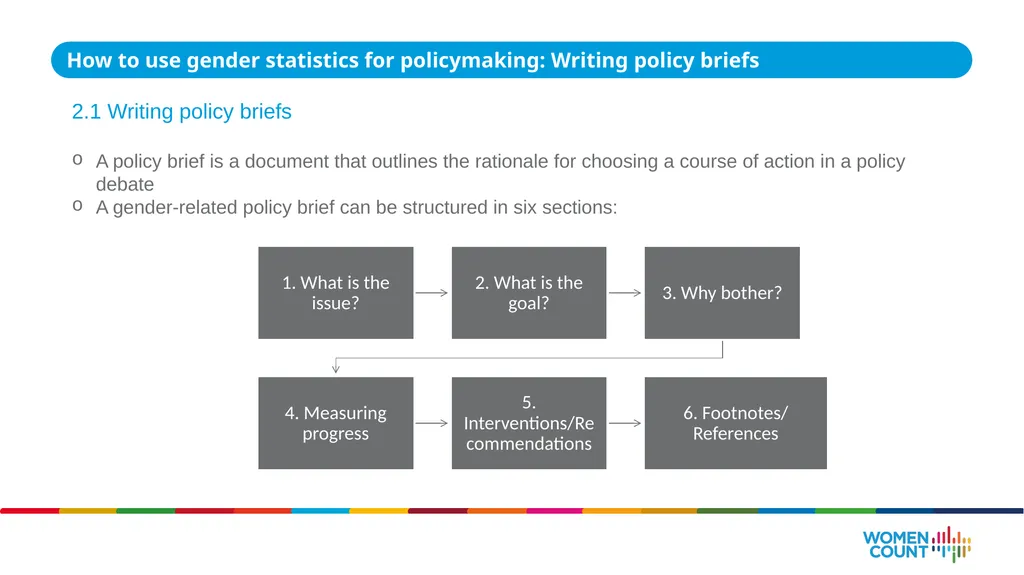
How to use gender statistics for policymaking: Writing policy briefs 2.1 Writing policy briefs
A policy brief is a document that outlines the rationale for choosing a course of action in a policy debate
A gender-related policy brief can be structured in six sections:<br>
A policy brief is a document that outlines the rationale for choosing a course of action in a policy debate
A gender-related policy brief can be structured in six sections:<br>
15
How to use gender statistics for policymaking: Writing policy briefs 1. What is the issue?
Quick snapshot of policy area
Current status and trends
Highlights the connection to gender equality
2. What is the goal?
Based on gender data and qualitative evidence
Highlights the main goal(s) of policy
3. Why bother?
Present arguments for a certain policy course and gender-mainstreaming approach
Include gender data to forecast and measure potential outcomes<br>
Quick snapshot of policy area
Current status and trends
Highlights the connection to gender equality
2. What is the goal?
Based on gender data and qualitative evidence
Highlights the main goal(s) of policy
3. Why bother?
Present arguments for a certain policy course and gender-mainstreaming approach
Include gender data to forecast and measure potential outcomes<br>
16
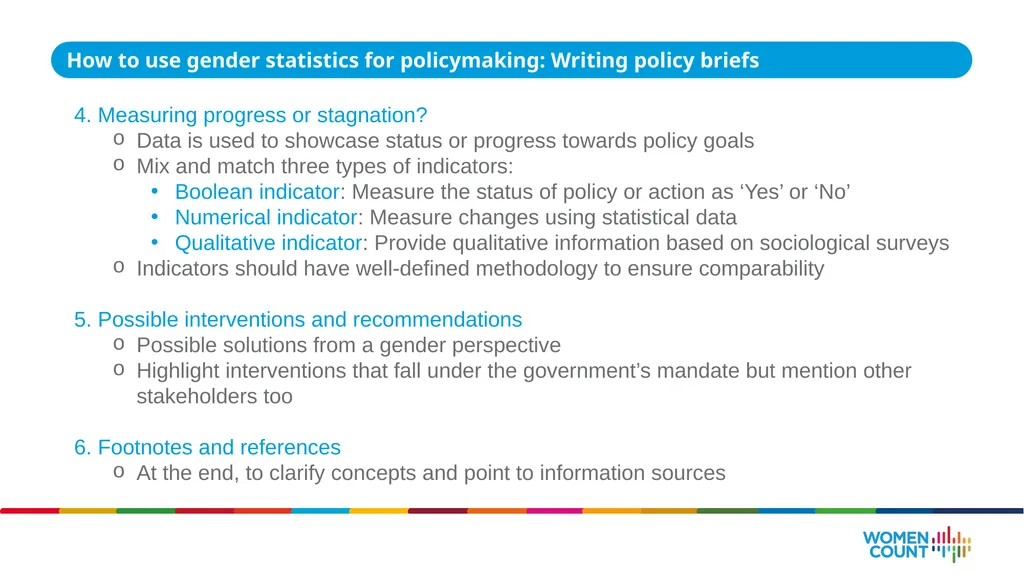
How to use gender statistics for policymaking: Writing policy briefs 4. Measuring progress or stagnation?
Data is used to showcase status or progress towards policy goals
Mix and match three types of indicators:
Boolean indicator: Measure the status of policy or action as ‘Yes’ or ‘No’
Numerical indicator: Measure changes using statistical data
Qualitative indicator: Provide qualitative information based on sociological surveys
Indicators should have well-defined methodology to ensure comparability
5. Possible interventions and recommendations
Possible solutions from a gender perspective
Highlight interventions that fall under the government’s mandate but mention other stakeholders too
6. Footnotes and references
At the end, to clarify concepts and point to information sources<br>
Data is used to showcase status or progress towards policy goals
Mix and match three types of indicators:
Boolean indicator: Measure the status of policy or action as ‘Yes’ or ‘No’
Numerical indicator: Measure changes using statistical data
Qualitative indicator: Provide qualitative information based on sociological surveys
Indicators should have well-defined methodology to ensure comparability
5. Possible interventions and recommendations
Possible solutions from a gender perspective
Highlight interventions that fall under the government’s mandate but mention other stakeholders too
6. Footnotes and references
At the end, to clarify concepts and point to information sources<br>
17
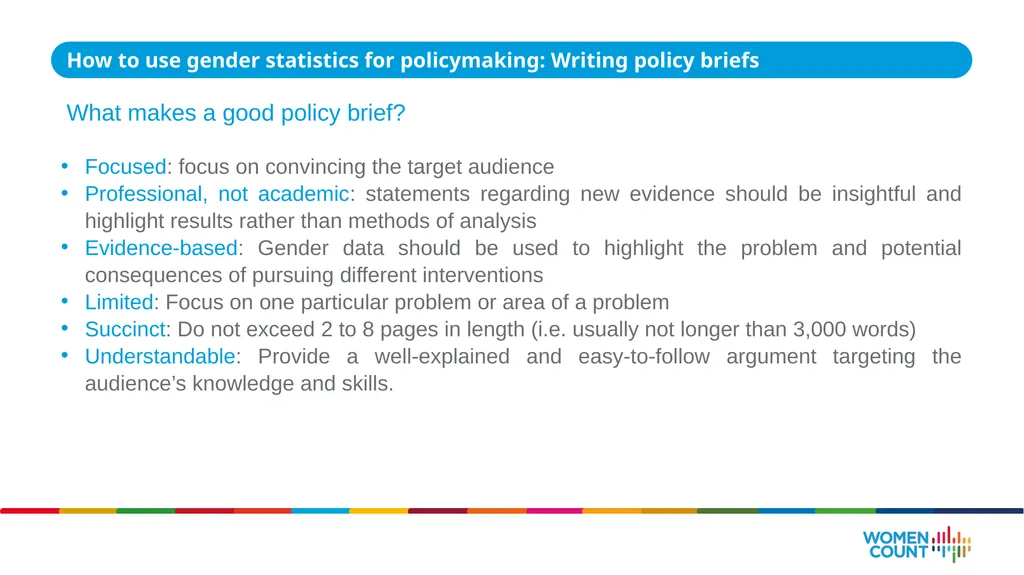
How to use gender statistics for policymaking: Writing policy briefs Focused: focus on convincing the target audience
Professional, not academic: statements regarding new evidence should be insightful and highlight results rather than methods of analysis
Evidence-based: Gender data should be used to highlight the problem and potential consequences of pursuing different interventions
Limited: Focus on one particular problem or area of a problem
Succinct: Do not exceed 2 to 8 pages in length (i.e. usually not longer than 3,000 words)
Understandable: Provide a well-explained and easy-to-follow argument targeting the audience’s knowledge and skills. What makes a good policy brief?<br>
Professional, not academic: statements regarding new evidence should be insightful and highlight results rather than methods of analysis
Evidence-based: Gender data should be used to highlight the problem and potential consequences of pursuing different interventions
Limited: Focus on one particular problem or area of a problem
Succinct: Do not exceed 2 to 8 pages in length (i.e. usually not longer than 3,000 words)
Understandable: Provide a well-explained and easy-to-follow argument targeting the audience’s knowledge and skills. What makes a good policy brief?<br>
18
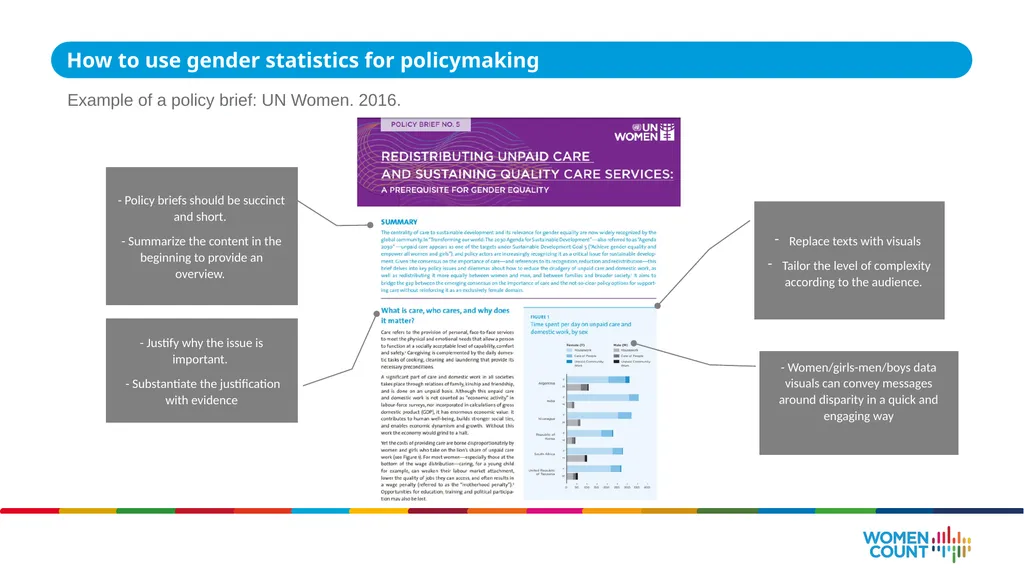
How to use gender statistics for policymaking Example of a policy brief: UN Women. 2016. - Policy briefs should be succinct and short.
- Summarize the content in the beginning to provide an overview. Replace texts with visuals
Tailor the level of complexity according to the audience. - Justify why the issue is important.
- Substantiate the justification with evidence - Women/girls-men/boys data visuals can convey messages around disparity in a quick and engaging way<br>
- Summarize the content in the beginning to provide an overview. Replace texts with visuals
Tailor the level of complexity according to the audience. - Justify why the issue is important.
- Substantiate the justification with evidence - Women/girls-men/boys data visuals can convey messages around disparity in a quick and engaging way<br>
19
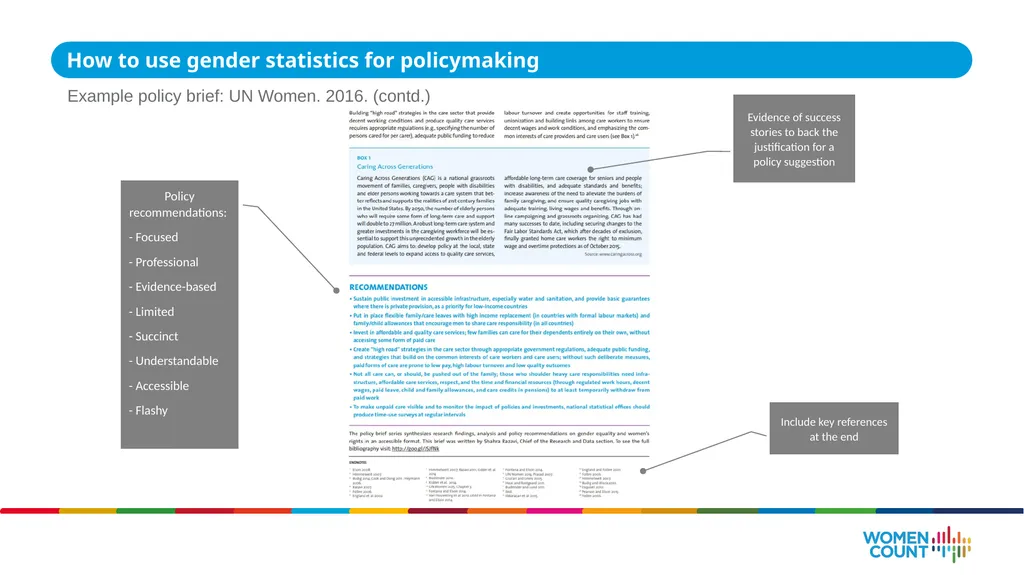
How to use gender statistics for policymaking Evidence of success stories to back the justification for a policy suggestion Policy recommendations:
- Focused
- Professional
- Evidence-based
- Limited
- Succinct
- Understandable
- Accessible
- Flashy Include key references at the end Example policy brief: UN Women. 2016. (contd.)<br>
- Focused
- Professional
- Evidence-based
- Limited
- Succinct
- Understandable
- Accessible
- Flashy Include key references at the end Example policy brief: UN Women. 2016. (contd.)<br>
20
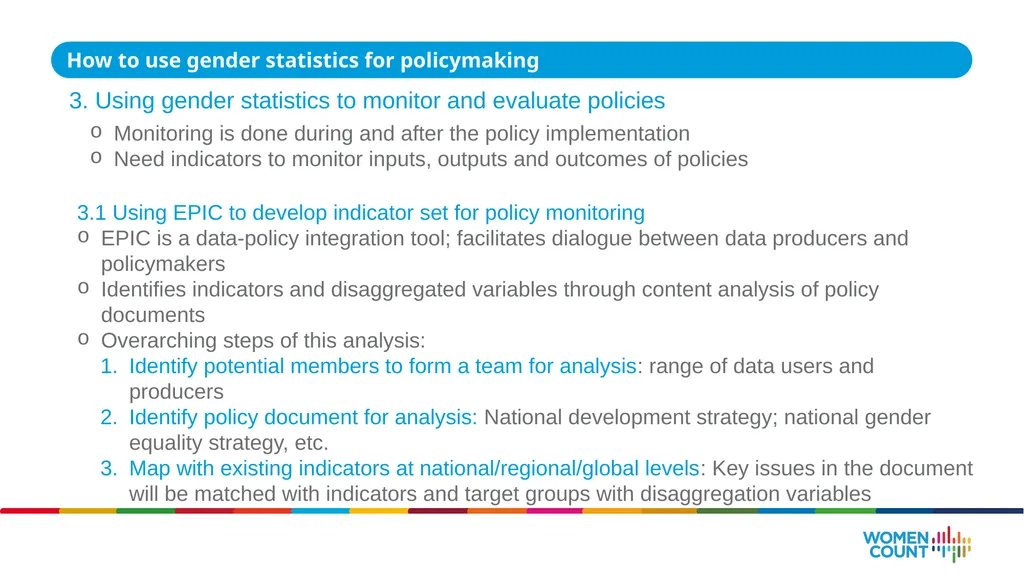
How to use gender statistics for policymaking 3. Using gender statistics to monitor and evaluate policies Monitoring is done during and after the policy implementation
Need indicators to monitor inputs, outputs and outcomes of policies 3.1 Using EPIC to develop indicator set for policy monitoring
EPIC is a data-policy integration tool; facilitates dialogue between data producers and policymakers
Identifies indicators and disaggregated variables through content analysis of policy documents
Overarching steps of this analysis:
Identify potential members to form a team for analysis: range of data users and producers
Identify policy document for analysis: National development strategy; national gender equality strategy, etc.
Map with existing indicators at national/regional/global levels: Key issues in the document will be matched with indicators and target groups with disaggregation variables<br>
Need indicators to monitor inputs, outputs and outcomes of policies 3.1 Using EPIC to develop indicator set for policy monitoring
EPIC is a data-policy integration tool; facilitates dialogue between data producers and policymakers
Identifies indicators and disaggregated variables through content analysis of policy documents
Overarching steps of this analysis:
Identify potential members to form a team for analysis: range of data users and producers
Identify policy document for analysis: National development strategy; national gender equality strategy, etc.
Map with existing indicators at national/regional/global levels: Key issues in the document will be matched with indicators and target groups with disaggregation variables<br>
21
Overcoming barriers to evidence-based decision- making 4<br>
22
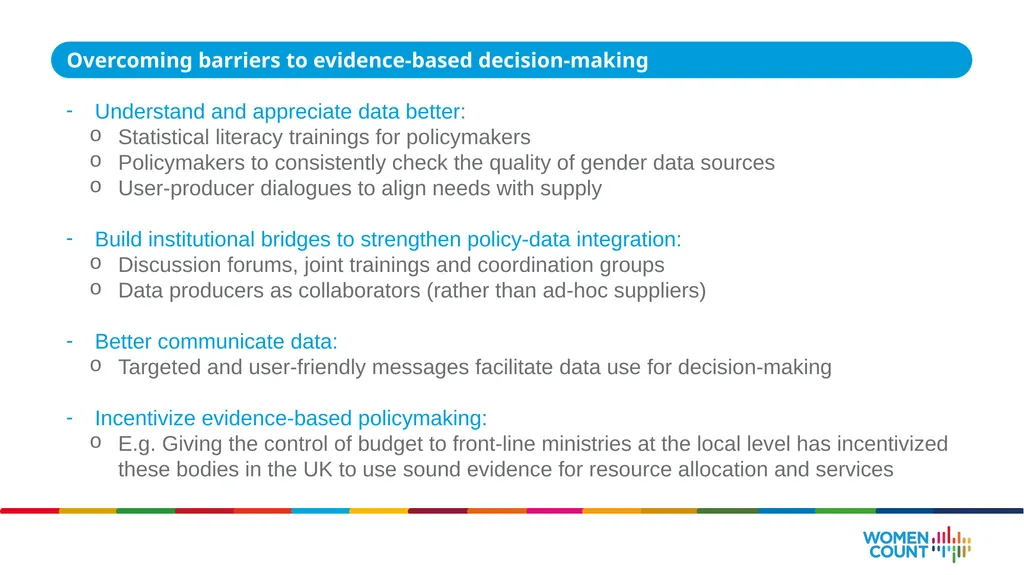
Overcoming barriers to evidence-based decision-making Understand and appreciate data better:
Statistical literacy trainings for policymakers
Policymakers to consistently check the quality of gender data sources
User-producer dialogues to align needs with supply
Build institutional bridges to strengthen policy-data integration:
Discussion forums, joint trainings and coordination groups
Data producers as collaborators (rather than ad-hoc suppliers)
Better communicate data:
Targeted and user-friendly messages facilitate data use for decision-making
Incentivize evidence-based policymaking:
E.g. Giving the control of budget to front-line ministries at the local level has incentivized these bodies in the UK to use sound evidence for resource allocation and services<br>
Statistical literacy trainings for policymakers
Policymakers to consistently check the quality of gender data sources
User-producer dialogues to align needs with supply
Build institutional bridges to strengthen policy-data integration:
Discussion forums, joint trainings and coordination groups
Data producers as collaborators (rather than ad-hoc suppliers)
Better communicate data:
Targeted and user-friendly messages facilitate data use for decision-making
Incentivize evidence-based policymaking:
E.g. Giving the control of budget to front-line ministries at the local level has incentivized these bodies in the UK to use sound evidence for resource allocation and services<br>
23
Key takeaways 5<br>
24
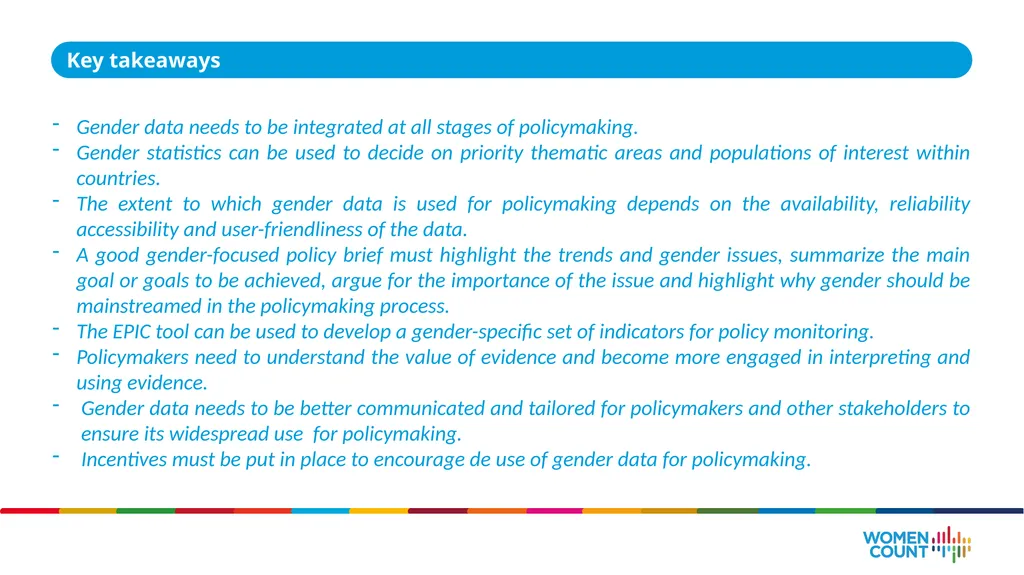
Key takeaways Gender data needs to be integrated at all stages of policymaking.
Gender statistics can be used to decide on priority thematic areas and populations of interest within countries.
The extent to which gender data is used for policymaking depends on the availability, reliability accessibility and user-friendliness of the data.
A good gender-focused policy brief must highlight the trends and gender issues, summarize the main goal or goals to be achieved, argue for the importance of the issue and highlight why gender should be mainstreamed in the policymaking process.
The EPIC tool can be used to develop a gender-specific set of indicators for policy monitoring.
Policymakers need to understand the value of evidence and become more engaged in interpreting and using evidence.
Gender data needs to be better communicated and tailored for policymakers and other stakeholders to ensure its widespread use for policymaking.
Incentives must be put in place to encourage de use of gender data for policymaking.<br>
Gender statistics can be used to decide on priority thematic areas and populations of interest within countries.
The extent to which gender data is used for policymaking depends on the availability, reliability accessibility and user-friendliness of the data.
A good gender-focused policy brief must highlight the trends and gender issues, summarize the main goal or goals to be achieved, argue for the importance of the issue and highlight why gender should be mainstreamed in the policymaking process.
The EPIC tool can be used to develop a gender-specific set of indicators for policy monitoring.
Policymakers need to understand the value of evidence and become more engaged in interpreting and using evidence.
Gender data needs to be better communicated and tailored for policymakers and other stakeholders to ensure its widespread use for policymaking.
Incentives must be put in place to encourage de use of gender data for policymaking.<br>
25
THANK YOU<br>