
Using ‘Open Government Data’ for Integrated
Description: Using Open Government Data for Integrated Environment Notification System: Meta-Analysis of Initiatives in India Amaresh Jha Assistant Professor, Amity School of Communication, Amity University, Uttar Pradesh Dr. Aman Vats, Associate
Related Topics
Download Presentation
"Using ‘Open Government Data’ for Integrated" is the property of its rightful owner. Permission is granted to download and print the materials on this website for personal, non-commercial use only, and to display it on your personal computer provided you do not modify the materials and that you retain all copyright notices contained in the materials. By downloading content from our website, you accept the terms of this agreement.
Presentation Transcript
slide1. Using ‘Open Government Data’ for Integrated Environment Notification System: Meta-Analysis of Initiatives in India Amaresh Jha
Assistant Professor, Amity School of Communication, Amity University, Uttar Pradesh
&
Dr. Aman Vats,
Associate Professor, Amity School of Communication, Amity University, Uttar Pradesh<br>
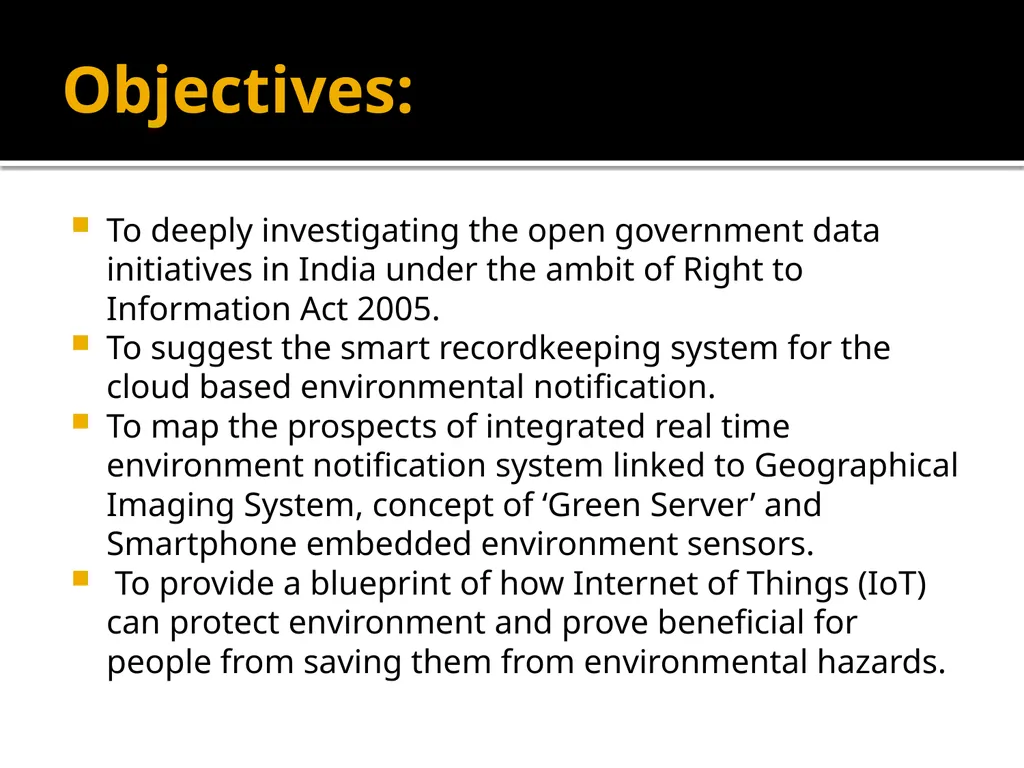
slide2. Objectives: To deeply investigating the open government data initiatives in India under the ambit of Right to Information Act 2005.
To suggest the smart recordkeeping system for the cloud based environmental notification.
To map the prospects of integrated real time environment notification system linked to Geographical Imaging System, concept of ‘Green Server’ and Smartphone embedded environment sensors.
To provide a blueprint of how Internet of Things (IoT) can protect environment and prove beneficial for people from saving them from environmental hazards.<br>
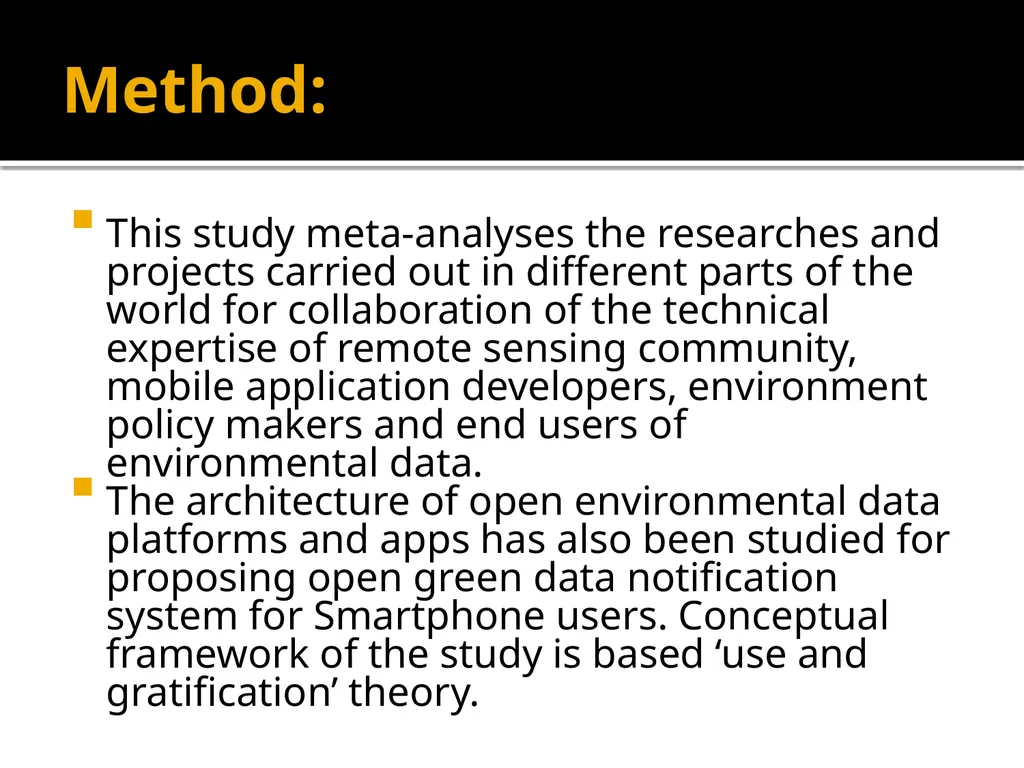
slide3. Method: This study meta-analyses the researches and projects carried out in different parts of the world for collaboration of the technical expertise of remote sensing community, mobile application developers, environment policy makers and end users of environmental data.
The architecture of open environmental data platforms and apps has also been studied for proposing open green data notification system for Smartphone users. Conceptual framework of the study is based ‘use and gratification’ theory.<br>
slide4. Review of Open data based Apps Android App “SAMEER”
This App provides hourly updates on the National Air Quality Index (AQI) revealed by CPCB.
NAMP (National Air Quality Monitoring Program)
Ganga Shravan Abhiyaan
Through this web base application people participate in Mission Clean Ganges.<br>
slide5. Review of Open data based Apps Bio Monitoring Field Protocol
It's a tool for the biological assessment of surface water bodies for the people who monitor the biological aspects of surface waters.
National Water Quality Program
Central Pollution Control board (CPCB) has established a network of 2500 water quality monitoring stations across the country<br>
slide6. Review of Open data based Apps CEPI (Comprehensive Environment Pollution Index for Critically Polluted Industrial Area/Clusters)
Air Casting App
AirVeda App
AirAlert App<br>
slide7. Knowledge Gap Identified There is need of dynamic and digital recordkeeping of the information so that it is easily accessible on open data platform.
There is no integrated Smartphone based notification system to supply real time environmental data.
There is lack of co-ordination between remote sensing community, communication consultants and environmental policy makers.
There is hardly any inventory in India to integrate the Open Government Data on Environment for Smart Use.<br>
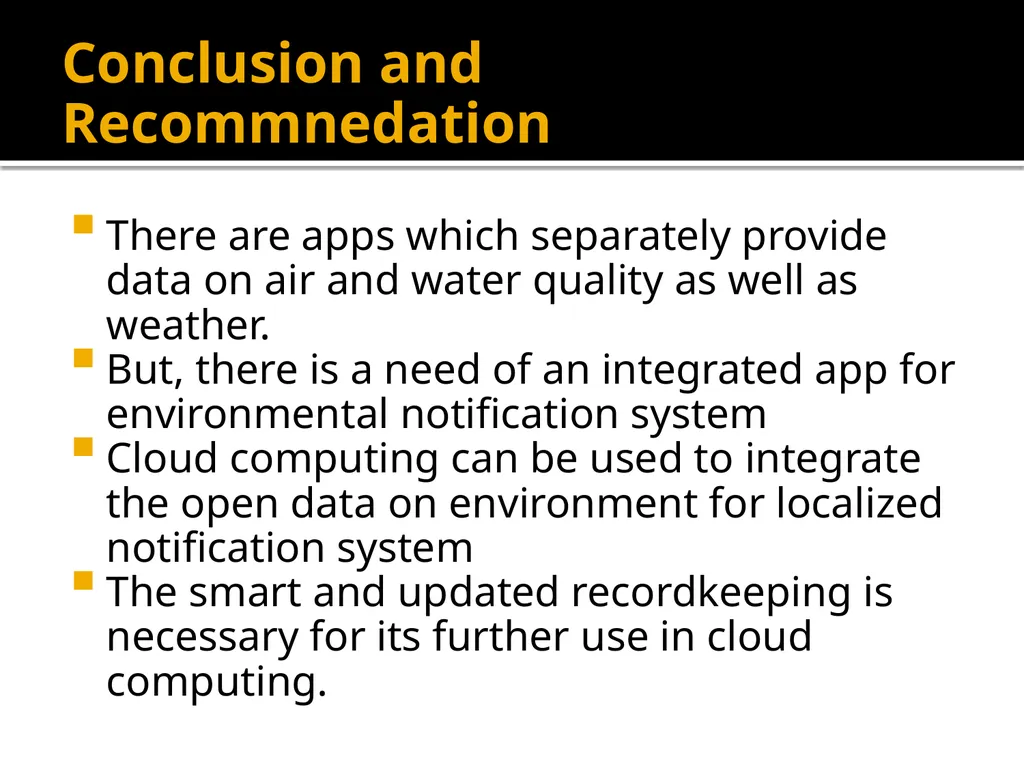
slide8. Conclusion and Recommnedation There are apps which separately provide data on air and water quality as well as weather.
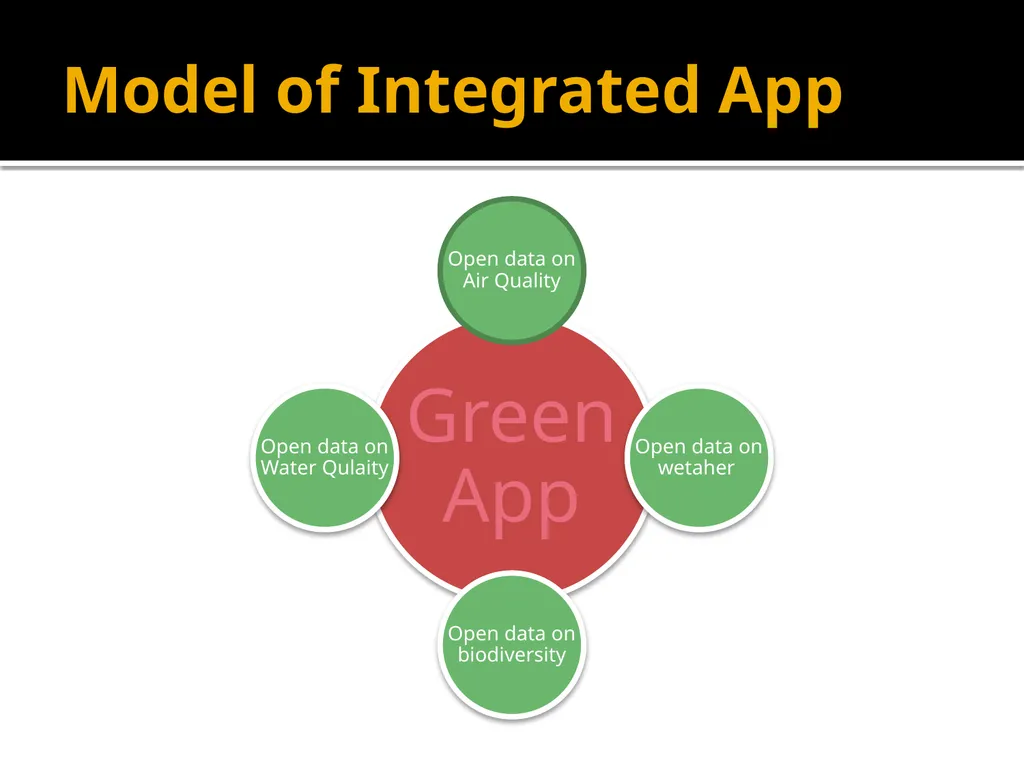
But, there is a need of an integrated app for environmental notification system
Cloud computing can be used to integrate the open data on environment for localized notification system
The smart and updated recordkeeping is necessary for its further use in cloud computing.<br>
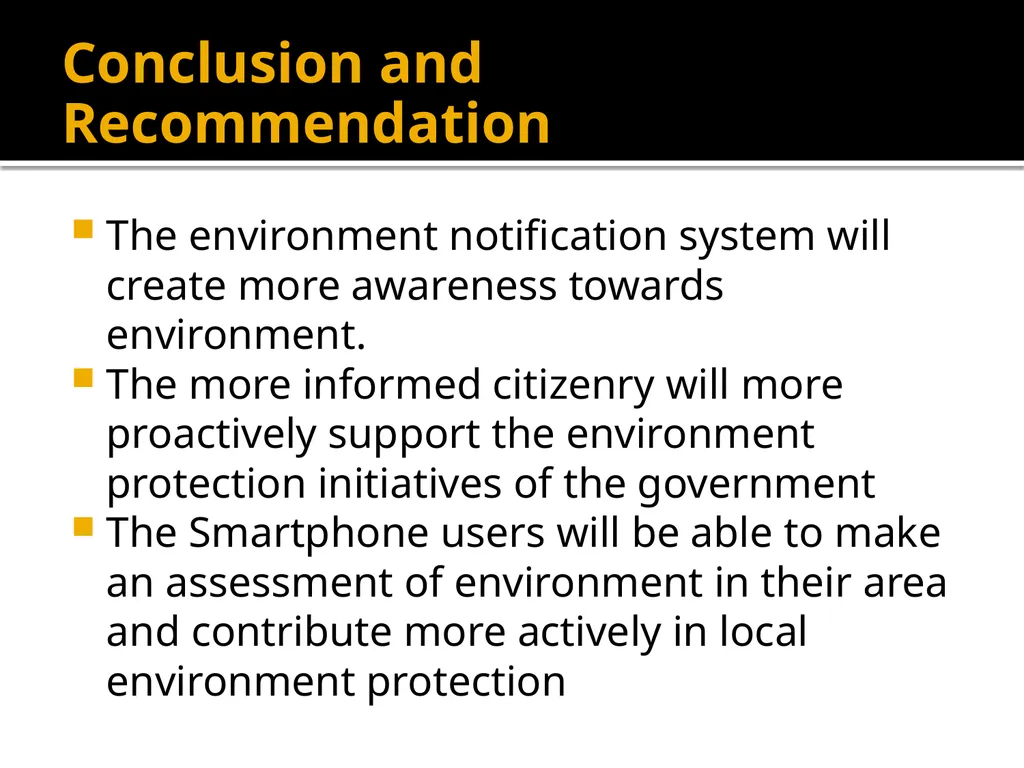
slide9. Conclusion and Recommendation The environment notification system will create more awareness towards environment.
The more informed citizenry will more proactively support the environment protection initiatives of the government
The Smartphone users will be able to make an assessment of environment in their area and contribute more actively in local environment protection<br>
slide10. Model of Integrated App<br>
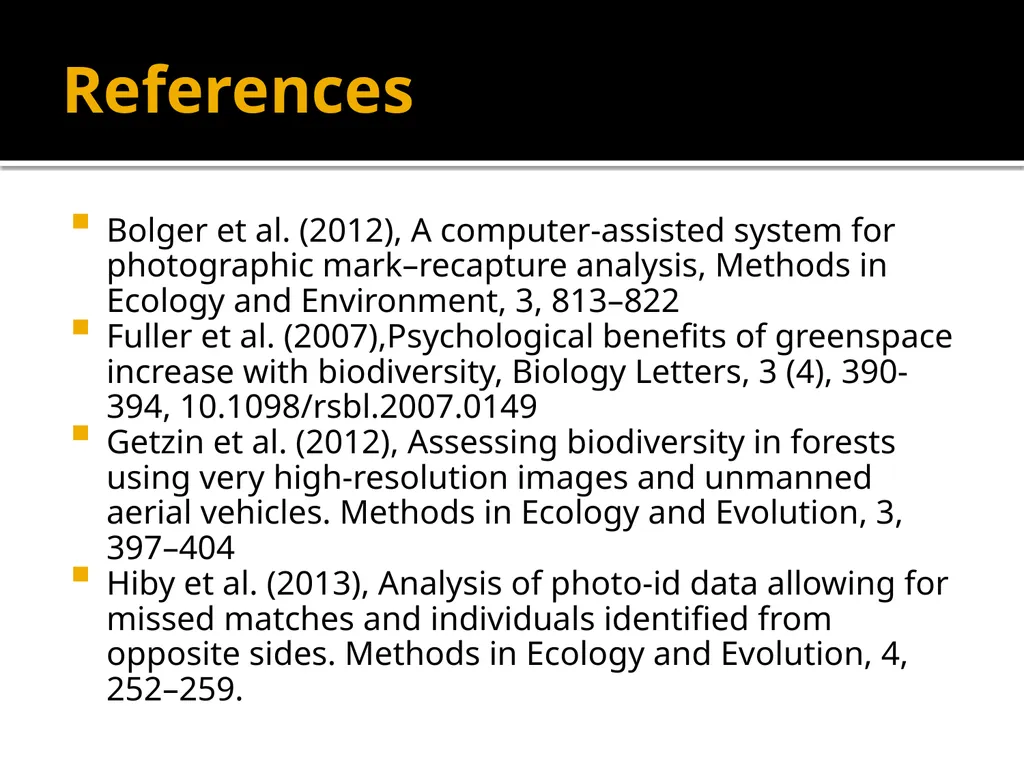
slide11. References Bolger et al. (2012), A computer-assisted system for photographic mark–recapture analysis, Methods in Ecology and Environment, 3, 813–822
Fuller et al. (2007),Psychological benefits of greenspace increase with biodiversity, Biology Letters, 3 (4), 390-394, 10.1098/rsbl.2007.0149
Getzin et al. (2012), Assessing biodiversity in forests using very high‐resolution images and unmanned aerial vehicles. Methods in Ecology and Evolution, 3, 397–404
Hiby et al. (2013), Analysis of photo-id data allowing for missed matches and individuals identified from opposite sides. Methods in Ecology and Evolution, 4, 252–259.<br>
slide12. Thank You<br>
Assistant Professor, Amity School of Communication, Amity University, Uttar Pradesh
&
Dr. Aman Vats,
Associate Professor, Amity School of Communication, Amity University, Uttar Pradesh<br>
slide2. Objectives: To deeply investigating the open government data initiatives in India under the ambit of Right to Information Act 2005.
To suggest the smart recordkeeping system for the cloud based environmental notification.
To map the prospects of integrated real time environment notification system linked to Geographical Imaging System, concept of ‘Green Server’ and Smartphone embedded environment sensors.
To provide a blueprint of how Internet of Things (IoT) can protect environment and prove beneficial for people from saving them from environmental hazards.<br>
slide3. Method: This study meta-analyses the researches and projects carried out in different parts of the world for collaboration of the technical expertise of remote sensing community, mobile application developers, environment policy makers and end users of environmental data.
The architecture of open environmental data platforms and apps has also been studied for proposing open green data notification system for Smartphone users. Conceptual framework of the study is based ‘use and gratification’ theory.<br>
slide4. Review of Open data based Apps Android App “SAMEER”
This App provides hourly updates on the National Air Quality Index (AQI) revealed by CPCB.
NAMP (National Air Quality Monitoring Program)
Ganga Shravan Abhiyaan
Through this web base application people participate in Mission Clean Ganges.<br>
slide5. Review of Open data based Apps Bio Monitoring Field Protocol
It's a tool for the biological assessment of surface water bodies for the people who monitor the biological aspects of surface waters.
National Water Quality Program
Central Pollution Control board (CPCB) has established a network of 2500 water quality monitoring stations across the country<br>
slide6. Review of Open data based Apps CEPI (Comprehensive Environment Pollution Index for Critically Polluted Industrial Area/Clusters)
Air Casting App
AirVeda App
AirAlert App<br>
slide7. Knowledge Gap Identified There is need of dynamic and digital recordkeeping of the information so that it is easily accessible on open data platform.
There is no integrated Smartphone based notification system to supply real time environmental data.
There is lack of co-ordination between remote sensing community, communication consultants and environmental policy makers.
There is hardly any inventory in India to integrate the Open Government Data on Environment for Smart Use.<br>
slide8. Conclusion and Recommnedation There are apps which separately provide data on air and water quality as well as weather.
But, there is a need of an integrated app for environmental notification system
Cloud computing can be used to integrate the open data on environment for localized notification system
The smart and updated recordkeeping is necessary for its further use in cloud computing.<br>
slide9. Conclusion and Recommendation The environment notification system will create more awareness towards environment.
The more informed citizenry will more proactively support the environment protection initiatives of the government
The Smartphone users will be able to make an assessment of environment in their area and contribute more actively in local environment protection<br>
slide10. Model of Integrated App<br>
slide11. References Bolger et al. (2012), A computer-assisted system for photographic mark–recapture analysis, Methods in Ecology and Environment, 3, 813–822
Fuller et al. (2007),Psychological benefits of greenspace increase with biodiversity, Biology Letters, 3 (4), 390-394, 10.1098/rsbl.2007.0149
Getzin et al. (2012), Assessing biodiversity in forests using very high‐resolution images and unmanned aerial vehicles. Methods in Ecology and Evolution, 3, 397–404
Hiby et al. (2013), Analysis of photo-id data allowing for missed matches and individuals identified from opposite sides. Methods in Ecology and Evolution, 4, 252–259.<br>
slide12. Thank You<br>