
Using Responsive and Reciprocal Interactions,

Description: Using Responsive and Reciprocal Interactions, Interventions, and Instruction Initial Practice-Based Professional Preparation Standards Early InterventionistsEarly Childhood Special Educators 6.5 Standard 6 Candidates plan and implement
Related Topics
Download Presentation
"Using Responsive and Reciprocal Interactions," is the property of its rightful owner. Permission is granted to download and print the materials on this website for personal, non-commercial use only, and to display it on your personal computer provided you do not modify the materials and that you retain all copyright notices contained in the materials. By downloading content from our website, you accept the terms of this agreement.
Presentation Transcript
slide1. Using Responsive and Reciprocal Interactions, Interventions, and Instruction Initial Practice-Based Professional Preparation Standards Early Interventionists/Early Childhood Special Educators
6.5<br>
slide2. Standard 6 Candidates plan and implement intentional, systematic, evidence-based, responsive interactions, interventions, and instruction to support all children’s learning and development across all developmental and content domains in partnership with families and other professionals. Candidates facilitate equitable access and participation for all children and families within natural and inclusive environments through culturally responsive and affirming practices and relationships. Candidates use data-based decision-making to plan for, adapt, and improve interactions, interventions, and instruction to ensure fidelity of implementation.<br>
slide3. Component 6.5 Candidates identify and create multiple opportunities for young children to develop and learn play skills and engage in meaningful play experiences independently and with others across contexts<br>
slide4. Objectives Describe how to identify and create multiple opportunities for young children to develop and learn play skills
Describe how to identify and create multiple opportunities for young children to engage in meaningful play experiences independently and with others across contexts<br>
slide5. How Do We Define “Play”? Intrinsically motivated
Entails active engagement
Explorative
Voluntary
Spontaneous<br>
slide6. Play Is How All Children Learn Children engage in play to practice their understanding of newly acquired knowledge, acquired through exploration
The process of play helps a child build new concepts onto existing frameworks of understanding (e.g., Piaget)
Play helps children make meaning of positive and negative social experiences<br>
slide7. Importance of Play For young children of all abilities, play promotes:
Social-emotional skills
Cognitive development
Social communication/language acquisition
Executive functioning/self-regulation
Motor and Adaptive Development<br>
slide8. Emergence of Play Skills Play skills emerge sequentially and build in complexity
2 commonly used taxonomies – many variations
Object play: Piaget
Social play: Parten<br>
slide9. Sequences of Object Play Sensorimotor: mouths objects, bangs them together
Relational: Stacking, dropping into containers, building, grouping
Functional: used in the manner toy was designed for
Symbolic play: Use objects as something else
Object substitution – imagining absent objects
Assigning absent characteristics – roles, emotions, attributes to self, others
Social pretend play – narrative pretending, drama scenes with others
Games with rules: can hold rules in mind during play, wait for turn, and self-regulate when the game is not “won.”<br>
slide10. Sequences of Social Play Unoccupied – not attending to objects or people
Onlooker – watching others interact/play
Solitary – plays with object/toy alone
Parallel – plays alongside another without interacting
Associative – interacts by sharing focus of play, sharing toys – no specific play roles
Cooperative – sharing toys, incorporating roles and interactive patterns that support structured pretend play<br>
slide11. Play and Children With Disabilities/Delays Children served in EI/ECSE practice often have delays in the development of play skills
Benefit from interventions that support access to play and opportunities to practice more complex play skills increasingly<br>
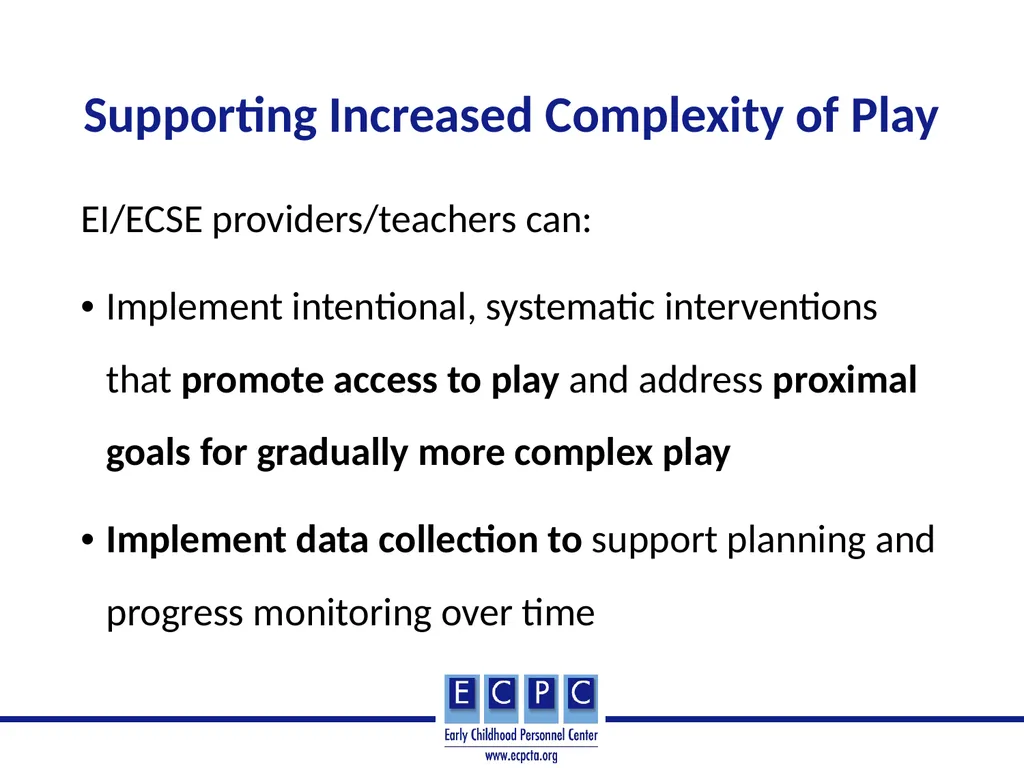
slide12. Supporting Increased Complexity of Play EI/ECSE providers/teachers can:
Implement intentional, systematic interventions that promote access to play and address proximal goals for gradually more complex play
Implement data collection to support planning and progress monitoring over time<br>
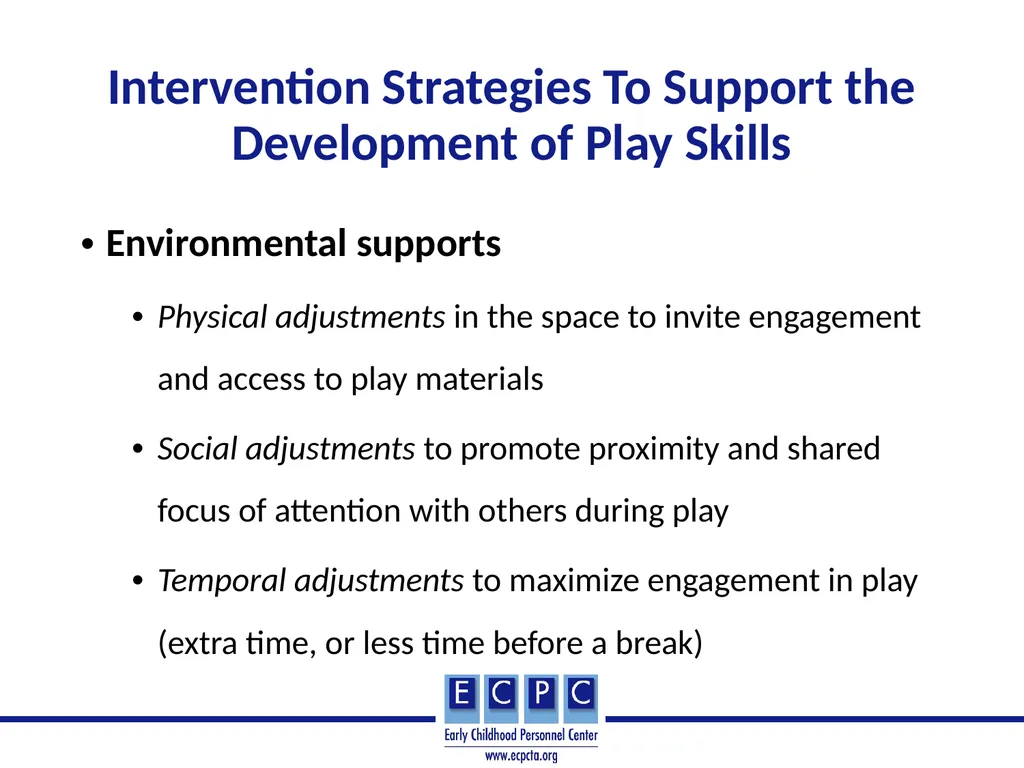
slide13. Intervention Strategies To Support the Development of Play Skills Environmental supports
Physical adjustments in the space to invite engagement and access to play materials
Social adjustments to promote proximity and shared focus of attention with others during play
Temporal adjustments to maximize engagement in play (extra time, or less time before a break)<br>
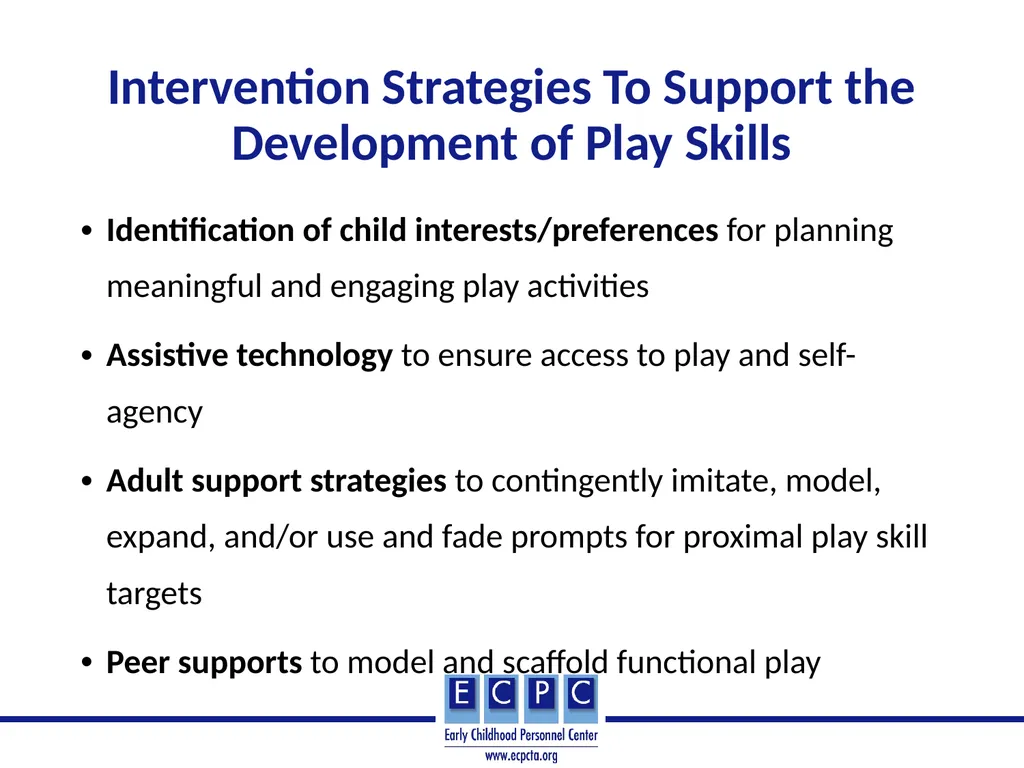
slide14. Intervention Strategies To Support the Development of Play Skills Identification of child interests/preferences for planning meaningful and engaging play activities
Assistive technology to ensure access to play and self-agency
Adult support strategies to contingently imitate, model, expand, and/or use and fade prompts for proximal play skill targets
Peer supports to model and scaffold functional play<br>
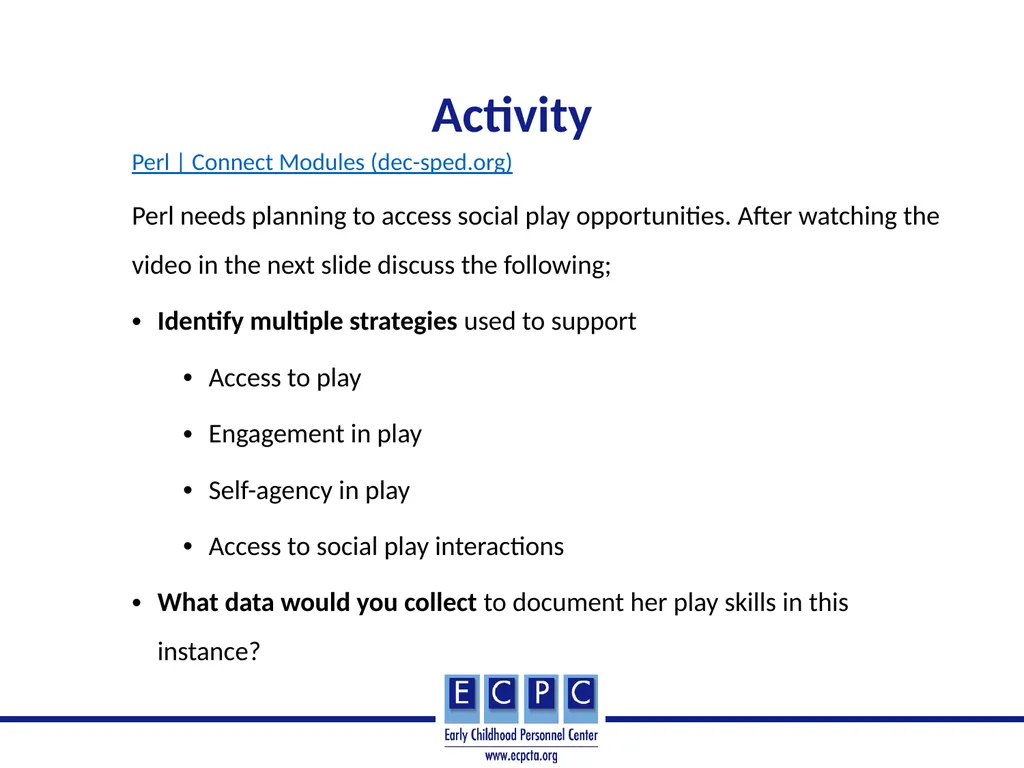
slide15. Activity Perl | Connect Modules (dec-sped.org)
Perl needs planning to access social play opportunities. After watching the video in the next slide discuss the following;
Identify multiple strategies used to support
Access to play
Engagement in play
Self-agency in play
Access to social play interactions
What data would you collect to document her play skills in this instance?<br>
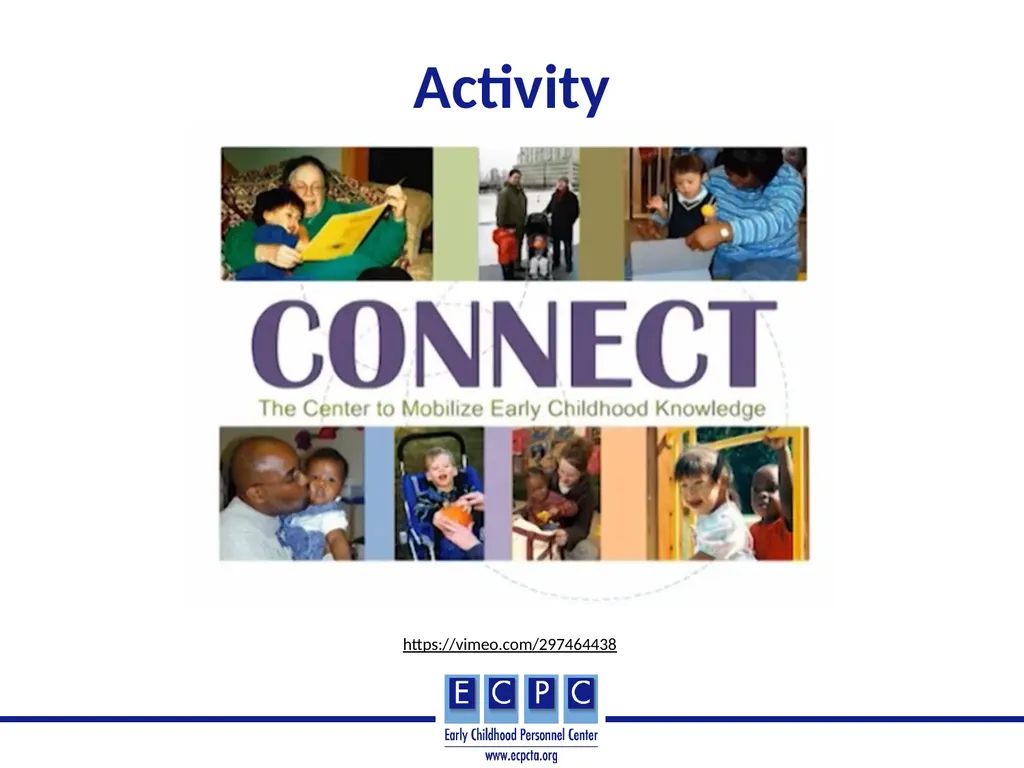
slide16. Activity https://vimeo.com/297464438<br>
slide17. Supporting Play in Young Children With ASD Children with ASD face pervasive challenges in symbolic and social play
Restricted, repetitive and stereotyped repertoire of interests and activities – often prefer to focus on objects
Challenges in social communication, reciprocal interactions, peer relationships
Need specific and intentional support to access and engage in instances of social and symbolic play<br>
slide18. Strategies To Engage Children With ASD in Play Across Contexts Assess environment to limit noise/intrusive sensory stimuli
Provide materials that promote joint attention, imitation, reciprocity, and pretend play
Construct daily schedules that build in a high level of predictability
Plan for single-focus activities that are not overwhelming
Identify peers/siblings that share interests to pair up during play activities<br>
slide19. Responsive Interaction Strategies: Enhancing Social Play for Young Children With ASD Nurture play initiations – teach caregivers/peers to recognize, interpret and respond to subtle ways children with ASD initiate social play
Follow the child’s lead – teach caregivers and peers to observe what children are interested in, and joining them in that play
Scaffold play – teach caregivers and peers how to provide just enough support to maintain play interactions, including contingent imitation, commenting, play and language expansions, animation, prompts as needed to remain engaged<br>
slide20. Responsive Interaction Strategies: Enhancing Social Play for Young Children With ASD Guide social communication – support children with ASD to use nonverbal and verbal communication cues to elicit attention and respond to other’s bids for attention, and sustain reciprocal engagement
Use proximal goals to support play with others just beyond the present level while supporting their presence in the interaction<br>
slide21. Activity https://ebip.vkcsites.org/responsive-play-interactions/
After watching the video in the next slide discuss the following;
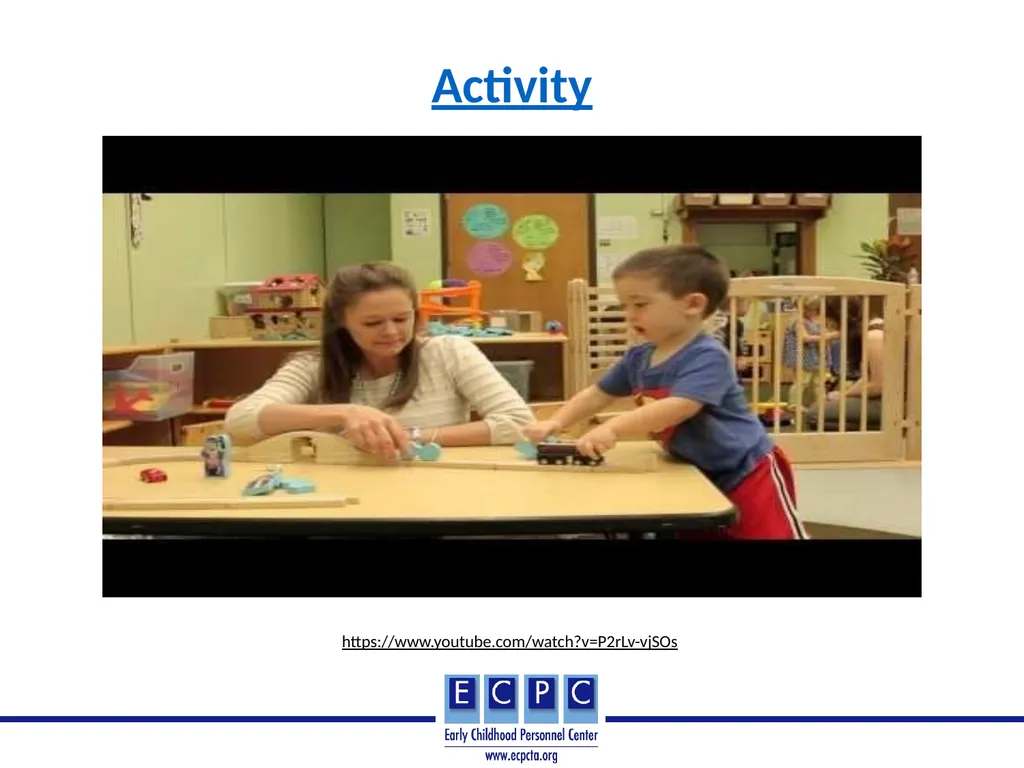
What level of social play would you say this child engaged in? What level of object play?
What strategies was this provider using to promote social play and functional play complexity?
What data would you have gathered to document the progress of play skills, if this child was on your caseload or in your classroom?<br>
slide22. Activity https://www.youtube.com/watch?v=P2rLv-vjSOs<br>
slide23. References and Resources Barton, E.E., (2010). Development of a taxonomy of pretend play for children with disabilities. Infants and Young Children, 23(4)., pp. 247-261
Connect Modules and the Division for Early Childhood (DEC)
Evidence-Based Instructional Practices for Young Children with Autism and Other Disabilities (EBIP), Vanderbilt University. https://ebip.vkcsites.org/responsive-play-interactions/<br>
slide24. References and Resources Jamison et al., (2012). Encouraging social skill development through play in early childhood special education classrooms. Young Exceptional Child (YEC)
Lifter, K., Foster-Sanda et al. (2011). Overview of Play: Its uses and importance in early intervention/early childhood special education. Infants and Young Children, 24 (3)., pp. 225-245
Parten, M.B. (1932). Social participation among pre‐school children. Journal of Abnormal and Social Psychology, 27: pp. 243–269<br>
slide25. References and Resources Piaget, J. (1964). Cognitive Development in Children: Development and Learning – Part 1. Journal of Research in Science Teaching, 2, pp. 176-186
Wolfberg, P. et al., (2015). Integrated Play Groups: Promoting symbolic play and social engagement with typical peers in children with ASD across settings. J Autism Dev Disord 45, 830–845 (2015). https://doi.org/10.1007/s10803-014-2245-0
Yogman, M., Hutchison J. et al., (2018), The Power of Play: A Pediatric Role in Enhancing Development in Young Children. Pediatrics, 142 (3)<br>
6.5<br>
slide2. Standard 6 Candidates plan and implement intentional, systematic, evidence-based, responsive interactions, interventions, and instruction to support all children’s learning and development across all developmental and content domains in partnership with families and other professionals. Candidates facilitate equitable access and participation for all children and families within natural and inclusive environments through culturally responsive and affirming practices and relationships. Candidates use data-based decision-making to plan for, adapt, and improve interactions, interventions, and instruction to ensure fidelity of implementation.<br>
slide3. Component 6.5 Candidates identify and create multiple opportunities for young children to develop and learn play skills and engage in meaningful play experiences independently and with others across contexts<br>
slide4. Objectives Describe how to identify and create multiple opportunities for young children to develop and learn play skills
Describe how to identify and create multiple opportunities for young children to engage in meaningful play experiences independently and with others across contexts<br>
slide5. How Do We Define “Play”? Intrinsically motivated
Entails active engagement
Explorative
Voluntary
Spontaneous<br>
slide6. Play Is How All Children Learn Children engage in play to practice their understanding of newly acquired knowledge, acquired through exploration
The process of play helps a child build new concepts onto existing frameworks of understanding (e.g., Piaget)
Play helps children make meaning of positive and negative social experiences<br>
slide7. Importance of Play For young children of all abilities, play promotes:
Social-emotional skills
Cognitive development
Social communication/language acquisition
Executive functioning/self-regulation
Motor and Adaptive Development<br>
slide8. Emergence of Play Skills Play skills emerge sequentially and build in complexity
2 commonly used taxonomies – many variations
Object play: Piaget
Social play: Parten<br>
slide9. Sequences of Object Play Sensorimotor: mouths objects, bangs them together
Relational: Stacking, dropping into containers, building, grouping
Functional: used in the manner toy was designed for
Symbolic play: Use objects as something else
Object substitution – imagining absent objects
Assigning absent characteristics – roles, emotions, attributes to self, others
Social pretend play – narrative pretending, drama scenes with others
Games with rules: can hold rules in mind during play, wait for turn, and self-regulate when the game is not “won.”<br>
slide10. Sequences of Social Play Unoccupied – not attending to objects or people
Onlooker – watching others interact/play
Solitary – plays with object/toy alone
Parallel – plays alongside another without interacting
Associative – interacts by sharing focus of play, sharing toys – no specific play roles
Cooperative – sharing toys, incorporating roles and interactive patterns that support structured pretend play<br>
slide11. Play and Children With Disabilities/Delays Children served in EI/ECSE practice often have delays in the development of play skills
Benefit from interventions that support access to play and opportunities to practice more complex play skills increasingly<br>
slide12. Supporting Increased Complexity of Play EI/ECSE providers/teachers can:
Implement intentional, systematic interventions that promote access to play and address proximal goals for gradually more complex play
Implement data collection to support planning and progress monitoring over time<br>
slide13. Intervention Strategies To Support the Development of Play Skills Environmental supports
Physical adjustments in the space to invite engagement and access to play materials
Social adjustments to promote proximity and shared focus of attention with others during play
Temporal adjustments to maximize engagement in play (extra time, or less time before a break)<br>
slide14. Intervention Strategies To Support the Development of Play Skills Identification of child interests/preferences for planning meaningful and engaging play activities
Assistive technology to ensure access to play and self-agency
Adult support strategies to contingently imitate, model, expand, and/or use and fade prompts for proximal play skill targets
Peer supports to model and scaffold functional play<br>
slide15. Activity Perl | Connect Modules (dec-sped.org)
Perl needs planning to access social play opportunities. After watching the video in the next slide discuss the following;
Identify multiple strategies used to support
Access to play
Engagement in play
Self-agency in play
Access to social play interactions
What data would you collect to document her play skills in this instance?<br>
slide16. Activity https://vimeo.com/297464438<br>
slide17. Supporting Play in Young Children With ASD Children with ASD face pervasive challenges in symbolic and social play
Restricted, repetitive and stereotyped repertoire of interests and activities – often prefer to focus on objects
Challenges in social communication, reciprocal interactions, peer relationships
Need specific and intentional support to access and engage in instances of social and symbolic play<br>
slide18. Strategies To Engage Children With ASD in Play Across Contexts Assess environment to limit noise/intrusive sensory stimuli
Provide materials that promote joint attention, imitation, reciprocity, and pretend play
Construct daily schedules that build in a high level of predictability
Plan for single-focus activities that are not overwhelming
Identify peers/siblings that share interests to pair up during play activities<br>
slide19. Responsive Interaction Strategies: Enhancing Social Play for Young Children With ASD Nurture play initiations – teach caregivers/peers to recognize, interpret and respond to subtle ways children with ASD initiate social play
Follow the child’s lead – teach caregivers and peers to observe what children are interested in, and joining them in that play
Scaffold play – teach caregivers and peers how to provide just enough support to maintain play interactions, including contingent imitation, commenting, play and language expansions, animation, prompts as needed to remain engaged<br>
slide20. Responsive Interaction Strategies: Enhancing Social Play for Young Children With ASD Guide social communication – support children with ASD to use nonverbal and verbal communication cues to elicit attention and respond to other’s bids for attention, and sustain reciprocal engagement
Use proximal goals to support play with others just beyond the present level while supporting their presence in the interaction<br>
slide21. Activity https://ebip.vkcsites.org/responsive-play-interactions/
After watching the video in the next slide discuss the following;
What level of social play would you say this child engaged in? What level of object play?
What strategies was this provider using to promote social play and functional play complexity?
What data would you have gathered to document the progress of play skills, if this child was on your caseload or in your classroom?<br>
slide22. Activity https://www.youtube.com/watch?v=P2rLv-vjSOs<br>
slide23. References and Resources Barton, E.E., (2010). Development of a taxonomy of pretend play for children with disabilities. Infants and Young Children, 23(4)., pp. 247-261
Connect Modules and the Division for Early Childhood (DEC)
Evidence-Based Instructional Practices for Young Children with Autism and Other Disabilities (EBIP), Vanderbilt University. https://ebip.vkcsites.org/responsive-play-interactions/<br>
slide24. References and Resources Jamison et al., (2012). Encouraging social skill development through play in early childhood special education classrooms. Young Exceptional Child (YEC)
Lifter, K., Foster-Sanda et al. (2011). Overview of Play: Its uses and importance in early intervention/early childhood special education. Infants and Young Children, 24 (3)., pp. 225-245
Parten, M.B. (1932). Social participation among pre‐school children. Journal of Abnormal and Social Psychology, 27: pp. 243–269<br>
slide25. References and Resources Piaget, J. (1964). Cognitive Development in Children: Development and Learning – Part 1. Journal of Research in Science Teaching, 2, pp. 176-186
Wolfberg, P. et al., (2015). Integrated Play Groups: Promoting symbolic play and social engagement with typical peers in children with ASD across settings. J Autism Dev Disord 45, 830–845 (2015). https://doi.org/10.1007/s10803-014-2245-0
Yogman, M., Hutchison J. et al., (2018), The Power of Play: A Pediatric Role in Enhancing Development in Young Children. Pediatrics, 142 (3)<br>