Using Section 1115 Demonstrations to Support Health-Related Social Needs for Prenatal to 3 Population September 5, 2024 Todays Agenda and Speakers Overview of HRSNs Pathways to cover HRSNs and qualifying criteria State efforts with HRSNs
"Using Section 1115 Demonstrations to Support" is the property of its rightful owner. Permission is granted to
download and print the materials on this website for personal, non-commercial use only, and to display it
on your personal computer provided you do not modify the materials and that you retain all copyright
notices contained in the materials. By downloading content from our website, you accept the terms of this
agreement.
Presentation Transcript
01
Using Section 1115 Demonstrations to Support Health-Related Social Needs for Prenatal to 3 Population September 5, 2024<br>
02
Today’s Agenda and Speakers Overview of HRSNs
Pathways to cover HRSNs and qualifying criteria
State efforts with HRSNs and 1115 demonstrations
CMS guardrails for 1115s
Implementation considerations Georgetown CCF
Tanesha Mondestin
Leo Cuello
Nancy Kaneb
Allie Gardner
CBPP
Allison Orris 2<br>
03
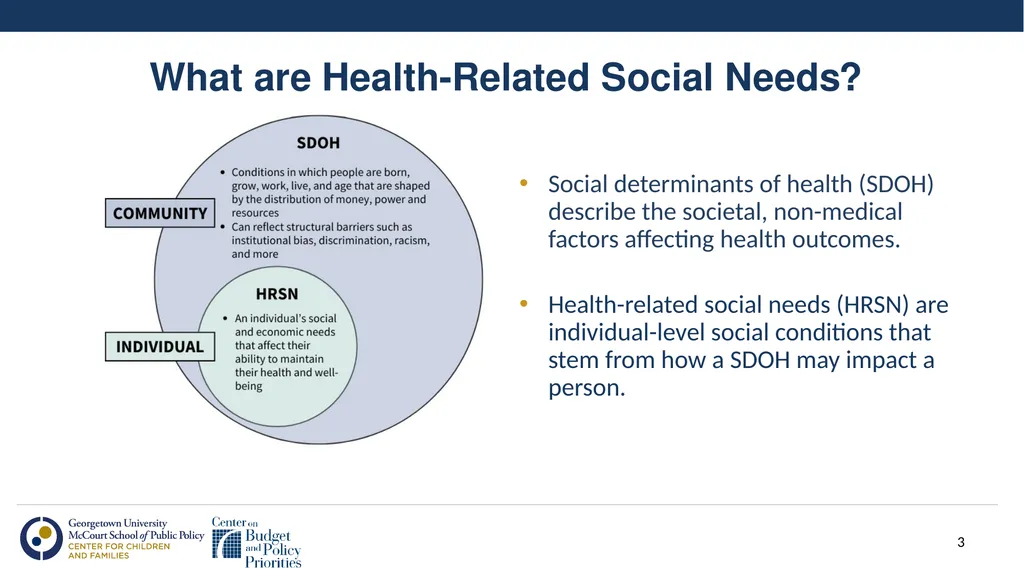
What are Health-Related Social Needs? Social determinants of health (SDOH) describe the societal, non-medical factors affecting health outcomes.
Health-related social needs (HRSN) are individual-level social conditions that stem from how a SDOH may impact a person. 3<br>
04
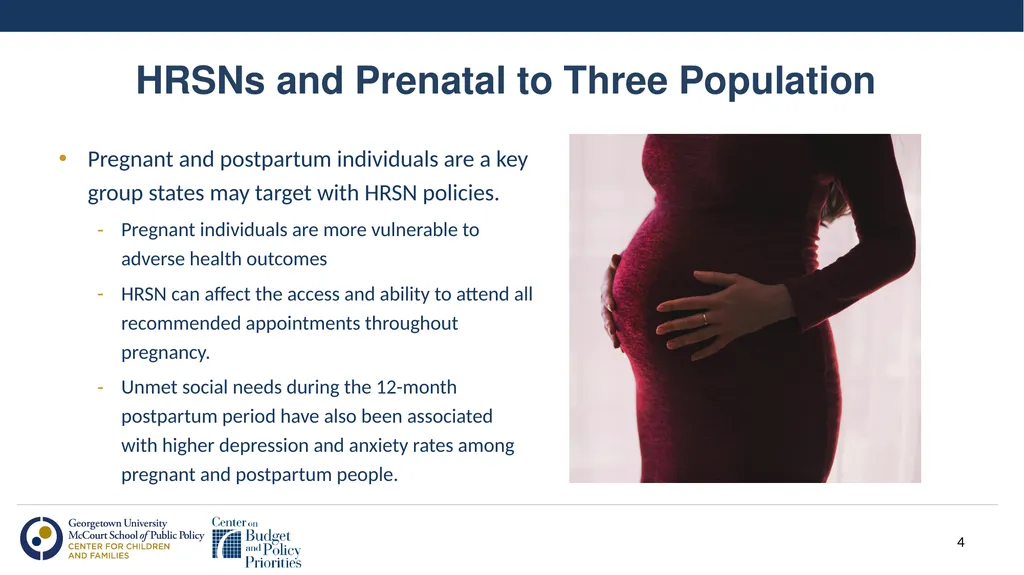
HRSNs and Prenatal to Three Population Pregnant and postpartum individuals are a key group states may target with HRSN policies.
Pregnant individuals are more vulnerable to adverse health outcomes
HRSN can affect the access and ability to attend all recommended appointments throughout pregnancy.
Unmet social needs during the 12-month postpartum period have also been associated with higher depression and anxiety rates among pregnant and postpartum people. 4<br>
05
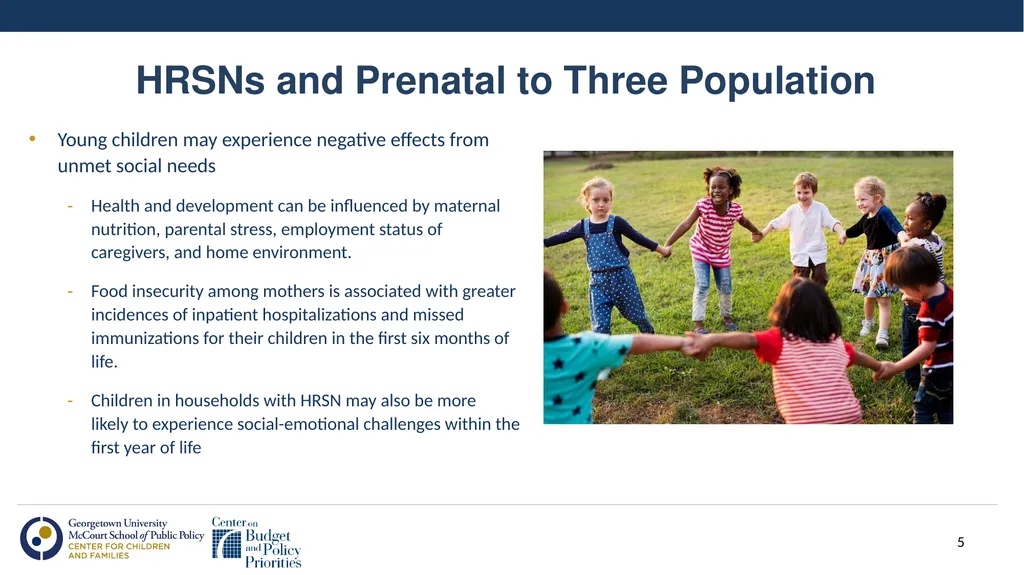
HRSNs and Prenatal to Three Population 5 Young children may experience negative effects from unmet social needs
Health and development can be influenced by maternal nutrition, parental stress, employment status of caregivers, and home environment.
Food insecurity among mothers is associated with greater incidences of inpatient hospitalizations and missed immunizations for their children in the first six months of life.
Children in households with HRSN may also be more likely to experience social-emotional challenges within the first year of life<br>
06
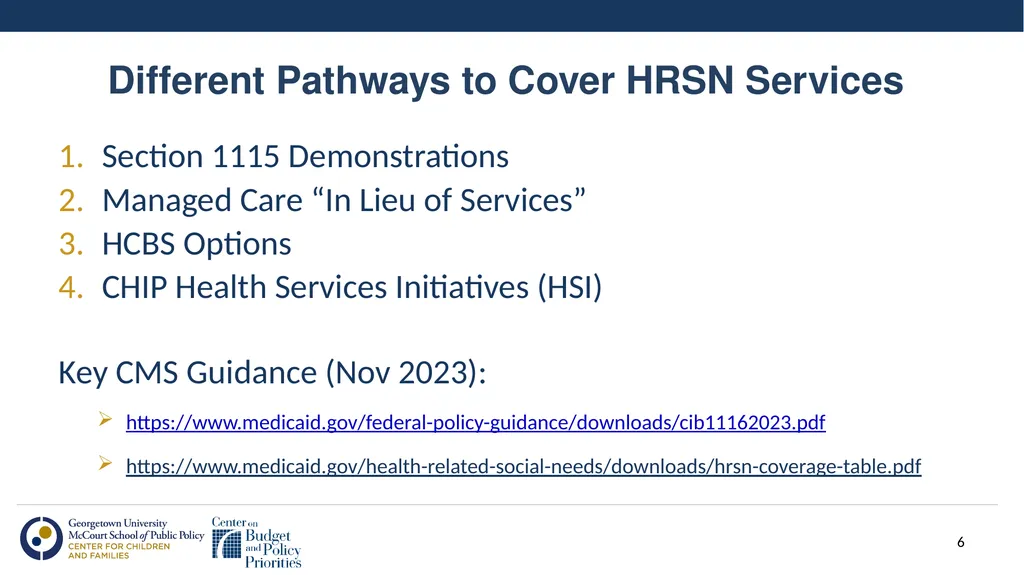
Different Pathways to Cover HRSN Services Section 1115 Demonstrations
Managed Care “In Lieu of Services”
HCBS Options
CHIP Health Services Initiatives (HSI)
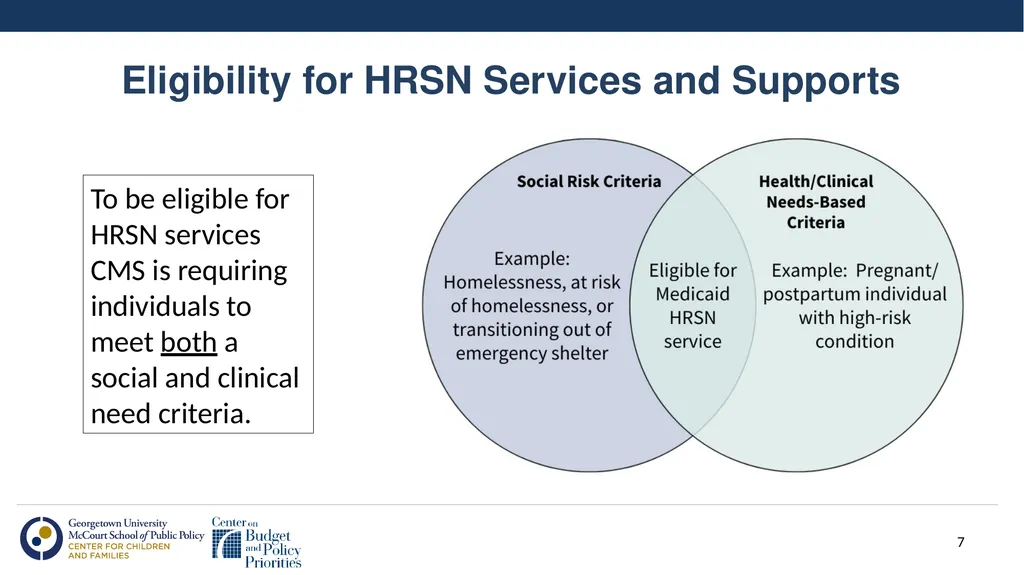
Eligibility for HRSN Services and Supports 7 To be eligible for HRSN services CMS is requiring individuals to meet both a social and clinical need criteria.<br>
08
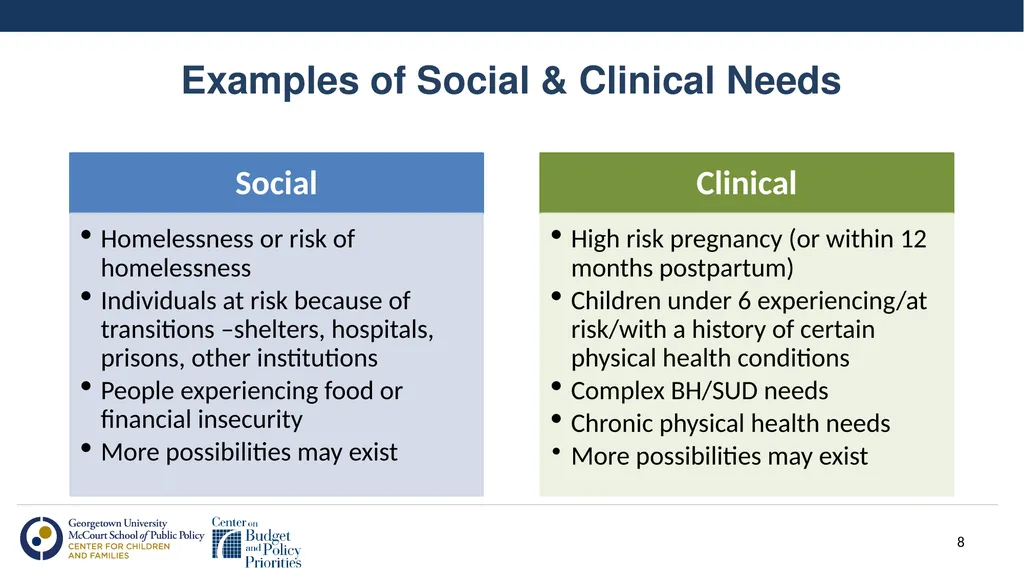
Examples of Social & Clinical Needs 8<br>
09
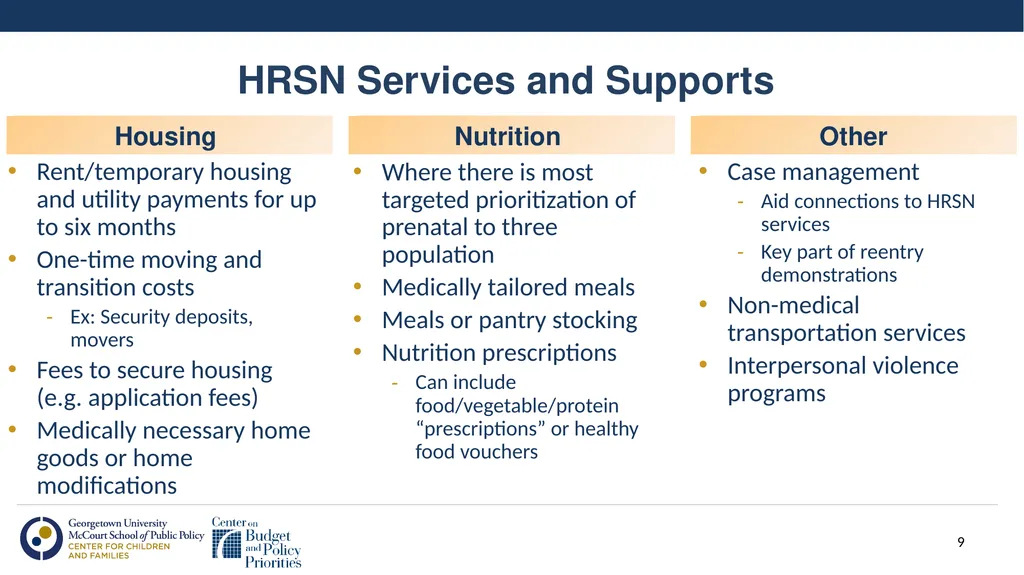
HRSN Services and Supports 9 Housing Nutrition Other Rent/temporary housing and utility payments for up to six months
One-time moving and transition costs
Ex: Security deposits, movers
Fees to secure housing (e.g. application fees)
Medically necessary home goods or home modifications Where there is most targeted prioritization of prenatal to three population
Medically tailored meals
Meals or pantry stocking
Nutrition prescriptions
Can include food/vegetable/protein “prescriptions” or healthy food vouchers Case management
Aid connections to HRSN services
Key part of reentry demonstrations
Non-medical transportation services
Interpersonal violence programs<br>
10
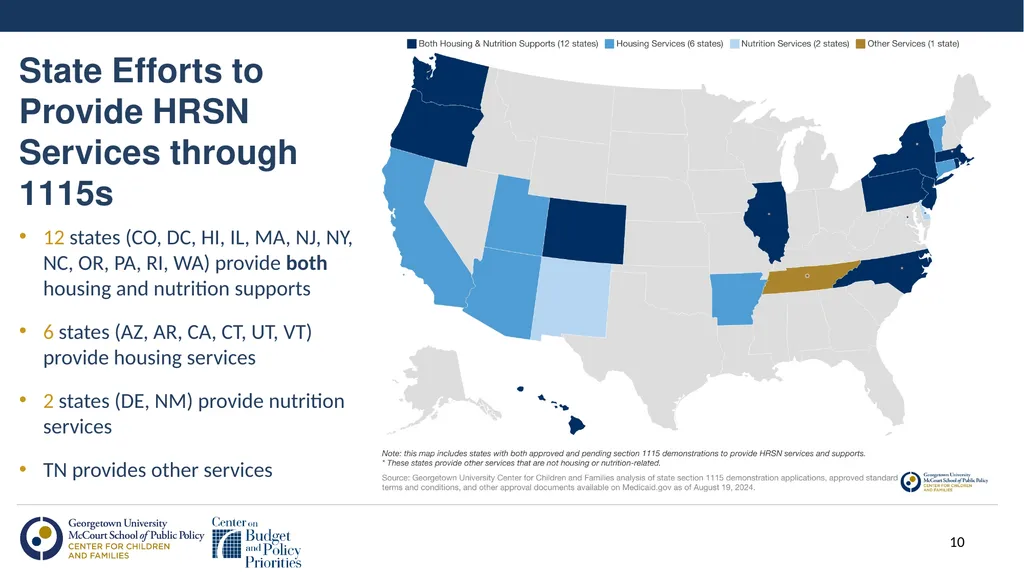
State Efforts to Provide HRSN Services through 1115s 10 12 states (CO, DC, HI, IL, MA, NJ, NY, NC, OR, PA, RI, WA) provide both housing and nutrition supports
6 states (AZ, AR, CA, CT, UT, VT) provide housing services
2 states (DE, NM) provide nutrition services
TN provides other services<br>
11
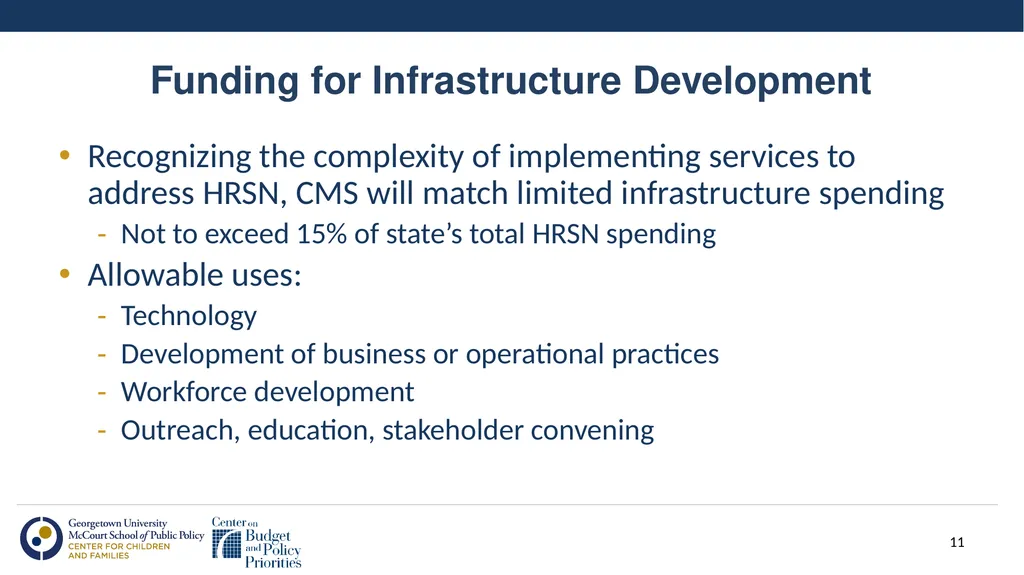
Funding for Infrastructure Development Recognizing the complexity of implementing services to address HRSN, CMS will match limited infrastructure spending
Not to exceed 15% of state’s total HRSN spending
Allowable uses:
Technology
Development of business or operational practices
Workforce development
Outreach, education, stakeholder convening 11<br>
12
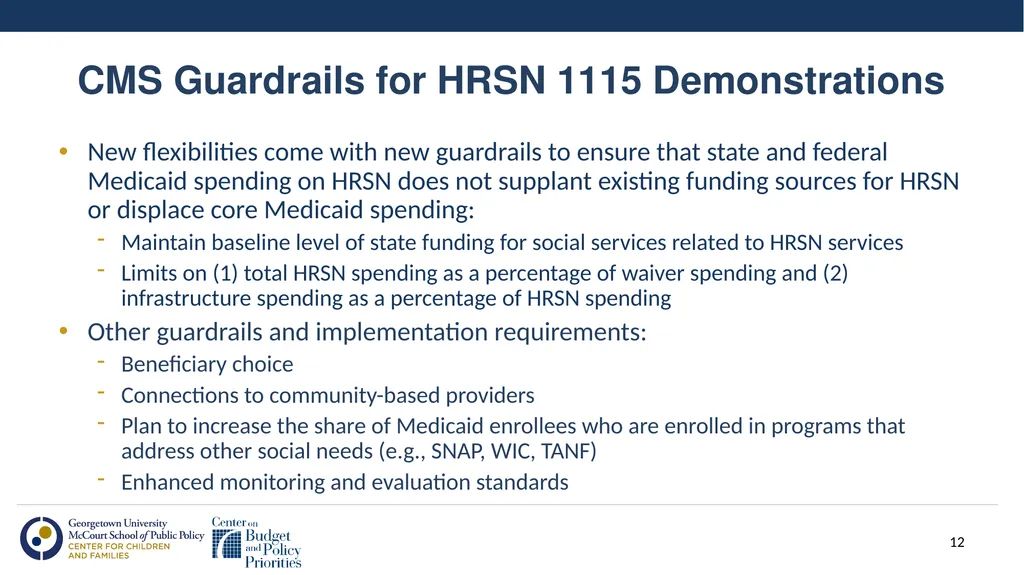
CMS Guardrails for HRSN 1115 Demonstrations 12 New flexibilities come with new guardrails to ensure that state and federal Medicaid spending on HRSN does not supplant existing funding sources for HRSN or displace core Medicaid spending:
Maintain baseline level of state funding for social services related to HRSN services
Limits on (1) total HRSN spending as a percentage of waiver spending and (2) infrastructure spending as a percentage of HRSN spending
Other guardrails and implementation requirements:
Beneficiary choice
Connections to community-based providers
Plan to increase the share of Medicaid enrollees who are enrolled in programs that address other social needs (e.g., SNAP, WIC, TANF)
Enhanced monitoring and evaluation standards<br>
13
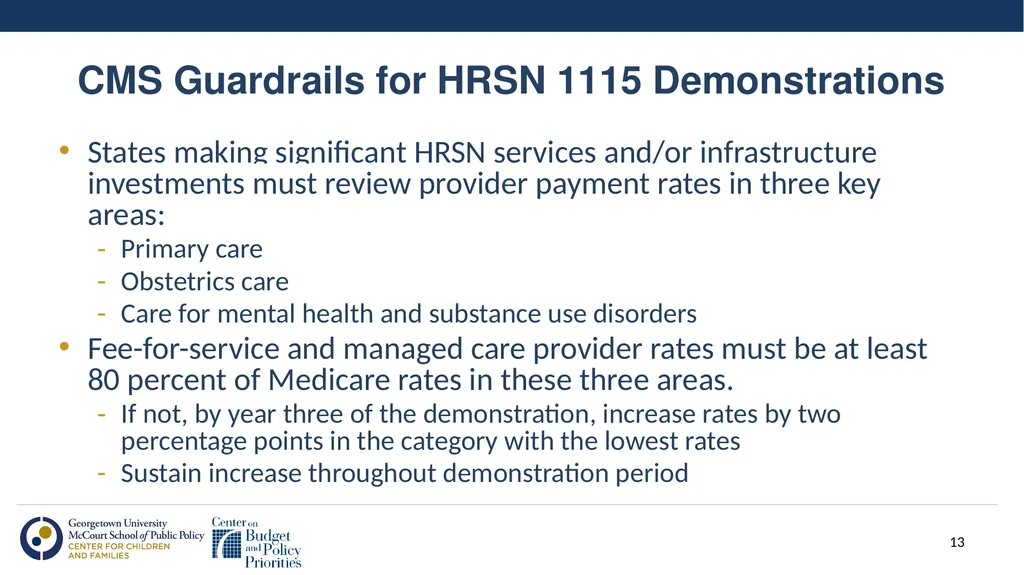
CMS Guardrails for HRSN 1115 Demonstrations States making significant HRSN services and/or infrastructure investments must review provider payment rates in three key areas:
Primary care
Obstetrics care
Care for mental health and substance use disorders
Fee-for-service and managed care provider rates must be at least 80 percent of Medicare rates in these three areas.
If not, by year three of the demonstration, increase rates by two percentage points in the category with the lowest rates
Sustain increase throughout demonstration period 13<br>
14
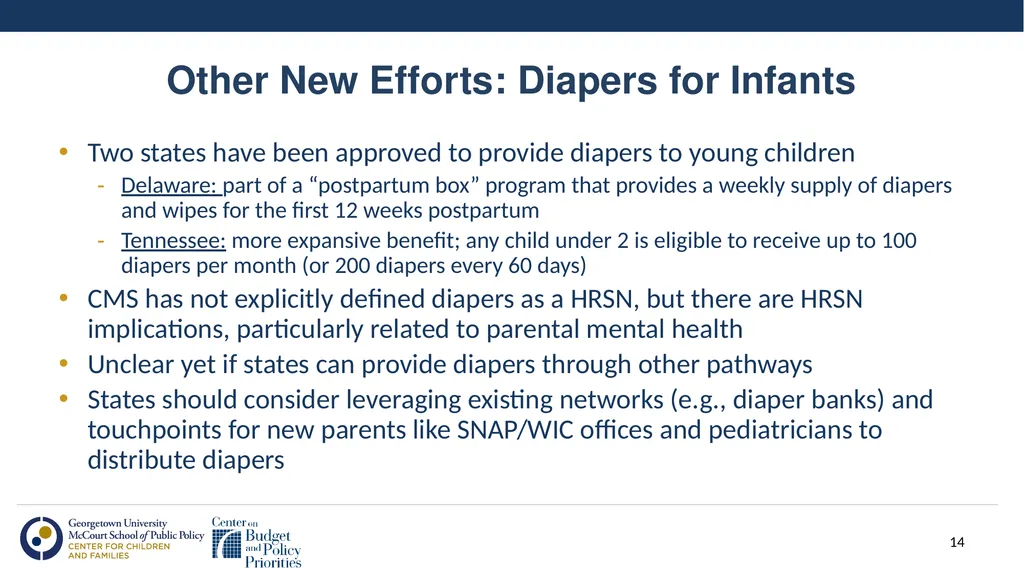
Other New Efforts: Diapers for Infants 14 Two states have been approved to provide diapers to young children
Delaware: part of a “postpartum box” program that provides a weekly supply of diapers and wipes for the first 12 weeks postpartum
Tennessee: more expansive benefit; any child under 2 is eligible to receive up to 100 diapers per month (or 200 diapers every 60 days)
CMS has not explicitly defined diapers as a HRSN, but there are HRSN implications, particularly related to parental mental health
Unclear yet if states can provide diapers through other pathways
States should consider leveraging existing networks (e.g., diaper banks) and touchpoints for new parents like SNAP/WIC offices and pediatricians to distribute diapers<br>
15
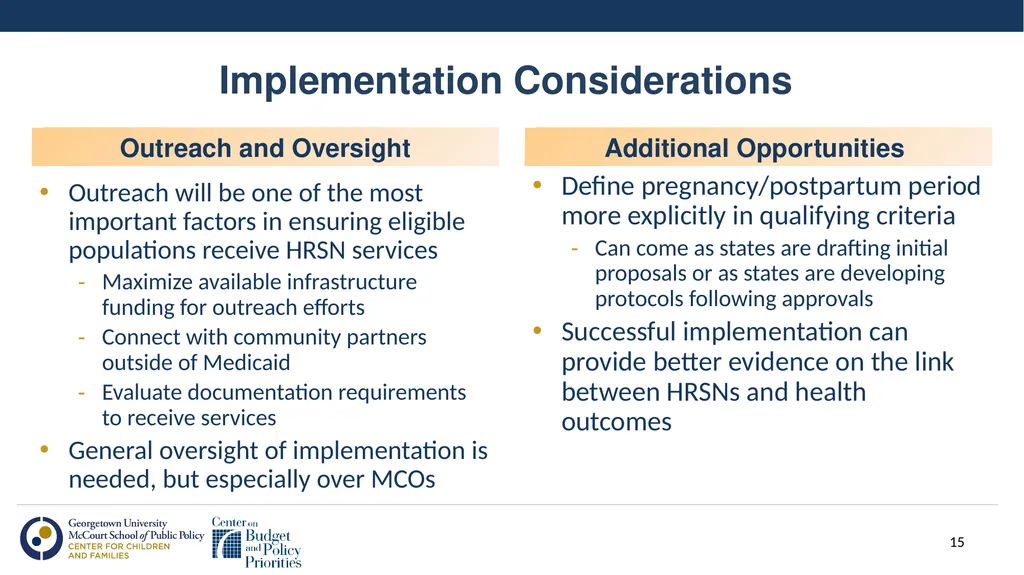
Implementation Considerations 15 Outreach and Oversight Additional Opportunities Outreach will be one of the most important factors in ensuring eligible populations receive HRSN services
Maximize available infrastructure funding for outreach efforts
Connect with community partners outside of Medicaid
Evaluate documentation requirements to receive services
General oversight of implementation is needed, but especially over MCOs Define pregnancy/postpartum period more explicitly in qualifying criteria
Can come as states are drafting initial proposals or as states are developing protocols following approvals
Successful implementation can provide better evidence on the link between HRSNs and health outcomes<br>
16
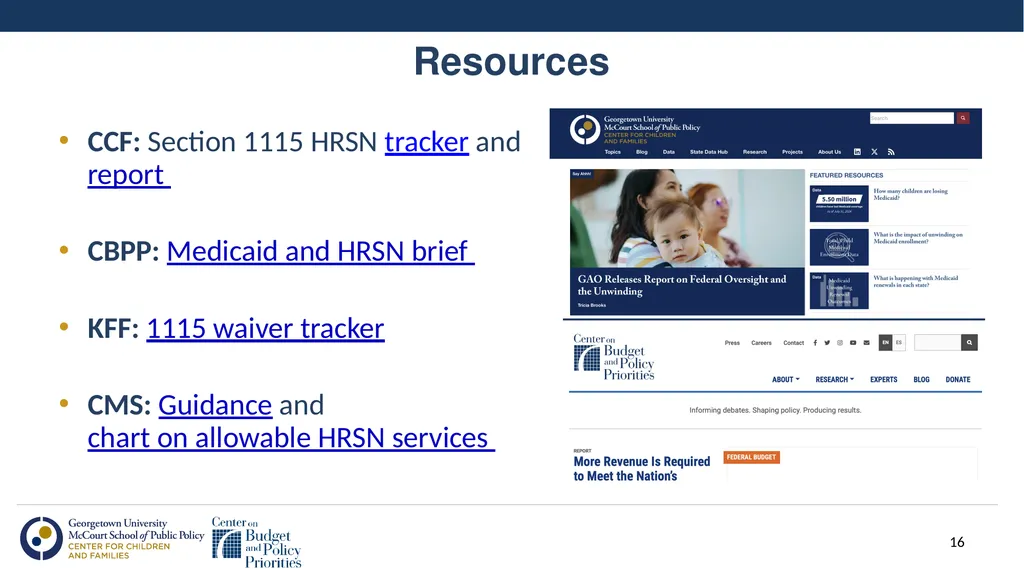
Resources CCF: Section 1115 HRSN tracker and report
CBPP: Medicaid and HRSN brief
KFF: 1115 waiver tracker
CMS: Guidance and chart on allowable HRSN services 16<br>