Utilitarian Principle A Course in Business Ethics Module 7 John Hooker Carnegie Mellon University May 2022 The utilitarian principle is based on the idea that one should try to make things better. Or as Jeremy Bentham put it, ones actions
"Utilitarian Principle A Course in Business Ethics" is the property of its rightful owner. Permission is granted to
download and print the materials on this website for personal, non-commercial use only, and to display it
on your personal computer provided you do not modify the materials and that you retain all copyright
notices contained in the materials. By downloading content from our website, you accept the terms of this
agreement.
Presentation Transcript
01
Utilitarian Principle A Course in Business Ethics
Module 7
John Hooker Carnegie Mellon University
May 2022<br>
02
The utilitarian principle is based on the idea that one should try to make things better.
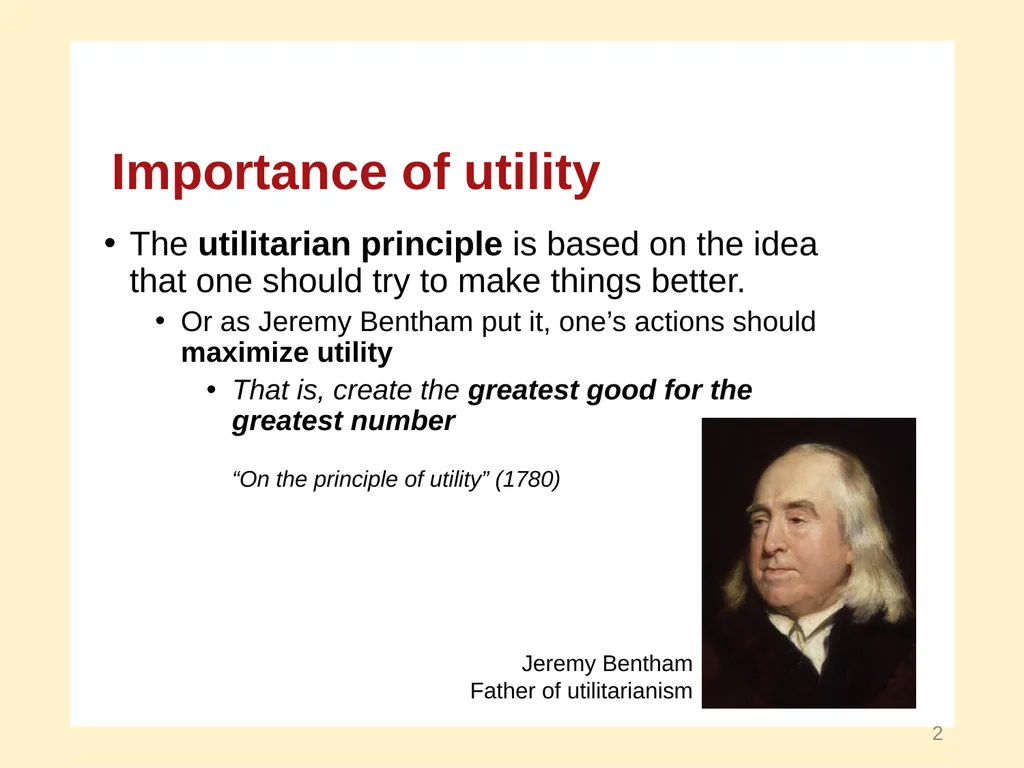
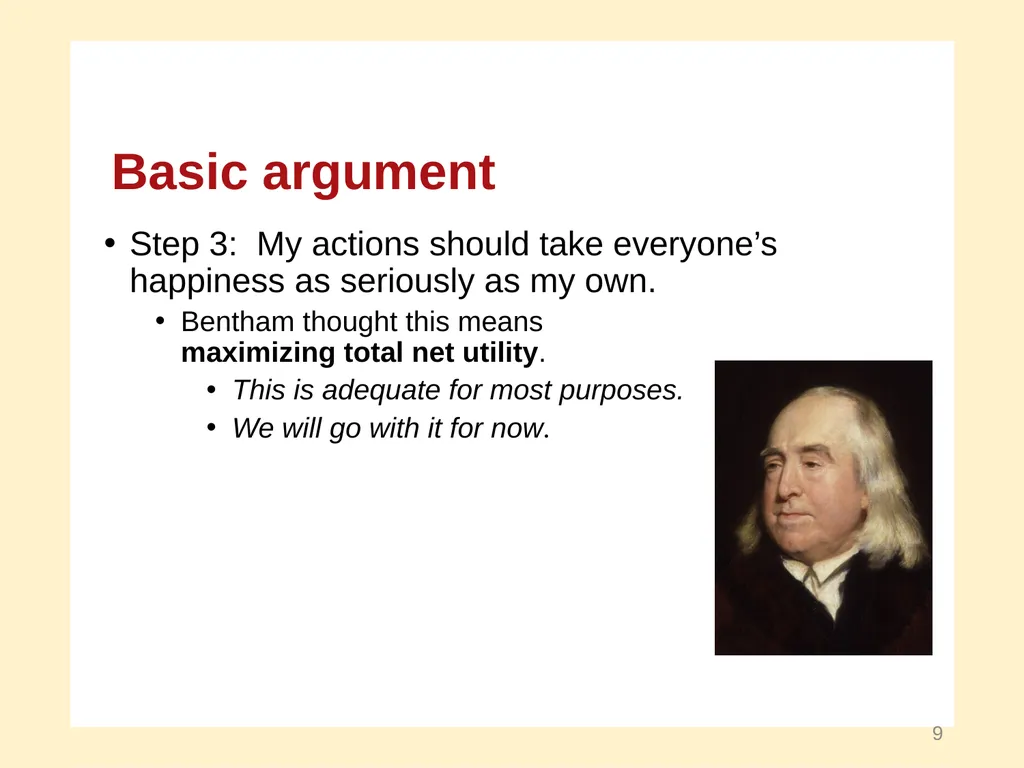
Or as Jeremy Bentham put it, one’s actions should maximize utility
That is, create the greatest good for the greatest number “On the principle of utility” (1780) 2 Importance of utility Jeremy Bentham
Father of utilitarianism<br>
03
The utilitarian principle is based on the idea that one should try to make things better.
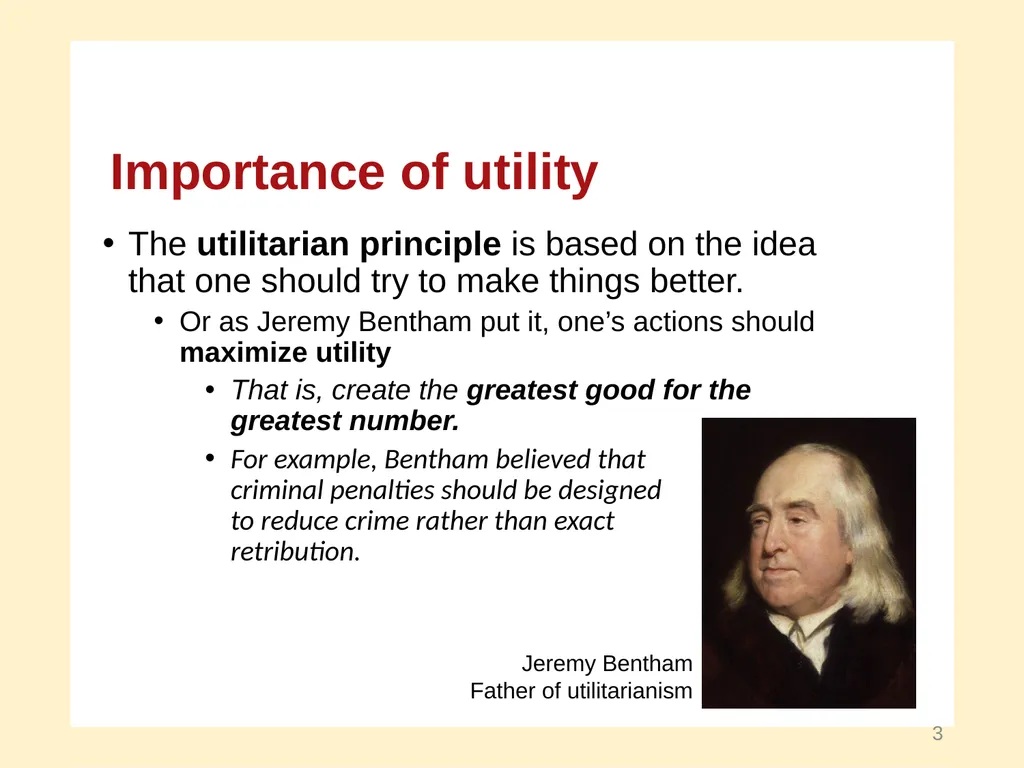
Or as Jeremy Bentham put it, one’s actions should maximize utility
That is, create the greatest good for the greatest number.
For example, Bentham believed that criminal penalties should be designed to reduce crime rather than exact retribution. 3 Importance of utility Jeremy Bentham
Father of utilitarianism<br>
04
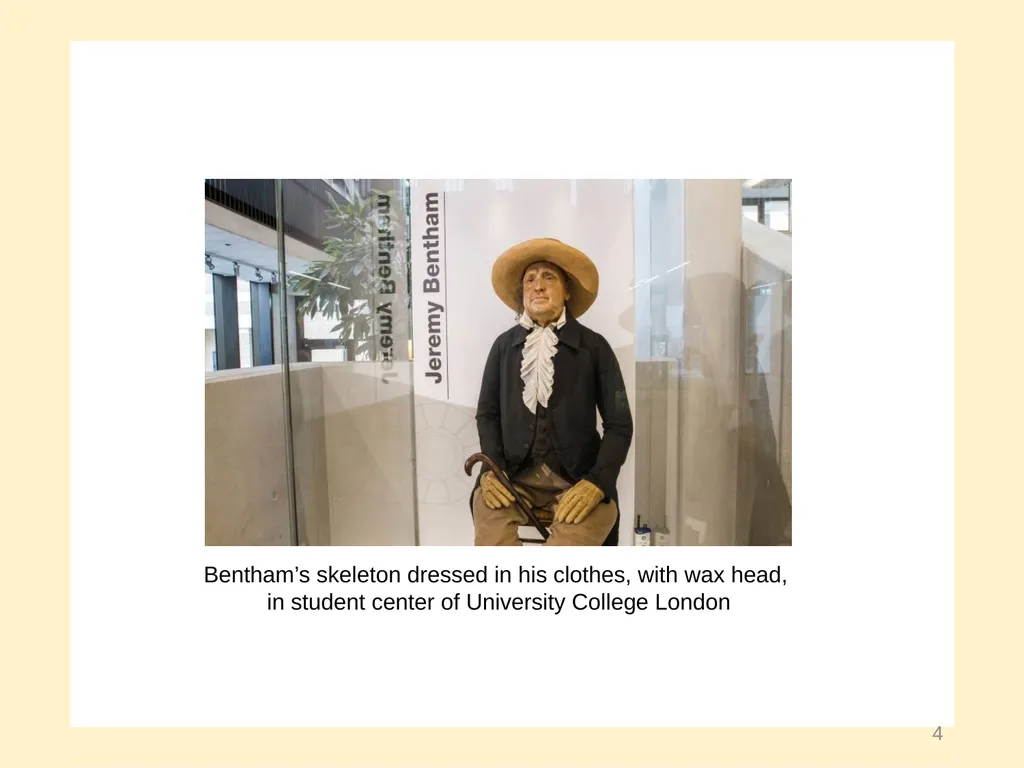
4 Bentham’s skeleton dressed in his clothes, with wax head, in student center of University College London<br>
05
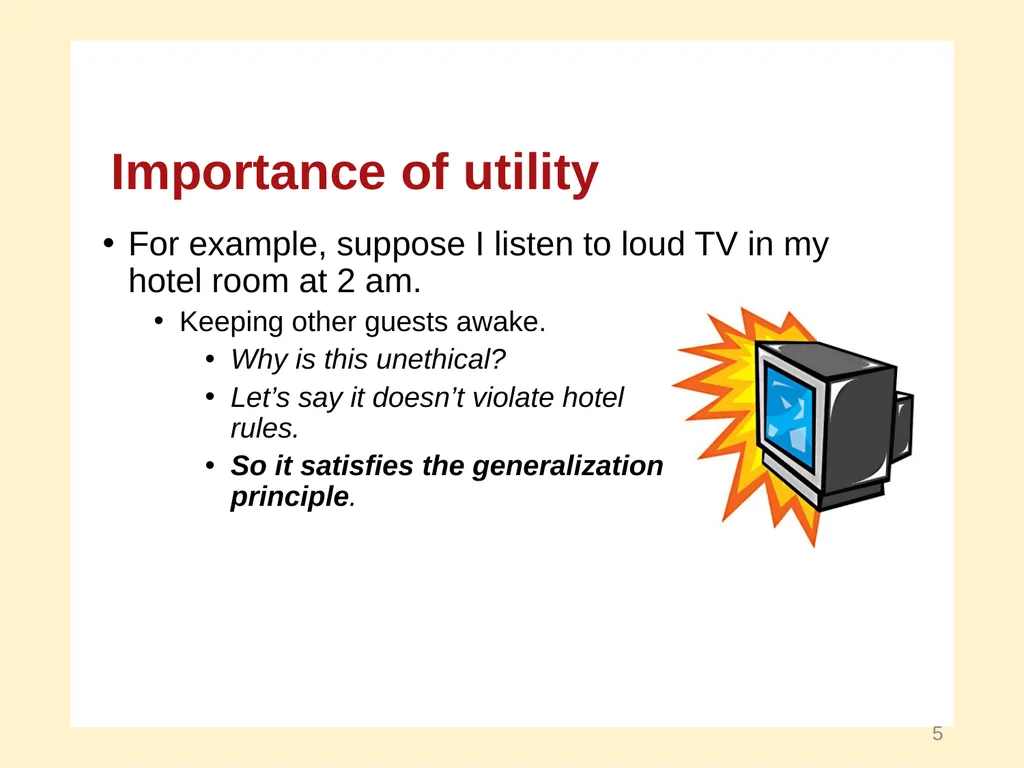
For example, suppose I listen to loud TV in my hotel room at 2 am.
Keeping other guests awake.
Why is this unethical?
Let’s say it doesn’t violate hotel rules.
So it satisfies the generalization principle. 5 Importance of utility<br>
06
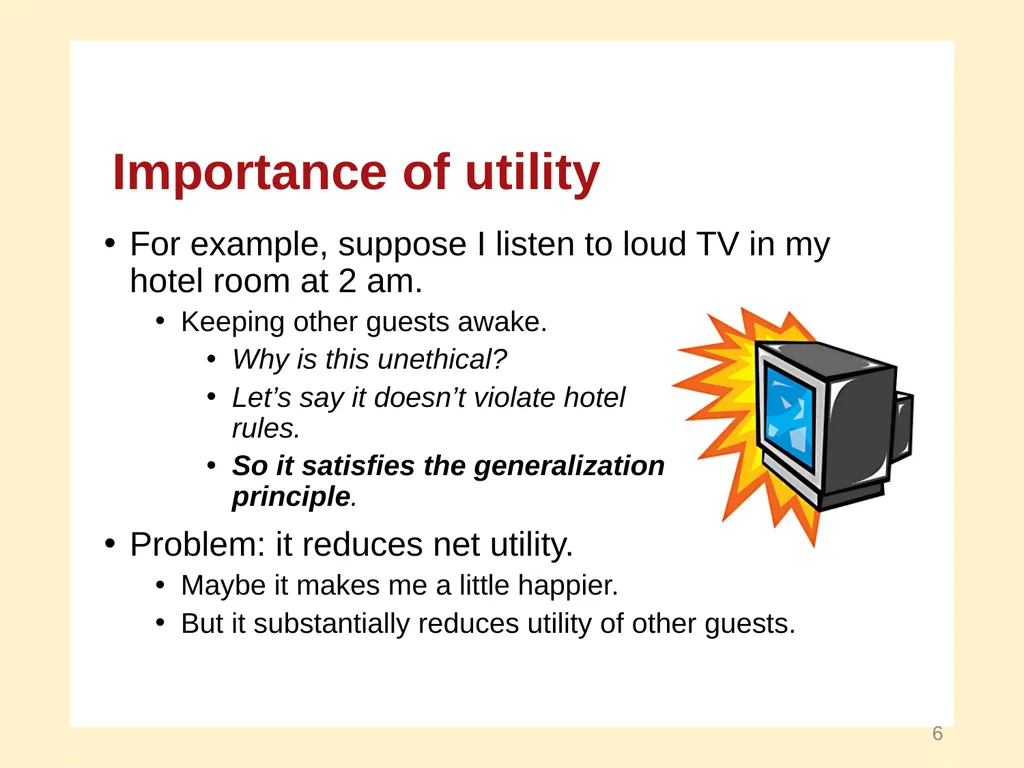
For example, suppose I listen to loud TV in my hotel room at 2 am.
Keeping other guests awake.
Why is this unethical?
Let’s say it doesn’t violate hotel rules.
So it satisfies the generalization principle.
Problem: it reduces net utility.
Maybe it makes me a little happier.
But it substantially reduces utility of other guests. 6 Importance of utility<br>
07
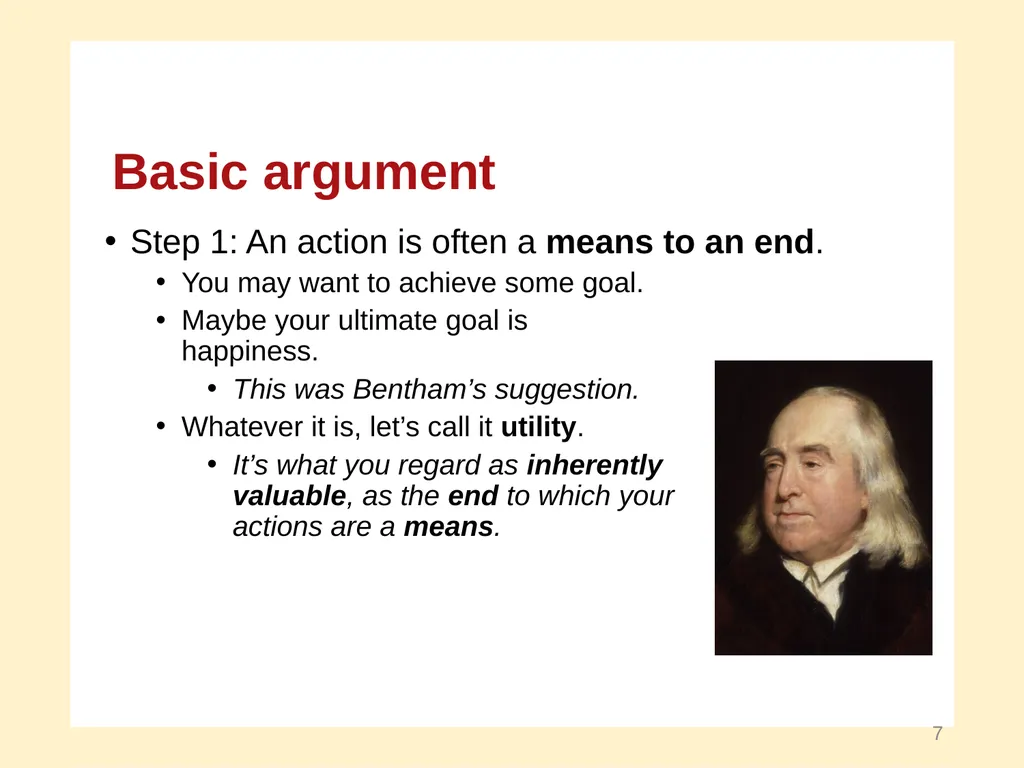
Step 1: An action is often a means to an end.
You may want to achieve some goal.
Maybe your ultimate goal is happiness.
This was Bentham’s suggestion.
Whatever it is, let’s call it utility.
It’s what you regard as inherently valuable, as the end to which your actions are a means. 7 Basic argument<br>
08
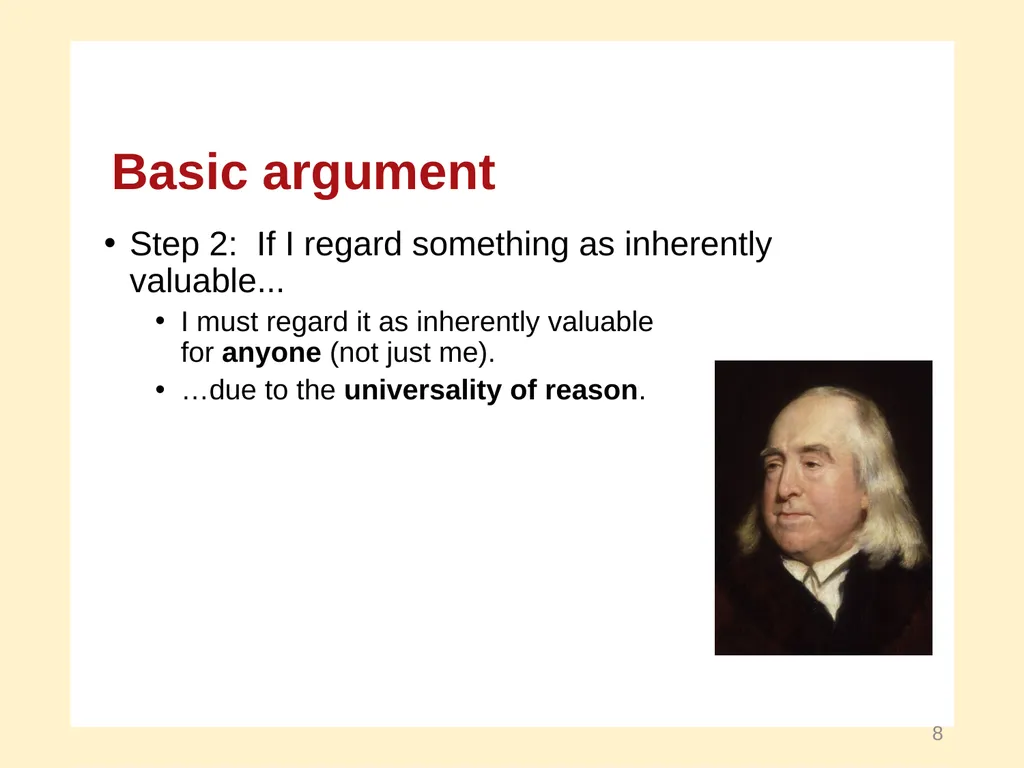
Step 2: If I regard something as inherently valuable...
I must regard it as inherently valuable for anyone (not just me).
…due to the universality of reason. 8 Basic argument<br>
09
Step 3: My actions should take everyone’s happiness as seriously as my own.
Bentham thought this means maximizing total net utility.
This is adequate for most purposes.
We will go with it for now. 9 Basic argument<br>
10
An act is ethical only if I can rationally believe that no other act…
creates more net expected utility*…
and satisfies other ethical principles.
Why consider only actions that satisfy other ethical principles?
Because behavior that doesn’t satisfy other ethical principles is not action.
And so is not a freely chosen option.
So utility can never “override” the other principles. 11 Utilitarian principle<br>
12
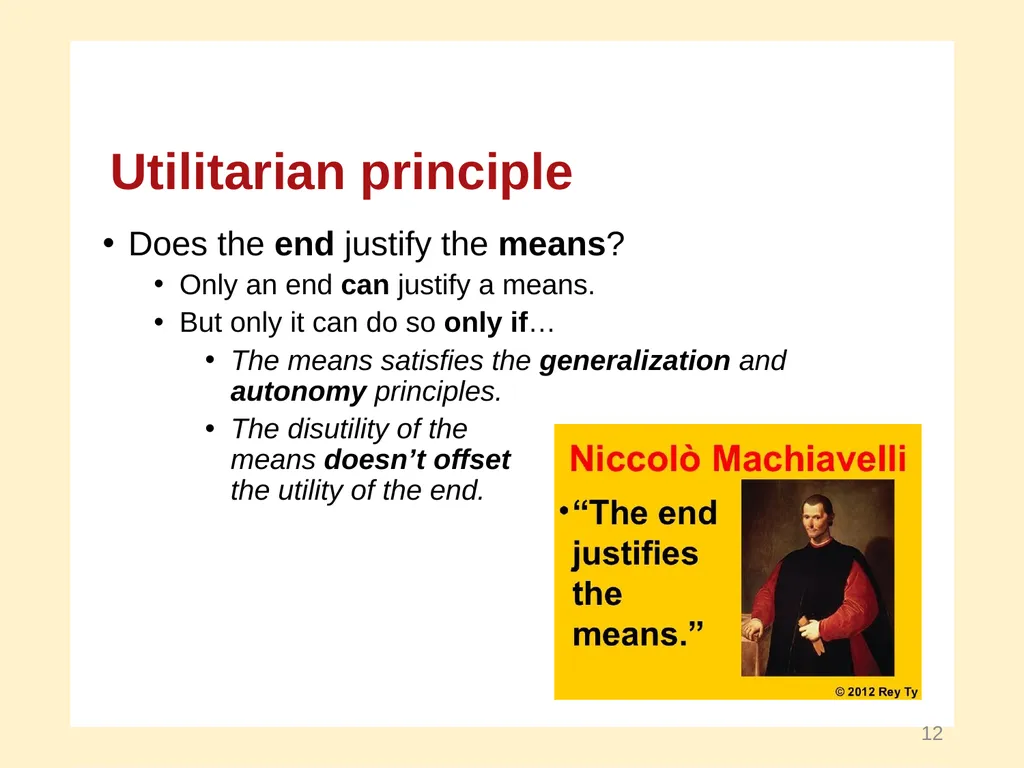
Does the end justify the means?
Only an end can justify a means.
But only it can do so only if…
The means satisfies the generalization and autonomy principles.
The disutility of the means doesn’t offset the utility of the end. 12 Utilitarian principle<br>
13
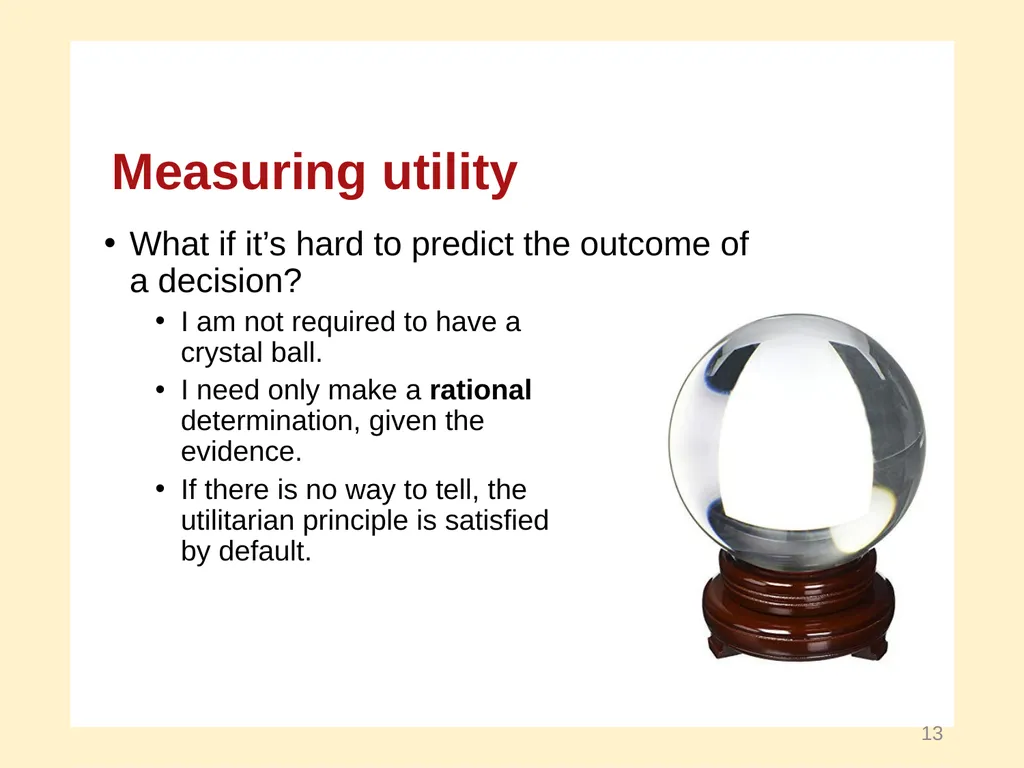
What if it’s hard to predict the outcome of a decision?
I am not required to have a crystal ball.
I need only make a rational determination, given the evidence.
If there is no way to tell, the utilitarian principle is satisfied by default. 13 Measuring utility<br>
14
But I must make a reasonable effort to research the issue.
The same effort I would invest in decisions that affect me.
For example, it is irrational to buy real estate without checking into it.
Find optimal tradeoff between research and need to act.
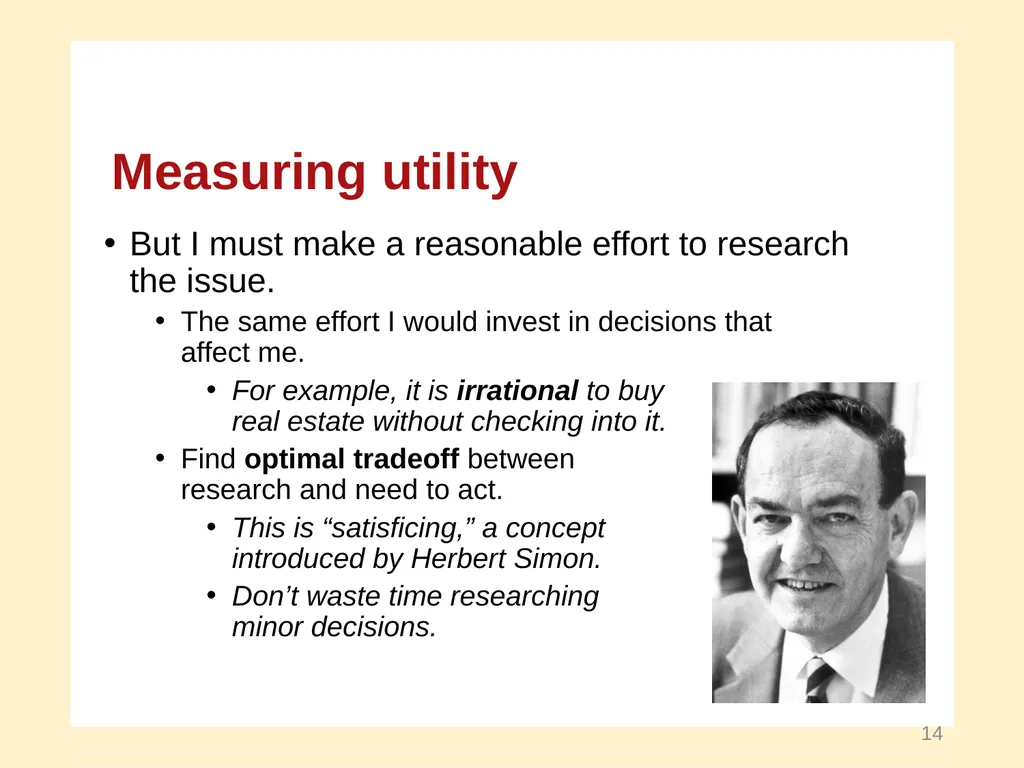
This is “satisficing,” a concept introduced by Herbert Simon.
Don’t waste time researching minor decisions. 14 Measuring utility<br>
15
J. N. Hooker, Taking Ethics Seriously, Taylor & Francis (2018), Chapter 4
J. N. Hooker, Advanced Introduction to Business Ethics, Edward Elgar (2021), Chapter 3 15 Further reading<br>