V Notch and Weirs for Flow measurement Dr. J. Badshah University Professor cum - Chief Scientist Dairy Engineering Department Sanjay Gandhi Institute of Dairy Science Technology, Jagdeopath, Patna (Bihar Animal Sciences University,
"V – Notch and Weirs for Flow measurement Dr. J." is the property of its rightful owner. Permission is granted to
download and print the materials on this website for personal, non-commercial use only, and to display it
on your personal computer provided you do not modify the materials and that you retain all copyright
notices contained in the materials. By downloading content from our website, you accept the terms of this
agreement.
Presentation Transcript
01
V – Notch and Weirs for Flow measurement Dr. J. Badshah
University Professor – cum - Chief Scientist
Dairy Engineering Department
Sanjay Gandhi Institute of Dairy Science & Technology, Jagdeopath, Patna
(Bihar Animal Sciences University, Patna)<br>
02
Flow Over Notches and Weirs Notch: It is defined as an obstruction over which the flow of liquid occurs. The depth of flow above the base of the notch is related to the discharge, the notch forms a useful measuring device. It is triangular in shape with varying degree at crest and varying height of nappe.
Weir: A weir is a notch on a large scale used for measuring the flow of a river, canal etc. It is a concrete or masonry structure of substantial breadth built across the river in the direction of flow. This allows the excess water to flow over its entire length to the downstream side. Thus a weir is similar to a small dam constructed across the river, with a difference that the excess water flows downstream only through a small portion called spillway and in case of weir, the excess water flows over its entire length.
The sheet of water flowing through a notch or over a weir is known as nappe or vein. The bottom edge of the notch or the top of a weir over which water flows is known as sill or crest. The height above the bottom of the tank or channel is known as crest height.<br>
03
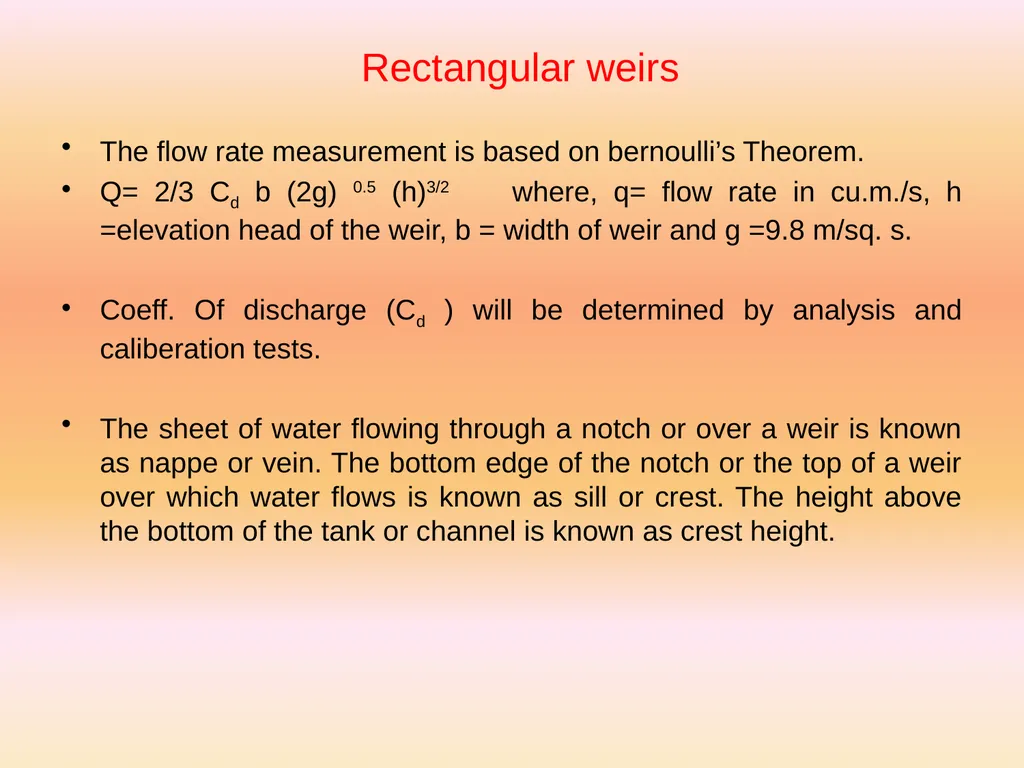
Rectangular weirs The flow rate measurement is based on bernoulli’s Theorem.
Q= 2/3 Cd b (2g) 0.5 (h)3/2 where, q= flow rate in cu.m./s, h =elevation head of the weir, b = width of weir and g =9.8 m/sq. s.
Coeff. Of discharge (Cd ) will be determined by analysis and caliberation tests.
The sheet of water flowing through a notch or over a weir is known as nappe or vein. The bottom edge of the notch or the top of a weir over which water flows is known as sill or crest. The height above the bottom of the tank or channel is known as crest height.<br>
04
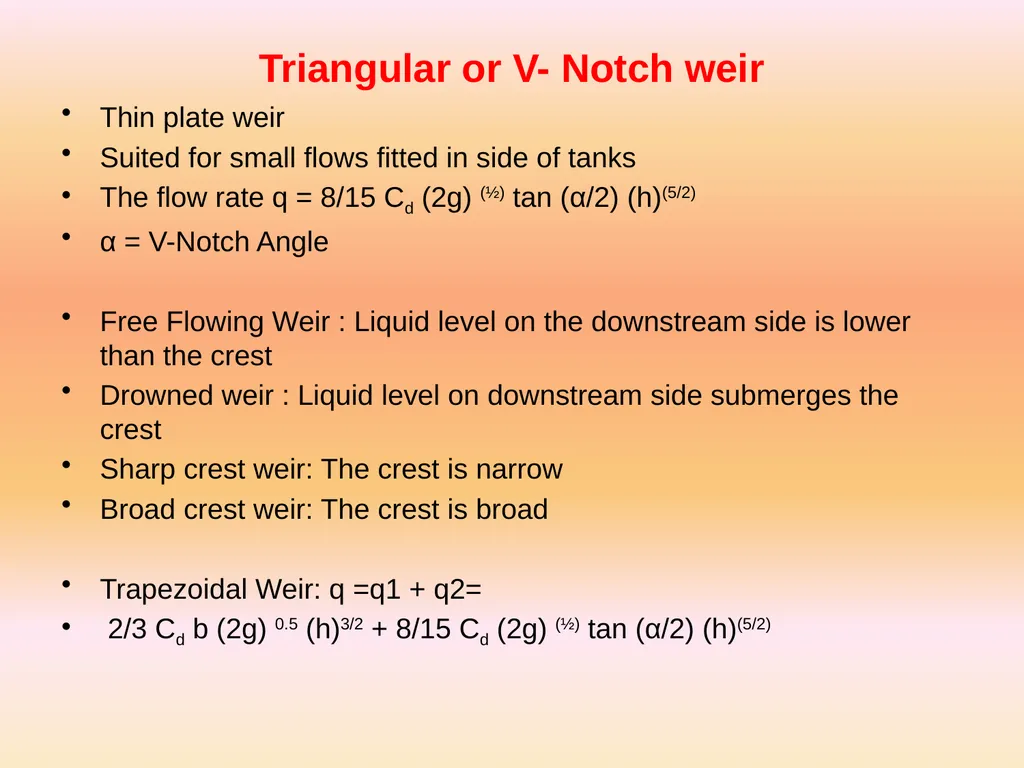
Triangular or V- Notch weir Thin plate weir
Suited for small flows fitted in side of tanks
The flow rate q = 8/15 Cd (2g) (½) tan (α/2) (h)(5/2)
α = V-Notch Angle
Free Flowing Weir : Liquid level on the downstream side is lower than the crest
Drowned weir : Liquid level on downstream side submerges the crest
Sharp crest weir: The crest is narrow
Broad crest weir: The crest is broad
Trapezoidal Weir: q =q1 + q2=
2/3 Cd b (2g) 0.5 (h)3/2 + 8/15 Cd (2g) (½) tan (α/2) (h)(5/2)<br>
05
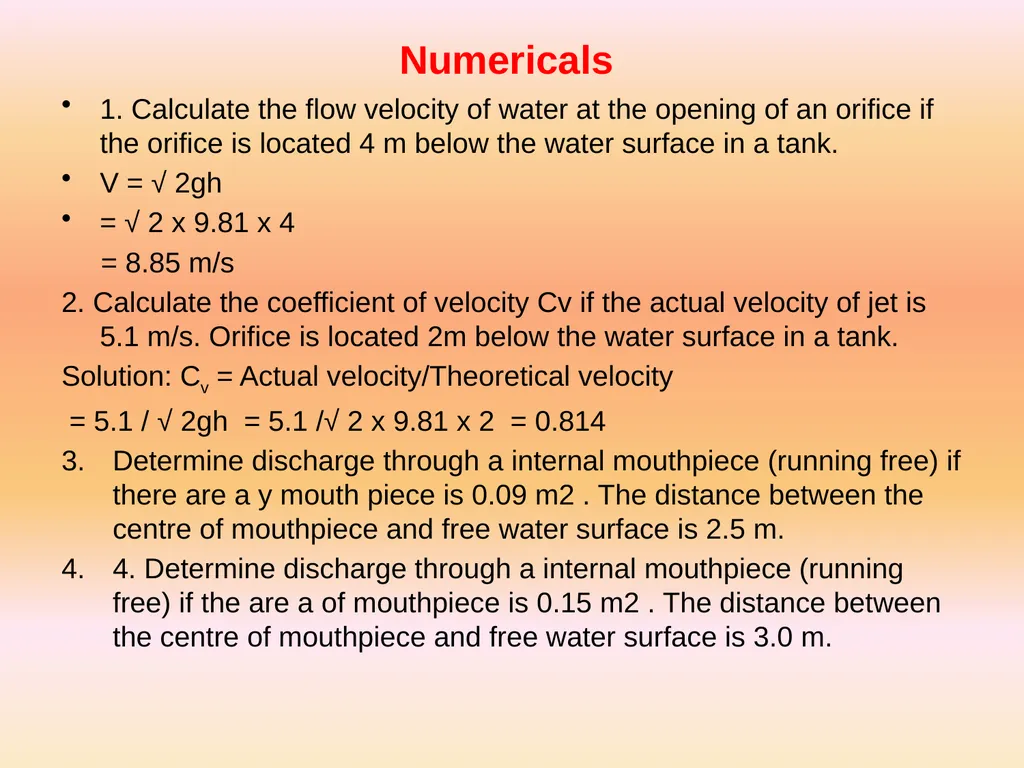
Numericals 1. Calculate the flow velocity of water at the opening of an orifice if the orifice is located 4 m below the water surface in a tank.
V = √ 2gh
= √ 2 x 9.81 x 4
= 8.85 m/s
2. Calculate the coefficient of velocity Cv if the actual velocity of jet is 5.1 m/s. Orifice is located 2m below the water surface in a tank.
Solution: Cv = Actual velocity/Theoretical velocity
= 5.1 / √ 2gh = 5.1 /√ 2 x 9.81 x 2 = 0.814
Determine discharge through a internal mouthpiece (running free) if there are a y mouth piece is 0.09 m2 . The distance between the centre of mouthpiece and free water surface is 2.5 m.
4. Determine discharge through a internal mouthpiece (running free) if the are a of mouthpiece is 0.15 m2 . The distance between the centre of mouthpiece and free water surface is 3.0 m.<br>
06
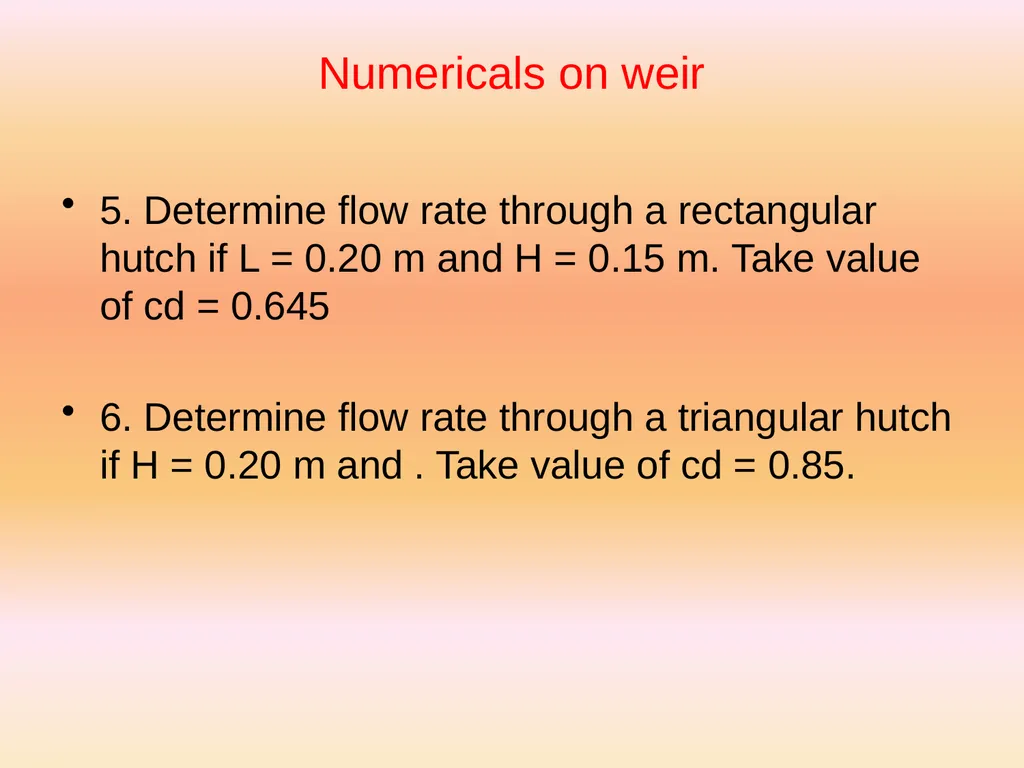
Numericals on weir 5. Determine flow rate through a rectangular hutch if L = 0.20 m and H = 0.15 m. Take value of cd = 0.645
6. Determine flow rate through a triangular hutch if H = 0.20 m and . Take value of cd = 0.85.<br>