04
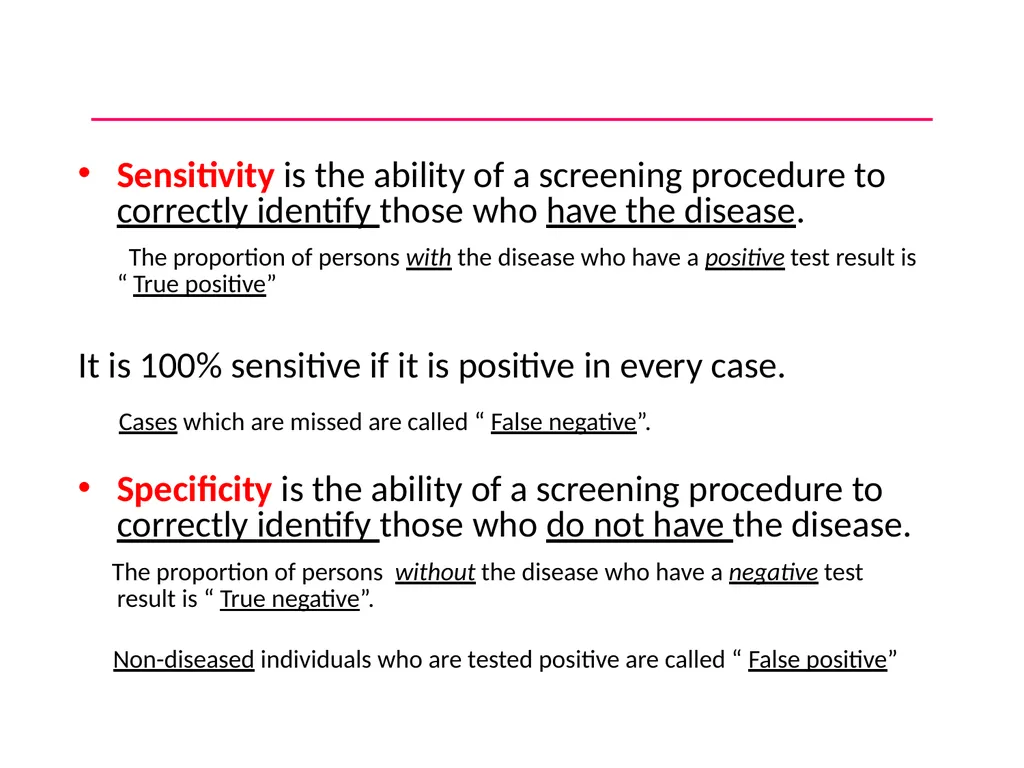
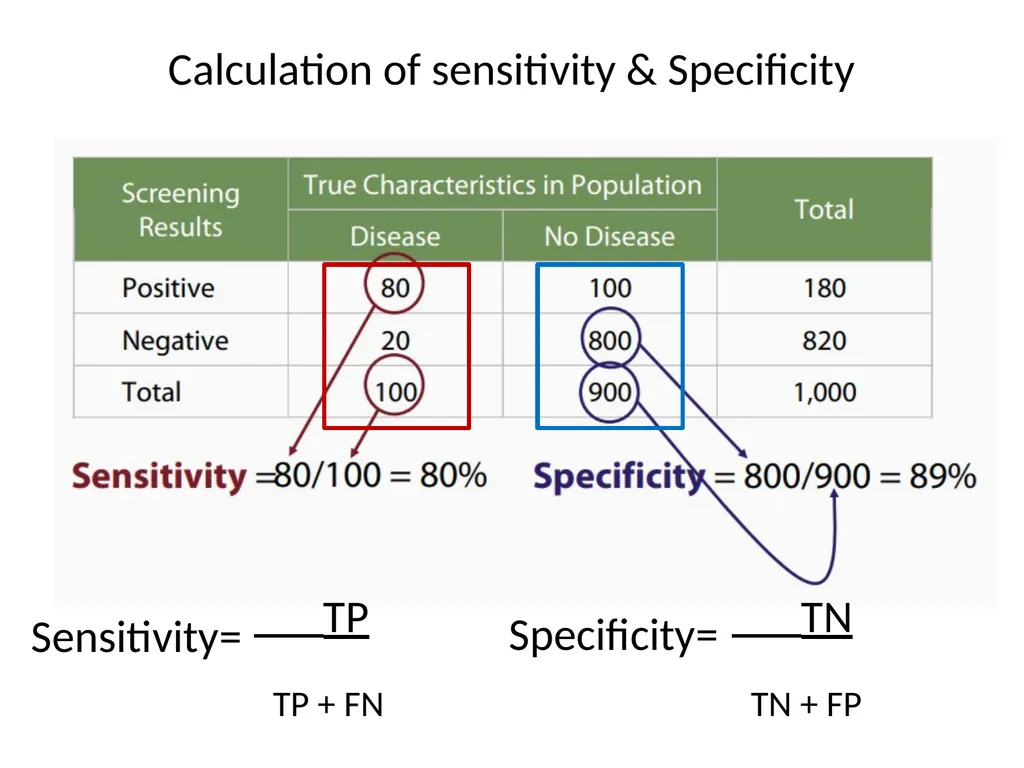
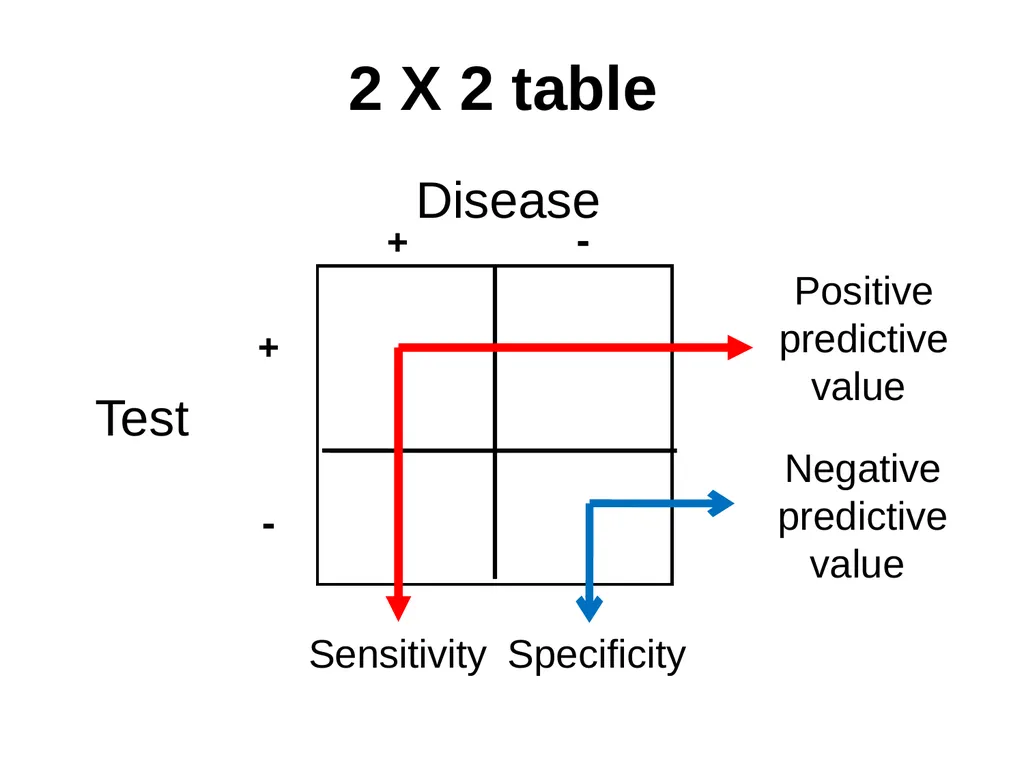
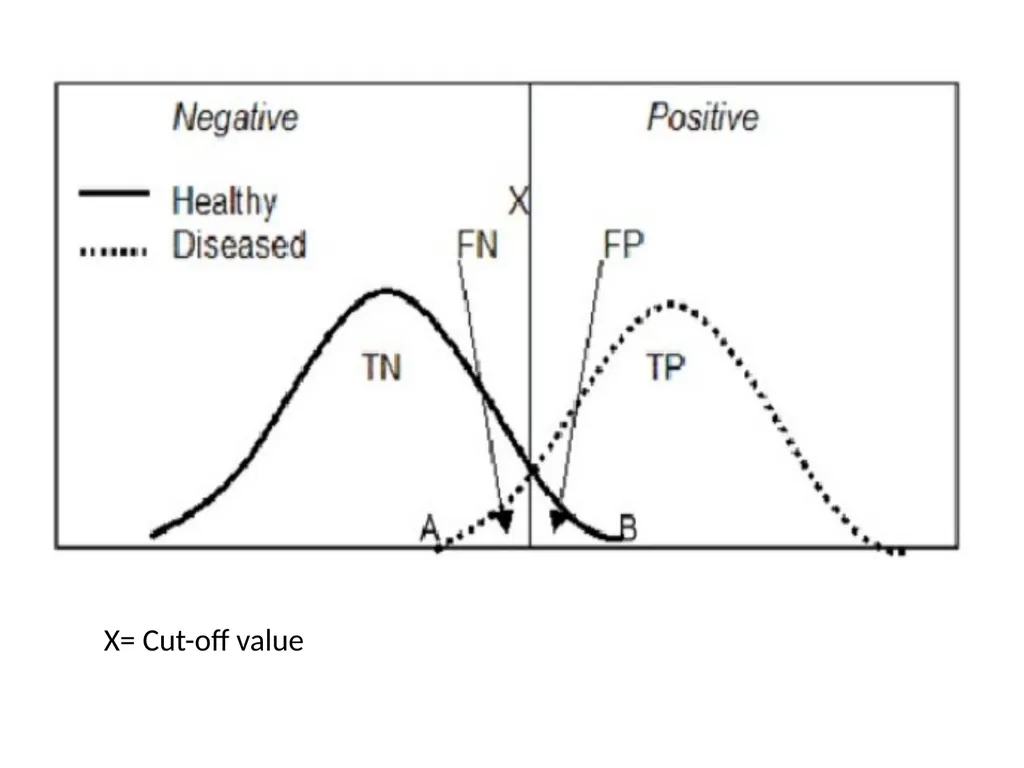
Sensitivity is the ability of a screening procedure to correctly identify those who have the disease.
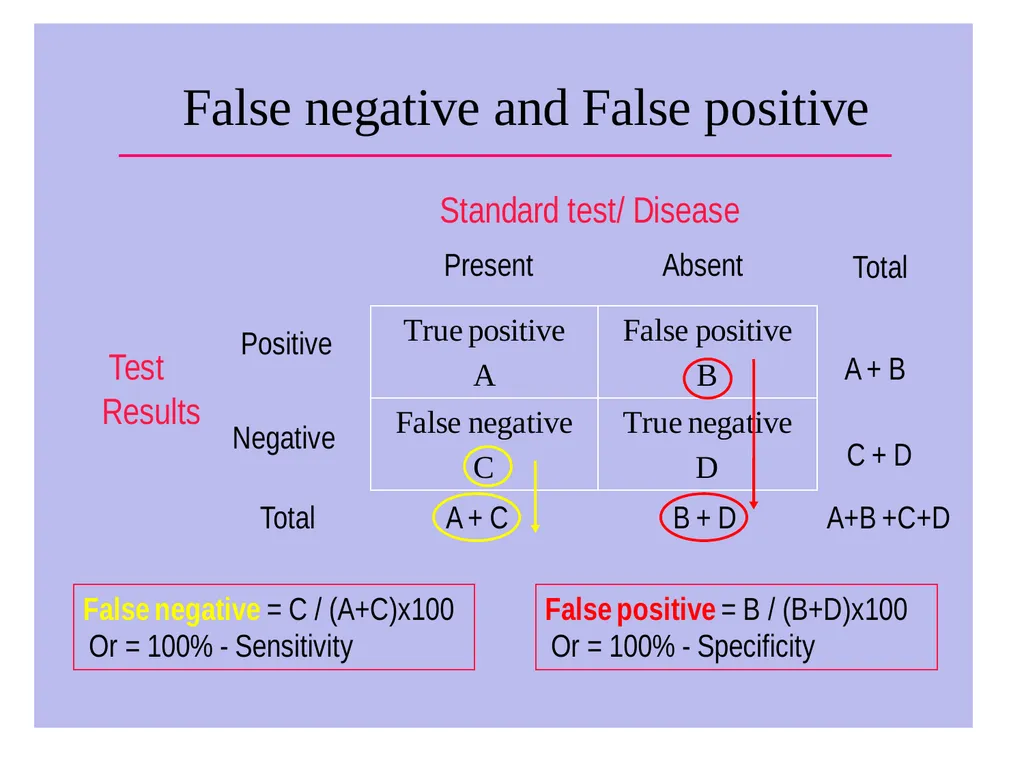
The proportion of persons with the disease who have a positive test result is “ True positive”
It is 100% sensitive if it is positive in every case.
Cases which are missed are called “ False negative”.
Specificity is the ability of a screening procedure to correctly identify those who do not have the disease.
The proportion of persons without the disease who have a negative test result is “ True negative”.
Non-diseased individuals who are tested positive are called “ False positive”<br>
05
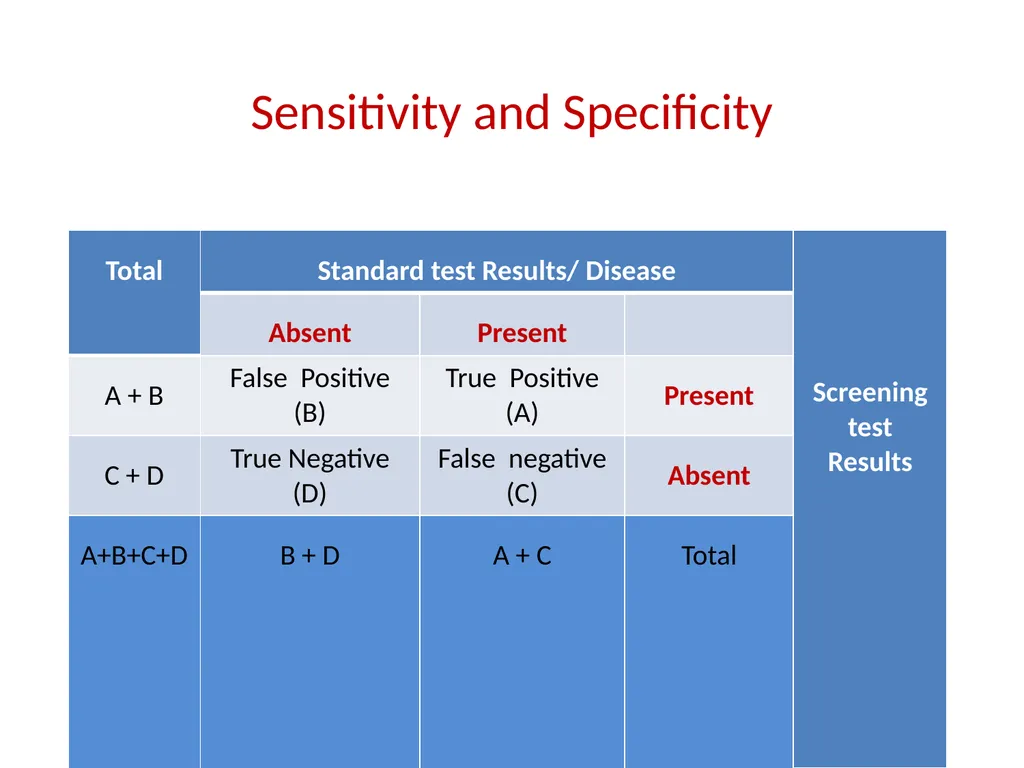
Sensitivity and Specificity<br>
06
Calculation of sensitivity & Specificity<br>
07
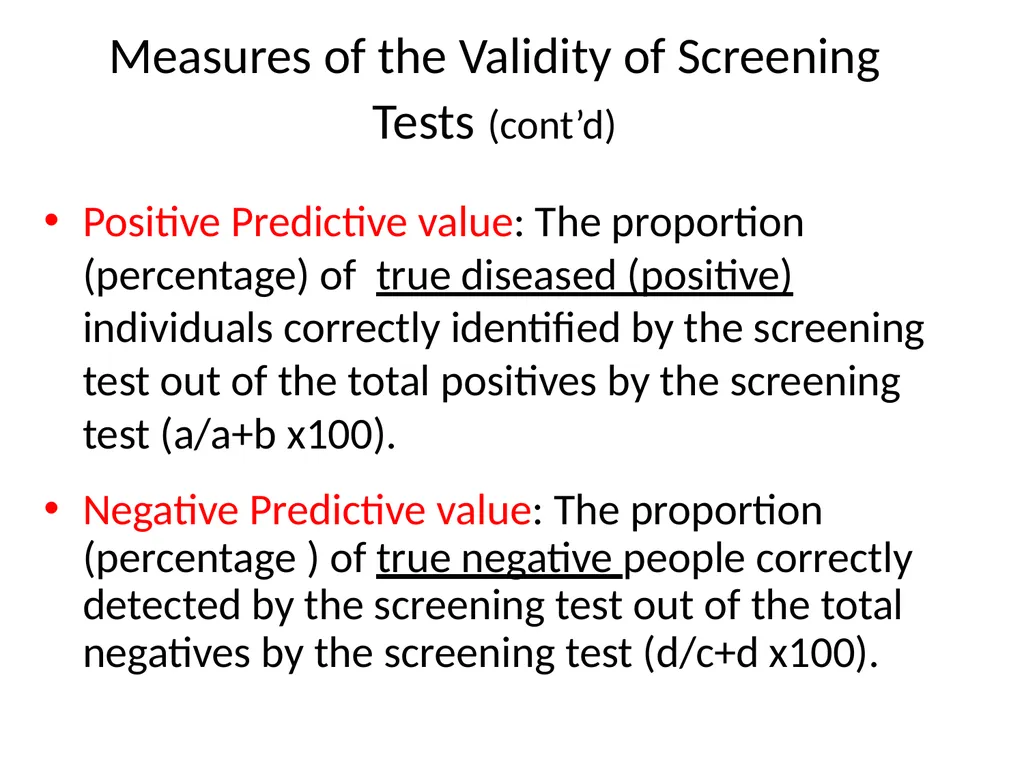
Measures of the Validity of Screening Tests (cont’d) Positive Predictive value: The proportion (percentage) of true diseased (positive) individuals correctly identified by the screening test out of the total positives by the screening test (a/a+b x100).
Negative Predictive value: The proportion (percentage ) of true negative people correctly detected by the screening test out of the total negatives by the screening test (d/c+d x100).<br>
08
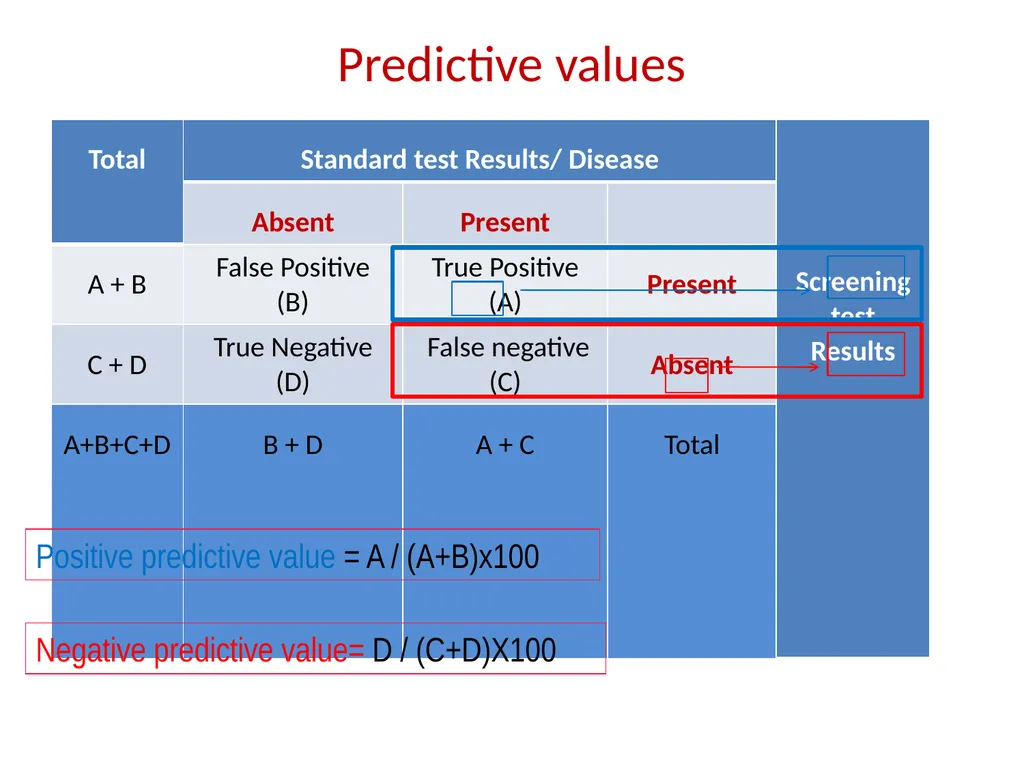
Predictive values Positive predictive value = A / (A+B)x100 Negative predictive value= D / (C+D)X100<br>
10
Other Measures from the 2 x 2 Table Accuracy of a screening test (Agreement rate): determined by the formula: (A+D)/(A+B+C+D) x 100.
Disagreement (misclassification) rate:
= B+C/(A+B+C+D) x100
Prevalence (True)--determined by the formula:
(A+C) /(A+B+C+D) x1000
Prevalence according to the screening results:
(A+B)/(A+B+C+D) x1000<br>
11
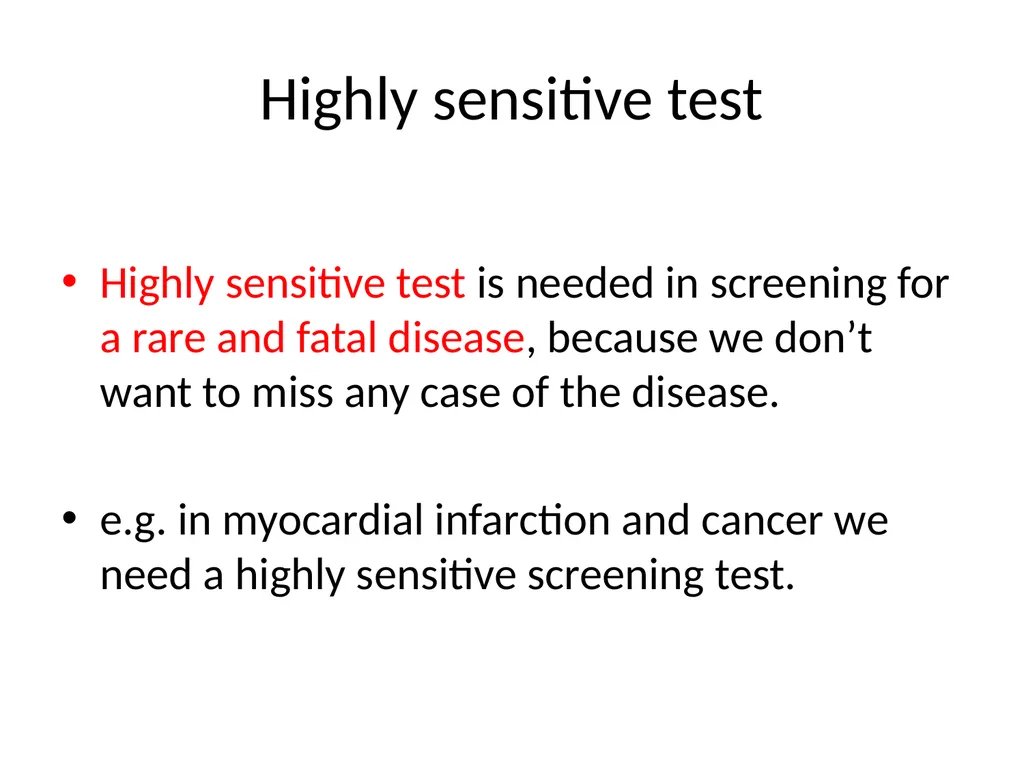
Highly sensitive test Highly sensitive test is needed in screening for a rare and fatal disease, because we don’t want to miss any case of the disease.
e.g. in myocardial infarction and cancer we need a highly sensitive screening test.<br>
12
Implication or significance of high false negative rate 1. Severe cases of the disease will be deprived from appropriate treatment. This will lead to more complications and death.
2. False reassurance of patients. This disagrees with characteristics of the screening test which should diagnose the disease at early stage.<br>
13
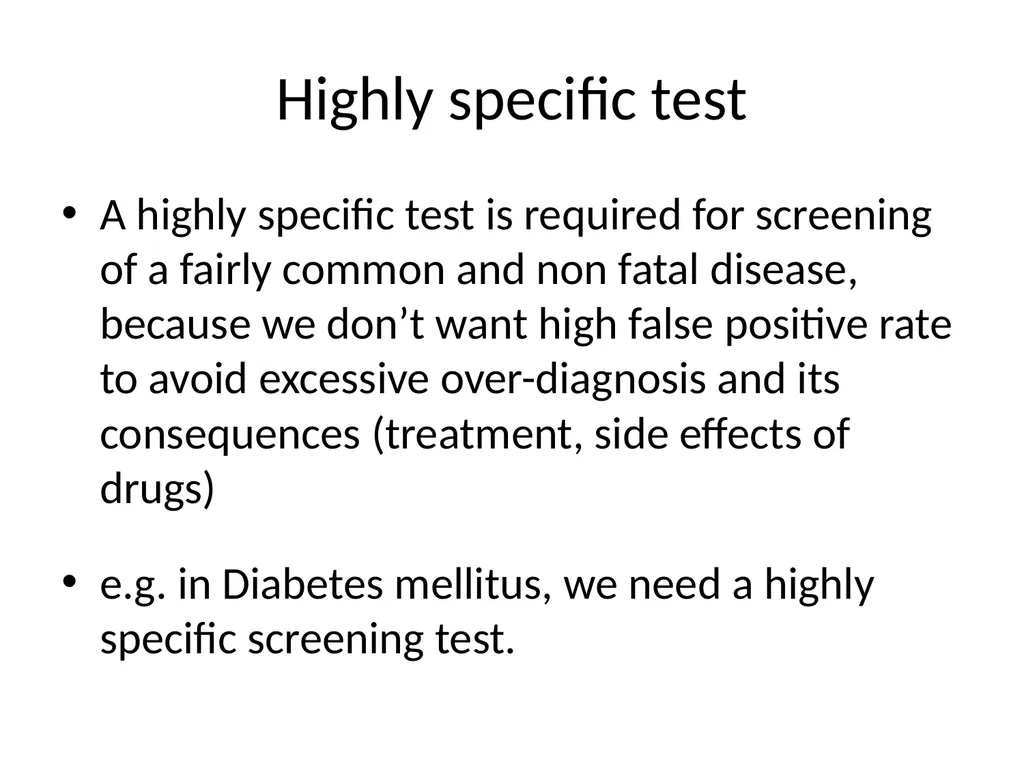
Highly specific test A highly specific test is required for screening of a fairly common and non fatal disease, because we don’t want high false positive rate to avoid excessive over-diagnosis and its consequences (treatment, side effects of drugs)
e.g. in Diabetes mellitus, we need a highly specific screening test.<br>
14
Implication or significance of high false positive rate 1. Treatment may be given to non-diseased persons with its sequences:
a. Side effects of drugs
b. High cost of drugs
2. The test may be harmful and invasive
3. Psychologically harmful to healthy person.<br>
15
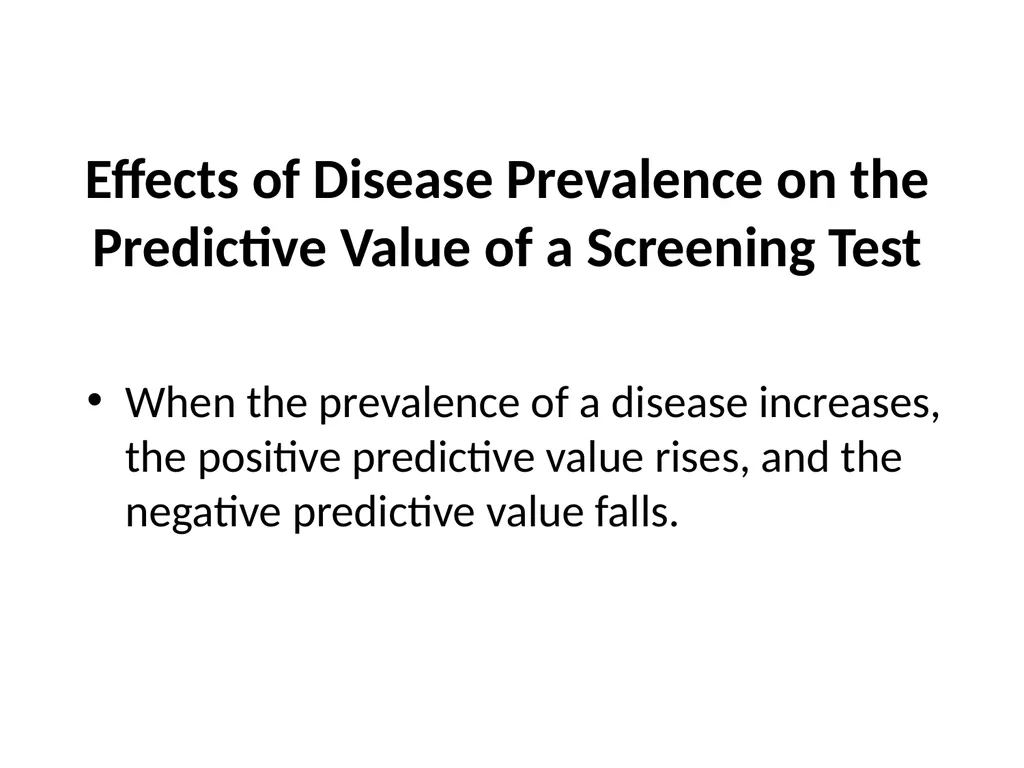
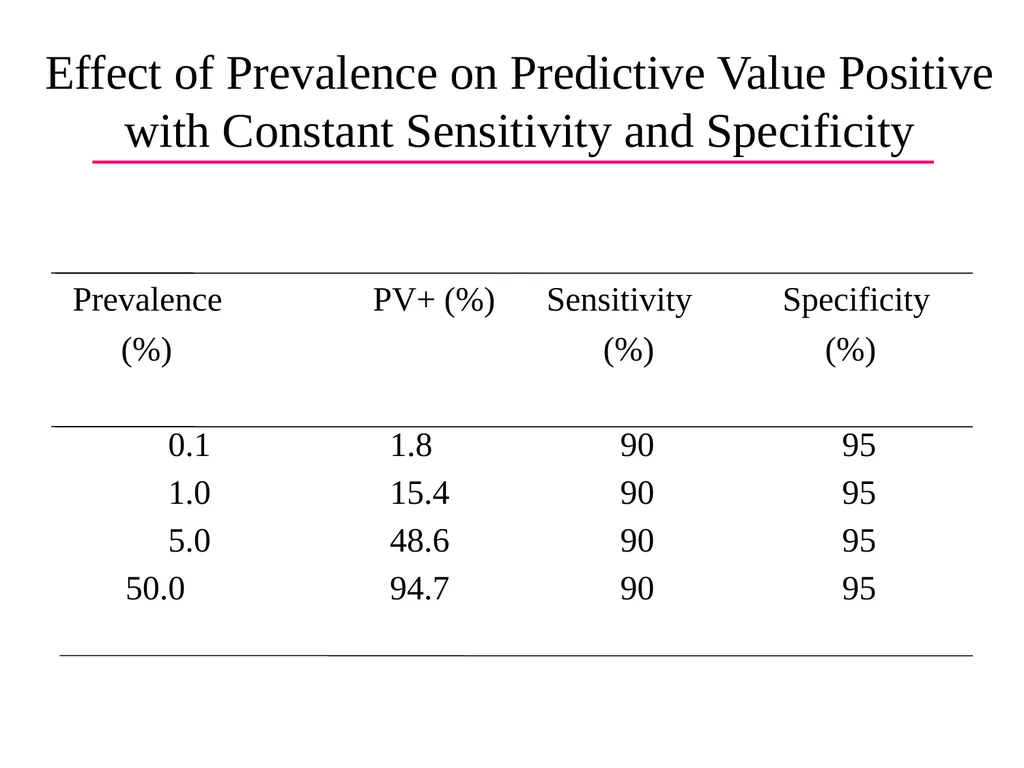
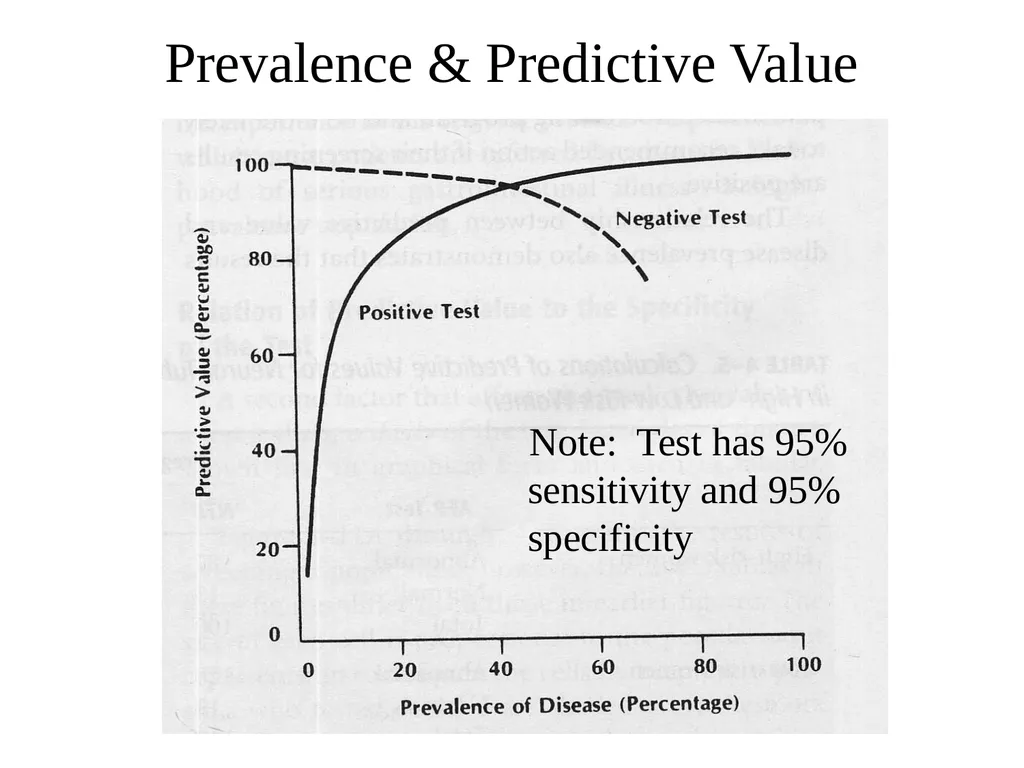
Effects of Disease Prevalence on the Predictive Value of a Screening Test When the prevalence of a disease increases, the positive predictive value rises, and the negative predictive value falls.<br>
16
Effect of Prevalence on Predictive Value Positive with Constant Sensitivity and Specificity Prevalence PV+ (%) Sensitivity Specificity
(%) (%) (%)
0.1 1.8 90 95
1.0 15.4 90 95
5.0 48.6 90 95
50.0 94.7 90 95<br>
17
Prevalence & Predictive Value<br>
18
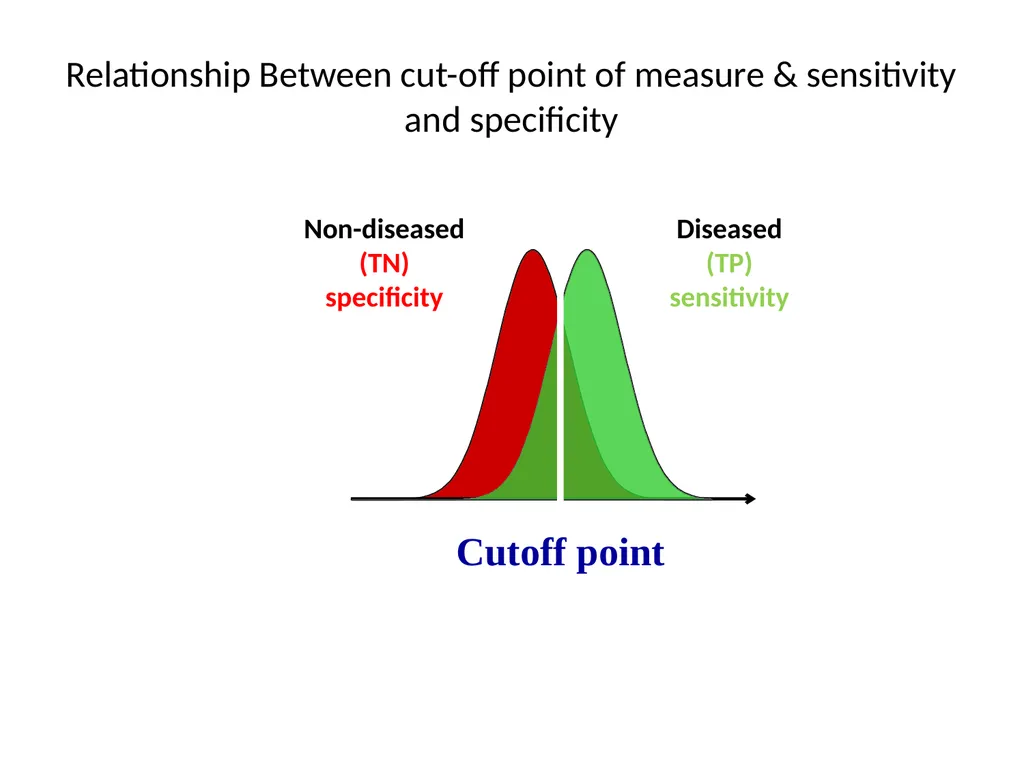
Relationship Between cut-off point of measure & sensitivity and specificity The sensitivity and specificity are generally constant and don’t change with change of prevalence of the disease, but they change in relation to each other if the cut-off point of reading is changed<br>
19
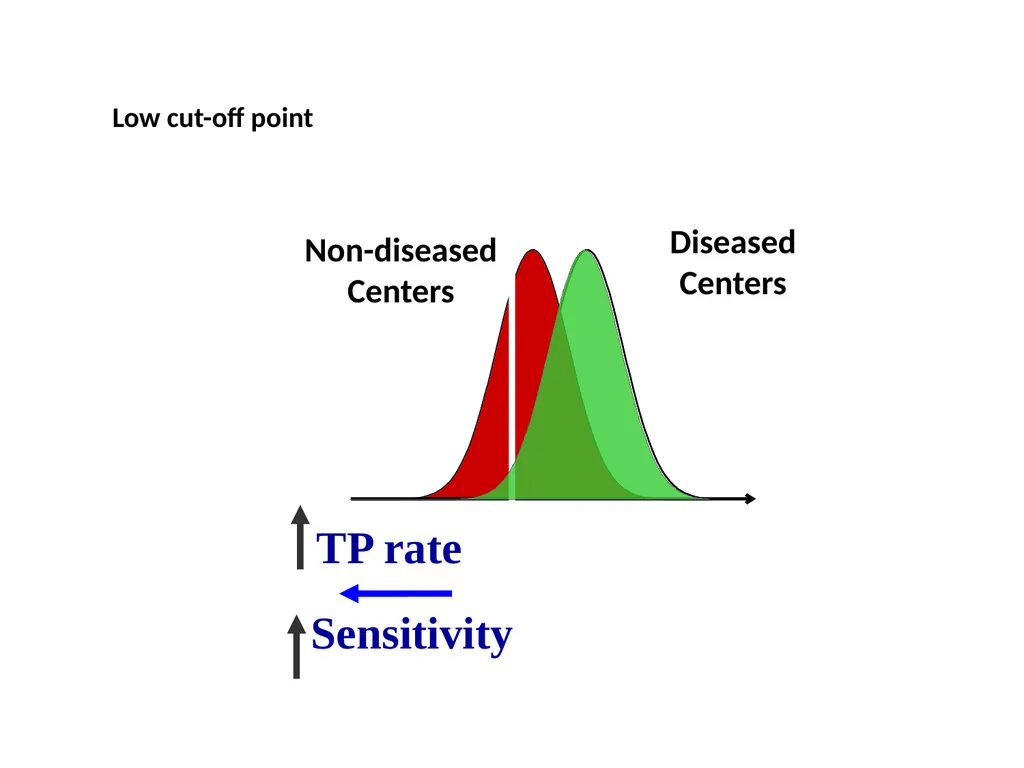
Relationship Between Sensitivity and Specificity To improve sensitivity, the cut-off point used to classify individuals as diseased should be moved farther in the range of the non-diseased (normal).
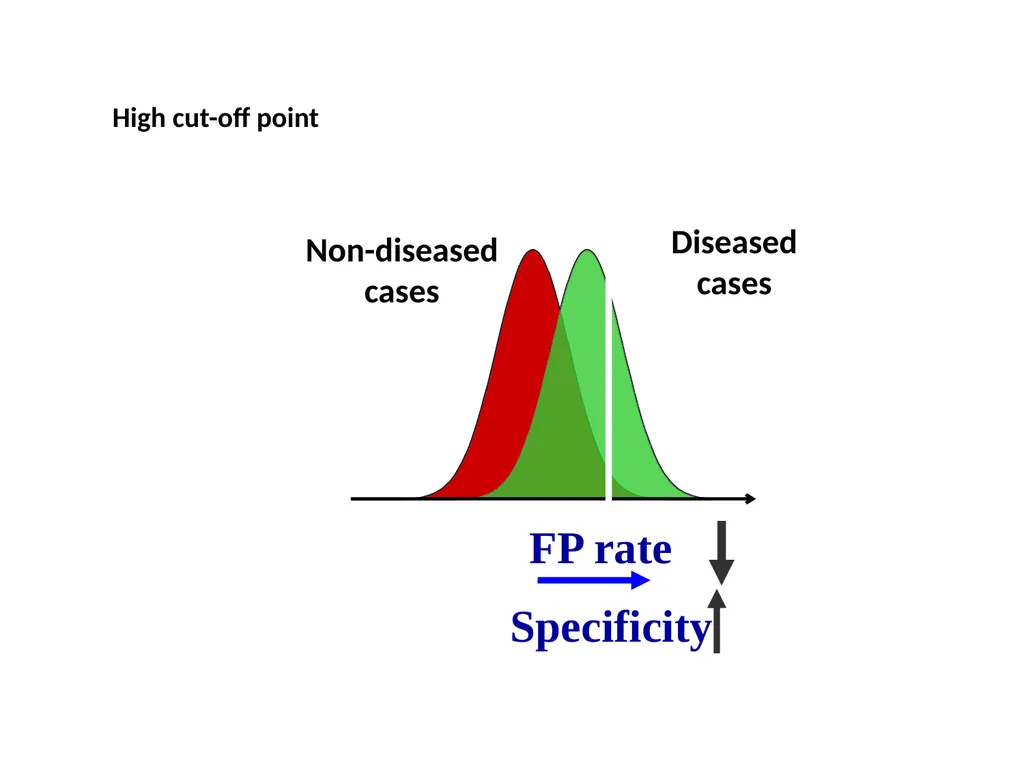
To improve specificity, the cut-off point should be moved farther in the range typically associated with the disease.<br>
21
Relationship Between cut-off point of measure & sensitivity and specificity<br>
22
Non-diseased
cases Diseased
cases FP rate
Specificity High cut-off point<br>
24
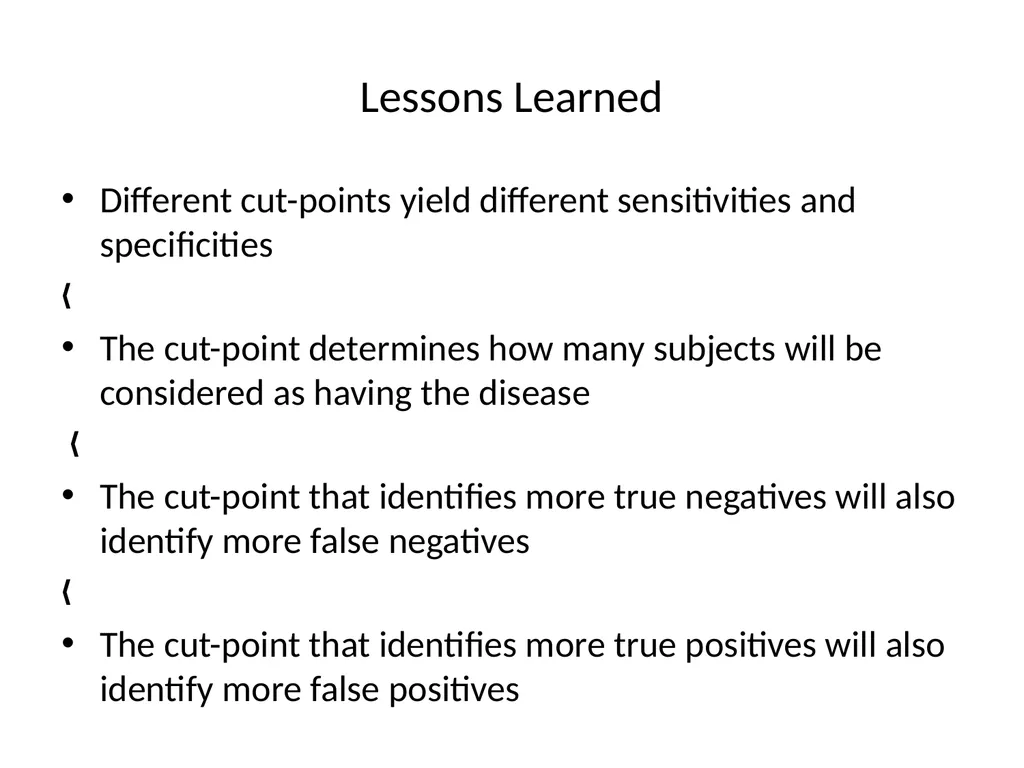
Lessons Learned Different cut-points yield different sensitivities and specificities
The cut-point determines how many subjects will be considered as having the disease
The cut-point that identifies more true negatives will also identify more false negatives
The cut-point that identifies more true positives will also identify more false positives<br>
25
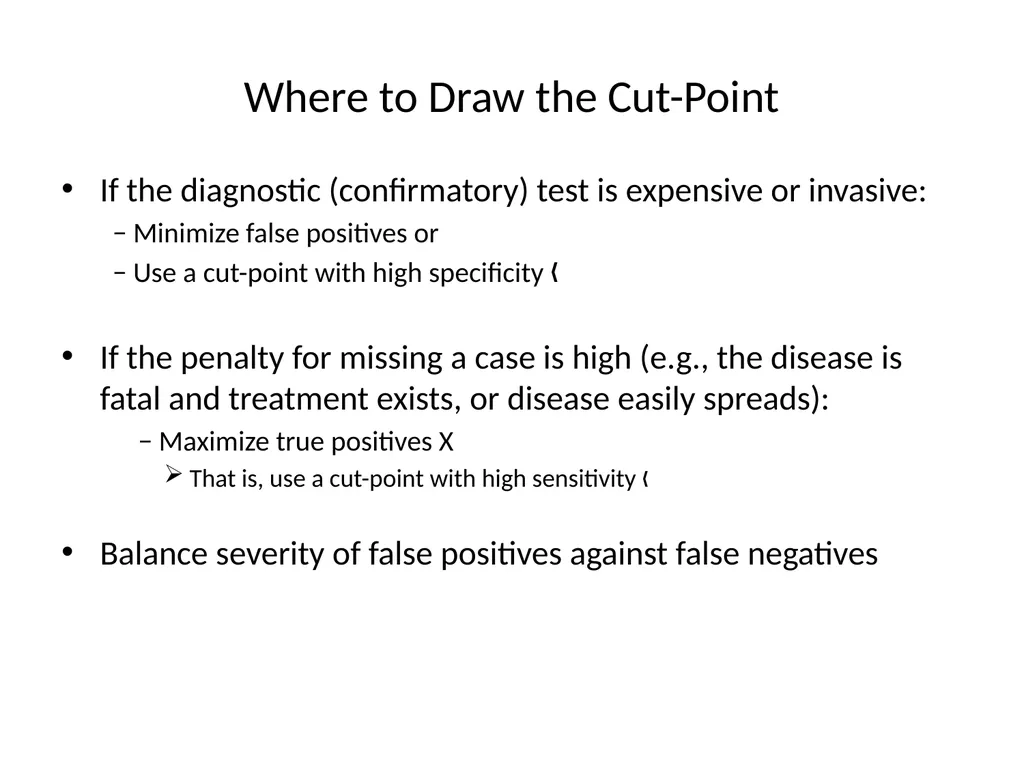
Where to Draw the Cut-Point If the diagnostic (confirmatory) test is expensive or invasive:
− Minimize false positives or
− Use a cut-point with high specificity
If the penalty for missing a case is high (e.g., the disease is fatal and treatment exists, or disease easily spreads):
− Maximize true positives X
That is, use a cut-point with high sensitivity
Balance severity of false positives against false negatives<br>
27
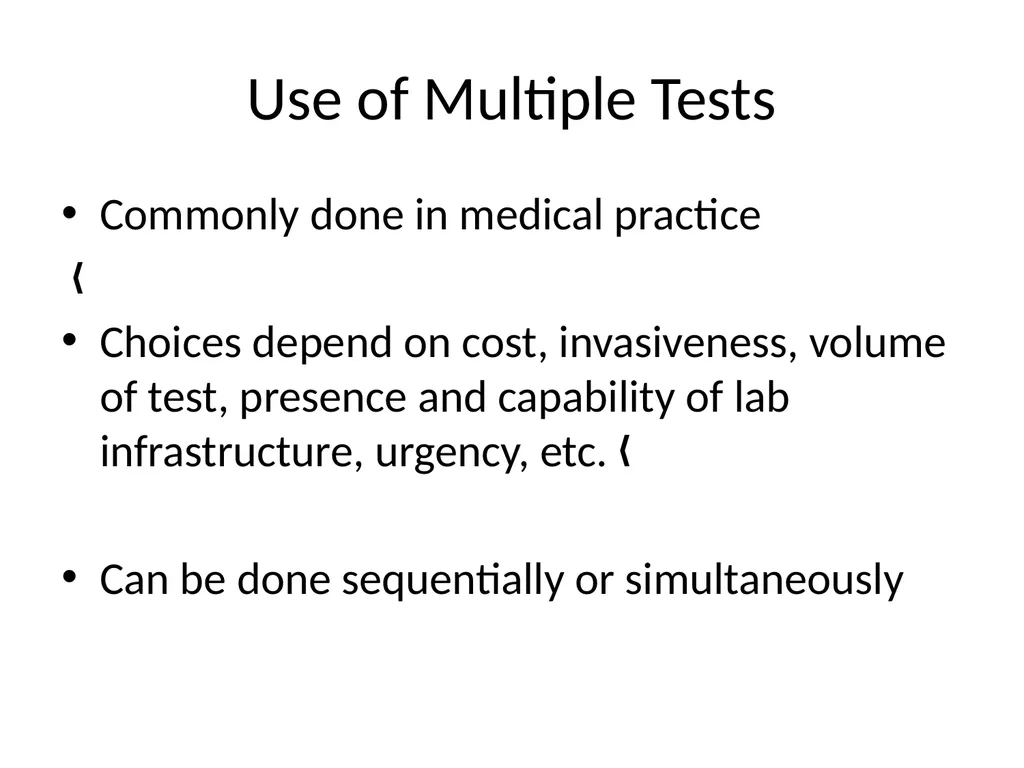
Use of Multiple Tests Commonly done in medical practice
Choices depend on cost, invasiveness, volume of test, presence and capability of lab infrastructure, urgency, etc.
Can be done sequentially or simultaneously<br>
28
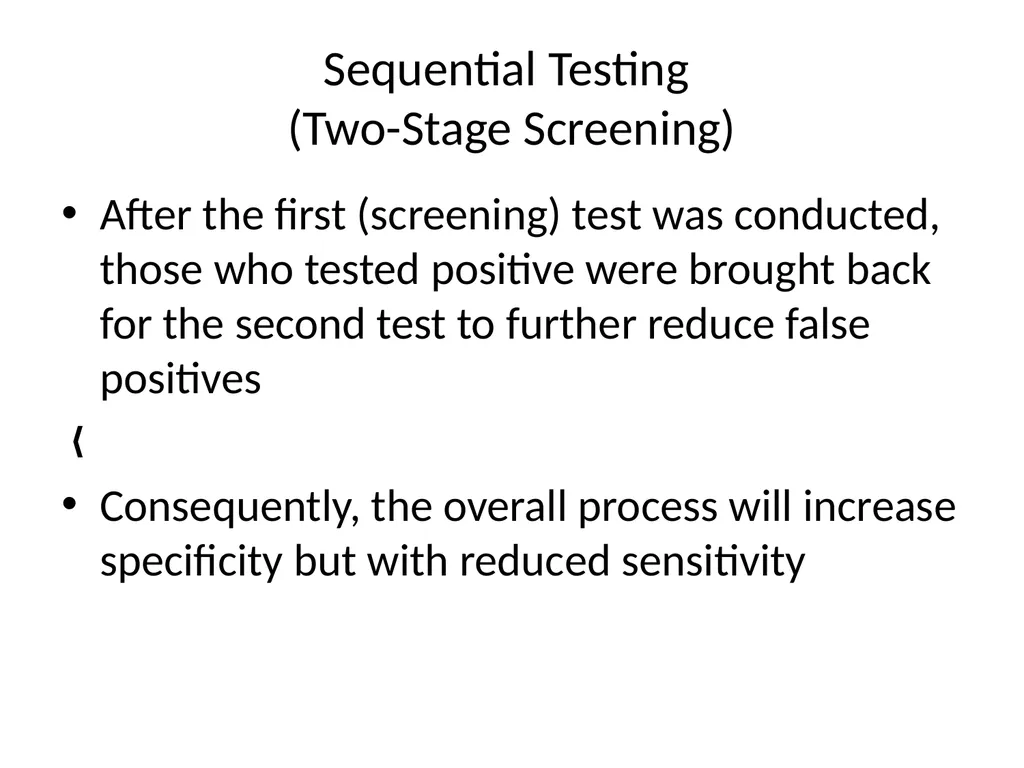
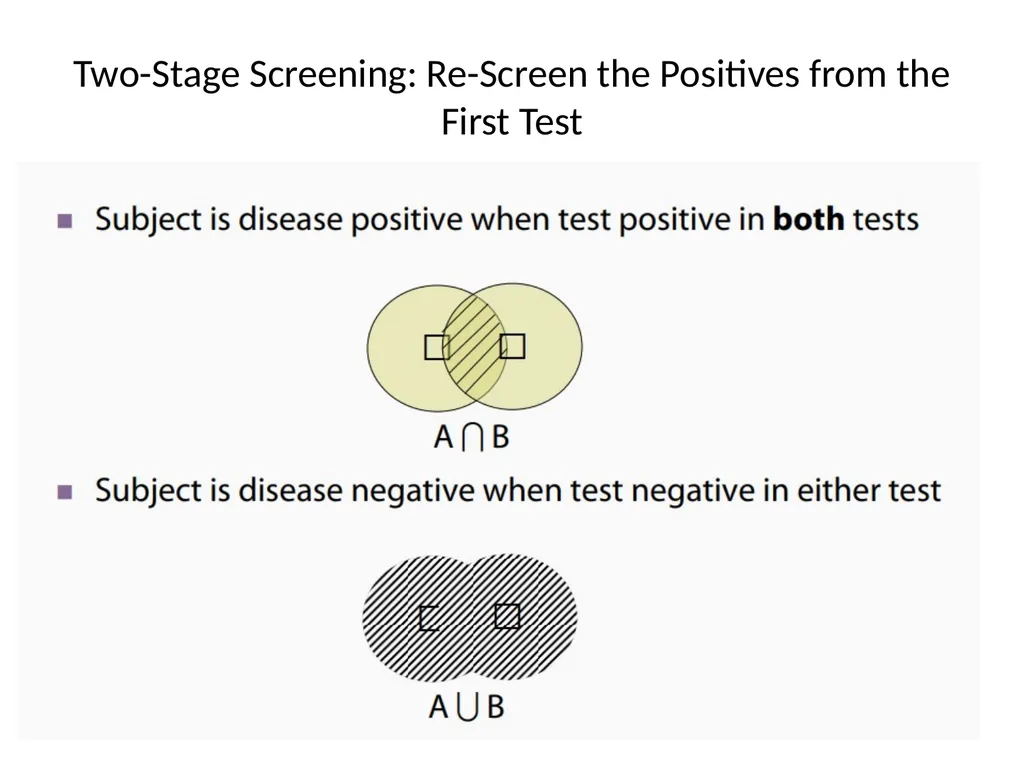
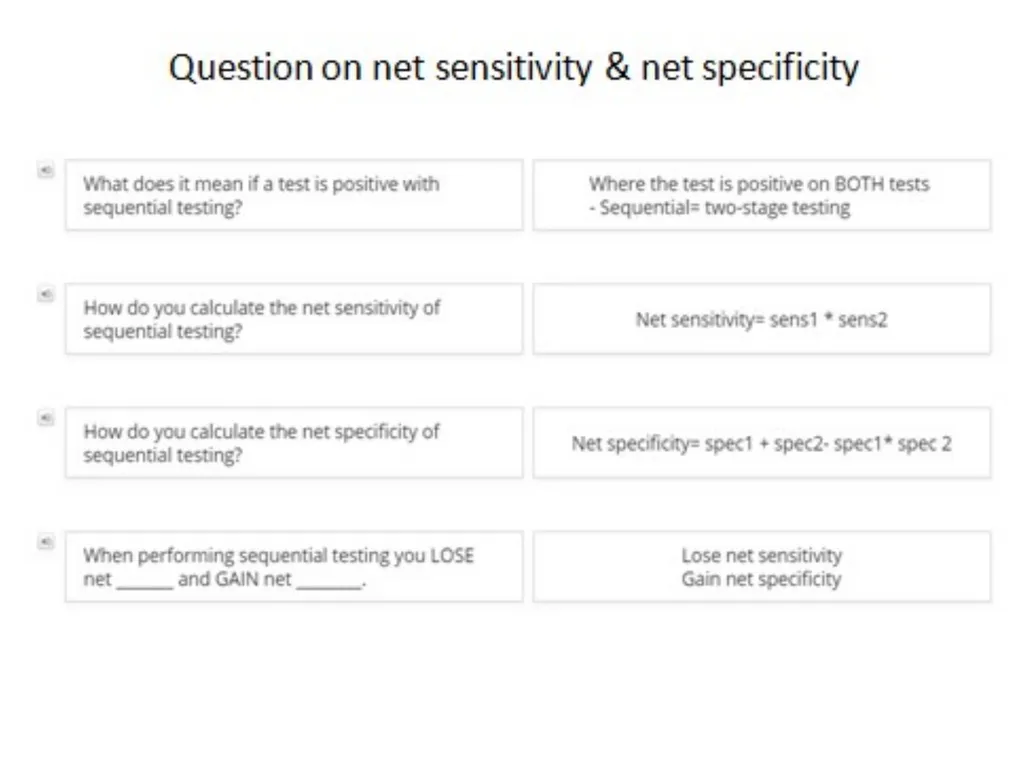
Sequential Testing �(Two-Stage Screening) After the first (screening) test was conducted, those who tested positive were brought back for the second test to further reduce false positives
Consequently, the overall process will increase specificity but with reduced sensitivity<br>
29
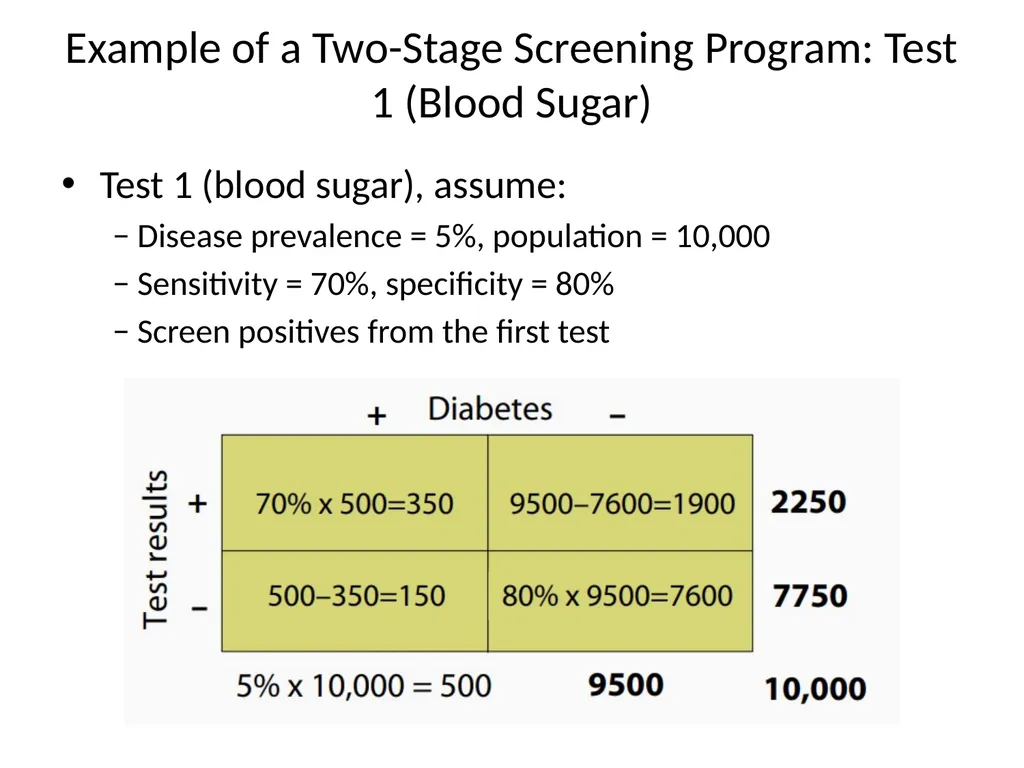
Example of a Two-Stage Screening Program: Test 1 (Blood Sugar) Test 1 (blood sugar), assume:
− Disease prevalence = 5%, population = 10,000
− Sensitivity = 70%, specificity = 80%
− Screen positives from the first test<br>
30
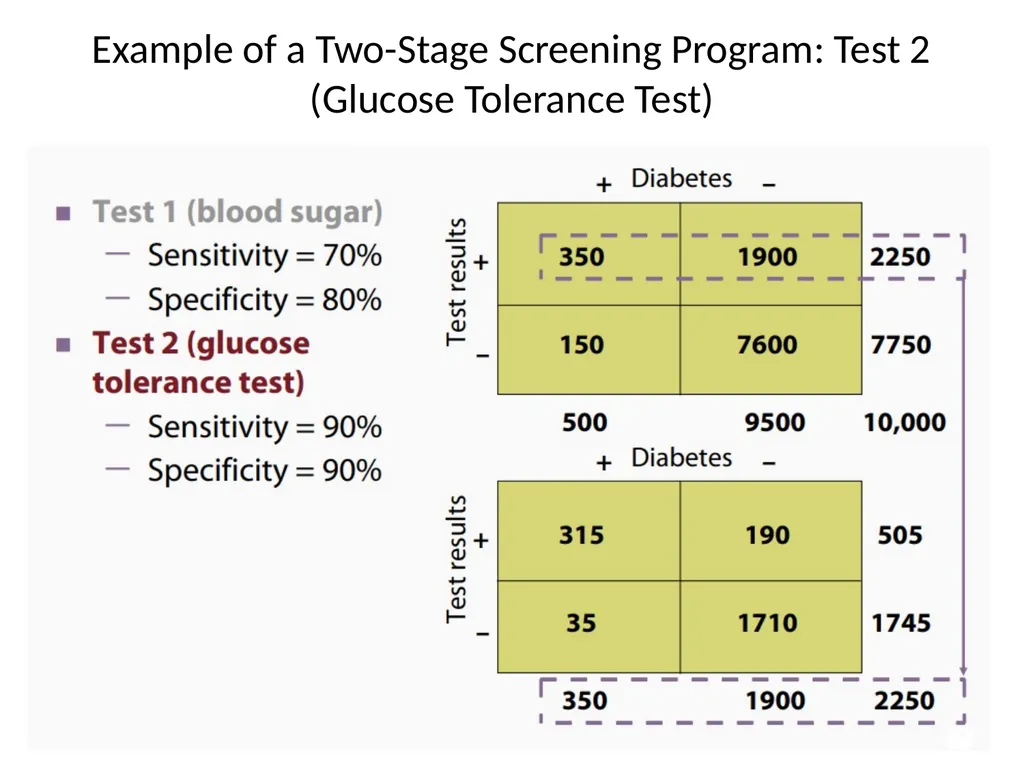
Example of a Two-Stage Screening Program: Test 2 (Glucose Tolerance Test)<br>
31
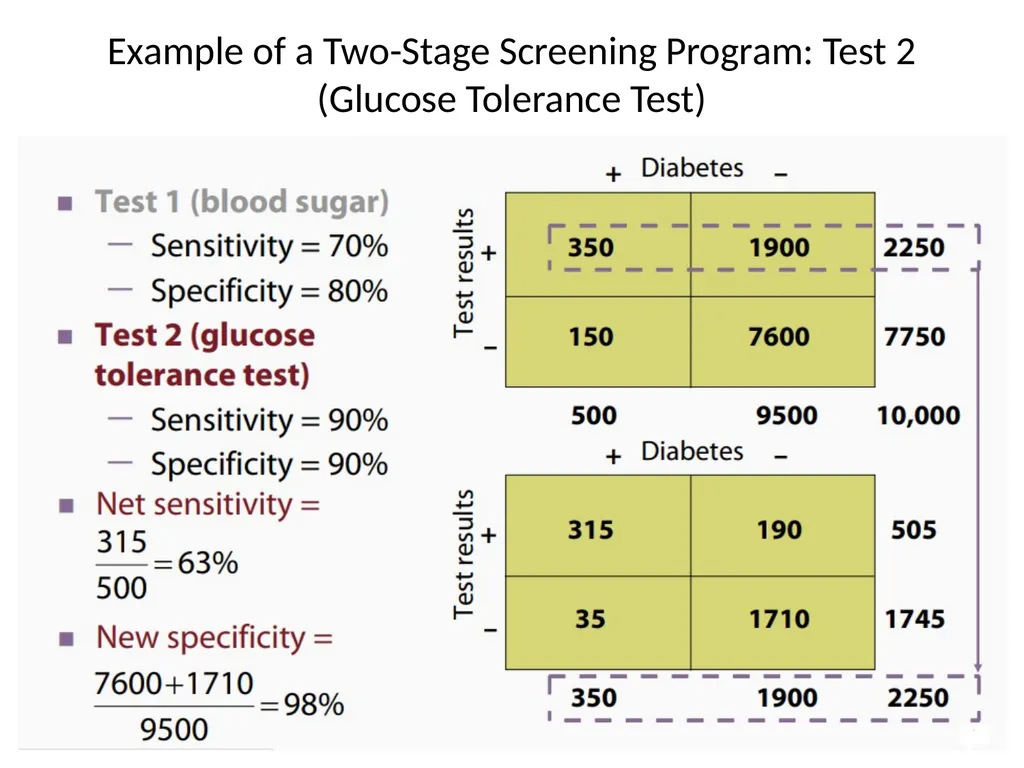
Example of a Two-Stage Screening Program: Test 2 (Glucose Tolerance Test)<br>
32
Two-Stage Screening: Re-Screen the Positives from the First Test<br>
33
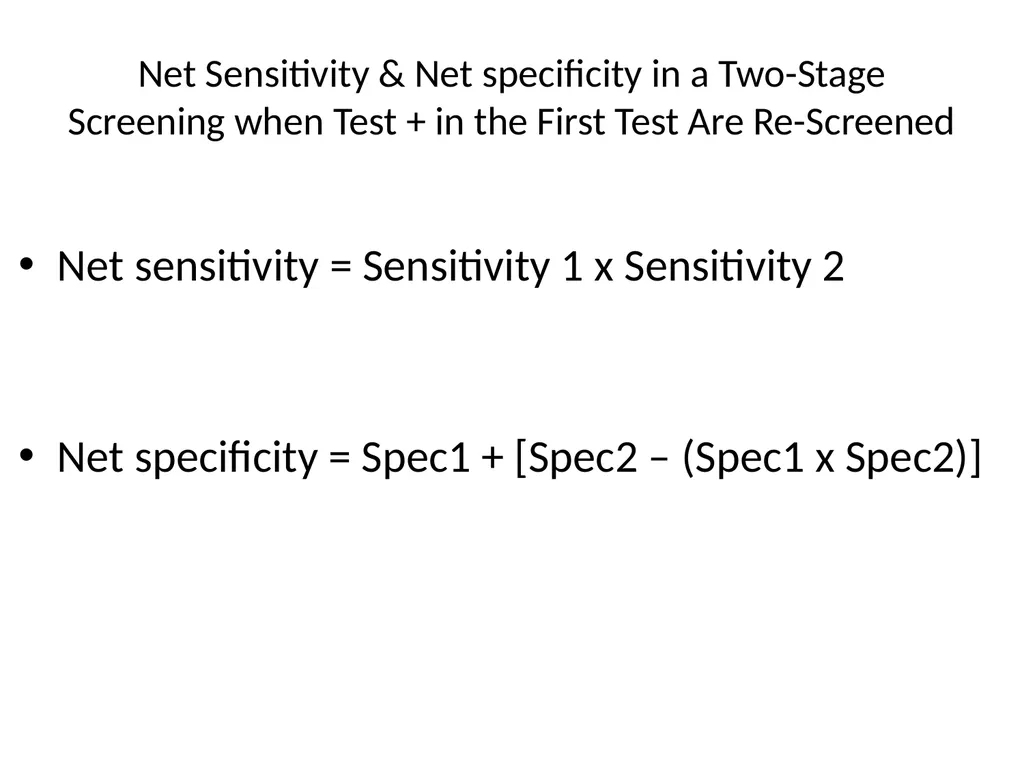
Net Sensitivity & Net specificity in a Two-Stage Screening when Test + in the First Test Are Re-Screened Net sensitivity = Sensitivity 1 x Sensitivity 2
Net specificity = Spec1 + [Spec2 – (Spec1 x Spec2)]<br>
34
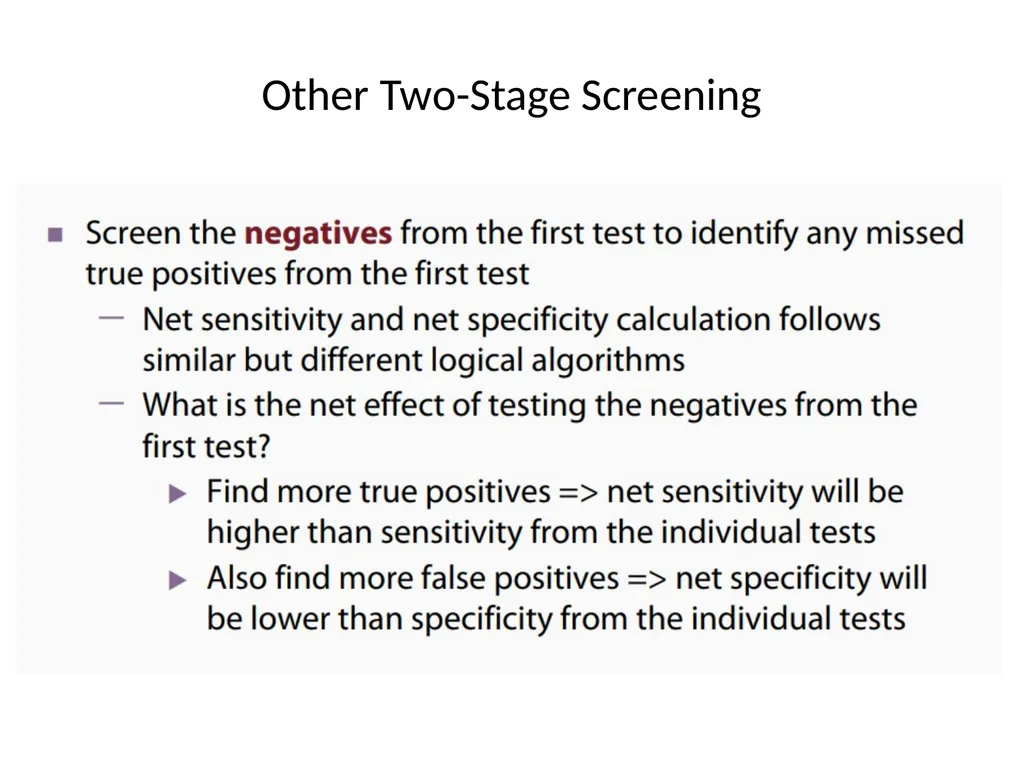
Other Two-Stage Screening<br>
35
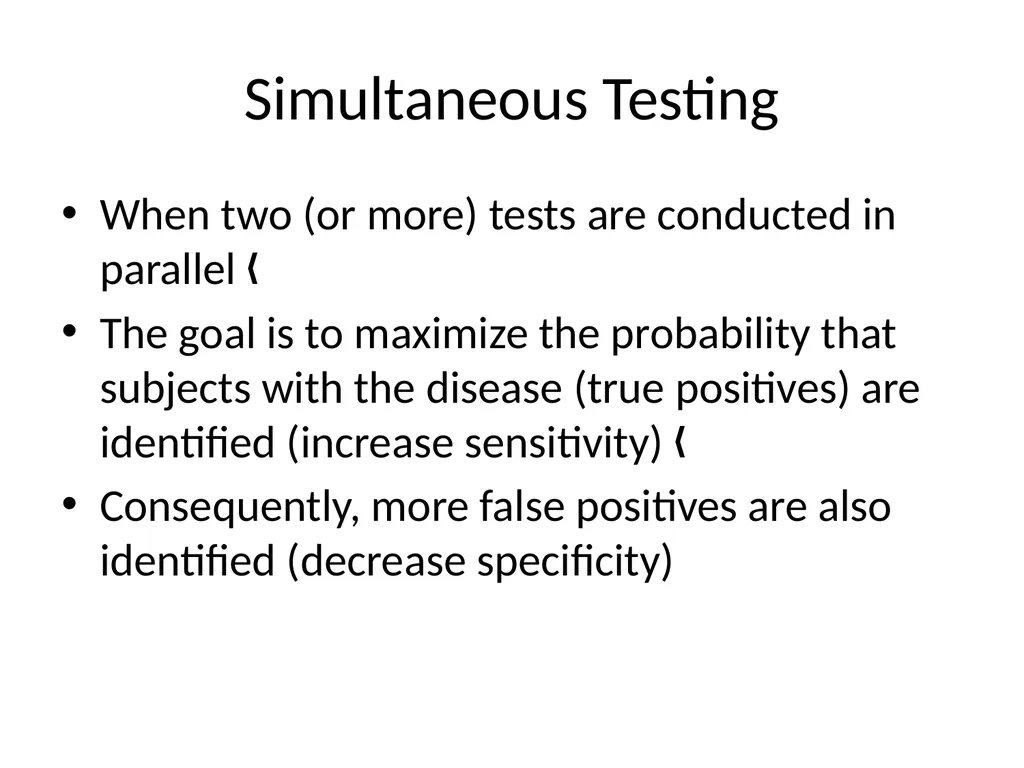
Simultaneous Testing When two (or more) tests are conducted in parallel
The goal is to maximize the probability that subjects with the disease (true positives) are identified (increase sensitivity)
Consequently, more false positives are also identified (decrease specificity)<br>
36
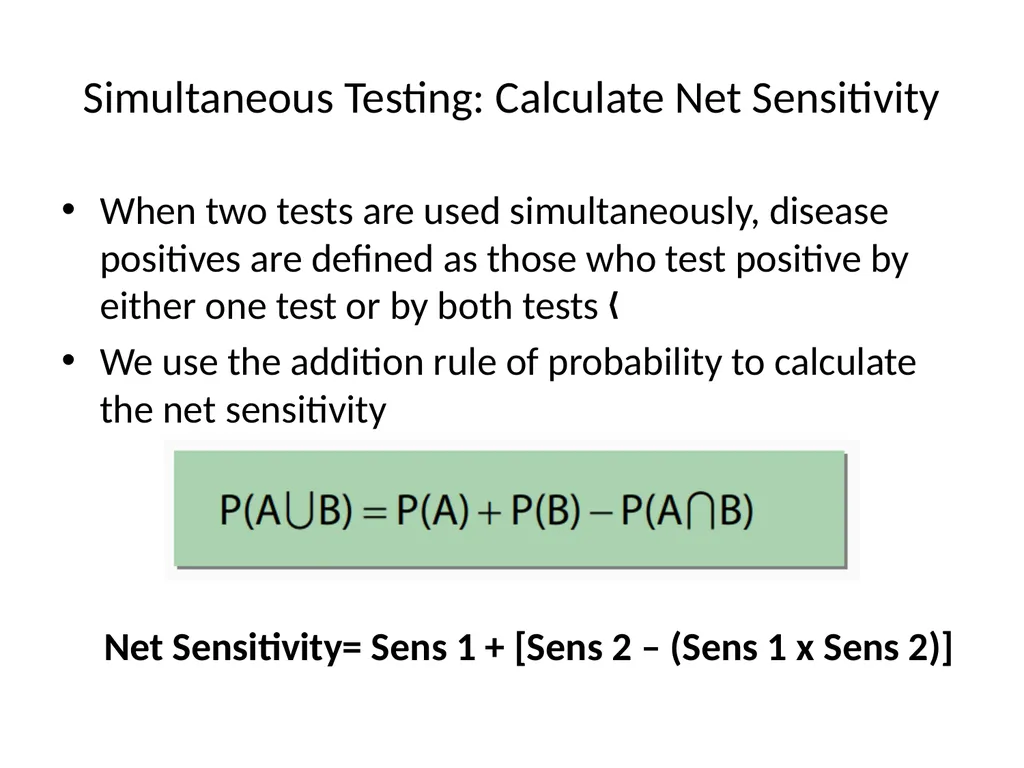
Simultaneous Testing: Calculate Net Sensitivity When two tests are used simultaneously, disease positives are defined as those who test positive by either one test or by both tests
We use the addition rule of probability to calculate the net sensitivity Net Sensitivity= Sens 1 + [Sens 2 – (Sens 1 x Sens 2)]<br>
37
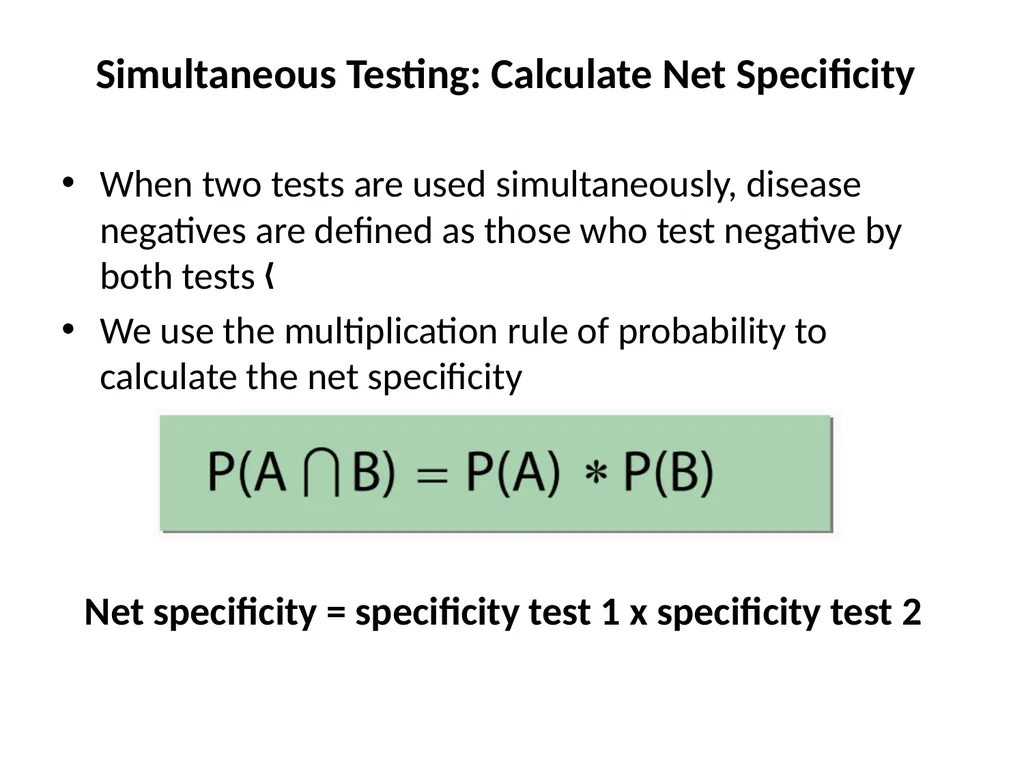
Simultaneous Testing: Calculate Net Specificity When two tests are used simultaneously, disease negatives are defined as those who test negative by both tests
We use the multiplication rule of probability to calculate the net specificity Net specificity = specificity test 1 x specificity test 2<br>
38
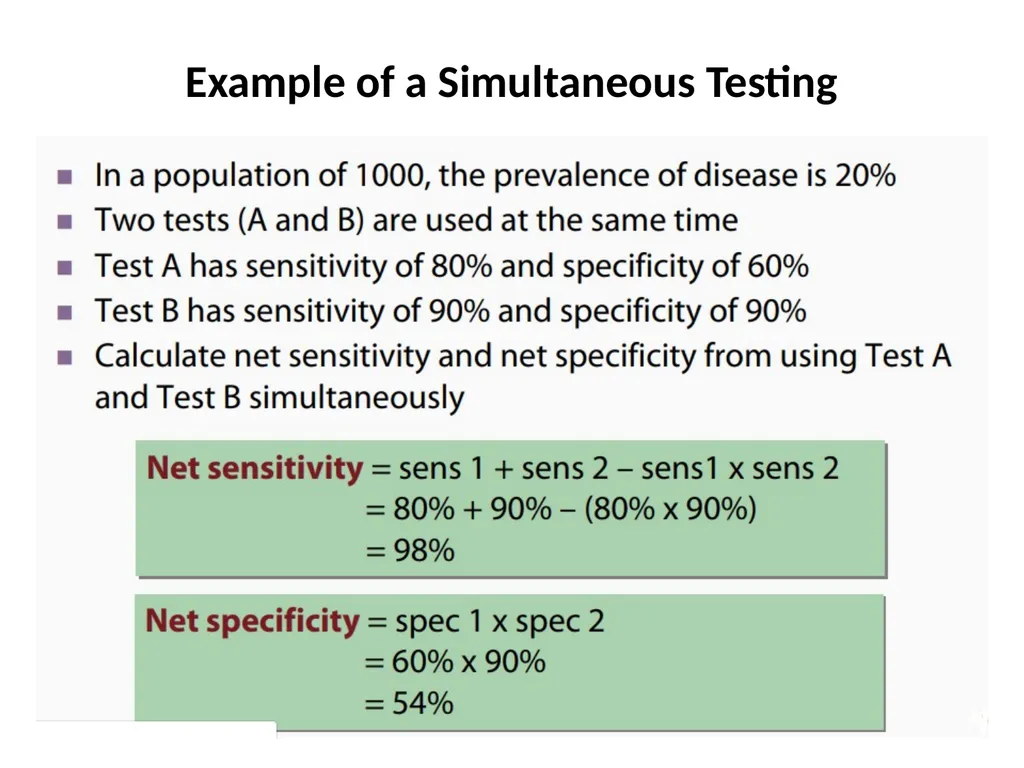
Example of a Simultaneous Testing<br>
39
Net Gain and Net Loss In simultaneous testing, there is a net gain in sensitivity but a net loss in specificity, when compared to either of the tests used
In sequential testing when positives from the first test are retested, there is a net loss in sensitivity but a net gain in specificity, compared to either of the tests used<br>
40
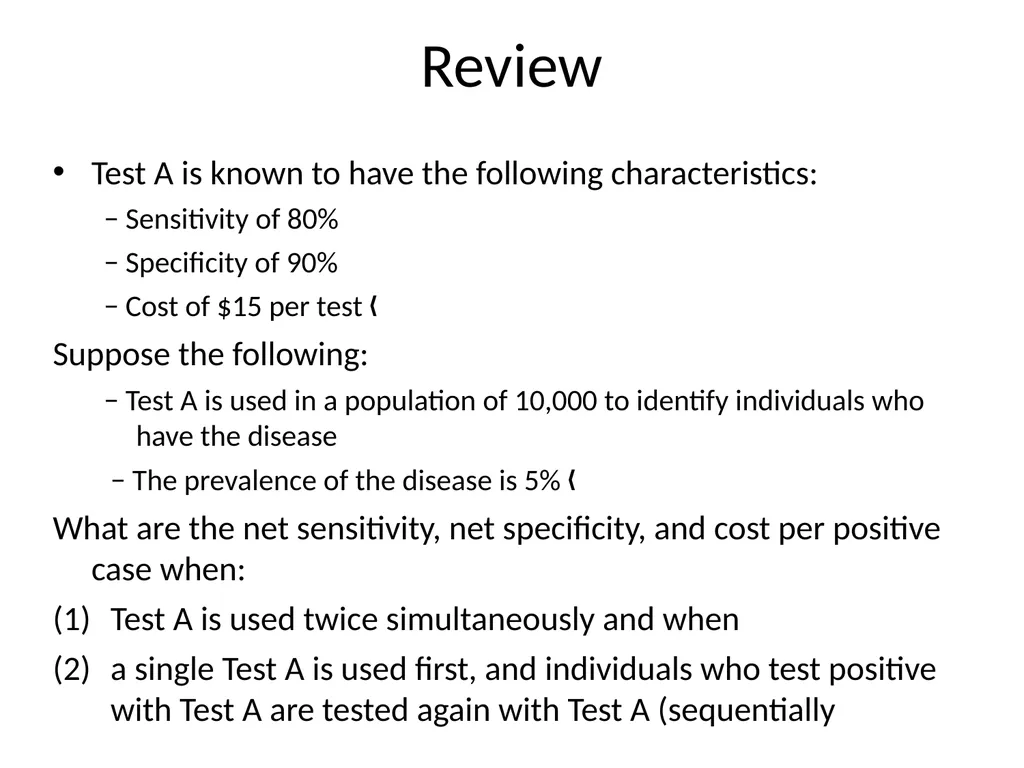
Review Test A is known to have the following characteristics:
− Sensitivity of 80%
− Specificity of 90%
− Cost of $15 per test
Suppose the following:
− Test A is used in a population of 10,000 to identify individuals who have the disease
− The prevalence of the disease is 5%
What are the net sensitivity, net specificity, and cost per positive case when:
Test A is used twice simultaneously and when
a single Test A is used first, and individuals who test positive with Test A are tested again with Test A (sequentially<br>