Value Cost Return which pays: Cost of debt: interest on a construction loan (variable rate 4 to 6.5) Return on equity: return to investors (15 to 20) Developer profit: based on project performance after paying costs of capital. Urban
Related Topics
Share
Embed code
Download this presentation From Below
"Value – Cost =Return which pays: Cost of debt:" is the property of its rightful owner. Permission is granted to
download and print the materials on this website for personal, non-commercial use only, and to display it
on your personal computer provided you do not modify the materials and that you retain all copyright
notices contained in the materials. By downloading content from our website, you accept the terms of this
agreement.
Presentation Transcript
01
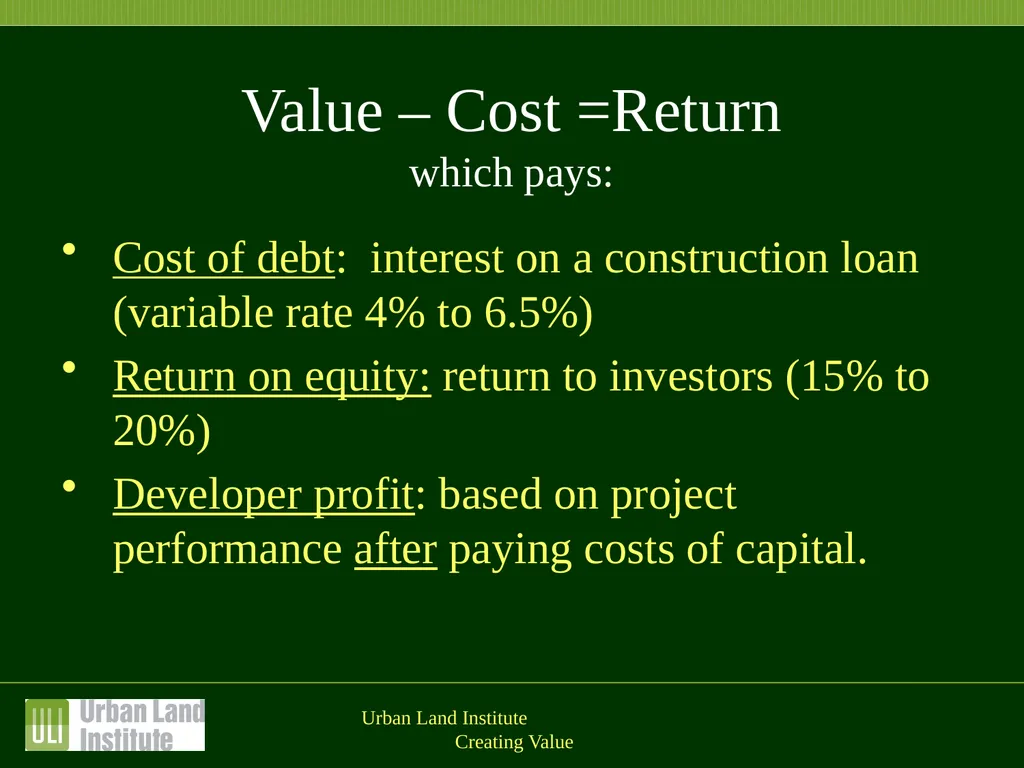
Value – Cost =Return which pays: Cost of debt: interest on a construction loan (variable rate 4% to 6.5%)
Return on equity: return to investors (15% to 20%)
Developer profit: based on project performance after paying costs of capital. Urban Land Institute Creating Value<br>
02
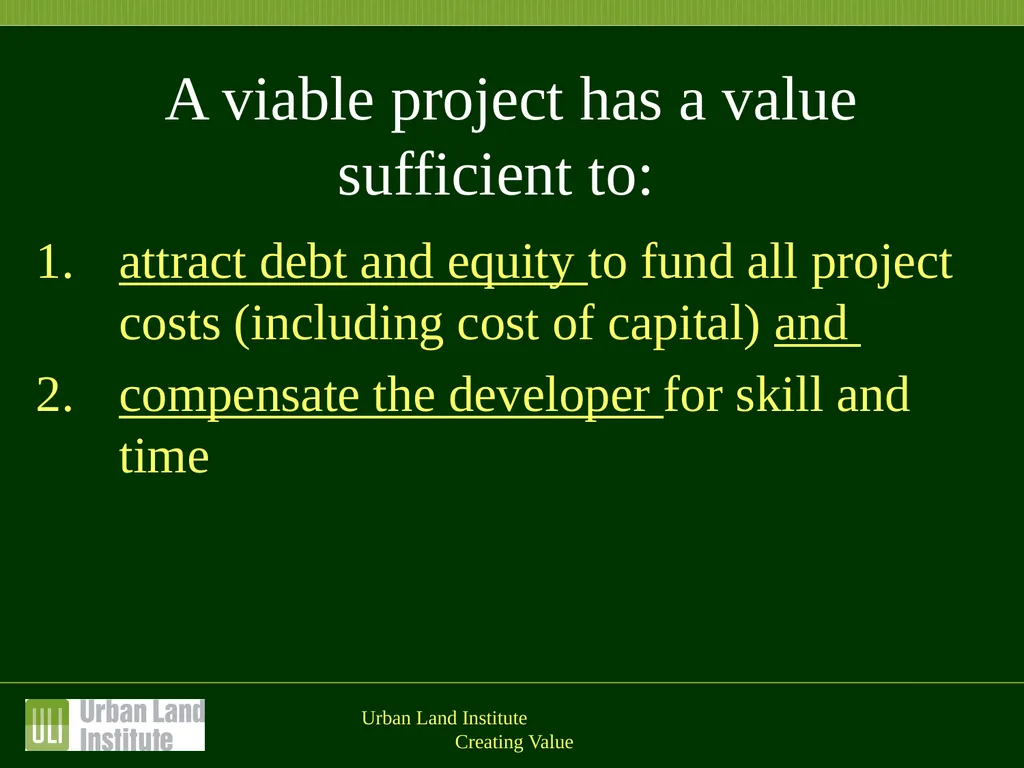
A viable project has a value sufficient to: attract debt and equity to fund all project costs (including cost of capital) and
compensate the developer for skill and time Urban Land Institute Creating Value<br>
03
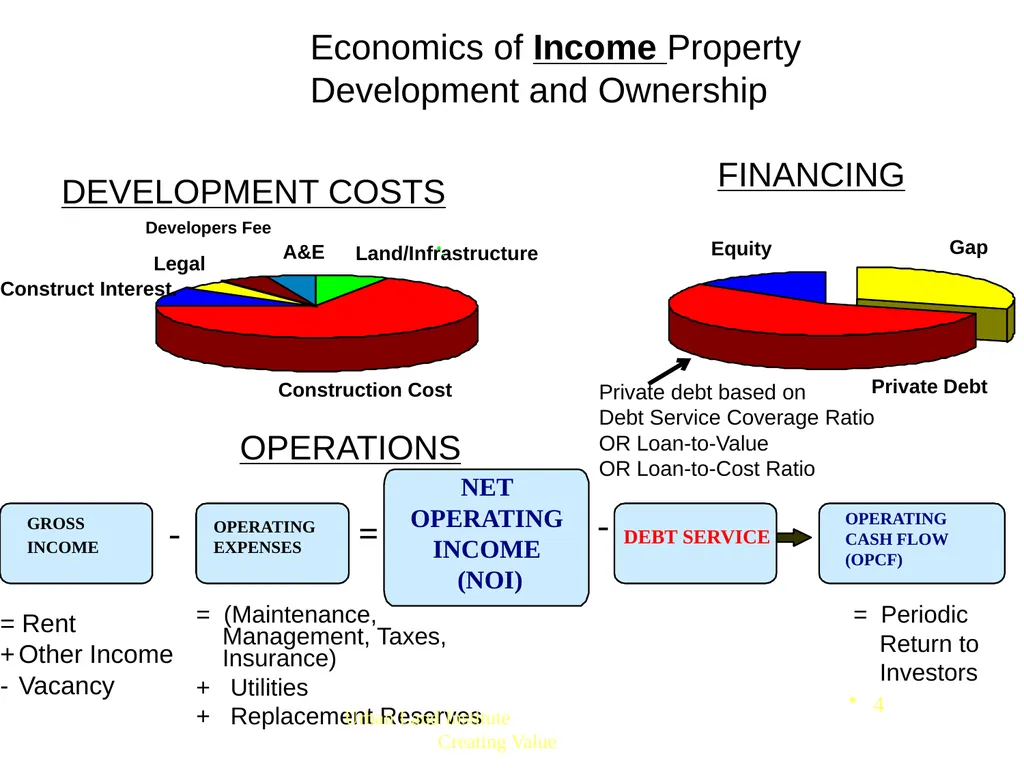
FINANCING DEVELOPMENT COSTS Legal Developers Fee Construction Cost Land/Infrastructure . A&E Construct Interest. Equity Private Debt Gap - = - OPERATIONS OPERATING
EXPENSES NET
OPERATING
INCOME
(NOI) DEBT SERVICE OPERATING
CASH FLOW
(OPCF) = (Maintenance, Management, Taxes, Insurance)
+ Utilities
+ Replacement Reserves = Rent
+ Other Income
- Vacancy Private debt based on
Debt Service Coverage Ratio
OR Loan-to-Value
OR Loan-to-Cost Ratio = Periodic
Return to
Investors Economics of Income Property
Development and Ownership GROSS
INCOME 4 Urban Land Institute Creating Value<br>
04
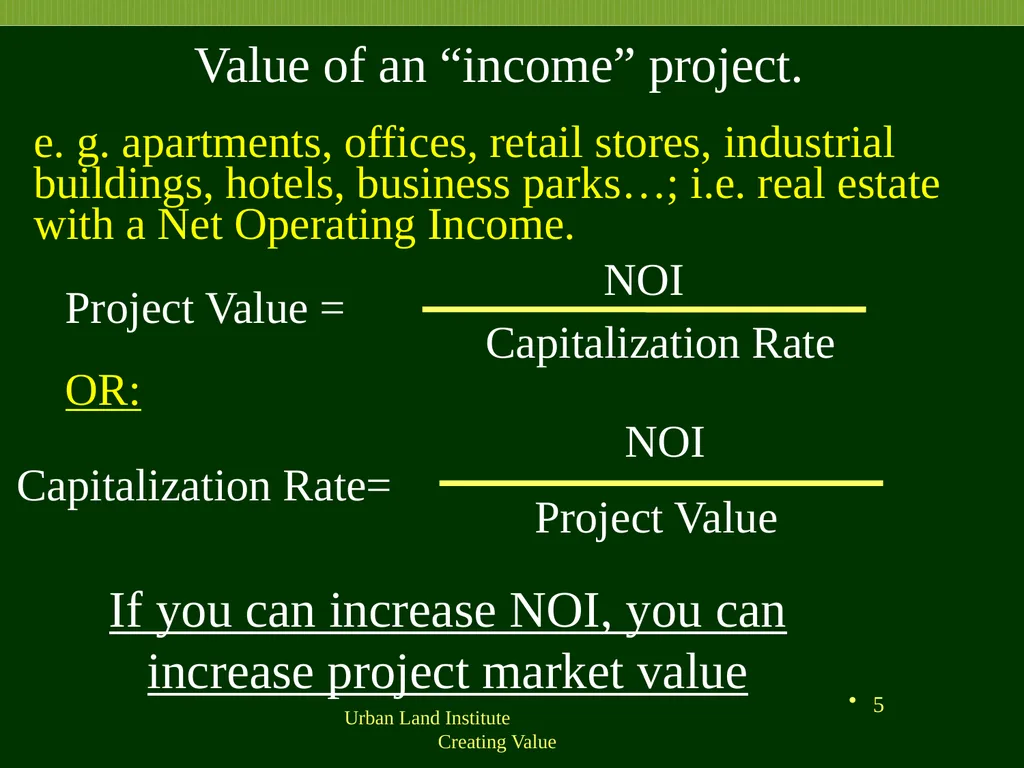
Value of an “income” project. e. g. apartments, offices, retail stores, industrial buildings, hotels, business parks…; i.e. real estate with a Net Operating Income. 5 Project Value = NOI Capitalization Rate Project Value OR: NOI Capitalization Rate= Urban Land Institute Creating Value If you can increase NOI, you can increase project market value<br>
05
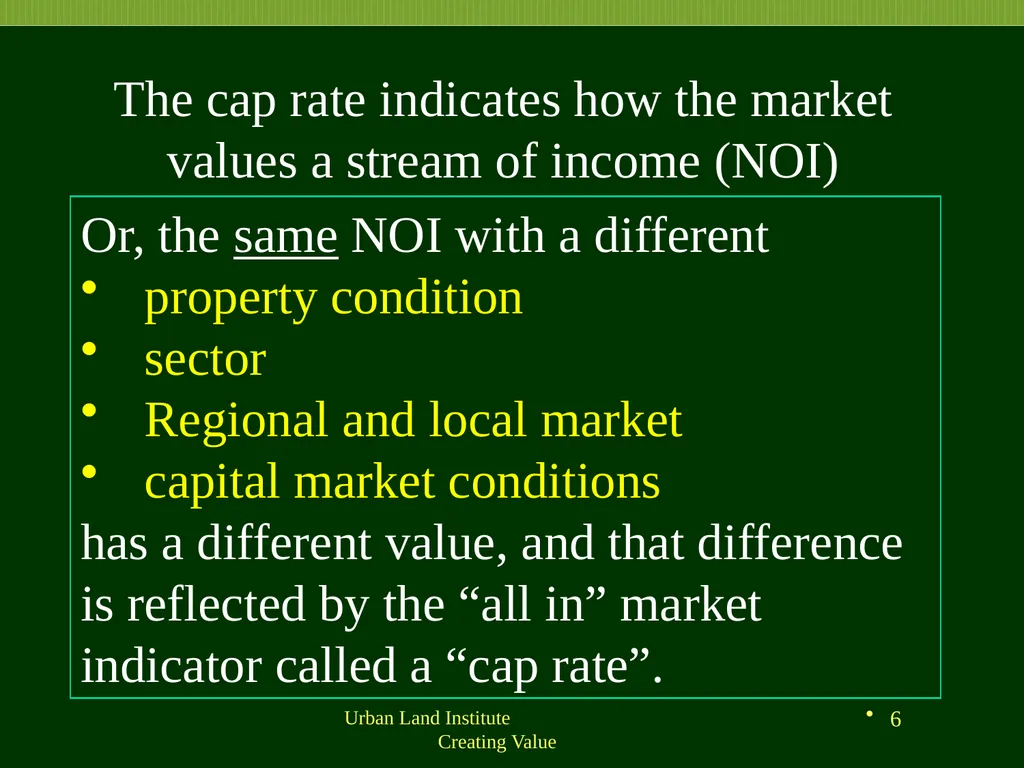
The cap rate indicates how the market values a stream of income (NOI) 6 Or, the same NOI with a different
property condition
sector
Regional and local market
capital market conditions
has a different value, and that difference is reflected by the “all in” market indicator called a “cap rate”. Urban Land Institute Creating Value<br>
06
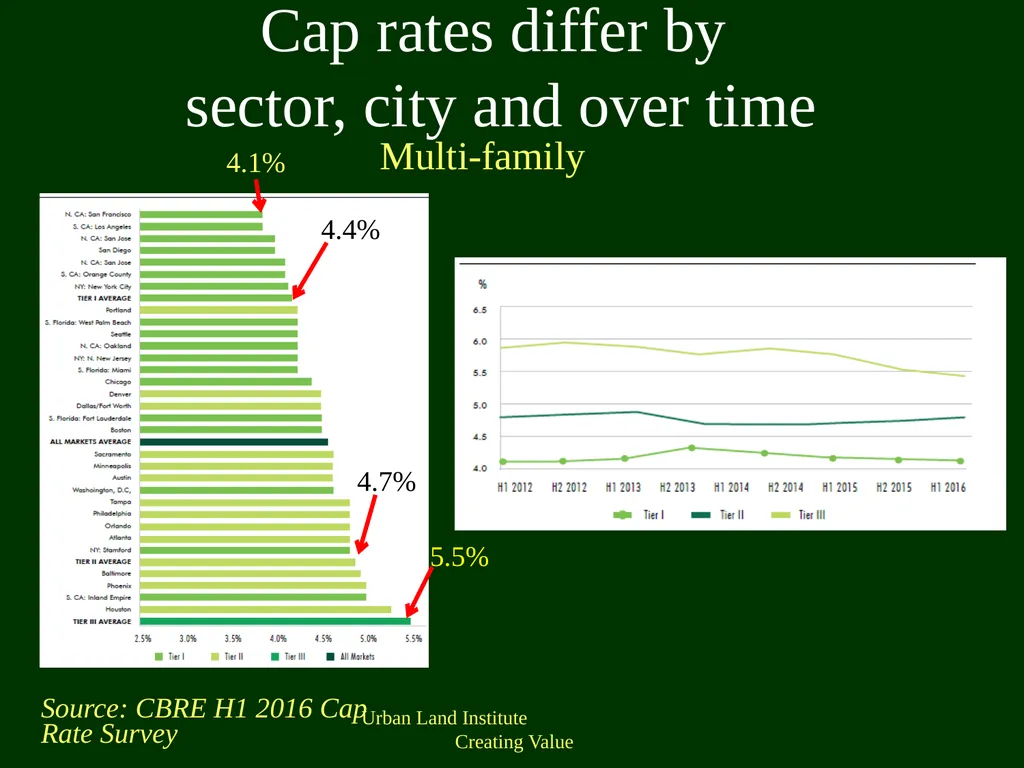
Cap rates differ by sector, city and over time Urban Land Institute Creating Value Source: CBRE H1 2016 Cap Rate Survey Multi-family 4.1% 4.4% 4.7% 5.5%<br>
07
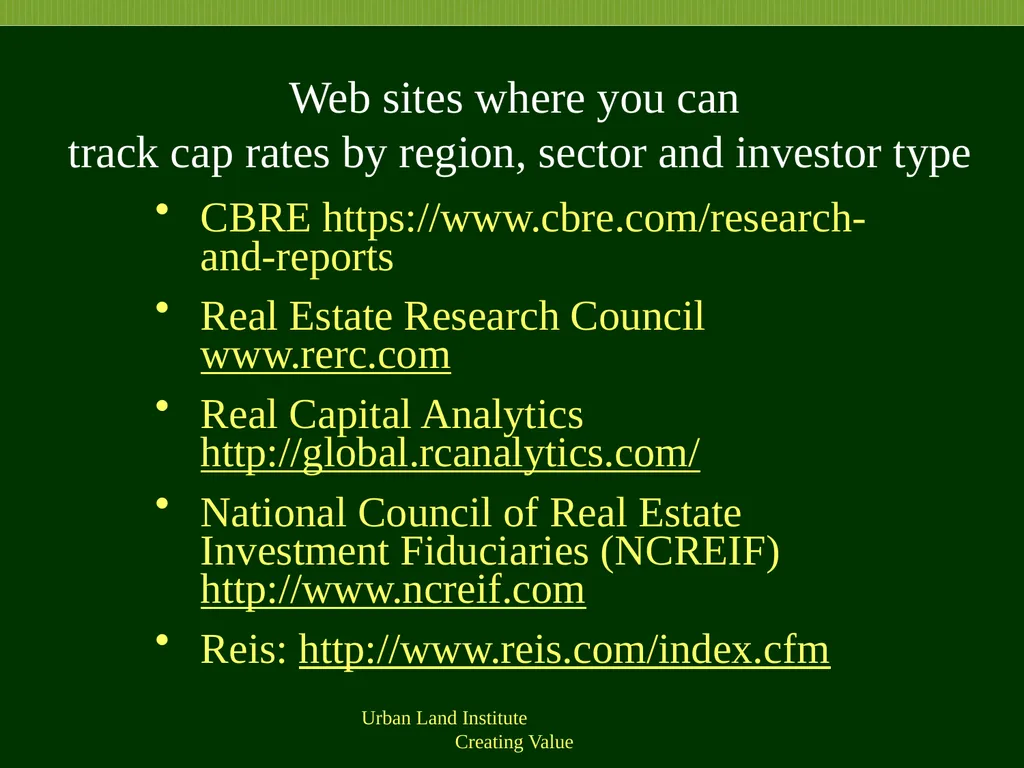
Web sites where you can track cap rates by region, sector and investor type CBRE https://www.cbre.com/research-and-reports
Real Estate Research Council www.rerc.com
Real Capital Analytics http://global.rcanalytics.com/
National Council of Real Estate Investment Fiduciaries (NCREIF) http://www.ncreif.com
Reis: http://www.reis.com/index.cfm Urban Land Institute Creating Value<br>
08
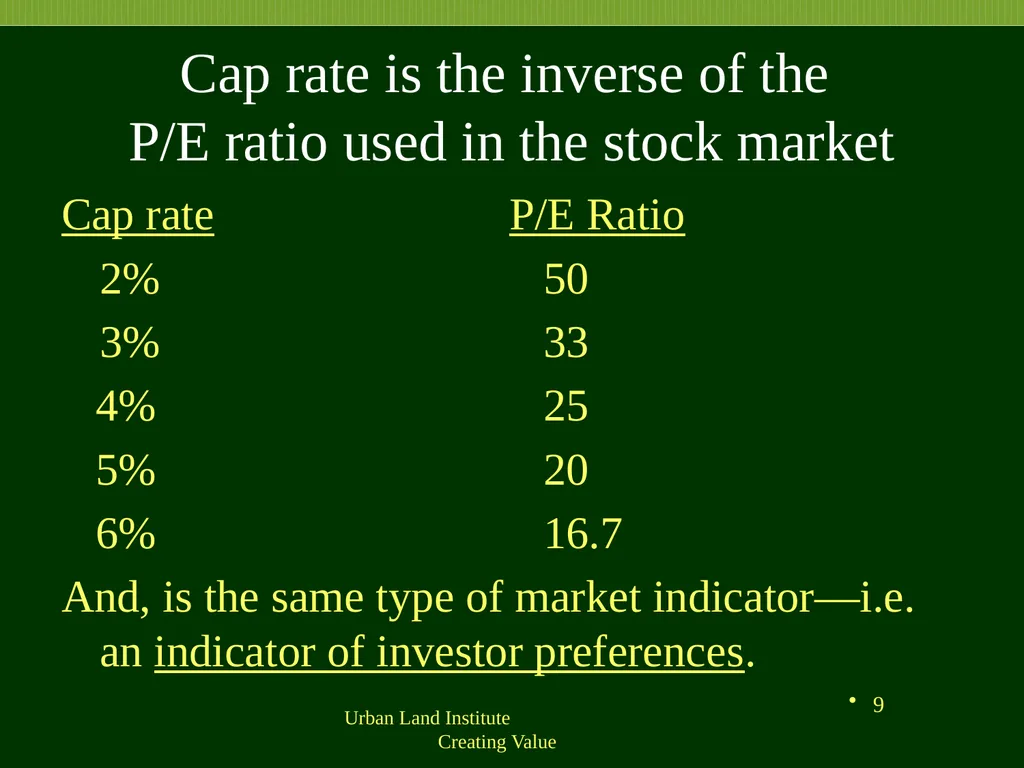
Cap rate P/E Ratio
2% 50
3% 33
4% 25
5% 20
6% 16.7
And, is the same type of market indicator—i.e. an indicator of investor preferences. Cap rate is the inverse of the P/E ratio used in the stock market 9 Urban Land Institute Creating Value<br>
09
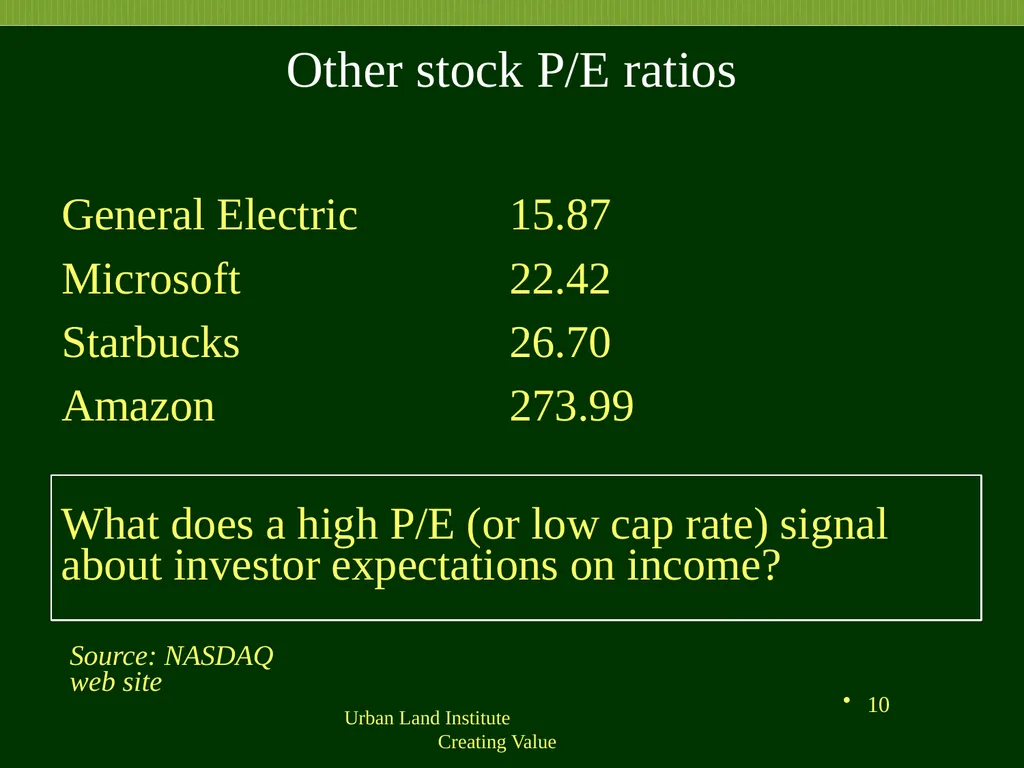
General Electric 15.87
Microsoft 22.42
Starbucks 26.70
Amazon 273.99 Other stock P/E ratios 10 What does a high P/E (or low cap rate) signal about investor expectations on income? Source: NASDAQ web site Urban Land Institute Creating Value<br>
10
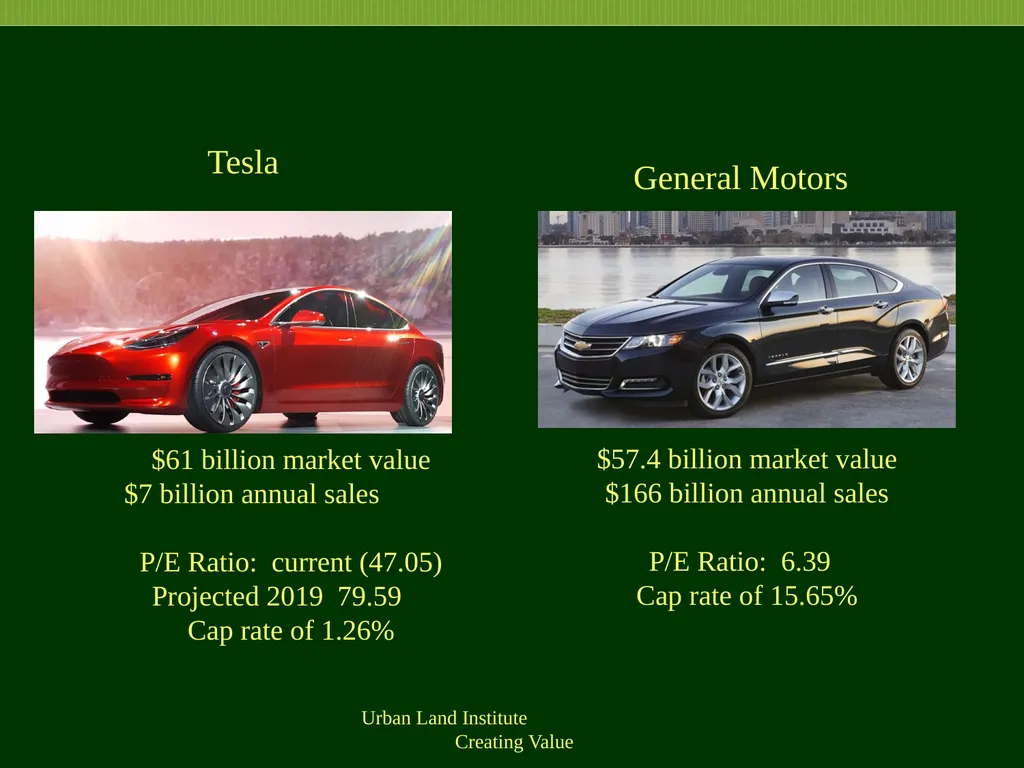
$61 billion market value
$7 billion annual sales
P/E Ratio: current (47.05)
Projected 2019 79.59
Cap rate of 1.26% $57.4 billion market value
$166 billion annual sales
P/E Ratio: 6.39
Cap rate of 15.65% Tesla General Motors Urban Land Institute Creating Value<br>
11
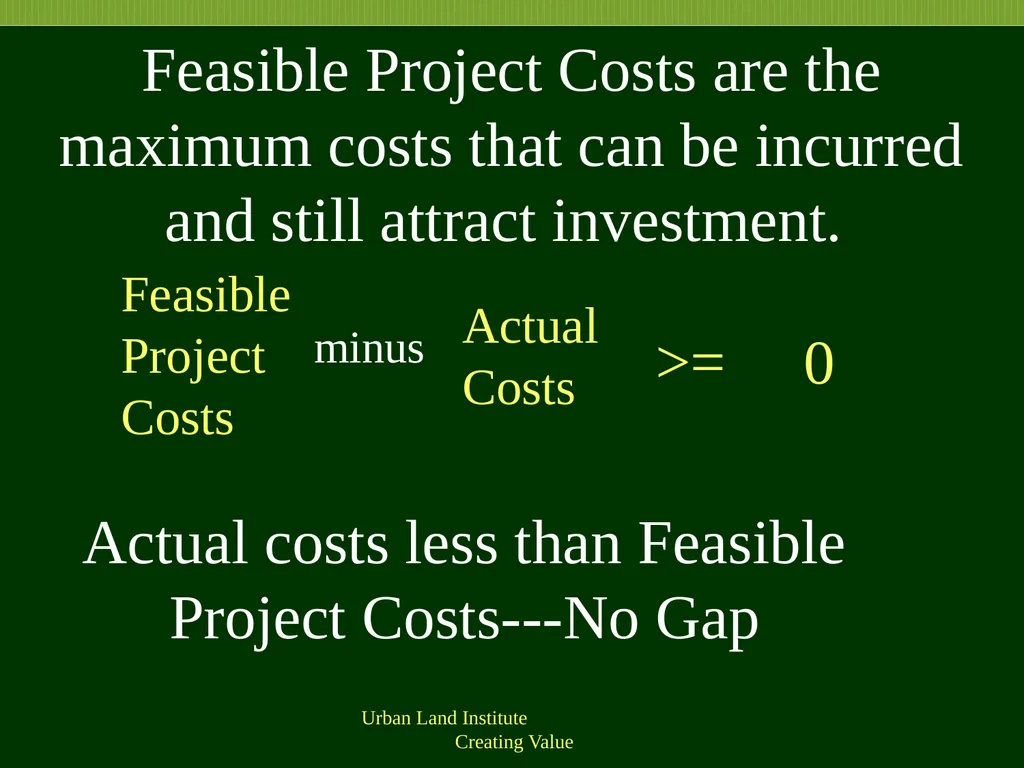
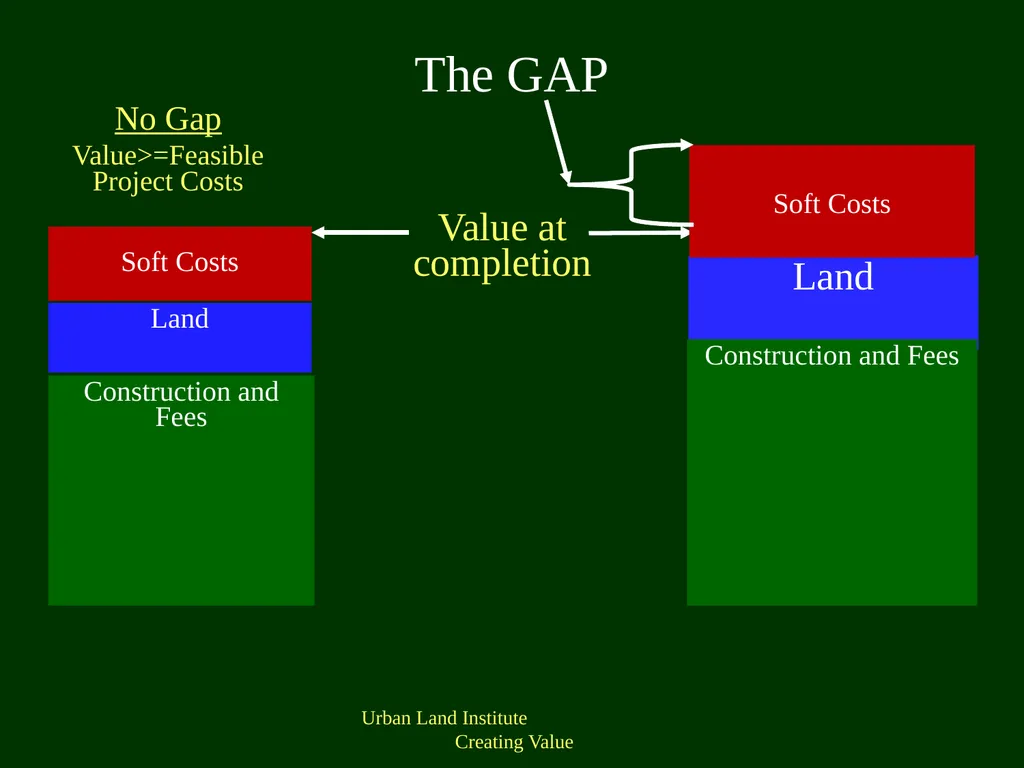
Feasible Project Costs are the maximum costs that can be incurred and still attract investment. Feasible Project Costs Actual costs less than Feasible Project Costs---No Gap Urban Land Institute Creating Value Actual Costs minus >= 0<br>
12
The GAP Soft Costs Land Construction and Fees Land Urban Land Institute Creating Value Value at completion Construction and Fees No Gap
Value>=Feasible Project Costs Soft Costs<br>
13
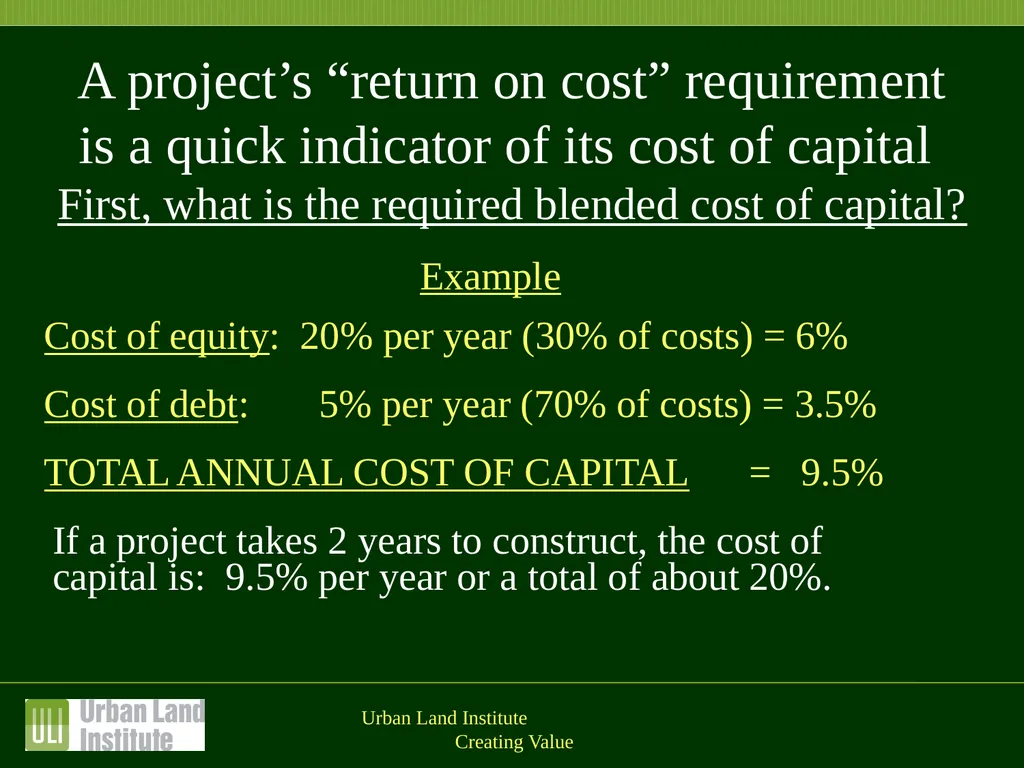
A project’s “return on cost” requirement is a quick indicator of its cost of capital First, what is the required blended cost of capital? Example Cost of equity: 20% per year (30% of costs) = 6% Cost of debt: 5% per year (70% of costs) = 3.5% TOTAL ANNUAL COST OF CAPITAL = 9.5% If a project takes 2 years to construct, the cost of capital is: 9.5% per year or a total of about 20%. Urban Land Institute Creating Value<br>
14
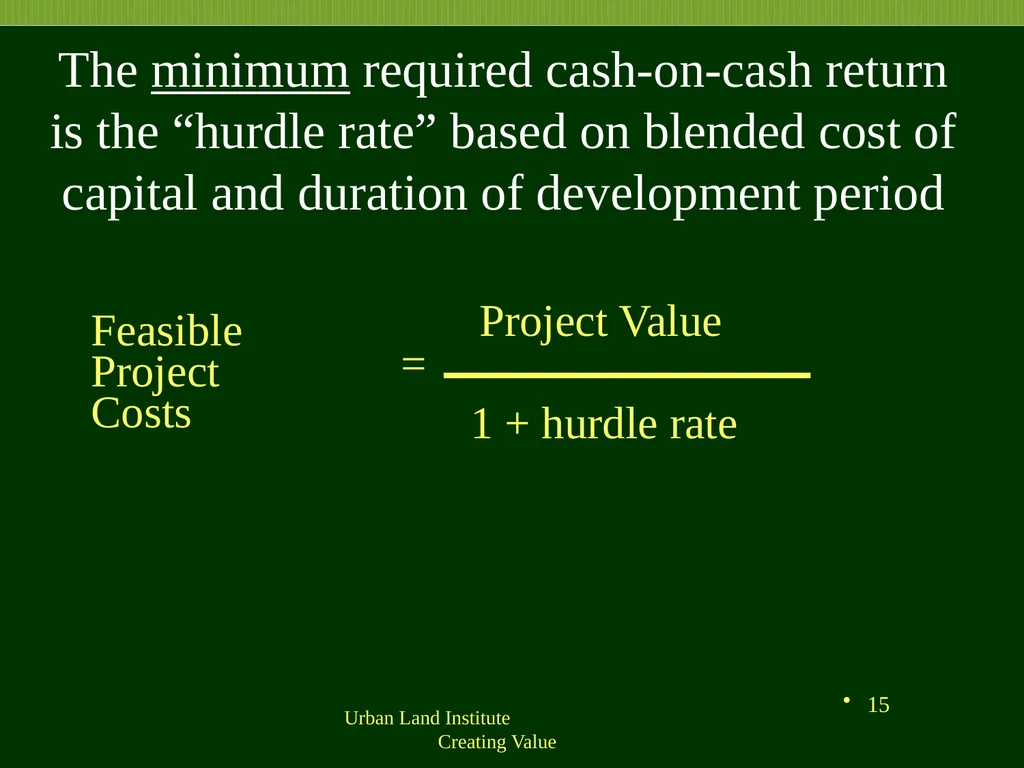
The minimum required cash-on-cash return is the “hurdle rate” based on blended cost of capital and duration of development period Feasible Project Costs = Project Value 1 + hurdle rate 15 Urban Land Institute Creating Value<br>
15
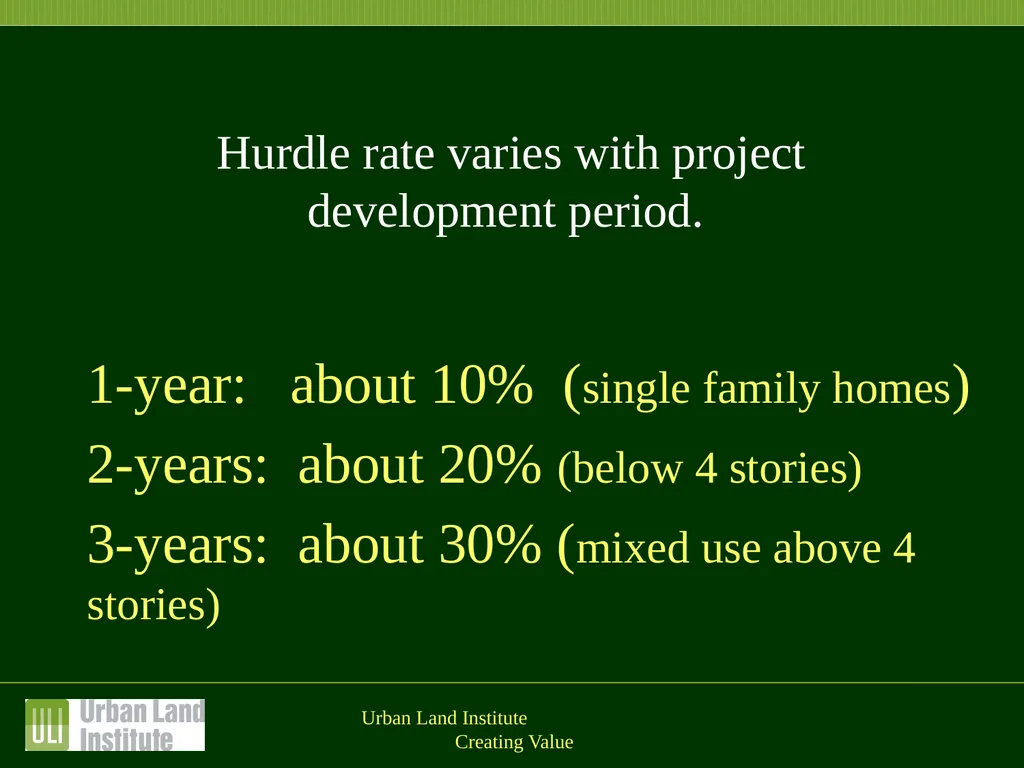
Hurdle rate varies with project development period. 1-year: about 10% (single family homes)
2-years: about 20% (below 4 stories)
3-years: about 30% (mixed use above 4 stories) Urban Land Institute Creating Value<br>
16
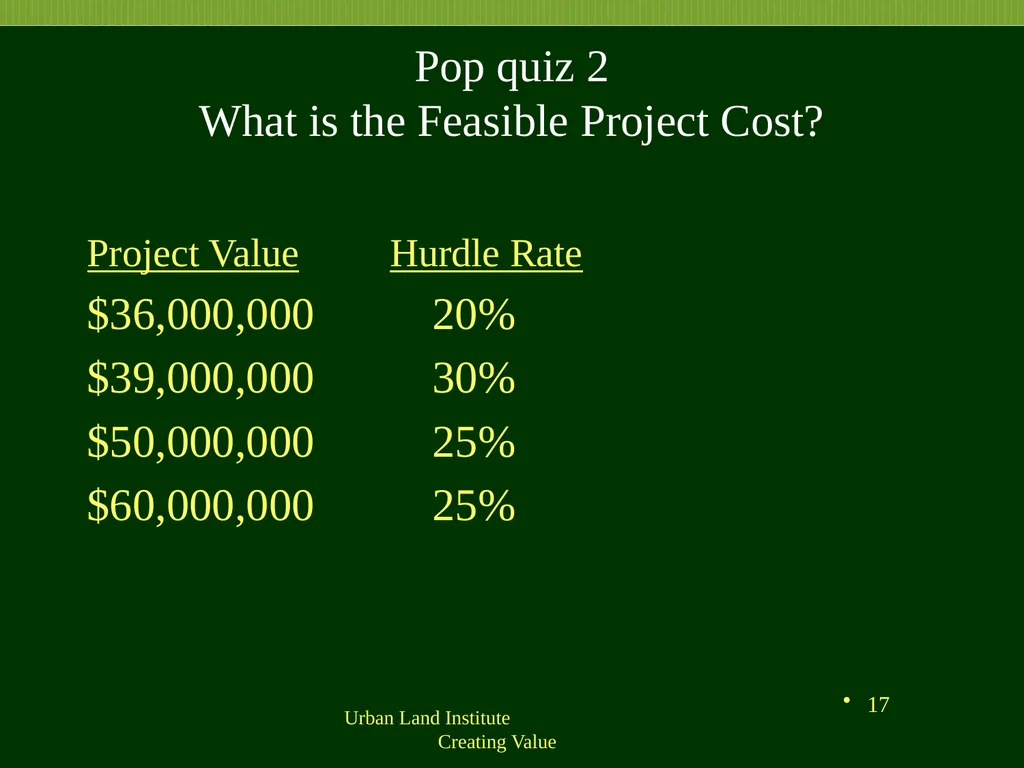
Pop quiz 2 What is the Feasible Project Cost? Project Value Hurdle Rate
$36,000,000 20%
$39,000,000 30%
$50,000,000 25%
$60,000,000 25% 17 Urban Land Institute Creating Value<br>
17
18 Urban Land Institute Creating Value Hinescompetition@uli.org<br>