
VARIOUS TECHNIQUES FOR COUNTERFEIT CURRENCY

Description: VARIOUS TECHNIQUES FOR COUNTERFEIT CURRENCY DETECTION : Presented by Akanksha Upadhyaya Research Scholar, AIIT, Amity University Under the Guidance of: Dr. Vinod Shokeen Dr. Garima Srivastava OUTLINE OF PRESENTATION Rationale of study
Related Topics
Download Presentation
"VARIOUS TECHNIQUES FOR COUNTERFEIT CURRENCY" is the property of its rightful owner. Permission is granted to download and print the materials on this website for personal, non-commercial use only, and to display it on your personal computer provided you do not modify the materials and that you retain all copyright notices contained in the materials. By downloading content from our website, you accept the terms of this agreement.
Presentation Transcript
slide1. VARIOUS TECHNIQUES FOR COUNTERFEIT CURRENCY DETECTION : Presented by
Akanksha Upadhyaya
Research Scholar, AIIT,
Amity University Under the Guidance of:
Dr. Vinod Shokeen
Dr. Garima Srivastava<br>
slide2. OUTLINE OF PRESENTATION Rationale of study
Overview: about the problem
Purpose of study
Research Questions
Introduction to related terms
Review brief
Findings
Conclusion and Future scope
References<br>
slide3. To explore various counterfeit detection techniques along with
their respective accuracy rate.
Part of PhD work RATIONALE OF STUDY<br>
slide4. OVERVIEW Currency counterfeiting is always been a challenging term for financial system of any country. The problem of counterfeiting majorly affects the economical as well as financial growth of a country; the race is going on between the counterfeiters and the banks. To resolve the issue various researchers came across with variety of techniques and proposed solutions mostly focused on Machine learning and Image processing areas.<br>
slide5. PURPOSE OF STUDY To identify counterfeit detection techniques from the area of machine learning, image processing and pattern recognition.
2. To identify the respective accuracy rate and a feature on which the technique was implemented.<br>
slide6. RESEARCH QUESTIONS? What are the various techniques which have been implemented using a country specific feature?
What is the accuracy rate of each implementation?
Which is the area taken into consideration most of the time.<br>
slide7. INTRODUCTION TO TECHNICAL TERMS Counterfeiting
Accuracy rate
Soiled currency
Machine learning: Supervised vs. Unsupervised
Image processing and pattern recognition<br>
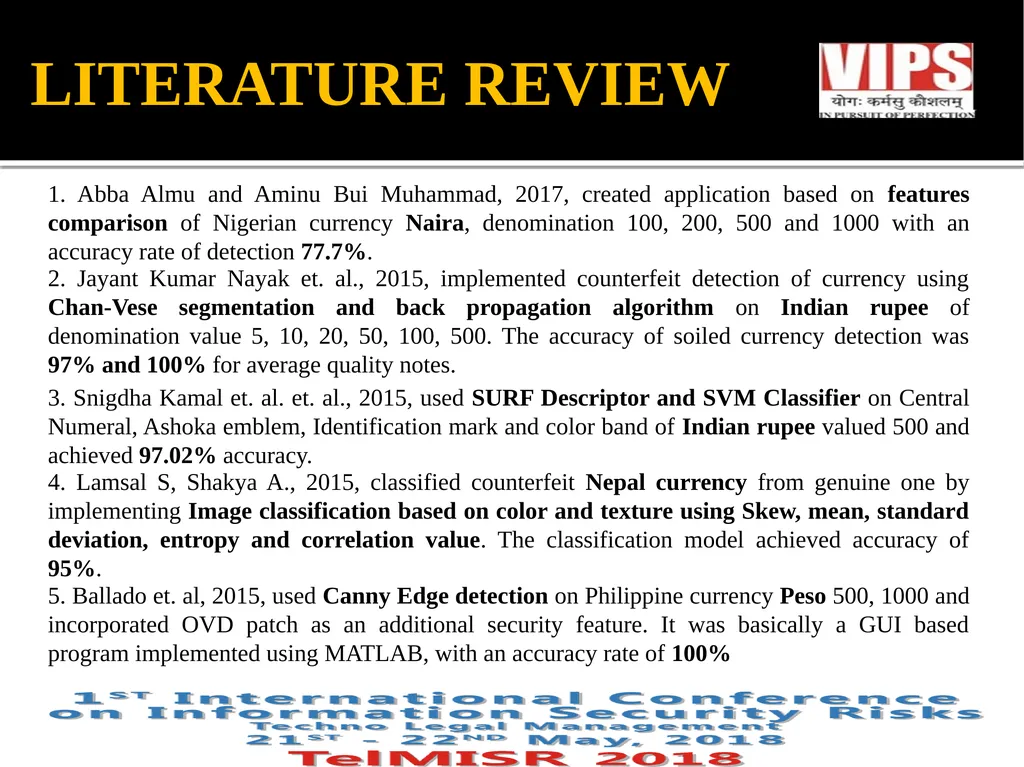
slide8. LITERATURE REVIEW 1. Abba Almu and Aminu Bui Muhammad, 2017, created application based on features comparison of Nigerian currency Naira, denomination 100, 200, 500 and 1000 with an accuracy rate of detection 77.7%. 2. Jayant Kumar Nayak et. al., 2015, implemented counterfeit detection of currency using Chan-Vese segmentation and back propagation algorithm on Indian rupee of denomination value 5, 10, 20, 50, 100, 500. The accuracy of soiled currency detection was 97% and 100% for average quality notes. 3. Snigdha Kamal et. al. et. al., 2015, used SURF Descriptor and SVM Classifier on Central Numeral, Ashoka emblem, Identification mark and color band of Indian rupee valued 500 and achieved 97.02% accuracy. 4. Lamsal S, Shakya A., 2015, classified counterfeit Nepal currency from genuine one by implementing Image classification based on color and texture using Skew, mean, standard deviation, entropy and correlation value. The classification model achieved accuracy of 95%. 5. Ballado et. al, 2015, used Canny Edge detection on Philippine currency Peso 500, 1000 and incorporated OVD patch as an additional security feature. It was basically a GUI based program implemented using MATLAB, with an accuracy rate of 100%<br>
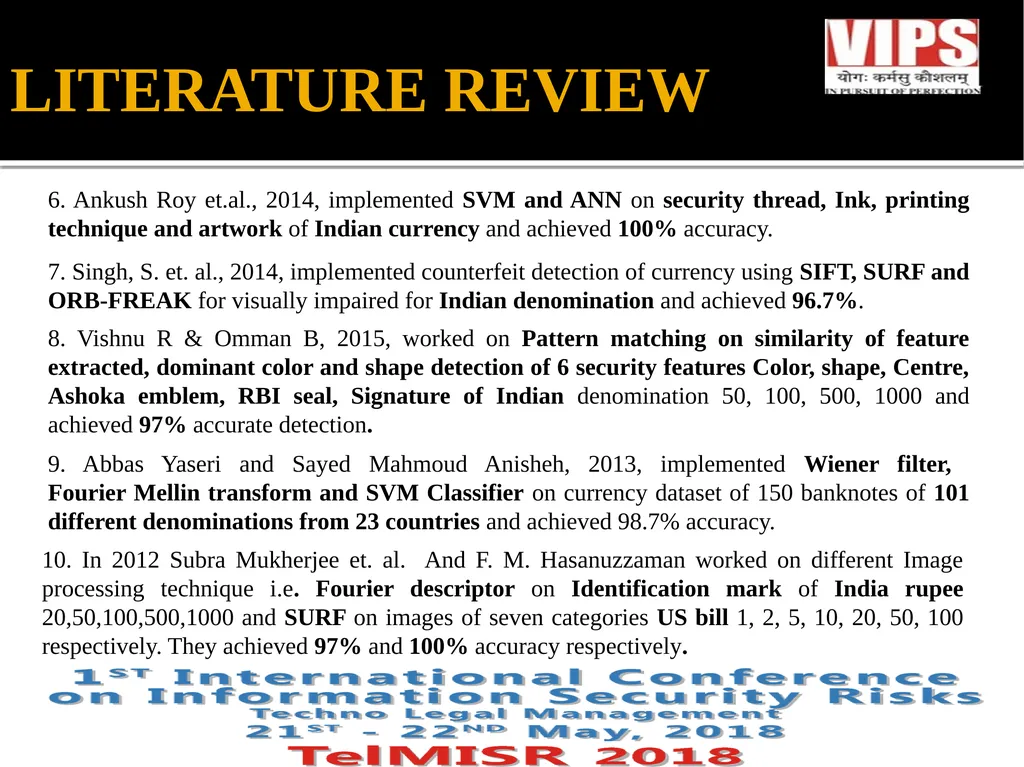
slide9. LITERATURE REVIEW 6. Ankush Roy et.al., 2014, implemented SVM and ANN on security thread, Ink, printing technique and artwork of Indian currency and achieved 100% accuracy. 7. Singh, S. et. al., 2014, implemented counterfeit detection of currency using SIFT, SURF and ORB-FREAK for visually impaired for Indian denomination and achieved 96.7%. 8. Vishnu R & Omman B, 2015, worked on Pattern matching on similarity of feature extracted, dominant color and shape detection of 6 security features Color, shape, Centre, Ashoka emblem, RBI seal, Signature of Indian denomination 50, 100, 500, 1000 and achieved 97% accurate detection. 9. Abbas Yaseri and Sayed Mahmoud Anisheh, 2013, implemented Wiener filter, Fourier Mellin transform and SVM Classifier on currency dataset of 150 banknotes of 101 different denominations from 23 countries and achieved 98.7% accuracy. 10. In 2012 Subra Mukherjee et. al. And F. M. Hasanuzzaman worked on different Image processing technique i.e. Fourier descriptor on Identification mark of India rupee 20,50,100,500,1000 and SURF on images of seven categories US bill 1, 2, 5, 10, 20, 50, 100 respectively. They achieved 97% and 100% accuracy respectively.<br>
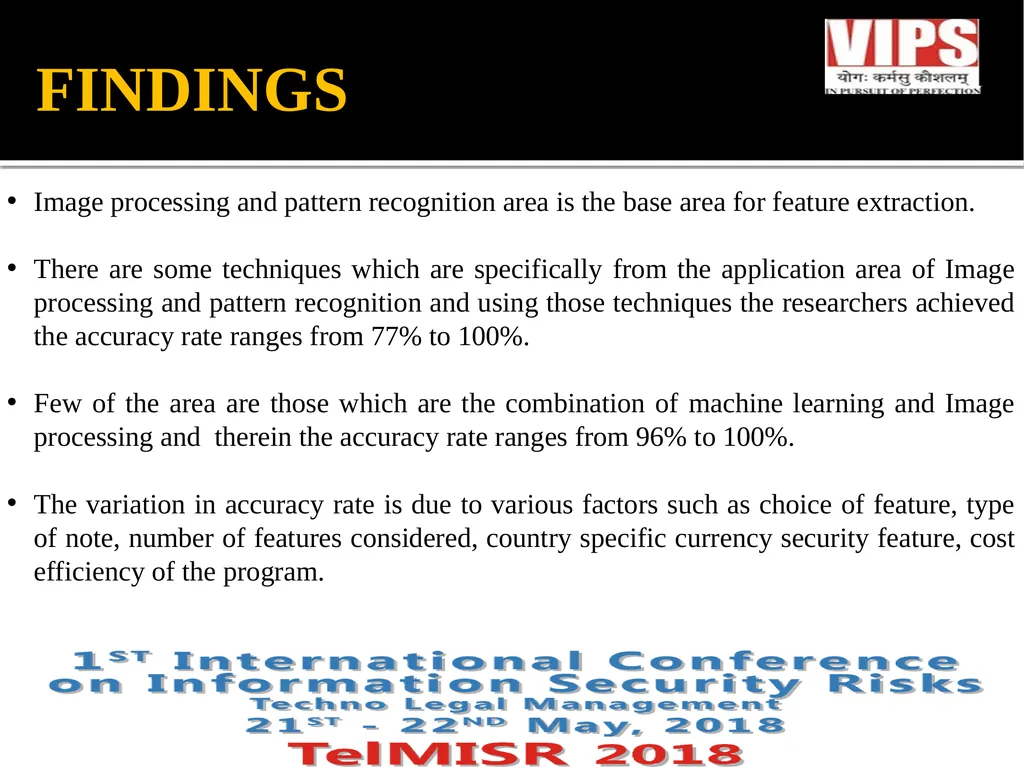
slide10. FINDINGS Image processing and pattern recognition area is the base area for feature extraction.
There are some techniques which are specifically from the application area of Image processing and pattern recognition and using those techniques the researchers achieved the accuracy rate ranges from 77% to 100%.
Few of the area are those which are the combination of machine learning and Image processing and therein the accuracy rate ranges from 96% to 100%.
The variation in accuracy rate is due to various factors such as choice of feature, type of note, number of features considered, country specific currency security feature, cost efficiency of the program.<br>
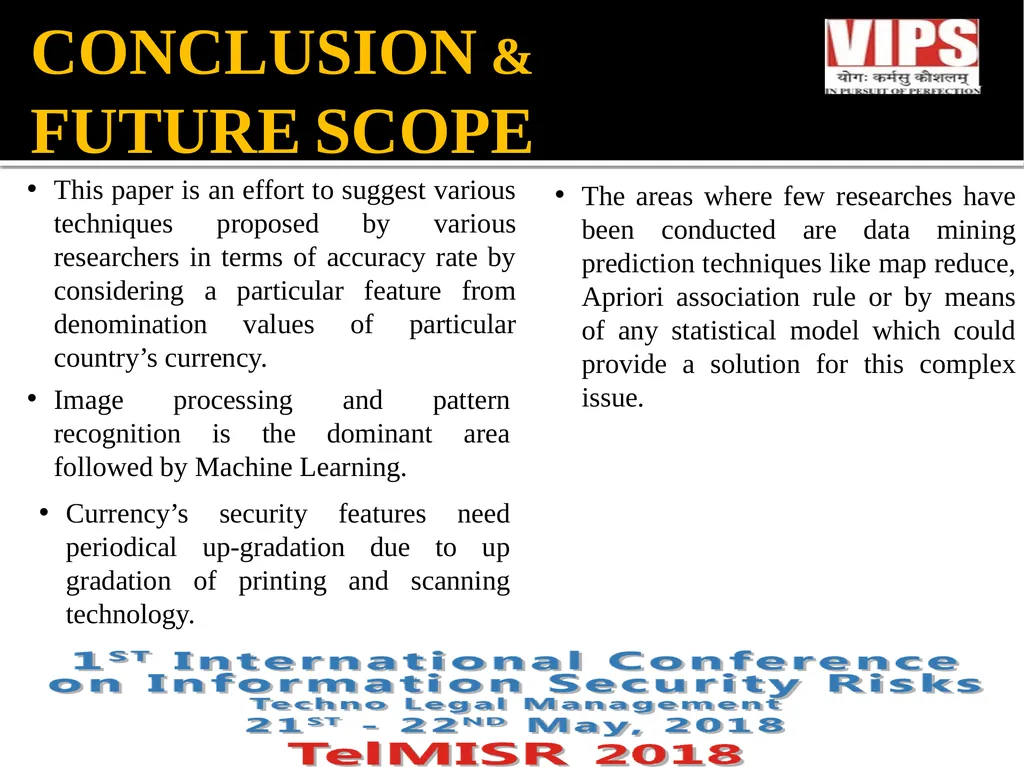
slide11. CONCLUSION & FUTURE SCOPE This paper is an effort to suggest various techniques proposed by various researchers in terms of accuracy rate by considering a particular feature from denomination values of particular country’s currency. Image processing and pattern recognition is the dominant area followed by Machine Learning. Currency’s security features need periodical up-gradation due to up gradation of printing and scanning technology. The areas where few researches have been conducted are data mining prediction techniques like map reduce, Apriori association rule or by means of any statistical model which could provide a solution for this complex issue.<br>
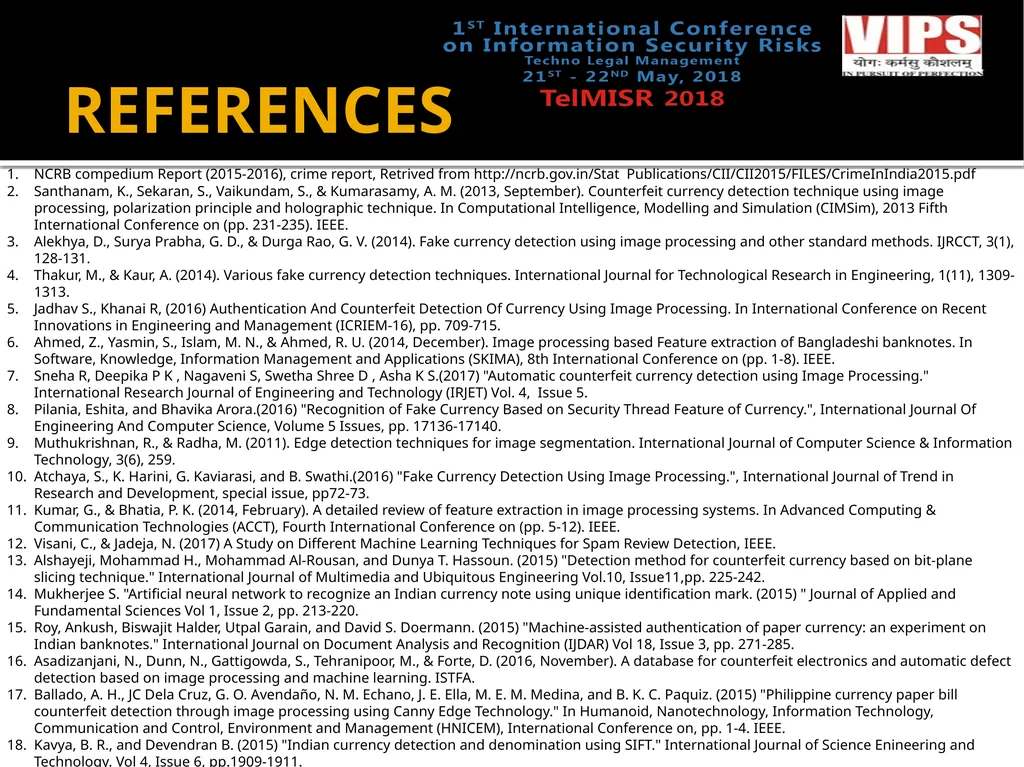
slide12. NCRB compedium Report (2015-2016), crime report, Retrived from http://ncrb.gov.in/Stat Publications/CII/CII2015/FILES/CrimeInIndia2015.pdf
Santhanam, K., Sekaran, S., Vaikundam, S., & Kumarasamy, A. M. (2013, September). Counterfeit currency detection technique using image processing, polarization principle and holographic technique. In Computational Intelligence, Modelling and Simulation (CIMSim), 2013 Fifth International Conference on (pp. 231-235). IEEE.
Alekhya, D., Surya Prabha, G. D., & Durga Rao, G. V. (2014). Fake currency detection using image processing and other standard methods. IJRCCT, 3(1), 128-131.
Thakur, M., & Kaur, A. (2014). Various fake currency detection techniques. International Journal for Technological Research in Engineering, 1(11), 1309-1313.
Jadhav S., Khanai R, (2016) Authentication And Counterfeit Detection Of Currency Using Image Processing. In International Conference on Recent Innovations in Engineering and Management (ICRIEM-16), pp. 709-715.
Ahmed, Z., Yasmin, S., Islam, M. N., & Ahmed, R. U. (2014, December). Image processing based Feature extraction of Bangladeshi banknotes. In Software, Knowledge, Information Management and Applications (SKIMA), 8th International Conference on (pp. 1-8). IEEE.
Sneha R, Deepika P K , Nagaveni S, Swetha Shree D , Asha K S.(2017) "Automatic counterfeit currency detection using Image Processing." International Research Journal of Engineering and Technology (IRJET) Vol. 4, Issue 5.
Pilania, Eshita, and Bhavika Arora.(2016) "Recognition of Fake Currency Based on Security Thread Feature of Currency.", International Journal Of Engineering And Computer Science, Volume 5 Issues, pp. 17136-17140.
Muthukrishnan, R., & Radha, M. (2011). Edge detection techniques for image segmentation. International Journal of Computer Science & Information Technology, 3(6), 259.
Atchaya, S., K. Harini, G. Kaviarasi, and B. Swathi.(2016) "Fake Currency Detection Using Image Processing.", International Journal of Trend in Research and Development, special issue, pp72-73.
Kumar, G., & Bhatia, P. K. (2014, February). A detailed review of feature extraction in image processing systems. In Advanced Computing & Communication Technologies (ACCT), Fourth International Conference on (pp. 5-12). IEEE.
Visani, C., & Jadeja, N. (2017) A Study on Different Machine Learning Techniques for Spam Review Detection, IEEE.
Alshayeji, Mohammad H., Mohammad Al-Rousan, and Dunya T. Hassoun. (2015) "Detection method for counterfeit currency based on bit-plane slicing technique." International Journal of Multimedia and Ubiquitous Engineering Vol.10, Issue11,pp. 225-242.
Mukherjee S. "Artificial neural network to recognize an Indian currency note using unique identification mark. (2015) " Journal of Applied and Fundamental Sciences Vol 1, Issue 2, pp. 213-220.
Roy, Ankush, Biswajit Halder, Utpal Garain, and David S. Doermann. (2015) "Machine-assisted authentication of paper currency: an experiment on Indian banknotes." International Journal on Document Analysis and Recognition (IJDAR) Vol 18, Issue 3, pp. 271-285.
Asadizanjani, N., Dunn, N., Gattigowda, S., Tehranipoor, M., & Forte, D. (2016, November). A database for counterfeit electronics and automatic defect detection based on image processing and machine learning. ISTFA.
Ballado, A. H., JC Dela Cruz, G. O. Avendaño, N. M. Echano, J. E. Ella, M. E. M. Medina, and B. K. C. Paquiz. (2015) "Philippine currency paper bill counterfeit detection through image processing using Canny Edge Technology." In Humanoid, Nanotechnology, Information Technology, Communication and Control, Environment and Management (HNICEM), International Conference on, pp. 1-4. IEEE.
Kavya, B. R., and Devendran B. (2015) "Indian currency detection and denomination using SIFT." International Journal of Science Enineering and Technology. Vol 4, Issue 6, pp.1909-1911. REFERENCES<br>
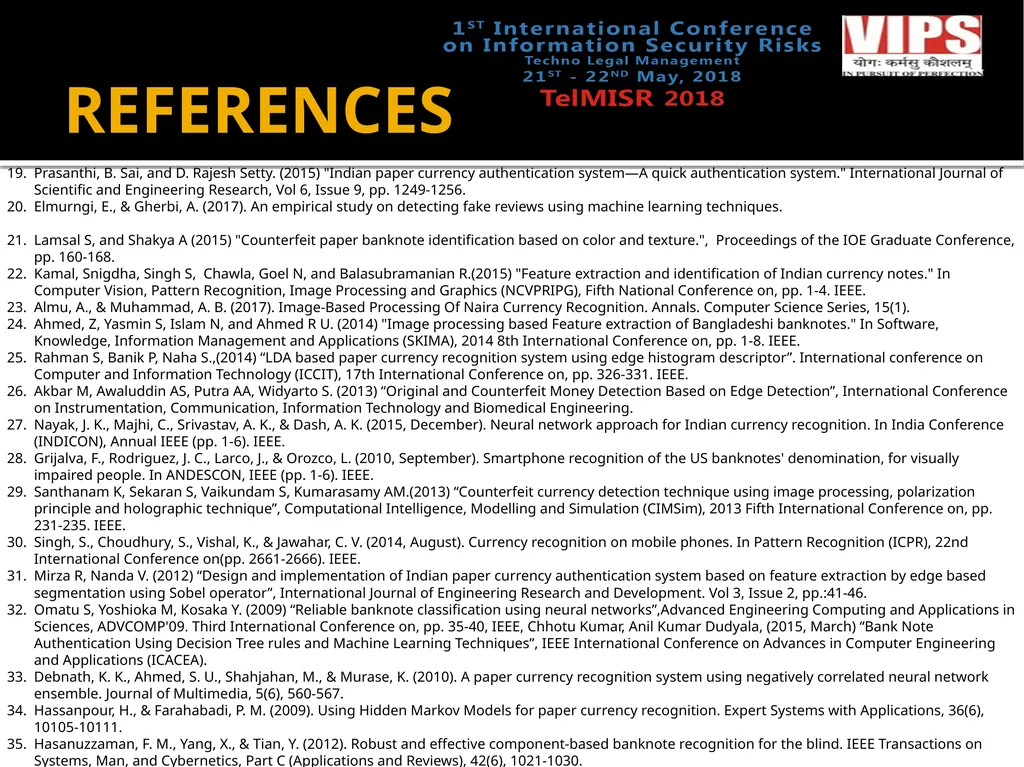
slide13. Prasanthi, B. Sai, and D. Rajesh Setty. (2015) "Indian paper currency authentication system—A quick authentication system." International Journal of Scientific and Engineering Research, Vol 6, Issue 9, pp. 1249-1256.
Elmurngi, E., & Gherbi, A. (2017). An empirical study on detecting fake reviews using machine learning techniques.
Lamsal S, and Shakya A (2015) "Counterfeit paper banknote identification based on color and texture.", Proceedings of the IOE Graduate Conference, pp. 160-168.
Kamal, Snigdha, Singh S, Chawla, Goel N, and Balasubramanian R.(2015) "Feature extraction and identification of Indian currency notes." In Computer Vision, Pattern Recognition, Image Processing and Graphics (NCVPRIPG), Fifth National Conference on, pp. 1-4. IEEE.
Almu, A., & Muhammad, A. B. (2017). Image-Based Processing Of Naira Currency Recognition. Annals. Computer Science Series, 15(1).
Ahmed, Z, Yasmin S, Islam N, and Ahmed R U. (2014) "Image processing based Feature extraction of Bangladeshi banknotes." In Software, Knowledge, Information Management and Applications (SKIMA), 2014 8th International Conference on, pp. 1-8. IEEE.
Rahman S, Banik P, Naha S.,(2014) “LDA based paper currency recognition system using edge histogram descriptor”. International conference on Computer and Information Technology (ICCIT), 17th International Conference on, pp. 326-331. IEEE.
Akbar M, Awaluddin AS, Putra AA, Widyarto S. (2013) “Original and Counterfeit Money Detection Based on Edge Detection”, International Conference on Instrumentation, Communication, Information Technology and Biomedical Engineering.
Nayak, J. K., Majhi, C., Srivastav, A. K., & Dash, A. K. (2015, December). Neural network approach for Indian currency recognition. In India Conference (INDICON), Annual IEEE (pp. 1-6). IEEE.
Grijalva, F., Rodriguez, J. C., Larco, J., & Orozco, L. (2010, September). Smartphone recognition of the US banknotes' denomination, for visually impaired people. In ANDESCON, IEEE (pp. 1-6). IEEE.
Santhanam K, Sekaran S, Vaikundam S, Kumarasamy AM.(2013) “Counterfeit currency detection technique using image processing, polarization principle and holographic technique”, Computational Intelligence, Modelling and Simulation (CIMSim), 2013 Fifth International Conference on, pp. 231-235. IEEE.
Singh, S., Choudhury, S., Vishal, K., & Jawahar, C. V. (2014, August). Currency recognition on mobile phones. In Pattern Recognition (ICPR), 22nd International Conference on(pp. 2661-2666). IEEE.
Mirza R, Nanda V. (2012) “Design and implementation of Indian paper currency authentication system based on feature extraction by edge based segmentation using Sobel operator”, International Journal of Engineering Research and Development. Vol 3, Issue 2, pp.:41-46.
Omatu S, Yoshioka M, Kosaka Y. (2009) “Reliable banknote classification using neural networks”,Advanced Engineering Computing and Applications in Sciences, ADVCOMP'09. Third International Conference on, pp. 35-40, IEEE, Chhotu Kumar, Anil Kumar Dudyala, (2015, March) “Bank Note Authentication Using Decision Tree rules and Machine Learning Techniques”, IEEE International Conference on Advances in Computer Engineering and Applications (ICACEA).
Debnath, K. K., Ahmed, S. U., Shahjahan, M., & Murase, K. (2010). A paper currency recognition system using negatively correlated neural network ensemble. Journal of Multimedia, 5(6), 560-567.
Hassanpour, H., & Farahabadi, P. M. (2009). Using Hidden Markov Models for paper currency recognition. Expert Systems with Applications, 36(6), 10105-10111.
Hasanuzzaman, F. M., Yang, X., & Tian, Y. (2012). Robust and effective component-based banknote recognition for the blind. IEEE Transactions on Systems, Man, and Cybernetics, Part C (Applications and Reviews), 42(6), 1021-1030. REFERENCES<br>
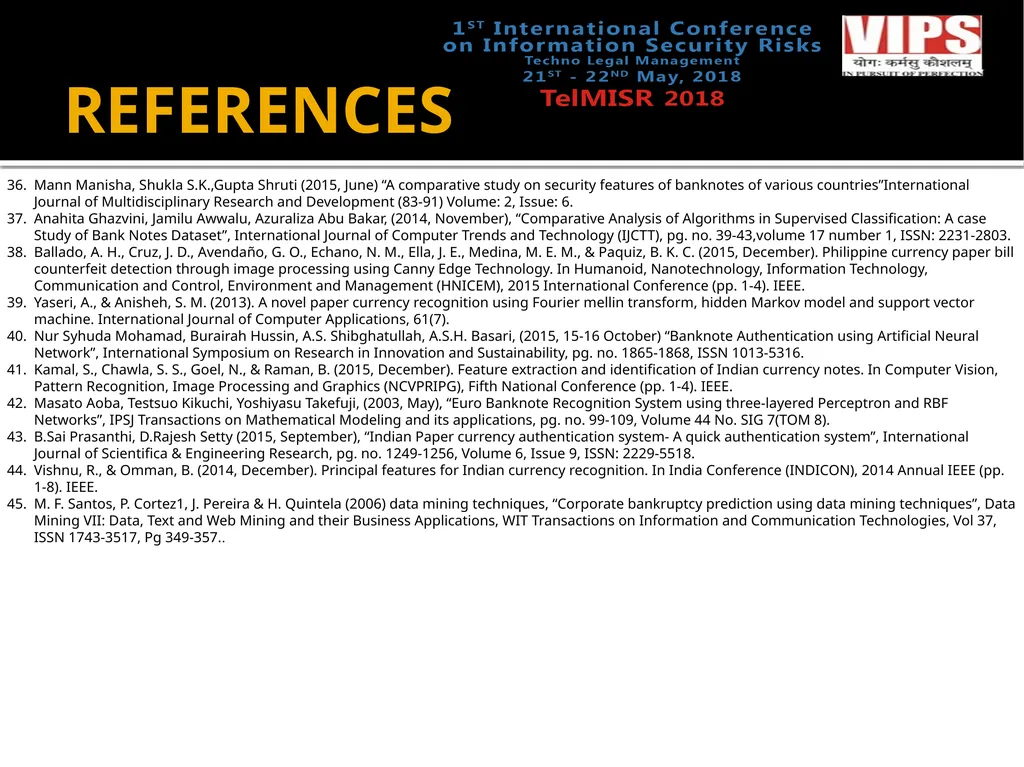
slide14. Mann Manisha, Shukla S.K.,Gupta Shruti (2015, June) “A comparative study on security features of banknotes of various countries”International Journal of Multidisciplinary Research and Development (83-91) Volume: 2, Issue: 6.
Anahita Ghazvini, Jamilu Awwalu, Azuraliza Abu Bakar, (2014, November), “Comparative Analysis of Algorithms in Supervised Classification: A case Study of Bank Notes Dataset”, International Journal of Computer Trends and Technology (IJCTT), pg. no. 39-43,volume 17 number 1, ISSN: 2231-2803.
Ballado, A. H., Cruz, J. D., Avendaño, G. O., Echano, N. M., Ella, J. E., Medina, M. E. M., & Paquiz, B. K. C. (2015, December). Philippine currency paper bill counterfeit detection through image processing using Canny Edge Technology. In Humanoid, Nanotechnology, Information Technology, Communication and Control, Environment and Management (HNICEM), 2015 International Conference (pp. 1-4). IEEE.
Yaseri, A., & Anisheh, S. M. (2013). A novel paper currency recognition using Fourier mellin transform, hidden Markov model and support vector machine. International Journal of Computer Applications, 61(7).
Nur Syhuda Mohamad, Burairah Hussin, A.S. Shibghatullah, A.S.H. Basari, (2015, 15-16 October) “Banknote Authentication using Artificial Neural Network”, International Symposium on Research in Innovation and Sustainability, pg. no. 1865-1868, ISSN 1013-5316.
Kamal, S., Chawla, S. S., Goel, N., & Raman, B. (2015, December). Feature extraction and identification of Indian currency notes. In Computer Vision, Pattern Recognition, Image Processing and Graphics (NCVPRIPG), Fifth National Conference (pp. 1-4). IEEE.
Masato Aoba, Testsuo Kikuchi, Yoshiyasu Takefuji, (2003, May), “Euro Banknote Recognition System using three-layered Perceptron and RBF Networks”, IPSJ Transactions on Mathematical Modeling and its applications, pg. no. 99-109, Volume 44 No. SIG 7(TOM 8).
B.Sai Prasanthi, D.Rajesh Setty (2015, September), “Indian Paper currency authentication system- A quick authentication system”, International Journal of Scientifica & Engineering Research, pg. no. 1249-1256, Volume 6, Issue 9, ISSN: 2229-5518.
Vishnu, R., & Omman, B. (2014, December). Principal features for Indian currency recognition. In India Conference (INDICON), 2014 Annual IEEE (pp. 1-8). IEEE.
M. F. Santos, P. Cortez1, J. Pereira & H. Quintela (2006) data mining techniques, “Corporate bankruptcy prediction using data mining techniques”, Data Mining VII: Data, Text and Web Mining and their Business Applications, WIT Transactions on Information and Communication Technologies, Vol 37, ISSN 1743-3517, Pg 349-357.. REFERENCES<br>
Akanksha Upadhyaya
Research Scholar, AIIT,
Amity University Under the Guidance of:
Dr. Vinod Shokeen
Dr. Garima Srivastava<br>
slide2. OUTLINE OF PRESENTATION Rationale of study
Overview: about the problem
Purpose of study
Research Questions
Introduction to related terms
Review brief
Findings
Conclusion and Future scope
References<br>
slide3. To explore various counterfeit detection techniques along with
their respective accuracy rate.
Part of PhD work RATIONALE OF STUDY<br>
slide4. OVERVIEW Currency counterfeiting is always been a challenging term for financial system of any country. The problem of counterfeiting majorly affects the economical as well as financial growth of a country; the race is going on between the counterfeiters and the banks. To resolve the issue various researchers came across with variety of techniques and proposed solutions mostly focused on Machine learning and Image processing areas.<br>
slide5. PURPOSE OF STUDY To identify counterfeit detection techniques from the area of machine learning, image processing and pattern recognition.
2. To identify the respective accuracy rate and a feature on which the technique was implemented.<br>
slide6. RESEARCH QUESTIONS? What are the various techniques which have been implemented using a country specific feature?
What is the accuracy rate of each implementation?
Which is the area taken into consideration most of the time.<br>
slide7. INTRODUCTION TO TECHNICAL TERMS Counterfeiting
Accuracy rate
Soiled currency
Machine learning: Supervised vs. Unsupervised
Image processing and pattern recognition<br>
slide8. LITERATURE REVIEW 1. Abba Almu and Aminu Bui Muhammad, 2017, created application based on features comparison of Nigerian currency Naira, denomination 100, 200, 500 and 1000 with an accuracy rate of detection 77.7%. 2. Jayant Kumar Nayak et. al., 2015, implemented counterfeit detection of currency using Chan-Vese segmentation and back propagation algorithm on Indian rupee of denomination value 5, 10, 20, 50, 100, 500. The accuracy of soiled currency detection was 97% and 100% for average quality notes. 3. Snigdha Kamal et. al. et. al., 2015, used SURF Descriptor and SVM Classifier on Central Numeral, Ashoka emblem, Identification mark and color band of Indian rupee valued 500 and achieved 97.02% accuracy. 4. Lamsal S, Shakya A., 2015, classified counterfeit Nepal currency from genuine one by implementing Image classification based on color and texture using Skew, mean, standard deviation, entropy and correlation value. The classification model achieved accuracy of 95%. 5. Ballado et. al, 2015, used Canny Edge detection on Philippine currency Peso 500, 1000 and incorporated OVD patch as an additional security feature. It was basically a GUI based program implemented using MATLAB, with an accuracy rate of 100%<br>
slide9. LITERATURE REVIEW 6. Ankush Roy et.al., 2014, implemented SVM and ANN on security thread, Ink, printing technique and artwork of Indian currency and achieved 100% accuracy. 7. Singh, S. et. al., 2014, implemented counterfeit detection of currency using SIFT, SURF and ORB-FREAK for visually impaired for Indian denomination and achieved 96.7%. 8. Vishnu R & Omman B, 2015, worked on Pattern matching on similarity of feature extracted, dominant color and shape detection of 6 security features Color, shape, Centre, Ashoka emblem, RBI seal, Signature of Indian denomination 50, 100, 500, 1000 and achieved 97% accurate detection. 9. Abbas Yaseri and Sayed Mahmoud Anisheh, 2013, implemented Wiener filter, Fourier Mellin transform and SVM Classifier on currency dataset of 150 banknotes of 101 different denominations from 23 countries and achieved 98.7% accuracy. 10. In 2012 Subra Mukherjee et. al. And F. M. Hasanuzzaman worked on different Image processing technique i.e. Fourier descriptor on Identification mark of India rupee 20,50,100,500,1000 and SURF on images of seven categories US bill 1, 2, 5, 10, 20, 50, 100 respectively. They achieved 97% and 100% accuracy respectively.<br>
slide10. FINDINGS Image processing and pattern recognition area is the base area for feature extraction.
There are some techniques which are specifically from the application area of Image processing and pattern recognition and using those techniques the researchers achieved the accuracy rate ranges from 77% to 100%.
Few of the area are those which are the combination of machine learning and Image processing and therein the accuracy rate ranges from 96% to 100%.
The variation in accuracy rate is due to various factors such as choice of feature, type of note, number of features considered, country specific currency security feature, cost efficiency of the program.<br>
slide11. CONCLUSION & FUTURE SCOPE This paper is an effort to suggest various techniques proposed by various researchers in terms of accuracy rate by considering a particular feature from denomination values of particular country’s currency. Image processing and pattern recognition is the dominant area followed by Machine Learning. Currency’s security features need periodical up-gradation due to up gradation of printing and scanning technology. The areas where few researches have been conducted are data mining prediction techniques like map reduce, Apriori association rule or by means of any statistical model which could provide a solution for this complex issue.<br>
slide12. NCRB compedium Report (2015-2016), crime report, Retrived from http://ncrb.gov.in/Stat Publications/CII/CII2015/FILES/CrimeInIndia2015.pdf
Santhanam, K., Sekaran, S., Vaikundam, S., & Kumarasamy, A. M. (2013, September). Counterfeit currency detection technique using image processing, polarization principle and holographic technique. In Computational Intelligence, Modelling and Simulation (CIMSim), 2013 Fifth International Conference on (pp. 231-235). IEEE.
Alekhya, D., Surya Prabha, G. D., & Durga Rao, G. V. (2014). Fake currency detection using image processing and other standard methods. IJRCCT, 3(1), 128-131.
Thakur, M., & Kaur, A. (2014). Various fake currency detection techniques. International Journal for Technological Research in Engineering, 1(11), 1309-1313.
Jadhav S., Khanai R, (2016) Authentication And Counterfeit Detection Of Currency Using Image Processing. In International Conference on Recent Innovations in Engineering and Management (ICRIEM-16), pp. 709-715.
Ahmed, Z., Yasmin, S., Islam, M. N., & Ahmed, R. U. (2014, December). Image processing based Feature extraction of Bangladeshi banknotes. In Software, Knowledge, Information Management and Applications (SKIMA), 8th International Conference on (pp. 1-8). IEEE.
Sneha R, Deepika P K , Nagaveni S, Swetha Shree D , Asha K S.(2017) "Automatic counterfeit currency detection using Image Processing." International Research Journal of Engineering and Technology (IRJET) Vol. 4, Issue 5.
Pilania, Eshita, and Bhavika Arora.(2016) "Recognition of Fake Currency Based on Security Thread Feature of Currency.", International Journal Of Engineering And Computer Science, Volume 5 Issues, pp. 17136-17140.
Muthukrishnan, R., & Radha, M. (2011). Edge detection techniques for image segmentation. International Journal of Computer Science & Information Technology, 3(6), 259.
Atchaya, S., K. Harini, G. Kaviarasi, and B. Swathi.(2016) "Fake Currency Detection Using Image Processing.", International Journal of Trend in Research and Development, special issue, pp72-73.
Kumar, G., & Bhatia, P. K. (2014, February). A detailed review of feature extraction in image processing systems. In Advanced Computing & Communication Technologies (ACCT), Fourth International Conference on (pp. 5-12). IEEE.
Visani, C., & Jadeja, N. (2017) A Study on Different Machine Learning Techniques for Spam Review Detection, IEEE.
Alshayeji, Mohammad H., Mohammad Al-Rousan, and Dunya T. Hassoun. (2015) "Detection method for counterfeit currency based on bit-plane slicing technique." International Journal of Multimedia and Ubiquitous Engineering Vol.10, Issue11,pp. 225-242.
Mukherjee S. "Artificial neural network to recognize an Indian currency note using unique identification mark. (2015) " Journal of Applied and Fundamental Sciences Vol 1, Issue 2, pp. 213-220.
Roy, Ankush, Biswajit Halder, Utpal Garain, and David S. Doermann. (2015) "Machine-assisted authentication of paper currency: an experiment on Indian banknotes." International Journal on Document Analysis and Recognition (IJDAR) Vol 18, Issue 3, pp. 271-285.
Asadizanjani, N., Dunn, N., Gattigowda, S., Tehranipoor, M., & Forte, D. (2016, November). A database for counterfeit electronics and automatic defect detection based on image processing and machine learning. ISTFA.
Ballado, A. H., JC Dela Cruz, G. O. Avendaño, N. M. Echano, J. E. Ella, M. E. M. Medina, and B. K. C. Paquiz. (2015) "Philippine currency paper bill counterfeit detection through image processing using Canny Edge Technology." In Humanoid, Nanotechnology, Information Technology, Communication and Control, Environment and Management (HNICEM), International Conference on, pp. 1-4. IEEE.
Kavya, B. R., and Devendran B. (2015) "Indian currency detection and denomination using SIFT." International Journal of Science Enineering and Technology. Vol 4, Issue 6, pp.1909-1911. REFERENCES<br>
slide13. Prasanthi, B. Sai, and D. Rajesh Setty. (2015) "Indian paper currency authentication system—A quick authentication system." International Journal of Scientific and Engineering Research, Vol 6, Issue 9, pp. 1249-1256.
Elmurngi, E., & Gherbi, A. (2017). An empirical study on detecting fake reviews using machine learning techniques.
Lamsal S, and Shakya A (2015) "Counterfeit paper banknote identification based on color and texture.", Proceedings of the IOE Graduate Conference, pp. 160-168.
Kamal, Snigdha, Singh S, Chawla, Goel N, and Balasubramanian R.(2015) "Feature extraction and identification of Indian currency notes." In Computer Vision, Pattern Recognition, Image Processing and Graphics (NCVPRIPG), Fifth National Conference on, pp. 1-4. IEEE.
Almu, A., & Muhammad, A. B. (2017). Image-Based Processing Of Naira Currency Recognition. Annals. Computer Science Series, 15(1).
Ahmed, Z, Yasmin S, Islam N, and Ahmed R U. (2014) "Image processing based Feature extraction of Bangladeshi banknotes." In Software, Knowledge, Information Management and Applications (SKIMA), 2014 8th International Conference on, pp. 1-8. IEEE.
Rahman S, Banik P, Naha S.,(2014) “LDA based paper currency recognition system using edge histogram descriptor”. International conference on Computer and Information Technology (ICCIT), 17th International Conference on, pp. 326-331. IEEE.
Akbar M, Awaluddin AS, Putra AA, Widyarto S. (2013) “Original and Counterfeit Money Detection Based on Edge Detection”, International Conference on Instrumentation, Communication, Information Technology and Biomedical Engineering.
Nayak, J. K., Majhi, C., Srivastav, A. K., & Dash, A. K. (2015, December). Neural network approach for Indian currency recognition. In India Conference (INDICON), Annual IEEE (pp. 1-6). IEEE.
Grijalva, F., Rodriguez, J. C., Larco, J., & Orozco, L. (2010, September). Smartphone recognition of the US banknotes' denomination, for visually impaired people. In ANDESCON, IEEE (pp. 1-6). IEEE.
Santhanam K, Sekaran S, Vaikundam S, Kumarasamy AM.(2013) “Counterfeit currency detection technique using image processing, polarization principle and holographic technique”, Computational Intelligence, Modelling and Simulation (CIMSim), 2013 Fifth International Conference on, pp. 231-235. IEEE.
Singh, S., Choudhury, S., Vishal, K., & Jawahar, C. V. (2014, August). Currency recognition on mobile phones. In Pattern Recognition (ICPR), 22nd International Conference on(pp. 2661-2666). IEEE.
Mirza R, Nanda V. (2012) “Design and implementation of Indian paper currency authentication system based on feature extraction by edge based segmentation using Sobel operator”, International Journal of Engineering Research and Development. Vol 3, Issue 2, pp.:41-46.
Omatu S, Yoshioka M, Kosaka Y. (2009) “Reliable banknote classification using neural networks”,Advanced Engineering Computing and Applications in Sciences, ADVCOMP'09. Third International Conference on, pp. 35-40, IEEE, Chhotu Kumar, Anil Kumar Dudyala, (2015, March) “Bank Note Authentication Using Decision Tree rules and Machine Learning Techniques”, IEEE International Conference on Advances in Computer Engineering and Applications (ICACEA).
Debnath, K. K., Ahmed, S. U., Shahjahan, M., & Murase, K. (2010). A paper currency recognition system using negatively correlated neural network ensemble. Journal of Multimedia, 5(6), 560-567.
Hassanpour, H., & Farahabadi, P. M. (2009). Using Hidden Markov Models for paper currency recognition. Expert Systems with Applications, 36(6), 10105-10111.
Hasanuzzaman, F. M., Yang, X., & Tian, Y. (2012). Robust and effective component-based banknote recognition for the blind. IEEE Transactions on Systems, Man, and Cybernetics, Part C (Applications and Reviews), 42(6), 1021-1030. REFERENCES<br>
slide14. Mann Manisha, Shukla S.K.,Gupta Shruti (2015, June) “A comparative study on security features of banknotes of various countries”International Journal of Multidisciplinary Research and Development (83-91) Volume: 2, Issue: 6.
Anahita Ghazvini, Jamilu Awwalu, Azuraliza Abu Bakar, (2014, November), “Comparative Analysis of Algorithms in Supervised Classification: A case Study of Bank Notes Dataset”, International Journal of Computer Trends and Technology (IJCTT), pg. no. 39-43,volume 17 number 1, ISSN: 2231-2803.
Ballado, A. H., Cruz, J. D., Avendaño, G. O., Echano, N. M., Ella, J. E., Medina, M. E. M., & Paquiz, B. K. C. (2015, December). Philippine currency paper bill counterfeit detection through image processing using Canny Edge Technology. In Humanoid, Nanotechnology, Information Technology, Communication and Control, Environment and Management (HNICEM), 2015 International Conference (pp. 1-4). IEEE.
Yaseri, A., & Anisheh, S. M. (2013). A novel paper currency recognition using Fourier mellin transform, hidden Markov model and support vector machine. International Journal of Computer Applications, 61(7).
Nur Syhuda Mohamad, Burairah Hussin, A.S. Shibghatullah, A.S.H. Basari, (2015, 15-16 October) “Banknote Authentication using Artificial Neural Network”, International Symposium on Research in Innovation and Sustainability, pg. no. 1865-1868, ISSN 1013-5316.
Kamal, S., Chawla, S. S., Goel, N., & Raman, B. (2015, December). Feature extraction and identification of Indian currency notes. In Computer Vision, Pattern Recognition, Image Processing and Graphics (NCVPRIPG), Fifth National Conference (pp. 1-4). IEEE.
Masato Aoba, Testsuo Kikuchi, Yoshiyasu Takefuji, (2003, May), “Euro Banknote Recognition System using three-layered Perceptron and RBF Networks”, IPSJ Transactions on Mathematical Modeling and its applications, pg. no. 99-109, Volume 44 No. SIG 7(TOM 8).
B.Sai Prasanthi, D.Rajesh Setty (2015, September), “Indian Paper currency authentication system- A quick authentication system”, International Journal of Scientifica & Engineering Research, pg. no. 1249-1256, Volume 6, Issue 9, ISSN: 2229-5518.
Vishnu, R., & Omman, B. (2014, December). Principal features for Indian currency recognition. In India Conference (INDICON), 2014 Annual IEEE (pp. 1-8). IEEE.
M. F. Santos, P. Cortez1, J. Pereira & H. Quintela (2006) data mining techniques, “Corporate bankruptcy prediction using data mining techniques”, Data Mining VII: Data, Text and Web Mining and their Business Applications, WIT Transactions on Information and Communication Technologies, Vol 37, ISSN 1743-3517, Pg 349-357.. REFERENCES<br>