01
Vectors + Multijet Theory�with BlackHat and Sherpa David A. Kosower�Institut de Physique Théorique, CEA–Saclay
on behalf of the BlackHat Collaboration
Carola Berger, Z. Bern, Giovanni Diana, L. Dixon, �Fernando Febres Cordero, Darren Forde, Tanju Gleisberg, �Stefan Höche, Harald Ita, DAK, Daniel Maître, Kemal Ozeren�with contributions by Kurt Barry (ATLAS)
HCP 2011�November 15, 2011<br>
04
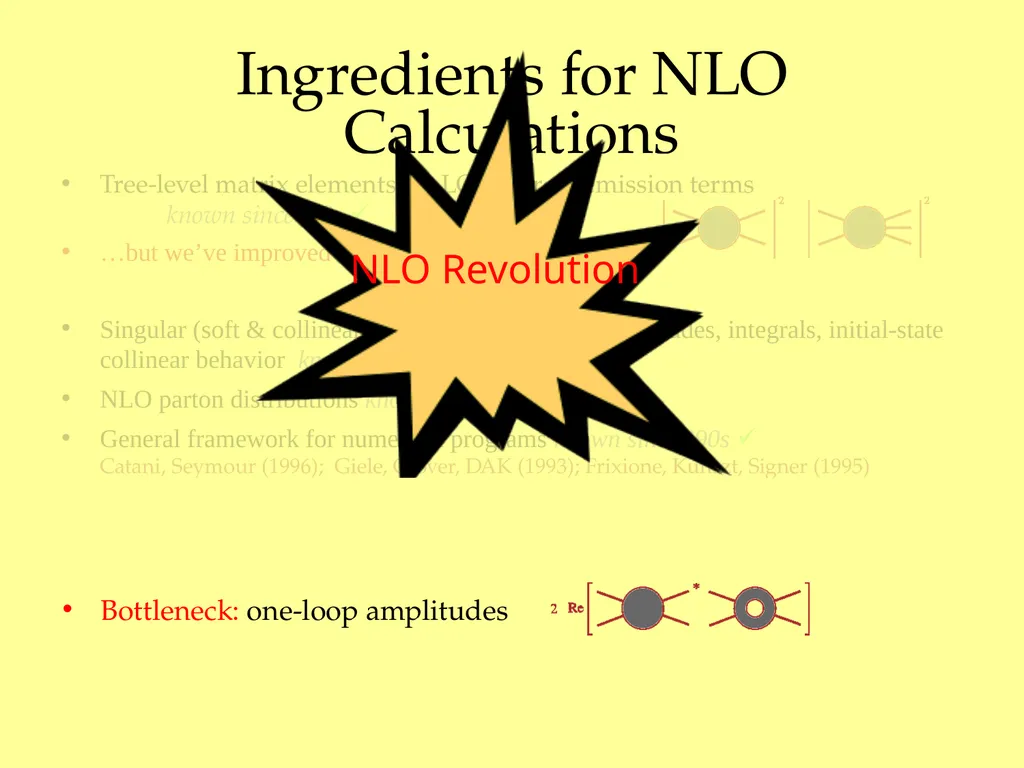
Ingredients for NLO Calculations Tree-level matrix elements for LO and real-emission terms� known since ’80s
…but we’ve improved efficiency since then
Singular (soft & collinear) behavior of tree-level amplitudes, integrals, initial-state collinear behavior known since ’90s
NLO parton distributions known since ’90s
General framework for numerical programs known since ’90s �Catani, Seymour (1996); Giele, Glover, DAK (1993); Frixione, Kunszt, Signer (1995)
Automating real—virtual cancellation for general processes�Gleisberg, Krauss; Seymour, Tevlin; Hasegawa, Moch, Uwer; Frederix, Gehrmann, Greiner (2008); Frederix, Frixione, Maltoni, Stelzer (2009)
On-shell Methods: one-loop amplitudes
W+2 jets (MCFM) W+3 jets W+4 jets
Bern, Dixon, DAK, Weinzierl (1997–8); BlackHat; BlackHat �Campbell, Glover, Miller (1997) Rocket Bottleneck: one-loop amplitudes NLO Revolution<br>
05
Lots of revolutionaries roaming the world
BlackHat
CutTools+HELAC-NLO: Ossola, Papadopoulos, Pittau, Actis, Bevilacqua, Czakon, Draggiotis, Garzelli, van Hameren, Mastrolia, Worek & their clients
Rocket: Ellis, Giele, Kunszt, Lazopoulos, Melnikov, Zanderighi
Samurai: Mastrolia, Ossola, Reiter, & Tramontano
NGluon: Badger, Biedermann, & Uwer
MadLoop: Hirschi, Frederix, Frixione, Garzelli, Maltoni, & Pittau
Giele, Kunszt, Stavenga, Winter
Ongoing analytic work
Almeida, Britto, Feng & Mirabella<br>
06
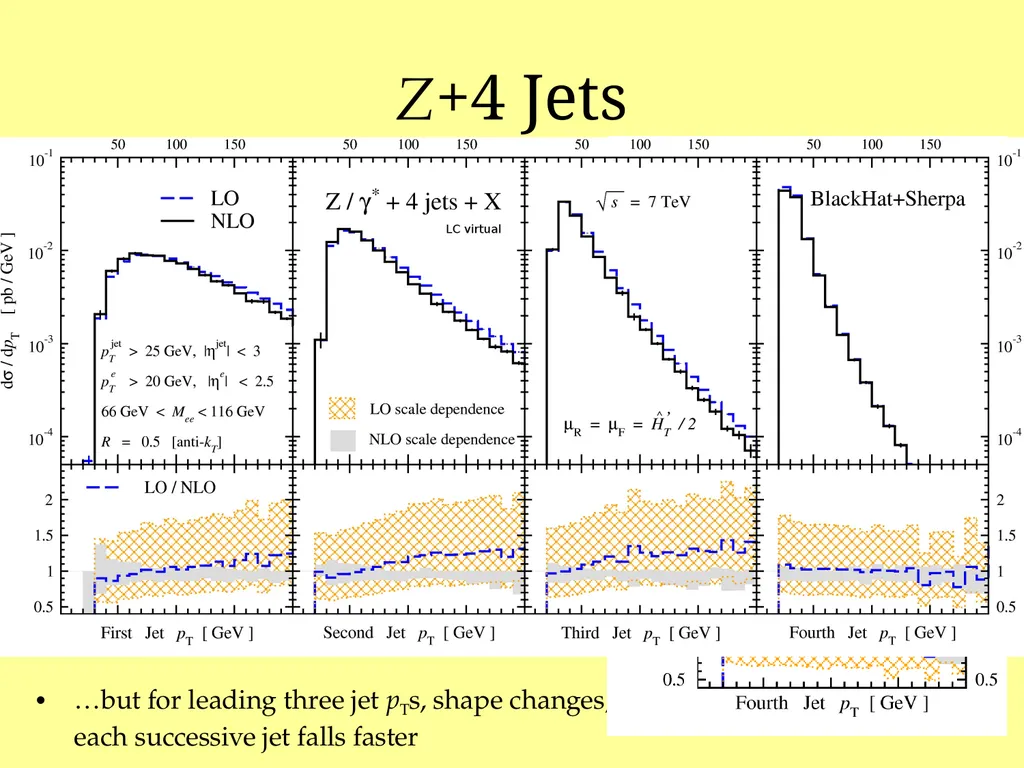
Z+4 Jets arXiv:1108.2229 [H. Ita, Z. Bern, L. J. Dixon, F. Febres Cordero, DAK, D. Maître]
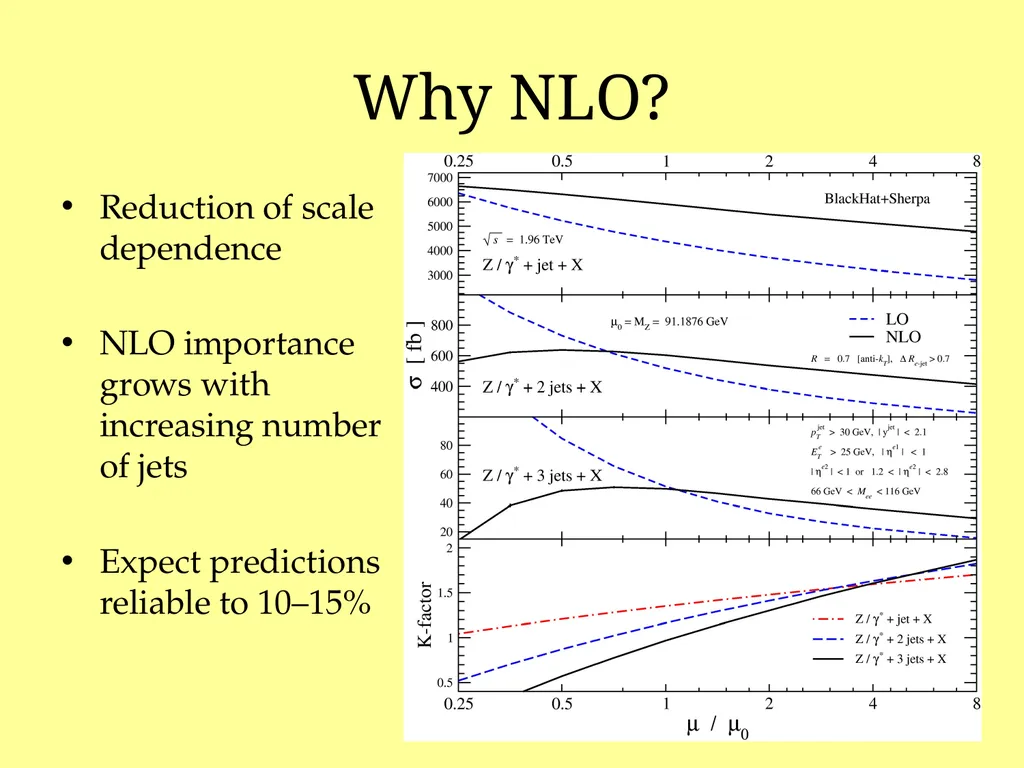
Dramatic improvement in scale stability
Numerical reliability
Fourth jet pT has little LONLO change in shape
…but for leading three jet pTs, shape changes; each successive jet falls faster<br>
07
Comparison to Data At the Tevatron…
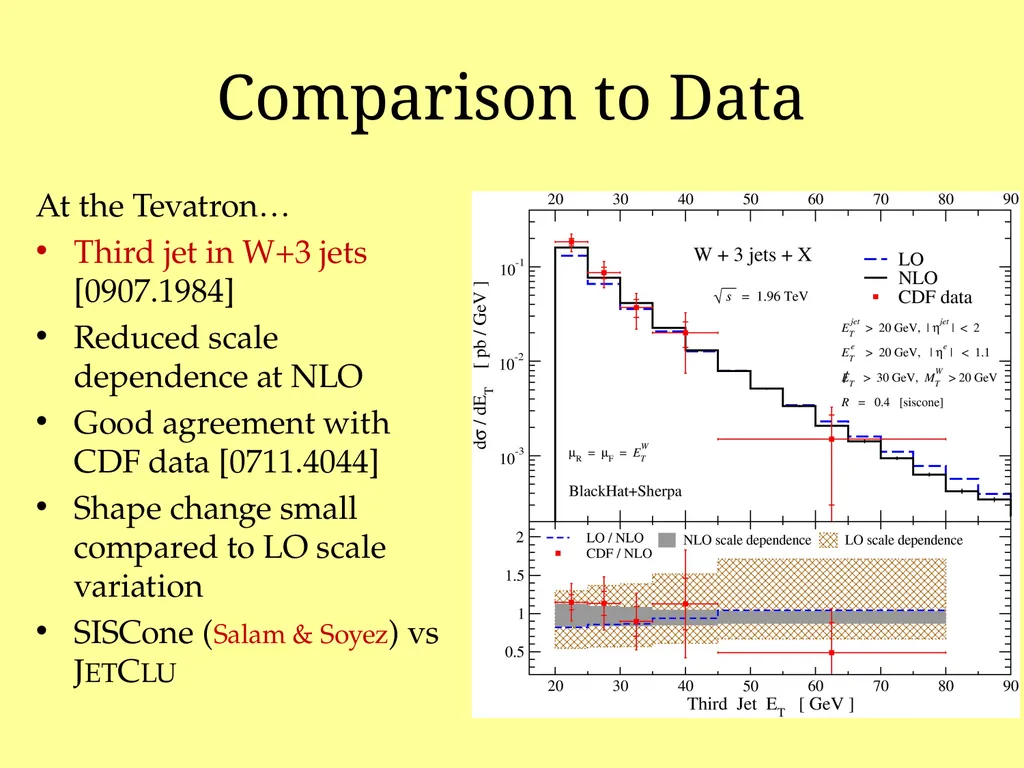
Third jet in W+3 jets [0907.1984]
Reduced scale dependence at NLO
Good agreement with CDF data [0711.4044]
Shape change small compared to LO scale variation
SISCone (Salam & Soyez) vs JETCLU<br>
08
Comparison to Data At the Tevatron…
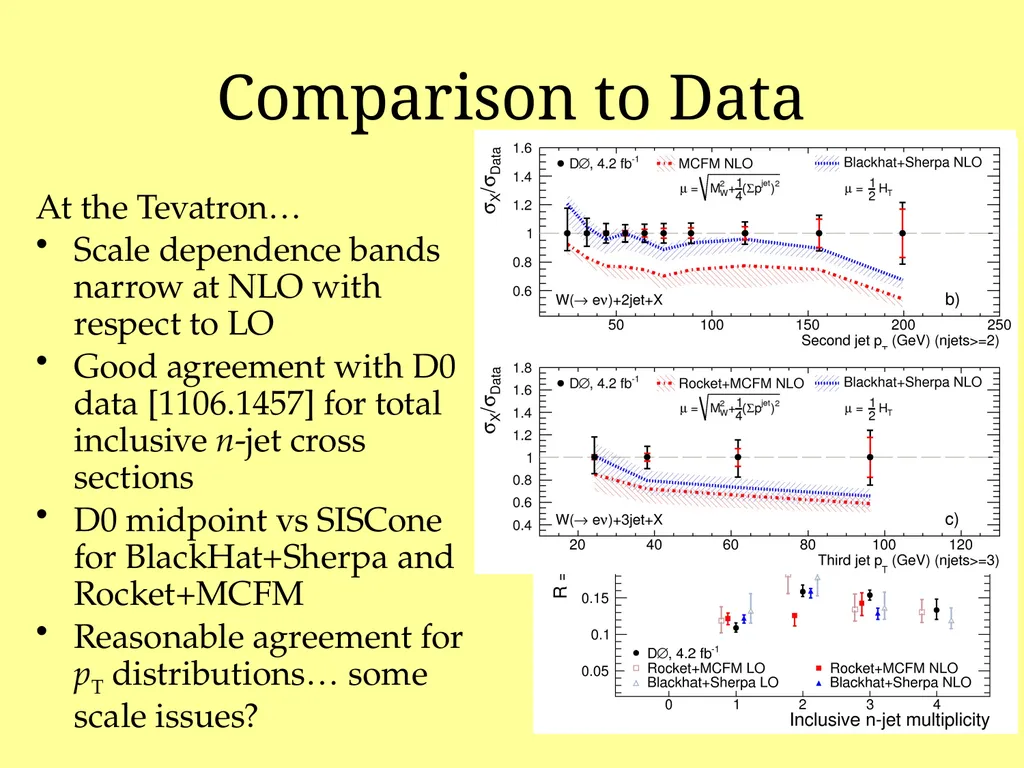
Scale dependence bands narrow at NLO with respect to LO
Good agreement with D0 data [1106.1457] for total inclusive n-jet cross sections
D0 midpoint vs SISCone for BlackHat+Sherpa and Rocket+MCFM
Reasonable agreement for pT distributions… some scale issues?<br>
09
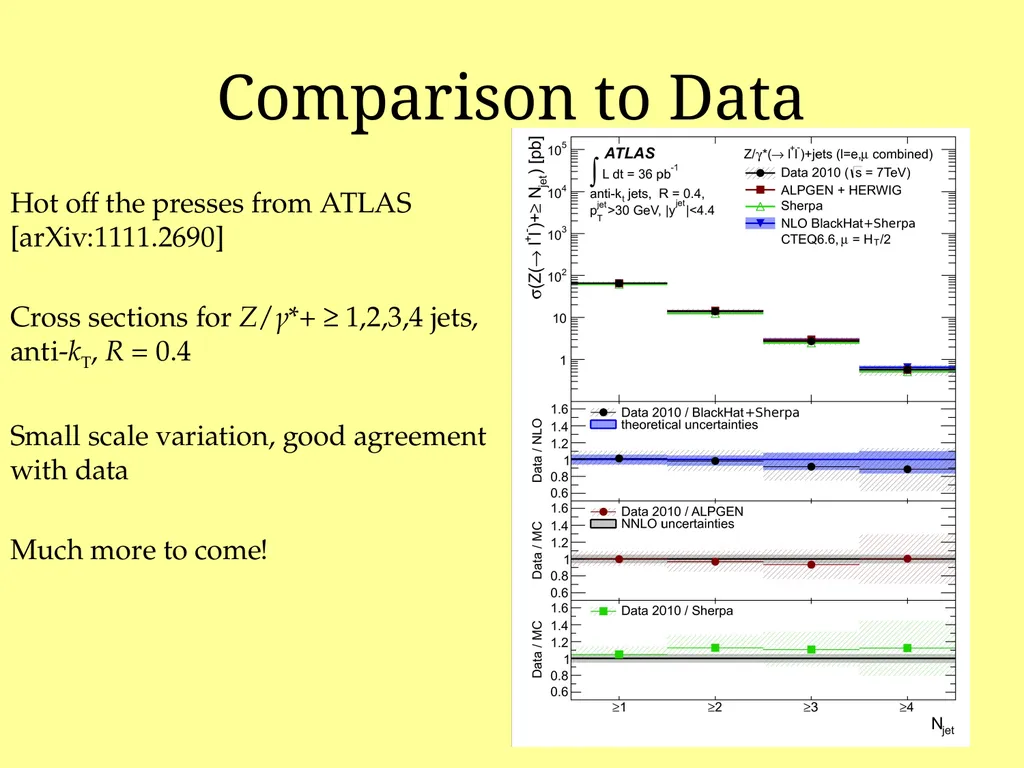
Comparison to Data Hot off the presses from ATLAS [arXiv:1111.2690]
Cross sections for Z/γ*+≥1,2,3,4 jets, anti-kT, R = 0.4
Small scale variation, good agreement with data
Much more to come!<br>
10
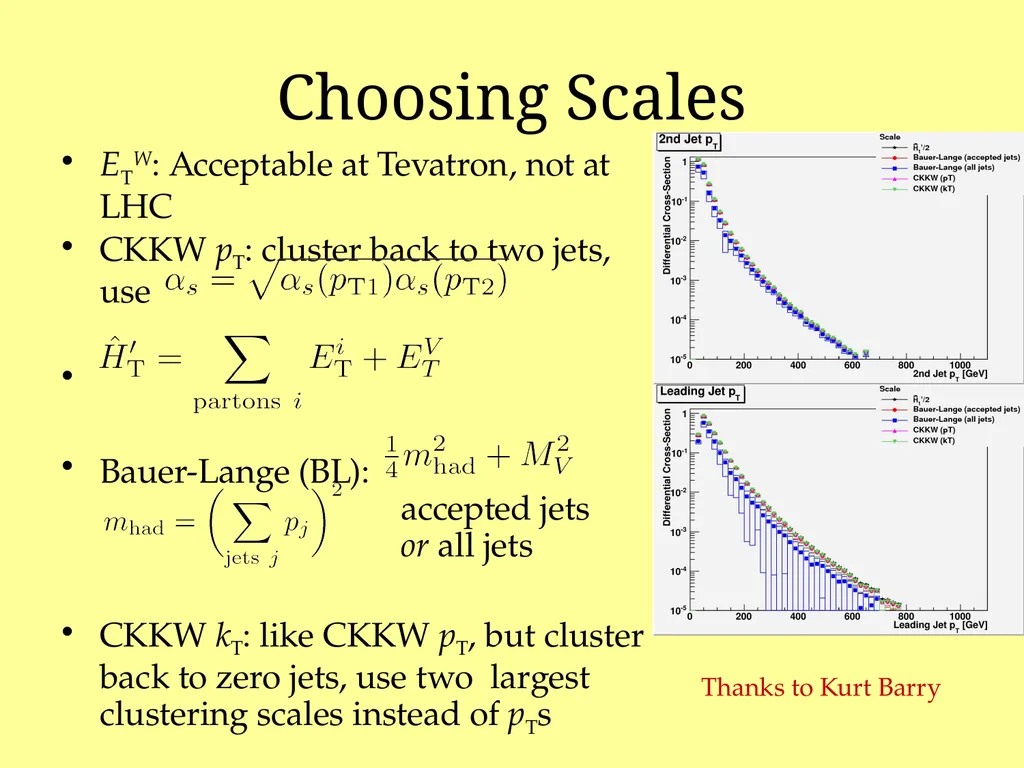
Choosing Scales ETW: Acceptable at Tevatron, not at LHC
CKKW pT: cluster back to two jets, use
Bauer-Lange (BL):� accepted jets� or all jets
CKKW kT: like CKKW pT, but cluster back to zero jets, use two largest clustering scales instead of pTs Thanks to Kurt Barry<br>
11
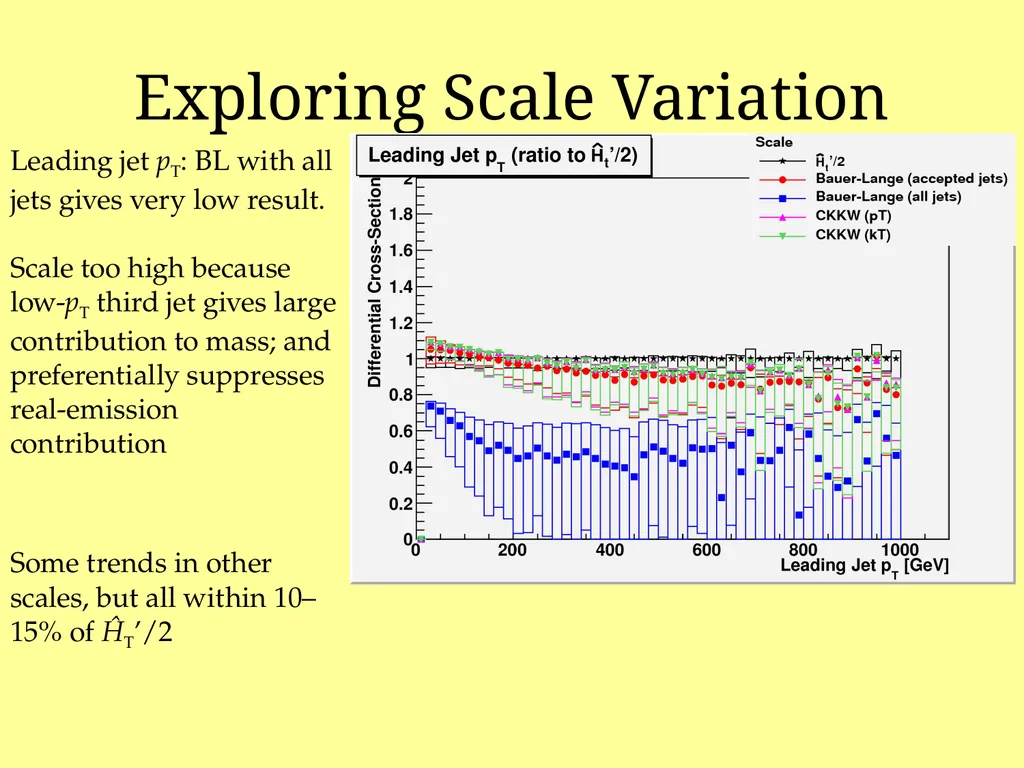
Exploring Scale Variation Leading jet pT: BL with all jets gives very low result. �Scale too high because low-pT third jet gives large contribution to mass; and preferentially suppresses real-emission contribution
Some trends in other scales, but all within 10–15% of ĤT’/2<br>
12
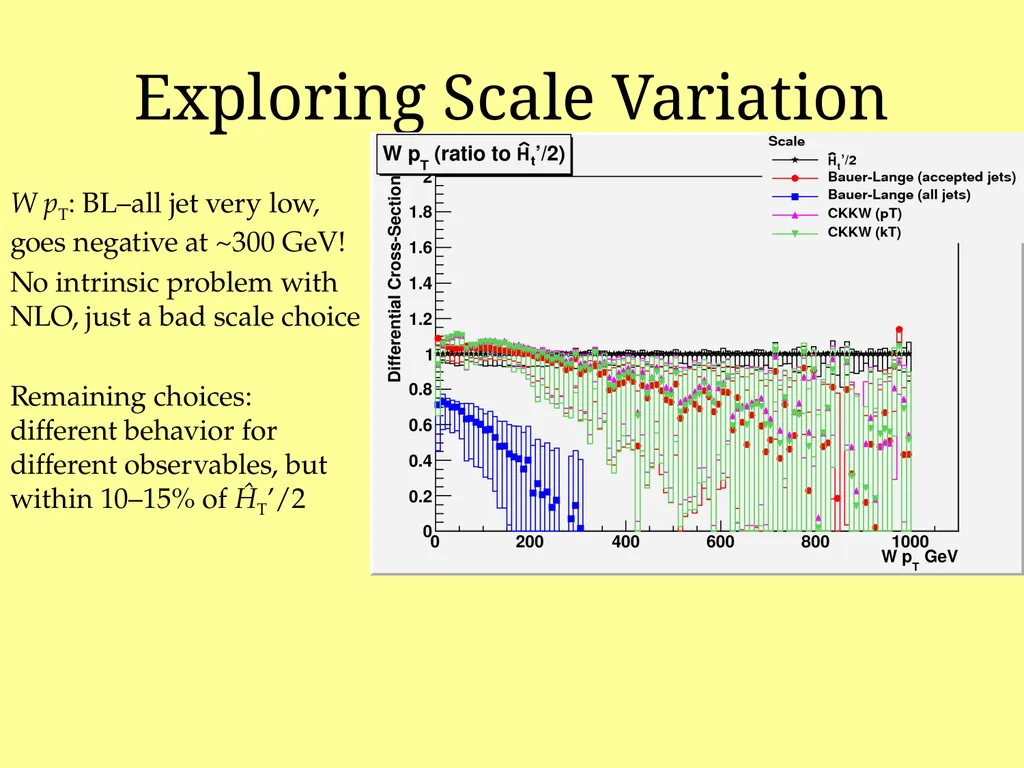
Exploring Scale Variation W pT: BL–all jet very low, goes negative at ~300 GeV!
No intrinsic problem with NLO, just a bad scale choice
Remaining choices: different behavior for different observables, but within 10–15% of ĤT’/2<br>
13
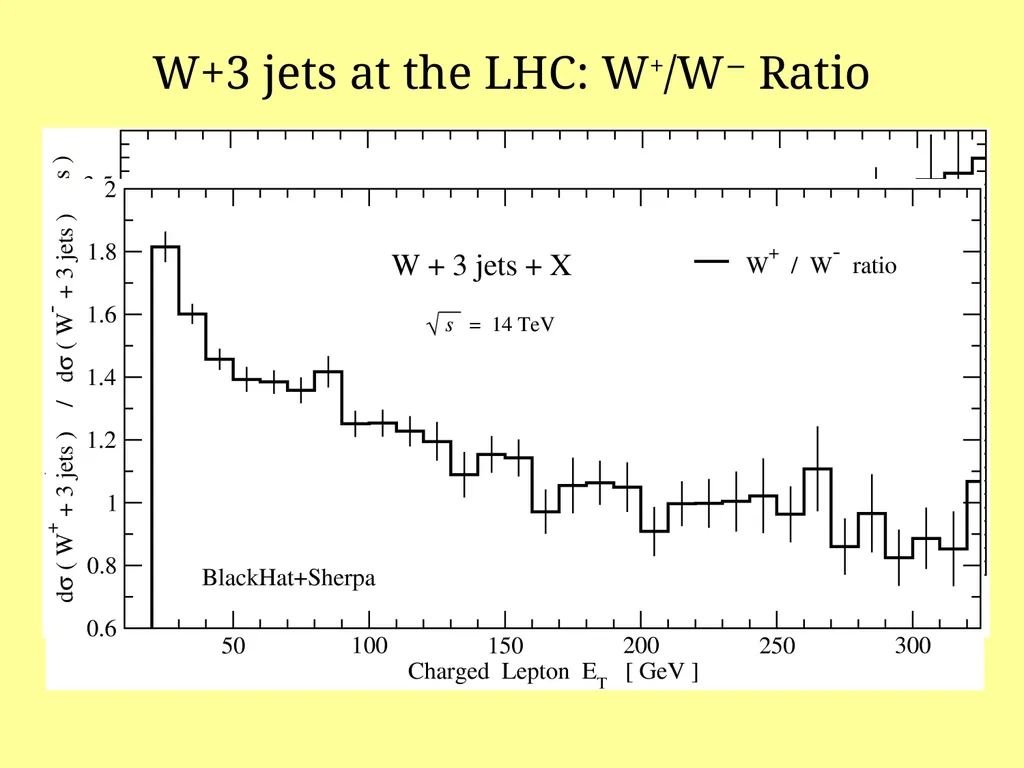
qg dominant initial state at the LHC ET-dependent rate difference because of u(x)/d(x) distribution difference
But that’s not the whole story W+3 jets at the LHC: W+/W− Ratio<br>
14
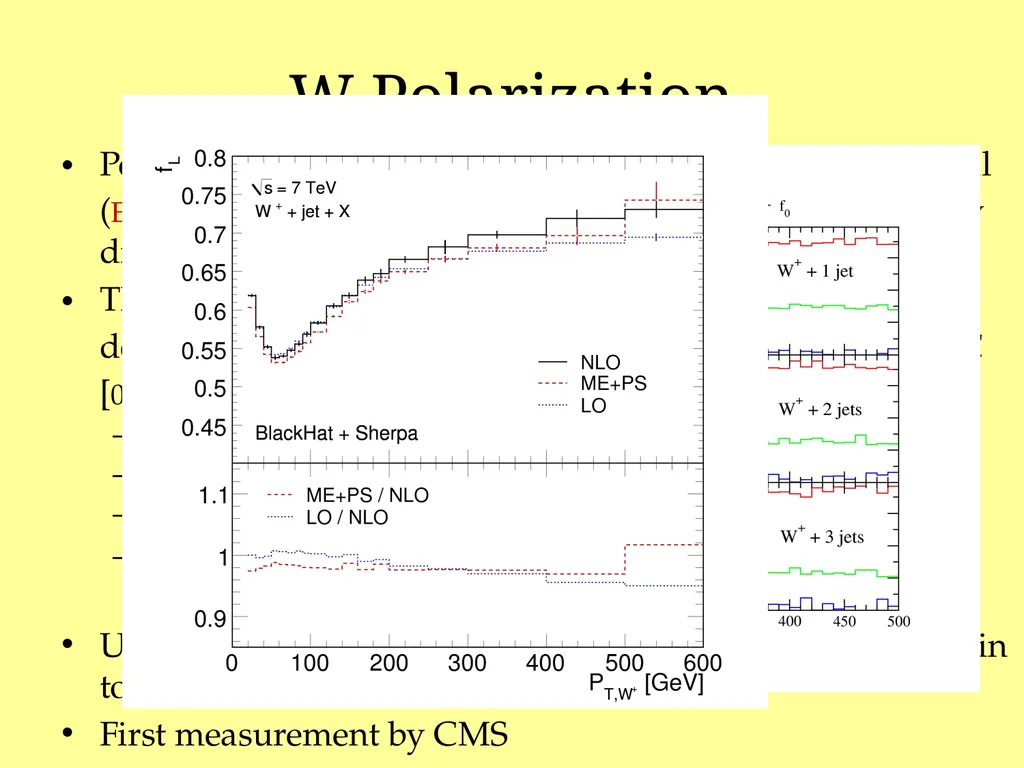
Polarization of low-pT, longitudinal, Ws is textbook material (Ellis, Stirling & Webber) dilution in charged-lepton rapidity distribution asymmetry at Tevatron
This is different! Ws are also polarized at high pT ET dependence of e+/e− ratio and missing ET in W+/W− at LHC [0907.1984,1103.5445]
Present at LO
Present for fewer jets too: universality
Very insensitive to NLO corrections
Insensitive to cuts at large pTW
Useful for distinguishing “prompt” Ws from daughter Ws in top decay!
First measurement by CMS W Polarization<br>
15
Z/γ & Backgrounds to SUSY Motivated by CMS’s data-driven estimation of � from prompt photon+jets production
Theory needed to translate
Theory needed to estimate uncertainties in translation
Stirling’s talk
Control region & search regions in terms of |−∑ET| & HTjets; force vector pT to large values
Control: HTjets > 300 GeV, |−∑ET| > 150 GeV
Search: HTjets > 300, |−∑ET| > 250 GeV; HTjets > 500, |−∑ET| > 150 GeV<br>
16
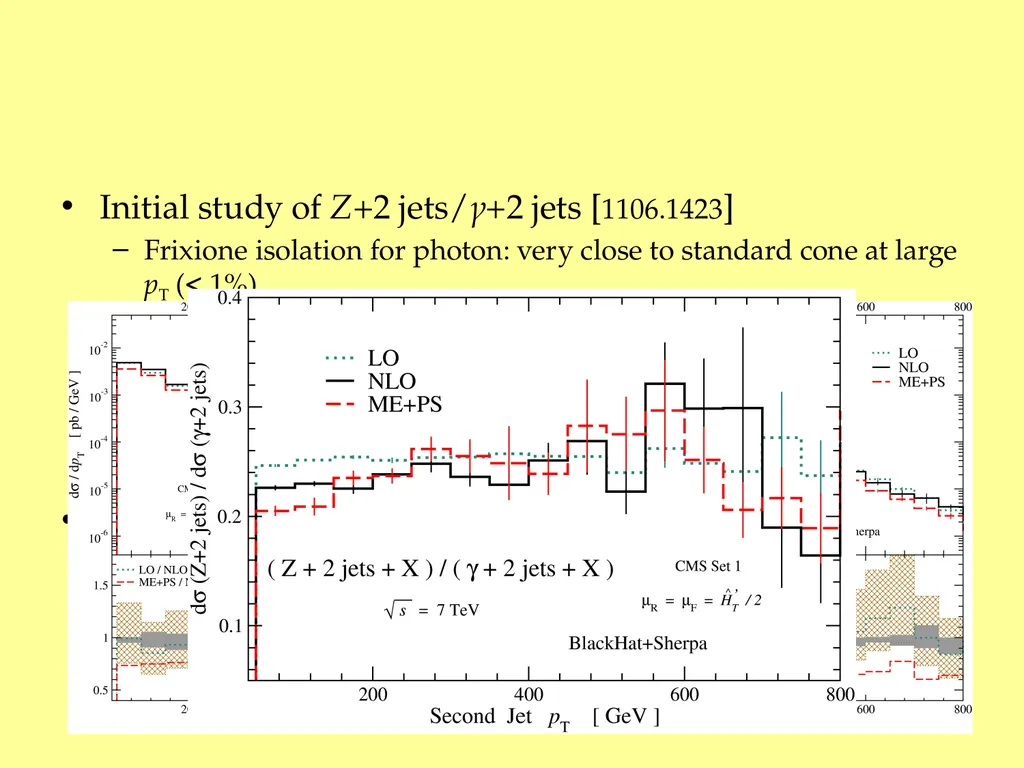
Initial study of Z+2 jets/γ+2 jets [1106.1423]
Frixione isolation for photon: very close to standard cone at large pT (< 1%)
NLO corrections largely disappear in Z/γ ratio; estimate uncertainties by comparing NLO with matrix-element-matched parton shower (ME+PS)
Expected translation uncertainties < 10%
Study of Z+3 jets/γ+3 jets in progress<br>
17
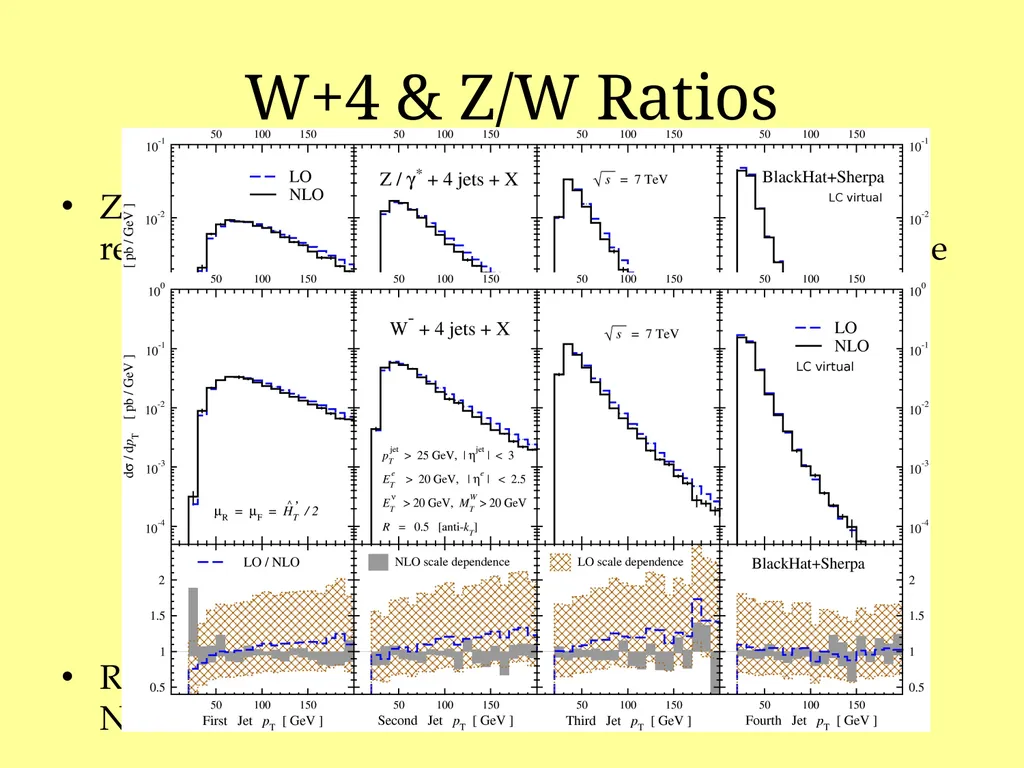
W+4 & Z/W Ratios Z+4 jet NLO results resemble earlier W+4 results: reduced scale dependence, no change in softest jet shape
Resembles so much that ratios are very insensitive to NLO corrections<br>
18
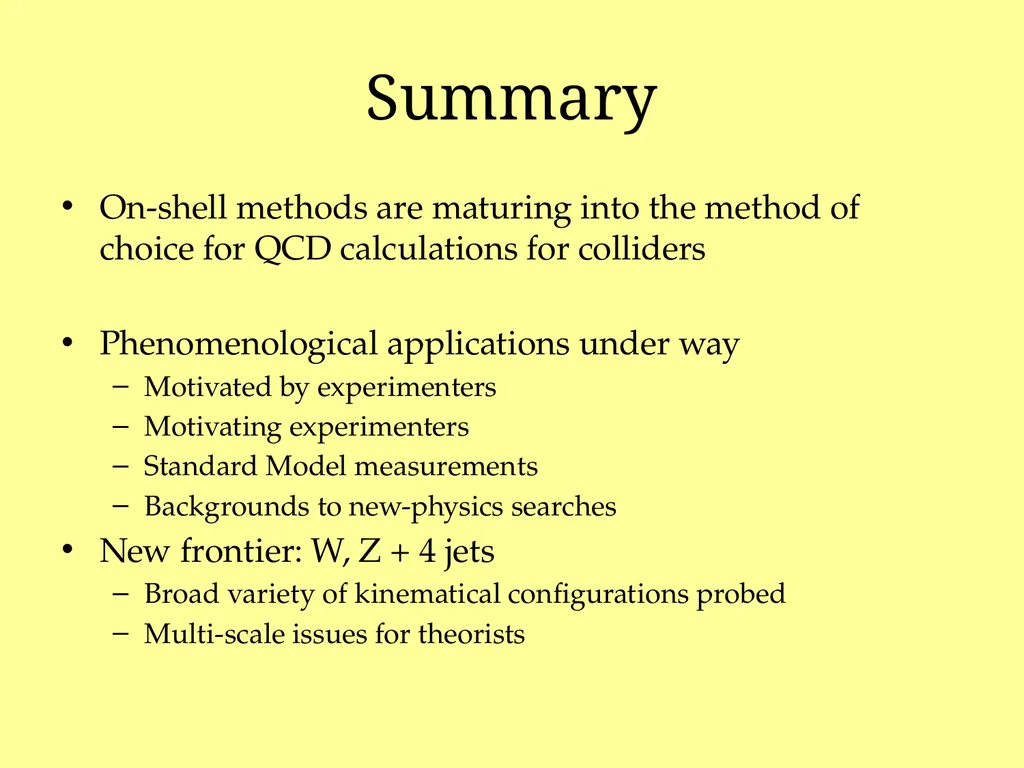
Summary On-shell methods are maturing into the method of choice for QCD calculations for colliders
Phenomenological applications under way
Motivated by experimenters
Motivating experimenters
Standard Model measurements
Backgrounds to new-physics searches
New frontier: W, Z + 4 jets
Broad variety of kinematical configurations probed
Multi-scale issues for theorists<br>