
Vehicle Rescue Incident Awareness CHAPTER 2
JO
Published · 82 slides · 0 views
1 / 1
Description
Vehicle Rescue Incident Awareness CHAPTER 2 Knowledge Objectives (1 of 3) Define the following terms: Risk assessment Hazard analysis Organizational analysis Riskbenefit analysis Level of response analysis Explain how a community
Related Topics
Share
Embed code
Download this presentation From Below
"Vehicle Rescue Incident Awareness CHAPTER 2" is the property of its rightful owner. Permission is granted to download and print the materials on this website for personal, non-commercial use only, and to display it on your personal computer provided you do not modify the materials and that you retain all copyright notices contained in the materials. By downloading content from our website, you accept the terms of this agreement.
Presentation Transcript
01
Vehicle Rescue Incident Awareness CHAPTER 2<br>
02
Knowledge Objectives (1 of 3) Define the following terms:
Risk assessment
Hazard analysis
Organizational analysis
Risk–benefit analysis
Level of response analysis
Explain how a community assessment is used to determine service level needs.
Identify the two types of risk–benefit analysis performed at a vehicle rescue incident.<br>
Risk assessment
Hazard analysis
Organizational analysis
Risk–benefit analysis
Level of response analysis
Explain how a community assessment is used to determine service level needs.
Identify the two types of risk–benefit analysis performed at a vehicle rescue incident.<br>
03
Knowledge Objectives (2 of 3) Explain the purpose of a standard operating procedure.
Identify information necessary to preplan a vehicle rescue response.
Explain the importance of resource identification and allocation in the preplanning process.
Identify jurisdictional authority considerations at a vehicle rescue incident.
Explain the application of incident command to a technical rescue incident.<br>
04
Knowledge Objectives (3 of 3) Articulate the importance of scene time awareness at a vehicle accident.
Define the following terms and explain their role in vehicle rescue incidents:
Golden Period
Defensive apparatus placement.
Traffic incident management (TIM)
List information to be included in a vehicle extrication scene size-up.
Describe the role of the awareness-level responder at the scene, including:
The identification of potential hazards.<br>
05
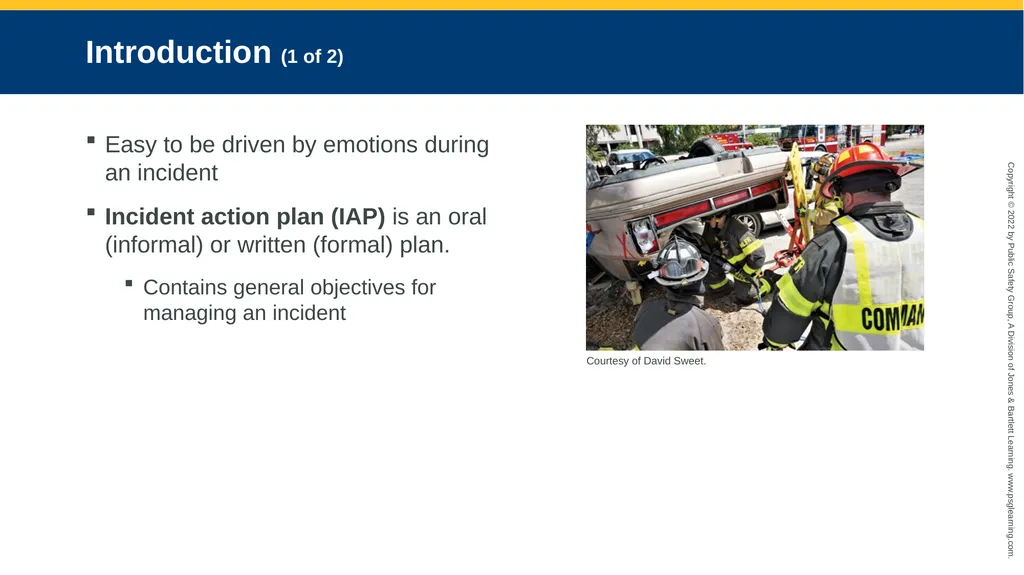
Introduction (1 of 2) Easy to be driven by emotions during an incident
Incident action plan (IAP) is an oral (informal) or written (formal) plan.
Contains general objectives for managing an incident Courtesy of David Sweet.<br>
Incident action plan (IAP) is an oral (informal) or written (formal) plan.
Contains general objectives for managing an incident Courtesy of David Sweet.<br>
06
Introduction (2 of 2) Implementing the requirements of NFPA 1006 and 1670 may be met with some resistance if it requires the organization to change operational structure.
It is important for the AHJ and/or the organization not to become overly focused on terminology or titles.<br>
It is important for the AHJ and/or the organization not to become overly focused on terminology or titles.<br>
07
Determining Level of Service The goal here is to
Focus on what level of service the fire rescue organization provides
Identify or match the skills with the action provided based on criteria from NFPA 1006 and 1670
Determine what level of response capability the organization has and what is adequate for the community (risk assessment study)<br>
Focus on what level of service the fire rescue organization provides
Identify or match the skills with the action provided based on criteria from NFPA 1006 and 1670
Determine what level of response capability the organization has and what is adequate for the community (risk assessment study)<br>
08
Risk Assessment (1 of 2) A process that identifies vulnerabilities to which a community, an organization, or a business is exposed and then determines the
actions required to reduce them
This is vital to understanding what level of response capability a rescue organization has.
To determine the level of response, the AHJ needs the appropriate data.
Data must support the function.<br>
This is vital to understanding what level of response capability a rescue organization has.
To determine the level of response, the AHJ needs the appropriate data.
Data must support the function.<br>
09
Risk Assessment (2 of 2) With this information, the AHJ can
Determine whether the organization is equipped to handle incidents
Minimize risks associated with incidents
Identify and legitimize the current operational response capability to hire additional personnel, purchase equipment, negotiate contracts, etc.<br>
Determine whether the organization is equipped to handle incidents
Minimize risks associated with incidents
Identify and legitimize the current operational response capability to hire additional personnel, purchase equipment, negotiate contracts, etc.<br>
10
Hazard Analysis Identifies situations or conditions that may injure people or damage property or the environment
AHJ must provide the appropriate PPE/equipment/training and ensure that rehabilitation policies and procedures are in place to assist with identified hazards
Must determine possibility and probability that an an incident will occur
Data research: incident run reports, area surveys, transportation plans<br>
11
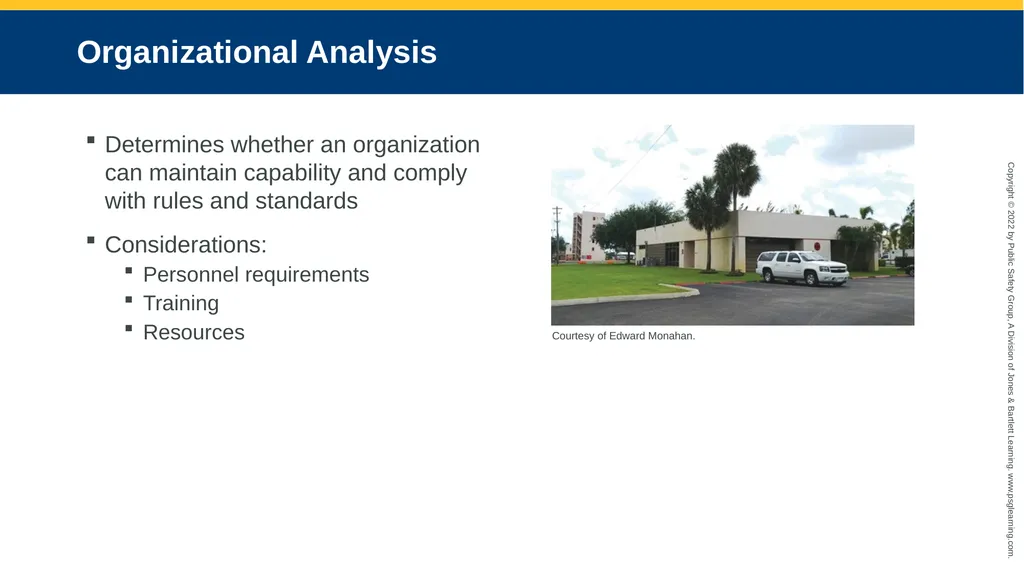
Organizational Analysis Determines whether an organization can maintain capability and comply with rules and standards
Considerations:
Personnel requirements
Training
Resources Courtesy of Edward Monahan.<br>
Considerations:
Personnel requirements
Training
Resources Courtesy of Edward Monahan.<br>
12
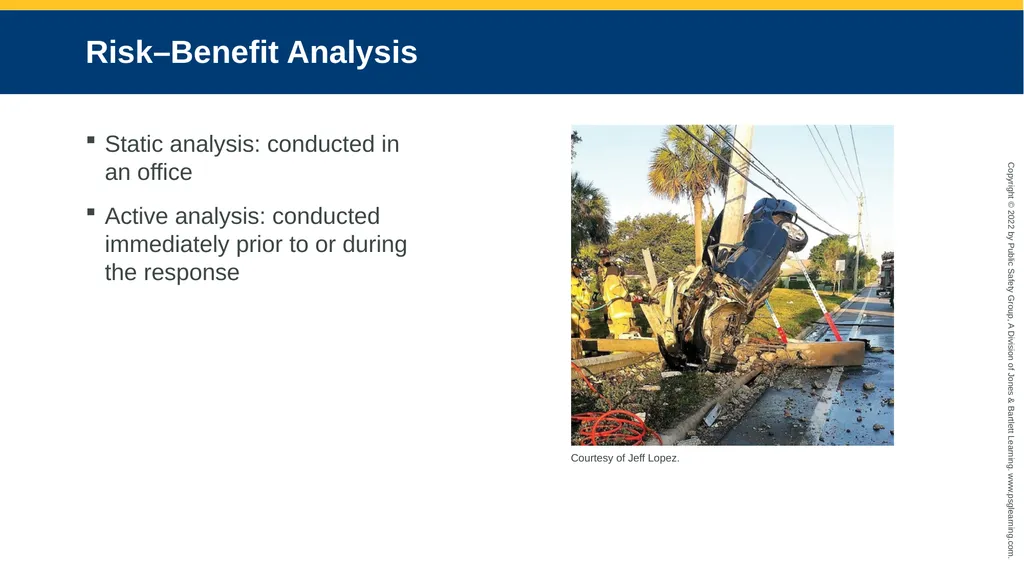
Risk–Benefit Analysis Static analysis: conducted in an office
Active analysis: conducted immediately prior to or during the response Courtesy of Jeff Lopez.<br>
Active analysis: conducted immediately prior to or during the response Courtesy of Jeff Lopez.<br>
13
Involves providing the appropriate level of service to manage a technical
rescue incident
Performance levels and training are evaluated and documented annually to determine whether the organization and personnel are prepared to manage a potential emergency incident recognized in the risk assessment.
All documentation and data must be readily available to those authorized. Level of Response Analysis<br>
14
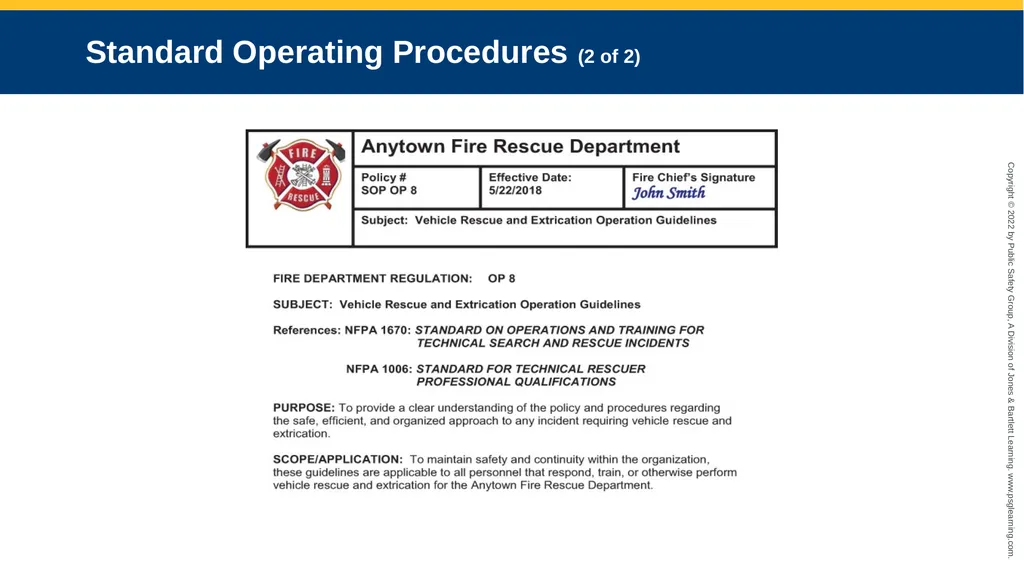
Standard Operating Procedures (1 of 2) A standard operating procedure (SOP) is an organizational directive that establishes a standard course of action.
Provides written guidelines required of emergency personnel
Not intended to tell you how to do the job, but rather related considerations
Technical skills are not normally the subject of SOPs.<br>
Provides written guidelines required of emergency personnel
Not intended to tell you how to do the job, but rather related considerations
Technical skills are not normally the subject of SOPs.<br>
15
Standard Operating Procedures (2 of 2)<br>
16
Incident Response Planning (1 of 3) Response planning (preincident planning) is the process of compiling, documenting, and dispersing information in preparation for an incident.
Problem identification
Conduct a needs assessment
Needs assessment combined with identified operational capability forms basis of the plan<br>
Problem identification
Conduct a needs assessment
Needs assessment combined with identified operational capability forms basis of the plan<br>
17
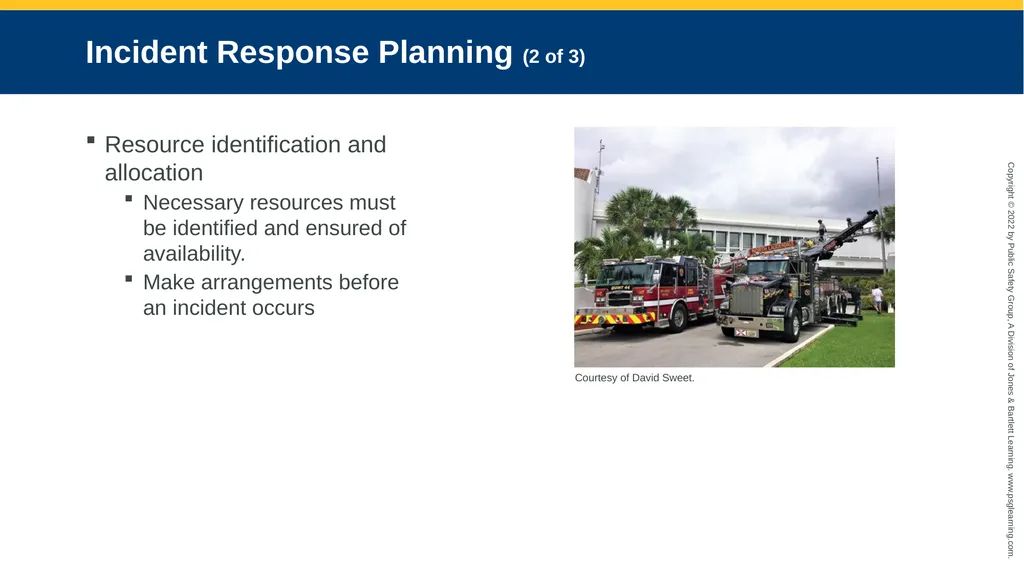
Incident Response Planning (2 of 3) Resource identification and allocation
Necessary resources must be identified and ensured of availability.
Make arrangements before an incident occurs Courtesy of David Sweet.<br>
Necessary resources must be identified and ensured of availability.
Make arrangements before an incident occurs Courtesy of David Sweet.<br>
18
Incident Response Planning (3 of 3) Operational procedures
Preincident plan should identify the resources needed and how they will be deployed.
Plan should identify alternatives.
Once the preincident plan is developed, it should be tested.<br>
Preincident plan should identify the resources needed and how they will be deployed.
Plan should identify alternatives.
Once the preincident plan is developed, it should be tested.<br>
19
Incident Command System Success depends on everyone following the same IAP.
IAP should follow the NIMS model.
NIMS model allows for a standardized approach by breaking down the incident into manageable sections and assigning appropriate resources.<br>
IAP should follow the NIMS model.
NIMS model allows for a standardized approach by breaking down the incident into manageable sections and assigning appropriate resources.<br>
20
Jurisdictional Authority ICS defines agency in charge of incident.
Large-scale incidents may cross boundaries.
ICS may employ a unified command (UC).
Different agencies coordinate, plan, and interact.
Multiple representatives make decisions.
Ensures cooperation, avoids confusion, and guarantees agreement on goals and objectives<br>
Large-scale incidents may cross boundaries.
ICS may employ a unified command (UC).
Different agencies coordinate, plan, and interact.
Multiple representatives make decisions.
Ensures cooperation, avoids confusion, and guarantees agreement on goals and objectives<br>
21
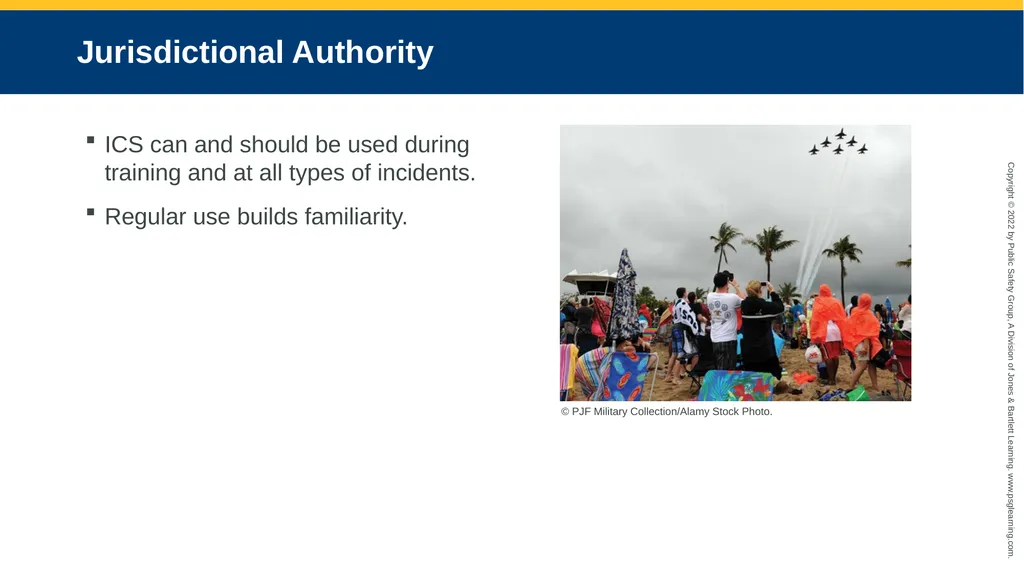
Jurisdictional Authority ICS can and should be used during training and at all types of incidents.
Regular use builds familiarity. © PJF Military Collection/Alamy Stock Photo.<br>
Regular use builds familiarity. © PJF Military Collection/Alamy Stock Photo.<br>
22
Span of Control ICS allows for a manageable span of control of people and resources.
One person can only effectively supervise 3–7 people.
The incident commander (IC) communicates and receives information from a maximum of five people rather than from all personnel at scene.<br>
One person can only effectively supervise 3–7 people.
The incident commander (IC) communicates and receives information from a maximum of five people rather than from all personnel at scene.<br>
23
Modular Organization Not all components of an ICS need to be used at every incident.
Additional components can be added or eliminated as the incident unfolds.<br>
Additional components can be added or eliminated as the incident unfolds.<br>
24
Common Terminology Shared language eliminates confusion about what is intended.
Use NFPA 1936
Increases level of understanding among the response agencies working at an incident site<br>
Use NFPA 1936
Increases level of understanding among the response agencies working at an incident site<br>
25
Integrated Communications ICS must support communication up and down the chain of command at every level.
Ensures that control objectives established by the command staff are implemented by task-level resources
Also ensures that outcomes produced by task-level units are reported back up the chain of command
Allows progress toward incident goals to be measured<br>
Ensures that control objectives established by the command staff are implemented by task-level resources
Also ensures that outcomes produced by task-level units are reported back up the chain of command
Allows progress toward incident goals to be measured<br>
26
Consolidated IAPs ICS ensures that everyone involved in the incident is following the same overall action plan.
IAP may be developed by the IC alone or in collaboration with other agencies.<br>
IAP may be developed by the IC alone or in collaboration with other agencies.<br>
27
Designated Incident Facilities Use of standard terminology for commonly needed operational facilities ensures everyone knows what occurs at each facility.
The command post at an extrication incident involving only a few vehicles may be established outside of the hazard zones.
A larger incident may require the command post to be established within a structure with an established base.
Staging area is vital and may be used to stage incoming apparatus.<br>
28
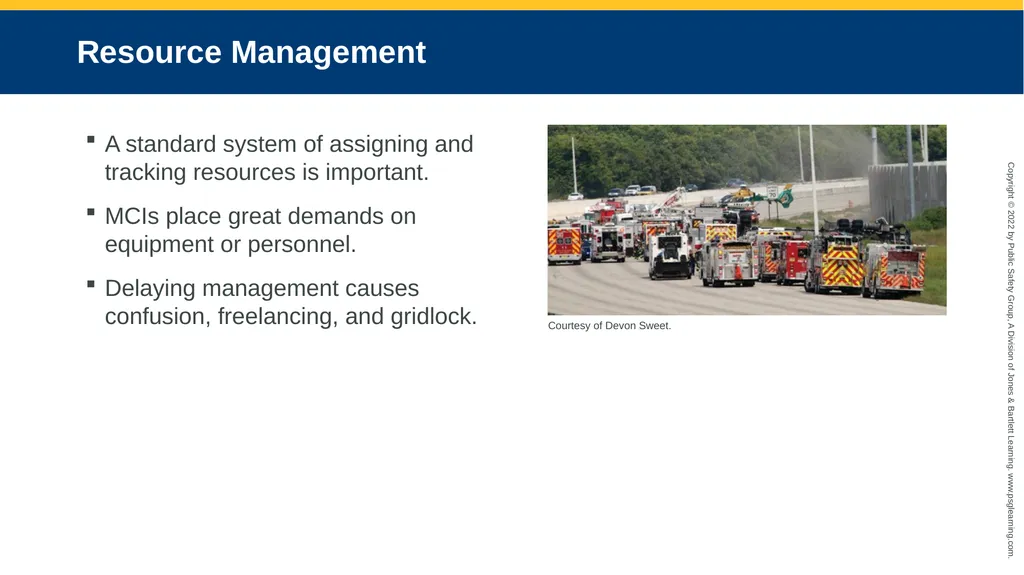
Resource Management A standard system of assigning and tracking resources is important.
MCIs place great demands on equipment or personnel.
Delaying management causes confusion, freelancing, and gridlock. Courtesy of Devon Sweet.<br>
MCIs place great demands on equipment or personnel.
Delaying management causes confusion, freelancing, and gridlock. Courtesy of Devon Sweet.<br>
29
Victim Reconnaissance When you are dispatched to the scene, start formulating a plan for the operation.
If multiple victims are involved, call for additional resources early on.
Can always be canceled later
Witnesses may assist in confirming how many victims are involved and where they are.<br>
If multiple victims are involved, call for additional resources early on.
Can always be canceled later
Witnesses may assist in confirming how many victims are involved and where they are.<br>
30
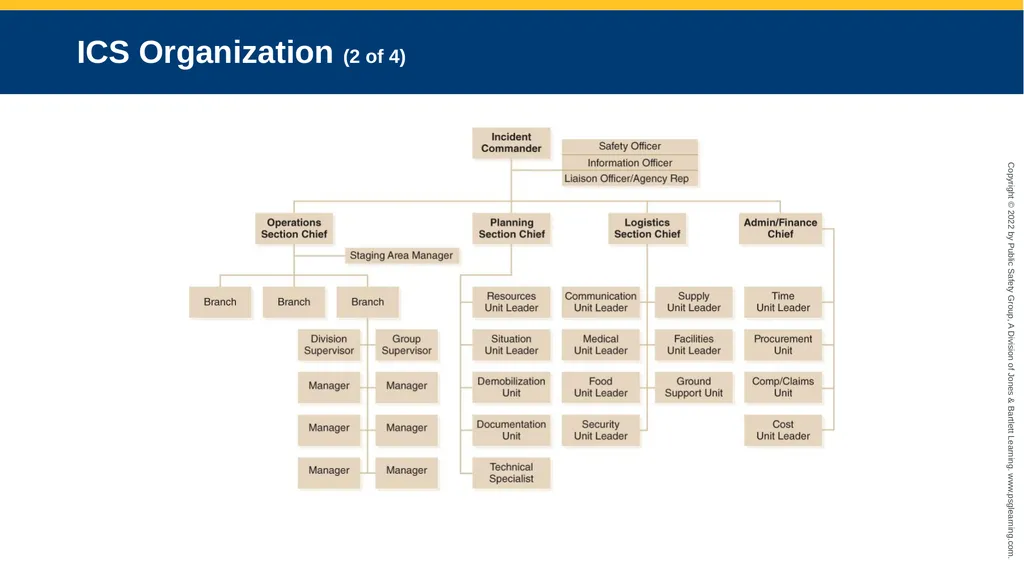
ICS Organization (1 of 4) ICS structure identifies a full range of duties, responsibilities, and functions.
Standard organizational chart clearly defines positions and chain of command.
The IC has overall management of operations.<br>
Standard organizational chart clearly defines positions and chain of command.
The IC has overall management of operations.<br>
31
ICS Organization (2 of 4)<br>
32
ICS Organization (3 of 4) IC position is established by the first unit on scene.
Transferred to a senior arriving officer
Elements of transfer of command report:
IAP
Tactical priorities
Hazardous conditions
Accomplishments
Assessment of effectiveness of operation
Current status of resources<br>
Transferred to a senior arriving officer
Elements of transfer of command report:
IAP
Tactical priorities
Hazardous conditions
Accomplishments
Assessment of effectiveness of operation
Current status of resources<br>
33
ICS Organization (4 of 4) The IC does not need to be an expert on technical rescue, but he/she needs to be familiar with the ICS management process.
IC must resist the temptation to get directly involved in operations.
IC should be nearby but apart from immediate action zone to maintain best vantage point.
At larger incidents, IC should establish a command post with visual access to the incident and restricted access to minimize interruptions.<br>
34
Public Information Officer Provides a single point of contact for information related to the incident
Prepares for IC approval any press releases
May provide IC with background information, suggest questions that may be asked, and assist with selection of photographers<br>
Prepares for IC approval any press releases
May provide IC with background information, suggest questions that may be asked, and assist with selection of photographers<br>
35
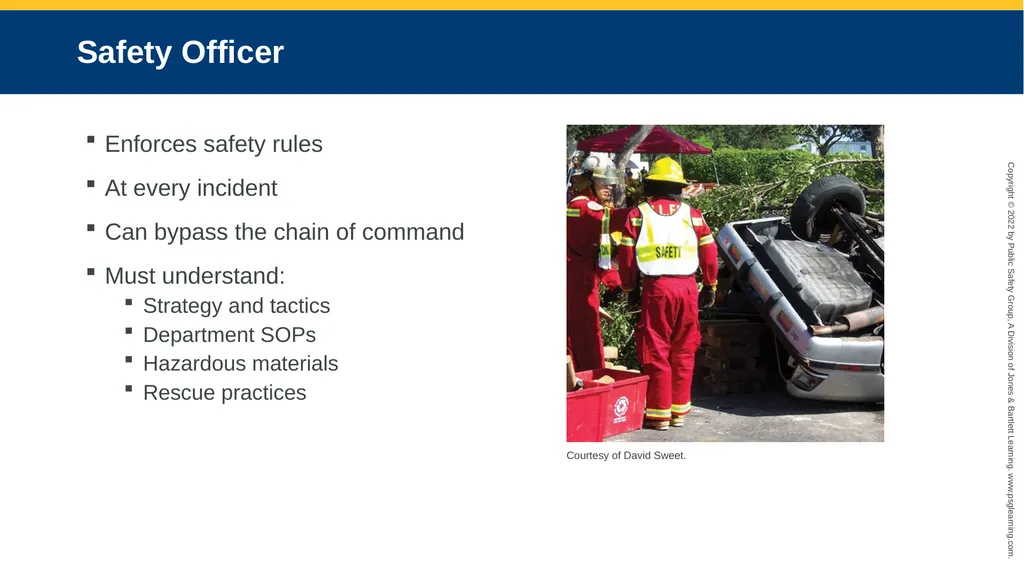
Safety Officer Enforces safety rules
At every incident
Can bypass the chain of command
Must understand:
Strategy and tactics
Department SOPs
Hazardous materials
Rescue practices Courtesy of David Sweet.<br>
At every incident
Can bypass the chain of command
Must understand:
Strategy and tactics
Department SOPs
Hazardous materials
Rescue practices Courtesy of David Sweet.<br>
36
Liaison Officer Is the IC’s point of contact for outside agencies
Coordinates information and resources between cooperating and existing agencies<br>
Coordinates information and resources between cooperating and existing agencies<br>
37
ICS Sections: Operations Develops, directs, and coordinates tactical operations
Coordinates and disseminates information
Functional areas needed at large-scale incident:
Staging (staging area manager)
Divisions
Groups
Branches<br>
Coordinates and disseminates information
Functional areas needed at large-scale incident:
Staging (staging area manager)
Divisions
Groups
Branches<br>
38
ICS Sections: Planning Collects, evaluates, disseminates, and uses information and intelligence
Anticipates potential problems, events, and logistical needs to execute upcoming IAP
Probably not required at smaller incidents
Technical specialists initially report to planning.<br>
Anticipates potential problems, events, and logistical needs to execute upcoming IAP
Probably not required at smaller incidents
Technical specialists initially report to planning.<br>
39
ICS Sections: Logistics (1 of 2) Responsible for all support requirements needed for effective and efficient incident management
Responsibilities:
Communications
Medical support
Supplies
Facilities
Works with staff to supply resources to accomplish and/or satisfy objectives<br>
Responsibilities:
Communications
Medical support
Supplies
Facilities
Works with staff to supply resources to accomplish and/or satisfy objectives<br>
40
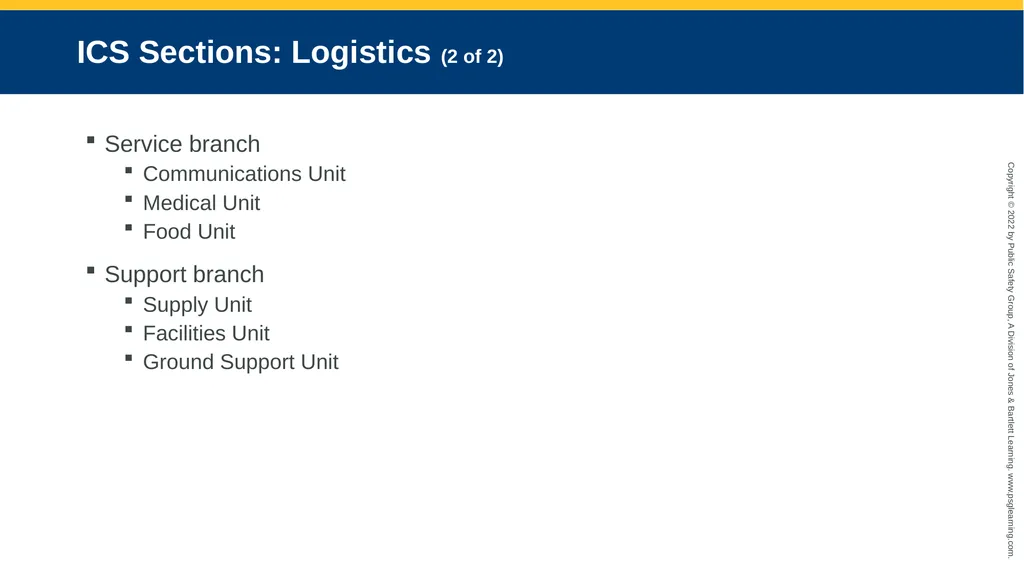
ICS Sections: Logistics (2 of 2) Service branch
Communications Unit
Medical Unit
Food Unit
Support branch
Supply Unit
Facilities Unit
Ground Support Unit<br>
Communications Unit
Medical Unit
Food Unit
Support branch
Supply Unit
Facilities Unit
Ground Support Unit<br>
41
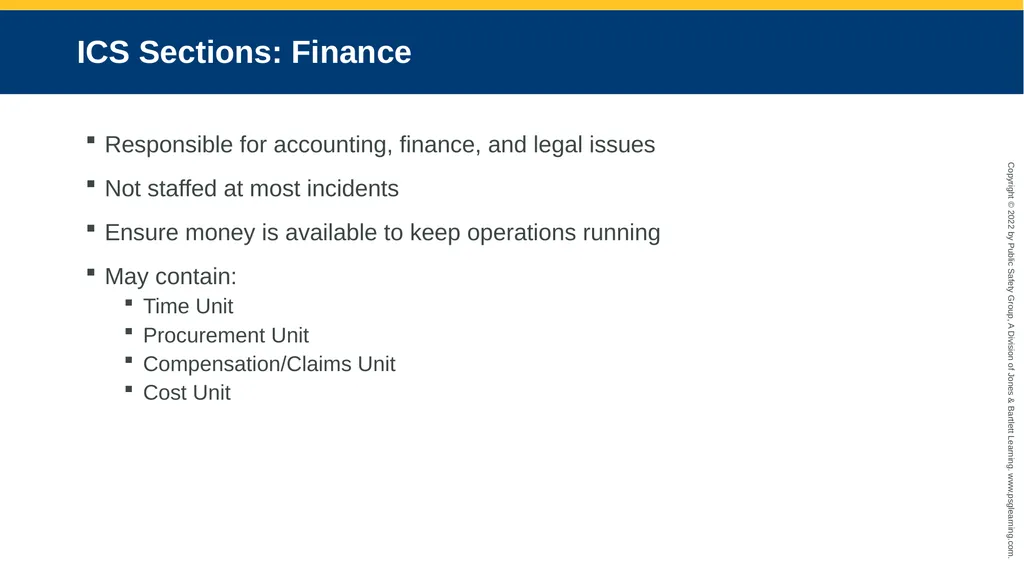
ICS Sections: Finance Responsible for accounting, finance, and legal issues
Not staffed at most incidents
Ensure money is available to keep operations running
May contain:
Time Unit
Procurement Unit
Compensation/Claims Unit
Cost Unit<br>
Not staffed at most incidents
Ensure money is available to keep operations running
May contain:
Time Unit
Procurement Unit
Compensation/Claims Unit
Cost Unit<br>
42
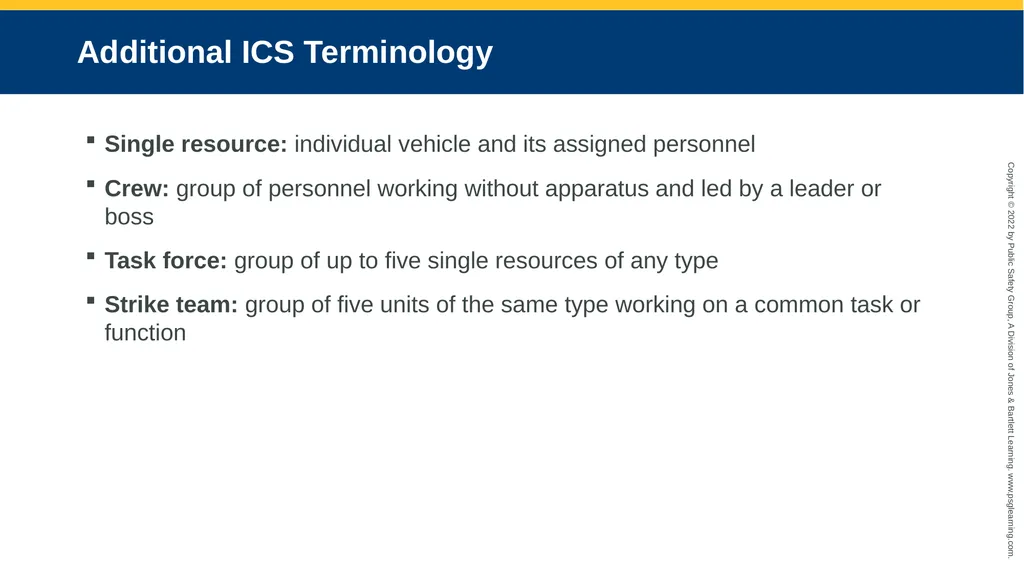
Additional ICS Terminology Single resource: individual vehicle and its assigned personnel
Crew: group of personnel working without apparatus and led by a leader or boss
Task force: group of up to five single resources of any type
Strike team: group of five units of the same type working on a common task or function<br>
Crew: group of personnel working without apparatus and led by a leader or boss
Task force: group of up to five single resources of any type
Strike team: group of five units of the same type working on a common task or function<br>
43
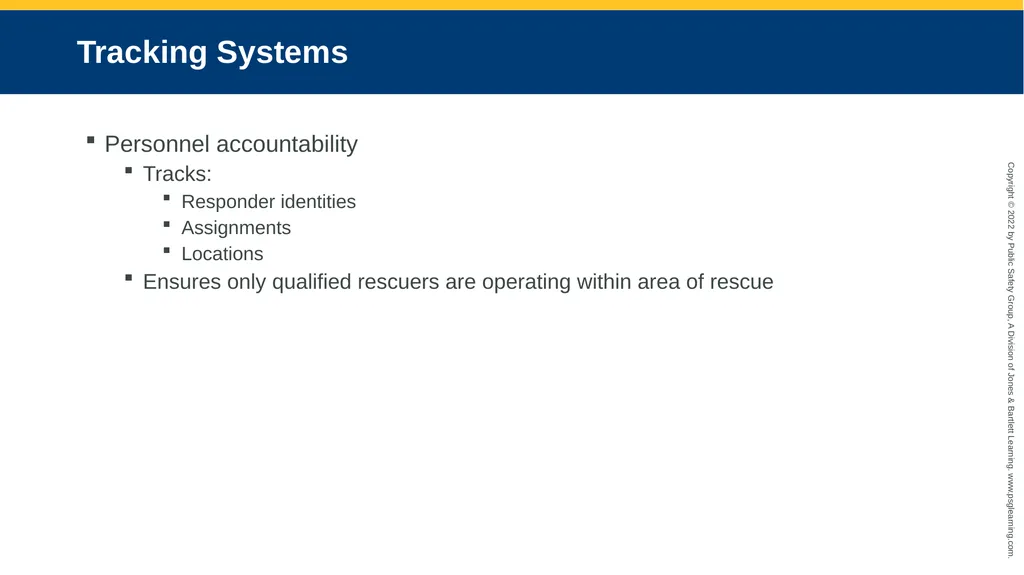
Tracking Systems Personnel accountability
Tracks:
Responder identities
Assignments
Locations
Ensures only qualified rescuers are operating within area of rescue<br>
Tracks:
Responder identities
Assignments
Locations
Ensures only qualified rescuers are operating within area of rescue<br>
44
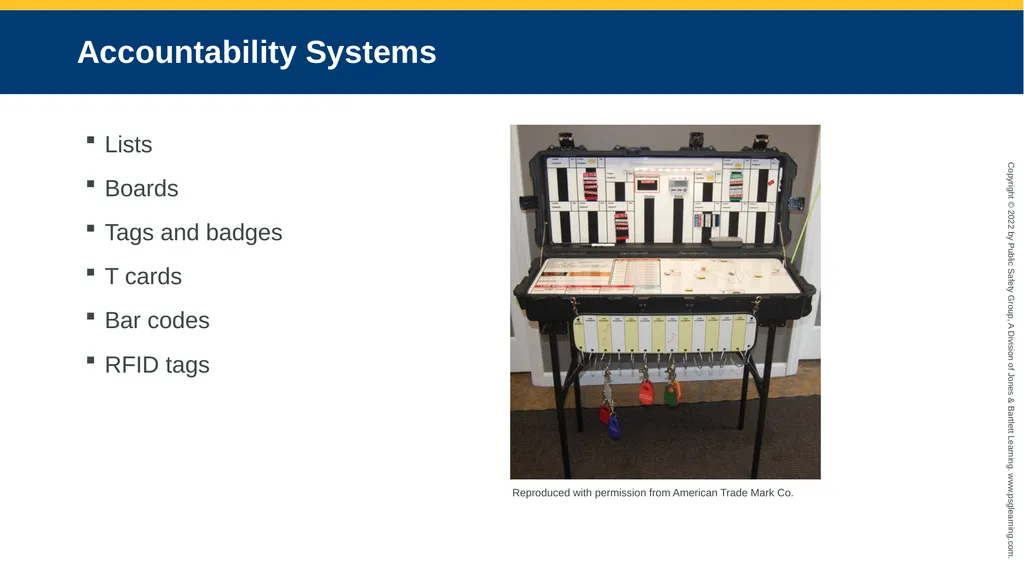
Accountability Systems Lists
Boards
Tags and badges
T cards
Bar codes
RFID tags Reproduced with permission from American Trade Mark Co.<br>
Boards
Tags and badges
T cards
Bar codes
RFID tags Reproduced with permission from American Trade Mark Co.<br>
45
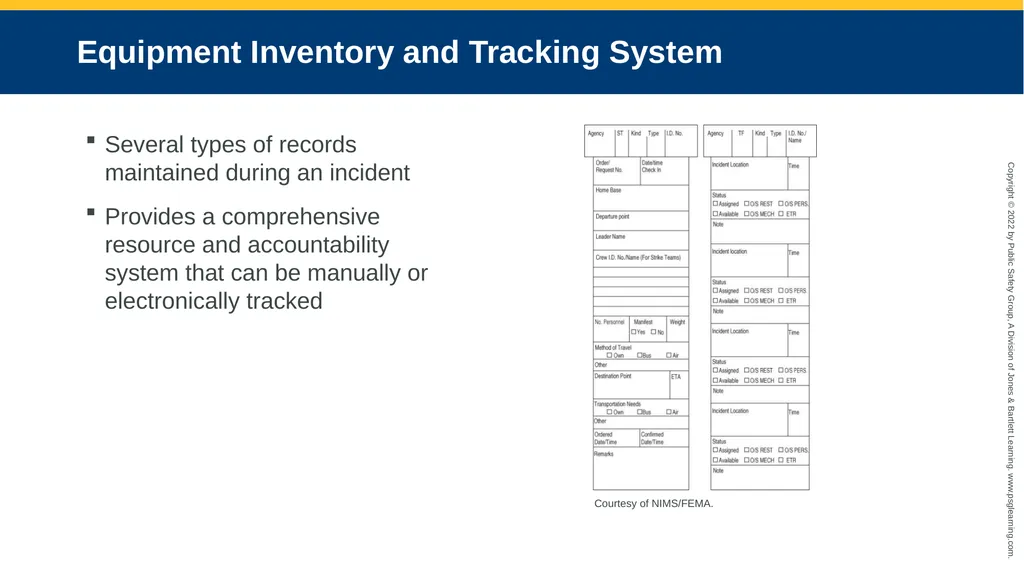
Equipment Inventory and Tracking System Several types of records maintained during an incident
Provides a comprehensive resource and accountability system that can be manually or electronically tracked Courtesy of NIMS/FEMA.<br>
Provides a comprehensive resource and accountability system that can be manually or electronically tracked Courtesy of NIMS/FEMA.<br>
46
Long–Term Operations Expanded ICS system will assist IC in planning and functioning in long-term incidents.
Factors affecting long-term incidents:
Extent of the rescue required
Training level of the rescue team
Available resources
Rescuers’ physical condition
Rescuers’ psychological condition
Needs supported by other ICS functions<br>
Factors affecting long-term incidents:
Extent of the rescue required
Training level of the rescue team
Available resources
Rescuers’ physical condition
Rescuers’ psychological condition
Needs supported by other ICS functions<br>
47
Safety Health and safety of personnel is the highest priority.
NFPA 1500 covers topics in health and safety programs
Requirements for special operations, PPE, and emergency operations
Works in concert with NFPA 1250, 1521, and 1561<br>
NFPA 1500 covers topics in health and safety programs
Requirements for special operations, PPE, and emergency operations
Works in concert with NFPA 1250, 1521, and 1561<br>
48
Time Management (1 of 3) A victim of a critical traumatic injury has the greatest chance of survival if he/she is treated at a trauma facility within 60 minutes from the time of injury.
Golden Period is the time during which treatment of shock and traumatic injuries is most critical and the potential for survival is highest.<br>
Golden Period is the time during which treatment of shock and traumatic injuries is most critical and the potential for survival is highest.<br>
49
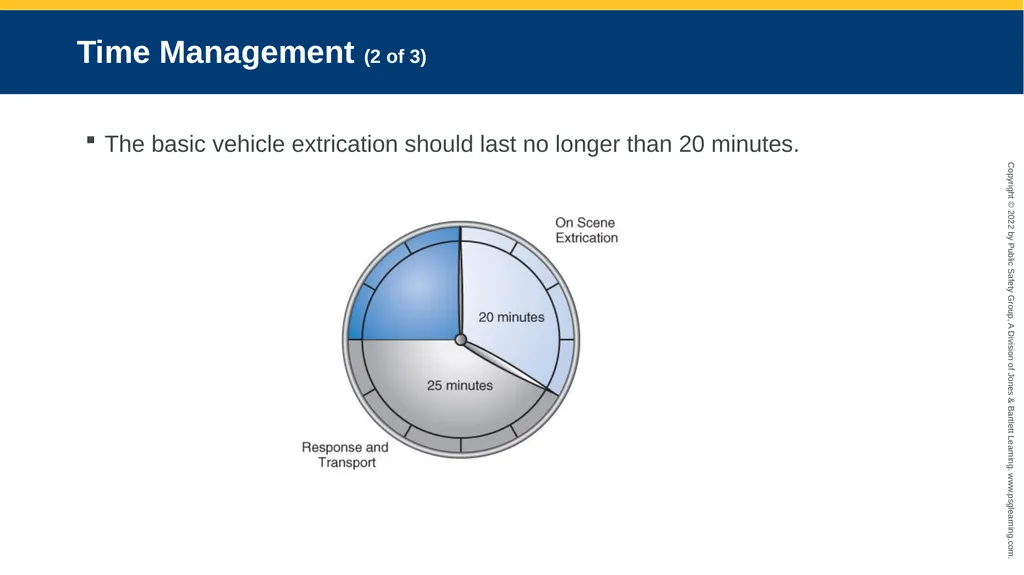
Time Management (2 of 3) The basic vehicle extrication should last no longer than 20 minutes.<br>
50
Time Management (3 of 3) The total incident time should be approximately 45 minutes for agencies located in urban areas.
Rural areas may exceed the benchmark.
This on-scene time is monitored by the IC and dispatch.
Some dispatching agencies have a standard protocol that will automatically inform the incident commander (IC) at 10-minute intervals until the incident becomes static or mitigated.
This is called an incident clock.<br>
51
Responding to the Scene Response should set the stage for how the incident will evolve.
Follow several benchmarks prior to the incident being dispatched and as the incident is dispatched:
Maintain readiness, where all equipment and PPE are operational and accounted for
Preincident planning with preassignments for personnel prior to the incident dispatch to alleviate confusion on arrival
Starting the size-up of the incident as the incident is dispatched<br>
52
Personal Protective Equipment Includes coats, trousers, coveralls, helmets, gloves, footwear, and interface components
Respiratory protection may also be necessary.
Reflective safety vests are used in areas requiring high visibility.
Must provide protection from exposure to physical, thermal, liquid, and body fluid–borne pathogens
Selection of PPE is based on hazards.<br>
Respiratory protection may also be necessary.
Reflective safety vests are used in areas requiring high visibility.
Must provide protection from exposure to physical, thermal, liquid, and body fluid–borne pathogens
Selection of PPE is based on hazards.<br>
53
Dispatch Information Emergency dispatch centers across the country may vary slightly in terminology.
Common language is the goal.
Emergency vehicles are not exempt from observing all traffic laws.
Listen for time of day, location of incident, speed of travel, and weather.
Will help the company officer preassign crew members while en route<br>
Common language is the goal.
Emergency vehicles are not exempt from observing all traffic laws.
Listen for time of day, location of incident, speed of travel, and weather.
Will help the company officer preassign crew members while en route<br>
54
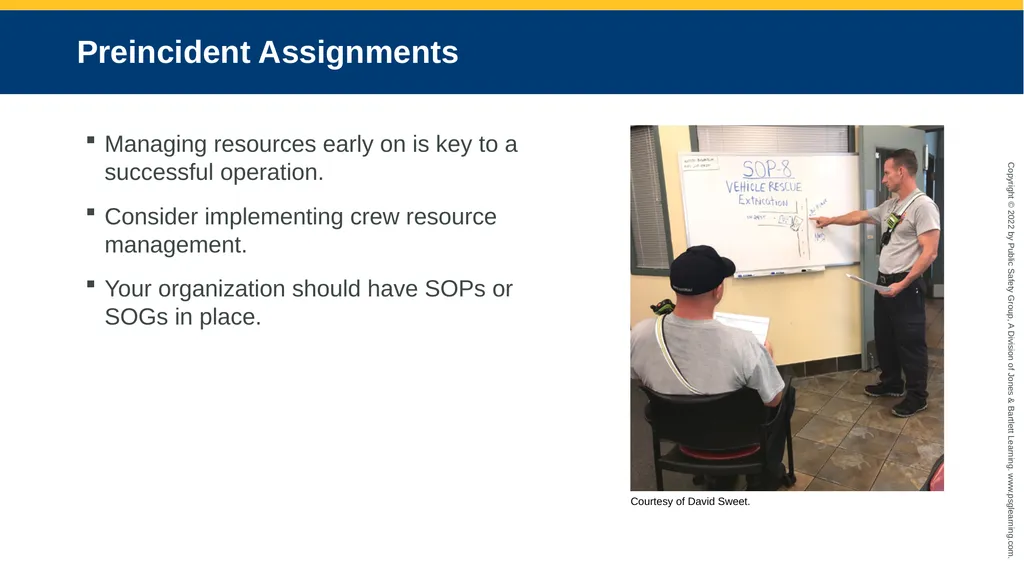
Preincident Assignments Managing resources early on is key to a successful operation.
Consider implementing crew resource management.
Your organization should have SOPs or SOGs in place. Courtesy of David Sweet.<br>
Consider implementing crew resource management.
Your organization should have SOPs or SOGs in place. Courtesy of David Sweet.<br>
55
Traffic Traffic incident management establishes roadway safety procedures and traffic control measures for emergency operations at a motor vehicle accident.
Defensive apparatus placement is a component of site operations; main goal is to protect the scene from the flow of traffic.
Whenever possible, place vehicles so that they ensure safety and not disrupt traffic.
On high-speed or high-volume roadways, a second apparatus should be dispatched as a roadway blocking unit.<br>
56
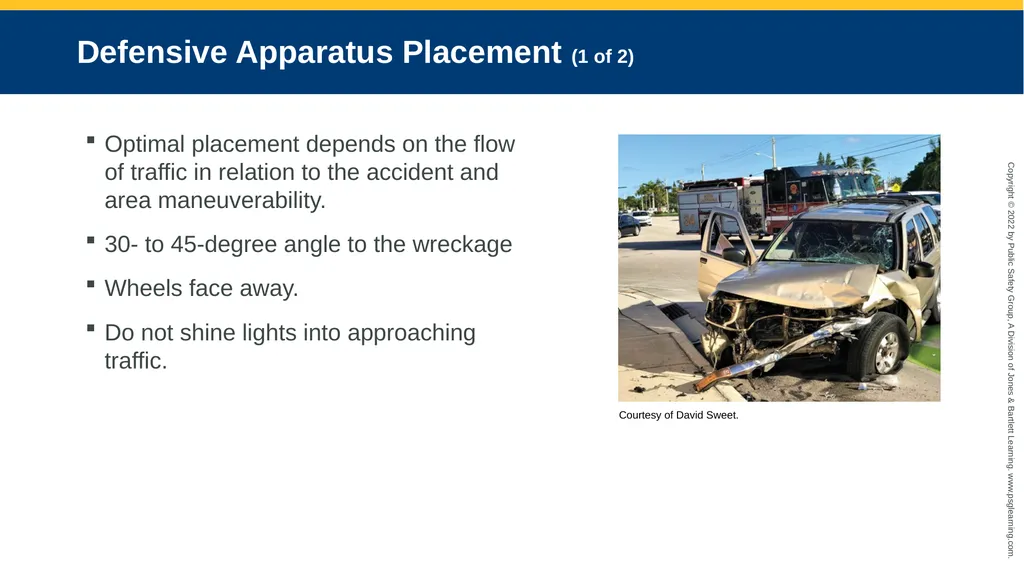
Defensive Apparatus Placement (1 of 2) Optimal placement depends on the flow of traffic in relation to the accident and area maneuverability.
30- to 45-degree angle to the wreckage
Wheels face away.
Do not shine lights into approaching traffic. Courtesy of David Sweet.<br>
30- to 45-degree angle to the wreckage
Wheels face away.
Do not shine lights into approaching traffic. Courtesy of David Sweet.<br>
57
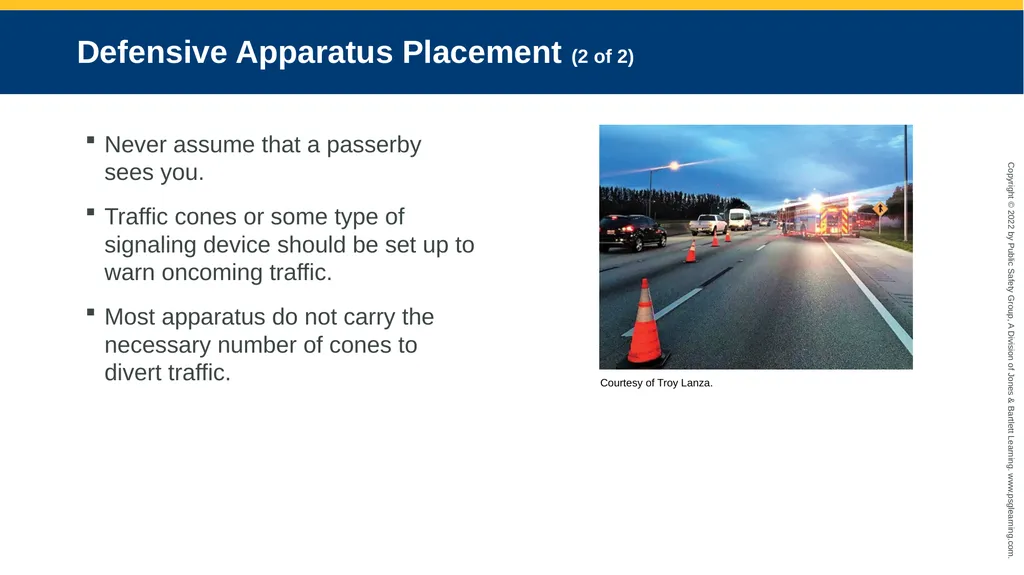
Defensive Apparatus Placement (2 of 2) Never assume that a passerby sees you.
Traffic cones or some type of signaling device should be set up to warn oncoming traffic.
Most apparatus do not carry the necessary number of cones to divert traffic. Courtesy of Troy Lanza.<br>
Traffic cones or some type of signaling device should be set up to warn oncoming traffic.
Most apparatus do not carry the necessary number of cones to divert traffic. Courtesy of Troy Lanza.<br>
58
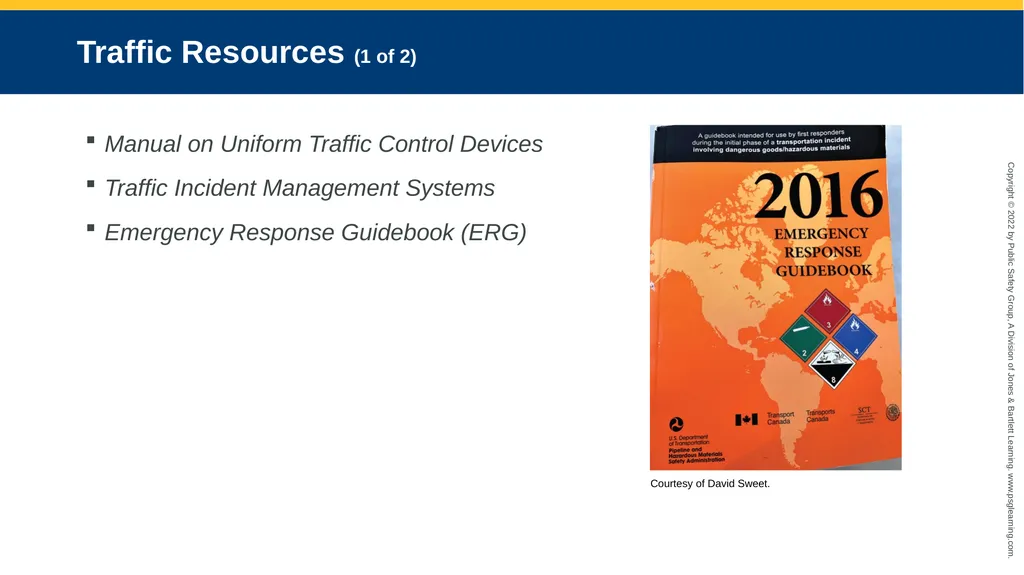
Traffic Resources (1 of 2) Manual on Uniform Traffic Control Devices
Traffic Incident Management Systems
Emergency Response Guidebook (ERG) Courtesy of David Sweet.<br>
Traffic Incident Management Systems
Emergency Response Guidebook (ERG) Courtesy of David Sweet.<br>
59
Traffic Resources (2 of 2) Resources discuss:
Incident traffic size-up
Risk analysis and assessment
Establishing traffic control zones
Proper traffic cone size, color, spacing
Electronic message signs and pre-warning signs
Flares and directional arrow panels
Flagger position<br>
Incident traffic size-up
Risk analysis and assessment
Establishing traffic control zones
Proper traffic cone size, color, spacing
Electronic message signs and pre-warning signs
Flares and directional arrow panels
Flagger position<br>
60
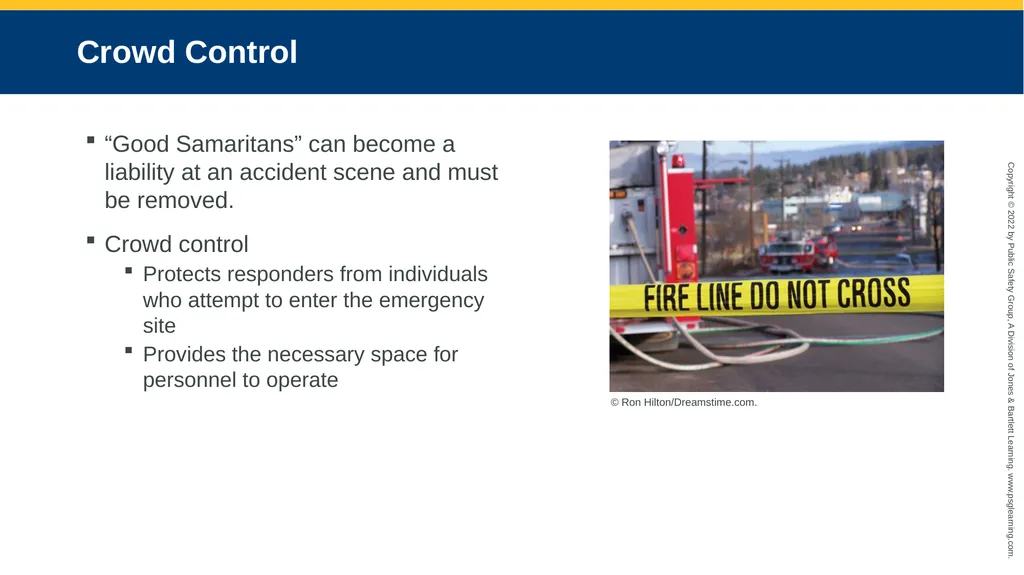
Crowd Control “Good Samaritans” can become a liability at an accident scene and must be removed.
Crowd control
Protects responders from individuals who attempt to enter the emergency site
Provides the necessary space for personnel to operate © Ron Hilton/Dreamstime.com.<br>
Crowd control
Protects responders from individuals who attempt to enter the emergency site
Provides the necessary space for personnel to operate © Ron Hilton/Dreamstime.com.<br>
61
Personnel Resources The size of an incident will dictate whether a large management staff is necessary.
As an incident grows, the need for additional resources may grow as well.
Recognizing the need for additional resources is a true sign of leadership and proper scene management.
Always call for additional support early in the incident.
Units can be cancelled if not needed.<br>
As an incident grows, the need for additional resources may grow as well.
Recognizing the need for additional resources is a true sign of leadership and proper scene management.
Always call for additional support early in the incident.
Units can be cancelled if not needed.<br>
62
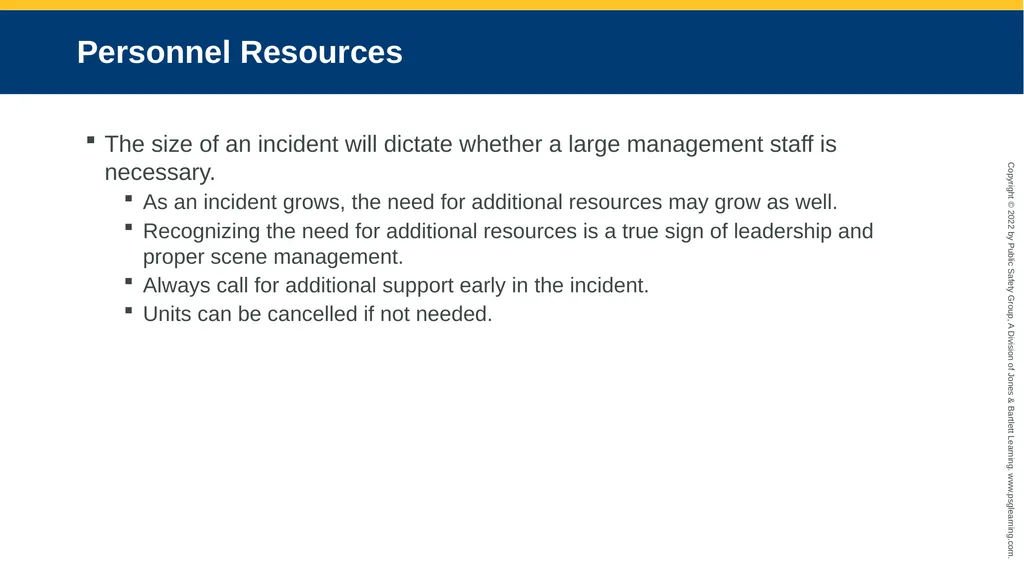
Law Enforcement Personnel Law enforcement should be requested for crowd and traffic control.
May be on the same dispatching system and notified before fire rescue
There must be clear communication between police, fire, and EMS. © Peter Titmuss/Alamy Stock Photo.<br>
May be on the same dispatching system and notified before fire rescue
There must be clear communication between police, fire, and EMS. © Peter Titmuss/Alamy Stock Photo.<br>
63
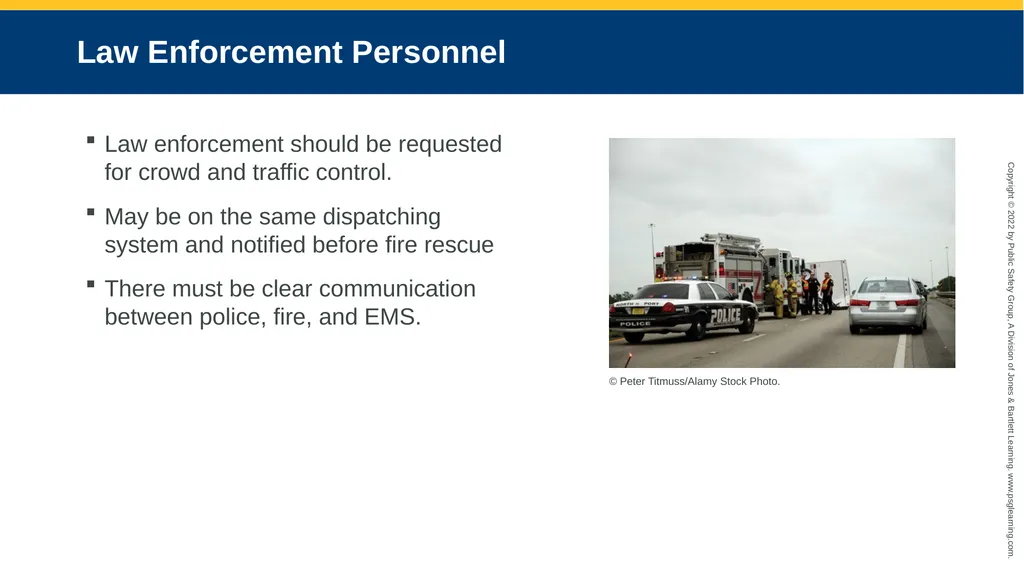
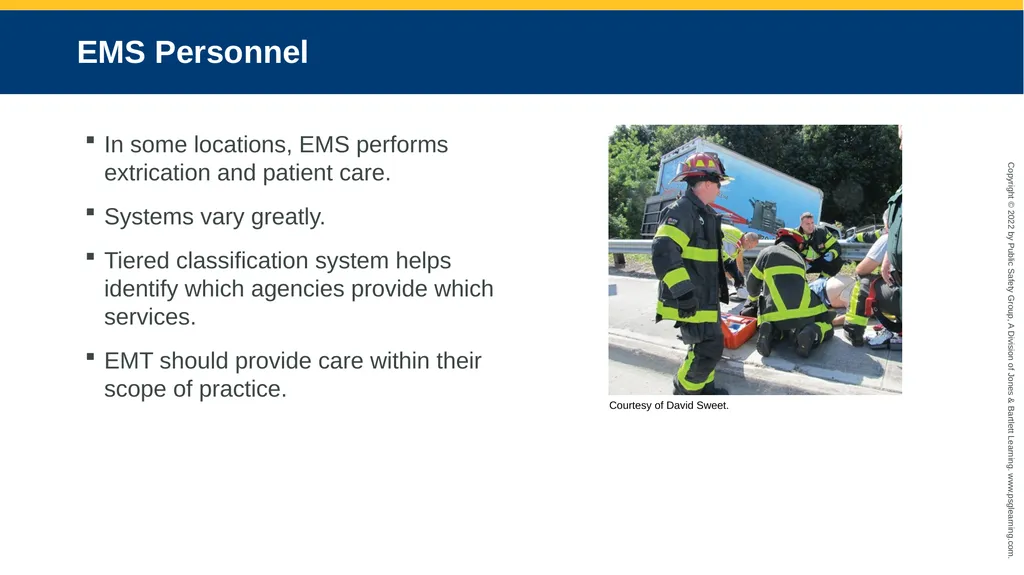
EMS Personnel In some locations, EMS performs extrication and patient care.
Systems vary greatly.
Tiered classification system helps identify which agencies provide which services.
EMT should provide care within their scope of practice. Courtesy of David Sweet.<br>
Systems vary greatly.
Tiered classification system helps identify which agencies provide which services.
EMT should provide care within their scope of practice. Courtesy of David Sweet.<br>
64
Tiered Systems Three-tiered system:
Fire apparatus responds to provide basic patient care and support.
EMS respond to provide patient treatment.
Two-tiered system:
Fire apparatus responds to provide basic patient care and support.
EMS provide treatment and support.
Single-tiered system:
One agency responds.<br>
Fire apparatus responds to provide basic patient care and support.
EMS respond to provide patient treatment.
Two-tiered system:
Fire apparatus responds to provide basic patient care and support.
EMS provide treatment and support.
Single-tiered system:
One agency responds.<br>
65
Hazardous Materials Personnel Could require special teams
Rescuers must allow a proper size-up.
Many rescuers are exposed to hazardous substances because they rush into dangerous situations.
Awareness-level responders can assist operations by
Identifying placards and other information
Crowd control
Research<br>
Rescuers must allow a proper size-up.
Many rescuers are exposed to hazardous substances because they rush into dangerous situations.
Awareness-level responders can assist operations by
Identifying placards and other information
Crowd control
Research<br>
66
Additional Resources (1 of 2) State and county emergency services
State and county health departments
Area hospitals
Emergency flight services
National Guard civil support team
K-9 organizations
Urban search and rescue teams
FEMA task force teams
Industry hazmat response teams<br>
State and county health departments
Area hospitals
Emergency flight services
National Guard civil support team
K-9 organizations
Urban search and rescue teams
FEMA task force teams
Industry hazmat response teams<br>
67
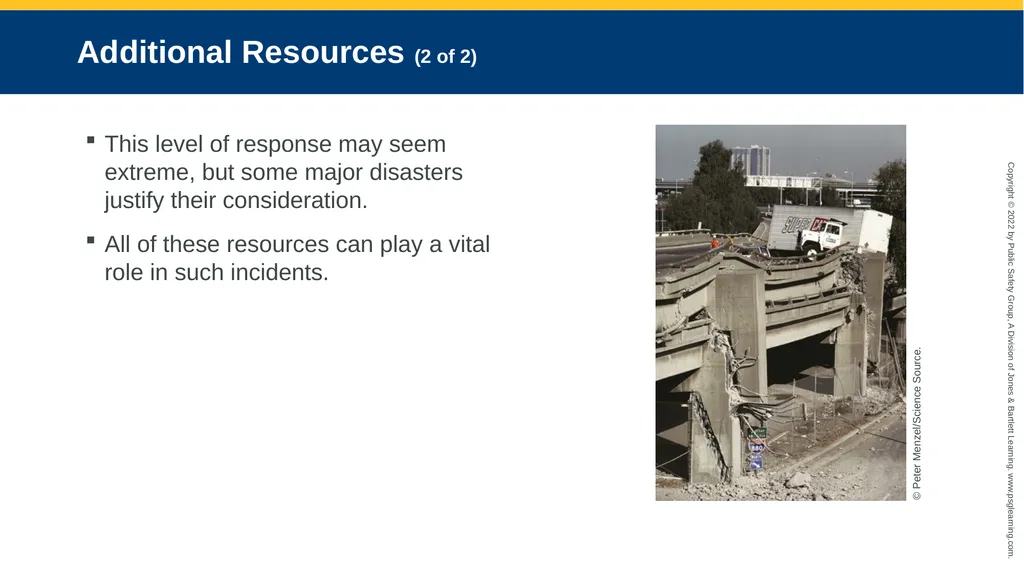
Additional Resources (2 of 2) This level of response may seem extreme, but some major disasters justify their consideration.
All of these resources can play a vital role in such incidents. © Peter Menzel/Science Source.<br>
All of these resources can play a vital role in such incidents. © Peter Menzel/Science Source.<br>
68
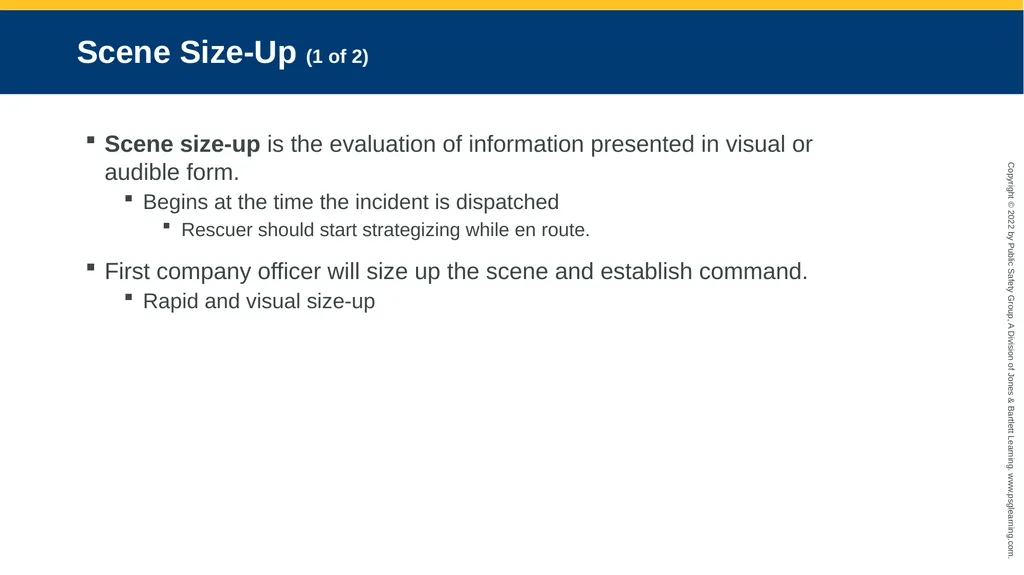
Scene Size-Up (1 of 2) Scene size-up is the evaluation of information presented in visual or audible form.
Begins at the time the incident is dispatched
Rescuer should start strategizing while en route.
First company officer will size up the scene and establish command.
Rapid and visual size-up<br>
Begins at the time the incident is dispatched
Rescuer should start strategizing while en route.
First company officer will size up the scene and establish command.
Rapid and visual size-up<br>
69
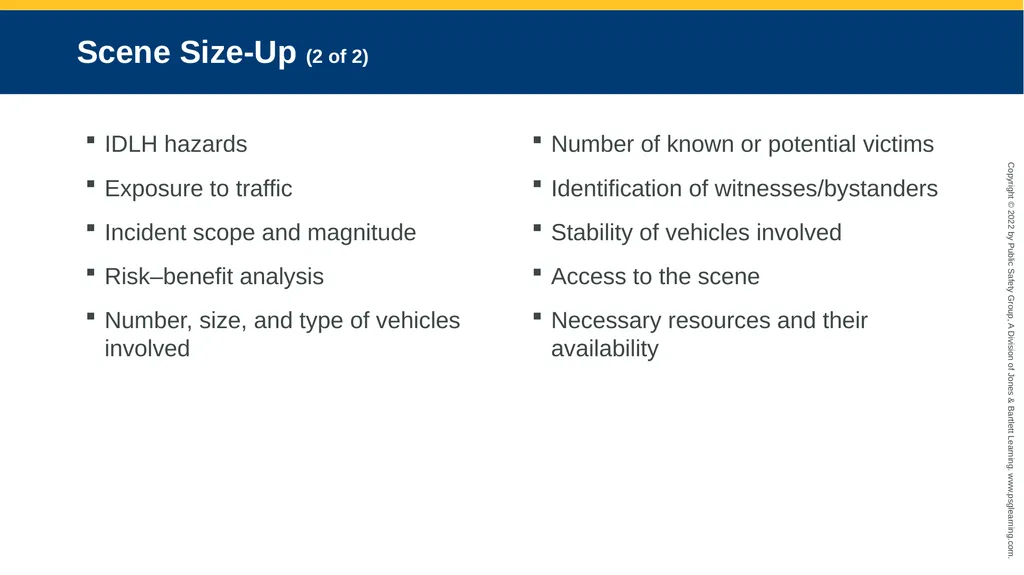
Scene Size-Up (2 of 2) IDLH hazards
Exposure to traffic
Incident scope and magnitude
Risk–benefit analysis
Number, size, and type of vehicles involved
Number of known or potential victims
Identification of witnesses/bystanders
Stability of vehicles involved
Access to the scene
Necessary resources and their availability<br>
Exposure to traffic
Incident scope and magnitude
Risk–benefit analysis
Number, size, and type of vehicles involved
Number of known or potential victims
Identification of witnesses/bystanders
Stability of vehicles involved
Access to the scene
Necessary resources and their availability<br>
70
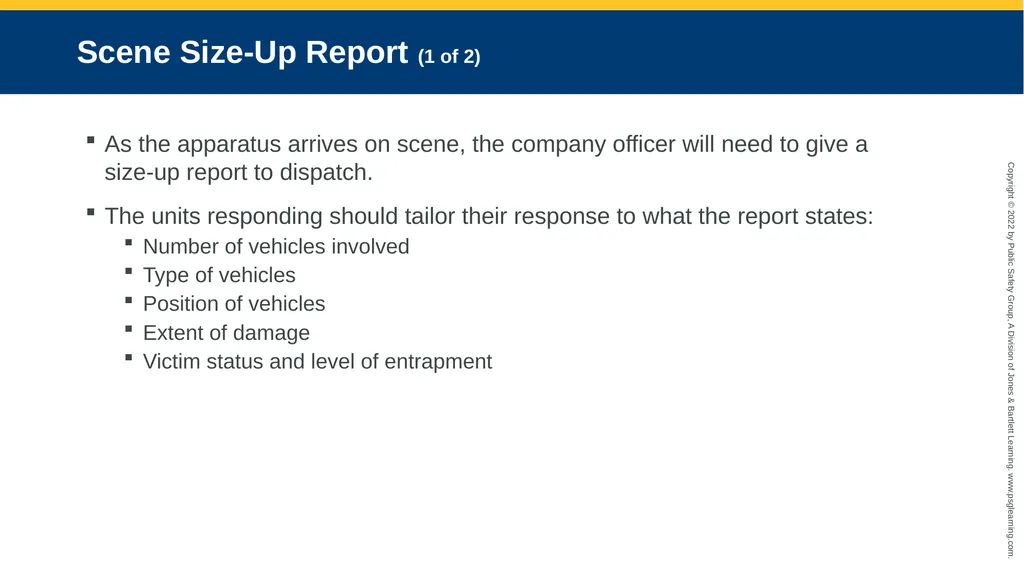
Scene Size-Up Report (1 of 2) As the apparatus arrives on scene, the company officer will need to give a size-up report to dispatch.
The units responding should tailor their response to what the report states:
Number of vehicles involved
Type of vehicles
Position of vehicles
Extent of damage
Victim status and level of entrapment<br>
The units responding should tailor their response to what the report states:
Number of vehicles involved
Type of vehicles
Position of vehicles
Extent of damage
Victim status and level of entrapment<br>
71
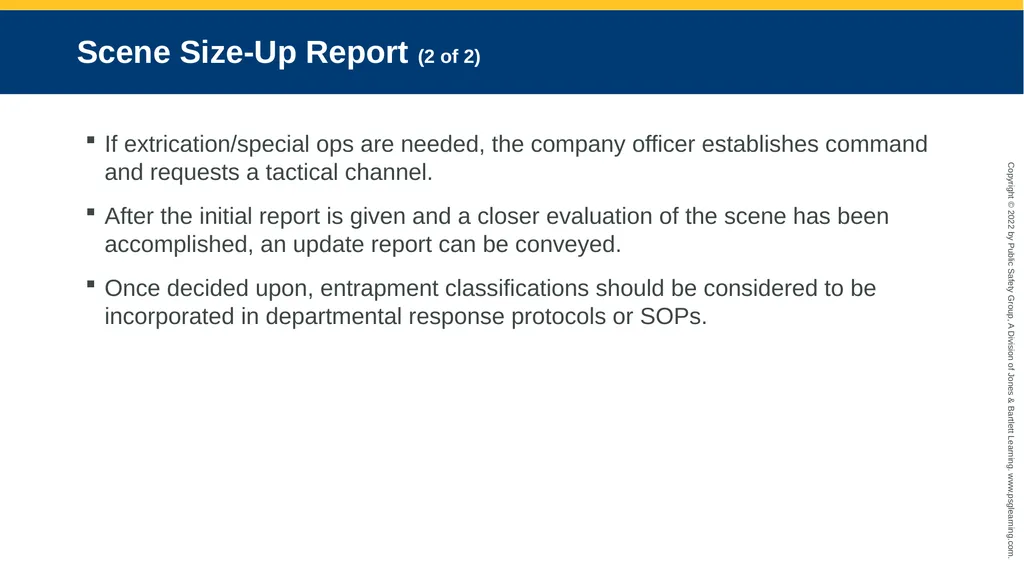
Scene Size-Up Report (2 of 2) If extrication/special ops are needed, the company officer establishes command and requests a tactical channel.
After the initial report is given and a closer evaluation of the scene has been accomplished, an update report can be conveyed.
Once decided upon, entrapment classifications should be considered to be incorporated in departmental response protocols or SOPs.<br>
After the initial report is given and a closer evaluation of the scene has been accomplished, an update report can be conveyed.
Once decided upon, entrapment classifications should be considered to be incorporated in departmental response protocols or SOPs.<br>
72
Inner and Outer Surveys (1 of 2) 360-degree inspections completed by two personnel
Every area in the hot zone should be investigated.<br>
Every area in the hot zone should be investigated.<br>
73
Inner and Outer Surveys (2 of 2) Provide the officer and crew with information about
Hazards
Types of vehicles
The number of victims
Possible ejections or entrapment
Need for additional resources
Information for IAP or incident strategy
If any IDLH hazards are found, rescue team members need to be ordered to freeze until the hazard has been mitigated.<br>
Hazards
Types of vehicles
The number of victims
Possible ejections or entrapment
Need for additional resources
Information for IAP or incident strategy
If any IDLH hazards are found, rescue team members need to be ordered to freeze until the hazard has been mitigated.<br>
74
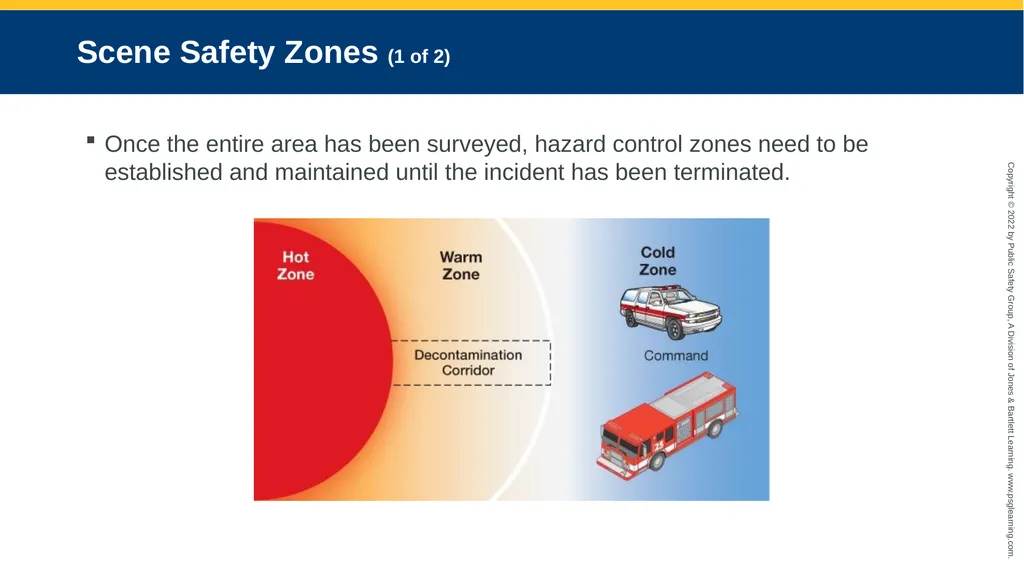
Scene Safety Zones (1 of 2) Once the entire area has been surveyed, hazard control zones need to be established and maintained until the incident has been terminated.<br>
75
Scene Safety Zones (2 of 2) Zones are designated by the IC and strictly enforced by the incident
safety officer.
Boundaries should be established in a manner that ensures the safety of the crews operating within the zones and limits the exposure of personnel outside the zone.
If there are changes, these must be acknowledged by all on-scene personnel.<br>
Boundaries should be established in a manner that ensures the safety of the crews operating within the zones and limits the exposure of personnel outside the zone.
If there are changes, these must be acknowledged by all on-scene personnel.<br>
76
Zones (1 of 2) Hot zone: for entry teams and rescue teams only
Warm zone: for properly trained and equipped personnel only
Personnel and equipment decontamination
Cold zone: for staging vehicles and equipment
Contains the command post
No-entry zone: nobody is permitted to enter because of an IDLH or need to preserve the scene
May or may not be needed<br>
Warm zone: for properly trained and equipped personnel only
Personnel and equipment decontamination
Cold zone: for staging vehicles and equipment
Contains the command post
No-entry zone: nobody is permitted to enter because of an IDLH or need to preserve the scene
May or may not be needed<br>
77
Zones (2 of 2) Most common methods of establishing zones involve
Law enforcement
Fire line tape
Barriers
Size of each zone will vary by incident.
Anyone entering the warm or hot zone must be wearing full PPE, without exception.<br>
Law enforcement
Fire line tape
Barriers
Size of each zone will vary by incident.
Anyone entering the warm or hot zone must be wearing full PPE, without exception.<br>
78
Summary (1 of 5) Vehicle rescue and extrication is a technical process that requires structured successive steps to produce favorable results.
Most, if not all, fire rescue organizations already provide a level of service to manage complex emergency incidents, such as vehicle rescue and extrication incidents.
There are a number of considerations that should be taken into account before committing your organization to providing technical rescue services, including actual need, cost, personnel, and equipment requirements, as well as social and political climate. The components of a risk assessment are hazard, organizational, risk–benefit, and level of response analyses.<br>
79
Summary (2 of 5) SOPs are designed to describe related considerations (the rules for doing the job), such as safety, evacuation, communication and notification procedures, command structures, and reporting requirements.
The major components of a response plan include the identification of potential problems and issues; resource identification and allocation; and in some cases, suggested or mandatory procedures.
An IAP formulated by an organization or AHJ should be designed following the model of the NIMS.<br>
The major components of a response plan include the identification of potential problems and issues; resource identification and allocation; and in some cases, suggested or mandatory procedures.
An IAP formulated by an organization or AHJ should be designed following the model of the NIMS.<br>
80
Summary (3 of 5) The ICS is a management structure that provides a standard approach and structure to managing operations. The use of ICS ensures that operations are coordinated, safe, and effective, especially when multiple agencies are working together.
It is important to have systems in place to keep track of both personnel and equipment on scene.
Emergency incidents many times extend into long-term operations (greater than a few hours), and consideration must be given to planning for such a possibility.<br>
It is important to have systems in place to keep track of both personnel and equipment on scene.
Emergency incidents many times extend into long-term operations (greater than a few hours), and consideration must be given to planning for such a possibility.<br>
81
Summary (4 of 5) The health and safety of members are of the highest importance, and a health and safety program, developed in concert with NFPA 1500, 1250, 1521, and 1561, will provide your organization with the tools necessary to run a safe and effective organization.
A basic vehicle extrication involving the assessment, removal, stabilization, and packaging of a victim should take no longer than 20 minutes; this does not include response or transport times.
The selection of body protection and PPE is made based on the known and potential hazards at the scene of the vehicle rescue and extrication incident as well as what is required by the AHJ for the agency.<br>
82
Summary (5 of 5) The main goal of defensive apparatus placement is to block and protect the scene from the flow of traffic.
Crowd control is an absolute necessity in protecting responders from individuals who might attempt to enter into the emergency site.
As an incident grows, the need for additional resources and personnel can grow as well.<br>
Crowd control is an absolute necessity in protecting responders from individuals who might attempt to enter into the emergency site.
As an incident grows, the need for additional resources and personnel can grow as well.<br>