Verbs: the Perfect and the Progressive 1 The National Curriculum References in the NC Vocabulary, grammar and punctuation appendix: Year 2: use of the progressive form of verbs in the present and past tense to mark actions in progress (e.g.
"Verbs: the Perfect and the Progressive 1 The" is the property of its rightful owner. Permission is granted to
download and print the materials on this website for personal, non-commercial use only, and to display it
on your personal computer provided you do not modify the materials and that you retain all copyright
notices contained in the materials. By downloading content from our website, you accept the terms of this
agreement.
Presentation Transcript
01
Verbs: the Perfect and the Progressive 1<br>
02
The National Curriculum References in the NC Vocabulary, grammar and punctuation appendix:
Year 2: use of the progressive form of verbs in the present and past tense to mark actions in progress (e.g. she is drumming, he was shouting)
Year 3: use of the present perfect form of verbs instead of the simple past (e.g. He has gone out to play contrasted with He went out to play) 2<br>
03
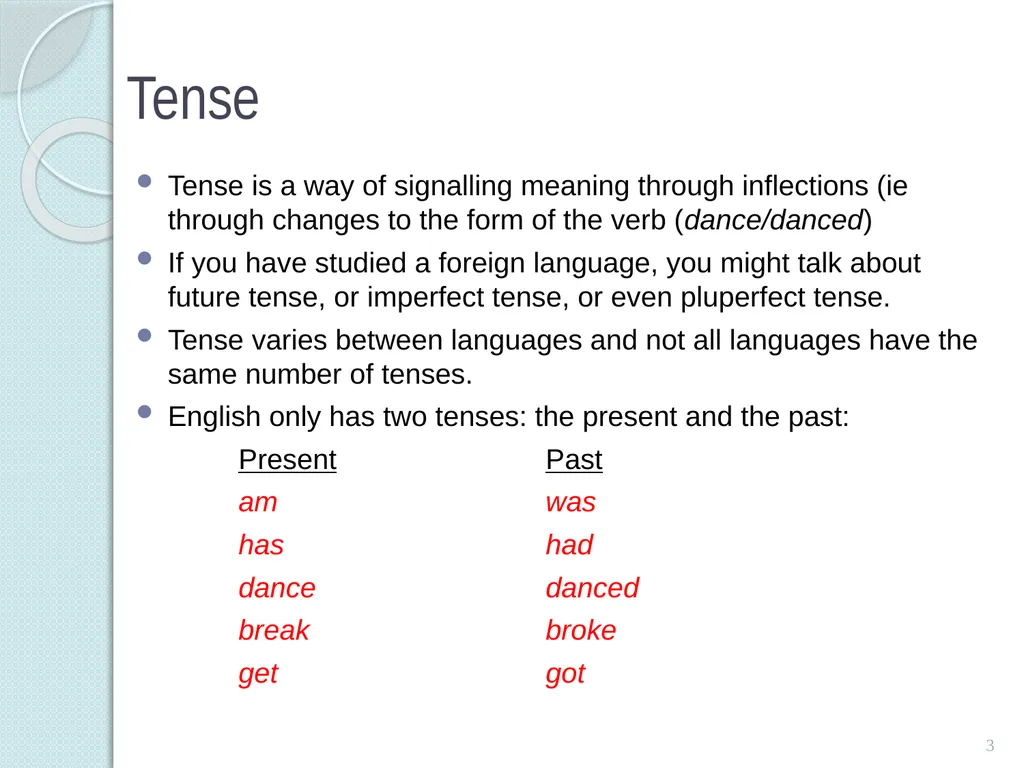
Tense Tense is a way of signalling meaning through inflections (ie through changes to the form of the verb (dance/danced)
If you have studied a foreign language, you might talk about future tense, or imperfect tense, or even pluperfect tense.
Tense varies between languages and not all languages have the same number of tenses.
English only has two tenses: the present and the past:
Present Past
am was
has had
dance danced
break broke
get got 3<br>
04
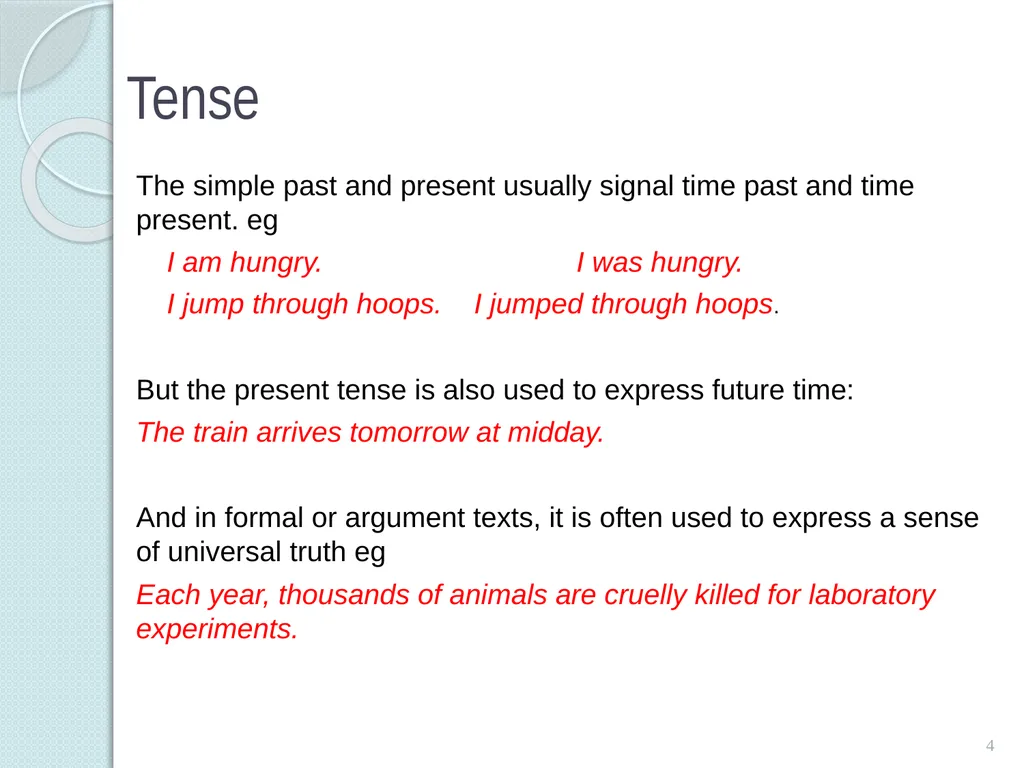
Tense The simple past and present usually signal time past and time present. eg
I am hungry. I was hungry.
I jump through hoops. I jumped through hoops.
But the present tense is also used to express future time:
The train arrives tomorrow at midday.
And in formal or argument texts, it is often used to express a sense of universal truth eg
Each year, thousands of animals are cruelly killed for laboratory experiments. 4<br>
05
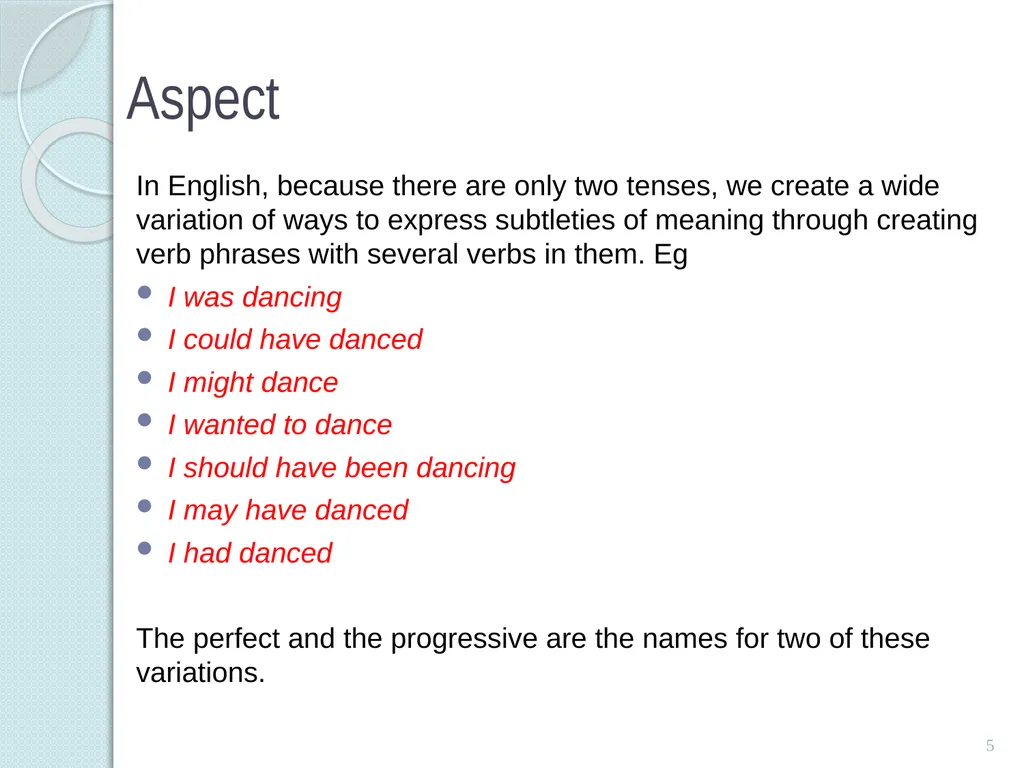
Aspect In English, because there are only two tenses, we create a wide variation of ways to express subtleties of meaning through creating verb phrases with several verbs in them. Eg
I was dancing
I could have danced
I might dance
I wanted to dance
I should have been dancing
I may have danced
I had danced
The perfect and the progressive are the names for two of these variations. 5<br>
06
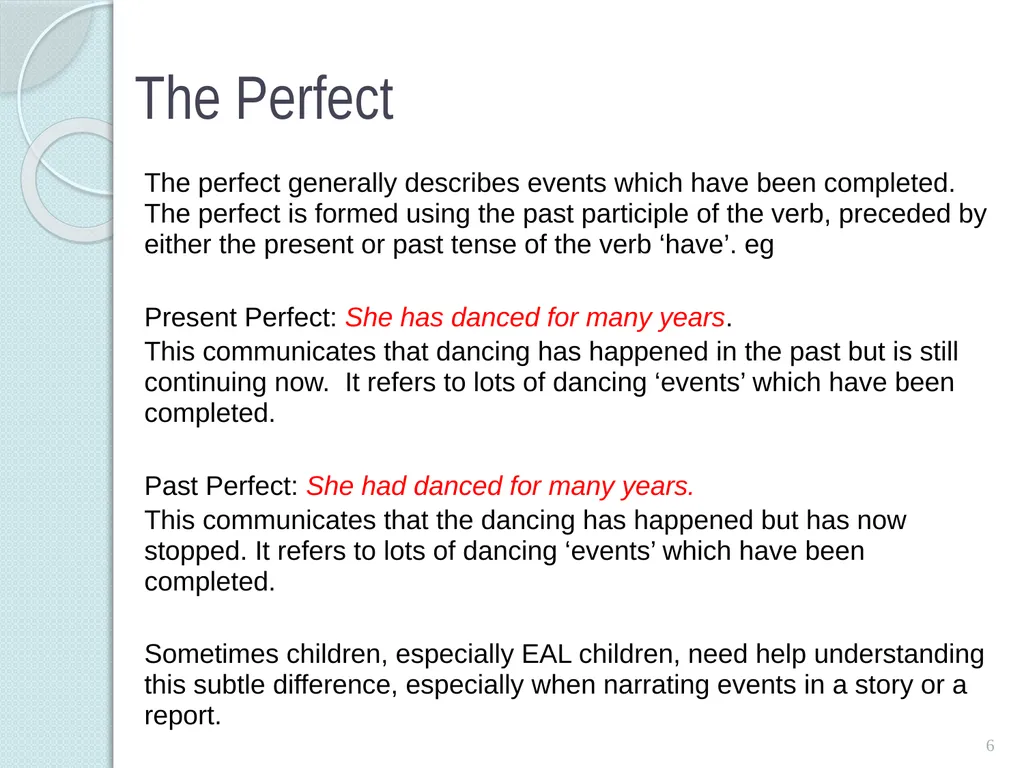
The Perfect The perfect generally describes events which have been completed. The perfect is formed using the past participle of the verb, preceded by either the present or past tense of the verb ‘have’. eg
Present Perfect: She has danced for many years.
This communicates that dancing has happened in the past but is still continuing now. It refers to lots of dancing ‘events’ which have been completed.
Past Perfect: She had danced for many years.
This communicates that the dancing has happened but has now stopped. It refers to lots of dancing ‘events’ which have been completed.
Sometimes children, especially EAL children, need help understanding this subtle difference, especially when narrating events in a story or a report. 6<br>
07
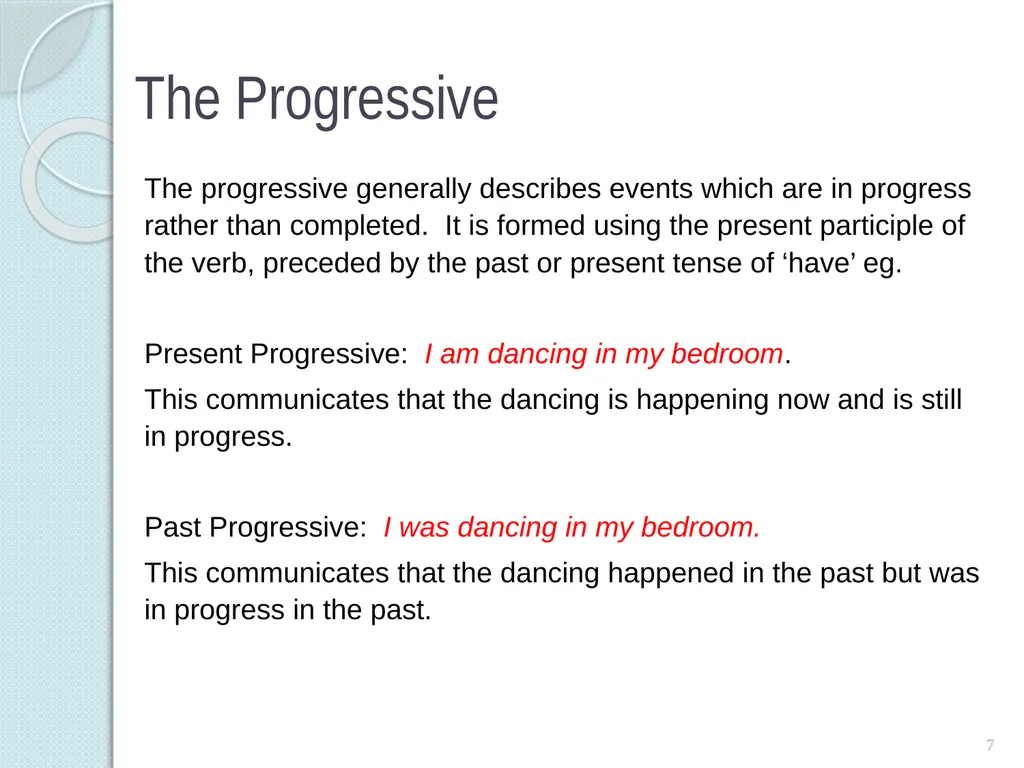
The Progressive The progressive generally describes events which are in progress rather than completed. It is formed using the present participle of the verb, preceded by the past or present tense of ‘have’ eg.
Present Progressive: I am dancing in my bedroom.
This communicates that the dancing is happening now and is still in progress.
Past Progressive: I was dancing in my bedroom.
This communicates that the dancing happened in the past but was in progress in the past. 7<br>
08
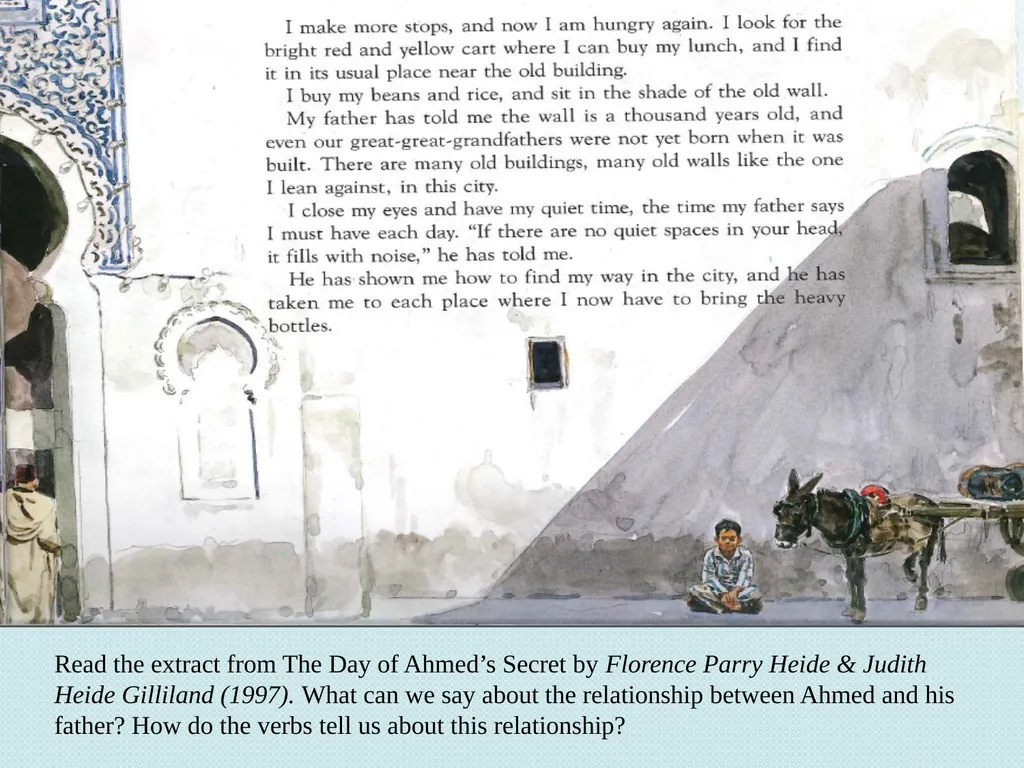
8 Read the extract from The Day of Ahmed’s Secret by Florence Parry Heide & Judith Heide Gilliland (1997). What can we say about the relationship between Ahmed and his father? How do the verbs tell us about this relationship?<br>